

Bolshoi Theatre

Encyclopedia
The Bolshoi Theatre is a historic theatre in Moscow
, Russia
, designed by architect Joseph Bové
, which holds performances of ballet
and opera
. The Bolshoi Ballet
and Bolshoi Opera are amongst the oldest and most renowned ballet and opera companies in the world. The theatre is the parent company of The Bolshoi Ballet Academy, a world-leading school of ballet.
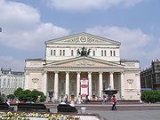
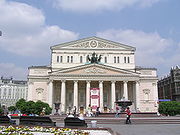
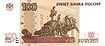
The main building of the theatre, rebuilt and renovated several times during its history, is a landmark of Moscow and Russia (its iconic neoclassical
facade is depicted on the Russian 100-ruble banknote
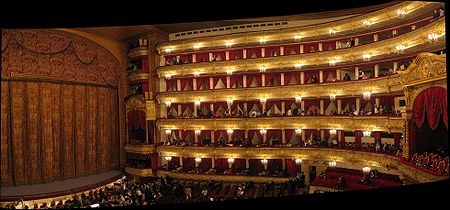
). On 28 October 2011, the Bolshoi was re-opened after an extensive six year renovation costing about 21 billion rubles (about $680 million). The renovation included restoring acoustics to the original quality (which had been lost during the Soviet Era), as well as restoring the original Imperial
decor of the Bolshoi.
 The company was founded in 1776 by Prince Pyotr Vasilyevich Urusov and Michael Maddox
. Initially, it held performances in a private home, but in 1780, it acquired the Petrovka Theatre and began producing plays and operas.
The current building was built on Theatre Square
in 1824 to replace the Petrovka Theatre, which had been destroyed by fire in 1805. It was designed by architect Andrei Mikhailov, who had built the nearby Maly Theatre
in 1824.
At that time, all Russian theatres were imperial property. Moscow and St Petersburg each had only two theatres, one intended for opera and ballet (these were known as the Bolshoi Theatres), and one for plays (tragedies and comedies). As opera and ballet were considered nobler than drama, the opera houses were named "Grand Theatres" ("Bolshoi" is Russian for "large" or "grand") and the drama theatres were called the "Smaller Theatre" ("Maly" is Russian for "small", "lesser", or "little").
The Bolshoi Theatre's original name was the Imperial Bolshoi Theatre of Moscow, while the St. Petersburg Bolshoi Theatre (demolished in 1886), was called the Imperial Bolshoi Kamenny Theatre.
The Moscow theatre was inaugurated on 18 January 1825 with a performance of Fernando Sor
's ballet, Cendrillon. Initially, it presented only Russian works, but foreign composers entered the repertoire around 1840. A fire in 1853 caused extensive damage; reconstruction was carried out by Alberto Cavos
, son of Catterino Cavos
, an opera composer. The theater reopened in 1856. During World War II, the theatre was damaged by a bomb, but it was immediately repaired.
The Bolshoi has been the site of many historic premieres including Tchaikovsky
's The Voyevoda and Mazeppa
, and Rachmaninoff
's Aleko
and Francesca da Rimini
. Feodor Chaliapin
, Leonid Sobinov
, Antonina Nezhdanova
, Ksenia Derzhinskaia and other outstanding opera singers have performed at the Bolshoi.
(app. $850 million) would need to be spent. However, at the completion of the restoration, it was announced that only 21 billion rubles were spent. The work was funded entirely by the federal government.
Despite the reconstruction, the company was operational, with performances held on the New Stage and on the stage of the Great Kremlin Palace. On 28 October 2011, the Bolshoi Theatre was re-opened with a concert featuring international artists and the ballet and opera companies.
The renovation included an improvement in the acoustics to restore it to the level of the pre-Soviet era as well as the restoration of the original Imperial
decor. The restoration also repaired the foundation and brickwork.
Inside the theatre, the entire space was stripped from the bottom up; the 19th-century wooden fixtures, silver stage curtain, and French-made red velvet banquettes were removed for repair in specialist workshops. Outside, on the top of the facade, the double-headed eagle
of the original Russian coat of arms was installed in the place where the Soviet hammer and sickle
had been mounted for decades.
, meaning that it draws from a stable of productions, any one of which may be performed on a given evening. It normally introduces two to four new ballet or opera productions each season and retires a similar number. The sets and costumes for most productions are made in the Bolshoi's own workshops. The performers are drawn primarily from the Bolshoi's regular ballet and opera companies, with occasional guest performances. Since the collapse of the Soviet Union, there have been a few attempts to reduce the theatre's traditional dependence on large state subsidies. Corporate sponsorship occurs for some productions, but state subsidy is still the lifeblood of the company.
The Bolshoi has been associated from its beginnings with ballet. Tchaikovsky's ballet Swan Lake
premiered at the theatre on 4 March 1877. Other staples of the Bolshoi repertoire include Tchaikovsky's The Sleeping Beauty and The Nutcracker
, Adam's Giselle
, Prokofiev's Romeo and Juliet
, and Khachaturian's Spartacus
.
After the death of Joseph Stalin
, international touring companies went out from the Bolshoi and became an important source of cultural prestige, as well as foreign currency earnings. As a result, the "Bolshoi Ballet" became a well-known name in the West. However, the Bolshoi suffered from losses through a series of defections of its dancers. The first occurrence was on 23 August 1979, with Alexander Godunov
; followed by
Leonid Kozlov
and Valentina Kozlova on 16 September 1979; and other cases in the following years. Bolshoi-related troupes continue to tour regularly in the post-Soviet era.
The opera company specializes in the classics of Russian opera such as Mussorgsky
's Boris Godunov
, Glinka's A Life for the Tsar
, and Rimsky-Korsakov's The Tsar's Bride
, as well as the operas of Tchaikovsky. Many operas by western composers are also performed, especially works of Italian composers such as Rossini, Verdi, and Puccini. Until the mid-1990s, most foreign operas were sung in Russian, but Italian and other languages have been heard more frequently on the Bolshoi stage in recent years.
Some operas, such as Borodin's Prince Igor
, include extensive ballet sequences. Many productions, especially of classic Russian opera, are given on a scale of grand spectacle, with dozens of costumed singers and dancers on stage for crowd or festival scenes.

Moscow
Moscow is the capital, the most populous city, and the most populous federal subject of Russia. The city is a major political, economic, cultural, scientific, religious, financial, educational, and transportation centre of Russia and the continent...
, Russia
Russia
Russia or , officially known as both Russia and the Russian Federation , is a country in northern Eurasia. It is a federal semi-presidential republic, comprising 83 federal subjects...
, designed by architect Joseph Bové
Joseph Bové
Joseph Bové was a Russian neoclassical architect with Italian roots who supervised reconstruction of Moscow after the Fire of 1812.-Biography:...
, which holds performances of ballet
Ballet
Ballet is a type of performance dance, that originated in the Italian Renaissance courts of the 15th century, and which was further developed in France and Russia as a concert dance form. The early portions preceded the invention of the proscenium stage and were presented in large chambers with...
and opera
Opera
Opera is an art form in which singers and musicians perform a dramatic work combining text and musical score, usually in a theatrical setting. Opera incorporates many of the elements of spoken theatre, such as acting, scenery, and costumes and sometimes includes dance...
. The Bolshoi Ballet
Bolshoi Ballet
The Bolshoi Ballet is an internationally renowned classical ballet company, based at the Bolshoi Theatre in Moscow, Russia. Founded in 1776, the Bolshoi is among the world's oldest ballet companies, however it only achieved worldwide acclaim by the early 20th century, when Moscow became the...
and Bolshoi Opera are amongst the oldest and most renowned ballet and opera companies in the world. The theatre is the parent company of The Bolshoi Ballet Academy, a world-leading school of ballet.
The main building of the theatre, rebuilt and renovated several times during its history, is a landmark of Moscow and Russia (its iconic neoclassical
Neoclassical architecture
Neoclassical architecture was an architectural style produced by the neoclassical movement that began in the mid-18th century, manifested both in its details as a reaction against the Rococo style of naturalistic ornament, and in its architectural formulas as an outgrowth of some classicizing...
facade is depicted on the Russian 100-ruble banknote
Russian ruble
The ruble or rouble is the currency of the Russian Federation and the two partially recognized republics of Abkhazia and South Ossetia. Formerly, the ruble was also the currency of the Russian Empire and the Soviet Union prior to their breakups. Belarus and Transnistria also use currencies with...
). On 28 October 2011, the Bolshoi was re-opened after an extensive six year renovation costing about 21 billion rubles (about $680 million). The renovation included restoring acoustics to the original quality (which had been lost during the Soviet Era), as well as restoring the original Imperial
Russian Empire
The Russian Empire was a state that existed from 1721 until the Russian Revolution of 1917. It was the successor to the Tsardom of Russia and the predecessor of the Soviet Union...
decor of the Bolshoi.
History
Michael Maddox
Michael Maddox was an English entrepreneur and theatre manager active in Imperial Russia...
. Initially, it held performances in a private home, but in 1780, it acquired the Petrovka Theatre and began producing plays and operas.
The current building was built on Theatre Square
Theatre Square
Theatre Square , known as Sverdlov Square between 1919 and 1991, is a city square in Tverskoy District of Moscow, Russia. It's located at the junction of Kuznetsky Bridge Street, Petrovka Street and Theatre Drive .The square is named after the three theatres situated there —...
in 1824 to replace the Petrovka Theatre, which had been destroyed by fire in 1805. It was designed by architect Andrei Mikhailov, who had built the nearby Maly Theatre
Maly Theatre (Moscow)
Maly Theatre is a drama theater in Moscow, Russia. Established in 1806 and operating on its present site on the Theatre Square since 1824, the theatre traces its history to the Moscow University drama company, established in 1756...
in 1824.
At that time, all Russian theatres were imperial property. Moscow and St Petersburg each had only two theatres, one intended for opera and ballet (these were known as the Bolshoi Theatres), and one for plays (tragedies and comedies). As opera and ballet were considered nobler than drama, the opera houses were named "Grand Theatres" ("Bolshoi" is Russian for "large" or "grand") and the drama theatres were called the "Smaller Theatre" ("Maly" is Russian for "small", "lesser", or "little").
The Bolshoi Theatre's original name was the Imperial Bolshoi Theatre of Moscow, while the St. Petersburg Bolshoi Theatre (demolished in 1886), was called the Imperial Bolshoi Kamenny Theatre.
The Moscow theatre was inaugurated on 18 January 1825 with a performance of Fernando Sor
Fernando Sor
Josep Ferran Sorts i Muntades was a Spanish classical guitarist and composer. While he is best known for his guitar compositions, he also composed music for a wide range of genres, including opera, orchestra, string quartet, piano, voice and ballet...
's ballet, Cendrillon. Initially, it presented only Russian works, but foreign composers entered the repertoire around 1840. A fire in 1853 caused extensive damage; reconstruction was carried out by Alberto Cavos
Alberto Cavos
Alberto Cavos was a Russian–Italian architect best known for his theatre designs, the builder of the Mariinsky Theatre in Saint Petersburg and the Bolshoi Theatre in Moscow .-Early years:Alberto Cavos was born in Saint Petersburg to Venetian opera composer Catterino Cavos Alberto Cavos (Russified...
, son of Catterino Cavos
Catterino Cavos
Catterino Albertovich Cavos , born Catarino Camillo Cavos, was an Italian composer, organist and conductor settled in Russia...
, an opera composer. The theater reopened in 1856. During World War II, the theatre was damaged by a bomb, but it was immediately repaired.
The Bolshoi has been the site of many historic premieres including Tchaikovsky
Pyotr Ilyich Tchaikovsky
Pyotr Ilyich Tchaikovsky Pyotr Ilyich Tchaikovsky Pyotr Ilyich Tchaikovsky (Russian: Пётр Ильи́ч Чайко́вский ; often "Peter Ilich Tchaikovsky" in English. His names are also transliterated "Piotr" or "Petr"; "Ilitsch", "Il'ich" or "Illyich"; and "Tschaikowski", "Tschaikowsky", "Chajkovskij"...
's The Voyevoda and Mazeppa
Mazeppa
-Places:United States* Mazeppa, Minnesota* Mazeppa, Pennsylvania* Mazeppa Township, Wabasha County, Minnesota* Mazeppa Township, South DakotaAustralia* Mazeppa National Park-People:* Ivan Mazepa, known also as Mazeppa, a Ukrainian Cossack hetman...
, and Rachmaninoff
Sergei Rachmaninoff
Sergei Vasilievich Rachmaninoff was a Russian composer, pianist, and conductor. Rachmaninoff is widely considered one of the finest pianists of his day and, as a composer, one of the last great representatives of Romanticism in Russian classical music...
's Aleko
Aleko
The Moskvitch 2141, commonly referred to as simply Aleko , is a Russian small class, third group hatchback car that was first announced in 1985 and...
and Francesca da Rimini
Francesca da Rimini
Francesca da Rimini or Francesca da Polenta was the daughter of Guido da Polenta, lord of Ravenna. She was a historical contemporary of Dante Alighieri, who portrayed her as a character in the Divine Comedy.-Arranged marriage:...
. Feodor Chaliapin
Feodor Chaliapin
Feodor Ivanovich Chaliapin was a Russian opera singer. The possessor of a large and expressive bass voice, he enjoyed an important international career at major opera houses and is often credited with establishing the tradition of naturalistic acting in his chosen art form.During the first phase...
, Leonid Sobinov
Leonid Sobinov
Leonid Vitalyevich Sobinov , was an acclaimed Imperial Russian operatic tenor. His fame continued unabated into the Soviet era, and he was made a People's Artist of the RSFSR in 1923...
, Antonina Nezhdanova
Antonina Nezhdanova
Antonina Vasilievna Nezhdanova was a Russian lyric-coloratura soprano. An outstanding opera singer, she represented the Russian vocal school at its best....
, Ksenia Derzhinskaia and other outstanding opera singers have performed at the Bolshoi.
Important dates
- 17 March 1776 — creation of the Bolshoi company, thus laying the foundation of the Bolshoi Theatre
- 30 December 1780 — opening of the Petrovsky theatre
- 8 October 1805 — fire and destruction of the building of the Petrovsky theatre
- 1806 — Theatre granted the status of "Imperial Theatre"
- 13 April 1808 — opening of New Arbat Imperial Theatre
- 1812 — fire and destruction of the theatre as a consequence of the French invasion of Moscow
- 1821—1824 — building of a new theatre, designed by Joseph Bové
- 6 January 1825 — opening of the Bolshoi (Big) Petrovsky Theatre
- 1843 — large-scale reconstruction of the theatre from the design by A. Nikitin
- 11 March 1853 — fire and destruction of the building of the theatre
- 14 May 1855 — approval of the reconstruction project for the theatre building. The project is undertaken by А. Kavos.
- 20 August 1856 — opening of the Bolshoi Theatre
- 16 December 1888 — première of the opera Boris GodunovBoris GodunovBoris Fyodorovich Godunov was de facto regent of Russia from c. 1585 to 1598 and then the first non-Rurikid tsar from 1598 to 1605. The end of his reign saw Russia descend into the Time of Troubles.-Early years:...
by Modest MussorgskyModest MussorgskyModest Petrovich Mussorgsky was a Russian composer, one of the group known as 'The Five'. He was an innovator of Russian music in the romantic period... - 1895 — capital repairs of the building of the theatre
- 10 October 1901 — première of the opera The Maid of PskovThe Maid of PskovThe Maid of Pskov , is an opera in three acts and six scenes by Nikolai Rimsky-Korsakov. The libretto was written by the composer, and is based on the drama of the same name by Lev Mei. The story concerns the Tsar Ivan the Terrible and his efforts to subject the cities of Pskov and Novgorod to his...
(Nikolai Rimsky-KorsakovNikolai Rimsky-KorsakovNikolai Andreyevich Rimsky-Korsakov was a Russian composer, and a member of the group of composers known as The Five.The Five, also known as The Mighty Handful or The Mighty Coterie, refers to a circle of composers who met in Saint Petersburg, Russia, in the years 1856–1870: Mily Balakirev , César...
) with Feodor ChaliapinFeodor ChaliapinFeodor Ivanovich Chaliapin was a Russian opera singer. The possessor of a large and expressive bass voice, he enjoyed an important international career at major opera houses and is often credited with establishing the tradition of naturalistic acting in his chosen art form.During the first phase...
acting as Ivan the Terrible - 4 May 1919 — creation of the first symphonySymphonyA symphony is an extended musical composition in Western classical music, scored almost always for orchestra. A symphony usually contains at least one movement or episode composed according to the sonata principle...
concert of the orchestra of the theatre conducted by Sergei Koussevitzky - 7 December 1919 — renamed: the State Academic Bolshoi theatre
- 12 December 1919 — attempt to abolish the Bolshoi theatre
- 18 February 1921 — opening of Beethoven Hall
- 1921—1923 - reconstruction of the theatre under auspices of Ivan RerbergIvan RerbergIvan Ivanovich Rerberg was a Russian civil engineer, architect and educator active in Moscow in 1897–1932. Rerberg's input to present-day Moscow include Kiyevsky Rail Terminal, Central Telegraph building and the Administration building of Moscow Kremlin...
- 1935 — première of Dmitri ShostakovichDmitri ShostakovichDmitri Dmitriyevich Shostakovich was a Soviet Russian composer and one of the most celebrated composers of the 20th century....
' opera Lady Macbeth of the Mtsensk DistrictLady Macbeth of the Mtsensk District (opera)Lady Macbeth of the Mtsensk District is an opera in four acts by Dmitri Shostakovich, his Op.29. The libretto was written by Alexander Preis and the composer, and is based on the story Lady Macbeth of Mtsensk District by Nikolai Leskov. The opera is sometimes referred to informally as Lady Macbeth...
New stage
The New Stage of the Bolshoi Theatre was opened on November 29, 2000. A new stage was built to the left of the historic Main Stage of the Bolshoi. Together with auxiliary buildings (a restored 17th century building, two rehearsal halls, and artists' recreation rooms) it became a single theater complex, the Bolshoi Theatre of Russia. The new building is built on a natural hill, where until recently there were blocks of old houses with communal apartments.21st-century renovation
From July 2005 to October 2011 the Theatre was closed for restoration. It had undergone many renovations in its time, but none as major as this. The building, whose architecture includes three different styles, was damaged, and a quick renovation seemed to be necessary. The renovation was initially due to cost 15 billion rubles ($610 million), but engineers found that the structure was more than 75% unstable and it was then estimated that about 25.5 billion rublesRussian ruble
The ruble or rouble is the currency of the Russian Federation and the two partially recognized republics of Abkhazia and South Ossetia. Formerly, the ruble was also the currency of the Russian Empire and the Soviet Union prior to their breakups. Belarus and Transnistria also use currencies with...
(app. $850 million) would need to be spent. However, at the completion of the restoration, it was announced that only 21 billion rubles were spent. The work was funded entirely by the federal government.
Despite the reconstruction, the company was operational, with performances held on the New Stage and on the stage of the Great Kremlin Palace. On 28 October 2011, the Bolshoi Theatre was re-opened with a concert featuring international artists and the ballet and opera companies.
The renovation included an improvement in the acoustics to restore it to the level of the pre-Soviet era as well as the restoration of the original Imperial
Russian Empire
The Russian Empire was a state that existed from 1721 until the Russian Revolution of 1917. It was the successor to the Tsardom of Russia and the predecessor of the Soviet Union...
decor. The restoration also repaired the foundation and brickwork.
Inside the theatre, the entire space was stripped from the bottom up; the 19th-century wooden fixtures, silver stage curtain, and French-made red velvet banquettes were removed for repair in specialist workshops. Outside, on the top of the facade, the double-headed eagle
Double-headed eagle
The double-headed eagle is a common symbol in heraldry and vexillology. It is most commonly associated with the Byzantine Empire and the Holy Roman Empire. In Byzantine heraldry, the heads represent the dual sovereignty of the Emperor and/or dominance of the Byzantine Emperors over both East and...
of the original Russian coat of arms was installed in the place where the Soviet hammer and sickle
Hammer and sickle
The hammer and sickle is a part of communist symbolism and its usage indicates an association with Communism, a Communist party, or a Communist state. It features a hammer and a sickle overlapping each other. The two tools are symbols of the industrial proletariat and the peasantry; placing them...
had been mounted for decades.
Ballet and opera
The Bolshoi is a repertory theatreRepertory
Repertory or rep, also called stock in the United States, is a term used in Western theatre and opera.A repertory theatre can be a theatre in which a resident company presents works from a specified repertoire, usually in alternation or rotation...
, meaning that it draws from a stable of productions, any one of which may be performed on a given evening. It normally introduces two to four new ballet or opera productions each season and retires a similar number. The sets and costumes for most productions are made in the Bolshoi's own workshops. The performers are drawn primarily from the Bolshoi's regular ballet and opera companies, with occasional guest performances. Since the collapse of the Soviet Union, there have been a few attempts to reduce the theatre's traditional dependence on large state subsidies. Corporate sponsorship occurs for some productions, but state subsidy is still the lifeblood of the company.
The Bolshoi has been associated from its beginnings with ballet. Tchaikovsky's ballet Swan Lake
Swan Lake
Swan Lake ballet, op. 20, by Pyotr Tchaikovsky, composed 1875–1876. The scenario, initially in four acts, was fashioned from Russian folk tales and tells the story of Odette, a princess turned into a swan by an evil sorcerer's curse. The choreographer of the original production was Julius Reisinger...
premiered at the theatre on 4 March 1877. Other staples of the Bolshoi repertoire include Tchaikovsky's The Sleeping Beauty and The Nutcracker
The Nutcracker
The Nutcracker is a two-act ballet, originally choreographed by Marius Petipa and Lev Ivanov with a score by Pyotr Ilyich Tchaikovsky. The libretto is adapted from E.T.A. Hoffmann's story "The Nutcracker and the Mouse King". It was given its première at the Mariinsky Theatre in St...
, Adam's Giselle
Giselle
Giselle is a ballet in two acts with a libretto by Jules-Henri Vernoy de Saint-Georges and Théophile Gautier, music by Adolphe Adam, and choreography by Jean Coralli and Jules Perrot. The librettist took his inspiration from a poem by Heinrich Heine...
, Prokofiev's Romeo and Juliet
Romeo and Juliet (Prokofiev)
Romeo and Juliet is a ballet by Sergei Prokofiev based on William Shakespeare's play Romeo and Juliet. It is one of the most enduringly popular ballets...
, and Khachaturian's Spartacus
Spartacus (ballet)
Spartacus, or Spartak, is a ballet by Aram Khachaturian . The work follows the exploits of Spartacus, the leader of the slave uprising against the Romans known as the Third Servile War, although the ballet's storyline takes considerable liberties with the historical record. Khachaturian composed...
.
After the death of Joseph Stalin
Joseph Stalin
Joseph Vissarionovich Stalin was the Premier of the Soviet Union from 6 May 1941 to 5 March 1953. He was among the Bolshevik revolutionaries who brought about the October Revolution and had held the position of first General Secretary of the Communist Party of the Soviet Union's Central Committee...
, international touring companies went out from the Bolshoi and became an important source of cultural prestige, as well as foreign currency earnings. As a result, the "Bolshoi Ballet" became a well-known name in the West. However, the Bolshoi suffered from losses through a series of defections of its dancers. The first occurrence was on 23 August 1979, with Alexander Godunov
Alexander Godunov
Alexander Borisovich Godunov was a Russian-American ballet danseur and film actor, whose defection caused a diplomatic incident between the USA and the USSR.-Biography:...
; followed by
Leonid Kozlov
Leonid Kozlov
Leonid Kozlov is a former principal dancer of the Bolshoi and New York City Ballet. He is also a choreographer, and the founder of Kozlov Dance International and Youth Dance Festival of New Jersey.-Biography:...
and Valentina Kozlova on 16 September 1979; and other cases in the following years. Bolshoi-related troupes continue to tour regularly in the post-Soviet era.
The opera company specializes in the classics of Russian opera such as Mussorgsky
Mussorgsky
Mussorgsky can refer to:*The Mussorgsky family of Russian nobility;*Modest Mussorgsky, a Russian composer belonging to that family.*Mussorgsky , a 1950 Soviet film about the composer...
's Boris Godunov
Boris Godunov (opera)
Boris Godunov is an opera by Modest Mussorgsky . The work was composed between 1868 and 1873 in Saint Petersburg, Russia. It is Mussorgsky's only completed opera and is considered his masterpiece. Its subjects are the Russian ruler Boris Godunov, who reigned as Tsar during the Time of Troubles,...
, Glinka's A Life for the Tsar
A Life for the Tsar
A Life for the Tsar , as it is known in English, although its original name was Ivan Susanin is a "patriotic-heroic tragic opera" in four acts with an epilogue by Mikhail Glinka. The original Russian libretto, based on historical events, was written by Nestor Kukolnik, Georgy Fyodorovich Rozen,...
, and Rimsky-Korsakov's The Tsar's Bride
The Tsar's Bride (opera)
The Tsar's Bride is an opera in four acts by Nikolai Rimsky-Korsakov, the composer's tenth opera. The libretto, by Il’ya Tyumenev, is based on the drama of the same name by Lev Mey. Mey's play was first suggested to the composer as an opera subject in 1868 by Mily Balakirev...
, as well as the operas of Tchaikovsky. Many operas by western composers are also performed, especially works of Italian composers such as Rossini, Verdi, and Puccini. Until the mid-1990s, most foreign operas were sung in Russian, but Italian and other languages have been heard more frequently on the Bolshoi stage in recent years.
Some operas, such as Borodin's Prince Igor
Prince Igor
Prince Igor is an opera in four acts with a prologue. It was composed by Alexander Borodin. The composer adapted the libretto from the East Slavic epic The Lay of Igor's Host, which recounts the campaign of Russian prince Igor Svyatoslavich against the invading Polovtsian tribes in 1185...
, include extensive ballet sequences. Many productions, especially of classic Russian opera, are given on a scale of grand spectacle, with dozens of costumed singers and dancers on stage for crowd or festival scenes.
Current cultural status
The Bolshoi Theatre is famous throughout the world. It is frequented by many tourists, with the result that prices can be much higher than other Russian theatres. This is especially the case for ballet, where the prices are comparable to those for performances in the West. For local citizens concerts and operas are still relatively affordable, with prices ranging from 350 rubles (balcony seats for matinee performances) to 5,000 rubles (for the seats in the orchestra or stalls).Music directors
- Vassily SinaiskyVassily SinaiskyVassily Serafimovich Sinaisky is a Russian conductor and pianist. He studied conducting with Ilya Musin at the Leningrad Conservatory and began his career as Assistant to Kirill Kondrashin at the Moscow Philharmonic Orchestra...
(from 2010) - Leonid DesyatnikovLeonid DesyatnikovLeonid Arkadievich Desyatnikov is a Russian composer.Leonid Desyatnikov was born in 1955 in Kharkiv, Ukraine. He is a graduate of the Leningrad Conservatory, where he studied composition and instrumentation. Desyatnikov has penned four operas, several cantatas and numerous vocal and instrumental...
(2009–2010) - Alexander VedernikovAlexander VedernikovAlexander Alexandrovich Vedernikov is a Russian conductor. He is son of the bass Alexander Filipovich Vedernikov ....
(2001–2009) - Gennady RozhdestvenskyGennady RozhdestvenskyGennady Nikolayevich Rozhdestvensky is a Russian conductor.-Biography:Rozhdestvensky was born in Moscow. His parents were the noted conductor and pedagogue Nikolai Anosov and soprano Natalya Rozhdestvenskaya...
(2000–2001) - Mark ErmlerMark ErmlerMark Fridrikhovich Ermler was a Russian conductor.-Biography:Mark Ermler was born in Leningrad in 1932. His parents were Vera Bakun, a film set designer, and Friedrich Ermler, a film director. He began to study piano at age 5....
(1998–2000) - Peter FeranecPeter FeranecPeter Feranec is a Slovak conductor. In 1995, he became the first foreign-born, as well as the youngest, person to be appointed Chief Conductor at the Bolshoi Theatre. From 2007 to 2009, he was the Principal Conductor of the Slovak Philharmonic...
(1995–1998) - Alexander LazarevAlexander LazarevAlexander Lazarev is a Russian conductor. He studied at the Saint Petersburg Conservatory, and later at the Moscow Conservatory with Leo Ginsbourg. In 1971, he was the first prize winner in a national conducting competition in the USSR...
(1987–1995) - Yuri SimonovYuri SimonovYuri Ivanovich Simonov is a Russian conductor.He studied at the Leningrad Conservatory under Nikolai Rabinovich. He is currently director of the Moscow Philharmonic Orchestra.-Selected recordings:...
(1970–1985) - Gennady Rozhdestvensky (1965–1970)
- Yevgeny Svetlanov (1963–1965)
- Alexander Melik-PashayevAlexander Melik-PashayevAlexander Shamil'evich Melik-Pashayev was a Soviet- conductor.-External links:**...
(1953–1963) - Nikolai Golovanov (1948 –1953)
- Ariy PazovskyAriy PazovskyAriy Moiseyevich Pazovsky was a Russian Jewish conductor.He was a junior conductor at the Bolshoi from 1923-1928, and then director 1943-1948. As a conductor of the Bolshoi Opera, he is credited with having returned parts of Modest Mussorgsky's opera Boris Godunov which had been censored in...
(1943–1948) - Samuil SamosudSamuil SamosudSamuil Abramovich Samosud |Georgia]], — Moscow, 6 November 1964) was a Russian conductor. He started his musical career on the cello, before conducting in the Mariinsky Theater, Petrograd in 1917. From 1918 to 1936 he conducted at the Maly Operny, Leningrad. In 1936 he became musical...
(1936–1942)
External links
- Bolshoi Theatre website
- Bolshoi Theatre in Theatrical Russia Annual Dictionary
- For Ballet Lovers Only: Bolshoi dancers of the past and of today in biographies and photos
- Chief Conductors
- Bolshoi Theatre School in Brazil website
- Bolshoi Delights Cuba Audience Photo Feature, Havana Times, Feb 15, 2010
- Reconstruction of Bolshoi Theatre, Pictures
- The New Stage of Bolshoi Theatre, Pictures