

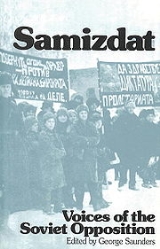
Samizdat

Encyclopedia
Samizdat was a key form of dissident
activity across the Soviet bloc in which individuals reproduced censored publications by hand and passed the documents from reader to reader. This grassroots
practice to evade officially imposed censorship
was fraught with danger as harsh punishments were meted out to people caught possessing or copying censored materials.
Vladimir Bukovsky
defined it as follows:
's novel The Master and Margarita
or Václav Havel
's writing The Power of the Powerless, were passed among friends. The techniques to reproduce the forbidden literature and periodicals varied from making several copies of the content using carbon paper
, either by hand or on a typewriter
, to printing on mainframe printers during night shifts, to printing the books on semi-professional printing press
es in larger quantities. Before glasnost
, the practice was dangerous, because copy machines, printing presses and even typewriters in offices were under control of the First Department
s (KGB outposts): reference printouts for all of them were stored for identification purposes.
, the word samizdat is made out of sam and izdat , thus “self-published.” The Ukrainian term is samvýdav (самвидав), from sam, “self”, and vydannya, “publication.”
The term was coined as a pun
by Russian poet Nikolai Glazkov in the 1940s, who typed copies of his poems indicating Samsebyaizdat (Самсебяиздат, “Myself by Myself Publishers”) on the front page by analogy with the typical names of publishing houses in the Soviet Union
, such as Politizdat.
Magnitizdat
is the passing on of taped sound recordings (magnit- referring to magnetic tape
), often of underground music groups, bards
, or lectures.
Roentgenizdat
were underground samizdat recordings on x-ray film: phonograph records made of a thin, flexible sheet with a spiral stylus groove, designed to be playable on a normal phonograph turntable. The name roentgenizdat comes from the combination of roentgen ray (another word for X-ray) and izdat.
Tamizdat refers to literature published abroad (там, tam, “there”), often from smuggled manuscripts.
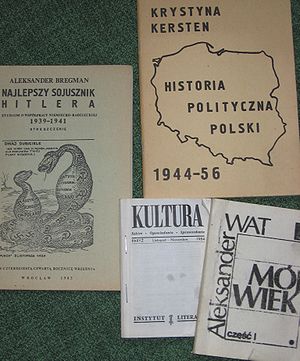
In the history of the Polish underground press
, the usual term in the later years of Communism was drugi obieg or “second circulation” (of publications), with the implied first circulation being legal and censored publications. The term bibuła (“blotting paper
”) is older, having been used even during the partitions of Poland
.
 Self-published and self-distributed literature has a long history, but samizdat is a unique phenomenon in the post-Joseph Stalin
USSR and other countries with similar systems of tyranny. Under the grip of censorship of the police state
, these societies used underground literature for self-analysis and self-expression.
At the outset of the Khrushchev Thaw
in the mid-1950s USSR, poetry
became very popular and writings of a wide variety of known, prohibited, repressed, as well as young and unknown poets circulated among Soviet intelligentsia
.
On June 29, 1958, a monument to Vladimir Mayakovsky
was opened in the center of Moscow
. The official ceremony ended with impromptu public poetry readings. The Moscovites liked the atmosphere of relatively free speech so much that the readings became regular and came to be known as "Mayak" , with students being a majority of participants. However, it did not last long as the authorities began clamping down on the meetings. In the summer of 1961, several meeting regulars (among them Eduard Kuznetsov
) were arrested and charged with "anti-Soviet agitation and propaganda" (Article 70 of the RSFSR Penal Code).
Editor and publisher of Moscow samizdat magazine "Синтаксис" (Syntaxis) Alexander Ginzburg
was arrested in 1960.
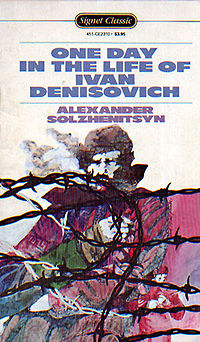
Some legitimate publications in the state-controlled media, such as a novel One Day in the Life of Ivan Denisovich
by Aleksandr Solzhenitsyn
(who won the Nobel Prize in Literature
, 1970), first published in literary magazine Novy Mir
in November 1962, were practically impossible to find in (and later taken out from) circulation and made their way into samizdat.
Not everything published in samizdat had political overtones.
In 1963, Joseph Brodsky
(to become a Nobel laureate in 1987) was charged with "social parasitism
" and convicted for being nothing but a poet.
In the mid-1960s, an underground literary group СМОГ ("Самое Молодое Общество Гениев", Samoye Molodoye Obshchestvo Geniyev, translated as The Youngest Society of Geniuses; the acronym forms the Russian word for "[One] Could") issued their literary almanac
"Сфинксы" (Sfinksy; The Sphinxes) and collections of prose and poetry. Some of their writings were close to Russian avantgarde of the 1910s–1920s.
The 1965 show trial
of writers Yuli Daniel
and Andrei Sinyavsky
(Sinyavsky–Daniel trial, also charged with violating Article 70) and increased repressions marked the demise of the Thaw and harsher times for samizdat authors. The trial was carefully documented in The White Book by Yuri Galanskov
and Alexander Ginzburg
. Both writers were later arrested and sentenced to prison in what was known as The Trial of the Four.
Some of the samizdat content became more politicized and played an important role in the dissident movement in the Soviet Union.
From 1964 to 1970, historian Roy Medvedev
regularly published analytical materials that later appeared in the West under the title "Политический дневник" (Politicheskiy Dnevnik; The Political Journal).
One of the longest-running and well-known samizdat publications was the information bulletin "Хроника текущих событий" (Khronika Tekushchikh Sobitiy; Chronicle of Current Events), dedicated to the defense of human rights
in the USSR. For 15 years from 1968 to 1983, a total of 63 issues were published. The anonymous authors encouraged the readers to utilize the same distribution channels in order to send feedback and local information to be published in the subsequent issues. The Chronicle was known for its dry concise style; its regular rubrics were "Arrests, Searches, Interrogations", "Out of Court Repressions", "In Prisons and Camps
", "News of Samizdat", "Persecution of Religion", "Persecution of Crimean Tatars
", "Repressions in Ukraine
", "Lithuania
n Events", and so on. The authors maintained that according to the Soviet Constitution, the Chronicle was not an illegal publication, but the long list of people arrested in relation to it included Natalya Gorbanevskaya
, Yuri Shikhanovich, Pyotr Yakir, Victor Krasin
, Sergei Kovalev
, Alexander Lavut, Tatyana Velikanova, among others.
Another notable and long-running (about 20 issues in the period of 1972-1980) publication was the refusenik
political and literary magazine "Евреи в СССР" (Yevrei v SSSR, Jews in the USSR), founded and edited by Alexander Voronel and after his release, by Mark Azbel and Alexander Luntz.
With increased proliferation of computer technologies, it became practically impossible for the government to control the copying and distribution of samizdat.
A well known samizdat comic character is the superheroine Octobriana.
In June 2009 issue of the Russian Life magazine Oleg Kashin
describes an antisemitic trend in samizdat of late 1970s: "Russian party... was a very strange element of the political landscape of Leonid Brezhnev
's era — feeling themselves practically dissidents, members of the Russian party with rare exceptions took quite prestigious official positions in writers or journalists medium."
 After Ayatollah Ruhollah Khomeini was exiled by the Shah of Iran
in 1964, his sermons were smuggled into Iran on cassette tapes and widely copied, increasing his popularity and leading, in part, to the Iranian Revolution
. After the Iranian Revolution led to the establishment of an Islamic state, the situation reversed. Works like Salman Rushdie's Satanic Verses
(1988) appeared inside the Religious Republic in illegal Samizdat editions.
A tradition of publishing handwritten material existed in the German
military during both the First and Second World War.
Poland
and Lithuania
have a long history of underground press
.
After Bell Labs
changed its UNIX
license to make dissemination of the source code illegal, the Lions Book
had to be withdrawn, but the technical data it contained was of such enormous value that illegal copies of it circulated for years. The act of copying the Lions book was often referred to as Samizdat. See Lions' Commentary on UNIX 6th Edition, with Source Code
for more information.
Other:
Soviet dissidents
Soviet dissidents were citizens of the Soviet Union who disagreed with the policies and actions of their government and actively protested against these actions through either violent or non-violent means...
activity across the Soviet bloc in which individuals reproduced censored publications by hand and passed the documents from reader to reader. This grassroots
Grassroots
A grassroots movement is one driven by the politics of a community. The term implies that the creation of the movement and the group supporting it are natural and spontaneous, highlighting the differences between this and a movement that is orchestrated by traditional power structures...
practice to evade officially imposed censorship
Censorship
thumb|[[Book burning]] following the [[1973 Chilean coup d'état|1973 coup]] that installed the [[Military government of Chile |Pinochet regime]] in Chile...
was fraught with danger as harsh punishments were meted out to people caught possessing or copying censored materials.
Vladimir Bukovsky
Vladimir Bukovsky
Vladimir Konstantinovich Bukovsky is a leading member of the dissident movement of the 1960s and 1970s, writer, neurophysiologist, and political activist....
defined it as follows:
"(...) I myself create it,
edit it,
censor it,
publish it,
distribute it, and ...
get imprisoned for it. (...)"
Techniques
Essentially, the samizdat copies of text, such as Mikhail BulgakovMikhail Bulgakov
Mikhaíl Afanásyevich Bulgákov was a Soviet Russian writer and playwright active in the first half of the 20th century. He is best known for his novel The Master and Margarita, which The Times of London has called one of the masterpieces of the 20th century.-Biography:Mikhail Bulgakov was born on...
's novel The Master and Margarita
The Master and Margarita
The Master and Margarita is a novel by Mikhail Bulgakov, woven around the premise of a visit by the Devil to the fervently atheistic Soviet Union. Many critics consider the book to be one of the greatest novels of the 20th century, and one of the foremost Soviet satires, directed against a...
or Václav Havel
Václav Havel
Václav Havel is a Czech playwright, essayist, poet, dissident and politician. He was the tenth and last President of Czechoslovakia and the first President of the Czech Republic . He has written over twenty plays and numerous non-fiction works, translated internationally...
's writing The Power of the Powerless, were passed among friends. The techniques to reproduce the forbidden literature and periodicals varied from making several copies of the content using carbon paper
Carbon paper
Carbon paper is paper coated on one side with a layer of a loosely bound dry ink or pigmented coating, usually bound with wax. It is used for making one or more copies simultaneous with the creation of an original document...
, either by hand or on a typewriter
Typewriter
A typewriter is a mechanical or electromechanical device with keys that, when pressed, cause characters to be printed on a medium, usually paper. Typically one character is printed per keypress, and the machine prints the characters by making ink impressions of type elements similar to the pieces...
, to printing on mainframe printers during night shifts, to printing the books on semi-professional printing press
Printing press
A printing press is a device for applying pressure to an inked surface resting upon a print medium , thereby transferring the ink...
es in larger quantities. Before glasnost
Glasnost
Glasnost was the policy of maximal publicity, openness, and transparency in the activities of all government institutions in the Soviet Union, together with freedom of information, introduced by Mikhail Gorbachev in the second half of the 1980s...
, the practice was dangerous, because copy machines, printing presses and even typewriters in offices were under control of the First Department
First Department
The First Department was in charge of secrecy and political security of the workplace of every enterprise or institution of the Soviet Union that dealt with any kind of technical or scientific information or had printing capabilities .Every branch of the Central Statistical Administration and its...
s (KGB outposts): reference printouts for all of them were stored for identification purposes.
Terminology and related concepts
EtymologicallyEtymology
Etymology is the study of the history of words, their origins, and how their form and meaning have changed over time.For languages with a long written history, etymologists make use of texts in these languages and texts about the languages to gather knowledge about how words were used during...
, the word samizdat is made out of sam and izdat , thus “self-published.” The Ukrainian term is samvýdav (самвидав), from sam, “self”, and vydannya, “publication.”
The term was coined as a pun
Pun
The pun, also called paronomasia, is a form of word play which suggests two or more meanings, by exploiting multiple meanings of words, or of similar-sounding words, for an intended humorous or rhetorical effect. These ambiguities can arise from the intentional use and abuse of homophonic,...
by Russian poet Nikolai Glazkov in the 1940s, who typed copies of his poems indicating Samsebyaizdat (Самсебяиздат, “Myself by Myself Publishers”) on the front page by analogy with the typical names of publishing houses in the Soviet Union
Publishing houses in the Soviet Union
Publishing houses in the Soviet Union, with the exception of the brief initial period and the period of perestroika before the dissolution of the Soviet Union, were state enterprises under strict ideological control and censorship for the compliance with the communist ideology under the guidelines...
, such as Politizdat.
Magnitizdat
Magnitizdat
Magnitizdat is a term used to describe the process of re-copying and self distributing live audio tape recordings in the Soviet Union that were not available commercially...
is the passing on of taped sound recordings (magnit- referring to magnetic tape
Magnetic tape
Magnetic tape is a medium for magnetic recording, made of a thin magnetizable coating on a long, narrow strip of plastic. It was developed in Germany, based on magnetic wire recording. Devices that record and play back audio and video using magnetic tape are tape recorders and video tape recorders...
), often of underground music groups, bards
Bard (Soviet Union)
The term bard came to be used in the Soviet Union in the early 1960s, and continues to be used in Russia today, to refer to singer-songwriters who wrote songs outside the Soviet establishment, similarly to beatnik folk singers of the United States...
, or lectures.
Roentgenizdat
Flexi disc
The flexi disc is a phonograph record made of a thin, flexible vinyl sheet with a molded-in spiral stylus groove, and is designed to be playable on a normal phonograph turntable...
were underground samizdat recordings on x-ray film: phonograph records made of a thin, flexible sheet with a spiral stylus groove, designed to be playable on a normal phonograph turntable. The name roentgenizdat comes from the combination of roentgen ray (another word for X-ray) and izdat.
Tamizdat refers to literature published abroad (там, tam, “there”), often from smuggled manuscripts.
In the history of the Polish underground press
Polish underground press
Polish underground press devoted to prohibited materials has a long history of combatting censorship of oppressive regimes in Poland...
, the usual term in the later years of Communism was drugi obieg or “second circulation” (of publications), with the implied first circulation being legal and censored publications. The term bibuła (“blotting paper
Blotting paper
Blotting paper is a highly absorbent type of paper or other material. It is used to absorb an excess of liquid substances from the surface of writing paper or objects. It is also commonly used as a beauty tool to absorb excess oil from the skin.-Manufacture:Blotting paper is made from different...
”) is older, having been used even during the partitions of Poland
Partitions of Poland
The Partitions of Poland or Partitions of the Polish–Lithuanian Commonwealth took place in the second half of the 18th century and ended the existence of the Polish–Lithuanian Commonwealth, resulting in the elimination of sovereign Poland for 123 years...
.
History
Joseph Stalin
Joseph Vissarionovich Stalin was the Premier of the Soviet Union from 6 May 1941 to 5 March 1953. He was among the Bolshevik revolutionaries who brought about the October Revolution and had held the position of first General Secretary of the Communist Party of the Soviet Union's Central Committee...
USSR and other countries with similar systems of tyranny. Under the grip of censorship of the police state
Police state
A police state is one in which the government exercises rigid and repressive controls over the social, economic and political life of the population...
, these societies used underground literature for self-analysis and self-expression.
At the outset of the Khrushchev Thaw
Khrushchev Thaw
The Khrushchev Thaw refers to the period from the mid 1950s to the early 1960s, when repression and censorship in the Soviet Union were partially reversed and millions of Soviet political prisoners were released from Gulag labor camps, due to Nikita Khrushchev's policies of de-Stalinization and...
in the mid-1950s USSR, poetry
Poetry
Poetry is a form of literary art in which language is used for its aesthetic and evocative qualities in addition to, or in lieu of, its apparent meaning...
became very popular and writings of a wide variety of known, prohibited, repressed, as well as young and unknown poets circulated among Soviet intelligentsia
Intelligentsia
The intelligentsia is a social class of people engaged in complex, mental and creative labor directed to the development and dissemination of culture, encompassing intellectuals and social groups close to them...
.
On June 29, 1958, a monument to Vladimir Mayakovsky
Vladimir Mayakovsky
Vladimir Vladimirovich Mayakovsky was a Russian and Soviet poet and playwright, among the foremost representatives of early-20th century Russian Futurism.- Early life :...
was opened in the center of Moscow
Moscow
Moscow is the capital, the most populous city, and the most populous federal subject of Russia. The city is a major political, economic, cultural, scientific, religious, financial, educational, and transportation centre of Russia and the continent...
. The official ceremony ended with impromptu public poetry readings. The Moscovites liked the atmosphere of relatively free speech so much that the readings became regular and came to be known as "Mayak" , with students being a majority of participants. However, it did not last long as the authorities began clamping down on the meetings. In the summer of 1961, several meeting regulars (among them Eduard Kuznetsov
Eduard Kuznetsov
Eduard Kuznetsov is a Soviet dissident, human rights activist, and writer.In 1961, Kuznetsov was arrested for the first time and served seven years in Soviet prisons for making overtly political speeches in poetry readings at Mayakovsky Square in the centre of Moscow and for publishing samizdat...
) were arrested and charged with "anti-Soviet agitation and propaganda" (Article 70 of the RSFSR Penal Code).
Editor and publisher of Moscow samizdat magazine "Синтаксис" (Syntaxis) Alexander Ginzburg
Alexander Ginzburg
Alexander Ilyich Ginzburg , was a Russian journalist, poet, human rights activist and dissident.During the Soviet period, Ginzburg edited the samizdat poetry almanac Sintaksis. Between 1961 and 1969 he was sentenced three times to labor camps...
was arrested in 1960.
Some legitimate publications in the state-controlled media, such as a novel One Day in the Life of Ivan Denisovich
One Day in the Life of Ivan Denisovich
One Day in the Life of Ivan Denisovich is a novel written by Aleksandr Solzhenitsyn, first published in November 1962 in the Soviet literary magazine Novy Mir . The story is set in a Soviet labor camp in the 1950s, and describes a single day of an ordinary prisoner, Ivan Denisovich Shukhov...
by Aleksandr Solzhenitsyn
Aleksandr Solzhenitsyn
Aleksandr Isayevich Solzhenitsyn was aRussian and Soviet novelist, dramatist, and historian. Through his often-suppressed writings, he helped to raise global awareness of the Gulag, the Soviet Union's forced labor camp system – particularly in The Gulag Archipelago and One Day in the Life of...
(who won the Nobel Prize in Literature
Nobel Prize in Literature
Since 1901, the Nobel Prize in Literature has been awarded annually to an author from any country who has, in the words from the will of Alfred Nobel, produced "in the field of literature the most outstanding work in an ideal direction"...
, 1970), first published in literary magazine Novy Mir
Novy Mir
Novy Mir is a Russian language literary magazine that has been published in Moscow since January 1925. It was supposed to be modelled on the popular pre-Soviet literary magazine Mir Bozhy , which was published from 1892 to 1906, and its follow-up, Sovremenny Mir , which was published 1906-1917...
in November 1962, were practically impossible to find in (and later taken out from) circulation and made their way into samizdat.
Not everything published in samizdat had political overtones.
In 1963, Joseph Brodsky
Joseph Brodsky
Iosif Aleksandrovich Brodsky , was a Russian poet and essayist.In 1964, 23-year-old Brodsky was arrested and charged with the crime of "social parasitism" He was expelled from the Soviet Union in 1972 and settled in America with the help of W. H. Auden and other supporters...
(to become a Nobel laureate in 1987) was charged with "social parasitism
Parasitism (social offense)
Social parasitism is a charge that is leveled against a group or class in society which is considered to be detrimental to the whole by analogy with biologic parasitism .-General concept:...
" and convicted for being nothing but a poet.
In the mid-1960s, an underground literary group СМОГ ("Самое Молодое Общество Гениев", Samoye Molodoye Obshchestvo Geniyev, translated as The Youngest Society of Geniuses; the acronym forms the Russian word for "[One] Could") issued their literary almanac
Almanac
An almanac is an annual publication that includes information such as weather forecasts, farmers' planting dates, and tide tables, containing tabular information in a particular field or fields often arranged according to the calendar etc...
"Сфинксы" (Sfinksy; The Sphinxes) and collections of prose and poetry. Some of their writings were close to Russian avantgarde of the 1910s–1920s.
The 1965 show trial
Show trial
The term show trial is a pejorative description of a type of highly public trial in which there is a strong connotation that the judicial authorities have already determined the guilt of the defendant. The actual trial has as its only goal to present the accusation and the verdict to the public as...
of writers Yuli Daniel
Yuli Daniel
Yuli Markovich Daniel was a Soviet dissident writer, poet, translator and political prisoner.He frequently wrote under the pseudonyms Nikolay Arzhak and Yu. Petrov .-Early life and World War II:...
and Andrei Sinyavsky
Andrei Sinyavsky
Andrei Donatovich Sinyavsky was a Russian writer, dissident, political prisoner, emigrant, Professor of Sorbonne University, magazine founder and publisher...
(Sinyavsky–Daniel trial, also charged with violating Article 70) and increased repressions marked the demise of the Thaw and harsher times for samizdat authors. The trial was carefully documented in The White Book by Yuri Galanskov
Yuri Galanskov
Yuri Timofeyevich Galanskov was a Russian poet, historian, human rights activist and dissident. For his political activities, such as founding and editing samizdat almanac Phoenix, he was incarcerated in prisons, camps and forced treatment psychiatric hospitals ...
and Alexander Ginzburg
Alexander Ginzburg
Alexander Ilyich Ginzburg , was a Russian journalist, poet, human rights activist and dissident.During the Soviet period, Ginzburg edited the samizdat poetry almanac Sintaksis. Between 1961 and 1969 he was sentenced three times to labor camps...
. Both writers were later arrested and sentenced to prison in what was known as The Trial of the Four.
Some of the samizdat content became more politicized and played an important role in the dissident movement in the Soviet Union.
From 1964 to 1970, historian Roy Medvedev
Roy Medvedev
Roy Aleksandrovich Medvedev |Georgia]]) is a Russian historian renowned as the author of the dissident history of Stalinism, Let History Judge , first published in English in 1972...
regularly published analytical materials that later appeared in the West under the title "Политический дневник" (Politicheskiy Dnevnik; The Political Journal).
One of the longest-running and well-known samizdat publications was the information bulletin "Хроника текущих событий" (Khronika Tekushchikh Sobitiy; Chronicle of Current Events), dedicated to the defense of human rights
Human rights
Human rights are "commonly understood as inalienable fundamental rights to which a person is inherently entitled simply because she or he is a human being." Human rights are thus conceived as universal and egalitarian . These rights may exist as natural rights or as legal rights, in both national...
in the USSR. For 15 years from 1968 to 1983, a total of 63 issues were published. The anonymous authors encouraged the readers to utilize the same distribution channels in order to send feedback and local information to be published in the subsequent issues. The Chronicle was known for its dry concise style; its regular rubrics were "Arrests, Searches, Interrogations", "Out of Court Repressions", "In Prisons and Camps
Gulag
The Gulag was the government agency that administered the main Soviet forced labor camp systems. While the camps housed a wide range of convicts, from petty criminals to political prisoners, large numbers were convicted by simplified procedures, such as NKVD troikas and other instruments of...
", "News of Samizdat", "Persecution of Religion", "Persecution of Crimean Tatars
Crimean Tatars
Crimean Tatars or Crimeans are a Turkic ethnic group that originally resided in Crimea. They speak the Crimean Tatar language...
", "Repressions in Ukraine
Ukraine
Ukraine is a country in Eastern Europe. It has an area of 603,628 km², making it the second largest contiguous country on the European continent, after Russia...
", "Lithuania
Lithuania
Lithuania , officially the Republic of Lithuania is a country in Northern Europe, the biggest of the three Baltic states. It is situated along the southeastern shore of the Baltic Sea, whereby to the west lie Sweden and Denmark...
n Events", and so on. The authors maintained that according to the Soviet Constitution, the Chronicle was not an illegal publication, but the long list of people arrested in relation to it included Natalya Gorbanevskaya
Natalya Gorbanevskaya
Natalya Yevgenyevna Gorbanevskaya is a Russian poet, translator of Polish literature and civil rights activist. She is also a citizen of Poland.- Life :Gorbanevskaya graduated from Leningrad University in 1964 and became a technical editor and translator...
, Yuri Shikhanovich, Pyotr Yakir, Victor Krasin
Victor Krasin
Victor Krasin is a Russian human rights activist, economist, a former Soviet dissident and a political prisoner. Krasin is currently a US citizen...
, Sergei Kovalev
Sergei Kovalev
Sergei Kovalev is a Russian human rights activist and politician and a former Soviet dissident and political prisoner.- Early career and arrest :...
, Alexander Lavut, Tatyana Velikanova, among others.
Another notable and long-running (about 20 issues in the period of 1972-1980) publication was the refusenik
Refusenik (Soviet Union)
Refusenik was an unofficial term for individuals, typically but not exclusively, Soviet Jews, who were denied permission to emigrate abroad by the authorities of the former Soviet Union and other countries of the Eastern bloc...
political and literary magazine "Евреи в СССР" (Yevrei v SSSR, Jews in the USSR), founded and edited by Alexander Voronel and after his release, by Mark Azbel and Alexander Luntz.
With increased proliferation of computer technologies, it became practically impossible for the government to control the copying and distribution of samizdat.
A well known samizdat comic character is the superheroine Octobriana.
In June 2009 issue of the Russian Life magazine Oleg Kashin
Oleg Kashin
Oleg Kashin is a former seaman and a prominent Russian journalist.-Career:Kashin graduated from the Baltic State Fishing Fleet Academy with a degree in sea navigation in 2001. While studying, he wrote for Komsomolskaya Pravda in Kaliningrad where he expressed rather sharp views...
describes an antisemitic trend in samizdat of late 1970s: "Russian party... was a very strange element of the political landscape of Leonid Brezhnev
Leonid Brezhnev
Leonid Ilyich Brezhnev – 10 November 1982) was the General Secretary of the Central Committee of the Communist Party of the Soviet Union , presiding over the country from 1964 until his death in 1982. His eighteen-year term as General Secretary was second only to that of Joseph Stalin in...
's era — feeling themselves practically dissidents, members of the Russian party with rare exceptions took quite prestigious official positions in writers or journalists medium."
Similar phenomena in other countries
Iran
Iran , officially the Islamic Republic of Iran , is a country in Southern and Western Asia. The name "Iran" has been in use natively since the Sassanian era and came into use internationally in 1935, before which the country was known to the Western world as Persia...
in 1964, his sermons were smuggled into Iran on cassette tapes and widely copied, increasing his popularity and leading, in part, to the Iranian Revolution
Iranian Revolution
The Iranian Revolution refers to events involving the overthrow of Iran's monarchy under Shah Mohammad Reza Pahlavi and its replacement with an Islamic republic under Ayatollah Ruhollah Khomeini, the leader of the...
. After the Iranian Revolution led to the establishment of an Islamic state, the situation reversed. Works like Salman Rushdie's Satanic Verses
The Satanic Verses
The Satanic Verses is Salman Rushdie's fourth novel, first published in 1988 and inspired in part by the life of Prophet Muhammad. As with his previous books, Rushdie used magical realism and relied on contemporary events and people to create his characters...
(1988) appeared inside the Religious Republic in illegal Samizdat editions.
A tradition of publishing handwritten material existed in the German
Germany
Germany , officially the Federal Republic of Germany , is a federal parliamentary republic in Europe. The country consists of 16 states while the capital and largest city is Berlin. Germany covers an area of 357,021 km2 and has a largely temperate seasonal climate...
military during both the First and Second World War.
Poland
Poland
Poland , officially the Republic of Poland , is a country in Central Europe bordered by Germany to the west; the Czech Republic and Slovakia to the south; Ukraine, Belarus and Lithuania to the east; and the Baltic Sea and Kaliningrad Oblast, a Russian exclave, to the north...
and Lithuania
Lithuania
Lithuania , officially the Republic of Lithuania is a country in Northern Europe, the biggest of the three Baltic states. It is situated along the southeastern shore of the Baltic Sea, whereby to the west lie Sweden and Denmark...
have a long history of underground press
Polish underground press
Polish underground press devoted to prohibited materials has a long history of combatting censorship of oppressive regimes in Poland...
.
After Bell Labs
Bell Labs
Bell Laboratories is the research and development subsidiary of the French-owned Alcatel-Lucent and previously of the American Telephone & Telegraph Company , half-owned through its Western Electric manufacturing subsidiary.Bell Laboratories operates its...
changed its UNIX
Unix
Unix is a multitasking, multi-user computer operating system originally developed in 1969 by a group of AT&T employees at Bell Labs, including Ken Thompson, Dennis Ritchie, Brian Kernighan, Douglas McIlroy, and Joe Ossanna...
license to make dissemination of the source code illegal, the Lions Book
Lions' Commentary on UNIX 6th Edition, with Source Code
Lions' Commentary on UNIX 6th Edition, with Source Code by John Lions contains the complete source code of the 6th Edition Unix kernel plus a commentary. It is commonly referred to as the Lions book...
had to be withdrawn, but the technical data it contained was of such enormous value that illegal copies of it circulated for years. The act of copying the Lions book was often referred to as Samizdat. See Lions' Commentary on UNIX 6th Edition, with Source Code
Lions' Commentary on UNIX 6th Edition, with Source Code
Lions' Commentary on UNIX 6th Edition, with Source Code by John Lions contains the complete source code of the 6th Edition Unix kernel plus a commentary. It is commonly referred to as the Lions book...
for more information.
See also
- Eastern Bloc information disseminationEastern Bloc information disseminationEastern Bloc information dissemination was controlled directly by each country's Communist party, which controlled the state media, censorship and propaganda organs...
- Censorship in the Soviet UnionCensorship in the Soviet UnionCensorship in the Soviet Union was pervasive and strictly enforced.Censorship was performed in two main directions:*State secrets were handled by Main Administration for Safeguarding State Secrets in the Press was in charge of censoring all publications and broadcasting for state...
- Human rights in the Soviet UnionHuman rights in the Soviet UnionHuman rights in the Soviet Union have been viewed differently, one view by the communist ideology adopted by the Soviet Union and another by its critics. The Soviet Union was established after a revolution that ended centuries of Tsarist monarchy...
- Political repression in the Soviet Union
- USSR anti-religious campaign (1970s–1990)USSR Anti-Religious Campaign (1970s–1990)A new and more aggressive phase of anti-religious persecution in the Soviet Union began in the mid 1970s after a more tolerant period following Nikita Khrushchev's downfall in 1964.Yuri Andropov headed the campaign in the 1970s when it began to rise....
Other:
- Samisdat (zine)Samisdat (zine)Samisdat debuted as The Berkeley Samisdat Review in June 1973 and over a period of two decades published 244 issues. Samisdat was from the beginning an anti-war, anti-establishment, anti-communist, anti-nuclear power, pro-animal, and pro-vegetarian literary magazine...
- WikileaksWikileaksWikiLeaks is an international self-described not-for-profit organisation that publishes submissions of private, secret, and classified media from anonymous news sources, news leaks, and whistleblowers. Its website, launched in 2006 under The Sunshine Press organisation, claimed a database of more...
- FaxloreFaxloreFaxlore is a sort of folklore: humorous texts, folk poetry, folk art, and urban legends that are circulated, not by word of mouth, but by fax machine...
- Freedom of speechFreedom of speechFreedom of speech is the freedom to speak freely without censorship. The term freedom of expression is sometimes used synonymously, but includes any act of seeking, receiving and imparting information or ideas, regardless of the medium used...
- Freedom of the pressFreedom of the pressFreedom of the press or freedom of the media is the freedom of communication and expression through vehicles including various electronic media and published materials...
- Ghost publishingGhost publishingGhost Publishing is an anonymous publishing movement. The basic philosophy of the movement is in part derivative of the new criticism of the early part of the twentieth century. The new criticism held that a work should be treated as though it were contemporary and anonymous whether it was a text...
- Self publishing
- Velvet RevolutionVelvet RevolutionThe Velvet Revolution or Gentle Revolution was a non-violent revolution in Czechoslovakia that took place from November 17 – December 29, 1989...
- ZineZineA zine is most commonly a small circulation publication of original or appropriated texts and images. More broadly, the term encompasses any self-published work of minority interest usually reproduced via photocopier....
- Doujinshi
External links
- December 1970 report by KGB regarding "alarming political tendencies"in Samizdat and Preventive measures (from the Soviet Archives collected by Vladimir BukovskyVladimir BukovskyVladimir Konstantinovich Bukovsky is a leading member of the dissident movement of the 1960s and 1970s, writer, neurophysiologist, and political activist....
) - Alexander Bolonkin - Memoirs of Soviet Political Prisoner detailing some technology used
- Anthology of samizdat
- Samizdat archive Вѣхи (Vekhi Library, in Russian)
- Julius Telesin - Inside "Samizdat", published in Encounter 40(2), pages 25–33, February 1973
- Präprintium. A Berlin Exhibition of Moscow Samizdat Books, Stephen Küpper, published in Other Voices, v.1 n.2 1998.
- Anthology of Czech samizdat periodicals
- Archive of Robert-Havemann-Society e.V., Berlin
- Arbeitsgruppe Menschenrechte/ Arbeitskreis Gerechtigkeit (Hrsg.): Die Mücke. Dokumentation der Ereignisse in Leipzig, DDR-Samisdat, Leipzig, März 1989.
- IFM-Archiv Sachsen e.V.: Internet-Collection of DDR-Samizdat
- DDR-Samizdat in Archiv Bürgerbewegung Leipzig
- Martin-Luther-King-Zentrum - Archiv der Bürgerbewegung Südwestsachsens e.V.
- Umweltbibliothek Großhennersdorf e.V.
- DDR-Samisdat in the IISG Amsterdam
- "Samizdat," poem by Jared CarterJared Carter-Background:Carter studied at Yale and at Goddard College. After military service and travel abroad, he made his home in Indianapolis, where he has lived since 1969...