


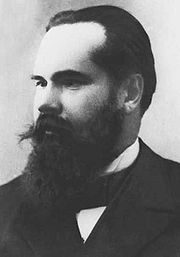
Sergei Taneyev

Encyclopedia
Russian language
Russian is a Slavic language used primarily in Russia, Belarus, Uzbekistan, Kazakhstan, Tajikistan and Kyrgyzstan. It is an unofficial but widely spoken language in Ukraine, Moldova, Latvia, Turkmenistan and Estonia and, to a lesser extent, the other countries that were once constituent republics...
: Сергей Иванович Танеев, Sergej Ivanovič Taneev tɐˈnʲejɪf; ), was a Russia
Russia
Russia or , officially known as both Russia and the Russian Federation , is a country in northern Eurasia. It is a federal semi-presidential republic, comprising 83 federal subjects...
n composer
Composer
A composer is a person who creates music, either by musical notation or oral tradition, for interpretation and performance, or through direct manipulation of sonic material through electronic media...
, pianist
Pianist
A pianist is a musician who plays the piano. A professional pianist can perform solo pieces, play with an ensemble or orchestra, or accompany one or more singers, solo instrumentalists, or other performers.-Choice of genres:...
, teacher of composition
Musical composition
Musical composition can refer to an original piece of music, the structure of a musical piece, or the process of creating a new piece of music. People who practice composition are called composers.- Musical compositions :...
, music theorist and author.
Life
Taneyev was born in VladimirVladimir
Vladimir is a city and the administrative center of Vladimir Oblast, Russia, located on the Klyazma River, to the east of Moscow along the M7 motorway. Population:...
, to a cultured and literary family of Russian nobility. A distant cousin, Alexander Taneyev
Alexander Taneyev
Alexander Sergeyevich Taneyev was a Russian composer of the late Romantic era, specifically of the nationalist school. Among his best works were three string quartets, believed to have been composed between 1898–1900....
, was also a composer, whose daughter, Anna Vyrubova
Anna Vyrubova
Anna Alexandrovna Vyrubova, née Taneyeva , was a lady-in-waiting, best friend and confidante to Tsaritsa Alexandra Fyodorovna.-Early life:...
, was highly influential at court. Alexander was drawn closely to the nationalist school of music, while Sergei would gravitate toward a more cosmopolitan outlook.
He began taking piano lessons at age five with a private teacher. His family moved to Moscow
Moscow
Moscow is the capital, the most populous city, and the most populous federal subject of Russia. The city is a major political, economic, cultural, scientific, religious, financial, educational, and transportation centre of Russia and the continent...
in 1865. The following year, the nine-year-old Taneyev entered the Moscow Conservatory
Moscow Conservatory
The Moscow Conservatory is a higher musical education institution in Moscow, and the second oldest conservatory in Russia after St. Petersburg Conservatory. Along with the St...
. His first piano teacher at the Conservatory was Edward Langer. After a year's interruption in his studies, Taneyev studied again with Langer. He also joined the theory class of Nikolai Hubert and, most importantly, the composition class of Pyotr Ilyich Tchaikovsky
Pyotr Ilyich Tchaikovsky
Pyotr Ilyich Tchaikovsky Pyotr Ilyich Tchaikovsky Pyotr Ilyich Tchaikovsky (Russian: Пётр Ильи́ч Чайко́вский ; often "Peter Ilich Tchaikovsky" in English. His names are also transliterated "Piotr" or "Petr"; "Ilitsch", "Il'ich" or "Illyich"; and "Tschaikowski", "Tschaikowsky", "Chajkovskij"...
. In 1871, Taneyev studied piano with the Conservatory's founder, Nikolai Rubinstein.
Taneyev graduated in 1875, the first student in the history of the Conservatory to win the gold medal both for composition and for performing (piano). He was also the first person ever to be awarded the Conservatory's Great Gold Medal; the second was Arseny Koreshchenko
Arseny Koreshchenko
Arseny Nikolayevich Koreshchenko was a Russian pianist and composer of classical music, including operas and ballets.-Biography:Koreshchenko was born in Moscow in 1870. He entered the Moscow Conservatory, graduating in 1891...
and the third was Sergei Rachmaninoff
Sergei Rachmaninoff
Sergei Vasilievich Rachmaninoff was a Russian composer, pianist, and conductor. Rachmaninoff is widely considered one of the finest pianists of his day and, as a composer, one of the last great representatives of Romanticism in Russian classical music...
. That summer he travelled abroad with Rubinstein. That year he also made his debut as a concert pianist in Moscow playing the first piano concerto
Piano Concerto No. 1 (Brahms)
The Piano Concerto No. 1 in D minor, Op. 15, is a work for piano and orchestra composed by Johannes Brahms in 1858. The composer gave the work's public debut in Hanover, Germany, the following year.-Form:...
in D minor of Johannes Brahms
Johannes Brahms
Johannes Brahms was a German composer and pianist, and one of the leading musicians of the Romantic period. Born in Hamburg, Brahms spent much of his professional life in Vienna, Austria, where he was a leader of the musical scene...
, and would become known for his interpretations of Johann Sebastian Bach
Johann Sebastian Bach
Johann Sebastian Bach was a German composer, organist, harpsichordist, violist, and violinist whose sacred and secular works for choir, orchestra, and solo instruments drew together the strands of the Baroque period and brought it to its ultimate maturity...
, Wolfgang Amadeus Mozart
Wolfgang Amadeus Mozart
Wolfgang Amadeus Mozart , baptismal name Johannes Chrysostomus Wolfgangus Theophilus Mozart , was a prolific and influential composer of the Classical era. He composed over 600 works, many acknowledged as pinnacles of symphonic, concertante, chamber, piano, operatic, and choral music...
and Ludwig van Beethoven
Ludwig van Beethoven
Ludwig van Beethoven was a German composer and pianist. A crucial figure in the transition between the Classical and Romantic eras in Western art music, he remains one of the most famous and influential composers of all time.Born in Bonn, then the capital of the Electorate of Cologne and part of...
. In March 1876 he toured Russia with violinist Leopold Auer
Leopold Auer
Leopold Auer was a Hungarian violinist, teacher, conductor and composer.-Early life and career:...
.
Taneyev was also the soloist in the Moscow première of Tchaikovsky's First Piano Concerto
Piano Concerto No. 1 (Tchaikovsky)
The Piano Concerto No. 1 in B-flat minor, Op. 23 was composed by Pyotr Ilyich Tchaikovsky between November 1874 and February 1875. It was revised in the summer of 1879 and again in December 1888. The first version received heavy criticism from Nikolai Rubinstein, Tchaikovsky's desired pianist....
in 1875. Tchaikovsky was clearly impressed by Taneyev's performance; he later asked Taneyev to be soloist in the Russian premiere of his Second Piano Concerto
Piano Concerto No. 2 (Tchaikovsky)
Pyotr Ilyich Tchaikovsky's Piano Concerto No. 2 in G major, Op. 44, was written in 1879-1880. It was dedicated to Nikolai Rubinstein, who had insisted he be allowed to perform it at the premiere as a way of making up for his harsh criticism of Tchaikovsky's First Piano Concerto. Rubinstein was...
. (After Tchaikovsky's death, Taneyev also completed and premiered his Third Piano Concerto
Piano Concerto No. 3 (Tchaikovsky)
Pyotr Ilyich Tchaikovsky's Piano Concerto No. 3 in E-flat major, Op. post. 75, was begun as a symphony in E flat. The symphony was abandoned, only to become a single-movement Allegro brillante when published posthumously. Controversy remains, despite the composer's stated intentions, as to what...
and Andante and Finale
Andante and Finale (Tchaikovsky)
Pyotr Ilyich Tchaikovsky's Andante and Finale for piano and orchestra was initially intended as the slow movement and finale of the Symphony in E flat, a work he started in 1892 but eventually abandoned. Tchaikovsky began reworking the sketches for these two movements into the second and third...
.)
Taneyev attended Moscow University for a short time and was acquainted with outstanding Russian writers, including Ivan Turgenev
Ivan Turgenev
Ivan Sergeyevich Turgenev was a Russian novelist, short story writer, and playwright. His first major publication, a short story collection entitled A Sportsman's Sketches, is a milestone of Russian Realism, and his novel Fathers and Sons is regarded as one of the major works of 19th-century...
and Mikhail Saltykov-Shchedrin
Mikhail Saltykov-Shchedrin
Mikhail Yevgrafovich Saltykov-Shchedrin , better known by his pseudonym Shchedrin , was a major Russian satirist of the 19th century. At one time, after the death of the poet Nikolai Nekrasov, he acted as editor of the well-known Russian magazine, the Otechestvenniye Zapiski, until it was banned by...
. During his travels in Western Europe in 1876 and 1877, he met Émile Zola
Émile Zola
Émile François Zola was a French writer, the most important exemplar of the literary school of naturalism and an important contributor to the development of theatrical naturalism...
, Gustave Flaubert
Gustave Flaubert
Gustave Flaubert was a French writer who is counted among the greatest Western novelists. He is known especially for his first published novel, Madame Bovary , and for his scrupulous devotion to his art and style.-Early life and education:Flaubert was born on December 12, 1821, in Rouen,...
, César Franck
César Franck
César-Auguste-Jean-Guillaume-Hubert Franck was a composer, pianist, organist, and music teacher who worked in Paris during his adult life....
and Camille Saint-Saëns
Camille Saint-Saëns
Charles-Camille Saint-Saëns was a French Late-Romantic composer, organist, conductor, and pianist. He is known especially for The Carnival of the Animals, Danse macabre, Samson and Delilah, Piano Concerto No. 2, Cello Concerto No. 1, Havanaise, Introduction and Rondo Capriccioso, and his Symphony...
amongst others.
When Tchaikovsky resigned from the Moscow Conservatory in 1878, Taneyev was appointed to teach harmony. He would later also teach piano and composition. He served as Director from 1885 to 1889, and continued teaching until 1905. He had great influence as a teacher of composition. His pupils included Alexander Scriabin
Alexander Scriabin
Alexander Nikolayevich Scriabin was a Russian composer and pianist who initially developed a lyrical and idiosyncratic tonal language inspired by the music of Frédéric Chopin. Quite independent of the innovations of Arnold Schoenberg, Scriabin developed an increasingly atonal musical system,...
, Sergei Rachmaninoff, Reinhold Glière
Reinhold Glière
Reinhold Moritzevich Glière was a Russian and Soviet composer of German–Polish descent.- Biography :Glière was born in Kiev, Ukraine...
, Paul Juon
Paul Juon
Paul Juon was a Germanised Russian composerHe was born in Moscow, where his father was an insurance official. His mother was German, and he went to a German school in Moscow. He entered the Moscow Conservatory in 1889, where he studied violin with Jan Hřímalý and composition with Anton Arensky...
, Julius Conus
Julius Conus
Julius Conus was a Russian violinist and composer.Conus was born in Moscow on to a distinguished musical family of French extraction who had migrated to Russia at the time of the Napoleonic Wars. His father was the piano teacher Eduard Conus, and his brothers were the composer and music teacher...
, and Nikolai Medtner
Nikolai Medtner
Nikolai Karlovich Medtner was a Russian composer and pianist.A younger contemporary of Sergei Rachmaninoff and Alexander Scriabin, he wrote a substantial number of compositions, all of which include the piano...
. The polyphonic interweaves in the music of Rachmaninoff and Medtner stem directly from Taneyev's teaching. Scriabin, on the other hand, broke away from Taneyev's influence.
Taneyev was also a scholar of massive erudition. In addition to music, he studied—for relaxation—natural and social science, history, mathematics, plus the philosophies of Plato
Plato
Plato , was a Classical Greek philosopher, mathematician, student of Socrates, writer of philosophical dialogues, and founder of the Academy in Athens, the first institution of higher learning in the Western world. Along with his mentor, Socrates, and his student, Aristotle, Plato helped to lay the...
and Spinoza.
During the summers of 1895 and 1896, Taneyev stayed at Yasnaya Polyana, the home of Leo Tolstoy
Leo Tolstoy
Lev Nikolayevich Tolstoy was a Russian writer who primarily wrote novels and short stories. Later in life, he also wrote plays and essays. His two most famous works, the novels War and Peace and Anna Karenina, are acknowledged as two of the greatest novels of all time and a pinnacle of realist...
and his wife Sofia. She developed an attachment to the composer which embarrassed her children and made Tolstoy jealous, though Taneyev himself remained unaware of it. However this also released her from the distress of the isolation she experienced when Tolstoy grew distant from family concerns and devoted himself to the Christian anarchist-pacifism which shaped his last years. Sofia's infatuation with Taneyev and his music echoes the story of Tolstoy's great and penetrating dissection of marital relations in The Kreutzer Sonata
The Kreutzer Sonata
The Kreutzer Sonata is a novella by Leo Tolstoy, published in 1889 and promptly censored by the Russian authorities. The work is an argument for the ideal of sexual abstinence and an in-depth first-person description of jealous rage...
.
In 1905, the revolution and its consequent effect on the Moscow Conservatory led Taneyev to resign from the staff there. He resumed his career as a concert pianist, both as soloist and chamber musician. He was also able to pursue composition more intensely, completing chamber works with a piano part which he could play in concerts as well as some choruses and a substantial number of songs. His last completed work was the cantata
Cantata
A cantata is a vocal composition with an instrumental accompaniment, typically in several movements, often involving a choir....
At the Reading of a Psalm, completed at the beginning of 1915.
Taneyev contracted pneumonia after attending the funeral of Scriabin. While he was recovering, he succumbed to a heart attack in Dyudkovo, near Moscow
Moscow
Moscow is the capital, the most populous city, and the most populous federal subject of Russia. The city is a major political, economic, cultural, scientific, religious, financial, educational, and transportation centre of Russia and the continent...
.
A museum dedicated to Taneyev is located in Dyudkovo. There is also a section dedicated to Taneyev at the Tchaikovsky Museum in Klin
Klin
Klin is a town and the administrative center of Klinsky District of Moscow Oblast, Russia, located northwest of Moscow. The M10 highway connecting Moscow to St. Petersburg and the Moscow-Saint Petersburg Railway run through the town. It was home to Klin air base during the Cold War. ...
.
Taneyev and Tchaikovsky
Taneyev became the most trusted musician among Tchaikovsky's friends. The two developed a friendship that would last until Tchaikovsky's death.While Taneyev lacked an original creative gift, he was a fastidious and diligent craftsman with an unrivaled technique. Tchaikovsky realized that the opinions of such a man, whose own taste and competence were so high, yet whose self-scrutiny was so exacting, was to be respected. Therefore, Tchaikovsky came to greatly appreciate criticism from Taneyev. In fact, Taneyev became the only one of Tchaikovsky's friends encouraged by the composer to be absolutely frank about his works.
Taneyev's frankness came at a price, however, and that price for Tchaikovsky was bearing with a forthrightness that went to the point of absolute bluntness. This means that while Tchaikovsky appreciated Taneyev's views, he did not always welcome them. A postscript to a letter Tchaikovsky wrote to Taneyev about Eugene Onegin and the Fourth Symphony basically sums up his general frame of mind: "I know you are absolutely sincere and I think a great deal of your judgment. But I also fear it."
Tchaikovsky's use of the word "fear" was not exaggerated. Music writer and composer Leonid Sabaneyev
Leonid Sabaneyev
Leonid Leonidovich Sabaneyev or Sabaneyeff or Sabaneev was a Russian musicologist, music critic, composer and scientist.-Biography:...
studied composition with Taneyev as a child and met Tchaikovsky through him. To Sabaneyev, Tchaikovsky really did seem afraid of Taneyev in some ways. He also suggests why:
I think he was unnerved by the overt frankness with which Taneyev reacted to Tchaikovsky's works: Taneyev believed that one must indicate precisely what one finds to be 'faults,' while strong points would make themselves evident. He was hardly fully justified in his conviction: composers are a nervous lot and they are often particularly dissatisfied with themselves. Tchaikovsky was just such a person: he worried himself almost sick over each work and often tried even to destroy them...
Sabaneyev recalled when Tchaikovsky came to Taneyev with the Fifth Symphony
Symphony No. 5 (Tchaikovsky)
The Symphony No. 5 in E minor, Op. 64 by Pyotr Ilyich Tchaikovsky was composed between May and August 1888 and was first performed in St Petersburg at the Hall of Nobility on November 6 of that year with Tchaikovsky conducting. It is dedicated to Theodore Avé-Lallemant.-Structure:A typical...
. Taneyev started playing through part of the manuscript at the piano. "With characteristic pedantry Taneyev began showing Tchaikovsky what he considered to be faults, thereby sending Tchaikovsky into even greater despair. Tchaikovsky grabbed the music and wrote across the page with a red pencil: "Awful muck." Still not satisfied with this punishment, he tore the sheet of music in half and threw it on the floor. Then he ran out of the room. Despondently Taneyev picked up the music and told me: "Pyotr Ilyich takes everything to heart. After all, he himself asked me to give my opinion..."
Despite Tchaikovsky's notoriously thin skin when it came to criticism, he could not take any lasting offense at such transparent honesty, especially when Taneyev's assessments could show a great deal of perception. Even if the manner in which Taneyev presented his comments made them sting all the more, Tchaikovsky was painfully grateful for his fellow-musician's candor.
Taneyev and The Five
Tchaikovsky was not the only one with whom Taneyev was frank, though some were less appreciative about it. Nikolai Rimsky-KorsakovNikolai Rimsky-Korsakov
Nikolai Andreyevich Rimsky-Korsakov was a Russian composer, and a member of the group of composers known as The Five.The Five, also known as The Mighty Handful or The Mighty Coterie, refers to a circle of composers who met in Saint Petersburg, Russia, in the years 1856–1870: Mily Balakirev , César...
recalls a clash Taneyev had with Mily Balakirev
Mily Balakirev
Mily Alexeyevich Balakirev ,Russia was still using old style dates in the 19th century, and information sources used in the article sometimes report dates as old style rather than new style. Dates in the article are taken verbatim from the source and therefore are in the same style as the source...
during a rehearsal of a concert to commemorate the unveiling of a monument to pioneering Russian composer Mikhail Glinka
Mikhail Glinka
Mikhail Ivanovich Glinka , was the first Russian composer to gain wide recognition within his own country, and is often regarded as the father of Russian classical music...
. Rimsky-Korsakov writes,
"At the rehearsal of the concert he publicly declared to Balakirev: 'Mily Alekseyevich! We are dissatisfied with you.' I picture to myself Balakirev constrained to swallow a rebuke of this sort. Honest, upright and straightforward, Taneyev always spoke sharply and frankly. On the other hand, Balakirev, of course, could never forgive Taneyev his harshness and frankness with regard to his own person."
Nor was this the only time Taneyev shared strong opinions about the St. Petersburg based nationalist music group known as "The Mighty Handful" or "The Five
The Five
The Five, also known as The Mighty Handful or The Mighty Coterie , refers to a circle of composers who met in Saint Petersburg, Russia, in the years 1856–1870: Mily Balakirev , César Cui, Modest Mussorgsky, Nikolai Rimsky-Korsakov and Alexander Borodin...
." Rimsky-Korsakov recalls what he considered Taneyev's glaring conservatism in the 1880s. Taneyev reportedly showed "deep distrust" in Alexander Glazunov
Alexander Glazunov
Alexander Konstantinovich Glazunov was a Russian composer of the late Russian Romantic period, music teacher and conductor...
's early appearances. Alexander Borodin
Alexander Borodin
Alexander Porfiryevich Borodin was a Russian Romantic composer and chemist of Georgian–Russian parentage. He was a member of the group of composers called The Five , who were dedicated to producing a specifically Russian kind of art music...
was merely a clever dilettante, and Modest Mussorgsky
Modest Mussorgsky
Modest Petrovich Mussorgsky was a Russian composer, one of the group known as 'The Five'. He was an innovator of Russian music in the romantic period...
"had made him laugh." He may not have had a high opinion of César Cui
César Cui
César Antonovich Cui was a Russian of French and Lithuanian descent. His profession was as an army officer and a teacher of fortifications; his avocational life has particular significance in the history of music, in that he was a composer and music critic; in this sideline he is known as a...
or even Rimsky-Korsakov. However, Rimsky-Korsakov's study of counterpoint, of which Taneyev learned from Tchaikovsky, may have prompted Taneyev to revise his opinion of that composer
The following decade showed a marked change in opinion, Rimsky-Korsakov writes. Taneyev now appreciated Glauzunov, respected Borodin's work and regarded only Mussorgsky's compositions with disdain. Rimsky-Korsakov ascribed this change to a new period in Taneyev's activity as a composer. Previously he had been absorbed mainly in research for his treatise on counterpoint
Counterpoint
In music, counterpoint is the relationship between two or more voices that are independent in contour and rhythm and are harmonically interdependent . It has been most commonly identified in classical music, developing strongly during the Renaissance and in much of the common practice period,...
, which left little time for composition. Now he was throwing himself more freely into creative work. In doing so, Taneyev was guiding himself by the ideals of contemporary music while still preserving "his astounding contrapuntal technique
Rimsky-Korsakov also writes that, after the fiasco regarding the Mariinsky Theater's production of Taneyev's Oresteia
Oresteia (opera)
Oresteia is an opera in three parts, eight tableaux, with music by Sergei Taneyev, composed during 1887-1894. The composer titled this work, his only opera, a "musical trilogy." The Russian libretto was adapted by A.A. Wenkstern from the The Oresteia of Aeschylus. The opera was premiered on at...
, Mitrofan Belyayev
Mitrofan Belyayev
Mitrofan Petrovich Belyayev was a Russian music publisher, outstanding philanthropist, and the owner of a large wood dealership enterprise in Russia. He was also the founder of the Belyayev circle, a society of musicians in Russia whose members included Nikolai Rimsky-Korsakov, Alexander Glazunov...
, the publisher and impresario who now headed the "Mighty Handful", shared Taneyev's outrage over the incident and volunteered to publish the score himself. Prior to publishing, Taneyev "revised and signally improved the orchestration, which had not been uniformly satisfactorily.... [T]hereafter, Taneyev began to avail himself of Glazunov's advice in orchestration; of course he made rapid strides in that field." Note the "of course." Glazunov had been Rimsky-Korsakov's student in orchestration as well as composition.
Master contrapuntalist
Taneyev's specialized field of study was counterpointCounterpoint
In music, counterpoint is the relationship between two or more voices that are independent in contour and rhythm and are harmonically interdependent . It has been most commonly identified in classical music, developing strongly during the Renaissance and in much of the common practice period,...
. He engrossed himself in the music of Johann Sebastian Bach
Johann Sebastian Bach
Johann Sebastian Bach was a German composer, organist, harpsichordist, violist, and violinist whose sacred and secular works for choir, orchestra, and solo instruments drew together the strands of the Baroque period and brought it to its ultimate maturity...
, Giovanni Palestrina
Giovanni Pierluigi da Palestrina
Giovanni Pierluigi da Palestrina was an Italian Renaissance composer of sacred music and the best-known 16th-century representative of the Roman School of musical composition...
and Flemish
Flemish people
The Flemings or Flemish are the Dutch-speaking inhabitants of Belgium, where they are mostly found in the northern region of Flanders. They are one of two principal cultural-linguistic groups in Belgium, the other being the French-speaking Walloons...
masters such as Johannes Ockeghem
Johannes Ockeghem
Johannes Ockeghem was the most famous composer of the Franco-Flemish School in the last half of the 15th century, and is often considered the most...
, Josquin des Prez
Josquin Des Prez
Josquin des Prez [Josquin Lebloitte dit Desprez] , often referred to simply as Josquin, was a Franco-Flemish composer of the Renaissance...
and Lassus. Eventually, he became one of the greatest of contrapuntalists.
Taneyev published a gigantic two-volume treatise, Convertible Counterpoint in the Strict Style, the result of 20 years of labor. In it, the laws of counterpoint are broken down, explained and brought into focus as a branch of pure mathematics. Taneyev used a quotation from Leonardo da Vinci
Leonardo da Vinci
Leonardo di ser Piero da Vinci was an Italian Renaissance polymath: painter, sculptor, architect, musician, scientist, mathematician, engineer, inventor, anatomist, geologist, cartographer, botanist and writer whose genius, perhaps more than that of any other figure, epitomized the Renaissance...
as its inscription: "No branch of study can claim to be considered a true science unless it is capable of being demonstrated mathematically."
An unfinished sequel on Canon
Canon (music)
In music, a canon is a contrapuntal composition that employs a melody with one or more imitations of the melody played after a given duration . The initial melody is called the leader , while the imitative melody, which is played in a different voice, is called the follower...
and Fugue
Fugue
In music, a fugue is a compositional technique in two or more voices, built on a subject that is introduced at the beginning in imitation and recurs frequently in the course of the composition....
was published posthumously.
Taneyev's focus on strict counterpoint strongly influenced the way he composed his music. He described this process, while discussing his dramatic trilogy Orestia, in a letter to Tchaikovsky dated June 21, 1891:
I spend a great deal of time on preparatory work, and less time on final composition. Some items I have not finished within the last few years. Important themes which are repeated in the opera, are used by me objectively, without any reference to a particular situation, for studies in counterpoint. Gradually, from this chaos of thoughts and sketches something orderly and definite begins to emerge. Everything extraneous is discarded. That which is unquestionably suitable remains.
Taneyev would continue this series of contrapuntal exercises until he had exhausted every polyphonic possibility. Only then would he actually begin composing music
Rimsky-Korsakov describes Taneyev's compositional process similarly, but with more telling detail:
Before setting out for the real expounding of a composition, Taneyev used to precede it with a multitude of sketches and studies: he used to write fugues, canons, and various contrapuntal interlacings on the individual themes, phrases, and motives of the coming composition; and only after gaining thorough experience in its component parts did he take up the general plan of the composition and the carrying out of this plan, knowing by that time, as he did, and perfectly, the nature of the material he had at his disposal and the possibilities of building with that material.
Taneyev's rationale for this process stemmed from his belief that truth and moral integrity in music were synonymous with its objectivity and purpose. He viewed classical concepts of composition as perfect examples of a compositional technique devoid of anything casual or extraneous.
Taneyev also saw a synthesis of counterpoint and folk-song as the means of creating large-scale musical structures that would follow Western rules of thematic development in sonata form
Sonata form
Sonata form is a large-scale musical structure used widely since the middle of the 18th century . While it is typically used in the first movement of multi-movement pieces, it is sometimes used in subsequent movements as well—particularly the final movement...
. This goal had eluded both "The Five" and Tchaikovsky. Taneyev wrote:
The task of every Russian composer consists in furthering the creation of national music. The history of western music gives us the answer as to what should be done to attain this: apply to the Russian song the workings of the mind that were applied to the song of western nations and we will have our own national music. Begin with elementary contrapuntal forms, pass to more complex ones, elaborate the form of the Russian fugueFugueIn music, a fugue is a compositional technique in two or more voices, built on a subject that is introduced at the beginning in imitation and recurs frequently in the course of the composition....
, and from there it is only a step to complex instrumental types. The Europeans took centuries to get there, we need far less. We know the way, the goal, we can profit by their experience.
Music
Compositionally, Taneyev and Tchaikovsky differed on how they felt music theoryMusic theory
Music theory is the study of how music works. It examines the language and notation of music. It seeks to identify patterns and structures in composers' techniques across or within genres, styles, or historical periods...
should function. Tchaikovsky prized spontaneity in musical creativity. Taneyev, in contrast, thought musical creativity should be both deliberate and intellectual, with preliminary theoretical analysis and preparation of thematic materials.
Consequently, Taneyev's intellectual approach to the way of characterizing the music of his teacher, Tchaikovsky.
Nevertheless, Taneyev's compositions reveal his mastery of the classical technique of composition, so his style could be said to reflect the European, and especially German, orientation of the Moscow Conservatory, rather than the Russian nationalist
Nationalism
Nationalism is a political ideology that involves a strong identification of a group of individuals with a political entity defined in national terms, i.e. a nation. In the 'modernist' image of the nation, it is nationalism that creates national identity. There are various definitions for what...
outlook of the school of Mily Balakirev
Mily Balakirev
Mily Alexeyevich Balakirev ,Russia was still using old style dates in the 19th century, and information sources used in the article sometimes report dates as old style rather than new style. Dates in the article are taken verbatim from the source and therefore are in the same style as the source...
.
His compositions include nine complete string quartet
String quartet
A string quartet is a musical ensemble of four string players – usually two violin players, a violist and a cellist – or a piece written to be performed by such a group...
s (plus two partially completed), a piano quintet
Piano quintet
In European classical music, a piano quintet is a work of chamber music written for piano and four other instruments, most commonly piano, two violins, viola, and cello . Among the most frequently performed piano quintets are those by Robert Schumann, Johannes Brahms, César Franck, Antonín Dvořák...
, two string quintet
String quintet
A string quintet is a musical composition for a standard string quartet supplemented by a fifth string instrument, usually a second viola or a second cello , but occasionally a double bass. Wolfgang Amadeus Mozart, who favoured addition of a viola, is considered a pioneer of the form...
s and other chamber works, including a piano prelude and fugue in G-sharp minor; four symphonies
Symphony
A symphony is an extended musical composition in Western classical music, scored almost always for orchestra. A symphony usually contains at least one movement or episode composed according to the sonata principle...
(only one published during his lifetime, and at least one incomplete), a concert suite with violin and a piano concerto
Piano concerto
A piano concerto is a concerto written for piano and orchestra.See also harpsichord concerto; some of these works are occasionally played on piano...
, and other orchestral works; an organ composition "Chorale with variations"; choral
Choir
A choir, chorale or chorus is a musical ensemble of singers. Choral music, in turn, is the music written specifically for such an ensemble to perform.A body of singers who perform together as a group is called a choir or chorus...
and vocal music. Among the choral works are two cantatas, "St. John of Damascus", op.
Opus number
An Opus number , pl. opera and opuses, abbreviated, sing. Op. and pl. Opp. refers to a number generally assigned by composers to an individual composition or set of compositions on publication, to help identify their works...
1 (also known as "A Russian Requiem"), and "At the Reading of a Psalm" (op. 36, sometimes regarded as his swan song
Swan song
"Swan song" is a metaphorical phrase for a final gesture, effort, or performance given just before death or retirement. The phrase refers to an ancient belief that the Mute Swan is completely silent during its lifetime until the moment just before death, when it sings one beautiful song...
). In the choral works the composer combines the Russian melos with remarkable contrapuntal writing.
Taneyev regarded his Oresteia
Oresteia (opera)
Oresteia is an opera in three parts, eight tableaux, with music by Sergei Taneyev, composed during 1887-1894. The composer titled this work, his only opera, a "musical trilogy." The Russian libretto was adapted by A.A. Wenkstern from the The Oresteia of Aeschylus. The opera was premiered on at...
, originally conceived in 1882, as his major achievement. This work, which the composer entitled a 'musical trilogy' rather than an opera, and was closely modeled on the original plays by Aeschylus
Aeschylus
Aeschylus was the first of the three ancient Greek tragedians whose work has survived, the others being Sophocles and Euripides, and is often described as the father of tragedy. His name derives from the Greek word aiskhos , meaning "shame"...
, was first performed at the Mariinsky Theatre
Mariinsky Theatre
The Mariinsky Theatre is a historic theatre of opera and ballet in Saint Petersburg, Russia. Opened in 1860, it became the preeminent music theatre of late 19th century Russia, where many of the stage masterpieces of Tchaikovsky, Mussorgsky, and Rimsky-Korsakov received their premieres. The...
on 17 October 1895. Taneyev wrote a separate concert overture based on some of the opera's major themes, which was conducted by Tchaikovsky in 1889.
Rimsky-Korsakov considered many of Taneyev's compositions "most dry and laboured in character." A private hearing of Oresteia at his home, with Taneyev at the piano, was quite another matter. The opera, he writes, "astonished us all with pages of extraordinary beauty and expressiveness." He adds that he felt Taneyev's working methods "ought to result in a dry and academic composition, devoid of the shadow of an inspiration; in reality, however, Oresteia proved quite the reverse—for all its strict premeditation, the opera was striking in its wealth of beauty and expressiveness."
Along with beauty and expressiveness, Taneyev could also show a whimsical streak in his musical nature. Gerald Abraham writes, "Taneyev had a dual nature rather like Lewis Carroll
Lewis Carroll
Charles Lutwidge Dodgson , better known by the pseudonym Lewis Carroll , was an English author, mathematician, logician, Anglican deacon and photographer. His most famous writings are Alice's Adventures in Wonderland and its sequel Through the Looking-Glass, as well as the poems "The Hunting of the...
's, half mathematician, half humorist." Among Taneyev's unpublished works are reportedly various parodies, including "Quartets of Government Officials", "humorous choruses, comic fugues and variations, toy symphonies, a mock ballet for Tchaikovsky's birthday with an absurd scenario and music which is an ingenious contrapuntal pot-pourri of themes from Tchaikovsky's works...."
Sources
- Bakst, James, A History of Russian-Soviet Music (New York: Dodd, Mean & Company, 1966, 1962).
- Belina, Anastasia. The Master of Moscow. The International Piano Magazine, January–February 2007, pp. 62–65.
- Brown, David, ed. Stanley Sadie, "Taneyev, Sergey Ivanovich", The New Grove Dictionary of Music and Musicians, Second Edition, 29 vols. (London: MacMillian, 2001). ISBN 1-56159-239-0.
- Brown, David, Tchaikovsky: The Crisis Years, 1874-1878, (New York: W.W. Norton & Company, 1983).
- Hanson, Lawrence and Hanson, Elisabeth, Tchaikovsky: The Man Behind the Music (New York: Dodd, Mead & Company).
- Leonard, Richard Anthony, A History of Russian Music (Westport, Connecticut: Greenwood Press, Publishers, 1977, 1957).
- Poznansky, Alexander, Tchaikovsky Through Others' Eyes (Russian Music Series) (Indiana University Press, 1999).
- Rimsky-Korsakov, Nikolai, Letopis Moyey Muzykalnoy Zhizni (St. Petersburg, 1909), published in English as My Musical Life (New York: Knopf, 1925, 3rd ed. 1942).
- Swan, Alfred J., Russian Music and Its Sources in Chant and Folk-Song (New York: W.W. Norton & Company, 1973). ISBN 0-393-2175-0.
- Warrack, John, Tchaikovsky (New York: Charles Scribner's Sons, 1973).
- Beattie Davis, Richard, "The Beauty of Belaieff" (G Clef Publishing, 2007).
Other books
- Convertible Counterpoint in the Strict Style, by Sergei Taneyev. 1962 edition, Branden Pub. Co. ISBN 0-8283-1415-2. Preface by Serge KoussevitzkySerge KoussevitzkySerge Koussevitzky , was a Russian-born Jewish conductor, composer and double-bassist, known for his long tenure as music director of the Boston Symphony Orchestra from 1924 to 1949.-Early career:...
. - Doctrine of Canon, 1915 (Available in English through ProQuestProQuestProQuest LLC is an Ann Arbor, Michigan-based electronic publisher and microfilm publisher.It provides archives of sources such as newspapers, periodicals, dissertations, and aggregated databases of many types. Its content is estimated at 125 billion digital pages...
as part of the dissertation Sergei Ivanovich Taneev's 'Doctrine of the Canon': A translation and commentary (Russia). by Paul R Grove, II.)
Selected discography
- The Russian Piano Quartet: Taneyev's Piano Quartet in E major, Op. 20; Paul JuonPaul JuonPaul Juon was a Germanised Russian composerHe was born in Moscow, where his father was an insurance official. His mother was German, and he went to a German school in Moscow. He entered the Moscow Conservatory in 1889, where he studied violin with Jan Hřímalý and composition with Anton Arensky...
's Rhapsody; and Alexander BorodinAlexander BorodinAlexander Porfiryevich Borodin was a Russian Romantic composer and chemist of Georgian–Russian parentage. He was a member of the group of composers called The Five , who were dedicated to producing a specifically Russian kind of art music...
's Polovtsian Dances. Performed by the Ames Piano Quartet (Dorian 93215) - Taneyev's Concert Suite for Violin & Orchestra; Entr'acte; and Oresteya Overture. Performed by the Helsinki Philharmonic Orchestra conducted by Vladimir AshkenazyVladimir AshkenazyVladimir Davidovich Ashkenazy is a Russian-Icelandic conductor and pianist. Since 1972 he has been a citizen of Iceland, his wife Þórunn's country of birth. Since 1978, because of his many obligations in Europe, he and his family have resided in Meggen, near Lucerne in Switzerland...
and Pekka KuusistoPekka KuusistoPekka Kuusisto is a Finnish classical and jazz violinist.Pekka Kuusisto began studying the violin at the age of three. His first violin teacher was Geza Szilvay at the East Helsinki Music Institute. In 1983 he enrolled in the Sibelius Academy in Helsinki. He began to study there with Tuomas...
as violin soloist (Ondine 959-2) - Taneyev's Trio in E-flat major, Op. 31; Trio in B minor; and Trio in D major. Performed by the Belcanto Strings (MDG 6341003)
- Taneyev's Piano Quintet in G minor, Op. 30; and Piano Trio in D major, Op. 22. Performed by Mikhail PletnevMikhail PletnevMikhail Vasilievich Pletnev is a Russian pianist, conductor, and composer.-Life and career:Pletnev was born into a very musical family in Arkhangelsk, then part of the Soviet Union; his father played and taught the bayan, and his mother the piano...
(piano), Vadim RepinVadim RepinVadim Repin is a Belgian Russian violinist who currently lives in Austria....
(violin) and Lynn HarrellLynn HarrellLynn Harrell is an American classical cellist.-Biography:Harrell was born in New York City of musician parents; his father was the baritone Mack Harrell and his mother, Marjorie Fulton, was a violinist. At the age of eight he decided to learn to play the cello. When Lynn was 12, his family moved...
(cello) joined in the quintet by Ilya Gringolts (violin) and Nobuko Imai (viola) (Deutsche Grammophon 4775419) - Taneyev's Symphony No. 1; and Symphony No. 3. Performed by the Russian State Symphony Orchestra conducted by Valeri Polyansky (Chandos 10390)
- Taneyev's Symphony No. 2; and Symphony No. 4. Performed by the Russian State Symphony Orchestra conducted by Valeri Polyansky (Chandos 9998)
- Taneyev's Symphony No. 4; and the Oresteia Overture, Op. 6. Performed by the Philharmonia Orchestra conducted by Neeme Järvi (Chandos 8953)
- String Quartets 1 and 4. Performed by the Leningrad Taneyev Quartet. Reissue of a Melodiya LP on Northern Flowers NF/PMA 9933 (and the other quartets, in five volumes.)
- String Quartets 8 and 9. Performed by the Leningrad Taneiev QuartetLeningrad Taneiev QuartetThe Leningrad Taneiev Quartet made its first appearance in the Small Hall of the Leningrad Conservatory in the winter of 1946, its members being students at the Conservatory. The quartet played in particular the quartets of Beethoven, Tchaikovsky, and Taneiev but also included first performances of...
. (Melodiya MA 12411; reissued on Olympia OCD 128) - Piano Trio in D; Piano Quartet in E. Performed by the Barbican Piano Trio with James Boyd (viola). (Dutton CDSA 6882)
External links
- Review of concert performance of 'Oresteia' (St. Petersburg, 2006).
- Review of recording of Taneyev's Symphonies Nos. 2 & 4 by Michael Carter in Fanfare MagazineFanfare MagazineFanfare is a magazine devoted to reviewing classical music performance and recordings.Fanfare's contributors have a range of expertise from the medieval to contemporary work...
. - Sergei Taneyev String Quartet No.2 & String Quintets Opp.14 & 16 sound-bites and biographical information
- Article Sergei Taneyev: Tchaikovsky's Heir or the Russian Bach?
- Turgenev and Taneyev