


Alfred Schnittke

Encyclopedia
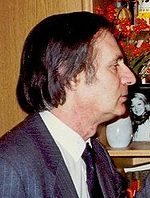
Alfred Schnittke was a Russia
Russia
Russia or , officially known as both Russia and the Russian Federation , is a country in northern Eurasia. It is a federal semi-presidential republic, comprising 83 federal subjects...
n and Soviet
Soviet Union
The Soviet Union , officially the Union of Soviet Socialist Republics , was a constitutionally socialist state that existed in Eurasia between 1922 and 1991....
composer
Composer
A composer is a person who creates music, either by musical notation or oral tradition, for interpretation and performance, or through direct manipulation of sonic material through electronic media...
. Schnittke's early music shows the strong influence of Dmitri Shostakovich
Dmitri Shostakovich
Dmitri Dmitriyevich Shostakovich was a Soviet Russian composer and one of the most celebrated composers of the 20th century....
. He developed a polystylistic
Polystylism
Polystylism is the use of multiple styles or techniques in literature, art, film, or, especially, music, and is a postmodern characteristic.Some prominent contemporary polystylist composers include Peter Maxwell Davies, Michael Colgrass, Lera Auerbach, Sofia Gubaidulina, George Rochberg, Alfred...
technique in works such as the epic First Symphony (1969–1972) and First Concerto Grosso
Concerto grosso
The concerto grosso is a form of baroque music in which the musical material is passed between a small group of soloists and full orchestra...
(1977). In the 1980s, Schnittke's music began to become more widely known abroad with the publication of his Second (1980) and Third (1983) String Quartets and the String Trio (1985); the ballet Peer Gynt
Peer Gynt
Peer Gynt is a five-act play in verse by the Norwegian dramatist Henrik Ibsen, loosely based on the fairy tale Per Gynt. It is the most widely performed Norwegian play. According to Klaus Van Den Berg, the "cinematic script blends poetry with social satire and realistic scenes with surreal ones"...
(1985–1987); the Third (1981), Fourth (1984), and Fifth (1988) Symphonies; and the Viola (1985) and 1st Cello (1985–1986) Concertos. As his health deteriorated, Schnittke's music started to abandon much of the extroversion of his polystylism and retreated into a more withdrawn, bleak style.
Life and career
Schnittke's father, Harry Viktorovich Schnittke (1914–1975, rus.), was Jewish and born in FrankfurtFrankfurt
Frankfurt am Main , commonly known simply as Frankfurt, is the largest city in the German state of Hesse and the fifth-largest city in Germany, with a 2010 population of 688,249. The urban area had an estimated population of 2,300,000 in 2010...
. He moved to the USSR
Soviet Union
The Soviet Union , officially the Union of Soviet Socialist Republics , was a constitutionally socialist state that existed in Eurasia between 1922 and 1991....
in 1927 and worked as a journalist
Journalist
A journalist collects and distributes news and other information. A journalist's work is referred to as journalism.A reporter is a type of journalist who researchs, writes, and reports on information to be presented in mass media, including print media , electronic media , and digital media A...
and translator from the Russian language into German. His mother, Maria Iosifovna Schnittke (née Vogel, 1910–1972), was a Volga German
Volga German
The Volga Germans were ethnic Germans living along the River Volga in the region of southern European Russia around Saratov and to the south. Recruited as immigrants to Russia in the 18th century, they were allowed to maintain German culture, language, traditions and churches: Lutherans, Reformed,...
born in Russia. Schnittke's paternal grandmother, Tea Abramovna Katz (1889–1970), was a philologist, translator, and editor of German-language literature.
Alfred Schnittke was born in Engels
Engels (city)
Engels is a city in Saratov Oblast, Russia. It is a port on the Volga River, located across from Saratov and connected to it with a bridge . Population: 163,000 ; 130,000 ; 91,000 ; 22,000 ....
in the Volga-German Republic
Volga German Autonomous Soviet Socialist Republic
The Volga German Autonomous Soviet Socialist Republic was an autonomous republic established in Soviet Russia, with its capital at the Volga port of Engels .-History:...
of the RSFSR, Soviet Union
Soviet Union
The Soviet Union , officially the Union of Soviet Socialist Republics , was a constitutionally socialist state that existed in Eurasia between 1922 and 1991....
. He began his musical education in 1946 in Vienna
Vienna
Vienna is the capital and largest city of the Republic of Austria and one of the nine states of Austria. Vienna is Austria's primary city, with a population of about 1.723 million , and is by far the largest city in Austria, as well as its cultural, economic, and political centre...
where his father had been posted. It was in Vienna, Schnittke's biographer Alexander Ivashkin writes, where "he fell in love with music which is part of life, part of history and culture, part of the past which is still alive." "I felt every moment there," the composer wrote, "to be a link of the historical chain: all was multi-dimensional; the past represented a world of ever-present ghosts, and I was not a barbarian without any connections, but the conscious bearer of the task in my life." Schnittke's experience in Vienna "gave him a certain spiritual experience and discipline for his future professional activities. It was Mozart
Wolfgang Amadeus Mozart
Wolfgang Amadeus Mozart , baptismal name Johannes Chrysostomus Wolfgangus Theophilus Mozart , was a prolific and influential composer of the Classical era. He composed over 600 works, many acknowledged as pinnacles of symphonic, concertante, chamber, piano, operatic, and choral music...
and Schubert
Franz Schubert
Franz Peter Schubert was an Austrian composer.Although he died at an early age, Schubert was tremendously prolific. He wrote some 600 Lieder, nine symphonies , liturgical music, operas, some incidental music, and a large body of chamber and solo piano music...
, not Tchaikovsky
Pyotr Ilyich Tchaikovsky
Pyotr Ilyich Tchaikovsky Pyotr Ilyich Tchaikovsky Pyotr Ilyich Tchaikovsky (Russian: Пётр Ильи́ч Чайко́вский ; often "Peter Ilich Tchaikovsky" in English. His names are also transliterated "Piotr" or "Petr"; "Ilitsch", "Il'ich" or "Illyich"; and "Tschaikowski", "Tschaikowsky", "Chajkovskij"...
and Rachmaninoff
Sergei Rachmaninoff
Sergei Vasilievich Rachmaninoff was a Russian composer, pianist, and conductor. Rachmaninoff is widely considered one of the finest pianists of his day and, as a composer, one of the last great representatives of Romanticism in Russian classical music...
, whom he kept in mind as a reference point in terms of taste, manner and style. This reference point was essentially Classical ... but never too blatant."
In 1948, the family moved to Moscow
Moscow
Moscow is the capital, the most populous city, and the most populous federal subject of Russia. The city is a major political, economic, cultural, scientific, religious, financial, educational, and transportation centre of Russia and the continent...
. Schnittke completed his graduate work in composition at the Moscow Conservatory
Moscow Conservatory
The Moscow Conservatory is a higher musical education institution in Moscow, and the second oldest conservatory in Russia after St. Petersburg Conservatory. Along with the St...
in 1961 and taught there from 1962 to 1972. Evgeny Golubev
Evgeny Golubev
Evgeny Kirillovich Golubev was a Russian Soviet composer.He was taught by Nikolai Myaskovsky, and his students included Alfred Schnittke, who studied with him from 1953 until 1958 and Michael L. Geller...
was one of his composition teachers. Thereafter, he earned his living chiefly by composing film scores, producing nearly 70 scores in 30 years. Schnittke converted to Christianity
Christianity
Christianity is a monotheistic religion based on the life and teachings of Jesus as presented in canonical gospels and other New Testament writings...
and possessed deeply held mystic
Mysticism
Mysticism is the knowledge of, and especially the personal experience of, states of consciousness, i.e. levels of being, beyond normal human perception, including experience and even communion with a supreme being.-Classical origins:...
beliefs, which influenced his music.
Schnittke and his music were often viewed suspiciously by the Soviet bureaucracy. His First Symphony was effectively banned by the Composers' Union. After he abstained from a Composers' Union vote in 1980, he was banned from travelling outside of the USSR. In 1985, Schnittke suffered a stroke that left him in a coma
Coma
In medicine, a coma is a state of unconsciousness, lasting more than 6 hours in which a person cannot be awakened, fails to respond normally to painful stimuli, light or sound, lacks a normal sleep-wake cycle and does not initiate voluntary actions. A person in a state of coma is described as...
. He was declared clinically dead on several occasions, but recovered and continued to compose.
In 1990, Schnittke left Russia and settled in Hamburg
Hamburg
-History:The first historic name for the city was, according to Claudius Ptolemy's reports, Treva.But the city takes its modern name, Hamburg, from the first permanent building on the site, a castle whose construction was ordered by the Emperor Charlemagne in AD 808...
. His health remained poor, however. He suffered several more strokes before his death on August 3, 1998, in Hamburg, at the age of 63. He was buried, with state honors, at the Novodevichy Cemetery
Novodevichy Cemetery
Novodevichy Cemetery is the most famous cemetery in Moscow, Russia. It is next to the 16th-century Novodevichy Convent, which is the city's third most popular tourist site. It should not be confused with the Novodevichy Cemetery in Saint Petersburg....
in Moscow, where many other prominent Russian composers, including Dmitri Shostakovich
Dmitri Shostakovich
Dmitri Dmitriyevich Shostakovich was a Soviet Russian composer and one of the most celebrated composers of the 20th century....
, are interred.
Music
Schnittke's early music shows the strong influence of Dmitri ShostakovichDmitri Shostakovich
Dmitri Dmitriyevich Shostakovich was a Soviet Russian composer and one of the most celebrated composers of the 20th century....
, but after the visit of the Italian
Italy
Italy , officially the Italian Republic languages]] under the European Charter for Regional or Minority Languages. In each of these, Italy's official name is as follows:;;;;;;;;), is a unitary parliamentary republic in South-Central Europe. To the north it borders France, Switzerland, Austria and...
composer Luigi Nono
Luigi Nono
Luigi Nono was an Italian avant-garde composer of classical music and remains one of the most prominent composers of the 20th century.- Early years :Born in Venice, he was a member of a wealthy artistic family, and his grandfather was a notable painter...
to the USSR, he took up the serial
Serialism
In music, serialism is a method or technique of composition that uses a series of values to manipulate different musical elements. Serialism began primarily with Arnold Schoenberg's twelve-tone technique, though his contemporaries were also working to establish serialism as one example of...
technique in works such as Music for Piano and Chamber Orchestra (1964). However, Schnittke soon became dissatisfied with what he termed the "puberty rites of serial self-denial." He created a new style which has been called "polystylism
Polystylism
Polystylism is the use of multiple styles or techniques in literature, art, film, or, especially, music, and is a postmodern characteristic.Some prominent contemporary polystylist composers include Peter Maxwell Davies, Michael Colgrass, Lera Auerbach, Sofia Gubaidulina, George Rochberg, Alfred...
", where he juxtaposed and combined music of various styles past and present. He once wrote, "The goal of my life is to unify serious music and light music, even if I break my neck in doing so." His first concert work to use the polystylistic
Polystylism
Polystylism is the use of multiple styles or techniques in literature, art, film, or, especially, music, and is a postmodern characteristic.Some prominent contemporary polystylist composers include Peter Maxwell Davies, Michael Colgrass, Lera Auerbach, Sofia Gubaidulina, George Rochberg, Alfred...
technique was the Second Violin Sonata
Violin sonata
A violin sonata is a musical composition for violin, which is nearly always accompanied by a piano or other keyboard instrument, or by figured bass in the Baroque period.-A:*Ella Adayevskaya**Sonata Greca for Violin or Clarinet and Piano...
, Quasi una sonata (1967–1968). He experimented with techniques in his film work, as shown by much of the sonata appearing first in his score for the animation short The Glass Harmonica. He continued to develop the polystylistic
Polystylism
Polystylism is the use of multiple styles or techniques in literature, art, film, or, especially, music, and is a postmodern characteristic.Some prominent contemporary polystylist composers include Peter Maxwell Davies, Michael Colgrass, Lera Auerbach, Sofia Gubaidulina, George Rochberg, Alfred...
technique in works such as the epic First Symphony (1969–1972) and First Concerto Grosso
Concerto grosso
The concerto grosso is a form of baroque music in which the musical material is passed between a small group of soloists and full orchestra...
(1977). Other works were more stylistically unified, such as his Piano Quintet
Piano quintet
In European classical music, a piano quintet is a work of chamber music written for piano and four other instruments, most commonly piano, two violins, viola, and cello . Among the most frequently performed piano quintets are those by Robert Schumann, Johannes Brahms, César Franck, Antonín Dvořák...
(1972–1976), written in memory of his recently deceased mother.
In the 1980s, Schnittke's music began to become more widely known abroad, thanks in part to the work of émigré
Émigré
Émigré is a French term that literally refers to a person who has "migrated out", but often carries a connotation of politico-social self-exile....
Soviet artists such as the violinists Gidon Kremer
Gidon Kremer
Gidon Kremer is a Latvian violinist and conductor. In 1980 he left the USSR and settled in Germany.-Biography:Kremer was born in Riga to parents of German-Jewish and Latvian-Swedish origins. He began playing the violin at the age of four, receiving instruction from his father and his grandfather,...
and Mark Lubotsky. Despite constant illness, he produced a large amount of music, including important works such as the Second (1980) and Third (1983) String Quartets and the String Trio (1985); the Faust Cantata (1983), which he later incorporated in his opera
Opera
Opera is an art form in which singers and musicians perform a dramatic work combining text and musical score, usually in a theatrical setting. Opera incorporates many of the elements of spoken theatre, such as acting, scenery, and costumes and sometimes includes dance...
Historia von D. Johann Fausten
Historia von D. Johann Fausten (opera)
Historia von D. Johann Fausten is an opera by the Russian composer Alfred Schnittke in three acts, with introduction and epilogue to the German libretto by Jörg Morgener and Alfred Schnittke after the anonymous prose book of the same name .-History of creation:Schnittke worked on this opera for...
; the ballet Peer Gynt (1985–1987); the Third (1981), Fourth (1984) and Fifth (1988) Symphonies (the last of which is also known as the Fourth Concerto Grosso) and the Viola (1985) and 1st Cello (1985–1986) concertos.
As his health deteriorated, Schnittke started to abandon much of the extroversion of his polystylism and retreated into a more withdrawn, bleak style. The Fourth Quartet (1989) and Sixth (1992), Seventh (1993) and Eighth (1994) symphonies are good examples of this. Some Schnittke scholars, such as Gerard McBurney
Gerard McBurney
Gerard McBurney — British composer, arranger, broadcaster, teacher and writer.Born 20 June 1954, in Cambridge, England. He is the son of Charles McBurney, an American archaeologist, and Anne Francis Edmondstone , who was a British secretary of English, Scots, and Irish ancestry...
, have argued that it is the late works that will ultimately be the most influential parts of Schnittke's output. After a stroke in 1994 left him almost completely paralysed, Schnittke largely ceased to compose. He did complete some short works in 1997 and also a Ninth Symphony
Symphony No. 9 (Schnittke)
Symphony No. 9 by Alfred Schnittke was written two years before his death in 1998. The reconstruction of the manuscript of a barely readable score was made by a younger generation composer – Alexander Raskatov – hired by Irina Schnittke, the composer's widow...
; its score was almost unreadable because he had written it with great difficulty with his left hand. The Ninth Symphony was first performed on 19 June 1998 in Moscow in a version deciphered – but also 'arranged' – by Gennadi Rozhdestvensky, who conducted the premiere. After hearing a tape of the performance, Schnittke indicated he wanted it withdrawn.
After Schnittke's death, others worked to decipher his score. Nikolai Korndorf
Nikolai Korndorf
Nikolai Sergeevich Korndorf was a Russian and Canadian composer and conductor. He was prolific both in Moscow, Russia and in Vancouver, Canada.-Biography:...
died before he could complete the task, which was continued and completed by Alexander Raskatov
Alexander Raskatov
Alexander Mikhailovich Raskatov is a Russian composer.-Life:Alexander Raskatov, a son of a leading journalist of the magazine Krokodil, studied composition under Albert Leman at the Moscow Conservatory. In 1990 he was composer in residence at Stetson University and 1998 in Lockenhaus...
. In Raskatov's version, the three orchestral movements of Schnittke's symphony may be followed by a choral fourth, which is Raskatov's own Nunc Dimittis (in memoriam Alfred Schnittke). This version was premiered in Dresden, Germany June 16, 2007. Andrei Boreyko also has a version of the symphony.
Symphonies
- Symphony No. 0 (1957)
- Symphony No. 1 (1969–74)
- Symphony No. 2Symphony No. 2 (Schnittke)Russian composer Alfred Schnittke wrote his Symphony No. 2, subtitled "St. Florian" and "Invisible Mass" in 1979. It is a choral symphony, written for contralto, countertenor, tenor and bass, plus chorus and orchestra. The symphony was written in homage to 19th century Austrian composer and...
"St. Florian" (1979) - Symphony No. 3Symphony No. 3 (Schnittke)The Third Symphony by Alfred Schnittke was his fourth composition in the symphonic form, completed in 1981.Like its predecessor, it is in four movements: an opening Moderato, followed by an Allegro, a long movement marked Allego pesante, with the briefer finale marked Adagio...
(1981) - Symphony No. 4Symphony No. 4 (Schnittke)Russian composer Alfred Schnittke wrote his Symphony No. 4 in 1983. It is a choral symphony, written for tenor, countertenor, chorus, and orchestra. It was first performed on April 12, 1984, in Moscow.-Structure:...
(1983) - Symphony No. 5 [Concerto Grosso No. 4] Symphony No. 5 (Schnittke)The Symphony No. 5 by the Russian composer Alfred Schnittke, which is also his Concerto Grosso No. 4, was composed in 1988.Written for a very large orchestra, as the dual nature of the work's titles suggest, the composition represents a synthesis of ideas from Schnittke's earlier works...
(1988) - Symphony No. 6 (1992)
- Symphony No. 7 (1993)
- Symphony No. 8 (1994)
- Symphony No. 9Symphony No. 9 (Schnittke)Symphony No. 9 by Alfred Schnittke was written two years before his death in 1998. The reconstruction of the manuscript of a barely readable score was made by a younger generation composer – Alexander Raskatov – hired by Irina Schnittke, the composer's widow...
(1996–97; reconstructed by Alexander Raskatov)
Other orchestral
- Pianissimo (1968)
- In Memoriam... (1977–78) (orchestral version of the Piano Quintet)
- Passacaglia (1979–80)
- Gogol Suite [Suite from 'The Census List'] (1980)
- Ritual (1984–85)
- (K)ein Sommernachtstraum (1985)
- Symphonic Prelude (1994)
- For Liverpool (1994)
Concerti grossi
- Concerto Grosso No. 1, for two violins, harpsichord, prepared piano and strings (1976–77)
- Concerto Grosso No. 2, for violin, violoncello and orchestra (1981–82)
- Concerto Grosso No. 3, for 2 violins, harpsichord and strings (1985)
- Concerto Grosso No. 4 [Symphony No. 5], for violin, oboe, harpsichord and orchestra (1988)
- Concerto Grosso No. 5, for violin, offstage piano and orchestra (1990-91)
- Concerto Grosso No. 6, for piano, violin and strings (1993)
Violin concertos
- Concerto No. 1 for Violin and Orchestra (1957, revised 1963)
- Concerto No. 2 for Violin and Chamber Orchestra (1966)
- Concerto No. 3 for Violin and Chamber Orchestra (1978)
- Concerto No. 4 for Violin and Orchestra (1984)
Piano concertos
- Concerto for Piano and Orchestra (1960)
- Music for Piano and Chamber Orchestra (1964)
- Concerto for Piano and Strings (1979)
- Concerto for Piano Four Hands and Chamber Orchestra (1988)
Cello concertos
- Concerto No. 1 for Violoncello and Orchestra (1986) – shares a theme with the String Trio from 1985
- Concerto No. 2 for Violoncello and Orchestra (1990)
Viola concertos
- Concerto for Viola and Orchestra (1985)
- Monologue for Viola and Strings (1989)
- Concerto for viola and small orchestra (1997)
Other instruments
- Double Concerto for Oboe, Harp, and Strings (1971)
- Konzert zu Dritt, for violin, viola, violoncello and strings (1994)
Choral music
- Nagasaki — oratorio (1958)
- Voices of Nature (1972)
- Requiem (1974–75)
- Minnesang, for 52 voices (1981)
- Seid Nüchtern und Wachet... [Faust Cantata] (1983)
- Three Sacred Hymns (1983–84)
- Concerto for Mixed Chorus (1984–85)
- Psalms of Repentance / Penitential Psalms (1988)
Chamber music
- Sonata No. 1 for violin and piano (1963; orchestrated, 1968)
- Dialogue, for violoncello and 7 instruments (1965)
- String Quartet No. 1 (1966)
- Serenade for violin, clarinet, double-bass, piano and percussion (1968)
- Sonata No. 2 for violin and piano "Quasi una Sonata" (1968; orchestrated, 1987)
- Canon in Memoriam Igor Stravinsky, for string quartet (1971)
- Suite in the Old Style, for violin and piano or harpsichord (1972)
- Gradulationsrondo, for violin and piano (1973)
- Hymns I-IV, for violoncello and ensemble (1974–79)
- Prelude in Memoriam Dmitri Shostakovich, for 2 violins (1975)
- Quintet for piano and strings (1972–76)
- "Stille Nacht", arr. for violin and piano (1978)
- Sonata No. 1 for violoncello and piano (1978)
- Stille Musik, for violin and violoncello (1979)
- Hommage to Stravinsky, Prokofiev and Shostakovich, for piano six handsPiano six handsMusic described as piano six hands is for three pianists at one piano, as distinct from piano duet which is music for two pianists at one piano, and from piano trio which is music for piano, violin and cello...
(1979) - String Quartet No. 2 (1981)
- Septet (1981–82)
- A Paganini, for solo violin (1982)
- String Quartet No. 3 (1983)
- String Trio (1985, also arranged as Piano Trio, 1992) - shares a theme with the Cello Concerto No. 1 from 1986
- String Quartet No. 4 (1989)
- Madrigal in Memoriam Oleg Kagan, for solo violin or violoncello (1990)
- Musica nostalgica, for violoncello and piano (1992)
- Peer Gynt: Epiloque, for violoncello, piano and tape (1993)
- Sonata No. 2 for violoncello and piano (1994)
- Sonata No. 3 for violin and piano (1994)
Solo instrumental
- Fuga for solo violin (1953)
- Piano Sonata No. 1 (1987)
- Klingende Buchstaben for solo cello (1988)
- Five Aphorisms, for piano (1990)
- Piano Sonata No. 2 (1990)
- Piano Sonata No. 3 (1992)
- Improvisation, for solo cello (1993)
Operas
- Life with an IdiotLife with an IdiotLife with an Idiot is an opera by the Russian composer Alfred Schnittke. The libretto is by Viktor Erofeyev. It was first performed at Het Muziektheater, Amsterdam on 13 April 1992. The opera is an allegory of Soviet oppression.-Roles:-Act One:...
, opera in 2 acts, libretto by Viktor Yerofeyev (1992) - Historia von D. Johann FaustenHistoria von D. Johann Fausten (opera)Historia von D. Johann Fausten is an opera by the Russian composer Alfred Schnittke in three acts, with introduction and epilogue to the German libretto by Jörg Morgener and Alfred Schnittke after the anonymous prose book of the same name .-History of creation:Schnittke worked on this opera for...
, opera in 3 acts and an epilogue, libretto by Jörg Morgener (Jürgen Köchel) and Alfred Schnittke (1991–1994) - Gesualdo, opera in 7 tableaus, a prologue and an epilogue, libretto by Richard BletschacherRichard BletschacherRichard Max Josef Bletschacher is a German writer and dramatic advisor.Bletschacher studied law, philosophy and literature in Munich, Heidelberg, Paris and Vienna. From 1982 to 1996 he was chief dramatic advisor at Vienna State Opera...
(1993)
Ballets
- Labyrinths, ballet in five episodes. Libretto by Vladimir Vasilyev. (1971)
- Sketches, ballet in one act. “Choerographic fantasia” by Andrei PetrovAndrei PetrovAndrey Pavlovich Petrov was a Russian and Soviet composer. Andrey Petrov is known for his music for films such as I Step Through Moscow, Beware of the Car, and Office Romance.-Life:...
after the themes by Nikolai Gogol. (1985) - Peer Gynt, ballet in three acts by John NeumeierJohn NeumeierJohn Neumeier is a well-known American ballet dancer, choreographer, and director. He has been the director and chief choreographer of the Hamburg Ballet since 1973. 5 years later he founded the Hamburg Ballet School, which also includes a boarding school...
based on Henrik IbsenHenrik IbsenHenrik Ibsen was a major 19th-century Norwegian playwright, theatre director, and poet. He is often referred to as "the father of prose drama" and is one of the founders of Modernism in the theatre...
’s drama (1988)
Soundtracks
- Adventures of a DentistAdventures of a DentistAdventures of a Dentist is a 1965 Soviet dark comedy/drama feature film directed by Elem Klimov on Mosfilm. It is currently unavailable on video or DVD for any audience, but is occasionally screened at film festivals.-Plot:...
, motion picture directed by Elem KlimovElem KlimovElem Germanovich Klimov was a Soviet Russian film director. He studied at VGIK, and was married to film director Larisa Shepitko. He is best known in the West for his final film, 1985's Come and See , a powerful tale of a teenage boy in German-occupied Byelorussia during the German-Soviet War,...
(1965, material reused in Suite in the Old Style) - The Glass Harmonica, animated film directed by Andrei KhrzhanovskyAndrei KhrzhanovskyAndrei Khrzhanovsky is a Russian animator, documaker, writer and producer. He is the father of director Ilya Khrzhanovsky.He rose to prominence in the west with his 2009 picture "Room and a half" about Joseph Brodsky.-Filmography :*Glass Harmonica *A Pushkin Trilogy *The Lion With the White...
(1968, much material reused in Second Violin Sonata) - Sport, Sport, Sport, motion picture directed by Elem KlimovElem KlimovElem Germanovich Klimov was a Soviet Russian film director. He studied at VGIK, and was married to film director Larisa Shepitko. He is best known in the West for his final film, 1985's Come and See , a powerful tale of a teenage boy in German-occupied Byelorussia during the German-Soviet War,...
(1971) - Butterfly, animated film directed by Andrei KhrzhanovskyAndrei KhrzhanovskyAndrei Khrzhanovsky is a Russian animator, documaker, writer and producer. He is the father of director Ilya Khrzhanovsky.He rose to prominence in the west with his 2009 picture "Room and a half" about Joseph Brodsky.-Filmography :*Glass Harmonica *A Pushkin Trilogy *The Lion With the White...
(1973) - The Agony, two-part motion picture directed by Elem KlimovElem KlimovElem Germanovich Klimov was a Soviet Russian film director. He studied at VGIK, and was married to film director Larisa Shepitko. He is best known in the West for his final film, 1985's Come and See , a powerful tale of a teenage boy in German-occupied Byelorussia during the German-Soviet War,...
(1974, main theme reused in the finale of the Second Cello Concerto) - Little TragediesLittle Tragedies (film)Little Tragedies is a 1987 Soviet television miniseries directed by Mikhail Shveytser, based on works by Alexander Pushkin.-Cast:* Aleksandr Trofimov * Vladimir Vysotsky - Don Juan* Georgi Taratorkin - Charsky* Sergei Yursky - Improvisator...
, three-part TV film directed by Mikhail Shvejtser (1979) - EkipazhEkipazhAir Crew is a movie produced by Mosfilm in 1979. It was the first catastrophe movie shot in the Soviet Union.-Plot:First part of the film tells about personal lives of the air crew, their problems and relationships. One of the pilots needed to exchange a promising career to the less ambitious one...
(Air Crew), motion picture directed by Alexander MittaAlexander MittaAlexander Naumovich Mitta is a Soviet and Russian film director, screenwriter and actor.Mitta's birth name was Alexander Naumovich Rabinovich . He studied engineering , then worked as a cartoonist in art and humour magazines...
(1979) - Skazka Stranstviy (The Fairytale of the Voyages), motion picture directed by Alexander MittaAlexander MittaAlexander Naumovich Mitta is a Soviet and Russian film director, screenwriter and actor.Mitta's birth name was Alexander Naumovich Rabinovich . He studied engineering , then worked as a cartoonist in art and humour magazines...
(1982) - The Last Days of St. Petersburg (1992, new score for 1927 motion picture, co-written with the composer's son Andrey)
- The Master and Margarita, motion picture directed by Yuri KaraYuri KaraYuri Viktorovich Kara , born on 12 November 1954 in Stalino, is a Russian film director, screenwriter and producer.-Biography:Yuri Kara was born on 12 November 1954 in the Ukrainian city of Stalino, which is now called Donetsk....
(1994)
External links
- Alfred Schnittke @ Boosey & Hawkes
- Alfred Schnittke on IMDB
- Biography
- Schnittke at his original publisher Sikorski
- Site for fans of music of Alfred Schnittke (Russia)
- Works list
- Works list (with hypothetical opus numbers)
- Chronology of the composer's life
- http://www.artmajeur.com/grayportraits Two portraits of Alfred Schnittke by Reginald Gray.