

Rationale for the Iraq War

Encyclopedia
2003 invasion of Iraq
The 2003 invasion of Iraq , was the start of the conflict known as the Iraq War, or Operation Iraqi Freedom, in which a combined force of troops from the United States, the United Kingdom, Australia and Poland invaded Iraq and toppled the regime of Saddam Hussein in 21 days of major combat operations...
and subsequent hostilities) has been a contentious issue since the Bush administration
George W. Bush administration
The presidency of George W. Bush began on January 20, 2001, when he was inaugurated as the 43rd President of the United States of America. The oldest son of former president George H. W. Bush, George W...
began actively pressing for military intervention in Iraq in late 2001. The primary rationalization for the Iraq War was articulated by a joint resolution of the U.S. Congress known as the Iraq Resolution
Iraq Resolution
The Iraq Resolution or the Iraq War Resolution is a joint resolution passed by the United States Congress in October 2002 as Public Law No: 107-243, authorizing military action against Iraq.-Contents:The resolution cited many factors to justify the use of military force against...
.
The U.S. stated that the intent was to remove "a regime that developed and used weapons of mass destruction, that harbored and supported terrorists, committed outrageous human rights abuses, and defied the just demands of the United Nations and the world". Additional reasons have been suggested: "to change the Middle East so as to deny support for militant Islam by pressuring or transforming the nations and transnational systems that support it." For the invasion of Iraq the rationale was "the United States relied on the authority of UN Security Council Resolutions 678 and 687 to use all necessary means to compel Iraq to comply with its international obligations".
In the lead-up to the invasion, the U.S. and UK emphasized the argument that Saddam Hussein
Saddam Hussein
Saddam Hussein Abd al-Majid al-Tikriti was the fifth President of Iraq, serving in this capacity from 16 July 1979 until 9 April 2003...
was developing "weapons of mass destruction
Weapons of mass destruction
A weapon of mass destruction is a weapon that can kill and bring significant harm to a large number of humans and/or cause great damage to man-made structures , natural structures , or the biosphere in general...
" and thus presented an imminent threat to his neighbors, to the U.S., and to the world community. The U.S. stated "on November 8, 2002, the UN Security Council unanimously adopted Resolution 1441
United Nations Security Council Resolution 1441
United Nations Security Council Resolution 1441 is a United Nations Security Council resolution adopted unanimously by the United Nations Security Council on November 8, 2002, offering Iraq under Saddam Hussein "a final opportunity to comply with its disarmament obligations" that had been set out...
. All fifteen members of the Security Council agreed to give Iraq a final opportunity to comply with its obligations and disarm or face the serious consequences of failing to disarm. The resolution strengthened the mandate of the UN Monitoring and Verification Commission (UNMOVIC) and the International Atomic Energy Agency
International Atomic Energy Agency
The International Atomic Energy Agency is an international organization that seeks to promote the peaceful use of nuclear energy, and to inhibit its use for any military purpose, including nuclear weapons. The IAEA was established as an autonomous organization on 29 July 1957...
(IAEA), giving them authority to go anywhere, at any time and talk to anyone in order to verify Iraq’s disarmament." Throughout late 2001, 2002, and early 2003, the Bush Administration worked to build a case for invading Iraq, culminating in then Secretary of State
United States Secretary of State
The United States Secretary of State is the head of the United States Department of State, concerned with foreign affairs. The Secretary is a member of the Cabinet and the highest-ranking cabinet secretary both in line of succession and order of precedence...
Colin Powell
Colin Powell
Colin Luther Powell is an American statesman and a retired four-star general in the United States Army. He was the 65th United States Secretary of State, serving under President George W. Bush from 2001 to 2005. He was the first African American to serve in that position. During his military...
's February 2003 address to the Security Council. Shortly after the invasion, the Central Intelligence Agency
Central Intelligence Agency
The Central Intelligence Agency is a civilian intelligence agency of the United States government. It is an executive agency and reports directly to the Director of National Intelligence, responsible for providing national security intelligence assessment to senior United States policymakers...
, Defense Intelligence Agency
Defense Intelligence Agency
The Defense Intelligence Agency is a member of the Intelligence Community of the United States, and is the central producer and manager of military intelligence for the United States Department of Defense, employing over 16,500 U.S. military and civilian employees worldwide...
, and other intelligence agencies largely discredited evidence related to Iraqi weapons and, as well as links to Al Qaeda, and at this point the Bush and Blair Administrations began to shift to secondary rationales for the war, such as the Hussein government's human rights record and promoting democracy
Democracy
Democracy is generally defined as a form of government in which all adult citizens have an equal say in the decisions that affect their lives. Ideally, this includes equal participation in the proposal, development and passage of legislation into law...
in Iraq. Opinion polls showed that the population of nearly all countries opposed a war without UN mandate, and that the view of the United States as a danger to world peace had significantly increased. UN Secretary-General Kofi Annan
Kofi Annan
Kofi Atta Annan is a Ghanaian diplomat who served as the seventh Secretary-General of the UN from 1 January 1997 to 31 December 2006...
described the war as illegal, saying in a September 2004 interview that it was "not in conformity with the Security Council."
Accusations of faulty evidence and alleged shifting rationales became the focal point for critics of the war, who charge that the Bush Administration purposely fabricated evidence to justify an invasion it long planned to launch. Supporters of the war claim that the threat from Iraq and Saddam Hussein was real and that this has later been established. The U.S. led the effort for "the redirection of former Iraqi weapons of mass destruction (WMD) scientists, technicians and engineers to civilian employment and discourage emigration of this community from Iraq."
Other critics have noted that the Iraq War has several similarities with the Vietnam War
Vietnam War
The Vietnam War was a Cold War-era military conflict that occurred in Vietnam, Laos, and Cambodia from 1 November 1955 to the fall of Saigon on 30 April 1975. This war followed the First Indochina War and was fought between North Vietnam, supported by its communist allies, and the government of...
.
The United States officially declared its combat role in Iraq over on August 31, 2010, although several thousand troops remain in the country and they have engaged in combat with Iraqi insurgents.
Background
The 1991 Gulf WarGulf War
The Persian Gulf War , commonly referred to as simply the Gulf War, was a war waged by a U.N.-authorized coalition force from 34 nations led by the United States, against Iraq in response to Iraq's invasion and annexation of Kuwait.The war is also known under other names, such as the First Gulf...
never fully ended, as there was no armistice
Armistice
An armistice is a situation in a war where the warring parties agree to stop fighting. It is not necessarily the end of a war, but may be just a cessation of hostilities while an attempt is made to negotiate a lasting peace...
formally ending the war. As a result relations between the United States, the United Nations, and Iraq remained strained, although Saddam Hussein issued formal statements renouncing his invasion of Kuwait and made reparations payments for Kuwait. The U.S. and the United Nations maintained a policy of “containment
Containment
Containment was a United States policy using military, economic, and diplomatic strategies to stall the spread of communism, enhance America’s security and influence abroad, and prevent a "domino effect". A component of the Cold War, this policy was a response to a series of moves by the Soviet...
” towards Iraq, which involved economic sanctions
Iraq sanctions
The Iraq sanctions were a near-total financial and trade embargo imposed by the United Nations Security Council on the nation of Iraq. They began August 6, 1990, four days after Iraq's invasion of Kuwait, stayed largely in force until May 2003 , and certain portions including reparations to Kuwait...
, Iraqi no-fly zones
Iraqi no-fly zones
The Iraqi no-fly zones were a set of two separate no-fly zones , and were proclaimed by the United States, United Kingdom and France after the Gulf War of 1991 to protect the Kurdish people in northern Iraq and Shiite Muslims in the south. Iraqi aircraft were forbidden from flying inside the zones...
enforced by the United States
United States
The United States of America is a federal constitutional republic comprising fifty states and a federal district...
, the United Kingdom
United Kingdom
The United Kingdom of Great Britain and Northern IrelandIn the United Kingdom and Dependencies, other languages have been officially recognised as legitimate autochthonous languages under the European Charter for Regional or Minority Languages...
and France
France
The French Republic , The French Republic , The French Republic , (commonly known as France , is a unitary semi-presidential republic in Western Europe with several overseas territories and islands located on other continents and in the Indian, Pacific, and Atlantic oceans. Metropolitan France...
, and ongoing inspections of Iraqi weapons programs
Iraq and weapons of mass destruction
During the regime of Saddam Hussein, the nation of Iraq used, possessed, and made efforts to acquire weapons of mass destruction . Hussein was internationally known for his use of chemical weapons in the 1980s against Iranian and Kurdish civilians during and after the Iran–Iraq War...
. In 2002, the UN Security Council unanimously passed Resolution 1441
United Nations Security Council Resolution 1441
United Nations Security Council Resolution 1441 is a United Nations Security Council resolution adopted unanimously by the United Nations Security Council on November 8, 2002, offering Iraq under Saddam Hussein "a final opportunity to comply with its disarmament obligations" that had been set out...
demanding that Iraq "comply with its disarmament obligations" and allow weapons inspections. Iraq war critics such as former weapons inspector Scott Ritter
Scott Ritter
William Scott Ritter, Jr. was an important United Nations weapons inspector in Iraq from 1991 to 1998, and later a critic of United States foreign policy in the Middle East. Prior to the U.S. invasion of Iraq in March 2003, Ritter stated that Iraq possessed no significant weapons of mass...
claimed that these sanctions and weapons inspections policies, supported by both the Bush and Clinton administrations, were actually intended to foster regime change in Iraq.
U.S. policy shifted in 1998 when the United States Congress
United States Congress
The United States Congress is the bicameral legislature of the federal government of the United States, consisting of the Senate and the House of Representatives. The Congress meets in the United States Capitol in Washington, D.C....
passed and President Bill Clinton
Bill Clinton
William Jefferson "Bill" Clinton is an American politician who served as the 42nd President of the United States from 1993 to 2001. Inaugurated at age 46, he was the third-youngest president. He took office at the end of the Cold War, and was the first president of the baby boomer generation...
signed the "Iraq Liberation Act
Iraq Liberation Act
The Iraq Liberation Act of 1998 is a United States Congressional statement of policy calling for regime change in Iraq. It was signed into law by President Bill Clinton, and states that it is the policy of the United States to support democratic movements within Iraq...
" after Iraq terminated its cooperation with U.N. weapons inspectors the preceding August. The act made it official U.S. policy to "support efforts to remove the regime headed by Saddam Hussein from power..." although it also made clear that "nothing in this Act shall be construed to authorize or otherwise speak to the use of United States Armed Forces." This legislation contrasted with the terms set out in United Nations Security Council Resolution 687
United Nations Security Council Resolution 687
United Nations Security Council Resolution 687, adopted on April 3, 1991, after reaffirming resolutions 660, 661, 662, 664, 665, 666, 667, 669, 670, 674, 677, 678 and 686 , the Council set the terms, in a comprehensive resolution, with which Iraq was to comply after losing the Gulf War.The...
, which made no mention of regime change.
One month after the passage of the “Iraq Liberation Act,” the U.S. and UK launched a bombardment campaign of Iraq called Operation Desert Fox
Operation Desert Fox
The December 1998 bombing of Iraq was a major four-day bombing campaign on Iraqi targets from December 16–19, 1998 by the United States and United Kingdom...
. The campaign’s express rationale was to hamper the Hussein government’s ability to produce chemical, biological
Iraqi biological weapons program
Saddam Hussein initiated an extensive biological weapons program in Iraq in the early 1980s, in violation of the Biological Weapons Convention of 1972...
, and nuclear weapons, but U.S. national security personnel also reportedly hoped it would help weaken Hussein’s grip on power.
The Republican Party's campaign platform in the 2000 election called for "full implementation" of the Iraq Liberation Act
Iraq Liberation Act
The Iraq Liberation Act of 1998 is a United States Congressional statement of policy calling for regime change in Iraq. It was signed into law by President Bill Clinton, and states that it is the policy of the United States to support democratic movements within Iraq...
and removal of Saddam Hussein; and key Bush advisers, including Vice President Dick Cheney
Dick Cheney
Richard Bruce "Dick" Cheney served as the 46th Vice President of the United States , under George W. Bush....
, Defense Secretary Donald Rumsfeld
Donald Rumsfeld
Donald Henry Rumsfeld is an American politician and businessman. Rumsfeld served as the 13th Secretary of Defense from 1975 to 1977 under President Gerald Ford, and as the 21st Secretary of Defense from 2001 to 2006 under President George W. Bush. He is both the youngest and the oldest person to...
, and Rumsfeld’s Deputy Paul Wolfowitz
Paul Wolfowitz
Paul Dundes Wolfowitz is a former United States Ambassador to Indonesia, U.S. Deputy Secretary of Defense, President of the World Bank, and former dean of the Paul H. Nitze School of Advanced International Studies at Johns Hopkins University...
, were longstanding advocates of invading Iraq, and contributed to a September 2000 report from the Project for the New American Century
Project for the New American Century
The Project for the New American Century was an American think tank based in Washington, D.C. that lasted from 1997 to 2006. It was co-founded as a non-profit educational organization by neoconservatives William Kristol and Robert Kagan...
that argued for using an invasion of Iraq as a means for the U.S. to "play a more permanent role in Gulf regional security..." After leaving the administration, former Bush treasury secretary Paul O'Neill said that "contingency planning" for an attack on Iraq was planned since the inauguration and that the first National Security Council
United States National Security Council
The White House National Security Council in the United States is the principal forum used by the President of the United States for considering national security and foreign policy matters with his senior national security advisors and Cabinet officials and is part of the Executive Office of the...
meeting involved discussion of an invasion. Retired Army Gen. Hugh Shelton, former chairman of the Joint Chiefs of Staff, said he saw nothing to indicate the United States was close to attacking Iraq early in Bush's term.
Despite key Bush advisers' stated interest in invading Iraq, little formal movement towards an invasion occurred until the September 11, 2001 attacks
September 11, 2001 attacks
The September 11 attacks The September 11 attacks The September 11 attacks (also referred to as September 11, September 11th or 9/119/11 is pronounced "nine eleven". The slash is not part of the pronunciation...
. According to aides who were with Defense Secretary Donald Rumsfeld
Donald Rumsfeld
Donald Henry Rumsfeld is an American politician and businessman. Rumsfeld served as the 13th Secretary of Defense from 1975 to 1977 under President Gerald Ford, and as the 21st Secretary of Defense from 2001 to 2006 under President George W. Bush. He is both the youngest and the oldest person to...
in the National Military Command Center on September 11, Rumsfeld asked for: "best info fast. Judge whether good enough hit Saddam Hussein
Saddam Hussein
Saddam Hussein Abd al-Majid al-Tikriti was the fifth President of Iraq, serving in this capacity from 16 July 1979 until 9 April 2003...
at same time. Not only Osama bin Laden
Osama bin Laden
Osama bin Mohammed bin Awad bin Laden was the founder of the militant Islamist organization Al-Qaeda, the jihadist organization responsible for the September 11 attacks on the United States and numerous other mass-casualty attacks against civilian and military targets...
." The notes also quote him as saying, "Go massive", and "Sweep it all up. Things related and not."
In the days immediately following 9/11, the Bush Administration national security team actively debated an invasion of Iraq, but opted instead to limit the initial military response to Afghanistan
War in Afghanistan (2001–present)
The War in Afghanistan began on October 7, 2001, as the armed forces of the United States of America, the United Kingdom, Australia, and the Afghan United Front launched Operation Enduring Freedom...
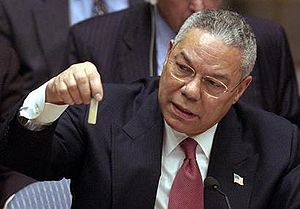
. In January 2002, President Bush began laying the public groundwork for an invasion of Iraq, calling Iraq a member of the Axis of Evil and saying that "The United States of America will not permit the world's most dangerous regimes to threaten us with the world's most destructive weapons." Over the next year, the Bush Administration began pushing for international support for an invasion of Iraq, a campaign that culminated in Secretary of State Colin Powell's February 5, 2003 presentation to the United Nations Security Council. After failing to gain U.N. support for an additional UN authorization, the U.S., together with the UK and small contingents from Australia, Poland, and Denmark, launched an invasion
2003 invasion of Iraq
The 2003 invasion of Iraq , was the start of the conflict known as the Iraq War, or Operation Iraqi Freedom, in which a combined force of troops from the United States, the United Kingdom, Australia and Poland invaded Iraq and toppled the regime of Saddam Hussein in 21 days of major combat operations...
on March 20, 2003 under the authority of UN Security Council Resolutions 660 and 678.
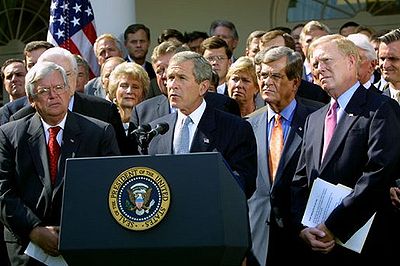
Iraq War Resolution
- Iraq's noncompliance with the conditions of the 1991 ceasefire agreement, including interference with U.N. weapons inspectors.
- Iraq's alleged weapons of mass destruction, and programs to develop such weapons, posed a "threat to the national security of the United States and international peace and security in the Persian Gulf region."
- Iraq's "brutal repression of its civilian population."
- Iraq's "capability and willingness to use weapons of mass destruction against other nations and its own people".
- Iraq's hostility towards the United States as demonstrated by the 1993 assassination attempt on former President George H. W. Bush and firing on coalition aircraft enforcing the no-fly zones following the 1991 Gulf War.
- Members of al-Qaeda, an organization bearing responsibility for attacks on the United States, its citizens, and interests, including the attacks that occurred on September 11, 2001, are known to be in Iraq.
- Iraq's "continuing to aid and harbor other international terrorist organizations," including anti-United States terrorist organizations.
- Iraq paid bounty to families of suicide bombers.
- The efforts by the Congress and the President to fight terrorists, including the September 11th, 2001 terrorists and those who aided or harbored them.
- The authorization by the Constitution and the Congress for the President to fight anti-United States terrorism.
- The governments in Turkey, Kuwait, and Saudi Arabia feared Saddam and wanted him removed from power.
- Citing the Iraq Liberation Act of 1998, the resolution reiterated that it should be the policy of the United States to remove the Saddam Hussein regime and promote a democratic replacement.
The Resolution required President Bush's diplomatic efforts at the U.N. Security Council to "obtain prompt and decisive action by the Security Council to ensure that Iraq abandons its strategy of delay, evasion, and noncompliance and promptly and strictly complies with all relevant Security Council resolutions." It authorized the United States to use military force to "defend the national security of the United States against the continuing threat posed by Iraq; and enforce all relevant United Nations Security Council Resolutions regarding Iraq."
Weapons of mass destruction
Throughout the run-up to the invasion of Iraq, George Bush and Tony Blair were explicit that they were concerned about a "single question" from the chief UN weapons inspector: Has the Iraqi regime fully and unconditionally disarmed, as required by Resolution 1441, or has it not? The U.S. government based their allegations that Iraq was developing Weapons of Mass DestructionWeapons of mass destruction
A weapon of mass destruction is a weapon that can kill and bring significant harm to a large number of humans and/or cause great damage to man-made structures , natural structures , or the biosphere in general...
, including nuclear weapons, upon documents that the CIA and others believed were unreliable.
George Bush, speaking in October 2002, said that "The stated policy of the United States is regime change… However, if [Hussein] were to meet all the conditions of the United Nations, the conditions that I have described very clearly in terms that everybody can understand, that in itself will signal the regime has changed." Similarly, in September 2002, Tony Blair stated, in an answer to a parliamentary question, that “Regime change in Iraq would be a wonderful thing. That is not the purpose of our action; our purpose is to disarm Iraq of weapons of mass destruction…” In November of that year, Tony Blair further stated that “So far as our objective, it is disarmament, not regime change - that is our objective. Now I happen to believe the regime of Saddam is a very brutal and repressive regime, I think it does enormous damage to the Iraqi people... so I have got no doubt Saddam is very bad for Iraq, but on the other hand I have got no doubt either that the purpose of our challenge from the United Nations is disarmament of weapons of mass destruction, it is not regime change.” At a press conference on January 31, 2003, George Bush stated: “Saddam Hussein must understand that if he does not disarm, for the sake of peace, we, along with others, will go disarm Saddam Hussein.” As late as February 25, 2003, Tony Blair said to the House of Commons: “I detest his regime. But even now he can save it by complying with the UN's demand. Even now, we are prepared to go the extra step to achieve disarmament peacefully.”
As Secretary of State Powell summarized in his February 5, 2003 presentation to the U.N. Security Council, "the facts and Iraq's behavior show that Saddam Hussein
Saddam Hussein
Saddam Hussein Abd al-Majid al-Tikriti was the fifth President of Iraq, serving in this capacity from 16 July 1979 until 9 April 2003...
and his regime are concealing their efforts to produce more weapons of mass destruction." On April 10, 2003, White House press secretary Ari Fleischer
Ari Fleischer
On May 19, 2003, he announced that he would resign during the summer, citing a desire to spend more time with his wife and to work in the private sector...
reiterated that, "But make no mistake -- as I said earlier -- we have high confidence that they have weapons of mass destruction. That is what this war was about and it is about. And we have high confidence it will be found." Despite the Bush Administration's consistent assertion that Iraqi weapons programs
Iraq and weapons of mass destruction
During the regime of Saddam Hussein, the nation of Iraq used, possessed, and made efforts to acquire weapons of mass destruction . Hussein was internationally known for his use of chemical weapons in the 1980s against Iranian and Kurdish civilians during and after the Iran–Iraq War...
justified an invasion, former Deputy Secretary of Defense
United States Deputy Secretary of Defense
The Deputy Secretary of Defense is the second-highest ranking official in the Department of Defense of the United States of America. The Deputy Secretary of Defense is appointed by the President, with the advice and consent of the Senate...
Paul Wolfowitz
Paul Wolfowitz
Paul Dundes Wolfowitz is a former United States Ambassador to Indonesia, U.S. Deputy Secretary of Defense, President of the World Bank, and former dean of the Paul H. Nitze School of Advanced International Studies at Johns Hopkins University...
later cast doubt on the Administration's conviction behind this rationale, saying in a May 2003 interview: "For bureaucratic reasons, we settled on one issue - weapons of mass destruction - because it was the one reason everyone could agree on."
After the invasion, despite an exhaustive search led by the Iraq Survey Group
Iraq Survey Group
The Iraq Survey Group was a fact-finding mission sent by the multinational force in Iraq after the 2003 invasion of Iraq to find the alleged weapons of mass destruction alleged to be possessed by Iraq that had been the main ostensible reason for the invasion. Its final report is commonly called...
involving a more than 1,400 member team, no evidence of Iraqi weapons programs was found. On the contrary, the investigation concluded that Iraq had destroyed all major stockpiles of WMD
WMD
WMD may refer to:* Weapon of mass destruction, a term used to describe munitions with the capacity to kill large numbers of human beings indiscriminately* Weighted mean difference, a measure in statistical meta-analysis...
s and ceased production in 1991 when sanctions
Iraq sanctions
The Iraq sanctions were a near-total financial and trade embargo imposed by the United Nations Security Council on the nation of Iraq. They began August 6, 1990, four days after Iraq's invasion of Kuwait, stayed largely in force until May 2003 , and certain portions including reparations to Kuwait...
were imposed.
The failure to find evidence of Iraqi weapons programs following the invasion led to considerable controversy in the United States
United States
The United States of America is a federal constitutional republic comprising fifty states and a federal district...
and worldwide, including claims by critics of the war that the Bush and Blair Administrations deliberately manipulated and misused intelligence to push for an invasion.
U.N. inspections before the invasion
Between 1991 and 1998, the United Nations Security Council tasked the United Nations Special Commission on Disarmament (UNSCOM) with finding and destroying Iraq's weapons of mass destruction. UNSCOM discovered evidence of continued biological weapons research and supervised destruction of the Al Hakam biological weapons production site - allegedly converted to a chicken feed plant, but retaining its barbed wire fences and antiaircraft defenses - in 1996. In 1998, Scott RitterScott Ritter
William Scott Ritter, Jr. was an important United Nations weapons inspector in Iraq from 1991 to 1998, and later a critic of United States foreign policy in the Middle East. Prior to the U.S. invasion of Iraq in March 2003, Ritter stated that Iraq possessed no significant weapons of mass...
, leader of a UNSCOM inspection team, found gaps in the prisoner records of Abu Ghraib when investigating allegations that prisoners had been used to test Anthrax weapons. Asked to explain the missing documents, the Iraqi government charged that Ritter was working for the CIA and refused to cooperate further with UNSCOM.
On August 26, 1998, approximately two months before the U.S. ordered United Nations inspectors withdrawn from Iraq, Scott Ritter resigned from his position rather than participate in what he called the "illusion of arms control." In his resignation letter to Ambassador Butler, Ritter wrote: "The sad truth is that Iraq today is not disarmed... UNSCOM has good reason to believe that there are significant numbers of proscribed weapons and related components and the means to manufacture such weapons unaccounted for in Iraq today ... Iraq has lied to the Special Commission and the world since day one concerning the true scope and nature of its proscribed programs and weapons systems." On September 7, 1998, in testimony to the Senate Armed Services and Foreign Relations Committee, Scott Ritter was asked by John McCain (R, AZ) whether UNSCOM had intelligence suggesting that Iraq had assembled the components for three nuclear weapons and all that it lacked was the fissile material. Ritter replied: "The Special Commission has intelligence information, which suggests that components necessary for three nuclear weapons exists, lacking the fissile material. Yes, sir."
On November 8, 2002, the U.N. Security Council passed Resolution 1441
United Nations Security Council Resolution 1441
United Nations Security Council Resolution 1441 is a United Nations Security Council resolution adopted unanimously by the United Nations Security Council on November 8, 2002, offering Iraq under Saddam Hussein "a final opportunity to comply with its disarmament obligations" that had been set out...
, giving Iraq "a final opportunity to comply with its disarmament obligations" including unrestricted inspections by the United Nations Monitoring, Verification and Inspection Commission
United Nations Monitoring, Verification and Inspection Commission
The United Nations Monitoring, Verification and Inspection Commission was created through the adoption of United Nations Security Council resolution 1284 of 17 December 1999....
(UNMOVIC) and the International Atomic Energy Agency
International Atomic Energy Agency
The International Atomic Energy Agency is an international organization that seeks to promote the peaceful use of nuclear energy, and to inhibit its use for any military purpose, including nuclear weapons. The IAEA was established as an autonomous organization on 29 July 1957...
(IAEA). Saddam Hussein accepted the resolution on November 13 and inspectors returned to Iraq under the direction of UNMOVIC chairman Hans Blix
Hans Blix
is a Swedish diplomat and politician for the Liberal People's Party. He was Swedish Minister for Foreign Affairs . Blix was also the head of the United Nations Monitoring, Verification and Inspection Commission from March 2000 to June 2003, when he was succeeded by Dimitris Perrikos...
and IAEA Director General Mohamed ElBaradei. Between that time and the time of the invasion, the IAEA "found no evidence or plausible indication of the revival of a nuclear weapons programme in Iraq"; the IAEA concluded that certain items which could have been used in nuclear enrichment centrifuges, such as aluminum tubes, were in fact intended for other uses. UNMOVIC "did not find evidence of the continuation or resumption of programmes of weapons of mass destruction" or significant quantities of proscribed items. UNMOVIC did supervise the destruction of a small number of empty chemical rocket warheads, 50 liters of mustard gas that had been declared by Iraq and sealed by UNSCOM in 1998, and laboratory quantities of a mustard gas precursor, along with about 50 Al-Samoud missiles of a design that Iraq claimed did not exceed the permitted 150 km range, but which had travelled up to 183 km in tests. Shortly before the invasion, UNMOVIC stated that it would take "months" to verify Iraqi compliance with resolution 1441.
Formal search after the invasion
After the invasion, the Iraq Survey GroupIraq Survey Group
The Iraq Survey Group was a fact-finding mission sent by the multinational force in Iraq after the 2003 invasion of Iraq to find the alleged weapons of mass destruction alleged to be possessed by Iraq that had been the main ostensible reason for the invasion. Its final report is commonly called...
(ISG), headed by American David Kay
David Kay
Dr. David A. Kay is best known for heading the Iraq Survey Group and acting as a Weapons inspector in Iraq after the 2003 U.S. invasion.-Education:...
, was tasked with searching for WMD. The survey ultimately concluded that Iraqi production of WMD ceased and all major stockpiles were destroyed in 1991 when economic sanctions
Iraq sanctions
The Iraq sanctions were a near-total financial and trade embargo imposed by the United Nations Security Council on the nation of Iraq. They began August 6, 1990, four days after Iraq's invasion of Kuwait, stayed largely in force until May 2003 , and certain portions including reparations to Kuwait...
were imposed, but that the expertise to restart production once sanctions were lifted was preserved. The group also concluded that Iraq continued developing long range missiles proscribed by the U.N. until just before the 2003 invasion.
In an interim report on October 3, 2003, Kay reported that the group had "not yet found stocks of weapons", but had discovered "dozens of WMD-related program activities" including clandestine laboratories "suitable for continuing CBW [chemical and biological warfare] research", a prison laboratory complex "possibly used in human testing of BW agents", a vial of live C. botulinum Okra B bacteria kept in one scientist's home, small parts and twelve year old documents "that would have been useful in resuming uranium enrichment", partially declared UAV
Unmanned aerial vehicle
An unmanned aerial vehicle , also known as a unmanned aircraft system , remotely piloted aircraft or unmanned aircraft, is a machine which functions either by the remote control of a navigator or pilot or autonomously, that is, as a self-directing entity...
s and undeclared fuel for Scud
Scud
Scud is a series of tactical ballistic missiles developed by the Soviet Union during the Cold War, and exported widely to other countries. The term comes from the NATO reporting name SS-1 Scud which was attached to the missile by Western intelligence agencies...
missiles with ranges beyond the 150 km U.N. limits, "[p]lans and advanced design work for new long-range missiles with ranges up to at least 1000 km", attempts to acquire long range missile technology from North Korea, and document destruction in headquarters buildings in Baghdad. None of the WMD programs involved active production; they instead appeared to be targeted at retaining the expertise needed to resume work once sanctions were dropped. Iraqi personnel involved with much of this work indicated they had orders to conceal it from U.N. weapons inspectors.
After Charles Duelfer took over from Kay in January 2004, Kay said at a Senate hearing that "we were almost all wrong" about Iraq having stockpiles of WMD, but that the other ISG findings made Iraq potentially "more dangerous" than was thought before the war. In an interview, Kay said that "a lot" of the former Iraqi government's WMD program had been moved to Syria shortly before the 2003 invasion, albeit not including large stockpiles of weapons.
On September 30, 2004, The ISG, under Charles Duelfer, issued a comprehensive report. The report stated that "Iraq's WMD capability ... was essentially destroyed in 1991" and that Saddam Hussein subsequently focused on ending the sanctions
Iraq sanctions
The Iraq sanctions were a near-total financial and trade embargo imposed by the United Nations Security Council on the nation of Iraq. They began August 6, 1990, four days after Iraq's invasion of Kuwait, stayed largely in force until May 2003 , and certain portions including reparations to Kuwait...
and "preserving the capability to reconstitute his weapons of mass destruction (WMD) when sanctions were lifted". No evidence was found for continued active production of WMD subsequent to the imposition of sanctions in 1991, though "[b]y 2000-2001, Saddam had managed to mitigate many of the effects of sanctions".
The report concluded in its Key Findings that: "Saddam [Hussein] so dominated the Iraqi Regime that its strategic intent was his alone... The former Regime had no formal written strategy or plan for the revival of WMD after sanctions. Neither was there an identifiable group of WMD policy makers or planners separate from Saddam. Instead, his lieutenants understood WMD revival was his goal from their long association with Saddam and his infrequent, but firm, verbal comments and directions to them." The report also noted that "Iran was the pre-eminent motivator of [Iraq's WMD revival] policy... The wish to balance Israel and acquire status and influence in the Arab world were also considerations, but secondary." A March 2005 addendum to the report stated that "[B]ased on the evidence available at present, ISG judged that it was unlikely that an official transfer of WMD material from Iraq to Syria took place. However, ISG was unable to rule out unofficial movement of limited WMD-related materials."
On January 12, 2005, U.S. military forces abandoned the formal search. Transcripts from high level meetings within Saddam Hussein's government before the invasion are consistent with the ISG conclusion that he destroyed his stockpiles of WMD but maintained the expertise to restart production.
Discovery of degraded chemical weapons
During the post-invasion search for WMD, U.S. and Polish forces located some decayed chemical weapons that dated to the Iran-Iraq warIran-Iraq War
The Iran–Iraq War was an armed conflict between the armed forces of Iraq and Iran, lasting from September 1980 to August 1988, making it the longest conventional war of the twentieth century...
. These discoveries led former senator Rick Santorum
Rick Santorum
Richard John "Rick" Santorum is a lawyer and a former United States Senator from the commonwealth of Pennsylvania. Santorum was the chairman of the Senate Republican Conference -making him the third-ranking Senate Republican from 2001 until his leave in 2007. Santorum is considered both a social...
(R-PA) and representative Peter Hoekstra (R-MI) to claim that the U.S. had indeed found weapons of mass destruction in Iraq.
These assertions were directly contradicted by weapons experts David Kay, the original director of the Iraq Survey Group
Iraq Survey Group
The Iraq Survey Group was a fact-finding mission sent by the multinational force in Iraq after the 2003 invasion of Iraq to find the alleged weapons of mass destruction alleged to be possessed by Iraq that had been the main ostensible reason for the invasion. Its final report is commonly called...
, and his successor Charles Duelfer. Both Kay and Duelfer made clear that the chemical weapons found were not the "weapons of mass destruction" that the U.S. was looking for and that their discovery did not suggest a broader chemical weapons stockpile or an ongoing weapons program under Saddam Hussein. Kay added that experts on Iraq's chemical weapons are in "almost 100 percent agreement" that sarin nerve agent produced in the 1980s would no longer be dangerous and that the chemical weapons found were "less toxic than most things that Americans have under their kitchen sink at this point". In reply, Hoekstra said "I am 100 percent sure if David Kay had the opportunity to look at the reports.. he would agree.. these things are lethal and deadly." Discussing the findings on NPR's Talk of the Nation, Charles Duelfer described such residual chemical munitions as hazardous but not deadly.
What we found, both as UN and later when I was with the Iraq Survey Group, is that some of these rounds would have highly degraded agent, but it is still dangerous. You know, it can be a local hazard. If an insurgent got it and wanted to create a local hazard, it could be exploded. When I was running the ISG – the Iraq Survey Group – we had a couple of them that had been turned in to these IEDs, the improvised explosive devices. But they are local hazards. They are not a major, you know, weapon of mass destruction.
The degraded chemical weapons were first discovered in May 2004, when a binary sarin nerve gas shell was used in an improvised explosive device
Improvised explosive device
An improvised explosive device , also known as a roadside bomb, is a homemade bomb constructed and deployed in ways other than in conventional military action...
(roadside bomb) in Iraq. The device exploded before it could be disarmed, and two soldiers displayed symptoms of minor sarin exposure. The 155 mm shell was unmarked and rigged as if it were a normal high explosive shell, indicating that the insurgents who placed the device did not know it contained nerve gas. Earlier in the month, a shell containing mustard gas was found abandoned in the median of a road in Baghdad.
In July 2004, Polish troops also found evidence of degraded chemical weapons when they discovered insurgents trying to purchase cyclosarin gas warheads produced during the Iran-Iraq war
Iran-Iraq War
The Iran–Iraq War was an armed conflict between the armed forces of Iraq and Iran, lasting from September 1980 to August 1988, making it the longest conventional war of the twentieth century...
. In their efforts to thwart insurgents acquiring these weapons, Polish troops purchased two rockets on June 23, 2004. The U.S. military later determined that the two rockets had only trace elements of sarin that were so small and deteriorated as to be virtually harmless and would have "limited to no impact if used by insurgents against coalition forces"
Conclusions
The failure to find stockpiles of weapons of mass destruction in Iraq caused considerable controversy, particularly in the United States. U.S. President George W. BushGeorge W. Bush
George Walker Bush is an American politician who served as the 43rd President of the United States, from 2001 to 2009. Before that, he was the 46th Governor of Texas, having served from 1995 to 2000....
and Prime Minister of the United Kingdom
Prime Minister of the United Kingdom
The Prime Minister of the United Kingdom of Great Britain and Northern Ireland is the Head of Her Majesty's Government in the United Kingdom. The Prime Minister and Cabinet are collectively accountable for their policies and actions to the Sovereign, to Parliament, to their political party and...
Tony Blair
Tony Blair
Anthony Charles Lynton Blair is a former British Labour Party politician who served as the Prime Minister of the United Kingdom from 2 May 1997 to 27 June 2007. He was the Member of Parliament for Sedgefield from 1983 to 2007 and Leader of the Labour Party from 1994 to 2007...
defended their decision to go to war, alleging that many nations, even those opposed to war, believed that the Hussein government was actively developing WMDs.
Critics such as Democratic National Committee
Democratic National Committee
The Democratic National Committee is the principal organization governing the United States Democratic Party on a day to day basis. While it is responsible for overseeing the process of writing a platform every four years, the DNC's central focus is on campaign and political activity in support...
Chairman Howard Dean
Howard Dean
Howard Brush Dean III is an American politician and physician from Vermont. He served six terms as the 79th Governor of Vermont and ran unsuccessfully for the 2004 Democratic presidential nomination. He was chairman of the Democratic National Committee from 2005 to 2009. Although his U.S...
charged that the Bush and Blair administrations deliberately falsified evidence to build a case for war. These criticisms were strengthened with the 2005 release of the so-called Downing Street Memo
Downing Street memo
The "Downing Street memo" , sometimes described by critics of the Iraq War as the "smoking gun memo", is the note of a secret 23 July 2002, meeting of senior British Labour government, defence and intelligence figures discussing the build-up to the war, which included direct reference to classified...
, written in July 2002, in which the former head of British Military Intelligence wrote that "the intelligence and facts were being fixed [by the U.S.] around the policy" of removing Saddam Hussein from power.
While the Downing Street Memo
Downing Street memo
The "Downing Street memo" , sometimes described by critics of the Iraq War as the "smoking gun memo", is the note of a secret 23 July 2002, meeting of senior British Labour government, defence and intelligence figures discussing the build-up to the war, which included direct reference to classified...
and the yellowcake uranium scandal lend credence to claims that intelligence was manipulated, two bipartisan investigations, one by the Senate Intelligence Committee and the other by a specially appointed Iraq Intelligence Commission
Iraq Intelligence Commission
The Commission on the Intelligence Capabilities of the United States Regarding Weapons of Mass Destruction is a panel created by Executive Order 13328 signed by U.S. President George W. Bush in February 2004...
chaired by Charles Robb and Laurence Silberman, found no evidence of political pressure applied to intelligence analysts. An independent assessment by the Annenberg Public Policy Center found, however, that Bush Administration officials did misuse intelligence in their public communications. For example, Vice President Dick Cheney's September 2002 statement on Meet the Press
Meet the Press
Meet the Press is a weekly American television news/interview program produced by NBC. It is the longest-running television series in American broadcasting history, despite bearing little resemblance to the original format of the program seen in its television debut on November 6, 1947. It has been...
that "we do know, with absolute certainty, that he (Saddam) is using his procurement system to acquire the equipment he needs in order to enrich uranium to build a nuclear weapon" was inconsistent with the views of the intelligence community at the time.
A study coauthored by the Center for Public Integrity
Center for Public Integrity
The Center for Public Integrity is a nonprofit organization dedicated to producing original, responsible investigative journalism on issues of public concern. The Center is non-partisan and non-advocacy and committed to transparent and comprehensive reporting both in the United States and around...
found that in the two years after September 11, 2001 the president and top administration officials had made 935 false statements, in an orchestrated public relations campaign to galvanize public opinion for the war, and that the press was largely complicit in its uncritical coverage of the reasons adduced for going to war. PBS commentator Bill Moyers
Bill Moyers
Bill Moyers is an American journalist and public commentator. He served as White House Press Secretary in the United States President Lyndon B. Johnson Administration from 1965 to 1967. He worked as a news commentator on television for ten years. Moyers has had an extensive involvement with public...
had made similar points throughout the run up to the Iraq War, and prior to a national press conference on the Iraq War Moyers correctly predicted "at least a dozen times during this press conference he [the President] will invoke 9/11 and Al Qaeda to justify a preemptive attack on a country that has not attacked America. But the White House press corps will ask no hard questions tonight about those claims." Moyers later also denounced the complicity of the press in the administration's campaign for the war, saying that the media "surrendered its independence and skepticism to join with [the U.S.] government in marching to war," and that the administration "needed a compliant press, to pass on their propaganda as news and cheer them on."
Many in the intelligence community expressed sincere regret over the flawed predictions about Iraqi weapons programs. Testifying before Congress in January 2004, David Kay
David Kay
Dr. David A. Kay is best known for heading the Iraq Survey Group and acting as a Weapons inspector in Iraq after the 2003 U.S. invasion.-Education:...
, the original director of the Iraq Survey Group
Iraq Survey Group
The Iraq Survey Group was a fact-finding mission sent by the multinational force in Iraq after the 2003 invasion of Iraq to find the alleged weapons of mass destruction alleged to be possessed by Iraq that had been the main ostensible reason for the invasion. Its final report is commonly called...
, said unequivocally that "It turns out that we were all wrong, probably in my judgment, and that is most disturbing." He later added in an interview that the intelligence community owed the President an apology.
In the aftermath of the invasion, much attention was also paid to the role of the press in promoting government claims concerning WMD production in Iraq. Between 1998 and 2003, The New York Times
The New York Times
The New York Times is an American daily newspaper founded and continuously published in New York City since 1851. The New York Times has won 106 Pulitzer Prizes, the most of any news organization...
and other influential U.S. newspapers published numerous articles about suspected Iraqi rearmament programs with headlines like "Iraqi Work Toward A-Bomb Reported" and "Iraq Suspected of Secret Germ War Effort." It later turned out that many of the sources for these articles were unreliable, and that some were tied to Ahmed Chalabi
Ahmed Chalabi
Ahmed Abdel Hadi Chalabi is an Iraqi politician. He was interim oil minister in Iraq in April-May 2005 and December-January 2006 and deputy prime minister from May 2005 until May 2006. Chalabi failed to win a seat in parliament in the December 2005 elections, and when the new Iraqi cabinet was...
, an Iraqi exile with close ties to the Bush Administration who was a consistent supporter of an invasion.
Some controversy also exists regarding whether the invasion increased or decreased the potential for nuclear proliferation. For example, hundreds of tons of dual-use high explosives that could be used to detonate fissile material in a nuclear weapon were sealed by the IAEA at the Al Qa'qaa
Al Qa'qaa
The Al Qa'qaa State Establishment in Iraq was a massive weapons facility 48 kilometres south of Baghdad. It is near to the towns of Yusifiyah and Iskandariya at the geographic coordinates...
site in January 2003. Immediately before the invasion, UN Inspectors had checked the locked bunker doors, but not the actual contents; the bunkers also had large ventilation shafts that were not sealed. By October, the material was no longer present. The IAEA expressed concerns that the material might have been looted after the invasion, posing a nuclear proliferation threat. The U.S. released satellite photographs from March 17, showing trucks at the site large enough to remove substantial amounts of material before U.S. forces reached the area in April. Ultimately, Major Austin Pearson of Task Force Bullet, a task force charged with securing and destroying Iraqi ammunition after the invasion, stated that the task force had removed about 250 tons of material from the site and had detonated it or used it to detonate other munitions. Similar concerns were raised about other dual use materials, such as high strength aluminum; before the invasion, the U.S. cited them as evidence for an Iraqi nuclear weapons program, while the IAEA was satisfied that they were being used for permitted industrial uses; after the war, the IAEA emphasized the proliferation concern, while the Duelfer report mentioned the material's use as scrap. Possible chemical weapons laboratories have also been found which were built subsequent to the 2003 invasion, apparently by insurgent forces.
On August 2, 2004, President Bush stated "Knowing what I know today we still would have gone on into Iraq.… The decision I made is the right decision. The world is better off without Saddam Hussein in power."
Iraqi links to terrorist organizations
Along with Iraq's alleged development of WMDs, another justification for invasion was the purported link between Saddam Hussein's government and terrorist organizations, in particular Al-QaedaAl-Qaeda
Al-Qaeda is a global broad-based militant Islamist terrorist organization founded by Osama bin Laden sometime between August 1988 and late 1989. It operates as a network comprising both a multinational, stateless army and a radical Sunni Muslim movement calling for global Jihad...
. In that sense, the Bush Administration cast the Iraq war as part of the broader War on Terrorism
War on Terrorism
The War on Terror is a term commonly applied to an international military campaign led by the United States and the United Kingdom with the support of other North Atlantic Treaty Organisation as well as non-NATO countries...
. As with the argument that Iraq was developing biological and nuclear weapons, evidence linking Hussein and Al-Qaeda was discredited by multiple U.S. intelligence agencies soon after the invasion of Iraq.
Al-Qaeda
In asserting a link between Saddam HusseinSaddam Hussein
Saddam Hussein Abd al-Majid al-Tikriti was the fifth President of Iraq, serving in this capacity from 16 July 1979 until 9 April 2003...
and Al Qaeda, the Bush Administration focused special attention on alleged ties between Hussein and Jordanian terrorist Abu Musab al-Zarqawi
Abu Musab al-Zarqawi
Abu Musab al-Zarqawi ; October 30, 1966 – June 7, 2006), born Ahmad Fadeel al-Nazal al-Khalayleh was a Jordanian militant Islamist who ran a paramilitary training camp in Afghanistan...
, who Secretary of State Powell called a "collaborator of Osama bin Laden
Osama bin Laden
Osama bin Mohammed bin Awad bin Laden was the founder of the militant Islamist organization Al-Qaeda, the jihadist organization responsible for the September 11 attacks on the United States and numerous other mass-casualty attacks against civilian and military targets...
." Soon after the start of the war, however, evidence of such ties was discredited by multiple U.S. intelligence agencies, including the Central Intelligence Agency
Central Intelligence Agency
The Central Intelligence Agency is a civilian intelligence agency of the United States government. It is an executive agency and reports directly to the Director of National Intelligence, responsible for providing national security intelligence assessment to senior United States policymakers...
(CIA), the Defense Intelligence Agency
Defense Intelligence Agency
The Defense Intelligence Agency is a member of the Intelligence Community of the United States, and is the central producer and manager of military intelligence for the United States Department of Defense, employing over 16,500 U.S. military and civilian employees worldwide...
, and the Defense Department's Inspector General's Office. A CIA report in early October 2004 "found no clear evidence of Iraq harboring Abu Musab al-Zarqawi," More broadly, the CIA's Kerr Group summarized in 2004 that despite "a 'purposely aggressive approach' in conducting exhaustive and repetitive searches for such links... [the U.S.] Intelligence Community remained firm in its assessment that no operational or collaborative relationship existed." Despite these findings, U.S. Vice President Dick Cheney
Dick Cheney
Richard Bruce "Dick" Cheney served as the 46th Vice President of the United States , under George W. Bush....
has continued to assert that a link existed between Al-Qaeda
Al-Qaeda
Al-Qaeda is a global broad-based militant Islamist terrorist organization founded by Osama bin Laden sometime between August 1988 and late 1989. It operates as a network comprising both a multinational, stateless army and a radical Sunni Muslim movement calling for global Jihad...
and Saddam Hussein
Saddam Hussein
Saddam Hussein Abd al-Majid al-Tikriti was the fifth President of Iraq, serving in this capacity from 16 July 1979 until 9 April 2003...
prior to the 2003 invasion of Iraq
2003 invasion of Iraq
The 2003 invasion of Iraq , was the start of the conflict known as the Iraq War, or Operation Iraqi Freedom, in which a combined force of troops from the United States, the United Kingdom, Australia and Poland invaded Iraq and toppled the regime of Saddam Hussein in 21 days of major combat operations...
, which has drawn criticism from members of the intelligence community and leading Democrats. As of the invasion, Bush's own State Department listed 45 countries, including the United States where Al Qaeda was active. Iraq was not one of them.
The eventual lack of evidence linking the Hussein government and Al Qaeda led many war critics to allege that the Bush Administration purposely fabricated such links to strengthen the case for the invasion.
These claims were supported by the July 2005 release of the so-called Downing Street Memo
Downing Street memo
The "Downing Street memo" , sometimes described by critics of the Iraq War as the "smoking gun memo", is the note of a secret 23 July 2002, meeting of senior British Labour government, defence and intelligence figures discussing the build-up to the war, which included direct reference to classified...
, in which Richard Dearlove
Richard Dearlove
Sir Richard Billing Dearlove, KCMG, OBE was head of the British Secret Intelligence Service from 1999 until 6 May 2004.-Career:...
(then head of British foreign intelligence service MI6) wrote that "the intelligence and facts were being fixed [by the U.S.] around the policy" of removing Saddam Hussein
Saddam Hussein
Saddam Hussein Abd al-Majid al-Tikriti was the fifth President of Iraq, serving in this capacity from 16 July 1979 until 9 April 2003...
from power. In addition, in his April 2007 report Acting Inspector General Thomas F. Gimble found that the Defense Department's Office of Special Plans—run by then-Undersecretary of Defense Douglas J. Feith, a close ally of Vice President Dick Cheney and Secretary of Defense Donald Rumsfeld—purposely manipulated evidence to strengthen the case for war. The Inspector General's report also highlighted the role of members of the Iraqi National Congress
Iraqi National Congress
The Iraqi National Congress is an umbrella Iraqi opposition group led by Ahmed Chalabi. It was formed with the aid and direction of the United States government following the Gulf War, for the purpose of fomenting the overthrow of Iraqi leader Saddam Hussein.-History:INC was set up following the...
, a group headed by Ahmad Chalabi in providing false intelligence about connections with al-Qaeda to build support for a U.S. invasion.
Other terrorist organizations
In making its case for the invasion of Iraq, the Bush Administration also made mention of Saddam Hussein's relationships with terrorist organizations other than al Qaeda. It is reported that Hussein provided financial assistance to the families of Palestinians killed in the conflict – including as much as $25,000 to the families of suicide bombers, some of whom were working with militant organizations in the Middle East such as HamasHamas
Hamas is the Palestinian Sunni Islamic or Islamist political party that governs the Gaza Strip. Hamas also has a military wing, the Izz ad-Din al-Qassam Brigades...
.
Human rights
The U.S. has cited the United NationsUnited Nations
The United Nations is an international organization whose stated aims are facilitating cooperation in international law, international security, economic development, social progress, human rights, and achievement of world peace...
in condemnation of Hussein's human right abuses as one of several reasons for the Iraq invasion.
As evidence supporting U.S. and British claims about Iraqi WMDs weakened, the Bush Administration began to focus more upon the other issues that Congress had articulated within the Iraq Resolution
Iraq Resolution
The Iraq Resolution or the Iraq War Resolution is a joint resolution passed by the United States Congress in October 2002 as Public Law No: 107-243, authorizing military action against Iraq.-Contents:The resolution cited many factors to justify the use of military force against...
such as human rights violations of the Hussein government
Human rights in Saddam's Iraq
Iraq under Saddam Hussein had high levels of torture and mass murder.Secret police, torture, murders, rape, abductions, deportations, forced disappearances, assassinations, chemical weapons, and the destruction of wetlands were some of the methods Saddam Hussein used to maintain control...
as justification for military intervention. That the Hussein government consistently and violently violated the human right of its people is in little doubt. During his more than twenty-year rule, Hussein killed and tortured thousands of Iraqi citizens, including gassing
Halabja poison gas attack
The Halabja poison gas attack , also known as Halabja massacre or Bloody Friday, was a genocidal massacre against the Kurdish people that took place on March 16, 1988, during the closing days of the Iran–Iraq War, when chemical weapons were used by the Iraqi government forces in the Kurdish town of...
and killing thousands of Kurds
Al-Anfal Campaign
The al-Anfal Campaign , also known as Operation Anfal or simply Anfal, was a genocidal campaign against the Kurdish people in Northern Iraq, led by the Iraqi regime of Saddam Hussein and headed by Ali Hassan al-Majid in the final stages of Iran-Iraq War...
in northern Iraq during the mid 1980s, brutally repressing Shia and Kurdish uprisings following the 1991 Gulf War, and a fifteen year campaign of repression and displacement of the Marsh Arabs
Marsh Arabs
The Marsh Arabs , also known as the Maʻdān , are inhabitants of the Tigris-Euphrates marshlands in the south and east of Iraq and along the Iranian border....
in Southern Iraq.
Hussein's brutal human rights record notwithstanding, war critics have severely questioned its use as rationale for military intervention.
Many critics have argued, despite its repeated mention in the Joint Resolution, that human rights was never a principal justification for the war, and that it became prominent only after evidence concerning WMDs and Hussein's links to terrorism became discredited. For example, during a July 29, 2003, hearing of the Senate Foreign Relations Committee, then Deputy Secretary of Defense Paul Wolfowitz
Paul Wolfowitz
Paul Dundes Wolfowitz is a former United States Ambassador to Indonesia, U.S. Deputy Secretary of Defense, President of the World Bank, and former dean of the Paul H. Nitze School of Advanced International Studies at Johns Hopkins University...
spent the majority of his testimony discussing Hussein's human rights record, causing Senator Lincoln Chafee
Lincoln Chafee
Lincoln Davenport Chafee is an American politician who has been the 74th Governor of Rhode Island since January 2011. Prior to his election as governor, Chafee served in the United States Senate as a Republican from 1999 until losing his Senate re-election bid in 2006 to Democrat Sheldon...
(R-RI) to complain that "in the months leading up to the war it was a steady drum beat of weapons of mass destruction, weapons of mass destruction, weapons of mass destruction. And, Secretary Wolfowitz, in your almost hour-long testimony here this morning, once -- only once did you mention weapons of mass destruction, and that was an ad lib."
Leading human rights groups such as Human Rights Watch
Human Rights Watch
Human Rights Watch is an international non-governmental organization that conducts research and advocacy on human rights. Its headquarters are in New York City and it has offices in Berlin, Beirut, Brussels, Chicago, Geneva, Johannesburg, London, Los Angeles, Moscow, Paris, San Francisco, Tokyo,...
and Amnesty International
Amnesty International
Amnesty International is an international non-governmental organisation whose stated mission is "to conduct research and generate action to prevent and end grave abuses of human rights, and to demand justice for those whose rights have been violated."Following a publication of Peter Benenson's...
further argued that even had human rights concerns been a central rationale for the invasion, military intervention would not have been justifiable on humanitarian grounds. As Human Rights Watch's Ken Roth wrote in 2004, despite Hussein's horrific human rights record, "the killing in Iraq at the time was not of the exceptional nature that would justify such intervention."
More broadly, war critics have argued that the U.S. supported the Hussein regime during the 1980s
United States support for Iraq during the Iran–Iraq war
United States support for Iraq during the Iran–Iraq War, as a counterbalance to post-revolutionary Iran, included several billion dollars worth of economic aid, the sale of dual-use technology, non-U.S. origin weaponry, military intelligence, Special Operations training, and direct involvement in...
, a period of some of his worst human rights abuses, thus casting doubt on the sincerity of claims that military intervention was for humanitarian purposes. Documents from the National Security Archive
National Security Archive
The National Security Archive is a 501 non-governmental, non-profit research and archival institution located in the George Washington University in Washington, D.C.. Founded in 1985 by Scott Armstrong, it archives and publishes declassified U.S. government files concerning selected topics of US...
released in 2003 show that the U.S. provided considerable military and financial support during the Iran-Iraq war
Iran-Iraq War
The Iran–Iraq War was an armed conflict between the armed forces of Iraq and Iran, lasting from September 1980 to August 1988, making it the longest conventional war of the twentieth century...
with full knowledge that the Hussein government was regularly using chemical weapons on Iranian soldiers and Kurdish insurgents. Following along this line, critics of the use of human rights as a rationale, such as Columbia University
Columbia University
Columbia University in the City of New York is a private, Ivy League university in Manhattan, New York City. Columbia is the oldest institution of higher learning in the state of New York, the fifth oldest in the United States, and one of the country's nine Colonial Colleges founded before the...
Law Professor Michael Dorf, have pointed out that during his first campaign for president
United States presidential election, 2000
The United States presidential election of 2000 was a contest between Republican candidate George W. Bush, then-governor of Texas and son of former president George H. W. Bush , and Democratic candidate Al Gore, then-Vice President....
Bush was highly critical of using U.S. military might for humanitarian ends.
Others have questioned why military intervention for humanitarian reasons was justified in Iraq but not in other countries where human rights violations were even greater, such as Liberia
Liberia
Liberia , officially the Republic of Liberia, is a country in West Africa. It is bordered by Sierra Leone on the west, Guinea on the north and Côte d'Ivoire on the east. Liberia's coastline is composed of mostly mangrove forests while the more sparsely populated inland consists of forests that open...
or Darfur
Darfur
Darfur is a region in western Sudan. An independent sultanate for several hundred years, it was incorporated into Sudan by Anglo-Egyptian forces in 1916. The region is divided into three federal states: West Darfur, South Darfur, and North Darfur...
.
United Nations
In the end, by Article 1 of the UN Charter, the United NationsUnited Nations
The United Nations is an international organization whose stated aims are facilitating cooperation in international law, international security, economic development, social progress, human rights, and achievement of world peace...
has the responsibility: "To achieve international co-operation in solving international problems of an economic, social, cultural, or humanitarian character, and in promoting and encouraging respect for human rights and for fundamental freedoms for all without distinction as to race, sex, language, or religion. By UN Charter Article 39, the responsibility for this determination lies with the Security Council Although every UN member has the right to bring these human rights issues before the Security Council, none have.
Ending sanctions
U.S. Vice President Dick CheneyDick Cheney
Richard Bruce "Dick" Cheney served as the 46th Vice President of the United States , under George W. Bush....
, who called the sanctions "the most intrusive system of arms control in history", cited the breakdown of the sanctions as one rationale for the Iraq war. Accepting a controversial large estimate of casualties due to sanctions, Walter Russell Mead
Walter Russell Mead
Walter Russell Mead is James Clarke Chace Professor of Foreign Affairs and Humanities at Bard College and Editor-at-Large of The American Interest magazine, and is recognized as one of the country's leading students of American foreign policy . Until 2010, Mead was the Henry A. Kissinger Senior...
argued on behalf of such a war as a better alternative than continuing the sanctions regime, since "Each year of containment is a new Gulf War
Gulf War
The Persian Gulf War , commonly referred to as simply the Gulf War, was a war waged by a U.N.-authorized coalition force from 34 nations led by the United States, against Iraq in response to Iraq's invasion and annexation of Kuwait.The war is also known under other names, such as the First Gulf...
." However, economist Michael Spagat "argue[s] that the contention that sanctions had caused the deaths of more than half a million children is [as were WMD
WMD
WMD may refer to:* Weapon of mass destruction, a term used to describe munitions with the capacity to kill large numbers of human beings indiscriminately* Weighted mean difference, a measure in statistical meta-analysis...
claims] very likely to be wrong."
Oil not a factor in the Iraq war
Tony BlairTony Blair
Anthony Charles Lynton Blair is a former British Labour Party politician who served as the Prime Minister of the United Kingdom from 2 May 1997 to 27 June 2007. He was the Member of Parliament for Sedgefield from 1983 to 2007 and Leader of the Labour Party from 1994 to 2007...
stated the theory the Iraq invasion was "somehow to do with oil" was a "conspiracy theory
Conspiracy theory
A conspiracy theory explains an event as being the result of an alleged plot by a covert group or organization or, more broadly, the idea that important political, social or economic events are the products of secret plots that are largely unknown to the general public.-Usage:The term "conspiracy...
"; "Let me first deal with the conspiracy theory that this is somehow to do with oil...The very reason why we are taking the action that we are taking is nothing to do with oil or any of the other conspiracy theories put forward."
Then Australian Prime Minister John Howard
John Howard
John Winston Howard AC, SSI, was the 25th Prime Minister of Australia, from 11 March 1996 to 3 December 2007. He was the second-longest serving Australian Prime Minister after Sir Robert Menzies....
has dismissed on multiple occasions the role of oil in the Iraq Invasion: "We didn't go there because of oil and we don't remain there because of oil." In early 2003 John Howard stated, "No criticism is more outrageous than the claim that United States behaviour is driven by a wish to take control of Iraq's oil reserves."
2008 Republican Presidential Candidate John McCain
John McCain
John Sidney McCain III is the senior United States Senator from Arizona. He was the Republican nominee for president in the 2008 United States election....
was forced to clarify his comments suggesting the Iraq war involved U.S. reliance on foreign oil. "My friends, I will have an energy policy that we will be talking about, which will eliminate our dependence on oil from the Middle East that will prevent us from having ever to send our young men and women into conflict again in the Middle East," McCain said. To clarify his comments, McCain explained that "the word `again' was misconstrued, I want us to remove our dependency on foreign oil for national security reasons, and that's all I mean."
Oil a factor in the Iraq war
In July 2003, Polish Foreign Minister, Wlodzimierz CimoszewiczWlodzimierz Cimoszewicz
Włodzimierz Cimoszewicz is a Polish politician. He was a member of the left-wing Democratic Left Alliance, the Prime Minister of Poland from 1996 to Autumn 1997, the Foreign Minister of Poland in the governments of Leszek Miller and Marek Belka , the speaker of the Sejm in January – October 2005...
, said "We have never hidden our desire for Polish oil companies to finally have access to sources of commodities." This remark came after a group of Polish firms had just signed a deal with Kellogg, Brown and Root, a subsidiary of Halliburton. Cimoszewicz stated that access to Iraq's oilfields "is our ultimate objective".
In an August 30, 2005 speech, Bush stated a role of the occupation of Iraq was to prevent oil fields from falling into hands of terrorists: “If Zarqawi and bin Laden
Osama bin Laden
Osama bin Mohammed bin Awad bin Laden was the founder of the militant Islamist organization Al-Qaeda, the jihadist organization responsible for the September 11 attacks on the United States and numerous other mass-casualty attacks against civilian and military targets...
gain control of Iraq, they would create a new training ground for future terrorist attacks. They’d seize oil fields to fund their ambitions.”
Alan Greenspan
Alan Greenspan
Alan Greenspan is an American economist who served as Chairman of the Federal Reserve of the United States from 1987 to 2006. He currently works as a private advisor and provides consulting for firms through his company, Greenspan Associates LLC...
, the former Federal Reserve chairman, said in an interview that the removal of Saddam Hussein
Saddam Hussein
Saddam Hussein Abd al-Majid al-Tikriti was the fifth President of Iraq, serving in this capacity from 16 July 1979 until 9 April 2003...
had been "essential" to secure world oil supplies, a point he emphasized to the White House in private conversations before the 2003 invasion of Iraq. Additionally, in his memoir, Mr. Greenspan writes: "I am saddened that it is politically inconvenient to acknowledge what everyone knows: the Iraq war is largely about oil." However, a Bush administration foreign policy critic Dr. Robert Jervis stated: "Indeed, it is quite likely that failure [in Iraq] will lead the most common explanation to be that the war was fought for oil and Israel
Israel
The State of Israel is a parliamentary republic located in the Middle East, along the eastern shore of the Mediterranean Sea...
. This would be unfortunate."
One report by BBC journalist Gregory Palast citing unnamed "insiders" alleged that the U.S. "called for the sell-off of all of Iraq's oil fields" and planned for a coup d'état in Iraq long before September 11. It was also alleged by the BBC's Greg Palast that the "new plan was crafted by neo-conservatives intent on using Iraq's oil to destroy the OPEC cartel through massive increases in production above OPEC quotas", but in reality Iraq oil production decreased with the neoconservative strategy and had the opposite effect.
Many critics have focused upon administration officials' past relationship with energy sector corporations. Both the President
George W. Bush
George Walker Bush is an American politician who served as the 43rd President of the United States, from 2001 to 2009. Before that, he was the 46th Governor of Texas, having served from 1995 to 2000....
and Vice President
Dick Cheney
Richard Bruce "Dick" Cheney served as the 46th Vice President of the United States , under George W. Bush....
were formerly CEOs of oil and oil-related companies such as Arbusto, Harken Energy
Harken Energy
HKN, Inc., formerly known as Harken Energy Corporation, is a small American oil and gas production company, with ownership interests in other production companies. The company is headquartered in Southlake, Texas, near Fort Worth. There is a second office near Dallas, in the town of Paris. The...
, Spectrum 7
Spectrum 7
Spectrum 7 was an oil company started by William DeWitt and Mercer Reynolds.In 1984, Spectrum 7 merged with George W. Bush's Arbusto Energy. After the merger, Bush became the Chairman and CEO of Spectrum 7....
, and Halliburton
Halliburton
Halliburton is the world's second largest oilfield services corporation with operations in more than 70 countries. It has hundreds of subsidiaries, affiliates, branches, brands and divisions worldwide and employs over 50,000 people....
. Before the 2003 invasion of Iraq
2003 invasion of Iraq
The 2003 invasion of Iraq , was the start of the conflict known as the Iraq War, or Operation Iraqi Freedom, in which a combined force of troops from the United States, the United Kingdom, Australia and Poland invaded Iraq and toppled the regime of Saddam Hussein in 21 days of major combat operations...
and even before the War on Terror
War on Terror
The War on Terror is a term commonly applied to an international military campaign led by the United States and the United Kingdom with the support of other North Atlantic Treaty Organisation as well as non-NATO countries...
, the administration had prompted anxiety over whether the private sector ties of cabinet members (including National Security Advisor
National Security Advisor (United States)
The Assistant to the President for National Security Affairs, commonly referred to as the National Security Advisor , serves as the chief advisor to the President of the United States on national security issues...
Condoleezza Rice
Condoleezza Rice
Condoleezza Rice is an American political scientist and diplomat. She served as the 66th United States Secretary of State, and was the second person to hold that office in the administration of President George W. Bush...
, former director of Chevron
Chevron Corporation
Chevron Corporation is an American multinational energy corporation headquartered in San Ramon, California, United States and active in more than 180 countries. It is engaged in every aspect of the oil, gas, and geothermal energy industries, including exploration and production; refining,...
, and Commerce Secretary
United States Secretary of Commerce
The United States Secretary of Commerce is the head of the United States Department of Commerce concerned with business and industry; the Department states its mission to be "to foster, promote, and develop the foreign and domestic commerce"...
Donald Evans
Donald Evans
Donald Louis Evans was the 34th U.S. Secretary of Commerce. He was appointed by his longtime friend George W. Bush and sworn into office on January 20, 2001...
, former head of Tom Brown Inc.) would affect their judgment on energy policy
Energy policy
Energy policy is the manner in which a given entity has decided to address issues of energy development including energy production, distribution and consumption...
. None of these officials, however, were in a position to benefit from energy policy decisions; all of the relationships had been severed before taking office.
2008 Republican Vice Presidential Candidate Sarah Palin
Sarah Palin
Sarah Louise Palin is an American politician, commentator and author. As the Republican Party nominee for Vice President in the 2008 presidential election, she was the first Alaskan on the national ticket of a major party and first Republican woman nominated for the vice-presidency.She was...
said "We are a nation at war and in many [ways] the reasons for war are fights over energy sources".
Private oil business
Iraq holds the world's second-largest proven oil reserves, with increasing exploration expected to enlarge them beyond 200 Goilbbl of "high-grade crude, extraordinarily cheap to produce." In fact, according to the U.S. Department of Energy, Iraq contains 112 Goilbbl of proven oil reserves, along with roughly 220 Goilbbl of probable and possible resources. For comparison, Saudi Arabia—the largest source of oil in the world—has 260 Goilbbl of proven oil reserves.Organizations such as the Global Policy Forum
Global Policy Forum
Global Policy Forum or GPF, founded in 1993, is an organization seeking to promote accountability of international organizations such as the United Nations and strengthen international law....
(GPF) have asserted that Iraq's oil is "the central feature of the political landscape" there, and that as a result of the 2003 invasion
2003 invasion of Iraq
The 2003 invasion of Iraq , was the start of the conflict known as the Iraq War, or Operation Iraqi Freedom, in which a combined force of troops from the United States, the United Kingdom, Australia and Poland invaded Iraq and toppled the regime of Saddam Hussein in 21 days of major combat operations...
,"'friendly' companies expect to gain most of the lucrative oil deals that will be worth hundreds of billions of dollars in profits in the coming decades." According to GPF, U.S. influence over the 2005 Constitution of Iraq
Constitution of Iraq
The Constitution of Iraq is Iraq's fundamental law.-History:Iraq's first constitution, which established a constitutional monarchy, entered into force under the auspices of a British military occupation in 1925 and remained in effect until the 1958 revolution established a republic...
has made sure it "contains language that guarantees a major role for foreign companies."
However, those reasons seem very unlikely since Iraq held two oil auctions in June and December 2009. Great beneficiaries were non-American oil companies, notably Chinese and Russian, US main strategic rivals. Besides them, some western European oil companies got contracts, but their countries played minor roles in the invasion compared to the U.S. (Britain, Netherlands, and Italy), or they even opposed it like France. Also, contracts are not lucrative at all for foreign companies if they are compared to contracts in other countries in which oil companies have much bigger share of profit.
Strategic importance of oil
Oil exerts tremendous economic and political influence worldwide, although the line between political and economic influence is not always distinct. The importance of oil to national securityNational security
National security is the requirement to maintain the survival of the state through the use of economic, diplomacy, power projection and political power. The concept developed mostly in the United States of America after World War II...
is unlike that of any other commodity
Commodity
In economics, a commodity is the generic term for any marketable item produced to satisfy wants or needs. Economic commodities comprise goods and services....
:
- "Modern warfare particularly depends on oil, because virtually all weapons systems rely on oil-based fuel – tanks, trucks, armored vehicles, self-propelled artillery pieces, airplanes, and naval ships. For this reason, the governments and general staffs of powerful nations seek to ensure a steady supply of oil during wartime, to fuel oil-hungry military forces in far-flung operational theaters. Such governments view their companies’ global interests as synonymous with the national interest and they readily support their companies’ efforts to control new production sources, to overwhelm foreign rivals, and to gain the most favorable pipeline routes and other transportation and distribution channels."
Critics of the Iraq War contend that U.S. officials and representatives from the private sector were planning just this kind of mutually supportive relationship as early as 2001, when the James Baker III Institute for Public Policy
James Baker Institute
The James A. Baker III Institute for Public Policy, often shortened to Baker Institute, is a think tank on the campus of Rice University in Houston, Texas. Founded in 1993, it has become a notable center of public policy research. It is named for James Baker, former United States Secretary of State...
and the Council on Foreign Relations
Council on Foreign Relations
The Council on Foreign Relations is an American nonprofit nonpartisan membership organization, publisher, and think tank specializing in U.S. foreign policy and international affairs...
produced "Strategic Energy Policy: Challenges for the 21st Century," a report describing the long-term threat of energy crises such as blackouts and rising fuel prices then playing havoc with the state of California
California
California is a state located on the West Coast of the United States. It is by far the most populous U.S. state, and the third-largest by land area...
. The report recommended a comprehensive review of U.S. military, energy, economic, and political policy toward Iraq "with the aim to lowering anti-Americanism
Anti-Americanism
The term Anti-Americanism, or Anti-American Sentiment, refers to broad opposition or hostility to the people, policies, culture or government of the United States...
in the Middle East and elsewhere, and set the groundwork to eventually ease Iraqi oil-field
Oil field
An oil field is a region with an abundance of oil wells extracting petroleum from below ground. Because the oil reservoirs typically extend over a large area, possibly several hundred kilometres across, full exploitation entails multiple wells scattered across the area...
investment restrictions
Iraq sanctions
The Iraq sanctions were a near-total financial and trade embargo imposed by the United Nations Security Council on the nation of Iraq. They began August 6, 1990, four days after Iraq's invasion of Kuwait, stayed largely in force until May 2003 , and certain portions including reparations to Kuwait...
." The report's urgent tone stood in contrast to the relatively calm speech Chevron
Chevron Corporation
Chevron Corporation is an American multinational energy corporation headquartered in San Ramon, California, United States and active in more than 180 countries. It is engaged in every aspect of the oil, gas, and geothermal energy industries, including exploration and production; refining,...
CEO Kenneth T. Derr
Kenneth T. Derr
Kenneth T. Derr is a member of the board of directors of the Halliburton Company. He is a retired Chairman of the Board, Chevron Corporation . He served as Chevron's Chairman and Chief Executive Officer from Jan. 1, 1989, to Dec. 31, 1999, when he was succeeded by David J. O'Reilly...
had given the Commonwealth Club of California
Commonwealth Club of California
The Commonwealth Club of California is a non-profit, non-partisan educational organization based in Northern California. Founded in 1903, it is the oldest and largest public affairs forum in the United States...
two years earlier, before the California electricity crisis
California electricity crisis
The California electricity crisis, also known as the Western U.S. Energy Crisis of 2000 and 2001 was a situation in which California had a shortage of electricity caused by market manipulations and illegal shutdowns of pipelines by Texas energy consortiums...
, where he said:
- "It might surprise you to learn that even though Iraq possesses huge reserves of oil and gas—reserves I'd love Chevron to have access to—I fully agree with the sanctions we have imposed on Iraq."
Oil and foreign relations
Post-Iraq invasion opinion polls conducted in JordanJordan
Jordan , officially the Hashemite Kingdom of Jordan , Al-Mamlaka al-Urduniyya al-Hashemiyya) is a kingdom on the East Bank of the River Jordan. The country borders Saudi Arabia to the east and south-east, Iraq to the north-east, Syria to the north and the West Bank and Israel to the west, sharing...
, Morocco
Morocco
Morocco , officially the Kingdom of Morocco , is a country located in North Africa. It has a population of more than 32 million and an area of 710,850 km², and also primarily administers the disputed region of the Western Sahara...
, Pakistan
Pakistan
Pakistan , officially the Islamic Republic of Pakistan is a sovereign state in South Asia. It has a coastline along the Arabian Sea and the Gulf of Oman in the south and is bordered by Afghanistan and Iran in the west, India in the east and China in the far northeast. In the north, Tajikistan...
, and Turkey
Turkey
Turkey , known officially as the Republic of Turkey , is a Eurasian country located in Western Asia and in East Thrace in Southeastern Europe...
showed that the majority in each country tended to "doubt the sincerity of the War on Terrorism
War on Terrorism
The War on Terror is a term commonly applied to an international military campaign led by the United States and the United Kingdom with the support of other North Atlantic Treaty Organisation as well as non-NATO countries...
," which they characterized instead as "an effort to control Mideast oil and to dominate the world."
Although there has been disagreement about where the alleged will to control and dominate originates, skeptics of the War on Terror have pointed early and often to the Project for a New American Century, a neoconservative think tank
Think tank
A think tank is an organization that conducts research and engages in advocacy in areas such as social policy, political strategy, economics, military, and technology issues. Most think tanks are non-profit organizations, which some countries such as the United States and Canada provide with tax...
established in 1997 by William Kristol
William Kristol
William Kristol is an American neoconservative political analyst and commentator. He is the founder and editor of the political magazine The Weekly Standard and a regular commentator on the Fox News Channel....
and Robert Kagan
Robert Kagan
Robert Kagan is an American historian and foreign policy commentator.-Early life and education:Kagan graduated from Yale University in 1980 where he was tapped by Skull and Bones, studied history, and founded the Yale Political Monthly. He later earned an MPP from the John F...
. The organization made plain its position on oil, territory, and the use of force in series of publications, including:
- a 1998 letter to President Bill ClintonBill ClintonWilliam Jefferson "Bill" Clinton is an American politician who served as the 42nd President of the United States from 1993 to 2001. Inaugurated at age 46, he was the third-youngest president. He took office at the end of the Cold War, and was the first president of the baby boomer generation...
:
- "It hardly needs to be added that if Saddam does acquire the capability to deliver weapons of mass destruction, as he is almost certain to do if we continue along the present course, the safety of American troops in the region, of our friends and allies like Israel and the moderate Arab states, and a significant portion of the world’s supply of oil will all be put at hazard. [...] The only acceptable strategy is one that eliminates the possibility that Iraq will be able to use or threaten to use weapons of mass destruction. In the near term, this means a willingness to undertake military action as diplomacy is clearly failing."
- a September 2000 report on foreign policy:
- "American forces, along with British and French units...represent the long-term commitment of the United States and its major allies to a region of vital importance. Indeed, the United States has for decades sought to play a more permanent role in Gulf regional security. While the unresolved conflict with Iraq provides the immediate justification, the need for a substantial American force presence in the GulfPersian GulfThe Persian Gulf, in Southwest Asia, is an extension of the Indian Ocean located between Iran and the Arabian Peninsula.The Persian Gulf was the focus of the 1980–1988 Iran-Iraq War, in which each side attacked the other's oil tankers...
transcends the issue of the regime of Saddam Hussein."
- a May, 2001 call to "Liberate Iraq":
- "Twice since 1980, Saddam has tried to dominate the Middle East by waging wars against neighbors that could have given him control of the region's oil wealth and the identity of the Arab world.
- a 2004 apologia:
- "HisSaddam HusseinSaddam Hussein Abd al-Majid al-Tikriti was the fifth President of Iraq, serving in this capacity from 16 July 1979 until 9 April 2003...
clear and unwavering ambition, an ambition nurtured and acted upon across three decades, was to dominate the Middle East, both economically and militarily, by attempting to acquire the lion's share of the region's oil and by intimidating or destroying anyone who stood in his way. This, too, was a sufficient reason to remove him from power."
Of 18 signatories to the 1998 PNAC letter, 11 would later occupy positions in President Bush's administration: Elliott Abrams
Elliott Abrams
Elliott Abrams is an American attorney and neoconservative policy analyst who served in foreign policy positions for two Republican U.S. Presidents, Ronald Reagan and George W. Bush. While serving for Reagan and in the State Department, Abrams, Paul Wolfowitz, and retired U.S. Marine Corps officer...
, Richard Armitage
Richard Armitage (politician)
Richard Lee Armitage, GCMG AC CNZM was the 13th United States Deputy Secretary of State, the second-in-command at the State Department, serving from 2001 to 2005.-Early life and military career:...
, John R. Bolton
John R. Bolton
John Robert Bolton is an American lawyer and diplomat who has served in several Republican presidential administrations. He served as the U.S. Permanent Representative to the United Nations from August 2005 until December 2006 on a recess appointment...
, Paula Dobriansky
Paula Dobriansky
Paula Jon Dobriansky is an American foreign policy expert who has served in key roles as a diplomat and policy maker in the administrations of five U.S. presidents, both Democrat and Republican. She is a specialist in the areas of Eastern Europe and the former Soviet Union as well as...
, Francis Fukuyama
Francis Fukuyama
Yoshihiro Francis Fukuyama is an American political scientist, political economist, and author. He is a Senior Fellow at the Center on Democracy, Development and the Rule of Law at Stanford. Before that he served as a professor and director of the International Development program at the School of...
, Zalmay Khalilzad
Zalmay Khalilzad
Zalmay Mamozy Khalilzad is a counselor at the Center for Strategic and International Studies and president of Khalilzad Associates, an international business consulting firm based in Washington, DC. He was the United States Ambassador to the United Nations under President George W. Bush...
, Richard Perle
Richard Perle
Richard Norman Perle is an American political advisor, consultant, and lobbyist who began his career in government, a senior staff member to Senator Henry “Scoop” Jackson on the Senate Armed Services Committee in the 1970’s...
, Peter W. Rodman, Donald Rumsfeld
Donald Rumsfeld
Donald Henry Rumsfeld is an American politician and businessman. Rumsfeld served as the 13th Secretary of Defense from 1975 to 1977 under President Gerald Ford, and as the 21st Secretary of Defense from 2001 to 2006 under President George W. Bush. He is both the youngest and the oldest person to...
, Paul Wolfowitz
Paul Wolfowitz
Paul Dundes Wolfowitz is a former United States Ambassador to Indonesia, U.S. Deputy Secretary of Defense, President of the World Bank, and former dean of the Paul H. Nitze School of Advanced International Studies at Johns Hopkins University...
, and Robert B. Zoellick. Administration officials Dick Cheney
Dick Cheney
Richard Bruce "Dick" Cheney served as the 46th Vice President of the United States , under George W. Bush....
, Eliot A. Cohen
Eliot A. Cohen
Eliot A. Cohen is the Robert E. Osgood Professor of Strategic Studies at the Paul H. Nitze School of Advanced International Studies at the Johns Hopkins University. Cohen is the Director of the Strategic Studies Program at SAIS and has specialized in the Middle East, Persian Gulf, Iraq, arms...
, and Lewis Libby
Lewis Libby
I. Lewis "Scooter" Libby is a former adviser to Vice President Dick Cheney, later disbarred and convicted of a felony....
were signatories to the 1997 PNAC "Statement of Principles."
Oil money for rebuilding
In a March 16, 2003 Meet the PressMeet the Press
Meet the Press is a weekly American television news/interview program produced by NBC. It is the longest-running television series in American broadcasting history, despite bearing little resemblance to the original format of the program seen in its television debut on November 6, 1947. It has been...
interview of Vice President Dick Cheney
Dick Cheney
Richard Bruce "Dick" Cheney served as the 46th Vice President of the United States , under George W. Bush....
, held less than a week before the Iraq War began
2003 invasion of Iraq
The 2003 invasion of Iraq , was the start of the conflict known as the Iraq War, or Operation Iraqi Freedom, in which a combined force of troops from the United States, the United Kingdom, Australia and Poland invaded Iraq and toppled the regime of Saddam Hussein in 21 days of major combat operations...
, host Tim Russert
Tim Russert
Timothy John "Tim" Russert was an American television journalist and lawyer who appeared for more than 16 years as the longest-serving moderator of NBC's Meet the Press. He was a senior vice president at NBC News, Washington bureau chief and also hosted the eponymous CNBC/MSNBC weekend interview...
asked the vice president about the anticipated costs of the war
Financial cost of the Iraq War
The following is a partial accounting of financial costs of the 2003 Iraq War by the United States and the United Kingdom, the two largest non Iraqi participants of the multinational force in Iraq.-Direct costs:...
and its subsequent recovery. Cheney provided no numbers but noted:
- It’s important, though, to recognize that we’ve got a different set of circumstances than we’ve had in Afghanistan. In Afghanistan you’ve got a nation without significant resources. In Iraq you’ve got a nation that’s got the second-largest oil reserves in the world, second only to Saudi Arabia. It will generate billions of dollars a year in cash flow if they get back to their production of roughly three million barrels of oil a day, in the relatively near future. And that flow of resources, obviously, belongs to the Iraqi people, needs to be put to use by the Iraqi people for the Iraqi people and that will be one of our major objectives.
Combating terrorism
In addition to claiming that the Hussein government had ties to Al-Qaeda, the Bush Administration and other supporters of the war have argued for continued involvement in Iraq as a means to combat terrorism. President Bush consistently referred to the Iraq war as the "central front in the war on terror."In contrast with this rationale, a few intelligence experts claim that the Iraq war has actually increased terrorism, even though no acts of terrorism have occurred within the US. London's conservative International Institute for Strategic Studies
International Institute for Strategic Studies
The International Institute for Strategic Studies is a British research institute in the area of international affairs. It describes itself as "the world’s leading authority on political-military conflict"...
concluded in 2004 that the occupation of Iraq had become "a potent global recruitment pretext" for jihadists and that the invasion "galvanized" al-Qaeda and "perversely inspired insurgent violence" there. Counter-terrorism expert Rohan Gunaratna
Rohan Gunaratna
Rohan Gunaratna is an international terrorism expert. He is the head of the International Centre for Political Violence and Terrorism Research ] at Nanyang Technological University in Singapore...
has called the invasion of Iraq as a "fatal mistake" that has greatly increased terrorism in the Middle East. The U.S. National Intelligence Council
National Intelligence Council
The National Intelligence Council is the center for midterm and long-term strategic thinking within the United States Intelligence Community . It was formed in 1979...
concluded in a January 2005 report that the war in Iraq had become a breeding ground for a new generation of terrorists; David B. Low, the national intelligence officer for transnational threats, indicated that the report concluded that the war in Iraq provided terrorists with "a training ground, a recruitment ground, the opportunity for enhancing technical skills.... here is even, under the best scenario, over time, the likelihood that some of the jihadists who are not killed there will, in a sense, go home, wherever home is, and will therefore disperse to various other countries." The Council's Chairman Robert L. Hutchings said, "At the moment, Iraq is a magnet for international terrorist activity." And the 2006 National Intelligence Estimate
National Intelligence Estimate
National Intelligence Estimates are United States federal government documents that are the authoritative assessment of the Director of National Intelligence on intelligence related to a particular national security issue...
, which outlined the considered judgment of all 16 U.S. intelligence agencies, held that "The Iraq conflict has become the 'cause celebre' for jihadists, breeding a deep resentment of US involvement in the Muslim world and cultivating supporters for the global jihadist movement."
Al-Qaeda leaders have also publicly cited the Iraq war as a boon to their recruiting and operational efforts, providing both evidence to jihadists worldwide that America is at war with Islam, and the training ground for a new generation of jihadists to practice attacks on American forces. In October 2003, Osama bin Laden announced: "Be glad of the good news: America is mired in the swamps of the Tigris and Euphrates. Bush is, through Iraq and its oil, easy prey. Here is he now, thank God, in an embarrassing situation and here is America today being ruined before the eyes of the whole world." Echoing this sentiment, Al-Qaeda commander Seif al-Adl gloated about the war in Iraq, indicating, "The Americans took the bait and fell into our trap." A letter thought to be from al-Qaeda leader Atiyah Abd al-Rahman
Atiyah Abd al-Rahman
Atiyah Abd Al Rahman was reported by the US State Department to be a senior member of al-Qaeda and a member of the Libyan Islamic Fighting Group and Ansar al-Sunna...
found in Iraq among the rubble where al-Zarqawi was killed and released by the U.S. military in October 2006, indicated that al-Qaeda perceived the war as beneficial to its goals: "The most important thing is that the jihad continues with steadfastness ... indeed, prolonging the war is in our interest."
Bringing democracy to the Middle East
One of the rationales that the Bush Administration employed periodically during the run-up to the Iraq war is that deposing Saddam Hussein and installing a democratic government in Iraq would promote democracy in other Middle Eastern countries. The United States also proclaims that monarchies JordanJordan
Jordan , officially the Hashemite Kingdom of Jordan , Al-Mamlaka al-Urduniyya al-Hashemiyya) is a kingdom on the East Bank of the River Jordan. The country borders Saudi Arabia to the east and south-east, Iraq to the north-east, Syria to the north and the West Bank and Israel to the west, sharing...
, Saudi Arabia
Saudi Arabia
The Kingdom of Saudi Arabia , commonly known in British English as Saudi Arabia and in Arabic as as-Sa‘ūdiyyah , is the largest state in Western Asia by land area, constituting the bulk of the Arabian Peninsula, and the second-largest in the Arab World...
and the military ruled Pakistan
Pakistan
Pakistan , officially the Islamic Republic of Pakistan is a sovereign state in South Asia. It has a coastline along the Arabian Sea and the Gulf of Oman in the south and is bordered by Afghanistan and Iran in the west, India in the east and China in the far northeast. In the north, Tajikistan...
are allies of America, despite the human rights abuses and subversion of democracy attributed to them respectively. As Vice President Dick Cheney
Dick Cheney
Richard Bruce "Dick" Cheney served as the 46th Vice President of the United States , under George W. Bush....
argued in an August 2002 speech to the annual Veterans of Foreign Wars
Veterans of Foreign Wars
The Veterans of Foreign Wars of the United States is a congressionally chartered war veterans organization in the United States. Headquartered in Kansas City, Missouri, VFW currently has 1.5 million members belonging to 7,644 posts, and is the largest American organization of combat...
convention, "When the gravest of threats are eliminated, the freedom-loving peoples of the region will have a chance to promote the values that can bring lasting peace."
At a 2003 Veterans' Day address, President Bush stated:
Establishing long term Middle East military presence
U.S. General Jay GarnerJay Garner
Jay Montgomery Garner is a retired United States Army lieutenant general who was appointed in 2003 as Director of the Office for Reconstruction and Humanitarian Assistance for Iraq following the 2003 invasion of Iraq but was soon replaced by Ambassador Paul Bremer and the ambassador's successor...
, who was in charge of planning and administering post-war reconstruction in Iraq, compared the U.S. occupation of Iraq to the Philippine model in a 2004 interview in National Journal
National Journal
National Journal is a nonpartisan American weekly magazine that reports on the current political environment and emerging political and policy trends. National Journal was first published in 1969. Times Mirror owned the magazine from 1986 to 1997, when it was purchased by David G. Bradley...
: "Look back on the Philippines around the turn of the 20th century: they were a coaling station for the navy, and that allowed us to keep a great presence in the Pacific. That's what Iraq is for the next few decades: our coaling station that gives us great presence in the Middle East" , "One of the most important things we can do right now is start getting basing rights with (the Iraqi authorities)", "I hope they're there a long time.... And I think we'll have basing rights in the north and basing rights in the south... we'd want to keep at least a brigade", Garner added.
Also, the House report accompanying the emergency spending legislation said the money was "of a magnitude normally associated with permanent bases".
Divine inspiration
Nabil ShaathNabil Shaath
Nabil Shaath is a senior Palestinian official who has held the following titles:*Palestinian chief negotiator*Palestinian cabinet minister*Palestinian International Co-operation Minister*Planning Minister for the Palestinian National Authority...
told the BBC that according to minutes of a conference with Palestinian leader Mahmoud Abbas
Mahmoud Abbas
Mahmoud Abbas , also known by the kunya Abu Mazen , has been the Chairman of the Palestine Liberation Organisation since 11 November 2004 and became President of the Palestinian National Authority on 15 January 2005 on the Fatah ticket.Elected to serve until 9 January 2009, he unilaterally...
, Bush said, "God inspired me to hit al Qaeda, and so I hit it. And I had the inspiration to hit Saddam, and so I hit him." Haaretz
Haaretz
Haaretz is Israel's oldest daily newspaper. It was founded in 1918 and is now published in both Hebrew and English in Berliner format. The English edition is published and sold together with the International Herald Tribune. Both Hebrew and English editions can be read on the Internet...
provided a similar translation of the minutes. When an Arabist
Arabist
This is an article about the western scholars known as Arabists, not the political movement Pan-Arabism.An Arabist is someone normally from outside the Arab World who specialises in the study of the Arabic language and Arab culture, and often Arabic literature.-Origins:Arabists began in medieval...
at the Washington Post translated the same transcript, Bush was said to have indicated that God inspired him to, "end the tyranny in Iraq," instead.
In a 2003 interview, Jacques Chirac
Jacques Chirac
Jacques René Chirac is a French politician who served as President of France from 1995 to 2007. He previously served as Prime Minister of France from 1974 to 1976 and from 1986 to 1988 , and as Mayor of Paris from 1977 to 1995.After completing his studies of the DEA's degree at the...
, President of France
France
The French Republic , The French Republic , The French Republic , (commonly known as France , is a unitary semi-presidential republic in Western Europe with several overseas territories and islands located on other continents and in the Indian, Pacific, and Atlantic oceans. Metropolitan France...
at that time, affirmed that President George W. Bush
George W. Bush
George Walker Bush is an American politician who served as the 43rd President of the United States, from 2001 to 2009. Before that, he was the 46th Governor of Texas, having served from 1995 to 2000....
asked him to send troops to Iraq to stop Gog and Magog
Gog and Magog
Gog and Magog are names that appear primarily in various Jewish, Christian and Muslim scriptures, as well as numerous subsequent references in other works. Their context can be either genealogical or eschatological and apocalyptic, as in Ezekiel and Revelation...
, the "Bible’s satanic agents of the Apocalypse." According to Chirac, the American leader appealed to their “common faith” (Christianity) and told him: “Gog and Magog are at work in the Middle East…. The biblical prophecies are being fulfilled…. This confrontation is willed by God, who wants to use this conflict to erase his people’s enemies before a New Age begins.”
Purported Iraqi intelligence plots
David Harrison claims in the Telegraph to have found secret documents that purport to show Russian President Vladimir PutinVladimir Putin
Vladimir Vladimirovich Putin served as the second President of the Russian Federation and is the current Prime Minister of Russia, as well as chairman of United Russia and Chairman of the Council of Ministers of the Union of Russia and Belarus. He became acting President on 31 December 1999, when...
offering the use of assassins to Saddam's Iraqi regime to kill Western targets on November 27, 2000. This story has disappeared from the media since it was first reported in April 2003; the documents themselves have never materialized.
Alleged Russian involvement
Romanian intelligence defector Ion Mihai Pacepa alleged that an operation for the removal of chemical weapons was prepared by the Soviet Union for Libya, and that he was told over thirty years ago by Romanian President Nicolae Ceauşescu, KGB chairman Yury Andropov, and later, Yevgeny Primakov, about the existence of a similar plan for Iraq. It is "perfectly obvious", wrote Pacepa, that the Russian GRU agency helped Saddam Hussein to destroy, hide, or transfer his chemical weapons prior to the American invasion of Iraq in 2003. "After all, Russia helped Saddam get his hands on them in the first place."[13]
John Loftus, director of The Intelligence Summit, said in the November 16, 2007 issue of FrontPage Magazine that many documents from Iraq point to WMD being transferred to other countries such as Syria: "As stated in more detail in my full report, the British, Ukrainian and American secret services all believed that the Russians had organized a last minute evacuation of CW and BW stockpiles from Baghdad to Syria." His researchers allegedly found a document ordering the concealment of nuclear weapons equipment in storage facilities under the Euphrates River a few weeks before the invasion.[14]
Syria
Iraqi general Georges Sada claimed that in late summer 2002, Saddam had ordered all of his stockpiles to be moved to Syria. He appeared on Fox News' Hannity & Colmes in January 2006 to discuss his book, Saddam's Secrets: How an Iraqi General Defied and Survived Saddam Hussein. Anticipating the arrival of weapon inspectors on November 1, Sada said Saddam took advantage of the June 4 Zeyzoun Dam disaster in Syria by forming an "air bridge", loading them onto cargo aircraft and piloting them out of the country.
They were moved by air and by ground, 56 sorties by jumbo, 747, and 27 were moved, after they were converted to cargo aircraft, they were moved to Syria.[15]
In January 2004, Nizar Nayuf, a Syrian journalist who moved to Western Europe, said in a letter to the Dutch newspaper De Telegraaf that he knows the three sites where Iraq's weapons of mass destruction are kept inside Syria. According to Nayuf's witness, described as a senior source inside Syrian military intelligence he had known for two years,[16] Iraq's WMD are in tunnels dug under the town of al-Baida near the city of Hama in northern Syria, in the village of Tal Snan, north of the town of Salamija, where there is a big Syrian air force camp, and in the city of Sjinsjar on the Syrian border with the Lebanon, south of Homs city. Nayouf also wrote that the transfer of Iraqi WMD to Syria was organized by the commanders of Saddam Hussein's Iraqi Republican Guard, including General Shalish, with the help of Assif Shoakat, Bashar Assad's cousin. Shoakat is the CEO of Bhaha, an import/export company owned by the Assad family
Assad family
The Assad family has ruled Syria, since Hafez al-Assad became Syrian President in 1971 and established an authoritarian regime under the control of the Baath party. After his death in 2000, his son Bashar al-Assad succeeded him....
.[17]
October 12, 2002 - Newsmax wrote that CNSNews correspondent Jeff Johnson reported US Senator Spector wanted a probe of the Oklahoma City bombing
Oklahoma City bombing
The Oklahoma City bombing was a terrorist bomb attack on the Alfred P. Murrah Federal Building in downtown Oklahoma City on April 19, 1995. It was the most destructive act of terrorism on American soil until the September 11, 2001 attacks. The Oklahoma blast claimed 168 lives, including 19...
link to Iraq after receiving 22 sworn affidavits by Oklahoma residents identifying 8 Middle Eastern men, including a former Iraqi Republican Guard (Hussain Al-Hussaini) from former KFOR-TV
KFOR-TV
KFOR-TV, virtual channel 4 , is the NBC-affiliated television station in Oklahoma City, Oklahoma. KFOR-TV is owned by Local TV, a subsidiary of the private equity group Oak Hill Capital Partners, in a duopoly with MyNetworkTV affiliate KAUT-TV ; its studios are located at 444 East Britton Road in...
reporter Jayna Davis. Jayna Davis had theorised on the purported links between Oklahoma City (OKC) bombing and Iraq as well OKC bombing to Al-Qaeda.
Abdul Rahman Yasin, a suspect detained shortly after the 1993 US World Trade Center Bombing attacks, fled upon release into Iraq. Shortly after release, the FBI had discovered evidence linking him to the creation of the bomb. After the invasion, Iraqi government official documents translated from Arabic to English described Saddam's regime provided monthly payments to Yasin while in residing in the United States. Yasin is on the FBI's most wanted terrorists list, and is still at large.
John Lumpkin, Associated Press Writer, consolidates statements made by Vice President Cheney concerning the 1993 WTC bombing and Iraq. Cheney indicated Saddam's Iraqi government claimed to have FBI Fugitive Yasin, alleged participant in the mixing of the chemicals making the bomb used in the 1993 WTC attack, in an Iraqi prison. During negotiations in the weeks prior the invasion of Iraq, Saddam refused to extradite him.
Fox News claimed that evidence found in Iraq after the invasion was used to stop the attempted assassination of the Pakistani ambassador in New York with a shoulder fired rocket.
U.S. government officials have claimed that after the invasion, Yemen and Jordan stopped Iraqi terroristic attacks against Western targets in those nations. U.S. intelligence also warned 10 other countries that small groups of Iraqi intelligence agents may be readying similar attacks.
After the Beslan school hostage crisis
Beslan school hostage crisis
The Beslan school hostage crisis of early September 2004 was a three-day hostage-taking of over 1,100 people which ended in the deaths of over 380...
, public school layouts and crisis plans were retrieved on a disk recovered during an Iraqi raid and had raised concerns in the United States. The information on the disks was "all publicly available on the Internet" and U.S. officials "said it was unclear who downloaded the information and stressed there is no evidence of any specific threats involving the schools."
Preemption of terrorist ties
Promoters of the war often referenced the religion of IslamIslam
Islam . The most common are and . : Arabic pronunciation varies regionally. The first vowel ranges from ~~. The second vowel ranges from ~~~...
, which proponents claimed was likely to have produced a future alliance between Iraq and rogue terrorist elements, and claim this was sufficient case for the "preventative or preemptive war
Preemptive war
A preemptive war is a war that is commenced in an attempt to repel or defeat a perceived inevitable offensive or invasion, or to gain a strategic advantage in an impending war before that threat materializes. It is a war which preemptively 'breaks the peace'. The term: 'preemptive war' is...
," as outlined in the "Just War
Just War
Just war theory is a doctrine of military ethics of Roman philosophical and Catholic origin, studied by moral theologians, ethicists and international policy makers, which holds that a conflict ought to meet philosophical, religious or political criteria.-Origins:The concept of justification for...
" clause of the Bush Doctrine
Bush Doctrine
The Bush Doctrine is a phrase used to describe various related foreign policy principles of former United States president George W. Bush. The phrase was first used by Charles Krauthammer in June 2001 to describe the Bush Administration's unilateral withdrawals from the ABM treaty and the Kyoto...
.
Critics have charged that, in the absence of material reasons, the invasion of Iraq was a mistake, a fraud, or (as claimed by anti-War
Anti-war
An anti-war movement is a social movement, usually in opposition to a particular nation's decision to start or carry on an armed conflict, unconditional of a maybe-existing just cause. The term can also refer to pacifism, which is the opposition to all use of military force during conflicts. Many...
intellectuals and activists) a "crime of aggression
Aggression (war crime)
United Nations General Assembly Resolution 3314 was adopted by the United Nations General Assembly on December 14, 1974 as a non-binding recommendation to the United Nations Security Council on the definition it should use for the crime of aggression.-Background:The adoption of the definition was...
," as defined in the Nuremberg Principles
Nuremberg Principles
The Nuremberg principles were a set of guidelines for determining what constitutes a war crime. The document was created by the International Law Commission of the United Nations to codify the legal principles underlying the Nuremberg Trials of Nazi party members following World War II.- Principle...
. As of 2006, as many as 76% of the American public has been polled as believing the war to be a "mistake."
Pressuring Saudi Arabia
The operations in Iraq came about as a result of the US attempting to put pressure on Saudi Arabia. Much of the funding for Al Qaeda came from sources in Saudi Arabia through channels left over from the Afghan War. The US, wanting to staunch such financial support, pressured the Saudi leadership to cooperate with the West. The Saudis in power, fearing an Islamic backlash if they cooperated with the US which could push them from power, refused. In order to put pressure on Saudi Arabia to cooperate, the invasion of Iraq was conceived. Such an action would demonstrate the power of the US military, put US troops near to Saudi Arabia, and demonstrate that the US did not need Saudi allies to project itself in the Middle East.Criticisms of the rationale for the Iraq war
Despite these efforts to sway public opinion, the invasion of Iraq was seen by some including Kofi AnnanKofi Annan
Kofi Atta Annan is a Ghanaian diplomat who served as the seventh Secretary-General of the UN from 1 January 1997 to 31 December 2006...
, United Nations Secretary-General
United Nations Secretary-General
The Secretary-General of the United Nations is the head of the Secretariat of the United Nations, one of the principal organs of the United Nations. The Secretary-General also acts as the de facto spokesperson and leader of the United Nations....
, Lord Goldsmith, British Attorney General
United Kingdom
The United Kingdom of Great Britain and Northern IrelandIn the United Kingdom and Dependencies, other languages have been officially recognised as legitimate autochthonous languages under the European Charter for Regional or Minority Languages...
, and Human Rights Watch
Human Rights Watch
Human Rights Watch is an international non-governmental organization that conducts research and advocacy on human rights. Its headquarters are in New York City and it has offices in Berlin, Beirut, Brussels, Chicago, Geneva, Johannesburg, London, Los Angeles, Moscow, Paris, San Francisco, Tokyo,...
as a violation of international law
International law
Public international law concerns the structure and conduct of sovereign states; analogous entities, such as the Holy See; and intergovernmental organizations. To a lesser degree, international law also may affect multinational corporations and individuals, an impact increasingly evolving beyond...
, breaking the UN Charter (see Legitimacy of the 2003 invasion of Iraq
Legitimacy of the 2003 invasion of Iraq
A dispute exists over the "legitimacy" of the 2003 invasion of Iraq. The debate centers around the question whether the invasion was an unprovoked assault on an independent country that may have breached international law, or if the United Nations Security Council authorized the invasion A dispute...
), especially since the U.S. failed to secure U.N. support for an invasion of Iraq. In 41 countries the majority of the populace did not support an invasion of Iraq without U.N. sanction and half said an invasion should not occur under any circumstances. In the U.S., 73 percent of Americans
United States
The United States of America is a federal constitutional republic comprising fifty states and a federal district...
supported an invasion. To build international support the United States formed a "Coalition of the Willing
Multinational force in Iraq
The Multi-National Force – Iraq was a military command, led by the United States, which was responsible for Operation Iraqi Freedom. Multi-National Force – Iraq replaced the previous force, Combined Joint Task Force 7, on 15 May 2004, and was later itself reorganized into its successor, United...
" with the United Kingdom
United Kingdom
The United Kingdom of Great Britain and Northern IrelandIn the United Kingdom and Dependencies, other languages have been officially recognised as legitimate autochthonous languages under the European Charter for Regional or Minority Languages...
, Italy
Italy
Italy , officially the Italian Republic languages]] under the European Charter for Regional or Minority Languages. In each of these, Italy's official name is as follows:;;;;;;;;), is a unitary parliamentary republic in South-Central Europe. To the north it borders France, Switzerland, Austria and...
, Australia
Australia
Australia , officially the Commonwealth of Australia, is a country in the Southern Hemisphere comprising the mainland of the Australian continent, the island of Tasmania, and numerous smaller islands in the Indian and Pacific Oceans. It is the world's sixth-largest country by total area...
and several other countries despite a majority of citizens in these countries opposing the invasion. Massive protests of the war have occurred in the U.S. and elsewhere. At the time of the invasion UNMOVIC inspectors were ordered out by the United Nations. The inspectors requested more time because "disarmament, and at any rate verification, cannot be instant."
Following the invasion, no stockpiles of weapons of mass destruction
Weapons of mass destruction
A weapon of mass destruction is a weapon that can kill and bring significant harm to a large number of humans and/or cause great damage to man-made structures , natural structures , or the biosphere in general...
were found, although about 500 abandoned chemical munitions, mostly degraded, remaining from Iraq's Iran-Iraq war
Iran-Iraq War
The Iran–Iraq War was an armed conflict between the armed forces of Iraq and Iran, lasting from September 1980 to August 1988, making it the longest conventional war of the twentieth century...
, were collected from around the country http://www.washingtonpost.com/ac2/wp-dyn/A12115-2004Oct6?language=printer. The Kelly Affair highlighted a possible attempt by the British government to cover-up fabrications in British intelligence, the exposure of which would have undermined the Prime Minister's
Tony Blair
Anthony Charles Lynton Blair is a former British Labour Party politician who served as the Prime Minister of the United Kingdom from 2 May 1997 to 27 June 2007. He was the Member of Parliament for Sedgefield from 1983 to 2007 and Leader of the Labour Party from 1994 to 2007...
original rationale for involvement in the war. The U.S. Senate Select Committee on Intelligence found no substantial evidence for reputed links between Iraq and al-Qaeda. President George W. Bush has since admitted that "much of the intelligence turned out to be wrong".
Although evidence of WMD was searched for by the Iraq Survey Group, their final report of September 2004 stated, "While a small number of old, abandoned chemical munitions have been discovered, ISG judges that Iraq unilaterally destroyed its undeclared chemical weapons stockpile in 1991. There are no credible indications that Baghdad resumed production of chemical munitions thereafter, a policy ISG attributes to Baghdad’s desire to see sanctions lifted, or rendered ineffectual, or its fear of force against it should WMD be discovered." In the March 2005 Addendum to the Report, the Special Advisor furthermore went on to state that "ISG assesses that Iraq and Coalition Forces will continue to discover small numbers of
degraded chemical weapons, which the former Regime mislaid or improperly destroyed prior
to 1991. ISG believes the bulk of these weapons were likely abandoned, forgotten and lost during the Iran-Iraq war because tens of thousands of CW munitions were forward deployed along frequently and rapidly shifting battlefronts." (For comparison, the U.S. Department of Defense itself was famously unable in 1998 to report the whereabouts of "56 airplanes, 32 tanks and 36 Javelin command launch units".) ISG also believed that Saddam did not want to verifiably disarm Iraq of WMD, as required by U.N. resolutions, for fear of looking weak to his enemies. http://www.globalsecurity.org/wmd/library/report/2004/isg-final-report/isg-final-report_vol1_rsi-05.htm
Claire Short claims that in July 2002, UK government ministers were warned that Britain was committed to participating in a U.S. invasion of Iraq, and a further allegation was that “the decision by Blair’s government to participate in the U.S. invasion of Iraq bypassed proper government procedures and ignored opposition to the war from Britain’s intelligence quarters.“. Tony Blair
Tony Blair
Anthony Charles Lynton Blair is a former British Labour Party politician who served as the Prime Minister of the United Kingdom from 2 May 1997 to 27 June 2007. He was the Member of Parliament for Sedgefield from 1983 to 2007 and Leader of the Labour Party from 1994 to 2007...
had agreed to back military action to oust Saddam Hussein
Saddam Hussein
Saddam Hussein Abd al-Majid al-Tikriti was the fifth President of Iraq, serving in this capacity from 16 July 1979 until 9 April 2003...
with an assessment
September Dossier
Iraq's Weapons of Mass Destruction: The Assessment of the British Government, also known as the September Dossier, was a document published by the British government on 24 September 2002 on the same day of a recall of Parliament to discuss the contents of the document...
regarding WMD, at a summit at President George W. Bush
George W. Bush
George Walker Bush is an American politician who served as the 43rd President of the United States, from 2001 to 2009. Before that, he was the 46th Governor of Texas, having served from 1995 to 2000....
's Texas ranch. Also present at the meeting were three other British officials - Defence Secretary
Secretary of State for Defence
The Secretary of State for Defence, popularly known as the Defence Secretary, is the senior Government of the United Kingdom minister in charge of the Ministry of Defence, chairing the Defence Council. It is a Cabinet position...
Geoff Hoon
Geoff Hoon
Geoffrey "Geoff" William Hoon is a British politician who served as the Member of Parliament for Ashfield from 1992 to 2010...
, Foreign Secretary
Secretary of State for Foreign and Commonwealth Affairs
The Secretary of State for Foreign and Commonwealth Affairs, commonly referred to as the Foreign Secretary, is a senior member of Her Majesty's Government heading the Foreign and Commonwealth Office and regarded as one of the Great Offices of State...
Jack Straw
Jack Straw
Jack Straw , British politician.Jack Straw may also refer to:* Jack Straw , English* "Jack Straw" , 1971 song by the Grateful Dead* Jack Straw by W...
and Secret Intelligence Service
Secret Intelligence Service
The Secret Intelligence Service is responsible for supplying the British Government with foreign intelligence. Alongside the internal Security Service , the Government Communications Headquarters and the Defence Intelligence , it operates under the formal direction of the Joint Intelligence...
(MI6) head Sir Richard Dearlove
Richard Dearlove
Sir Richard Billing Dearlove, KCMG, OBE was head of the British Secret Intelligence Service from 1999 until 6 May 2004.-Career:...
.
In Europe the peace movement
Peace movement
A peace movement is a social movement that seeks to achieve ideals such as the ending of a particular war , minimize inter-human violence in a particular place or type of situation, often linked to the goal of achieving world peace...
was very strong, especially in Germany
Germany
Germany , officially the Federal Republic of Germany , is a federal parliamentary republic in Europe. The country consists of 16 states while the capital and largest city is Berlin. Germany covers an area of 357,021 km2 and has a largely temperate seasonal climate...
, where three quarters of the population were opposed to the war. Ten NATO member countries did not join the coalition with the U.S., and their leaders made public statements in opposition to the invasion of Iraq. These leaders included Gerhard Schroeder of Germany
Germany
Germany , officially the Federal Republic of Germany , is a federal parliamentary republic in Europe. The country consists of 16 states while the capital and largest city is Berlin. Germany covers an area of 357,021 km2 and has a largely temperate seasonal climate...
, Jacques Chirac
Jacques Chirac
Jacques René Chirac is a French politician who served as President of France from 1995 to 2007. He previously served as Prime Minister of France from 1974 to 1976 and from 1986 to 1988 , and as Mayor of Paris from 1977 to 1995.After completing his studies of the DEA's degree at the...
of France
France
The French Republic , The French Republic , The French Republic , (commonly known as France , is a unitary semi-presidential republic in Western Europe with several overseas territories and islands located on other continents and in the Indian, Pacific, and Atlantic oceans. Metropolitan France...
, Guy Verhofstadt
Guy Verhofstadt
Guy Verhofstadt is a Belgian politician who was the 47th Prime Minister of Belgium from 1999 to 2008. He is currently a Member of the European Parliament and leader of the Group of the Alliance of Liberals and Democrats for Europe.- Early career :...
of Belgium
Belgium
Belgium , officially the Kingdom of Belgium, is a federal state in Western Europe. It is a founding member of the European Union and hosts the EU's headquarters, and those of several other major international organisations such as NATO.Belgium is also a member of, or affiliated to, many...
, and Recep Tayyip Erdoğan
Recep Tayyip Erdogan
Recep Tayyip Erdoğan has been Prime Minister of Turkey since 2003 and is chairman of the ruling Justice and Development Party , which holds a majority of the seats in the Grand National Assembly of Turkey. Erdoğan served as Mayor of Istanbul from 1994 to 1998. He graduated in 1981 from Marmara...
of Turkey
Turkey
Turkey , known officially as the Republic of Turkey , is a Eurasian country located in Western Asia and in East Thrace in Southeastern Europe...
. Public perceptions of the U.S. changed dramatically as a consequence of the invasion.
Other possible U.S. objectives, denied by the U.S. government but acknowledged by retired U.S. General Jay Garner, included the establishment of permanent U.S. military bases in Iraq as a way of projecting power (creating a credible threat of U.S. military intervention) to the oil-rich Persian Gulf region and the Middle East generally. In February 2004, Jay Garner, who was in charge of planning and administering post-war reconstruction in Iraq, explained that the U.S. occupation of Iraq was comparable to the Philippine model: "Look back on the Philippines around the turn of the 20th century: they were a coaling station for the navy, and that allowed us to keep a great presence in the Pacific. That's what Iraq is for the next few decades: our coaling station that gives us great presence in the Middle East"; (see also Philippine-American War
Philippine-American War
The Philippine–American War, also known as the Philippine War of Independence or the Philippine Insurrection , was an armed conflict between a group of Filipino revolutionaries and the United States which arose from the struggle of the First Philippine Republic to gain independence following...
). Garner was replaced by Paul Bremer after reports came out of his position in SY Coleman, a division of defense contractor L-3 Communications specializing in missile-defense systems. It was believed his role in the company was in contention with his role in Iraq. The House Appropriations Committee said the report accompanying the emergency spending legislation was "of a magnitude normally associated with permanent bases." However, the United States House of Representatives
United States House of Representatives
The United States House of Representatives is one of the two Houses of the United States Congress, the bicameral legislature which also includes the Senate.The composition and powers of the House are established in Article One of the Constitution...
voted in 2006 to not fund any permanent bases in Iraq
Iraq
Iraq ; officially the Republic of Iraq is a country in Western Asia spanning most of the northwestern end of the Zagros mountain range, the eastern part of the Syrian Desert and the northern part of the Arabian Desert....
.
See also
- 2003 invasion of Iraq2003 invasion of IraqThe 2003 invasion of Iraq , was the start of the conflict known as the Iraq War, or Operation Iraqi Freedom, in which a combined force of troops from the United States, the United Kingdom, Australia and Poland invaded Iraq and toppled the regime of Saddam Hussein in 21 days of major combat operations...
- Legitimacy of the 2003 invasion of IraqLegitimacy of the 2003 invasion of IraqA dispute exists over the "legitimacy" of the 2003 invasion of Iraq. The debate centers around the question whether the invasion was an unprovoked assault on an independent country that may have breached international law, or if the United Nations Security Council authorized the invasion A dispute...
- Iraq resolutionIraq ResolutionThe Iraq Resolution or the Iraq War Resolution is a joint resolution passed by the United States Congress in October 2002 as Public Law No: 107-243, authorizing military action against Iraq.-Contents:The resolution cited many factors to justify the use of military force against...
- Legality of the Iraq warLegality of the Iraq WarThe legality of the invasion and occupation of Iraq has been widely debated since the United States, United Kingdom, and a coalition of other countries launched the 2003 invasion of Iraq...
- The UN Security Council and the Iraq warThe UN Security Council and the Iraq warIn March 2003 the United States government announced that "diplomacy has failed" and that it would proceed with a "coalition of the willing" to rid Iraq under Saddam Hussein of weapons of mass destruction the US insisted it possessed...
- Public relations preparations for 2003 invasion of IraqPublic relations preparations for 2003 invasion of IraqThe Rendon Group, a Washington, DC based public relations firm with close ties to the US government, and which has had a prominent role in promoting the Iraqi National Congress, was alleged by some journalists to be planning to support the 2003 invasion of Iraq by a careful public relations...
- Iraqi biological weapons programIraqi biological weapons programSaddam Hussein initiated an extensive biological weapons program in Iraq in the early 1980s, in violation of the Biological Weapons Convention of 1972...