
| |
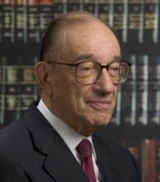
Alan Greenspan (born March 6, 1926 in New York City) is an American economist and was the Chairman of the Federal Reserve of the United States from 1987 to 2006. He currently works as a private advisor and providing consulting for firms through his company, Greenspan Associates LLC.
First appointed Fed chairman by President Ronald Reagan in August 1987, he was reappointed at successive four-year intervals until retiring on January 31, 2006 after the second-longest tenure in the position.

Discussion
Ask a question about 'Alan Greenspan'
Start a new discussion about 'Alan Greenspan'
Answer questions from other users
|
Recent Posts

Quotations
I guess I should warn you, if I turn out to be particularly clear, you've probably misunderstood what I said.
1988 speech, as quoted in The New York Times, October 28, 2005
Since becoming a central banker, I have learned to mumble with great incoherence. If I seem unduly clear to you, you must have misunderstood what I said.
Speaking to a Senate Committee in 1987, as quoted in the Guardian Weekly, November 4, 2005
Rising interest rates have been advertised for so long and in so many places that anyone who has not appropriately hedged this position by now obviously is desirous of losing money.
Novermber 2004 in a speech in Frankfurt

Encyclopedia
Alan Greenspan (born March 6, 1926 in New York City) is an American economist and was the Chairman of the Federal Reserve of the United States from 1987 to 2006. He currently works as a private advisor and providing consulting for firms through his company, Greenspan Associates LLC.
First appointed Fed chairman by President Ronald Reagan in August 1987, he was reappointed at successive four-year intervals until retiring on January 31, 2006 after the second-longest tenure in the position. He was lauded for his handling of the Black Monday October 19, 1987 stock market crash, which occurred very shortly after he first became chairman, as well as for his stewardship of the Internet-driven "dot-com" economic boom of the 1990s. This expansion eventually ended in a burst in March 2000 leading to an economic downturn, including negative GDP growth in the first quarter of 2001.
After 2001, some congressional leaders and others criticized him, for certain statements they found to overstep the Fed's traditional purview of monetary policy, and for other statements they saw as overly supportive of the policies of President George W. Bush. In 2004 Business Week Magazine criticized his keeping of low interest levels too long and his concurrent praise of sub-prime lending vehicles such as ARMs as leading to a housing bubble. Some, including Nobel Prize-winning economists Joseph E. Stiglitz and Paul Krugman, attribute a large degree of culpability for the devastating Economic crisis of 2008 to Greenspan. Stiglitz stated that Greenspan “didn't really believe in regulation; when the excesses of the financial system were noted, (he and others) called for self-regulation—an oxymoron.” Greenspan, according to The New York Times, says he refuses to blame himself. Krugman has expressed his view that of "two guys that I would blame for this crisis" Greenspan would be the first . However, on April 6, 2005 Greenspan called for a substantial increase in the regulation of Fannie Mae and Freddie Mac: “Appearing before the Senate Banking Committee, the Fed chairman, Alan Greenspan, said the enormous portfolios of the companies - nearly a quarter of the home-mortgage market - posed significant risks to the nation's financial system should either company face significant problems.” Despite this, Greenspan still claims to be a firm believer in free markets. He was also nicknamed "the maestro" after his tenure at the U.S. central bank coincided with a lengthy period of strong economic growth.
All considered, during his tenure Greenspan was the leading authority on American domestic economic and monetary policy, and his active influence continues.
Biography
Greenspan was born in 1926 to a Hungarian Jewish family in the Washington Heights area of New York City. The family name was anglicized from the German and Yiddish surname Grünspan. He studied clarinet at The Juilliard School from 1943 to 1944. He is an accomplished saxophone player who played with Stan Getz. While in college, he played in a jazz band. He then attended New York University (NYU) and received a B.S. in Economics (summa cum laude) in 1948 and an M.A. in Economics in 1950. Greenspan went on to Columbia University, intending to pursue advanced economic studies, but subsequently dropped out. At Columbia, Greenspan did study economics under the tutelage of future Fed chairman Arthur Burns, who constantly warned of the dangers of inflation.
Much later, in 1977, NYU also awarded him a Ph.D. in Economics. He may not have done a dissertation, normally required for that degree.On December 14, 2005, he was awarded an honorary Doctor of Commercial Science degree by NYU, his fourth degree from that institution.
In the early 1950s, Greenspan began an association with famed novelist and philosopher Ayn Rand that would last until her death in 1982. He wrote for Rand’s newsletters and authored several essays in her book Capitalism: The Unknown Ideal. Rand stood beside him at his 1974 swearing-in as Chair of the Council of Economic Advisers.
From 1948 to 1953, Greenspan worked as an economic analyst at The Conference Board, a business and industry oriented think-tank in New York City. From 1955 to 1987, when he was appointed as chairman of the Federal Reserve, Greenspan was chairman and president of Townsend-Greenspan & Co., Inc., an economic consulting firm in New York City, a 33-year stint interrupted only from 1974 to 1977 by his service as Chairman of the Council of Economic Advisers under President Gerald Ford. In the summer of 1968, Greenspan agreed to serve Richard Nixon as his coordinator on domestic policy in the nomination campaign. Greenspan also has served as a corporate director for Aluminum Company of America (Alcoa); Automatic Data Processing, Inc.; Capital Cities/ABC, Inc.; General Foods, Inc.; J.P. Morgan & Co., Inc.; Morgan Guaranty Trust Company of New York; Mobil Corporation; and The Pittston Company. He was a director of the Council on Foreign Relations foreign policy organization between 1982 and 1988. He also served as a member of the influential Washington-based financial advisory body, the Group of Thirty in 1984.
Alan Greenspan has been married twice. His first marriage was to artist Joan Mitchell in 1952; the marriage ended in annulment less than a year later. He dated newswoman Barbara Walters in the late 1970s. In 1984, Greenspan began dating journalist Andrea Mitchell. Greenspan at the time was 58, and the also divorced Mitchell was 20 years his junior. In 1997, they were married by Supreme Court Justice Ruth Bader Ginsburg.
Greenspan and Objectivism
Greenspan was initially a logical positivist but was converted to Objectivism by Nathaniel Branden. During the 1950s and 1960s Greenspan was a proponent of Ayn Rand's philosophy, writing articles for Objectivist newsletters and contributing several essays for Rand's 1966 book Capitalism: the Unknown Ideal including an essay supporting the gold standard.
During the 1950s, Greenspan was one of the members of Ayn Rand's inner circle, the Ayn Rand Collective, who read Atlas Shrugged while it was being written. Rand nicknamed Greenspan "the undertaker" because of his penchant for dark clothing and reserved demeanor. Although Greenspan was once recognized as a proponent of laissez-faire capitalism, some Objectivists find his support for a gold standard somewhat incongruous or dubious, given the Federal Reserve's role in America's fiat money system and endogenous inflation. He has come under criticism from Harry Binswanger, who believes his actions while at work for the Federal Reserve and his publicly expressed opinions on other issues show abandonment of Objectivist and free market principles. However, when questioned in relation to this, he has said that in a democratic society individuals have to make compromises with each other over conflicting ideas of how money should be handled. He said he himself had to make such compromises, because he believes that "we did extremely well" without a central bank and with a gold standard. Greenspan and Rand maintained a close relationship until her death in 1982.
In a congressional hearing on October 23, 2008 Greenspan admitted that his free-market ideology shunning certain regulations was flawed. This has caused backlash from Objectivist intellectuals, blaming the economic crisis on Greenspan's pandering to the mixed economy and betraying his laissez-faire views.
Chairman of the Federal Reserve
On June 2, 1987, President Reagan nominated Dr. Greenspan as a successor to Paul Volcker as chairman of the Board of Governors of the Federal Reserve, and the Senate confirmed him on August 11, 1987. After the nomination, bond markets experienced their biggest one-day drop in 5 years. Just two months after his confirmation he was faced with his first crisis—the 1987 stock market crash. Noted investor, author and commentator Jim Rogers has claimed that Alan Greenspan has lobbied to get this chairmanship
His terse statement that the Fed "affirmed today its readiness to serve as a source of liquidity to support the economic
and financial system" is seen by many as having been effective in helping to control the damage from that crash.
His handling of monetary policy in the run-up to the 1991 recession was criticized from the right as being excessively tight, and costing George H. W. Bush re-election. The incoming Democratic president Bill Clinton reappointed Alan Greenspan, and kept him as a core member of his economic team. Greenspan, while still fundamentally monetarist in orientation, argued that doctrinaire application of theory was insufficiently flexible for central banks to meet emerging situations.
Another famous example of the effect of his closely parsed comments was his December 5 1996 remark about "irrational exuberance and unduly escalating stock prices" that led Japanese stocks to fall 3.2%.
During the Asian financial crisis of 1997-1998, the Federal Reserve flooded the world with dollars, and organized a bailout of Long-Term Capital Management. Some have argued that 1997-1998 represented a monetary policy bind—as the early 1970s had represented a fiscal policy bind—and that while asset inflation had crept into the United States, demanding that the Fed tighten, the Federal Reserve needed to ease liquidity in response to the capital flight from Asia. Greenspan himself noted this when he stated that the American stock market showed signs of irrationally high valuations.
In 2000, Alan Greenspan raised interest rates several times; these actions were believed by many to have caused the bursting of the dot-com bubble. In autumn of 2001, as a decisive reaction to September 11th attacks and the various corporate scandals which undermined the economy, the Greenspan-led Federal Reserve initiated a series of interest cuts that brought down the Federal Funds rate to 1% in 2004. His critics, notably Steve Forbes attributed the rapid rise in commodity prices and gold to Greenspan's loose monetary policy which is causing excessive asset inflation and a weak dollar. By late 2004 the price of gold was higher than its 12-year moving average.
On May 18, 2004, Greenspan was nominated by President George W. Bush to serve for an unprecedented fifth term as chairman of the Federal Reserve. He was previously appointed to the post by Presidents Ronald Reagan, George H. W. Bush and Bill Clinton.
Greenspan's term as a member of the Board ended on January 31, 2006, and Ben Bernanke was confirmed as his successor.
Alan Greenspan is blamed by the followers of the Austrian School for creating excessive liquidity which caused lending standards to deteriorate resulting in the housing bubble of 2004-2006 and the market meltdown beginning in 2008. Currently the American Federal Reserve follows a modified form of monetarism, where broader ranges of intervention are possible in light of temporary instabilities in market dynamics.
After the Federal Reserve
On February 26, 2007, Greenspan forecast a possible recession in the U.S. before or in early 2008. Stabilizing corporate profits are said to have influenced his comments. The following day, the Dow Jones Industrial Average closed at 12,216.24 dropping by 416 points and losing 3.3% of its value, the worst one day loss, at the time, since September 17, 2001, when the Dow Jones lost 684 points (7.1%) after reopening in the wake of the 9/11 terrorist attacks.
In mid-January 2008, hedge fund Paulson & Co hired Alan Greenspan as an adviser on economic issues and monetary policy. This is the third private role given to Alan Greenspan, the first two being given by Deutsche Bank and bond investment company Pacific Investment Management (PIMCO). Greenspan advises Paulson & Co on economics issues surrounding United States and world financial markets.
Greenspan also counsels on monetary policy and falling housing prices and about a possible recession in the United States. Paulson & Co is famously known for its record profit making during 2007 by conducting bets against mortgage derivatives which earned the firm billions of dollars last year. The financial terms of the agreement were not disclosed and Greenspan must not, under the agreement, advise any other hedge fund manager while working for Paulson. In February 2008, Greenspan spoke at the Jeddah Economic Forum.
Greenspan wrote in the week of March 17, 2008 that the 2008-financial crisis in the United States is likely to be judged as the most wrenching since the end of World War II.
Greenspan also now works as a private advisor making speeches and providing consulting for firms through his company, Greenspan Associates LLC. Directly following his retirement as Fed chairman, Greenspan accepted an honorary (unpaid) position at HM Treasury in the United Kingdom. In May 2007, Greenspan was hired as a special consultant by PIMCO to participate in Pimco’s quarterly economic forums and speak privately with the bond manager about Fed interest rate policy. In August 2007, Deutsche Bank announced that it would be retaining Greenspan as a Senior Advisor to its investment banking team and clients.
He has written his memoir, titled The Age of Turbulence: Adventures in a New World, published September 17, 2007. Greenspan says that he wrote this book in longhand mostly while soaking in the bathtub, a habit he regularly employs ever since an accident in 1971, when he injured his back. Greenspan discusses in his book, among other things, his history in government and economics, capitalism and other modes of economies, current issues in the global economy, and future issues that face the global economy. In the book Greenspan criticizes President George W. Bush, Vice President Dick Cheney, and the Republican-controlled Congress for abandoning the Republican Party's principles on spending and deficits. Greenspan's criticisms of President Bush include his refusal to veto spending bills, sending the country into increasingly deep deficits, and for "putting political imperatives ahead of sound economic policies". Greenspan writes, "They swapped principle for power. They ended up with neither. They deserved to lose [the 2006 election]." Of all the presidents with whom he worked, he praises Bill Clinton above all others, saying that Clinton maintained “a consistent, disciplined focus on long-term economic growth.” Although he respected what he saw as Richard Nixon's immense intelligence, Greenspan found him to be "sadly paranoid, misanthropic and cynical." He said of Gerald Ford that he "was as close to normal as you get in a president, but he was never elected."
Housing "Bubble"
In the wake of the subprime mortgage and credit crisis in 2007, Greenspan admitted that there was a bubble in the US housing market, warning in 2007 of "large double digit declines" in home values "larger than most people expect." However, Greenspan also noted, "I really didn't get it until very late in 2005 and 2006."
Greenspan admitted that the housing bubble was “fundamentally engendered by the decline in real long-term interest rates”, though he also claims that long-term interest rates are beyond the control of central banks because "the market value of global long-term securities is approaching $100 trillion" and thus these and other asset markets are large enough that they "now swamp the resources of central banks."
Following the September 11, 2001 attacks, the Federal Open Market Committee voted to reduce the federal funds rate from 3.5% to 3.0%. Then, after the accounting scandals of 2002, the Fed dropped the federal funds rate from then current 1.25% to 1.00%. Greenspan acknowledged that this drop in rates would have the effect of leading to a surge in home sales and refinancing.
- Besides sustaining the demand for new construction, mortgage markets have also been a powerful stabilizing force over the past two years of economic distress by facilitating the extraction of some of the equity that homeowners have built up over the years.
However, Greenspan's policies of adjusting interest rates to historic lows contributed to a housing bubble in the US. The Federal Reserve acknowledges the connection between lower interest rates, higher home values, and the increased liquidity the higher home values bring to the overall economy.
- Like other asset prices, house prices are influenced by interest rates, and in some countries, the housing market is a key channel of monetary policy transmission. —Board of Governors of the Federal Reserve System, September 2005.
In a speech in February 2004, Greenspan suggested that more homeowners should consider taking out Adjustable Rate Mortgages (ARMs) where the interest rate adjusts itself to the current interest in the market. The fed own funds rate was at an all-time-low of 1%. A few months after his recommendation, Greenspan began raising interest rates, in a series of rate hikes that would bring the funds rate to 5.25% about two years later. A triggering factor in the 2007 subprime mortgage financial crisis is believed to be the many subprime ARMs that reset at much higher interest rates than what the borrower paid during the first few years of the mortgage.
In 2008, Greenspan expressed great frustration that his 23 February 2004 speech was used to criticize him on ARMs and the subprime mortgage crisis, and stated that he had made countervailing comments eight days after it that praised traditional fixed-rate mortgages.
In that speech on February 23, 2004, Greenspan had suggested that lenders should offer to home purchasers a greater variety of "mortgage product alternatives" other than traditional fixed-rate mortgages. Greenspan also praised the rise of the subprime mortgage industry and the tools which it uses to assess credit-worthiness in an April 2005 speech:
- Innovation has brought about a multitude of new products, such as subprime loans and niche credit programs for immigrants. Such developments are representative of the market responses that have driven the financial services industry throughout the history of our country … With these advances in technology, lenders have taken advantage of credit-scoring models and other techniques for efficiently extending credit to a broader spectrum of consumers. … Where once more-marginal applicants would simply have been denied credit, lenders are now able to quite efficiently judge the risk posed by individual applicants and to price that risk appropriately. These improvements have led to rapid growth in subprime mortgage lending; indeed, today subprime mortgages account for roughly 10 percent of the number of all mortgages outstanding, up from just 1 or 2 percent in the early 1990s. With these advances in technology, lenders have taken advantage of credit-scoring models and other techniques for efficiently extending credit to a broader spectrum of consumers. The widespread adoption of these models has reduced the costs of evaluating the creditworthiness of borrowers, and in competitive markets cost reductions tend to be passed through to borrowers. Where once more-marginal applicants would simply have been denied credit, lenders are now able to quite efficiently judge the risk posed by individual applicants and to price that risk appropriately. These improvements have led to rapid growth in subprime mortgage lending; indeed, today subprime mortgages account for roughly 10 percent of the number of all mortgages outstanding, up from just 1 or 2 percent in the early 1990s."
The subprime mortgage industry collapsed in March 2007, with many of the largest lenders filing for bankruptcy protection in the face of spiraling foreclosure rates. For these reasons, Greenspan has been criticized for his role in the rise of the housing bubble and the subsequent problems in the mortgage industry, as well as "engineering" the housing bubble itself:
- It was the Federal Reserve-engineered decline in rates that inflated the housing bubble … the most troublesome aspect of the price runup is that many recent buyers are squeezing into houses that they can barely afford by taking advantage of the lower rates available from adjustable-rate mortgages. That leaves them fully exposed to rising rates. —BusinessWeek, July 19, 2004, Is A Housing Bubble About To Burst?
George Soros and Warren Buffett criticized derivatives while Greenspan defended them.
Economic Crisis of 2008
On March 17, 2008, Alan Greenspan wrote an article for the Financial Times Economists’ Forum entitled “We will never have a perfect model of risk“ in which he argued: “We will never be able to anticipate all discontinuities in financial markets.” He concluded: “It is important, indeed crucial, that any reforms in, and adjustments to, the structure of markets and regulation not inhibit our most reliable and effective safeguards against cumulative economic failure: market flexibility and open competition.”
The article attracted a number of critical responses from forum contributors, which consists of some of the world’s leading economists (including two Nobel Memorial Prize in Economic Sciences winners, Edmund Phelps and Joseph Stiglitz), who, finding causation between Greenspan's policies and the discontinuities in financial markets that followed, criticized Greenspan mainly for what many believed to be his unbalanced and immovable ideological suppositions about global capitalism and free competitive markets. Notable critics included J. Bradford DeLong, Alice Rivlin, Richard Werner, Christopher Whalen, Michael Hudson, and Willem Buiter.
On April 6, Greenspan responded to his critics in a follow-up article entitled “A response to my critics” in which he rigorously defended his ideology as applied to his conceptual and policy framework, which, among other things, prohibited him from exerting real pressure against the burgeoning housing bubble or, in his words, "leaning against the wind" (which became a catchphrase used during the discussion). Greenspan argued, "My view of the range of dispersion of outcomes has been shaken, but not my judgment that free competitive markets are by far the unrivaled way to organize economies." He concluded: "We have tried regulation ranging from heavy to central planning. None meaningfully worked. Do we wish to retest the evidence?"
On April 9, the Financial Times associate editor and chief economics commentator, Martin Wolf, responded to the discussion with an article entitled “Why Greenspan does not bear most of the blame,” defending Greenspan primarily as a scapegoat for the market turmoil. Several notable contributors in defense of Greenspan included Stephen Roach, Allan Meltzer, and Robert Brusca.
On October 15, 2008, Anthony Faiola, Ellen Nakashima and Jill Drew wrote a lengthy article in the Washington Post titled "What Went Wrong". In their investigation, the authors claim that Greenspan vehemently opposed any regulation of financial instruments known as derivatives. They further claim that Greenspan actively sought to undermine the office of the Commodity Futures Trading Commission, specifically under the leadership of Brooksley E. Born, when the Commission sought to initiate regulation of derivatives.
In Congressional testimony on October 23, 2008, Greenspan acknowledged that he was "partially" wrong in opposing regulation and stated "Those of us who have looked to the self-interest of lending institutions to protect shareholder's equity -- myself especially -- are in a state of shocked disbelief." Referring to his free-market ideology, Greenspan said: “I have found a flaw. I don’t know how significant or permanent it is. But I have been very distressed by that fact.” Rep. Henry Waxman (D-CA) then pressed him to clarify his words. “In other words, you found that your view of the world, your ideology, was not right, it was not working,” Waxman said. “Absolutely, precisely,” Greenspan replied. “You know, that’s precisely the reason I was shocked, because I have been going for 40 years or more with very considerable evidence that it was working exceptionally well.” Greenspan admitted fault in opposing regulation of derivatives and acknowledged that financial institutions didn't protect shareholders and investments as well as he expected. During testimony, Rep. John Yarmuth (D-KY) compared Greenspan to Bill Buckner, the Boston Red Sox first baseman whose fielding error caused the team's loss in the 1986 World Series.
Political views and alleged politicization of office
Greenspan describes himself as a “lifelong Libertarian Republican,” although his actions while Fed chairman belie this statement.
In March 2005, in reaction to Greenspan's support of President Bush's plan to partially privatize Social Security, Democratic Senate Minority Leader Harry Reid attacked Greenspan as “one of the biggest political hacks we have in Washington” and criticized him for supporting Bush's 2001 tax cut plan. Then-Democratic House Minority Leader Nancy Pelosi added that there were serious questions about the Fed's independence as a result of Greenspan's public statements. Greenspan also received criticism from Democratic Congressman Barney Frank and others for supporting Bush's Social Security plans in favor of private accounts. Greenspan had said Bush's model has "the seeds of developing full funding by its very nature. As I've said before, I've always supported moves to full funding in the context of a private account."
Others, like Republican Senator Mitch McConnell, disagreed that Greenspan was too deferential to Bush, stating that Greenspan “has been an independent player at the Fed for a long time under both parties and made an enormous positive contribution”.
Economist Paul Krugman wrote that Greenspan was a “three-card maestro” with a “lack of sincerity” who, “by repeatedly shilling for whatever the Bush administration wants, has betrayed the trust placed in the Fed chairman”.
Republican Senator Jim Bunning, who opposed Greenspan's fifth reconfirmation, charged that Greenspan should comment only on monetary policy, not fiscal policy. However, Greenspan had used his position as Fed Chairman to comment upon fiscal policy as early as 1993, when he supported President Clinton's deficit reduction plan, which included tax hikes and budget cuts.
In 1997, the Wall Street Journal editorial page asserted that Greenspan believed one of his jobs as Chairman was to maintain a high enough level of worker insecurity to discourage employees from demanding pay raises and benefit increases.
Honors
Greenspan was awarded the Presidential Medal of Freedom, the highest civilian award in the United States, by President George W. Bush in November 2005. His honorary titles include Knight Commander of the British Empire, bestowed in 2002 and Commander of the Légion d'honneur (Legion of Honor). In 2006, Greenspan was awarded the Department of Defense Medal for Distinguished Public Service.
In 2004, Greenspan received the Dwight D. Eisenhower Medal for Leadership and Service, from Eisenhower Fellowships. In 2005, he became the first recipient of the Harry S. Truman Medal for Economic Policy, presented by the Harry S. Truman Library Institute. In 2007, Greenspan was the recipient of the inaugural Thomas Jefferson Foundation Medal in Citizen Leadership, presented by the University of Virginia.
Further reading
The Economist (October 15–21, 2005 issue) page 29, "After Alan" **
See also
External links
- : an article in the by Robert B. Reich, December 19 2007
- See featured on Time.com
- Sept 24 2007 - Greenspan and Naomi Klein on Democracy Now:
- Oct 17 2007 - economist Paul Krugman to the Sept 24 Democracy Now interview
-
Criticism
|