
During the Presidency of
Saddam HusseinSaddam Hussein Abd al-Majid al-Tikriti was the President of Iraq from 16 July 1979 until 9 April 2003...
, the nation of
IraqIraq , officially the Republic of Iraq , also known as Mesopotamia, is a country in Western Asia spanning most of the northwestern end of the Zagros mountain range, the eastern part of the Syrian Desert and the northern part of the Arabian Desert.Iraq shares borders with Jordan to the west, Syria...
used, possessed, and made efforts to acquire
weapons of mass destructionThe term weapon of mass destruction is often used to describe a weapon that can kill large numbers of humans and/or cause great damage to man-made structures , natural structures , or the biosphere in general....
(WMD). Hussein was internationally known for his use of chemical weapons in the 1980s against Kurdish civilians during and after the Iran–Iraq War. It is also known that in the 1980s he pursued an extensive
biological weapons programSaddam Hussein initiated an extensive biological weapons program in Iraq in the early 1980s, in violation of the Biological Weapons Convention of 1972...
and a nuclear weapons program.
After the 1990-1991
Persian Gulf WarThe Persian Gulf War , known also as the Gulf War, the First Gulf War,or often as the Second Gulf War and by Iraqi leader Saddam Hussein as The Mother of all Battles, or commonly as Desert Storm, for the military response...
, the United Nations located and destroyed large quantities of Iraqi WMD and related equipment and materials throughout the early 1990s, with varying degrees of Iraqi cooperation and obstruction. In response to diminishing Iraqi cooperation with UNSCOM, the
United StatesThe United States of America is a federal constitutional republic comprising fifty states and a federal district...
called for withdrawal of all UN and IAEA inspectors in 1998, resulting in
Operation Desert FoxThe December 1998 bombing of Iraq was a major four-day bombing campaign on Iraqi targets from December 16–19, 1998 by the United States and United Kingdom...
. The United States and the UK asserted that Saddam Hussein still possessed large hidden stockpiles of WMD in 2003, and that he was clandestinely procuring and producing more. Inspections by the UN to resolve the status of unresolved disarmament questions restarted from November 2002 until March 2003, under UN Security Council Resolution 1441, which demanded Saddam give "immediate, unconditional and active cooperation" with UN and IAEA inspections.
By March 2003,
Hans Blixis a Swedish diplomat and politician. He was Swedish Minister for Foreign Affairs . Blix was also the head of the United Nations Monitoring, Verification and Inspection Commission from March 2000 to June 2003, when he was succeeded by Demetrius Perricos...
had found no stockpiles of WMD and had made significant progress toward resolving open issues of disarmament noting "proactive" but not always the "immediate" Iraqi cooperation as called for by UN Security Council Resolution 1441. He concluded that it would take “but months” to resolve the key remaining disarmament tasks. The United States asserted this was a breach of Resolution 1441 but failed to convince the UN Security Council to pass a new resolution authorizing the use of force due to lack of evidence. Despite being unable to get a new resolution authorizing force and citing section 3 of the Joint Resolution passed by the U.S. Congress, President Bush asserted peaceful measures couldn't disarm Iraq of the weapons he alleged it to have and launched a
second Gulf WarThe Iraq War, also known as the Occupation of Iraq or Operation Iraqi Freedom, is an ongoing military campaign which began on March 20, 2003 with the invasion of Iraq by a multinational force led by troops from the United States and the United Kingdom.Prior to the war, the governments of the United...
, despite multiple dissenting opinions and questions of integrity about the underlying intelligence. Later U.S.-led inspections agreed that Iraq had earlier abandoned its WMD programs, but asserted Iraq had an intention to pursue those programs if UN sanctions were ever lifted. President Bush later said that the biggest regret of his presidency was "the intelligence failure" in Iraq, while the Senate Intelligence Committee found in 2008 that his administration "misrepresented the intelligence and the threat from Iraq".
Program development 1960s - 1980s
1959 August 17 USSR and
IraqIraq , officially the Republic of Iraq , also known as Mesopotamia, is a country in Western Asia spanning most of the northwestern end of the Zagros mountain range, the eastern part of the Syrian Desert and the northern part of the Arabian Desert.Iraq shares borders with Jordan to the west, Syria...
wrote an agreement about building an atomic power station.
1968 a Soviet supplied IRT-2000 research reactor together with a number of other facilities that could be used for radioisotope production was built close to
BaghdadBaghdad is the capital of Iraq and of Baghdad Governorate, with which it is coterminous. Having a municipal population estimated at 6.5 million, it is the largest city in Iraq and the second largest in the Arab World....
.
1975
Saddam HusseinSaddam Hussein Abd al-Majid al-Tikriti was the President of Iraq from 16 July 1979 until 9 April 2003...
arrived in Moscow in April. He asked about building an advanced model of an atomic power station. Moscow would approve, but only if the station was regulated by the
International Atomic Energy AgencyThe International Atomic Energy Agency is an international organization that seeks to promote the peaceful use of nuclear energy and to inhibit its use for military purposes. It was established as an autonomous organization on 29 July 1957...
. Iraq refused.
After 6 months Paris agreed to sell 72 kg of 93% Uranium and built the atomic power station without
International Atomic Energy AgencyThe International Atomic Energy Agency is an international organization that seeks to promote the peaceful use of nuclear energy and to inhibit its use for military purposes. It was established as an autonomous organization on 29 July 1957...
control at a price of $3 billion.
In the early 1970s, Saddam Hussein ordered the creation of a clandestine
nuclear weaponA nuclear weapon is an explosive device that derives its destructive force from nuclear reactions, either fission or a combination of fission and fusion...
s program. Iraq's weapons of mass destruction programs were assisted by a wide variety of firms and governments in the 1970s and 1980s. As part of Project 922, German firms such as Karl Kobe helped build Iraqi chemical weapons facilities such as laboratories, bunkers, an administrative building, and first production buildings in the early 1980s under the cover of a pesticide plant. Other German firms sent 1,027 tons of precursors of mustard gas,
sarinSarin, also known by its NATO designation of GB, is an extremely toxic substance whose sole application is as a nerve agent. As a chemical weapon, it is classified as a weapon of mass destruction by the United Nations in UN Resolution 687...
,
tabunTabun or GA is an extremely toxic chemical substance. It is a clear, colorless, and tasteless liquid with a faint fruity odor. It is classified as a nerve agent because it fatally interferes with normal functioning of the mammalian nervous system...
, and tear gasses in all. This work allowed Iraq to produce 150 tons of mustard agent and 60 tons of
TabunTabun or GA is an extremely toxic chemical substance. It is a clear, colorless, and tasteless liquid with a faint fruity odor. It is classified as a nerve agent because it fatally interferes with normal functioning of the mammalian nervous system...
in 1983 and 1984 respectively, continuing throughout the decade. Five other German firms supplied equipment to manufacture botulin toxin and
mycotoxinA mycotoxin is a toxic secondary metabolite produced by an organism of the fungus kingdom, including mushrooms, molds, and yeasts. The term 'mycotoxin' is usually reserved for the toxic chemical products produced by fungi that readily colonize crops...
for germ warfare. In 1988, German engineers presented
centrifugeA centrifuge is a piece of equipment, generally driven by an electric motor , that puts an object in rotation around a fixed axis, applying a force perpendicular to the axis...
data that helped Iraq expand its nuclear weapons program. Laboratory equipment and other information was provided, involving many German engineers. All told, 52% of Iraq's international chemical weapon equipment was of German origin. The State Establishment for Pesticide Production (SEPP) ordered culture media and incubators from Germany's Water Engineering Trading.
France built Iraq's
OsirakOsirak, also spelled Osiraq, , was a French-supplied 40 MW light-water nuclear materials testing reactor in Iraq. It was constructed by the Iraqi government at the Al Tuwaitha Nuclear Research Center, 18 km south-east of Baghdad in 1977...
nuclear reactor in the late 1970s.
IsraelIsrael officially the State of Israel , is a developed state in Western Asia located on the eastern shore of the Mediterranean Sea. It borders Lebanon in the north, Syria in the northeast, Jordan in the east, and Egypt on the southwest, and contains geographically diverse features within its...
claimed that Iraq was getting close to building nuclear weapons, and
successfully destroyed the reactors in 1981Operation Opera was a successful surprise Israeli air strike against the Iraqi Osirak nuclear reactor in 1981....
. Later, a French company built a
turnkeyA turn-key or a turn-key project is a type of project that is constructed by a developer and sold or turned over to a buyer in a ready-to-use condition.-Common usage:...
factory which helped make nuclear fuel. France also provided glass-lined reactors, tanks, vessels, and columns used for the production of chemical weapons. Around 21% of Iraq’s international chemical weapon equipment was French. Strains of dual-use biological material also helped advance Iraq’s biological warfare program.
Italy gave Iraq plutonium extraction facilities that advanced Iraq’s nuclear weapon program. 75,000 shells and rockets designed for chemical weapon use also came from Italy. Between 1979 and 1982 Italy gave depleted, natural, and low-enriched uranium. Swiss companies aided in Iraq’s nuclear weapons development in the form of specialized presses, milling machines, grinding machines, electrical discharge machines, and equipment for processing uranium to nuclear weapon grade.
BrazilBrazil , officially the Federative Republic of Brazil , is a country in South America. It is the fifth largest country by geographical area, occupying nearly half of South America, the fifth most populous country, and the fourth most populous democracy in the world. Bounded by the Atlantic Ocean...
secretly aided the Iraqi nuclear weapon program by supplying natural uranium dioxide between 1981 and 1982 without notifying the IAEA. About 100 tons of mustard gas also came from Brazil.
The United States exported
over $500 million of dual use exportsThe United States supported Iraq during the Iran–Iraq War as a counterbalance to post-revolutionary Iran. This support included several billion dollars worth of economic aid, the sale of dual-use technology, non-U.S. origin weaponry, military intelligence, Special Operations training, and direct...
to Iraq that were approved by the Commerce department. Among them were advanced computers, some of which were used in Iraq's nuclear program. The non-profit
American Type Culture CollectionThe American Type Culture Collection is a private, not-for-profit biological resource center whose mission focuses on the acquisition, authentication, production, preservation, development and distribution of standard reference microorganisms, cell lines and other materials for research in the...
and the Centers for Disease Control sold or sent biological samples to Iraq under Saddam Hussein up until 1989, which Iraq claimed it needed for medical research. These materials included
anthraxAnthrax is an acute disease caused by Bacillus anthracis. It affects both humans and animals. Most forms of the disease are highly lethal...
,
West Nile virusWest Nile virus is a virus of the family Flaviviridae. Part of the koji Japanese encephalitis antigenic complex of viruses, it is found in both tropical and temperate regions. It mainly infects birds, but is known to infect humans, horses, dogs, cats, bats, chipmunks, skunks, squirrels, and...
and
botulismBotulism also known as botulinus intoxication is a rare but serious paralytic illness caused by botulinum toxin, which is produced by the bacterium Clostridium botulinum...
, as well as
Brucella melitensisBrucella melitensis is a gram negative coccobacillus bacteria that causes brucellosis, a disease affecting sheep, cattle, and sometimes humans. It is primarily considered to be associated with caprine brucellosis, but is also found in sheep. It causes reproductive disease such as orchitis,...
, which damages major organs, and
clostridium perfringensClostridium perfringens is a Gram-positive, rod-shaped, anaerobic, spore-forming bacterium of the genus Clostridium. C. perfringens is ubiquitous in nature and can be found as a normal component of decaying vegetation, marine sediment, the intestinal tract of humans and other vertebrates, insects,...
, which causes gas gangrene. Some of these materials were used for Iraq's biological weapons research program, while others were used for vaccine development. For example, the Iraqi military settled on the American Type Culture Collection strain 14578 as the exclusive anthrax strain for use as a biological weapon, according to Charles Duelfer.
The United Kingdom paid for a chlorine factory that was intended to be used for manufacturing mustard gas. The government secretly gave the arms company Matrix Churchill permission to supply parts for the Iraqi supergun, precipitating the
Arms-to-IraqThe Arms-to-Iraq affair concerned the uncovering of the government-endorsed sale of arms by British companies to Iraq, then under the rule of Saddam Hussein...
affair when it became known.
Many other countries contributed as well; since Iraq's nuclear program in the early 1980s was officially viewed internationally as for power production, not weapons, there were no UN prohibitions against it. An
AustriaAustria , officially the Republic of Austria , is a landlocked country of roughly 8.3 million people in Central Europe. It borders both Germany and the Czech Republic to the north, Slovakia and Hungary to the east, Slovenia and Italy to the south, and Switzerland and Liechtenstein to the west...
n company gave Iraq calutrons for enriching uranium. The nation also provided heat exchangers, tanks, condensers, and columns for the Iraqi chemical weapons infrastructure, 16% of the international sales.
SingaporeSingapore , officially the Republic of Singapore, is an island city-state located at the southern tip of the Malay Peninsula, lying north of the equator, south of the Malaysian state of Johor and north of Indonesia's Riau Islands. At , Singapore is a microstate and the smallest nation in Southeast...
gave 4,515 tons of precursors for VX, sarin, tabun, and mustard gasses to Iraq. The Dutch gave 4,261 tons of precursors for sarin, tabun, mustard, and tear gasses to Iraq.
EgyptEgypt , officially the Arab Republic of Egypt, is a country mainly in North Africa, with the Sinai Peninsula forming a land bridge in Western Asia...
gave 2,400 tons of tabun and sarin precursors to Iraq and 28,500 tons of weapons designed for carrying chemical munitions. India gave 2,343 tons of precursors to VX, tabun, Sarin, and mustard gasses.
LuxembourgLuxembourg , officially the Grand Duchy of Luxembourg , is a small, landlocked country in western Europe, bordered by Belgium, France, and Germany...
gave Iraq 650 tons of mustard gas precursors. Spain gave Iraq 57,500 munitions designed for carrying chemical weapons. In addition, they provided reactors, condensers, columns and tanks for Iraq’s chemical warfare program, 4.4% of the international sales. China provided 45,000 munitions designed for chemical warfare.
PortugalPortugal , officially the Portuguese Republic , is a country located in southwestern Europe on the Iberian Peninsula. Portugal is the westernmost country of mainland Europe and is bordered by the Atlantic Ocean to the west and south and by Spain to the north and east...
provided yellowcake between 1980 and 1982.
NigerNiger , officially the Republic of Niger is a landlocked country in Western Africa, named after the Niger River. It borders Nigeria and Benin to the south, Burkina Faso and Mali to the west, Algeria and Libya to the north and Chad to the east...
provided yellowcake in 1981.
Iran–Iraq War
In 1980 the U.S. Defense Intelligence Agency filed a report stating that Iraq had been actively acquiring chemical weapons capacities for several years, which later proved to be accurate. In November 1980, two months into the Iran–Iraq War, the first reported use of chemical weapons took place when Tehran radio reported a poison gas attack on Susangerd by Iraqi forces. The United Nations reported many similar attacks occurred the following year, leading Iran to develop and deploy a mustard gas capability. By 1984, Iraq was using poison gas with great effectiveness against Iranian "human wave" attacks. Chemical weapons were used extensively against
IranIran , officially the Islamic Republic of Iran is a country in Western Asia. The name Iran has been in use natively since the Sassanid period and came into international use from 1935, before which the country was known internationally as Persia...
by Iraq. On January 14, 1991, the Defense Intelligence Agency said an Iraqi agent described, in medically accurate terms, military smallpox casualties he said he saw in 1985 or 1986. Two weeks after, the Armed Forces Medical Intelligence Center reported that eight of 69 Iraqi prisoners of war whose blood was tested showed a current immunity to smallpox, which had not occurred naturally in Iraq since 1971; the same prisoners had also been inoculated for anthrax. All of this occurring while Iraq was a party to the
Geneva ProtocolThe Protocol for the Prohibition of the Use in War of Asphyxiating, Poisonous or other Gases, and of Bacteriological Methods of Warfare, usually called the Geneva Protocol, is a treaty prohibiting the first use of chemical and biological weapons...
on September 8, 1931, the
Nuclear Non-Proliferation TreatyThe Treaty on the Non-Proliferation of Nuclear Weapons, also Nuclear Non-Proliferation Treaty is a treaty to limit the spread of nuclear weapons, opened for signature on July 1, 1968...
on October 29, 1969, signed the
Biological Weapons ConventionThe Convention on the Prohibition of the Development, Production and Stockpiling of Bacteriological and Toxin Weapons and on their Destruction was the first multilateral disarmament treaty banning the...
in 1972, but did not ratify until June 11, 1991. Iraq has not signed to the
Chemical Weapons ConventionThe Chemical Weapons Convention is an arms control agreement which outlaws the production, stockpiling and use of chemical weapons...
.
The
Washington Post reported that in 1984 the CIA secretly started providing intelligence to the Iraqi army. This included information that was used by the Iraqis in targeting chemical weapons strikes. The same year it was confirmed beyond doubt by European doctors and UN expert missions that Iraq was employing chemical weapons against the Iranians. Most of these occurred during the Iran–Iraq War, but WMDs were used at least once to crush the popular uprisings of 1991. Chemical weapons were used extensively, with more than 100,000 Iranian soldiers as victims of Saddam Hussein's chemical weapons during the eight-year war with Iraq, Iran today is the world's second-most afflicted country by
weapons of mass destructionThe term weapon of mass destruction is often used to describe a weapon that can kill large numbers of humans and/or cause great damage to man-made structures , natural structures , or the biosphere in general....
, only after Japan. The official estimate does not include the civilian population contaminated in bordering towns or the children and relatives of veterans, many of whom have developed blood, lung and skin complications, according to the Organization for Veterans. Nerve gas agents killed about 20,000 Iranian soldiers immediately, according to official reports. Of the 90,000 survivors, some 5,000 seek medical treatment regularly and about 1,000 are still hospitalized with severe, chronic conditions. Many others were hit by mustard gas. Despite the removal of Saddam and his regime by American forces, there is deep resentment and anger in Iran that it was Western nations that helped Iraq develop and direct its chemical weapons arsenal in the first place and that the world did nothing to punish Iraq for its use of chemical weapons throughout the war. For example, the United States and the UK blocked condemnation of Iraq's known chemical weapons attacks at the UN Security Council. No resolution was passed during the war that specifically criticized Iraq's use of chemical weapons, despite the wishes of the majority to condemn this use. On March 21, 1986 the United Nation Security Council recognized that "chemical weapons on many occasions have been used by Iraqi forces against Iranian forces"; this statement was opposed by the United States, the sole country to vote against it in the Security Council (the UK abstained).
On March 23, 1988 western media sources reported from
HalabjaHalabja , is an Iraqi town in a majority Kurdish area of Iraq about northeast of Baghdad and 8-10 miles from the Iranian border....
in Iraqi
KurdistanKurdistan is an extensive plateau and mountainous area in the Middle East, inhabited mainly by Kurds...
, that several days before Iraq had launched a large scale chemical assault on the town. Later estimates were that 7,000 people had been killed and 20,000 wounded. The
Halabja poison gas attackThe Halabja poison gas attack occurred in the period March 16–17 1988, during the Iran-Iraq War. Chemical weapons were used by the Iraqi government forces in the Iraqi Kurdish town of Halabja....
caused an international outcry against the Iraqis. Later that year the U.S. Senate unanimously passed the
Prevention of Genocide Act of 1988The Prevention of Genocide Act of 1988 was a United States bill which aimed to punish Iraq for chemical weapons attacks on the Kurds at Halabja during the Iran–Iraq War...
, cutting off all U.S. assistance to Iraq and stopping U.S. imports of Iraqi oil. The Reagan administration opposed the bill, calling it premature, and eventually prevented it from taking effect, partly due to a mistaken DIA assessment which blamed
IranIran , officially the Islamic Republic of Iran is a country in Western Asia. The name Iran has been in use natively since the Sassanid period and came into international use from 1935, before which the country was known internationally as Persia...
for the attack. At the time of the attack the town was held by Iranian troops and Iraqi Kurdish guerrillas allied with Tehran. The Iraqis blamed the Halabja attack on Iranian forces. This was still the position of Saddam Hussein in his December 2003 captivity. On August 21, 2006, the trial of Saddam Hussein and six codefendants, including Hassan al-Majid ("Chemical Ali"), opened on charges of genocide against the Kurds. While this trial does not cover the Halabja attack, it does cover attacks on other villages during the Iraqi "Anfal" operation alleged to have included bombing with chemical weapons.
Chemical weapon attacks
| Location | Weapon Used | Date | Casualties |
| Haij Umran |
Mustard |
August 1983 |
fewer than 100 Iranian/Kurdish |
| Panjwin |
Mustard |
October-November 1983 |
3,001 Iranian/Kurdish |
| Majnoon Island |
Mustard |
February-March 1984 |
2,500 Iranians |
| al-Basrah |
Tabun |
March 1984 |
50-100 Iranians |
| Hawizah Marsh |
Mustard & Tabun |
March 1985 |
3,000 Iranians |
| al-Faw |
Mustard & Tabun |
February 1986 |
8,000 to 10,000 Iranians |
| Um ar-Rasas |
Mustard |
December 1986 |
1,000s Iranians |
| al-Basrah |
Mustard & Tabun |
April 1987 |
5,000 Iranians |
| Sumar/Mehran |
Mustard & nerve agent |
October 1987 |
3,000 Iranians |
| Halabjah |
Mustard & nerve agent |
March 1988 |
7,000s Kurdish/Iranian |
| al-Faw |
Mustard & nerve agent |
April 1988 |
1,000s Iranians |
| Fish Lake |
Mustard & nerve agent |
May 1988 |
100s or 1,000s Iranians |
| Majnoon Islands |
Mustard & nerve agent |
June 1988 |
100s or 1,000s Iranians |
| South-central border |
Mustard & nerve agent |
July 1988 |
100s or 1,000s Iranians |
an-Najaf - KarbalaKarbala is a city in Iraq, located about southwest of Baghdad at 32.61°N, 44.08°E. In the time of Husayn ibn Alī's life, the place was also known as al-Ghadiriyah, Naynawa, and Shathi'ul-Furaat. The estimated population in 2003 was 572,300 people. It is the capital of Karbala Governorate... area |
Nerve agent & CS |
March 1991 |
Unknown |
(Source:)
The 1991 Persian Gulf War
On August 2, 1990
IraqIraq , officially the Republic of Iraq , also known as Mesopotamia, is a country in Western Asia spanning most of the northwestern end of the Zagros mountain range, the eastern part of the Syrian Desert and the northern part of the Arabian Desert.Iraq shares borders with Jordan to the west, Syria...
invaded
KuwaitThe State of Kuwait is a sovereign Arab emirate bordered by Saudi Arabia to the south and Iraq to the north and west. The greatest distance from north to south is 200 km and from east to west 170 km . The name is a diminutive of an Arabic word meaning "fortress built near water." It has a...
and was widely condemned internationally. The policy of the United States on Hussein's government changed rapidly, as it was feared Saddam intended to attack other oil-rich nations in the region such as
Saudi ArabiaSaudi Arabia , is an Arab country and the largest country of the Arabian Peninsula. It is bordered by Jordan on the northwest, Iraq on the north and northeast, Kuwait, Qatar, Bahrain, and the United Arab Emirates on the east, Oman on the southeast, and Yemen on the south...
. As stories of atrocities from the occupation of Kuwait spread, several of which later proved false, older atrocities and his WMD arsenal were also given attention. Iraq's nuclear weapons program suffered a serious setback in 1981 when the reactor used to generate source material for its bomb was bombed by
IsraelIsrael officially the State of Israel , is a developed state in Western Asia located on the eastern shore of the Mediterranean Sea. It borders Lebanon in the north, Syria in the northeast, Jordan in the east, and Egypt on the southwest, and contains geographically diverse features within its...
. David Albright and Mark Hibbs, writing for the
Bulletin of the Atomic ScientistsThe Bulletin of the Atomic Scientists is a nontechnical online magazine that covers global security and public policy issues, especially related to the dangers posed by nuclear and other weapons of mass destruction...
, concur with this view: there were far too many technological challenges unsolved, they say.
An international coalition of nations, led by the United States, liberated Kuwait in 1991.
In the terms of the UN ceasefire set out in Security Council Resolution 686, and in Resolution 687, Iraq was forbidden from developing, possessing or using chemical, biological and nuclear weapons by resolution 686. Also proscribed by the treaty were missiles with a range of more than 150 kilometres. The UN Special Commission on weapons (UNSCOM) was created to carry out weapons inspections in Iraq, and the International Atomic Energy Agency (IAEA) was to verify the destruction of Iraq's nuclear program.
UNSCOM inspections 1991-1998
The United Nations Special Commission on Iraq (UNSCOM) was set up after the 1990 invasion of Kuwait to inspect Iraqi weapons facilities. It was headed first by
Rolf EkéusCarl Rolf Ekéus is a Swedish diplomat. From 1978 to 1983, he was a representative to the Conference on Disarmament in Geneva, and he has worked on various other disarmament committees and commissions....
and later by
Richard ButlerRichard William Butler, AC served as an Australian diplomat, United Nations weapons inspector, and Governor of Tasmania.-Life and career:...
. During several visits to Iraq by UNSCOM, weapons inspectors interviewed British-educated Iraqi biologist Rihab Rashid Taha. According to a 1999 report from the U.S. Defense Intelligence Agency, the normally mild-mannered Taha exploded into violent rages whenever UNSCOM questioned her about al-Hakam, shouting, screaming and, on one occasion, smashing a chair, while insisting that al-Hakam was a chicken-feed plant. "There were a few things that were peculiar about this animal-feed production plant", Charles Duelfer, UNSCOM's deputy executive chairman, later told reporters, "beginning with the extensive air defenses surrounding it." The facility was destroyed by UNSCOM in 1996.
In 1995, UNSCOM's principal weapons inspector, Dr. Rod Barton from Australia, showed Taha documents obtained by UNSCOM that showed the Iraqi government had just purchased 10 tons of
growth mediumA growth medium or culture medium is a liquid or gel designed to support the growth of microorganisms or cells , or small plants like the moss Physcomitrella patens .There are different types of media for growing different types of cells....
from a British company called Oxoid. Growth media is a mixture of
sugarSugar is a class of edible crystalline substances, mainly sucrose, lactose, and fructose. Human taste buds interpret its flavor as sweet. Sugar as a basic food carbohydrate primarily comes from sugar cane and from sugar beet, but also appears in fruit, honey, sorghum, sugar maple , and in many...
s,
proteinProteins are organic compounds made of amino acids arranged in a linear chain and folded into a globular form. The amino acids in a polymer chain are joined together by the peptide bonds between the carboxyl and amino groups of adjacent amino acid residues...
s and
mineralA mineral is a naturally occurring solid formed through geological processes that has a characteristic chemical composition, a highly ordered atomic structure, and specific physical properties. A rock, by comparison, is an aggregate of minerals and/or mineraloids, and need not have a specific...
s that provides
nutrientA nutrient is a chemical that an organism needs to live and grow or a substance used in an organism's metabolism which must be taken in from its environment. Nutrients are the substances that enrich the body. They build and repair tissues, give heat and energy, and regulate body processes...
s for
microorganismA microorganism or microbe is an organism that is microscopic...
s to grow. It can be used in hospitals and
microbiologyMicrobiology is the study of microorganisms, which are unicellular or cell-cluster microscopic organisms. This includes eukaryotes such as fungi and protists, and prokaryotes. Viruses, though not strictly classed as living organisms, are also studied...
/
molecular biologyMolecular biology is the study of biology at a molecular level. The field overlaps with other areas of biology and chemistry, particularly genetics and biochemistry...
research laboratories. In hospitals, swabs from patients are placed in dishes containing growth medium for diagnostic purposes. Iraq's hospital consumption of growth medium was just 200 kg a year; yet in 1988, Iraq imported 39 tons of it. Shown this evidence by UNSCOM, Taha admitted to the inspectors that she had grown 19,000 litres of
botulismBotulism also known as botulinus intoxication is a rare but serious paralytic illness caused by botulinum toxin, which is produced by the bacterium Clostridium botulinum...
toxin; 8,000 litres of
anthraxAnthrax is an acute disease caused by Bacillus anthracis. It affects both humans and animals. Most forms of the disease are highly lethal...
; 2,000 litres of
aflatoxinAflatoxins are naturally occurring mycotoxins that are produced by many species of Aspergillus, a fungus, most notably Aspergillus flavus and Aspergillus parasiticus. Aflatoxins are toxic and among the most carcinogenic substances known...
s, which can cause liver failure;
Clostridium perfringensClostridium perfringens is a Gram-positive, rod-shaped, anaerobic, spore-forming bacterium of the genus Clostridium. C. perfringens is ubiquitous in nature and can be found as a normal component of decaying vegetation, marine sediment, the intestinal tract of humans and other vertebrates, insects,...
, a bacterium that can cause gas
gangreneGangrene is a complication of necrosis or cell death characterized by the decay of body tissues, which become black and malodorous. It is caused by infection or ischemia, such as from thrombosis. It is usually the result of critically insufficient blood supply and is often associated with...
; and
ricinRicin is a protein that is extracted from the castor bean . It can be either a white powder or a liquid in crystalline form. Ricin is known to cause severe allergic reactions, and exposure to small quantities can be fatal.The U.S...
, a castor-bean derivative which can kill by impeding circulation. She also admitted conducting research into
choleraCholera, sometimes known as Asiatic or epidemic cholera, is an infectious gastroenteritis caused by enterotoxin-producing strains of the bacterium Vibrio cholerae. Transmission to humans occurs through eating food or drinking water contaminated with Vibrio cholerae from other cholera patients...
,
salmonellaSalmonella is a genus of rod-shaped, Gram-negative, non-spore forming, predominantly motile enterobacteria with diameters around 0.7 to 1.5 µm, lengths from 2 to 5 µm, and flagella which project in all directions...
, foot and mouth disease, and camel pox, a disease that uses the same growth techniques as
smallpoxSmallpox is an infectious disease unique to humans, caused by either of two virus variants, Variola major and Variola minor. The disease is also known by the Latin names Variola or Variola vera, which is a derivative of the Latin varius, meaning spotted, or varus, meaning "pimple"...
, but which is safer for researchers to work with. It was because of the discovery of Taha's work with camel pox that the U.S. and British intelligence services feared Saddam Hussein may have been planning to weaponize the smallpox virus. Iraq had a smallpox outbreak in 1971 and the Weapons Intelligence, Nonproliferation and Arms Control Center (WINPAC) believed the Iraqi government retained contaminated material.
UNSCOM also learned that, in August 1990, after Iraq's invasion of Kuwait, Taha's team was ordered to set up a program to weaponize the biological agents. By January 1991, a team of 100 scientists and support staff had filled 157 bombs and 16 missile warheads with botulin toxin, and 50 bombs and five missile warheads with anthrax. In an interview with the BBC, Taha denied the Iraqi government had weaponized the bacteria. "We never intended to use it", she told journalist Jane Corbin of the BBC's Panorama program. "We never wanted to cause harm or damage to anybody." However, UNSCOM found the munitions dumped in a river near al-Hakam. UNSCOM also discovered that Taha's team had conducted inhalation experiments on donkeys from England and on beagles from Germany. The inspectors seized photographs showing beagles having convulsions inside sealed containers.
The inspectors feared that Taha's team had experimented on human beings. During one inspection, they discovered two primate-sized inhalation chambers, one measuring 5 cubic meters, though there was no evidence the Iraqis had used large primates in their experiments. According to former weapons inspector
Scott RitterWilliam Scott Ritter, Jr. is noted for his role as a chief United Nations weapons inspector in Iraq from 1991 to 1998, and later for his criticism of United States foreign policy in the Middle East. Prior to the U.S. invasion of Iraq in March 2003, Ritter publicly argued that Iraq possessed no...
in his 1999 book Endgame: Solving the Iraq Crisis, UNSCOM learned that, between July 1 and August 15, 1995, 50 prisoners from the Abu Ghraib prison were transferred to a military post in al-Haditha, in the northwest of Iraq. Iraqi opposition groups say that scientists sprayed the prisoners with anthrax, though no evidence was produced to support these allegations. During one experiment, the inspectors were told, 12 prisoners were tied to posts while shells loaded with anthrax were blown up nearby. Ritter's team demanded to see documents from Abu Ghraib prison showing a prisoner count. Ritter writes that they discovered the records for July and August 1995 were missing. Asked to explain the missing documents, the Iraqi government charged that Ritter was working for the CIA and refused UNSCOM access to certain sites like Baath Party headquarters. Although Ekéus has said that he resisted attempts at such espionage, many allegations have since been made against the agency commission under Butler, charges which Butler has denied.
In April 1991 Iraq provided its first of what would be several declarations of its chemical weapons programs. Subsequent declarations submitted by Iraq in June 1992 , March 1995, June 1996 came only after pressure from UNSCOM. In February 1998 , UNSCOM unanimously determined that after seven years of attempts to establish the extent of Iraq’s chemical weapons programs, that Iraq had still not given the Commission sufficient information for them to conclude that Iraq had undertaken all the disarmament steps required by the UNSC resolutions concerning chemical weapons.
In August 1991 Iraq had declared to the UNSCOM biological inspection team that it did indeed have a biological weapons program but that it was for defensive purposes. Iraq then provided its first biological weapons declaration shortly after. After UNSCOM determined such declarations to be incomplete, more pressure was placed on Iraq to declare fully and completely. A second disclosure of the biological weapons came in March 1995 however after UNSCOM's investigations and the discovery of inreffutable evidence, Iraq was now forced to admit for the fist time the existence of an offensive biological weapons program. But Iraq still denied weaponization. Further UNSCOM pressure resulted in a third prohibited biological weapons disclosure from Iraq in August 1995. Only after General Hussein Kamel, Minister of Industry and Minerals and former Director of Iraq's Military Industrialization Corporation, with responsibility for all of Iraq's weapons programs, fled Iraq for Jordan, Iraq was forced to reveal that its biological warfare program was much more extensive than was previously admitted and that the program included weaponization. At this time Iraq admitted that it had achieved the ability to produce longer-range missiles than had previously been admitted to. At this point Iraq provides UNSCOM and IAEA with more documentation that turns out Hussein Kamel had hidden on chicken farm. These documents gave further revelation to Iraq’s development of VX gas and its attempts to develop and nuclear weapon. More declarations would follow in June 1996 and September 1997. However, in April and July 1998, the biological weapons team and UNSCOM Executive Chairman assessed that Iraq’s declarations were as of yet “unverifiable” and “incomplete and inadequate”, seven years after the first declarations were given in 1991.
In August 1998, Ritter resigned his position as UN weapons inspector and sharply criticized the
ClintonWilliam Jefferson "Bill" Clinton was the 42nd President of the United States from 1993 to 2001. He was the third-youngest president; only Theodore Roosevelt and John F. Kennedy were younger when entering office...
administration and the UN Security Council for not being vigorous enough about insisting that Iraq's weapons of mass destruction be destroyed. Ritter also accused UN Secretary General
Kofi AnnanKofi Atta Annan, Honorary GCMG is a Ghanaian diplomat who served as the seventh Secretary-General of the United Nations from 1 January 1997 to 1 January 2007. Annan and the United Nations were the co-recipients of the 2001 Nobel Peace Prize.-Early years and family:Kofi Annan was born in the...
of assisting Iraqi efforts at impeding UNSCOM's work. "Iraq is not disarming", Ritter said on August 27, 1998, and in a second statement, "Iraq retains the capability to launch a chemical strike." In 1998 the UNSCOM weapons inspectors left Iraq. There is considerable debate about whether they were "withdrawn", "expelled" from the country by Iraqi officials (as alleged by George W. Bush in his "axis of evil" speech), or they chose to leave because they felt their hands were tied sufficiently to see the mission as hopeless. According to Butler himself in his book Saddam Defiant, it was U.S. Ambassador Peter Burleigh, acting on instructions from Washington, who suggested Butler pull his team from Iraq in order to protect them from the forthcoming U.S. and British airstrikes which eventually took place from December 16-19 1998.
Between inspections: 1998-2002
In August, 1998, absent effective monitoring, Scott Ritter remarked that Iraq could "reconstitute chemical biological weapons, long-range ballistic missiles to deliver these weapons, and even certain aspects of their nuclear weaponization program."
Ritter later accused some UNSCOM personnel of spying, and he strongly criticized the
Bill Clinton administrationThe United States Presidency of Bill Clinton, also known as the Clinton Administration, was the executive branch of the federal government of the United States from January 20,1993 to January 20 ,2001.-First Term :...
for misusing the commission's resources to eavesdrop on the Iraqi military.
In June, 1999, Ritter responded to an interviewer, saying: "When you ask the question, 'Does Iraq possess militarily viable biological or chemical weapons?' the answer is no! It is a resounding NO. Can Iraq produce today chemical weapons on a meaningful scale? No! Can Iraq produce biological weapons on a meaningful scale? No! Ballistic missiles? No! It is 'no' across the board. So from a qualitative standpoint, Iraq has been disarmed. Iraq today possesses no meaningful weapons of mass destruction capability."
In June 2000, he penned a piece for
Arms Control TodayArms Control Association is a US-based national nonpartisan membership organization founded in 1971 with the self-stated mission of promoting public understanding of and support for effective arms control policies. The group is known for its publication of the magazine Arms Control Today...
entiled
The Case for Iraq's Qualitative Disarmament. 2001 saw the theatrical release of his documentary on the UNSCOM weapons inspections in Iraq,
In Shifting Sands: The Truth About Unscom and the Disarming of IraqIn Shifting Sands: The Truth About Unscom and the Disarming of Iraq is a 2001 documentary by Scott Ritter that discusses the UNSCOM inspections in Iraq. Ritter was a chief United Nations weapons inspector in Iraq from 1991 to 1998...
. The film was funded by an Iraqi-American businessman who, unknown to Ritter, had received Oil-for-Food coupons from the Iraqi regime.
In 2002, Scott Ritter stated that, as of 1998, 90–95% of Iraq's nuclear, biological and chemical capabilities, and long-range ballistic missiles capable of delivering such weapons, had been verified as destroyed. Technical 100% verification was not possible, said Ritter, not because Iraq still had any hidden weapons, but because Iraq had preemptively destroyed some stockpiles and claimed they had never existed. Many people were surprised by Ritter's turnaround in his view of Iraq during a period when no inspections were made. During the 2002–2003 build-up to war Ritter criticized the
Bush administrationThe Presidency of George W. Bush began on his inauguration on January 20, 2001 as the 43rd President of the United States of America. The oldest son of former president George H. W. Bush, George W...
and maintained that it had provided no credible evidence that Iraq had reconstituted a significant WMD capability. In an interview with
Time in September 2002 Ritter said there were attempts to use UNSCOM for spying on Iraq. In doing so, he was merely confirming what had been known since 1999: according to the New York Times for Jan. 8, 1999, , "In March [1998], in a last-ditch attempt to uncover Saddam Hussein's covert weapons and intelligence networks, the United States used the United Nations inspection team to send an American spy into
Baghdad to install a highly sophisticated electronic eavesdropping system."
UNSCOM encountered various difficulties and a lack of cooperation by the Iraqi government. In 1998, UNSCOM was withdrawn at the request of the United States before
Operation Desert FoxThe December 1998 bombing of Iraq was a major four-day bombing campaign on Iraqi targets from December 16–19, 1998 by the United States and United Kingdom...
. Despite this, UNSCOM's own estimate was that 90-95% of Iraqi WMDs had been successfully destroyed before its 1998 withdrawal. After that Iraq remained without any outside weapons inspectors for four years. During this time speculations arose that Iraq had actively resumed its WMD programmes. In particular, various figures in the George W. Bush administration as well as Congress went so far as to express concern about nuclear weapons.
There is dispute about whether Iraq still had WMD programs after 1998 and whether its cooperation with the
United Nations Monitoring, Verification and Inspection CommissionThe United Nations Monitoring, Verification and Inspection Commission was created through the adoption of United Nations Security Council resolution 1284 of 17 December 1999....
(UNMOVIC) was complete. Chief weapons inspector
Hans Blixis a Swedish diplomat and politician. He was Swedish Minister for Foreign Affairs . Blix was also the head of the United Nations Monitoring, Verification and Inspection Commission from March 2000 to June 2003, when he was succeeded by Demetrius Perricos...
said in January 2003 that "access has been provided to all sites we have wanted to inspect" and Iraq had "cooperated rather well" in that regard, although "Iraq appears not to have come to a genuine acceptance of the disarmament." On March 7, in an address to the Security Council, Hans Blix stated: "Against this background, the question is now asked whether Iraq has cooperated "immediately, unconditionally and actively" with UNMOVIC, as is required under paragraph 9 of resolution 1441 (2002)... while the numerous initiatives, which are now taken by the Iraqi side with a view to resolving some long-standing open disarmament issues, can be seen as "active", or even "proactive", these initiatives 3–4 months into the new resolution cannot be said to constitute "immediate" cooperation. Nor do they necessarily cover all areas of relevance." Some U.S. officials understood this contradictory statement as a declaration of noncompliance.
There were no weapon inspections in Iraq for nearly four years after the UN departed from Iraq in 1998, and
IraqIraq , officially the Republic of Iraq , also known as Mesopotamia, is a country in Western Asia spanning most of the northwestern end of the Zagros mountain range, the eastern part of the Syrian Desert and the northern part of the Arabian Desert.Iraq shares borders with Jordan to the west, Syria...
asserted that they would never be invited back. In addition, Saddam had issued a secret order that Iraq did not have to abide by any UN Resolution since in his view the United States had broken international law.
In 2001 Saddam stated that "we are not at all seeking to build up weapons or look for the most harmful weapons . . . however, we will never hesitate to possess the weapons to defend Iraq and the Arab nation". The
International Institute for Strategic StudiesThe International Institute for Strategic Studies is a British research institute in the area of international affairs. It describes itself as "the world’s leading authority on political-military conflict". Since 1997 its headquarters have been Arundel House, in London.The IISS was founded in...
in Britain published in September 2002 a review of Iraq's military capability, and concluded that Iraq could assemble nuclear weapons within months if fissile material from foreign sources were obtained. However, it concluded that without such foreign sources, it would take years at a bare minimum. The numbers were viewed as overly optimistic by many critics (such as the Federation of American Scientists and the Bulletin of the Atomic Scientists).
Prelude
In late 2002 Saddam Hussein, in a letter to Hans Blix, invited UN weapons inspectors back into the country. Subsequently the Security Council issued resolution 1441 authorizing new inspections in Iraq. The carefully-worded UN resolution put the burden on Iraq, not UN inspectors, to prove that they no longer had weapons of mass destruction. The United States claimed that Iraq's latest weapons declaration left materials and munitions unaccounted for; the Iraqis claimed that all such material had been destroyed, something which had been stated years earlier by Iraq's highest ranking defector,
Hussein KamelHussein Kamel Hassan al-Majid was the son-in-law and second cousin of Iraqi leader Saddam Hussein. He defected to Jordan and assisted United Nations Special Commission and International Atomic Energy Agency inspection teams assigned to look for weapons of mass destruction in...
. According to reports from the previous UN inspection agency, UNSCOM, Iraq produced 600 metric tons of chemical agents, including mustard gas,
VXVX, IUPAC name O-ethyl S-[2-ethyl] methylphosphonothioate, is an extremely toxic substance whose only application is in chemical warfare as a nerve agent. As a chemical weapon, it is classified as a weapon of mass destruction by the United Nations in UN Resolution 687...
and
sarinSarin, also known by its NATO designation of GB, is an extremely toxic substance whose sole application is as a nerve agent. As a chemical weapon, it is classified as a weapon of mass destruction by the United Nations in UN Resolution 687...
, and nearly 25,000 rockets and 15,000 artillery shells, with chemical agents, that are still unaccounted for. In fact, in 1995, Iraq told the United Nations that it had produced at least 30,000 liters of biological agents, including anthrax and other toxins it could put on missiles, but that all of it had been destroyed.
In January 2003, United Nations weapons inspectors reported that they had found no indication that Iraq possessed nuclear weapons or an active program. Some former UNSCOM inspectors disagree about whether the United States could know for certain whether or not Iraq had renewed production of weapons of mass destruction.
Robert GallucciRobert L. Gallucci is an American academic and diplomat, who currently works as President of the John D. and Catherine T. MacArthur Foundation. He previously served as Dean of the Edmund A. Walsh School of Foreign Service at Georgetown University from 1996 to June 2009...
said, "If Iraq had [uranium or plutonium], a fair assessment would be they could fabricate a nuclear weapon, and there's no reason for us to assume we'd find out if they had." Similarly, former inspector Jonathan Tucker said, "Nobody really knows what Iraq has. You really can't tell from a satellite image what's going on inside a factory." However,
Hans Blixis a Swedish diplomat and politician. He was Swedish Minister for Foreign Affairs . Blix was also the head of the United Nations Monitoring, Verification and Inspection Commission from March 2000 to June 2003, when he was succeeded by Demetrius Perricos...
said in late January 2003 that Iraq had "not genuinely accepted UN resolutions demanding that it disarm." He claimed there were some materials which had not been accounted for. Since sites had been found which evidenced the destruction of chemical weaponry, UNSCOM was actively working with Iraq on methods to ascertain for certain whether the amounts destroyed matched up with the amounts that Iraq had produced. In the next quarterly report, after the war, the total amount of proscribed items destroyed by UNMOVIC in Iraq can be gathered. Those include:
- 50 deployed Al-Samoud 2
Al-Samoud was a liquid-fuel ballistic missile developed by Iraq in the years between the Persian Gulf War and the American Invasion.- Development :...
missiles
- Various equipment, including vehicles, engines and warheads, related to the AS2 missiles
- 2 large propellant casting chambers
- 14 155 mm shells filled with mustard gas, the mustard gas totaling approximately 49 litres and still at high purity
- Approximately 500 ml of thiodiglycol
Thiodiglycol, or bissulfide, is a viscous, clear to pale-yellow liquid used as a solvent. Its chemical formula is 4102, or HOCH2CH2SCH2CH2OH. It is miscible with acetone, alcohols, and chloroform...
- Some 122 mm chemical warheads
- Some chemical equipment
- 224.6 kg of expired growth media
Scott RitterWilliam Scott Ritter, Jr. is noted for his role as a chief United Nations weapons inspector in Iraq from 1991 to 1998, and later for his criticism of United States foreign policy in the Middle East. Prior to the U.S. invasion of Iraq in March 2003, Ritter publicly argued that Iraq possessed no...
argued that the WMDs Saddam had in his possession all those years ago, if retained, would have long since turned to harmless substances. He stated that Iraqi Sarin and tabun have a shelf life of approximately five years, VX lasts a bit longer (but not much longer), and finally he said botulinum toxin and liquid anthrax last about three years.
Legal justification
On March 17, 2003, Peter Goldsmith, Attorney General of the UK, set out his government's legal justification for an invasion of Iraq. He said that
Security Council resolution 678United Nations Security Council Resolution 678 was the legal authorization for the Gulf War which was passed by the Security Council by 12 votes to 2 on 29 November 1990...
authorised force against Iraq, which was suspended but not terminated by resolution 687, which imposed continuing obligations on Iraq to eliminate its weapons of mass destruction. A material breach of resolution 687 would revive the authority to use force under resolution 678. In resolution 1441 the Security Council determined that Iraq was in material breach of resolution 687 because it had not fully carried out its obligations to disarm. Although resolution 1441 had given Iraq a final chance to comply, UK Attorney General Goldsmith wrote "it is plain that Iraq has failed so to comply". Most member governments of the United Nations Security Council made clear that after resolution 1441 there still was no authorization for the use of force. Indeed, at the time 1441 was passed, both the U.S. and UK representatives stated explicitly that 1441 contained no provision for military action. As the New York Times noted about the negotiations,
'There's no 'automaticity' and this is a two-stage process, and in that regard we have met the principal concerns that have been expressed for the resolution,’ [stated then U.S. Ambassador Negroponte] ‘Whatever violation there is, or is judged to exist, will be dealt with in the council, and the council will have an opportunity to consider the matter before any other action is taken.’
The British ambassador to the UN, Sir Jeremy Greenstock concurred,
We heard loud and clear during the negotiations the concerns about "automaticity" and "hidden triggers" - the concern that on a decision so crucial we should not rush into military action; that on a decision so crucial any Iraqi violations should be discussed by the Council. Let me be equally clear in response, as one of. the co-sponsors of the text we have adopted. There is no "automaticity" in this Resolution.
The UN itself never had the chance to declare that Iraq had failed to take its "final opportunity" to comply as the U.S. invasion made it a moot point. American President George W. Bush stated that Saddam Hussein had 48 hours to step down and leave Iraq. As the deadline approached, the United States announced that forces would be sent to verify his disarmament and a transition to a new government.
Coalition expanded intelligence
On May 30, 2003,
Paul WolfowitzPaul Dundes Wolfowitz is a former United States Ambassador to Indonesia, U.S. Deputy Secretary of Defense, President of the World Bank, and former Dean of The Paul H...
stated in an interview with
Vanity Fair magazine that the issue of weapons of mass destruction was the point of greatest agreement among Bush's team among the reasons to remove Saddam Hussein from power. He said, "The truth is that for reasons that have a lot to do with the U.S. government bureaucracy, we settled on the one issue that everyone could agree on, which was weapons of mass destruction as the core reason, but, there have always been three fundamental concerns. One is weapons of mass destruction, the second is support for terrorism, the third is the criminal treatment of the Iraqi people. Actually I guess you could say there's a fourth overriding one which is the connection between the first two." The same day, General
James T. ConwayGeneral James Terry Conway, USMC is the 34
th and current Commandant of the Marine Corps. Among his previous postings were Director of Operations on the Joint Staff and Commanding General of the 1st Marine Expeditionary Force from 2002 through 2004 taking part in the 2003 invasion of...
, senior
MarineThe United States Marine Corps is a branch of the United States armed forces responsible for providing force projection from the sea, using the mobility of the United States Navy to rapidly deliver combined-arms task forces. It is one of seven uniformed services of the United States...
commander in Iraq, expressed similar thoughts in a satellite interview with reporters at the Pentagon. "It was to do with information management. The intention was to dramatise it."
In an interview with BBC in June 2004,
David KayDr. David A. Kay is best known for heading the Iraq Survey Group and acting as a weapons inspector in Iraq after the 2003 U.S. invasion.-Education:...
, former head of the
Iraq Survey GroupThe Iraq Survey Group was a fact-finding mission sent by the multinational force in Iraq after the 2003 Invasion of Iraq to find the alleged Iraqi weapons of mass destruction that had been the main ostensible reason for the invasion. Its final report is commonly called the Duelfer Report...
, made the following comment:
- "Anyone out there holding as I gather Prime Minister Blair has recently said the prospect that, in fact, the Iraq Survey Group is going to unmask actual weapons of mass destruction, [is] really delusional."
On June 4, 2003, U.S. Senator
Pat RobertsCharles Patrick "Pat" Roberts is the junior United States Senator from Kansas. A member of the Republican Party, he was formerly the Chairman of the Senate Intelligence Committee.-Newspaper background:...
announced that the U.S. Select Committee on Intelligence that he chaired would, as a part of its ongoing oversight of the intelligence community, conduct a
Review of intelligenceThe Senate Report on Iraqi WMD Intelligence was the report by the United States Senate Select Committee on Intelligence concerning the U.S. intelligence community's assessments of Iraq during the time leading up to the 2003 U.S. invasion...
on Iraqi weapons of mass destruction. On July 9, 2004, the Committee released the
Senate Report of Pre-war Intelligence on IraqThe Senate Report on Iraqi WMD Intelligence was the report by the United States Senate Select Committee on Intelligence concerning the U.S. intelligence community's assessments of Iraq during the time leading up to the 2003 U.S. invasion...
. On July 17, 2003, the British Prime Minister
Tony BlairAnthony Charles Lynton "Tony" Blair is a British politician who served as Prime Minister of the United Kingdom from 2 May 1997 to 27 June 2007. He was the Member of Parliament for Sedgefield from 1983 to 2007 and Leader of the Labour Party from 1994 to 2007...
said in an address to the U.S. Congress, that history would forgive the United States and United Kingdom, even if they were wrong about weapons of mass destruction. He still maintained that "with every fiber of instinct and conviction" Iraq did have weapons of mass destruction.
On February 3, 2004,
British Foreign SecretaryThe Secretary of State for Foreign and Commonwealth Affairs, commonly referred to as the Foreign Secretary, is a member of the Her Majesty's Government heading the Foreign and Commonwealth Office and responsible for relations with foreign countries, matters pertaining to the Commonwealth of...
Jack StrawJack Straw , British politician.Jack Straw may also be:* Jack Straw , English* "Jack Straw" * Jack Straw * Jack Straw Foundation, American public radio foundation* Jackstraws, game pick-up sticks...
announced an independent
inquiryOn February 3 2004, the British Government announced an inquiry into the intelligence relating to Iraq's weapons of mass destruction which played a key part in the Government's decision to invade Iraq in 2003. A similar investigation was set up in the USA...
, to be chaired by
Lord Butler of BrockwellFrederick Edward Robin Butler, Baron Butler of Brockwell, KG, GCB, CVO, PC is a retired British civil servant, now sitting in the House of Lords as a life peer....
, to examine the reliability of British intelligence relating to alleged
weapons of mass destructionThe term weapon of mass destruction is often used to describe a weapon that can kill large numbers of humans and/or cause great damage to man-made structures , natural structures , or the biosphere in general....
in Iraq. The
Butler ReviewOn February 3 2004, the British Government announced an inquiry into the intelligence relating to Iraq's weapons of mass destruction which played a key part in the Government's decision to invade Iraq in 2003. A similar investigation was set up in the USA...
was published July 14, 2004.
In the build up to the 2003 war the
New York Times published a number of stories claiming to prove that Iraq possessed WMD. One story in particular, written by
Judith MillerJudith Miller , is an American journalist. Miller, based in Washington D.C., was a prominent New York Times reporter with access to top U.S. government officials...
helped persuade the American public that Iraq had WMD: in September 2002 she wrote about an intercepted shipment of aluminum tubes which the NYT said were to be used to develop nuclear material. It is now clear that they could not be used for that purpose. The story was followed up with television appearances by
Colin PowellColin Luther Powell is an American statesman and a retired four-star general in the United States Army. He was the 65th United States Secretary of State , serving under President George W. Bush. He was the first African American appointed to that position...
,
Donald RumsfeldDonald Henry Rumsfeld is a United States businessman, politician, the 13th Secretary of Defense under President Gerald Ford from 1975 to 1977, and the 21st Secretary of Defense under President George W. Bush from 2001 to 2006...
and
Condoleezza RiceCondoleezza Rice is a professor, diplomat, author, and national security expert. She served as the 66th United States Secretary of State, and the second to hold that office in the administration of President George W. Bush...
all pointing to the story as part of the basis for taking military action against Iraq. Miller's sources were introduced to her by
Ahmed ChalabiAhmed Abdel Hadi Chalabi was interim oil minister in Iraq in April-May 2005 and December-January 2006 and deputy prime minister from May 2005 until May 2006. Chalabi failed to win a seat in parliament in the December 2005 elections, and when the new Iraqi cabinet was announced in May 2006, he was...
, an Iraqi exile favorable to a U.S. invasion of Iraq. Miller is also listed as a speaker for
The Middle East ForumThe Middle East Forum is an American conservative think tank founded in 1990 by historian and columnist Daniel Pipes, who also serves as its director. MEF became a 5013 non-profit organization in 1994...
, an organization which openly declared support for an invasion. In May 2004 the New York Times published an editorial which stated that its journalism in the build up to war had sometimes been lax. It appears that in the cases where Iraqi exiles were used for the stories about WMD were either ignorant as to the real status of Iraq's WMD or lied to journalists to achieve their own ends.
Despite the intelligence lapse, Bush stood by his decision to invade Iraq stating:
- But what wasn't wrong was Saddam Hussein had invaded a country, he had used weapons of mass destruction, he had the capability of making weapons of mass destruction, he was firing at our pilots. He was a state sponsor of terror. Removing Saddam Hussein was the right thing for world peace and the security of our country.
In a speech before the World Affairs Council of Charlotte, NC, on April 7, 2006, President Bush stated that he "fully understood that the intelligence was wrong, and [he was] just as disappointed as everybody else" when U.S. troops failed to find weapons of mass destruction in Iraq.
Intelligence shortly before the 2003 invasion of Iraq was heavily used as support arguments in favor of military intervention with the October 2002 C.I.A. report on Iraqi WMDs considered to be the most reliable one available at that time.
"According to the CIA's report, all U.S. intelligence experts agree that Iraq is seeking nuclear weapons. There is little question that Saddam Hussein wants to develop nuclear weapons." Senator
John KerryJohn Forbes Kerry is the senior United States Senator from Massachusetts, and is chairman of the Senate Foreign Relations Committee....
(D-Mass.) - Congressional Record, October 9, 2002
On May 29, 2003,
Andrew GilliganAndrew Paul Gilligan is a journalist, best known for his 2003 report about a British government briefing paper on Iraq and weapons of mass destruction while working for BBC Radio 4's The Today Programme as its defence and diplomatic correspondent...
appears on the
BBC's Today program early in the morning. Among the contentions he makes in his report are that the government "ordered (the
September DossierIraq's Weapons of Mass Destruction: The Assessment of the British Government, also known as the September Dossier, was a document published by the British government on 24 September 2002 on the same day of a recall of Parliament to discuss the contents of the document. The paper was part of a...
, a British Government dossier on WMD) to be
sexed upSexed up refers to making something more sexually appealing. Since 2003 it has been used in the sense of making something more attractive than it really is by selective presentation; a modern update to the phrase "hyped up". Variants include "sex it up"...
, to be made more exciting, and ordered more facts to be...discovered." The broadcast is not repeated.
On May 27, 2003, a secret
Defense Intelligence AgencyThe Defense Intelligence Agency, or DIA, is a major producer and manager of military intelligence for the United States Department of Defense, employing over 16,500 military and civilian employees worldwide...
fact-finding mission in Iraq reported unanimously to intelligence officials in Washington that
two trailersMobile weapons laboratories are bioreactors and other processing equipment to manufacture and process biological weapons that can be moved from location to locating either by train or vehicle.-Iraqi Mobile weapons laboratories:...
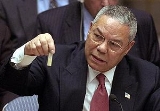
captured in Iraq by Kurdish troops "had nothing to do with biological weapons." The trailers had been a key part of the argument for the 2003 invasion; Secretary of State Colin Powell had told the United Nations Security Council, "We have firsthand descriptions of biological weapons factories on wheels and on rails. We know what the fermenters look like. We know what the tanks, pumps, compressors and other parts look like." The Pentagon team had been sent to investigate the trailers after the invasion. The team of experts unanimously found "no connection to anything biological"; one of the experts told reporters that they privately called the trailers "the biggest sand toilets in the world." The report was classified, and the next day, the CIA publicly released the assessment of its Washington analysts that the trailers were "mobile biological weapons production." The White House continued to refer to the trailers as
mobile biological laboratoriesMobile weapons laboratories are bioreactors and other processing equipment to manufacture and process biological weapons that can be moved from location to locating either by train or vehicle.-Iraqi Mobile weapons laboratories:...
throughout the year, and the Pentagon field report remained classified. It is still classified, but a
Washington Post report of April 12, 2006 disclosed some of the details of the report. According to the
Post:
- A spokesman for the DIA asserted that the team's findings were neither ignored nor suppressed, but were incorporated in the work of the Iraqi Survey Group, which led the official search for Iraqi weapons of mass destruction. The survey group's final report in September 2004 15 months after the technical report was written said the trailers were "impractical" for biological weapons production and were "almost certainly intended" for manufacturing hydrogen for weather balloons. "No one was more surprised than I that we didn't find (WMDs)." General Tommy Franks
General Tommy Ray Franks, United States Army, KBE, is a retired General in the United States Army. His last Army post was as the Commander of the United States Central Command, overseeing United States Armed Forces operations in a 25-country region, including the Middle East...
December 2, 2005.
On February 6, 2004, U.S. President
George W. BushGeorge Walker Bush was the 43rd President of the United States from 2001 to 2009 and the 46th Governor of Texas from 1995 to 2000....
named an
Iraq Intelligence CommissionThe Commission on the Intelligence Capabilities of the United States Regarding Weapons of Mass Destruction is a panel created by Executive Order 13328 signed by U.S. President George W. Bush in February 2004...
, chaired by Charles Robb and Laurence Silberman, to investigate U.S. intelligence, specifically regarding the
2003 invasion of IraqThe 2003 invasion of Iraq, was led by the United States, backed by British forces and smaller contingents from Australia, Denmark, Poland and Spain. Four countries participated with troops during the initial invasion phase, which lasted from March 20 to May 1...
and Iraq's
weapons of mass destructionThe term weapon of mass destruction is often used to describe a weapon that can kill large numbers of humans and/or cause great damage to man-made structures , natural structures , or the biosphere in general....
. On February 8, 2004, Dr
Hans Blixis a Swedish diplomat and politician. He was Swedish Minister for Foreign Affairs . Blix was also the head of the United Nations Monitoring, Verification and Inspection Commission from March 2000 to June 2003, when he was succeeded by Demetrius Perricos...
, in an interview on BBC TV, accused the U.S. and UK
governmentA government is the body within a community, political entity or organization which has the authority to make and enforce rules, laws and regulations.....
s of dramatising the threat of
weapons of mass destructionThe term weapon of mass destruction is often used to describe a weapon that can kill large numbers of humans and/or cause great damage to man-made structures , natural structures , or the biosphere in general....
in
IraqIraq , officially the Republic of Iraq , also known as Mesopotamia, is a country in Western Asia spanning most of the northwestern end of the Zagros mountain range, the eastern part of the Syrian Desert and the northern part of the Arabian Desert.Iraq shares borders with Jordan to the west, Syria...
, in order to strengthen the case for the
2003 warThe 2003 invasion of Iraq, was led by the United States, backed by British forces and smaller contingents from Australia, Denmark, Poland and Spain. Four countries participated with troops during the initial invasion phase, which lasted from March 20 to May 1...
against the government of Saddam Hussein.
Iraq Survey Group
On May 30, 2003, The U.S. Department of Defense briefed the media that it was ready to formally begin the work of the
Iraq Survey GroupThe Iraq Survey Group was a fact-finding mission sent by the multinational force in Iraq after the 2003 Invasion of Iraq to find the alleged Iraqi weapons of mass destruction that had been the main ostensible reason for the invasion. Its final report is commonly called the Duelfer Report...
(ISG), a fact finding mission from the coalition of the Iraq occupation into the WMD programs developed by Iraq, taking over from the British-American 75th Exploitation Task Force.
On October 6, 2004, the head of the
Iraq Survey GroupThe Iraq Survey Group was a fact-finding mission sent by the multinational force in Iraq after the 2003 Invasion of Iraq to find the alleged Iraqi weapons of mass destruction that had been the main ostensible reason for the invasion. Its final report is commonly called the Duelfer Report...
(ISG), Charles Duelfer, announced to the
U.S. SenateThe United States Senate is the upper house of the bicameral United States Congress, the lower house being the House of Representatives. The composition and powers of the Senate and the House are established in Article One of the U.S. Constitution . Each U.S state is represented by two senators,...
Armed Services Committee that the group found no evidence that Iraq under Saddam Hussein had produced and stockpiled any weapons of mass destruction since 1991, when
UNThe United Nations is an international organization whose stated aims are facilitating cooperation in international law, international security, economic development, social progress, human rights, and the achieving of world peace...
sanctionsInternational sanctions are actions taken by countries against others for political reasons, either unilaterally or multilaterally.There are three types of sanctions....
were imposed.
Various nuclear facilities, including the
Baghdad Nuclear Research FacilityThe Baghdad Nuclear Research Facility adjacent to the Tuwaitha "Yellow Cake Factory" contains the remains of nuclear reactors bombed by Israel in 1981 and the United States in 1991. It was used as a storage facility for spent reactor fuel and industrial and medical wastes. The radioactive material...
and Tuwaitha Nuclear Research Center, were found looted in the month following the invasion. (Gellman, May 3, 2003) On June 20, 2003, the International Atomic Energy Agency reported that tons of
uraniumUranium is a silvery-white metallic chemical element in the actinide series of the periodic table that has the symbol U and atomic number 92. Besides its 92 protons, a uranium nucleus can have between 141 and 146 neutrons. The most common uranium isotopes are U-238 and U-235 . A uranium atom has...
, as well as other radioactive materials such as
thoriumThorium is a chemical element with the symbol Th and atomic number 90. It is a naturally occurring, slightly radioactive metal. Thorium is estimated to be about three to four times more abundant than uranium in the earth's crust...
, had been recovered, and that the vast majority had remained on site. There were several reports of radiation sickness in the area. It has been suggested that the documents and suspected weapons sites were looted and burned in Iraq by looters in the final days of the war.
On May 2, 2004 a shell containing mustard gas, was found in the middle of street west of
BaghdadBaghdad is the capital of Iraq and of Baghdad Governorate, with which it is coterminous. Having a municipal population estimated at 6.5 million, it is the largest city in Iraq and the second largest in the Arab World....
. The
Iraq Survey GroupThe Iraq Survey Group was a fact-finding mission sent by the multinational force in Iraq after the 2003 Invasion of Iraq to find the alleged Iraqi weapons of mass destruction that had been the main ostensible reason for the invasion. Its final report is commonly called the Duelfer Report...
investigation reported that it had been previously "stored improperly", and thus the gas was "ineffective" as a useful chemical agent. Officials from the
Defense DepartmentThe United States Department of Defense is the federal department charged with coordinating and supervising all agencies and functions of the government relating directly to national security and the military...
commented that they were not certain if use was to be made of the device as a bomb.
On May 16, 2004 a 152 mm artillery shell was used as an improvised bomb. The shell exploded and two U.S. soldiers were treated for minor exposure to a nerve agent (nausea and dilated pupils). On May 18 it was reported by U.S. Department of Defense intelligence officials that tests showed the two-chambered shell contained the chemical agent
sarinSarin, also known by its NATO designation of GB, is an extremely toxic substance whose sole application is as a nerve agent. As a chemical weapon, it is classified as a weapon of mass destruction by the United Nations in UN Resolution 687...
, the shell being "likely" to have contained three to four liters of the substance (in the form of its two unmixed precursor chemicals prior to the aforementioned explosion that had not effectively mixed them). Former U.S. weapons inspector
David KayDr. David A. Kay is best known for heading the Iraq Survey Group and acting as a weapons inspector in Iraq after the 2003 U.S. invasion.-Education:...
told the
Associated PressThe Associated Press is an American news agency. The AP is a cooperative owned by its contributing newspapers, radio and television stations in the United States, which both contribute stories to the AP and use material written by its staff journalists...
that "he doubted the shell or the nerve agent came from a hidden stockpile, although he didn't rule out that possibility." Kay also considered it possible that the shell was "an old relic overlooked when Saddam said he had destroyed such weapons in the mid-1990s." It is likely that the insurgents who planted the bomb did not know it contained sarin, according to Brig. Gen.
Mark KimmittMark Traecey Patrick Kimmitt was the 16th Assistant Secretary of State for Political-Military Affairs, serving under George W. Bush from August 2008 to January 2009. Prior to joining the State Department, he was a Brigadier General in the United States Army, and served as the Deputy Assistant...
, and another U.S. official confirmed that the shell did not have the markings of a chemical agent. The
Iraq Survey GroupThe Iraq Survey Group was a fact-finding mission sent by the multinational force in Iraq after the 2003 Invasion of Iraq to find the alleged Iraqi weapons of mass destruction that had been the main ostensible reason for the invasion. Its final report is commonly called the Duelfer Report...
later concluded that the shell "probably originated with a batch that was stored in a Al Muthanna CW complex basement during the late 1980s for the purpose of leakage testing."
On October 29 U.S. intelligence spokesmen claimed that Iraqi WMDs and programs had been comprehensively hidden before or immediately after the fall of Baghdad, with some elements of the programs being shipped out of the country.
In a July 2, 2004 article published by The Associated Press and reported by Fox News that more WMD not destroyed by the Iraqi Regime were discovered in South Central Iraq by Polish Allies. Sarin Gas warheads dating back to the last Iran–Iraq War were trying to be purchased by terrorists for $5000 a warhead. The Polish troops secured munitions on June 23, 2004. After being tested, it turned out that the warheads did not in fact contain sarin gas. The
Coalition Press Information CenterThe Coalition Press Information Center is a centralized media information center that was established during the 2003 invasion of Iraq.-Operation Iraqi Freedom:...
in Baghdad announced that the munitions "were all empty and tested negative for any type of chemicals." The United States abandoned its search for WMDs in Iraq on January 12, 2005.
On September 30, 2004, the U.S. Iraq Survey Group Final Report concluded that, "ISG has not found evidence that Saddam Husayn (sic) possessed WMD stocks in 2003, but the available evidence from its investigation—including detainee interviews and document exploitation—leaves open the possibility that some weapons existed in Iraq although not of a militarily significant capability." Among the key findings of the final ISG report were:
- Evidence of the maturity and significance of the pre-1991 Iraqi Nuclear Program but found that Iraq's ability to reconstitute a nuclear weapons program progressively decayed after that date;
- Concealment of nuclear program in its entirety, as with Iraq's BW program. Aggressive UN inspections after Desert Storm forced Saddam to admit the existence of the program and destroy or surrender components of the program;
- After Desert Storm, Iraq concealed key elements of its program and preserved what it could of the professional capabilities of its nuclear scientific community;
- Saddam's ambitions in the nuclear area were secondary to his prime objective of ending UN sanctions; and
- A limited number of post-1995 activities would have aided the reconstitution of the nuclear weapons program once sanctions were lifted.
The report found that "The ISG has not found evidence that Saddam possessed WMD stocks in 2003, but [there is] the possibility that some weapons existed in Iraq, although not of a militarily significant capability." It also concluded that there was a possible intent to restart all banned weapons programs as soon as multilateral sanctions against it had been dropped, with Hussein pursuing WMD proliferation in the future: "There is an extensive, yet fragmentary and circumstantial, body of evidence suggesting that Saddam pursued a strategy to maintain a capability to return to WMD after sanctions were lifted..." No senior Iraqi official interviewed by the ISG believed that Saddam had forsaken WMD forever.
After he was captured by U.S. forces in Baghdad in 2003, Dr. Mahdi Obeidi, who ran Saddam's nuclear centrifuge program until 1997, handed over blueprints for a nuclear centrifuge along with some actual centrifuge components, stored at his home buried in the front yard awaiting orders from Baghdad to proceed. He said, "I had to maintain the program to the bitter end." In his book, "The Bomb in My Garden", the Iraqi physicist explains that his nuclear stash was the key that could have unlocked and restarted Saddam's bombmaking program. However, it would require a massive investment and a re-creation of thousands of centrifuges in order to reconstitute a full centrifugal enrichment program.
On October 3, 2003, the world digests
David KayDr. David A. Kay is best known for heading the Iraq Survey Group and acting as a weapons inspector in Iraq after the 2003 U.S. invasion.-Education:...
's
Iraq Survey GroupThe Iraq Survey Group was a fact-finding mission sent by the multinational force in Iraq after the 2003 Invasion of Iraq to find the alleged Iraqi weapons of mass destruction that had been the main ostensible reason for the invasion. Its final report is commonly called the Duelfer Report...
report that finds no stockpiles of
WMDThe term weapon of mass destruction is often used to describe a weapon that can kill large numbers of humans and/or cause great damage to man-made structures , natural structures , or the biosphere in general....
in Iraq, although it states the government intended to develop more weapons with additional capabilities. Weapons inspectors in Iraq do find some "
biological laboratoriesA laboratory is a facility that provides controlled conditions in which scientific research, experiments, and measurement may be performed. The title of laboratory is also used for certain other facilities where the processes or equipment used are similar to those in scientific laboratories...
" and a collection of "reference strains", including a strain of botulinum bacteria, "ought to have been declared to the UN." Kay testifies that Iraq had not fully complied with UN inspections. In some cases, equipment and materials subject to UN monitoring had been kept hidden from UN inspectors. "So there was a WMD program. It was going ahead. It was rudimentary in many areas", Kay would say in a later interview. In other cases, Iraq had simply lied to the UN in its weapons programs. The U.S.-sponsored search for WMD had at this point cost $300 million and was projected to cost around $600 million more.
In David Kay's statement on the interim report of the ISG the following paragraphs are found:
"We have not yet found stocks of weapons, but we are not yet at the point where we can say definitively either that such weapon stocks do not exist or that they existed before the war and our only task is to find where they have gone. We are actively engaged in searching for such weapons based on information being supplied to us by Iraqis."
"With regard to delivery systems, the ISG team has discovered sufficient evidence to date to conclude that the Iraqi regime was committed to delivery system improvements that would have, if OIF had not occurred, dramatically breached UN restrictions placed on Iraq after the 1991 Persian Gulf War."
"ISG has gathered testimony from missile designers at Al Kindi State Company that Iraq has reinitiated work on converting SA-2 Surface-to-Air Missiles into ballistic missiles with a range goal of about 250 km. Engineering work was reportedly underway in early 2003, despite the presence of UNMOVIC. This program was not declared to the UN."
"ISG has developed multiple sources of testimony, which is corroborated in part by a captured document, that Iraq undertook a program aimed at increasing the HY-2's range and permitting its use as a land-attack missile. These efforts extended the HY-2's range from its original 100 km to 150-180km. Ten modified missiles were delivered to the military prior to OIF and two of these were fired from Umm Qasr during OIF one was shot down and one hit Kuwait."
Another notable statement is the following:
"We have discovered dozens of WMD-related program activities and significant amounts of equipment that Iraq concealed from the United Nations during the inspections that began in late 2002."
The phrase 'WMD-related program activities' was later used in George Bush's state of the union speech. Bush's critics, often not realizing the origin of the statement, derided Bush for unclear wording and trying to "lower the bar" on confirming his pre-war WMD-claims.
In a January 26, 2004 interview with
Tom BrokawThomas John "Tom" Brokaw is an American television journalist and author. Brokaw is best known as the former anchor and managing editor of NBC Nightly News. His last broadcast as anchor was on December 1, 2004, after which he was succeeded by Brian Williams...
of
NBCThe National Broadcasting Company is an American television network and former radio network headquartered in the GE Building in New York City's Rockefeller Center with additional major offices in Burbank,California...
news, Mr. Kay described Iraq's nuclear, chemical, and biological weapons programs as being in a "rudimentary" stage. He also stated that "What we did find, and as others are investigating it, we found a lot of terrorist groups and individuals that passed through Iraq." In responding to a question by Mr. Brokaw as to whether Iraq was a "gathering threat" as President Bush had asserted before the invasion, Mr. Kay answered:
- Tom, an imminent threat is a political judgment. It’s not a technical judgment. I think Baghdad was actually becoming more dangerous in the last two years than even we realized. Saddam was not controlling the society any longer. In the marketplace of terrorism and of WMD, Iraq well could have been that supplier if the war had not intervened.
In June 2004, the United States removed 2 tons of low-enriched uranium from Iraq, sufficient raw material for a single nuclear weapon.
Since the 2003 invasion of Iraq, several reported finds of chemical weapons were announced. During the invasion itself, there were half a dozen incidents in which the U.S. military announced that it had found chemical weapons. All of these claims were based on field reports, and were later retracted. After the war, many cases most notably on April 7, 2003 when several large drums tested positive continued to be reported in the same way.
Another such post-war case occurred on January 9, 2004, when Icelandic munitions experts and Danish military engineers discovered 36 120-mm
mortarA mortar is a muzzle-loading indirect fire weapon that fires shells at low velocities, short ranges, and high-arcing ballistic trajectories. It typically has a barrel length less than 15 times its caliber.- Function :...
rounds containing liquid buried in Southern Iraq. While initial tests suggested that the rounds contained a
blister agentA blister agent is a chemical compound that causes severe skin, eye and mucosal pain and irritation. They are named for their ability to cause severe chemical burns, resulting in large, painful water blisters on the bodies of those affected...
, a
chemical weaponChemical warfare involves using the toxic properties of chemical substances as weapons to kill, injure, or incapacitate an enemy....
banned by the Geneva Convention, subsequent analysis by American and Danish experts showed that no chemical agent was present. It appears that the rounds have been buried, and most probably forgotten, since the Iran–Iraq War. Some of the munitions were in an advanced state of decay and most of the weaponry would likely have been unusable.
Demetrius Perricos, then head of UNMOVIC, stated that the Kay report contained little information not already known by UNMOVIC. Many organizations, such as the journal
Biosecurity and Bioterrorism, have claimed that Kay's report is a "worst case analysis"
Beginning in 2003, the ISG had uncovered remnants of Iraq's 1980s-era WMD programs. On June 21, 2006
Rick SantorumRichard John Santorum is a former United States Senator from the Commonwealth of Pennsylvania. Santorum is a member of the Republican Party and was the chairman of the Senate Republican Conference, the number-three job in the party leadership of the Senate.Santorum is usually considered a social...
claimed that "we have found weapons of mass destruction in Iraq, chemical weapons", citing a declassified June 6 letter to
Pete HoekstraPeter "Pete" Hoekstra is a Dutch-born American politician from the U.S. state of Michigan. A Republican, Hoekstra has represented the Michigan's 2nd congressional district since taking office in 1993 following his win in the 1992 election.Born Cornelius Peter Hoekstra in Groningen in the...
saying that since the 2003 invasion, a total of "approximately 500 weapons munitions which contain degraded mustard or sarin nerve agent" had been found scattered throughout the country.
The Washington Post reported that "the U.S. military announced in 2004 in Iraq that several crates of the old shells had been uncovered and that they contained a blister agent that was no longer active." It said the shells "had been buried near the Iranian border, and then long forgotten, by Iraqi troops during their eight-year war with Iran, which ended in 1988."
On July 2008, 550 metric tonnes of "yellowcake" the last major remnant of Saddam Hussein's nuclear program, a huge stockpile of concentrated natural uranium, arrived in Montreal as part of a top-secret U.S. operation. This transport of the seed material for higher-grade nuclear enrichment, included a two-week airlift from Baghdad and a voyage across two oceans. The Iraqi government sold the yellowcake to a Canadian uranium producer, Cameco Corp., in a transaction the official described as worth "tens of millions of dollars."
Captured documents
Operation Iraqi Freedom documents refers to some 48,000 boxes of documents, audiotapes and videotapes that were captured by the U.S. military during the 2003 invasion of Iraq. Many of these documents seem to make clear that Saddam's regime had given up on seeking a WMD capability by the mid-1990s. Associated Press reported, "Repeatedly in the transcripts, Saddam and his lieutenants remind each other that Iraq destroyed its chemical and biological weapons in the early 1990s, and shut down those programs and the nuclear-bomb program, which had never produced a weapon." At one 1996 presidential meeting, top weapons program official Amer Mohammed Rashid, describes his conversation with UN weapons inspector Rolf Ekeus: "We don't have anything to hide, so we're giving you all the details." At another meeting Saddam told his deputies, "We cooperated with the resolutions 100 percent and you all know that, and the 5 percent they claim we have not executed could take them 10 years to (verify). Don't think for a minute that we still have WMD. We have nothing." U.S. Congressman Peter Hoekstra called for the U.S. government to put the remaining documents on the Internet so Arabic speakers around the world can help translate the documents.
Theories in the aftermath of the 2003 war
Given the absence of illicit stockpiles and the heavy volume of traffic leaving Iraq shortly before invasion, some analysts and politicians believed Saddam Hussein may have transferred illicit material out of the country during this period. Mainstream opinion is that Iraq had no weapons of mass destruction as of late 2002.
2009 Declaration
Iraq became a member state of the
Chemical Weapons ConventionThe Chemical Weapons Convention is an arms control agreement which outlaws the production, stockpiling and use of chemical weapons...
in 2009, declaring "two bunkers with filled and unfilled chemical weapons munitions, some precursors, as well as five former chemical weapons production facilities" according to OPCW Director General Rogelio Pfirter. No plans were announced at that time for the destruction of the material, although it was noted that the bunkers were damaged in the 2003 war and even inspection of the site must be carefully planned.
See also
- At the Center of the Storm: My Years at the CIA
At the Center of the Storm: My Years at the CIA is a memoir co-written by former Director of the Central Intelligence Agency, George Tenet with Bill Harlow, former CIA Director of Public Affairs...
- In Shifting Sands: The Truth About Unscom and the Disarming of Iraq
In Shifting Sands: The Truth About Unscom and the Disarming of Iraq is a 2001 documentary by Scott Ritter that discusses the UNSCOM inspections in Iraq. Ritter was a chief United Nations weapons inspector in Iraq from 1991 to 1998...
- Iraqi biological weapons program
Saddam Hussein initiated an extensive biological weapons program in Iraq in the early 1980s, in violation of the Biological Weapons Convention of 1972...
- Operation Rockingham
Operation Rockingham was the codeword for UK involvement in inspections in Iraq following the war over Kuwait in 1990-91. Early in 1991 the United Nations Special Commission on Iraq was established to oversee the destruction of Iraq's weapons of mass destruction...
- Office of Special Plans
The Office of Special Plans , which existed from September 2002 to June 2003, was a Pentagon unit created by Paul Wolfowitz and Douglas Feith, and headed by Feith, as charged by then-United States Secretary of Defense Donald Rumsfeld, to supply senior George W. Bush administration officials with...
- Yellowcake forgery
The Niger uranium forgeries refers to forged documents initially revealed by Italian Military intelligence. These documents purport to depict an attempt by the regime of Saddam Hussein in Iraq to purchase "yellowcake" uranium powder from Niger during the Iraq disarmament crisis.On the basis of...
- Mobile weapons laboratory
Mobile weapons laboratories are bioreactors and other processing equipment to manufacture and process biological weapons that can be moved from location to locating either by train or vehicle.-Iraqi Mobile weapons laboratories:...
- Iraqi aluminum tubes order
- Dodgy Dossier
Iraq: Its Infrastructure of Concealment, Deception and Intimidation was a 2003 briefing document for the Blair Labour government...
- Operation Opera
Operation Opera was a successful surprise Israeli air strike against the Iraqi Osirak nuclear reactor in 1981....
- UN Inspectors: David Kelly
David Christopher Kelly, CMG was an employee of the United Kingdom Ministry of Defence , an expert in biological warfare and a former United Nations weapons inspector in Iraq...
, Demetrius PerricosDemetrius Perricos is Acting Executive Chairman of United Nations Monitoring, Verification and Inspection Commission, or Unmovic. He succeeded Dr. Hans Blix. His contract is up at the end of June 2007....
, Corinne HeraudCorinne Heraud was formerly a Chief Inspector of the Missile inspection team in Iraq, while working for the United Nation’s Monitoring, Verification and Inspection Commission...
, Alexander CokerAlexander Coker was formerly a Chief Inspector of the Chemical Weapons team in Iraq, while working for the United Nation’s Monitoring, Verification and Inspection Commission...
External links