


Recep Tayyip Erdogan

Encyclopedia
Recep Tayyip Erdoğan (ɾe̞ˈd͡ʒe̞p t̪äjˈjip ˈæɾd̪oän; born 26 February 1954) has been Prime Minister of Turkey since 2003 and is chairman of the ruling Justice and Development Party
(AK Party), which holds a majority of the seats in the Grand National Assembly of Turkey
. Erdoğan served as Mayor of Istanbul
from 1994 to 1998. He graduated in 1981 from Marmara University
's Faculty of Economics and Commercial Sciences
. Erdoğan was also a semi-professional
footballer from 1969 to 1982. Recep Tayyip Erdogan is the only Prime Minister of Turkey who usually goes by his first name.
Erdoğan was elected Mayor of Istanbul in the local elections of 27 March 1994
. He was banned from office and sentenced to a prison term for reciting a poem during a public address in the province of Siirt
on 12 December 1997. The poem was allegedly quoted from a book published by a state enterprise and one that had been recommended to teachers by the Ministry of Education
. After six months in prison, Erdoğan established the Justice and Development Party (AK Party) on August 14, 2001. From its first year, the AK Party became the largest publicly-supported political movement
in Turkey. In the general election
of 2002 the AK Party won nearly two-thirds of the seats in parliament
, forming the first single-party government for 19 years.
As prime minister, Erdoğan implemented numerous reforms. 45 years after Turkey signed an Association Agreement with the EU, the negotiations for Turkey's accession to the EU
started during Erdoğan's tenure. Parallel to this, inflation
, which had for decades adversely affected the country's economy
, was brought under control and the Turkish Lira
regained its former prestige through the elimination of six zeros.
Interest rates were reduced and per capita income
grew significantly. The AK party won the elections of 2007
making it the first time in 52 years that a party in power had increased its votes for a second term. In the 2011 general election
, the AK Party was re-elected for a third term and Erdoğan remained Prime Minister.
neighborhood of Istanbul
to a family that had moved there from Rize Province
. When he visited Georgia on 11 August 2004, he said I'm a Georgian
too, my family is Georgian family, migrated from Batumi
to Rize
. However, Turkish historian Cezmi Yurtsever claims Erdoğan's family actually descends from the family of Bagatlı Recep, a large Muslim Turkish family that was settled around Trabzon
after Mehmed II
's conquest of the city. Bagatlı Recep died in 1916 fighting against the invading Russian
and Armenian
forces.
Erdoğan spent his early childhood in Rize, where his father was a member of the Turkish Coast Guard
. The family returned to Istanbul when Erdoğan was 13 years old. As a teenager, he sold lemonade and sesame buns (simit
) on the streets of Istanbul's rougher districts to earn extra money. Brought up in a observant Muslim family, he graduated from Kasımpaşa Piyale primary school in 1965 and from Istanbul Religious Vocational High School in 1973 (İmam Hatip school
). He received his high school diploma from Eyüp High School. He studied Business Administration at Aksaray School of Economics and Commercial Sciences (now it is known as Marmara University's Faculty of Economics and Administrative Sciences).
In his youth, Erdoğan played semi-professional football at a local club. The stadium of the local football club of the district he grew up in, Kasımpaşa S.K.
is named after him.
Erdoğan married Emine Gülbaran (b. 1955, Siirt
), whom he met during a conference, on 4 July 1978. The couple has two sons (Ahmet Burak, Necmeddin Bilal) and two daughters (Esra, Sümeyye).
's Faculty of Economics and Administrative Sciences
and playing semi-professional football, Erdoğan engaged in politics by joining the National Turkish Student Union, an anti-communist
action group. In 1974 he wrote, directed and played the lead role in the play
Maskomya, which presented Freemasonry
, Communism
and Judaism
as evil. In 1976, he became the head of Beyoğlu
youth branch of the Islamist National Salvation Party
(MSP). That same year, he was promoted to the position of chair for the Istanbul youth branch of the party.
After the 1980 military coup, Erdoğan followed most of Erbakan's followers into the Welfare Party
. He became the party’s Beyoglu district chair in 1984, and in 1985 he became the chair of the Istanbul city branch. He was elected to parliament in 1991, but barred from taking his seat.
Erdoğan was elected Mayor of Istanbul, the social and economic capital of Turkey and one of the biggest metropolitan areas of the world. He won a plurality (25.19%) of the popular vote. Many feared that he would impose Islamic law, however, he was pragmatic in office, tackling such chronic problems in Istanbul as water shortage, pollution
and traffic chaos
. The water shortage problem was solved with the laying of hundreds of kilometers of new pipelines. The garbage problem was solved with the establishment of state-of-the-art recycling facilities. While Erdoğan was in office, air pollution was reduced through a plan developed to switch to natural gas
. He changed the public buses
with environmentally friendly buses. The city's traffic and transportation jams were ameliorated with more than fifty bridges, viaducts, and highways. Erdoğan prohibited the sale of alcohol in city-owned facilities, but later this measure was reversed. While taking precautions to prevent corruption, he took measures to ensure that municipal funds were used prudently. He paid back a major portion of Istanbul Metropolitan Municipality
's two billion dollar debt when he took office and meanwhile invested four billion dollars in the city.
Erdoğan initiated the first roundtable of mayors during the Istanbul conference
, which led to a global, organized movement of mayors. A seven member international jury from the United Nations
unanimously found Erdoğan deserving the UN-HABITAT
award.
. Erdoğan became a constant speaker at the demonstrations held by his party colleagues.
He was given a ten month prison sentence (of which he served six months) for reciting a poem in Siirt
in December 1997, which, under article 312/2 of the Turkish penal code was regarded as an incitement to commit an offense and incitement to religious or racial hatred. It included verses translated as "The mosques are our barracks, the domes our helmets, the minarets our bayonets and the faithful our soldiers...." The aforementioned verses, however, are not in the original version of the poem. The poem was from a work written by Ziya Gökalp
, a pan-Turkish activist of the early 20th century. Erdoğan claimed the poem had been approved by the education ministry to be published in textbooks. With the conviction, Erdoğan was forced to give up his mayoral position. The conviction also stipulated a political ban, which prevented him from participating in parliamentary elections. He completed his sentence on 24 July 1999.
, taking nearly two-thirds of the seats. However, Erdoğan could not became prime minister right away, as he was still banned from politics by the judiciary for his speech in Siirt; Gül thus became the prime minister instead. In December 2002 the Supreme Election Board canceled the general election results from Siirt due to voting irregularities and scheduled a new election for 9 February 2003. By this time, party leader Erdoğan was able to run for Parliament thanks to a legal change made possible by the opposition Republican People’s Party. The AK Party duly listed Erdoğan as a candidate for the rescheduled Siirt election, and he won, becoming prime minister after Gül subsequently handed over the post.
supremacy over Turkish courts, reduced the powers of the 1991 Anti-Terror Law which had constrained Turkey’s democratization, and abolished many restrictions on freedom of speech and the press. The government planned several times to replace the Turkish Constitution of 1982 with a more democratic "civil constitution", but the main opposition party CHP did not want to participate.
During a visit to Bishkek
he stated that "We currently already have a semi-presidential system. There is a strong presidency."
In 2009, the Turkish government under Prime Minister Erdoğan announced a plan to help end the quarter-century-long Turkey – Kurdistan Workers' Party conflict that has cost more than 40,000 lives. The government's plan, supported by the European Union
, allowed the Kurdish language
to be used in all broadcast media and political campaigns, and restore Kurdish names to cities and towns that have been given Turkish ones. “We took a courageous step to resolve chronic issues that constitute an obstacle along Turkey's development, progression and empowerment”, Erdoğan said regarding the matter.Erdogan passed a partial amnesty to reduce penalties faced by many members of the Kurdish terrorist organization PKK who had surrendered to the government. On 23 November 2011, he apologised on behalf of the state for the 1937 Dersim massacre of Kurds
during a televised meeting of his party in Ankara.
in enforcing macro-economic policies. Erdoğan tried to attract more foreign investors to Turkey and lifted most of government regulations, with the average GDP growth rate 7.3% during his premiership as he presided over a record 26 quarters of economic growth.
Since 1961, Turkey has begun 19 IMF loan accords. Erdoğan's government satisfied the budgetary and market requirements of the two on his watch and received every loan installment, the only time any government has ever done so. Erdoğan inherited a debt of $23.5 billion to the IMF, which has been reduced to $6.1 billion in 2010. He decided not to sign a new deal. Turkey's debt to the IMF will be completely paid off in 2013.
In 2010, Five-year credit default swaps for Turkey's sovereign debt were trading at a record low of 1.17%, below those of nine EU member countries and Russia. The unemployment rate decreased from 10.3% to 9.7% in 2007. Along with the global economic crisis of 2008, Turkey’s unemployment rate jumped to a record high of 16.1% in the January–March period of 2009. In the April–June period of 2010, the unemployment decreased again to 11.0%, compared to 10.0% in the eurozone.
In 2002, the Turkish Central Bank had $26.5 billion in reserves. This amount reached $92.2 billion in 2011. In the same period, inflation fell from 34.9% to 5.7%, the lowest in 39 years.
The public debt as percentage of annual gross domestic product declined from 74% in 2002 to 39% in 2009.
The World Bank
praised Erdoğan for the courageous reforms and the economic stability in the country.
In May 2007, the head of Turkey's High Court asked prosecutors to consider whether Erdoğan should be charged over critical comments regarding the election of Abdullah Gül
as president. Erdoğan said the ruling was "a disgrace to the justice system", and criticized the Constitutional Court which had invalidated a presidential vote because a boycott of other parties meant there was no quorum
. Prosecutors have already investigated his earlier comments, including saying it had fired a "bullet at democracy". Tülay Tuğcu
, head of the Constitutional Court, condemned Erdoğan for "threats, insults and hostility" towards the justice system. The Turkish parliament agreed to reduce the age of candidacy
to the parliament from 30 to 25 and abolished the death penalty in all instances, including war time.
under a loan deal. He claimed that the move, which was passed with fierce opposition, was one of the most radical reforms. Turkey’s three social security bodies were united under one roof, bringing equal health services and retirement benefits for members of all three bodies. Under the second bill, everyone under the age of 18 years old will be entitled to free health services, irrespective of whether they pay premiums to any social security organization or not. The bill also envisages a gradual increase in the retirement age. Starting from 2036, the retirement age will increase to 65 by
2048 for both men and women. The government unified three systems of hospitals and insurance for different professions that were criticized for offering unequal benefits and reserving the best hospitals for civil servants while others waited in long queues.
On January 2008, the Turkish Parliament adopted a law on a complete prohibition of smoking in most public places. Erdoğan is outspokenly anti-smoking.
remains young, every family would need to have at least three children. He has repeated this statement on numerous occasions. As of 2010, Turkey's population is estimated at 73,700,000, with a growth rate of 1.21% per annum (2009 figure).
is a continent where civilisations reconcile and not clash." On 3 October 2005, the negotiations for Turkey's accession to the EU formally started during Erdoğan's tenure as Prime Minister.
Erdoğan is a co-founder of the Alliance of Civilizations
(AOC). The AOC initiative was proposed by the Prime Minister of Spain, José Luis Rodríguez Zapatero
, at the 59th General Assembly of the United Nations (UN) in 2005. The initiative seeks to galvanize international action against extremism
through the forging of international, intercultural and inter-religious dialogue and cooperation.
have been normalized. Political and economic relations are much improved. In 2007, Erdoğan and Greek Prime Minister Kostas Karamanlis met on the bridge over the Evros River at the border between Greece and Turkey, for the inauguration of the Greek-Turkish natural gas pipeline, linking the longtime Aegean rivals through a project that will give Caspian gas its first direct Western outlet and help ease Russia's energy dominance.
Turkey and Greece signed an agreement to create a Combined Joint Operational Unit within the framework of NATO to participate in Peace Support Operations.
Erdoğan and his party strongly supported the EU backed referendum of Cyprus, 2004 to reunify the island.
and Turkey signed 48 trade agreements by the Iraqi-Turkish Strategic Council in Baghdad. Agreements signed included sectors of security, energy, oil, electricity, water, health, trade, environment, transport, housing, construction, agriculture, education, higher education, and defense. The Turkish government mended relations with Iraqi Kurdistan
by opening a Turkish university in Arbil
, and a Turkish consulate in Mosul
. Abdullah Gül
became the first Turkish head of state to visit Iraq in 33 years, on 23 March 2009.
 Erdoğan paid a state visit to Israel in 2005, bringing along a delegation of businessmen to further economic ties.
The President of Israel Shimon Peres
addressed the Turkish parliament during a visit in 2007, the first time an Israeli leader had addressed the legislature of a predominantly Muslim nation.
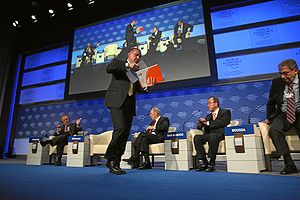
At the 2009 World Economic Forum
conference, the debate became heated in relation to the Gaza conflict. Israeli President Shimon Peres
responded to Erdoğan's claims, stating that Turkey would have done the same if rockets had been hitting Istanbul. Erdoğan was interrupted by the moderator while he was responding to Peres. Erdoğan stated: "Mister Peres, you are older than I am. Maybe you are feeling guilty and that is why you are raising your voice. When it comes to killing you know it too well. I remember the children who was killed on beaches..." Upon the moderator's reminder that they needed to adjourn for dinner, Erdoğan left the panel, accusing the moderator of giving Peres more time than all the other panelists combined.
Following the Gaza flotilla raid
in May 2010, tension between the two countries dramatically mounted. Erdoğan strongly condemned the raid, describing it as "state terrorism", calling for Israeli leaders responsible to apologize. Erdoğan has described Israel
as "the main threat to regional peace", and has called for Israel's nuclear facilities
to come under IAEA
inspection. Erdoğan accused Israel of turning Gaza into an "open-air prison".
In December 2004, President Putin
visited Turkey. This was the first Presidential visit in the history of Turkish-Russian relations besides that of the Chairman of the Presidium, Nikolai Podgorny
in 1972. In November 2005, Putin attended the inauguration of a jointly constructed Blue Stream
natural gas pipeline in Turkey. This sequence of top-level visits has brought several important bilateral issues to the forefront. The two countries consider it their strategic goal to achieve "multidimensional co-operation", especially in the fields of energy, transport and the military. Specifically, Russia aims to invest in Turkey’s fuel and energy industries, and it also expects to participate in tenders for the modernisation of Turkey’s military.
President Medvedev
described Turkey as “one of our most important partners with respect to regional and international issues... We can confidently say that Russian-Turkish relations have advanced to the level of a multidimensional strategic partnership.”
On 12 May 2010, Ankara and Moscow signed 17 agreements to enhance cooperation in energy and other fields, including pacts to build Turkey’s first nuclear power plant and furthering plans for an oil pipeline from the Black Sea
to the Mediterranean Sea
. The leaders of both countries have also signed an agreement on visa-free travel. Tourists will be able to get into the country for free and stay there for up to 30 days.
were established in 1929. In recent years importance has been given to regional issues and to the improvement of bilateral relations to strengthen political, economic and military ties.
In August 2006, King Abdullah bin Abdulaziz as-Saud
made a visit to Turkey
. This was the first visit by a Saudi
monarch to Turkey in last four decades. The monarch made a second visit, on 9 November 2007. Turk-Saudi trade volume has exceeded 3.2 billion in 2006, almost double the figure achieved in 2003. In 2009, this amount reached 5.5 billion and the goal for the year 2010 was 10 billion. Trade is expected to increase even more, as the strategic locations of both countries translate into economies which are in a position to supplement each other.
arrived in Turkey for the first official visit by a Syrian President in 57 years. In late 2004, Turkish Prime Minister Erdoğan signed a free trade agreement with Syria. The visa restrictions between the two countries have been lifted in 2009, which caused an economic boom in the regions near the Syrian border. In 2011, the relationship between the two countries has strained again mostly due to the 2011 Syrian uprising
.
was affecting the entire East Africa
region. Said to be "the worst in 60 years", the drought has caused a severe food crisis
that threatened the livelihood of more than 12 million people in Somalia
and neighbouring countries. On August 19, 2011, Prime Minister Recep Tayyip Erdoğan went to Somalia to draw international attention to the East African country's drought and famine situation. He became the first leader from outside Africa to visit Somalia in nearly two decades. Erdogan, who was accompanied on the trip by his wife, daughter and an entourage consisting of cabinet members and their families, visited refugee camps and hospitals in Somalia to witness the devastation caused by the severe drought.
Turkey will open an embassy in Mogadishu
and take several measures to help Somalia improve its infrastructure, which include digging wells to improve water supply, building a major hospital, six field hospitals and a highway from the Mogadishu Airport to the city center, as well as facilities for waste management to clean up Mogadishu's rubbish-strewn streets, Erdoğan said. He said Housing Development Administration of Turkey (TOKİ) will also build houses and schools in the famine-hit country.
A week later, the Turkish Prime Ministry Disaster & Emergency Management Directorate said that Turkish people collected a total of $201 million in donations for Somalia since the aid campaign started August 1. Somali President Sheikh Sharif Sheikh Ahmed was quoted in the Hurriyet newspaper as calling Prime Minister Erdogan's visit to Somalia an “historic gesture.”
on 12 September 2011, he was accompanied with six ministers and a fleet of 200 businessmen. This visit is considered as a diplomatic success, as it was made very soon after Turkey had ejected Israeli ambassadors, cut all diplomatic and bilateral military agreements. because Israel has refused to apologize for the Gaza flotilla attack
which killed Turkish humanitarian worker aboard an aid convoy headed to Gaza. and with in last 15 years and after Egypt Revolution of 2011, this is the first visit by a Prime Minister of Turkey.
Erdoğan's visit to Egypt was met with much enthusiasm by Egypt
ians. Even though it was midnight, Cairo traffic was reported to be jammed as thousands rushed to welcome the Turkish Prime Minister with Turkish flags. CNN
reported some Egyptians saying "We consider him as the Islamic leader in the Middle East", while others were appreciative of his role in supporting Gaza. Erdoğan was later honored in Tahrir Square by members of the Egyptian Revolution Youth Union, and members of the Turkish embassy were presented with a coat of arms in acknowledgment of the Prime Minister’s support of the Egyptian Revolution.
His visit also brought criticism from Middle Eastern Christians
when he drew comparisons in a speech between the fall of Mubarak and the Fall of Constantinople
, describing the Byzantine Empire
as a "dark civilization".
A week after he left, Turkish Foreign Minister, Ahmet Davutoğlu
proclaimed his vision of a strategic alliance between Egypt and Turkey which he described as an “Axis of Democracy”. However, some voiced concerns that the Egyptian revolution was not fulfilled and that Erdoğan was seeking his own country's strategic interests. It was feared that by forming an alliance with the military junta in Egypt during the country’s transition to democracy, Erdoğan may have tipped the balance in favor of those that stand between the Egyptians and their freedom.
became President of United States, he made his first overseas bilateral meeting to Turkey in April 2009.
At a joint news conference in Turkey, Obama said: "I'm trying to make a statement about the importance of Turkey, not just to the United States
but to the world. I think that where there's the most promise of building stronger U.S.-Turkish relations is in the recognition that Turkey and the United States
can build a model partnership in which a predominantly Christian
nation, a predominantly Muslim
nation – a Western
nation and a nation that straddles two continents," he continued, "that we can create a modern international community that is respectful, that is secure, that is prosperous, that there are not tensions – inevitable tensions between cultures – which I think is extraordinarily important."
, Bahceli
, Yılmaz
and Çiller
, resigned. The second largest party, the CHP, received 19.4% of the votes.
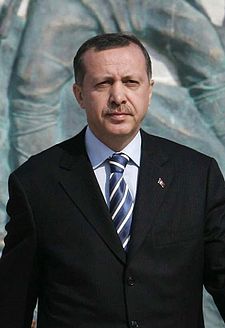 The stage of the elections of 2007 was set for a fight for legitimacy in the eyes of voters between his government and the country's Kemalist opposition. Erdoğan used the events at that took place during the ill-fated Presidential elections a few months earlier as a part of the general election campaign of his party. On 22 July 2007, the AK Party had won an important victory over the opposition, garnering 46.7% of the popular vote. The 22 July elections marked only the second time in the Turkish Republic's history whereby an incumbent governing party won an election by increasing its share of popular support.
On 14 March 2008, Turkey's Chief Prosecutor asked the country's Constitutional Court to ban Erdoğan's governing party. The party escaped a ban on 30 July 2008, a year after winning 46.7% of the vote in national elections, losing 50% of its public funding.
In the 12 June 2011 elections, Erdoğan's governing party won 327 seats (49.83% of the popular vote) making Erdoğan the only prime minister in Turkey's history to win three consecutive general elections, each time receiving more votes than the previous election. The second party, the Republican People's Party (CHP), received 135 seats (25.94%), the nationalist MHP received 53 seats (13.01%), and the Independents received 35 seats (6.58%).
to protest the possible candidacy of Erdoğan in the 2007 presidential election, afraid that if elected as President, he would alter the secular nature of the Turkish state. Erdoğan announced on 24 April 2007 that the party had nominated Abdullah Gül
as the AK Party candidate in the presidential election. The protests continued over the next several weeks, with over one million reported at a 29 April rally in Istanbul, tens of thousands reported at separate protests on 4 May in Manisa
and Çanakkale
, and one million in İzmir
on 13 May.
Early parliamentary elections were called after the failure of the parties in parliament to agree on the next Turkish president. The opposition parties boycotted the parliamentary vote and deadlocked the election process. At the same time, Erdoğan claimed the failure to elect a president was a failure of the Turkish political system and proposed to modify the constitution.
Gül was later elected President after the general elections on 22 July 2007 that saw AK Party and Erdoğan brought back to power with 46.7% of the vote. Later in 2007, Turkish constitutional referendum approved with the support of 69% of the voters to modify the constitution to allow the people to elect the President.
The Turkish local elections of 2009 took place during the financial crisis of 2007–2010. In these elections the AK Party received 39% of the vote, 3% less than in the local elections of 2004. The second party CHP received 23% of the vote and the third party MHP received 16% of the vote. The AK Party won in Turkey's largest cities: Ankara
and Istanbul
.
The reforms consisted of:
Reforming the Constitution was one of the main pledges of the AK Party during the 2007 election campaign. The main opposition party CHP was not interested in altering the Constitution on a big scale, making it impossible to form a Constitutional Commission
(Anayasa Uzlaşma Komisyonu). The amendments lacked the two-thirds majority needed to instantly become law, but secured 336 votes in the 550 seat parliament – enough to put the proposals to a referendum. The reform package included a number of issues such as the right of individuals to appeal to the highest court, the creation of the ombudsman
’s office, the possibility to negotiate a nation-wide labour contract, gender equality, the ability of civilian courts to convict members of the military, the right of civil servants to go on strike, a privacy law, and the structure of the Constitutional Court. The referendum was agreed by a majority of 58%.
Media coverge
|-
|-
|-
Justice and Development Party (Turkey)
The Justice and Development Party , abbreviated JDP in English and AK PARTİ or AKP in Turkish, is a centre-right political party in Turkey. The party is the largest in Turkey, with 327 members of parliament...
(AK Party), which holds a majority of the seats in the Grand National Assembly of Turkey
Grand National Assembly of Turkey
The Grand National Assembly of Turkey , usually referred to simply as the Meclis , is the unicameral Turkish legislature. It is the sole body given the legislative prerogatives by the Turkish Constitution. It was founded in Ankara on 23 April 1920 in the midst of the Turkish War of Independence...
. Erdoğan served as Mayor of Istanbul
Istanbul
Istanbul , historically known as Byzantium and Constantinople , is the largest city of Turkey. Istanbul metropolitan province had 13.26 million people living in it as of December, 2010, which is 18% of Turkey's population and the 3rd largest metropolitan area in Europe after London and...
from 1994 to 1998. He graduated in 1981 from Marmara University
Marmara University
Marmara University is a public university in Turkey. Situated in Istanbul, Marmara University has succeeded in becoming the second largest university in the whole country...
's Faculty of Economics and Commercial Sciences
Marmara University Faculty of Economics and Administrative Sciences
The Faculty of Economic and Administrative Sciences has 127 year history and provides education in 11 departments and in four languages: Turkish, English, German and French.-Departments:*Departments in Turkish** ** ** ** ** *Departments in Foreign Languages...
. Erdoğan was also a semi-professional
Semi-professional
A semi-professional athlete is one who is paid to play and thus is not an amateur, but for whom sport is not a full-time occupation, generally because the level of pay is too low to make a reasonable living based solely upon that source, thus making the athlete not a full professional...
footballer from 1969 to 1982. Recep Tayyip Erdogan is the only Prime Minister of Turkey who usually goes by his first name.
Erdoğan was elected Mayor of Istanbul in the local elections of 27 March 1994
Turkish local elections, 1994
Turkey held local elections on 27 March 1994.-Mayor of metropolitan municipality:-External links:*...
. He was banned from office and sentenced to a prison term for reciting a poem during a public address in the province of Siirt
Siirt Province
Siirt Province is a province of Turkey, located in the southeast. The province borders Bitlis to the north, Batman to the west, Mardin to the southwest, Şırnak to the south, and Van to the east. It has an area of 5,406 km² and a total population of 300,695...
on 12 December 1997. The poem was allegedly quoted from a book published by a state enterprise and one that had been recommended to teachers by the Ministry of Education
Ministry of National Education (Turkey)
The Ministry of National Education is a government ministry of the Republic of Turkey, responsible for the supervision of public and private educational system, agreements and authorizations under a national curriculum....
. After six months in prison, Erdoğan established the Justice and Development Party (AK Party) on August 14, 2001. From its first year, the AK Party became the largest publicly-supported political movement
Political movement
A political movement is a social movement in the area of politics. A political movement may be organized around a single issue or set of issues, or around a set of shared concerns of a social group...
in Turkey. In the general election
Turkish general election, 2002
Turkey's 15th general election was held on November 3, 2002 following the collapse of the DSP-MHP-ANAP coalition led by Bülent Ecevit. It was won by the Justice and Development Party , led by Recep Tayyip Erdoğan, producing a crushing majority in spite of their winning just 34.3% of the national vote...
of 2002 the AK Party won nearly two-thirds of the seats in parliament
Grand National Assembly of Turkey
The Grand National Assembly of Turkey , usually referred to simply as the Meclis , is the unicameral Turkish legislature. It is the sole body given the legislative prerogatives by the Turkish Constitution. It was founded in Ankara on 23 April 1920 in the midst of the Turkish War of Independence...
, forming the first single-party government for 19 years.
As prime minister, Erdoğan implemented numerous reforms. 45 years after Turkey signed an Association Agreement with the EU, the negotiations for Turkey's accession to the EU
Accession of Turkey to the European Union
Turkey's application to accede to the European Union was made on 14 April 1987. Turkey has been an associate member of the European Union and its predecessors since 1963...
started during Erdoğan's tenure. Parallel to this, inflation
Inflation
In economics, inflation is a rise in the general level of prices of goods and services in an economy over a period of time.When the general price level rises, each unit of currency buys fewer goods and services. Consequently, inflation also reflects an erosion in the purchasing power of money – a...
, which had for decades adversely affected the country's economy
Economy of Turkey
The economy of Turkey is defined as an emerging market economy by the IMF and is largely developed, making Turkey one of the world's newly industrialized countries. The country is among the world's leading producers of agricultural products; textiles; motor vehicles, ships and other transportation...
, was brought under control and the Turkish Lira
Turkish lira
The Turkish lira is the currency of Turkey and the de facto independent state of the Turkish Republic of Northern Cyprus. The lira is subdivided into 100 kuruş...
regained its former prestige through the elimination of six zeros.
Interest rates were reduced and per capita income
Per capita income
Per capita income or income per person is a measure of mean income within an economic aggregate, such as a country or city. It is calculated by taking a measure of all sources of income in the aggregate and dividing it by the total population...
grew significantly. The AK party won the elections of 2007
Turkish general election, 2007
Turkey's 16th general election was held on July 22, 2007 and resulted in a resounding victory for the incumbent Justice and Development Party...
making it the first time in 52 years that a party in power had increased its votes for a second term. In the 2011 general election
Turkish general election, 2011
Turkey's 17th general election was held on 12 June 2011 to elect 550 new members of Grand National Assembly. They were Turkey's first non-early elections in 34 years.-Background:...
, the AK Party was re-elected for a third term and Erdoğan remained Prime Minister.
Personal life and education
Erdoğan was born in the KasımpaşaKasımpaşa (district)
Kasımpaşa is a quarter within the Beyoğlu district of Istanbul, Turkey. It is a low-lying area north of the Golden Horn in the European part of the city. Neighbouring quarters include Dolapdere and Kurtuluş.-History:...
neighborhood of Istanbul
Istanbul
Istanbul , historically known as Byzantium and Constantinople , is the largest city of Turkey. Istanbul metropolitan province had 13.26 million people living in it as of December, 2010, which is 18% of Turkey's population and the 3rd largest metropolitan area in Europe after London and...
to a family that had moved there from Rize Province
Rize Province
Rize Province is a province of north-east Turkey, on the eastern Black Sea coast between Trabzon and Artvin. Its capital is the city of Rize.-Geography:...
. When he visited Georgia on 11 August 2004, he said I'm a Georgian
Georgian people
The Georgians are an ethnic group that have originated in Georgia, where they constitute a majority of the population. Large Georgian communities are also present throughout Russia, European Union, United States, and South America....
too, my family is Georgian family, migrated from Batumi
Batumi
Batumi is a seaside city on the Black Sea coast and capital of Adjara, an autonomous republic in southwest Georgia. Sometimes considered Georgia's second capital, with a population of 121,806 , Batumi serves as an important port and a commercial center. It is situated in a subtropical zone, rich in...
to Rize
Rize Province
Rize Province is a province of north-east Turkey, on the eastern Black Sea coast between Trabzon and Artvin. Its capital is the city of Rize.-Geography:...
. However, Turkish historian Cezmi Yurtsever claims Erdoğan's family actually descends from the family of Bagatlı Recep, a large Muslim Turkish family that was settled around Trabzon
Trabzon
Trabzon is a city on the Black Sea coast of north-eastern Turkey and the capital of Trabzon Province. Trabzon, located on the historical Silk Road, became a melting pot of religions, languages and culture for centuries and a trade gateway to Iran in the southeast and the Caucasus to the northeast...
after Mehmed II
Mehmed II
Mehmed II , was Sultan of the Ottoman Empire for a short time from 1444 to September 1446, and later from...
's conquest of the city. Bagatlı Recep died in 1916 fighting against the invading Russian
Imperial Russian Army
The Imperial Russian Army was the land armed force of the Russian Empire, active from around 1721 to the Russian Revolution of 1917. In the early 1850s, the Russian army consisted of around 938,731 regular soldiers and 245,850 irregulars . Until the time of military reform of Dmitry Milyutin in...
and Armenian
Armenian Revolutionary Federation
The Armenian Revolutionary Federation is an Armenian political party founded in Tiflis in 1890 by Christapor Mikaelian, Stepan Zorian, and Simon Zavarian...
forces.
Erdoğan spent his early childhood in Rize, where his father was a member of the Turkish Coast Guard
Turkish Coast Guard
The Turkish Coast Guard is a branch of the Turkish Armed Forces and was established in 1859.-Organization:...
. The family returned to Istanbul when Erdoğan was 13 years old. As a teenager, he sold lemonade and sesame buns (simit
Simit
A simit , Aramaic qeluro/qelora, koulouri , đevrek , gjevrek , gevrek , covrig is a circular bread with sesame seeds, very common in Turkey, as well as in Greece, Serbia, Bulgaria and other parts of the Balkans and Middle...
) on the streets of Istanbul's rougher districts to earn extra money. Brought up in a observant Muslim family, he graduated from Kasımpaşa Piyale primary school in 1965 and from Istanbul Religious Vocational High School in 1973 (İmam Hatip school
Imam Hatip school
In Turkey, an Imam Hatip school ) is a secondary education institution. As the name suggests, they were originally founded in lieu of a vocational school to train government employed imams; after madrasas in Turkey were abolished by the Unification of Education Act as a part of Atatürk's...
). He received his high school diploma from Eyüp High School. He studied Business Administration at Aksaray School of Economics and Commercial Sciences (now it is known as Marmara University's Faculty of Economics and Administrative Sciences).
In his youth, Erdoğan played semi-professional football at a local club. The stadium of the local football club of the district he grew up in, Kasımpaşa S.K.
Kasimpasa S.K.
Kasımpaşa Spor Kulübü is a Turkish football club located in Istanbul, Turkey. They play their home games in the Recep Tayyip Erdoğan Stadium. The club was founded in 1921 as Altıntuğ. They played in the Istanbul First League between 1939–1945 and 1946–1959. The club was promoted to the Turkish...
is named after him.
Erdoğan married Emine Gülbaran (b. 1955, Siirt
Siirt
- External links :* * * *...
), whom he met during a conference, on 4 July 1978. The couple has two sons (Ahmet Burak, Necmeddin Bilal) and two daughters (Esra, Sümeyye).
Early political career
While studying business administration at what is today Marmara UniversityMarmara University
Marmara University is a public university in Turkey. Situated in Istanbul, Marmara University has succeeded in becoming the second largest university in the whole country...
's Faculty of Economics and Administrative Sciences
Marmara University Faculty of Economics and Administrative Sciences
The Faculty of Economic and Administrative Sciences has 127 year history and provides education in 11 departments and in four languages: Turkish, English, German and French.-Departments:*Departments in Turkish** ** ** ** ** *Departments in Foreign Languages...
and playing semi-professional football, Erdoğan engaged in politics by joining the National Turkish Student Union, an anti-communist
Anti-communism
Anti-communism is opposition to communism. Organized anti-communism developed in reaction to the rise of communism, especially after the 1917 October Revolution in Russia and the beginning of the Cold War in 1947.-Objections to communist theory:...
action group. In 1974 he wrote, directed and played the lead role in the play
Play (theatre)
A play is a form of literature written by a playwright, usually consisting of scripted dialogue between characters, intended for theatrical performance rather than just reading. There are rare dramatists, notably George Bernard Shaw, who have had little preference whether their plays were performed...
Maskomya, which presented Freemasonry
Freemasonry
Freemasonry is a fraternal organisation that arose from obscure origins in the late 16th to early 17th century. Freemasonry now exists in various forms all over the world, with a membership estimated at around six million, including approximately 150,000 under the jurisdictions of the Grand Lodge...
, Communism
Communism
Communism is a social, political and economic ideology that aims at the establishment of a classless, moneyless, revolutionary and stateless socialist society structured upon common ownership of the means of production...
and Judaism
Judaism
Judaism ) is the "religion, philosophy, and way of life" of the Jewish people...
as evil. In 1976, he became the head of Beyoğlu
Beyoglu
Beyoğlu is a district located on the European side of İstanbul, Turkey, separated from the old city by the Golden Horn...
youth branch of the Islamist National Salvation Party
National Salvation Party
The National Salvation Party was an Islamist political party in Turkey founded on 11 October 1972 as the successor of the banned National Order Party . The party was led by Necmettin Erbakan...
(MSP). That same year, he was promoted to the position of chair for the Istanbul youth branch of the party.
After the 1980 military coup, Erdoğan followed most of Erbakan's followers into the Welfare Party
Welfare Party
The Welfare Party was an Islamist political party in Turkey. It was founded by Ali Türkmen, Ahmet Tekdal and Necmettin Erbakan in Ankara in 1983 as heir to two earlier parties, Milli Nizam Partisi and Milli Selamet Partisi , which were banned from politics...
. He became the party’s Beyoglu district chair in 1984, and in 1985 he became the chair of the Istanbul city branch. He was elected to parliament in 1991, but barred from taking his seat.
Mayor of Istanbul, 1994–1998
In the local elections of March 27, 1994Turkish local elections, 1994
Turkey held local elections on 27 March 1994.-Mayor of metropolitan municipality:-External links:*...
Erdoğan was elected Mayor of Istanbul, the social and economic capital of Turkey and one of the biggest metropolitan areas of the world. He won a plurality (25.19%) of the popular vote. Many feared that he would impose Islamic law, however, he was pragmatic in office, tackling such chronic problems in Istanbul as water shortage, pollution
Pollution
Pollution is the introduction of contaminants into a natural environment that causes instability, disorder, harm or discomfort to the ecosystem i.e. physical systems or living organisms. Pollution can take the form of chemical substances or energy, such as noise, heat or light...
and traffic chaos
Traffic
Traffic on roads may consist of pedestrians, ridden or herded animals, vehicles, streetcars and other conveyances, either singly or together, while using the public way for purposes of travel...
. The water shortage problem was solved with the laying of hundreds of kilometers of new pipelines. The garbage problem was solved with the establishment of state-of-the-art recycling facilities. While Erdoğan was in office, air pollution was reduced through a plan developed to switch to natural gas
Natural gas
Natural gas is a naturally occurring gas mixture consisting primarily of methane, typically with 0–20% higher hydrocarbons . It is found associated with other hydrocarbon fuel, in coal beds, as methane clathrates, and is an important fuel source and a major feedstock for fertilizers.Most natural...
. He changed the public buses
Transit bus
A transit bus , also known as a commuter bus, city bus, or public bus, is a bus used for short-distance public transport purposes...
with environmentally friendly buses. The city's traffic and transportation jams were ameliorated with more than fifty bridges, viaducts, and highways. Erdoğan prohibited the sale of alcohol in city-owned facilities, but later this measure was reversed. While taking precautions to prevent corruption, he took measures to ensure that municipal funds were used prudently. He paid back a major portion of Istanbul Metropolitan Municipality
Metropolitan municipality
A metropolitan municipality is a type of municipality established in some countries to serve a metropolitan area.-Canada:In generic terms, and in practical application within Canada, a metropolitan municipality is an urban local government; or at least a suburban government flanked by urban and/or...
's two billion dollar debt when he took office and meanwhile invested four billion dollars in the city.
Erdoğan initiated the first roundtable of mayors during the Istanbul conference
Habitat II
Habitat II - the Second United Nations Conference on Human Settlements - was held in Istanbul, Turkey from June 3–14, 1996, twenty years after the 1976 Habitat conference in Vancouver that had led to the establishment of the Nairobi-based United Nations Centre on Human Settlements. The twin...
, which led to a global, organized movement of mayors. A seven member international jury from the United Nations
United Nations
The United Nations is an international organization whose stated aims are facilitating cooperation in international law, international security, economic development, social progress, human rights, and achievement of world peace...
unanimously found Erdoğan deserving the UN-HABITAT
United Nations Human Settlements Programme
The United Nations Human Settlements Programme is the United Nations agency for human settlements. It was established in 1978 and has its headquarters at the United Nations Office at Nairobi, Kenya...
award.
Imprisonment in 1998
Before his conviction, the Welfare Party was declared unconstitutional and was shut down by the Turkish constitutional court on the grounds of threatening the secular order in TurkeySecularism in Turkey
Secularism in Turkey defines the relationship between religion and state in the country of Turkey. Secularism was first introduced with the 1928 amendment of the Constitution of 1924, which removed the provision declaring that the "Religion of the State is Islam", and with the later reforms of...
. Erdoğan became a constant speaker at the demonstrations held by his party colleagues.
He was given a ten month prison sentence (of which he served six months) for reciting a poem in Siirt
Siirt
- External links :* * * *...
in December 1997, which, under article 312/2 of the Turkish penal code was regarded as an incitement to commit an offense and incitement to religious or racial hatred. It included verses translated as "The mosques are our barracks, the domes our helmets, the minarets our bayonets and the faithful our soldiers...." The aforementioned verses, however, are not in the original version of the poem. The poem was from a work written by Ziya Gökalp
Ziya Gökalp
Ziya Gökalp was a Turkish sociologist, writer, poet, and political activist. In 1908, after the Young Turk revolution, he adopted the pen name Gökalp , which he retained for the rest of his life...
, a pan-Turkish activist of the early 20th century. Erdoğan claimed the poem had been approved by the education ministry to be published in textbooks. With the conviction, Erdoğan was forced to give up his mayoral position. The conviction also stipulated a political ban, which prevented him from participating in parliamentary elections. He completed his sentence on 24 July 1999.
Prime Ministership, 2003–present
In 2001, Erdoğan established the Justice and Development Party. The AK Party won a landslide victory in the 2002 electionTurkish general election, 2002
Turkey's 15th general election was held on November 3, 2002 following the collapse of the DSP-MHP-ANAP coalition led by Bülent Ecevit. It was won by the Justice and Development Party , led by Recep Tayyip Erdoğan, producing a crushing majority in spite of their winning just 34.3% of the national vote...
, taking nearly two-thirds of the seats. However, Erdoğan could not became prime minister right away, as he was still banned from politics by the judiciary for his speech in Siirt; Gül thus became the prime minister instead. In December 2002 the Supreme Election Board canceled the general election results from Siirt due to voting irregularities and scheduled a new election for 9 February 2003. By this time, party leader Erdoğan was able to run for Parliament thanks to a legal change made possible by the opposition Republican People’s Party. The AK Party duly listed Erdoğan as a candidate for the rescheduled Siirt election, and he won, becoming prime minister after Gül subsequently handed over the post.
Democracy
Erdoğan's government instituted several democratic reforms. He gave the European Court of Human RightsEuropean Court of Human Rights
The European Court of Human Rights in Strasbourg is a supra-national court established by the European Convention on Human Rights and hears complaints that a contracting state has violated the human rights enshrined in the Convention and its protocols. Complaints can be brought by individuals or...
supremacy over Turkish courts, reduced the powers of the 1991 Anti-Terror Law which had constrained Turkey’s democratization, and abolished many restrictions on freedom of speech and the press. The government planned several times to replace the Turkish Constitution of 1982 with a more democratic "civil constitution", but the main opposition party CHP did not want to participate.
During a visit to Bishkek
Bishkek
Bishkek , formerly Pishpek and Frunze, is the capital and the largest city of Kyrgyzstan.Bishkek is also the administrative centre of Chuy Province which surrounds the city, even though the city itself is not part of the province but rather a province-level unit of Kyrgyzstan.The name is thought to...
he stated that "We currently already have a semi-presidential system. There is a strong presidency."
In 2009, the Turkish government under Prime Minister Erdoğan announced a plan to help end the quarter-century-long Turkey – Kurdistan Workers' Party conflict that has cost more than 40,000 lives. The government's plan, supported by the European Union
European Union
The European Union is an economic and political union of 27 independent member states which are located primarily in Europe. The EU traces its origins from the European Coal and Steel Community and the European Economic Community , formed by six countries in 1958...
, allowed the Kurdish language
Kurdish language
Kurdish is a dialect continuum spoken by the Kurds in western Asia. It is part of the Iranian branch of the Indo-Iranian group of Indo-European languages....
to be used in all broadcast media and political campaigns, and restore Kurdish names to cities and towns that have been given Turkish ones. “We took a courageous step to resolve chronic issues that constitute an obstacle along Turkey's development, progression and empowerment”, Erdoğan said regarding the matter.Erdogan passed a partial amnesty to reduce penalties faced by many members of the Kurdish terrorist organization PKK who had surrendered to the government. On 23 November 2011, he apologised on behalf of the state for the 1937 Dersim massacre of Kurds
Dersim Massacre
The Dersim Massacre took place in 1937 and 1938 in Dersim, now called Tunceli Province, in Turkey. It was the outcome of a Turkish military campaign against the Dersim Rebellion by local ethnic minority groups against Turkey's Resettlement Law of 1934...
during a televised meeting of his party in Ankara.
Economy
In 2002, Erdoğan inherited a Turkish economy deep in recession due to the financial crisis during the coalition government under the leadership of Ecevit. Erdoğan supported Finance Minister Ali BabacanAli Babacan
Ali Babacan is a Turkish politician and the current Deputy Prime Minister of Turkey responsible for the Economy. He was previously Minister of Economy in the 58th cabinet from the Justice and Development Party . On August 29, 2007, he was named Minister of Foreign Affairs of in the cabinet of...
in enforcing macro-economic policies. Erdoğan tried to attract more foreign investors to Turkey and lifted most of government regulations, with the average GDP growth rate 7.3% during his premiership as he presided over a record 26 quarters of economic growth.
Since 1961, Turkey has begun 19 IMF loan accords. Erdoğan's government satisfied the budgetary and market requirements of the two on his watch and received every loan installment, the only time any government has ever done so. Erdoğan inherited a debt of $23.5 billion to the IMF, which has been reduced to $6.1 billion in 2010. He decided not to sign a new deal. Turkey's debt to the IMF will be completely paid off in 2013.
In 2010, Five-year credit default swaps for Turkey's sovereign debt were trading at a record low of 1.17%, below those of nine EU member countries and Russia. The unemployment rate decreased from 10.3% to 9.7% in 2007. Along with the global economic crisis of 2008, Turkey’s unemployment rate jumped to a record high of 16.1% in the January–March period of 2009. In the April–June period of 2010, the unemployment decreased again to 11.0%, compared to 10.0% in the eurozone.
In 2002, the Turkish Central Bank had $26.5 billion in reserves. This amount reached $92.2 billion in 2011. In the same period, inflation fell from 34.9% to 5.7%, the lowest in 39 years.
The public debt as percentage of annual gross domestic product declined from 74% in 2002 to 39% in 2009.
The World Bank
World Bank
The World Bank is an international financial institution that provides loans to developing countries for capital programmes.The World Bank's official goal is the reduction of poverty...
praised Erdoğan for the courageous reforms and the economic stability in the country.
Justice
On March 2006, the Supreme Board of Judges and Prosecutors (HSYK) for the first time in Turkey's history held a press conference and publicly protest the obstruction of the appointment of judges to the high courts for over 10 months. It claimed Erdoğan wanted to fill the vacant posts with his own appointees which Erdoğan was accused of creating a rift with the Turkey's highest court of appeals (the Yargıtay) and high administrative court (the Danıştay). Erdoğan claimed that the constitution gave power of assigning members to his elected party.In May 2007, the head of Turkey's High Court asked prosecutors to consider whether Erdoğan should be charged over critical comments regarding the election of Abdullah Gül
Abdullah Gül
Dr. Abdullah Gül, GCB is the 11th and current President of the Republic of Turkey, serving in that office since 28 August 2007. He previously served for four months as Prime Minister from 2002-03, and as Minister of Foreign Affairs from 2003-07....
as president. Erdoğan said the ruling was "a disgrace to the justice system", and criticized the Constitutional Court which had invalidated a presidential vote because a boycott of other parties meant there was no quorum
Quorum
A quorum is the minimum number of members of a deliberative assembly necessary to conduct the business of that group...
. Prosecutors have already investigated his earlier comments, including saying it had fired a "bullet at democracy". Tülay Tuğcu
Tülay Tugcu
Tülay Tuğcu is a retired Turkish judge. She was the President of the Constitutional Court of Turkey, Chief Justice of Turkey. She retired on June 12, 2007.-Biography:...
, head of the Constitutional Court, condemned Erdoğan for "threats, insults and hostility" towards the justice system. The Turkish parliament agreed to reduce the age of candidacy
Age of candidacy
Age of candidacy is the minimum age at which a person can legally qualify to hold certain elected government offices. In many cases, it also determines the age at which a person may be eligible to stand for an election or be granted ballot access....
to the parliament from 30 to 25 and abolished the death penalty in all instances, including war time.
Health care
On April 2006, Erdoğan unveiled a social security reform package demanded by the International Monetary FundInternational Monetary Fund
The International Monetary Fund is an organization of 187 countries, working to foster global monetary cooperation, secure financial stability, facilitate international trade, promote high employment and sustainable economic growth, and reduce poverty around the world...
under a loan deal. He claimed that the move, which was passed with fierce opposition, was one of the most radical reforms. Turkey’s three social security bodies were united under one roof, bringing equal health services and retirement benefits for members of all three bodies. Under the second bill, everyone under the age of 18 years old will be entitled to free health services, irrespective of whether they pay premiums to any social security organization or not. The bill also envisages a gradual increase in the retirement age. Starting from 2036, the retirement age will increase to 65 by
2048 for both men and women. The government unified three systems of hospitals and insurance for different professions that were criticized for offering unequal benefits and reserving the best hospitals for civil servants while others waited in long queues.
On January 2008, the Turkish Parliament adopted a law on a complete prohibition of smoking in most public places. Erdoğan is outspokenly anti-smoking.
Demographics
In 2008, Erdoğan commented that to ensure that the Turkish populationTurkish population
-Traditional areas of Turkish settlement:-Other countries:- Bibliography :...
remains young, every family would need to have at least three children. He has repeated this statement on numerous occasions. As of 2010, Turkey's population is estimated at 73,700,000, with a growth rate of 1.21% per annum (2009 figure).
Foreign policy
European Union
Erdoğan was named "The European of the Year 2004" by the European Voice Organization for the reforms in his country. He said in a comment that "Turkey's accession shows that EuropeEurope
Europe is, by convention, one of the world's seven continents. Comprising the westernmost peninsula of Eurasia, Europe is generally 'divided' from Asia to its east by the watershed divides of the Ural and Caucasus Mountains, the Ural River, the Caspian and Black Seas, and the waterways connecting...
is a continent where civilisations reconcile and not clash." On 3 October 2005, the negotiations for Turkey's accession to the EU formally started during Erdoğan's tenure as Prime Minister.
Erdoğan is a co-founder of the Alliance of Civilizations
Alliance of Civilizations
The Alliance of Civilizations is an initiative proposed by the Prime Minister of the Government of Spain, José Luis Rodríguez Zapatero, at the 59th General Assembly of the United Nations in 2005. It was co-sponsored by the Turkish Prime Minister, Recep Tayyip Erdoğan...
(AOC). The AOC initiative was proposed by the Prime Minister of Spain, José Luis Rodríguez Zapatero
José Luis Rodríguez Zapatero
José Luis Rodríguez Zapatero is a member of the Spanish Socialist Workers' Party . He was elected for two terms as Prime Minister of Spain, in the 2004 and 2008 general elections. On 2 April 2011 he announced he will not stand for re-election in 2012...
, at the 59th General Assembly of the United Nations (UN) in 2005. The initiative seeks to galvanize international action against extremism
Extremism
Extremism is any ideology or political act far outside the perceived political center of a society; or otherwise claimed to violate common moral standards...
through the forging of international, intercultural and inter-religious dialogue and cooperation.
Greece and Cyprus
During Erdoğan's Prime Ministership, relations with GreeceGreece
Greece , officially the Hellenic Republic , and historically Hellas or the Republic of Greece in English, is a country in southeastern Europe....
have been normalized. Political and economic relations are much improved. In 2007, Erdoğan and Greek Prime Minister Kostas Karamanlis met on the bridge over the Evros River at the border between Greece and Turkey, for the inauguration of the Greek-Turkish natural gas pipeline, linking the longtime Aegean rivals through a project that will give Caspian gas its first direct Western outlet and help ease Russia's energy dominance.
Turkey and Greece signed an agreement to create a Combined Joint Operational Unit within the framework of NATO to participate in Peace Support Operations.
Erdoğan and his party strongly supported the EU backed referendum of Cyprus, 2004 to reunify the island.
Iraq
Under Erdoğan, IraqIraq
Iraq ; officially the Republic of Iraq is a country in Western Asia spanning most of the northwestern end of the Zagros mountain range, the eastern part of the Syrian Desert and the northern part of the Arabian Desert....
and Turkey signed 48 trade agreements by the Iraqi-Turkish Strategic Council in Baghdad. Agreements signed included sectors of security, energy, oil, electricity, water, health, trade, environment, transport, housing, construction, agriculture, education, higher education, and defense. The Turkish government mended relations with Iraqi Kurdistan
Iraqi Kurdistan
Iraqi Kurdistan or Kurdistan Region is an autonomous region of Iraq. It borders Iran to the east, Turkey to the north, Syria to the west and the rest of Iraq to the south. The regional capital is Arbil, known in Kurdish as Hewlêr...
by opening a Turkish university in Arbil
Arbil
Arbil / Hewlêr is the fourth largest city in Iraq after Baghdad, Basra and Mosul...
, and a Turkish consulate in Mosul
Mosul
Mosul , is a city in northern Iraq and the capital of the Ninawa Governorate, some northwest of Baghdad. The original city stands on the west bank of the Tigris River, opposite the ancient Assyrian city of Nineveh on the east bank, but the metropolitan area has now grown to encompass substantial...
. Abdullah Gül
Abdullah Gül
Dr. Abdullah Gül, GCB is the 11th and current President of the Republic of Turkey, serving in that office since 28 August 2007. He previously served for four months as Prime Minister from 2002-03, and as Minister of Foreign Affairs from 2003-07....
became the first Turkish head of state to visit Iraq in 33 years, on 23 March 2009.
Israel
The President of Israel Shimon Peres
Shimon Peres
GCMG is the ninth President of the State of Israel. Peres served twice as the eighth Prime Minister of Israel and once as Interim Prime Minister, and has been a member of 12 cabinets in a political career spanning over 66 years...
addressed the Turkish parliament during a visit in 2007, the first time an Israeli leader had addressed the legislature of a predominantly Muslim nation.
At the 2009 World Economic Forum
World Economic Forum
The World Economic Forum is a Swiss non-profit foundation, based in Cologny, Geneva, best known for its annual meeting in Davos, a mountain resort in Graubünden, in the eastern Alps region of Switzerland....
conference, the debate became heated in relation to the Gaza conflict. Israeli President Shimon Peres
Shimon Peres
GCMG is the ninth President of the State of Israel. Peres served twice as the eighth Prime Minister of Israel and once as Interim Prime Minister, and has been a member of 12 cabinets in a political career spanning over 66 years...
responded to Erdoğan's claims, stating that Turkey would have done the same if rockets had been hitting Istanbul. Erdoğan was interrupted by the moderator while he was responding to Peres. Erdoğan stated: "Mister Peres, you are older than I am. Maybe you are feeling guilty and that is why you are raising your voice. When it comes to killing you know it too well. I remember the children who was killed on beaches..." Upon the moderator's reminder that they needed to adjourn for dinner, Erdoğan left the panel, accusing the moderator of giving Peres more time than all the other panelists combined.
Following the Gaza flotilla raid
Gaza flotilla raid
The Gaza flotilla raid was a military operation by Israel against six ships of the "Gaza Freedom Flotilla" on 31 May 2010 in international waters of the Mediterranean Sea...
in May 2010, tension between the two countries dramatically mounted. Erdoğan strongly condemned the raid, describing it as "state terrorism", calling for Israeli leaders responsible to apologize. Erdoğan has described Israel
Israel
The State of Israel is a parliamentary republic located in the Middle East, along the eastern shore of the Mediterranean Sea...
as "the main threat to regional peace", and has called for Israel's nuclear facilities
Nuclear weapons and Israel
Israel is widely believed to be the sixth country in the world to have developed nuclear weapons and to be one of four nuclear-armed countries not recognized as a Nuclear Weapons State by the Nuclear Non-Proliferation Treaty , the others being India, Pakistan and North Korea...
to come under IAEA
International Atomic Energy Agency
The International Atomic Energy Agency is an international organization that seeks to promote the peaceful use of nuclear energy, and to inhibit its use for any military purpose, including nuclear weapons. The IAEA was established as an autonomous organization on 29 July 1957...
inspection. Erdoğan accused Israel of turning Gaza into an "open-air prison".
Russia
For centuries, Turkey and Russia have been rivals for regional supremacy. With the rise of the Erdoğan government, the two countries have realised that friendly relations are in the interest of both. Accordingly, co-operation rather than rivalry appears to dominate the ties. In 2002, trade between Turkey and Russia was worth some $5 billion. By the end of 2010, this figure reached almost $30 billion.In December 2004, President Putin
Vladimir Putin
Vladimir Vladimirovich Putin served as the second President of the Russian Federation and is the current Prime Minister of Russia, as well as chairman of United Russia and Chairman of the Council of Ministers of the Union of Russia and Belarus. He became acting President on 31 December 1999, when...
visited Turkey. This was the first Presidential visit in the history of Turkish-Russian relations besides that of the Chairman of the Presidium, Nikolai Podgorny
Nikolai Podgorny
Nikolai Viktorovich Podgorny was a Soviet Ukrainian statesman during the Cold War. He served as First Secretary of the Central Committee of the Communist Party of Ukraine, or leader of the Ukrainian SSR, from 1957 to 1963 and as Chairman of the Presidium of the Supreme Soviet from 1965 to 1977...
in 1972. In November 2005, Putin attended the inauguration of a jointly constructed Blue Stream
Blue Stream
Blue Stream is a major trans-Black Sea gas pipeline that carries natural gas from Russia into Turkey. The pipeline has been constructed by the Blue Stream Pipeline B.V., the Netherlands based joint venture of Russian Gazprom and Italian Eni. The Blue Stream Pipeline B.V...
natural gas pipeline in Turkey. This sequence of top-level visits has brought several important bilateral issues to the forefront. The two countries consider it their strategic goal to achieve "multidimensional co-operation", especially in the fields of energy, transport and the military. Specifically, Russia aims to invest in Turkey’s fuel and energy industries, and it also expects to participate in tenders for the modernisation of Turkey’s military.
President Medvedev
Dmitry Medvedev
Dmitry Anatolyevich Medvedev is the third President of the Russian Federation.Born to a family of academics, Medvedev graduated from the Law Department of Leningrad State University in 1987. He defended his dissertation in 1990 and worked as a docent at his alma mater, now renamed to Saint...
described Turkey as “one of our most important partners with respect to regional and international issues... We can confidently say that Russian-Turkish relations have advanced to the level of a multidimensional strategic partnership.”
On 12 May 2010, Ankara and Moscow signed 17 agreements to enhance cooperation in energy and other fields, including pacts to build Turkey’s first nuclear power plant and furthering plans for an oil pipeline from the Black Sea
Black Sea
The Black Sea is bounded by Europe, Anatolia and the Caucasus and is ultimately connected to the Atlantic Ocean via the Mediterranean and the Aegean seas and various straits. The Bosphorus strait connects it to the Sea of Marmara, and the strait of the Dardanelles connects that sea to the Aegean...
to the Mediterranean Sea
Mediterranean Sea
The Mediterranean Sea is a sea connected to the Atlantic Ocean surrounded by the Mediterranean region and almost completely enclosed by land: on the north by Anatolia and Europe, on the south by North Africa, and on the east by the Levant...
. The leaders of both countries have also signed an agreement on visa-free travel. Tourists will be able to get into the country for free and stay there for up to 30 days.
Saudi Arabia
Diplomatic ties with Saudi ArabiaSaudi Arabia
The Kingdom of Saudi Arabia , commonly known in British English as Saudi Arabia and in Arabic as as-Sa‘ūdiyyah , is the largest state in Western Asia by land area, constituting the bulk of the Arabian Peninsula, and the second-largest in the Arab World...
were established in 1929. In recent years importance has been given to regional issues and to the improvement of bilateral relations to strengthen political, economic and military ties.
In August 2006, King Abdullah bin Abdulaziz as-Saud
Abdullah of Saudi Arabia
Abdullah bin Abdul-Aziz Al Saud, Custodian of the Two Holy Mosques, is the King of Saudi Arabia. He succeeded to the throne on 1 August 2005 upon the death of his half-brother, King Fahd. When Crown Prince, he governed Saudi Arabia as regent from 1998 to 2005...
made a visit to Turkey
Turkey
Turkey , known officially as the Republic of Turkey , is a Eurasian country located in Western Asia and in East Thrace in Southeastern Europe...
. This was the first visit by a Saudi
Saudi Arabia
The Kingdom of Saudi Arabia , commonly known in British English as Saudi Arabia and in Arabic as as-Sa‘ūdiyyah , is the largest state in Western Asia by land area, constituting the bulk of the Arabian Peninsula, and the second-largest in the Arab World...
monarch to Turkey in last four decades. The monarch made a second visit, on 9 November 2007. Turk-Saudi trade volume has exceeded 3.2 billion in 2006, almost double the figure achieved in 2003. In 2009, this amount reached 5.5 billion and the goal for the year 2010 was 10 billion. Trade is expected to increase even more, as the strategic locations of both countries translate into economies which are in a position to supplement each other.
Syria
During Erdoğan's term of office, the diplomatic relations between Turkey and Syria have significantly improved. In 2004, President Bashar al-AssadBashar al-Assad
Bashar al-Assad is the President of Syria and Regional Secretary of the Ba'ath Party. His father Hafez al-Assad ruled Syria for 29 years until his death in 2000. Al-Assad was elected in 2000, re-elected in 2007, unopposed each time.- Early Life :...
arrived in Turkey for the first official visit by a Syrian President in 57 years. In late 2004, Turkish Prime Minister Erdoğan signed a free trade agreement with Syria. The visa restrictions between the two countries have been lifted in 2009, which caused an economic boom in the regions near the Syrian border. In 2011, the relationship between the two countries has strained again mostly due to the 2011 Syrian uprising
2011 Syrian uprising
The 2011 Syrian uprising is an ongoing internal conflict occurring in Syria. Protests started on 26 January 2011, and escalated into an uprising by 15 March 2011...
.
Somalia
In 2011, a severe droughtDrought
A drought is an extended period of months or years when a region notes a deficiency in its water supply. Generally, this occurs when a region receives consistently below average precipitation. It can have a substantial impact on the ecosystem and agriculture of the affected region...
was affecting the entire East Africa
East Africa
East Africa or Eastern Africa is the easterly region of the African continent, variably defined by geography or geopolitics. In the UN scheme of geographic regions, 19 territories constitute Eastern Africa:...
region. Said to be "the worst in 60 years", the drought has caused a severe food crisis
Food security
Food security refers to the availability of food and one's access to it. A household is considered food-secure when its occupants do not live in hunger or fear of starvation. According to the World Resources Institute, global per capita food production has been increasing substantially for the past...
that threatened the livelihood of more than 12 million people in Somalia
Somalia
Somalia , officially the Somali Republic and formerly known as the Somali Democratic Republic under Socialist rule, is a country located in the Horn of Africa. Since the outbreak of the Somali Civil War in 1991 there has been no central government control over most of the country's territory...
and neighbouring countries. On August 19, 2011, Prime Minister Recep Tayyip Erdoğan went to Somalia to draw international attention to the East African country's drought and famine situation. He became the first leader from outside Africa to visit Somalia in nearly two decades. Erdogan, who was accompanied on the trip by his wife, daughter and an entourage consisting of cabinet members and their families, visited refugee camps and hospitals in Somalia to witness the devastation caused by the severe drought.
Turkey will open an embassy in Mogadishu
Mogadishu
Mogadishu , popularly known as Xamar, is the largest city in Somalia and the nation's capital. Located in the coastal Benadir region on the Indian Ocean, the city has served as an important port for centuries....
and take several measures to help Somalia improve its infrastructure, which include digging wells to improve water supply, building a major hospital, six field hospitals and a highway from the Mogadishu Airport to the city center, as well as facilities for waste management to clean up Mogadishu's rubbish-strewn streets, Erdoğan said. He said Housing Development Administration of Turkey (TOKİ) will also build houses and schools in the famine-hit country.
A week later, the Turkish Prime Ministry Disaster & Emergency Management Directorate said that Turkish people collected a total of $201 million in donations for Somalia since the aid campaign started August 1. Somali President Sheikh Sharif Sheikh Ahmed was quoted in the Hurriyet newspaper as calling Prime Minister Erdogan's visit to Somalia an “historic gesture.”
Egypt
Erdoğan had made his first 3 days official visit to EgyptEgypt
Egypt , officially the Arab Republic of Egypt, Arabic: , is a country mainly in North Africa, with the Sinai Peninsula forming a land bridge in Southwest Asia. Egypt is thus a transcontinental country, and a major power in Africa, the Mediterranean Basin, the Middle East and the Muslim world...
on 12 September 2011, he was accompanied with six ministers and a fleet of 200 businessmen. This visit is considered as a diplomatic success, as it was made very soon after Turkey had ejected Israeli ambassadors, cut all diplomatic and bilateral military agreements. because Israel has refused to apologize for the Gaza flotilla attack
Gaza flotilla raid
The Gaza flotilla raid was a military operation by Israel against six ships of the "Gaza Freedom Flotilla" on 31 May 2010 in international waters of the Mediterranean Sea...
which killed Turkish humanitarian worker aboard an aid convoy headed to Gaza. and with in last 15 years and after Egypt Revolution of 2011, this is the first visit by a Prime Minister of Turkey.
Erdoğan's visit to Egypt was met with much enthusiasm by Egypt
Egypt
Egypt , officially the Arab Republic of Egypt, Arabic: , is a country mainly in North Africa, with the Sinai Peninsula forming a land bridge in Southwest Asia. Egypt is thus a transcontinental country, and a major power in Africa, the Mediterranean Basin, the Middle East and the Muslim world...
ians. Even though it was midnight, Cairo traffic was reported to be jammed as thousands rushed to welcome the Turkish Prime Minister with Turkish flags. CNN
CNN
Cable News Network is a U.S. cable news channel founded in 1980 by Ted Turner. Upon its launch, CNN was the first channel to provide 24-hour television news coverage, and the first all-news television channel in the United States...
reported some Egyptians saying "We consider him as the Islamic leader in the Middle East", while others were appreciative of his role in supporting Gaza. Erdoğan was later honored in Tahrir Square by members of the Egyptian Revolution Youth Union, and members of the Turkish embassy were presented with a coat of arms in acknowledgment of the Prime Minister’s support of the Egyptian Revolution.
His visit also brought criticism from Middle Eastern Christians
Christianity in the Middle East
Christianity has its origin in the Middle East and was the major religion of the region from the fourth century until some time after the Saracen Muslim Conquests of the 7th century...
when he drew comparisons in a speech between the fall of Mubarak and the Fall of Constantinople
Fall of Constantinople
The Fall of Constantinople was the capture of the capital of the Byzantine Empire, which occurred after a siege by the Ottoman Empire, under the command of Ottoman Sultan Mehmed II, against the defending army commanded by Byzantine Emperor Constantine XI...
, describing the Byzantine Empire
Byzantine Empire
The Byzantine Empire was the Eastern Roman Empire during the periods of Late Antiquity and the Middle Ages, centred on the capital of Constantinople. Known simply as the Roman Empire or Romania to its inhabitants and neighbours, the Empire was the direct continuation of the Ancient Roman State...
as a "dark civilization".
A week after he left, Turkish Foreign Minister, Ahmet Davutoğlu
Ahmet Davutoglu
Professor Ahmet Davutoğlu is a Turkish political scientist, an academic and an ambassador. On May 1, 2009, he was named Minister of Foreign Affairs of Turkey after being the chief advisor to the Prime Minister of Republic of Turkey.-Life and career:...
proclaimed his vision of a strategic alliance between Egypt and Turkey which he described as an “Axis of Democracy”. However, some voiced concerns that the Egyptian revolution was not fulfilled and that Erdoğan was seeking his own country's strategic interests. It was feared that by forming an alliance with the military junta in Egypt during the country’s transition to democracy, Erdoğan may have tipped the balance in favor of those that stand between the Egyptians and their freedom.
United States
When Barack ObamaBarack Obama
Barack Hussein Obama II is the 44th and current President of the United States. He is the first African American to hold the office. Obama previously served as a United States Senator from Illinois, from January 2005 until he resigned following his victory in the 2008 presidential election.Born in...
became President of United States, he made his first overseas bilateral meeting to Turkey in April 2009.
At a joint news conference in Turkey, Obama said: "I'm trying to make a statement about the importance of Turkey, not just to the United States
United States
The United States of America is a federal constitutional republic comprising fifty states and a federal district...
but to the world. I think that where there's the most promise of building stronger U.S.-Turkish relations is in the recognition that Turkey and the United States
United States
The United States of America is a federal constitutional republic comprising fifty states and a federal district...
can build a model partnership in which a predominantly Christian
Christian
A Christian is a person who adheres to Christianity, an Abrahamic, monotheistic religion based on the life and teachings of Jesus of Nazareth as recorded in the Canonical gospels and the letters of the New Testament...
nation, a predominantly Muslim
Muslim
A Muslim, also spelled Moslem, is an adherent of Islam, a monotheistic, Abrahamic religion based on the Quran, which Muslims consider the verbatim word of God as revealed to prophet Muhammad. "Muslim" is the Arabic term for "submitter" .Muslims believe that God is one and incomparable...
nation – a Western
Western world
The Western world, also known as the West and the Occident , is a term referring to the countries of Western Europe , the countries of the Americas, as well all countries of Northern and Central Europe, Australia and New Zealand...
nation and a nation that straddles two continents," he continued, "that we can create a modern international community that is respectful, that is secure, that is prosperous, that there are not tensions – inevitable tensions between cultures – which I think is extraordinarily important."
General elections
The elections of 2002 were the first elections in which Erdoğan participated as a leader of a party. All parties previously elected to parliament failed to win enough votes to re-enter the parliament. The AK Party won 34.3% of the national vote and formed the new government. Turkish stocks rose more than 7% on Monday morning. Politicians of the previous generation, such as EcevitBülent Ecevit
Mustafa Bülent Ecevit was a Turkish politician, poet, writer and journalist, who was the leader of Republican People's Party , later of the Democratic Left Party and four-time Prime Minister of Turkey.- Personal life :...
, Bahceli
Devlet Bahçeli
Devlet Bahçeli is a Turkish politician and has been the second chairman of the Nationalist Movement Party since 6 July 1997....
, Yılmaz
Mesut Yilmaz
Ahmet Mesut Yılmaz is the former leader of the Motherland Party and was the Turkish prime minister in the 1990s.Mesut Yılmaz was a rising star in the Motherland Party of Turgut Özal, representing the Black Sea province of Rize in the parliament and serving as tourism minister in Ozal's cabinet...
and Çiller
Tansu Çiller
Tansu Penbe Çiller is a Turkish economist and politician. She was Turkey's first and only female Prime Minister.- Early career :She is the daughter of a Turkish governor of Bilecik province during the 1950s. She graduated from the School of Economics at Robert College after finishing the American...
, resigned. The second largest party, the CHP, received 19.4% of the votes.
On 14 March 2008, Turkey's Chief Prosecutor asked the country's Constitutional Court to ban Erdoğan's governing party. The party escaped a ban on 30 July 2008, a year after winning 46.7% of the vote in national elections, losing 50% of its public funding.
In the 12 June 2011 elections, Erdoğan's governing party won 327 seats (49.83% of the popular vote) making Erdoğan the only prime minister in Turkey's history to win three consecutive general elections, each time receiving more votes than the previous election. The second party, the Republican People's Party (CHP), received 135 seats (25.94%), the nationalist MHP received 53 seats (13.01%), and the Independents received 35 seats (6.58%).
Presidential elections
On 14 April 2007, an estimated 300,000 people marched in AnkaraAnkara
Ankara is the capital of Turkey and the country's second largest city after Istanbul. The city has a mean elevation of , and as of 2010 the metropolitan area in the entire Ankara Province had a population of 4.4 million....
to protest the possible candidacy of Erdoğan in the 2007 presidential election, afraid that if elected as President, he would alter the secular nature of the Turkish state. Erdoğan announced on 24 April 2007 that the party had nominated Abdullah Gül
Abdullah Gül
Dr. Abdullah Gül, GCB is the 11th and current President of the Republic of Turkey, serving in that office since 28 August 2007. He previously served for four months as Prime Minister from 2002-03, and as Minister of Foreign Affairs from 2003-07....
as the AK Party candidate in the presidential election. The protests continued over the next several weeks, with over one million reported at a 29 April rally in Istanbul, tens of thousands reported at separate protests on 4 May in Manisa
Manisa
Manisa is a large city in Turkey's Aegean Region and the administrative seat of Manisa Province.Modern Manisa is a booming center of industry and services, advantaged by its closeness to the international port city and the regional metropolitan center of İzmir and by its fertile hinterland rich in...
and Çanakkale
Çanakkale
Çanakkale is a town and seaport in Turkey, in Çanakkale Province, on the southern coast of the Dardanelles at their narrowest point. The population of the town is 106,116 . The mayor is Ülgür Gökhan ....
, and one million in İzmir
Izmir
Izmir is a large metropolis in the western extremity of Anatolia. The metropolitan area in the entire Izmir Province had a population of 3.35 million as of 2010, making the city third most populous in Turkey...
on 13 May.
Early parliamentary elections were called after the failure of the parties in parliament to agree on the next Turkish president. The opposition parties boycotted the parliamentary vote and deadlocked the election process. At the same time, Erdoğan claimed the failure to elect a president was a failure of the Turkish political system and proposed to modify the constitution.
Gül was later elected President after the general elections on 22 July 2007 that saw AK Party and Erdoğan brought back to power with 46.7% of the vote. Later in 2007, Turkish constitutional referendum approved with the support of 69% of the voters to modify the constitution to allow the people to elect the President.
Local elections
In 1994 Erdoğan was elected Mayor of Istanbul, one of the biggest metropolitan areas of the world. He received 25.19% of the popular vote. After the AK Party won the 2002 general elections under the leadership of Erdoğan, it has received more votes in the 2004 local elections. The AK party was the biggest party in 12 out of 16 metropolitan municipality.The Turkish local elections of 2009 took place during the financial crisis of 2007–2010. In these elections the AK Party received 39% of the vote, 3% less than in the local elections of 2004. The second party CHP received 23% of the vote and the third party MHP received 16% of the vote. The AK Party won in Turkey's largest cities: Ankara
Ankara
Ankara is the capital of Turkey and the country's second largest city after Istanbul. The city has a mean elevation of , and as of 2010 the metropolitan area in the entire Ankara Province had a population of 4.4 million....
and Istanbul
Istanbul
Istanbul , historically known as Byzantium and Constantinople , is the largest city of Turkey. Istanbul metropolitan province had 13.26 million people living in it as of December, 2010, which is 18% of Turkey's population and the 3rd largest metropolitan area in Europe after London and...
.
Referenda
After the opposition parties deadlocked the 2007 presidential election by boycotting the parliament, the ruling AK party proposed a constitutional reform package. The reform package was first vetoed by president Sezer. Then he applied to the Turkish constituonal court about the reform package, because the president is unable to veto amendments for the second time. The Turkish constituonal court did not find any problems in the packet and 68.95% of the voters supported the constitutional changes.The reforms consisted of:
- Electing the president by popular vote instead of by parliament;
- Reducing the presidential term from seven years to five;
- Allowing the president to stand for re-election for a second term;
- Holding general elections every four years instead of five;
- Reducing the quorum of lawmakers needed for parliamentary decisions from 367 to 184.
Reforming the Constitution was one of the main pledges of the AK Party during the 2007 election campaign. The main opposition party CHP was not interested in altering the Constitution on a big scale, making it impossible to form a Constitutional Commission
Constitutional Commission
Many entities have been called a Constitutional Commission with the general purpose of reviewing a constitution, or planning to create one.-Afghanistan:*Afghan Constitution Commission**Timeline of the War in Afghanistan...
(Anayasa Uzlaşma Komisyonu). The amendments lacked the two-thirds majority needed to instantly become law, but secured 336 votes in the 550 seat parliament – enough to put the proposals to a referendum. The reform package included a number of issues such as the right of individuals to appeal to the highest court, the creation of the ombudsman
Ombudsman
An ombudsman is a person who acts as a trusted intermediary between an organization and some internal or external constituency while representing not only but mostly the broad scope of constituent interests...
’s office, the possibility to negotiate a nation-wide labour contract, gender equality, the ability of civilian courts to convict members of the military, the right of civil servants to go on strike, a privacy law, and the structure of the Constitutional Court. The referendum was agreed by a majority of 58%.
Awards
- On 29 January 2004, Erdoğan received the Profiles of Courage Award from the American Jewish CommitteeAmerican Jewish CommitteeThe American Jewish Committee was "founded in 1906 with the aim of rallying all sections of American Jewry to defend the rights of Jews all over the world...
, for promoting peace between cultures. - On 18 April 2004, Erdoğan was listed in TimeTime (magazine)Time is an American news magazine. A European edition is published from London. Time Europe covers the Middle East, Africa and, since 2003, Latin America. An Asian edition is based in Hong Kong...
magazine's "100 most influential people in the worldTime 100Time 100 is an annual list of the 100 most influential people in the world, as assembled by Time. First published in 1999 as a result of a debate among several academics, the list has become an annual event.-History and format:...
" and was called a builder of bridges by the magazine. - On 13 June 2004, Erdoğan received the Golden Plate award from the Academy of AchievementAcademy of AchievementThe Academy of Achievement is a U.S.-based nonprofit organization founded in 1961 by photographer Hy Peskin. He established the Academy of Achievement to bring aspiring young people together with accomplished people...
during the conference in Chicago. - On 3 October 2004, Erdoğan won the German Quadriga prizeQuadriga (award)Quadriga is an annual German award sponsored by Netzwerk Quadriga gGmbH, a non-profit organization based in Berlin. The award recognizes four people or groups for their commitment to innovation, renewal, and a pioneering spirit through political, economic, and cultural activities.The award consists...
for improving relationships between different cultures. - On 1 December 2004, Erdoğan received the named European of the Year by the weekly European VoiceEuropean VoiceEuropean Voice is an English language newspaper owned by The Economist Group. The newspaper gives an account of the activities of the key European Union institutions – the European Commission, European Parliament and Council of Ministers...
, for having put Turkey on the path to reform. - On 2 September 2005, Erdoğan received the Mediterranean Award for Institutions (ItalianItalian languageItalian is a Romance language spoken mainly in Europe: Italy, Switzerland, San Marino, Vatican City, by minorities in Malta, Monaco, Croatia, Slovenia, France, Libya, Eritrea, and Somalia, and by immigrant communities in the Americas and Australia...
: Premio Mediterraneo Istituzioni). This was awarded by the Fondazione Mediterraneo. - On 1 June 2006, Erdoğan received a Russian state medal from the President of the Russian Federation Vladimir PutinVladimir PutinVladimir Vladimirovich Putin served as the second President of the Russian Federation and is the current Prime Minister of Russia, as well as chairman of United Russia and Chairman of the Council of Ministers of the Union of Russia and Belarus. He became acting President on 31 December 1999, when...
. - On 8 August 2006, Erdoğan received the Caspian Energy Integration Award from the Caspian Integration Business ClubBaku-Tbilisi-Ceyhan pipelineThe Baku–Tbilisi–Ceyhan pipeline is a long crude oil pipeline from the Azeri-Chirag-Guneshli oil field in the Caspian Sea to the Mediterranean Sea. It connects Baku, the capital of Azerbaijan; Tbilisi, the capital of Georgia; and Ceyhan, a port on the south-eastern Mediterranean coast of Turkey,...
. - On 1 November 2006, Erdoğan received Outstanding Service award from the Turkish humanitarian organization Red CrescentTurkish Red CrescentTurkish Red Crescent is the largest humanitarian organization in Turkey and is part of the International Red Cross and Red Crescent Movement....
. - On 2 February 2007, Erdoğan received the Dialogue Between Cultures Award from the President of Tatarstan Mintimer Shaimiev.
- On 12 March 2007, Erdoğan received, together with Spanish Prime Minister Zapatero, the 2007 RUMI Peace and Dialogue award.
- On 15 April 2007, Erdoğan received the Crystal Hermes Award from the German Chancellor Angela MerkelAngela MerkelAngela Dorothea Merkel is the current Chancellor of Germany . Merkel, elected to the Bundestag from Mecklenburg-Vorpommern, has been the chairwoman of the Christian Democratic Union since 2000, and chairwoman of the CDU-CSU parliamentary coalition from 2002 to 2005.From 2005 to 2009 she led a...
at the opening of the Hannover Industrial Fair. - On 14 June 2007, Erdoğan received the Turkish Leader of the Year Award from the mediagroup Imedya.
- On 11 July 2007, Erdoğan received the highest award of the UN Food and Agriculture OrganizationFood and Agriculture OrganizationThe Food and Agriculture Organization of the United Nations is a specialised agency of the United Nations that leads international efforts to defeat hunger. Serving both developed and developing countries, FAO acts as a neutral forum where all nations meet as equals to negotiate agreements and...
, the Agricola Medal, in recognition of his contribution to agricultural and social development in Turkey. - On 15 January 2008, Erdoğan received, together with Spanish Prime Minister Zapatero, the Building Bridges Award from the AMSS(UKUnited KingdomThe United Kingdom of Great Britain and Northern IrelandIn the United Kingdom and Dependencies, other languages have been officially recognised as legitimate autochthonous languages under the European Charter for Regional or Minority Languages...
), for their efforts to unify communities separated by race, culture and religion, for promoting a climate of respect, and peaceful co-existence through launching the Alliance of CivilizationsAlliance of CivilizationsThe Alliance of Civilizations is an initiative proposed by the Prime Minister of the Government of Spain, José Luis Rodríguez Zapatero, at the 59th General Assembly of the United Nations in 2005. It was co-sponsored by the Turkish Prime Minister, Recep Tayyip Erdoğan...
project. - On 11 May 2009, Erdoğan received the Avicenna award from the AvicennaAvicennaAbū ʿAlī al-Ḥusayn ibn ʿAbd Allāh ibn Sīnā , commonly known as Ibn Sīnā or by his Latinized name Avicenna, was a Persian polymath, who wrote almost 450 treatises on a wide range of subjects, of which around 240 have survived...
Foundation in FrankfurtFrankfurtFrankfurt am Main , commonly known simply as Frankfurt, is the largest city in the German state of Hesse and the fifth-largest city in Germany, with a 2010 population of 688,249. The urban area had an estimated population of 2,300,000 in 2010...
, Germany. - On 9 June 2009, Erdoğan was the guest of honor at the 20th Crans Montana Forum in BrusselsBrusselsBrussels , officially the Brussels Region or Brussels-Capital Region , is the capital of Belgium and the de facto capital of the European Union...
and received the Prix de la Fondation, for democracy and freedom. - On 25 June 2009, Erdoğan received a copy of the Key to the City of TiranaTiranaTirana is the capital and the largest city of Albania. Modern Tirana was founded as an Ottoman town in 1614 by Sulejman Bargjini, a local ruler from Mullet, although the area has been continuously inhabited since antiquity. Tirana became Albania's capital city in 1920 and has a population of over...
on the occasion of his state visit to AlbaniaAlbaniaAlbania , officially known as the Republic of Albania , is a country in Southeastern Europe, in the Balkans region. It is bordered by Montenegro to the northwest, Kosovo to the northeast, the Republic of Macedonia to the east and Greece to the south and southeast. It has a coast on the Adriatic Sea...
. - On 26 October 2009, the Government of Pakistan awarded Erdoğan the Nishan-e-PakistanNishan-e-PakistanThe Nishan-e-Pakistan is the highest of civil awards and decorations given by the Government of Pakistan for the highest degree of service to the country and nation of Pakistan...
, the highest civilian award in Pakistan. - On 29 December 2009, Erdoğan received the Award for Contribution to World Peace from the Turgut Özal Thought and Move AssociationTurgut ÖzalHalil Turgut Özal was Prime Minister of Turkey and President of Turkey . As Prime Minister, he transformed the economy of Turkey by paving the way for the privatization of many state enterprises.-Early life and career:...
. - On 12 January 2010, Erdoğan won the King Faisal International Prize for "service to Islam" from the King Faisal FoundationKing Faisal FoundationThe King Faisal Foundation was established in 1976 by the sons of King Faisal of Saudi Arabia. The Director-General is HRH Prince Khalid Al-Faisal...
. - On 23 February 2010, Erdoğan received the Nodo Culture Award from the mayor of SevilleSevilleSeville is the artistic, historic, cultural, and financial capital of southern Spain. It is the capital of the autonomous community of Andalusia and of the province of Seville. It is situated on the plain of the River Guadalquivir, with an average elevation of above sea level...
for his efforts to launch the Alliance of Civilizations initiative. - On 1 March 2010, Erdoğan won the United Nations–HABITATUnited Nations Human Settlements ProgrammeThe United Nations Human Settlements Programme is the United Nations agency for human settlements. It was established in 1978 and has its headquarters at the United Nations Office at Nairobi, Kenya...
award in memorial of Rafik Hariri. A seven member international jury unanimously found Erdoğan deserving the award because of his “excellent achievement and commendable conduct in the area of leadership, statesmanship and good governance. Erdoğan also initiated the first roundtable of mayors during the Istanbul conference, which led to a global, organized movement of mayors.” - On 29 April 2010, Erdoğan was listed for the second time in Time magazine's "100 most influential people in the world".
- On 17 May 2010, Georgia's president awarded Erdoğan the Order of Golden Fleece for his contribution to development of bilateral relations.
- On 27 May 2010, Erdoğan received a medal of honor from the BrazilBrazilBrazil , officially the Federative Republic of Brazil , is the largest country in South America. It is the world's fifth largest country, both by geographical area and by population with over 192 million people...
ian Federation of Industry for the State of São PauloSão Paulo (state)São Paulo is a state in Brazil. It is the major industrial and economic powerhouse of the Brazilian economy. Named after Saint Paul, São Paulo has the largest population, industrial complex, and economic production in the country. It is the richest state in Brazil...
(FIESP) for his contributions to industry - On 31 May 2010, the World Health OrganizationWorld Health OrganizationThe World Health Organization is a specialized agency of the United Nations that acts as a coordinating authority on international public health. Established on 7 April 1948, with headquarters in Geneva, Switzerland, the agency inherited the mandate and resources of its predecessor, the Health...
awarded Erdoğan the 2010 World No Tobacco Award for "his dedicated leadership on tobacco control in Turkey." - On 29 June 2010, Erdoğan received the 2010 World Family Award from the World Family Organization which operates under the umbrella of the United Nations.
- On 4 November 2010, Erdoğan received the Golden Medal of Independence, an award conferred upon Kosovo citizens and foreigners that have contributed to the independence of Kosovo.
- On 25 November 2010, Erdoğan received the "Leader of the Year" award presented by the Union of Arab Banks in LebanonLebanonLebanon , officially the Republic of LebanonRepublic of Lebanon is the most common term used by Lebanese government agencies. The term Lebanese Republic, a literal translation of the official Arabic and French names that is not used in today's world. Arabic is the most common language spoken among...
. - On 29 November 2010, Erdoğan was invited as guest of honor at the 3rd EU-Africa Summit in Libya, where he is given the Al-Gaddafi International Prize for Human RightsAl-Gaddafi International Prize for Human RightsThe Al-Gaddafi International Prize for Human Rights was an annual prize founded by Libyan leader Muammar Gaddafi in 1988.Gaddafi made an initial grant of ten million US$ to the Swiss-based foundation North-South which later administered the prize...
. - On 11 January 2011, Erdoğan was presented with the "Outstanding Personality in the Islamic World Award" of the Sheikh Fahad al-Ahmad International Award for Charity in KuwaitKuwaitThe State of Kuwait is a sovereign Arab state situated in the north-east of the Arabian Peninsula in Western Asia. It is bordered by Saudi Arabia to the south at Khafji, and Iraq to the north at Basra. It lies on the north-western shore of the Persian Gulf. The name Kuwait is derived from the...
. - On 2 February 2011, Kyrgyzstan's president decorated Erdoğan with the Danaker Order in BishkekBishkekBishkek , formerly Pishpek and Frunze, is the capital and the largest city of Kyrgyzstan.Bishkek is also the administrative centre of Chuy Province which surrounds the city, even though the city itself is not part of the province but rather a province-level unit of Kyrgyzstan.The name is thought to...
. - On 25 October 2011, Erdoğan received the Palestinian International Award for Excellence and Creativity (PIA) 2011 for for his support to the Palestinian people and cause.
Honorary doctorates
- On 26 January 2004, Erdoğan received an honorary doctorate from St. John's University.
- On 3 April 2004, Erdoğan received an honorary doctorate from the Crimean State UniversityCrimea State Medical University named after S. I. GeorgievskyCrimea State Medical University named after S. I. Georgievsky is the institution of higher medical education situated in Simferopol . According to some independent estimations it is one of the most prominent medical schools of Ukraine. The university has 6 faculties and 54 departments...
. - On 18 May 2006, Erdoğan received an honorary doctorate from the Bulgarian Academy of SciencesBulgarian Academy of SciencesThe Bulgarian Academy of Sciences is the National Academy of Bulgaria, established in 1869. The Academy is autonomous and has a Society of Academicians, Correspondent Members and Foreign Members...
. - On 20 July 2006, Erdoğan received an honorary doctorates from Girne American UniversityGirne American UniversityGirne American University is located in Kyrenia, a city in the northern area of Cyprus. The university was founded in 1985 as an independent, non-profit institution of American-style higher education. Today, GAU is an international university with campuses in Cyprus, Singapore, UK and US.On-line...
. - On 29 March 2008, Erdoğan received an honorary doctorate from the University of SarajevoUniversity of SarajevoThe University of Sarajevo is the first university in Bosnia and Herzegovina. It was originally established in 1531 as a Madrasah or Islamic Law college, with a modern university being established and expanded on top of that in 1949. Today, with 23 faculties and around 55,000 enrolled students, it...
. - On 15 October 2008, Erdoğan received an honorary doctorate from the Fatih UniversityFatih UniversityFatih University is a private university mainly located in Büyükçekmece, Istanbul, Turkey. The university was established in 1996 by the Turkish Association of Health and Medical Treatment...
. - On 4 July 2009, Erdoğan received an honorary doctorate from Maltepe University.
- On 4 July 2009, Erdoğan received an honorary doctorate from the Istanbul UniversityIstanbul UniversityIstanbul University is a Turkish university located in Istanbul. The main campus is adjacent to Beyazıt Square.- Synopsis :A madrasa, a religious school, was established sometime in the 15th century after the Ottoman conquest of Constantinople. An institution of higher education named the...
. - On 22 August 2009, Erdoğan received an honorary doctorate from the University of AleppoUniversity of AleppoUniversity of Aleppo is a public university located in Aleppo, Syria. It is the second largest university in Syria after the University of Damascus....
. - On 16 April 2010, Erdoğan received an honorary doctorate from the Islamic University of GazaIslamic University of GazaIslamic University of Gaza is an independent Palestinian university established in 1978 in Gaza City, Palestinian territories. The university, according to its website, has 10 faculties capable of awarding either B.A., B.Sc., M.A., M.Sc., Diploma and higher diploma in their respective disciplines...
. - On 18 May 2010, Erdoğan received an honorary doctorate from European University of Madrid.
- On 12 June 2010, Erdoğan received an honorary doctorate from Black Sea Technical University.
- On 2 October 2010, Erdoğan received an honorary doctorate from Piri Reis UniversityPiri Reis UniversityPiri Reis University is a private university founded in 2008 in Istanbul, Turkey. Named after the Turkish admiral and cartographer Piri Reis Piri Reis University is a private university founded in 2008 in Istanbul, Turkey. Named after the Turkish admiral and cartographer Piri Reis Piri Reis...
. - On 31 October 2010, Erdoğan received an honorary doctorate from Harran UniversityHarran UniversityHarran University is a state university in Şanlıurfa, Turkey, founded in 1992.-External links:*...
. - On 4 November 2010, Erdoğan received an honorary doctorate from University of PrishtinaUniversity of PrishtinaThe University of Prishtina as well as the Universiteti i Prishtinës are at present two disjoint public universities located in Kosovo, sharing the same history up to a point of bifurcation, which took place in 1999....
. - On 25 January 2011, Erdoğan received an honorary doctorate from Taras Shevchenko University.
- On 16 March 2011, Erdoğan received an honorary doctorate from Moscow State University.
- On 21 March 2011, Erdoğan received an honorary doctorate from Umm al-Qura University.
- On 2 July 2011, Erdoğan received an honorary doctorate from Istanbul Aydın University.
Honorary citizenship
- Erdoğan received honorary citizenship of SeoulSeoulSeoul , officially the Seoul Special City, is the capital and largest metropolis of South Korea. A megacity with a population of over 10 million, it is the largest city proper in the OECD developed world...
, South KoreaSouth KoreaThe Republic of Korea , , is a sovereign state in East Asia, located on the southern portion of the Korean Peninsula. It is neighbored by the People's Republic of China to the west, Japan to the east, North Korea to the north, and the East China Sea and Republic of China to the south...
, on February 2004. - Erdoğan received honorary citizenship of TehranTehranTehran , sometimes spelled Teheran, is the capital of Iran and Tehran Province. With an estimated population of 8,429,807; it is also Iran's largest urban area and city, one of the largest cities in Western Asia, and is the world's 19th largest city.In the 20th century, Tehran was subject to...
, IranIranIran , officially the Islamic Republic of Iran , is a country in Southern and Western Asia. The name "Iran" has been in use natively since the Sassanian era and came into use internationally in 1935, before which the country was known to the Western world as Persia...
, on February 2009. - Erdoğan received honorary citizenship of PrizrenPrizrenPrizren is a historical city located in southern Kosovo. It is the administrative center of the eponymous municipality and district.The city has a population of around 131,247 , mostly Albanians...
, KosovoKosovoKosovo is a region in southeastern Europe. Part of the Ottoman Empire for more than five centuries, later the Autonomous Province of Kosovo and Metohija within Serbia...
, on November 2010.
External links
- Official Website of the Prime Minister of the Republic of Turkey
- Official Website of the Turkish PM Recep Tayyip Erdogan
- Erdoğan's personal website
- Profile at Justice and Development PartyJustice and Development Party (Turkey)The Justice and Development Party , abbreviated JDP in English and AK PARTİ or AKP in Turkish, is a centre-right political party in Turkey. The party is the largest in Turkey, with 327 members of parliament...
- Column archive at NewsweekNewsweekNewsweek is an American weekly news magazine published in New York City. It is distributed throughout the United States and internationally. It is the second-largest news weekly magazine in the U.S., having trailed Time in circulation and advertising revenue for most of its existence...
- Column archive at Project SyndicateProject SyndicateProject Syndicate is an international not-for-profit newspaper syndicate and association of newspapers. It distributes commentaries and analysis by experts, activists, Nobel laureates, statesmen, economists, political thinkers, business leaders and academics to its member publications, and...
Media coverge
- Prime Minister Recep Tayyip Erdogan official news website
- Profile: Recep Tayyip Erdogan, BBC NewsBBC NewsBBC News is the department of the British Broadcasting Corporation responsible for the gathering and broadcasting of news and current affairs. The department is the world's largest broadcast news organisation and generates about 120 hours of radio and television output each day, as well as online...
, 18 July 2007 - Speaker profile at OECD
|-
|-
|-