
All Topics  
Ozymandias

 
Ozymandias

   Email Print
   Bookmark   Link


Ozymandias


I met a traveller from an antique land Who said: Two vast and trunkless legs of stone Stand in the desert. Near them on the sand, Half sunk, a shatter'd visage lies, whose frown And wrinkled lip and sneer of cold command Tell that its sculptor well those passions read Which yet survive, stamp'd on these lifeless things, The hand that mock'd them and the heart that fed. And on the pedestal these words appear: "My name is Ozymandias, king of kings: Look on my works, ye Mighty, and despair!" Nothing beside remains: round the decay Of that colossal wreck, boundless and bare, The lone and level sands stretch far away.
"Ozymandias" ( or ) is a sonnet
Sonnet

The sonnet is one of the Poetry that can be found in lyric poetry from Europe.The term "sonnet" derives from the Occitan word sonet and the Italian language word sonetto, both meaning "little song"....
 by Percy Bysshe Shelley
Percy Bysshe Shelley

Percy Bysshe Shelley was one of the major England Romantic poets and is widely considered to be among the finest Lyric poetry in the English language....
, published in 1818.


Discussion
Ask a question about 'Ozymandias'
Start a new discussion about 'Ozymandias'
Answer questions from other users
Full Discussion Forum


Recent Posts


Encyclopedia


I met a traveller from an antique land Who said: Two vast and trunkless legs of stone Stand in the desert. Near them on the sand, Half sunk, a shatter'd visage lies, whose frown And wrinkled lip and sneer of cold command Tell that its sculptor well those passions read Which yet survive, stamp'd on these lifeless things, The hand that mock'd them and the heart that fed. And on the pedestal these words appear: "My name is Ozymandias, king of kings: Look on my works, ye Mighty, and despair!" Nothing beside remains: round the decay Of that colossal wreck, boundless and bare, The lone and level sands stretch far away.
"Ozymandias" ( or ) is a sonnet
Sonnet

The sonnet is one of the Poetry that can be found in lyric poetry from Europe.The term "sonnet" derives from the Occitan word sonet and the Italian language word sonetto, both meaning "little song"....
 by Percy Bysshe Shelley
Percy Bysshe Shelley

Percy Bysshe Shelley was one of the major England Romantic poets and is widely considered to be among the finest Lyric poetry in the English language....
, published in 1818. It is frequently anthologized and is probably Shelley's most famous short poem. It was written in competition with his friend Horace Smith
Horace Smith

Horace Smith was an England poet and novelist, perhaps best known for his participation in a sonnet-writing competition with Percy Bysshe Shelley....
, who wrote another sonnet entitled "Ozymandias" (for which see below).

In addition to the power of its themes and imagery, the poem is notable for its virtuosic diction
Diction

Diction, in its original, primary meaning, refers to the writer's or the speaker's distinctive vocabulary choices and style of expression. A secondary, more common meaning of "diction" is more precisely expressed with the word enunciation ? the art of speaking clearly so that each word is clearly heard and understood to its fullest complexity...
. The rhyme scheme of the sonnet is unusual and creates a sinuous and interwoven effect.

Analysis


Written in December 1817 during a writing contest, and first published in Leigh Hunt
Leigh Hunt

James Henry Leigh Hunt was an England critic, essayist, poet and writer....
's Examiner
Examiner

The Examiner was a weekly paper founded by James Henry Leigh Hunt and John Hunt in 1808.John Forster became the magazine's literary editor in 1835, and succeeded Albany Fonblanque as editor from 1847 to 1855....
 of January 11, 1818. Shelley pointed out that the poem was selected for the book by his "bookseller" (publisher) and not by himself, in the preface to 'Rosalind and Helen' (1819).

The central theme of Ozymandias is mankind's hubris
Hubris

Hubris or hybris , mythology is a term used in modern English to indicate overweening pride, superciliousness, or arrogance, often resulting in fatal retribution....
. In fourteen short lines, Shelley condenses the history of not only Ozymandias' rise, peak, and fall, but also that of an entire civilization. Shelley suggests all works of humankind - and humans themselves - are transitory. Whether a Pharaoh or peasant, we are mortal.

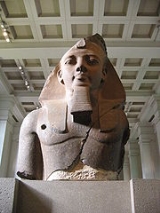
Ozymandias was another name for Ramesses the Great
Ramesses II

Ramesses II was the third Egyptian pharaoh of the Nineteenth dynasty of Egypt. He is often regarded as Ancient Egypt's greatest, most celebrated, and most powerful pharaoh....
, Pharaoh
Pharaoh

Pharaoh is a title used in many modern discussions of the ancient Egyptian rulers of all periods. In antiquity this title began to be used for the ruler who was the religious and political leader of united ancient Egypt, only during the New Kingdom, specifically, during the middle of the Eighteenth dynasty of Egypt....
 of the nineteenth dynasty
Nineteenth dynasty of Egypt

The Eighteenth, Nineteenth, and Twentieth Dynasties of ancient Egypt are often combined under the group title, New Kingdom....
 of ancient Egypt. Ozymandias represents a transliteration into Greek
Greek language

Greek is an Indo-European languages native to the southern Balkan peninsula, the language of the Greek people. It forms an independent branch within Indo-European....
 of a part of Ramesses' throne name, User-maat-re Setep-en-re. The sonnet paraphrases the inscription on the base of the statue
Statue

A statue is a sculpture in the round representing a person or persons, an animal, or an event, normally full-length, as opposed to a Bust , and at least close to life-size, or larger....
, given by Diodorus Siculus
Diodorus Siculus

Diodorus Siculus , was a Roman Greece historian who flourished in the 1st century BC. According to Diodorus' own work, he was born at Agira in Sicily ....
 as "King of Kings
King of Kings

King of Kings is a title that has been used by several monarchies throughout history, and in many cases the literal title meaning "King of Kings", i.e....
 am I, Osymandias. If anyone would know how great I am and where I lie, let him surpass one of my works." Shelley's poem is often said to have been inspired by the arrival in London of a colossal statue of Ramesses II, acquired for the British Museum
British Museum

The British Museum is a museum of human history and culture situated in London. Its collections, which number more than 7 million Object , are amongst the largest and most comprehensive in the world and originate from all continents, illustrating and documenting the story of human culture from its beginning to the present....
 by the Italian adventurer Giovanni Belzoni in 1816. Rodenbeck and Chaney, however, point out that the poem was written and published before the statue arrived in Britain, and thus that Shelley could not have seen it. But its repute in Western Europe preceded its actual arrival in Britain (Napoleon had previously made an unsuccessful attempt to acquire it for France, for example), and thus it may have been its repute or news of its imminent arrival rather than seeing the statue itself which provided the inspiration.

Among the earlier senses of the verb "to mock" is "to fashion an imitation of reality" (as in "a mock-up"); but by Shelley's day the current sense "to ridicule" (especially by mimicking) had come to the fore.

The sonnet celebrates the anonymous sculptor and his artistic achievement, whilst Shelley imaginatively surveys the ruins of a bygone power to fashion a sinuous, compact sonnet spun from a traveller's tale of far distant desert ruins. The lone and level sands stretching to the horizon perhaps suggest a resultant barrenness from a misuse of power where "nothing beside remains".

This sonnet is often incorrectly quoted or reproduced. The most common misquotation – "Look upon my works, ye Mighty, and despair!" – replaces the correct "on" with "upon", thus turning the regular decasyllabic
Decasyllable

Decasyllable is a Poetry Meter of ten syllables used in poetic traditions of syllabic verse. In languages with a stress accent , it is the equivalent of pentameter with iambs or trochees ....
 (iambic pentameter
Iambic pentameter

Iambic pentameter is a type of meter that is used in poetry and drama. It describes a particular rhythm that the words establish in each Line ....
) verse into an 11-syllable line.

Smith's poem

In Egypt's sandy silence, all alone, Stands a gigantic Leg, which far off throws The only shadow that the Desert knows: "I am great OZYMANDIAS," saith the stone, "The King of Kings; this mighty City shows "The wonders of my hand." The City's gone, Nought but the Leg remaining to disclose The site of this forgotten Babylon. We wonder, and some Hunter may express Wonder like ours, when thro' the wilderness Where London stood, holding the Wolf in chace, He meets some fragments huge, and stops to guess What powerful but unrecorded race Once dwelt in that annihilated place.


Percy Shelley apparently wrote this sonnet in competition with his friend Horace Smith
Horace Smith

Horace Smith was an England poet and novelist, perhaps best known for his participation in a sonnet-writing competition with Percy Bysshe Shelley....
, as Smith published a sonnet a month after Shelley's in the same magazine. It takes the same subject, tells the same story, and makes the same moral point. It was originally published under the same title as Shelley's verse; but in later collections Smith retitled it "On A Stupendous Leg of Granite, Discovered Standing by Itself in the Deserts of Egypt, with the Inscription Inserted Below".

Smith's verse lacks the enduring appeal of Shelley's, and is not nearly so fondly remembered or so often quoted. Shelley's Ozymandias is a fairly archetypal example of what constitutes a classic poem in terms of the modern English literature syllabus. On the other hand, Smith's verse may appear excessively didactic or even heavy-handed, to some readers.

See also

  • Egypt in the European imagination
  • Watchmen
    Watchmen

    Watchmen is a twelve-issue comic book limited series created by writer Alan Moore, artist Dave Gibbons, and colorist John Higgins . The series was published by DC Comics during 1986 and 1987, and has been subsequently reprinted in collected form....
     (Ozymandias
    Ozymandias (comics)

    Ozymandias is a fictional character appearing in the comic book limited series Watchmen by Alan Moore and Dave Gibbons, published by DC Comics....
    )


Further reading


  • Reiman, Donald H. and Sharon B. Powers. Shelley's Poetry and Prose. Norton, 1977. ISBN 0-393-09164-3.
  • Shelley, Percy Bysshe and Theo Gayer-Anderson (illust.) Ozymandias. Hoopoe Books, 1999. ISBN 977-5325-82-X
  • Rodenbeck, John. “Travelers from an Antique Land: Shelley's Inspiration for ‘Ozymandias,’” Alif: Journal of Comparative Poetics, no. 24 (“Archeology of Literature: Tracing the Old in the New”), 2004, pp. 121-148.
  • Edward Chaney, 'Egypt in England and America: The Cultural Memorials of Religion, Royalty and Revolution', in: Sites of Exchange: European Crossroads and Faultlines, eds. M. Ascari and A. Corrado (Rodopi, Amsterdam and New York,2006), 39-74.


External links


  • (text of poem with notes)
  • (autograph fair copy of the text from one of Shelley's notebooks; shows slight variants against modern editions)
  • by Machinima pioneers Strange Company
    Strange Company

    Strange Company is a group of machinima creators and distributors based in Edinburgh, Scotland. They are known in the medium as the longest-standing machinima production company, having produced machinima films since 1997, and for creating the Machinima.com website, which distributes such films on the Internet since 2000....
    , praised as an adaptation by film critic Roger Ebert
    Roger Ebert

    Roger Joseph Ebert born June 18, 1942) is an United States film criticism and screenwriter.He is known for his film review column and for two television programs Sneak Previews and At the Movies , which he co-hosted for a combined 23 years with Gene Siskel....
  • (Use of a reference to the poem for humorous effect)