

Amarna

Encyclopedia
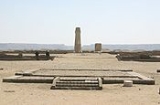
Amarna is an extensive Egypt
ian archaeological
site that represents the remains of the capital city newly–established and built by the Pharaoh
Akhenaten
of the late Eighteenth Dynasty
(c. 1353 BC), and abandoned shortly afterwards. The name for the city employed by the ancient Egypt
ians is written as Akhetaten (or Akhetaton – transliterations vary) in English transliteration. Akhetaten means "Horizon
of the Aten
."
The area is located on the east bank of the Nile River in the modern Egyptian province of Minya
, some 58 km (36 mi) south of the city of al-Minya, 312 km (193.9 mi) south of the Egyptian capital Cairo
and 402 km (249.8 mi) north of Luxor
. The site of Amarna includes several modern villages, chief of which are el-Till in the north and el-Hagg Qandil in the south.
The area was also occupied during later Roman
and early Christian
times, excavations to the south of the city have found several structures from this period.
" (Arabic: "hill"), so common elsewhere in the region.
It may be that the Royal Wadi's resemblance to the hieroglyph for horizon showed that this was the place to found the city.
The city was built as the new capital of the Pharaoh Akhenaten, dedicated to his new religion of worship to the Aten. Construction started in or around Year 5 of his reign (1346 BC) and was probably completed by Year 9 (1341 BC), although it became the capital city two years earlier. To speed up construction of the city most of the buildings were constructed out of mud-brick, and white washed. The most important buildings were faced with local stone.
It is the only ancient Egypt
ian city
which preserves great details of its internal plan, in large part because the city was abandoned after the death of Akhenaten. The city seems to have remained active for a decade or so after his death, and a shrine to Horemheb
indicates that it was at least partially occupied at the beginning of his reign, if only as a source for building material elsewhere. Once it was abandoned it remained uninhabited until Roman settlement began along the edge of the Nile. However, due to the unique circumstances of its creation and abandonment, it is questionable how representative of ancient Egyptian cities it actually is. Akhetaten was hastily constructed and covered an area of approximately 8 miles (12.9 km) of territory on the east bank of the Nile River; on the west bank, land was set aside to provide crops for the city's population. The entire city was encircled with a total of 14 boundary stelae detailing Akhenaten's conditions for the establishment of this new capital city of Egypt.
The earliest dated stelae from Akhenaten's new city is known to be Boundary stelae K which is dated to Year 5, IV Peret (or month 8), day 13 of Akhenaten's reign. (Most of the original 14 boundary stelas have been badly eroded). It preserves an account of Akhenaten's foundation of this city. The document records the pharaoh's wish to have several temples of the Aten to be erected here, for several royal tombs to be created in the eastern hills of Akhetaten for himself, his chief wife Nefertiti
and his eldest daughter Meritaten
as well as his explicit command that when he was dead, he would be brought back to Akhetaten for burial. Boundary stela K introduces a description of the events that were being celebrated at Akhetaten:
This text then goes on to state that Akhenaten made a great oblation to the god Aten "and this is the theme [of the occasion] which is illustrated in the lunette
s of the stelae where he stands with his queen and eldest daughter before an altar heaped with offerings under the Aten, while it shines upon him rejuvenating his body with its rays."
, with a central administration and religious area and the south of the city is made up of residential suburbs.
, the main residence of the Royal Family. Between this and the central city, the Northern Suburb was initially a prosperous area with large houses, but the house size decreased and became poorer the further from the road they were.
and the Small Aten Temple
were used for religious functions and between these the Great Royal Palace and Royal Residence were the ceremonial residence of the King and Royal Family, and were linked by a bridge or ramp. Located behind the Royal Residence was the Bureau of Correspondence of Pharaoh
, where the Amarna Letters
were found.
This area was probably the first area to be completed, and had at least 2 phases of construction.
(Chief Minister), Ranefer (General), Panehesy
(High Priest of the Aten) and Ramose
(Master of Horses). This area also held the studio of the sculptor Thutmose
, where the famous bust of Nefertiti was found in 1912.
Further to the south of the city was Kom el-Nana
, an enclosure, usually referred to as a sun-shade, and was probably built as a sun-temple., and then the Maru-Aten
, which was palace or sun-temple originally thought to have been constructed for Akhenaten
's queen Kiya
, but on her death her name and images were altered to those of Meritaten
, his daughter.
(each a rectangle of carved rock on the cliffs on both sides of the Nile) describe the founding of the city and are a primary source of information about the city.
Away from the city Akhenaten's a Royal necropolis
was started in a narrow valley to the east of the city, hidden in the cliffs. Only one tomb was completed, and was used by a un-named Royal Wife, and Akhenaten's tomb was hastily used to hold his and probably Meketaten
, his second daughter.
In the cliffs to the north and south of the Royal Wadi, the nobles of the city constructed their Tombs
.
universal in Egyptian art
up until that point, as well as for depicting many informal scenes such as the royal family playing with their children. Although the worship of Aten
(often referred to as the Amarna heresy) was completely suppressed, the artistic legacy had a more lasting impact. The art broke with a number of important long-established Egyptian conventions. These included intimate portrayals of affection within the royal family, and the abandonment of portraying women as lighter coloured than men. The art also has a realism that sometimes borders on caricature.
 The first western mention of the city was made in 1714 by Claude Sicard
, a French
Jesuit priest
who was travelling through the Nile Valley, and described the boundary stela from Amarna. As with much of Egypt, it was visited by Napoleon's corps de savants in 1798–1799, who prepared the first detailed map of Amarna, which was subsequently published in Description de l'Égypte
between 1821 and 1830.
After this European exploration continued in 1824 when Sir John Gardiner Wilkinson explored and mapped the city remains. The copyist Robert Hay
and his surveyor G. Laver visited the locality and uncovered several of the Southern Tombs from sand drifts, recording the reliefs in 1833. The copies made by Hay and Laver languish largely unpublished in the British Library
, where an ongoing project to identify their locations is underway.
The Prussia
n expedition led by Richard Lepsius visited the site in 1843 and 1845, and recorded the visible monuments and topography of Amarna in two separate visits over a total of twelve days, using drawings and paper squeezes. The results were ultimately published in Denkmäler aus Ægypten und Æthiopien between 1849 to 1913, including an improved map of the city. Despite being somewhat limited in accuracy, the engraved Denkmäler plates formed the basis for scholastic knowledge and interpretation of many of the scenes and inscriptions in the private tombs and some of the Boundary Stelae for the rest of the century. The records made by these early explorers teams are of immense importance since many of these remains were later destroyed or otherwise lost.
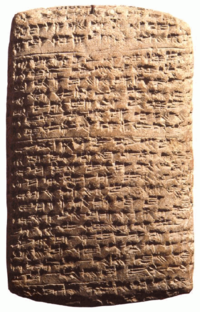
In 1887 a local woman digging for sebakh
uncovered a cache of over 300 cuneiform tablet
s (now commonly known as the Amarna Letters
). These tablets recorded select diplomatic
correspondence of the Pharaoh and were predominantly written in Akkadian
, the lingua franca
commonly used during the Late Bronze Age of the Ancient Near East
for such communication. This discovery led to the recognition of the importance of the site, and lead to a further increase in exploration.
In 1891 and 1892 Alessandro Barsanti
'discovered' and cleared the king's tomb (although it was probably known to the local population from about 1880). Around the same time Sir Flinders Petrie worked for one season at Amarna, working independently of the Egypt Exploration Fund. He excavated primarily in the Central City, investigating the Great Temple of the Aten
, the Great Official Palace, the King's House, the Bureau of Correspondence of Pharaoh
and several private houses. Although frequently amounting to little more than a sondage, Petrie's excavations revealed additional cuneiform tablets, the remains of several glass factories, and a great quantity of discarded faience
, glass and ceramic in sifting the palace rubbish heaps (including Mycenaean sherds). By publishing his results and reconstructions rapidly, Petrie was able to stimulate further interest in the site's potential.
The copyist and artist Norman de Garis Davies
published drawn and photographic descriptions of private tombs and boundary stelae from Amarna from 1903 to 1908. These books were republished by the EES in 2006.
In the early years of the 20th century (1907 to 1914) the Deutsche Orientgesellschaft expedition, led by Ludwig Borchardt
, excavated extensively throughout the North and South suburbs of the city. The famous bust of Nefertiti
, now in Berlin's Ägyptisches Museum, was discovered amongst other sculptural artefacts in the workshop of the sculptor Thutmose
. The outbreak of the First World War
in August 1914 terminated the German excavations.
From 1921 to 1936 an Egypt Exploration Society expedition returned to excavation at Amarna under the direction of T.E. Peet, Sir Leonard Woolley
, Henri Frankfort
, Stephen Glanville
and John Pendlebury
. The renewed investigations was focused on religious and royal structures.
During the 1960s the Egyptian Antiquities Organization (now the Egyptian Supreme Council of Antiquities) undertook a number of excavations at Amarna.
Exploration of the city continues to the present, currently under the direction of Barry Kemp (Reader in Egyptology, University of Cambridge, England) under the auspices of the Egypt Exploration Society
. In 1980 A separate expedition led by Geoffrey Martin described and copies the reliefs from the Royal Tomb, later publishing its findings together with objects thought to have come from the tomb, this work was published in 2 volumes by the EES.
In 2007, the continuing EES exploration discovered a cemetery
of private individuals, close to the southern tombs of the Nobles.
Egypt
Egypt , officially the Arab Republic of Egypt, Arabic: , is a country mainly in North Africa, with the Sinai Peninsula forming a land bridge in Southwest Asia. Egypt is thus a transcontinental country, and a major power in Africa, the Mediterranean Basin, the Middle East and the Muslim world...
ian archaeological
Archaeology
Archaeology, or archeology , is the study of human society, primarily through the recovery and analysis of the material culture and environmental data that they have left behind, which includes artifacts, architecture, biofacts and cultural landscapes...
site that represents the remains of the capital city newly–established and built by the Pharaoh
Pharaoh
Pharaoh is a title used in many modern discussions of the ancient Egyptian rulers of all periods. The title originates in the term "pr-aa" which means "great house" and describes the royal palace...
Akhenaten
Akhenaten
Akhenaten also spelled Echnaton,Ikhnaton,and Khuenaten;meaning "living spirit of Aten") known before the fifth year of his reign as Amenhotep IV , was a Pharaoh of the Eighteenth dynasty of Egypt who ruled for 17 years and died perhaps in 1336 BC or 1334 BC...
of the late Eighteenth Dynasty
Eighteenth dynasty of Egypt
The eighteenth dynasty of ancient Egypt is perhaps the best known of all the dynasties of ancient Egypt...
(c. 1353 BC), and abandoned shortly afterwards. The name for the city employed by the ancient Egypt
Ancient Egypt
Ancient Egypt was an ancient civilization of Northeastern Africa, concentrated along the lower reaches of the Nile River in what is now the modern country of Egypt. Egyptian civilization coalesced around 3150 BC with the political unification of Upper and Lower Egypt under the first pharaoh...
ians is written as Akhetaten (or Akhetaton – transliterations vary) in English transliteration. Akhetaten means "Horizon
Akhet (hieroglyph and season)
The Egyptian language word Akhet is both a hieroglyph and an Ancient Egyptian season.The two uses for akhet:* In ancient Egyptian, the place where the sun rises and sets; often translated as "horizon" or "mountain of light". It is included in names like "Akhet Khufu" and Akhetaten...
of the Aten
Aten
Aten is the disk of the sun in ancient Egyptian mythology, and originally an aspect of Ra. The deified Aten is the focus of the monolatristic, henotheistic, or monotheistic religion of Atenism established by Amenhotep IV, who later took the name Akhenaten in worship in recognition of Aten...
."
The area is located on the east bank of the Nile River in the modern Egyptian province of Minya
Minya Governorate
Minya Governorate is one of the governorates of Upper Egypt. The name originates from the chief city of the governorate, originally known in Sahidic Coptic as Tmoone and in Bohairic as Thmonē , meaning “the residence”, in reference to a monastery formerly in the area...
, some 58 km (36 mi) south of the city of al-Minya, 312 km (193.9 mi) south of the Egyptian capital Cairo
Cairo
Cairo , is the capital of Egypt and the largest city in the Arab world and Africa, and the 16th largest metropolitan area in the world. Nicknamed "The City of a Thousand Minarets" for its preponderance of Islamic architecture, Cairo has long been a centre of the region's political and cultural life...
and 402 km (249.8 mi) north of Luxor
Luxor
Luxor is a city in Upper Egypt and the capital of Luxor Governorate. The population numbers 487,896 , with an area of approximately . As the site of the Ancient Egyptian city of Thebes, Luxor has frequently been characterized as the "world's greatest open air museum", as the ruins of the temple...
. The site of Amarna includes several modern villages, chief of which are el-Till in the north and el-Hagg Qandil in the south.
The area was also occupied during later Roman
Roman Empire
The Roman Empire was the post-Republican period of the ancient Roman civilization, characterised by an autocratic form of government and large territorial holdings in Europe and around the Mediterranean....
and early Christian
Coptic Christianity
The Coptic Orthodox Church of Alexandria is the official name for the largest Christian church in Egypt and the Middle East. The Church belongs to the Oriental Orthodox family of churches, which has been a distinct church body since the Council of Chalcedon in AD 451, when it took a different...
times, excavations to the south of the city have found several structures from this period.
Naming issues
The frequent designation "Tel el-Amarna" for the city is inaccurate: nowhere do the ancient remains constitute a mound of eroded architecture that would warrant the description of a "TellTell
A tell or tel, is a type of archaeological mound created by human occupation and abandonment of a geographical site over many centuries. A classic tell looks like a low, truncated cone with a flat top and sloping sides.-Archaeology:A tell is a hill created by different civilizations living and...
" (Arabic: "hill"), so common elsewhere in the region.
The city of Akhetaten
The area of the city was effectively a virgin–site, and it was in this city that the Akhetaten described as the Aten's
"..the seat of the First Occasion, which he had made for himself that he might rest in it."
It may be that the Royal Wadi's resemblance to the hieroglyph for horizon showed that this was the place to found the city.
The city was built as the new capital of the Pharaoh Akhenaten, dedicated to his new religion of worship to the Aten. Construction started in or around Year 5 of his reign (1346 BC) and was probably completed by Year 9 (1341 BC), although it became the capital city two years earlier. To speed up construction of the city most of the buildings were constructed out of mud-brick, and white washed. The most important buildings were faced with local stone.
It is the only ancient Egypt
Egypt
Egypt , officially the Arab Republic of Egypt, Arabic: , is a country mainly in North Africa, with the Sinai Peninsula forming a land bridge in Southwest Asia. Egypt is thus a transcontinental country, and a major power in Africa, the Mediterranean Basin, the Middle East and the Muslim world...
ian city
City
A city is a relatively large and permanent settlement. Although there is no agreement on how a city is distinguished from a town within general English language meanings, many cities have a particular administrative, legal, or historical status based on local law.For example, in the U.S...
which preserves great details of its internal plan, in large part because the city was abandoned after the death of Akhenaten. The city seems to have remained active for a decade or so after his death, and a shrine to Horemheb
Horemheb
Horemheb was the last Pharaoh of the 18th Dynasty from either 1319 BC to late 1292 BC, or 1306 to late 1292 BC although he was not related to the preceding royal family and is believed to have been of common birth.Before he became pharaoh, Horemheb was the commander in chief...
indicates that it was at least partially occupied at the beginning of his reign, if only as a source for building material elsewhere. Once it was abandoned it remained uninhabited until Roman settlement began along the edge of the Nile. However, due to the unique circumstances of its creation and abandonment, it is questionable how representative of ancient Egyptian cities it actually is. Akhetaten was hastily constructed and covered an area of approximately 8 miles (12.9 km) of territory on the east bank of the Nile River; on the west bank, land was set aside to provide crops for the city's population. The entire city was encircled with a total of 14 boundary stelae detailing Akhenaten's conditions for the establishment of this new capital city of Egypt.
The earliest dated stelae from Akhenaten's new city is known to be Boundary stelae K which is dated to Year 5, IV Peret (or month 8), day 13 of Akhenaten's reign. (Most of the original 14 boundary stelas have been badly eroded). It preserves an account of Akhenaten's foundation of this city. The document records the pharaoh's wish to have several temples of the Aten to be erected here, for several royal tombs to be created in the eastern hills of Akhetaten for himself, his chief wife Nefertiti
Nefertiti
Nefertiti was the Great Royal Wife of the Egyptian Pharaoh Akhenaten. Nefertiti and her husband were known for a religious revolution, in which they started to worship one god only...
and his eldest daughter Meritaten
Meritaten
Meritaten also spelled Merytaten or Meryetaten was an ancient Egyptian queen of the eighteenth dynasty, who held the position of Great Royal Wife to Pharaoh Smenkhkare, who may have been a brother or son of Akhenaten...
as well as his explicit command that when he was dead, he would be brought back to Akhetaten for burial. Boundary stela K introduces a description of the events that were being celebrated at Akhetaten:
This text then goes on to state that Akhenaten made a great oblation to the god Aten "and this is the theme [of the occasion] which is illustrated in the lunette
Lunette (stele)
The lunette spatial region in the upper portion of stelas, became common for steles as a prelude to a stele's topic. Its major use was from ancient Egypt in all the various categories of steles: funerary, Victory Steles, autobiographical, temple, votive, etc.The lunettes are most common from...
s of the stelae where he stands with his queen and eldest daughter before an altar heaped with offerings under the Aten, while it shines upon him rejuvenating his body with its rays."
Site and plan
Located on the east bank of the Nile, the ruins of the city are laid out roughly north to south along a 'Royal Road', now referred to as 'Sikhet es-Sultan'. The Royal residences are generally to the north, in what is known as the North CityNorth City, Amarna
Located within the Ancient Egyptian city of Amarna, the short-lived capital of Akhenaten, area known as the North City contains the ruins of royal palaces, especially the Northern Palace and other administrative buildings and occupies an area between the river and the cliffs that terminate the...
, with a central administration and religious area and the south of the city is made up of residential suburbs.
North City
Located within the North City area is the Northern PalaceNorthern Palace (Amarna)
The Northern Palace is located in the abandoned Northern Suburbs of the city of Ahketaten .Like the other structures in the city, it was constructed quickly, and hence was easy to dismantle and reuse the material for later construction.-External links:*...
, the main residence of the Royal Family. Between this and the central city, the Northern Suburb was initially a prosperous area with large houses, but the house size decreased and became poorer the further from the road they were.
Central City
Most of the important ceremonial and administrative buildings were located in the central city. Here the Great Temple of the AtenGreat Temple of the Aten
The Great Temple of the Aten was located in the city of el-Amarna, Egypt, and was the main temple for the worship of the god Aten during the reign of Tutankhamen]...
and the Small Aten Temple
Small Aten Temple
The Small Aten Temple is located in the abandoned city of Akhetaten . It is one of the 2 major temples in the city, the other being the Great Temple of the Aten...
were used for religious functions and between these the Great Royal Palace and Royal Residence were the ceremonial residence of the King and Royal Family, and were linked by a bridge or ramp. Located behind the Royal Residence was the Bureau of Correspondence of Pharaoh
Bureau of Correspondence of Pharaoh
The building known as the Bureau of Correspondence of Pharaoh is located in the 'Central City' area of the Ancient Egyptian city of Amarna, Akhetaten, the short-lived capital of Akhenaten.-History:...
, where the Amarna Letters
Amarna letters
The Amarna letters are an archive of correspondence on clay tablets, mostly diplomatic, between the Egyptian administration and its representatives in Canaan and Amurru during the New Kingdom...
were found.
This area was probably the first area to be completed, and had at least 2 phases of construction.
Southern suburbs
To the south of the city was the area now referred to as the Southern Suburbs. It contained the estates of many of the city's powerful nobles, including NakhtpaatenNakhtpaaten
Nakhtpaaten or Nakht was an ancient Egyptian vizier during the reign of Pharaoh Akhenaten of the 18th dynasty.-Career:...
(Chief Minister), Ranefer (General), Panehesy
Panehesy
The Egyptian noble Panehesy was the 'Chief servitor of the Aten in the temple of Aten in Akhetaten' . He was also the 'Seal-bearer of Lower Egypt.'. These titles show how powerful he must have been during the Amarna Period.His house has been located in the ruins of Amarna , lying in the main city...
(High Priest of the Aten) and Ramose
Ramose
Ramose was an ancient Egyptian name, meaning "Born of Ra". A variant of the name is Ramesses; Egyptologists usually use the Ramesses variant for pharaohs and Ramose for non-royals...
(Master of Horses). This area also held the studio of the sculptor Thutmose
Thutmose
Thutmose is an Anglicization of the Egyptian name dhwty-ms, usually translated as "Born of the god Thoth". It may refer to several individuals from the 18th Dynasty:*Thutmose I, third pharaoh of the Eighteenth Dynasty*Thutmose II Thutmose (also rendered Thutmosis, Tuthmose, Tutmosis, Thothmes,...
, where the famous bust of Nefertiti was found in 1912.
Further to the south of the city was Kom el-Nana
Kom el-Nana
Kom el-Nana is an archaeological site near the ancient Egyptian city of Akhet-Aten. It lies south of the city and east of the modern village of el-Hagg Quandil...
, an enclosure, usually referred to as a sun-shade, and was probably built as a sun-temple., and then the Maru-Aten
Maru-Aten
Located 3 km to the south of the central city area of the city of Akhetaten , the Maru-Aten, short for Pa-maru-en-pa-aten , is a palace or sun-temple originally thought to have been constructed for Akhenaten's queen Kiya, but on her death her name and images were altered to those of Meritaten, his...
, which was palace or sun-temple originally thought to have been constructed for Akhenaten
Akhenaten
Akhenaten also spelled Echnaton,Ikhnaton,and Khuenaten;meaning "living spirit of Aten") known before the fifth year of his reign as Amenhotep IV , was a Pharaoh of the Eighteenth dynasty of Egypt who ruled for 17 years and died perhaps in 1336 BC or 1334 BC...
's queen Kiya
Kiya
Kiya was one of the wives of the Egyptian Pharaoh Akhenaten. Little is known about her, and her actions and roles are poorly documented in the historical record, in contrast to those of Akhenaten's first royal wife, Nefertiti. Her unusual name suggests that she may originally have been a Mitanni...
, but on her death her name and images were altered to those of Meritaten
Meritaten
Meritaten also spelled Merytaten or Meryetaten was an ancient Egyptian queen of the eighteenth dynasty, who held the position of Great Royal Wife to Pharaoh Smenkhkare, who may have been a brother or son of Akhenaten...
, his daughter.
City outskirts
Surrounding the city and marking its extent, the Boundary StelaeBoundary Stelae of Akhenaten
The Boundary Stelae at the city of Amarna were constructed between Year 5 and Year 8 in the reign of Akhenaten.-Naming:There have been fifteen stelae found at this site, each of which has been labeled with a letter. Of the fifteen, three are located on the western side of the Nile. These have been...
(each a rectangle of carved rock on the cliffs on both sides of the Nile) describe the founding of the city and are a primary source of information about the city.
Away from the city Akhenaten's a Royal necropolis
Royal Wadi and tombs
The Royal Wadi at Amarna is a where the Royal Family of Amarna were to be buried. It can be thought of as being an Amarna replacement for the Valley of the Kings....
was started in a narrow valley to the east of the city, hidden in the cliffs. Only one tomb was completed, and was used by a un-named Royal Wife, and Akhenaten's tomb was hastily used to hold his and probably Meketaten
Meketaten
Meketaten was the second daughter of six born to the Egyptian Pharaoh Akhenaten and his Great Royal Wife Nefertiti. She was probably born in year 4 of Akhenaten's reign...
, his second daughter.
In the cliffs to the north and south of the Royal Wadi, the nobles of the city constructed their Tombs
Tombs of the Nobles (Amarna)
Located in Middle Egypt, the Tombs of the Nobles at Amarna are the burial places of some of the powerful courtiers and persons of the city of Akhetaten....
.
- Workmen's villageWorkmen's Village, AmarnaLocated in the desert east of the ancient city of Akhetaten, the Workmen's village at Amarna closely resembles in many respects that much more ancient worker's village at Lahun or at Deir el-Medina, and was intended for the artisans who worked on the nearby Tombs of Nobles and the Royal Wadi...
s
Amarna art-style
The Amarna art-style is unique among the Egyptian world for its more realistic depiction of its subjects, instead of the strict idealistic formalismFormalism (art)
In art theory, formalism is the concept that a work's artistic value is entirely determined by its form--the way it is made, its purely visual aspects, and its medium. Formalism emphasizes compositional elements such as color, line, shape and texture rather than realism, context, and content...
universal in Egyptian art
Art of Ancient Egypt
Ancient Egyptian art is the painting, sculpture, architecture and other arts produced by the civilization in the lower Nile Valley from 5000 BC to 300 AD. Ancient Egyptian art reached a high level in painting and sculpture, and was both highly stylized and symbolic...
up until that point, as well as for depicting many informal scenes such as the royal family playing with their children. Although the worship of Aten
Aten
Aten is the disk of the sun in ancient Egyptian mythology, and originally an aspect of Ra. The deified Aten is the focus of the monolatristic, henotheistic, or monotheistic religion of Atenism established by Amenhotep IV, who later took the name Akhenaten in worship in recognition of Aten...
(often referred to as the Amarna heresy) was completely suppressed, the artistic legacy had a more lasting impact. The art broke with a number of important long-established Egyptian conventions. These included intimate portrayals of affection within the royal family, and the abandonment of portraying women as lighter coloured than men. The art also has a realism that sometimes borders on caricature.
Rediscovery and excavation
Claude Sicard
Father Claude Sicard was a French Jesuit priest, and an early modern visitor to Egypt, between 1708 and 1712, producing the earliest known map of the country. He was Supervisor of the Jesuit Mission in Cairo.-References:...
, a French
France
The French Republic , The French Republic , The French Republic , (commonly known as France , is a unitary semi-presidential republic in Western Europe with several overseas territories and islands located on other continents and in the Indian, Pacific, and Atlantic oceans. Metropolitan France...
Jesuit priest
Priest
A priest is a person authorized to perform the sacred rites of a religion, especially as a mediatory agent between humans and deities. They also have the authority or power to administer religious rites; in particular, rites of sacrifice to, and propitiation of, a deity or deities...
who was travelling through the Nile Valley, and described the boundary stela from Amarna. As with much of Egypt, it was visited by Napoleon's corps de savants in 1798–1799, who prepared the first detailed map of Amarna, which was subsequently published in Description de l'Égypte
Description de l'Egypte
Description de l'Égypte is the title of several books.* Description de l'Égypte - Description de l'Égypte ou Recueil des observations et des recherches qui ont été faites en Égypte pendant l'expédition de l'armée française Pub; First Edition , L'Imprimerie Imperiale, 1809-1813; l'Imprimerie...
between 1821 and 1830.
After this European exploration continued in 1824 when Sir John Gardiner Wilkinson explored and mapped the city remains. The copyist Robert Hay
Robert Hay (Egyptologist)
Robert Hay was a Scottish traveller, antiquarian, and early Egyptologist. He was born in Duns Castle, Berwickshire. During his service in the Royal Navy he visited Alexandria, Egypt, in 1818....
and his surveyor G. Laver visited the locality and uncovered several of the Southern Tombs from sand drifts, recording the reliefs in 1833. The copies made by Hay and Laver languish largely unpublished in the British Library
British Library
The British Library is the national library of the United Kingdom, and is the world's largest library in terms of total number of items. The library is a major research library, holding over 150 million items from every country in the world, in virtually all known languages and in many formats,...
, where an ongoing project to identify their locations is underway.
The Prussia
Prussia
Prussia was a German kingdom and historic state originating out of the Duchy of Prussia and the Margraviate of Brandenburg. For centuries, the House of Hohenzollern ruled Prussia, successfully expanding its size by way of an unusually well-organized and effective army. Prussia shaped the history...
n expedition led by Richard Lepsius visited the site in 1843 and 1845, and recorded the visible monuments and topography of Amarna in two separate visits over a total of twelve days, using drawings and paper squeezes. The results were ultimately published in Denkmäler aus Ægypten und Æthiopien between 1849 to 1913, including an improved map of the city. Despite being somewhat limited in accuracy, the engraved Denkmäler plates formed the basis for scholastic knowledge and interpretation of many of the scenes and inscriptions in the private tombs and some of the Boundary Stelae for the rest of the century. The records made by these early explorers teams are of immense importance since many of these remains were later destroyed or otherwise lost.
In 1887 a local woman digging for sebakh
Sebakh
Sebakh is an Aramaic word which translates to "dry land" in English. This term is used to described decomposed organic material that can be employed both as an agricultural fertilizer and as a fuel for fires....
uncovered a cache of over 300 cuneiform tablet
Cuneiform
Cuneiform can refer to:*Cuneiform script, an ancient writing system originating in Mesopotamia in the 4th millennium BC*Cuneiform , three bones in the human foot*Cuneiform Records, a music record label...
s (now commonly known as the Amarna Letters
Amarna letters
The Amarna letters are an archive of correspondence on clay tablets, mostly diplomatic, between the Egyptian administration and its representatives in Canaan and Amurru during the New Kingdom...
). These tablets recorded select diplomatic
Diplomacy
Diplomacy is the art and practice of conducting negotiations between representatives of groups or states...
correspondence of the Pharaoh and were predominantly written in Akkadian
Akkadian language
Akkadian is an extinct Semitic language that was spoken in ancient Mesopotamia. The earliest attested Semitic language, it used the cuneiform writing system derived ultimately from ancient Sumerian, an unrelated language isolate...
, the lingua franca
Lingua franca
A lingua franca is a language systematically used to make communication possible between people not sharing a mother tongue, in particular when it is a third language, distinct from both mother tongues.-Characteristics:"Lingua franca" is a functionally defined term, independent of the linguistic...
commonly used during the Late Bronze Age of the Ancient Near East
Ancient Near East
The ancient Near East was the home of early civilizations within a region roughly corresponding to the modern Middle East: Mesopotamia , ancient Egypt, ancient Iran The ancient Near East was the home of early civilizations within a region roughly corresponding to the modern Middle East: Mesopotamia...
for such communication. This discovery led to the recognition of the importance of the site, and lead to a further increase in exploration.
In 1891 and 1892 Alessandro Barsanti
Alessandro Barsanti
Alessandro Barsanti was an Italian architect and Egyptologist who worked for the Egyptian Antiquities Service. He excavated throughout Egypt . He was also in charge of the transfer of collection of the Cairo Museum from its site at Giza to the current location in Cairo itself.-References:...
'discovered' and cleared the king's tomb (although it was probably known to the local population from about 1880). Around the same time Sir Flinders Petrie worked for one season at Amarna, working independently of the Egypt Exploration Fund. He excavated primarily in the Central City, investigating the Great Temple of the Aten
Great Temple of the Aten
The Great Temple of the Aten was located in the city of el-Amarna, Egypt, and was the main temple for the worship of the god Aten during the reign of Tutankhamen]...
, the Great Official Palace, the King's House, the Bureau of Correspondence of Pharaoh
Bureau of Correspondence of Pharaoh
The building known as the Bureau of Correspondence of Pharaoh is located in the 'Central City' area of the Ancient Egyptian city of Amarna, Akhetaten, the short-lived capital of Akhenaten.-History:...
and several private houses. Although frequently amounting to little more than a sondage, Petrie's excavations revealed additional cuneiform tablets, the remains of several glass factories, and a great quantity of discarded faience
Faience
Faience or faïence is the conventional name in English for fine tin-glazed pottery on a delicate pale buff earthenware body, originally associated with Faenza in northern Italy. The invention of a white pottery glaze suitable for painted decoration, by the addition of an oxide of tin to the slip...
, glass and ceramic in sifting the palace rubbish heaps (including Mycenaean sherds). By publishing his results and reconstructions rapidly, Petrie was able to stimulate further interest in the site's potential.
The copyist and artist Norman de Garis Davies
N. de Garis Davies
The Egyptologists Nina and Norman de Garis Davies were a married couple of illustrators and copyists who worked in the early and mid-twentieth century drawing and recording paintings in Egypt. Their work was often published together, as N...
published drawn and photographic descriptions of private tombs and boundary stelae from Amarna from 1903 to 1908. These books were republished by the EES in 2006.
In the early years of the 20th century (1907 to 1914) the Deutsche Orientgesellschaft expedition, led by Ludwig Borchardt
Ludwig Borchardt
Ludwig Borchardt was a German Egyptologist who was born in Berlin.-Life:Borchardt initially studied Architecture and later Egyptology under Adolf Erman. In 1895 he journeyed to Cairo and produced, with Gaston Maspero, the Catalogue of the Egyptian Museum...
, excavated extensively throughout the North and South suburbs of the city. The famous bust of Nefertiti
Nefertiti
Nefertiti was the Great Royal Wife of the Egyptian Pharaoh Akhenaten. Nefertiti and her husband were known for a religious revolution, in which they started to worship one god only...
, now in Berlin's Ägyptisches Museum, was discovered amongst other sculptural artefacts in the workshop of the sculptor Thutmose
Thutmose (sculptor)
"The King's Favourite and Master of Works, the Sculptor Thutmose" , flourished 1350 BC, is thought to have been the official court sculptor of the Egyptian Pharaoh Akhenaten in the latter part of his reign...
. The outbreak of the First World War
World War I
World War I , which was predominantly called the World War or the Great War from its occurrence until 1939, and the First World War or World War I thereafter, was a major war centred in Europe that began on 28 July 1914 and lasted until 11 November 1918...
in August 1914 terminated the German excavations.
From 1921 to 1936 an Egypt Exploration Society expedition returned to excavation at Amarna under the direction of T.E. Peet, Sir Leonard Woolley
Leonard Woolley
Sir Charles Leonard Woolley was a British archaeologist best known for his excavations at Ur in Mesopotamia...
, Henri Frankfort
Henri Frankfort
Henri 'Hans' Frankfort was a Dutch Egyptologist, archaeologist and orientalist.-Biography:Born in Amsterdam, Frankfort studied history at the University of Amsterdam and then moved to London, where in 1924, he took an MA under Sir Flinders Petrie at the University College. In 1927 he gained a...
, Stephen Glanville
Stephen Glanville
Stephen Ranulph Kingdon Glanville, MBE was an English historian and egyptologist.-Biography:S R K Glanville was born in Westminster, London, the eldest son of Stephen James Glanville and Nannie Elizabeth . He was first cousin to Frank Kingdon-Ward the explorer and botanist and also related to...
and John Pendlebury
John Pendlebury
John Devitt Stringfellow Pendlebury was a British archaeologist who worked for British intelligence during World War II. He was killed during the Battle of Crete.-Early life:...
. The renewed investigations was focused on religious and royal structures.
During the 1960s the Egyptian Antiquities Organization (now the Egyptian Supreme Council of Antiquities) undertook a number of excavations at Amarna.
Exploration of the city continues to the present, currently under the direction of Barry Kemp (Reader in Egyptology, University of Cambridge, England) under the auspices of the Egypt Exploration Society
Egypt Exploration Society
The Egypt Exploration Society is the foremost learned society in the United Kingdom promoting the field of Egyptology....
. In 1980 A separate expedition led by Geoffrey Martin described and copies the reliefs from the Royal Tomb, later publishing its findings together with objects thought to have come from the tomb, this work was published in 2 volumes by the EES.
In 2007, the continuing EES exploration discovered a cemetery
Southern Tombs Cemetery
The Southern Tomb Cemetery, the burial of low status individuals from the city of Akhenaten , is located close to the southern tombs of the Nobles.-Discovery:...
of private individuals, close to the southern tombs of the Nobles.
External links
- The University of Cambridge's Amarna Project
- Amarna Art Gallery Shows just a few, but stunning, examples of the art of the Amarna periodAmarna PeriodThe Amarna Period was an era of Egyptian history during the latter half of the Eighteenth Dynasty when the royal residence of the pharaoh and his queen was shifted to Akhetaten in what is now modern-day Amarna...
. - M.A. Mansoor Amarna Collection