
All Topics  
Cartouche

 
Cartouche

   Email Print
   Bookmark   Link


Cartouche


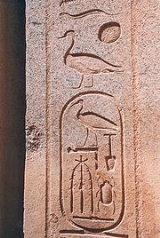
In Egyptian hieroglyphs, a cartouche is an oblong inclosure with a horizontal line at one end, indicating that the text enclosed is a royal
Pharaoh

Pharaoh is a title used in many modern discussions of the ancient Egyptian rulers of all periods. In antiquity this title began to be used for the ruler who was the religious and political leader of united ancient Egypt, only during the New Kingdom, specifically, during the middle of the Eighteenth dynasty of Egypt....
 name, coming into use during the beginning of the Fourth Dynasty
Fourth dynasty of Egypt

The Fourth Dynasty of Ancient Egypt, also written Dynasty 4 and Dynasty IV, is characterized as a golden age of the Old Kingdom....
 under Pharaoh Sneferu
Sneferu

Sneferu, also spelled as Snefru or Snofru , was the founder of the Fourth dynasty of Egypt, reigning from around 2613 BC to 2589 BC....
. The Ancient Egyptian
Egyptian language

Egyptian is a branch of the Afro-Asiatic languages language family along with the Chadic languages, Berber languages, Semitic languages, Cushitic languages and possibly Omotic languages languages....
 word for it was shenu, and it was essentially an expanded shen ring
Shen ring

A shen ring is a circle with a line at a tangent to it, which was used in Egyptian hieroglyphsics as a stylised loop of a rope. In particular, the circle represented eternity, as circles did in many ancient cultures ....
. In Demotic
Demotic (Egyptian)

Demotic refers to either the ancient Egyptian script derived from northern forms of hieratic used in the Nile Delta, or the stage of the Egyptian language following Late Egyptian and preceding Coptic language....
, the cartouche was reduced to a pair of parentheses and a vertical line.

Of the five royal titularies it was the throne name, also referred to as prenomen, and the "Son of Re" titulary, the so-called nomen, i.e., the name given at birth, which were enclosed by a cartouche.

At times amulets were given the form of a cartouche displaying the name of a king and placed in tombs.


Discussion
Ask a question about 'Cartouche'
Start a new discussion about 'Cartouche'
Answer questions from other users
Full Discussion Forum


Encyclopedia


In Egyptian hieroglyphs, a cartouche is an oblong inclosure with a horizontal line at one end, indicating that the text enclosed is a royal
Pharaoh

Pharaoh is a title used in many modern discussions of the ancient Egyptian rulers of all periods. In antiquity this title began to be used for the ruler who was the religious and political leader of united ancient Egypt, only during the New Kingdom, specifically, during the middle of the Eighteenth dynasty of Egypt....
 name, coming into use during the beginning of the Fourth Dynasty
Fourth dynasty of Egypt

The Fourth Dynasty of Ancient Egypt, also written Dynasty 4 and Dynasty IV, is characterized as a golden age of the Old Kingdom....
 under Pharaoh Sneferu
Sneferu

Sneferu, also spelled as Snefru or Snofru , was the founder of the Fourth dynasty of Egypt, reigning from around 2613 BC to 2589 BC....
. The Ancient Egyptian
Egyptian language

Egyptian is a branch of the Afro-Asiatic languages language family along with the Chadic languages, Berber languages, Semitic languages, Cushitic languages and possibly Omotic languages languages....
 word for it was shenu, and it was essentially an expanded shen ring
Shen ring

A shen ring is a circle with a line at a tangent to it, which was used in Egyptian hieroglyphsics as a stylised loop of a rope. In particular, the circle represented eternity, as circles did in many ancient cultures ....
. In Demotic
Demotic (Egyptian)

Demotic refers to either the ancient Egyptian script derived from northern forms of hieratic used in the Nile Delta, or the stage of the Egyptian language following Late Egyptian and preceding Coptic language....
, the cartouche was reduced to a pair of parentheses and a vertical line.

Of the five royal titularies it was the throne name, also referred to as prenomen, and the "Son of Re" titulary, the so-called nomen, i.e., the name given at birth, which were enclosed by a cartouche.

At times amulets were given the form of a cartouche displaying the name of a king and placed in tombs. Such items are often important to archaeologists for dating the tomb and its contents. There were periods in Egyptian history when people refrained from inscribing these amulets with a name, for fear they might fall into somebody's hands conferring power over the bearer of the name.

Etymology

It is said that the label cartouche was first applied by soldiers who fancied that the symbol they saw so frequently repeated on the pharaonic ruins they encountered resembled a muzzle-loading firearm's paper powder cartridge
Paper cartridge

Paper cartridge refers to one of various types of small arms ammunition used before the advent of the cartridge . These cartridges consisted of a paper cylinder or cone containing the bullet, gunpowder, and, in some cases, a primer or a lubricant and anti-fouling agent....
 ( in French
French language

French is a Romance language spoken around the world by around 80 million people as first language, by 190 million as second language, and by about another 200 million people as an acquired tongue, with significant speakers in 54 countries....
). This is also the modern French word for a video game cartridge.

External links

Cosmetic palette
Cosmetic palette

The Cosmetic palettes are archaeological artifacts originally used to grind and apply ingredients for facial or body cosmetics. The decorative palettes of the late Fourth millenium BCE appear to have lost this function and became commemorative, ornamental, and possibly ceremonial....
, Egypt, burial V21, Abydos
Abydos, Egypt

Abydos , one of the most ancient cities of Upper and Lower Egypt, is about 11 km west of the Nile at latitude 26? 10' N. The Egyptian name of both the eighth Nome of Upper Egypt and its capital city was Abdju, technically, 3bdw as in the hieroglyphs shown to the right, the hill of the symbol or reliquary, in which...
. (Click on picture.)