


Avaris

Encyclopedia
Avaris capital of Egypt under the Hyksos
(15th Dynasty), was located near modern Tell el-Dab'a in the northeastern region of the Nile Delta
, at the juncture of the 8th, 14th, 19th and 20th Nomes
. As the main course of the Nile migrated eastward, its position at the hub of Egypt's delta emporia made it a major administrative capital of the Hyksos
and other traders. It was occupied from about 1783 to 1550 BC, or from the Thirteenth Dynasty of Egypt
through the second intermediate until its destruction by Ahmose I
, the first Pharaoh of the Eighteenth dynasty
. The name in the Egyptian language
of the 2nd millennium BCE was probably pronounced *Ḥaʔat-Wūrat 'Great House' and denotes the capital of an administrative division of the land. Today, the name Hawara survives, referring to the site at the entrance to Fayyum.
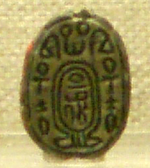 In 1885 the Swiss
Édouard Naville
started the first excavations in the area around Tell-el-Daba. Between 1941 and 1942 Labib Habachi
, an Egypt
ian Egyptologist first forwarded the idea that the site could be identified with Avaris. Between 1966 and 1969 and since 1975 the site has been excavated by the Austrian Archaeological Institute. Using radar imaging technology its scientists could identify in 2010 the outline of the city including streets, houses, a port, and a side arm of the River Nile passing through the city.
The site at Tell el-Dab'a, covering an area of about 2 square kilometers, is in ruins today, but excavations have shown that at one point it was a well-developed center of trade with a busy harbour catering to over 300 ships during a trading season. Artifacts excavated at a temple erected in the Hyksos period have produced goods from all over the Aegean
world. The temple even has Minoan
-like wall paintings that are similar to those found on Crete
at the Palace of Knossos
. A large mudbrick
tomb has also been excavated to the west of the temple. where grave-goods
, such as copper swords, have been found.
Towards the end of the Seventeenth dynasty
, Kamose
, the last king of the Seventeenth Dynasty
, besieged Avaris, but could not dislodge the Hyksos, who were finally expelled some 18 years later by Ahmose I
, the founder of the Eighteenth Dynasty
(c. 1530 BC). The Eighteenth Dynasty based themselves in Thebes
and Avaris was largely abandoned, its former citadel becoming the site first of enormous storage facilities, including numerous silos and then a military camp, until finally a new palatial compound of the 18th Dynasty was constructed on top of the camps and soldier graves. Avaris was absorbed into the new city of Pi-Ramesses
constructed by Ramesses II
(1279 - 1213 BC) of the Nineteenth dynasty
when he moved the capital from Thebes back to the Delta.
and Crete
, only two other sites have a record of Minoan civilization
besides Avaris: Tel Kabri
in Israel and Alalakh
in Syria. It is speculated by the excavator of Tell Dab'a, the Austrian archaeologist Bietak
, that there was close contact with the rulers of Avaris, and the large building representing the frescoes allowed the Minoans to have a ritual life in Egypt. French archaeologist Yves Duhoux proposed the existence of a Minoan 'colony' on an island in the Nile delta.
Hyksos
The Hyksos were an Asiatic people who took over the eastern Nile Delta during the twelfth dynasty, initiating the Second Intermediate Period of ancient Egypt....
(15th Dynasty), was located near modern Tell el-Dab'a in the northeastern region of the Nile Delta
Nile Delta
The Nile Delta is the delta formed in Northern Egypt where the Nile River spreads out and drains into the Mediterranean Sea. It is one of the world's largest river deltas—from Alexandria in the west to Port Said in the east, it covers some 240 km of Mediterranean coastline—and is a rich...
, at the juncture of the 8th, 14th, 19th and 20th Nomes
Nome (Egypt)
A nome was a subnational administrative division of ancient Egypt. Today's use of the Greek nome rather than the Egyptian term sepat came about during the Ptolemaic period. Fascinated with Egypt, Greeks created many historical records about the country...
. As the main course of the Nile migrated eastward, its position at the hub of Egypt's delta emporia made it a major administrative capital of the Hyksos
Hyksos
The Hyksos were an Asiatic people who took over the eastern Nile Delta during the twelfth dynasty, initiating the Second Intermediate Period of ancient Egypt....
and other traders. It was occupied from about 1783 to 1550 BC, or from the Thirteenth Dynasty of Egypt
Thirteenth dynasty of Egypt
The thirteenth dynasty of ancient Egypt is often combined with Dynasties XI, XII and XIV under the group title Middle Kingdom. Other writers separate it from these dynasties and join it to Dynasties XIV through XVII as part of the Second Intermediate Period...
through the second intermediate until its destruction by Ahmose I
Ahmose I
Ahmose I was a pharaoh of ancient Egypt and the founder of the Eighteenth dynasty. He was a member of the Theban royal house, the son of pharaoh Tao II Seqenenre and brother of the last pharaoh of the Seventeenth dynasty, King Kamose...
, the first Pharaoh of the Eighteenth dynasty
Eighteenth dynasty of Egypt
The eighteenth dynasty of ancient Egypt is perhaps the best known of all the dynasties of ancient Egypt...
. The name in the Egyptian language
Egyptian language
Egyptian is the oldest known indigenous language of Egypt and a branch of the Afroasiatic language family. Written records of the Egyptian language have been dated from about 3400 BC, making it one of the oldest recorded languages known. Egyptian was spoken until the late 17th century AD in the...
of the 2nd millennium BCE was probably pronounced *Ḥaʔat-Wūrat 'Great House' and denotes the capital of an administrative division of the land. Today, the name Hawara survives, referring to the site at the entrance to Fayyum.
Overview
Switzerland
Switzerland name of one of the Swiss cantons. ; ; ; or ), in its full name the Swiss Confederation , is a federal republic consisting of 26 cantons, with Bern as the seat of the federal authorities. The country is situated in Western Europe,Or Central Europe depending on the definition....
Édouard Naville
Édouard Naville
Captaine Henri Édouard Naville was a Swiss egyptologist.He was born in Geneva. He studied in London, Paris and Berlin ....
started the first excavations in the area around Tell-el-Daba. Between 1941 and 1942 Labib Habachi
Labib Habachi
Labib Habachi was an influential Egyptian Egyptologist.Dr Habachi spent 30 years in the Antiquities Department of the Egyptian Government, ending his career as Chief inspector. During this period he spent an enormous amount of time in numerous dig sites in Egypt and the Sudan...
, an Egypt
Egypt
Egypt , officially the Arab Republic of Egypt, Arabic: , is a country mainly in North Africa, with the Sinai Peninsula forming a land bridge in Southwest Asia. Egypt is thus a transcontinental country, and a major power in Africa, the Mediterranean Basin, the Middle East and the Muslim world...
ian Egyptologist first forwarded the idea that the site could be identified with Avaris. Between 1966 and 1969 and since 1975 the site has been excavated by the Austrian Archaeological Institute. Using radar imaging technology its scientists could identify in 2010 the outline of the city including streets, houses, a port, and a side arm of the River Nile passing through the city.
The site at Tell el-Dab'a, covering an area of about 2 square kilometers, is in ruins today, but excavations have shown that at one point it was a well-developed center of trade with a busy harbour catering to over 300 ships during a trading season. Artifacts excavated at a temple erected in the Hyksos period have produced goods from all over the Aegean
Aegean civilization
Aegean civilization is a general term for the Bronze Age civilizations of Greece around the Aegean Sea. There are three distinct but communicating and interacting geographic regions covered by this term: Crete, the Cyclades and the Greek mainland. Crete is associated with the Minoan civilization...
world. The temple even has Minoan
Minoan civilization
The Minoan civilization was a Bronze Age civilization that arose on the island of Crete and flourished from approximately the 27th century BC to the 15th century BC. It was rediscovered at the beginning of the 20th century through the work of the British archaeologist Arthur Evans...
-like wall paintings that are similar to those found on Crete
Crete
Crete is the largest and most populous of the Greek islands, the fifth largest island in the Mediterranean Sea, and one of the thirteen administrative regions of Greece. It forms a significant part of the economy and cultural heritage of Greece while retaining its own local cultural traits...
at the Palace of Knossos
Knossos
Knossos , also known as Labyrinth, or Knossos Palace, is the largest Bronze Age archaeological site on Crete and probably the ceremonial and political centre of the Minoan civilization and culture. The palace appears as a maze of workrooms, living spaces, and store rooms close to a central square...
. A large mudbrick
Mudbrick
A mudbrick is a firefree brick, made of a mixture of clay, mud, sand, and water mixed with a binding material such as rice husks or straw. They use a stiff mixture and let them dry in the sun for 25 days....
tomb has also been excavated to the west of the temple. where grave-goods
Grave goods
Grave goods, in archaeology and anthropology, are the items buried along with the body.They are usually personal possessions, supplies to smooth the deceased's journey into the afterlife or offerings to the gods. Grave goods are a type of votive deposit...
, such as copper swords, have been found.
Towards the end of the Seventeenth dynasty
Seventeenth dynasty of Egypt
The Fifteenth, Sixteenth and Seventeenth Dynasties of ancient Egypt are often combined under the group title, Second Intermediate Period. The Seventeenth Dynasty dates approximately from 1580 to 1550 BC.-Rulers:...
, Kamose
Kamose
Kamose was the last king of the Theban Seventeenth Dynasty. He was probably the son of Seqenenre Tao II and Ahhotep I and the full brother of Ahmose I, founder of the Eighteenth Dynasty. His reign fell at the very end of the Second Intermediate Period...
, the last king of the Seventeenth Dynasty
Seventeenth dynasty of Egypt
The Fifteenth, Sixteenth and Seventeenth Dynasties of ancient Egypt are often combined under the group title, Second Intermediate Period. The Seventeenth Dynasty dates approximately from 1580 to 1550 BC.-Rulers:...
, besieged Avaris, but could not dislodge the Hyksos, who were finally expelled some 18 years later by Ahmose I
Ahmose I
Ahmose I was a pharaoh of ancient Egypt and the founder of the Eighteenth dynasty. He was a member of the Theban royal house, the son of pharaoh Tao II Seqenenre and brother of the last pharaoh of the Seventeenth dynasty, King Kamose...
, the founder of the Eighteenth Dynasty
Eighteenth dynasty of Egypt
The eighteenth dynasty of ancient Egypt is perhaps the best known of all the dynasties of ancient Egypt...
(c. 1530 BC). The Eighteenth Dynasty based themselves in Thebes
Thebes, Egypt
Thebes is the Greek name for a city in Ancient Egypt located about 800 km south of the Mediterranean, on the east bank of the river Nile within the modern city of Luxor. The Theban Necropolis is situated nearby on the west bank of the Nile.-History:...
and Avaris was largely abandoned, its former citadel becoming the site first of enormous storage facilities, including numerous silos and then a military camp, until finally a new palatial compound of the 18th Dynasty was constructed on top of the camps and soldier graves. Avaris was absorbed into the new city of Pi-Ramesses
Pi-Ramesses
Pi-Ramesses was the new capital built by the Nineteenth Dynasty of Egypt Pharaoh Ramesses II at Qantir near the old site of Avaris. The city had previously served as a summer palace under Seti I and may have been originally founded by Ramesses I Pi-Ramesses (Pi-Ramesses Aa-nakhtu, meaning...
constructed by Ramesses II
Ramesses II
Ramesses II , referred to as Ramesses the Great, was the third Egyptian pharaoh of the Nineteenth dynasty. He is often regarded as the greatest, most celebrated, and most powerful pharaoh of the Egyptian Empire...
(1279 - 1213 BC) of the Nineteenth dynasty
Nineteenth dynasty of Egypt
The Nineteenth Dynasty of ancient Egypt was one of the periods of the Egyptian New Kingdom. Founded by Vizier Ramesses I, whom Pharaoh Horemheb chose as his successor to the throne, this dynasty is best known for its military conquests in Palestine, Lebanon, and Syria.The warrior kings of the...
when he moved the capital from Thebes back to the Delta.
Minoan civilization connection
Besides TheraSantorini
Santorini , officially Thira , is an island located in the southern Aegean Sea, about southeast from Greece's mainland. It is the largest island of a small, circular archipelago which bears the same name and is the remnant of a volcanic caldera...
and Crete
Crete
Crete is the largest and most populous of the Greek islands, the fifth largest island in the Mediterranean Sea, and one of the thirteen administrative regions of Greece. It forms a significant part of the economy and cultural heritage of Greece while retaining its own local cultural traits...
, only two other sites have a record of Minoan civilization
Minoan civilization
The Minoan civilization was a Bronze Age civilization that arose on the island of Crete and flourished from approximately the 27th century BC to the 15th century BC. It was rediscovered at the beginning of the 20th century through the work of the British archaeologist Arthur Evans...
besides Avaris: Tel Kabri
Tel Kabri
Tel Kabri is an archaeological site on the grounds of Kibbutz Kabri, near the city of Nahariya, Israel.Tel Kabri is notable for its Minoan-style frescoes, the only such frescoes ever discovered in Israel....
in Israel and Alalakh
Alalakh
Alalakh is the name of an ancient city-state near modern Antakya in the Amuq River valley of Turkey's Hatay Province.Now represented by an extensive mound, the name of the modern archaeological site is Tell Atchana.-History:...
in Syria. It is speculated by the excavator of Tell Dab'a, the Austrian archaeologist Bietak
Manfred Bietak
Manfred Bietak is an Austrian archaeologist. He is Professor emeritus of Egyptology at the University of Vienna and Director of the Austrian Archaeological Institute in Cairo 1973-2009...
, that there was close contact with the rulers of Avaris, and the large building representing the frescoes allowed the Minoans to have a ritual life in Egypt. French archaeologist Yves Duhoux proposed the existence of a Minoan 'colony' on an island in the Nile delta.
External links
- Tell el-Dabʿa Homepage - available in German and English