


Interest

Encyclopedia
Interest is a fee
paid by a borrower of asset
s to the owner as a form of compensation for the use of the assets. It is most commonly the price paid for the use of borrowed money, or money earned by deposited funds.
When money is borrowed, interest is typically paid to the lender as a percentage of the principal, the amount owed to the lender. The percentage of the principal that is paid as a fee over a certain period of time (typically one month or year) is called the interest rate
. A bank deposit will earn interest because the bank is paying for the use of the deposited funds. Assets that are sometimes lent with interest include money
, shares, consumer goods through hire purchase
, major assets such as aircraft
, and even entire factories in finance lease
arrangements. The interest is calculated upon the value of the assets in the same manner as upon money.
Interest is compensation to the lender, for a) risk of principal loss, called credit risk
; and b) forgoing other investments that could have been made with the loaned asset. These forgone investments are known as the opportunity cost
. Instead of the lender using the assets directly, they are advanced to the borrower. The borrower then enjoys the benefit of using the assets ahead of the effort required to pay for them, while the lender enjoys the benefit of the fee paid by the borrower for the privilege. In economics, interest is considered the price of credit.
Interest is often compounded
, which means that interest is earned on prior interest in addition to the principal. The total amount of debt grows exponentially, and its mathematical study led to the discovery of the number e
.
, time was considered to be the property of God
. Therefore, to charge interest was considered to be commerce with God's property. Also, St. Thomas Aquinas
, the leading theologian of the Catholic Church, argued that the charging of interest is wrong because it amounts to "double charging", charging for both the thing and the use of the thing. The church regarded this as a sin of usury
; nevertheless, this rule was never strictly obeyed and eroded gradually until it disappeared during the industrial revolution.
Usury
has always been viewed negatively by the Roman Catholic Church. The Second Lateran Council condemned any repayment of a debt with more money than was originally loaned, the Council of Vienna explicitly prohibited usury and declared any legislation tolerant of usury to be heretical, and the first scholastics reproved the charging of interest. In the medieval economy, loans were entirely a consequence of necessity (bad harvests, fire in a workplace) and, under those conditions, it was considered morally reproachable to charge interest. It was also considered morally dubious, since no goods were produced through the lending of money, and thus it should not be compensated, unlike other activities with direct physical output such as blacksmithing or farming.
As Jewish citizens were ostracized from most professions by local rulers, the church and the guilds, they were pushed into marginal occupations considered socially inferior, such as tax and rent collecting and moneylending. Natural tensions between creditors and debtors were added to social, political, religious, and economic strains.
...financial oppression of Jews tended to occur in areas where they were most disliked, and if Jews reacted by concentrating on moneylending to non-Jews, the unpopularity — and so, of course, the pressure — would increase.
Thus the Jews became an element in a vicious circle. The Christians, on the basis of the Biblical rulings, condemned interest-taking absolutely, and from 1179 those who practiced it were excommunicated. Catholic autocrats frequently imposed the harshest financial burdens on the Jews. The Jews reacted by engaging in the one business where Christian laws actually discriminated in their favor, and became identified with the hated trade of moneylending.
Interest has often been looked down upon in Islamic civilization
as well for the same reason for which usury was forbidden by the Catholic Church, with most scholars agreeing that the Qur'an explicitly forbids charging interest. Medieval jurists therefore developed several financial instruments to encourage responsible lending.
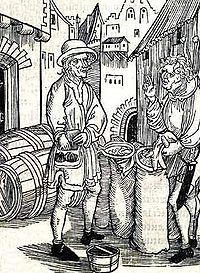 In the Renaissance
era, greater mobility of people facilitated an increase in commerce and the appearance of appropriate conditions for entrepreneur
s to start new, lucrative businesses. Given that borrowed money was no longer strictly for consumption but for production as well, interest was no longer viewed in the same manner. The School of Salamanca
elaborated on various reasons that justified the charging of interest: the person who received a loan benefited, and one could consider interest as a premium paid for the risk taken by the loaning party.
There was also the question of opportunity cost
, in that the loaning party lost other possibilities of using the loaned money. Finally and perhaps most originally was the consideration of money itself as merchandise, and the use of one's money as something for which one should receive a benefit in the form of interest.
Martín de Azpilcueta
also considered the effect of time. Other things being equal, one would prefer to receive a given good now rather than in the future. This preference
indicates greater value. Interest, under this theory, is the payment for the time the loaning individual is deprived of the money.
Economically, the interest rate
is the cost of capital and is subject to the laws of supply and demand
of the money supply
. The first attempt to control interest rates through manipulation of the money supply was made by the French Central Bank
in 1847.
The first formal studies of interest rates and their impact on society were conducted by Adam Smith
, Jeremy Bentham
and Mirabeau
during the birth of classic economic thought. In the late 19th century leading Swedish economist Knut Wicksell
in his 1898 Interest and Prices elaborated a comprehensive theory of economic crises based upon a distinction between natural and nominal interest rates. In the early 20th century, Irving Fisher
made a major breakthrough in the economic analysis of interest rates by distinguishing nominal interest from real interest. Several perspectives on the nature and impact of interest rates have arisen since then.
The latter half of the 20th century saw the rise of interest-free Islamic banking
and finance, a movement that attempts to apply religious law developed in the medieval period to the modern economy. Some entire countries, including Iran, Sudan, and Pakistan, have taken steps to eradicate interest from their financial systems entirely.
Rather than charging interest, the interest-free lender shares the risk by investing as a partner in profit loss sharing scheme, because predetermined loan repayment as interest is prohibited, as well as making money out of money is unacceptable. All financial transactions must be asset-backed and it does not charge any "fee" for the service of lending.
The amount of simple interest is calculated according to the following formula:

where r is the period interest rate (I/m), B0 the initial balance and m the number of time periods elapsed.
To calculate the period interest rate r, one divides the interest rate I by the number of periods m.
For example, imagine that a credit card holder has an outstanding balance of $2500 and that the simple interest rate
is 12.99% per annum. The interest added at the end of 3 months would be,

and they would have to pay $2581.19 to pay off the balance at this point.
If instead they make interest-only payments for each of those 3 months at the period rate r, the amount of interest paid would be,

Their balance at the end of 3 months would still be $2500.
In this case, the time value of money
is not factored in. The steady payments have an additional cost that needs to be considered when comparing loans. For example, given a $100 principal:
There are two complications involved when comparing different simple interest bearing offers.
A bank account that offers only simple interest, that money can freely be withdrawn from is unlikely, since withdrawing money and immediately depositing it again would be advantageous.
. The nominal interest rate, which refers to the price before adjustment to inflation, is the one visible to the consumer (i.e., the interest tagged in a loan contract, credit card statement, etc.). Nominal interest is composed of the real interest rate
plus inflation, among other factors. A simple formula for the nominal interest is:

Where i is the nominal interest, r is the real interest and is inflation.
This formula attempts to measure the value of the interest in units of stable purchasing power. However, if this statement were true, it would imply at least two misconceptions. First, that all interest rates within an area that shares the same inflation (that is, the same country) should be the same. Second, that the lenders know the inflation for the period of time that they are going to lend the money.
One reason behind the difference between the interest that yields a treasury bond and the interest that yields a mortgage loan
is the risk that the lender takes from lending money to an economic agent. In this particular case, a government is more likely to pay than a private citizen. Therefore, the interest rate charged to a private citizen is larger than the rate charged to the government.
To take into account the information asymmetry
aforementioned, both the value of inflation and the real price of money are changed to their expected
values resulting in the following equation:

Here, is the nominal interest at the time of the loan,
  is the real interest expected over the period of the loan,
  is the inflation expected over the period of the loan and
  is the representative value for the risk engaged in the operation.
Flat Rate Loans and the Rule of .78s: Some consumer loans have been structured as flat rate loans, with the loan outstanding determined by allocating the total interest across the term of the loan by using the "Rule of 78s
" or "Sum of digits" method. Seventy-eight is the sum of the numbers 1 through 12, inclusive. The practice enabled quick calculations of interest in the pre-computer days. In a loan with interest calculated per the Rule of 78s, the total interest over the life of the loan is calculated as either simple or compound interest and amounts to the same as either of the above methods. Payments remain constant over the life of the loan; however, payments are allocated to interest in progressively smaller amounts. In a one-year loan, in the first month, 12/78 of all interest owed over the life of the loan is due; in the second month, 11/78; progressing to the twelfth month where only 1/78 of all interest is due. The practical effect of the Rule of 78s is to make early pay-offs of term loans more expensive. For a one year loan, approximately 3/4 of all interest due is collected by the sixth month, and pay-off of the principal then will cause the effective interest rate to be much higher than the APY used to calculate the payments.
In 1992, the United States
outlawed the use of "Rule of 78s" interest in connection with mortgage refinancing and other consumer loans over five years in term. Certain other jurisdictions have outlawed application of the Rule of 78s in certain types of loans, particularly consumer loans.
Rule of 72: The "Rule of 72
" is a "quick and dirty" method for finding out how fast money doubles for a given interest rate. For example, if you have an interest rate of 6%, it will take 72/6 or 12 years for your money to double, compounding at 6%. This is an approximation that starts to break down above 10%.
s. Each specific debt takes into account the following factors in determining its interest rate:
encompasses any other use to which the money could be put, including lending to others, investing elsewhere, holding cash (for safety, for example), and simply spending the funds.
. Because future inflation is unknown, there are three ways this might be achieved:
However interest rates are set by the market, and it happens frequently that they are insufficient to compensate for inflation: for example at times of high inflation during e.g. the oil crisis; and currently (2011) when real yields on many inflation-linked government stocks are negative.
on the loan. The risk premium
attempts to measure the integrity of the borrower, the risk of his enterprise succeeding and the security of any collateral pledged. For example, loans to developing countries have higher risk premiums than those to the US government due to the difference in creditworthiness. An operating line of credit to a business will have a higher rate than a mortgage loan
.
The creditworthiness of businesses is measured by bond rating services and individual's credit score
s by credit bureau
s. The risks of an individual debt may have a large standard deviation of possibilities. The lender may want to cover his maximum risk, but lenders with portfolios of debt can lower the risk premium to cover just the most probable outcome.
Banks tend to add default interest to the loan agreements in order to separate between different scenarios.
- may strongly influence short-term interest rates, and is one of the main tools of monetary policy
. The central bank offers to borrow (or lend) large quantities of money at a rate which they determine (sometimes this is money that they have created ex nihilo, i.e. printed) which has a major influence on supply and demand and hence on market interest rates.
. This is the rate that banks charge each other for overnight loans of federal funds
. Federal funds are the reserves held by banks at the Fed.
Open market operations are one tool within monetary policy implemented by the Federal Reserve to steer short-term interest rates. Using the power to buy and sell treasury securities, the Open Market Desk at the Federal Reserve Bank of New York
can supply the market with dollars by purchasing T-notes, hence increasing the nation's money supply. By increasing the money supply or Aggregate Supply of Funding (ASF), interest rates will fall due to the excess of dollars banks will end up with in their reserves. Excess reserves
may be lent in the Fed funds
market to other banks, thus driving down rates.
s and credit risk
are tightly interrelated. The Jarrow-Turnbull model was the first model of credit risk that explicitly had random interest rates at its core. Lando (2004), Darrell Duffie
and Singleton (2003), and van Deventer and Imai (2003) discuss interest rates when the issuer of the interest-bearing instrument can default.
National governments (provided, of course, that the country has retained its own currency) can influence interest rates and thus the supply and demand for such loans, thus altering the total of loans and bonds issued. Generally speaking, a higher real interest rate reduces the broad money supply.
Through the quantity theory of money
, increases in the money supply lead to inflation. This means that interest rates can affect inflation in the future.
by studying a question about compound interest.
He realized that if an account that starts with $1.00 and pays say 100% interest per year, at the end of the year, the value is $2.00; but if the interest is computed and added twice in the year, the $1 is multiplied by 1.5 twice, yielding $1.00×1.5² = $2.25. Compounding quarterly yields $1.00×1.254 = $2.4414…, and so on.
Bernoulli noticed that if the frequency of compounding is increased without limit, this sequence can be modeled as follows:
where n is the number of times the interest is to be compounded in a year.
of a loan with regular monthly payments is augmented by the monthly interest charge and decreased by the payment so
 ,
,
where
By repeated substitution one obtains expressions for Bk, which are linearly proportional to B0 and p and use of the formula for the partial sum of a geometric series results in

A solution of this expression for p in terms of B0 and Bn reduces to

To find the payment if the loan is to be paid off in n payments one sets Bn = 0.
The PMT function found in spreadsheet
programs can be used to calculate the monthly payment of a loan:

An interest-only payment on the current balance would be
 .
.
The total interest, IT, paid on the loan is
 .
.
The formulas for a regular savings program are similar but the payments are added to the balances instead of being subtracted and the formula for the payment is the negative of the one above. These formulas are only approximate since actual loan balances are affected by rounding. To avoid an underpayment at the end of the loan, the payment must be rounded up to the next cent. The final payment would then be (1+r)Bn-1.
Consider a similar loan but with a new period equal to k periods of the problem above. If rk and pk are the new rate and payment, we now have
 .
.
Comparing this with the expression for Bk above we note that

and
 .
.
The last equation allows us to define a constant that is the same for both problems,

and Bk can be written as
 .
.
Solving for rk we find a formula for rk involving known quantities and Bk, the balance after k periods,

Since B0 could be any balance in the loan, the formula works for any two balances separate by k periods and can be used to compute a value for the annual interest rate.
B* is a scale invariant since it does not change with changes in the length of the period.
Rearranging the equation for B* one gets a transformation coefficient (scale factor
),
 (see binomial theorem
)
and we see that r and p transform in the same manner,


The change in the balance transforms likewise,

which gives an insight into the meaning of some of the coefficients found in the formulas above. The annual rate, r12, assumes only one payment per year and is not an "effective" rate for monthly payments. With monthly payments the monthly interest is paid out of each payment and so should not be compounded and an annual rate of 12·r would make more sense. If one just made interest-only payments the amount paid for the year would be 12·r·B0.
Substituting pk = rk B* into the equation for the Bk we get,

Since Bn = 0 we can solve for B*,
 .
.
Substituting back into the formula for the Bk shows that they are a linear function of the rk and therefore the λk,

This is the easiest way of estimating the balances if the λk are known. Substituting into the first formula for Bk above and solving for λk+1 we get,

λ0 and λn can be found using the formula for λk above or computing the λk recursively from λ0 = 0 to λn.
Since p=rB* the formula for the payment reduces to,

and the average interest rate over the period of the loan is
 ,
,
which is less than r if n>1.
Religion:
Fee
A fee is the price one pays as remuneration for services. Fees usually allow for overhead, wages, costs, and markup.Traditionally, professionals in Great Britain received a fee in contradistinction to a payment, salary, or wage, and would often use guineas rather than pounds as units of account...
paid by a borrower of asset
Asset
In financial accounting, assets are economic resources. Anything tangible or intangible that is capable of being owned or controlled to produce value and that is held to have positive economic value is considered an asset...
s to the owner as a form of compensation for the use of the assets. It is most commonly the price paid for the use of borrowed money, or money earned by deposited funds.
When money is borrowed, interest is typically paid to the lender as a percentage of the principal, the amount owed to the lender. The percentage of the principal that is paid as a fee over a certain period of time (typically one month or year) is called the interest rate
Interest rate
An interest rate is the rate at which interest is paid by a borrower for the use of money that they borrow from a lender. For example, a small company borrows capital from a bank to buy new assets for their business, and in return the lender receives interest at a predetermined interest rate for...
. A bank deposit will earn interest because the bank is paying for the use of the deposited funds. Assets that are sometimes lent with interest include money
Money
Money is any object or record that is generally accepted as payment for goods and services and repayment of debts in a given country or socio-economic context. The main functions of money are distinguished as: a medium of exchange; a unit of account; a store of value; and, occasionally in the past,...
, shares, consumer goods through hire purchase
Hire purchase
Hire purchase is the legal term for a contract, in this persons usually agree to pay for goods in parts or a percentage at a time. It was developed in the United Kingdom and can now be found in China, Japan, Malaysia, India, South Africa, Australia, Jamaica and New Zealand. It is also called...
, major assets such as aircraft
Aircraft finance
Aircraft finance refers to financing for the purchase and operation of aircraft. Complex aircraft finance shares many characteristics with maritime finance, and to a lesser extent with project finance....
, and even entire factories in finance lease
Finance lease
A finance lease or capital lease is a type of lease. It is a commercial arrangement where:* the lessee will select an asset ;* the lessor will purchase that asset;...
arrangements. The interest is calculated upon the value of the assets in the same manner as upon money.
Interest is compensation to the lender, for a) risk of principal loss, called credit risk
Credit risk
Credit risk is an investor's risk of loss arising from a borrower who does not make payments as promised. Such an event is called a default. Other terms for credit risk are default risk and counterparty risk....
; and b) forgoing other investments that could have been made with the loaned asset. These forgone investments are known as the opportunity cost
Opportunity cost
Opportunity cost is the cost of any activity measured in terms of the value of the best alternative that is not chosen . It is the sacrifice related to the second best choice available to someone, or group, who has picked among several mutually exclusive choices. The opportunity cost is also the...
. Instead of the lender using the assets directly, they are advanced to the borrower. The borrower then enjoys the benefit of using the assets ahead of the effort required to pay for them, while the lender enjoys the benefit of the fee paid by the borrower for the privilege. In economics, interest is considered the price of credit.
Interest is often compounded
Compound interest
Compound interest arises when interest is added to the principal, so that from that moment on, the interest that has been added also itself earns interest. This addition of interest to the principal is called compounding...
, which means that interest is earned on prior interest in addition to the principal. The total amount of debt grows exponentially, and its mathematical study led to the discovery of the number e
E (mathematical constant)
The mathematical constant ' is the unique real number such that the value of the derivative of the function at the point is equal to 1. The function so defined is called the exponential function, and its inverse is the natural logarithm, or logarithm to base...
.
History of interest
In ancient biblical Israel, it was against the Law of Moses to charge interest on private loans. During the Middle AgesMiddle Ages
The Middle Ages is a periodization of European history from the 5th century to the 15th century. The Middle Ages follows the fall of the Western Roman Empire in 476 and precedes the Early Modern Era. It is the middle period of a three-period division of Western history: Classic, Medieval and Modern...
, time was considered to be the property of God
God
God is the English name given to a singular being in theistic and deistic religions who is either the sole deity in monotheism, or a single deity in polytheism....
. Therefore, to charge interest was considered to be commerce with God's property. Also, St. Thomas Aquinas
Thomas Aquinas
Thomas Aquinas, O.P. , also Thomas of Aquin or Aquino, was an Italian Dominican priest of the Catholic Church, and an immensely influential philosopher and theologian in the tradition of scholasticism, known as Doctor Angelicus, Doctor Communis, or Doctor Universalis...
, the leading theologian of the Catholic Church, argued that the charging of interest is wrong because it amounts to "double charging", charging for both the thing and the use of the thing. The church regarded this as a sin of usury
Usury
Usury Originally, when the charging of interest was still banned by Christian churches, usury simply meant the charging of interest at any rate . In countries where the charging of interest became acceptable, the term came to be used for interest above the rate allowed by law...
; nevertheless, this rule was never strictly obeyed and eroded gradually until it disappeared during the industrial revolution.
Usury
Usury
Usury Originally, when the charging of interest was still banned by Christian churches, usury simply meant the charging of interest at any rate . In countries where the charging of interest became acceptable, the term came to be used for interest above the rate allowed by law...
has always been viewed negatively by the Roman Catholic Church. The Second Lateran Council condemned any repayment of a debt with more money than was originally loaned, the Council of Vienna explicitly prohibited usury and declared any legislation tolerant of usury to be heretical, and the first scholastics reproved the charging of interest. In the medieval economy, loans were entirely a consequence of necessity (bad harvests, fire in a workplace) and, under those conditions, it was considered morally reproachable to charge interest. It was also considered morally dubious, since no goods were produced through the lending of money, and thus it should not be compensated, unlike other activities with direct physical output such as blacksmithing or farming.
As Jewish citizens were ostracized from most professions by local rulers, the church and the guilds, they were pushed into marginal occupations considered socially inferior, such as tax and rent collecting and moneylending. Natural tensions between creditors and debtors were added to social, political, religious, and economic strains.
...financial oppression of Jews tended to occur in areas where they were most disliked, and if Jews reacted by concentrating on moneylending to non-Jews, the unpopularity — and so, of course, the pressure — would increase.
Thus the Jews became an element in a vicious circle. The Christians, on the basis of the Biblical rulings, condemned interest-taking absolutely, and from 1179 those who practiced it were excommunicated. Catholic autocrats frequently imposed the harshest financial burdens on the Jews. The Jews reacted by engaging in the one business where Christian laws actually discriminated in their favor, and became identified with the hated trade of moneylending.
Interest has often been looked down upon in Islamic civilization
Muslim world
The term Muslim world has several meanings. In a religious sense, it refers to those who adhere to the teachings of Islam, referred to as Muslims. In a cultural sense, it refers to Islamic civilization, inclusive of non-Muslims living in that civilization...
as well for the same reason for which usury was forbidden by the Catholic Church, with most scholars agreeing that the Qur'an explicitly forbids charging interest. Medieval jurists therefore developed several financial instruments to encourage responsible lending.
Renaissance
The Renaissance was a cultural movement that spanned roughly the 14th to the 17th century, beginning in Italy in the Late Middle Ages and later spreading to the rest of Europe. The term is also used more loosely to refer to the historical era, but since the changes of the Renaissance were not...
era, greater mobility of people facilitated an increase in commerce and the appearance of appropriate conditions for entrepreneur
Entrepreneur
An entrepreneur is an owner or manager of a business enterprise who makes money through risk and initiative.The term was originally a loanword from French and was first defined by the Irish-French economist Richard Cantillon. Entrepreneur in English is a term applied to a person who is willing to...
s to start new, lucrative businesses. Given that borrowed money was no longer strictly for consumption but for production as well, interest was no longer viewed in the same manner. The School of Salamanca
School of Salamanca
The School of Salamanca is the renaissance of thought in diverse intellectual areas by Spanish and Portuguese theologians, rooted in the intellectual and pedagogical work of Francisco de Vitoria...
elaborated on various reasons that justified the charging of interest: the person who received a loan benefited, and one could consider interest as a premium paid for the risk taken by the loaning party.
There was also the question of opportunity cost
Opportunity cost
Opportunity cost is the cost of any activity measured in terms of the value of the best alternative that is not chosen . It is the sacrifice related to the second best choice available to someone, or group, who has picked among several mutually exclusive choices. The opportunity cost is also the...
, in that the loaning party lost other possibilities of using the loaned money. Finally and perhaps most originally was the consideration of money itself as merchandise, and the use of one's money as something for which one should receive a benefit in the form of interest.
Martín de Azpilcueta
Martín de Azpilcueta
Martín de Azpilcueta , or Doctor Navarrus, was an important Spanish canonist and theologian in his time, and an early economist, the first to develop monetarist theory.-Life:...
also considered the effect of time. Other things being equal, one would prefer to receive a given good now rather than in the future. This preference
Time preference
In economics, time preference pertains to how large a premium a consumer places on enjoyment nearer in time over more remote enjoyment....
indicates greater value. Interest, under this theory, is the payment for the time the loaning individual is deprived of the money.
Economically, the interest rate
Interest rate
An interest rate is the rate at which interest is paid by a borrower for the use of money that they borrow from a lender. For example, a small company borrows capital from a bank to buy new assets for their business, and in return the lender receives interest at a predetermined interest rate for...
is the cost of capital and is subject to the laws of supply and demand
Supply and demand
Supply and demand is an economic model of price determination in a market. It concludes that in a competitive market, the unit price for a particular good will vary until it settles at a point where the quantity demanded by consumers will equal the quantity supplied by producers , resulting in an...
of the money supply
Money supply
In economics, the money supply or money stock, is the total amount of money available in an economy at a specific time. There are several ways to define "money," but standard measures usually include currency in circulation and demand deposits .Money supply data are recorded and published, usually...
. The first attempt to control interest rates through manipulation of the money supply was made by the French Central Bank
Banque de France
The Banque de France is the central bank of France; it is linked to the European Central Bank . Its main charge is to implement the interest rate policy of the European System of Central Banks...
in 1847.
The first formal studies of interest rates and their impact on society were conducted by Adam Smith
Adam Smith
Adam Smith was a Scottish social philosopher and a pioneer of political economy. One of the key figures of the Scottish Enlightenment, Smith is the author of The Theory of Moral Sentiments and An Inquiry into the Nature and Causes of the Wealth of Nations...
, Jeremy Bentham
Jeremy Bentham
Jeremy Bentham was an English jurist, philosopher, and legal and social reformer. He became a leading theorist in Anglo-American philosophy of law, and a political radical whose ideas influenced the development of welfarism...
and Mirabeau
Mirabeau
Mirabeau can refer to:People* Victor de Riqueti, marquis de Mirabeau, a French physiocrat and economist.* Honoré Gabriel Riqueti, comte de Mirabeau, renowned orator, a figure in the French Revolution and son of Victor....
during the birth of classic economic thought. In the late 19th century leading Swedish economist Knut Wicksell
Knut Wicksell
Johan Gustaf Knut Wicksell was a leading Swedish economist of the Stockholm school. His economic contributions would influence both the Keynesian and Austrian schools of economic thought....
in his 1898 Interest and Prices elaborated a comprehensive theory of economic crises based upon a distinction between natural and nominal interest rates. In the early 20th century, Irving Fisher
Irving Fisher
Irving Fisher was an American economist, inventor, and health campaigner, and one of the earliest American neoclassical economists, though his later work on debt deflation often regarded as belonging instead to the Post-Keynesian school.Fisher made important contributions to utility theory and...
made a major breakthrough in the economic analysis of interest rates by distinguishing nominal interest from real interest. Several perspectives on the nature and impact of interest rates have arisen since then.
The latter half of the 20th century saw the rise of interest-free Islamic banking
Islamic banking
Islamic banking is banking or banking activity that is consistent with the principles of Islamic law and its practical application through the development of Islamic economics. Sharia prohibits the fixed or floating payment or acceptance of specific interest or fees for loans of money...
and finance, a movement that attempts to apply religious law developed in the medieval period to the modern economy. Some entire countries, including Iran, Sudan, and Pakistan, have taken steps to eradicate interest from their financial systems entirely.
Rather than charging interest, the interest-free lender shares the risk by investing as a partner in profit loss sharing scheme, because predetermined loan repayment as interest is prohibited, as well as making money out of money is unacceptable. All financial transactions must be asset-backed and it does not charge any "fee" for the service of lending.
Simple interest
Simple interest is calculated only on the principal amount, or on that portion of the principal amount that remains unpaid.The amount of simple interest is calculated according to the following formula:
where r is the period interest rate (I/m), B0 the initial balance and m the number of time periods elapsed.
To calculate the period interest rate r, one divides the interest rate I by the number of periods m.
For example, imagine that a credit card holder has an outstanding balance of $2500 and that the simple interest rate
Interest rate
An interest rate is the rate at which interest is paid by a borrower for the use of money that they borrow from a lender. For example, a small company borrows capital from a bank to buy new assets for their business, and in return the lender receives interest at a predetermined interest rate for...
is 12.99% per annum. The interest added at the end of 3 months would be,
and they would have to pay $2581.19 to pay off the balance at this point.
If instead they make interest-only payments for each of those 3 months at the period rate r, the amount of interest paid would be,
Their balance at the end of 3 months would still be $2500.
In this case, the time value of money
Time value of money
The time value of money is the value of money figuring in a given amount of interest earned over a given amount of time. The time value of money is the central concept in finance theory....
is not factored in. The steady payments have an additional cost that needs to be considered when comparing loans. For example, given a $100 principal:
- Credit card debt where $1/day is charged: 1/100 = 1%/day = 7%/week = 365%/year.
- Corporate bond where the first $3 are due after six months, and the second $3 are due at the year's end: (3+3)/100 = 6%/year.
- Certificate of deposit (GICGuaranteed Investment CertificateA Guaranteed Investment Certificate or GIC is a Canadian investment that offers a guaranteed rate of return over a fixed period of time, most commonly issued by trust companies or banks. Due to its low risk profile, the return is generally less than other investments such as stocks, bonds, or...
) where $6 is paid at the year's end: 6/100 = 6%/year.
There are two complications involved when comparing different simple interest bearing offers.
- When rates are the same but the periods are different a direct comparison is inaccurate because of the time value of moneyTime value of moneyThe time value of money is the value of money figuring in a given amount of interest earned over a given amount of time. The time value of money is the central concept in finance theory....
. Paying $3 every six months costs more than $6 paid at year end so, the 6% bond cannot be 'equated' to the 6% GIC. - When interest is due, but not paid, does it remain 'interest payable', like the bond's $3 payment after six months or, will it be added to the balance due? In the latter case it is no longer simple interest, but compound interest.
A bank account that offers only simple interest, that money can freely be withdrawn from is unlikely, since withdrawing money and immediately depositing it again would be advantageous.
Composition of interest rates
In economics, interest is considered the price of credit, therefore, it is also subject to distortions due to inflationInflation
In economics, inflation is a rise in the general level of prices of goods and services in an economy over a period of time.When the general price level rises, each unit of currency buys fewer goods and services. Consequently, inflation also reflects an erosion in the purchasing power of money – a...
. The nominal interest rate, which refers to the price before adjustment to inflation, is the one visible to the consumer (i.e., the interest tagged in a loan contract, credit card statement, etc.). Nominal interest is composed of the real interest rate
Real interest rate
The "real interest rate" is the rate of interest an investor expects to receive after allowing for inflation. It can be described more formally by the Fisher equation, which states that the real interest rate is approximately the nominal interest rate minus the inflation rate...
plus inflation, among other factors. A simple formula for the nominal interest is:
Where i is the nominal interest, r is the real interest and
is inflation.This formula attempts to measure the value of the interest in units of stable purchasing power. However, if this statement were true, it would imply at least two misconceptions. First, that all interest rates within an area that shares the same inflation (that is, the same country) should be the same. Second, that the lenders know the inflation for the period of time that they are going to lend the money.
One reason behind the difference between the interest that yields a treasury bond and the interest that yields a mortgage loan
Mortgage loan
A mortgage loan is a loan secured by real property through the use of a mortgage note which evidences the existence of the loan and the encumbrance of that realty through the granting of a mortgage which secures the loan...
is the risk that the lender takes from lending money to an economic agent. In this particular case, a government is more likely to pay than a private citizen. Therefore, the interest rate charged to a private citizen is larger than the rate charged to the government.
To take into account the information asymmetry
Information asymmetry
In economics and contract theory, information asymmetry deals with the study of decisions in transactions where one party has more or better information than the other. This creates an imbalance of power in transactions which can sometimes cause the transactions to go awry, a kind of market failure...
aforementioned, both the value of inflation and the real price of money are changed to their expected
Expected
Expected may refer to:*Expectation*Expected value*Expected shortfall*Expected utility hypothesis*Expected return*Expected gainSee also*Unexpected...
values resulting in the following equation:
Here,
is the nominal interest at the time of the loan, is the real interest expected over the period of the loan, is the inflation expected over the period of the loan and is the representative value for the risk engaged in the operation.Cumulative interest or return
The calculation for cumulative interest is (FV/PV)-1. It ignores the 'per year' convention and assumes compounding at every payment date. It is usually used to compare two long term opportunities.Other conventions and uses
Exceptions:- US and Canadian T-Bills (short term Government debt) have a different calculation for interest. Their interest is calculated as (100-P)/P where 'P' is the price paid. Instead of normalizing it to a year, the interest is prorated by the number of days 't': (365/t)*100. (See also: Day count conventionDay count conventionIn finance, a day count convention determines how interest accrues over time for a variety of investments, including bonds, notes, loans, mortgages, medium-term notes, swaps, and forward rate agreements . This determines the amount transferred on interest payment dates, and also the calculation of...
). The total calculation is ((100-P)/P)*((365/t)*100). This is equivalent to calculating the price by a process called discounting at a simple interest rate. - Corporate Bonds are most frequently payable twice yearly. The amount of interest paid is the simple interest disclosed divided by two (multiplied by the face value of debt).
Flat Rate Loans and the Rule of .78s: Some consumer loans have been structured as flat rate loans, with the loan outstanding determined by allocating the total interest across the term of the loan by using the "Rule of 78s
Rule of 78s
Also known as the sum-of-the-digits method, the Rule of 78s is a term used in lending that refers to a method of yearly interest calculation. The name comes from the total number of months' interest that is being calculated in a year...
" or "Sum of digits" method. Seventy-eight is the sum of the numbers 1 through 12, inclusive. The practice enabled quick calculations of interest in the pre-computer days. In a loan with interest calculated per the Rule of 78s, the total interest over the life of the loan is calculated as either simple or compound interest and amounts to the same as either of the above methods. Payments remain constant over the life of the loan; however, payments are allocated to interest in progressively smaller amounts. In a one-year loan, in the first month, 12/78 of all interest owed over the life of the loan is due; in the second month, 11/78; progressing to the twelfth month where only 1/78 of all interest is due. The practical effect of the Rule of 78s is to make early pay-offs of term loans more expensive. For a one year loan, approximately 3/4 of all interest due is collected by the sixth month, and pay-off of the principal then will cause the effective interest rate to be much higher than the APY used to calculate the payments.
In 1992, the United States
United States
The United States of America is a federal constitutional republic comprising fifty states and a federal district...
outlawed the use of "Rule of 78s" interest in connection with mortgage refinancing and other consumer loans over five years in term. Certain other jurisdictions have outlawed application of the Rule of 78s in certain types of loans, particularly consumer loans.
Rule of 72: The "Rule of 72
Rule of 72
In finance, the rule of 72, the rule of 70 and the rule of 69 are methods for estimating an investment's doubling time. The rule number is divided by the interest percentage per period to obtain the approximate number of periods required for doubling...
" is a "quick and dirty" method for finding out how fast money doubles for a given interest rate. For example, if you have an interest rate of 6%, it will take 72/6 or 12 years for your money to double, compounding at 6%. This is an approximation that starts to break down above 10%.
Market interest rates
There are markets for investments (which include the money market, bond market, as well as retail financial institutions like banks) set interest rateInterest rate
An interest rate is the rate at which interest is paid by a borrower for the use of money that they borrow from a lender. For example, a small company borrows capital from a bank to buy new assets for their business, and in return the lender receives interest at a predetermined interest rate for...
s. Each specific debt takes into account the following factors in determining its interest rate:
Opportunity cost
Opportunity costOpportunity cost
Opportunity cost is the cost of any activity measured in terms of the value of the best alternative that is not chosen . It is the sacrifice related to the second best choice available to someone, or group, who has picked among several mutually exclusive choices. The opportunity cost is also the...
encompasses any other use to which the money could be put, including lending to others, investing elsewhere, holding cash (for safety, for example), and simply spending the funds.
Inflation
Since the lender is deferring consumption, they will wish, as a bare minimum, to recover enough to pay the increased cost of goods due to inflationInflation
In economics, inflation is a rise in the general level of prices of goods and services in an economy over a period of time.When the general price level rises, each unit of currency buys fewer goods and services. Consequently, inflation also reflects an erosion in the purchasing power of money – a...
. Because future inflation is unknown, there are three ways this might be achieved:
- Charge X% interest 'plus inflation'. Many governments issue 'real-return' or 'inflation indexed' bonds. The principal amount or the interest payments are continually increased by the rate of inflation. See the discussion at real interest rateReal interest rateThe "real interest rate" is the rate of interest an investor expects to receive after allowing for inflation. It can be described more formally by the Fisher equation, which states that the real interest rate is approximately the nominal interest rate minus the inflation rate...
. - Decide on the 'expected' inflation rate. This still leaves the lender exposed to the risk of 'unexpected' inflation.
- Allow the interest rate to be periodically changed. While a 'fixed interest rate' remains the same throughout the life of the debt, 'variable' or 'floating' rates can be reset. There are derivative products that allow for hedging and swaps between the two.
However interest rates are set by the market, and it happens frequently that they are insufficient to compensate for inflation: for example at times of high inflation during e.g. the oil crisis; and currently (2011) when real yields on many inflation-linked government stocks are negative.
Default
There is always the risk the borrower will become bankrupt, abscond or otherwise defaultDefault (finance)
In finance, default occurs when a debtor has not met his or her legal obligations according to the debt contract, e.g. has not made a scheduled payment, or has violated a loan covenant of the debt contract. A default is the failure to pay back a loan. Default may occur if the debtor is either...
on the loan. The risk premium
Risk premium
A risk premium is the minimum amount of money by which the expected return on a risky asset must exceed the known return on a risk-free asset, in order to induce an individual to hold the risky asset rather than the risk-free asset...
attempts to measure the integrity of the borrower, the risk of his enterprise succeeding and the security of any collateral pledged. For example, loans to developing countries have higher risk premiums than those to the US government due to the difference in creditworthiness. An operating line of credit to a business will have a higher rate than a mortgage loan
Mortgage loan
A mortgage loan is a loan secured by real property through the use of a mortgage note which evidences the existence of the loan and the encumbrance of that realty through the granting of a mortgage which secures the loan...
.
The creditworthiness of businesses is measured by bond rating services and individual's credit score
Credit score
A credit score is a numerical expression based on a statistical analysis of a person's credit files, to represent the creditworthiness of that person...
s by credit bureau
Credit bureau
A credit bureau , or credit reference agency is a company that collects information from various sources and provides consumer credit information on individual consumers for a variety of uses. It is an organization providing information on individuals' borrowing and bill paying habits...
s. The risks of an individual debt may have a large standard deviation of possibilities. The lender may want to cover his maximum risk, but lenders with portfolios of debt can lower the risk premium to cover just the most probable outcome.
Default Interest
Default interest is the interest that a borrower would pay if the borrower will not fulfill the loan covenants. The default interest is usually much higher than the original interest since it is reflecting the aggravation in the financial risk of the borrower. The default interest compensates the lender for the added risk.Banks tend to add default interest to the loan agreements in order to separate between different scenarios.
Deferred consumption
Charging interest equal only to inflation will leave the lender with the same purchasing power, but they would prefer their own consumption sooner rather than later. There will be an interest premium of the delay. They may not want to consume, but instead would invest in another product. The possible return they could realize in competing investments will determine what interest they charge.Length of time
Shorter terms often have less risk of default and exposure to inflation because the near future is easier to predict. In these circumstances, short term interest rates are lower than longer term interest rates (an upward sloping yield curve).Government intervention
Interest rates are generally determined by the market, but government intervention - usually by a central bankCentral bank
A central bank, reserve bank, or monetary authority is a public institution that usually issues the currency, regulates the money supply, and controls the interest rates in a country. Central banks often also oversee the commercial banking system of their respective countries...
- may strongly influence short-term interest rates, and is one of the main tools of monetary policy
Monetary policy
Monetary policy is the process by which the monetary authority of a country controls the supply of money, often targeting a rate of interest for the purpose of promoting economic growth and stability. The official goals usually include relatively stable prices and low unemployment...
. The central bank offers to borrow (or lend) large quantities of money at a rate which they determine (sometimes this is money that they have created ex nihilo, i.e. printed) which has a major influence on supply and demand and hence on market interest rates.
Open market operations in the United States
The Federal Reserve (Fed) implements monetary policy largely by targeting the federal funds rateFederal funds rate
In the United States, the federal funds rate is the interest rate at which depository institutions actively trade balances held at the Federal Reserve, called federal funds, with each other, usually overnight, on an uncollateralized basis. Institutions with surplus balances in their accounts lend...
. This is the rate that banks charge each other for overnight loans of federal funds
Federal funds
In the United States, federal funds are overnight borrowings by banks to maintain their bank reserves at the Federal Reserve. Banks keep reserves at Federal Reserve Banks to meet their reserve requirements and to clear financial transactions...
. Federal funds are the reserves held by banks at the Fed.
Open market operations are one tool within monetary policy implemented by the Federal Reserve to steer short-term interest rates. Using the power to buy and sell treasury securities, the Open Market Desk at the Federal Reserve Bank of New York
Federal Reserve Bank of New York
The Federal Reserve Bank of New York is one of the 12 Federal Reserve Banks of the United States. It is located at 33 Liberty Street, New York, NY. It is responsible for the Second District of the Federal Reserve System, which encompasses New York state, the 12 northern counties of New Jersey,...
can supply the market with dollars by purchasing T-notes, hence increasing the nation's money supply. By increasing the money supply or Aggregate Supply of Funding (ASF), interest rates will fall due to the excess of dollars banks will end up with in their reserves. Excess reserves
Excess reserves
In banking, excess reserves are bank reserves in excess of the reserve requirement set by a central bank. They are reserves of cash more than the required amounts. Holding excess reserves is generally considered costly and uneconomical as no interest is earned on the excess amount...
may be lent in the Fed funds
Federal funds
In the United States, federal funds are overnight borrowings by banks to maintain their bank reserves at the Federal Reserve. Banks keep reserves at Federal Reserve Banks to meet their reserve requirements and to clear financial transactions...
market to other banks, thus driving down rates.
Interest rates and credit risk
It is increasingly recognized that the business cycle, interest rateInterest rate
An interest rate is the rate at which interest is paid by a borrower for the use of money that they borrow from a lender. For example, a small company borrows capital from a bank to buy new assets for their business, and in return the lender receives interest at a predetermined interest rate for...
s and credit risk
Credit risk
Credit risk is an investor's risk of loss arising from a borrower who does not make payments as promised. Such an event is called a default. Other terms for credit risk are default risk and counterparty risk....
are tightly interrelated. The Jarrow-Turnbull model was the first model of credit risk that explicitly had random interest rates at its core. Lando (2004), Darrell Duffie
Darrell Duffie
James Darrell Duffie is a Canadian economist. He is the Dean Witter Distinguished Professor of Finance at Stanford Graduate School of Business, and has been on the finance faculty at Stanford since receiving his Ph.D. from Stanford in 1984...
and Singleton (2003), and van Deventer and Imai (2003) discuss interest rates when the issuer of the interest-bearing instrument can default.
Money and inflation
Loans and bonds have some of the characteristics of money and are included in the broad money supply.National governments (provided, of course, that the country has retained its own currency) can influence interest rates and thus the supply and demand for such loans, thus altering the total of loans and bonds issued. Generally speaking, a higher real interest rate reduces the broad money supply.
Through the quantity theory of money
Quantity theory of money
In monetary economics, the quantity theory of money is the theory that money supply has a direct, proportional relationship with the price level....
, increases in the money supply lead to inflation. This means that interest rates can affect inflation in the future.
Interest in mathematics
It is thought that Jacob Bernoulli discovered the mathematical constant eE (mathematical constant)
The mathematical constant ' is the unique real number such that the value of the derivative of the function at the point is equal to 1. The function so defined is called the exponential function, and its inverse is the natural logarithm, or logarithm to base...
by studying a question about compound interest.
He realized that if an account that starts with $1.00 and pays say 100% interest per year, at the end of the year, the value is $2.00; but if the interest is computed and added twice in the year, the $1 is multiplied by 1.5 twice, yielding $1.00×1.5² = $2.25. Compounding quarterly yields $1.00×1.254 = $2.4414…, and so on.
Bernoulli noticed that if the frequency of compounding is increased without limit, this sequence can be modeled as follows:
-
 ,
,
where n is the number of times the interest is to be compounded in a year.
Formulate
The balanceBalance (accounting)
In banking and accountancy, the outstanding balance is the amount of money owed, , that remains in a deposit account at a given date, after all past remittances, payments and withdrawal have been accounted for. It can be positive or negative ....
of a loan with regular monthly payments is augmented by the monthly interest charge and decreased by the payment so
,where
- i = loan rate/100 = annual rate in decimal form (e.g. 10% = 0.10 The loan rate is the rate used to compute payments and balances.)
- r = period rate = i/12 for monthly payments (customary usage for convenience)http://www.fdic.gov/regulations/laws/rules/6500-1650.html#6500226.14
- B0 = initial balance (loan principal)
- Bk = balance after k payments
- k = balance index
- p = period (monthly) payment
By repeated substitution one obtains expressions for Bk, which are linearly proportional to B0 and p and use of the formula for the partial sum of a geometric series results in
A solution of this expression for p in terms of B0 and Bn reduces to
To find the payment if the loan is to be paid off in n payments one sets Bn = 0.
The PMT function found in spreadsheet
Spreadsheet
A spreadsheet is a computer application that simulates a paper accounting worksheet. It displays multiple cells usually in a two-dimensional matrix or grid consisting of rows and columns. Each cell contains alphanumeric text, numeric values or formulas...
programs can be used to calculate the monthly payment of a loan:
An interest-only payment on the current balance would be
.The total interest, IT, paid on the loan is
.The formulas for a regular savings program are similar but the payments are added to the balances instead of being subtracted and the formula for the payment is the negative of the one above. These formulas are only approximate since actual loan balances are affected by rounding. To avoid an underpayment at the end of the loan, the payment must be rounded up to the next cent. The final payment would then be (1+r)Bn-1.
Consider a similar loan but with a new period equal to k periods of the problem above. If rk and pk are the new rate and payment, we now have
.Comparing this with the expression for Bk above we note that
and
.The last equation allows us to define a constant that is the same for both problems,
and Bk can be written as
.Solving for rk we find a formula for rk involving known quantities and Bk, the balance after k periods,
Since B0 could be any balance in the loan, the formula works for any two balances separate by k periods and can be used to compute a value for the annual interest rate.
B* is a scale invariant since it does not change with changes in the length of the period.
Rearranging the equation for B* one gets a transformation coefficient (scale factor
Scale factor
A scale factor is a number which scales, or multiplies, some quantity. In the equation y=Cx, C is the scale factor for x. C is also the coefficient of x, and may be called the constant of proportionality of y to x...
),
(see binomial theoremBinomial theorem
In elementary algebra, the binomial theorem describes the algebraic expansion of powers of a binomial. According to the theorem, it is possible to expand the power n into a sum involving terms of the form axbyc, where the exponents b and c are nonnegative integers with , and the coefficient a of...
)
and we see that r and p transform in the same manner,
The change in the balance transforms likewise,
which gives an insight into the meaning of some of the coefficients found in the formulas above. The annual rate, r12, assumes only one payment per year and is not an "effective" rate for monthly payments. With monthly payments the monthly interest is paid out of each payment and so should not be compounded and an annual rate of 12·r would make more sense. If one just made interest-only payments the amount paid for the year would be 12·r·B0.
Substituting pk = rk B* into the equation for the Bk we get,
Since Bn = 0 we can solve for B*,
.Substituting back into the formula for the Bk shows that they are a linear function of the rk and therefore the λk,
This is the easiest way of estimating the balances if the λk are known. Substituting into the first formula for Bk above and solving for λk+1 we get,
λ0 and λn can be found using the formula for λk above or computing the λk recursively from λ0 = 0 to λn.
Since p=rB* the formula for the payment reduces to,
and the average interest rate over the period of the loan is
,which is less than r if n>1.
See also
- Actuarial notationActuarial notationActuarial notation is a shorthand method to allow actuaries to record mathematical formulas that deal with interest rates and life tables.Traditional notation uses a halo system where symbols are placed as superscript or subscript before or after the main letter...
- Promissory notePromissory noteA promissory note is a negotiable instrument, wherein one party makes an unconditional promise in writing to pay a determinate sum of money to the other , either at a fixed or determinable future time or on demand of the payee, under specific terms.Referred to as a note payable in accounting, or...
- Rate of returnRate of returnIn finance, rate of return , also known as return on investment , rate of profit or sometimes just return, is the ratio of money gained or lost on an investment relative to the amount of money invested. The amount of money gained or lost may be referred to as interest, profit/loss, gain/loss, or...
- Cash accumulation equationCash accumulation equationThe cash accumulation equation is an equation which calculates how much money will be in a bank account, at any point in time. The account pays interest, and is being fed a steady trickle of money.- Compound interest :...
- Compound interestCompound interestCompound interest arises when interest is added to the principal, so that from that moment on, the interest that has been added also itself earns interest. This addition of interest to the principal is called compounding...
- Credit rating agencyCredit rating agencyA Credit rating agency is a company that assigns credit ratings for issuers of certain types of debt obligations as well as the debt instruments themselves...
- Credit card interestCredit card interestCredit card interest is the principal way in which credit card issuers generate revenue. A card issuer is a bank or credit union that gives a consumer a card or account number that can be used with various payees to make payments and borrow money from the bank simultaneously...
- Discount
- Fisher equationFisher equationThe Fisher equation in financial mathematics and economics estimates the relationship between nominal and real interest rates under inflation....
- Hire purchaseHire purchaseHire purchase is the legal term for a contract, in this persons usually agree to pay for goods in parts or a percentage at a time. It was developed in the United Kingdom and can now be found in China, Japan, Malaysia, India, South Africa, Australia, Jamaica and New Zealand. It is also called...
- Interest expenseInterest expenseInterest expense relates to the cost of borrowing money. It is the price that a lender charges a borrower for the use of the lender's money. Interest expense is different from OPEX and CAPEX, for it relates to the capital structure of a company. Interest expense is usually tax-deductible....
- Interest rateInterest rateAn interest rate is the rate at which interest is paid by a borrower for the use of money that they borrow from a lender. For example, a small company borrows capital from a bank to buy new assets for their business, and in return the lender receives interest at a predetermined interest rate for...
- LeasingLeasingLeasing is a process by which a firm can obtain the use of a certain fixed assets for which it must pay a series of contractual, periodic, tax deductible payments....
- Monetary policyMonetary policyMonetary policy is the process by which the monetary authority of a country controls the supply of money, often targeting a rate of interest for the purpose of promoting economic growth and stability. The official goals usually include relatively stable prices and low unemployment...
- Mortgage loanMortgage loanA mortgage loan is a loan secured by real property through the use of a mortgage note which evidences the existence of the loan and the encumbrance of that realty through the granting of a mortgage which secures the loan...
- Risk-free interest rateRisk-free interest rateRisk-free interest rate is the theoretical rate of return of an investment with no risk of financial loss. The risk-free rate represents the interest that an investor would expect from an absolutely risk-free investment over a given period of time....
- Yield curveYield curveIn finance, the yield curve is the relation between the interest rate and the time to maturity, known as the "term", of the debt for a given borrower in a given currency. For example, the U.S. dollar interest rates paid on U.S...
- Time value of moneyTime value of moneyThe time value of money is the value of money figuring in a given amount of interest earned over a given amount of time. The time value of money is the central concept in finance theory....
- Simple Interest
Religion:
- UsuryUsuryUsury Originally, when the charging of interest was still banned by Christian churches, usury simply meant the charging of interest at any rate . In countries where the charging of interest became acceptable, the term came to be used for interest above the rate allowed by law...
- RibaRibaRiba means one of the senses of "usury" . Riba is forbidden in Islamic economic jurisprudence fiqh and considered as a major sin...
External links
- White Paper: More than Math, The Lost Art of Interest calculation
- Mortgages made clear Financial Services AuthorityFinancial Services AuthorityThe Financial Services Authority is a quasi-judicial body responsible for the regulation of the financial services industry in the United Kingdom. Its board is appointed by the Treasury and the organisation is structured as a company limited by guarantee and owned by the UK government. Its main...
(UK) - OECD interest rate statistics
- You can see a list of current interest rates at these sites: