


Galilean moons

Encyclopedia
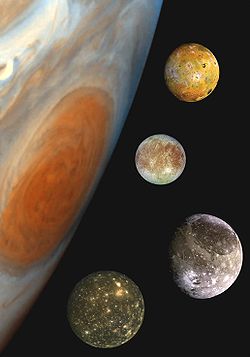
Jupiter
Jupiter is the fifth planet from the Sun and the largest planet within the Solar System. It is a gas giant with mass one-thousandth that of the Sun but is two and a half times the mass of all the other planets in our Solar System combined. Jupiter is classified as a gas giant along with Saturn,...
discovered by Galileo Galilei
Galileo Galilei
Galileo Galilei , was an Italian physicist, mathematician, astronomer, and philosopher who played a major role in the Scientific Revolution. His achievements include improvements to the telescope and consequent astronomical observations and support for Copernicanism...
in January 1610. They are the largest of the many moons of Jupiter and derive their names from the lovers of Zeus
Zeus
In the ancient Greek religion, Zeus was the "Father of Gods and men" who ruled the Olympians of Mount Olympus as a father ruled the family. He was the god of sky and thunder in Greek mythology. His Roman counterpart is Jupiter and his Etruscan counterpart is Tinia.Zeus was the child of Cronus...
: Io
Io (moon)
Io ) is the innermost of the four Galilean moons of the planet Jupiter and, with a diameter of , the fourth-largest moon in the Solar System. It was named after the mythological character of Io, a priestess of Hera who became one of the lovers of Zeus....
, Europa
Europa (moon)
Europa Slightly smaller than Earth's Moon, Europa is primarily made of silicate rock and probably has an iron core. It has a tenuous atmosphere composed primarily of oxygen. Its surface is composed of ice and is one of the smoothest in the Solar System. This surface is striated by cracks and...
, Ganymede
Ganymede (moon)
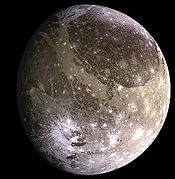
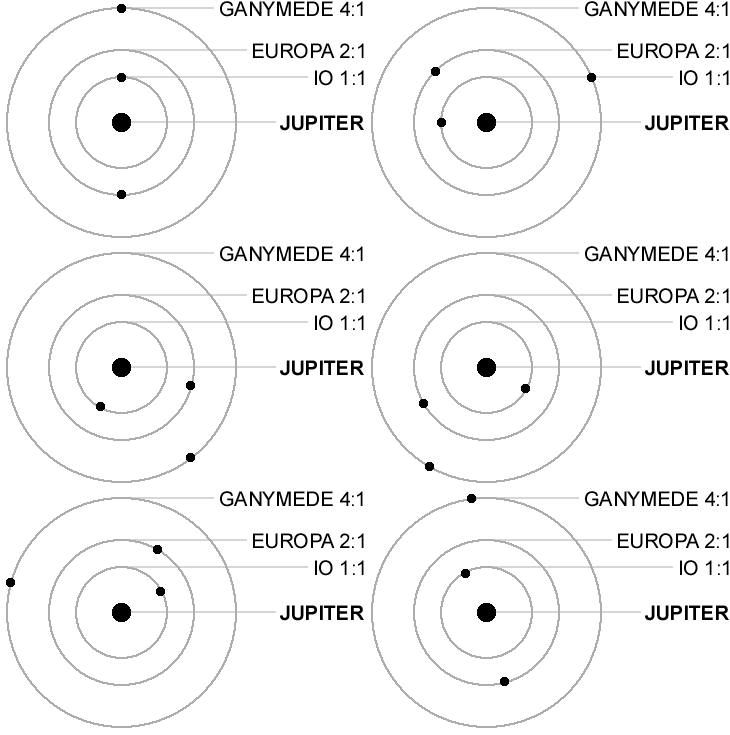
Ganymede is a satellite of Jupiter and the largest moon in the Solar System. It is the seventh moon and third Galilean satellite outward from Jupiter. Completing an orbit in roughly seven days, Ganymede participates in a 1:2:4 orbital resonance with the moons Europa and Io, respectively...
and Callisto
Callisto (moon)
Callisto named after the Greek mythological figure of Callisto) is a moon of the planet Jupiter. It was discovered in 1610 by Galileo Galilei. It is the third-largest moon in the Solar System and the second largest in the Jovian system, after Ganymede. Callisto has about 99% the diameter of the...
. Ganymede, Europa and Io participate in a 1:2:4 orbital resonance
Orbital resonance
In celestial mechanics, an orbital resonance occurs when two orbiting bodies exert a regular, periodic gravitational influence on each other, usually due to their orbital periods being related by a ratio of two small integers. Orbital resonances greatly enhance the mutual gravitational influence of...
. They are among the most massive objects in the Solar System
Solar System
The Solar System consists of the Sun and the astronomical objects gravitationally bound in orbit around it, all of which formed from the collapse of a giant molecular cloud approximately 4.6 billion years ago. The vast majority of the system's mass is in the Sun...
outside the Sun
Sun
The Sun is the star at the center of the Solar System. It is almost perfectly spherical and consists of hot plasma interwoven with magnetic fields...
and the eight planet
Planet
A planet is a celestial body orbiting a star or stellar remnant that is massive enough to be rounded by its own gravity, is not massive enough to cause thermonuclear fusion, and has cleared its neighbouring region of planetesimals.The term planet is ancient, with ties to history, science,...
s, with radii larger than any of the dwarf planet
Dwarf planet
A dwarf planet, as defined by the International Astronomical Union , is a celestial body orbiting the Sun that is massive enough to be spherical as a result of its own gravity but has not cleared its neighboring region of planetesimals and is not a satellite...
s.
The four moons were discovered sometime between 1609 and 1610 when Galileo made improvements to his telescope
Telescope
A telescope is an instrument that aids in the observation of remote objects by collecting electromagnetic radiation . The first known practical telescopes were invented in the Netherlands at the beginning of the 1600s , using glass lenses...
, which enabled him to observe celestial bodies more distinctly than had ever been possible before. Galileo’s discovery showed the importance of the telescope as a tool for astronomers by proving that there were objects in space that cannot be seen by the naked eye. More importantly, the incontrovertible discovery of celestial bodies orbiting something other than the Earth dealt a serious blow to the then-accepted Ptolemaic world system
Geocentric model
In astronomy, the geocentric model , is the superseded theory that the Earth is the center of the universe, and that all other objects orbit around it. This geocentric model served as the predominant cosmological system in many ancient civilizations such as ancient Greece...
, or the geocentric theory in which everything orbits around the Earth
Earth
Earth is the third planet from the Sun, and the densest and fifth-largest of the eight planets in the Solar System. It is also the largest of the Solar System's four terrestrial planets...
.
Galileo initially named his discovery the Cosmica Sidera ("Cosimo
Cosimo II de' Medici, Grand Duke of Tuscany
Cosimo II de' Medici was Grand Duke of Tuscany from 1609 until 1621. He was the elder son of the then incumbent Grand Duke and Christina of Lorraine. He married Maria Magdalena of Austria, and had eight children....
's stars"), but names that eventually prevailed were chosen by Simon Marius
Simon Marius
Simon Marius was a German astronomer. He was born in Gunzenhausen, near Nuremberg, but he spent most of his life in the city of Ansbach....
. Marius claimed to have discovered the moons at the same time as Galileo, and gave them their present names in his Mundus Jovialis, published in 1614.
Discovery
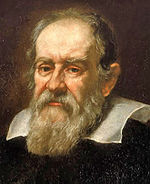
Galileo Galilei
Galileo Galilei , was an Italian physicist, mathematician, astronomer, and philosopher who played a major role in the Scientific Revolution. His achievements include improvements to the telescope and consequent astronomical observations and support for Copernicanism...
made to the telescope
Telescope
A telescope is an instrument that aids in the observation of remote objects by collecting electromagnetic radiation . The first known practical telescopes were invented in the Netherlands at the beginning of the 1600s , using glass lenses...
, with a magnifying capability of 20×, he was able to see celestial bodies more distinctly than was ever possible before. This allowed Galilei to discover sometime between December 1609 and January 1610 what came to be known as the Galilean moons.
On January 7, 1610, Galileo wrote a letter containing the first mention of Jupiter’s moons. At the time, he saw only three of them, and he believed them to be fixed stars near Jupiter. He continued to observe these celestial orbs
Celestial spheres
The celestial spheres, or celestial orbs, were the fundamental entities of the cosmological models developed by Plato, Eudoxus, Aristotle, Ptolemy, Copernicus and others...
from January 8 to March 2, 1610. In these observations, he discovered a fourth body, and also observed that the four were not fixed stars, but rather were orbiting Jupiter.
Galileo’s discovery proved the importance of the telescope as a tool for astronomers by showing that there were objects in space to be discovered that until then had remained unseen by the naked eye. More importantly, the discovery of celestial bodies orbiting something other than the Earth dealt a blow to the then-accepted Ptolemaic world system
Geocentric model
In astronomy, the geocentric model , is the superseded theory that the Earth is the center of the universe, and that all other objects orbit around it. This geocentric model served as the predominant cosmological system in many ancient civilizations such as ancient Greece...
, which held that the Earth was at the center of the universe and all other celestial bodies revolved around it. Galileo's Sidereus Nuncius (Starry Messenger), which announced celestial observations through his telescope, does not explicitly mention Copernican heliocentrism
Copernican heliocentrism
Copernican heliocentrism is the name given to the astronomical model developed by Nicolaus Copernicus and published in 1543. It positioned the Sun near the center of the Universe, motionless, with Earth and the other planets rotating around it in circular paths modified by epicycles and at uniform...
, a theory that placed the Sun
Sun
The Sun is the star at the center of the Solar System. It is almost perfectly spherical and consists of hot plasma interwoven with magnetic fields...
at the center of the universe. Nevertheless, Galileo accepted the Copernican theory. As a result of these discoveries, Galileo was able to develop a method of determining longitude
Longitude
Longitude is a geographic coordinate that specifies the east-west position of a point on the Earth's surface. It is an angular measurement, usually expressed in degrees, minutes and seconds, and denoted by the Greek letter lambda ....
based on the timing of the orbits of the Galilean moons.
A Chinese historian of astronomy, Xi Zezong
Xi Zezong
Xi Zezong was a Chinese astronomical historian. He is best known for his finding in Ancient Chinese history of the reference to Ganymede being visible to the human eye by ancient astronomer Gan De, before it was officially recognised by the west...
, has claimed that a "small reddish star" observed near Jupiter in 362 BC by Chinese astronomer Gan De
Gan De
Gan De was a Chinese astronomer/astrologer born in the State of Qi also known as the Lord Gan . Along with Shi Shen, he is believed to be the first in history known by name to compile a star catalogue, preceded by the anonymous authors of the early Babylonian star catalogues and followed by the...
may have been Ganymede
Ganymede
Ganymede most often refers to:*Ganymede , Trojan prince in Greek mythology* Ganymede , Jupiter's largest moon, named after the mythological characterGanymede, Ganymed or Ganymedes may also refer to:...
, predating Gallileo's discovery by around two millenia.
Dedication to the Medicis
In 1605, Galileo had been employed as a mathematics tutor for Cosimo de’ MediciCosimo II de' Medici, Grand Duke of Tuscany
Cosimo II de' Medici was Grand Duke of Tuscany from 1609 until 1621. He was the elder son of the then incumbent Grand Duke and Christina of Lorraine. He married Maria Magdalena of Austria, and had eight children....
. In 1609, Cosimo became Grand Duke Cosimo II of Tuscany
Tuscany
Tuscany is a region in Italy. It has an area of about 23,000 square kilometres and a population of about 3.75 million inhabitants. The regional capital is Florence ....
. Galileo, seeking patronage from his now-wealthy former student and his powerful family, used the discovery of Jupiter’s moons to gain it. On February 13, 1610, Galileo wrote to the Grand Duke’s secretary:
God graced me with being able, through such a singular sign, to reveal to my Lord my devotion and the desire I have that his glorious name live as equal among the stars, and since it is up to me, the first discoverer, to name these new planets, I wish, in imitation of the great sages who placed the most excellent heroes of that age among the stars, to inscribe these with the name of the Most Serene Grand Duke.
Galileo asked whether he should name the moons the "Cosmian Stars," after Cosimo alone, or the "Medician Stars," which would honor all four brothers in the Medici clan. The secretary replied that the latter name would be best.
On March 12, 1610, Galileo wrote his dedicatory letter to the Duke of Tuscany, and the next day sent a copy to the Grand Duke, hoping to obtain the Grand Duke’s support as quickly as possible. On March 19, he sent the telescope he had used to first view Jupiter’s moons to the Grand Duke, along with an official copy of Sidereus Nuncius (The Starry Messenger) that, following the secretary's advice, named the four moons the Medician Stars. In his dedicatory introduction, Galileo wrote:
Scarcely have the immortal graces of your soul begun to shine forth on earth than bright stars offer themselves in the heavens which, like tongues, will speak of and celebrate your most excellent virtues for all time. Behold, therefore, four stars reserved for your illustrious name ... which ... make their journeys and orbits with a marvelous speed around the star of Jupiter ... like children of the same family ... Indeed, it appears the Maker of the Stars himself, by clear arguments, admonished me to call these new planets by the illustrious name of Your Highness before all others.
Name
Galileo initially called his discovery the Cosmica Sidera ("Cosimo's stars"), in honour of Cosimo II de' Medici (1590–1621). At Cosimo's suggestion, Galileo changed the name to Medicea Sidera ("the Medician stars"), honouring all four Medici brothers (Cosimo, Francesco, CarloCarlo de' Medici (1595-1666)
Carlo de' Medici was the son of Ferdinando I de' Medici, Grand Duke of Tuscany and Christina of Lorraine. Born in Florence, he had a successful career in the Church, rising to become Cardinal Bishop of Ostia and Dean of the College of Cardinals.De' Medici was raised to the cardinalate by Pope Paul...
, and Lorenzo). The discovery was announced in the Sidereus Nuncius
Sidereus Nuncius
Sidereus Nuncius is a short treatise published in New Latin by Galileo Galilei in March 1610. It was the first scientific treatise based on observations made through a telescope...
("Starry Messenger"), published in Venice
Venice
Venice is a city in northern Italy which is renowned for the beauty of its setting, its architecture and its artworks. It is the capital of the Veneto region...
in March 1610, less than two months after the first observations.
Other names put forward include:
- I. Principharus (for the "prince" of Tuscany), II. Victripharus (after Vittoria della RovereVittoria della RovereVittoria della Rovere was Grand Duchess of Tuscany as the wife of Grand Duke Ferdinando II. She gave her husband four children, two of which would survive infancy; the future Cosimo III, Tuscany's longest reigning monarch and Francesco Maria, a prince of the Church...
), III. Cosmipharus (after Cosimo de' MediciCosimo I de' Medici, Grand Duke of TuscanyCosimo I de' Medici was Duke of Florence from 1537 to 1574, reigning as the first Grand Duke of Tuscany from 1569.-Biography:...
) and IV. Fernipharus (after Duke Ferdinand de' MediciFerdinando II de' Medici, Grand Duke of TuscanyFerdinando II de' Medici was grand duke of Tuscany from 1621 to 1670. He was the eldest child of Cosimo II de' Medici and Maria Maddalena of Austria. His 49 year rule was punctuated by the terminations of the remaining operations of the Medici Bank, and the beginning of Tuscany's long economic...
)http://books.google.com/books?id=eF4LAQAAIAAJ&pg=PA263 - by Giovanni Batista Hodierna, a disciple of Galileo and author of the first ephemeridesEphemerisAn ephemeris is a table of values that gives the positions of astronomical objects in the sky at a given time or times. Different kinds of ephemerides are used for astronomy and astrology...
(Medicaeorum Ephemerides, 1656); - Circulatores Jovis, or Jovis Comites - by Johannes HeveliusJohannes HeveliusJohannes Hevelius Some sources refer to Hevelius as Polish:Some sources refer to Hevelius as German:*Encyplopedia Britannica * of the Royal Society was a councilor and mayor of Danzig , Pomeranian Voivodeship, in the Polish-Lithuanian Commonwealth...
; - Gardes, or Satellites (from the LatinLatinLatin is an Italic language originally spoken in Latium and Ancient Rome. It, along with most European languages, is a descendant of the ancient Proto-Indo-European language. Although it is considered a dead language, a number of scholars and members of the Christian clergy speak it fluently, and...
satelles, satellitis, meaning "escorts") - by Jacques OzanamJacques OzanamJacques Ozanam was a French mathematician.-Biography:Jacques Ozanam was born in Sainte-Olive, Ain, France....
.
The names that eventually prevailed were chosen by Simon Marius
Simon Marius
Simon Marius was a German astronomer. He was born in Gunzenhausen, near Nuremberg, but he spent most of his life in the city of Ansbach....
, who claimed to have discovered the moons at the same time as Galileo: he named them after lovers of the god Zeus (the Greek equivalent of Jupiter): Io
Io (moon)
Io ) is the innermost of the four Galilean moons of the planet Jupiter and, with a diameter of , the fourth-largest moon in the Solar System. It was named after the mythological character of Io, a priestess of Hera who became one of the lovers of Zeus....
, Europa
Europa (moon)
Europa Slightly smaller than Earth's Moon, Europa is primarily made of silicate rock and probably has an iron core. It has a tenuous atmosphere composed primarily of oxygen. Its surface is composed of ice and is one of the smoothest in the Solar System. This surface is striated by cracks and...
, Ganymede
Ganymede (moon)
Ganymede is a satellite of Jupiter and the largest moon in the Solar System. It is the seventh moon and third Galilean satellite outward from Jupiter. Completing an orbit in roughly seven days, Ganymede participates in a 1:2:4 orbital resonance with the moons Europa and Io, respectively...
and Callisto
Callisto (moon)
Callisto named after the Greek mythological figure of Callisto) is a moon of the planet Jupiter. It was discovered in 1610 by Galileo Galilei. It is the third-largest moon in the Solar System and the second largest in the Jovian system, after Ganymede. Callisto has about 99% the diameter of the...
, in his Mundus Jovialis, published in 1614.
Galileo steadfastly refused to use Marius' names and invented as a result the numbering scheme that is still used nowadays, in parallel with proper moon names. The numbers run from Jupiter outward, thus I, II, III and IV for Io, Europa, Ganymede and Callisto respectively. Galileo used this system in his notebooks but never actually published it. The numbered names (Jupiter x) were used until mid-20th century when other inner moons were discovered, and Marius' names became widely used.
Members
Simulations suggest there may have been several generations of Galilean satellites in Jupiter's early history. Each generation of moons to have formed would have spiraled into Jupiter and been destroyed, due to drag from Jupiter's proto-lunar diskProtoplanetary disk
A protoplanetary disk is a rotating circumstellar disk of dense gas surrounding a young newly formed star, a T Tauri star, or Herbig Ae/Be star...
, with new moons forming from the remaining debris. By the time the present generation formed, the debris had thinned out to the point that it no longer greatly interfered with the moons' orbits. Io is anhydrous
Anhydrous
As a general term, a substance is said to be anhydrous if it contains no water. The way of achieving the anhydrous form differs from one substance to another...
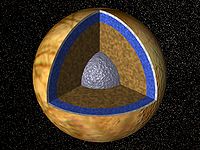
and likely has an interior of rock and metal. Europa is thought to contain 8% ice and water by mass with the remainder rock. These moons are, in increasing order of distance from Jupiter:
| Name |
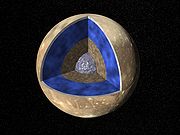
Image | Model of Interior I E G C |
Diameter (km) |
Mass (kg) |
Density (g/cm³) |
Semi-major axis Semi-major axis The major axis of an ellipse is its longest diameter, a line that runs through the centre and both foci, its ends being at the widest points of the shape... (km) |
Orbital period Orbital period The orbital period is the time taken for a given object to make one complete orbit about another object.When mentioned without further qualification in astronomy this refers to the sidereal period of an astronomical object, which is calculated with respect to the stars.There are several kinds of... (d Day A day is a unit of time, commonly defined as an interval equal to 24 hours. It also can mean that portion of the full day during which a location is illuminated by the light of the sun... ) (relative) |
Inclination Inclination Inclination in general is the angle between a reference plane and another plane or axis of direction.-Orbits:The inclination is one of the six orbital parameters describing the shape and orientation of a celestial orbit... (° Degree (angle) A degree , usually denoted by ° , is a measurement of plane angle, representing 1⁄360 of a full rotation; one degree is equivalent to π/180 radians... ) |
Eccentricity Orbital eccentricity The orbital eccentricity of an astronomical body is the amount by which its orbit deviates from a perfect circle, where 0 is perfectly circular, and 1.0 is a parabola, and no longer a closed orbit... |
|---|---|---|---|---|---|---|---|---|---|
| Io Io (moon) Io ) is the innermost of the four Galilean moons of the planet Jupiter and, with a diameter of , the fourth-largest moon in the Solar System. It was named after the mythological character of Io, a priestess of Hera who became one of the lovers of Zeus.... Jupiter I |
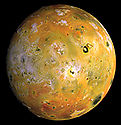 |
3660.0×3637.4×3630.6 | 3.528 | 421,800 | 1.769 (1) |
0.050 | 0.0041 | ||
| Europa Europa (moon) Europa Slightly smaller than Earth's Moon, Europa is primarily made of silicate rock and probably has an iron core. It has a tenuous atmosphere composed primarily of oxygen. Its surface is composed of ice and is one of the smoothest in the Solar System. This surface is striated by cracks and... Jupiter II |
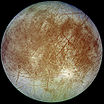 |
 |
3121.6 | 3.014 | 671,100 | 3.551 (2) |
0.471 | 0.0094 | |
| Ganymede Ganymede (moon) Ganymede is a satellite of Jupiter and the largest moon in the Solar System. It is the seventh moon and third Galilean satellite outward from Jupiter. Completing an orbit in roughly seven days, Ganymede participates in a 1:2:4 orbital resonance with the moons Europa and Io, respectively... Jupiter III |
 |
 |
5262.4 | 1.942 | 1,070,400 | 7.155 (4) |
0.204 | 0.0011 | |
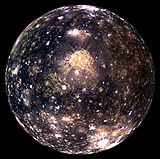
| Callisto Callisto (moon) Callisto named after the Greek mythological figure of Callisto) is a moon of the planet Jupiter. It was discovered in 1610 by Galileo Galilei. It is the third-largest moon in the Solar System and the second largest in the Jovian system, after Ganymede. Callisto has about 99% the diameter of the... Jupiter IV |
 |
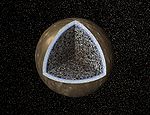 |
4820.6 | 1.834 | 1,882,700 | 16.69 (9.4) |
0.205 | 0.0074 |
Io
Natural satellite
A natural satellite or moon is a celestial body that orbits a planet or smaller body, which is called its primary. The two terms are used synonymously for non-artificial satellites of planets, of dwarf planets, and of minor planets....
of Jupiter
Jupiter
Jupiter is the fifth planet from the Sun and the largest planet within the Solar System. It is a gas giant with mass one-thousandth that of the Sun but is two and a half times the mass of all the other planets in our Solar System combined. Jupiter is classified as a gas giant along with Saturn,...
and, with a diameter
Diameter
In geometry, a diameter of a circle is any straight line segment that passes through the center of the circle and whose endpoints are on the circle. The diameters are the longest chords of the circle...
of 3,642 kilometers, the fourth-largest moon in the Solar System
Solar System
The Solar System consists of the Sun and the astronomical objects gravitationally bound in orbit around it, all of which formed from the collapse of a giant molecular cloud approximately 4.6 billion years ago. The vast majority of the system's mass is in the Sun...
. It was named after Io
Io (mythology)
Io was, in Greek mythology, a priestess of Hera in Argos, a nymph who was seduced by Zeus, who changed her into a heifer to escape detection. His wife Hera set ever-watchful Argus Panoptes to guard her, but Hermes was sent to distract the guardian and slay him...
, a priestess of Hera
Hera
Hera was the wife and one of three sisters of Zeus in the Olympian pantheon of Greek mythology and religion. Her chief function was as the goddess of women and marriage. Her counterpart in the religion of ancient Rome was Juno. The cow and the peacock were sacred to her...
who became one of the lovers of Zeus
Zeus
In the ancient Greek religion, Zeus was the "Father of Gods and men" who ruled the Olympians of Mount Olympus as a father ruled the family. He was the god of sky and thunder in Greek mythology. His Roman counterpart is Jupiter and his Etruscan counterpart is Tinia.Zeus was the child of Cronus...
. Nevertheless, it was simply referred to as “Jupiter I,” or “The first satellite of Jupiter,” until mid-20th century.
With over 400 active volcanoes, Io is the most geologically active object in the Solar System. Its surface is dotted with more than 100 mountains, some of which are taller than Earth's Mount Everest
Mount Everest
Mount Everest is the world's highest mountain, with a peak at above sea level. It is located in the Mahalangur section of the Himalayas. The international boundary runs across the precise summit point...
. Unlike most satellites in the outer Solar System (which have a thick coating of ice), Io is primarily composed of silicate rock surrounding a molten iron or iron sulfide core.
Although not proven, recent data from the Galileo orbiter indicates that Io might have its own magnetic field. Io has an extremely thin atmosphere made up mostly of sulfur dioxide
Sulfur dioxide
Sulfur dioxide is the chemical compound with the formula . It is released by volcanoes and in various industrial processes. Since coal and petroleum often contain sulfur compounds, their combustion generates sulfur dioxide unless the sulfur compounds are removed before burning the fuel...
(SO2). If a surface data or collection vessel were to land on Io in the future, it would have to be extremely tough (similar to the tank
Tank
A tank is a tracked, armoured fighting vehicle designed for front-line combat which combines operational mobility, tactical offensive, and defensive capabilities...
-like bodies of the Soviet Venera
Venera
The Venera series probes were developed by the Soviet Union between 1961 and 1984 to gather data from Venus, Venera being the Russian name for Venus...
landers) to survive the radiation and magnetic fields that originate from Jupiter.
Europa
Europa, the second of the four Galilean moons, is the second closest to Jupiter and the smallest at 3121.6 kilometers in diameter, which is slightly smaller than EarthEarth
Earth is the third planet from the Sun, and the densest and fifth-largest of the eight planets in the Solar System. It is also the largest of the Solar System's four terrestrial planets...
's Moon
Moon
The Moon is Earth's only known natural satellite,There are a number of near-Earth asteroids including 3753 Cruithne that are co-orbital with Earth: their orbits bring them close to Earth for periods of time but then alter in the long term . These are quasi-satellites and not true moons. For more...
. The name, Europa was after a mythical Phoenicia
Phoenicia
Phoenicia , was an ancient civilization in Canaan which covered most of the western, coastal part of the Fertile Crescent. Several major Phoenician cities were built on the coastline of the Mediterranean. It was an enterprising maritime trading culture that spread across the Mediterranean from 1550...
n noblewoman, Europa
Europa (mythology)
In Greek mythology Europa was a Phoenician woman of high lineage, from whom the name of the continent Europe has ultimately been taken. The name Europa occurs in Hesiod's long list of daughters of primordial Oceanus and Tethys...
, who was courted by Zeus
Zeus
In the ancient Greek religion, Zeus was the "Father of Gods and men" who ruled the Olympians of Mount Olympus as a father ruled the family. He was the god of sky and thunder in Greek mythology. His Roman counterpart is Jupiter and his Etruscan counterpart is Tinia.Zeus was the child of Cronus...
and became the queen of Crete
Crete
Crete is the largest and most populous of the Greek islands, the fifth largest island in the Mediterranean Sea, and one of the thirteen administrative regions of Greece. It forms a significant part of the economy and cultural heritage of Greece while retaining its own local cultural traits...
, but did not become widely used until the mid-20th century.
It is one of the smoothest objects in the solar system, with a layer of water surrounding the mantle of the planet, thought to be 100 kilometers thick. The smooth surface includes a layer of ice, while the bottom of the ice is theorized to be liquid water. The apparent youth and smoothness of the surface have led to the hypothesis that a water ocean exists beneath it, which could conceivably serve as an abode for extraterrestrial life
Extraterrestrial life
Extraterrestrial life is defined as life that does not originate from Earth...
. Heat energy from tidal flexing ensures that the ocean remains liquid and drives geological activity. Life may exist in Europa's under-ice ocean, perhaps subsisting in an environment similar to Earth's deep-ocean hydrothermal vent
Hydrothermal vent
A hydrothermal vent is a fissure in a planet's surface from which geothermally heated water issues. Hydrothermal vents are commonly found near volcanically active places, areas where tectonic plates are moving apart, ocean basins, and hotspots. Hydrothermal vents exist because the earth is both...
s or the Antarctic Lake Vostok
Lake Vostok
Lake Vostok is the largest of more than 140 subglacial lakes found under the surface of Antarctica. The overlying ice provides a continuous paleoclimatic record of 400,000 years, although the lake water itself may have been isolated for 15 to 25 million years. The lake is named after the...
. Life in such an ocean could possibly be similar to microbial
Microorganism
A microorganism or microbe is a microscopic organism that comprises either a single cell , cell clusters, or no cell at all...
life on Earth in the deep ocean. So far, there is no evidence that life exists on Europa, but the likely presence of liquid water has spurred calls to send a probe there.
The prominent markings that criss-cross the moon seem to be mainly albedo feature
Albedo feature
An albedo feature is a large area on the surface of a planet which shows a contrast in brightness or darkness with adjacent areas....
s, which emphasize low topography. There are few craters
Impact crater
In the broadest sense, the term impact crater can be applied to any depression, natural or manmade, resulting from the high velocity impact of a projectile with a larger body...
on Europa because its surface is tectonically active and young. Some theories suggest that Jupiter’s gravity is causing these markings, as one side of Europa is constantly facing Jupiter. Also, volcanic water eruptions splitting the surface of Europa, and even geysers have been considered as a cause. The color of the markings, reddish-brown, is theorized to be caused by sulfur, but scientists cannot confirm that, because no data collection devices have been sent to Europa. Europa is primarily made of silicate
Silicate
A silicate is a compound containing a silicon bearing anion. The great majority of silicates are oxides, but hexafluorosilicate and other anions are also included. This article focuses mainly on the Si-O anions. Silicates comprise the majority of the earth's crust, as well as the other...
rock and likely has an iron
Iron
Iron is a chemical element with the symbol Fe and atomic number 26. It is a metal in the first transition series. It is the most common element forming the planet Earth as a whole, forming much of Earth's outer and inner core. It is the fourth most common element in the Earth's crust...
core. It has a tenuous atmosphere composed primarily of oxygen
Oxygen
Oxygen is the element with atomic number 8 and represented by the symbol O. Its name derives from the Greek roots ὀξύς and -γενής , because at the time of naming, it was mistakenly thought that all acids required oxygen in their composition...
.
Ganymede
Ganymede, the third Galilean moon is named after the mythological GanymedeGanymede (mythology)
In Greek mythology, Ganymede is a divine hero whose homeland was Troy. Homer describes Ganymede as the most beautiful of mortals. In the best-known myth, he is abducted by Zeus, in the form of an eagle, to serve as cup-bearer in Olympus. Some interpretations of the myth treat it as an allegory of...
, cupbearer of the Greek gods
Greek mythology
Greek mythology is the body of myths and legends belonging to the ancient Greeks, concerning their gods and heroes, the nature of the world, and the origins and significance of their own cult and ritual practices. They were a part of religion in ancient Greece...
and Zeus's
Zeus
In the ancient Greek religion, Zeus was the "Father of Gods and men" who ruled the Olympians of Mount Olympus as a father ruled the family. He was the god of sky and thunder in Greek mythology. His Roman counterpart is Jupiter and his Etruscan counterpart is Tinia.Zeus was the child of Cronus...
beloved. Ganymede is the largest natural satellite in the Solar System
Solar System
The Solar System consists of the Sun and the astronomical objects gravitationally bound in orbit around it, all of which formed from the collapse of a giant molecular cloud approximately 4.6 billion years ago. The vast majority of the system's mass is in the Sun...
at 5262.4 kilometers in diameter, which makes it larger than the planet Mercury
Mercury (planet)
Mercury is the innermost and smallest planet in the Solar System, orbiting the Sun once every 87.969 Earth days. The orbit of Mercury has the highest eccentricity of all the Solar System planets, and it has the smallest axial tilt. It completes three rotations about its axis for every two orbits...
- although only at about half of its mass since Ganymede is an icy world. It is the only satellite in the Solar System known to possess a magnetosphere
Magnetosphere
A magnetosphere is formed when a stream of charged particles, such as the solar wind, interacts with and is deflected by the intrinsic magnetic field of a planet or similar body. Earth is surrounded by a magnetosphere, as are the other planets with intrinsic magnetic fields: Mercury, Jupiter,...
, likely created through convection
Convection
Convection is the movement of molecules within fluids and rheids. It cannot take place in solids, since neither bulk current flows nor significant diffusion can take place in solids....
within the liquid iron core.
Ganymede is composed primarily of silicate rock
Silicate
A silicate is a compound containing a silicon bearing anion. The great majority of silicates are oxides, but hexafluorosilicate and other anions are also included. This article focuses mainly on the Si-O anions. Silicates comprise the majority of the earth's crust, as well as the other...
and water ice, and a salt-water ocean is believed to exist nearly 200 km below Ganymede's surface, sandwiched between layers of ice. The metallic core of Ganymede suggests a greater heat at some time in its past than had previously been proposed. The surface is a mix of two types of terrain – highly cratered dark regions and younger, but still ancient, regions with a large array of grooves and ridges. Ganymede has a high number of craters, but many are gone or barely visible due to its icy crust forming over them. The satellite has a thin oxygen
Oxygen
Oxygen is the element with atomic number 8 and represented by the symbol O. Its name derives from the Greek roots ὀξύς and -γενής , because at the time of naming, it was mistakenly thought that all acids required oxygen in their composition...
atmosphere
Atmosphere
An atmosphere is a layer of gases that may surround a material body of sufficient mass, and that is held in place by the gravity of the body. An atmosphere may be retained for a longer duration, if the gravity is high and the atmosphere's temperature is low...
that includes O, O2, and possibly O3 (ozone
Ozone
Ozone , or trioxygen, is a triatomic molecule, consisting of three oxygen atoms. It is an allotrope of oxygen that is much less stable than the diatomic allotrope...
), and some atomic hydrogen.
Callisto
Callisto is the fourth and last Galilean moon, and is the second largest of the four, and at 4820.6 kilometers in diameter, it is the third largest moon in the Solar SystemSolar System
The Solar System consists of the Sun and the astronomical objects gravitationally bound in orbit around it, all of which formed from the collapse of a giant molecular cloud approximately 4.6 billion years ago. The vast majority of the system's mass is in the Sun...
. Callisto was a daughter of the Arkadian King Lykaon and a hunting companion of the goddess Artemis. It does not form part of the orbital resonance
Orbital resonance
In celestial mechanics, an orbital resonance occurs when two orbiting bodies exert a regular, periodic gravitational influence on each other, usually due to their orbital periods being related by a ratio of two small integers. Orbital resonances greatly enhance the mutual gravitational influence of...
that affects three inner Galilean satellites and thus does not experience appreciable tidal heating. Callisto is composed of approximately equal amounts of rock
Rock (geology)
In geology, rock or stone is a naturally occurring solid aggregate of minerals and/or mineraloids.The Earth's outer solid layer, the lithosphere, is made of rock. In general rocks are of three types, namely, igneous, sedimentary, and metamorphic...
and ices
Volatiles
In planetary science, volatiles are that group of chemical elements and chemical compounds with low boiling points that are associated with a planet's or moon's crust and/or atmosphere. Examples include nitrogen, water, carbon dioxide, ammonia, hydrogen, and methane, all compounds of C, H, O...
, which makes it the least dense of the Galilean moons. It is one of the most heavily cratered satellites in the solar system, and one major feature is a basin around 3000 km wide called Valhalla
Valhalla (crater)
Valhalla is the largest multi-ring structure on Jupiter's moon Callisto and in the Solar System. It was named after Valhalla, Odin's hall in Norse mythology. Valhalla consists of a bright central region 360 km across, an inner ridge and trough zone and striking concentric rings extending up...
.
Callisto is surrounded by an extremely thin atmosphere
Atmosphere
An atmosphere is a layer of gases that may surround a material body of sufficient mass, and that is held in place by the gravity of the body. An atmosphere may be retained for a longer duration, if the gravity is high and the atmosphere's temperature is low...
composed of carbon dioxide
Carbon dioxide
Carbon dioxide is a naturally occurring chemical compound composed of two oxygen atoms covalently bonded to a single carbon atom...
and probably molecular oxygen. Investigation revealed that Callisto may have possibly a subsurface ocean of liquid water at depths greater than 100 kilometers. The likely presence of an ocean within Callisto indicates that it can or could harbor life
Extraterrestrial life
Extraterrestrial life is defined as life that does not originate from Earth...
. However, this is less likely than on nearby Europa
Europa (moon)
Europa Slightly smaller than Earth's Moon, Europa is primarily made of silicate rock and probably has an iron core. It has a tenuous atmosphere composed primarily of oxygen. Its surface is composed of ice and is one of the smoothest in the Solar System. This surface is striated by cracks and...
. Callisto has long been considered the most suitable place for a human base for future exploration of the Jupiter system since it is furthest from the intense radiation of Jupiter.
Comparative Structure
Fluctuations in the orbits of the moons indicate that their mean density decreases with distance from Jupiter. Callisto, the outermost and least dense of the four, has a density intermediate between ice and rock whereas Io, the innermost and densest moon, has a density intermediate between rock and iron. Callisto has an ancient, heavily-cratered and unaltered ice surface and the way it rotates indicates that its density is equally distributed, suggesting that it has no rocky or metallic core but consists of a homogenous mix of rock and ice. This may well have been the original structure of all the moons. The rotation of the three inner moons, in contrast, indicates differentiation of their interiors with denser matter at the core and lighter matter above. They also reveal significant alteration of the surface. Ganymede reveals past tectonic movement of the ice surface which required partial melting of subsurface layers. Europa reveals more dynamic and recent movement of this nature, suggesting a thinner ice crust. Finally, Io, the innermost moon, has a sulphur surface, active volcanism and no sign of ice. All this evidence suggests that the nearer a moon is to Jupiter the hotter its interior. The current model is that the moons experience tidal heating as a result of the gravitational field of Jupiter in inverse proportion to the square of their distance from the giant planet. In all but Callisto this will have melted the interior ice, allowing rock and iron to sink to the interior and water to cover the surface. In Ganymede a thick and solid ice crust then formed. In warmer Europa a thinner more easily broken crust formed. In Io the heating is so extreme that all the rock has melted and water has long ago boiled out into space.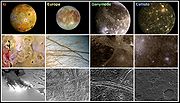
Size
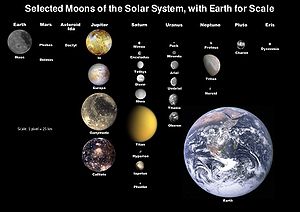
Latest flyby
Visibility
_(by).jpg)
Binoculars
Binoculars, field glasses or binocular telescopes are a pair of identical or mirror-symmetrical telescopes mounted side-by-side and aligned to point accurately in the same direction, allowing the viewer to use both eyes when viewing distant objects...
.) They have apparent magnitude
Apparent magnitude
The apparent magnitude of a celestial body is a measure of its brightness as seen by an observer on Earth, adjusted to the value it would have in the absence of the atmosphere...
s between 4.6 and 5.6 when Jupiter is in opposition
Opposition (astronomy)
In positional astronomy, two celestial bodies are said to be in opposition when they are on opposite sides of the sky, viewed from a given place . In particular, two planets are in opposition to each other when their ecliptic longitudes differ by 180°.The astronomical symbol for opposition is ☍...
with the Sun, and are about one unit of magnitude dimmer when Jupiter is in conjunction. The main difficulty in observing the moons from Earth is their proximity to Jupiter since they are obscured by its brightness. The maximum angular separations of the moons are between 2 and 10 minutes of arc
Minute of arc
A minute of arc, arcminute, or minute of angle , is a unit of angular measurement equal to one sixtieth of one degree. In turn, a second of arc or arcsecond is one sixtieth of one minute of arc....
from Jupiter, close to the limit of human visual acuity
Visual acuity
Visual acuity is acuteness or clearness of vision, which is dependent on the sharpness of the retinal focus within the eye and the sensitivity of the interpretative faculty of the brain....
. Ganymede and Callisto, at their maximum separation, are the likeliest targets for potential naked-eye observation. The easiest way to observe them is to "cover" Jupiter with an object, e.g., a tree limb or a utility pole that is perpendicular to the plane of the moons' orbits.
External links
- Animation of Galileo's observation, march 1613
- Sky & Telescope utility for identifying Galilean moons