

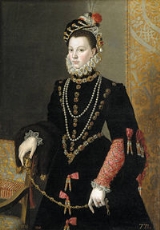
Elisabeth of Valois

Encyclopedia
Elisabeth of Valois was the eldest daughter of Henry II of France
and Catherine de' Medici
.
. Her childhood was spent in the French royal nursery, where her father insisted she share her bedroom with her future sister-in-law, Mary, Queen of Scots, who was about the same age. Even though Elisabeth had to give precedence to Mary (since Mary was already a crowned queen), the two would remain close friends for the rest of their lives. While it is acknowledged that her sister Margaret and her future sister-in-law Mary were prettier than she, she was one of Catherine's attractive daughters. Elisabeth was also described as being shy, timid and very much in awe of her formidable mother; although there is also evidence that Catherine was tender and loving toward Elisabeth. This was certainly evident in her letters to Elisabeth.
("Philip the Catholic"), son of Charles V, Holy Roman Emperor
, and Isabella of Portugal
in 1559. Originally married via proxy at Notre Dame (with the Duke of Alba standing in for Philip) prior to leaving France, the actual ceremony took place in Guadalajara, Spain upon her arrival. The marriage was a result of the Peace of Cateau Cambrésis (1559). His second wife, Mary I of England
, had recently died, making Elisabeth of Valois Philip's third wife.
At her wedding she met the famous painter Sofonisba Anguissola
and Ana de Mendoza, who would live with her the rest of her life. Elisabeth had been an amateur painter before, but Anguissola helped her improve her technique further.
Philip was completely enchanted by his 14 year old bride, and within a short period of time had given up his mistress. Despite the significant age difference, Elisabeth was also quite pleased with her husband. (In letters to her mother, she proclaimed herself to be fortunate to have married so charming a prince.) Philip enjoyed hosting chivalric tournaments to entertain his wife. Elisabeth would play liege lady to the three young Princes of the Spanish Court: Carlos, Prince of Asturias, John of Austria (illegitimate son of Charles V), and Alexander Farnese, Duke of Parma
(son of Charles V's illegitimate daughter Margaret).
Elisabeth had originally been betrothed to Philip's son, Carlos, Prince of Asturias, but political complications unexpectedly necessitated instead a marriage to Philip. Her relationship with her troubled stepson Carlos was warm and friendly. Despite reports of his progressively bizarre behavior, Carlos was always kind and gentle to Elisabeth. When it eventually became necessary for Philip to lock him away (which shortly led to the Prince’s demise) Elisabeth cried for days.
Philip was very attached to Elisabeth, staying close by her side even when she was ill with smallpox
. Elisabeth's first pregnancy in 1564 ended with a miscarriage
of twin girls. She later gave birth to Infanta Isabella Clara Eugenia of Spain
on 12 August 1566, and then to Isabella's younger sister Catherine Michelle of Spain on 10 October 1567. Elisabeth had another miscarriage on 3 October 1568, and died the same day, along with her newborn infant son.
After the death of Elisabeth, Catherine de' Medici offered her younger daughter Margaret as a bride for Philip. Philip declined the offer, because he thought it was against Biblical and Canon Law to marry the sister of a deceased wife.
's play Don Carlos, in Schiller's play of the same name
, and in Verdi
's opera adapted from Schiller's play, also titled Don Carlos
. All these works imply a tragic romance between Elisabeth and Carlos, suggesting that they were really in love with each other when Elisabeth was forced to break off her engagement to Carlos and marry his father Philip.
Henry II of France
Henry II was King of France from 31 March 1547 until his death in 1559.-Early years:Henry was born in the royal Château de Saint-Germain-en-Laye, near Paris, the son of Francis I and Claude, Duchess of Brittany .His father was captured at the Battle of Pavia in 1525 by his sworn enemy,...
and Catherine de' Medici
Catherine de' Medici
Catherine de' Medici was an Italian noblewoman who was Queen consort of France from 1547 until 1559, as the wife of King Henry II of France....
.
Early life
She was born in the Château de FontainebleauChâteau de Fontainebleau
The Palace of Fontainebleau, located 55 kilometres from the centre of Paris, is one of the largest French royal châteaux. The palace as it is today is the work of many French monarchs, building on an early 16th century structure of Francis I. The building is arranged around a series of courtyards...
. Her childhood was spent in the French royal nursery, where her father insisted she share her bedroom with her future sister-in-law, Mary, Queen of Scots, who was about the same age. Even though Elisabeth had to give precedence to Mary (since Mary was already a crowned queen), the two would remain close friends for the rest of their lives. While it is acknowledged that her sister Margaret and her future sister-in-law Mary were prettier than she, she was one of Catherine's attractive daughters. Elisabeth was also described as being shy, timid and very much in awe of her formidable mother; although there is also evidence that Catherine was tender and loving toward Elisabeth. This was certainly evident in her letters to Elisabeth.
Marriage
Elisabeth married Philip II of SpainPhilip II of Spain
Philip II was King of Spain, Portugal, Naples, Sicily, and, while married to Mary I, King of England and Ireland. He was lord of the Seventeen Provinces from 1556 until 1581, holding various titles for the individual territories such as duke or count....
("Philip the Catholic"), son of Charles V, Holy Roman Emperor
Charles V, Holy Roman Emperor
Charles V was ruler of the Holy Roman Empire from 1519 and, as Charles I, of the Spanish Empire from 1516 until his voluntary retirement and abdication in favor of his younger brother Ferdinand I and his son Philip II in 1556.As...
, and Isabella of Portugal
Isabella of Portugal
Isabella of Portugal was a Portuguese Princess and Holy Roman Empress, Duchess of Burgundy, and a Queen Regent/Consort of Spain. She was the daughter of Manuel I of Portugal and Maria of Aragon. By her marriage to Charles V, Holy Roman Emperor, Isabella was also Holy Roman Empress and Queen...
in 1559. Originally married via proxy at Notre Dame (with the Duke of Alba standing in for Philip) prior to leaving France, the actual ceremony took place in Guadalajara, Spain upon her arrival. The marriage was a result of the Peace of Cateau Cambrésis (1559). His second wife, Mary I of England
Mary I of England
Mary I was queen regnant of England and Ireland from July 1553 until her death.She was the only surviving child born of the ill-fated marriage of Henry VIII and his first wife Catherine of Aragon. Her younger half-brother, Edward VI, succeeded Henry in 1547...
, had recently died, making Elisabeth of Valois Philip's third wife.
At her wedding she met the famous painter Sofonisba Anguissola
Sofonisba Anguissola
Sofonisba Anguissola was an Italian painter of the Renaissance.-The Anguissola family:...
and Ana de Mendoza, who would live with her the rest of her life. Elisabeth had been an amateur painter before, but Anguissola helped her improve her technique further.
Philip was completely enchanted by his 14 year old bride, and within a short period of time had given up his mistress. Despite the significant age difference, Elisabeth was also quite pleased with her husband. (In letters to her mother, she proclaimed herself to be fortunate to have married so charming a prince.) Philip enjoyed hosting chivalric tournaments to entertain his wife. Elisabeth would play liege lady to the three young Princes of the Spanish Court: Carlos, Prince of Asturias, John of Austria (illegitimate son of Charles V), and Alexander Farnese, Duke of Parma
Alexander Farnese, Duke of Parma
Alexander Farnese was Duke of Parma and Piacenza from 1586 to 1592, and Governor of the Spanish Netherlands from 1578 to 1592.-Biography:...
(son of Charles V's illegitimate daughter Margaret).
Elisabeth had originally been betrothed to Philip's son, Carlos, Prince of Asturias, but political complications unexpectedly necessitated instead a marriage to Philip. Her relationship with her troubled stepson Carlos was warm and friendly. Despite reports of his progressively bizarre behavior, Carlos was always kind and gentle to Elisabeth. When it eventually became necessary for Philip to lock him away (which shortly led to the Prince’s demise) Elisabeth cried for days.
Philip was very attached to Elisabeth, staying close by her side even when she was ill with smallpox
Smallpox
Smallpox was an infectious disease unique to humans, caused by either of two virus variants, Variola major and Variola minor. The disease is also known by the Latin names Variola or Variola vera, which is a derivative of the Latin varius, meaning "spotted", or varus, meaning "pimple"...
. Elisabeth's first pregnancy in 1564 ended with a miscarriage
Miscarriage
Miscarriage or spontaneous abortion is the spontaneous end of a pregnancy at a stage where the embryo or fetus is incapable of surviving independently, generally defined in humans at prior to 20 weeks of gestation...
of twin girls. She later gave birth to Infanta Isabella Clara Eugenia of Spain
Infanta Isabella Clara Eugenia of Spain
Isabella Clara Eugenia of Austria was sovereign of the Spanish Netherlands in the Low Countries and the north of modern France, together with her husband Albert. In some sources, she is referred to as Clara Isabella Eugenia...
on 12 August 1566, and then to Isabella's younger sister Catherine Michelle of Spain on 10 October 1567. Elisabeth had another miscarriage on 3 October 1568, and died the same day, along with her newborn infant son.
After the death of Elisabeth, Catherine de' Medici offered her younger daughter Margaret as a bride for Philip. Philip declined the offer, because he thought it was against Biblical and Canon Law to marry the sister of a deceased wife.
In fiction
Elisabeth of Valois is a central character in Thomas OtwayThomas Otway
Thomas Otway was an English dramatist of the Restoration period, best known for Venice Preserv'd, or A Plot Discover'd .-Life:...
's play Don Carlos, in Schiller's play of the same name
Don Carlos (play)
Don Carlos is a historical tragedy in five acts by Friedrich Schiller; it was written between 1783 and 1787 and first produced in Hamburg in 1787...
, and in Verdi
Giuseppe Verdi
Giuseppe Fortunino Francesco Verdi was an Italian Romantic composer, mainly of opera. He was one of the most influential composers of the 19th century...
's opera adapted from Schiller's play, also titled Don Carlos
Don Carlos
Don Carlos is a five-act grand opera composed by Giuseppe Verdi to a French language libretto by Camille du Locle and Joseph Méry, based on the dramatic play Don Carlos, Infant von Spanien by Friedrich Schiller...
. All these works imply a tragic romance between Elisabeth and Carlos, suggesting that they were really in love with each other when Elisabeth was forced to break off her engagement to Carlos and marry his father Philip.