

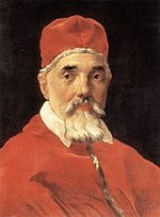
Pope Urban VIII

Encyclopedia
- Maffeo Barberini redirects here. For Pope Urban VIII's great-nephew, see Maffeo Barberini (1631-1685).
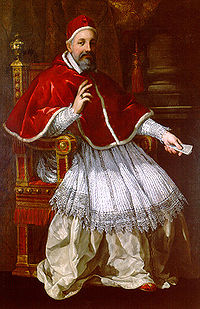
Pope Urban VIII (baptised 5 April 1568 – 29 July 1644), born Maffeo Barberini, was pope
Pope
The Pope is the Bishop of Rome, a position that makes him the leader of the worldwide Catholic Church . In the Catholic Church, the Pope is regarded as the successor of Saint Peter, the Apostle...
from 1623 to 1644. He was the last pope to expand the papal territory by force of arms, and was a prominent patron of the arts and reformer of Church missions. However, the massive debts incurred during his papacy greatly weakened his successors, who were unable to maintain the papacy's longstanding political and military influence in Europe. He was also involved in a controversy with Galileo and his theory on heliocentrism
Heliocentrism
Heliocentrism, or heliocentricism, is the astronomical model in which the Earth and planets revolve around a stationary Sun at the center of the universe. The word comes from the Greek . Historically, heliocentrism was opposed to geocentrism, which placed the Earth at the center...
during his reign.
Early life
Barberini
The Barberini are a family of the Italian nobility that rose to prominence in 17th century Rome. Their influence peaked with the election of Cardinal Maffeo Barberini to the papal throne in 1623, as Pope Urban VIII...
in Florence, Italy. He was educated by the Jesuit
Society of Jesus
The Society of Jesus is a Catholic male religious order that follows the teachings of the Catholic Church. The members are called Jesuits, and are also known colloquially as "God's Army" and as "The Company," these being references to founder Ignatius of Loyola's military background and a...
s and received a doctorate of law from the University of Pisa
University of Pisa
The University of Pisa , located in Pisa, Tuscany, is one of the oldest universities in Italy. It was formally founded on September 3, 1343 by an edict of Pope Clement VI, although there had been lectures on law in Pisa since the 11th century...
in 1589.
In 1601, Maffeo, through the influence of an uncle who had become apostolic protonotary, was able to secure from Clement VIII, the appointment as papal legate to the court of King Henry IV of France
Henry IV of France
Henry IV , Henri-Quatre, was King of France from 1589 to 1610 and King of Navarre from 1572 to 1610. He was the first monarch of the Bourbon branch of the Capetian dynasty in France....
. In 1604 Clement VIII appointed him archbishop of Nazareth
Nazareth
Nazareth is the largest city in the North District of Israel. Known as "the Arab capital of Israel," the population is made up predominantly of Palestinian Arab citizens of Israel...
, although this was an honorary position as the Holy Land was under Turkish rule.
On the death of his uncle, he inherited his riches, with which he bought a palace in Rome which he made a luxurious Renaissance residence.
Under Clement VIII
Pope Clement VIII
Pope Clement VIII , born Ippolito Aldobrandini, was Pope from 30 January 1592 to 3 March 1605.-Cardinal:...
he himself was made protonotary and nuncio
Nuncio
Nuncio is an ecclesiastical diplomatic title, derived from the ancient Latin word, Nuntius, meaning "envoy." This article addresses this title as well as derived similar titles, all within the structure of the Roman Catholic Church...
to the French court; Paul V
Pope Paul V
-Theology:Paul met with Galileo Galilei in 1616 after Cardinal Bellarmine had, on his orders, warned Galileo not to hold or defend the heliocentric ideas of Copernicus. Whether there was also an order not to teach those ideas in any way has been a matter for controversy...
also employed him in a similar capacity, afterwards raising him, in 1606, to Cardinal-Priest of S. Pietro in Montorio and appointing him the papal legate to Bologna
Bologna
Bologna is the capital city of Emilia-Romagna, in the Po Valley of Northern Italy. The city lies between the Po River and the Apennine Mountains, more specifically, between the Reno River and the Savena River. Bologna is a lively and cosmopolitan Italian college city, with spectacular history,...
.
Papacy
On 6 August 1623, after the papal conclavePapal conclave, 1623
The papal conclave of 1623 was the papal conclave of Cardinals called on the death of Pope Gregory XV. It lasted eighteen days from 19 July 1623 to 6 August 1623 and chose Maffeo Barberini, who took office as Pope Urban VIII.- History :...
following the death of Pope Gregory XV
Pope Gregory XV
Pope Gregory XV , born Alessandro Ludovisi, was pope from 1621, succeeding Paul V on 9 February 1621...
, he was chosen as Gregory's successor and took the name Urban VIII.
Upon his election, Zeno, the Venetian envoy, wrote the following description of him:
Urban's papacy covered twenty-one years of the Thirty Years' War
Thirty Years' War
The Thirty Years' War was fought primarily in what is now Germany, and at various points involved most countries in Europe. It was one of the most destructive conflicts in European history....
and was an eventful one even by the standards of the day. He canonised
Canonization
Canonization is the act by which a Christian church declares a deceased person to be a saint, upon which declaration the person is included in the canon, or list, of recognized saints. Originally, individuals were recognized as saints without any formal process...
Elizabeth of Portugal and Andrew Corsini
Andrew Corsini
Andrew Corsini was an Italian Carmelite, and bishop of Fiesole.-Biography:He was born in Florence, November 30, 1302, as member of the illustrious Corsini family...
and issued the Papal bull
Papal bull
A Papal bull is a particular type of letters patent or charter issued by a Pope of the Catholic Church. It is named after the bulla that was appended to the end in order to authenticate it....
s of canonisation for Ignatius Loyola and Francis Xavier
Francis Xavier
Francis Xavier, born Francisco de Jasso y Azpilicueta was a pioneering Roman Catholic missionary born in the Kingdom of Navarre and co-founder of the Society of Jesus. He was a student of Saint Ignatius of Loyola and one of the first seven Jesuits, dedicated at Montmartre in 1534...
who had been canonized by his predecessor, Gregory XV.
Despite an early friendship and encouragement for his teachings, Urban was responsible for summoning Galileo
Galileo Galilei
Galileo Galilei , was an Italian physicist, mathematician, astronomer, and philosopher who played a major role in the Scientific Revolution. His achievements include improvements to the telescope and consequent astronomical observations and support for Copernicanism...
to Rome in 1633 to recant his work.
He practiced nepotism
Nepotism
Nepotism is favoritism granted to relatives regardless of merit. The word nepotism is from the Latin word nepos, nepotis , from which modern Romanian nepot and Italian nipote, "nephew" or "grandchild" are also descended....
on a grand scale; various members of his family were enormously enriched by him, so that it seemed to contemporaries as if were establishing a Barberini
Barberini
The Barberini are a family of the Italian nobility that rose to prominence in 17th century Rome. Their influence peaked with the election of Cardinal Maffeo Barberini to the papal throne in 1623, as Pope Urban VIII...
dynasty. He elevated his brother Antonio Marcello Barberini
Antonio Marcello Barberini
Antonio Marcello Barberini was an Italian cardinal and the younger brother of Maffeo Barberini, later Pope Urban VIII. He is sometimes referred to as Antonio the Elder to distinguish him from his nephew Antonio Barberini.Born Marcello Barberini in Florence into the Barberini family, he entered the...
(Antonio the Elder) and then his nephews Francesco Barberini
Francesco Barberini (seniore)
Francesco Barberini was an Italian Catholic Cardinal. The nephew of Pope Urban VIII , he benefited immensely from the nepotism practiced by his uncle...
and Antonio Barberini
Antonio Barberini
Antonio Barberini was an Italian Catholic cardinal, Archbishop of Reims, military leader, patron of the arts and a prominent member of the House of Barberini. As one of the cardinal-nephews of Pope Urban VIII and a supporter of France, he played a significant role at a number of the papal...
(Antonio the Younger). He also bestowed upon their brother, Taddeo Barberini
Taddeo Barberini
Taddeo Barberini was an Italian nobleman of the House of Barberini who became Prince of Palestrina and Gonfalonier of the Church; commander of the Papal Army. He was a nephew of Pope Urban VIII and brother of Cardinals Francesco Barberini and Antonio Barberini...
, the honorific title Prince of Palestrina; Palestrina
Palestrina
Palestrina is an ancient city and comune with a population of about 18,000, in Lazio, c. 35 km east of Rome...
being the comune
Comune
In Italy, the comune is the basic administrative division, and may be properly approximated in casual speech by the English word township or municipality.-Importance and function:...
owned by the Barberini family. During the Wars of Castro
Wars of Castro
The Wars of Castro is a term referring to a series of events in the mid-17th century revolving around the ancient city of Castro , which eventually resulted in the city's destruction on 2 September 1649...
, Taddeo was also appointed Commander of the Papal Army
Gonfalonier of the Church
The Gonfalonier of the Church or Papal Gonfalonier was a military and political office of the Papal States. Originating from the use of the Papal banner during combat, the office later became largely ceremonial and political...
.
Urban was a skilled writer of Latin verse, and a collection of Scriptural
Bible
The Bible refers to any one of the collections of the primary religious texts of Judaism and Christianity. There is no common version of the Bible, as the individual books , their contents and their order vary among denominations...
paraphrases as well as original hymns of his composition has been frequently reprinted.
A 1638 papal bull protected the existence of Jesuit missions
Mission (Christian)
Christian missionary activities often involve sending individuals and groups , to foreign countries and to places in their own homeland. This has frequently involved not only evangelization , but also humanitarian work, especially among the poor and disadvantaged...
in South America by forbidding the enslavement of natives who joined a mission community
Jesuit Reductions
A Jesuit Reduction was a type of settlement for indigenous people in Latin America created by the Jesuit Order during the 17th and 18th centuries. In general, the strategy of the Spanish Empire was to gather native populations into centers called Indian Reductions , in order to Christianize, tax,...
. At the same time, Urban repealed the Jesuit monopoly on missionary work in China and Japan, opening these countries to missionaries of all orders.
Urban VIII issued a 1624 papal bull that made the use of tobacco in holy places punishable by excommunication; Pope Benedict XIII
Pope Benedict XIII
-Footnotes:...
would later repeal the ban.
Politics
Roman Catholic Church
The Catholic Church, also known as the Roman Catholic Church, is the world's largest Christian church, with over a billion members. Led by the Pope, it defines its mission as spreading the gospel of Jesus Christ, administering the sacraments and exercising charity...
in Europe
Europe
Europe is, by convention, one of the world's seven continents. Comprising the westernmost peninsula of Eurasia, Europe is generally 'divided' from Asia to its east by the watershed divides of the Ural and Caucasus Mountains, the Ural River, the Caspian and Black Seas, and the waterways connecting...
than at adjusting the balance of power to favour his own independence in Italy
Italy
Italy , officially the Italian Republic languages]] under the European Charter for Regional or Minority Languages. In each of these, Italy's official name is as follows:;;;;;;;;), is a unitary parliamentary republic in South-Central Europe. To the north it borders France, Switzerland, Austria and...
. In 1626 the duchy of Urbino was incorporated into the papal dominions, and, in 1627, when the direct male line of the Gonzaga
House of Gonzaga
The Gonzaga family ruled Mantua in Northern Italy from 1328 to 1708.-History:In 1433, Gianfrancesco I assumed the title of Marquis of Mantua, and in 1530 Federico II received the title of Duke of Mantua. In 1531, the family acquired the Duchy of Monferrato through marriage...
s in Mantua
Mantua
Mantua is a city and comune in Lombardy, Italy and capital of the province of the same name. Mantua's historic power and influence under the Gonzaga family, made it one of the main artistic, cultural and notably musical hubs of Northern Italy and the country as a whole...
became extinct, he controversially favoured the succession of the Protestant Duke Charles of Nevers against the claims of the Catholic Habsburgs. He also launched the Wars of Castro
Wars of Castro
The Wars of Castro is a term referring to a series of events in the mid-17th century revolving around the ancient city of Castro , which eventually resulted in the city's destruction on 2 September 1649...
(1641) against a fiefdom of Odoardo Farnese
Odoardo Farnese
Odoardo Farnese was Duke of Parma and Piacenza from 1622 to 1646.-Biography:Odoardo was the sole legitimate son of Ranuccio I Farnese and Margherita Aldobrandini...
, Duke of Parma and Piacenza, whom he excommunicated; Castro was destroyed and its duchy incorporated into the Papal States.
He was the last pope to extend the papal territory, and fortified Castelfranco Emilia
Castelfranco Emilia
Castelfranco Emilia is a town and comune in Italy in the province of Modena, region of Emilia-Romagna. The town lies c. 25 km northwest of Bologna....
on the Mantuan frontier and the Castel Sant'Angelo
Castel Sant'Angelo
The Mausoleum of Hadrian, usually known as the Castel Sant'Angelo, is a towering cylindrical building in Parco Adriano, Rome, Italy. It was initially commissioned by the Roman Emperor Hadrian as a mausoleum for himself and his family...
in Rome. Urban also established an arsenal in the Vatican, an arms factory at Tivoli
Tivoli, Italy
Tivoli , the classical Tibur, is an ancient Italian town in Lazio, about 30 km east-north-east of Rome, at the falls of the Aniene river where it issues from the Sabine hills...
and fortified the harbour of Civitavecchia
Civitavecchia
Civitavecchia is a town and comune of the province of Rome in the central Italian region of Lazio. A sea port on the Tyrrhenian Sea, it is located 80 kilometers west-north-west of Rome, across the Mignone river. The harbor is formed by two piers and a breakwater, on which is a lighthouse...
.
For the purposes of making cannon and the baldacchino in St Peters, massive bronze girders were pillaged from the portico of the Pantheon
Pantheon, Rome
The Pantheon ,Rarely Pantheum. This appears in Pliny's Natural History in describing this edifice: Agrippae Pantheum decoravit Diogenes Atheniensis; in columnis templi eius Caryatides probantur inter pauca operum, sicut in fastigio posita signa, sed propter altitudinem loci minus celebrata.from ,...
leading to the well known lampoon: quod non fecerunt barbari, fecerunt Barberini, "what the barbarians did not do, the Barberini did."
Patron of the arts
Urban and his family patronized art on a grand scale. He expended vast funds to bring polymaths like Athanasius KircherAthanasius Kircher
Athanasius Kircher was a 17th century German Jesuit scholar who published around 40 works, most notably in the fields of oriental studies, geology, and medicine...
to Rome and on a variety of works by the sculptor Bernini who was particularly favored during Urban's reign. Artistic and architectural commissions included the family palace in Rome, the Palazzo Barberini
Palazzo Barberini
Palazzo Barberini is a palace in Rome, facing the piazza of the same name in Rione Trevi and is home to the Galleria Nazionale d'Arte Antica.-History:...
, the college of the Propaganda Fide, the Fontana del Tritone in Piazza Barberini, the cathedra in St Peters and other prominent structures in the city. He also rebuilt Santa Bibiana
Santa Bibiana
Santa Bibiana is a small church in Rome, devoted to St Bibiana. It was initially built by Pope Simplicius, and consecrated in 467. The church was restored by Pope Honorius III in 1224....
and the church of San Sebastiano al Palatino
San Sebastiano al Palatino
San Sebastiano al Palatino is a basilica church in Rome. It is devoted to Saint Sebastian, and is located on the Palatine Hill.According to legend, it is built on the site of its dedicatee's martyrdom, with the first church constructed in the 10th century, and the second church being the result of...
on the Palatine Hill
Palatine Hill
The Palatine Hill is the centermost of the Seven Hills of Rome and is one of the most ancient parts of the city...
. The Barberini patronised painters such as Nicolas Poussin
Nicolas Poussin
Nicolas Poussin was a French painter in the classical style. His work predominantly features clarity, logic, and order, and favors line over color. His work serves as an alternative to the dominant Baroque style of the 17th century...
and Claude Lorrain
Claude Lorrain
Claude Lorrain, , traditionally just Claude in English Claude Lorrain, , traditionally just Claude in English (also Claude Gellée, his real name, or in French Claude Gellée, , dit le Lorrain) Claude Lorrain, , traditionally just Claude in English (also Claude Gellée, his real name, or in French...
. One of the most eulogistic of these artistic works in its celebration of his reign, is the 'Glorification of the Reign of Urban VIII' painted by Pietro da Cortona
Pietro da Cortona
Pietro da Cortona, by the name of Pietro Berrettini, born Pietro Berrettini da Cortona, was the leading Italian Baroque painter of his time and also one of the key architects in the emergence of Roman Baroque architecture. He was also an important decorator...
in the large vault of salone of the Palazzo Barberini.
Later life and legacy

Italian scudo
The scudo was the name for a number of coins used in Italy until the 19th century. The name, like that of the French écu and the Spanish and Portuguese escudo, was derived from the Latin scutum . From the 16th century, the name was used in Italy for large silver coins...
, and by 1635 had increased it to 28 million. By 1640 the debt had reached 35 million scudi, consuming more than 80 percent of annual papal income in interest repayments.
Urban's death (29 July 1644) is said to have been hastened by chagrin at the result of the Wars of Castro. Because of the costs incurred by the city of Rome to finance this war, Urban VIII became immensely unpopular. On his death, the bust of Urban that lay beside the Palace of the Conservators on the Capitoline Hill
Capitoline Hill
The Capitoline Hill , between the Forum and the Campus Martius, is one of the seven hills of Rome. It was the citadel of the earliest Romans. By the 16th century, Capitolinus had become Capitolino in Italian, with the alternative Campidoglio stemming from Capitolium. The English word capitol...
was rapidly destroyed by an enraged crowd, and only a quick-thinking priest saved the sculpture of Urban belonging to the Jesuits from a similar fate.
His unpopularity swayed the papal conlave not to elect Cardinal Giulio Sacchetti who was closely associated with the Barberini. Instead, it elected Cardinal Giovanni Battista Pamphili as his successor, who took the name of Innocent X
Pope Innocent X
Pope Innocent X , born Giovanni Battista Pamphilj , was Pope from 1644 to 1655. Born in Rome of a family from Gubbio in Umbria who had come to Rome during the pontificate of Pope Innocent IX, he graduated from the Collegio Romano and followed a conventional cursus honorum, following his uncle...
.
Private revelation
Numerous books that allege private revelationPrivate revelation
In the teaching of the Catholic Church, a private revelation refers to visions and revelations from God to a specific Christian which have taken place since the completion of the New Testament...
s have a disclaimer in the beginning that quotes an alleged saying of Pope Urban VIII. The disclaimer usually goes:
Whether or not Urban VIII said this is debated.
Pope Urban VIII did make a public statement about private revelations and their dissemination in the Catholic Church in his Constitution, Sanctissimus Dominus Noster of 13 March 1625.
See also
- House of BarberiniBarberiniThe Barberini are a family of the Italian nobility that rose to prominence in 17th century Rome. Their influence peaked with the election of Cardinal Maffeo Barberini to the papal throne in 1623, as Pope Urban VIII...
- Wars of CastroWars of CastroThe Wars of Castro is a term referring to a series of events in the mid-17th century revolving around the ancient city of Castro , which eventually resulted in the city's destruction on 2 September 1649...
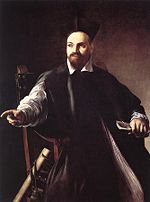
- Portrait of Maffeo BarberiniPortrait of Maffeo BarberiniPortrait of Maffeo Barberini is a painting by the Italian Baroque master Michelangelo Merisi da Caravaggio.It is held in a private collection in Florence....