

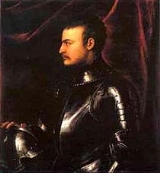
Giovanni dalle Bande Nere

Encyclopedia
Lodovico de Medici also known as Giovanni dalle Bande Nere (April 5, 1498 – November 30, 1526) was an Italian condottiero.
to Giovanni de' Medici
(also known as il Popolano) and Caterina Sforza
, one of the most famous women of the Italian Renaissance
.
From an early age, he demonstrated great interest and ability in physical activity, especially the martial arts of the age: horse riding, sword-fighting, etc. He committed his first murder at the age of 12, and was twice banished from the city of Florence
for his unruly behavior, including involvement in the sodomitical rape of a sixteen-year-old boy, Giovanni being about thirteen at the time. He had a son, Cosimo (1519–1574), who went on to become Grand Duke of Florence.
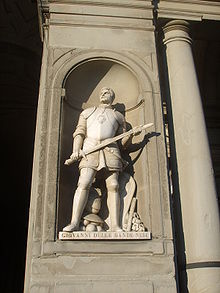 Giovanni became a condottiero
, or mercenary military captain, in the employ of Pope Leo X
(Giovanni di Lorenzo de' Medici) and on March 5, 1516 led the war
against Francesco Maria I della Rovere
, duke of Urbino
. Giovanni won after 22 days. He thenceforth formed a company of his own, mounted on light horses and specializing in fast but devastating skirmishing tactics and ambushes. In 1520 he defeated several rebel barons in the Marche
. The following year Leo X allied with Emperor Charles V
against King Francis I of France
to regain Milan, Parma
and Piacenza
; Giovanni was called in under the command of Prospero Colonna
, defeating the French at Vaprio d'Adda
in November.
As a symbol of mourning for the death of Pope Leo X (December 1, 1521), Giovanni added black stripes to his insignia
, whence comes his nick-name, Giovanni dalle Bande Nere (or Giovanni of the Black Bands). In the August 1523 he was hired by the Imperial
army, and in January 1524 he defeated the French and the Swiss at Caprino Bergamasco
. In the same year another Medici, Giulio di Giuliano, became Pope, and took the name of Clement VII. The new Pope paid all of Giovanni's debt, but in exchange ordered him to switch to the French side of the ongoing conflict. He did not take part in the battle of Pavia
, but was soon severely wounded in a skirmish and later had to move to Venice
to recuperate from his wounds.
In 1526 the War of the League of Cognac
broke out. The League's captain general, Francesco Maria I della Rovere
, abandoned Milan in the face of the overwhelming superiority of the Imperial
army led by Georg von Frundsberg
. Giovanni was able to defeat the Landsknecht
s rearguard at the confluence of the Mincio
with the Po River
.
in a battle near Govérnolo. The ball shattered his leg above the knee and he had to be carried to San Nicolò Po, where no doctor could be found.
He was taken to Luigi Gonzaga's palace in Mantua
, where the surgeon Abramo, who had cared for him two years earlier, amputated his leg. To perform the operation Abramo asked for 10 men to hold down the stricken condottiero.
Pietro Aretino
, eyewitness to the event, recalled in a letter to Francesco Albizi:
Giovanni de' Medici died five days later, of septicemia, on November 30, 1526.
ically signaled the end of the age of the condottieri, as their mode of fighting (which emphasized armored knights on horseback) was rendered practically obsolete by the introduction of the mobile field cannon
. He is therefore known as the last of the great Italian
condottieri. His lasting reputation has been kept alive in part thanks to Pietro Aretino
, the Renaissance author, satirist, playwright and "scourge of the princes", who was Giovanni's close friend and accompanied him on some of his exploits.
Biography
Giovanni was born in the Northern Italian town of ForlìForlì
Forlì is a comune and city in Emilia-Romagna, Italy, and is the capital of the province of Forlì-Cesena. The city is situated along the Via Emilia, to the right of the Montone river, and is an important agricultural centre...
to Giovanni de' Medici
Giovanni de' Medici il Popolano
Giovanni de' Medici, later known as il Popolano was an Italian nobleman of the Medici House of Florence. He was the son of Pierfrancesco di Lorenzo de' Medici, and therefore a member of a secondary branch of the family.-Biography:Giovanni was born in Florence...
(also known as il Popolano) and Caterina Sforza
Caterina Sforza
Caterina Sforza, Countess of Forlì was an Italian noblewoman, the illegitimate daughter of Galeazzo Maria Sforza, Duke of Milan and Lucrezia Landriani, the wife of the courtier Gian Piero Landriani, a close friend of the Duke...
, one of the most famous women of the Italian Renaissance
Italian Renaissance
The Italian Renaissance began the opening phase of the Renaissance, a period of great cultural change and achievement in Europe that spanned the period from the end of the 13th century to about 1600, marking the transition between Medieval and Early Modern Europe...
.
From an early age, he demonstrated great interest and ability in physical activity, especially the martial arts of the age: horse riding, sword-fighting, etc. He committed his first murder at the age of 12, and was twice banished from the city of Florence
Florence
Florence is the capital city of the Italian region of Tuscany and of the province of Florence. It is the most populous city in Tuscany, with approximately 370,000 inhabitants, expanding to over 1.5 million in the metropolitan area....
for his unruly behavior, including involvement in the sodomitical rape of a sixteen-year-old boy, Giovanni being about thirteen at the time. He had a son, Cosimo (1519–1574), who went on to become Grand Duke of Florence.
Condottieri
thumb|Depiction of [[Farinata degli Uberti]] by [[Andrea del Castagno]], showing a 15th century condottiero's typical attire.Condottieri were the mercenary soldier leaders of the professional, military free companies contracted by the Italian city-states and the Papacy, from the late Middle Ages...
, or mercenary military captain, in the employ of Pope Leo X
Pope Leo X
Pope Leo X , born Giovanni di Lorenzo de' Medici, was the Pope from 1513 to his death in 1521. He was the last non-priest to be elected Pope. He is known for granting indulgences for those who donated to reconstruct St. Peter's Basilica and his challenging of Martin Luther's 95 Theses...
(Giovanni di Lorenzo de' Medici) and on March 5, 1516 led the war
War of Urbino
The War of Urbino was a secondary episode of the Italian Wars.The conflict ensued after the end of the War of the League of Cambrai , when Francesco Maria I della Rovere decided to take advantage of the situation to recover the Duchy of Urbino, from which he had been ousted in the previous year.In...
against Francesco Maria I della Rovere
Francesco Maria I della Rovere
Francesco Maria I della Rovere was an Italian condottiero, who was Duke of Urbino from 1508 until 1538.- Biography :...
, duke of Urbino
Urbino
Urbino is a walled city in the Marche region of Italy, south-west of Pesaro, a World Heritage Site notable for a remarkable historical legacy of independent Renaissance culture, especially under the patronage of Federico da Montefeltro, duke of Urbino from 1444 to 1482...
. Giovanni won after 22 days. He thenceforth formed a company of his own, mounted on light horses and specializing in fast but devastating skirmishing tactics and ambushes. In 1520 he defeated several rebel barons in the Marche
Marche
The population density in the region is below the national average. In 2008, it was 161.5 inhabitants per km2, compared to the national figure of 198.8. It is highest in the province of Ancona , and lowest in the province of Macerata...
. The following year Leo X allied with Emperor Charles V
Charles V, Holy Roman Emperor
Charles V was ruler of the Holy Roman Empire from 1519 and, as Charles I, of the Spanish Empire from 1516 until his voluntary retirement and abdication in favor of his younger brother Ferdinand I and his son Philip II in 1556.As...
against King Francis I of France
Francis I of France
Francis I was King of France from 1515 until his death. During his reign, huge cultural changes took place in France and he has been called France's original Renaissance monarch...
to regain Milan, Parma
Parma
Parma is a city in the Italian region of Emilia-Romagna famous for its ham, its cheese, its architecture and the fine countryside around it. This is the home of the University of Parma, one of the oldest universities in the world....
and Piacenza
Piacenza
Piacenza is a city and comune in the Emilia-Romagna region of northern Italy. It is the capital of the province of Piacenza...
; Giovanni was called in under the command of Prospero Colonna
Prospero Colonna
Prospero Colonna , sometimes referred to as Prosper Colonna, was an Italian condottiero in the service of the Papal States and the Holy Roman Empire during the Italian Wars.-Biography:...
, defeating the French at Vaprio d'Adda
Vaprio d'Adda
Vaprio d'Adda is a comune in the Province of Milan in the Italian region Lombardy, located about 30 km northeast of Milan....
in November.
As a symbol of mourning for the death of Pope Leo X (December 1, 1521), Giovanni added black stripes to his insignia
Insignia
Insignia or insigne pl -nia or -nias : a symbol or token of personal power, status or office, or of an official body of government or jurisdiction...
, whence comes his nick-name, Giovanni dalle Bande Nere (or Giovanni of the Black Bands). In the August 1523 he was hired by the Imperial
Holy Roman Empire
The Holy Roman Empire was a realm that existed from 962 to 1806 in Central Europe.It was ruled by the Holy Roman Emperor. Its character changed during the Middle Ages and the Early Modern period, when the power of the emperor gradually weakened in favour of the princes...
army, and in January 1524 he defeated the French and the Swiss at Caprino Bergamasco
Caprino Bergamasco
Caprino Bergamasco is a comune in the Province of Bergamo in the Italian region of Lombardy, located about 40 km northeast of Milan and about 15 km northwest of Bergamo...
. In the same year another Medici, Giulio di Giuliano, became Pope, and took the name of Clement VII. The new Pope paid all of Giovanni's debt, but in exchange ordered him to switch to the French side of the ongoing conflict. He did not take part in the battle of Pavia
Battle of Pavia
The Battle of Pavia, fought on the morning of 24 February 1525, was the decisive engagement of the Italian War of 1521–26.A Spanish-Imperial army under the nominal command of Charles de Lannoy attacked the French army under the personal command of Francis I of France in the great hunting preserve...
, but was soon severely wounded in a skirmish and later had to move to Venice
Venice
Venice is a city in northern Italy which is renowned for the beauty of its setting, its architecture and its artworks. It is the capital of the Veneto region...
to recuperate from his wounds.
In 1526 the War of the League of Cognac
War of the League of Cognac
The War of the League of Cognac was fought between the Habsburg dominions of Charles V—primarily Spain and the Holy Roman Empire—and the League of Cognac, an alliance including France, Pope Clement VII, the Republic of Venice, England, the Duchy of Milan and Republic of Florence.- Prelude :Shocked...
broke out. The League's captain general, Francesco Maria I della Rovere
Francesco Maria I della Rovere
Francesco Maria I della Rovere was an Italian condottiero, who was Duke of Urbino from 1508 until 1538.- Biography :...
, abandoned Milan in the face of the overwhelming superiority of the Imperial
Holy Roman Empire
The Holy Roman Empire was a realm that existed from 962 to 1806 in Central Europe.It was ruled by the Holy Roman Emperor. Its character changed during the Middle Ages and the Early Modern period, when the power of the emperor gradually weakened in favour of the princes...
army led by Georg von Frundsberg
Georg von Frundsberg
Georg von Frundsberg was a South German knight and Landsknecht leader in the service of the Imperial Habsburg dynasty of the Holy Roman Empire....
. Giovanni was able to defeat the Landsknecht
Landsknecht
Landsknechte were European, predominantly German mercenary pikemen and supporting foot soldiers from the late 15th to the late 16th century, and achieved the reputation for being the universal mercenary of Early modern Europe.-Etymology:The term is from German, Land "land, country" + Knecht...
s rearguard at the confluence of the Mincio
Mincio
Mincio is a river in the Lombardy region of northern Italy.Called the Sarca River before entering Lake Garda, it flows from there about 65 km past Mantua into the Po River....
with the Po River
Po River
The Po |Ligurian]]: Bodincus or Bodencus) is a river that flows either or – considering the length of the Maira, a right bank tributary – eastward across northern Italy, from a spring seeping from a stony hillside at Pian del Re, a flat place at the head of the Val Po under the northwest face...
.
Death
On the evening of November 25 he was hit by a shot from a falconetFalconet (cannon)
The falconet or falcon was a light cannon developed in the late 15th century. During the Middle Ages guns were decorated with engravings of reptiles, birds or beasts depending on their size. For example, a culverin would often feature snakes, as the handles on the early cannons were often decorated...
in a battle near Govérnolo. The ball shattered his leg above the knee and he had to be carried to San Nicolò Po, where no doctor could be found.
He was taken to Luigi Gonzaga's palace in Mantua
Mantua
Mantua is a city and comune in Lombardy, Italy and capital of the province of the same name. Mantua's historic power and influence under the Gonzaga family, made it one of the main artistic, cultural and notably musical hubs of Northern Italy and the country as a whole...
, where the surgeon Abramo, who had cared for him two years earlier, amputated his leg. To perform the operation Abramo asked for 10 men to hold down the stricken condottiero.
Pietro Aretino
Pietro Aretino
Pietro Aretino was an Italian author, playwright, poet and satirist who wielded immense influence on contemporary art and politics and invented modern literate pornography.- Life :...
, eyewitness to the event, recalled in a letter to Francesco Albizi:
Giovanni de' Medici died five days later, of septicemia, on November 30, 1526.
Legacy
Giovanni's premature death metaphorMetaphor
A metaphor is a literary figure of speech that uses an image, story or tangible thing to represent a less tangible thing or some intangible quality or idea; e.g., "Her eyes were glistening jewels." Metaphor may also be used for any rhetorical figures of speech that achieve their effects via...
ically signaled the end of the age of the condottieri, as their mode of fighting (which emphasized armored knights on horseback) was rendered practically obsolete by the introduction of the mobile field cannon
Cannon
A cannon is any piece of artillery that uses gunpowder or other usually explosive-based propellents to launch a projectile. Cannon vary in caliber, range, mobility, rate of fire, angle of fire, and firepower; different forms of cannon combine and balance these attributes in varying degrees,...
. He is therefore known as the last of the great Italian
Italy
Italy , officially the Italian Republic languages]] under the European Charter for Regional or Minority Languages. In each of these, Italy's official name is as follows:;;;;;;;;), is a unitary parliamentary republic in South-Central Europe. To the north it borders France, Switzerland, Austria and...
condottieri. His lasting reputation has been kept alive in part thanks to Pietro Aretino
Pietro Aretino
Pietro Aretino was an Italian author, playwright, poet and satirist who wielded immense influence on contemporary art and politics and invented modern literate pornography.- Life :...
, the Renaissance author, satirist, playwright and "scourge of the princes", who was Giovanni's close friend and accompanied him on some of his exploits.
Ancestors
| Giovanni dalle Bande Nere (Lodovico de' Medici) |
Mother: Caterina Sforza Countess of Forlì Caterina Sforza Caterina Sforza, Countess of Forlì was an Italian noblewoman, the illegitimate daughter of Galeazzo Maria Sforza, Duke of Milan and Lucrezia Landriani, the wife of the courtier Gian Piero Landriani, a close friend of the Duke... |
Father: Giovanni the Popolano Giovanni de' Medici il Popolano Giovanni de' Medici, later known as il Popolano was an Italian nobleman of the Medici House of Florence. He was the son of Pierfrancesco di Lorenzo de' Medici, and therefore a member of a secondary branch of the family.-Biography:Giovanni was born in Florence... |
Paternal Grandfather: Pierfrancesco de' Medici Pierfrancesco di Lorenzo de' Medici Pierfrancesco de' Medici the Elder was an Italian banker and diplomat, a member of the House of Medici of Florence.Born in Florence, he was the son of Lorenzo the Elder and Ginevra Cavalcanti, and thus nephew of Cosimo de' Medici and cousin to Piero the Gouty, de facto lords of the city from... (the Elder) |
Paternal Great-grandfather: Lorenzo di Giovanni de' Medici (the Elder) Medici Popolani line |
Paternal Great-great-grandfather: Giovanni di Bicci de' Medici Giovanni di Bicci de' Medici Giovanni di Bicci de' Medici was an Italian banker, the first historically relevant member of Medici family of Florence, and the founder of the Medici bank... Founder of the Medici |
Descendants
| Lodovico de' Medici Giovanni dalle Bande Nere |
Son: Cosimo I de' Medici Grand duke of Tuscany |
Grandson: Francesco I de' Medici Grand duke of Tuscany |
Great-granddaughter: Marie de' Medici Marie de' Medici Marie de Médicis , Italian Maria de' Medici, was queen consort of France, as the second wife of King Henry IV of France, of the House of Bourbon. She herself was a member of the wealthy and powerful House of Medici... Queen of France |
Great-Great-granddaughter: Henrietta Maria of France Queen of England |
Later references
- A cruiserItalian cruiser Giovanni dalle Bande NereGiovanni delle Bande Nere was an Italian light cruiser of the first group of the Condottieri class, which served in the Regia Marina during World War II. She was named after the eponymous 16th century condottiero and member of the Medici family...
of the Regia MarinaRegia MarinaThe Regia Marina dates from the proclamation of the Kingdom of Italy in 1861 after Italian unification...
was named after Giovanni delle Bande Nere in 1930. - Ermanno Olmi'sErmanno OlmiErmanno Olmi is a renowned Italian film director.-Biography:Olmi was born in Bergamo, Lombardy. He is married to Loredana Detto, who played Antonietta Masetti in Il Posto....
2001 film, Il mestiere delle armi, faithfully follows Giovanni dalle Bande Nere in his last week of life, as he engages in battle with the Imperial forces amidst the cold, damp fields of the LombardLombardyLombardy is one of the 20 regions of Italy. The capital is Milan. One-sixth of Italy's population lives in Lombardy and about one fifth of Italy's GDP is produced in this region, making it the most populous and richest region in the country and one of the richest in the whole of Europe...
countryside.