

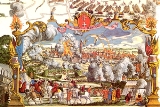
War of the Polish Succession

Encyclopedia
The War of the Polish Succession (1733–1738) was a major European war for princes' possessions sparked by a Polish civil war
over the succession to Augustus II, King of Poland that other European powers
widened in pursuit of their own national interests. France
and Spain
, the two Bourbon
powers, attempted to check the power of the Austrian Habsburgs
in western Europe, as did the Kingdom of Prussia
; whilst in the East, Saxony
and Russia
mobilized to support the eventual Polish victor. The slight amount of fighting in Poland resulted in the accession of Augustus III
, who in addition to Russia and Saxony, was politically supported by the Habsburgs.
The war's major military campaigns occurred outside Poland. The Bourbons, supported by Charles Emmanuel III of Sardinia
, moved against isolated Habsburg territories. In the Rhineland
France successfully took the Duchy of Lorraine, and in Italy
Spain regained control over the kingdoms of Naples
and Sicily
(lost in the War of the Spanish Succession
), while territorial gains in northern Italy were limited despite bloody campaigning. Great Britain
's unwillingness to support Habsburg Austria demonstrated major cracks in the Anglo-Austrian Alliance
and may have contributed to Austria's military failures.
Although a preliminary peace was reached in 1735, the war was formally ended with the Treaty of Vienna (1738)
in which Augustus III was confirmed as king of Poland and his opponent Stanisław Leszczyński (who had received virtually no foreign military support) was awarded the Duchy of Lorraine. Francis Stephen
, the duke of Lorraine, was given the Grand Duchy of Tuscany
in compensation for the loss of Lorraine. The Duchy of Parma
went to Austria
whereas Charles of Parma
took the crowns of Naples and Sicily, resulting in territorial gains for the Bourbons. Poland also gave up claims to Livonia
and direct control over the Duchy of Courland and Semigallia
, which, although remaining a Polish fief, was not integrated into Poland proper, and came under strong Russian influence.
in 1572, Polish kings were elected by Polish nobility. The process gave the nobility a great deal of power over the king, but the sejm
s (meetings of delegates) to elect kings and conduct other business were in later years paralyzed by the institution of the Liberum Veto
, which gave any individual in the sejm the power to negate its decisions. As a result, Poland's powerful neighbors were able to exert significant influence on the decision-making process, and by the early 18th century the system was in decline.
Former Polish King Stanisław Leszczyński hoped to be elected king once again upon the death of his old adversary, Augustus II of Saxony, who had failed in his attempts to make the Polish crown hereditary within his family. Thirty years earlier, Stanisław had been installed as king of Poland by King Charles XII of Sweden
during his period of dominance in the early part of the Great Northern War
, and was ousted following the Battle of Poltava
by the victorious Russians. Stanisław was supported in his bid to regain the throne by his son-in-law, King Louis XV
of France
, who hoped to renew France's traditional alliance with Poland as a way to balance Russian and Austrian power in northern and eastern Europe.
In 1732 Empress Anna of Russia
, Holy Roman Emperor
Charles VI
and King Frederick William I
of Prussia
, irritated with Augustus but unwilling to allow Stanisław to become king, secretly signed Löwenwolde's Treaty
, in which they agreed to jointly back the candidacy of Infante Manuel of Portugal
for the Polish throne.
France's prime minister, Cardinal Fleury, saw the Polish struggle as a chance to strike at Austrian power in the west without seeming to be the aggressor. While he cared little for who should become King of Poland, the cause of protecting the King's father-in-law was a sympathetic one, and he hoped to use the war as a means of humbling the Austrians, and perhaps securing the long-desired Duchy of Lorraine from its duke, Francis Stephen
, who was expected to marry Emperor Charles's daughter Maria Theresa
, which would bring Austrian power dangerously close to the French border. Fleury's diplomatic moves would bring additional powers into the war that had no interest in Polish affairs, most notably Spain
and the Charles Emmanuel
, the King of Sardinia who was also the Duke of Savoy.
for the purpose. While the aging Prince Eugene of Savoy
had recommended to the emperor a more warlike posture against potential actions by France in the Rhine valley and northern Italy, only minimal steps were taken to improve imperial defenses on the Rhine.
The Marquis de Monti, France's ambassador in Warsaw, convinced the rival Potocki
and Czartoryski
families to unite behind Stanisław. Teodor Potocki, Primate of Poland and interrex
following the death of Augustus, called a convocation sejm in March 1733. Delegates to this sejm passed a resolution forbidding the candidacy of foreigners; this would explicitly exclude both Emmanuel of Portugal and Augustus II's son, Frederick August II
, the Elector of Saxony.
Frederick August negotiated agreements with Austria and Russia in July 1733. In exchange for Russian support, he agreed to give up any remaining Polish claims to Livonia
, and promised to Anna of Russia her choice of successor to the Duchy of Courland
, a Polish fief (of which she had been duchess prior to her ascension to the Russian throne) which would have otherwise come under direct Polish rule on the death of the current duke, Ferdinand Kettler
, who had no heirs. To the Austrian emperor he promised recognition of the Pragmatic Sanction of 1713
, a document designed to guarantee inheritance of the Austrian throne to Maria Theresa, Charles' oldest child.
In August, Polish nobles gathered for the election sejm. On August 11, 30,000 Russian troops under Field Marshal Peter Lascy entered Poland in a bid to influence the sejm's decision. On September 4, France openly declared its support for Leszczyński, who was elected king by a sejm of 12,000 delegates on September 12. A group of nobles, led by Lithuanian magnates including Duke Michael Wiśniowiecki (the former Lithuanian grand chancellor nominated by Augustus II), crossed the Vistula River to Praga and the protection of Russian troops. This group, numbering about 3,000, elected Frederick August II King of Poland as Augustus III
on October 5. Despite the fact that this group was a minority, Russia and Austria, intent on maintaining their influence within Poland, recognised Augustus as king.
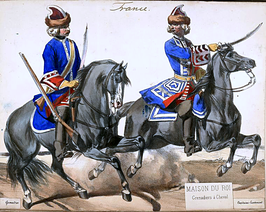 On October 10, France declared war on Austria and Saxony. Louis XV was later joined by his uncle, King Philip V of Spain
, who hoped to secure territories in Italy for his sons by his second marriage to Elizabeth Farnese. Specifically, he hoped to secure Mantua
for the elder son, Don Carlos
, who was already Duke of Parma and had the expectation of the Grand Duchy of Tuscany
, and the Kingdoms of Naples
and Sicily
for the younger son, Don Felipe. The two Bourbon monarchs were also joined by Charles Emmanuel of Savoy, who hoped to secure gains from the Austrian Duchies of Milan
and Mantua
.
and the Dutch Republic
. They were disappointed in this, since both the Dutch and the British chose to pursue a policy of neutrality. The British Prime Minister Sir Robert Walpole justified Britain's non-intervention by insisting that the Anglo-Austrian Alliance
agreed at the 1731 Treaty of Vienna
was a purely defensive agreement, while Austria was in this instance the aggressor. This position was attacked by English Austrophiles who wanted to aid the Austrians against France, but Walpole's dominant position ensured that Britain stayed out of the conflict. The French, not wishing to provoke Britain, carefully chose not to campaign in the Austrian Netherlands and avoided campaigning in parts of the Holy Roman Empire
that might draw either power into the conflict.
On Austria's southern border, France in November 1733 negotiated the secret Treaty of Turin
with Charles Emmanuel and prepared for military operations in northern Italy. It concluded the (also secret) Treaty of the Escorial with Spain, which included promises of French assistance in the Spanish conquest of Naples and Sicily. France also made diplomatic overtures to Sweden
and the Ottoman Empire
in a fruitless attempt to draw them into the conflict in support of Stanisław.
The Austrians were thus left largely without effective external allies on their southern and western frontiers. Their Russian and Saxon allies were occupied with the Polish campaign, and the Emperor distrusted Frederick William I of Prussia
, who was willing to provide some aid. Divisions within the empire also had an impact on the raising of troops in 1733, as Charles-Albert of Bavaria, who harbored ambitions to become the next Holy Roman Emperor
, signed a secret agreement with France in November 1733, and tried, with limited success, to dissuade other rulers within the empire from the Wittelsbach family from providing troops to the emperor under their treaty obligations. While Britain itself did not provide support, the Electorate of Hanover
, where George II
also ruled as an Imperial Elector, proved willing to help.
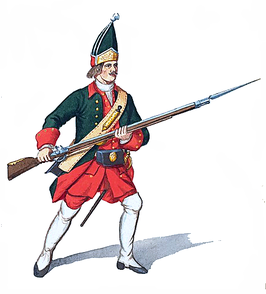 The Russians, led by Lascy, quickly took Warsaw
and installed Augustus, forcing Stanisław to flee to Danzig (present-day Gdańsk
), where he was besieged for some time by a Russian-Saxon army that came under the overall command of Field Marshal Burkhard Christoph von Münnich
. Danzig capitulated in June 1734, and Stanisław fled, first to Königsberg
, and eventually to France. This ended major military activity in Poland itself, although it continued to be occupied by foreign troops as Augustus dealt with partisan supporters of Stanisław. A group of nobles supporting Stanisław formed the Confederation of Dzikow late in 1734, and under their commander, Adam Tarło, tried to fight the Russians and Saxons, but their efforts were ineffective. In what became known as the Pacification Sejm
, held June–July 1736, Augustus was confirmed as king.
, across the Rhine River from Strasbourg
, gaining control of both objectives in a few weeks. Unable to attack Austria directly, and unwilling to invade the intervening German states for fear of drawing Great Britain and the Dutch into the conflict, France consolidated its position in Lorraine, and withdrew its troops across the Rhine for the winter.
The emperor mobilized his active forces in response to the French attacks, and began the process of calling up troops from the states of the empire, establishing a defensive line at Ettlingen
, near Karlsruhe
. In the spring of 1734 French maneuvers successfully flanked this line, and Prince Eugene of Savoy
(who, despite being a Savoyard, fought on the Austrian side) was forced to withdraw these forces to the imperial encampment at Heilbronn
. This cleared the way for the French army under the Duke of Berwick to besiege the imperial fort at Philippsburg
, which fell after a siege of two months in July 1734. Eugene, who was accompanied by Crown Prince Frederick
of Prussia
, made some attempts to relieve the siege, but never made any decisive attacks against the besieging army owing to its size and relatively poor quality of the troops under his command. Berwick was killed by a shell at Philippsburg.
French armies continued to advance along the Rhine, reaching as far as Mainz
, but the growing imperial army, which came to include troops from Russia that had assisted with the capture of Danzig, was able to prevent France from establishing a siege there, and Eugene went on the offensive. A force of 30,000 under Friedrich Heinrich von Seckendorff crossed the Rhine and began pushing the French back toward Trier
, defeating them
at Clausen
in October 1735, in one of the last battles before preliminary peace terms were reached.
itself had surrendered, although the Austrian governor, Count Wirich Philipp von Daun
, still held the fortress. France's great general, the Duke de Villars
, joined Charles Emmanuel in Milan on November 11. While Villars wanted to immediately move to secure the Alpine passes against Austrian reinforcements by moving against Mantua
, Charles Emmanuel, mistrustful of his French allies and their dealings with Spain, sought to secure Milan. The army spent the next three months eliminating Austrian opposition from the remaining fortified towns in the duchy. Villars attempted to interest Don Carlos of Parma in joining the expedition against Mantua, but Carlos was focused on the campaign into Naples. Villars began to move against Mantua, but Charles Emmanuel resisted, and the army made little progress. In early May, an Austrian army of 40,000 under Count Claude Florimond de Mercy crossed the Alps
and threatened to close in on the French army's rear by a flanking maneuver. Villars responded by retreating from Mantua and attempted without success to interrupt the Austrian army's crossing of the Po River
. Villars, frustrated by Charles Emmanuel's delaying tactics, quit the army on May 27. He fell ill on the way back to France and died in Turin on June 17.
Mercy's forces made repeated attempts to cross the Parma River in June, but it was not until late in that month that they were able to cross the river and approach the city of Parma
, where the allied forces, now under the command of French marshals de Broglie
and Coigny
, were entrenched. In a bloody battle near the village of Crocetta
on June 29, the Austrians were beaten back, Mercy was killed, and Frederick of Württemberg
, his second, was wounded. Charles Emmanuel returned the next day to retake command, and resumed his delaying tactics by failing to immediately pursue the retreating Austrians. The Austrians retreated to the Po, where they were reinforced by additional troops and placed under the command of Field Marshal Königsegg
. After two months of inaction, during which the armies faced each other across the Secchia River, Königsegg on September 15 took advantage of lax security and executed a raid on Coigny's headquarters, very nearly capturing Coigny and taking among other prizes Charles Emmanuel's china. Two days later the French withdrew to a position near Guastalla
in response to Austrian maneuvers, but one detachment of nearly 3,000 men was surrounded and captured by the advancing Austrians. On September 19, Königsegg attacked the allied position at Guastalla
, and in another bloody encounter, was beaten back, losing among others Frederick of Württemberg. Königsegg retreated across the Po, adopting a defensive position between the Po and the Oglio
while Charles Emmanuel again did not capitalize on his victory. When he finally withdrew most of the allied army to Cremona
, the Austrians advanced on the north bank of the Po as far as the Adda
before both armies entered winter quarters in December 1734.
In southern Italy, the Austrians, choosing a strategy of defending a large number of fortresses, were soundly defeated. Don Carlos assembled an army composed primarily of Spaniards, but also including some troops from France and Savoy. Moving south through the Papal States
, his army flanked the frontline Austrian defense at Mignano, forcing them to retreat into the fortress at Capua
. He was then practically welcomed into Naples
by the city fathers, as the Austrian viceroy had fled toward Bari
, and the fortresses held by the Austrians in the city were quickly captured. While maintaining a blockade of the largest Austrian holdings at Capua and Gaeta, a large portion of the allied army gave chase to the remaining Austrian forces. These finally attempted a stand in late May, and were defeated at Bitonto
. Capua and Gaeta were then properly besieged while Austrian fortresses in Sicily
were quickly subdued. Gaeta surrendered in August
, and Capua held out until November
when its commander, Otto Ferdinand von Abensberg und Traun, finally negotiated surrender terms when he ran out of ammunition. The Jacobite pretender to the thrones of United Kingdom
and France
, Charles Edward Stuart
, who was under 14 then, also participated in the French and Spanish siege of Gaeta, making his first exposure to battle.
The armies in northern Italy suffered significantly over the winter, with significant losses to disease and desertion. For the 1735 campaign the allied forces in northern Italy came under the command of the Duke de Noailles, elevated to Marshal after his successful contributions to the Rhine campaign. They were also joined by Spanish forces in May, now available after the successes in the south. In response to this threat, Königsegg retreated into the Bishopric of Trent
, but leaving the fortress city of Mantua well-defended. At this point divisions between the allies became clear, as Spain laid claim to Mantua, and also refused to guarantee Milan to Charles Emmanuel. In response, Charles Emmanuel refused to allow his siege equipment to be used against Mantua. As a result, the Franco-Spanish army was unable to do more than blockade the city. When Charles Emmanuel withdrew his forces from the area, the allies were forced to retreat, and the beleaguered Austrians capitalized, eventually recovering most of Milan against little opposition in November.
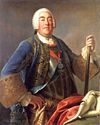 As early as February 1734 the British and Dutch had offered to mediate peace talks between the various parties. By early 1735, proposals were being circulated. As 1735 progressed with the Austrians being in no real position to continue the fight, and the French concerned by the possible arrival of Russian reinforcements on the Rhine (which did eventually occur), negotiations continued through the summer of 1735.
A preliminary peace was finally concluded in October 1735 and ratified in the Treaty of Vienna
in November 1738. Augustus was confirmed as king of Poland, Stanisław was compensated with Lorraine (which would pass on his death, through his daughter, to the French), while the former Duke of Lorraine, Francis Stephen
, was made heir to the Grand Duchy of Tuscany
.
Charles of Parma
gave up Parma, which came under direct Austrian rule, but he was richly compensated by being confirmed instead as king of Naples and Sicily. Although fighting stopped after the preliminary peace in 1735, the final peace settlement had to wait until the death of the last Medici
Grand Duke of Tuscany, Gian Gastone
in 1737, to allow the territorial exchanges provided for by the peace settlement to go into effect.
The French (and their allies), hoping for détente and good relations with the Austrians, now also recognized the Pragmatic Sanction that would allow Emperor Charles
's daughter Maria Theresa
to succeed him. This proved a hollow guarantee, however, as the French decided to intervene
to partition the Habsburg Monarchy after all following the death of Charles in 1740. The acquisition of Lorraine for the former Polish king, however, proved of lasting benefit to France, as it passed under direct French rule with Stanisław's death in 1766.
Stanisław signed the act of abdication in 1736, while Augustus III pronounced a general amnesty. Wiśniowiecki was rewarded: the king made him the Grand Hetman (commander-in-chief) of Lithuania.
Civil war
A civil war is a war between organized groups within the same nation state or republic, or, less commonly, between two countries created from a formerly-united nation state....
over the succession to Augustus II, King of Poland that other European powers
Regional power
In international relations, a regional power is a state that has power within a geographic region. States which wield unrivaled power and influence within a region of the world possess regional hegemony.-Characteristics:...
widened in pursuit of their own national interests. France
France
The French Republic , The French Republic , The French Republic , (commonly known as France , is a unitary semi-presidential republic in Western Europe with several overseas territories and islands located on other continents and in the Indian, Pacific, and Atlantic oceans. Metropolitan France...
and Spain
Spain
Spain , officially the Kingdom of Spain languages]] under the European Charter for Regional or Minority Languages. In each of these, Spain's official name is as follows:;;;;;;), is a country and member state of the European Union located in southwestern Europe on the Iberian Peninsula...
, the two Bourbon
Pacte de Famille
The Pacte de Famille is one of three separate, but similar alliances between the Bourbon kings of France and Spain.- The first Pacte de Famille :...
powers, attempted to check the power of the Austrian Habsburgs
Habsburg Monarchy
The Habsburg Monarchy covered the territories ruled by the junior Austrian branch of the House of Habsburg , and then by the successor House of Habsburg-Lorraine , between 1526 and 1867/1918. The Imperial capital was Vienna, except from 1583 to 1611, when it was moved to Prague...
in western Europe, as did the Kingdom of Prussia
Kingdom of Prussia
The Kingdom of Prussia was a German kingdom from 1701 to 1918. Until the defeat of Germany in World War I, it comprised almost two-thirds of the area of the German Empire...
; whilst in the East, Saxony
Electorate of Saxony
The Electorate of Saxony , sometimes referred to as Upper Saxony, was a State of the Holy Roman Empire. It was established when Emperor Charles IV raised the Ascanian duchy of Saxe-Wittenberg to the status of an Electorate by the Golden Bull of 1356...
and Russia
Russian Empire
The Russian Empire was a state that existed from 1721 until the Russian Revolution of 1917. It was the successor to the Tsardom of Russia and the predecessor of the Soviet Union...
mobilized to support the eventual Polish victor. The slight amount of fighting in Poland resulted in the accession of Augustus III
Augustus III of Poland
Augustus III, known as the Saxon ; ; also Prince-elector Friedrich August II was the Elector of Saxony in 1733-1763, as Frederick Augustus II , King of Poland and Grand Duke of Lithuania in 1734-1763.-Biography:Augustus was the only legitimate son of Augustus II the Strong, Imperial Prince-Elector...
, who in addition to Russia and Saxony, was politically supported by the Habsburgs.
The war's major military campaigns occurred outside Poland. The Bourbons, supported by Charles Emmanuel III of Sardinia
Charles Emmanuel III of Sardinia
Charles Emmanuel III was the Duke of Savoy and King of Sardinia from 1730 until his death.-Biography:...
, moved against isolated Habsburg territories. In the Rhineland
Rhineland
Historically, the Rhinelands refers to a loosely-defined region embracing the land on either bank of the River Rhine in central Europe....
France successfully took the Duchy of Lorraine, and in Italy
Italy
Italy , officially the Italian Republic languages]] under the European Charter for Regional or Minority Languages. In each of these, Italy's official name is as follows:;;;;;;;;), is a unitary parliamentary republic in South-Central Europe. To the north it borders France, Switzerland, Austria and...
Spain regained control over the kingdoms of Naples
Kingdom of Naples
The Kingdom of Naples, comprising the southern part of the Italian peninsula, was the remainder of the old Kingdom of Sicily after secession of the island of Sicily as a result of the Sicilian Vespers rebellion of 1282. Known to contemporaries as the Kingdom of Sicily, it is dubbed Kingdom of...
and Sicily
Kingdom of Sicily
The Kingdom of Sicily was a state that existed in the south of Italy from its founding by Roger II in 1130 until 1816. It was a successor state of the County of Sicily, which had been founded in 1071 during the Norman conquest of southern Italy...
(lost in the War of the Spanish Succession
War of the Spanish Succession
The War of the Spanish Succession was fought among several European powers, including a divided Spain, over the possible unification of the Kingdoms of Spain and France under one Bourbon monarch. As France and Spain were among the most powerful states of Europe, such a unification would have...
), while territorial gains in northern Italy were limited despite bloody campaigning. Great Britain
Kingdom of Great Britain
The former Kingdom of Great Britain, sometimes described as the 'United Kingdom of Great Britain', That the Two Kingdoms of Scotland and England, shall upon the 1st May next ensuing the date hereof, and forever after, be United into One Kingdom by the Name of GREAT BRITAIN. was a sovereign...
's unwillingness to support Habsburg Austria demonstrated major cracks in the Anglo-Austrian Alliance
Anglo-Austrian Alliance
The Anglo-Austrian Alliance connected the Kingdom of Great Britain and the Habsburg monarchy during the first half of the 18th century. It was largely the work of the British statesman Duke of Newcastle, who considered an alliance with Austria crucial to prevent the further expansion of French...
and may have contributed to Austria's military failures.
Although a preliminary peace was reached in 1735, the war was formally ended with the Treaty of Vienna (1738)
Treaty of Vienna (1738)
The Treaty of Vienna or Peace of Vienna was signed on November 18, 1738. It ended the War of the Polish Succession. By the terms of the treaty, Stanisław Leszczyński renounced his claim on the Polish throne and recognized Augustus III, Duke of Saxony. As compensation he received instead the...
in which Augustus III was confirmed as king of Poland and his opponent Stanisław Leszczyński (who had received virtually no foreign military support) was awarded the Duchy of Lorraine. Francis Stephen
Francis I, Holy Roman Emperor
Francis I was Holy Roman Emperor and Grand Duke of Tuscany, though his wife effectively executed the real power of those positions. With his wife, Maria Theresa, he was the founder of the Habsburg-Lorraine dynasty...
, the duke of Lorraine, was given the Grand Duchy of Tuscany
Grand Duchy of Tuscany
The Grand Duchy of Tuscany was a central Italian monarchy that existed, with interruptions, from 1569 to 1859, replacing the Duchy of Florence. The grand duchy's capital was Florence...
in compensation for the loss of Lorraine. The Duchy of Parma
Duchy of Parma
The Duchy of Parma was created in 1545 from that part of the Duchy of Milan south of the Po River, as a fief for Pope Paul III's illegitimate son, Pier Luigi Farnese, centered on the city of Parma....
went to Austria
Habsburg Monarchy
The Habsburg Monarchy covered the territories ruled by the junior Austrian branch of the House of Habsburg , and then by the successor House of Habsburg-Lorraine , between 1526 and 1867/1918. The Imperial capital was Vienna, except from 1583 to 1611, when it was moved to Prague...
whereas Charles of Parma
Charles III of Spain
Charles III was the King of Spain and the Spanish Indies from 1759 to 1788. He was the eldest son of Philip V of Spain and his second wife, the Princess Elisabeth Farnese...
took the crowns of Naples and Sicily, resulting in territorial gains for the Bourbons. Poland also gave up claims to Livonia
Livonia
Livonia is a historic region along the eastern shores of the Baltic Sea. It was once the land of the Finnic Livonians inhabiting the principal ancient Livonian County Metsepole with its center at Turaida...
and direct control over the Duchy of Courland and Semigallia
Duchy of Courland and Semigallia
The Duchy of Courland and Semigallia is the name of a duchy in the Baltic region that existed from 1562 to 1569 as a vassal state of the Grand Duchy of Lithuania and from 1569...
, which, although remaining a Polish fief, was not integrated into Poland proper, and came under strong Russian influence.
Background
Ever since the death of Sigismund II AugustusSigismund II Augustus
Sigismund II Augustus I was King of Poland and Grand Duke of Lithuania, the only son of Sigismund I the Old, whom Sigismund II succeeded in 1548...
in 1572, Polish kings were elected by Polish nobility. The process gave the nobility a great deal of power over the king, but the sejm
Sejm
The Sejm is the lower house of the Polish parliament. The Sejm is made up of 460 deputies, or Poseł in Polish . It is elected by universal ballot and is presided over by a speaker called the Marshal of the Sejm ....
s (meetings of delegates) to elect kings and conduct other business were in later years paralyzed by the institution of the Liberum Veto
Liberum veto
The liberum veto was a parliamentary device in the Polish-Lithuanian Commonwealth. It allowed any member of the Sejm to force an immediate end to the current session and nullify any legislation that had already been passed at the session by shouting Nie pozwalam! .From the mid-16th to the late 18th...
, which gave any individual in the sejm the power to negate its decisions. As a result, Poland's powerful neighbors were able to exert significant influence on the decision-making process, and by the early 18th century the system was in decline.
Former Polish King Stanisław Leszczyński hoped to be elected king once again upon the death of his old adversary, Augustus II of Saxony, who had failed in his attempts to make the Polish crown hereditary within his family. Thirty years earlier, Stanisław had been installed as king of Poland by King Charles XII of Sweden
Charles XII of Sweden
Charles XII also Carl of Sweden, , Latinized to Carolus Rex, Turkish: Demirbaş Şarl, also known as Charles the Habitué was the King of the Swedish Empire from 1697 to 1718...
during his period of dominance in the early part of the Great Northern War
Great Northern War
The Great Northern War was a conflict in which a coalition led by the Tsardom of Russia successfully contested the supremacy of the Swedish Empire in northern Central Europe and Eastern Europe. The initial leaders of the anti-Swedish alliance were Peter I the Great of Russia, Frederick IV of...
, and was ousted following the Battle of Poltava
Battle of Poltava
The Battle of Poltava on 27 June 1709 was the decisive victory of Peter I of Russia over the Swedish forces under Field Marshal Carl Gustav Rehnskiöld in one of the battles of the Great Northern War. It is widely believed to have been the beginning of Sweden's decline as a Great Power; the...
by the victorious Russians. Stanisław was supported in his bid to regain the throne by his son-in-law, King Louis XV
Louis XV of France
Louis XV was a Bourbon monarch who ruled as King of France and of Navarre from 1 September 1715 until his death. He succeeded his great-grandfather at the age of five, his first cousin Philippe II, Duke of Orléans, served as Regent of the kingdom until Louis's majority in 1723...
of France
Ancien Régime in France
The Ancien Régime refers primarily to the aristocratic, social and political system established in France from the 15th century to the 18th century under the late Valois and Bourbon dynasties...
, who hoped to renew France's traditional alliance with Poland as a way to balance Russian and Austrian power in northern and eastern Europe.
In 1732 Empress Anna of Russia
Anna of Russia
Anna of Russia or Anna Ivanovna reigned as Duchess of Courland from 1711 to 1730 and as Empress of Russia from 1730 to 1740.-Accession to the throne:Anna was the daughter of Ivan V of Russia, as well as the niece of Peter the Great...
, Holy Roman Emperor
Holy Roman Emperor
The Holy Roman Emperor is a term used by historians to denote a medieval ruler who, as German King, had also received the title of "Emperor of the Romans" from the Pope...
Charles VI
Charles VI, Holy Roman Emperor
Charles VI was the penultimate Habsburg sovereign of the Habsburg Empire. He succeeded his elder brother, Joseph I, as Holy Roman Emperor, King of Bohemia , Hungary and Croatia , Archduke of Austria, etc., in 1711...
and King Frederick William I
Frederick William I of Prussia
Frederick William I of the House of Hohenzollern, was the King in Prussia and Elector of Brandenburg from 1713 until his death...
of Prussia
Kingdom of Prussia
The Kingdom of Prussia was a German kingdom from 1701 to 1918. Until the defeat of Germany in World War I, it comprised almost two-thirds of the area of the German Empire...
, irritated with Augustus but unwilling to allow Stanisław to become king, secretly signed Löwenwolde's Treaty
Löwenwolde's Treaty
The Treaty of the Three Black Eagles or the Treaty of Berlin , was a secret treaty between the Austrian Empire, the Russian Empire and Prussia...
, in which they agreed to jointly back the candidacy of Infante Manuel of Portugal
Infante Manuel, Count of Ourém
The Infante Manuel, Count of Ourém, KGF was a Portuguese infante , seventh child of Peter II, King of Portugal, and his wife Marie-Sophie of Neuburg...
for the Polish throne.
France's prime minister, Cardinal Fleury, saw the Polish struggle as a chance to strike at Austrian power in the west without seeming to be the aggressor. While he cared little for who should become King of Poland, the cause of protecting the King's father-in-law was a sympathetic one, and he hoped to use the war as a means of humbling the Austrians, and perhaps securing the long-desired Duchy of Lorraine from its duke, Francis Stephen
Francis I, Holy Roman Emperor
Francis I was Holy Roman Emperor and Grand Duke of Tuscany, though his wife effectively executed the real power of those positions. With his wife, Maria Theresa, he was the founder of the Habsburg-Lorraine dynasty...
, who was expected to marry Emperor Charles's daughter Maria Theresa
Maria Theresa of Austria
Maria Theresa Walburga Amalia Christina was the only female ruler of the Habsburg dominions and the last of the House of Habsburg. She was the sovereign of Austria, Hungary, Croatia, Bohemia, Mantua, Milan, Lodomeria and Galicia, the Austrian Netherlands and Parma...
, which would bring Austrian power dangerously close to the French border. Fleury's diplomatic moves would bring additional powers into the war that had no interest in Polish affairs, most notably Spain
Spain
Spain , officially the Kingdom of Spain languages]] under the European Charter for Regional or Minority Languages. In each of these, Spain's official name is as follows:;;;;;;), is a country and member state of the European Union located in southwestern Europe on the Iberian Peninsula...
and the Charles Emmanuel
Charles Emmanuel III of Sardinia
Charles Emmanuel III was the Duke of Savoy and King of Sardinia from 1730 until his death.-Biography:...
, the King of Sardinia who was also the Duke of Savoy.
Death of Augustus II
Augustus II died on February 1, 1733. Throughout the spring and summer of 1733, France began building up forces along its northern and eastern frontiers, while the emperor massed troops on Polish borders, reducing garrisons in the Duchy of MilanDuchy of Milan
The Duchy of Milan , was created on the 1st of may 1395, when Gian Galeazzo Visconti, Lord of Milan, purchased a diploma for 100,000 Florins from King Wenceslaus. It was this diploma that installed, Gian Galeazzo as Duke of Milan and Count of Pavia...
for the purpose. While the aging Prince Eugene of Savoy
Prince Eugene of Savoy
Prince Eugene of Savoy , was one of the most successful military commanders in modern European history, rising to the highest offices of state at the Imperial court in Vienna. Born in Paris to aristocratic Italian parents, Eugene grew up around the French court of King Louis XIV...
had recommended to the emperor a more warlike posture against potential actions by France in the Rhine valley and northern Italy, only minimal steps were taken to improve imperial defenses on the Rhine.
The Marquis de Monti, France's ambassador in Warsaw, convinced the rival Potocki
Potocki
Potocki is the surname of a Polish noble family.-History:The Potocki family is a great artistocratic family originated from Potok in the Kraków Voivodeship; their family name derives from that place name. The family is heavily entwined with the cultural development and history of Poland's Eastern...
and Czartoryski
Czartoryski
Czartoryski is the surname of a Polish-Ukrainian-Lithuanian magnate family also known as the Familia. They used the Czartoryski Coat of arms and were the leading noble family of the Polish-Lithuanian Commonwealth in the 18th century.-History:The Czartoryski is a family of a Grand Ducal...
families to unite behind Stanisław. Teodor Potocki, Primate of Poland and interrex
Interrex (Poland)
The institution of interrex existed in the Polish-Lithuanian Commonwealth, whose ruling classes liked to view their Republic or Commonwealth as an heir to Roman republican traditions...
following the death of Augustus, called a convocation sejm in March 1733. Delegates to this sejm passed a resolution forbidding the candidacy of foreigners; this would explicitly exclude both Emmanuel of Portugal and Augustus II's son, Frederick August II
Augustus III of Poland
Augustus III, known as the Saxon ; ; also Prince-elector Friedrich August II was the Elector of Saxony in 1733-1763, as Frederick Augustus II , King of Poland and Grand Duke of Lithuania in 1734-1763.-Biography:Augustus was the only legitimate son of Augustus II the Strong, Imperial Prince-Elector...
, the Elector of Saxony.
Frederick August negotiated agreements with Austria and Russia in July 1733. In exchange for Russian support, he agreed to give up any remaining Polish claims to Livonia
Livonia
Livonia is a historic region along the eastern shores of the Baltic Sea. It was once the land of the Finnic Livonians inhabiting the principal ancient Livonian County Metsepole with its center at Turaida...
, and promised to Anna of Russia her choice of successor to the Duchy of Courland
Duchy of Courland and Semigallia
The Duchy of Courland and Semigallia is the name of a duchy in the Baltic region that existed from 1562 to 1569 as a vassal state of the Grand Duchy of Lithuania and from 1569...
, a Polish fief (of which she had been duchess prior to her ascension to the Russian throne) which would have otherwise come under direct Polish rule on the death of the current duke, Ferdinand Kettler
Ferdinand Kettler
Ferdinand Kettler was Duke of Courland and Semigallia from 1730 to 1737. Ferdinand was the son of Jacob Kettler and Louise Charlotte of Brandenburg. Married in 1730 to Johanna Magdalene of Saxe-Weissenfels ....
, who had no heirs. To the Austrian emperor he promised recognition of the Pragmatic Sanction of 1713
Pragmatic Sanction of 1713
The Pragmatic Sanction of 1713 was an edict issued by Holy Roman Emperor Charles VI to ensure that the throne of the Archduchy of Austria could be inherited by a daughter....
, a document designed to guarantee inheritance of the Austrian throne to Maria Theresa, Charles' oldest child.
In August, Polish nobles gathered for the election sejm. On August 11, 30,000 Russian troops under Field Marshal Peter Lascy entered Poland in a bid to influence the sejm's decision. On September 4, France openly declared its support for Leszczyński, who was elected king by a sejm of 12,000 delegates on September 12. A group of nobles, led by Lithuanian magnates including Duke Michael Wiśniowiecki (the former Lithuanian grand chancellor nominated by Augustus II), crossed the Vistula River to Praga and the protection of Russian troops. This group, numbering about 3,000, elected Frederick August II King of Poland as Augustus III
Augustus III of Poland
Augustus III, known as the Saxon ; ; also Prince-elector Friedrich August II was the Elector of Saxony in 1733-1763, as Frederick Augustus II , King of Poland and Grand Duke of Lithuania in 1734-1763.-Biography:Augustus was the only legitimate son of Augustus II the Strong, Imperial Prince-Elector...
on October 5. Despite the fact that this group was a minority, Russia and Austria, intent on maintaining their influence within Poland, recognised Augustus as king.
Philip V of Spain
Philip V was King of Spain from 15 November 1700 to 15 January 1724, when he abdicated in favor of his son Louis, and from 6 September 1724, when he assumed the throne again upon his son's death, to his death.Before his reign, Philip occupied an exalted place in the royal family of France as a...
, who hoped to secure territories in Italy for his sons by his second marriage to Elizabeth Farnese. Specifically, he hoped to secure Mantua
Duchy of Mantua
The Duchy of Mantua was a duchy in Lombardy, Northern Italy, subject to the Holy Roman Empire.-History:After the fall of the Western Roman Empire, Mantua was invaded by Byzantines, Longobards and Franks. In the 11th century it became a possession of Boniface of Canossa, marquis of Toscana...
for the elder son, Don Carlos
Charles III of Spain
Charles III was the King of Spain and the Spanish Indies from 1759 to 1788. He was the eldest son of Philip V of Spain and his second wife, the Princess Elisabeth Farnese...
, who was already Duke of Parma and had the expectation of the Grand Duchy of Tuscany
Grand Duchy of Tuscany
The Grand Duchy of Tuscany was a central Italian monarchy that existed, with interruptions, from 1569 to 1859, replacing the Duchy of Florence. The grand duchy's capital was Florence...
, and the Kingdoms of Naples
Kingdom of Naples
The Kingdom of Naples, comprising the southern part of the Italian peninsula, was the remainder of the old Kingdom of Sicily after secession of the island of Sicily as a result of the Sicilian Vespers rebellion of 1282. Known to contemporaries as the Kingdom of Sicily, it is dubbed Kingdom of...
and Sicily
Kingdom of Sicily
The Kingdom of Sicily was a state that existed in the south of Italy from its founding by Roger II in 1130 until 1816. It was a successor state of the County of Sicily, which had been founded in 1071 during the Norman conquest of southern Italy...
for the younger son, Don Felipe. The two Bourbon monarchs were also joined by Charles Emmanuel of Savoy, who hoped to secure gains from the Austrian Duchies of Milan
Duchy of Milan
The Duchy of Milan , was created on the 1st of may 1395, when Gian Galeazzo Visconti, Lord of Milan, purchased a diploma for 100,000 Florins from King Wenceslaus. It was this diploma that installed, Gian Galeazzo as Duke of Milan and Count of Pavia...
and Mantua
Duchy of Mantua
The Duchy of Mantua was a duchy in Lombardy, Northern Italy, subject to the Holy Roman Empire.-History:After the fall of the Western Roman Empire, Mantua was invaded by Byzantines, Longobards and Franks. In the 11th century it became a possession of Boniface of Canossa, marquis of Toscana...
.
Austrian isolation
When hostilities finally broke out, the Austrians had hoped for aid from the maritime powers, Great BritainKingdom of Great Britain
The former Kingdom of Great Britain, sometimes described as the 'United Kingdom of Great Britain', That the Two Kingdoms of Scotland and England, shall upon the 1st May next ensuing the date hereof, and forever after, be United into One Kingdom by the Name of GREAT BRITAIN. was a sovereign...
and the Dutch Republic
Dutch Republic
The Dutch Republic — officially known as the Republic of the Seven United Netherlands , the Republic of the United Netherlands, or the Republic of the Seven United Provinces — was a republic in Europe existing from 1581 to 1795, preceding the Batavian Republic and ultimately...
. They were disappointed in this, since both the Dutch and the British chose to pursue a policy of neutrality. The British Prime Minister Sir Robert Walpole justified Britain's non-intervention by insisting that the Anglo-Austrian Alliance
Anglo-Austrian Alliance
The Anglo-Austrian Alliance connected the Kingdom of Great Britain and the Habsburg monarchy during the first half of the 18th century. It was largely the work of the British statesman Duke of Newcastle, who considered an alliance with Austria crucial to prevent the further expansion of French...
agreed at the 1731 Treaty of Vienna
Treaty of Vienna (1731)
The Treaty of Vienna was first signed on 16 March 1731 by Count Finzendorf and the Earl of Chesterfield. This treaty marked the collapse of the Anglo-French Alliance , the beginning of the Anglo-Austrian Alliance and the birth of the legend of the natural enmity between the Kingdom of France and...
was a purely defensive agreement, while Austria was in this instance the aggressor. This position was attacked by English Austrophiles who wanted to aid the Austrians against France, but Walpole's dominant position ensured that Britain stayed out of the conflict. The French, not wishing to provoke Britain, carefully chose not to campaign in the Austrian Netherlands and avoided campaigning in parts of the Holy Roman Empire
Holy Roman Empire
The Holy Roman Empire was a realm that existed from 962 to 1806 in Central Europe.It was ruled by the Holy Roman Emperor. Its character changed during the Middle Ages and the Early Modern period, when the power of the emperor gradually weakened in favour of the princes...
that might draw either power into the conflict.
On Austria's southern border, France in November 1733 negotiated the secret Treaty of Turin
Treaty of Turin (1733)
The Treaty of Turin, signed in Turin in September 1733, was a secret agreement between France and Charles Emmanuel . Charles was promised French military support for the conquest of the Duchy of Milan in exchange for allowing French troops to use his territory in the conquest of Tuscany, the two...
with Charles Emmanuel and prepared for military operations in northern Italy. It concluded the (also secret) Treaty of the Escorial with Spain, which included promises of French assistance in the Spanish conquest of Naples and Sicily. France also made diplomatic overtures to Sweden
Sweden
Sweden , officially the Kingdom of Sweden , is a Nordic country on the Scandinavian Peninsula in Northern Europe. Sweden borders with Norway and Finland and is connected to Denmark by a bridge-tunnel across the Öresund....
and the Ottoman Empire
Ottoman Empire
The Ottoman EmpireIt was usually referred to as the "Ottoman Empire", the "Turkish Empire", the "Ottoman Caliphate" or more commonly "Turkey" by its contemporaries...
in a fruitless attempt to draw them into the conflict in support of Stanisław.
The Austrians were thus left largely without effective external allies on their southern and western frontiers. Their Russian and Saxon allies were occupied with the Polish campaign, and the Emperor distrusted Frederick William I of Prussia
Frederick William I of Prussia
Frederick William I of the House of Hohenzollern, was the King in Prussia and Elector of Brandenburg from 1713 until his death...
, who was willing to provide some aid. Divisions within the empire also had an impact on the raising of troops in 1733, as Charles-Albert of Bavaria, who harbored ambitions to become the next Holy Roman Emperor
Holy Roman Emperor
The Holy Roman Emperor is a term used by historians to denote a medieval ruler who, as German King, had also received the title of "Emperor of the Romans" from the Pope...
, signed a secret agreement with France in November 1733, and tried, with limited success, to dissuade other rulers within the empire from the Wittelsbach family from providing troops to the emperor under their treaty obligations. While Britain itself did not provide support, the Electorate of Hanover
Electorate of Hanover
The Electorate of Brunswick-Lüneburg was the ninth Electorate of the Holy Roman Empire of the German Nation...
, where George II
George II of Great Britain
George II was King of Great Britain and Ireland, Duke of Brunswick-Lüneburg and Archtreasurer and Prince-elector of the Holy Roman Empire from 11 June 1727 until his death.George was the last British monarch born outside Great Britain. He was born and brought up in Northern Germany...
also ruled as an Imperial Elector, proved willing to help.
Poland
Warsaw
Warsaw is the capital and largest city of Poland. It is located on the Vistula River, roughly from the Baltic Sea and from the Carpathian Mountains. Its population in 2010 was estimated at 1,716,855 residents with a greater metropolitan area of 2,631,902 residents, making Warsaw the 10th most...
and installed Augustus, forcing Stanisław to flee to Danzig (present-day Gdańsk
Gdansk
Gdańsk is a Polish city on the Baltic coast, at the centre of the country's fourth-largest metropolitan area.The city lies on the southern edge of Gdańsk Bay , in a conurbation with the city of Gdynia, spa town of Sopot, and suburban communities, which together form a metropolitan area called the...
), where he was besieged for some time by a Russian-Saxon army that came under the overall command of Field Marshal Burkhard Christoph von Münnich
Burkhard Christoph von Munnich
Count Burkhard Christoph von Münnich was a Danish-born German soldier-engineer who became a field marshal and political figure in the Russian Empire. He was the major Russian Army reformer and founder of several elite military formations during the reign of Anna of Russia. As a statesman, he is...
. Danzig capitulated in June 1734, and Stanisław fled, first to Königsberg
Königsberg
Königsberg was the capital of East Prussia from the Late Middle Ages until 1945 as well as the northernmost and easternmost German city with 286,666 inhabitants . Due to the multicultural society in and around the city, there are several local names for it...
, and eventually to France. This ended major military activity in Poland itself, although it continued to be occupied by foreign troops as Augustus dealt with partisan supporters of Stanisław. A group of nobles supporting Stanisław formed the Confederation of Dzikow late in 1734, and under their commander, Adam Tarło, tried to fight the Russians and Saxons, but their efforts were ineffective. In what became known as the Pacification Sejm
Pacification Sejm
The Pacification Sejm was a session of the Sejm in 1736 that concluded the War of the Polish Succession in the Polish-Lithuanian Commonwealth that erupted after the death of Augustus II the Strong in February 1733...
, held June–July 1736, Augustus was confirmed as king.
Rhineland
Following France's October 10 declaration of war, it began military operations three days later, invading the Duchy of Lorraine and besieging the imperial fortress at KehlSiege of Kehl (1733)
The Siege of Kehl was one of the opening moves of the French Rhineland campaign in the War of the Polish Succession, at the fortress town of Kehl in the upper Rhine River valley...
, across the Rhine River from Strasbourg
Strasbourg
Strasbourg is the capital and principal city of the Alsace region in eastern France and is the official seat of the European Parliament. Located close to the border with Germany, it is the capital of the Bas-Rhin département. The city and the region of Alsace are historically German-speaking,...
, gaining control of both objectives in a few weeks. Unable to attack Austria directly, and unwilling to invade the intervening German states for fear of drawing Great Britain and the Dutch into the conflict, France consolidated its position in Lorraine, and withdrew its troops across the Rhine for the winter.
The emperor mobilized his active forces in response to the French attacks, and began the process of calling up troops from the states of the empire, establishing a defensive line at Ettlingen
Ettlingen
Ettlingen is a town in Baden-Württemberg, Germany, about south of the city of Karlsruhe. Ettlingen is the second largest town in the district of Karlsruhe, after Bruchsal.-Geography:...
, near Karlsruhe
Karlsruhe
The City of Karlsruhe is a city in the southwest of Germany, in the state of Baden-Württemberg, located near the French-German border.Karlsruhe was founded in 1715 as Karlsruhe Palace, when Germany was a series of principalities and city states...
. In the spring of 1734 French maneuvers successfully flanked this line, and Prince Eugene of Savoy
Prince Eugene of Savoy
Prince Eugene of Savoy , was one of the most successful military commanders in modern European history, rising to the highest offices of state at the Imperial court in Vienna. Born in Paris to aristocratic Italian parents, Eugene grew up around the French court of King Louis XIV...
(who, despite being a Savoyard, fought on the Austrian side) was forced to withdraw these forces to the imperial encampment at Heilbronn
Heilbronn
Heilbronn is a city in northern Baden-Württemberg, Germany. It is completely surrounded by Heilbronn County and with approximately 123.000 residents, it is the sixth-largest city in the state....
. This cleared the way for the French army under the Duke of Berwick to besiege the imperial fort at Philippsburg
Siege of Philippsburg
The Siege of Philippsburg was conducted by French forces against forces in the fortress of Philippsburg in the Rhine River valley during the War of the Polish Succession. The Duke of Berwick led 100,000 men up the Rhine Valley in opposition to Austrian forces, of which 60,000 were detached to...
, which fell after a siege of two months in July 1734. Eugene, who was accompanied by Crown Prince Frederick
Frederick II of Prussia
Frederick II was a King in Prussia and a King of Prussia from the Hohenzollern dynasty. In his role as a prince-elector of the Holy Roman Empire, he was also Elector of Brandenburg. He was in personal union the sovereign prince of the Principality of Neuchâtel...
of Prussia
Prussia
Prussia was a German kingdom and historic state originating out of the Duchy of Prussia and the Margraviate of Brandenburg. For centuries, the House of Hohenzollern ruled Prussia, successfully expanding its size by way of an unusually well-organized and effective army. Prussia shaped the history...
, made some attempts to relieve the siege, but never made any decisive attacks against the besieging army owing to its size and relatively poor quality of the troops under his command. Berwick was killed by a shell at Philippsburg.
French armies continued to advance along the Rhine, reaching as far as Mainz
Mainz
Mainz under the Holy Roman Empire, and previously was a Roman fort city which commanded the west bank of the Rhine and formed part of the northernmost frontier of the Roman Empire...
, but the growing imperial army, which came to include troops from Russia that had assisted with the capture of Danzig, was able to prevent France from establishing a siege there, and Eugene went on the offensive. A force of 30,000 under Friedrich Heinrich von Seckendorff crossed the Rhine and began pushing the French back toward Trier
Trier
Trier, historically called in English Treves is a city in Germany on the banks of the Moselle. It is the oldest city in Germany, founded in or before 16 BC....
, defeating them
Battle of Clausen
The Battle of Clausen was fought on 20 October 1735 near the town of Klausen , which was then in the Electorate of Trier and part of the Holy Roman Empire, and is now in the German state of Rhineland-Palatinate...
at Clausen
Klausen, Germany
Klausen is an Ortsgemeinde – a municipality belonging to a Verbandsgemeinde, a kind of collective municipality – in the Bernkastel-Wittlich district in Rhineland-Palatinate, Germany.- Location :...
in October 1735, in one of the last battles before preliminary peace terms were reached.
Italy
French and Savoyard troops numbering over 50,000, under the command of Charles Emmanuel, entered Milanese territory as early as October 24, against minimal resistance, as the Austrian forces in the duchy numbered only about 12,000. By November 3, the city of MilanMilan
Milan is the second-largest city in Italy and the capital city of the region of Lombardy and of the province of Milan. The city proper has a population of about 1.3 million, while its urban area, roughly coinciding with its administrative province and the bordering Province of Monza and Brianza ,...
itself had surrendered, although the Austrian governor, Count Wirich Philipp von Daun
Count Wirich Philipp von Daun
Count Wirich Philipp von Daun was an Austrian Field Marshal in the War of Spanish Succession, and father of the better known Leopold Josef Graf Daun....
, still held the fortress. France's great general, the Duke de Villars
Claude Louis Hector de Villars
Claude Louis Hector de Villars, Prince de Martigues, Marquis then Duc de Villars, Vicomte de Melun was the last great general of Louis XIV of France and one of the most brilliant commanders in French military history, one of only six Marshals who have been promoted to Marshal General of...
, joined Charles Emmanuel in Milan on November 11. While Villars wanted to immediately move to secure the Alpine passes against Austrian reinforcements by moving against Mantua
Mantua
Mantua is a city and comune in Lombardy, Italy and capital of the province of the same name. Mantua's historic power and influence under the Gonzaga family, made it one of the main artistic, cultural and notably musical hubs of Northern Italy and the country as a whole...
, Charles Emmanuel, mistrustful of his French allies and their dealings with Spain, sought to secure Milan. The army spent the next three months eliminating Austrian opposition from the remaining fortified towns in the duchy. Villars attempted to interest Don Carlos of Parma in joining the expedition against Mantua, but Carlos was focused on the campaign into Naples. Villars began to move against Mantua, but Charles Emmanuel resisted, and the army made little progress. In early May, an Austrian army of 40,000 under Count Claude Florimond de Mercy crossed the Alps
Alps
The Alps is one of the great mountain range systems of Europe, stretching from Austria and Slovenia in the east through Italy, Switzerland, Liechtenstein and Germany to France in the west....
and threatened to close in on the French army's rear by a flanking maneuver. Villars responded by retreating from Mantua and attempted without success to interrupt the Austrian army's crossing of the Po River
Po River
The Po |Ligurian]]: Bodincus or Bodencus) is a river that flows either or – considering the length of the Maira, a right bank tributary – eastward across northern Italy, from a spring seeping from a stony hillside at Pian del Re, a flat place at the head of the Val Po under the northwest face...
. Villars, frustrated by Charles Emmanuel's delaying tactics, quit the army on May 27. He fell ill on the way back to France and died in Turin on June 17.
Mercy's forces made repeated attempts to cross the Parma River in June, but it was not until late in that month that they were able to cross the river and approach the city of Parma
Parma
Parma is a city in the Italian region of Emilia-Romagna famous for its ham, its cheese, its architecture and the fine countryside around it. This is the home of the University of Parma, one of the oldest universities in the world....
, where the allied forces, now under the command of French marshals de Broglie
François-Marie, 1st duc de Broglie
François-Marie de Broglie, 1er duc de Broglie was a French military leader.-Early years:Francois Marie de Broglie was the third son of Victor Maurice de Broglie, comte de Broglie, named for his grandfather, François Marie...
and Coigny
François de Franquetot de Coigny
François de Franquetot de Coigny was a Marshal of France, Count, and from 1747, the Duke of Coigny.He was born in the Coigny château near Coutances, Normandy as son of Robert-Jean de Coigny, and Marie-Françoise de Matignon. His uncle was Charles-Auguste de Goyon-Matignon, Marshal of France and his...
, were entrenched. In a bloody battle near the village of Crocetta
Battle of San Pietro
The Battle of San Pietro, also known as the Battle of Crocetta or the Battle of Parma was a battle fought on June 29, 1734, between troops of France and Sardinia on one side, and Habsburg Austrian troops on the other, as part of the War of Polish Succession, between the village of La Crocetta and...
on June 29, the Austrians were beaten back, Mercy was killed, and Frederick of Württemberg
Frederick Louis of Württemberg-Winnental
Frederick Louis of Württemberg-Winnental was a German army commander of the eighteenth century....
, his second, was wounded. Charles Emmanuel returned the next day to retake command, and resumed his delaying tactics by failing to immediately pursue the retreating Austrians. The Austrians retreated to the Po, where they were reinforced by additional troops and placed under the command of Field Marshal Königsegg
Dominik von Königsegg-Rothenfels
Lothar Joseph Dominik Graf von Königsegg-Rothenfels was an imperial Fieldmarshal.Lothar was the youngest son of Count Leopold Wilhelm von Königsegg-Rothenfels and Maria Polyxena, Countess Scherffenberg. His parents sent him to the Jesuit school in Besançon, to become a priest. At the age of 16...
. After two months of inaction, during which the armies faced each other across the Secchia River, Königsegg on September 15 took advantage of lax security and executed a raid on Coigny's headquarters, very nearly capturing Coigny and taking among other prizes Charles Emmanuel's china. Two days later the French withdrew to a position near Guastalla
Guastalla
Guastalla is a town and comune in the province of Reggio Emilia in Emilia-Romagna, Italy.-Geography:Guastalla is situated in the Po Valley, and lies on the banks of the Po River...
in response to Austrian maneuvers, but one detachment of nearly 3,000 men was surrounded and captured by the advancing Austrians. On September 19, Königsegg attacked the allied position at Guastalla
Battle of Guastalla
The Battle of Guastalla or Battle of Luzzara was a battle fought on September 19, 1734, between Franco-Sardinian and Austrian troops as part of the War of Polish Succession.-Background:...
, and in another bloody encounter, was beaten back, losing among others Frederick of Württemberg. Königsegg retreated across the Po, adopting a defensive position between the Po and the Oglio
Oglio
The Oglio is a left-side tributary of the Po River in Lombardy, Italy. It is 280 km long....
while Charles Emmanuel again did not capitalize on his victory. When he finally withdrew most of the allied army to Cremona
Cremona
Cremona is a city and comune in northern Italy, situated in Lombardy, on the left bank of the Po River in the middle of the Pianura Padana . It is the capital of the province of Cremona and the seat of the local City and Province governments...
, the Austrians advanced on the north bank of the Po as far as the Adda
Adda (river)
The Adda is a river in North Italy, a tributary of the Po. It rises in the Alps near the border with Switzerland and flows through Lake Como. The Adda joins the Po a few kilometres upstream of Cremona. It is 313 kilometres long...
before both armies entered winter quarters in December 1734.
In southern Italy, the Austrians, choosing a strategy of defending a large number of fortresses, were soundly defeated. Don Carlos assembled an army composed primarily of Spaniards, but also including some troops from France and Savoy. Moving south through the Papal States
Papal States
The Papal State, State of the Church, or Pontifical States were among the major historical states of Italy from roughly the 6th century until the Italian peninsula was unified in 1861 by the Kingdom of Piedmont-Sardinia .The Papal States comprised territories under...
, his army flanked the frontline Austrian defense at Mignano, forcing them to retreat into the fortress at Capua
Capua
Capua is a city and comune in the province of Caserta, Campania, southern Italy, situated 25 km north of Naples, on the northeastern edge of the Campanian plain. Ancient Capua was situated where Santa Maria Capua Vetere is now...
. He was then practically welcomed into Naples
Naples
Naples is a city in Southern Italy, situated on the country's west coast by the Gulf of Naples. Lying between two notable volcanic regions, Mount Vesuvius and the Phlegraean Fields, it is the capital of the region of Campania and of the province of Naples...
by the city fathers, as the Austrian viceroy had fled toward Bari
Bari
Bari is the capital city of the province of Bari and of the Apulia region, on the Adriatic Sea, in Italy. It is the second most important economic centre of mainland Southern Italy after Naples, and is well known as a port and university city, as well as the city of Saint Nicholas...
, and the fortresses held by the Austrians in the city were quickly captured. While maintaining a blockade of the largest Austrian holdings at Capua and Gaeta, a large portion of the allied army gave chase to the remaining Austrian forces. These finally attempted a stand in late May, and were defeated at Bitonto
Battle of Bitonto
The Battle of Bitonto was a Spanish victory over Austrian forces near Bitonto in the Kingdom of Naples in the War of Polish Succession...
. Capua and Gaeta were then properly besieged while Austrian fortresses in Sicily
Sicily
Sicily is a region of Italy, and is the largest island in the Mediterranean Sea. Along with the surrounding minor islands, it constitutes an autonomous region of Italy, the Regione Autonoma Siciliana Sicily has a rich and unique culture, especially with regard to the arts, music, literature,...
were quickly subdued. Gaeta surrendered in August
Siege of Gaeta (1734)
The Siege of Gaeta was a siege during the War of Polish Succession fought at Gaeta, Italy. The Habsburgs at Gaeta withstood four months of siege from the Bourbon armies under the Duke of Parma ....
, and Capua held out until November
Siege of Capua (1734)
The Siege of Capua was the last major military action of the War of the Polish Succession in the Kingdom of Naples. Austrian forces of the Habsburg Monarchy, under the command of the Austrian Marshal Otto Ferdinand von Abensberg und Traun, withstood for seven months a blockade begun in April 1734...
when its commander, Otto Ferdinand von Abensberg und Traun, finally negotiated surrender terms when he ran out of ammunition. The Jacobite pretender to the thrones of United Kingdom
United Kingdom
The United Kingdom of Great Britain and Northern IrelandIn the United Kingdom and Dependencies, other languages have been officially recognised as legitimate autochthonous languages under the European Charter for Regional or Minority Languages...
and France
France
The French Republic , The French Republic , The French Republic , (commonly known as France , is a unitary semi-presidential republic in Western Europe with several overseas territories and islands located on other continents and in the Indian, Pacific, and Atlantic oceans. Metropolitan France...
, Charles Edward Stuart
Charles Edward Stuart
Prince Charles Edward Louis John Casimir Sylvester Severino Maria Stuart commonly known as Bonnie Prince Charlie or The Young Pretender was the second Jacobite pretender to the thrones of Great Britain , and Ireland...
, who was under 14 then, also participated in the French and Spanish siege of Gaeta, making his first exposure to battle.
The armies in northern Italy suffered significantly over the winter, with significant losses to disease and desertion. For the 1735 campaign the allied forces in northern Italy came under the command of the Duke de Noailles, elevated to Marshal after his successful contributions to the Rhine campaign. They were also joined by Spanish forces in May, now available after the successes in the south. In response to this threat, Königsegg retreated into the Bishopric of Trent
Bishopric of Trent
The Bishopric of Trent is a former ecclesiastical territory roughly corresponding to the present-day Northern Italian autonomous province of Trentino. It was created in 1027 and existed until 1802, when it was secularised and absorbed into the County of Tyrol held by the House of Habsburg...
, but leaving the fortress city of Mantua well-defended. At this point divisions between the allies became clear, as Spain laid claim to Mantua, and also refused to guarantee Milan to Charles Emmanuel. In response, Charles Emmanuel refused to allow his siege equipment to be used against Mantua. As a result, the Franco-Spanish army was unable to do more than blockade the city. When Charles Emmanuel withdrew his forces from the area, the allies were forced to retreat, and the beleaguered Austrians capitalized, eventually recovering most of Milan against little opposition in November.
Peace settlement
A preliminary peace was finally concluded in October 1735 and ratified in the Treaty of Vienna
Treaty of Vienna (1738)
The Treaty of Vienna or Peace of Vienna was signed on November 18, 1738. It ended the War of the Polish Succession. By the terms of the treaty, Stanisław Leszczyński renounced his claim on the Polish throne and recognized Augustus III, Duke of Saxony. As compensation he received instead the...
in November 1738. Augustus was confirmed as king of Poland, Stanisław was compensated with Lorraine (which would pass on his death, through his daughter, to the French), while the former Duke of Lorraine, Francis Stephen
Francis I, Holy Roman Emperor
Francis I was Holy Roman Emperor and Grand Duke of Tuscany, though his wife effectively executed the real power of those positions. With his wife, Maria Theresa, he was the founder of the Habsburg-Lorraine dynasty...
, was made heir to the Grand Duchy of Tuscany
Grand Duchy of Tuscany
The Grand Duchy of Tuscany was a central Italian monarchy that existed, with interruptions, from 1569 to 1859, replacing the Duchy of Florence. The grand duchy's capital was Florence...
.
Charles of Parma
Charles III of Spain
Charles III was the King of Spain and the Spanish Indies from 1759 to 1788. He was the eldest son of Philip V of Spain and his second wife, the Princess Elisabeth Farnese...
gave up Parma, which came under direct Austrian rule, but he was richly compensated by being confirmed instead as king of Naples and Sicily. Although fighting stopped after the preliminary peace in 1735, the final peace settlement had to wait until the death of the last Medici
Medici
The House of Medici or Famiglia de' Medici was a political dynasty, banking family and later royal house that first began to gather prominence under Cosimo de' Medici in the Republic of Florence during the late 14th century. The family originated in the Mugello region of the Tuscan countryside,...
Grand Duke of Tuscany, Gian Gastone
Gian Gastone de' Medici, Grand Duke of Tuscany
Gian Gastone de' Medici was the seventh and last Medicean Grand Duke of Tuscany. He was the second son of Cosimo III de' Medici, Grand Duke of Tuscany, and Marguerite Louise d'Orléans, Princess of France...
in 1737, to allow the territorial exchanges provided for by the peace settlement to go into effect.
The French (and their allies), hoping for détente and good relations with the Austrians, now also recognized the Pragmatic Sanction that would allow Emperor Charles
Charles VI, Holy Roman Emperor
Charles VI was the penultimate Habsburg sovereign of the Habsburg Empire. He succeeded his elder brother, Joseph I, as Holy Roman Emperor, King of Bohemia , Hungary and Croatia , Archduke of Austria, etc., in 1711...
's daughter Maria Theresa
Maria Theresa of Austria
Maria Theresa Walburga Amalia Christina was the only female ruler of the Habsburg dominions and the last of the House of Habsburg. She was the sovereign of Austria, Hungary, Croatia, Bohemia, Mantua, Milan, Lodomeria and Galicia, the Austrian Netherlands and Parma...
to succeed him. This proved a hollow guarantee, however, as the French decided to intervene
War of the Austrian Succession
The War of the Austrian Succession – including King George's War in North America, the Anglo-Spanish War of Jenkins' Ear, and two of the three Silesian wars – involved most of the powers of Europe over the question of Maria Theresa's succession to the realms of the House of Habsburg.The...
to partition the Habsburg Monarchy after all following the death of Charles in 1740. The acquisition of Lorraine for the former Polish king, however, proved of lasting benefit to France, as it passed under direct French rule with Stanisław's death in 1766.
Stanisław signed the act of abdication in 1736, while Augustus III pronounced a general amnesty. Wiśniowiecki was rewarded: the king made him the Grand Hetman (commander-in-chief) of Lithuania.