


History of paper

Encyclopedia
Paper
was invented by the Chinese
by 105 AD during the Han Dynasty
and spread slowly to the west via Samarkand
and Baghdad
. Papermaking
and manufacturing in Europe
started in Spain
and Sicily
in the 10th century by the Muslims living there at the time, and slowly spread to Italy
and South France reaching Germany
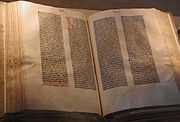
by 1400. In medieval Europe, the hitherto handcraft of papermaking was mechanized by the use of waterpower and other processes. The rapid expansion of European paper production was truly enhanced by the invention of the printing press and the beginning of the Printing Revolution in the 15th century.
The word "paper" is etymologically derived from papyros, Ancient Greek
for the Cyperus papyrus
plant. Papyrus
is a thick, paper-like material produced from the pith of the Cyperus papyrus plant which was used in ancient Egypt
and other Mediterranean cultures
for writing
long before the development of paper in China. Papyrus however is a "lamination of natural plants, while paper is manufactured from fibres whose properties have been changed by maceration or disintegration.
 Papermaking
has traditionally been traced to China
about 105 AD, when Cai Lun
, an official attached to the Imperial court during the Han Dynasty
(202 BC-220 AD), created a sheet of paper using mulberry
and other bast fibre
s along with fishnets, old rags, and hemp
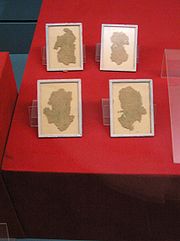
waste, though the earliest piece of paper found, at Fangmatan in Gansu province inscribed with a map, dates from 179-41 BC.
(1600–1050 BC) and Zhou
(1050 BC – 256 AD) dynasties of ancient China, documents were ordinarily written on bone or bamboo
(on tablets or on bamboo strips sewn and rolled together into scrolls), making them very heavy and awkward to transport. The light material of silk
was sometimes used, but was normally too expensive to consider. While the Han Dynasty
Chinese
court official Cai Lun
is widely regarded to have invented the modern method of papermaking (inspired from wasps and bees) from rags and other plant fibers in 105 CE, the discovery of specimens bearing written Chinese character
s in 2006 at north-east China's Gansu
province suggest that paper was in use by the ancient Chinese military more than 100 years before Cai, in 8 BC. It therefore would appear that "Cai Lun's contribution was to improve this skill systematically and scientifically, fixing a recipe for papermaking".
The record in the standard history
says
The manufacture may have originated from the practice of pounding and stirring rags in water, after which the matted fibres were collected on a mat. The bark of Paper Mulberry
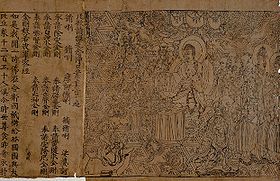
was particularly valued and high quality paper was developed in the late Han period, which used the bark of the than wood. In the Eastern Jin period paper began to be made on a fine bamboo screen-mould, treated with insecticidal dye for permanence. After printing
became popular in the Song dynasty
the demand grew more. Paper was often used as a levy, with one prefecture sending some 1.5m sheets of paper to the capital as tribute up to the year 1101.
from the 2nd century BC, used for purposes of wrapping or padding protection for delicate bronze mirrors. It was also used for safety, such as the padding of poisonous 'medicine' as mentioned in the official history of the period. Although paper used for writing became widespread by the 3rd century, paper continued to be used for wrapping (and other) purposes. Toilet paper
was used in China by at least the 6th century CE. In 589 AD, the Chinese scholar-official Yan Zhitui
(531-591 AD) wrote: "Paper on which there are quotations or commentaries from Five Classics or the names of sage
s, I dare not use for toilet purposes". An Arab
traveler to China once wrote of the curious Chinese tradition of toilet paper in AD 851, writing: "[The Chinese] are not careful about cleanliness, and they do not wash themselves with water when they have done their necessities; but they only wipe themselves with paper".
During the Tang Dynasty
(618–907 AD) paper was folded and sewn into square bags to preserve the flavor of tea
. During the same period, it was written that tea was served from baskets with multi-colored paper cups and paper napkins of different size and shape. During the Chinese Song Dynasty
(960–1279 AD) not only did the government produce the world's first known paper-printed money, or banknote
(see Jiaozi
and Huizi), but paper money bestowed as gifts to deserving government officials were wrapped in special paper envelope
s.
from China by Buddhist priests, around 610, where fibres (called bast) from the mulberry
tree were used.
in 751 (present day Kyrgyzstan
), the invention spread to the Middle East
.
The legend goes, the secret of papermaking
was obtained from two Chinese
prisoners from the Battle of Talas, which led to the first paper mill
in the Islamic world being founded in Samarkand
.
The laborious process of paper making was refined and machinery was designed for bulk manufacturing of paper. Production began in Baghdad
, where a method was invented to make a thicker sheet of paper, which helped transform papermaking from an art into a major industry. The use of water-powered pulp mill
s for preparing the pulp
material used in papermaking, dates back to Samarkand
in the 8th century, though this should not be confused with paper mill
s (see Paper mills section below). The Muslims also introduced the use of trip hammer
s (human- or animal-powered) in the production of paper, replacing the traditional Chinese mortar and pestle
method. In turn, the trip hammer method was later employed by the Chinese.
By the 9th century, Arabs were using paper regularly, although for important works like copies of the revered Qur'an
vellum
was still preferred. Advances in book
production and bookbinding
were introduced.
The Arabs made books lighter—sewn with silk and bound with leather-covered paste boards; they had a flap that wrapped the book up when not in use. As paper was less reactive to humidity, the heavy boards were not needed.
By the 12th century in Marrakech
in Morocco
a street was named "Kutubiyyin" or book sellers which contained more than 100 bookshops.
The earliest recorded use of paper for packaging dates back to 1035, when a Persian
traveler visiting markets in Cairo
noted that vegetables, spices and hardware were wrapped in paper for the customers after they were sold.
Since the First Crusade
in 1096, paper manufacturing in Damascus had been interrupted by wars, splitting production into two centres. Egypt
continued with the thicker paper, while Iran
became the center of the thinner papers. Papermaking was diffused across the Islamic world, from where it was diffused further west into Europe
. Paper manufacture was introduced to India in the 13th century by Arab merchants, where it almost wholly replaced traditional writing materials.
, archaeological evidence indicates that a similar bark-paper writing material was used by the Maya
ns no later than the 5th century CE. Called amatl
, it was in widespread use among Mesoamerican cultures until the Spanish conquest. The parchment is created by boiling and pounding the inner bark of trees, until the material becomes suitable for art and writing.
These materials made from pounded reeds and bark are technically not true paper, which is made from pulp, rags, and fibers of plants and cellulose.
 The oldest known paper document in the West is the Mozarab
Missal of Silos from the 11th century, probably using paper made in the Islamic part of Spain
. They used hemp
and linen
rags as a source of fibre. The first recorded paper mill in Spain was in Xàtiva
in 1151.
Paper is recorded as being manufactured in Italy
in 1276 with watermark
s being used in Fabriano
by 1300 and factories established at Treviso
and other northern towns by 1340. In Italy also paper moulds consisting of metal wires and in connection with that also watermarks were first introduced. The earliest German
manufacture was in Mainz
in 1320 with a mill in Nurenberg being set up by Ulman Stromer
in 1390, just about the time when the woodcut
printmaking
technique was transferred from fabric to paper in the old master print
and popular prints. The first known mill in England
was set up by John Tate in 1490 near Stevenage
in Hertfordshire
, but the first commercially successful paper mill in Britain did not occur before 1588 when John Spilman
set up a mill near Dartford
in Kent
and was initially reliant on German papermaking expertise.
that pounds the pulp by the use of trip-hammers. The mechanization of the pounding process was an important improvement in paper manufacture over the manual pounding with hand pestles
.
While the use of human and animal powered mills were known to Chinese and Muslim papermakers
, evidence for water-powered paper mills is elusive in both of them. The general absence of the use of water-power in Muslim papermaking is suggested by the habit of Muslim authors to call a production center not a "mill", but a "paper manufactory".
Donald Hill
has identified a possible reference to a water-powered paper mill
in Samarkand, in the 11th-century work of the Persian scholar Abu Rayhan Biruni, but concludes that the passage is "too brief to enable us to say with certainty" that it refers to a water-powered paper mill. While this is seen by Halevi nonetheless as evidence of Samarkand first harnessing waterpower in the production of paper, he concedes that it is not known if waterpower was applied to papermaking elsewhere across the Islamic world at the time; Burns remains altogether sceptical given the isolated occurrence of the reference and the prevalence of manual labour in Islamic papermaking elsewhere.
The earliest certain evidence to a water-powered paper mill dates to 1282 in the Spanish Kingdom of Aragon
. A decree by the Christian king Peter III
addresses the establishment of a royal "molendinum
", a proper hydraulic mill, in the paper manufacturing centre of Xàtiva
. The crown innovation appears to be resented by the local Muslim papermakering community; the document guarantees the Muslim subjects the right to continue their way of traditional papermaking by beating the pulp manually and grants them the right to be exempted from work in the new mill. Papermaking centres began to multiply in the late 13th century in Italy, reducing the price of paper to one sixth of parchment
and then falling further; papermaking centers reached Germany a century later.
The first paper mill north of the Alps was established in Nuremberg
by Ulman Stromer
in 1390; it is later depicted in the lavishly illustrated Nuremberg Chronicle
. From the mid-14th century onwards, European paper milling underwent a rapid improvement of many work processes.
, linen
and cotton
. A process for removing printing inks from recycled paper was invented by German jurist Justus Claproth
in 1774. Today this method is called deinking
. It was not until the introduction of wood pulp
in 1843 that paper production was not dependent on recycled materials.
. Although older machines predated it, the Fourdrinier
paper making machine became the basis for most modern papermaking. Nicholas Louis Robert
of Essonnes, France
, was granted a patent for a continuous paper making machine in 1799. At the time he was working for Leger Didot with whom he quarrelled over the ownership of the invention. Didot sent his brother-in-law, John Gamble
, to meet Sealy and Henry Fourdrinier
, stationers of London
, who agreed to finance the project. Gamble was granted British patent
2487 on 20 October 1801. With the help particularly of Bryan Donkin
, a skilled and ingenious mechanic, an improved version of the Robert original was installed at Frogmore, Hertfordshire, in 1803, followed by another in 1804. A third machine was installed at the Fourdriniers' own mill at Two Waters. The Fourdriniers also bought a mill at St Neots
intending to install two machines there and the process and machines continued to develop.
However, experiments with wood showed no real results in the late 18th-century and at the start of the 19th-century. By 1800, Matthias Koops (in London, England) further investigated the idea of using wood to make paper, and in 1801 he wrote and published a book titled Historical account of the substances which have been used to describe events, and to convey ideas, from the earliest date, to the invention of paper. His book was printed on paper made from wood shavings (and adhered together). No pages were fabricated using the pulping method (from either rags or wood). He received financial support from the royal family to make his printing machines and acquire the materials and infrastructure need to start his printing business. But his enterprise was short lived. Only a few years following his first and only printed book (the one he wrote and printed), he went bankrupt. The book was very well done (strong and had a fine appearance), but it was very costly.
Then in the 1830s and 1840s, two men on two different continents took up the challenge, but from a totally new perspective. Both Charles Fenerty
and Friedrich Gottlob Keller
began experiments with wood but using the same technique used in paper making; instead of pulping rags, they thought about pulping wood. And at about the same time, by mid-1844, they announced that their findings. They invented a machine which extracted the fibres from wood (exactly as with rags) and made paper from it. Charles Fenerty also bleached the pulp so that the paper was white. This started a new era for paper making. By the end of the 19th-century almost all printers in the western world
were using wood in lieu of rags to make paper.
Together with the invention of the practical fountain pen
and the mass produced pencil
of the same period, and in conjunction with the advent of the steam driven rotary printing press
, wood based paper caused a major transformation of the 19th century economy and society in industrialized countries. With the introduction of cheaper paper, schoolbooks, fiction, non-fiction, and newspapers became gradually available by 1900. Cheap wood based paper also meant that keeping personal diaries or writing letters became possible and so, by 1850, the clerk, or writer, ceased to be a high-status job.
The original wood-based paper was acidic due to the use of alum
and more prone to disintegrate over time, through processes known as slow fires
. Documents written on more expensive rag paper were more stable. Mass-market paperback books still use these cheaper mechanical papers (see below), but book publishers can now use acid-free paper
for hardback and trade paperback books.
Paper
Paper is a thin material mainly used for writing upon, printing upon, drawing or for packaging. It is produced by pressing together moist fibers, typically cellulose pulp derived from wood, rags or grasses, and drying them into flexible sheets....
was invented by the Chinese
Chinese people
The term Chinese people may refer to any of the following:*People with Han Chinese ethnicity ....
by 105 AD during the Han Dynasty
Han Dynasty
The Han Dynasty was the second imperial dynasty of China, preceded by the Qin Dynasty and succeeded by the Three Kingdoms . It was founded by the rebel leader Liu Bang, known posthumously as Emperor Gaozu of Han. It was briefly interrupted by the Xin Dynasty of the former regent Wang Mang...
and spread slowly to the west via Samarkand
Samarkand
Although a Persian-speaking region, it was not united politically with Iran most of the times between the disintegration of the Seleucid Empire and the Arab conquest . In the 6th century it was within the domain of the Turkic kingdom of the Göktürks.At the start of the 8th century Samarkand came...
and Baghdad
Baghdad
Baghdad is the capital of Iraq, as well as the coterminous Baghdad Governorate. The population of Baghdad in 2011 is approximately 7,216,040...
. Papermaking
Papermaking
Papermaking is the process of making paper, a substance which is used universally today for writing and packaging.In papermaking a dilute suspension of fibres in water is drained through a screen, so that a mat of randomly interwoven fibres is laid down. Water is removed from this mat of fibres by...
and manufacturing in Europe
Europe
Europe is, by convention, one of the world's seven continents. Comprising the westernmost peninsula of Eurasia, Europe is generally 'divided' from Asia to its east by the watershed divides of the Ural and Caucasus Mountains, the Ural River, the Caspian and Black Seas, and the waterways connecting...
started in Spain
Spain
Spain , officially the Kingdom of Spain languages]] under the European Charter for Regional or Minority Languages. In each of these, Spain's official name is as follows:;;;;;;), is a country and member state of the European Union located in southwestern Europe on the Iberian Peninsula...
and Sicily
Sicily
Sicily is a region of Italy, and is the largest island in the Mediterranean Sea. Along with the surrounding minor islands, it constitutes an autonomous region of Italy, the Regione Autonoma Siciliana Sicily has a rich and unique culture, especially with regard to the arts, music, literature,...
in the 10th century by the Muslims living there at the time, and slowly spread to Italy
Italy
Italy , officially the Italian Republic languages]] under the European Charter for Regional or Minority Languages. In each of these, Italy's official name is as follows:;;;;;;;;), is a unitary parliamentary republic in South-Central Europe. To the north it borders France, Switzerland, Austria and...
and South France reaching Germany
Germany
Germany , officially the Federal Republic of Germany , is a federal parliamentary republic in Europe. The country consists of 16 states while the capital and largest city is Berlin. Germany covers an area of 357,021 km2 and has a largely temperate seasonal climate...
by 1400. In medieval Europe, the hitherto handcraft of papermaking was mechanized by the use of waterpower and other processes. The rapid expansion of European paper production was truly enhanced by the invention of the printing press and the beginning of the Printing Revolution in the 15th century.
The word "paper" is etymologically derived from papyros, Ancient Greek
Ancient Greek
Ancient Greek is the stage of the Greek language in the periods spanning the times c. 9th–6th centuries BC, , c. 5th–4th centuries BC , and the c. 3rd century BC – 6th century AD of ancient Greece and the ancient world; being predated in the 2nd millennium BC by Mycenaean Greek...
for the Cyperus papyrus
Cyperus papyrus
Cyperus papyrus is a monocot belonging to the sedge family Cyperaceae. It is a herbaceous perennial native to Africa, and forms tall stands of reed-like swamp vegetation in shallow water....
plant. Papyrus
Papyrus
Papyrus is a thick paper-like material produced from the pith of the papyrus plant, Cyperus papyrus, a wetland sedge that was once abundant in the Nile Delta of Egypt....
is a thick, paper-like material produced from the pith of the Cyperus papyrus plant which was used in ancient Egypt
Ancient Egypt
Ancient Egypt was an ancient civilization of Northeastern Africa, concentrated along the lower reaches of the Nile River in what is now the modern country of Egypt. Egyptian civilization coalesced around 3150 BC with the political unification of Upper and Lower Egypt under the first pharaoh...
and other Mediterranean cultures
History of the Mediterranean region
The history of the Mediterranean region is the history of the interaction of the cultures and people of the lands surrounding the Mediterranean Sea —the central superhighway of transport, trade and cultural exchange between diverse peoples...
for writing
History of writing
The history of writing records the development of expressing language by letters or other marks. In the history of how systems of representation of language through graphic means have evolved in different human civilizations, more complete writing systems were preceded by proto-writing, systems of...
long before the development of paper in China. Papyrus however is a "lamination of natural plants, while paper is manufactured from fibres whose properties have been changed by maceration or disintegration.
Early papermaking in China
Papermaking
Papermaking is the process of making paper, a substance which is used universally today for writing and packaging.In papermaking a dilute suspension of fibres in water is drained through a screen, so that a mat of randomly interwoven fibres is laid down. Water is removed from this mat of fibres by...
has traditionally been traced to China
China
Chinese civilization may refer to:* China for more general discussion of the country.* Chinese culture* Greater China, the transnational community of ethnic Chinese.* History of China* Sinosphere, the area historically affected by Chinese culture...
about 105 AD, when Cai Lun
Cai Lun
Cai Lun , courtesy name Jingzhong , was a Chinese eunuch. He is traditionally regarded as the inventor of paper and the papermaking process, in forms recognizable in modern times as paper...
, an official attached to the Imperial court during the Han Dynasty
Han Dynasty
The Han Dynasty was the second imperial dynasty of China, preceded by the Qin Dynasty and succeeded by the Three Kingdoms . It was founded by the rebel leader Liu Bang, known posthumously as Emperor Gaozu of Han. It was briefly interrupted by the Xin Dynasty of the former regent Wang Mang...
(202 BC-220 AD), created a sheet of paper using mulberry
Mulberry
Morus is a genus of flowering plants in the family Moraceae. The 10–16 species of deciduous trees it contains are commonly known as Mulberries....
and other bast fibre
Bast fibre
Bast fibre or skin fibre is plant fibre collected from the phloem or bast surrounding the stem of certain, mainly dicotyledonous, plants. They support the conductive cells of the phloem and provide strength to the stem...
s along with fishnets, old rags, and hemp
Hemp
Hemp is mostly used as a name for low tetrahydrocannabinol strains of the plant Cannabis sativa, of fiber and/or oilseed varieties. In modern times, hemp has been used for industrial purposes including paper, textiles, biodegradable plastics, construction, health food and fuel with modest...
waste, though the earliest piece of paper found, at Fangmatan in Gansu province inscribed with a map, dates from 179-41 BC.
Techniques
During the ShangShang Dynasty
The Shang Dynasty or Yin Dynasty was, according to traditional sources, the second Chinese dynasty, after the Xia. They ruled in the northeastern regions of the area known as "China proper" in the Yellow River valley...
(1600–1050 BC) and Zhou
Zhou Dynasty
The Zhou Dynasty was a Chinese dynasty that followed the Shang Dynasty and preceded the Qin Dynasty. Although the Zhou Dynasty lasted longer than any other dynasty in Chinese history, the actual political and military control of China by the Ji family lasted only until 771 BC, a period known as...
(1050 BC – 256 AD) dynasties of ancient China, documents were ordinarily written on bone or bamboo
Bamboo
Bamboo is a group of perennial evergreens in the true grass family Poaceae, subfamily Bambusoideae, tribe Bambuseae. Giant bamboos are the largest members of the grass family....
(on tablets or on bamboo strips sewn and rolled together into scrolls), making them very heavy and awkward to transport. The light material of silk
Silk
Silk is a natural protein fiber, some forms of which can be woven into textiles. The best-known type of silk is obtained from the cocoons of the larvae of the mulberry silkworm Bombyx mori reared in captivity...
was sometimes used, but was normally too expensive to consider. While the Han Dynasty
Han Dynasty
The Han Dynasty was the second imperial dynasty of China, preceded by the Qin Dynasty and succeeded by the Three Kingdoms . It was founded by the rebel leader Liu Bang, known posthumously as Emperor Gaozu of Han. It was briefly interrupted by the Xin Dynasty of the former regent Wang Mang...
Chinese
China
Chinese civilization may refer to:* China for more general discussion of the country.* Chinese culture* Greater China, the transnational community of ethnic Chinese.* History of China* Sinosphere, the area historically affected by Chinese culture...
court official Cai Lun
Cai Lun
Cai Lun , courtesy name Jingzhong , was a Chinese eunuch. He is traditionally regarded as the inventor of paper and the papermaking process, in forms recognizable in modern times as paper...
is widely regarded to have invented the modern method of papermaking (inspired from wasps and bees) from rags and other plant fibers in 105 CE, the discovery of specimens bearing written Chinese character
Chinese character
Chinese characters are logograms used in the writing of Chinese and Japanese , less frequently Korean , formerly Vietnamese , or other languages...
s in 2006 at north-east China's Gansu
Gansu
' is a province located in the northwest of the People's Republic of China.It lies between the Tibetan and Huangtu plateaus, and borders Mongolia, Inner Mongolia, and Ningxia to the north, Xinjiang and Qinghai to the west, Sichuan to the south, and Shaanxi to the east...
province suggest that paper was in use by the ancient Chinese military more than 100 years before Cai, in 8 BC. It therefore would appear that "Cai Lun's contribution was to improve this skill systematically and scientifically, fixing a recipe for papermaking".
The record in the standard history
Twenty-Four Histories
The Twenty-Four Histories is a collection of Chinese historical books covering a period from 3000 BC to the Ming Dynasty in the 17th century. The whole set contains 3213 volumes and about 40 million words...
says
- In ancient times writings and inscriptions were generally made on tablets of bamboo or on pieces of silk called chih. But silk being costly and bamboos heavy they were not convenient to use. Tshai Lun then initiated the idea of making paper from the bark of trees, remnants of hemp, rags of cloth and fishing nets. He submitted the process to the emperor in the first year of Yuan-Hsing [+105] and received praise for his ability. From this time, paper has been in use everywhere and is universally called the paper of Marquis Tshai.
The manufacture may have originated from the practice of pounding and stirring rags in water, after which the matted fibres were collected on a mat. The bark of Paper Mulberry
Paper Mulberry
The Paper Mulberry is a tree in the family Moraceae, native to eastern Asia. Other names include Dak, Halibun, Kalivon, Kozo, and Tapacloth tree.It is a deciduous tree growing to tall...
was particularly valued and high quality paper was developed in the late Han period, which used the bark of the than wood. In the Eastern Jin period paper began to be made on a fine bamboo screen-mould, treated with insecticidal dye for permanence. After printing
Printing
Printing is a process for reproducing text and image, typically with ink on paper using a printing press. It is often carried out as a large-scale industrial process, and is an essential part of publishing and transaction printing....
became popular in the Song dynasty
Song Dynasty
The Song Dynasty was a ruling dynasty in China between 960 and 1279; it succeeded the Five Dynasties and Ten Kingdoms Period, and was followed by the Yuan Dynasty. It was the first government in world history to issue banknotes or paper money, and the first Chinese government to establish a...
the demand grew more. Paper was often used as a levy, with one prefecture sending some 1.5m sheets of paper to the capital as tribute up to the year 1101.
Uses
The first use of paper without writing has been excavated in China dating to the reign of Emperor Wu of HanEmperor Wu of Han
Emperor Wu of Han , , personal name Liu Che , was the seventh emperor of the Han Dynasty of China, ruling from 141 BC to 87 BC. Emperor Wu is best remembered for the vast territorial expansion that occurred under his reign, as well as the strong and centralized Confucian state he organized...
from the 2nd century BC, used for purposes of wrapping or padding protection for delicate bronze mirrors. It was also used for safety, such as the padding of poisonous 'medicine' as mentioned in the official history of the period. Although paper used for writing became widespread by the 3rd century, paper continued to be used for wrapping (and other) purposes. Toilet paper
Toilet paper
Toilet paper is a soft paper product used to maintain personal hygiene after human defecation or urination. However, it can also be used for other purposes such as blowing one's nose when one has a cold or absorbing common spills around the house, although paper towels are more used for the latter...
was used in China by at least the 6th century CE. In 589 AD, the Chinese scholar-official Yan Zhitui
Yan Zhitui
Yan Zhitui was a Chinese scholar, calligrapher, painter, musician, and government official who served four different Chinese states during the late Southern and Northern Dynasties: the Liang Dynasty in southern China, the Northern Qi and Northern Zhou Dynasties of northern China, and their...
(531-591 AD) wrote: "Paper on which there are quotations or commentaries from Five Classics or the names of sage
Wise old man
The wise old man is an archetype as described by Carl Jung, as well as a classic literary figure, and may be seen as a stock character...
s, I dare not use for toilet purposes". An Arab
Arab
Arab people, also known as Arabs , are a panethnicity primarily living in the Arab world, which is located in Western Asia and North Africa. They are identified as such on one or more of genealogical, linguistic, or cultural grounds, with tribal affiliations, and intra-tribal relationships playing...
traveler to China once wrote of the curious Chinese tradition of toilet paper in AD 851, writing: "[The Chinese] are not careful about cleanliness, and they do not wash themselves with water when they have done their necessities; but they only wipe themselves with paper".
During the Tang Dynasty
Tang Dynasty
The Tang Dynasty was an imperial dynasty of China preceded by the Sui Dynasty and followed by the Five Dynasties and Ten Kingdoms Period. It was founded by the Li family, who seized power during the decline and collapse of the Sui Empire...
(618–907 AD) paper was folded and sewn into square bags to preserve the flavor of tea
Tea
Tea is an aromatic beverage prepared by adding cured leaves of the Camellia sinensis plant to hot water. The term also refers to the plant itself. After water, tea is the most widely consumed beverage in the world...
. During the same period, it was written that tea was served from baskets with multi-colored paper cups and paper napkins of different size and shape. During the Chinese Song Dynasty
Song Dynasty
The Song Dynasty was a ruling dynasty in China between 960 and 1279; it succeeded the Five Dynasties and Ten Kingdoms Period, and was followed by the Yuan Dynasty. It was the first government in world history to issue banknotes or paper money, and the first Chinese government to establish a...
(960–1279 AD) not only did the government produce the world's first known paper-printed money, or banknote
Banknote
A banknote is a kind of negotiable instrument, a promissory note made by a bank payable to the bearer on demand, used as money, and in many jurisdictions is legal tender. In addition to coins, banknotes make up the cash or bearer forms of all modern fiat money...
(see Jiaozi
Jiaozi (currency)
Jiaozi is a form of banknote which appeared around 10th century in the Sichuan capital of Chengdu, China. Most numismatists generally regard it as the first paper money in history, a development of the Chinese Song Dynasty ....
and Huizi), but paper money bestowed as gifts to deserving government officials were wrapped in special paper envelope
Envelope
An envelope is a common packaging item, usually made of thin flat material. It is designed to contain a flat object, such as a letter or card....
s.
Diffusion of paper
Paper spread slowly outside of China; other East Asian cultures, even after seeing paper, could not make it themselves. Instruction in the manufacturing process was required, and the Chinese were reluctant to share their secrets. The paper was thin and translucent, not like modern western paper, and thus only written on one side. The technology transferred to JapanJapan
Japan is an island nation in East Asia. Located in the Pacific Ocean, it lies to the east of the Sea of Japan, China, North Korea, South Korea and Russia, stretching from the Sea of Okhotsk in the north to the East China Sea and Taiwan in the south...
from China by Buddhist priests, around 610, where fibres (called bast) from the mulberry
Mulberry
Morus is a genus of flowering plants in the family Moraceae. The 10–16 species of deciduous trees it contains are commonly known as Mulberries....
tree were used.
Islamic world
After the defeat of the Chinese in the Battle of TalasBattle of Talas
The Battle of Talas in 751 AD was an especially notable conflict between the Arab Abbasid Caliphate and the Chinese Tang Dynasty for control not only of the Syr Darya region, but even more...
in 751 (present day Kyrgyzstan
Kyrgyzstan
Kyrgyzstan , officially the Kyrgyz Republic is one of the world's six independent Turkic states . Located in Central Asia, landlocked and mountainous, Kyrgyzstan is bordered by Kazakhstan to the north, Uzbekistan to the west, Tajikistan to the southwest and China to the east...
), the invention spread to the Middle East
Middle East
The Middle East is a region that encompasses Western Asia and Northern Africa. It is often used as a synonym for Near East, in opposition to Far East...
.
The legend goes, the secret of papermaking
Papermaking
Papermaking is the process of making paper, a substance which is used universally today for writing and packaging.In papermaking a dilute suspension of fibres in water is drained through a screen, so that a mat of randomly interwoven fibres is laid down. Water is removed from this mat of fibres by...
was obtained from two Chinese
Han Chinese
Han Chinese are an ethnic group native to China and are the largest single ethnic group in the world.Han Chinese constitute about 92% of the population of the People's Republic of China , 98% of the population of the Republic of China , 78% of the population of Singapore, and about 20% of the...
prisoners from the Battle of Talas, which led to the first paper mill
Paper mill
A paper mill is a factory devoted to making paper from vegetable fibres such as wood pulp, old rags and other ingredients using a Fourdrinier machine or other type of paper machine.- History :...
in the Islamic world being founded in Samarkand
Samarkand
Although a Persian-speaking region, it was not united politically with Iran most of the times between the disintegration of the Seleucid Empire and the Arab conquest . In the 6th century it was within the domain of the Turkic kingdom of the Göktürks.At the start of the 8th century Samarkand came...
.
The laborious process of paper making was refined and machinery was designed for bulk manufacturing of paper. Production began in Baghdad
Baghdad
Baghdad is the capital of Iraq, as well as the coterminous Baghdad Governorate. The population of Baghdad in 2011 is approximately 7,216,040...
, where a method was invented to make a thicker sheet of paper, which helped transform papermaking from an art into a major industry. The use of water-powered pulp mill
Pulp mill
A pulp mill is a manufacturing facility that converts wood chips or other plant fibre source into a thick fibre board which can be shipped to a paper mill for further processing. Pulp can be manufactured using mechanical, semi-chemical or fully chemical methods...
s for preparing the pulp
Pulp (paper)
Pulp is a lignocellulosic fibrous material prepared by chemically or mechanically separating cellulose fibres from wood, fibre crops or waste paper. Wood pulp is the most common raw material in papermaking.-History:...
material used in papermaking, dates back to Samarkand
Samarkand
Although a Persian-speaking region, it was not united politically with Iran most of the times between the disintegration of the Seleucid Empire and the Arab conquest . In the 6th century it was within the domain of the Turkic kingdom of the Göktürks.At the start of the 8th century Samarkand came...
in the 8th century, though this should not be confused with paper mill
Paper mill
A paper mill is a factory devoted to making paper from vegetable fibres such as wood pulp, old rags and other ingredients using a Fourdrinier machine or other type of paper machine.- History :...
s (see Paper mills section below). The Muslims also introduced the use of trip hammer
Trip hammer
A trip hammer, also known as a helve hammer, is a massive powered hammer used in:* agriculture to facilitate the labor of pounding, decorticating and polishing of grain;...
s (human- or animal-powered) in the production of paper, replacing the traditional Chinese mortar and pestle
Mortar and pestle
A mortar and pestle is a tool used to crush, grind, and mix solid substances . The pestle is a heavy bat-shaped object, the end of which is used for crushing and grinding. The mortar is a bowl, typically made of hard wood, ceramic or stone...
method. In turn, the trip hammer method was later employed by the Chinese.
By the 9th century, Arabs were using paper regularly, although for important works like copies of the revered Qur'an
Qur'an
The Quran , also transliterated Qur'an, Koran, Alcoran, Qur’ān, Coran, Kuran, and al-Qur’ān, is the central religious text of Islam, which Muslims consider the verbatim word of God . It is regarded widely as the finest piece of literature in the Arabic language...
vellum
Vellum
Vellum is mammal skin prepared for writing or printing on, to produce single pages, scrolls, codices or books. It is generally smooth and durable, although there are great variations depending on preparation, the quality of the skin and the type of animal used...
was still preferred. Advances in book
Book
A book is a set or collection of written, printed, illustrated, or blank sheets, made of hot lava, paper, parchment, or other materials, usually fastened together to hinge at one side. A single sheet within a book is called a leaf or leaflet, and each side of a leaf is called a page...
production and bookbinding
Bookbinding
Bookbinding is the process of physically assembling a book from a number of folded or unfolded sheets of paper or other material. It usually involves attaching covers to the resulting text-block.-Origins of the book:...
were introduced.
The Arabs made books lighter—sewn with silk and bound with leather-covered paste boards; they had a flap that wrapped the book up when not in use. As paper was less reactive to humidity, the heavy boards were not needed.
By the 12th century in Marrakech
Marrakech
Marrakech or Marrakesh , known as the "Ochre city", is the most important former imperial city in Morocco's history...
in Morocco
Morocco
Morocco , officially the Kingdom of Morocco , is a country located in North Africa. It has a population of more than 32 million and an area of 710,850 km², and also primarily administers the disputed region of the Western Sahara...
a street was named "Kutubiyyin" or book sellers which contained more than 100 bookshops.
The earliest recorded use of paper for packaging dates back to 1035, when a Persian
Persian people
The Persian people are part of the Iranian peoples who speak the modern Persian language and closely akin Iranian dialects and languages. The origin of the ethnic Iranian/Persian peoples are traced to the Ancient Iranian peoples, who were part of the ancient Indo-Iranians and themselves part of...
traveler visiting markets in Cairo
Cairo
Cairo , is the capital of Egypt and the largest city in the Arab world and Africa, and the 16th largest metropolitan area in the world. Nicknamed "The City of a Thousand Minarets" for its preponderance of Islamic architecture, Cairo has long been a centre of the region's political and cultural life...
noted that vegetables, spices and hardware were wrapped in paper for the customers after they were sold.
Since the First Crusade
First Crusade
The First Crusade was a military expedition by Western Christianity to regain the Holy Lands taken in the Muslim conquest of the Levant, ultimately resulting in the recapture of Jerusalem...
in 1096, paper manufacturing in Damascus had been interrupted by wars, splitting production into two centres. Egypt
Egypt
Egypt , officially the Arab Republic of Egypt, Arabic: , is a country mainly in North Africa, with the Sinai Peninsula forming a land bridge in Southwest Asia. Egypt is thus a transcontinental country, and a major power in Africa, the Mediterranean Basin, the Middle East and the Muslim world...
continued with the thicker paper, while Iran
Iran
Iran , officially the Islamic Republic of Iran , is a country in Southern and Western Asia. The name "Iran" has been in use natively since the Sassanian era and came into use internationally in 1935, before which the country was known to the Western world as Persia...
became the center of the thinner papers. Papermaking was diffused across the Islamic world, from where it was diffused further west into Europe
Europe
Europe is, by convention, one of the world's seven continents. Comprising the westernmost peninsula of Eurasia, Europe is generally 'divided' from Asia to its east by the watershed divides of the Ural and Caucasus Mountains, the Ural River, the Caspian and Black Seas, and the waterways connecting...
. Paper manufacture was introduced to India in the 13th century by Arab merchants, where it almost wholly replaced traditional writing materials.
America
In AmericaAmericas
The Americas, or America , are lands in the Western hemisphere, also known as the New World. In English, the plural form the Americas is often used to refer to the landmasses of North America and South America with their associated islands and regions, while the singular form America is primarily...
, archaeological evidence indicates that a similar bark-paper writing material was used by the Maya
Maya civilization
The Maya is a Mesoamerican civilization, noted for the only known fully developed written language of the pre-Columbian Americas, as well as for its art, architecture, and mathematical and astronomical systems. Initially established during the Pre-Classic period The Maya is a Mesoamerican...
ns no later than the 5th century CE. Called amatl
Amatl
Amate is a form of paper that has been manufactured in Mexico since the pre Hispanic times. Amate paper was extensively produced and used for both communication, records and ritual during the Aztec Empire; however, after the Spanish conquest, its production was mostly banned and replaced by...
, it was in widespread use among Mesoamerican cultures until the Spanish conquest. The parchment is created by boiling and pounding the inner bark of trees, until the material becomes suitable for art and writing.
These materials made from pounded reeds and bark are technically not true paper, which is made from pulp, rags, and fibers of plants and cellulose.
Europe
Mozarab
The Mozarabs were Iberian Christians who lived under Arab Islamic rule in Al-Andalus. Their descendants remained unconverted to Islam, but did however adopt elements of Arabic language and culture...
Missal of Silos from the 11th century, probably using paper made in the Islamic part of Spain
Al-Andalus
Al-Andalus was the Arabic name given to a nation and territorial region also commonly referred to as Moorish Iberia. The name describes parts of the Iberian Peninsula and Septimania governed by Muslims , at various times in the period between 711 and 1492, although the territorial boundaries...
. They used hemp
Hemp
Hemp is mostly used as a name for low tetrahydrocannabinol strains of the plant Cannabis sativa, of fiber and/or oilseed varieties. In modern times, hemp has been used for industrial purposes including paper, textiles, biodegradable plastics, construction, health food and fuel with modest...
and linen
Linen
Linen is a textile made from the fibers of the flax plant, Linum usitatissimum. Linen is labor-intensive to manufacture, but when it is made into garments, it is valued for its exceptional coolness and freshness in hot weather....
rags as a source of fibre. The first recorded paper mill in Spain was in Xàtiva
Xàtiva
Xàtiva is a town in eastern Spain, in the province of Valencia, on the right bank of the river Albaida and at the junction of the Valencia–Murcia and Valencia Albacete railways....
in 1151.
Paper is recorded as being manufactured in Italy
Italy
Italy , officially the Italian Republic languages]] under the European Charter for Regional or Minority Languages. In each of these, Italy's official name is as follows:;;;;;;;;), is a unitary parliamentary republic in South-Central Europe. To the north it borders France, Switzerland, Austria and...
in 1276 with watermark
Watermark
A watermark is a recognizable image or pattern in paper that appears as various shades of lightness/darkness when viewed by transmitted light , caused by thickness or density variations in the paper...
s being used in Fabriano
Fabriano
Fabriano is a town and comune of Ancona province in the Italian region of the Marche, at 325 m above sea-level. It lies in the Esino valley 44 km upstream and SW of Jesi; and 15 km ENE of Fossato di Vico and 36 km east of Gubbio...
by 1300 and factories established at Treviso
Treviso
Treviso is a city and comune in Veneto, northern Italy. It is the capital of the province of Treviso and the municipality has 82,854 inhabitants : some 3,000 live within the Venetian walls or in the historical and monumental center, some 80,000 live in the urban center proper, while the city...
and other northern towns by 1340. In Italy also paper moulds consisting of metal wires and in connection with that also watermarks were first introduced. The earliest German
Germany
Germany , officially the Federal Republic of Germany , is a federal parliamentary republic in Europe. The country consists of 16 states while the capital and largest city is Berlin. Germany covers an area of 357,021 km2 and has a largely temperate seasonal climate...
manufacture was in Mainz
Mainz
Mainz under the Holy Roman Empire, and previously was a Roman fort city which commanded the west bank of the Rhine and formed part of the northernmost frontier of the Roman Empire...
in 1320 with a mill in Nurenberg being set up by Ulman Stromer
Ulman Stromer
Ulman Stromer was a German long-distance trader, factory owner and councillor of Nuremberg, then a free imperial city of the Holy Roman Empire...
in 1390, just about the time when the woodcut
Woodcut
Woodcut—occasionally known as xylography—is a relief printing artistic technique in printmaking in which an image is carved into the surface of a block of wood, with the printing parts remaining level with the surface while the non-printing parts are removed, typically with gouges...
printmaking
Printmaking
Printmaking is the process of making artworks by printing, normally on paper. Printmaking normally covers only the process of creating prints with an element of originality, rather than just being a photographic reproduction of a painting. Except in the case of monotyping, the process is capable...
technique was transferred from fabric to paper in the old master print
Old master print
An old master print is a work of art produced by a printing process within the Western tradition . A date of about 1830 is usually taken as marking the end of the period whose prints are covered by this term. The main techniques concerned are woodcut, engraving and etching, although there are...
and popular prints. The first known mill in England
England
England is a country that is part of the United Kingdom. It shares land borders with Scotland to the north and Wales to the west; the Irish Sea is to the north west, the Celtic Sea to the south west, with the North Sea to the east and the English Channel to the south separating it from continental...
was set up by John Tate in 1490 near Stevenage
Stevenage
Stevenage is a town and borough in Hertfordshire, England. It is situated to the east of junctions 7 and 8 of the A1, and is between Letchworth Garden City to the north, and Welwyn Garden City to the south....
in Hertfordshire
Hertfordshire
Hertfordshire is a ceremonial and non-metropolitan county in the East region of England. The county town is Hertford.The county is one of the Home Counties and lies inland, bordered by Greater London , Buckinghamshire , Bedfordshire , Cambridgeshire and...
, but the first commercially successful paper mill in Britain did not occur before 1588 when John Spilman
John Spilman
Sir John Spilman was a Lindau, German-born entrepreneur who founded the first commercially successful paper-mill in England, establishing a factory on the River Darenth in Dartford, Kent in 1588...
set up a mill near Dartford
Dartford
Dartford is the principal town in the borough of Dartford. It is situated in the northwest corner of Kent, England, east south-east of central London....
in Kent
Kent
Kent is a county in southeast England, and is one of the home counties. It borders East Sussex, Surrey and Greater London and has a defined boundary with Essex in the middle of the Thames Estuary. The ceremonial county boundaries of Kent include the shire county of Kent and the unitary borough of...
and was initially reliant on German papermaking expertise.
Paper mills
A paper mill is a water-powered millWatermill
A watermill is a structure that uses a water wheel or turbine to drive a mechanical process such as flour, lumber or textile production, or metal shaping .- History :...
that pounds the pulp by the use of trip-hammers. The mechanization of the pounding process was an important improvement in paper manufacture over the manual pounding with hand pestles
Mortar and pestle
A mortar and pestle is a tool used to crush, grind, and mix solid substances . The pestle is a heavy bat-shaped object, the end of which is used for crushing and grinding. The mortar is a bowl, typically made of hard wood, ceramic or stone...
.
While the use of human and animal powered mills were known to Chinese and Muslim papermakers
Papermaking
Papermaking is the process of making paper, a substance which is used universally today for writing and packaging.In papermaking a dilute suspension of fibres in water is drained through a screen, so that a mat of randomly interwoven fibres is laid down. Water is removed from this mat of fibres by...
, evidence for water-powered paper mills is elusive in both of them. The general absence of the use of water-power in Muslim papermaking is suggested by the habit of Muslim authors to call a production center not a "mill", but a "paper manufactory".
Donald Hill
Donald Routledge Hill
Donald Routledge Hill was an English engineer and historian of science and technology.Alongside more general works on the history of technology, he wrote works on the history of medieval Arabic science and technology, and translated The Book of Knowledge of Ingenious Mechanical Devices of the...
has identified a possible reference to a water-powered paper mill
Paper mill
A paper mill is a factory devoted to making paper from vegetable fibres such as wood pulp, old rags and other ingredients using a Fourdrinier machine or other type of paper machine.- History :...
in Samarkand, in the 11th-century work of the Persian scholar Abu Rayhan Biruni, but concludes that the passage is "too brief to enable us to say with certainty" that it refers to a water-powered paper mill. While this is seen by Halevi nonetheless as evidence of Samarkand first harnessing waterpower in the production of paper, he concedes that it is not known if waterpower was applied to papermaking elsewhere across the Islamic world at the time; Burns remains altogether sceptical given the isolated occurrence of the reference and the prevalence of manual labour in Islamic papermaking elsewhere.
The earliest certain evidence to a water-powered paper mill dates to 1282 in the Spanish Kingdom of Aragon
Kingdom of Aragon
The Kingdom of Aragon was a medieval and early modern kingdom in the Iberian Peninsula, corresponding to the modern-day autonomous community of Aragon, in Spain...
. A decree by the Christian king Peter III
Peter III of Aragon
Peter the Great was the King of Aragon of Valencia , and Count of Barcelona from 1276 to his death. He conquered Sicily and became its king in 1282. He was one of the greatest of medieval Aragonese monarchs.-Youth and succession:Peter was the eldest son of James I of Aragon and his second wife...
addresses the establishment of a royal "molendinum
Watermill
A watermill is a structure that uses a water wheel or turbine to drive a mechanical process such as flour, lumber or textile production, or metal shaping .- History :...
", a proper hydraulic mill, in the paper manufacturing centre of Xàtiva
Xàtiva
Xàtiva is a town in eastern Spain, in the province of Valencia, on the right bank of the river Albaida and at the junction of the Valencia–Murcia and Valencia Albacete railways....
. The crown innovation appears to be resented by the local Muslim papermakering community; the document guarantees the Muslim subjects the right to continue their way of traditional papermaking by beating the pulp manually and grants them the right to be exempted from work in the new mill. Papermaking centres began to multiply in the late 13th century in Italy, reducing the price of paper to one sixth of parchment
Parchment
Parchment is a thin material made from calfskin, sheepskin or goatskin, often split. Its most common use was as a material for writing on, for documents, notes, or the pages of a book, codex or manuscript. It is distinct from leather in that parchment is limed but not tanned; therefore, it is very...
and then falling further; papermaking centers reached Germany a century later.
The first paper mill north of the Alps was established in Nuremberg
Nuremberg
Nuremberg[p] is a city in the German state of Bavaria, in the administrative region of Middle Franconia. Situated on the Pegnitz river and the Rhine–Main–Danube Canal, it is located about north of Munich and is Franconia's largest city. The population is 505,664...
by Ulman Stromer
Ulman Stromer
Ulman Stromer was a German long-distance trader, factory owner and councillor of Nuremberg, then a free imperial city of the Holy Roman Empire...
in 1390; it is later depicted in the lavishly illustrated Nuremberg Chronicle
Nuremberg Chronicle
right|thumbnail|240px|Fifth dayThe Nuremberg Chronicle is an illustrated Biblical paraphrase and world history that follows the story of human history related in the Bible; it includes the histories of a number of important Western cities. Written in Latin by Hartmann Schedel, with a version in...
. From the mid-14th century onwards, European paper milling underwent a rapid improvement of many work processes.
Fibre sources
Before the industrialisation of the paper production the most common fibre source was recycled fibres from used textiles, called rags. The rags was from hempHemp
Hemp is mostly used as a name for low tetrahydrocannabinol strains of the plant Cannabis sativa, of fiber and/or oilseed varieties. In modern times, hemp has been used for industrial purposes including paper, textiles, biodegradable plastics, construction, health food and fuel with modest...
, linen
Linen
Linen is a textile made from the fibers of the flax plant, Linum usitatissimum. Linen is labor-intensive to manufacture, but when it is made into garments, it is valued for its exceptional coolness and freshness in hot weather....
and cotton
Cotton
Cotton is a soft, fluffy staple fiber that grows in a boll, or protective capsule, around the seeds of cotton plants of the genus Gossypium. The fiber is almost pure cellulose. The botanical purpose of cotton fiber is to aid in seed dispersal....
. A process for removing printing inks from recycled paper was invented by German jurist Justus Claproth
Justus Claproth
Justus Claproth was a German jurist and inventor of the deinking process of recycled paper....
in 1774. Today this method is called deinking
Deinking
Deinking is the industrial process of removing printing ink from paperfibers of recycled paper to make deinked pulp.The key in the deinking process is the ability to detach ink from the fibers. This is achieved by a combination of mechanical action and chemical means. In Europe the most common...
. It was not until the introduction of wood pulp
Wood pulp
Pulp is a lignocellulosic fibrous material prepared by chemically or mechanically separating cellulose fibres from wood, fibre crops or waste paper. Wood pulp is the most common raw material in papermaking.-History:...
in 1843 that paper production was not dependent on recycled materials.
19th century advances in papermaking
Although cheaper than vellum, paper remained expensive, at least in book-sized quantities, through the centuries, until the advent of steam-driven paper making machines in the 19th century, which could make paper with fibres from wood pulpWood pulp
Pulp is a lignocellulosic fibrous material prepared by chemically or mechanically separating cellulose fibres from wood, fibre crops or waste paper. Wood pulp is the most common raw material in papermaking.-History:...
. Although older machines predated it, the Fourdrinier
Fourdrinier machine
This article contains a glossary section at the end.Most modern papermaking machines are based on the principles of the Fourdrinier Machine. It has been used in some variation since its inception...
paper making machine became the basis for most modern papermaking. Nicholas Louis Robert
Robert brothers
Les Frères Robert were two French brothers. Anne-Jean Robert , and Nicolas-Louis Robert , The brothers were the engineers who built the world's first hydrogen balloon for professor Jacques Charles; it flew from central Paris on...
of Essonnes, France
France
The French Republic , The French Republic , The French Republic , (commonly known as France , is a unitary semi-presidential republic in Western Europe with several overseas territories and islands located on other continents and in the Indian, Pacific, and Atlantic oceans. Metropolitan France...
, was granted a patent for a continuous paper making machine in 1799. At the time he was working for Leger Didot with whom he quarrelled over the ownership of the invention. Didot sent his brother-in-law, John Gamble
John Gamble
John Gamble may refer to:* John Gamble * John Gamble , musician and song collector* John A. Gamble Canadian politician* John M. Gamble Officer in the United States Marine Corps...
, to meet Sealy and Henry Fourdrinier
Henry Fourdrinier
Henry Fourdrinier was a British inventor.He was born in 1766, the son of a paper maker and stationer. With his brother, Sealy, he invented and improved the Fourdrinier machine, a papermaking machine that could make continuous paper...
, stationers of London
London
London is the capital city of :England and the :United Kingdom, the largest metropolitan area in the United Kingdom, and the largest urban zone in the European Union by most measures. Located on the River Thames, London has been a major settlement for two millennia, its history going back to its...
, who agreed to finance the project. Gamble was granted British patent
Patent
A patent is a form of intellectual property. It consists of a set of exclusive rights granted by a sovereign state to an inventor or their assignee for a limited period of time in exchange for the public disclosure of an invention....
2487 on 20 October 1801. With the help particularly of Bryan Donkin
Bryan Donkin
Bryan Donkin was an English engineer and industrialist. Of his six sons, John, Bryan, and Thomas also became engineers.-Early life:Born in Sandoe, Northumberland, his father was a surveyor and land agent...
, a skilled and ingenious mechanic, an improved version of the Robert original was installed at Frogmore, Hertfordshire, in 1803, followed by another in 1804. A third machine was installed at the Fourdriniers' own mill at Two Waters. The Fourdriniers also bought a mill at St Neots
St Neots
St Neots is a town and civil parish with a population of 26,356 people. It lies on the River Great Ouse in Huntingdonshire District, approximately north of central London, and is the largest town in Cambridgeshire . The town is named after the Cornish monk St...
intending to install two machines there and the process and machines continued to develop.
However, experiments with wood showed no real results in the late 18th-century and at the start of the 19th-century. By 1800, Matthias Koops (in London, England) further investigated the idea of using wood to make paper, and in 1801 he wrote and published a book titled Historical account of the substances which have been used to describe events, and to convey ideas, from the earliest date, to the invention of paper. His book was printed on paper made from wood shavings (and adhered together). No pages were fabricated using the pulping method (from either rags or wood). He received financial support from the royal family to make his printing machines and acquire the materials and infrastructure need to start his printing business. But his enterprise was short lived. Only a few years following his first and only printed book (the one he wrote and printed), he went bankrupt. The book was very well done (strong and had a fine appearance), but it was very costly.
Then in the 1830s and 1840s, two men on two different continents took up the challenge, but from a totally new perspective. Both Charles Fenerty
Charles Fenerty
Charles Fenerty , is a Canadian inventor who invented the wood pulp process for papermaking, which was first adapted into the production of newsprint. Fenerty was also a poet...
and Friedrich Gottlob Keller
Friedrich Gottlob Keller
Friedrich Gottlob Keller was a German machinist and inventor, who invented the wood pulp process for the use in papermaking. He is widely known for his wood-cut machine . Unlike Charles Fenerty, F.G...
began experiments with wood but using the same technique used in paper making; instead of pulping rags, they thought about pulping wood. And at about the same time, by mid-1844, they announced that their findings. They invented a machine which extracted the fibres from wood (exactly as with rags) and made paper from it. Charles Fenerty also bleached the pulp so that the paper was white. This started a new era for paper making. By the end of the 19th-century almost all printers in the western world
Western world
The Western world, also known as the West and the Occident , is a term referring to the countries of Western Europe , the countries of the Americas, as well all countries of Northern and Central Europe, Australia and New Zealand...
were using wood in lieu of rags to make paper.
Together with the invention of the practical fountain pen
Fountain pen
A fountain pen is a nib pen that, unlike its predecessor the dip pen, contains an internal reservoir of water-based liquid ink. The pen draws ink from the reservoir through a feed to the nib and deposits it on paper via a combination of gravity and capillary action...
and the mass produced pencil
Pencil
A pencil is a writing implement or art medium usually constructed of a narrow, solid pigment core inside a protective casing. The case prevents the core from breaking, and also from marking the user’s hand during use....
of the same period, and in conjunction with the advent of the steam driven rotary printing press
Printing press
A printing press is a device for applying pressure to an inked surface resting upon a print medium , thereby transferring the ink...
, wood based paper caused a major transformation of the 19th century economy and society in industrialized countries. With the introduction of cheaper paper, schoolbooks, fiction, non-fiction, and newspapers became gradually available by 1900. Cheap wood based paper also meant that keeping personal diaries or writing letters became possible and so, by 1850, the clerk, or writer, ceased to be a high-status job.
The original wood-based paper was acidic due to the use of alum
Alum
Alum is both a specific chemical compound and a class of chemical compounds. The specific compound is the hydrated potassium aluminium sulfate with the formula KAl2.12H2O. The wider class of compounds known as alums have the related empirical formula, AB2.12H2O.-Chemical properties:Alums are...
and more prone to disintegrate over time, through processes known as slow fires
Slow fires
A slow fire is a term used in library and information science to describe paper embrittlement resulting from acid decay. The term is taken from the title of Terry Sanders' 1987 film Slow Fires: On the preservation of the human record....
. Documents written on more expensive rag paper were more stable. Mass-market paperback books still use these cheaper mechanical papers (see below), but book publishers can now use acid-free paper
Acid-free paper
Acid-free paper is paper that has a neutral or basic pH . It can be made from any cellulose fiber as long as the active acid pulp is eliminated during processing. It is also lignin and sulfur free...
for hardback and trade paperback books.
See also
- History of origamiHistory of OrigamiThe history of origami followed after the invention of paper, and as a result of paper's use in society. Independent paper folding traditions exist in East Asia and Europe, and it is unclear whether these evolved separately, or had a common source....
- Paperless officePaperless officeA paperless office is a work environment in which the use of paper is eliminated or greatly reduced. This is done by converting documents and other papers into digital form. Proponents claim that "going paperless" can save money, boost productivity, save space, make documentation and information...
- Charles FenertyCharles FenertyCharles Fenerty , is a Canadian inventor who invented the wood pulp process for papermaking, which was first adapted into the production of newsprint. Fenerty was also a poet...
- Friedrich Gottlob KellerFriedrich Gottlob KellerFriedrich Gottlob Keller was a German machinist and inventor, who invented the wood pulp process for the use in papermaking. He is widely known for his wood-cut machine . Unlike Charles Fenerty, F.G...
- PapyrusPapyrusPapyrus is a thick paper-like material produced from the pith of the papyrus plant, Cyperus papyrus, a wetland sedge that was once abundant in the Nile Delta of Egypt....
Sources
- Bloom, Jonathan (2001). Paper before print: the history and impact of paper in the Islamic world. Yale University Press.