

Chinese character

Encyclopedia
Chinese characters are logogram
s used in the writing of Chinese
(in which case they may be called hanzi; / hànzì "Han
character") and Japanese
(called kanji
), less frequently Korean
(called hanja
), formerly Vietnamese
(called hán tự), or other languages. Chinese characters constitute the oldest continuously-used system of writing in the world.
Chinese characters number in the tens of thousands, though most of these are minor graphic variants only encountered in historical texts. Studies carried out in China
have shown that functional literacy requires a knowledge of between three and four thousand characters.
In Chinese orthography, the characters are largely morphosyllabic
, each corresponding to a spoken syllable with a distinct meaning. However, the majority of Chinese words today consist of two or more characters. About 10% of native words have two syllables without separate meanings, but they are nonetheless written with two characters. Some characters, generally ligatures, represent polysyllabic words or even phrases, though this is the exception and is generally informal.
Cognate
s in the various varieties of Chinese are generally written with the same character. They typically have similar meanings, but often quite different pronunciations. In other languages, most significantly today in Japanese
, characters are used to represent native words, ignoring the Chinese pronunciation, to represent Chinese loanwords, and as purely phonetic elements based on their pronunciation in the historical variety of Chinese they were acquired from. These foreign adaptations of Chinese pronunciation are known as Sinoxenic
pronunciations, and have been useful in the reconstruction of Ancient Chinese.
pottery and on bones at a variety of locations in China, including Banpo
and Hualouzi near Xi'an
. These simple, often geometric marks are similar to some of the earliest known Chinese characters, potentially indicating that the history of Chinese writing extends back over six millennia.
However, because these marks occur singly, without any implied context, and are made crudely and simply, Qiu Xigui concluded that "we do not have any basis for stating that these constituted writing nor is there reason to conclude that they were ancestral to Shang Dynasty
Chinese characters." Nonetheless, isolated graphs and pictures continue to be found periodically, frequently accompanied by media reports that push back the purported beginnings of Chinese writing by thousands of years. For example, at Damaidi
in Ningxia
, 3,172 pictorial cliff carvings dating to 6000–5000 BC were discovered, leading to headlines such as "Chinese writing '8,000 years old.'" Similarly, archaeologists reported finding a few inscribed symbols on tortoise shells at the Neolithic site of Jiahu
in Henan
dated to around 6600–6200 BC, leading to headlines of "'Earliest writing' which was found in China".
In a comment released to the BBC
, Professor David Keightley
urged caution in the latter instance, pointing to the lack of any direct cultural connection to Shang culture, considering that the Shang Dynasty arose several millennia later. However, in the same BBC article, a supporting argument was provided by Dr. Garman Harbottle of the Brookhaven National Laboratory
in New York City
, who collaborated with a team of archaeologists at the University of Science and Technology of China
in Anhui
in the discovery. Dr. Harbottle pointed to the persistence of sign use at different sites along the Yellow River
throughout the Neolithic and up to the Shang period, when a complex writing system appears.
One group of sites of interest is the Dawenkou culture
sites (2800–2500 BC), only a millennium earlier than the early Shang sites and positioned so as plausibly be ancestral to the Shang. There, a few inscribed pottery and jade pieces have been found, one of which combines pictorial elements (a sun, moon or clouds, and afire or a mountain) in a stack which brings to mind the compounding of elements in Chinese characters. Major scholars are divided in their interpretation of such inscribed symbols. Some, such as Yu Xingwu, Tang Lan, and Li Xueqin have identified these with specific Chinese characters. Others such as Wang Ningsheng interpret them as pictorial symbols such as clan insignia, rather than writing. But in the view of Wang Ningsheng, "True writing begins when it represents sounds and consists of symbols that are able to record language. The few isolated figures found on pottery still cannot substantiate this point."
(c. 2650 BC), a bureaucrat under the legendary Yellow Emperor
. There are quite a few variations of the legend. One of them tells that Cangjie was hunting on Mount Yangxu in modern Shanxi
when he saw a tortoise whose veins caught his curiosity. Inspired by the possibility of a logical relation of those veins, he studied the animals of the world, the landscape of the earth, and the stars in the sky, and invented a symbolic system called zì (字) — the first Chinese characters. It was said that on the day the characters were born, Chinese heard the devil mourning and saw crops falling like rain, as it marked a second beginning of the world.
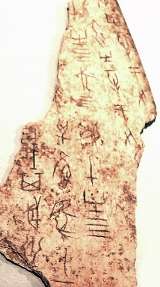
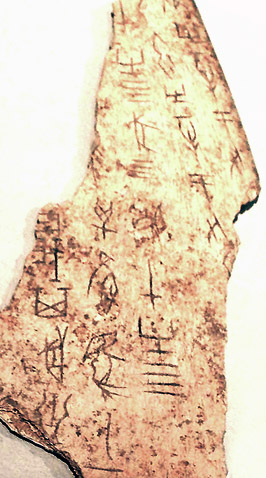 The oldest Chinese inscriptions that are indisputably writing are the so-called oracle bone script
. These were identified by scholars in 1899 on pieces of bone and turtle shell being sold as medicine. By 1928, the source of the oracle bones had been traced back to modern Xiaotun village near Anyang
in Henan
Province, where official archaeological excavations in 1928–1937 discovered 20,000 oracle bone pieces, about 1/5th of the total discovered. The inscriptions were records of the divinations performed for or by the royal Shang household. The oracle bone script is a well-developed writing system, attested from the late Shang Dynasty (1200–1050 BC). Only about 1,400 of the 2,500 known oracle bone script logographs can be identified with later Chinese characters and thus be deciphered by paleographers.
books (preserved in typical bronze inscriptions), as well as the extra-elaborate pictorial forms (often clan emblems) found on many bronzes.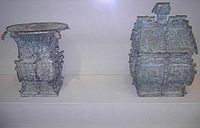 Based on studies of such bronze inscriptions, it is clear that from the Shang Dynasty writing to that of the Western Zhou
and early Eastern Zhou, the mainstream script evolved in a slow, unbroken fashion, until taking the form now known as seal script
in the late Eastern Zhou in the state of Qin
, without any clear line of division. Meanwhile other scripts had evolved, especially in the eastern and southern areas during the late Zhou Dynasty
, including regional forms, such as the guwen
(“ancient forms”) of the eastern Warring States preserved in the Han Dynasty
character dictionary Shuowen Jiezi as variant forms, as well as decorative forms such as bird and insect scripts
.
, which had evolved slowly in the state of Qin during the Eastern Zhou Dynasty
, became standardized and adopted as the formal script for all of China in the Qin Dynasty
(leading to a popular misconception that it was invented at that time), and was still widely used for decorative engraving and seal
s (name chops, or signets) in the Han Dynasty
period. However, despite the Qin script standardization, more than one script remained in use at the time. For example, a little-known, rectilinear and roughly executed kind of common (vulgar) writing had for centuries coexisted with the more formal seal script in the Qin state
, and the popularity of this vulgar writing grew as the use of writing itself became more widespread. By the Warring States period
, an immature form of clerical script
called “early clerical” or “proto-clerical” had already developed in the state of Qin based upon this vulgar writing, and with influence from seal script as well. The coexistence of the three scripts – small seal, vulgar and proto-clerical, with the latter evolving gradually in the Qin to early Han dynasties into clerical script
– runs counter to the traditional belief that the Qin Dynasty had one script only, and that clerical script was suddenly invented in the early Han Dynasty from the small seal script.
, who ruled from 141 BC to 87 BC.
, also called 八分 (bāfēn) script, was dominant at that time, an early type of cursive script
was also in use by the Han by at least as early as 24 BC (during the very late Western Han period), incorporating cursive forms popular at the time, well as many elements from the vulgar writing of the Warring State of Qin
. By around the time of the Eastern Jin dynasty, this Han cursive became known as 章草 zhāngcǎo (also known as 隶草 / 隸草 lìcǎo today), or in English sometimes clerical cursive, ancient cursive, or draft cursive. Some believe that the name, based on 章 zhāng meaning "orderly", arose because the script was a more orderly form of cursive than the modern form
, which emerged during the Eastern Jin Dynasty and is still in use today, called 今草 jīncǎo or "modern cursive".
and Jin dynasties.
appeared, developing out of a cursively-written form of neo-clerical script and simple cursive. This semi-cursive script was traditionally attributed to Liu Desheng ca. 147–188 AD, although such attributions refer to early masters of a script rather than to their actual inventors, since the scripts generally evolved into being over time. Qiu gives examples of early semi-cursive script, showing that it had popular origins rather than being purely Liu’s invention.
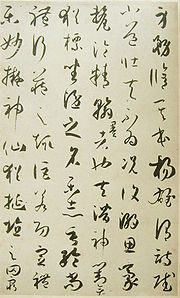 There are numerous styles, or scripts, in which Chinese characters can be written, deriving from various calligraphic and historical models. Most of these originated in China and are now common, with minor variations, in all countries where Chinese characters are used.
The Shang Dynasty
oracle bone script
and the Zhou Dynasty
scripts found on Chinese bronze inscriptions are no longer used; the oldest script that is still in use today is the Seal Script
(篆书 / 篆書, zhuànshū). It evolved organically out of the Spring and Autumn period Zhou script, and was adopted in a standardized form under the first Emperor of China
, Qin Shi Huang
. The seal script, as the name suggests, is now used only in artistic seals. Few people are still able to read it effortlessly today, although the art of carving a traditional seal in the script remains alive; some calligraphers
also work in this style.
Scripts that are still used regularly are the "Clerical Script
" (隶书 / 隸書, lìshū) of the Qin Dynasty
to the Han Dynasty
, the Weibei (魏碑, wèibēi), the "Regular Script
" (楷书 / 楷書, kǎishū), which is used mostly for printing, and the "Semi-cursive Script
" (行书 / 行書, xíngshū), used mostly for handwriting.
The cursive script
(草书 / 草書, cǎoshū, literally "grass script") is used informally. The basic character shapes are suggested, rather than explicitly realized, and the abbreviations are sometimes extreme. Despite being cursive to the point where individual strokes are no longer differentiable and the characters often illegible to the untrained eye, this script (also known as draft) is highly revered for the beauty and freedom that it embodies. Some of the simplified Chinese characters adopted by the People's Republic of China
, and some of the simplified characters used in Japan, are derived from the cursive script. The Japanese hiragana
script is also derived from this script.
There also exist scripts created outside China, such as the Japanese Edomoji
styles; these have tended to remain restricted to their countries of origin, rather than spreading to other countries like the Chinese scripts.
has been attributed to Zhong Yao
, of the Eastern Han to Cao Wei
period (ca. 151–230 AD), who has been called the “father of regular script”. However, some scholars postulate that one person alone could not have developed a new script which was universally adopted, but could only have been a contributor to its gradual formation. The earliest surviving pieces written in regular script are copies of Yao's works, including at least one copied by Wang Xizhi
. This new script, which is the dominant modern Chinese script, developed out of a neatly-written form of early semi-cursive, with addition of the pause (顿 / 頓, dùn) technique to end horizontal strokes, plus heavy tails on strokes which are written to the downward-right diagonal. Thus, early regular script emerged from a neat, formal form of semi-cursive, which had itself emerged from neo-clerical (a simplified, convenient form of clerical script). It then matured further in the Eastern Jin Dynasty in the hands of the "Sage of Calligraphy", Wang Xizhi
, and his son Wang Xianzhi. It was not, however, in widespread use at that time, and most writers continued using neo-clerical, or a somewhat semi-cursive form of it, for daily writing, while the conservative bafen clerical script remained in use on some stelae, alongside some semi-cursive, but primarily neo-clerical.
.
that regular script rose to dominant status. During that period, regular script continued evolving stylistically, reaching full maturity in the early Tang Dynasty
. Some call the writing of the early Tang calligrapher Ouyang Xun
(557–641) the first mature regular script. After this point, although developments in the art of calligraphy and in character simplification still lay ahead, there were no more major stages of evolution for the mainstream script.
in the 1950s and 60s, character simplification predates the republic's formation in 1949.
One of the earliest proponents of character simplification was Lufei Kui
, who proposed in 1909 that simplified characters should be used in education. In the years following the May Fourth Movement
in 1919, many anti-imperialist Chinese intellectuals sought ways to modernise China. In the 1930s and 1940s, discussions on character simplification took place within the Kuomintang
government, and a large number of Chinese intellectuals and writers have long maintained that character simplification would help boost literacy in China. In many world languages, literacy has been promoted as a justification for spelling reform
s. The People's Republic of China issued its first round of official character simplifications in two documents, the first in 1956 and the second in 1964. In the 1950s and 1960s, while confusion about simplified characters was still rampant, transitional characters that mixed simplified parts with yet-to-be simplified parts of characters together appeared briefly, then disappeared.
"Han unification
" was an effort by the authors of Unicode and the Universal Character Set to map multiple character sets of the so-called CJK languages (Chinese/Japanese/Korean) into a single set of unified characters and was completed for the purposes of Unicode
in 1991 (Unicode 1.0).
The earliest known Chinese texts, in the Oracle bone script
, display a fully developed writing system, with little difference in functionality from modern characters. It is assumed that the early stages of the development of characters were dominated by pictogram
s, which were the objects depicted, and ideogram
s, in which meaning was expressed iconically
. The demands of writing full language, including words which had no easy pictographic or iconic representation, forced an expansion of this system, presumably through use of rebus
.
The presumed methods of forming characters were first classified c. 100 AD by the Chinese linguist Xu Shen
(許慎), whose etymological dictionary Shuowen Jiezi
(说文解字 / 說文解字) divides the script into six categories, the liùshū (六书 / 六書). While the categories and classification are occasionally problematic and arguably fail to reflect the complete nature of the Chinese writing system, this account has been perpetuated by its long history and pervasive use.
Four percent of Chinese characters are derived directly from individual pictograms, though in most cases the resemblance to an object is no longer clear. Others were derived as ideograms; as compound ideograms, where two ideograms are combined to give a third reading; and as rebuses. But most characters were devised as phono-semantic compounds, with one element to indicate the general category of meaning and the other to suggest the pronunciation. Again, in many cases the suggested sound is no longer accurate. All today are logograms, and are not actually used pictographically or ideographically.
Pictograms make up only a small portion of Chinese characters. While characters in this class derive from pictures, they have been standardized, simplified, and stylized to make them easier to write, and their derivation is therefore not always obvious. Examples include rì for "sun", yuè for "moon", and mù for "tree"....
There is no concrete number for the proportion of modern characters that are pictographic in nature; however, Xu Shen (c. 100 AD) estimated that 4% of characters fell into this category.
Also called simple indicatives or simple ideographs, these characters either modify existing pictographs iconically, or are direct iconic illustrations. For instance, by modifying dāo, a pictogram for "knife", by marking the blade, an ideogram rèn for "blade" is obtained. Direct examples include shàng "up" and xià "down". This category is small.
Translated literally as logical aggregates or associative compounds, these characters symbolically combine pictograms or ideograms to create a third character. For instance, doubling the pictogram mù "tree" produces lín "grove", while tripling it produces sēn "forest". (It is interesting to note (see below) that and both have the same reconstructed Old Chinese final *-ǐǝm.) Similarly, combining rì "sun" and yuè "moon", the two natural sources of light, makes míng "bright". Other commonly cited examples
include the characters xiū "rest", composed of the pictograms rén "person" and mù "tree", and also hǎo "good", composed of the pictograms nǚ "woman" and zǐ "son/child".
Xu Shen estimated that 13% of characters fall into this category.
Some scholars flatly reject the existence of this category, opining that failure of modern attempts to identify a phonetic in a compound is due simply to our not looking at ancient "secondary readings", which were lost over time. For example, the character ān "peace", a combination of "roof" and "woman" , is commonly cited as an ideogrammic compound, purportedly motivated by a meaning such as "all is peaceful with the woman at home". However, there is evidence that 女 was once a polyphone with a secondary reading of *an, as may be gleaned from the set yàn "tranquil", nuán "to quarrel", and jiān "licentious". Supporting this reasoning is the fact that modern interpretations often neglect archaic forms that were in use when the characters were created.
These arguments notwithstanding, there are some characters that do appear to genuinely belong to this category. It is doubtful that secondary readings can be found for many cases, and the characters , , , , and are all attested in oracle bone script, with the same components as the modern forms.
Further, some modern characters have certainly been coined by this method, such as some chemical names such as 鉑 (platinum, "white metal"), created in 19th century China – see chemical elements in East Asian languages – and the Japanese-coined (kokuji) Chinese characters for SI units for some (but not all) SI units, such as 粁 (米 "meter" + 千 "thousand, kilo-") for kilometer, coined in the late 19th century (Meiji era).
By far the most numerous characters are the phono-semantic compounds, also called semantic-phonetic compounds or pictophonetic compounds. These characters are composed of two parts: one of a limited set of characters called 'radicals', which are often graphically simplified and which suggests the general meaning of the character, and an existing character pronounced approximately as the new target word.
Examples are hé "river", hú "lake", liú "stream", chōng "riptide" (or "flush"), huá "slippery". All these characters have on the left a radical
of three short strokes, which is a simplified pictograph for a river, indicating that the character has a semantic connection with water; the right-hand side in each case is a phonetic indicator. For example, in the case of chōng (Old Chinese /druŋ/), the phonetic indicator is zhōng (Old Chinese /truŋ/), which by itself means "middle". In this case it can be seen that the pronunciation of the character is slightly different from that of its phonetic indicator; this process means that the composition of such characters can sometimes seem arbitrary today. Further, the choice of radicals may also seem arbitrary in some cases; for example, the radical of māo "cat" is zhì, originally a pictograph for worms, but in characters of this sort indicating an animal of any kind.
Xu Shen (c. 100 AD) placed approximately 82% of characters into this category, while in the Kangxi Dictionary
(1716 AD) the number is closer to 90%, due to the extremely productive use of this technique to extend the Chinese vocabulary.
This method is still sometimes used to form new characters, for example bù ("plutonium
") is the metal radical jīn plus the phonetic component bù, described in Chinese as " gives sound, gives meaning". Many Chinese names of elements in the periodic table and many other chemistry-related characters
were formed this way.
In occasional cases, a 2-character compound word will share a radical across both characters (use the same radical on both characters), with the radical serving to disambiguate the entire word. A notable example is biwa
(a Chinese lute, also a fruit, the loquat
, of similar shape) – originally written as 批把 with the hand radical, referring to the down and up strokes when playing this instrument, which was then changed to 枇杷 (tree radical), which is still used for the fruit, while the character was changed to 琵琶 when referring to the instrument. Another example, this one in Japanese, is 醗酵 (fermentation – 酵 is a Japanese kokuji), which shares the wine bottle radical 酉, due to relation of wine to fermentation, though this may also be written 発酵. In other cases a compound word may coincidentally share a radical without this being meaningful.
Characters in this category originally didn't represent the same meaning but have bifurcated through orthographic
and often semantic drift
. For instance, kǎo "to verify" and lǎo "old" were once the same character, meaning "elderly person", but detached into two separate words. Characters of this category are rare, so in modern systems this group is often omitted or combined with others.
Also called borrowings or phonetic loan characters, this category covers cases where an existing character is used to represent an unrelated word with similar or identical pronunciation; sometimes the old meaning is then lost completely, as with characters such as zì, which has lost its original meaning of "nose" completely and exclusively means "oneself", or wàn, which originally meant "scorpion" but is now used only in the sense of "ten thousand" as evidenced by modern character dictionaries.
The jiǎjièzì class of characters may be thought of as pivotal in the history of writing in China insofar as it can be said to represent the stage at which writing either moves from syllabic to alphabetic form, or doesn't as was the case in China. That Chinese characters, in desemanticized form, were used purely for their sound value is attested on numerous occasions in the Chun Qiu 春秋 and Zhan Guo 战国 manuscripts in which 'zhi' 氏 was used to write 'shi' 是 and vice versa, just lines apart; the same is in evidence for 'shao' 勺 for 'Zhao' 赵, with the characters in question being homophonous or nearly homophonous at the time.
In this sense, Chinese characters may be seen as a case of arrested development in that as a system of writing single letters failed to be synthecized from the syllable as was the case with forms of writing derived from hieroglyphics. Some scholars view this fact as having adversely affected the capacity of the users of Chinese characters for abstract thought and creative endeavors in general since precisely this division of syllables into individual letters is seen as crucial to such a development.
s (not necessarily words) are monosyllabic and are written with a single character. However, a number of basic morphemes are disyllabic, and this dates back to Classical Chinese. Excluding foreign loan words, these are typically words for plants and small animals. Usually the two characters, which may have no independent meaning apart from poetic abbreviation for the disyllabic word, will each have a phonetic for that syllable and share a common radical. Examples are 蝴蝶 húdié 'butterfly' and 珊瑚 shānhú 'coral'. Note that the 蝴 hú of húdié and the 瑚 hú of shānhú have the same phonetic, 胡, but different radicals (insect and stone, respectively). Neither exists as an independent morpheme except as an abbreviation.
With the fusion of the diminutive -er suffix in Mandarin, monosyllabic words may even be written with two characters, as in 花儿 huār 'flower'.
On the other hand, compound words and set phrases may be conflated into single characters. Common examples are 圕 túshūguǎn 'library', a contraction of 圖書館, and 瓩 qiānwǎ 'kilowatt', a contraction of 千瓦. A four-morpheme word, 社会主义 shèhuì zhǔyì 'socialism', is commonly written with a single character formed by combining the last character, 义, with the radical of the first, 社. This is not a recent phenomenon; in medieval manuscripts 菩薩 púsà 'bodhisattva' is sometimes written with a single character formed of four 十. In the Oracle Bone script, personal names and ritual items are commonly contracted into single characters, and although it is discouraged by language planners, in the modern language phrases such as 七十人 qīshí rén 'seventy people' and 受又(祐) shòu yòu 'receive blessings' are fused into single characters as well. There are elements here of true logographology, where characters represent whole words rather than syllable-morphemes, though some are phrases rather than words. They might be better seen as ligatures. (See Chinese ligatures.)
, with ascenders or descenders on some letters), Chinese characters occupy a more or less square area in which the components of every character are written to fit in order to maintain a uniform size and shape, especially with small printed characters in Ming and sans-serif styles. Because of this, beginners often practise writing on squared graph paper, and the Chinese sometimes use the term "Square-Block Characters" (方块字 / 方塊字, fāngkuàizì), sometimes translated as tetragraph, in reference to Chinese characters.
Despite standardization, some nonstandard forms are commonly used, especially in handwriting.
Mainland China
adopted simplified Chinese characters in 1956. They are also used in Singapore
. Traditional Chinese characters are used in Hong Kong
, Macau
and Taiwan
. Postwar Japan has used its own less drastically simplified characters, Shinjitai
, since 1946, while South Korea
has limited its use of Chinese characters, and Vietnam
and North Korea
have completely abolished their use in favour of Vietnamese alphabet
and Hangul
, respectively.
The standard character forms of each region are described in:
In addition to strictness in character size and shape, Chinese characters are written with very precise rules. The most important rules regard the strokes employed, stroke placement, and stroke order
. Just as each region that uses Chinese characters has standardized character forms, each also has standardized stroke orders, with each standard being different. Most characters can be written with just one correct stroke order, though some words also have many valid stroke orders, which may occasionally result in different stroke counts. Some characters are also written with different stroke orders due to character simplification.
 There are three major families of typefaces used in Chinese typography:
Ming and sans-serif are the most popular in body text
and are based on regular script for Chinese characters akin to Western serif
and sans-serif
typefaces, respectively. Regular script typefaces emulate regular script
.
The Song typeface (宋体 / 宋體, sòngtǐ) is known as the Ming typeface (明朝, minchō) in Japan, and it is also a bit more prevalent known as the Ming typeface (明体 / 明體, míngtǐ) over the term Song typeface in Taiwan
and Hong Kong
. The names of these styles come from the Song
and Ming
dynasties, when block printing flourished in China. Because the wood grain
on printing blocks ran horizontally, it was fairly easy to carve horizontal lines with the grain. However, carving vertical or slanted patterns was difficult because those patterns intersect with the grain and break easily. This resulted in a typeface that has thin horizontal strokes and thick vertical strokes. To prevent wear and tear, the ending of horizontal strokes are also thickened. These design forces resulted in the current Ming typeface characterized by thick vertical strokes contrasted with thin horizontal strokes; triangular ornaments at the end of single horizontal strokes; and overall geometrical regularity.
Sans-serif typefaces, called black typeface (黑体 / 黑體, hēitǐ) in Chinese and Gothic typeface (ゴシック体) in Japanese, are characterized by simple lines of even thickness for each stroke, akin to sans-serif styles such as Arial
and Helvetica
in Western typography. This group of typefaces, first introduced on newspaper headlines, is commonly used where legibility and neutrality is desired.
Regular script
typefaces are also commonly used, but not as common as Ming or sans-serif typefaces for body text. Regular script typefaces are often used to teach students Chinese characters, and often aim to match the standard forms of the region where they are meant to be used. Most typefaces in the Song Dynasty
were regular script typefaces which resembled a particular person's handwriting (e.g. the handwriting of Ouyang Xun
, Yan Zhenqing
, or Liu Gongquan
), while most modern regular script typefaces tend toward anonymity and regularity.
of a set of Chinese characters.
has officially adopted simplified Chinese characters for use in mainland China
, while Hong Kong
, Macau, and the Republic of China
(Taiwan) were not affected by the reform. There is no absolute rule for using either system, and often it is determined by what the target audience understands, as well as the upbringing of the writer.
Although most often associated with the People's Republic of China, character simplification predates the 1949 communist victory. Caoshu, cursive written text, almost always includes character simplification, and simplified forms have always existed in print, albeit not for the most formal works. In the 1930s and 1940s, discussions on character simplification took place within the Kuomintang
government, and a large number of Chinese intellectuals and writers have long maintained that character simplification would help boost literacy in China. Indeed, this desire by the Kuomintang to simplify the Chinese writing system (inherited and implemented by the Communist Party of China
) also nursed aspirations of some for the adoption of a phonetic script, in imitation of the Roman alphabet, and spawned such inventions as the Gwoyeu Romatzyh
.
The People's Republic of China issued its first round of official character simplifications in two documents, the first in 1956 and the second in 1964. A second round of character simplifications
(known as erjian, or "second round simplified characters") was promulgated in 1977. It was poorly received, and in 1986 the authorities rescinded the second round completely, while making six revisions to the 1964 list, including the restoration of three traditional characters that had been simplified: 叠 dié, 覆 fù, 像 xiàng.
The majority of simplified characters are drawn from conventional abbreviated forms, or ancient standard forms. For example, the orthodox character 來 lái ("come") was written with the structure 来 in the clerical script
(隶书 / 隸書, lìshū) of the Han Dynasty
. This clerical form uses one fewer stroke, and was thus adopted as a simplified form. The character 雲 yún ("cloud") was written with the structure 云 in the oracle bone script
of the Shang Dynasty
, and had remained in use later as a phonetic loan in the meaning of "to say" while the 雨 radical
was added to differentiate meanings. The simplified form adopts the original structure.
, the Japanese government also instituted a series of orthographic reforms. Some characters were given simplified forms called shinjitai
新字体 (lit. "new character forms", the older forms were then labelled the kyūjitai
旧字体, lit. "old character forms"). The number of characters in common use was restricted, and formal lists of characters to be learned during each grade of school were established, first the 1850-character tōyō kanji
当用漢字 list in 1945, the 1945-character jōyō kanji
常用漢字 list in 1981, and a 2136-character reformed version of the jōyō kanji in 2010. Many variant forms of characters and obscure alternatives for common characters were officially discouraged. This was done with the goal of facilitating learning for children and simplifying kanji use in literature and periodicals. These are simply guidelines, hence many characters outside these standards are still widely known and commonly used, especially those used for personal and place names (for the latter, see jinmeiyō kanji
).
underwent three successive rounds of character simplification. These resulted in some simplifications that differed from those used in mainland China
. It ultimately adopted the reforms of the People's Republic of China in their entirety as official, and has implemented them in the educational system
. However, unlike in China, personal names may still be registered in traditional characters.
Malaysia started teaching a set of simplified characters at schools in 1981, which were also completely identical to the Mainland China simplifications. Chinese newspapers in Malaysia are published in either set of characters, typically with the headlines in traditional Chinese while the body is in simplified Chinese.
Although in both countries the use of simplified characters is universal among the younger Chinese generation, a large majority of the older Chinese literate generation still use the traditional characters. Chinese shop signs are also generally written in traditional characters.
In the Philippines
, most Chinese schools and businesses still use the traditional characters and bopomofo
, owing from influence from the Republic of China (Taiwan) due to the shared Hokkien heritage. Recently, however, more Chinese schools now use both simplified characters and pinyin
. Since most readers of Chinese newspapers in the Philippines belong to the older generation, they are still published largely using traditional characters.
, a common traditional Chinese standard used in Taiwan; the Xiàndài Hànyǔ Chángyòng Zìbiǎo
, the standard for Mainland Chinese simplified Chinese characters; and the jōyō kanji
, the standard for Japanese kanji
. "Simplified" refers to having significant differences from the Taiwan standard, not necessarily being a newly created character or a newly performed substitution. The characters in the Hong Kong standard and the Kangxi Dictionary
are also known as "Traditional," but are not shown.
. The great majority of these schemes have appeared in only a single dictionary; only one such system has achieved truly widespread use. This is the system of radicals
.
Chinese character dictionaries often allow users to locate entries in several different ways. Many Chinese, Japanese, and Korean dictionaries of Chinese characters list characters in radical order: characters are grouped together by radical, and radicals containing fewer strokes come before radicals containing more strokes. Under each radical, characters are listed by their total number of strokes. It is often also possible to search for characters by sound, using pinyin
(in Chinese dictionaries), zhuyin
(in Taiwanese dictionaries), kana
(in Japanese dictionaries) or hangul
(in Korean dictionaries). Most dictionaries also allow searches by total number of strokes, and individual dictionaries often allow other search methods as well.
For instance, to look up the character where the sound is not known, e.g., 松 (pine tree), the user first determines which part of the character is the radical (here 木), then counts the number of strokes in the radical (four), and turns to the radical index (usually located on the inside front or back cover of the dictionary). Under the number "4" for radical stroke count, the user locates 木, then turns to the page number listed, which is the start of the listing of all the characters containing this radical. This page will have a sub-index giving remainder stroke numbers (for the non-radical portions of characters) and page numbers. The right half of the character also contains four strokes, so the user locates the number 4, and turns to the page number given. From there, the user must scan the entries to locate the character he or she is seeking. Some dictionaries have a sub-index which lists every character containing each radical, and if the user knows the number of strokes in the non-radical portion of the character, he or she can locate the correct page directly.
Another dictionary system is the four corner method
, where characters are classified according to the "shape" of each of the four corners.
Most modern Chinese dictionaries and Chinese dictionaries sold to English speakers use the traditional radical-based character index in a section at the front, while the main body of the dictionary arranges the main character entries alphabetically according to their pinyin
spelling. To find a character with unknown sound using one of these dictionaries, the reader finds the radical and stroke number of the character, as before, and locates the character in the radical index. The character's entry will have the character's pronunciation in pinyin written down; the reader then turns to the main dictionary section and looks up the pinyin spelling alphabetically.
, Japanese/Japonic languages
, Korean, and Vietnamese language
(chữ Nôm), a number of smaller Asian languages have been written or continue to be written using Hanzi, characters modified from Hanzi, or Hanzi in combination with native characters. They include:
In addition, the Yi script
is similar to Hanzi, but is not known to be directly related to it.
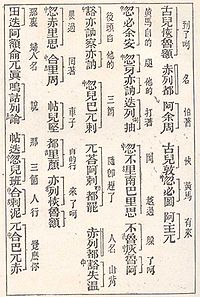 Along with Persian and Arabic
, Chinese characters were also used as a foreign script to write the Mongolian language
, where characters were used to phonetically transcribe Mongolian sounds. Before the 13th century and the establishment of the Mongolian script
, foreign scripts such as Chinese had to be used to write the Mongolian language. Most notably, the only surviving copies of The Secret History of the Mongols
were written in such a manner; the Chinese characters 忙豁侖紐察 脫[卜]察安 (pinyin: mánghuōlúnniǔchá tuō[bo]chá'ān) is the rendering of Mongγol-un niγuca tobčiyan, the title in Mongolian.
starting in 111 BC, while adaptation for the vernacular chữ Nôm script (based on Chinese characters) emerged around the 13th century AD.
The oldest known record of the Sawndip characters used by the Zhuang, a non-Han
peoples from what is today known as Guangxi
, is from a stele dating from 689, which predates the earliest example of Vietnamese chữ Nôm. The Zhuang word for characters used in the Chinese language is "sawgun" (saw meaning character, and cognate to Chinese 字, and gun 倱 meaning the Han Chinese
ethnicity, cognate to 漢), whilst "sawndip" refers to the characters used in the Zhuang language.
The Chinese script spread to Korea
together with Buddhism from the 7th century (hanja
). The Japanese kanji
were adopted for recording the Japanese language from the 8th century AD.
Even the Zhonghua Zihai fails to be completely comprehensive, as it ignores the roughly 1,500 Japanese-made kokuji given in the Kokuji no Jiten as well as the chữ Nôm inventory used only in Vietnam in past days.
Modified radicals and new variants are two common reasons for the ever-increasing number of characters. There are about 300 radicals and 100 are in common use. Creating a new character by modifying the radical is an easy way to disambiguate homograph
s among xíngshēngzì pictophonetic compounds. This practice began long before the standardization of Chinese script by Qin Shi Huang
and continues to the present day. The traditional 3rd-person pronoun tā (他 "he, she, it"), which is written with the "person radical", illustrates modifying significs to form new characters. In modern usage, there is a graphic distinction between tā (她 "she") with the "woman radical", tā (牠 "it") with the "animal radical", tā (它 "it") with the "roof radical", and tā (祂 "He") with the "deity radical", One consequence of modifying radicals is the fossilization of rare and obscure variant logographs, some of which are not even used in Classical Chinese
. For instance, he 和 "harmony, peace", which combines the "grain radical" with the "mouth radical", has infrequent variants 咊 with the radicals reversed and 龢 with the "flute radical".
and Middle Chinese
counterparts, are multi-morphemic
and multi-syllabic compounds, that is, most Chinese words are written with two or more characters; each character representing one syllable. Knowing the meanings of the individual characters of a word will often allow the general meaning of the word to be inferred, but this is not invariably the case.
In the People's Republic of China
, which uses simplified Chinese character
s, the Xiàndài Hànyǔ Chángyòng Zìbiǎo
(现代汉语常用字表, Chart of Common Characters of Modern Chinese) lists 2,500 common characters and 1,000 less-than-common characters, while the Xiàndài Hànyǔ Tōngyòng Zìbiǎo (现代汉语通用字表, Chart of Generally Utilized Characters of Modern Chinese) lists 7,000 characters, including the 3,500 characters already listed above. GB2312, an early version of the national encoding standard used in the People's Republic of China
, has 6,763 code points. GB18030, the modern, mandatory standard, has a much higher number. The New Hànyǔ Shuǐpíng Kǎoshì
(汉语水平考试, Chinese Proficiency Test) proficiency test covers approximately 2,600 characters in its highest level (level six).
In the Republic of China (Taiwan), which uses traditional Chinese character
s, the Ministry of Education's Chángyòng Guózì Biāozhǔn Zìtǐ Biǎo (常用國字標準字體表, Chart of Standard Forms of Common National Characters) lists 4,808 characters; the Cì Chángyòng Guózì Biāozhǔn Zìtǐ Biǎo (次常用國字標準字體表, Chart of Standard Forms of Less-Than-Common National Characters) lists another 6,341 characters. The Chinese Standard Interchange Code (CNS11643)—the official national encoding standard—supports 48,027 characters, while the most widely used encoding scheme, BIG-5
, supports only 13,053.
In Hong Kong
, which uses traditional Chinese character
s, the Education and Manpower Bureau's Soengjung Zi Zijing Biu (常用字字形表), intended for use in elementary and junior secondary education, lists a total of 4,759 characters.
In addition, there is a large corpus of dialect characters (方言字), which are not used in formal written Chinese but represent colloquial terms in non-Mandarin Chinese spoken forms. One such variety is Written Cantonese
, in widespread use in Hong Kong
even for certain formal documents, due to the former British colonial
administration's recognition of Cantonese for use for official purposes. In Taiwan, there is also an informal body of characters used to represent the spoken Hokkien (Min Nan
) dialect. Many dialects have specific characters for words exclusive to the dialect, for example, the vernacular character , pronounced cii11 in Hakka, means "to kill". Furthermore, Shanghainese and Sichaunese
also have their own series of written text, but these are not widely used in actual texts, Mandarin being the preference for all mainland regions.
' onMouseout='HidePop("9415")' href="/topics/Kanji">kanji
") designated by the Japanese Ministry of Education; these are taught during primary and secondary school. The list is a recommendation, not a restriction, and many characters missing from it are still in common use.
The one area where character usage is officially restricted is in names, which may contain only government-approved characters. Since the jōyō kanji list excludes many characters which have been used in personal and place names for generations, an additional list, referred to as the jinmeiyō kanji
, is published. It currently contains 983 characters, bringing the total number of government-endorsed characters to 2928. (See also the Names section of the kanji
article.)
Today, a well-educated Japanese person may know upwards of 3,500 kanji. The kanji kentei
tests a speaker's ability to read and write kanji. The highest level of the kanji kentei tests on 6,000 kanji, though in practice few people attain (or need to attain) this level.
Written Japanese also includes a pair of syllabic scripts
known as kana
, which are used in combination with kanji. In Japanese, verb and adjective inflections, many small and common grammatical and function words, many loanwords, as well as miscellaneous other words, have no kanji forms and are instead written in kana. Therefore, written communication generally requires the use of kana as well as kanji.
, the Korean alphabet. Much of the vocabulary, especially in the realms of science and sociology, comes directly from Chinese, comparable to Latin or Greek root words in European languages. However due to the lack of tones in Korean, as the words were imported from Chinese, many dissimilar characters took on identical sounds, and subsequently identical spelling in hangul. Chinese characters are sometimes used to this day for either clarification in a practical manner, or to give a distinguished appearance, as knowledge of Chinese characters is considered a high class attribute and an indispensable part of a classical education. It is also observed that the preference for Chinese characters is treated as being conservative and Confucian.
In Korea, 한자 hanja
have become a politically contentious issue, with some Koreans urging a "purification" of the national language and culture by totally abandoning their use. These individuals encourage the exclusive use of the native hangul alphabet throughout Korean society and the end to character education in public schools.
In South Korea, educational policy on characters has swung back and forth, often swayed by education ministers' personal opinions. At times, middle and high school students have been formally exposed to 1,800 to 2,000 basic characters, albeit with the principal focus on recognition, with the aim of achieving newspaper-literacy. Since there is little need to use hanja in everyday life, young adult Koreans are often unable to read more than a few hundred characters.
There is a clear trend toward the exclusive use of hangul in day-to-day South Korean society. Hanja are still used to some extent, particularly in newspapers, weddings, place names and calligraphy
. Hanja is also extensively used in situations where ambiguity must be avoided, such as academic papers, high-level corporate reports, government documents, and newspapers; this is due to the large number of homonyms that have resulted from extensive borrowing of Chinese words.
The issue of ambiguity is the main hurdle in any effort to "cleanse" the Korean language of Chinese characters. Characters convey meaning visually, while alphabets convey guidance to pronunciation, which in turn hints at meaning. As an example, in Korean dictionaries, the phonetic entry for 기사 gisa yields more than 30 different entries. In the past, this ambiguity had been efficiently resolved by parenthetically displaying the associated hanja.
In the modern hangul-based Korean writing system, Chinese characters are no longer used to represent native morphemes.
In North Korea, the government, wielding much tighter control than its sister government to the south, has banned Chinese characters from virtually all public displays and media, and mandated the use of hangul in their place.
, a derivative of the Latin alphabet
.
While new characters can be easily coined by writing on paper, they are difficult to represent on a computer – they must generally be represented as a picture, rather than as text – which presents a significant barrier to their use or widespread adoption. Compare with use of symbols as names in American 20th century musical albums such as Led Zeppelin IV
(1971) and Love Symbol Album (1993) – an album cover may potentially contain any graphics, but in writing and other computation these symbols are difficult to use.
, Japanese name
, Korean name
, and Vietnamese name
, respectively). This has caused problems as many computer encoding systems include only the most common characters and exclude the less oft-used characters. This is especially a problem for personal names which often contain rare or classical, antiquated characters.
One man who has encountered this problem is Taiwanese politician Yu Shyi-kun
, due to the rarity of the last character in his name. Newspapers have dealt with this problem in varying ways, including using software to combine two existing, similar characters, including a picture of the personality, or, especially as is the case with Yu Shyi-kun, simply substituting a homophone for the rare character in the hope that the reader would be able to make the correct inference. Taiwanese political posters, movie posters etc. will often add the bopomofo
phonetic symbols next to such a character. Japanese newspapers may render such names and words in katakana
instead of kanji, and it is accepted practice for people to write names for which they are unsure of the correct kanji in katakana instead.
There are also some extremely complex characters which have understandably become rather rare. According to Joël Bellassen
(1989), the most complex Chinese character is /𪚥 (U+2A6A5) zhé , meaning "verbose" and boasting sixty-four strokes; this character fell from use around the 5th century. It might be argued, however, that while boasting the most strokes, it is not necessarily the most complex character (in terms of difficulty), as it simply requires writing the same sixteen-stroke character 龍 lóng (lit. "dragon") four times in the space for one. Another 64-stroke character is /𠔻 (U+2053B) zhèng composed of 興 xīng/xìng (lit. "flourish") four times.
One of the most complex characters found in modern Chinese dictionaries is 齉 (U+9F49) (nàng, , pictured below, middle image), meaning "snuffle" (that is, a pronunciation marred by a blocked nose), with "just" thirty-six strokes. However, this is not in common use. The most complex character that can be input using the Microsoft New Phonetic IME 2002a for traditional Chinese is 龘 (dá, "the appearance of a dragon flying"). It is composed of the dragon radical represented three times, for a total of 16 × 3 = 48 strokes. Among the most complex characters in modern dictionaries and also in frequent modern use are 籲 (yù, "to implore"), with 32 strokes; 鬱 (yù, "luxuriant, lush; gloomy"), with 29 strokes, as in 憂鬱 (yōuyù, "depressed"); 豔 (yàn, "colorful"), with 28 strokes; and 釁 (xìn, "quarrel"), with 25 strokes, as in 挑釁 (tiǎoxìn, "to pick a fight"). Also in occasional modern use is 鱻 (xiān “fresh”; variant of 鮮 xiān) with 33 strokes.
In Japanese
, an 84-stroke kokuji exists: —it is composed of three "cloud" (雲) characters on top of the abovementioned triple "dragon" character (龘). Also meaning "the appearance of a dragon in flight", it has been pronounced おとど otodo, たいと taito, and だいと daito.
The most complex Chinese character still in use may be biáng (pictured right, bottom), with 57 strokes, which refers to Biang biang noodles
, a type of noodle from China
's Shaanxi
province. This character along with syllable biang cannot be found in dictionaries. The fact that it represents a syllable that does not exist in any Standard Chinese
word means that it could be classified as a dialectal character.
Ancient characters
Chinese characters in computing
Others
Logogram
A logogram, or logograph, is a grapheme which represents a word or a morpheme . This stands in contrast to phonograms, which represent phonemes or combinations of phonemes, and determinatives, which mark semantic categories.Logograms are often commonly known also as "ideograms"...
s used in the writing of Chinese
Chinese language
The Chinese language is a language or language family consisting of varieties which are mutually intelligible to varying degrees. Originally the indigenous languages spoken by the Han Chinese in China, it forms one of the branches of Sino-Tibetan family of languages...
(in which case they may be called hanzi; / hànzì "Han
Han Chinese
Han Chinese are an ethnic group native to China and are the largest single ethnic group in the world.Han Chinese constitute about 92% of the population of the People's Republic of China , 98% of the population of the Republic of China , 78% of the population of Singapore, and about 20% of the...
character") and Japanese
Japanese language
is a language spoken by over 130 million people in Japan and in Japanese emigrant communities. It is a member of the Japonic language family, which has a number of proposed relationships with other languages, none of which has gained wide acceptance among historical linguists .Japanese is an...
(called kanji
Kanji
Kanji are the adopted logographic Chinese characters hanzi that are used in the modern Japanese writing system along with hiragana , katakana , Indo Arabic numerals, and the occasional use of the Latin alphabet...
), less frequently Korean
Korean language
Korean is the official language of the country Korea, in both South and North. It is also one of the two official languages in the Yanbian Korean Autonomous Prefecture in People's Republic of China. There are about 78 million Korean speakers worldwide. In the 15th century, a national writing...
(called hanja
Hanja
Hanja is the Korean name for the Chinese characters hanzi. More specifically, it refers to those Chinese characters borrowed from Chinese and incorporated into the Korean language with Korean pronunciation...
), formerly Vietnamese
Vietnamese language
Vietnamese is the national and official language of Vietnam. It is the mother tongue of 86% of Vietnam's population, and of about three million overseas Vietnamese. It is also spoken as a second language by many ethnic minorities of Vietnam...
(called hán tự), or other languages. Chinese characters constitute the oldest continuously-used system of writing in the world.
Chinese characters number in the tens of thousands, though most of these are minor graphic variants only encountered in historical texts. Studies carried out in China
China
Chinese civilization may refer to:* China for more general discussion of the country.* Chinese culture* Greater China, the transnational community of ethnic Chinese.* History of China* Sinosphere, the area historically affected by Chinese culture...
have shown that functional literacy requires a knowledge of between three and four thousand characters.
In Chinese orthography, the characters are largely morphosyllabic
Morpheme
In linguistics, a morpheme is the smallest semantically meaningful unit in a language. The field of study dedicated to morphemes is called morphology. A morpheme is not identical to a word, and the principal difference between the two is that a morpheme may or may not stand alone, whereas a word,...
, each corresponding to a spoken syllable with a distinct meaning. However, the majority of Chinese words today consist of two or more characters. About 10% of native words have two syllables without separate meanings, but they are nonetheless written with two characters. Some characters, generally ligatures, represent polysyllabic words or even phrases, though this is the exception and is generally informal.
Cognate
Cognate
In linguistics, cognates are words that have a common etymological origin. This learned term derives from the Latin cognatus . Cognates within the same language are called doublets. Strictly speaking, loanwords from another language are usually not meant by the term, e.g...
s in the various varieties of Chinese are generally written with the same character. They typically have similar meanings, but often quite different pronunciations. In other languages, most significantly today in Japanese
Japanese language
is a language spoken by over 130 million people in Japan and in Japanese emigrant communities. It is a member of the Japonic language family, which has a number of proposed relationships with other languages, none of which has gained wide acceptance among historical linguists .Japanese is an...
, characters are used to represent native words, ignoring the Chinese pronunciation, to represent Chinese loanwords, and as purely phonetic elements based on their pronunciation in the historical variety of Chinese they were acquired from. These foreign adaptations of Chinese pronunciation are known as Sinoxenic
Sinoxenic
Sino-Xenic refers to the pronunciations given to Chinese characters in Japanese, Korean, and Vietnamese – none of which have accepted genetic relatedness to Sinitic languages – in the Sino-Japanese, Sino-Korean, and Sino-Vietnamese vocabularies...
pronunciations, and have been useful in the reconstruction of Ancient Chinese.
Precursors
In recent decades, inscriptions have been found on NeolithicNeolithic
The Neolithic Age, Era, or Period, or New Stone Age, was a period in the development of human technology, beginning about 9500 BC in some parts of the Middle East, and later in other parts of the world. It is traditionally considered as the last part of the Stone Age...
pottery and on bones at a variety of locations in China, including Banpo
Banpo
Banpo is an archaeological remain discovered in 1953 and located in the Yellow River Valley just east of Xi'an, China. It contains the remains of several well organized Neolithic settlements dating from 5600 - 6700 BP according to radiocarbon dating. It is a large area of 5-6 hectares and...
and Hualouzi near Xi'an
Xi'an
Xi'an is the capital of the Shaanxi province, and a sub-provincial city in the People's Republic of China. One of the oldest cities in China, with more than 3,100 years of history, the city was known as Chang'an before the Ming Dynasty...
. These simple, often geometric marks are similar to some of the earliest known Chinese characters, potentially indicating that the history of Chinese writing extends back over six millennia.
However, because these marks occur singly, without any implied context, and are made crudely and simply, Qiu Xigui concluded that "we do not have any basis for stating that these constituted writing nor is there reason to conclude that they were ancestral to Shang Dynasty
Shang Dynasty
The Shang Dynasty or Yin Dynasty was, according to traditional sources, the second Chinese dynasty, after the Xia. They ruled in the northeastern regions of the area known as "China proper" in the Yellow River valley...
Chinese characters." Nonetheless, isolated graphs and pictures continue to be found periodically, frequently accompanied by media reports that push back the purported beginnings of Chinese writing by thousands of years. For example, at Damaidi
Damaidi
Damaidi , is the location of 3,172 sets of early Chinese petroglyphs, carved into the cliffs which feature 8,453 individual figures. These are believed to represent possibly the earliest writing system known in China....
in Ningxia
Ningxia
Ningxia, formerly transliterated as Ningsia, is an autonomous region of the People's Republic of China. Located in Northwest China, on the Loess Plateau, the Yellow River flows through this vast area of land. The Great Wall of China runs along its northeastern boundary...
, 3,172 pictorial cliff carvings dating to 6000–5000 BC were discovered, leading to headlines such as "Chinese writing '8,000 years old.'" Similarly, archaeologists reported finding a few inscribed symbols on tortoise shells at the Neolithic site of Jiahu
Jiahu
Jiahu was the site of a Neolithic Yellow River settlement based in the central plains of ancient China, modern Wuyang, Henan Province. Archaeologists consider the site to be one of the earliest examples of the Peiligang culture. Settled from 7000 to 5800 BC, the site was later flooded and abandoned...
in Henan
Henan
Henan , is a province of the People's Republic of China, located in the central part of the country. Its one-character abbreviation is "豫" , named after Yuzhou , a Han Dynasty state that included parts of Henan...
dated to around 6600–6200 BC, leading to headlines of "'Earliest writing' which was found in China".
In a comment released to the BBC
BBC
The British Broadcasting Corporation is a British public service broadcaster. Its headquarters is at Broadcasting House in the City of Westminster, London. It is the largest broadcaster in the world, with about 23,000 staff...
, Professor David Keightley
David Keightley
David N. Keightley is an American sinologist, historian, and Professor Emeritus, Department of History, at University of California, Berkeley.He graduated from Columbia University with a PhD.-Works:*, Chinese Science, 12, 1995...
urged caution in the latter instance, pointing to the lack of any direct cultural connection to Shang culture, considering that the Shang Dynasty arose several millennia later. However, in the same BBC article, a supporting argument was provided by Dr. Garman Harbottle of the Brookhaven National Laboratory
Brookhaven National Laboratory
Brookhaven National Laboratory , is a United States national laboratory located in Upton, New York on Long Island, and was formally established in 1947 at the site of Camp Upton, a former U.S. Army base...
in New York City
New York City
New York is the most populous city in the United States and the center of the New York Metropolitan Area, one of the most populous metropolitan areas in the world. New York exerts a significant impact upon global commerce, finance, media, art, fashion, research, technology, education, and...
, who collaborated with a team of archaeologists at the University of Science and Technology of China
University of Science and Technology of China
The University of Science and Technology of China is a national research university in Hefei, People's Republic of China. It is a member of the C9 League formed by nine top universities in China...
in Anhui
Anhui
Anhui is a province in the People's Republic of China. Located in eastern China across the basins of the Yangtze River and the Huai River, it borders Jiangsu to the east, Zhejiang to the southeast, Jiangxi to the south, Hubei to the southwest, Henan to the northwest, and Shandong for a tiny...
in the discovery. Dr. Harbottle pointed to the persistence of sign use at different sites along the Yellow River
Yellow River
The Yellow River or Huang He, formerly known as the Hwang Ho, is the second-longest river in China and the sixth-longest in the world at the estimated length of . Originating in the Bayan Har Mountains in Qinghai Province in western China, it flows through nine provinces of China and empties into...
throughout the Neolithic and up to the Shang period, when a complex writing system appears.
One group of sites of interest is the Dawenkou culture
Dawenkou culture
The Dawenkou culture is a name given by archaeologists to a group of Neolithic communities who lived primarily in Shandong, but also appeared in Anhui, Henan and Jiangsu, China. The culture existed from 4100 BC to 2600 BC, co-existing with the Yangshao culture. Turquoise, jade and ivory artefacts...
sites (2800–2500 BC), only a millennium earlier than the early Shang sites and positioned so as plausibly be ancestral to the Shang. There, a few inscribed pottery and jade pieces have been found, one of which combines pictorial elements (a sun, moon or clouds, and afire or a mountain) in a stack which brings to mind the compounding of elements in Chinese characters. Major scholars are divided in their interpretation of such inscribed symbols. Some, such as Yu Xingwu, Tang Lan, and Li Xueqin have identified these with specific Chinese characters. Others such as Wang Ningsheng interpret them as pictorial symbols such as clan insignia, rather than writing. But in the view of Wang Ningsheng, "True writing begins when it represents sounds and consists of symbols that are able to record language. The few isolated figures found on pottery still cannot substantiate this point."
Legendary origins
According to legend, Chinese characters were invented by CangjieCangjie
Cangjie is a very important figure in ancient China , claimed to be an official historian of the Yellow Emperor and the inventor of Chinese characters. Legend has it that he had four eyes and four pupils, and that when he invented the characters, the deities and ghosts cried and the sky rained...
(c. 2650 BC), a bureaucrat under the legendary Yellow Emperor
Yellow Emperor
The Yellow Emperor or Huangdi1 is a legendary Chinese sovereign and culture hero, included among the Three Sovereigns and Five Emperors. Tradition holds that he reigned from 2697–2597 or 2696–2598 BC...
. There are quite a few variations of the legend. One of them tells that Cangjie was hunting on Mount Yangxu in modern Shanxi
Shanxi
' is a province in Northern China. Its one-character abbreviation is "晋" , after the state of Jin that existed here during the Spring and Autumn Period....
when he saw a tortoise whose veins caught his curiosity. Inspired by the possibility of a logical relation of those veins, he studied the animals of the world, the landscape of the earth, and the stars in the sky, and invented a symbolic system called zì (字) — the first Chinese characters. It was said that on the day the characters were born, Chinese heard the devil mourning and saw crops falling like rain, as it marked a second beginning of the world.
Oracle bone script
Oracle bone script
Oracle bone script refers to incised ancient Chinese characters found on oracle bones, which are animal bones or turtle shells used in divination in Bronze Age China...
. These were identified by scholars in 1899 on pieces of bone and turtle shell being sold as medicine. By 1928, the source of the oracle bones had been traced back to modern Xiaotun village near Anyang
Anyang
Anyang is a prefecture-level city in Henan province, People's Republic of China. The northernmost city in Henan, Anyang borders Puyang to the east, Hebi and Xinxiang to the south, and the provinces of Shanxi and Hebei to its west and north respectively....
in Henan
Henan
Henan , is a province of the People's Republic of China, located in the central part of the country. Its one-character abbreviation is "豫" , named after Yuzhou , a Han Dynasty state that included parts of Henan...
Province, where official archaeological excavations in 1928–1937 discovered 20,000 oracle bone pieces, about 1/5th of the total discovered. The inscriptions were records of the divinations performed for or by the royal Shang household. The oracle bone script is a well-developed writing system, attested from the late Shang Dynasty (1200–1050 BC). Only about 1,400 of the 2,500 known oracle bone script logographs can be identified with later Chinese characters and thus be deciphered by paleographers.
Bronze Age: Parallel script forms and gradual evolution
The traditional picture of an orderly series of scripts, each one invented suddenly and then completely displacing the previous one, has been conclusively demonstrated to be fiction by the archaeological finds and scholarly research of the later 20th and early 21st centuries. Gradual evolution and the coexistence of two or more scripts was more often the case. As early as the Shang Dynasty, oracle bone script coexisted as a simplified form alongside the normal script of bambooBamboo
Bamboo is a group of perennial evergreens in the true grass family Poaceae, subfamily Bambusoideae, tribe Bambuseae. Giant bamboos are the largest members of the grass family....
books (preserved in typical bronze inscriptions), as well as the extra-elaborate pictorial forms (often clan emblems) found on many bronzes.
Western Zhou
The Western Zhōu period was the first half of the Zhou Dynasty of ancient China. It began when King Wu of Zhou overthrew the Shang Dynasty at the Battle of Muye. C.H...
and early Eastern Zhou, the mainstream script evolved in a slow, unbroken fashion, until taking the form now known as seal script
Seal script
Seal script is an ancient style of Chinese calligraphy. It evolved organically out of the Zhōu dynasty script , arising in the Warring State of Qin...
in the late Eastern Zhou in the state of Qin
Qin (state)
The State of Qin was a Chinese feudal state that existed during the Spring and Autumn and Warring States Periods of Chinese history...
, without any clear line of division. Meanwhile other scripts had evolved, especially in the eastern and southern areas during the late Zhou Dynasty
Zhou Dynasty
The Zhou Dynasty was a Chinese dynasty that followed the Shang Dynasty and preceded the Qin Dynasty. Although the Zhou Dynasty lasted longer than any other dynasty in Chinese history, the actual political and military control of China by the Ji family lasted only until 771 BC, a period known as...
, including regional forms, such as the guwen
Guwen
Gǔwén literally means ancient Chinese script. Historically the term has been used in several different ways.The first usage, which is common, is as a reference to the most ancient forms of Chinese writing, namely the writing of the Shāng and early Zhōu dynasties, such as found on oracle bones,...
(“ancient forms”) of the eastern Warring States preserved in the Han Dynasty
Han Dynasty
The Han Dynasty was the second imperial dynasty of China, preceded by the Qin Dynasty and succeeded by the Three Kingdoms . It was founded by the rebel leader Liu Bang, known posthumously as Emperor Gaozu of Han. It was briefly interrupted by the Xin Dynasty of the former regent Wang Mang...
character dictionary Shuowen Jiezi as variant forms, as well as decorative forms such as bird and insect scripts
Bird-worm seal script
Bird-worm seal script , is a type of ancient seal script originated from China.-Names:...
.
Unification: Seal script, vulgar writing and proto-clerical
Seal scriptSeal script
Seal script is an ancient style of Chinese calligraphy. It evolved organically out of the Zhōu dynasty script , arising in the Warring State of Qin...
, which had evolved slowly in the state of Qin during the Eastern Zhou Dynasty
Zhou Dynasty
The Zhou Dynasty was a Chinese dynasty that followed the Shang Dynasty and preceded the Qin Dynasty. Although the Zhou Dynasty lasted longer than any other dynasty in Chinese history, the actual political and military control of China by the Ji family lasted only until 771 BC, a period known as...
, became standardized and adopted as the formal script for all of China in the Qin Dynasty
Qin Dynasty
The Qin Dynasty was the first imperial dynasty of China, lasting from 221 to 207 BC. The Qin state derived its name from its heartland of Qin, in modern-day Shaanxi. The strength of the Qin state was greatly increased by the legalist reforms of Shang Yang in the 4th century BC, during the Warring...
(leading to a popular misconception that it was invented at that time), and was still widely used for decorative engraving and seal
Seal (device)
A seal can be a figure impressed in wax, clay, or some other medium, or embossed on paper, with the purpose of authenticating a document ; but the term can also mean the device for making such impressions, being essentially a mould with the mirror image of the design carved in sunken- relief or...
s (name chops, or signets) in the Han Dynasty
Han Dynasty
The Han Dynasty was the second imperial dynasty of China, preceded by the Qin Dynasty and succeeded by the Three Kingdoms . It was founded by the rebel leader Liu Bang, known posthumously as Emperor Gaozu of Han. It was briefly interrupted by the Xin Dynasty of the former regent Wang Mang...
period. However, despite the Qin script standardization, more than one script remained in use at the time. For example, a little-known, rectilinear and roughly executed kind of common (vulgar) writing had for centuries coexisted with the more formal seal script in the Qin state
Qin (state)
The State of Qin was a Chinese feudal state that existed during the Spring and Autumn and Warring States Periods of Chinese history...
, and the popularity of this vulgar writing grew as the use of writing itself became more widespread. By the Warring States period
Warring States Period
The Warring States Period , also known as the Era of Warring States, or the Warring Kingdoms period, covers the Iron Age period from about 475 BC to the reunification of China under the Qin Dynasty in 221 BC...
, an immature form of clerical script
Clerical script
The clerical script , also formerly chancery script, is an archaic style of Chinese calligraphy which evolved in the Warring States period to the Qin dynasty, was dominant in the Han dynasty, and remained in use through the Wèi-Jìn periods...
called “early clerical” or “proto-clerical” had already developed in the state of Qin based upon this vulgar writing, and with influence from seal script as well. The coexistence of the three scripts – small seal, vulgar and proto-clerical, with the latter evolving gradually in the Qin to early Han dynasties into clerical script
Clerical script
The clerical script , also formerly chancery script, is an archaic style of Chinese calligraphy which evolved in the Warring States period to the Qin dynasty, was dominant in the Han dynasty, and remained in use through the Wèi-Jìn periods...
– runs counter to the traditional belief that the Qin Dynasty had one script only, and that clerical script was suddenly invented in the early Han Dynasty from the small seal script.
Proto-clerical evolving to clerical
Proto-clerical script, which had emerged by the time of the Warring States period from vulgar Qin writing, matured gradually, and by the early Western Han period, it was little different from that of the Qin. Recently-discovered bamboo slips show the script becoming mature clerical script by the middle-to-late reign of Emperor Wu of the Western HanEmperor Wu of Han
Emperor Wu of Han , , personal name Liu Che , was the seventh emperor of the Han Dynasty of China, ruling from 141 BC to 87 BC. Emperor Wu is best remembered for the vast territorial expansion that occurred under his reign, as well as the strong and centralized Confucian state he organized...
, who ruled from 141 BC to 87 BC.
Clerical & clerical cursive
Contrary to the popular belief of there being only one script per period, there were in fact multiple scripts in use during the Han period. Although mature clerical scriptClerical script
The clerical script , also formerly chancery script, is an archaic style of Chinese calligraphy which evolved in the Warring States period to the Qin dynasty, was dominant in the Han dynasty, and remained in use through the Wèi-Jìn periods...
, also called 八分 (bāfēn) script, was dominant at that time, an early type of cursive script
Cursive script (East Asia)
Cursive script , sometimes translated as Grass script is a style of Chinese calligraphy. Cursive script is faster to write than other styles, but difficult to read for those unfamiliar with it. It functions primarily as a kind of shorthand script or calligraphic style...
was also in use by the Han by at least as early as 24 BC (during the very late Western Han period), incorporating cursive forms popular at the time, well as many elements from the vulgar writing of the Warring State of Qin
Qin (state)
The State of Qin was a Chinese feudal state that existed during the Spring and Autumn and Warring States Periods of Chinese history...
. By around the time of the Eastern Jin dynasty, this Han cursive became known as 章草 zhāngcǎo (also known as 隶草 / 隸草 lìcǎo today), or in English sometimes clerical cursive, ancient cursive, or draft cursive. Some believe that the name, based on 章 zhāng meaning "orderly", arose because the script was a more orderly form of cursive than the modern form
Cursive script (East Asia)
Cursive script , sometimes translated as Grass script is a style of Chinese calligraphy. Cursive script is faster to write than other styles, but difficult to read for those unfamiliar with it. It functions primarily as a kind of shorthand script or calligraphic style...
, which emerged during the Eastern Jin Dynasty and is still in use today, called 今草 jīncǎo or "modern cursive".
Neo-clerical
Around the mid-Eastern Han period, a simplified and easier-to-write form of clerical script appeared, which Qiú (2000, p. 113 & 139) terms "neo-clerical" (新隶体 / 新隸體, xīnlìtǐ). By the late Eastern Han, this had become the dominant daily script, although the formal, mature bāfēn (八分) clerical script remained in use for formal works such as engraved stelae. Qiú describes this neo-clerical script as a transition between clerical and regular script, and it remained in use through the Cao WeiCao Wei
Cao Wei was one of the states that competed for control of China during the Three Kingdoms period. With the capital at Luoyang, the state was established by Cao Pi in 220, based upon the foundations that his father Cao Cao laid...
and Jin dynasties.
Semi-cursive
By the late Eastern Han period, an early form of semi-cursive scriptSemi-cursive script
Semi-cursive script is a cursive style of Chinese characters. Because it is not as abbreviated as cursive, most people who can read regular script can read semi-cursive....
appeared, developing out of a cursively-written form of neo-clerical script and simple cursive. This semi-cursive script was traditionally attributed to Liu Desheng ca. 147–188 AD, although such attributions refer to early masters of a script rather than to their actual inventors, since the scripts generally evolved into being over time. Qiu gives examples of early semi-cursive script, showing that it had popular origins rather than being purely Liu’s invention.
Written styles
The Shang Dynasty
Shang Dynasty
The Shang Dynasty or Yin Dynasty was, according to traditional sources, the second Chinese dynasty, after the Xia. They ruled in the northeastern regions of the area known as "China proper" in the Yellow River valley...
oracle bone script
Oracle bone script
Oracle bone script refers to incised ancient Chinese characters found on oracle bones, which are animal bones or turtle shells used in divination in Bronze Age China...
and the Zhou Dynasty
Zhou Dynasty
The Zhou Dynasty was a Chinese dynasty that followed the Shang Dynasty and preceded the Qin Dynasty. Although the Zhou Dynasty lasted longer than any other dynasty in Chinese history, the actual political and military control of China by the Ji family lasted only until 771 BC, a period known as...
scripts found on Chinese bronze inscriptions are no longer used; the oldest script that is still in use today is the Seal Script
Seal script
Seal script is an ancient style of Chinese calligraphy. It evolved organically out of the Zhōu dynasty script , arising in the Warring State of Qin...
(篆书 / 篆書, zhuànshū). It evolved organically out of the Spring and Autumn period Zhou script, and was adopted in a standardized form under the first Emperor of China
Emperor of China
The Emperor of China refers to any sovereign of Imperial China reigning between the founding of Qin Dynasty of China, united by the King of Qin in 221 BCE, and the fall of Yuan Shikai's Empire of China in 1916. When referred to as the Son of Heaven , a title that predates the Qin unification, the...
, Qin Shi Huang
Qin Shi Huang
Qin Shi Huang , personal name Ying Zheng , was king of the Chinese State of Qin from 246 BC to 221 BC during the Warring States Period. He became the first emperor of a unified China in 221 BC...
. The seal script, as the name suggests, is now used only in artistic seals. Few people are still able to read it effortlessly today, although the art of carving a traditional seal in the script remains alive; some calligraphers
East Asian calligraphy
East Asian calligraphy is a form of calligraphy widely practised and revered in the Sinosphere. This most often includes China, Japan, Korea, and Vietnam. The East Asian calligraphic tradition originated and developed from China. There is a general standardization of the various styles of...
also work in this style.
Scripts that are still used regularly are the "Clerical Script
Clerical script
The clerical script , also formerly chancery script, is an archaic style of Chinese calligraphy which evolved in the Warring States period to the Qin dynasty, was dominant in the Han dynasty, and remained in use through the Wèi-Jìn periods...
" (隶书 / 隸書, lìshū) of the Qin Dynasty
Qin Dynasty
The Qin Dynasty was the first imperial dynasty of China, lasting from 221 to 207 BC. The Qin state derived its name from its heartland of Qin, in modern-day Shaanxi. The strength of the Qin state was greatly increased by the legalist reforms of Shang Yang in the 4th century BC, during the Warring...
to the Han Dynasty
Han Dynasty
The Han Dynasty was the second imperial dynasty of China, preceded by the Qin Dynasty and succeeded by the Three Kingdoms . It was founded by the rebel leader Liu Bang, known posthumously as Emperor Gaozu of Han. It was briefly interrupted by the Xin Dynasty of the former regent Wang Mang...
, the Weibei (魏碑, wèibēi), the "Regular Script
Regular script
Regular script , also called 正楷 , 真書 , 楷体 and 正書 , is the newest of the Chinese script styles Regular script , also called 正楷 , 真書 (zhēnshū), 楷体 (kǎitǐ) and 正書 (zhèngshū), is the newest of the Chinese script styles Regular script , also called 正楷 , 真書 (zhēnshū), 楷体 (kǎitǐ) and 正書 (zhèngshū), is...
" (楷书 / 楷書, kǎishū), which is used mostly for printing, and the "Semi-cursive Script
Semi-cursive script
Semi-cursive script is a cursive style of Chinese characters. Because it is not as abbreviated as cursive, most people who can read regular script can read semi-cursive....
" (行书 / 行書, xíngshū), used mostly for handwriting.
The cursive script
Cursive script (East Asia)
Cursive script , sometimes translated as Grass script is a style of Chinese calligraphy. Cursive script is faster to write than other styles, but difficult to read for those unfamiliar with it. It functions primarily as a kind of shorthand script or calligraphic style...
(草书 / 草書, cǎoshū, literally "grass script") is used informally. The basic character shapes are suggested, rather than explicitly realized, and the abbreviations are sometimes extreme. Despite being cursive to the point where individual strokes are no longer differentiable and the characters often illegible to the untrained eye, this script (also known as draft) is highly revered for the beauty and freedom that it embodies. Some of the simplified Chinese characters adopted by the People's Republic of China
People's Republic of China
China , officially the People's Republic of China , is the most populous country in the world, with over 1.3 billion citizens. Located in East Asia, the country covers approximately 9.6 million square kilometres...
, and some of the simplified characters used in Japan, are derived from the cursive script. The Japanese hiragana
Hiragana
is a Japanese syllabary, one basic component of the Japanese writing system, along with katakana, kanji, and the Latin alphabet . Hiragana and katakana are both kana systems, in which each character represents one mora...
script is also derived from this script.
There also exist scripts created outside China, such as the Japanese Edomoji
Edomoji
are Japanese lettering styles, which were invented for advertising in the Edo period.The main styles of Edomoji include Kanteiryū, Yosemoji, Kagomoji, Higemoji, Chōchinmoji and Kakuji .-Kanteiryū :...
styles; these have tended to remain restricted to their countries of origin, rather than spreading to other countries like the Chinese scripts.
Regular script
Regular scriptRegular script
Regular script , also called 正楷 , 真書 , 楷体 and 正書 , is the newest of the Chinese script styles Regular script , also called 正楷 , 真書 (zhēnshū), 楷体 (kǎitǐ) and 正書 (zhèngshū), is the newest of the Chinese script styles Regular script , also called 正楷 , 真書 (zhēnshū), 楷体 (kǎitǐ) and 正書 (zhèngshū), is...
has been attributed to Zhong Yao
Zhong Yao
Zhong Yao was a Chinese calligrapher and politician of Cao Wei during the late Han Dynasty and Three Kingdoms period of Chinese history. Born in modern Xuchang, Henan, he was at one time the Grand Administrator of Chang'an....
, of the Eastern Han to Cao Wei
Cao Wei
Cao Wei was one of the states that competed for control of China during the Three Kingdoms period. With the capital at Luoyang, the state was established by Cao Pi in 220, based upon the foundations that his father Cao Cao laid...
period (ca. 151–230 AD), who has been called the “father of regular script”. However, some scholars postulate that one person alone could not have developed a new script which was universally adopted, but could only have been a contributor to its gradual formation. The earliest surviving pieces written in regular script are copies of Yao's works, including at least one copied by Wang Xizhi
Wang Xizhi
Wang Xizhi was a Chinese calligrapher, traditionally referred to as the Sage of Calligraphy , who lived during the Jin Dynasty...
. This new script, which is the dominant modern Chinese script, developed out of a neatly-written form of early semi-cursive, with addition of the pause (顿 / 頓, dùn) technique to end horizontal strokes, plus heavy tails on strokes which are written to the downward-right diagonal. Thus, early regular script emerged from a neat, formal form of semi-cursive, which had itself emerged from neo-clerical (a simplified, convenient form of clerical script). It then matured further in the Eastern Jin Dynasty in the hands of the "Sage of Calligraphy", Wang Xizhi
Wang Xizhi
Wang Xizhi was a Chinese calligrapher, traditionally referred to as the Sage of Calligraphy , who lived during the Jin Dynasty...
, and his son Wang Xianzhi. It was not, however, in widespread use at that time, and most writers continued using neo-clerical, or a somewhat semi-cursive form of it, for daily writing, while the conservative bafen clerical script remained in use on some stelae, alongside some semi-cursive, but primarily neo-clerical.
Modern cursive
Meanwhile, modern cursive script slowly emerged out of the clerical cursive (zhāngcǎo) script during the Cao Wei to Jin period, under the influence of both semi-cursive and the newly emerged regular script. Cursive was formalized in the hands of a few master calligraphers, the most famous and influential of which was Wang XizhiWang Xizhi
Wang Xizhi was a Chinese calligrapher, traditionally referred to as the Sage of Calligraphy , who lived during the Jin Dynasty...
.
Dominance and maturation of regular script
It was not until the Southern and Northern DynastiesSouthern and Northern Dynasties
The Southern and Northern Dynasties was a period in the history of China that lasted from 420 to 589 AD. Though an age of civil war and political chaos, it was also a time of flourishing arts and culture, advancement in technology, and the spreading of Mahayana Buddhism and Daoism...
that regular script rose to dominant status. During that period, regular script continued evolving stylistically, reaching full maturity in the early Tang Dynasty
Tang Dynasty
The Tang Dynasty was an imperial dynasty of China preceded by the Sui Dynasty and followed by the Five Dynasties and Ten Kingdoms Period. It was founded by the Li family, who seized power during the decline and collapse of the Sui Empire...
. Some call the writing of the early Tang calligrapher Ouyang Xun
Ouyang Xun
Ouyang Xun , courtesy name Xinben , was a Confucian scholar and calligrapher of the early Tang Dynasty. He was born in Hunan, Changsha, to a family of government officials; and died in modern Anhui province.-Achievements:...
(557–641) the first mature regular script. After this point, although developments in the art of calligraphy and in character simplification still lay ahead, there were no more major stages of evolution for the mainstream script.
Modern history
Although most of the simplified Chinese characters in use today are the result of the works moderated by the government of the People's Republic of ChinaPeople's Republic of China
China , officially the People's Republic of China , is the most populous country in the world, with over 1.3 billion citizens. Located in East Asia, the country covers approximately 9.6 million square kilometres...
in the 1950s and 60s, character simplification predates the republic's formation in 1949.
One of the earliest proponents of character simplification was Lufei Kui
Lufei Kui
Lufei Kui was a Chinese educationist and publisher. His courtesy name was Bo hong . He is known in his advocacy for simplified Chinese characters.-Early life:...
, who proposed in 1909 that simplified characters should be used in education. In the years following the May Fourth Movement
May Fourth Movement
The May Fourth Movement was an anti-imperialist, cultural, and political movement growing out of student demonstrations in Beijing on May 4, 1919, protesting the Chinese government's weak response to the Treaty of Versailles, especially the Shandong Problem...
in 1919, many anti-imperialist Chinese intellectuals sought ways to modernise China. In the 1930s and 1940s, discussions on character simplification took place within the Kuomintang
Kuomintang
The Kuomintang of China , sometimes romanized as Guomindang via the Pinyin transcription system or GMD for short, and translated as the Chinese Nationalist Party is a founding and ruling political party of the Republic of China . Its guiding ideology is the Three Principles of the People, espoused...
government, and a large number of Chinese intellectuals and writers have long maintained that character simplification would help boost literacy in China. In many world languages, literacy has been promoted as a justification for spelling reform
Spelling reform
Many languages have undergone spelling reform, where a deliberate, often officially sanctioned or mandated, change to spelling takes place. Proposals for such reform are also common....
s. The People's Republic of China issued its first round of official character simplifications in two documents, the first in 1956 and the second in 1964. In the 1950s and 1960s, while confusion about simplified characters was still rampant, transitional characters that mixed simplified parts with yet-to-be simplified parts of characters together appeared briefly, then disappeared.
"Han unification
Han unification
Han unification is an effort by the authors of Unicode and the Universal Character Set to map multiple character sets of the so-called CJK languages into a single set of unified characters. Han characters are a common feature of written Chinese , Japanese , Korean , and—at least historically—other...
" was an effort by the authors of Unicode and the Universal Character Set to map multiple character sets of the so-called CJK languages (Chinese/Japanese/Korean) into a single set of unified characters and was completed for the purposes of Unicode
Unicode
Unicode is a computing industry standard for the consistent encoding, representation and handling of text expressed in most of the world's writing systems...
in 1991 (Unicode 1.0).
Formation of characters
| Category | Percentage of characters (approximation) |
|---|---|
| Phono-semantic compounds | 82% |
| Ideogrammic compounds | 13% |
| Pictograms | 4% |
| Ideograms | Few (less than 1%) |
| Transformed cognates | Few |
| Rebus | Few |
The earliest known Chinese texts, in the Oracle bone script
Oracle bone script
Oracle bone script refers to incised ancient Chinese characters found on oracle bones, which are animal bones or turtle shells used in divination in Bronze Age China...
, display a fully developed writing system, with little difference in functionality from modern characters. It is assumed that the early stages of the development of characters were dominated by pictogram
Pictogram
A pictograph, also called pictogram or pictogramme is an ideogram that conveys its meaning through its pictorial resemblance to a physical object. Pictographs are often used in writing and graphic systems in which the characters are to considerable extent pictorial in appearance.Pictography is a...
s, which were the objects depicted, and ideogram
Ideogram
An ideogram or ideograph is a graphic symbol that represents an idea or concept. Some ideograms are comprehensible only by familiarity with prior convention; others convey their meaning through pictorial resemblance to a physical object, and thus may also be referred to as pictograms.Examples of...
s, in which meaning was expressed iconically
Iconicity
In functional-cognitive linguistics, as well as in semiotics, iconicity is the conceived similarity or analogy between the form of a sign and its meaning, as opposed to arbitrariness.Iconic principles:...
. The demands of writing full language, including words which had no easy pictographic or iconic representation, forced an expansion of this system, presumably through use of rebus
Rebus
A rebus is an allusional device that uses pictures to represent words or parts of words. It was a favourite form of heraldic expression used in the Middle Ages to denote surnames, for example in its basic form 3 salmon fish to denote the name "Salmon"...
.
The presumed methods of forming characters were first classified c. 100 AD by the Chinese linguist Xu Shen
Xu Shen
Xǔ Shèn was a Chinese philologist of the Han Dynasty. He was the author of Shuowen Jiezi, the first Chinese dictionary with character analysis, as well as the first to organize the characters by shared components. It contains over 9,000 character entries under 540 radicals, explaining the origins...
(許慎), whose etymological dictionary Shuowen Jiezi
Shuowen Jiezi
The Shuōwén Jiězì was an early 2nd century CE Chinese dictionary from the Han Dynasty. Although not the first comprehensive Chinese character dictionary , it was still the first to analyze the structure of the characters and to give the rationale behind them , as well as the first to use the...
(说文解字 / 說文解字) divides the script into six categories, the liùshū (六书 / 六書). While the categories and classification are occasionally problematic and arguably fail to reflect the complete nature of the Chinese writing system, this account has been perpetuated by its long history and pervasive use.
Four percent of Chinese characters are derived directly from individual pictograms, though in most cases the resemblance to an object is no longer clear. Others were derived as ideograms; as compound ideograms, where two ideograms are combined to give a third reading; and as rebuses. But most characters were devised as phono-semantic compounds, with one element to indicate the general category of meaning and the other to suggest the pronunciation. Again, in many cases the suggested sound is no longer accurate. All today are logograms, and are not actually used pictographically or ideographically.
Pictograms
, xiàngxíngzìPictograms make up only a small portion of Chinese characters. While characters in this class derive from pictures, they have been standardized, simplified, and stylized to make them easier to write, and their derivation is therefore not always obvious. Examples include rì for "sun", yuè for "moon", and mù for "tree"....
There is no concrete number for the proportion of modern characters that are pictographic in nature; however, Xu Shen (c. 100 AD) estimated that 4% of characters fell into this category.
Ideograms
, zhǐshìzìAlso called simple indicatives or simple ideographs, these characters either modify existing pictographs iconically, or are direct iconic illustrations. For instance, by modifying dāo, a pictogram for "knife", by marking the blade, an ideogram rèn for "blade" is obtained. Direct examples include shàng "up" and xià "down". This category is small.
Ideogrammic compounds
/ , huìyìzìTranslated literally as logical aggregates or associative compounds, these characters symbolically combine pictograms or ideograms to create a third character. For instance, doubling the pictogram mù "tree" produces lín "grove", while tripling it produces sēn "forest". (It is interesting to note (see below) that and both have the same reconstructed Old Chinese final *-ǐǝm.) Similarly, combining rì "sun" and yuè "moon", the two natural sources of light, makes míng "bright". Other commonly cited examples
include the characters xiū "rest", composed of the pictograms rén "person" and mù "tree", and also hǎo "good", composed of the pictograms nǚ "woman" and zǐ "son/child".
Xu Shen estimated that 13% of characters fall into this category.
Some scholars flatly reject the existence of this category, opining that failure of modern attempts to identify a phonetic in a compound is due simply to our not looking at ancient "secondary readings", which were lost over time. For example, the character ān "peace", a combination of "roof" and "woman" , is commonly cited as an ideogrammic compound, purportedly motivated by a meaning such as "all is peaceful with the woman at home". However, there is evidence that 女 was once a polyphone with a secondary reading of *an, as may be gleaned from the set yàn "tranquil", nuán "to quarrel", and jiān "licentious". Supporting this reasoning is the fact that modern interpretations often neglect archaic forms that were in use when the characters were created.
These arguments notwithstanding, there are some characters that do appear to genuinely belong to this category. It is doubtful that secondary readings can be found for many cases, and the characters , , , , and are all attested in oracle bone script, with the same components as the modern forms.
Further, some modern characters have certainly been coined by this method, such as some chemical names such as 鉑 (platinum, "white metal"), created in 19th century China – see chemical elements in East Asian languages – and the Japanese-coined (kokuji) Chinese characters for SI units for some (but not all) SI units, such as 粁 (米 "meter" + 千 "thousand, kilo-") for kilometer, coined in the late 19th century (Meiji era).
Phono-semantic compounds
/ , xíngshēngzìBy far the most numerous characters are the phono-semantic compounds, also called semantic-phonetic compounds or pictophonetic compounds. These characters are composed of two parts: one of a limited set of characters called 'radicals', which are often graphically simplified and which suggests the general meaning of the character, and an existing character pronounced approximately as the new target word.
Examples are hé "river", hú "lake", liú "stream", chōng "riptide" (or "flush"), huá "slippery". All these characters have on the left a radical
Radical (Chinese character)
A Chinese radical is a component of a Chinese character. The term may variously refer to the original semantic element of a character, or to any semantic element, or, loosely, to any element whatever its origin or purpose...
of three short strokes, which is a simplified pictograph for a river, indicating that the character has a semantic connection with water; the right-hand side in each case is a phonetic indicator. For example, in the case of chōng (Old Chinese /druŋ/), the phonetic indicator is zhōng (Old Chinese /truŋ/), which by itself means "middle". In this case it can be seen that the pronunciation of the character is slightly different from that of its phonetic indicator; this process means that the composition of such characters can sometimes seem arbitrary today. Further, the choice of radicals may also seem arbitrary in some cases; for example, the radical of māo "cat" is zhì, originally a pictograph for worms, but in characters of this sort indicating an animal of any kind.
Xu Shen (c. 100 AD) placed approximately 82% of characters into this category, while in the Kangxi Dictionary
Kangxi dictionary
The Kangxi Dictionary was the standard Chinese dictionary during the 18th and 19th centuries. The Kangxi Emperor of the Manchu Qing Dynasty ordered its compilation in 1710. The creator innovated greatly by reusing and confirming the new Zihui system of 596 radicals, since then known as 596 Kangxi...
(1716 AD) the number is closer to 90%, due to the extremely productive use of this technique to extend the Chinese vocabulary.
This method is still sometimes used to form new characters, for example bù ("plutonium
Plutonium
Plutonium is a transuranic radioactive chemical element with the chemical symbol Pu and atomic number 94. It is an actinide metal of silvery-gray appearance that tarnishes when exposed to air, forming a dull coating when oxidized. The element normally exhibits six allotropes and four oxidation...
") is the metal radical jīn plus the phonetic component bù, described in Chinese as " gives sound, gives meaning". Many Chinese names of elements in the periodic table and many other chemistry-related characters
Organic nomenclature in Chinese
The Chinese Chemical Society lays out a set of rules based on those given by the International Union of Pure and Applied Chemistry for the purpose of systematic organic nomenclature in Chinese...
were formed this way.
In occasional cases, a 2-character compound word will share a radical across both characters (use the same radical on both characters), with the radical serving to disambiguate the entire word. A notable example is biwa
Biwa
The is a Japanese short-necked fretted lute, often used in narrative storytelling. The biwa is the chosen instrument of Benten, goddess of music, eloquence, poetry, and education in Japanese Shinto....
(a Chinese lute, also a fruit, the loquat
Loquat
The loquat , Eriobotrya japonica, is a fruit tree in the family Rosaceae, indigenous to southeastern China. It was formerly thought to be closely related to the genus Mespilus, and is still sometimes known as the Japanese medlar...
, of similar shape) – originally written as 批把 with the hand radical, referring to the down and up strokes when playing this instrument, which was then changed to 枇杷 (tree radical), which is still used for the fruit, while the character was changed to 琵琶 when referring to the instrument. Another example, this one in Japanese, is 醗酵 (fermentation – 酵 is a Japanese kokuji), which shares the wine bottle radical 酉, due to relation of wine to fermentation, though this may also be written 発酵. In other cases a compound word may coincidentally share a radical without this being meaningful.
Transformed cognates
/ , zhuǎnzhùzìCharacters in this category originally didn't represent the same meaning but have bifurcated through orthographic
Orthography
The orthography of a language specifies a standardized way of using a specific writing system to write the language. Where more than one writing system is used for a language, for example Kurdish, Uyghur, Serbian or Inuktitut, there can be more than one orthography...
and often semantic drift
Semantic change
Semantic change, also known as semantic shift or semantic progression describes the evolution of word usage — usually to the point that the modern meaning is radically different from the original usage. In diachronic linguistics, semantic change is a change in one of the meanings of a word...
. For instance, kǎo "to verify" and lǎo "old" were once the same character, meaning "elderly person", but detached into two separate words. Characters of this category are rare, so in modern systems this group is often omitted or combined with others.
Rebus
, jiǎjièzìAlso called borrowings or phonetic loan characters, this category covers cases where an existing character is used to represent an unrelated word with similar or identical pronunciation; sometimes the old meaning is then lost completely, as with characters such as zì, which has lost its original meaning of "nose" completely and exclusively means "oneself", or wàn, which originally meant "scorpion" but is now used only in the sense of "ten thousand" as evidenced by modern character dictionaries.
The jiǎjièzì class of characters may be thought of as pivotal in the history of writing in China insofar as it can be said to represent the stage at which writing either moves from syllabic to alphabetic form, or doesn't as was the case in China. That Chinese characters, in desemanticized form, were used purely for their sound value is attested on numerous occasions in the Chun Qiu 春秋 and Zhan Guo 战国 manuscripts in which 'zhi' 氏 was used to write 'shi' 是 and vice versa, just lines apart; the same is in evidence for 'shao' 勺 for 'Zhao' 赵, with the characters in question being homophonous or nearly homophonous at the time.
In this sense, Chinese characters may be seen as a case of arrested development in that as a system of writing single letters failed to be synthecized from the syllable as was the case with forms of writing derived from hieroglyphics. Some scholars view this fact as having adversely affected the capacity of the users of Chinese characters for abstract thought and creative endeavors in general since precisely this division of syllables into individual letters is seen as crucial to such a development.
Polysyllabic words and polysyllabic characters
Most Chinese morphemeMorpheme
In linguistics, a morpheme is the smallest semantically meaningful unit in a language. The field of study dedicated to morphemes is called morphology. A morpheme is not identical to a word, and the principal difference between the two is that a morpheme may or may not stand alone, whereas a word,...
s (not necessarily words) are monosyllabic and are written with a single character. However, a number of basic morphemes are disyllabic, and this dates back to Classical Chinese. Excluding foreign loan words, these are typically words for plants and small animals. Usually the two characters, which may have no independent meaning apart from poetic abbreviation for the disyllabic word, will each have a phonetic for that syllable and share a common radical. Examples are 蝴蝶 húdié 'butterfly' and 珊瑚 shānhú 'coral'. Note that the 蝴 hú of húdié and the 瑚 hú of shānhú have the same phonetic, 胡, but different radicals (insect and stone, respectively). Neither exists as an independent morpheme except as an abbreviation.
With the fusion of the diminutive -er suffix in Mandarin, monosyllabic words may even be written with two characters, as in 花儿 huār 'flower'.
On the other hand, compound words and set phrases may be conflated into single characters. Common examples are 圕 túshūguǎn 'library', a contraction of 圖書館, and 瓩 qiānwǎ 'kilowatt', a contraction of 千瓦. A four-morpheme word, 社会主义 shèhuì zhǔyì 'socialism', is commonly written with a single character formed by combining the last character, 义, with the radical of the first, 社. This is not a recent phenomenon; in medieval manuscripts 菩薩 púsà 'bodhisattva' is sometimes written with a single character formed of four 十. In the Oracle Bone script, personal names and ritual items are commonly contracted into single characters, and although it is discouraged by language planners, in the modern language phrases such as 七十人 qīshí rén 'seventy people' and 受又(祐) shòu yòu 'receive blessings' are fused into single characters as well. There are elements here of true logographology, where characters represent whole words rather than syllable-morphemes, though some are phrases rather than words. They might be better seen as ligatures. (See Chinese ligatures.)
Variants
Just as Roman letters have a characteristic shape (lower-case letters mostly occupying the x-heightX-height
In typography, the x-height or corpus size refers to the distance between the baseline and the mean line in a typeface. Typically, this is the height of the letter x in the font , as well as the u, v, w, and z...
, with ascenders or descenders on some letters), Chinese characters occupy a more or less square area in which the components of every character are written to fit in order to maintain a uniform size and shape, especially with small printed characters in Ming and sans-serif styles. Because of this, beginners often practise writing on squared graph paper, and the Chinese sometimes use the term "Square-Block Characters" (方块字 / 方塊字, fāngkuàizì), sometimes translated as tetragraph, in reference to Chinese characters.
Despite standardization, some nonstandard forms are commonly used, especially in handwriting.
Regional standards
The nature of Chinese characters makes it very easy to produce allographs for many characters, and there have been many efforts at orthographical standardization throughout history. In recent times, the widespread usage of the characters in several different nations has prevented any particular system becoming universally adopted and the standard form of many Chinese characters thus varies in different regions.Mainland China
Mainland China
Mainland China, the Chinese mainland or simply the mainland, is a geopolitical term that refers to the area under the jurisdiction of the People's Republic of China . According to the Taipei-based Mainland Affairs Council, the term excludes the PRC Special Administrative Regions of Hong Kong and...
adopted simplified Chinese characters in 1956. They are also used in Singapore
Singapore
Singapore , officially the Republic of Singapore, is a Southeast Asian city-state off the southern tip of the Malay Peninsula, north of the equator. An island country made up of 63 islands, it is separated from Malaysia by the Straits of Johor to its north and from Indonesia's Riau Islands by the...
. Traditional Chinese characters are used in Hong Kong
Hong Kong
Hong Kong is one of two Special Administrative Regions of the People's Republic of China , the other being Macau. A city-state situated on China's south coast and enclosed by the Pearl River Delta and South China Sea, it is renowned for its expansive skyline and deep natural harbour...
, Macau
Macau
Macau , also spelled Macao , is, along with Hong Kong, one of the two special administrative regions of the People's Republic of China...
and Taiwan
Taiwan
Taiwan , also known, especially in the past, as Formosa , is the largest island of the same-named island group of East Asia in the western Pacific Ocean and located off the southeastern coast of mainland China. The island forms over 99% of the current territory of the Republic of China following...
. Postwar Japan has used its own less drastically simplified characters, Shinjitai
Shinjitai
Shinjitai are the forms of kanji used in Japan since the promulgation of the Tōyō Kanji List in 1946. Some of the new forms found in shinjitai are also found in simplified Chinese, but shinjitai is generally not as extensive in the scope of its modification...
, since 1946, while South Korea
South Korea
The Republic of Korea , , is a sovereign state in East Asia, located on the southern portion of the Korean Peninsula. It is neighbored by the People's Republic of China to the west, Japan to the east, North Korea to the north, and the East China Sea and Republic of China to the south...
has limited its use of Chinese characters, and Vietnam
Vietnam
Vietnam – sometimes spelled Viet Nam , officially the Socialist Republic of Vietnam – is the easternmost country on the Indochina Peninsula in Southeast Asia. It is bordered by China to the north, Laos to the northwest, Cambodia to the southwest, and the South China Sea –...
and North Korea
North Korea
The Democratic People’s Republic of Korea , , is a country in East Asia, occupying the northern half of the Korean Peninsula. Its capital and largest city is Pyongyang. The Korean Demilitarized Zone serves as the buffer zone between North Korea and South Korea...
have completely abolished their use in favour of Vietnamese alphabet
Vietnamese alphabet
The Vietnamese alphabet, called Chữ Quốc Ngữ , usually shortened to Quốc Ngữ , is the modern writing system for the Vietnamese language...
and Hangul
Hangul
Hangul,Pronounced or ; Korean: 한글 Hangeul/Han'gŭl or 조선글 Chosŏn'gŭl/Joseongeul the Korean alphabet, is the native alphabet of the Korean language. It is a separate script from Hanja, the logographic Chinese characters which are also sometimes used to write Korean...
, respectively.
The standard character forms of each region are described in:
- The List of Frequently Used Characters in Modern Chinese for Mainland China.
- The List of Forms of Frequently Used Characters for Hong Kong.
- The Standard Form of National CharactersStandard Form of National CharactersThe Standard Form of National Characters is a standardized form of Chinese characters set by the Ministry of Education of the Republic of China.-Characteristics:...
for Taiwan. - The list of Jōyō kanjiJoyo kanjiThe is the guide to kanji characters announced officially by the Japanese Ministry of Education. Current jōyō kanji are those on a list of 2,136 characters issued in 2010...
for Japan. - The Kangxi DictionaryKangxi dictionaryThe Kangxi Dictionary was the standard Chinese dictionary during the 18th and 19th centuries. The Kangxi Emperor of the Manchu Qing Dynasty ordered its compilation in 1710. The creator innovated greatly by reusing and confirming the new Zihui system of 596 radicals, since then known as 596 Kangxi...
(de facto) for Korea.
In addition to strictness in character size and shape, Chinese characters are written with very precise rules. The most important rules regard the strokes employed, stroke placement, and stroke order
Stroke order
Stroke order refers to the order in which the strokes of a Chinese character are written. A stroke is a movement of a writing instrument on a writing surface. Chinese characters are used in various forms in Chinese, Japanese, and in Korean...
. Just as each region that uses Chinese characters has standardized character forms, each also has standardized stroke orders, with each standard being different. Most characters can be written with just one correct stroke order, though some words also have many valid stroke orders, which may occasionally result in different stroke counts. Some characters are also written with different stroke orders due to character simplification.
Typography and design
- Song / Ming
- Sans-serif
- Regular scriptRegular scriptRegular script , also called 正楷 , 真書 , 楷体 and 正書 , is the newest of the Chinese script styles Regular script , also called 正楷 , 真書 (zhēnshū), 楷体 (kǎitǐ) and 正書 (zhèngshū), is the newest of the Chinese script styles Regular script , also called 正楷 , 真書 (zhēnshū), 楷体 (kǎitǐ) and 正書 (zhèngshū), is...
Ming and sans-serif are the most popular in body text
Body text
Body text is the term for the text forming the main content of a book, magazine, web page or other printed matter. This is as a contrast to both the headings on each page, and also the pages of front matter that form the introduction to a book....
and are based on regular script for Chinese characters akin to Western serif
Serif
In typography, serifs are semi-structural details on the ends of some of the strokes that make up letters and symbols. A typeface with serifs is called a serif typeface . A typeface without serifs is called sans serif or sans-serif, from the French sans, meaning “without”...
and sans-serif
Sans-serif
In typography, a sans-serif, sans serif or san serif typeface is one that does not have the small projecting features called "serifs" at the end of strokes. The term comes from the French word sans, meaning "without"....
typefaces, respectively. Regular script typefaces emulate regular script
Regular script
Regular script , also called 正楷 , 真書 , 楷体 and 正書 , is the newest of the Chinese script styles Regular script , also called 正楷 , 真書 (zhēnshū), 楷体 (kǎitǐ) and 正書 (zhèngshū), is the newest of the Chinese script styles Regular script , also called 正楷 , 真書 (zhēnshū), 楷体 (kǎitǐ) and 正書 (zhèngshū), is...
.
The Song typeface (宋体 / 宋體, sòngtǐ) is known as the Ming typeface (明朝, minchō) in Japan, and it is also a bit more prevalent known as the Ming typeface (明体 / 明體, míngtǐ) over the term Song typeface in Taiwan
Taiwan
Taiwan , also known, especially in the past, as Formosa , is the largest island of the same-named island group of East Asia in the western Pacific Ocean and located off the southeastern coast of mainland China. The island forms over 99% of the current territory of the Republic of China following...
and Hong Kong
Hong Kong
Hong Kong is one of two Special Administrative Regions of the People's Republic of China , the other being Macau. A city-state situated on China's south coast and enclosed by the Pearl River Delta and South China Sea, it is renowned for its expansive skyline and deep natural harbour...
. The names of these styles come from the Song
Song Dynasty
The Song Dynasty was a ruling dynasty in China between 960 and 1279; it succeeded the Five Dynasties and Ten Kingdoms Period, and was followed by the Yuan Dynasty. It was the first government in world history to issue banknotes or paper money, and the first Chinese government to establish a...
and Ming
Ming Dynasty
The Ming Dynasty, also Empire of the Great Ming, was the ruling dynasty of China from 1368 to 1644, following the collapse of the Mongol-led Yuan Dynasty. The Ming, "one of the greatest eras of orderly government and social stability in human history", was the last dynasty in China ruled by ethnic...
dynasties, when block printing flourished in China. Because the wood grain
Wood grain
In speaking of wood the term grain refers to the alternating regions of relatively darker and lighter wood resulting from the differing growth parameters occurring in different seasons . The term is used in several ways. Perhaps most important is that in woodworking techniques...
on printing blocks ran horizontally, it was fairly easy to carve horizontal lines with the grain. However, carving vertical or slanted patterns was difficult because those patterns intersect with the grain and break easily. This resulted in a typeface that has thin horizontal strokes and thick vertical strokes. To prevent wear and tear, the ending of horizontal strokes are also thickened. These design forces resulted in the current Ming typeface characterized by thick vertical strokes contrasted with thin horizontal strokes; triangular ornaments at the end of single horizontal strokes; and overall geometrical regularity.
Sans-serif typefaces, called black typeface (黑体 / 黑體, hēitǐ) in Chinese and Gothic typeface (ゴシック体) in Japanese, are characterized by simple lines of even thickness for each stroke, akin to sans-serif styles such as Arial
Arial
Arial, sometimes marketed or displayed in software as Arial MT, is a sans-serif typeface and set of computer fonts. Fonts from the Arial family are packaged with Microsoft Windows, some other Microsoft software applications, Apple Mac OS X and many PostScript 3 computer printers...
and Helvetica
Helvetica
Helvetica is a widely used sans-serif typeface developed in 1957 by Swiss typeface designer Max Miedinger with Eduard Hoffmann.-Visual distinctive characteristics:Characteristics of this typeface are:lower case:square dot over the letter i....
in Western typography. This group of typefaces, first introduced on newspaper headlines, is commonly used where legibility and neutrality is desired.
Regular script
Regular script
Regular script , also called 正楷 , 真書 , 楷体 and 正書 , is the newest of the Chinese script styles Regular script , also called 正楷 , 真書 (zhēnshū), 楷体 (kǎitǐ) and 正書 (zhèngshū), is the newest of the Chinese script styles Regular script , also called 正楷 , 真書 (zhēnshū), 楷体 (kǎitǐ) and 正書 (zhèngshū), is...
typefaces are also commonly used, but not as common as Ming or sans-serif typefaces for body text. Regular script typefaces are often used to teach students Chinese characters, and often aim to match the standard forms of the region where they are meant to be used. Most typefaces in the Song Dynasty
Song Dynasty
The Song Dynasty was a ruling dynasty in China between 960 and 1279; it succeeded the Five Dynasties and Ten Kingdoms Period, and was followed by the Yuan Dynasty. It was the first government in world history to issue banknotes or paper money, and the first Chinese government to establish a...
were regular script typefaces which resembled a particular person's handwriting (e.g. the handwriting of Ouyang Xun
Ouyang Xun
Ouyang Xun , courtesy name Xinben , was a Confucian scholar and calligrapher of the early Tang Dynasty. He was born in Hunan, Changsha, to a family of government officials; and died in modern Anhui province.-Achievements:...
, Yan Zhenqing
Yan Zhenqing
Yan Zhenqing was a leading Chinese calligrapher and a loyal governor of the Tang Dynasty. His artistic accomplishment in Chinese calligraphy parallels the greatest master calligraphers throughout the history, and his regular script style, Yan, is often imitated.-Early life:Yan Zhenqing was born...
, or Liu Gongquan
Liu Gongquan
Liu Gongquan , courtesy name Chengxuan , was a Chinese calligrapher who stood with Yan Zhenqing as the two great masters of late Tang calligraphy....
), while most modern regular script typefaces tend toward anonymity and regularity.
Reform
Chinese character simplification is the overall reduction of the number of strokes in the regular scriptRegular script
Regular script , also called 正楷 , 真書 , 楷体 and 正書 , is the newest of the Chinese script styles Regular script , also called 正楷 , 真書 (zhēnshū), 楷体 (kǎitǐ) and 正書 (zhèngshū), is the newest of the Chinese script styles Regular script , also called 正楷 , 真書 (zhēnshū), 楷体 (kǎitǐ) and 正書 (zhèngshū), is...
of a set of Chinese characters.
Simplification in China
The use of traditional Chinese characters versus simplified Chinese characters varies greatly, and can depend on both the local customs and the medium. Before the official reform, character simplifications were not officially sanctioned and generally adopted vulgar variants and idiosyncratic substitutions. Orthodox variants were mandatory in printed works, while the (unofficial) simplified characters would be used in everyday writing or quick notes. Since the 1950s, and especially with the publication of the 1964 list, the People's Republic of ChinaPeople's Republic of China
China , officially the People's Republic of China , is the most populous country in the world, with over 1.3 billion citizens. Located in East Asia, the country covers approximately 9.6 million square kilometres...
has officially adopted simplified Chinese characters for use in mainland China
Mainland China
Mainland China, the Chinese mainland or simply the mainland, is a geopolitical term that refers to the area under the jurisdiction of the People's Republic of China . According to the Taipei-based Mainland Affairs Council, the term excludes the PRC Special Administrative Regions of Hong Kong and...
, while Hong Kong
Hong Kong
Hong Kong is one of two Special Administrative Regions of the People's Republic of China , the other being Macau. A city-state situated on China's south coast and enclosed by the Pearl River Delta and South China Sea, it is renowned for its expansive skyline and deep natural harbour...
, Macau, and the Republic of China
Republic of China
The Republic of China , commonly known as Taiwan , is a unitary sovereign state located in East Asia. Originally based in mainland China, the Republic of China currently governs the island of Taiwan , which forms over 99% of its current territory, as well as Penghu, Kinmen, Matsu and other minor...
(Taiwan) were not affected by the reform. There is no absolute rule for using either system, and often it is determined by what the target audience understands, as well as the upbringing of the writer.
Although most often associated with the People's Republic of China, character simplification predates the 1949 communist victory. Caoshu, cursive written text, almost always includes character simplification, and simplified forms have always existed in print, albeit not for the most formal works. In the 1930s and 1940s, discussions on character simplification took place within the Kuomintang
Kuomintang
The Kuomintang of China , sometimes romanized as Guomindang via the Pinyin transcription system or GMD for short, and translated as the Chinese Nationalist Party is a founding and ruling political party of the Republic of China . Its guiding ideology is the Three Principles of the People, espoused...
government, and a large number of Chinese intellectuals and writers have long maintained that character simplification would help boost literacy in China. Indeed, this desire by the Kuomintang to simplify the Chinese writing system (inherited and implemented by the Communist Party of China
Communist Party of China
The Communist Party of China , also known as the Chinese Communist Party , is the founding and ruling political party of the People's Republic of China...
) also nursed aspirations of some for the adoption of a phonetic script, in imitation of the Roman alphabet, and spawned such inventions as the Gwoyeu Romatzyh
Gwoyeu Romatzyh
Gwoyeu Romatzyh , abbreviated GR, is a system for writing Mandarin Chinese in the Latin alphabet. The system was conceived by Y.R. Chao and developed by a group of linguists including Chao and Lin Yutang from 1925 to 1926. Chao himself later published influential works in linguistics using GR...
.
The People's Republic of China issued its first round of official character simplifications in two documents, the first in 1956 and the second in 1964. A second round of character simplifications
Second-round simplified Chinese character
The second round of Chinese character simplification, made by official document Second Chinese Character Simplification Scheme to introduce second round of simplified Chinese characters, was an aborted orthography reform promulgated on 20 December 1977 by the People's Republic of China...
(known as erjian, or "second round simplified characters") was promulgated in 1977. It was poorly received, and in 1986 the authorities rescinded the second round completely, while making six revisions to the 1964 list, including the restoration of three traditional characters that had been simplified: 叠 dié, 覆 fù, 像 xiàng.
The majority of simplified characters are drawn from conventional abbreviated forms, or ancient standard forms. For example, the orthodox character 來 lái ("come") was written with the structure 来 in the clerical script
Clerical script
The clerical script , also formerly chancery script, is an archaic style of Chinese calligraphy which evolved in the Warring States period to the Qin dynasty, was dominant in the Han dynasty, and remained in use through the Wèi-Jìn periods...
(隶书 / 隸書, lìshū) of the Han Dynasty
Han Dynasty
The Han Dynasty was the second imperial dynasty of China, preceded by the Qin Dynasty and succeeded by the Three Kingdoms . It was founded by the rebel leader Liu Bang, known posthumously as Emperor Gaozu of Han. It was briefly interrupted by the Xin Dynasty of the former regent Wang Mang...
. This clerical form uses one fewer stroke, and was thus adopted as a simplified form. The character 雲 yún ("cloud") was written with the structure 云 in the oracle bone script
Oracle bone script
Oracle bone script refers to incised ancient Chinese characters found on oracle bones, which are animal bones or turtle shells used in divination in Bronze Age China...
of the Shang Dynasty
Shang Dynasty
The Shang Dynasty or Yin Dynasty was, according to traditional sources, the second Chinese dynasty, after the Xia. They ruled in the northeastern regions of the area known as "China proper" in the Yellow River valley...
, and had remained in use later as a phonetic loan in the meaning of "to say" while the 雨 radical
Radical (Chinese character)
A Chinese radical is a component of a Chinese character. The term may variously refer to the original semantic element of a character, or to any semantic element, or, loosely, to any element whatever its origin or purpose...
was added to differentiate meanings. The simplified form adopts the original structure.
Japanese kanji
In the years after World War IIWorld War II
World War II, or the Second World War , was a global conflict lasting from 1939 to 1945, involving most of the world's nations—including all of the great powers—eventually forming two opposing military alliances: the Allies and the Axis...
, the Japanese government also instituted a series of orthographic reforms. Some characters were given simplified forms called shinjitai
Shinjitai
Shinjitai are the forms of kanji used in Japan since the promulgation of the Tōyō Kanji List in 1946. Some of the new forms found in shinjitai are also found in simplified Chinese, but shinjitai is generally not as extensive in the scope of its modification...
新字体 (lit. "new character forms", the older forms were then labelled the kyūjitai
Kyujitai
Kyūjitai, literally "old character forms" , are the traditional forms of kanji, Chinese written characters used in Japanese. Their simplified counterparts are shinjitai, "new character forms". Some of the simplified characters arose centuries ago and were in everyday use in both China and Japan,...
旧字体, lit. "old character forms"). The number of characters in common use was restricted, and formal lists of characters to be learned during each grade of school were established, first the 1850-character tōyō kanji
Toyo kanji
The tōyō kanji, also known as the Tōyō kanjihyō are the result of a reform of the Kanji characters of Chinese origin in the Japanese written language. They were the kanji declared "official" by the Japanese on November 16, 1946...
当用漢字 list in 1945, the 1945-character jōyō kanji
Joyo kanji
The is the guide to kanji characters announced officially by the Japanese Ministry of Education. Current jōyō kanji are those on a list of 2,136 characters issued in 2010...
常用漢字 list in 1981, and a 2136-character reformed version of the jōyō kanji in 2010. Many variant forms of characters and obscure alternatives for common characters were officially discouraged. This was done with the goal of facilitating learning for children and simplifying kanji use in literature and periodicals. These are simply guidelines, hence many characters outside these standards are still widely known and commonly used, especially those used for personal and place names (for the latter, see jinmeiyō kanji
Jinmeiyo kanji
The are a set of 861 Chinese characters known as the "name kanji" in English. They are a supplementary set of characters that can be legally used in registered personal names in Japan, despite not being in that country's set of "commonly used characters" . As a rule, registered personal names may...
).
Southeast Asian Chinese communities
SingaporeSingapore
Singapore , officially the Republic of Singapore, is a Southeast Asian city-state off the southern tip of the Malay Peninsula, north of the equator. An island country made up of 63 islands, it is separated from Malaysia by the Straits of Johor to its north and from Indonesia's Riau Islands by the...
underwent three successive rounds of character simplification. These resulted in some simplifications that differed from those used in mainland China
Mainland China
Mainland China, the Chinese mainland or simply the mainland, is a geopolitical term that refers to the area under the jurisdiction of the People's Republic of China . According to the Taipei-based Mainland Affairs Council, the term excludes the PRC Special Administrative Regions of Hong Kong and...
. It ultimately adopted the reforms of the People's Republic of China in their entirety as official, and has implemented them in the educational system
Education in Singapore
Education in Singapore is managed by the Ministry of Education , which controls the development and administration of state schools receiving government funding, but also has an advisory and supervisory role in respect of private schools...
. However, unlike in China, personal names may still be registered in traditional characters.
Malaysia started teaching a set of simplified characters at schools in 1981, which were also completely identical to the Mainland China simplifications. Chinese newspapers in Malaysia are published in either set of characters, typically with the headlines in traditional Chinese while the body is in simplified Chinese.
Although in both countries the use of simplified characters is universal among the younger Chinese generation, a large majority of the older Chinese literate generation still use the traditional characters. Chinese shop signs are also generally written in traditional characters.
In the Philippines
Philippines
The Philippines , officially known as the Republic of the Philippines , is a country in Southeast Asia in the western Pacific Ocean. To its north across the Luzon Strait lies Taiwan. West across the South China Sea sits Vietnam...
, most Chinese schools and businesses still use the traditional characters and bopomofo
Bopomofo
Zhuyin fuhao , often abbreviated as zhuyin and colloquially called bopomofo, was introduced in the 1910s as the first official phonetic system for transcribing Chinese, especially Mandarin....
, owing from influence from the Republic of China (Taiwan) due to the shared Hokkien heritage. Recently, however, more Chinese schools now use both simplified characters and pinyin
Pinyin
Pinyin is the official system to transcribe Chinese characters into the Roman alphabet in China, Malaysia, Singapore and Taiwan. It is also often used to teach Mandarin Chinese and spell Chinese names in foreign publications and used as an input method to enter Chinese characters into...
. Since most readers of Chinese newspapers in the Philippines belong to the older generation, they are still published largely using traditional characters.
Comparisons of Traditional, Simplified, and Kanji
The following is a comparison of Chinese characters in the Standard Form of National CharactersStandard Form of National Characters
The Standard Form of National Characters is a standardized form of Chinese characters set by the Ministry of Education of the Republic of China.-Characteristics:...
, a common traditional Chinese standard used in Taiwan; the Xiàndài Hànyǔ Chángyòng Zìbiǎo
Xiandai Hanyu changyong zibiao
The List of Commonly Used Characters in Modern Chinese is a list of 7,000 commonly used Simplified Chinese characters in Chinese. It was created in 1988 in the People's Republic of China.It is comparable to the Standard Form of National Characters in Taiwan....
, the standard for Mainland Chinese simplified Chinese characters; and the jōyō kanji
Joyo kanji
The is the guide to kanji characters announced officially by the Japanese Ministry of Education. Current jōyō kanji are those on a list of 2,136 characters issued in 2010...
, the standard for Japanese kanji
Kanji
Kanji are the adopted logographic Chinese characters hanzi that are used in the modern Japanese writing system along with hiragana , katakana , Indo Arabic numerals, and the occasional use of the Latin alphabet...
. "Simplified" refers to having significant differences from the Taiwan standard, not necessarily being a newly created character or a newly performed substitution. The characters in the Hong Kong standard and the Kangxi Dictionary
Kangxi dictionary
The Kangxi Dictionary was the standard Chinese dictionary during the 18th and 19th centuries. The Kangxi Emperor of the Manchu Qing Dynasty ordered its compilation in 1710. The creator innovated greatly by reusing and confirming the new Zihui system of 596 radicals, since then known as 596 Kangxi...
are also known as "Traditional," but are not shown.
| Traditional Chinese | Simplified Chinese | Japanese Kanji Shinjitai Shinjitai are the forms of kanji used in Japan since the promulgation of the Tōyō Kanji List in 1946. Some of the new forms found in shinjitai are also found in simplified Chinese, but shinjitai is generally not as extensive in the scope of its modification... |
meaning | |
|---|---|---|---|---|
| Simplified in mainland China, not Japan | electricity | |||
| buy | ||||
| open | ||||
| east | ||||
| car, vehicle | ||||
| red (crimson in Japanese) | ||||
| nothing | ||||
| bird | ||||
| hot | ||||
| time | ||||
| language | ||||
| Simplified in Japan, not Mainland China (In some cases this represents the adoption of different variants as standard) |
Buddha | |||
| favour | ||||
| moral, virtue | ||||
| kowtow Kowtow Kowtow is the act of deep respect shown by kneeling and bowing so low as to have one's head touching the ground. An alternative Chinese term is ketou, however the meaning is somewhat altered: kòu originally meant "knock with reverence", whereas kē has the general meaning of "touch upon ".In Han... , pray to, worship |
||||
| black | ||||
| ice | ||||
| rabbit | ||||
| jealousy | ||||
| Simplified in Mainland China and Japan, but differently |
listen | |||
| certificate, proof | ||||
| dragon | ||||
| sell | ||||
| turtle, tortoise | ||||
| age, year | ||||
| art, arts | ||||
| fight, war | ||||
| to close, relationship | ||||
| iron, metal | ||||
| picture, diagram | ||||
| group, regiment | ||||
| turn | ||||
| wide, broad | ||||
| bad, evil | ||||
| abundant | ||||
| brain | ||||
| miscellaneous | ||||
| pressure, compression | ||||
| chicken | ||||
| price | ||||
| fun | ||||
| air | ||||
| hall, office | ||||
| Simplified in Mainland China and Japan in the same way |
sound, voice | |||
| learn | ||||
| body | ||||
| dot, point | ||||
| cat | ||||
| insect | ||||
| old | ||||
| can (verb), meeting | ||||
| ten-thousand | ||||
| thief | ||||
| treasure | ||||
| country | ||||
| medicine |
Dictionaries
Dozens of indexing schemes have been created for arranging Chinese characters in Chinese dictionariesChinese dictionary
Chinese dictionaries date back over two millennia to the Eastern Zhou Dynasty, which is a significantly longer lexicographical history than any other language. There are hundreds of dictionaries for Chinese, and this article will introduce some of the most important...
. The great majority of these schemes have appeared in only a single dictionary; only one such system has achieved truly widespread use. This is the system of radicals
Radical (Chinese character)
A Chinese radical is a component of a Chinese character. The term may variously refer to the original semantic element of a character, or to any semantic element, or, loosely, to any element whatever its origin or purpose...
.
Chinese character dictionaries often allow users to locate entries in several different ways. Many Chinese, Japanese, and Korean dictionaries of Chinese characters list characters in radical order: characters are grouped together by radical, and radicals containing fewer strokes come before radicals containing more strokes. Under each radical, characters are listed by their total number of strokes. It is often also possible to search for characters by sound, using pinyin
Pinyin
Pinyin is the official system to transcribe Chinese characters into the Roman alphabet in China, Malaysia, Singapore and Taiwan. It is also often used to teach Mandarin Chinese and spell Chinese names in foreign publications and used as an input method to enter Chinese characters into...
(in Chinese dictionaries), zhuyin
Bopomofo
Zhuyin fuhao , often abbreviated as zhuyin and colloquially called bopomofo, was introduced in the 1910s as the first official phonetic system for transcribing Chinese, especially Mandarin....
(in Taiwanese dictionaries), kana
Kana
Kana are the syllabic Japanese scripts, as opposed to the logographic Chinese characters known in Japan as kanji and the Roman alphabet known as rōmaji...
(in Japanese dictionaries) or hangul
Hangul
Hangul,Pronounced or ; Korean: 한글 Hangeul/Han'gŭl or 조선글 Chosŏn'gŭl/Joseongeul the Korean alphabet, is the native alphabet of the Korean language. It is a separate script from Hanja, the logographic Chinese characters which are also sometimes used to write Korean...
(in Korean dictionaries). Most dictionaries also allow searches by total number of strokes, and individual dictionaries often allow other search methods as well.
For instance, to look up the character where the sound is not known, e.g., 松 (pine tree), the user first determines which part of the character is the radical (here 木), then counts the number of strokes in the radical (four), and turns to the radical index (usually located on the inside front or back cover of the dictionary). Under the number "4" for radical stroke count, the user locates 木, then turns to the page number listed, which is the start of the listing of all the characters containing this radical. This page will have a sub-index giving remainder stroke numbers (for the non-radical portions of characters) and page numbers. The right half of the character also contains four strokes, so the user locates the number 4, and turns to the page number given. From there, the user must scan the entries to locate the character he or she is seeking. Some dictionaries have a sub-index which lists every character containing each radical, and if the user knows the number of strokes in the non-radical portion of the character, he or she can locate the correct page directly.
Another dictionary system is the four corner method
Four corner method
The Four Corner Method is a character input method used for encoding Chinese characters into either a computer or a manual typewriter, using four or five numerical digits per character. The Four Corner Method is also known as the Four Corner System.The four digits encode the shapes found in the...
, where characters are classified according to the "shape" of each of the four corners.
Most modern Chinese dictionaries and Chinese dictionaries sold to English speakers use the traditional radical-based character index in a section at the front, while the main body of the dictionary arranges the main character entries alphabetically according to their pinyin
Pinyin
Pinyin is the official system to transcribe Chinese characters into the Roman alphabet in China, Malaysia, Singapore and Taiwan. It is also often used to teach Mandarin Chinese and spell Chinese names in foreign publications and used as an input method to enter Chinese characters into...
spelling. To find a character with unknown sound using one of these dictionaries, the reader finds the radical and stroke number of the character, as before, and locates the character in the radical index. The character's entry will have the character's pronunciation in pinyin written down; the reader then turns to the main dictionary section and looks up the pinyin spelling alphabetically.
Other languages
Besides Chinese/Sinitic languagesSinitic languages
The Sinitic languages, often called the Chinese languages or the Chinese language, are a language family frequently postulated as one of two primary branches of Sino-Tibetan...
, Japanese/Japonic languages
Japonic languages
Japonic languages is a term which identifies and characterises the Japanese which is spoken on the main islands of Japan and the Ryukyuan languages spoken in the Ryukyu Islands. This widely accepted linguistics term was coined by Leon Serafim....
, Korean, and Vietnamese language
Vietnamese language
Vietnamese is the national and official language of Vietnam. It is the mother tongue of 86% of Vietnam's population, and of about three million overseas Vietnamese. It is also spoken as a second language by many ethnic minorities of Vietnam...
(chữ Nôm), a number of smaller Asian languages have been written or continue to be written using Hanzi, characters modified from Hanzi, or Hanzi in combination with native characters. They include:
- Bai language
- Dong languageDong languageThe Kam language, also known as Gam , or in Chinese, Dong or Tung-Chia, is the language of the Dong people...
- Iu Mien languageIu Mien languageThe Iu Mien language is one of the main languages spoken by the Yao people in China, Laos, Vietnam, Thailand and more recently the United States, in diaspora. There are about 2,172,000 speakers in total, according to census data in 2000 from China, Vietnam, Thai, Laos, United States of America,...
- Jurchen languageJurchen languageJurchen language is an extinct language. It was spoken by Jurchen people of eastern Manchuria, the creators of the Jin Empire in the northeastern China of the 12th–13th centuries. It is classified as a Southwestern Tungusic language.-Writing:...
, Jurchen scriptJurchen scriptJurchen script was the writing system used to write Jurchen language, the language of the Jurchen people who created the Jin Empire in the northeastern China of the 12th–13th centuries. It was derived from the Khitan script, which in turn was derived from Chinese... - Khitan languageKhitan languageThe Khitan language is a now-extinct language once spoken by the Khitan people . Khitan is generally deemed to be genetically linked to the Mongolic languages. It was written using two mutually exclusive writing systems known as the Khitan large script and the Khitan small script...
, Khitan scriptKhitan scriptKhitan scripts may refer to one of two mutually exclusive scripts used by the Khitan people during the 10th-12th centuries:*Khitan small script – invented in about 924 or 925 CE by a scholar named Diela... - Miao languageMiao languageMiao refers to the various languages of the Miao peoples of China. The Miao languages are part of the Hmong–Mien language family. It is written with Chinese characters or the Latin alphabet...
- Nakhi (Naxi) language (Geba scriptGeba scriptGeba is a syllabic script for the Naxi language. It is called ¹Ggo¹baw in Naxi, adapted as Geba, 哥巴, in Chinese. Some glyphs resemble the Yi script, and some appear to be adaptations of Chinese characters. Geba is only used to transcribe mantras, and there are few texts, though it is sometimes used...
) - Tangut languageTangut languageTangut is an ancient northeastern Tibeto-Burman language once spoken in the Western Xia Dynasty, also known as the Tangut Empire. It is classified by some linguists as one of the Qiangic languages, which also include Qiang and rGyalrong, among others...
, Tangut scriptTangut scriptThe Tangut script was a logographic writing system, used for writing the extinct Tangut language of the Western Xia Dynasty. According to the latest count, 5863 Tangut characters are known, excluding variants... - Zhuang language (using Zhuang logogramZhuang logogramZhuang characters or Sawndip are logograms derived from Han characters and used by the Zhuang people of Guangxi, China to write the Zhuang languages. In Mandarin Chinese, these are called Gǔ Zhuàngzì or Fāngkuài Zhuàngzì .- History :...
s, or "sawndip") - Sui script
In addition, the Yi script
Yi script
The Yi script, also historically known as Cuan Wen or Wei Shu , is used to write the Yi languages.-Classical Yi:Classical Yi is a syllabic logographic system that was reputedly devised during the Tang dynasty by someone called Aki...
is similar to Hanzi, but is not known to be directly related to it.
Arabic alphabet
The Arabic alphabet or Arabic abjad is the Arabic script as it is codified for writing the Arabic language. It is written from right to left, in a cursive style, and includes 28 letters. Because letters usually stand for consonants, it is classified as an abjad.-Consonants:The Arabic alphabet has...
, Chinese characters were also used as a foreign script to write the Mongolian language
Mongolian language
The Mongolian language is the official language of Mongolia and the best-known member of the Mongolic language family. The number of speakers across all its dialects may be 5.2 million, including the vast majority of the residents of Mongolia and many of the Mongolian residents of the Inner...
, where characters were used to phonetically transcribe Mongolian sounds. Before the 13th century and the establishment of the Mongolian script
Mongolian script
The classical Mongolian script , also known as Uyghurjin, was the first writing system created specifically for the Mongolian language, and was the most successful until the introduction of Cyrillic in 1946...
, foreign scripts such as Chinese had to be used to write the Mongolian language. Most notably, the only surviving copies of The Secret History of the Mongols
The Secret History of the Mongols
The Secret History of the Mongols is the oldest surviving Mongolian-language literary work...
were written in such a manner; the Chinese characters 忙豁侖紐察 脫[卜]察安 (pinyin: mánghuōlúnniǔchá tuō[bo]chá'ān) is the rendering of Mongγol-un niγuca tobčiyan, the title in Mongolian.
Historical spread
The Vietnamese hán tự were first used in Vietnam during the millennium of Chinese ruleHistory of Vietnam
The history of Vietnam covers a period of more than 2,700 years. By far Vietnam's most important historical international relationship has been with China. Vietnam's prehistory includes a legend about a kingdom known as Van Lang that included what is now China's Guangxi Autonomous Region and...
starting in 111 BC, while adaptation for the vernacular chữ Nôm script (based on Chinese characters) emerged around the 13th century AD.
The oldest known record of the Sawndip characters used by the Zhuang, a non-Han
Han Chinese
Han Chinese are an ethnic group native to China and are the largest single ethnic group in the world.Han Chinese constitute about 92% of the population of the People's Republic of China , 98% of the population of the Republic of China , 78% of the population of Singapore, and about 20% of the...
peoples from what is today known as Guangxi
Guangxi
Guangxi, formerly romanized Kwangsi, is a province of southern China along its border with Vietnam. In 1958, it became the Guangxi Zhuang Autonomous Region of the People's Republic of China, a region with special privileges created specifically for the Zhuang people.Guangxi's location, in...
, is from a stele dating from 689, which predates the earliest example of Vietnamese chữ Nôm. The Zhuang word for characters used in the Chinese language is "sawgun" (saw meaning character, and cognate to Chinese 字, and gun 倱 meaning the Han Chinese
Han Chinese
Han Chinese are an ethnic group native to China and are the largest single ethnic group in the world.Han Chinese constitute about 92% of the population of the People's Republic of China , 98% of the population of the Republic of China , 78% of the population of Singapore, and about 20% of the...
ethnicity, cognate to 漢), whilst "sawndip" refers to the characters used in the Zhuang language.
The Chinese script spread to Korea
Korea
Korea ) is an East Asian geographic region that is currently divided into two separate sovereign states — North Korea and South Korea. Located on the Korean Peninsula, Korea is bordered by the People's Republic of China to the northwest, Russia to the northeast, and is separated from Japan to the...
together with Buddhism from the 7th century (hanja
Hanja
Hanja is the Korean name for the Chinese characters hanzi. More specifically, it refers to those Chinese characters borrowed from Chinese and incorporated into the Korean language with Korean pronunciation...
). The Japanese kanji
Kanji
Kanji are the adopted logographic Chinese characters hanzi that are used in the modern Japanese writing system along with hiragana , katakana , Indo Arabic numerals, and the occasional use of the Latin alphabet...
were adopted for recording the Japanese language from the 8th century AD.
Representation of foreign languages
The following is an extract from "ON THE BEST METHOD OF REPRESENTING THE UNASPIRATED MUTES OF THE MANDARIN DIALECT" By Rev. John Gulick. "The inhabitants of other Asiatic nations, who have had occasion to represent the words of their several languages by Chinese characters, have as a rule used unaspirated characters for the sounds, g, d, b. The Muslims from Arabia and Persia have followed this method... The Mongols, Manchu, and Japanese also constantly select unaspirated characters to represent the sounds g, d, b, and j of their languages. These surrounding Asiatic nations, in writing Chinese words in their own alphabets, have uniformly used g, d, b, &e., to represent the unaspirated sounds."Number of Chinese characters
The total number of Chinese characters from past to present remains unknowable because new ones are developed all the time – for instance, brands may create new characters when none of the existing ones allow for the intended meaning. Chinese characters are theoretically an open set and anyone can create new characters as they see fit. Such inventions are however often excluded from officialized character sets. The number of entries in major Chinese dictionaries is the best means of estimating the historical growth of character inventory.| Year | Name of dictionary | Number of characters |
|---|---|---|
| 100 | Shuowen Jiezi Shuowen Jiezi The Shuōwén Jiězì was an early 2nd century CE Chinese dictionary from the Han Dynasty. Although not the first comprehensive Chinese character dictionary , it was still the first to analyze the structure of the characters and to give the rationale behind them , as well as the first to use the... |
9,353 |
| 543? | Yupian Yupian The Yupian is a circa 543 CE Chinese dictionary edited by Gu Yewang during the Liang Dynasty. It arranges 12,158 character entries under 542 radicals, which differ somewhat from the original 540 in the Shuowen Jiezi... |
12,158 |
| 601 | Qieyun Qieyun The Qieyun is a Chinese rime dictionary, published in 601 CE during the Sui Dynasty. The title Qieyun literally means "cutting rimes" referring to the traditional Chinese fănqiè system of spelling, and is thus translatable as "Spelling Rimes."Lù Făyán was the chief editor... |
16,917 |
| 997 | Longkan Shoujian Longkan Shoujian Longkan Shoujian is a Chinese dictionary compiled during the Liao Dynasty by the monk Xingjun . Completed in 997, the work had originally been entitled Longkan Shoujing , but had its title changed owing to naming taboo when it was later printed by the Song publishers... |
26,430 |
| 1011 | Guangyun Guangyun The Guangyun is a Chinese rime dictionary that was compiled from 1007 to 1008 under the auspices of Emperor Zhenzong of Song. Chen Pengnian and Qiu Yong were the chief editors.... |
26,194 |
| 1039 | Jiyun Jiyun The Jiyun is a Chinese rime dictionary published in 1037 during the Song Dynasty. The chief editor Ding Du and others expanded and revised the Guangyun. It is possible, according to Teng and Biggerstaff , that Sima Guang completed the text in 1067... |
53,525 |
| 1615 | Zihui Zihui The Zìhuì is a Chinese dictionary, edited by Mei Yingzuo during the late Ming Dynasty and published in 1615, the forty-third year of the Ming Wanli Emperor. The work is divided into 14 fascicles and contains a total of 33,179 Chinese characters. It was the first dictionary to introduce the... |
33,179 |
| 1675 | Zhengzitong Zhengzitong The Zhengzitong was a 17th century Chinese dictionary. The Ming Dynasty scholar Zhang Zilie originally published it in 1627 as a supplement to the 1615 Zihui dictionary of Chinese characters, and called it the Zihui bian... |
33,440 |
| 1716 | Kangxi Zidian | 47,035 |
| 1916 | Zhonghua Da Zidian Zhonghua Da Zidian The Zhonghua Da Zidian was an unabridged Chinese dictionary of characters published in 1915. The chief editors were Xu Yuan'gao , Lu Feikui , and Ouyang Pucun . It was based upon the 1716 Kangxi Zidian, and is internally organized using the 214 Kangxi radicals... |
48,000 |
| 1989 | Hanyu Da Zidian Hanyu Da Zidian The Hanyu Da Zidian is one of the best available reference works on Chinese characters. A group of more than 400 editors and lexicographers began compilation in 1979, and it was published in eight volumes from 1986 to 1989. A separate volume of essays documents the lexicographical complexities... |
54,678 |
| 1994 | Zhonghua Zihai Zhonghua Zihai Zhonghua Zihai is the largest Chinese character dictionary available for print, compiled in 1994 and consisting of 85,568 different characters.- Details :... |
85,568 |
| 2004 | Yitizi Zidian | 106,230 |
| Year | Country | Name of dictionary | Number of characters |
|---|---|---|---|
| 2003 | Japan | Dai Kan-Wa jiten Dai Kan-Wa jiten The is a Japanese dictionary of kanji compiled by Morohashi Tetsuji. Remarkable for its comprehensiveness and size, Morohashi's dictionary contains over 50,000 character entries and 530,000 compound words... |
50,000+ |
| 2008 | South Korea | Han-Han Dae Sajeon Han-Han Dae Sajeon Han-Han Dae Sajeon is the generic term for Korean hanja-to-hangul dictionaries. There are several such dictionaries from different publishers. The most comprehensive one, published by Dankook University Publishing, contains 53,667 Chinese characters and 420,269 compound words... |
53,667 |
Even the Zhonghua Zihai fails to be completely comprehensive, as it ignores the roughly 1,500 Japanese-made kokuji given in the Kokuji no Jiten as well as the chữ Nôm inventory used only in Vietnam in past days.
Modified radicals and new variants are two common reasons for the ever-increasing number of characters. There are about 300 radicals and 100 are in common use. Creating a new character by modifying the radical is an easy way to disambiguate homograph
Homograph
A homograph is a word or a group of words that share the same written form but have different meanings. When spoken, the meanings may be distinguished by different pronunciations, in which case the words are also heteronyms. Words with the same writing and pronunciation A homograph (from the ,...
s among xíngshēngzì pictophonetic compounds. This practice began long before the standardization of Chinese script by Qin Shi Huang
Qin Shi Huang
Qin Shi Huang , personal name Ying Zheng , was king of the Chinese State of Qin from 246 BC to 221 BC during the Warring States Period. He became the first emperor of a unified China in 221 BC...
and continues to the present day. The traditional 3rd-person pronoun tā (他 "he, she, it"), which is written with the "person radical", illustrates modifying significs to form new characters. In modern usage, there is a graphic distinction between tā (她 "she") with the "woman radical", tā (牠 "it") with the "animal radical", tā (它 "it") with the "roof radical", and tā (祂 "He") with the "deity radical", One consequence of modifying radicals is the fossilization of rare and obscure variant logographs, some of which are not even used in Classical Chinese
Classical Chinese
Classical Chinese or Literary Chinese is a traditional style of written Chinese based on the grammar and vocabulary of ancient Chinese, making it different from any modern spoken form of Chinese...
. For instance, he 和 "harmony, peace", which combines the "grain radical" with the "mouth radical", has infrequent variants 咊 with the radicals reversed and 龢 with the "flute radical".
Chinese
It is usually said that about 2,000 characters are needed for basic literacy in Chinese (for example, to read a Chinese newspaper), and a well-educated person will know well in excess of 4,000 to 5,000 characters. Note that Chinese characters should not be confused with Chinese words, as the majority of modern Chinese words, unlike their Old ChineseOld Chinese
The earliest known written records of the Chinese language were found at a site near modern Anyang identified as Yin, the last capital of the Shang dynasty, and date from about 1200 BC....
and Middle Chinese
Middle Chinese
Middle Chinese , also called Ancient Chinese by the linguist Bernhard Karlgren, refers to the Chinese language spoken during Southern and Northern Dynasties and the Sui, Tang, and Song dynasties...
counterparts, are multi-morphemic
Morpheme
In linguistics, a morpheme is the smallest semantically meaningful unit in a language. The field of study dedicated to morphemes is called morphology. A morpheme is not identical to a word, and the principal difference between the two is that a morpheme may or may not stand alone, whereas a word,...
and multi-syllabic compounds, that is, most Chinese words are written with two or more characters; each character representing one syllable. Knowing the meanings of the individual characters of a word will often allow the general meaning of the word to be inferred, but this is not invariably the case.
In the People's Republic of China
People's Republic of China
China , officially the People's Republic of China , is the most populous country in the world, with over 1.3 billion citizens. Located in East Asia, the country covers approximately 9.6 million square kilometres...
, which uses simplified Chinese character
Simplified Chinese character
Simplified Chinese characters are standardized Chinese characters prescribed in the Xiandai Hanyu Tongyong Zibiao for use in Mainland China. Along with traditional Chinese characters, it is one of many standard character sets of the contemporary Chinese written language...
s, the Xiàndài Hànyǔ Chángyòng Zìbiǎo
Xiandai Hanyu changyong zibiao
The List of Commonly Used Characters in Modern Chinese is a list of 7,000 commonly used Simplified Chinese characters in Chinese. It was created in 1988 in the People's Republic of China.It is comparable to the Standard Form of National Characters in Taiwan....
(现代汉语常用字表, Chart of Common Characters of Modern Chinese) lists 2,500 common characters and 1,000 less-than-common characters, while the Xiàndài Hànyǔ Tōngyòng Zìbiǎo (现代汉语通用字表, Chart of Generally Utilized Characters of Modern Chinese) lists 7,000 characters, including the 3,500 characters already listed above. GB2312, an early version of the national encoding standard used in the People's Republic of China
People's Republic of China
China , officially the People's Republic of China , is the most populous country in the world, with over 1.3 billion citizens. Located in East Asia, the country covers approximately 9.6 million square kilometres...
, has 6,763 code points. GB18030, the modern, mandatory standard, has a much higher number. The New Hànyǔ Shuǐpíng Kǎoshì
Hànyu Shuipíng Kaoshì
The Hanyu Shuiping Kaoshi, , abbreviated as HSK, is the People's Republic of China's only standardized test of Standard Chinese language proficiency for non-native speakers, namely foreign students, overseas Chinese, and members of ethnic minority groups in China...
(汉语水平考试, Chinese Proficiency Test) proficiency test covers approximately 2,600 characters in its highest level (level six).
In the Republic of China (Taiwan), which uses traditional Chinese character
Traditional Chinese character
Traditional Chinese characters refers to Chinese characters in any character set which does not contain newly created characters or character substitutions performed after 1946. It most commonly refers to characters in the standardized character sets of Taiwan, of Hong Kong, or in the Kangxi...
s, the Ministry of Education's Chángyòng Guózì Biāozhǔn Zìtǐ Biǎo (常用國字標準字體表, Chart of Standard Forms of Common National Characters) lists 4,808 characters; the Cì Chángyòng Guózì Biāozhǔn Zìtǐ Biǎo (次常用國字標準字體表, Chart of Standard Forms of Less-Than-Common National Characters) lists another 6,341 characters. The Chinese Standard Interchange Code (CNS11643)—the official national encoding standard—supports 48,027 characters, while the most widely used encoding scheme, BIG-5
Big5
Big-5 or Big5 is a character encoding method used in Taiwan, Hong Kong, and Macau for Traditional Chinese characters.Mainland China, which uses Simplified Chinese Characters, uses the GB instead.- Organization :...
, supports only 13,053.
In Hong Kong
Hong Kong
Hong Kong is one of two Special Administrative Regions of the People's Republic of China , the other being Macau. A city-state situated on China's south coast and enclosed by the Pearl River Delta and South China Sea, it is renowned for its expansive skyline and deep natural harbour...
, which uses traditional Chinese character
Traditional Chinese character
Traditional Chinese characters refers to Chinese characters in any character set which does not contain newly created characters or character substitutions performed after 1946. It most commonly refers to characters in the standardized character sets of Taiwan, of Hong Kong, or in the Kangxi...
s, the Education and Manpower Bureau's Soengjung Zi Zijing Biu (常用字字形表), intended for use in elementary and junior secondary education, lists a total of 4,759 characters.
In addition, there is a large corpus of dialect characters (方言字), which are not used in formal written Chinese but represent colloquial terms in non-Mandarin Chinese spoken forms. One such variety is Written Cantonese
Written Cantonese
Cantonese has the most well-developed written form of all Chinese varieties apart from the standard varieties of Mandarin and Classical Chinese. Standard written Chinese is based on Mandarin, but when spoken word for word as Cantonese, it sounds unnatural because its expressions are ungrammatical...
, in widespread use in Hong Kong
Hong Kong
Hong Kong is one of two Special Administrative Regions of the People's Republic of China , the other being Macau. A city-state situated on China's south coast and enclosed by the Pearl River Delta and South China Sea, it is renowned for its expansive skyline and deep natural harbour...
even for certain formal documents, due to the former British colonial
Colony
In politics and history, a colony is a territory under the immediate political control of a state. For colonies in antiquity, city-states would often found their own colonies. Some colonies were historically countries, while others were territories without definite statehood from their inception....
administration's recognition of Cantonese for use for official purposes. In Taiwan, there is also an informal body of characters used to represent the spoken Hokkien (Min Nan
Min Nan
The Southern Min languages, or Min Nan , are a family of Chinese languages spoken in southern Fujian, eastern Guangdong, Hainan, Taiwan, and southern Zhejiang provinces of China, and by descendants of emigrants from these areas in diaspora....
) dialect. Many dialects have specific characters for words exclusive to the dialect, for example, the vernacular character , pronounced cii11 in Hakka, means "to kill". Furthermore, Shanghainese and Sichaunese
Sichuanese Mandarin
Sichuanese Mandarin , commonly known as Sichuanese, Szechuanese or Szechwanese , is a branch of Southwestern Mandarin, spoken mainly in Sichuan and Chongqing, which was part of Sichuan until 1997, and the adjacent regions of their neighboring provinces, such as Hubei, Guizhou, Yunnan, Hunan and...
also have their own series of written text, but these are not widely used in actual texts, Mandarin being the preference for all mainland regions.
Japanese
In Japanese there are 2,136 jōyō kanjiJoyo kanji
The is the guide to kanji characters announced officially by the Japanese Ministry of Education. Current jōyō kanji are those on a list of 2,136 characters issued in 2010...
' onMouseout='HidePop("9415")' href="/topics/Kanji">kanji
Kanji
Kanji are the adopted logographic Chinese characters hanzi that are used in the modern Japanese writing system along with hiragana , katakana , Indo Arabic numerals, and the occasional use of the Latin alphabet...
") designated by the Japanese Ministry of Education; these are taught during primary and secondary school. The list is a recommendation, not a restriction, and many characters missing from it are still in common use.
The one area where character usage is officially restricted is in names, which may contain only government-approved characters. Since the jōyō kanji list excludes many characters which have been used in personal and place names for generations, an additional list, referred to as the jinmeiyō kanji
Jinmeiyo kanji
The are a set of 861 Chinese characters known as the "name kanji" in English. They are a supplementary set of characters that can be legally used in registered personal names in Japan, despite not being in that country's set of "commonly used characters" . As a rule, registered personal names may...
, is published. It currently contains 983 characters, bringing the total number of government-endorsed characters to 2928. (See also the Names section of the kanji
Kanji
Kanji are the adopted logographic Chinese characters hanzi that are used in the modern Japanese writing system along with hiragana , katakana , Indo Arabic numerals, and the occasional use of the Latin alphabet...
article.)
Today, a well-educated Japanese person may know upwards of 3,500 kanji. The kanji kentei
Kanji kentei
The , also known as , or , is a test of kanji ability.There are 12 levels with level 10 being the easiest and level 1 the most difficult. The test examines ability to read and write kanji, to understand their meanings and use them correctly in sentences, and to identify correct stroke order...
tests a speaker's ability to read and write kanji. The highest level of the kanji kentei tests on 6,000 kanji, though in practice few people attain (or need to attain) this level.
Written Japanese also includes a pair of syllabic scripts
Syllabary
A syllabary is a set of written symbols that represent syllables, which make up words. In a syllabary, there is no systematic similarity between the symbols which represent syllables with the same consonant or vowel...
known as kana
Kana
Kana are the syllabic Japanese scripts, as opposed to the logographic Chinese characters known in Japan as kanji and the Roman alphabet known as rōmaji...
, which are used in combination with kanji. In Japanese, verb and adjective inflections, many small and common grammatical and function words, many loanwords, as well as miscellaneous other words, have no kanji forms and are instead written in kana. Therefore, written communication generally requires the use of kana as well as kanji.
Korean
In times past, until the 15th century, in Korea, Literary Chinese was the dominant form of written communication, prior to the creation of hangulHangul
Hangul,Pronounced or ; Korean: 한글 Hangeul/Han'gŭl or 조선글 Chosŏn'gŭl/Joseongeul the Korean alphabet, is the native alphabet of the Korean language. It is a separate script from Hanja, the logographic Chinese characters which are also sometimes used to write Korean...
, the Korean alphabet. Much of the vocabulary, especially in the realms of science and sociology, comes directly from Chinese, comparable to Latin or Greek root words in European languages. However due to the lack of tones in Korean, as the words were imported from Chinese, many dissimilar characters took on identical sounds, and subsequently identical spelling in hangul. Chinese characters are sometimes used to this day for either clarification in a practical manner, or to give a distinguished appearance, as knowledge of Chinese characters is considered a high class attribute and an indispensable part of a classical education. It is also observed that the preference for Chinese characters is treated as being conservative and Confucian.
In Korea, 한자 hanja
Hanja
Hanja is the Korean name for the Chinese characters hanzi. More specifically, it refers to those Chinese characters borrowed from Chinese and incorporated into the Korean language with Korean pronunciation...
have become a politically contentious issue, with some Koreans urging a "purification" of the national language and culture by totally abandoning their use. These individuals encourage the exclusive use of the native hangul alphabet throughout Korean society and the end to character education in public schools.
In South Korea, educational policy on characters has swung back and forth, often swayed by education ministers' personal opinions. At times, middle and high school students have been formally exposed to 1,800 to 2,000 basic characters, albeit with the principal focus on recognition, with the aim of achieving newspaper-literacy. Since there is little need to use hanja in everyday life, young adult Koreans are often unable to read more than a few hundred characters.
There is a clear trend toward the exclusive use of hangul in day-to-day South Korean society. Hanja are still used to some extent, particularly in newspapers, weddings, place names and calligraphy
Calligraphy
Calligraphy is a type of visual art. It is often called the art of fancy lettering . A contemporary definition of calligraphic practice is "the art of giving form to signs in an expressive, harmonious and skillful manner"...
. Hanja is also extensively used in situations where ambiguity must be avoided, such as academic papers, high-level corporate reports, government documents, and newspapers; this is due to the large number of homonyms that have resulted from extensive borrowing of Chinese words.
The issue of ambiguity is the main hurdle in any effort to "cleanse" the Korean language of Chinese characters. Characters convey meaning visually, while alphabets convey guidance to pronunciation, which in turn hints at meaning. As an example, in Korean dictionaries, the phonetic entry for 기사 gisa yields more than 30 different entries. In the past, this ambiguity had been efficiently resolved by parenthetically displaying the associated hanja.
In the modern hangul-based Korean writing system, Chinese characters are no longer used to represent native morphemes.
In North Korea, the government, wielding much tighter control than its sister government to the south, has banned Chinese characters from virtually all public displays and media, and mandated the use of hangul in their place.
Vietnamese
Although now nearly extinct in Vietnam, varying scripts of Chinese characters (hán tự) were once in widespread use to write the language, although hán tự became limited to ceremonial uses beginning in the 19th century. Similarly to Japan and Korea, Chinese (especially Literary Chinese) was used by the ruling classes, and the characters were eventually adapted to write Vietnamese. To express native Vietnamese words which had different pronunciations from the Chinese, Vietnamese developed the chữ Nôm script which used various methods to distinguish native Vietnamese words from Chinese. Vietnamese is currently exclusively written in the Vietnamese alphabetVietnamese alphabet
The Vietnamese alphabet, called Chữ Quốc Ngữ , usually shortened to Quốc Ngữ , is the modern writing system for the Vietnamese language...
, a derivative of the Latin alphabet
Latin alphabet
The Latin alphabet, also called the Roman alphabet, is the most recognized alphabet used in the world today. It evolved from a western variety of the Greek alphabet called the Cumaean alphabet, which was adopted and modified by the Etruscans who ruled early Rome...
.
Modern creation
New characters can in principle be coined at any time, just as new words can be, but they may not be adopted. Significant historically recent coinages date to scientific terms of the 19th century. Specifically, Chinese coined new characters for chemical elements – see chemical elements in East Asian languages – which continue to be used and taught in schools in China and Taiwan. In Japan, in the Meiji era (specifically, late 19th century), new characters were coined for some (but not all) SI units, such as 粁 (米 "meter" + 千 "thousand, kilo-") for kilometer. These kokuji (Japanese-coinages) have found use in China as well – see Chinese characters for SI units for details.While new characters can be easily coined by writing on paper, they are difficult to represent on a computer – they must generally be represented as a picture, rather than as text – which presents a significant barrier to their use or widespread adoption. Compare with use of symbols as names in American 20th century musical albums such as Led Zeppelin IV
Led Zeppelin IV
The fourth album by the English rock band Led Zeppelin was released on 8 November 1971. No title is printed on the album, so it is generally referred to as Led Zeppelin IV, following the naming standard used by the band's first three studio albums...
(1971) and Love Symbol Album (1993) – an album cover may potentially contain any graphics, but in writing and other computation these symbols are difficult to use.
Rare and complex characters
Often a character not commonly used (a "rare" or "variant" character) will appear in a personal or place name in Chinese, Japanese, Korean, and Vietnamese (see Chinese nameChinese name
Personal names in Chinese culture follow a number of conventions different from those of personal names in Western cultures. Most noticeably, a Chinese name is written with the family name first and the given name next, therefore "John-Paul Smith" as a Chinese name would be "Smith John-Paul"...
, Japanese name
Japanese name
in modern times usually consist of a family name , followed by a given name. "Middle names" are not generally used.Japanese names are usually written in kanji, which are characters of usually Chinese origin in Japanese pronunciation...
, Korean name
Korean name
A Korean name consists of a family name followed by a given name, as used by the Korean people in both North Korea and South Korea. In the Korean language, 'ireum' or 'seong-myeong' usually refers to the family name and given name together...
, and Vietnamese name
Vietnamese name
Vietnamese names generally consist of three parts: a family name, a middle name, and a given name, used in that order. The "family name first" order follows the system of Chinese names and is common throughout the Sinosphere , but is different from Chinese, Korean, and Japanese names in having a...
, respectively). This has caused problems as many computer encoding systems include only the most common characters and exclude the less oft-used characters. This is especially a problem for personal names which often contain rare or classical, antiquated characters.
One man who has encountered this problem is Taiwanese politician Yu Shyi-kun
Yu Shyi-kun
Yu Shyi-kun , a Taiwanese politician of the Democratic Progressive Party, is a former chairman of the Democratic Progressive Party in Taiwan. He previously served as Premier of the Republic of China from 2002 to 2005...
, due to the rarity of the last character in his name. Newspapers have dealt with this problem in varying ways, including using software to combine two existing, similar characters, including a picture of the personality, or, especially as is the case with Yu Shyi-kun, simply substituting a homophone for the rare character in the hope that the reader would be able to make the correct inference. Taiwanese political posters, movie posters etc. will often add the bopomofo
Bopomofo
Zhuyin fuhao , often abbreviated as zhuyin and colloquially called bopomofo, was introduced in the 1910s as the first official phonetic system for transcribing Chinese, especially Mandarin....
phonetic symbols next to such a character. Japanese newspapers may render such names and words in katakana
Katakana
is a Japanese syllabary, one component of the Japanese writing system along with hiragana, kanji, and in some cases the Latin alphabet . The word katakana means "fragmentary kana", as the katakana scripts are derived from components of more complex kanji. Each kana represents one mora...
instead of kanji, and it is accepted practice for people to write names for which they are unsure of the correct kanji in katakana instead.
There are also some extremely complex characters which have understandably become rather rare. According to Joël Bellassen
Joël Bellassen
Joël Bellassen or Bel Lassen is a professor of Chinese at Institut National des Langues et Civilisations Orientales and the first Inspector General in the field of Chinese Language Teaching at the Ministry of Education...
(1989), the most complex Chinese character is /𪚥 (U+2A6A5) zhé , meaning "verbose" and boasting sixty-four strokes; this character fell from use around the 5th century. It might be argued, however, that while boasting the most strokes, it is not necessarily the most complex character (in terms of difficulty), as it simply requires writing the same sixteen-stroke character 龍 lóng (lit. "dragon") four times in the space for one. Another 64-stroke character is /𠔻 (U+2053B) zhèng composed of 興 xīng/xìng (lit. "flourish") four times.
One of the most complex characters found in modern Chinese dictionaries is 齉 (U+9F49) (nàng, , pictured below, middle image), meaning "snuffle" (that is, a pronunciation marred by a blocked nose), with "just" thirty-six strokes. However, this is not in common use. The most complex character that can be input using the Microsoft New Phonetic IME 2002a for traditional Chinese is 龘 (dá, "the appearance of a dragon flying"). It is composed of the dragon radical represented three times, for a total of 16 × 3 = 48 strokes. Among the most complex characters in modern dictionaries and also in frequent modern use are 籲 (yù, "to implore"), with 32 strokes; 鬱 (yù, "luxuriant, lush; gloomy"), with 29 strokes, as in 憂鬱 (yōuyù, "depressed"); 豔 (yàn, "colorful"), with 28 strokes; and 釁 (xìn, "quarrel"), with 25 strokes, as in 挑釁 (tiǎoxìn, "to pick a fight"). Also in occasional modern use is 鱻 (xiān “fresh”; variant of 鮮 xiān) with 33 strokes.
In Japanese
Japanese writing system
The modern Japanese writing system uses three main scripts:*Kanji, adopted Chinese characters*Kana, a pair of syllabaries , consisting of:...
, an 84-stroke kokuji exists: —it is composed of three "cloud" (雲) characters on top of the abovementioned triple "dragon" character (龘). Also meaning "the appearance of a dragon in flight", it has been pronounced おとど otodo, たいと taito, and だいと daito.
The most complex Chinese character still in use may be biáng (pictured right, bottom), with 57 strokes, which refers to Biang biang noodles
Biang biang noodles
Biáng biáng noodles, also known as , are a type of noodle popular in China's Shaanxi province. The noodles, touted as one of the "ten strange wonders of Shaanxi" , are described as being like a belt, due to their thickness and length...
, a type of noodle from China
China
Chinese civilization may refer to:* China for more general discussion of the country.* Chinese culture* Greater China, the transnational community of ethnic Chinese.* History of China* Sinosphere, the area historically affected by Chinese culture...
's Shaanxi
Shaanxi
' is a province in the central part of Mainland China, and it includes portions of the Loess Plateau on the middle reaches of the Yellow River in addition to the Qinling Mountains across the southern part of this province...
province. This character along with syllable biang cannot be found in dictionaries. The fact that it represents a syllable that does not exist in any Standard Chinese
Standard Chinese
Standard Chinese, or Modern Standard Chinese, also known as Mandarin or Putonghua, is the official language of the People's Republic of China and Republic of China , and is one of the four official languages of Singapore....
word means that it could be classified as a dialectal character.
Chinese calligraphy
The art of writing Chinese characters is called Chinese calligraphy. It is usually done with ink brushes. In ancient China, Chinese calligraphy is one of the Four Arts of the Chinese Scholars. There is a minimalist set of rules of Chinese calligraphy. Every character from the Chinese scripts is built into a uniform shape by means of assigning it a geometric area in which the character must occur. Each character has a set number of brushstrokes; none must be added or taken away from the character to enhance it visually, lest the meaning be lost. Finally, strict regularity is not required, meaning the strokes may be accentuated for dramatic effect of individual style. Calligraphy was the means by which scholars could mark their thoughts and teachings for immortality, and as such, represent some of the more precious treasures that can be found from ancient China.See also
List of languages written in Chinese characters and derivatives of Chinese characters- Romanization of ChineseRomanization of ChineseThe romanization of Mandarin Chinese is the use of the Latin alphabet to write Chinese. Because Chinese is a tonal language with a logographic script, its characters do not represent phonemes directly. There have been many systems of romanization throughout history...
- Transcription into Chinese characters Wiktionary:Chinese total strokes index Wiktionary:Chinese radical index
- Eight Principles of YongEight Principles of YongStroke order animated and in color gradation from black to red The strokes numbered Where there are multiple numbers in an area, the strokes overlap briefly and continue from the previous number to the next....
- Character amnesiaCharacter amnesiaCharacter amnesia is a phenomenon whereby experienced speakers of some East Asian languages forget how to write Chinese characters previously well known to them. The phenomenon is specifically tied to prolonged and extensive use of input methods, such as those that use romanizations of characters,...
- Chinese character encodingChinese character encodingIn computing, Chinese character encodings can be used to represent text written in the CJK languages — Chinese, Japanese, Korean — and obsolete Vietnamese, all of which use Chinese characters...
- Chinese input methods for computersChinese input methods for computersHundreds of Chinese input methods are available for entry of Chinese characters into computers, but most keyboard-based methods rely on either pinyin phonetic readings or root shapes in Chinese characters...
- Chinese numerals, or how to write numbers with Chinese charactersChinese numeralsChinese numerals are characters for writing numbers in Chinese. Today speakers of Chinese use three numeral systems:the ubiquitous Arabic numerals and two indigenous systems....
- BlissymbolsBlissymbolsBlissymbols or Blissymbolics was conceived as an ideographic writing system called Semantography consisting of several hundred basic symbols, each representing a concept, which can be composed together to generate new symbols that represent new concepts...
(an international auxiliary logographic script) - Horizontal and vertical writing in East Asian scriptsHorizontal and vertical writing in East Asian scriptsMany East Asian scripts can be written horizontally or vertically. The Chinese, Japanese and Korean scripts can be oriented in either direction, as they consist mainly of disconnected syllabic units, each occupying a square block of space...
- SinosphereSinosphereIn areal linguistics, Sinosphere refers to a grouping of countries and regions that are currently inhabited with a majority of Chinese population or were historically under Chinese cultural influence...
- A Book from the Sky, an attempt by a world-famous artist to create new, meaningless Chinese characters
Sources
Generalities [English translation by Gilbert L. Mattos and Jerry Norman of Wénzìxué Gàiyào 文字學概要, Shangwu, 1988.]Ancient characters
External links
History and construction of Chinese characters- History of Chinese writing
- Evolution of Chinese Characters
- Zhongwen.com : a searchable dictionary with information about character formation
- Chinese character etymologies
- Chinese Characters: Explanation of the forms of Chinese Characters; of their ideographic nature. Based on the Shuo Wen, other traditional sources and modern archeological finds.
Chinese characters in computing
- Unihan Database: Chinese, Japanese, and Korean references, readings, and meanings for all the Chinese and Chinese-derived characters in the UnicodeUnicodeUnicode is a computing industry standard for the consistent encoding, representation and handling of text expressed in most of the world's writing systems...
character set - cchar.com: Step by step pictures showing how to write Chinese characters
Others
- Chinese Text Project Dictionary Comprehensive character dictionary including data for all Chinese characters in Unicode, and exemplary usage from early Chinese texts.