

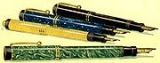
Fountain pen

Encyclopedia
A fountain pen is a nib
pen
that, unlike its predecessor the dip pen
, contains an internal reservoir of water-based liquid ink. The pen draws ink from the reservoir through a feed to the nib and deposits it on paper via a combination of gravity and capillary action
. As a result, the typical fountain pen requires little or no pressure to write.
Filling the reservoir with ink may be done manually (via the use of an eyedropper or syringe
), or via an internal "filler" mechanism which creates suction to transfer ink directly through the nib into the reservoir. Some pens employ removable reservoirs, in the form of pre-filled ink cartridges.

of the Maghreb
, demanded a pen that would not stain his hands or clothes, and was provided with a pen that held ink in a reservoir and delivered it to the nib, which could be held upside-down without leaking, as recorded in Kitab al-Majalis wa 'l-musayardt, by Qadi
al-Nu'man al-Tamimi
(d. 974). No details of the construction or mechanism of operation of this pen are known, and no examples have survived.
 In Deliciae Physico-Mathematicae (a 1636 magazine), German
inventor Daniel Schwenter
described a pen made from two quill
s. One quill served as a reservoir for ink
inside the other quill. The ink was sealed inside the quill with cork
. Ink was squeezed through a small hole to the writing point. Noted Maryland historian Hester Dorsey Richardson (1862–1933) documented a reference to "three silver fountain pens, worth 15 shillings" in England during the reign of Charles II
, ca. 1649-1685. She also found a 1734 notation made by Robert Morris the elder in the ledger of the expenses of Robert Morris the younger, who was at the time in Philadelphia, for "one fountain pen".
In 1828 Josiah Mason
improved a cheap, efficient slip-in nib
in Birmingham
, England, which could be added to a fountain pen
and in 1830, with the invention of a new machine, William Joseph Gillott
, William Mitchell
and James Stephen Perry devised a way to mass manufacture robust, cheap steel pen nibs. This boosted the Birmingham pen trade
and by the 1850s, more than half the steel-nib pens manufactured in the world were made in Birmingham. Thousands of skilled craftsmen and -women were employed in the industry. Many new manufacturing techniques were perfected, enabling the city's factories to mass produce their pens cheaply and efficiently. These were sold worldwide to many who previously could not afford to write, thus encouraging the development of education and literacy.
Progress in developing a reliable pen was slow until the mid-19th century, because of an imperfect understanding of the role that air pressure plays in the operation of pens and because most inks were highly corrosive and full of sedimentary inclusions. The Romania
n inventor Petrache Poenaru
received a French patent
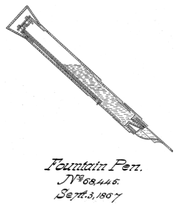
for the invention of the first fountain pen with a replaceable ink cartridge on May 25, 1827. Starting in the 1850s there was a steadily accelerating stream of fountain pen patent
s and pens in production. However, it was only after three key inventions were in place that the fountain pen became a widely popular writing instrument. Those were the iridium
-tipped gold
nib, hard rubber
, and free-flowing ink.
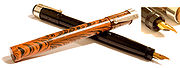 The first fountain pens making use of all these key ingredients appeared in the 1850s. In the 1870s Duncan MacKinnon, a Canadian living in New York City, and Alonzo T. Cross of Providence, Rhode Island, created stylographic pens with a hollow, tubular nib and a wire acting as a valve. Stylographic pens are now used mostly for drafting and technical drawing but were very popular in the decade beginning in 1875. In the 1880s the era of the mass-produced
fountain pen finally began. The dominant American producers in this pioneer era were Waterman
, of New York City
, and Wirt, based in Bloomsburg, Pennsylvania
. Waterman soon outstripped Wirt, along with many companies that sprang up to fill the new and growing fountain pen market. Waterman remained the market leader until the early 1920s.
At this time fountain pens were almost all filled by unscrewing a portion of the hollow barrel or holder and inserting the ink by means of an eyedropper—a slow and messy procedure. Pens also tended to leak inside their caps and at the joint where the barrel opened for filling. Now that the materials' problems had been overcome and the flow of ink while writing had been regulated, the next problems to be solved were the creation of a simple, convenient self-filler and the problem of leakage. Self-fillers began to arrive around the turn of the century; the most successful of these was probably the Conklin crescent-filler, followed by A. A. Waterman's twist-filler. The tipping point, however, was the runaway success of Walter A. Sheaffer's lever-filler, introduced in 1912, paralleled by Parker's roughly contemporary button-filler.
 Meanwhile many inventors turned their attention to the problem of leakage. Some of the earliest solutions to this problem came in the form of a "safety" pen with a retractable point that allowed the ink reservoir to be corked like a bottle. The most successful of these came from F.C. Brown of the Caw's Pen and Ink Co. and from Morris W. Moore of Boston. In 1907 Waterman began marketing a safety pen of its own that soon became the most widely distributed such pen. For pens with nonretractable nibs, the adoption of screw-on caps with inner caps that sealed around the nib by bearing against the front of the section effectively solved the leakage problem (such pens were also marketed as "safety pens", as with the Parker Jack Knife Safety and the Swan Safety Screw-Cap).
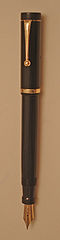 In Europe, the German supplies company which came to be known as Pelikan
and was started in 1838, first introduced their pen in 1929, based upon the acquisition of patents for solid-ink fountain pens from the factory of Slavoljub Penkala from Croatia
(patented 1907, in mass production since 1911), and the patent of the Hungarian
Theodor Kovacs for the modern piston filler by 1925.
The decades that followed saw many technological innovations in the manufacture of fountain pens. Celluloid
gradually replaced hard rubber
, which enabled production in a much wider range of colors and designs. At the same time, manufacturers experimented with new filling systems. The inter-war period saw the introduction of some of the most notable models, such as the Parker Duofold
and Vacumatic
, Sheaffer's Lifetime Balance series, and the Pelikan 100.
During the 1940s and 1950s, fountain pens retained their dominance: early ballpoint pen
s were expensive, prone to leaks and had irregular inkflow, while the fountain pen continued to benefit from the combination of mass production and craftsmanship. This period saw the launch of innovative models such as the Parker 51
, the Sheaffer Snorkel and the Eversharp Skyline, while the Esterbrook J series of lever-fill models with interchangeable steel nibs offered inexpensive reliability to the masses.
By the 1960s, refinements in ballpoint pen production gradually ensured its dominance over the fountain pen for casual use. Although cartridge-filler fountain pens are still in common use in France
, Germany
, India
and the United Kingdom
, and are widely used by young students in most private schools in England and at least one private school in Scotland, a few modern manufacturers (especially Montblanc
and Visconti) now depict the fountain pen as a collectible item or a status symbol
, rather than an everyday writing tool.
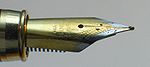 The modern fountain pen nib
may be traced back to the original gold nib which had a tiny fragment of ruby attached to form the wear-point. Following the discovery of the Platinum group of metals which include ruthenium, palladium, osmium and iridium, a small quantity of iridium was isolated and used on the iridium-tipped gold dip pen
nibs of the 1830s. Today, nibs are usually made of stainless steel
or gold
, with the most popular gold content being 14 karat
and 18 karat. Gold is considered the optimum metal for its flexibility and its resistance to corrosion, although gold's corrosion resistance is less of an issue than in the past because of better stainless steel alloys and less corrosive inks. Gold nibs are tipped with a hard, wear-resistant alloy that typically uses metals from the platinum group
. The tipping material is often called "iridium
", but there are few, if any, penmakers that still use tipping alloys containing the metal. Steel nibs may also have harder tips; those with un-tipped steel points will wear more rapidly due to abrasion by the paper.
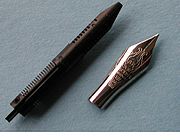 The nib usually has a slit cut down its centre, to convey the ink down the nib by capillary action, as well as a "breather hole" of varying shape to promote the exchange of air for ink in the pen's reservoir. The breather hole also acts as a stress relieving point, preventing the nib from cracking longitudinally from the end of the slit as a result of repeated flexing during use. The whole nib narrows to a point where the ink is transferred to the paper. Broad calligraphy
pens may have several slits in the nib to increase ink flow and help distribute it evenly across the broad point. Nibs divided into three 'tines' are commonly known as 'music' nibs, as their line, which can be varied from broad to fine, is suited for writing musical scores.
Although the most common nibs end in a round point of various sizes (fine, medium, broad), various other nib shapes are available. Examples of this are oblique, reverse oblique, stub, italic and 360 degree nibs.
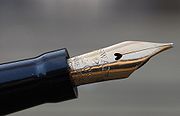 Fountain pens dating from the first half of the 20th century are more likely to have flexible nibs, suited to the favored handwriting styles of the period (e.g.: Copperplate script
and Spencerian Script
). By the 1940s, writing preferences had shifted towards stiffer nibs that could withstand the greater pressure required for writing through copy paper to create duplicate documents. Furthermore, competition between the major pen brands such as Parker and Waterman, and the introduction of lifetime guarantees meant that flexible nibs could no longer be supported profitably. In countries where this rivalry was not present to the same degree, for example the UK and Germany, flexible nibs are more common. Nowadays, stiff nibs are the norm as people exchange between fountain pens and other writing modes. These more closely emulate the ballpoint pens modern users are experienced with, but are often described as feeling like "writing with a nail" by those who prefer the feel of a more flexible nib. (Nibs, especially more flexible nibs, can be easily damaged by ballpoint users who write with excessive pressure. Ideally, a fountain pen's nib glides across the paper using the ink as a lubricant, and requires no pressure.)
An apparent common denominator of good quality nibs—as long as they have been used appropriately—is that they are long lasting, often lasting longer than the lifetime of the original owner. Many vintage pens with decades-old nibs can still be used today.

Other styles of fountain pen nibs include Hooded Nibs (Examples of hooded nibs are Parker 51, Parker 61, or the current (2007) Parker 100, Hero 329), Inlaid Nibs (e.g., Sheaffer Targa or Sheaffer P.F.M) or Integral Nib (Parker T-1 and Falcon, Pilot Myu 701), which may also be ground to have different writing characteristics.
Users are often cautioned not to lend or borrow fountain pens as the nib "wears in" at an angle unique to each individual person. A different user is likely to find that a worn-in nib does not write satisfactorily in their hand and, furthermore, creates a second wear surface, ruining the nib for the original user. This, however, is not a point of concern in pens with modern, strong tipping material, as these pens take many years to develop any significant wear.
 The reservoirs of the earliest fountain pens were mostly filled by eyedropper
. This was a cumbersome and potentially messy process, which led to the commercial development of alternative methods that quickly dominated the industry. However, newer, more convenient filling mechanisms have never entirely displaced "eyedropper-filling" pens in the marketplace, and they remain widely manufactured today. For some the simplicity of the mechanism, coupled with the large volume of ink it can encapsulate, compensates for the inconvenience of ink transfer.
After the eyedropper-filler era came the first generation of mass-produced self-fillers, almost all using a rubber sac to hold the ink. The sac was compressed and then released by various mechanisms to fill the pen.
The Conklin crescent filler, introduced c. 1901, was one of the first mass-produced self-filling pen designs. The crescent filling system employs an arch-shaped crescent attached to a rigid metal pressure bar, with the crescent portion protruding from the pen through a slot and the pressure bar inside the barrel. A second component, a C-shaped hard rubber ring, is located between the crescent and the barrel. Ordinarily, the ring blocks the crescent from pushing down. To fill the pen, one simply turns the ring around the barrel until the crescent matches up to the hole in the ring, allowing one to push down the crescent and squeeze the internal sac. Several other filling mechanisms were introduced to compete, such as the coin-filler (where a 'coin' or 'medallion' was supplied along with the pen) match-filler using a matchstick and a 'blow-filler' which unsurprisingly required the pen owner to blow into the barrel to depress the internal sac. In 1907 Walter A. Sheaffer patented the Lever filler, using a hinged lever set into the pen barrel which pressed down onto a bar which in turn compressed the rubber sac inside, creating a vacuum to force ink into the pen. Introduced in 1912, this innovation was rapidly imitated by the other major pen makers. Parker introduced the button filler, which had a button hidden beneath a blind cap on the end of the barrel; when pressed, it acted on a pressure bar inside to depress the ink sac.
Following the crescent filler came a series of systems of increasing complexity, reaching their apogee in the Sheaffer Snorkel, introduced in 1952. With the advent of the modern plastic ink cartridge in the early 1950s, though, most of these systems were phased out in favour of convenience (but reduced capacity).
Screw-mechanism piston-fillers were made as early as the 1820s, but the mechanism's modern popularity begins with the original Pelikan
of 1929, based upon a Croatian patent. The basic idea is simple: turn a knob at the end of the pen, and a screw mechanism draws a piston up the barrel, sucking in ink. Thus they were easier to fill. This is also why this filling mechanism is very popular in today's fountain pens. Some of the earlier models had to dedicate as much as half of the pen length to the mechanism. The advent of telescoping pistons has improved this.
The Touchdown Filler was introduced by Sheaffer
in 1949. It was advertised as an “Exclusive Pneumatic Down-stroke Filler.” To fill it, a knob at the end of the barrel is unscrewed and the attached plunger is drawn out to its full length. The nib is immersed in ink, the plunger is pushed in, compressing and then releasing the ink sac by means of air pressure. The nib is kept in the ink for approximately 10 seconds to allow the reservoir to fill. This mechanism is very closely modeled after a similar pneumatic filler introduced by Chilton over a decade earlier.
The Sheaffer "Snorkel" system filled the ink sac through a retractable tube above and behind the pen point. This eliminated the need to dunk the point in ink, and the subsequent need to wipe it.
A capillary
filling system was introduced by Parker
in the Parker 61 in 1956. There were no moving parts: the ink reservoir within the barrel was open at the upper end, but contained a tightly rolled length of slotted, flexible plastic. To fill, the barrel was unscrewed, the exposed open end of the reservoir was placed in ink and the interstices of the plastic sheet and slots initiated capillary action
, drawing up and retaining the ink. The outside of the reservoir was coated with Teflon, a repellent compound that released excess ink as it was withdrawn. Ink was transferred through a further capillary tube to the nib. No method of flushing the device was offered, and because of problems from clogging with dried and hardened ink production was eventually stopped.
Around the year 2000 Pelikan introduced a filling system involving a valve in the blind end of the pen, which mates with a specially designed ink bottle. Thus docked, ink is then squeezed into the pen barrel (which, lacking any mechanism other than the valve itself, has nearly the capacity of an eyedropper-fill pen of the same size). This system had been implemented only in their "Level" line, which was discontinued in 2006.
Most pens use either a piston filler or a cartridge; many pens can use a converter, a device which has the same fitting as the pen's cartridge and has a filling mechanism and a reservoir attached to it. This enables a pen to either fill from cartridges, or from a bottle of ink. The most common type of converters are Piston-style, but many other varieties may be found in vintage Sheaffers.
s intended for use with fountain pens are water-based. These inks are commonly available in bottles. Plastic cartridges came into use in the 1960s, but bottled inks are still the mainstay for most fountain pen enthusiasts. Bottled inks usually cost less than an equivalent amount in cartridges and afford a wider variety of colors and properties.
As fountain pens are not tightly coupled with their inks as is with ballpoints
or gel pen
s, some care must be taken when selecting an ink. Fountain pen inks are almost exclusively dye
-based because pigment
particles usually clog the narrow passages. Some pigmented inks do exist for fountain pens, but these are uncommon. Normal Indian ink cannot be used in fountain pens because it contains shellac
as a binder which would very quickly clog such pens.
Inks ideally should be fairly free-flowing, free of sediment, and non-corrosive, though this generally excludes permanence and prevents large scale commercial use of some colored dyes. Proper care and selection of ink will prevent most problems.
, Faber-Castell
, Michel Perchin, DuPont, Montegrappa
, Stipula
, Pelikan
, Waterman
, Montblanc, Monteverde
, Sigma
, Delta
, Italix and Rotring
) and some pen brands of other continents (for example Bexley
, Retro51, Tombow
and Acura) use so called "international cartridges" (AKA "European cartridges" or "standard cartridges" or "universal cartridges"), in short (38 mm in length, about 0.75 ml
of capacity) or long (72 mm, 1.45 ml) sizes, or both. It is to some extent a standard, so the international cartridges of any manufacturer can be used in most fountain pens that accept international cartridges. Also, converters that are meant to replace international cartridges can be used in most fountain pens that accept international cartridges. Some very compact fountain pens (for example Waterman Ici et La and Monteverde Diva) accept only short international cartridges. Converters can not be used in them (except for so-called mini-converters by Monteverde). Some pens like modern Waterman pens have intentional fittings which prevent the usage of short cartridges. Such pens can only take a proprietary cartridge from the same maker, in this case the long Waterman cartridges
Many fountain pen manufacturers have at various times developed their own proprietary cartridges, for example Parker, Lamy
, Sheaffer
, Cross
, Sailor
, Platinum
, Platignum, Waterman
and Namiki
. Fountain pens from Aurora
, Hero
, Duke
and Uranus
accept the same cartridges and converters that Parker uses and vice versa (Lamy
cartridges, though not officially, are known to interchange with Parker cartridges also). Cartridges of Aurora are slightly different from cartridges by Parker. Hero, Duke and Uranus have made few fountain pens that take international cartridges. Corresponding converters to be used instead of such proprietary cartridges are usually made by the same company that made the fountain pen itself. Some very compact fountain pens accept only proprietary cartridges made by the same company that made that pen, for example Sheaffer Agio Compact and Sheaffer Prelude Compact. It is not possible to use a converter in them at all. In such pens the only practical way to use another brand of ink is to fill empty cartridges with bottled ink using a syringe
.
International cartridges are closed by a small ball of glass, held inside the ink exit hole by glue or by a very thin layer of plastic. When the cartridge is pressed into the pen, a small pin pushes in the ball, which falls inside the cartridge. The Parker cartridges do not have such a ball. They are closed by a piece of plastic, which is broken by a sharp pin when inserted in the pen.
While cartridges are mess free and more convenient to refill on the go than bottle filling, converter and filling systems are still sold. Non-cartridge filling systems tend to be slightly more economical in the long run since ink is generally less expensive in bottles than in cartridges. Advocates of bottle-based filling systems also cite less waste of plastic for the environment, a wider selection of inks, easier cleaning of pens (as drawing the ink in through the nib helps dissolve old ink), and the ability to check and refill inks at any time. The Noodler's Ink Company even goes so far as to maintain a "zero disposable cartridge" policy and refuses to issue any cartridges due to their high levels of economic and environmental waste (a single bottle of ink can represent a few hundred international cartridges at between 350% and 780% the cost of similar bottled ink on a volume/dye content comparison depending upon different brand costs). Disposable pen cartridges have been found floating in most ocean trash samples another reason for Noodler's refusal to cooperate with the predominant filling method used by modern pen companies.
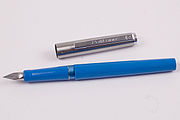 Today, fountain pens are treated as luxury good
s and often as a status symbol
. Fountain pens may serve as an everyday writing instrument, much like the common ballpoint pen
. Good quality steel and gold pens are available inexpensively today, particularly in Europe
and China
where there are "disposable" fountain pens such as the Pilot Varsity.
Fountain pens can serve various artistic purposes such as expressive penmanship
and calligraphy
, pen and ink artwork, and professional art and design. Many users also favor a fountain pen's air of timeless elegance, personalization and sentimentality, which computers and ballpoint pens seem to lack, and often state that once they start using fountain pens, ballpoints become awkward to use due to the extra motor effort needed and lack of expressiveness.
For ergonomics, fountain pens may relieve physiological stress from writing; alternatives such as the ballpoint pen can induce more pain and damage to those with arthritis
. Some also believe it could improve academic performance. In some countries, fountain pens are usual in lower school grades, believed to teach kids better control over writing as many common mistakes of people not used to handwriting (like too much presure or incorrect held) feel unnatural or are almost impossible when using traditional pen tips.
Some fountain pens are prized as works of art. Ornate pens may be made of precious metal
s and jewel
s with cloisonné
designs. Some are inlaid with lacquer designs in a process known as maki-e
. Avid communities of pen enthusiasts collect and use antique and modern pens and also collect and exchange information about old and modern inks, ink bottles, and inkwell
s. Collectors may decide to use the antiques in addition to showcasing them in closed spaces such as glass displays.
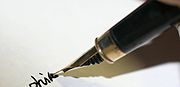
Nib (pen)
A nib is the part of a quill, dip pen or fountain pen which comes into contact with the writing surface in order to deposit ink. Different types of nibs vary in their purpose, shape and size, as well as the material they are made from.-Quill:...
pen
Pen
A pen is a device used to apply ink to a surface, usually paper, for writing or drawing. Historically, reed pens, quill pens, and dip pens were used, with a nib of some sort to be dipped in the ink. Ruling pens allow precise adjustment of line width, and still find a few specialized uses, but...
that, unlike its predecessor the dip pen
Dip pen
A dip pen or nib pen usually consists of a metal nib with capillary channels like those of fountain pen nibs, mounted on a handle or holder, often made of wood. Other materials can be used for the holder, including bone, metal and plastic, while some pens are made entirely of glass...
, contains an internal reservoir of water-based liquid ink. The pen draws ink from the reservoir through a feed to the nib and deposits it on paper via a combination of gravity and capillary action
Capillary action
Capillary action, or capilarity, is the ability of a liquid to flow against gravity where liquid spontanously rise in a narrow space such as between the hair of a paint-brush, in a thin tube, or in porous material such as paper or in some non-porous material such as liquified carbon fiber, or in a...
. As a result, the typical fountain pen requires little or no pressure to write.
Filling the reservoir with ink may be done manually (via the use of an eyedropper or syringe
Syringe
A syringe is a simple pump consisting of a plunger that fits tightly in a tube. The plunger can be pulled and pushed along inside a cylindrical tube , allowing the syringe to take in and expel a liquid or gas through an orifice at the open end of the tube...
), or via an internal "filler" mechanism which creates suction to transfer ink directly through the nib into the reservoir. Some pens employ removable reservoirs, in the form of pre-filled ink cartridges.
History
The earliest historical record of a reservoir pen dates to the 10th century. In 953, Ma'ād al-Mu'izz, the caliphCaliph
The Caliph is the head of state in a Caliphate, and the title for the ruler of the Islamic Ummah, an Islamic community ruled by the Shari'ah. It is a transcribed version of the Arabic word which means "successor" or "representative"...
of the Maghreb
Maghreb
The Maghreb is the region of Northwest Africa, west of Egypt. It includes five countries: Morocco, Algeria, Tunisia, Libya, and Mauritania and the disputed territory of Western Sahara...
, demanded a pen that would not stain his hands or clothes, and was provided with a pen that held ink in a reservoir and delivered it to the nib, which could be held upside-down without leaking, as recorded in Kitab al-Majalis wa 'l-musayardt, by Qadi
Qadi
Qadi is a judge ruling in accordance with Islamic religious law appointed by the ruler of a Muslim country. Because Islam makes no distinction between religious and secular domains, qadis traditionally have jurisdiction over all legal matters involving Muslims...
al-Nu'man al-Tamimi
Banu Tamim
Banī Tamīm Tamim is one of the largest of all Arab tribes. Their history goes back to pre-Islamic times....
(d. 974). No details of the construction or mechanism of operation of this pen are known, and no examples have survived.
Germans
The Germans are a Germanic ethnic group native to Central Europe. The English term Germans has referred to the German-speaking population of the Holy Roman Empire since the Late Middle Ages....
inventor Daniel Schwenter
Daniel Schwenter
Daniel Schwenter was a German Orientalist, mathematician, inventor, poet, and librarian. He was professor of oriental languages and mathematics at the University of Altdorf...
described a pen made from two quill
Quill
A quill pen is a writing implement made from a flight feather of a large bird. Quills were used for writing with ink before the invention of the dip pen, metal-nibbed pens, the fountain pen, and, eventually, the ballpoint pen...
s. One quill served as a reservoir for ink
Ink
Ink is a liquid or paste that contains pigments and/or dyes and is used to color a surface to produce an image, text, or design. Ink is used for drawing and/or writing with a pen, brush, or quill...
inside the other quill. The ink was sealed inside the quill with cork
Cork (material)
Cork is an impermeable, buoyant material, a prime-subset of bark tissue that is harvested for commercial use primarily from Quercus suber , which is endemic to southwest Europe and northwest Africa...
. Ink was squeezed through a small hole to the writing point. Noted Maryland historian Hester Dorsey Richardson (1862–1933) documented a reference to "three silver fountain pens, worth 15 shillings" in England during the reign of Charles II
Charles II of England
Charles II was monarch of the three kingdoms of England, Scotland, and Ireland.Charles II's father, King Charles I, was executed at Whitehall on 30 January 1649, at the climax of the English Civil War...
, ca. 1649-1685. She also found a 1734 notation made by Robert Morris the elder in the ledger of the expenses of Robert Morris the younger, who was at the time in Philadelphia, for "one fountain pen".
In 1828 Josiah Mason
Josiah Mason
Sir Josiah Mason was an English pen-manufacturer.Mason was born in Mill Street, Kidderminster, the son of a carpet-weaver. He began life as a street hawker of cakes, fruits and vegetables. After trying his hand in his native town at shoemaking, baking, carpentering, blacksmithing, house-painting...
improved a cheap, efficient slip-in nib
Nib (pen)
A nib is the part of a quill, dip pen or fountain pen which comes into contact with the writing surface in order to deposit ink. Different types of nibs vary in their purpose, shape and size, as well as the material they are made from.-Quill:...
in Birmingham
Birmingham
Birmingham is a city and metropolitan borough in the West Midlands of England. It is the most populous British city outside the capital London, with a population of 1,036,900 , and lies at the heart of the West Midlands conurbation, the second most populous urban area in the United Kingdom with a...
, England, which could be added to a fountain pen
Fountain pen
A fountain pen is a nib pen that, unlike its predecessor the dip pen, contains an internal reservoir of water-based liquid ink. The pen draws ink from the reservoir through a feed to the nib and deposits it on paper via a combination of gravity and capillary action...
and in 1830, with the invention of a new machine, William Joseph Gillott
Joseph Gillott
Joseph Gillott was an English pen-maker and patron of the arts.- Pen manufacturing :For some time he was a working cutler in his home town Sheffield, but in 1821 he moved to Birmingham, where he found employment in the steel toy trade, the technical name for the manufacture of steel buckles,...
, William Mitchell
William Mitchell
-People:* W. O. Mitchell , Canadian writer* William A. Mitchell , corporate chemist responsible for Tang and Pop Rocks* William B. Mitchell , former Justice of the Minnesota Supreme Court...
and James Stephen Perry devised a way to mass manufacture robust, cheap steel pen nibs. This boosted the Birmingham pen trade
Birmingham pen trade
The Birmingham pen trade evolved in the Birmingham Jewellery Quarter and its surrounding area in the 19th century; for many years, the city was the centre of the world's pen trade.-19th century:...
and by the 1850s, more than half the steel-nib pens manufactured in the world were made in Birmingham. Thousands of skilled craftsmen and -women were employed in the industry. Many new manufacturing techniques were perfected, enabling the city's factories to mass produce their pens cheaply and efficiently. These were sold worldwide to many who previously could not afford to write, thus encouraging the development of education and literacy.
Progress in developing a reliable pen was slow until the mid-19th century, because of an imperfect understanding of the role that air pressure plays in the operation of pens and because most inks were highly corrosive and full of sedimentary inclusions. The Romania
Romania
Romania is a country located at the crossroads of Central and Southeastern Europe, on the Lower Danube, within and outside the Carpathian arch, bordering on the Black Sea...
n inventor Petrache Poenaru
Petrache Poenaru
Petrache Poenaru was a Romanian inventor of the Enlightenment era.Poenaru, who had studied in Paris and Vienna and, later, completed his specialized studies in England, was a mathematician, physicist, engineer, inventor, teacher and organizer of the educational system, as well as a politician,...
received a French patent
Patent
A patent is a form of intellectual property. It consists of a set of exclusive rights granted by a sovereign state to an inventor or their assignee for a limited period of time in exchange for the public disclosure of an invention....
for the invention of the first fountain pen with a replaceable ink cartridge on May 25, 1827. Starting in the 1850s there was a steadily accelerating stream of fountain pen patent
Patent
A patent is a form of intellectual property. It consists of a set of exclusive rights granted by a sovereign state to an inventor or their assignee for a limited period of time in exchange for the public disclosure of an invention....
s and pens in production. However, it was only after three key inventions were in place that the fountain pen became a widely popular writing instrument. Those were the iridium
Iridium
Iridium is the chemical element with atomic number 77, and is represented by the symbol Ir. A very hard, brittle, silvery-white transition metal of the platinum family, iridium is the second-densest element and is the most corrosion-resistant metal, even at temperatures as high as 2000 °C...
-tipped gold
Gold
Gold is a chemical element with the symbol Au and an atomic number of 79. Gold is a dense, soft, shiny, malleable and ductile metal. Pure gold has a bright yellow color and luster traditionally considered attractive, which it maintains without oxidizing in air or water. Chemically, gold is a...
nib, hard rubber
Rubber
Natural rubber, also called India rubber or caoutchouc, is an elastomer that was originally derived from latex, a milky colloid produced by some plants. The plants would be ‘tapped’, that is, an incision made into the bark of the tree and the sticky, milk colored latex sap collected and refined...
, and free-flowing ink.
Mass production
Mass production is the production of large amounts of standardized products, including and especially on assembly lines...
fountain pen finally began. The dominant American producers in this pioneer era were Waterman
Waterman pens
The Waterman pen company is a major manufacturer of fountain pens. Established in 1884 in New York City by Lewis Edson Waterman, it is one of the few remaining first-generation fountain pen companies, as Waterman S.A.. It is currently owned by Newell Rubbermaid.- History :The initial years of...
, of New York City
New York City
New York is the most populous city in the United States and the center of the New York Metropolitan Area, one of the most populous metropolitan areas in the world. New York exerts a significant impact upon global commerce, finance, media, art, fashion, research, technology, education, and...
, and Wirt, based in Bloomsburg, Pennsylvania
Bloomsburg, Pennsylvania
Bloomsburg is a town in Columbia County, Pennsylvania, 40 miles southwest of Wilkes Barre along the Susquehanna River. In 1900, the population of Bloomsburg stood at 6,170; in 1910, 7,413; in 1940, 9,799, and in 1990, 12,439. The population was 14,855 at the 2010 census...
. Waterman soon outstripped Wirt, along with many companies that sprang up to fill the new and growing fountain pen market. Waterman remained the market leader until the early 1920s.
At this time fountain pens were almost all filled by unscrewing a portion of the hollow barrel or holder and inserting the ink by means of an eyedropper—a slow and messy procedure. Pens also tended to leak inside their caps and at the joint where the barrel opened for filling. Now that the materials' problems had been overcome and the flow of ink while writing had been regulated, the next problems to be solved were the creation of a simple, convenient self-filler and the problem of leakage. Self-fillers began to arrive around the turn of the century; the most successful of these was probably the Conklin crescent-filler, followed by A. A. Waterman's twist-filler. The tipping point, however, was the runaway success of Walter A. Sheaffer's lever-filler, introduced in 1912, paralleled by Parker's roughly contemporary button-filler.
Pelikan
Pelikan is a German manufacturer of fountain pens and other writing, office and art equipment, credited with the invention of the differential-piston filling method....
and was started in 1838, first introduced their pen in 1929, based upon the acquisition of patents for solid-ink fountain pens from the factory of Slavoljub Penkala from Croatia
Croatia
Croatia , officially the Republic of Croatia , is a unitary democratic parliamentary republic in Europe at the crossroads of the Mitteleuropa, the Balkans, and the Mediterranean. Its capital and largest city is Zagreb. The country is divided into 20 counties and the city of Zagreb. Croatia covers ...
(patented 1907, in mass production since 1911), and the patent of the Hungarian
Hungary
Hungary , officially the Republic of Hungary , is a landlocked country in Central Europe. It is situated in the Carpathian Basin and is bordered by Slovakia to the north, Ukraine and Romania to the east, Serbia and Croatia to the south, Slovenia to the southwest and Austria to the west. The...
Theodor Kovacs for the modern piston filler by 1925.
The decades that followed saw many technological innovations in the manufacture of fountain pens. Celluloid
Celluloid
Celluloid is the name of a class of compounds created from nitrocellulose and camphor, plus dyes and other agents. Generally regarded to be the first thermoplastic, it was first created as Parkesine in 1862 and as Xylonite in 1869, before being registered as Celluloid in 1870. Celluloid is...
gradually replaced hard rubber
Rubber
Natural rubber, also called India rubber or caoutchouc, is an elastomer that was originally derived from latex, a milky colloid produced by some plants. The plants would be ‘tapped’, that is, an incision made into the bark of the tree and the sticky, milk colored latex sap collected and refined...
, which enabled production in a much wider range of colors and designs. At the same time, manufacturers experimented with new filling systems. The inter-war period saw the introduction of some of the most notable models, such as the Parker Duofold
Duofold
The Parker Duofold is a range of fountain pens produced by the Parker Pen CompanyThe first model was produced in 1921 and was a large pen, 5.5 inches long when capped, and made of a showy bright red hard rubber and expensively priced at $7.00, equivalent to about $83 in 2009.The original...
and Vacumatic
Parker Vacumatic
The Parker Vacumatic fountain pen was launched in 1933, displacing the Duofold as Parker's top-of-the-line product. The pen was originally named the Golden Arrow, a reference to the new arrow clip which would go on to become a Parker trademark, appearing in some form on almost all of Parker’s...
, Sheaffer's Lifetime Balance series, and the Pelikan 100.
During the 1940s and 1950s, fountain pens retained their dominance: early ballpoint pen
Ballpoint pen
A ballpoint pen is a writing instrument with an internal ink reservoir and a sphere for a point. The internal chamber is filled with a viscous ink that is dispensed at its tip during use by the rolling action of a small sphere...
s were expensive, prone to leaks and had irregular inkflow, while the fountain pen continued to benefit from the combination of mass production and craftsmanship. This period saw the launch of innovative models such as the Parker 51
Parker 51
The Parker 51, introduced in 1941, is a famous fountain pen. Parker’s period advertising called it “The World’s Most Wanted Pen,” and this assertion was true although a little deceptive; the U.S.A. entered World War II in December 1941, and the War Production Board placed severe restrictions on...
, the Sheaffer Snorkel and the Eversharp Skyline, while the Esterbrook J series of lever-fill models with interchangeable steel nibs offered inexpensive reliability to the masses.
By the 1960s, refinements in ballpoint pen production gradually ensured its dominance over the fountain pen for casual use. Although cartridge-filler fountain pens are still in common use in France
France
The French Republic , The French Republic , The French Republic , (commonly known as France , is a unitary semi-presidential republic in Western Europe with several overseas territories and islands located on other continents and in the Indian, Pacific, and Atlantic oceans. Metropolitan France...
, Germany
Germany
Germany , officially the Federal Republic of Germany , is a federal parliamentary republic in Europe. The country consists of 16 states while the capital and largest city is Berlin. Germany covers an area of 357,021 km2 and has a largely temperate seasonal climate...
, India
India
India , officially the Republic of India , is a country in South Asia. It is the seventh-largest country by geographical area, the second-most populous country with over 1.2 billion people, and the most populous democracy in the world...
and the United Kingdom
United Kingdom
The United Kingdom of Great Britain and Northern IrelandIn the United Kingdom and Dependencies, other languages have been officially recognised as legitimate autochthonous languages under the European Charter for Regional or Minority Languages...
, and are widely used by young students in most private schools in England and at least one private school in Scotland, a few modern manufacturers (especially Montblanc
Montblanc (pens)
Montblanc International GmbH is a German manufacturer of writing instruments, watches and accessories, often identified by their "White Star" logo.-History:...
and Visconti) now depict the fountain pen as a collectible item or a status symbol
Status symbol
A status symbol is a perceived visible, external denotation of one's social position and perceived indicator of economic or social status. Many luxury goods are often considered status symbols...
, rather than an everyday writing tool.
Nibs
Nib (pen)
A nib is the part of a quill, dip pen or fountain pen which comes into contact with the writing surface in order to deposit ink. Different types of nibs vary in their purpose, shape and size, as well as the material they are made from.-Quill:...
may be traced back to the original gold nib which had a tiny fragment of ruby attached to form the wear-point. Following the discovery of the Platinum group of metals which include ruthenium, palladium, osmium and iridium, a small quantity of iridium was isolated and used on the iridium-tipped gold dip pen
Dip pen
A dip pen or nib pen usually consists of a metal nib with capillary channels like those of fountain pen nibs, mounted on a handle or holder, often made of wood. Other materials can be used for the holder, including bone, metal and plastic, while some pens are made entirely of glass...
nibs of the 1830s. Today, nibs are usually made of stainless steel
Stainless steel
In metallurgy, stainless steel, also known as inox steel or inox from French "inoxydable", is defined as a steel alloy with a minimum of 10.5 or 11% chromium content by mass....
or gold
Gold
Gold is a chemical element with the symbol Au and an atomic number of 79. Gold is a dense, soft, shiny, malleable and ductile metal. Pure gold has a bright yellow color and luster traditionally considered attractive, which it maintains without oxidizing in air or water. Chemically, gold is a...
, with the most popular gold content being 14 karat
Carat (purity)
The karat or carat is a unit of purity for gold alloys.- Measure :Karat purity is measured as 24 times the purity by mass:where...
and 18 karat. Gold is considered the optimum metal for its flexibility and its resistance to corrosion, although gold's corrosion resistance is less of an issue than in the past because of better stainless steel alloys and less corrosive inks. Gold nibs are tipped with a hard, wear-resistant alloy that typically uses metals from the platinum group
Platinum group
The platinum group metals is a term used sometimes to collectively refer to six metallic elements clustered together in the periodic table.These elements are all transition metals, lying in the d-block .The six...
. The tipping material is often called "iridium
Iridium
Iridium is the chemical element with atomic number 77, and is represented by the symbol Ir. A very hard, brittle, silvery-white transition metal of the platinum family, iridium is the second-densest element and is the most corrosion-resistant metal, even at temperatures as high as 2000 °C...
", but there are few, if any, penmakers that still use tipping alloys containing the metal. Steel nibs may also have harder tips; those with un-tipped steel points will wear more rapidly due to abrasion by the paper.
Western calligraphy
Western Calligraphy is the art of writing. A contemporary definition of calligraphic practice is "the art of giving form to signs in an expressive, harmonious and skillful manner." The story of writing is one of aesthetic development framed within the technical skills, transmission speed and...
pens may have several slits in the nib to increase ink flow and help distribute it evenly across the broad point. Nibs divided into three 'tines' are commonly known as 'music' nibs, as their line, which can be varied from broad to fine, is suited for writing musical scores.
Although the most common nibs end in a round point of various sizes (fine, medium, broad), various other nib shapes are available. Examples of this are oblique, reverse oblique, stub, italic and 360 degree nibs.
Copperplate script
Copperplate, or English round hand, is a style of calligraphic writing, using a sharp pointed nib instead of the flat nib used in most calligraphic writing. Its name comes from the fact that the copybooks from which students learned it were printed from etched copper plates...
and Spencerian Script
Spencerian Script
Spencerian Script is a script style that flourished in the United States from 1850 to 1925.Platt Rogers Spencer, whose name the style bears, was impressed with the idea that America needed a penmanship style that could be written quickly, legibly, and elegantly to aid in matters of business...
). By the 1940s, writing preferences had shifted towards stiffer nibs that could withstand the greater pressure required for writing through copy paper to create duplicate documents. Furthermore, competition between the major pen brands such as Parker and Waterman, and the introduction of lifetime guarantees meant that flexible nibs could no longer be supported profitably. In countries where this rivalry was not present to the same degree, for example the UK and Germany, flexible nibs are more common. Nowadays, stiff nibs are the norm as people exchange between fountain pens and other writing modes. These more closely emulate the ballpoint pens modern users are experienced with, but are often described as feeling like "writing with a nail" by those who prefer the feel of a more flexible nib. (Nibs, especially more flexible nibs, can be easily damaged by ballpoint users who write with excessive pressure. Ideally, a fountain pen's nib glides across the paper using the ink as a lubricant, and requires no pressure.)
An apparent common denominator of good quality nibs—as long as they have been used appropriately—is that they are long lasting, often lasting longer than the lifetime of the original owner. Many vintage pens with decades-old nibs can still be used today.
Other styles of fountain pen nibs include Hooded Nibs (Examples of hooded nibs are Parker 51, Parker 61, or the current (2007) Parker 100, Hero 329), Inlaid Nibs (e.g., Sheaffer Targa or Sheaffer P.F.M) or Integral Nib (Parker T-1 and Falcon, Pilot Myu 701), which may also be ground to have different writing characteristics.
Users are often cautioned not to lend or borrow fountain pens as the nib "wears in" at an angle unique to each individual person. A different user is likely to find that a worn-in nib does not write satisfactorily in their hand and, furthermore, creates a second wear surface, ruining the nib for the original user. This, however, is not a point of concern in pens with modern, strong tipping material, as these pens take many years to develop any significant wear.
Filling mechanisms
Pipette
A pipette is a laboratory tool used to transport a measured volume of liquid.-Use and variations:Pipettes are commonly used in molecular biology, analytical chemistry as well as medical tests...
. This was a cumbersome and potentially messy process, which led to the commercial development of alternative methods that quickly dominated the industry. However, newer, more convenient filling mechanisms have never entirely displaced "eyedropper-filling" pens in the marketplace, and they remain widely manufactured today. For some the simplicity of the mechanism, coupled with the large volume of ink it can encapsulate, compensates for the inconvenience of ink transfer.
After the eyedropper-filler era came the first generation of mass-produced self-fillers, almost all using a rubber sac to hold the ink. The sac was compressed and then released by various mechanisms to fill the pen.
The Conklin crescent filler, introduced c. 1901, was one of the first mass-produced self-filling pen designs. The crescent filling system employs an arch-shaped crescent attached to a rigid metal pressure bar, with the crescent portion protruding from the pen through a slot and the pressure bar inside the barrel. A second component, a C-shaped hard rubber ring, is located between the crescent and the barrel. Ordinarily, the ring blocks the crescent from pushing down. To fill the pen, one simply turns the ring around the barrel until the crescent matches up to the hole in the ring, allowing one to push down the crescent and squeeze the internal sac. Several other filling mechanisms were introduced to compete, such as the coin-filler (where a 'coin' or 'medallion' was supplied along with the pen) match-filler using a matchstick and a 'blow-filler' which unsurprisingly required the pen owner to blow into the barrel to depress the internal sac. In 1907 Walter A. Sheaffer patented the Lever filler, using a hinged lever set into the pen barrel which pressed down onto a bar which in turn compressed the rubber sac inside, creating a vacuum to force ink into the pen. Introduced in 1912, this innovation was rapidly imitated by the other major pen makers. Parker introduced the button filler, which had a button hidden beneath a blind cap on the end of the barrel; when pressed, it acted on a pressure bar inside to depress the ink sac.
Following the crescent filler came a series of systems of increasing complexity, reaching their apogee in the Sheaffer Snorkel, introduced in 1952. With the advent of the modern plastic ink cartridge in the early 1950s, though, most of these systems were phased out in favour of convenience (but reduced capacity).
Screw-mechanism piston-fillers were made as early as the 1820s, but the mechanism's modern popularity begins with the original Pelikan
Pelikan
Pelikan is a German manufacturer of fountain pens and other writing, office and art equipment, credited with the invention of the differential-piston filling method....
of 1929, based upon a Croatian patent. The basic idea is simple: turn a knob at the end of the pen, and a screw mechanism draws a piston up the barrel, sucking in ink. Thus they were easier to fill. This is also why this filling mechanism is very popular in today's fountain pens. Some of the earlier models had to dedicate as much as half of the pen length to the mechanism. The advent of telescoping pistons has improved this.
The Touchdown Filler was introduced by Sheaffer
Sheaffer
Sheaffer is a pen company that manufactures writing instruments including ballpoint, fountain and rollerball pens and mechanical pencils. It is famous for its “school” lineup of fountain pens, as well as calligraphy sets....
in 1949. It was advertised as an “Exclusive Pneumatic Down-stroke Filler.” To fill it, a knob at the end of the barrel is unscrewed and the attached plunger is drawn out to its full length. The nib is immersed in ink, the plunger is pushed in, compressing and then releasing the ink sac by means of air pressure. The nib is kept in the ink for approximately 10 seconds to allow the reservoir to fill. This mechanism is very closely modeled after a similar pneumatic filler introduced by Chilton over a decade earlier.
The Sheaffer "Snorkel" system filled the ink sac through a retractable tube above and behind the pen point. This eliminated the need to dunk the point in ink, and the subsequent need to wipe it.
A capillary
Capillary action
Capillary action, or capilarity, is the ability of a liquid to flow against gravity where liquid spontanously rise in a narrow space such as between the hair of a paint-brush, in a thin tube, or in porous material such as paper or in some non-porous material such as liquified carbon fiber, or in a...
filling system was introduced by Parker
Parker Pen Company
The Parker Pen Company is a manufacturer of pens, founded in 1888 by George Safford Parker in Janesville, Wisconsin, United States. It is currently owned by Newell Rubbermaid, and headquartered in Newhaven, East Sussex, England.-History:...
in the Parker 61 in 1956. There were no moving parts: the ink reservoir within the barrel was open at the upper end, but contained a tightly rolled length of slotted, flexible plastic. To fill, the barrel was unscrewed, the exposed open end of the reservoir was placed in ink and the interstices of the plastic sheet and slots initiated capillary action
Capillary action
Capillary action, or capilarity, is the ability of a liquid to flow against gravity where liquid spontanously rise in a narrow space such as between the hair of a paint-brush, in a thin tube, or in porous material such as paper or in some non-porous material such as liquified carbon fiber, or in a...
, drawing up and retaining the ink. The outside of the reservoir was coated with Teflon, a repellent compound that released excess ink as it was withdrawn. Ink was transferred through a further capillary tube to the nib. No method of flushing the device was offered, and because of problems from clogging with dried and hardened ink production was eventually stopped.
Around the year 2000 Pelikan introduced a filling system involving a valve in the blind end of the pen, which mates with a specially designed ink bottle. Thus docked, ink is then squeezed into the pen barrel (which, lacking any mechanism other than the valve itself, has nearly the capacity of an eyedropper-fill pen of the same size). This system had been implemented only in their "Level" line, which was discontinued in 2006.
Most pens use either a piston filler or a cartridge; many pens can use a converter, a device which has the same fitting as the pen's cartridge and has a filling mechanism and a reservoir attached to it. This enables a pen to either fill from cartridges, or from a bottle of ink. The most common type of converters are Piston-style, but many other varieties may be found in vintage Sheaffers.
Inks
InkInk
Ink is a liquid or paste that contains pigments and/or dyes and is used to color a surface to produce an image, text, or design. Ink is used for drawing and/or writing with a pen, brush, or quill...
s intended for use with fountain pens are water-based. These inks are commonly available in bottles. Plastic cartridges came into use in the 1960s, but bottled inks are still the mainstay for most fountain pen enthusiasts. Bottled inks usually cost less than an equivalent amount in cartridges and afford a wider variety of colors and properties.
As fountain pens are not tightly coupled with their inks as is with ballpoints
Ballpoint pen
A ballpoint pen is a writing instrument with an internal ink reservoir and a sphere for a point. The internal chamber is filled with a viscous ink that is dispensed at its tip during use by the rolling action of a small sphere...
or gel pen
Gel pen
A gel pen uses ink in which pigment is suspended in a water-based gel. Because the ink is thick and opaque, it shows up more clearly on dark or slick surfaces than the typical inks used in ballpoint or felt tip pens...
s, some care must be taken when selecting an ink. Fountain pen inks are almost exclusively dye
Dye
A dye is a colored substance that has an affinity to the substrate to which it is being applied. The dye is generally applied in an aqueous solution, and requires a mordant to improve the fastness of the dye on the fiber....
-based because pigment
Pigment
A pigment is a material that changes the color of reflected or transmitted light as the result of wavelength-selective absorption. This physical process differs from fluorescence, phosphorescence, and other forms of luminescence, in which a material emits light.Many materials selectively absorb...
particles usually clog the narrow passages. Some pigmented inks do exist for fountain pens, but these are uncommon. Normal Indian ink cannot be used in fountain pens because it contains shellac
Shellac
Shellac is a resin secreted by the female lac bug, on trees in the forests of India and Thailand. It is processed and sold as dry flakes , which are dissolved in ethyl alcohol to make liquid shellac, which is used as a brush-on colorant, food glaze and wood finish...
as a binder which would very quickly clog such pens.
Inks ideally should be fairly free-flowing, free of sediment, and non-corrosive, though this generally excludes permanence and prevents large scale commercial use of some colored dyes. Proper care and selection of ink will prevent most problems.
Cartridges
Most European fountain pen brands (for example Caran d'AcheCaran d'Ache (company)
-History:It was founded in Geneva in 1924 when Arnold Schweitzer purchased the Ecridor Pencil Factory. Schweitzer named his new company after Caran d'Ache, the nickname of a French satiric political cartoonist from Russia...
, Faber-Castell
Faber-Castell
Faber-Castell is one of the world's largest manufacturers of pens, pencils, other office supplies and art supplies, as well as high-end writing instruments and luxury leather goods...
, Michel Perchin, DuPont, Montegrappa
Montegrappa
Montegrappa is the oldest Italian manufacturer of fine writing instruments, founded as "Manifattura pennini d'oro e penne stilografiche" in 1912...
, Stipula
Stipula
Stipula was founded by Renzo Salvadori in the spring of 1973.The company used to produce gold and silver clasps and ornamental fittings for prestigious leather firms...
, Pelikan
Pelikan
Pelikan is a German manufacturer of fountain pens and other writing, office and art equipment, credited with the invention of the differential-piston filling method....
, Waterman
Waterman pens
The Waterman pen company is a major manufacturer of fountain pens. Established in 1884 in New York City by Lewis Edson Waterman, it is one of the few remaining first-generation fountain pen companies, as Waterman S.A.. It is currently owned by Newell Rubbermaid.- History :The initial years of...
, Montblanc, Monteverde
Monteverde (disambiguation)
-Places:Chile* Monte Verde, an archaeological siteCosta Rica* Monteverde, a small town in the Province of PuntarenasItaly* Monteverde, Campania, a comune in the Province of Avellino* Monteverde, Lazio, a district in the City of Rome-People:...
, Sigma
Sigma (disambiguation)
Sigma is a letter of the Greek alphabet.Sigma may also refer to:- Companies :* Sigma TV, a television channel in Cyprus* Sigma Company, an Australian pharmaceutical company* Sigma Corporation, a Japanese camera and lens manufacturer...
, Delta
Delta (pen manufacturer)
-History:Delta S.r.l. was founded in 1982 through the partnership of Nino Marino, Ciro Matrone and Mario Muscente. In 1995, Delta reintroduced the rare lateral lever filling system for fountain pens.-Models:Delta produces both open and limited edition pens...
, Italix and Rotring
Rotring
Rotring is a German technical writing and drawing instruments company based in Hamburg.-History:The company was established in 1928 as Tintenkuli Handels GmbH. The company's first product was the Tintenkuli, a stylographic pen—a fountain pen with a narrow steel tube instead of a conventional nib...
) and some pen brands of other continents (for example Bexley
Bexley
Bexley is an South East London]] in the London Borough of Bexley, London, England. It is located on the banks of the River Cray south of the Roman Road, Watling Street...
, Retro51, Tombow
Tombow
is a Japanese manufacturer of pens and pencils and other stationery. The company was founded in 1913 and has since grown into an international business. Tombow has two overseas production facilities in Thailand and Vietnam...
and Acura) use so called "international cartridges" (AKA "European cartridges" or "standard cartridges" or "universal cartridges"), in short (38 mm in length, about 0.75 ml
Litre
pic|200px|right|thumb|One litre is equivalent to this cubeEach side is 10 cm1 litre water = 1 kilogram water The litre is a metric system unit of volume equal to 1 cubic decimetre , to 1,000 cubic centimetres , and to 1/1,000 cubic metre...
of capacity) or long (72 mm, 1.45 ml) sizes, or both. It is to some extent a standard, so the international cartridges of any manufacturer can be used in most fountain pens that accept international cartridges. Also, converters that are meant to replace international cartridges can be used in most fountain pens that accept international cartridges. Some very compact fountain pens (for example Waterman Ici et La and Monteverde Diva) accept only short international cartridges. Converters can not be used in them (except for so-called mini-converters by Monteverde). Some pens like modern Waterman pens have intentional fittings which prevent the usage of short cartridges. Such pens can only take a proprietary cartridge from the same maker, in this case the long Waterman cartridges
Many fountain pen manufacturers have at various times developed their own proprietary cartridges, for example Parker, Lamy
Lamy
Lamy is a producer of fountain pens in Europe. The company is German-owned and its presence is particularly strong there. Josef Lamy, who was a sales representative for The Parker Pen Company in Germany, founded the business in 1930 by purchasing the Orthos pen manufacturer. Lamy was a pioneer in...
, Sheaffer
Sheaffer
Sheaffer is a pen company that manufactures writing instruments including ballpoint, fountain and rollerball pens and mechanical pencils. It is famous for its “school” lineup of fountain pens, as well as calligraphy sets....
, Cross
A. T. Cross Company
A. T. Cross is a traded American company that competes in the writing instrument, stationery and premium sunglass businesses.-Overview:Cross manufactures and distributes writing instruments, journals and sunglasses worldwide...
, Sailor
Sailor
A sailor, mariner, or seaman is a person who navigates water-borne vessels or assists in their operation, maintenance, or service. The term can apply to professional mariners, military personnel, and recreational sailors as well as a plethora of other uses...
, Platinum
Platinum (disambiguation)
Platinum may refer to:Precious metals:* Platinum, the chemical element:**Platinum group, a collective name used for six chemical elements in the periodic tableMusic:...
, Platignum, Waterman
Waterman
Waterman may refer to:* Watermen, river workers who transferred passengers across and along the city centre rivers in Britain* Waterman Or Waterperson. Someone who takes part in multiple water activities...
and Namiki
Namiki
Namiki is a Japanese brand of fountain pens and other writing equipment. Namiki is most famous for their maki-e designs on urushi.- Overview :...
. Fountain pens from Aurora
Aurora (pen manufacturer)
Aurora is an Italian manufacturer of fine writing instruments, fountain pens, paper and leather goods, founded in 1919 by a rich textile merchant. Their products represent the first true Italian fountain pens and are still manufactured in their original factory in Turin, northern Italy.US...
, Hero
The Shanghai Hero Pen Company
- Overview :The Shanghai Hero Pen Company, popular for its Hero fountain pens, is a Chinese company. Founded in 1931 as the Huafu Pen Factory , it was renamed in 1966 to the current name....
, Duke
Duke (disambiguation)
A Duke or Grand Duke is a title of nobility for aristocrats of very high rank.Duke or Dukes may also refer to:-Persons:As a surname:* See Duke and Dukes As a nickname, Duke may refer to:...
and Uranus
Uranus (disambiguation)
Uranus is the seventh planet from the sun.Uranus may also refer to:*Uranus , a deity in Greek mythology*Uranus , the astrological aspects of Uranus*Uranus...
accept the same cartridges and converters that Parker uses and vice versa (Lamy
Lamy
Lamy is a producer of fountain pens in Europe. The company is German-owned and its presence is particularly strong there. Josef Lamy, who was a sales representative for The Parker Pen Company in Germany, founded the business in 1930 by purchasing the Orthos pen manufacturer. Lamy was a pioneer in...
cartridges, though not officially, are known to interchange with Parker cartridges also). Cartridges of Aurora are slightly different from cartridges by Parker. Hero, Duke and Uranus have made few fountain pens that take international cartridges. Corresponding converters to be used instead of such proprietary cartridges are usually made by the same company that made the fountain pen itself. Some very compact fountain pens accept only proprietary cartridges made by the same company that made that pen, for example Sheaffer Agio Compact and Sheaffer Prelude Compact. It is not possible to use a converter in them at all. In such pens the only practical way to use another brand of ink is to fill empty cartridges with bottled ink using a syringe
Syringe
A syringe is a simple pump consisting of a plunger that fits tightly in a tube. The plunger can be pulled and pushed along inside a cylindrical tube , allowing the syringe to take in and expel a liquid or gas through an orifice at the open end of the tube...
.
International cartridges are closed by a small ball of glass, held inside the ink exit hole by glue or by a very thin layer of plastic. When the cartridge is pressed into the pen, a small pin pushes in the ball, which falls inside the cartridge. The Parker cartridges do not have such a ball. They are closed by a piece of plastic, which is broken by a sharp pin when inserted in the pen.
While cartridges are mess free and more convenient to refill on the go than bottle filling, converter and filling systems are still sold. Non-cartridge filling systems tend to be slightly more economical in the long run since ink is generally less expensive in bottles than in cartridges. Advocates of bottle-based filling systems also cite less waste of plastic for the environment, a wider selection of inks, easier cleaning of pens (as drawing the ink in through the nib helps dissolve old ink), and the ability to check and refill inks at any time. The Noodler's Ink Company even goes so far as to maintain a "zero disposable cartridge" policy and refuses to issue any cartridges due to their high levels of economic and environmental waste (a single bottle of ink can represent a few hundred international cartridges at between 350% and 780% the cost of similar bottled ink on a volume/dye content comparison depending upon different brand costs). Disposable pen cartridges have been found floating in most ocean trash samples another reason for Noodler's refusal to cooperate with the predominant filling method used by modern pen companies.
Fountain pens today
Luxury good
Luxury goods are products and services that are not considered essential and associated with affluence.The concept of luxury has been present in various forms since the beginning of civilization. Its role was just as important in ancient western and eastern empires as it is in modern societies...
s and often as a status symbol
Status symbol
A status symbol is a perceived visible, external denotation of one's social position and perceived indicator of economic or social status. Many luxury goods are often considered status symbols...
. Fountain pens may serve as an everyday writing instrument, much like the common ballpoint pen
Ballpoint pen
A ballpoint pen is a writing instrument with an internal ink reservoir and a sphere for a point. The internal chamber is filled with a viscous ink that is dispensed at its tip during use by the rolling action of a small sphere...
. Good quality steel and gold pens are available inexpensively today, particularly in Europe
Europe
Europe is, by convention, one of the world's seven continents. Comprising the westernmost peninsula of Eurasia, Europe is generally 'divided' from Asia to its east by the watershed divides of the Ural and Caucasus Mountains, the Ural River, the Caspian and Black Seas, and the waterways connecting...
and China
China
Chinese civilization may refer to:* China for more general discussion of the country.* Chinese culture* Greater China, the transnational community of ethnic Chinese.* History of China* Sinosphere, the area historically affected by Chinese culture...
where there are "disposable" fountain pens such as the Pilot Varsity.
Fountain pens can serve various artistic purposes such as expressive penmanship
Penmanship
Penmanship is the technique of writing with the hand using a writing instrument. The various generic and formal historical styles of writing are called hands, whilst an individual personal style of penmanship is referred to as handwriting....
and calligraphy
Calligraphy
Calligraphy is a type of visual art. It is often called the art of fancy lettering . A contemporary definition of calligraphic practice is "the art of giving form to signs in an expressive, harmonious and skillful manner"...
, pen and ink artwork, and professional art and design. Many users also favor a fountain pen's air of timeless elegance, personalization and sentimentality, which computers and ballpoint pens seem to lack, and often state that once they start using fountain pens, ballpoints become awkward to use due to the extra motor effort needed and lack of expressiveness.
For ergonomics, fountain pens may relieve physiological stress from writing; alternatives such as the ballpoint pen can induce more pain and damage to those with arthritis
Arthritis
Arthritis is a form of joint disorder that involves inflammation of one or more joints....
. Some also believe it could improve academic performance. In some countries, fountain pens are usual in lower school grades, believed to teach kids better control over writing as many common mistakes of people not used to handwriting (like too much presure or incorrect held) feel unnatural or are almost impossible when using traditional pen tips.
Some fountain pens are prized as works of art. Ornate pens may be made of precious metal
Precious metal
A precious metal is a rare, naturally occurring metallic chemical element of high economic value.Chemically, the precious metals are less reactive than most elements, have high lustre, are softer or more ductile, and have higher melting points than other metals...
s and jewel
Gemstone
A gemstone or gem is a piece of mineral, which, in cut and polished form, is used to make jewelry or other adornments...
s with cloisonné
Cloisonné
Cloisonné is an ancient technique for decorating metalwork objects, in recent centuries using vitreous enamel, and in older periods also inlays of cut gemstones, glass, and other materials. The resulting objects can also be called cloisonné...
designs. Some are inlaid with lacquer designs in a process known as maki-e
Maki-e
is Japanese lacquer sprinkled with gold or silver powder as a decoration using a makizutsu or a kebo brush. The technique was developed mainly in the Heian Period and blossomed in the Edo Period...
. Avid communities of pen enthusiasts collect and use antique and modern pens and also collect and exchange information about old and modern inks, ink bottles, and inkwell
Inkwell
An inkwell is a small jar or container, often made of glass, porcelain, silver, brass, or pewter, used for holding ink in a place convenient for the person who is writing...
s. Collectors may decide to use the antiques in addition to showcasing them in closed spaces such as glass displays.
See also
- Demonstrator penDemonstrator penDemonstrator pens are pens which are partially or mostly transparent.Demonstrator pens were originally furnished by manufacturers to dealers, so that the features of their products could be shown to potential buyers. The first demonstrators had openings cut in their barrels, and usually, their caps...
- Fountain pen inks
- InkwellInkwellAn inkwell is a small jar or container, often made of glass, porcelain, silver, brass, or pewter, used for holding ink in a place convenient for the person who is writing...
- IAMPETH
- List of terms about pen and ink
External links
- Early Cartridge Pens (Article about the very first cartridge pens, from the early 20th century)
- Fountain Pen Info (Some information about fountain pens)
- The Fountain Pen Network (Forums on the collecting and use of various fountain pens and inks)
- PenHero.com (Many illustrated articles and reviews on modern and vintage pens)
- Pendemonium: Ink Facts (Reviews on inks and list of cartridge type used by different fountain pens)
- Glenn's Pen Page (Reviews of pen shops and fountain pen inks)
- Penexchange (Information and forum for pen collectors, hosted by PelikanPelikanPelikan is a German manufacturer of fountain pens and other writing, office and art equipment, credited with the invention of the differential-piston filling method....
) - Penpedia (A wiki for fountain pens and related topics)
- Penspotters (Information site about fountain pens)
- Richard's Pens (Information from a fountain pen restorer)
- Infos for Pelikan collectors (Information site about Pelikan fountain pens)
- Stylophiles on-line magazine (On-line magazine devoted to fountain pen enthusiasts and aficionados)
- Richardink.com (Fountain pen artisan and expert Richard Lee Merritt's pen blog)
- Fountainpen.it (gallery of old fountain pen ads from an Italian site on fountain pens)
- Fountain Pen Care (Fountain Pen Care Guide)