


Bast fibre

Encyclopedia
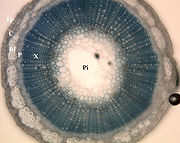
Phloem
In vascular plants, phloem is the living tissue that carries organic nutrients , in particular, glucose, a sugar, to all parts of the plant where needed. In trees, the phloem is the innermost layer of the bark, hence the name, derived from the Greek word "bark"...
(the "inner bark" or the skin) or bast surrounding the stem of certain, mainly dicotyledon
Dicotyledon
The dicotyledons, also known as dicots, are a group of flowering plants whose seed typically has two embryonic leaves or cotyledons. There are around 199,350 species within this group...
ous, plant
Plant
Plants are living organisms belonging to the kingdom Plantae. Precise definitions of the kingdom vary, but as the term is used here, plants include familiar organisms such as trees, flowers, herbs, bushes, grasses, vines, ferns, mosses, and green algae. The group is also called green plants or...
s. They support the conductive cells of the phloem and provide strength to the stem. Most of the technically important bast fibres are obtained from herbs cultivated in agriculture, as for instance flax
Flax
Flax is a member of the genus Linum in the family Linaceae. It is native to the region extending from the eastern Mediterranean to India and was probably first domesticated in the Fertile Crescent...
, hemp
Hemp
Hemp is mostly used as a name for low tetrahydrocannabinol strains of the plant Cannabis sativa, of fiber and/or oilseed varieties. In modern times, hemp has been used for industrial purposes including paper, textiles, biodegradable plastics, construction, health food and fuel with modest...
, or ramie
Ramie
Ramie is a flowering plant in the nettle family Urticaceae, native to eastern Asia. It is a herbaceous perennial growing to 1–2.5 m tall; the leaves are heart-shaped, 7–15 cm long and 6–12 cm broad, and white on the underside with dense small hairs—this gives it a silvery appearance;...
, but also bast fibres from wild plants, as stinging nettle
Stinging nettle
Stinging nettle or common nettle, Urtica dioica, is a herbaceous perennial flowering plant, native to Europe, Asia, northern Africa, and North America, and is the best-known member of the nettle genus Urtica...
, and trees such as lime or linden
Tilia
Tilia is a genus of about 30 species of trees native throughout most of the temperate Northern Hemisphere. The greatest species diversity is found in Asia, and the genus also occurs in Europe and eastern North America, but not western North America...
, have been used to some extent. Since the valuable fibres are located in the phloem, they must often be separated from the xylem
Xylem
Xylem is one of the two types of transport tissue in vascular plants. . The word xylem is derived from the Classical Greek word ξυλον , meaning "wood"; the best-known xylem tissue is wood, though it is found throughout the plant...
material ("woody core"), and sometimes also from epidermis
Epidermis (botany)
The epidermis is a single-layered group of cells that covers plants' leaves, flowers, roots and stems. It forms a boundary between the plant and the external environment. The epidermis serves several functions, it protects against water loss, regulates gas exchange, secretes metabolic compounds,...
. The process for this is called retting
Retting
Retting is a process employing the action of micro-organisms and moisture on plants to dissolve or rot away much of the cellular tissues and pectins surrounding bast-fibre bundles, and so facilitating separation of the fibre from the stem...
, and can be performed by micro-organisms either on land (nowadays the most important) or in water, or by chemicals (for instance high pH and chelating agents) or by pectin
Pectin
Pectin is a structural heteropolysaccharide contained in the primary cell walls of terrestrial plants. It was first isolated and described in 1825 by Henri Braconnot...
olytic enzyme
Enzyme
Enzymes are proteins that catalyze chemical reactions. In enzymatic reactions, the molecules at the beginning of the process, called substrates, are converted into different molecules, called products. Almost all chemical reactions in a biological cell need enzymes in order to occur at rates...
s. In the phloem bast fibres occur in bundles that are glued together by pectin
Pectin
Pectin is a structural heteropolysaccharide contained in the primary cell walls of terrestrial plants. It was first isolated and described in 1825 by Henri Braconnot...
and calcium
Calcium
Calcium is the chemical element with the symbol Ca and atomic number 20. It has an atomic mass of 40.078 amu. Calcium is a soft gray alkaline earth metal, and is the fifth-most-abundant element by mass in the Earth's crust...
ion
Ion
An ion is an atom or molecule in which the total number of electrons is not equal to the total number of protons, giving it a net positive or negative electrical charge. The name was given by physicist Michael Faraday for the substances that allow a current to pass between electrodes in a...
s. More intense retting separates the fibre bundles into elementary fibres, that can be several centimetres long. Often bast fibres have higher tensile strength
Tensile strength
Ultimate tensile strength , often shortened to tensile strength or ultimate strength, is the maximum stress that a material can withstand while being stretched or pulled before necking, which is when the specimen's cross-section starts to significantly contract...
than other kinds, and are used in high-quality textile
Textile
A textile or cloth is a flexible woven material consisting of a network of natural or artificial fibres often referred to as thread or yarn. Yarn is produced by spinning raw fibres of wool, flax, cotton, or other material to produce long strands...
s (sometimes in blends with cotton or synthetic fibres), rope
Rope
A rope is a length of fibres, twisted or braided together to improve strength for pulling and connecting. It has tensile strength but is too flexible to provide compressive strength...
s, yarn
Yarn
Yarn is a long continuous length of interlocked fibres, suitable for use in the production of textiles, sewing, crocheting, knitting, weaving, embroidery and ropemaking. Thread is a type of yarn intended for sewing by hand or machine. Modern manufactured sewing threads may be finished with wax or...
, paper
Paper
Paper is a thin material mainly used for writing upon, printing upon, drawing or for packaging. It is produced by pressing together moist fibers, typically cellulose pulp derived from wood, rags or grasses, and drying them into flexible sheets....
, composite material
Composite material
Composite materials, often shortened to composites or called composition materials, are engineered or naturally occurring materials made from two or more constituent materials with significantly different physical or chemical properties which remain separate and distinct at the macroscopic or...
s and burlap
Burlap
Hessian , or burlap in the US, is a woven fabric usually made from skin of the jute plant or sisal fibres, or may be combined with other vegetable fibres to make rope, nets, and similar products...
. A special property of bast fibres is that they contain a special structure, the fibre node, that represents a weak point. Seed hairs, such as cotton, do not have nodes.
Examples are:
- JuteJuteJute is a long, soft, shiny vegetable fibre that can be spun into coarse, strong threads. It is produced from plants in the genus Corchorus, which has been classified in the family Tiliaceae, or more recently in Malvaceae....
- HempHempHemp is mostly used as a name for low tetrahydrocannabinol strains of the plant Cannabis sativa, of fiber and/or oilseed varieties. In modern times, hemp has been used for industrial purposes including paper, textiles, biodegradable plastics, construction, health food and fuel with modest...
- FlaxFlaxFlax is a member of the genus Linum in the family Linaceae. It is native to the region extending from the eastern Mediterranean to India and was probably first domesticated in the Fertile Crescent...
(LinenLinenLinen is a textile made from the fibers of the flax plant, Linum usitatissimum. Linen is labor-intensive to manufacture, but when it is made into garments, it is valued for its exceptional coolness and freshness in hot weather....
) - RamieRamieRamie is a flowering plant in the nettle family Urticaceae, native to eastern Asia. It is a herbaceous perennial growing to 1–2.5 m tall; the leaves are heart-shaped, 7–15 cm long and 6–12 cm broad, and white on the underside with dense small hairs—this gives it a silvery appearance;...
- KenafKenafKenaf [Etymology: Persian], Hibiscus cannabinus, is a plant in the Malvaceae family. Hibiscus cannabinus is in the genus Hibiscus and is probably native to southern Asia, though its exact natural origin is unknown. The name also applies to the fibre obtained from this plant...
- KudzuKudzuKudzu is a plant in the genus Pueraria in the pea family Fabaceae, subfamily Faboideae. It is a climbing, coiling, and trailing vine native to southern Japan and southeast China. Its name comes from the Japanese name for the plant, . It is a weed that climbs over trees or shrubs and grows so...
- NettleNettleNettles constitute between 24 and 39 species of flowering plants of the genus Urtica in the family Urticaceae, with a cosmopolitan though mainly temperate distribution. They are mostly herbaceous perennial plants, but some are annual and a few are shrubby...
- OkraOkraOkra is a flowering plant in the mallow family. It is valued for its edible green seed pods. The geographical origin of okra is disputed, with supporters of South Asian, Ethiopian and West African origins...
- Paper MulberryPaper MulberryThe Paper Mulberry is a tree in the family Moraceae, native to eastern Asia. Other names include Dak, Halibun, Kalivon, Kozo, and Tapacloth tree.It is a deciduous tree growing to tall...
- Roselle hemp
- RattanRattanRattan is the name for the roughly 600 species of palms in the tribe Calameae, native to tropical regions of Africa, Asia and Australasia.- Structure :...
- WisteriaWisteriaWisteria is a genus of flowering plants in the pea family, Fabaceae, that includes ten species of woody climbing vines native to the eastern United States and to China, Korea, and Japan. Aquarists refer to the species Hygrophila difformis, in the family Acanthaceae, as Water Wisteria...
Use of bast fibre
Bast fibres are processed for use in carpetCarpet
A carpet is a textile floor covering consisting of an upper layer of "pile" attached to a backing. The pile is generally either made from wool or a manmade fibre such as polypropylene,nylon or polyester and usually consists of twisted tufts which are often heat-treated to maintain their...
yarn
Yarn
Yarn is a long continuous length of interlocked fibres, suitable for use in the production of textiles, sewing, crocheting, knitting, weaving, embroidery and ropemaking. Thread is a type of yarn intended for sewing by hand or machine. Modern manufactured sewing threads may be finished with wax or...
, rope
Rope
A rope is a length of fibres, twisted or braided together to improve strength for pulling and connecting. It has tensile strength but is too flexible to provide compressive strength...
, geotextile
Geotextile
Geotextiles are permeable fabrics which, when used in association with soil, have the ability to separate, filter, reinforce, protect, or drain...
(netting or matting), traditional carpets, hessian or burlap
Burlap
Hessian , or burlap in the US, is a woven fabric usually made from skin of the jute plant or sisal fibres, or may be combined with other vegetable fibres to make rope, nets, and similar products...
, paper
Paper
Paper is a thin material mainly used for writing upon, printing upon, drawing or for packaging. It is produced by pressing together moist fibers, typically cellulose pulp derived from wood, rags or grasses, and drying them into flexible sheets....
, sacks, etc. Bast fibres are also used in the non-woven, moulding, and composite technology industries for the manufacturing of non-woven mats and carpets, composite boards as furniture materials, automobile door pannels and headliners, etc. From prehistoric times through at least the early 20th century, bast shoe
Bast shoe
Bast shoes are shoes made primarily from bast - fiber from the bark of the linden tree or birch tree: they are a kind of basket woven and fitted to the shape of a foot. Bast shoes are an obsolete traditional footwear of forest areas of Northern Europe, formerly worn by poorer members of the Finnic...
s were woven from bast strips in the forest areas of Eastern Europe.