


Gwynedd in the High Middle Ages

Encyclopedia
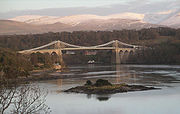
Kingdom of Gwynedd
Gwynedd was one petty kingdom of several Welsh successor states which emerged in 5th-century post-Roman Britain in the Early Middle Ages, and later evolved into a principality during the High Middle Ages. It was based on the former Brythonic tribal lands of the Ordovices, Gangani, and the...
in the High Middle Ages
High Middle Ages
The High Middle Ages was the period of European history around the 11th, 12th, and 13th centuries . The High Middle Ages were preceded by the Early Middle Ages and followed by the Late Middle Ages, which by convention end around 1500....
is a period in the History of Wales
History of Wales
The history of Wales begins with the arrival of human beings in the region thousands of years ago. Neanderthals lived in what is now Wales, or Cymru in Welsh, at least 230,000 years ago, while Homo sapiens arrived by about 29,000 years ago...
spanning the 11th through the 13th centuries. Gwynedd, located in the north
North Wales
North Wales is the northernmost unofficial region of Wales. It is bordered to the south by the counties of Ceredigion and Powys in Mid Wales and to the east by the counties of Shropshire in the West Midlands and Cheshire in North West England...
of Wales
Wales
Wales is a country that is part of the United Kingdom and the island of Great Britain, bordered by England to its east and the Atlantic Ocean and Irish Sea to its west. It has a population of three million, and a total area of 20,779 km²...
, eventually became the most dominant of Welsh principalities during this period. Distinctive achievements in Gwynedd include further development of Medieval Welsh literature
Medieval Welsh literature
Medieval Welsh literature is the literature written in the Welsh language during the Middle Ages. This includes material from the fifth century, when Welsh was in the process of becoming distinct from the British language, to the works of the 16th century....
, particularly poets known as the Beirdd y Tywysogion (Welsh
Welsh language
Welsh is a member of the Brythonic branch of the Celtic languages spoken natively in Wales, by some along the Welsh border in England, and in Y Wladfa...
for Poets of the Princes) associated with the court of Gwynedd; the reformation of bard
Bard
In medieval Gaelic and British culture a bard was a professional poet, employed by a patron, such as a monarch or nobleman, to commemorate the patron's ancestors and to praise the patron's own activities.Originally a specific class of poet, contrasting with another class known as fili in Ireland...
ic schools; and the continued development of Cyfraith Hywel
Welsh law
Welsh law was the system of law practised in Wales before the 16th century. According to tradition it was first codified by Hywel Dda during the period between 942 and 950 when he was king of most of Wales; as such it is usually called Cyfraith Hywel, the Law of Hywel, in Welsh...
(The Law of Hywel, or Welsh law). All three of these further contributed to the development of a Welsh national identity
Welsh people
The Welsh people are an ethnic group and nation associated with Wales and the Welsh language.John Davies argues that the origin of the "Welsh nation" can be traced to the late 4th and early 5th centuries, following the Roman departure from Britain, although Brythonic Celtic languages seem to have...
in the face of Anglo-Norman
Anglo-Norman
The Anglo-Normans were mainly the descendants of the Normans who ruled England following the Norman conquest by William the Conqueror in 1066. A small number of Normans were already settled in England prior to the conquest...
encroachment of Wales.
Gwynedd's traditional territory included Anglesey
Anglesey
Anglesey , also known by its Welsh name Ynys Môn , is an island and, as Isle of Anglesey, a county off the north west coast of Wales...
(Ynys Môn) and all of north Wales
North Wales
North Wales is the northernmost unofficial region of Wales. It is bordered to the south by the counties of Ceredigion and Powys in Mid Wales and to the east by the counties of Shropshire in the West Midlands and Cheshire in North West England...
between the River Dyfi
River Dyfi
The River Dyfi is a river in Mid Wales. The Dyfi estuary forms the border between the counties of Gwynedd and Ceredigion.- Source :...
in the south and River Dee
River Dee, Wales
The River Dee is a long river in the United Kingdom. It travels through Wales and England and also forms part of the border between the two countries....
(Welsh Dyfrdwy) in the northeast. The Irish Sea
Irish Sea
The Irish Sea separates the islands of Ireland and Great Britain. It is connected to the Celtic Sea in the south by St George's Channel, and to the Atlantic Ocean in the north by the North Channel. Anglesey is the largest island within the Irish Sea, followed by the Isle of Man...
(Môr Iwerddon) lies to the north and west, and lands formerly part of the Powys border the south-east. Gwynedd's strength was due in part to the region's mountainous geography
Snowdonia
Snowdonia is a region in north Wales and a national park of in area. It was the first to be designated of the three National Parks in Wales, in 1951.-Name and extent:...
which made it difficult for foreign invaders to campaign in the country and impose their will effectively.
Gwynedd emerged from the Early Middle Ages having suffered from increasing Viking
Viking
The term Viking is customarily used to refer to the Norse explorers, warriors, merchants, and pirates who raided, traded, explored and settled in wide areas of Europe, Asia and the North Atlantic islands from the late 8th to the mid-11th century.These Norsemen used their famed longships to...
raids
Raid (military)
Raid, also known as depredation, is a military tactic or operational warfare mission which has a specific purpose and is not normally intended to capture and hold terrain, but instead finish with the raiding force quickly retreating to a previous defended position prior to the enemy forces being...
and various occupations by rival Welsh princes, causing political and social upheaval. With the historic Aberffraw family
House of Aberffraw
The House of Aberffraw is a historiographical and genealogical term historians use to illustrate the clear line of succession from Rhodri the Great of Wales through his eldest son Anarawd....
displaced, by the mid 11th century Gwynedd was united with the rest of Wales by the conquest of Gruffydd ap Llywelyn
Gruffydd ap Llywelyn
Gruffydd ap Llywelyn was the ruler of all Wales from 1055 until his death, the only Welsh monarch able to make this boast...
, followed by the Norman invasions between 1067 and 1100.
After the restoration of the Aberffraw family in Gwynedd, a series of successful rulers such as Gruffydd ap Cynan
Gruffydd ap Cynan
Gruffydd ap Cynan was a King of Gwynedd. In the course of a long and eventful life, he became a key figure in Welsh resistance to Norman rule, and was remembered as King of all Wales...
, Owain Gwynedd
Owain Gwynedd
Owain Gwynedd ap Gruffydd , in English also known as Owen the Great, was King of Gwynedd from 1137 until his death in 1170. He is occasionally referred to as "Owain I of Gwynedd"; and as "Owain I of Wales" on account of his claim to be King of Wales. He is considered to be the most successful of...
, Llywelyn the Great
Llywelyn the Great
Llywelyn the Great , full name Llywelyn ab Iorwerth, was a Prince of Gwynedd in north Wales and eventually de facto ruler over most of Wales...
and his grandson Llywelyn II
Llywelyn ap Gruffydd Fychan
Llywelyn ap Gruffydd Fychan of Caeo was a Welsh landowner, a squire in effect, who in 1401 organized a decoy of Henry IV's English forces searching for the Welsh resistance leader Owain Glyndŵr. The deception allowed Owain to escape but involved Llywelyn in putting his life on the line...
led to the emergence of the Principality of Wales
Principality of Wales
The Principality of Wales existed between 1216 and 1542, encompassing two-thirds of modern Wales.It was formally founded in 1216 at the Council of Aberdyfi, and later recognised by the 1218 Treaty of Worcester between Llywelyn the Great of Wales and Henry III of England...
, based in Gwynedd. The emergence of the principality in the 13th century was proof that all the elements necessary for the growth of Welsh statehood
Sovereign state
A sovereign state, or simply, state, is a state with a defined territory on which it exercises internal and external sovereignty, a permanent population, a government, and the capacity to enter into relations with other sovereign states. It is also normally understood to be a state which is neither...
independent of England were in place. As part of the Principality of Wales, Gwynedd would retain Welsh laws and customs and home rule until the Edwardian Conquest of Wales
Statute of Rhuddlan
The Statute of Rhuddlan , also known as the Statutes of Wales or as the Statute of Wales provided the constitutional basis for the government of the Principality of North Wales from 1284 until 1536...
of 1282.
Norse raids; Aberffraw dispossessed
See also Early Mediaeval Wales; 700–1066.svg.png)
Maredudd ab Owain
Maredudd ab Owain was a King of Deheubarth, and through conquest also of Gwynedd and Powys, kingdoms in medieval Wales.Maredudd was the son of Owain ap Hywel and the grandson of Hywel Dda. His father was king of Deheubarth before him. As Owain grew too old to lead in battle his son Maredudd took...
deposed Gwynedd's ruler Cadwallon ab Ieuaf
Cadwallon ab Ieuaf
Cadwallon ap Ieuaf was a King of Gwynedd.Cadwallon was the son of Ieuaf ab Idwal and succeeded to the throne of Gwynedd on the death of his brother Hywel ab Ieuaf in 985. He only reigned for a year, for in 986 Maredudd ab Owain of Deheubarth invaded Gwynedd, slew Cadwallon and annexed his...
of the House of Aberffraw
House of Aberffraw
The House of Aberffraw is a historiographical and genealogical term historians use to illustrate the clear line of succession from Rhodri the Great of Wales through his eldest son Anarawd....
in 986, annexing Gwynedd into his enlarged domain, which came to include most of Wales.
The Hiberno-Norse
Norse-Gaels
The Norse–Gaels were a people who dominated much of the Irish Sea region, including the Isle of Man, and western Scotland for a part of the Middle Ages; they were of Gaelic and Scandinavian origin and as a whole exhibited a great deal of Gaelic and Norse cultural syncretism...
from Dublin
Kings of Dublin
The Vikings invaded the territory around Dublin in the 9th century, establishing the Norse Kingdom of Dublin, the earliest and longest lasting Norse kingdom in all of Europe outside of Scandinavia, excepting the so-called Kingdom of Mann and the Isles. This corresponded to most of present-day...
and the Isle of Man routinely raided the coasts of Wales, with the Welsh of Ynys Môn
Anglesey
Anglesey , also known by its Welsh name Ynys Môn , is an island and, as Isle of Anglesey, a county off the north west coast of Wales...
and the Llŷn Peninsula
Llŷn Peninsula
The Llŷn Peninsula extends into the Irish Sea from north west Wales, south west of the Isle of Anglesey. It is part of the modern county and historic region of Gwynedd. The name is thought to be of Irish origin, and to have the same root Laigin in Irish as the word Leinster...
suffering the most in Gwynedd. In 987 a Norse raiding party landed on Môn and captured as many as two thousand of the island's residents, selling them as slaves across northern Europe. Historian and author Dr. John Davies
John Davies (historian)
John Davies is a Welsh historian, and a television and radio broadcaster.Davies was born in the Rhondda, Wales, and studied at both University College, Cardiff, and Trinity College, Cambridge. He is married with four children...
argues that it is during this period that the Norse
Old Norse
Old Norse is a North Germanic language that was spoken by inhabitants of Scandinavia and inhabitants of their overseas settlements during the Viking Age, until about 1300....
name for Môn, Anglesey, came into existence and was later adopted into English. In 989 Meredudd ab Owain bribed the Norse not to raid that year. However the Norse resumed significant raids on Môn in 993, as well as other parts of Wales for the remainder of the century.
In 999 Meredudd ab Owain of Deheubarth died, and Cynan ap Hywel
Cynan ap Hywel
Cynan ap Hywel was a Prince of Gwynedd, one of the kingdoms or principalities of medieval Wales.After the death in 999 of Maredudd ab Owain who had seized Gwynedd from the line of Idwal Foel, the rule of Gwynedd returned to the original dynasty in the form of Idwal's great-grandson, Cynan ap Hywel...
was able to wrestle back Gwynedd for the Aberffraw dynasty. However, Cynan himself was deposed by Aeddan ap Blegywryd
Aeddan ap Blegywryd
Aeddan ap Blegywryd was a Prince of Gwynedd in medieval Wales.After the death of Cynan ap Hywel in 1005, the throne of Gwynedd fell to Aeddan ap Blegywryd, who was apparently out of the direct line of succession. It is not known whether or not Aeddan seized the throne by force, but his lack of...
in 1005. Aeddan was not himself connected to the Aberffraw family, and was perhaps a minor commote
Commote
A commote , sometimes spelt in older documents as cymwd, was a secular division of land in Medieval Wales. The word derives from the prefix cym- and the noun bod...
lord. Aeddan ruled Gwynedd until 1018, when he and his four sons were defeated in battle by Llywelyn ap Seisyll
Llywelyn ap Seisyll
Llywelyn ap Seisyll was a King of Gwynedd and of Deheubarth in north-west and south-west Wales, also called King of the Britons by the Annals of Ulster. Also called Llywelyn ap Seisyllt- Lineage :...
, lord of Rhuddlan
Rhuddlan Castle
Rhuddlan Castle is a castle located in Rhuddlan, Denbighshire, Wales. It was erected by Edward I in 1277 following the First Welsh War.-Construction:Rhuddlan was planned as a concentric castle...
in lower Gwynedd.
Llywelyn ap Seisyll married Anghared, daughter of Meredudd ab Owain of Deheubarth, and ruled Gwynedd until his death in 1023, when Iago ab Idwal
Iago ab Idwal ap Meurig
Iago ab Idwal ap Meurig was a Prince of Gwynedd.On the death of Llywelyn ap Seisyll in 1023, the rule of Gwynedd returned to the ancient dynasty with the accession of Iago, who was a great-grandson of Idwal Foel....
recovered the rulership of Gwynedd for the senior line of the Aberffraw house. Iago reigned over Gwynedd until 1039 when he was murdered by his own men, perhaps under the direction of Gruffydd of Rhuddlan
Gruffydd ap Llywelyn
Gruffydd ap Llywelyn was the ruler of all Wales from 1055 until his death, the only Welsh monarch able to make this boast...
, Llywelyn ap Seisyll's eldest son.
At age four, the Aberffraw heir Cynan ab Iago escaped with his mother to exile in Dublin.
Gruffydd ap Llywelyn; 1039–1063
Gruffydd ap LlywelynGruffydd ap Llywelyn
Gruffydd ap Llywelyn was the ruler of all Wales from 1055 until his death, the only Welsh monarch able to make this boast...
seized control of Gwynedd in 1039 with the death of Iago ab Idwal and, after taking possession of Powys, struck at Mercia
Mercia
Mercia was one of the kingdoms of the Anglo-Saxon Heptarchy. It was centred on the valley of the River Trent and its tributaries in the region now known as the English Midlands...
slaying Edwin of Mercia, brother of Leofric, Earl of Mercia
Leofric, Earl of Mercia
Leofric was the Earl of Mercia and founded monasteries at Coventry and Much Wenlock. Leofric is remembered as the husband of Lady Godiva.-Life and political influence:...
. Gruffydd's decisive defeat of the Mercians in battle at Rhyd y Groes on the Severn (near Welshpool
Welshpool
Welshpool is a town in Powys, Wales, or ancient county Montgomeryshire, from the Wales-England border. The town is low-lying on the River Severn; the Welsh language name Y Trallwng literally meaning 'the marshy or sinking land'...
), neutralized Mercian incursions on Gwynedd and Powys' eastern borders as many of Mercia's leading magnates were also slain alongside Edwin of Mercia.
Conquest of South Wales
Gruffydd then turned his attention to the conquest of Deheubarth, ruled by his maternal cousin Hywel ab Edwin
Hywel ab Edwin
Hywel ab Edwin was king of Deheubarth in south Wales from 1033.Hywel was the son of Edwin ab Einion and great-grandson of Hywel Dda. When the previous king, Rhydderch ap Iestyn, who had usurped the throne, died in 1033 Hywel became king of Deheubarth, sharing the realm with his brother Maredudd.On...
of the House of Dinefwr
House of Dinefwr
The House of Dinefwr was a royal house of Wales and refers to the descendants of Cadell ap Rhodri King of Seisyllwg, son of Rhodri the Great.With the death of Rhodri Mawr, the kingdom of Gwynedd passed to his eldest son Anarawd ap Rhodri...
. The latter was "by no means easy to dislodge", wrote Lloyd. Gruffydd raided Deheubarth's province of Ceredigion
Kingdom of Ceredigion
The Kingdom of Ceredigion was one of several Welsh kingdoms that emerged in 5th-century post-Roman Britain. Its area corresponded roughly to that of the modern county of Ceredigion. The kingdom's hilly geography made it difficult for foreign invaders to conquer. Cardigan Bay bordered to the west...
in 1036, ravaging the lands of the monastic community of Llanbadarn Fawr
Llanbadarn Fawr
Llanbadarn Fawr is an urbanised village and community in Ceredigion, Wales. It is located on the outskirts of Aberystwyth situated next to Penparcau and Southgate. It forms the eastern part of the continually built-up area of Aberystwyth...
(Great Llanbadarn). Hywel of Deheubarth was able to defend Deheubarth against Gruffydd's raids until he was defeated in 1041 at the Battle of Pencader, after which Gruffydd captured Hywel's wife and became master of Ceredigion. Following the Battle of Pencader, Hywel retained Dyfed
Kingdom of Dyfed
The Kingdom of Dyfed is one of several Welsh petty kingdoms that emerged in 5th-century post-Roman Britain in south-west Wales, based on the former Irish tribal lands of the Déisi from c 350 until it was subsumed into Deheubarth in 920. In Latin, the country of the Déisi was Demetae, eventually to...
(Pembrokeshire
Pembrokeshire
Pembrokeshire is a county in the south west of Wales. It borders Carmarthenshire to the east and Ceredigion to the north east. The county town is Haverfordwest where Pembrokeshire County Council is headquartered....
) and Ystrad Tywi
Ystrad Tywi
Ystrad Tywi is an area of south-west Wales situated on the banks of the Tywi river as it approaches the sea to join the Bristol Channel at Carmarthen...
(Carmarthenshire
Carmarthenshire
Carmarthenshire is a unitary authority in the south west of Wales and one of thirteen historic counties. It is the 3rd largest in Wales. Its three largest towns are Llanelli, Carmarthen and Ammanford...
), the heart of Deheubarth. However he was expelled by Gruffydd in 1043 after an unrecorded event, and sought refuge in Ireland. In 1044 Hywel returned to recover Deheubarth with an army of Hiberno-Norse, but was slain and defeated in the Battle of Aber Tywi by Gruffydd ap Llywelyn.
Between 1044 and 1055 Gruffydd ap Llywelyn fought Gruffydd ap Rhydderch
Gruffydd ap Rhydderch
Gruffydd ap Rhydderch was a king of Gwent and part of the kingdom of Morgannwg in south Wales and later king of Deheubarth.Gruffydd was the son of Rhydderch ab Iestyn who had been able to take over the kingdom of Deheubarth from 1023 to 1033...
of Gwent for control of Deheubarth. Following the defeat of Hywel by Gruffydd ap Llywelyn, Gruffydd ap Rhydderch of Gwent was able to "stir up" the minor commote lords of Deheubarth on his behalf, and was able to call up an army to resist Gruffydd ap Llywelyn, wrote Lloyd. By 1046 Gruffydd ap Llywelyn allied with Sweyn Godwinson
Sweyn Godwinson
Sweyn Godwinson , also spelled Swein, was the eldest son of Earl Godwin of Wessex, and brother of Harold II of England.- Early life :...
, Earl of Hereford
Earl of Hereford
The title of Earl of Hereford was created six times in the Peerage of England. See also Duke of Hereford, Viscount Hereford. Dates indicate the years the person held the title for.-Earls of Hereford, First Creation :*Swegen Godwinson...
, and the two of them campaigned in South Wales against Gruffydd of Gwent. In 1047 the lords of Ystrad Tywi, the heart of Deheubarth and the seat of the Dinefwr family, led an army which totally defeated the 150-strong teulu, or household guard, of Gruffydd ap Llywelyn, who was narrowly able to escape. In retaliation against the resurgent nobles of Ystrad Tywi and Dyfed, Gruffydd ap Llywelyn devastated those provinces, but "in vain", wrote John Edward Lloyd
John Edward Lloyd
Sir John Edward Lloyd , was a Welsh historian, the author of the first serious history of the country's formative years, A History of Wales from the Earliest Times to the Edwardian Conquest, 2 vols...
, "as his authority in South Wales was ... shattered" by Gruffydd ap Rhydderch of Gwent who was now firmly in control of Ystrad Tywi and Dyfed.
In the summer of 1052 Gruffydd ap Llywelyn raided the Norman settlements in Herefordshire in retaliation for the displacement of his former ally Sweyn Godwinson. Sweyn Godwinson and his family were forced into exile and replaced by the Norman
Normans
The Normans were the people who gave their name to Normandy, a region in northern France. They were descended from Norse Viking conquerors of the territory and the native population of Frankish and Gallo-Roman stock...
Ralph the Timid
Ralph the Timid
Ralph the Timid, also known as Ralf of Mantes, died 1057, was Earl of Hereford between 1051 and 1055 or 1057. His mother was Godgifu, the daughter of King Æthelred the Unready and his second wife Emma. His father was Drogo of Mantes, Count of the Vexin, who died on pilgrimage to Jerusalem in...
. Gruffydd defeated the mixed force of Norman and English sent against his raiding party near Leominster
Leominster
Leominster is a market town in Herefordshire, England, located approximately north of the city of Hereford and south of Ludlow, at...
. In 1055 Gruffydd ap Llywelyn defeated and killed his southern rival Gruffydd ap Rhydderch and took possession of Deheubarth, later driving out Meurig ap Hywel and Cadwagan ap Hywel of Gwent, and so becoming master over the whole of Wales.
Wars with England
Gruffydd allied with Ælfgar
Ælfgar, Earl of Mercia
Ælfgar was son of Leofric, Earl of Mercia,by his well-known wife Godgifu . He succeeded to his father's title and responsibilities on the latter's death in 1057....
, Earl of East Anglia
Earl of East Anglia
The Earls of East Anglia were governors of East Anglia during the 11th century. The post was established by Cnut in 1017 and disappeared following Ralph Guader's participation in the failed Revolt of the Earls in 1075.-Ealdormen of East Anglia:...
(and son of Leofric, Earl of Mercia), who had been dispossessed of his earldom on charges of treason, charges which may or may not have been substantiated.
On 24 October 1055, Gruffydd, Ælfgar, and Ælfgar's Hiberno-Norse mercenaries, attacked the Norman settlement at Hereford
Herefordshire
Herefordshire is a historic and ceremonial county in the West Midlands region of England. For Eurostat purposes it is a NUTS 3 region and is one of three counties that comprise the "Herefordshire, Worcestershire and Gloucestershire" NUTS 2 region. It also forms a unitary district known as the...
, defeating Ralph, Earl of Hereford, and razing Hereford Castle
Hereford Castle
Hereford Castle was a castle in the cathedral city of Hereford in Herefordshire, England.- Pre Norman Castle :It stood on a site to the south and east of the modern city overlooking the River Wye...
. In the looting which followed, Gruffydd and Ælfgar raided Hereford Cathedral
Hereford Cathedral
The current Hereford Cathedral, located at Hereford in England, dates from 1079. Its most famous treasure is Mappa Mundi, a mediæval map of the world dating from the 13th century. The cathedral is a Grade I listed building.-Origins:...
of its rich vessels and furnishing, killing seven of the canons who sought to bar the cathedral doors against the raiders.
Edward the Confessor
Edward the Confessor
Edward the Confessor also known as St. Edward the Confessor , son of Æthelred the Unready and Emma of Normandy, was one of the last Anglo-Saxon kings of England and is usually regarded as the last king of the House of Wessex, ruling from 1042 to 1066....
, King of England, commissioned Harold Godwinson
Harold Godwinson
Harold Godwinson was the last Anglo-Saxon King of England.It could be argued that Edgar the Atheling, who was proclaimed as king by the witan but never crowned, was really the last Anglo-Saxon king...
, Earl of Wessex
Earl of Wessex
The title Earl of Wessex has been created twice in British history, once in the pre-Conquest Anglo-Saxon nobility of England and once in the Peerage of the United Kingdom...
, to respond to Gruffydd's raid on Hereford. However Harold was unable to penetrate into Wales but for a few miles beyond the Dyffryn Dŵr
Golden Valley, Herefordshire
The Golden Valley is the name given to the valley of the River Dore in western Herefordshire, England. The valley is a picturesque area of gently rolling countryside...
(Valley of Dore). Unable to campaign in Wales, a peace accord was reached between Gruffydd, Ælfgar, and Harold of Wessex, and Edward the Confessor at Billingsley
Billingsley, Shropshire
Billingsley is a small village and civil parish in Shropshire, England, six miles south of Bridgnorth. According to the 2001 census it had a population of 181....
, near Boulston in Archenfield
Archenfield
Archenfield is the historic English name for an area of southern and western Herefordshire in England. Since the Anglo-Saxons took over the region in the 8th century, it has stretched between the River Monnow and River Wye, but it derives from the once much larger Welsh kingdom of...
, with Ælfgar regaining his earldom of East Anglia.
Despite the peace of Billingsley, cross border raids continued. In June 1056 Leofgar, Bishop of Hereford
Leofgar of Hereford
Leofgar was a medieval Bishop of Hereford.Leofgar was consecrated in March 1056. He had previously been the chaplain to Harold Godwineson, and it was probably Harold who persuaded King Edward the Confessor to appoint him to the bishopric. The appointment was disapproved of by the Anglo-Saxon...
, led an army into Wales in revenge for the earlier raid committed by Gruffydd and Ælfgar. Gruffydd defeated Bishop Leofgar on June 16 in a battle in Dyffryn Machawy, with the bishop among those slain. The following year the men of Hereford raised another army against the Welsh, but their army was dogged by skirmishes and defeat, and they were obliged to negotiate for a peace.
King of Wales
.svg.png)
Aldred
Ealdred was Abbot of Tavistock, Bishop of Worcester, and Archbishop of York in Anglo-Saxon England. He was related to a number of other ecclesiastics of the period. After becoming a monk at the monastery at Winchester, he was appointed Abbot of Tavistock Abbey in around 1027. In 1046 he was named...
(the soon-to-be Archbishop of York
Archbishop of York
The Archbishop of York is a high-ranking cleric in the Church of England, second only to the Archbishop of Canterbury. He is the diocesan bishop of the Diocese of York and metropolitan of the Province of York, which covers the northern portion of England as well as the Isle of Man...
). Gruffydd would be recognized in all of his conquests if he would swear fealty to King Edward the Confessor, becoming an "under-king
Mediatization
Mediatisation is the loss of imperial immediacy. Broadly defined it is the subsumption of one monarchy into another monarchy in such a way that the ruler of the annexed state keeps his sovereign title and, sometimes, a measure of local power...
" in a similar manner the King of Scots. Agreeing to the terms, Gruffydd traveled from Chepstow
Chepstow
Chepstow is a town in Monmouthshire, Wales, adjoining the border with Gloucestershire, England. It is located on the River Wye, close to its confluence with the River Severn, and close to the western end of the Severn Bridge on the M48 motorway...
to Gloucester where he and King Edward the Confessor met, and the treaty terms performed.
From his family seat at Rhuddlan, Gruffydd ruled the whole of Wales as king.
Gruffydd's position as King of Wales
King of Wales
King of Wales was a very rarely used title, because Wales never achieved the degree of political unity that England or Scotland did. However, in the mid-11th century, one of the Welsh kings, Gruffydd ap Llywelyn, gained supreme power: "in 1055 he absorbed Deheubarth as well, thus becoming in...
was further strengthened in 1057 when his friend and ally, Ælfgar, Earl of East Anglia, inherited Mercia on the death of his father, Earl Leofric. Their alliance was cemented with a dynastic marriage, as Gruffydd married Ældyth
Edith of Mercia
Ealdgyth , also Aldgyth or anglicized, Edith, was a daughter of Ælfgar, Earl of Mercia, the wife of Gruffudd ap Llywelyn Ealdgyth (fl. c. 1057–1066), also Aldgyth or anglicized, Edith, was a daughter of Ælfgar, Earl of Mercia, the wife of Gruffudd ap Llywelyn Ealdgyth (fl. c. 1057–1066), also...
, Ælfgar's daughter, around this time. As allied neighbors, Gruffydd and Ælfgar were "fortified against all attack", argued Lloyd, as their territory included Gruffydd's Wales, and Ælfgar's Mercia and Anglia.
However, Earl Ælfgar died in 1062 and was succeeded by his young and inexperienced son Edwin. The loss of a strong Mercian ruler exposed Gruffydd's position. Following King Edward's Christmas court held at Gloucester, "at a time most unusual for campaigning in Wales", noted Lloyd, Harold Godwinson led a small force of huscarls from Chester into Wales, boldly striking Gruffydd's court at Rhuddlan. However, Gruffydd received warning beforehand, and escaped on a small ship into the River Clwyd
River Clwyd
The River Clwyd is a river in North Wales which rises in the Clocaenog Forest northwest of Corwen.It flows due south until at Melin-y-Wig it veers northeastwards, tracking the A494 to Ruthin. Here it leaves the relatively narrow valley and enters a broad agricultural vale, the Vale of Clwyd...
just as Harold's forces took Rhuddlan.
Though having failed to take Gruffydd in the winter of 1062, Harold Godwinson began preparations for a spring campaign in Wales. Tostig Godwinson
Tostig Godwinson
Tostig Godwinson was an Anglo-Saxon Earl of Northumbria and brother of King Harold Godwinson, the last crowned english King of England.-Early life:...
, Earl of Northumbria
Northumbria
Northumbria was a medieval kingdom of the Angles, in what is now Northern England and South-East Scotland, becoming subsequently an earldom in a united Anglo-Saxon kingdom of England. The name reflects the approximate southern limit to the kingdom's territory, the Humber Estuary.Northumbria was...
and Harold's brother, brought a force into North Wales aiming to conquer Ynys Môn, while Harold assembled a light infantry at Bristol
Bristol
Bristol is a city, unitary authority area and ceremonial county in South West England, with an estimated population of 433,100 for the unitary authority in 2009, and a surrounding Larger Urban Zone with an estimated 1,070,000 residents in 2007...
where they boarded ships sailing for North Wales. On landing first in South Wales, and seeing the English army, the local magnates of Deheubarth came to terms with Harold and gave hostages as a guarantee of peace. Harold continued on to Gwynedd, where Gruffydd was already besieged by Tostig's army and "driven from one hiding place to another", wrote Lloyd. Harold landed in Wales and joined in the hunt, and offered peace to the Welsh of Gwynedd in exchange for Gruffydd's head. Desperate to end the Anglo-Saxon
Anglo-Saxons
Anglo-Saxon is a term used by historians to designate the Germanic tribes who invaded and settled the south and east of Great Britain beginning in the early 5th century AD, and the period from their creation of the English nation to the Norman conquest. The Anglo-Saxon Era denotes the period of...
siege, Gruffydd's own men murdered him on August 5, 1063.
Following Gruffydd's death, Harold took Gruffydd's widow Ældyth of Mercia as his wife. Ældyth was the only women to have been known as Queen of Wales and then Queen of England in turn.
Mathrafal ascendency and English alliances; 1063–1081
Harold Godwinson did not undertake the conquest or occupation of Wales; there was not the planning or resources nor any national will to conquer Wales. Harold aimed at the elimination of any centralized authority in Wales.On his death, Gruffydd ap Llywelyn's maternal half brothers Bleddyn ap Cynfyn
Bleddyn ap Cynfyn
Bleddyn ap Cynfyn was a Prince of the Welsh Kingdoms of Gwynedd and of Powys.- Lineage :Bleddyn was the son of Princess Angharad ferch Maredudd with her second husband Cynfyn ap Gwerstan, a Powys Lord, about whom little is now known...
and Rhiwallon ap Cynfyn
Rhiwallon ap Cynfyn
Rhiwallon ap Cynfyn was a Welsh prince, the son of Cynfyn ap Gwerstan. On the downfall of Gruffydd ap Llywelyn in 1063 he received North Wales on condition of faithfully serving Edward the Confessor ‘everywhere by water and by land.’ As the son of Angharad, daughter of Maredudd ab Owain ap Hywel...
of the Mathrafal
Mathrafal
Mathrafal near Welshpool, in Powys, Mid Wales, was the seat of the Kings and Princes of Powys probably from the 9th century until its destruction in 1212 by Llywelyn ap Iorwerth of Gwynedd.- Location :...
house of Powys divided Gwynedd and Powys between them, swearing fealty to Edward the Confessor
Edward the Confessor
Edward the Confessor also known as St. Edward the Confessor , son of Æthelred the Unready and Emma of Normandy, was one of the last Anglo-Saxon kings of England and is usually regarded as the last king of the House of Wessex, ruling from 1042 to 1066....
who endorsed their seizure, and with Deheubarth, Glamorgan, and Gwent returned to their historic dynasties.
Bleddyn ap Cynfyn allied with the Anglo-Saxons of Northern England
Northern England
Northern England, also known as the North of England, the North or the North Country, is a cultural region of England. It is not an official government region, but rather an informal amalgamation of counties. The southern extent of the region is roughly the River Trent, while the North is bordered...
to resist the threat from William the Conqueror following the Norman Conquest of England
Norman conquest of England
The Norman conquest of England began on 28 September 1066 with the invasion of England by William, Duke of Normandy. William became known as William the Conqueror after his victory at the Battle of Hastings on 14 October 1066, defeating King Harold II of England...
in 1066. In 1067 Bleddyn and Rhiwallon joined with the Mercia
Mercia
Mercia was one of the kingdoms of the Anglo-Saxon Heptarchy. It was centred on the valley of the River Trent and its tributaries in the region now known as the English Midlands...
n Eadric the Wild
Eadric the Wild
Eadric the Wild , also known as Eadric Cild, was an Anglo-Saxon magnate of the West Midlands who led English resistance to the Norman Conquest, active in 1068-70.-Background:...
in an attack on the Normans at Hereford Castle, and ravaged the Norman lands in Herefordshire along the River Lugg
River Lugg
The River Lugg , rises near Llangynllo, Powys. It flows through the border town of Presteigne, Wales then through Herefordshire, England, including the town of Leominster, south of which it is met by a tributary, the River Arrow, then to a confluence with the River Wye, which it joins at Mordiford,...
, "causing serious damage" to the Normans, wrote Lloyd. Between 1068 and 1070 Bleddyn allied with Edwin, Earl of Mercia
Edwin, Earl of Mercia
Edwin was the elder brother of Morcar, Earl of Northumbria, son of Ælfgār, Earl of Mercia and grandson of Leofric, Earl of Mercia. He succeeded to his father's title and responsibilities on Ælfgār's death in 1062...
, Gospatric, Earl of Northumbria
Gospatric, Earl of Northumbria
Gospatric or Cospatric , , was Earl of Northumbria, or of Bernicia, and later lord of sizable estates around Dunbar...
and Morcar of Northumbria
Morcar of Northumbria
Morcar was the son of Ælfgār and brother of Ēadwine. He was himself the earl of Northumbria from 1065 to 1066, when he was replaced by William the Conqueror with Copsi....
in an alliance against the Normans during the Harrowing of the North. However the defeat of the Saxons in 1070 exposed lower Gwynedd, the Perfeddwlad, to Norman incursions, with Robert "of Rhuddlan"
Robert of Rhuddlan
Robert of Rhuddlan was a Norman adventurer who became lord of much of north-east Wales and for a period lord of all North Wales....
taking Rhuddlan Castle and establishing himself firmly at the mouth of the Clwyd river
River Clwyd
The River Clwyd is a river in North Wales which rises in the Clocaenog Forest northwest of Corwen.It flows due south until at Melin-y-Wig it veers northeastwards, tracking the A494 to Ruthin. Here it leaves the relatively narrow valley and enters a broad agricultural vale, the Vale of Clwyd...
by 1073.
Bleddyn was killed in 1075 by Rhys ab Owain
Rhys ab Owain
Rhys ab Owain was a king of Deheubarth in southern Wales.Rhys was the son of Owain ab Edwin of the line of Hywel Dda, and member of the Dinefwr dynasty. He followed his brother Maredudd as king of Deheubarth in 1072...
, Prince of Deheubarth, an ally of the dispossessed Aberffraw heir of Gwynedd, Gruffydd ap Cynan
Gruffydd ap Cynan
Gruffydd ap Cynan was a King of Gwynedd. In the course of a long and eventful life, he became a key figure in Welsh resistance to Norman rule, and was remembered as King of all Wales...
, who was himself attempting to recover his inheritance. Rhys ab Owain was able to recover Deheubarth for the House of Dinefwr following the death of Gruffydd ap Llywelyn in 1063. However, Trahaearn ap Caradog
Trahaearn ap Caradog
- Accession:On the death of Bleddyn ap Cynfyn in 1075, it appears that none of his sons were old enough to claim the throne, and Bleddyn's cousin Trahaearn ap Caradog, seized power...
of Arwystli
Arwystli
Arwystli was a cantref in medieval Wales, located in the headland of the River Severn in what is now the county of Powys. It was chiefly associated with the Kingdom of Powys, but was heavily disputed between Powys, Gwynedd, and the Norman Marcher Lords for hundreds of years, and was the scene of...
, Bleddyn's cousin, took control of Gwynedd and by 1078 defeated Rhys ab Owain at the Battle of Goodwick. Trahaearn allied with Caradog ap Gruffydd
Caradog ap Gruffydd
Caradog ap Gruffydd was a Prince of Gwent in south-east Wales who made repeated attempts to gain power over all of southern Wales by seizing the Kingdom of Deheubarth.- Lineage :...
of Gwent against Deheubarth.
Gruffydd ap Cynan, who grew up in exile in Dublin and was himself half Hiberno-Norse on his mother's side, made his first attempt to recover Gwynedd in 1075 when he landed on Ynys Môn with a Norse force, and mercenary troops provided by Robert of Rhuddlan
Robert of Rhuddlan
Robert of Rhuddlan was a Norman adventurer who became lord of much of north-east Wales and for a period lord of all North Wales....
. Gruffydd ap Cynan first defeated and killed Cynwrig ap Rhiwallon, an ally of Trahaearn who held Llŷn, then defeated Trahaearn himself in the Battle of Gwaed Erw in Meirionnydd
Meirionnydd
Meirionnydd is a coastal and mountainous region of Wales. It has been a kingdom, a cantref, a district and, as Merionethshire, a county.-Kingdom:...
, gaining control of Gwynedd. Gruffydd then led his forces eastwards into lower Gwynedd, the Perfeddwlad, to recover lands lost to the Normans. Despite the "assistance" previously given by Robert of Rhuddlan, Gruffydd attacked and destroyed Rhuddlan castle. However, tension between Gruffydd's Hiberno-Norse bodyguard and the local Welsh led to a rebellion in Llŷn, and Trahaearn took the opportunity to counterattack, defeating Gruffydd at the Battle of Bron yr Erw, above Clynnog Fawr
Clynnog Fawr
Clynnog Fawr, often simply called "Clynnog", is a village on the north coast of the Llŷn peninsula in Gwynedd, north-west Wales.Clynnog Fawr lies on the A499 road between Caernarfon and Pwllheli, at . It had a population of 130 in 1991...
, that same year. Gruffydd retreated to Ireland but in 1081 returned and made an alliance with Rhys ap Tewdwr
Rhys ap Tewdwr
Rhys ap Tewdwr was a Prince of Deheubarth in south-west Wales and member of the Dinefwr dynasty, a branch descended from Rhodri the Great...
, the new Prince of Deheubarth following the death of his cousin. Rhys had been attacked by Caradog ap Gruffydd
Caradog ap Gruffydd
Caradog ap Gruffydd was a Prince of Gwent in south-east Wales who made repeated attempts to gain power over all of southern Wales by seizing the Kingdom of Deheubarth.- Lineage :...
of Gwent and Morgannwg, and had been forced to flee from his fortress of Dinefwr
Dinefwr
Dinefwr was a local government district of Dyfed, Wales from 1974 to 1996. It was named after Dinefwr Castle which was the royal capital of the Principality of Deheubarth and one of the three principal royal courts of Wales....
to St David's Cathedral
St David's Cathedral
St David's Cathedral is situated in St David's in the county of Pembrokeshire, on the most westerly point of Wales.-Early history:The monastic community was founded by Saint David, Abbot of Menevia, who died in AD589...
in Penfro (Pembrokeshire
Pembrokeshire
Pembrokeshire is a county in the south west of Wales. It borders Carmarthenshire to the east and Ceredigion to the north east. The county town is Haverfordwest where Pembrokeshire County Council is headquartered....
).
Gruffydd this time embarked from Hiberno-Norse Waterford in Ireland with a Norse army and landed near Tyddewi (St David's)
St David's
St Davids , is a city and community in Pembrokeshire, Wales. Lying on the River Alun on St David's Peninsula, it is Britain's smallest city in terms of both size and population, the final resting place of Saint David, the country's patron saint, and the de facto ecclesiastical capital of...
joining his ally Rhys ap Tewdwr of Deheubarth and by Aberffraw supporters from Gwynedd. Gruffydd and Rhys marched their army north to seek out Trahaearn ap Caradog and Caradog ap Gruffydd of Powys, who had themselves made an alliance and been joined by Meilyr ap Rhiwallon of Morgannwg-Gwent. The armies of the two confederacies met at the Battle of Mynydd Carn
Battle of Mynydd Carn
The Battle of Mynydd Carn took place in 1081, as part of a dynastic struggle for control of the Welsh kingdoms of Gwynedd and Deheubarth. The result of the battle had a radical effect on the history of Wales....
, with Gruffydd and Rhys victorious and Trahaearn, Caradog and Meilyr all killed. Gruffydd was thus able to seize power in Gwynedd for the second time.
Norman invasion, and the Aberffraw resistance; 1081–1100
See also Norman invasion of WalesNorman invasion of Wales
The Norman invasion of Wales began shortly after the Norman conquest of England under William the Conqueror, who believed England to be his birthright...
Normans
The Normans were the people who gave their name to Normandy, a region in northern France. They were descended from Norse Viking conquerors of the territory and the native population of Frankish and Gallo-Roman stock...
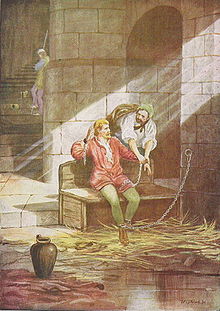
launched an invasion of Wales following the Saxon revolt in northern England. Shortly after the Battle of Mynydd Carn in 1081, Gruffydd was lured into a trap with the promise of an alliance but seized by Hugh the Fat, 1st Earl of Chester
Hugh d'Avranches, 1st Earl of Chester
Hugh d'Avranches , also known as le Gros and Lupus was the first Earl of Chester and one of the great magnates of early Norman England.-Early career:...
in an ambush at Rug, near Corwen
Corwen
Corwen is a town and community in the county of Denbighshire in Wales; it was previously part of the county of Meirionnydd). Corwen stands on the banks of the River Dee beneath the Berwyn mountains. The town is situated west of Llangollen and south of Ruthin...
. Earl Hugh claimed the Perfeddwlad up to the Clwyd river
River Clwyd
The River Clwyd is a river in North Wales which rises in the Clocaenog Forest northwest of Corwen.It flows due south until at Melin-y-Wig it veers northeastwards, tracking the A494 to Ruthin. Here it leaves the relatively narrow valley and enters a broad agricultural vale, the Vale of Clwyd...
(the commote
Commote
A commote , sometimes spelt in older documents as cymwd, was a secular division of land in Medieval Wales. The word derives from the prefix cym- and the noun bod...
s of Tegeingl and Rhufoniog
Rhufoniog
Rhufoniog was a small sub-kingdom of the Dark Ages Gwynedd, and later a cantref in medieval Wales. According to tradition, it was ruled by its eponymous founder Rhufon, the third son of the first King of Gwynedd, Cunedda, and his direct descendants from the year 445 until the year 540 when it was...
; the modern counties of Denbighshire
Denbighshire
Denbighshire is a county in north-east Wales. It is named after the historic county of Denbighshire, but has substantially different borders. Denbighshire has the distinction of being the oldest inhabited part of Wales. Pontnewydd Palaeolithic site has remains of Neanderthals from 225,000 years...
, Flintshire
Flintshire
Flintshire is a county in north-east Wales. It borders Denbighshire, Wrexham and the English county of Cheshire. It is named after the historic county of Flintshire, which had notably different borders...
and Wrexham
Wrexham
Wrexham is a town in Wales. It is the administrative centre of the wider Wrexham County Borough, and the largest town in North Wales, located in the east of the region. It is situated between the Welsh mountains and the lower Dee Valley close to the border with Cheshire, England...
) as part of Chester, and viewed the restoration of the Aberffraw family in Gwynedd as a threat to his own expansion into Wales. The lands west of the Clwyd were intended for his cousin Robert of Rhuddlan, and their advance extended to the Llŷn peninsula by 1090. Once in power, the Normans sought control over the spiritual traditions and ecclesiastical institutions in Wales. In his effort further to consolidate control over Gwynedd, Earl Hugh of Chester had forced the election of Hervé the Breton
Hervey le Breton
Hervey le Breton was a Breton cleric who became Bishop of Bangor in Wales and later Bishop of Ely in England. Appointed to Bangor by King William II of England, when Normans were advancing into Wales, Hervey was unable to remain in his diocese when the Welsh began to drive the Normans back from...
upon the Bangor diocese in 1092, with Hervé's consecration
Consecration
Consecration is the solemn dedication to a special purpose or service, usually religious. The word "consecration" literally means "to associate with the sacred". Persons, places, or things can be consecrated, and the term is used in various ways by different groups...
as Bishop of Bangor
Bishop of Bangor
The Bishop of Bangor is the Ordinary of the Church in Wales Diocese of Bangor.The diocese covers the counties of Anglesey, most of Caernarfonshire and Merionethshire and a small part of Montgomeryshire...
performed by Thomas of Bayeux, the Archbishop of York
Archbishop of York
The Archbishop of York is a high-ranking cleric in the Church of England, second only to the Archbishop of Canterbury. He is the diocesan bishop of the Diocese of York and metropolitan of the Province of York, which covers the northern portion of England as well as the Isle of Man...
. It was hoped that placing a prelate loyal to the Normans over the traditionally independent Welsh Church in Gwynedd would help pacify the local inhabitants. However, the Welsh parishioners remained hostile to Hervé's appointment, and the bishop was forced to carry a sword with him and rely on a contingent of Norman knights for his protection. Additionally, Hervé routinely excommunicated parishioners who he perceived as challenging his spiritual and temporal authority.
By 1094 almost the whole of Wales was occupied by Norman forces. However, although they erected many castles, Norman control in most regions of Wales was tenuous at best. Motivated by local anger over the "gratuitously cruel" invaders and led by the historic ruling houses such as Gwynedd's Aberffraw family, represented by Gruffydd ap Cynan, Welsh control over the greater part of Wales was restored by 1100. Gruffydd escaped Norman imprisonment in Chester, and slew Robert of Rhuddlan in a beach side battle at Deganwy on 3 July 1093. Gruffydd recovered Gwynedd by 1095, and by 1098 he allied with Cadwgan ap Bleddyn
Cadwgan ap Bleddyn
Cadwgan ap Bleddyn was a prince of Powys in eastern Wales.Cadwgan was the second son of Bleddyn ap Cynfyn who was king of both Powys and Gwynedd. When Bleddyn was killed in 1075, Powys was divided between three of his sons, Cadwgan, Iorwerth and Maredudd. Cadwgan is first heard of in 1088 when he...
of the Mathrafal house of Powys, their traditional dynastic rivalries notwithstanding. Gruffydd and Cadwgan led the Welsh resistance to the Norman occupation in north and mid Wales. However, by 1098 Earl Hugh of Chester and Hugh of Montgomery, 2nd Earl of Shrewsbury
Hugh of Montgomery, 2nd Earl of Shrewsbury
Hugh of Montgomery, 2nd Earl of Shrewsbury was an Anglo-Norman aristocrat.-Lineage:He was the second surviving son of Roger of Montgomery, 1st Earl of Shrewsbury and Mabel of Bellême...
advanced their army to the Menai Strait
Menai Strait
The Menai Strait is a narrow stretch of shallow tidal water about long, which separates the island of Anglesey from the mainland of Wales.The strait is bridged in two places - the main A5 road is carried over the strait by Thomas Telford's elegant iron suspension bridge, the first of its kind,...
, with Gruffydd and Cadwgan regrouping on defensible Ynys Môn
Anglesey
Anglesey , also known by its Welsh name Ynys Môn , is an island and, as Isle of Anglesey, a county off the north west coast of Wales...
, where they planned to make retaliatory strikes from their island fortress. Gruffydd hired a Norse
Norsemen
Norsemen is used to refer to the group of people as a whole who spoke what is now called the Old Norse language belonging to the North Germanic branch of Indo-European languages, especially Norwegian, Icelandic, Faroese, Swedish and Danish in their earlier forms.The meaning of Norseman was "people...
fleet from a settlement in Ireland to patrol the Menai and prevent the Norman army from crossing; however the Normans were able to pay off the fleet to ferry them to Môn instead. Betrayed, Gruffydd and Cadwgan were forced to flee to Ireland in a skiff
Skiff
The term skiff is used for a number of essentially unrelated styles of small boat. The word is related to ship and has a complicated etymology: "skiff" comes from the Middle English skif, which derives from the Old French esquif, which in turn derives from the Old Italian schifo, which is itself of...
.
,_anglesey.jpg)
St Tyfrydog's Church, Llandyfrydog
St Tyfrydog's Church, Llandyfrydog is a small medieval church, in Llandyfrydog, Anglesey, north Wales. The date of establishment of a church on this site is unknown, but one 19th-century Anglesey historian says that it was about 450...
a kennel for his dogs. During the 'celebrations', a Norse fleet led by Magnus Barefoot
Magnus III of Norway
Magnus Barefoot or Magnus III Olafsson was King of Norway from 1093 until 1103 and King of Mann and the Isles from 1099 until 1103.-Background:...
, king of Norway, appeared off the coast at Ynys Seiriol (Puffin Island), and in the battle that followed, known as the Battle of Anglesey Sound, Magnus shot dead the earl of Shrewsbury with an arrow to the eye. The Norse left as suddenly and as mysteriously as they had arrived, however leaving the Norman army weakened and demoralized. The Norman army retired to England, leaving a Welshman, Edwin ap Goronwy, lord of Tegeingl, in command of a token force to control Ynys Môn and upper Gwynedd, and ultimately abandoning any colonization plans there. Edwin ap Goronwy transferred his allegiance to Chester following the defeat
Battle of Mynydd Carn
The Battle of Mynydd Carn took place in 1081, as part of a dynastic struggle for control of the Welsh kingdoms of Gwynedd and Deheubarth. The result of the battle had a radical effect on the history of Wales....
of his ally Trahaearn ap Caradog in 1081, a move which earned him the epithet Bradwr, traitor, among the Welsh.
Pura Wallia and Marchia Wallie
See also Welsh MarchesWelsh Marches
The Welsh Marches is a term which, in modern usage, denotes an imprecisely defined area along and around the border between England and Wales in the United Kingdom. The precise meaning of the term has varied at different periods...
, Marcher Lord, Cambro-Norman
Cambro-Norman
Cambro-Norman is a term used for Norman knights who settled in southern Wales after the Norman conquest of England in 1066. Some historians suggest that the term is to be preferred to Anglo-Norman for the Normans who invaded Ireland after 1170 — many of whom originated in Wales. However, the term...
In late 1098 Gruffydd and Cadwgan landed in Wales and recovered Ynys Môn without much difficulty, with Hervé the Breton fleeing Bangor for safety in England. Over the course of the next three years Gruffydd recovered upper Gwynedd to the Conwy and defeating Hugh, Earl of Chester in border skermishes. In 1101, after Earl Hugh's death, Gruffydd and Cadwgan came to terms with England's new king, Henry I
Henry I of England
Henry I was the fourth son of William I of England. He succeeded his elder brother William II as King of England in 1100 and defeated his eldest brother, Robert Curthose, to become Duke of Normandy in 1106...
, who was consolidating his own authority and also eager to come to terms.
In the negotiations which followed Henry I recognized Gruffydd's ancestral claims of Môn, Arfon, Llŷn, Dunoding
Dunoding
Dunoding was an early sub-kingdom within the Kingdom of Gwynedd in north-west Wales which existed between the 5th and 10th centuries. According to tradition, it was named after Dunod, a son of the founding father of Gwynedd - Cunedda Wledig - who drove the Irish settlers from the area in c.460...
(Eifionydd
Eifionydd
Eifionydd is an area in north-west Wales covering the south-eastern part of the Llŷn Peninsula from Porthmadog to just east of Pwllheli. The Afon Erch forms its western border. It now lies in Gwynedd....
and Ardudwy
Ardudwy
Ardudwy is an area of Gwynedd in north-west Wales, lying between Tremadog Bay and the Rhinogydd. Administratively, under the old Kingdom of Gwynedd, it was first a division of the sub kingdom of Dunoding and later a cantref in its own right...
) and Arllechwedd
Arllechwedd
The ancient Welsh cantref of Arllechwedd in north-west Wales was part of the kingdom of Gwynedd for much of its history until it was included in the new county of Caernarfonshire, together with Arfon and Llŷn under the terms of the Statute of Rhuddlan in 1284.In the middle ages the Cantref...
(Môn, Caernarfonshire
Caernarfonshire
Caernarfonshire , historically spelled as Caernarvonshire or Carnarvonshire in English during its existence, was one of the thirteen historic counties, a vice-county and a former administrative county of Wales....
and northern Merionethshire
Merionethshire
Merionethshire is one of thirteen historic counties of Wales, a vice county and a former administrative county.The administrative county of Merioneth, created under the Local Government Act 1888, was abolished under the Local Government Act 1972 on April 1, 1974...
), the lands of upper Gwynedd to the Conwy which were already firmly in Gruffydd's control. Cadwgan regained Ceredigion
Ceredigion
Ceredigion is a county and former kingdom in mid-west Wales. As Cardiganshire , it was created in 1282, and was reconstituted as a county under that name in 1996, reverting to Ceredigion a day later...
, and his share of the family inheritance in Powys, from the new earl of Shrewsbury, Robert of Bellême
Robert of Bellême, 3rd Earl of Shrewsbury
Robert de Bellême, 3rd Earl of Shrewsbury , also spelled Belleme or Belesme, was an Anglo-Norman nobleman, and one of the most prominent figures in the competition for the succession to England and Normandy between the sons of William the Conqueror...
.
With the settlement reached between Henry I and Gruffydd I, and other Welsh lords, the division of Wales between Pura Wallia, the two-thirds of Wales under Welsh control; and Marchia Wallie
Welsh Marches
The Welsh Marches is a term which, in modern usage, denotes an imprecisely defined area along and around the border between England and Wales in the United Kingdom. The precise meaning of the term has varied at different periods...
, the remaining one-third of Wales under Norman control, came into existence. Author and historian John Davies notes that the border shifted on occasion, "in one direction and in the other", but remained more or less stable for almost the next two hundred years.
Gruffydd's consolidation 1101–1132
After generations of incessant warfare, Gruffydd began the reconstruction of Gwynedd, intent on bringing stability to his country. According to Davies, Gruffydd sought to give his people the peace to "plant their crops in the full confidence that they would be able to harvest them". Gruffydd consolidated princely authority in north Wales, and offered sanctuary to displaced Welsh from the Perfeddwlad, particularly from Rhos, at the time harassed by Richard, 2nd Earl of ChesterRichard d'Avranches, 2nd Earl of Chester
Richard d'Avranches, 2nd Earl of Chester was the son of Hugh, 1st Earl of Chester and Ermentrude of Clermont.-Early life:...
.
Alarmed by Gruffydd's growing influence and authority in north Wales, and on the pretext that Gruffydd sheltered rebels from Rhos against Chester, Henry I launched a campaign against Gwynedd and Powys in 1114, which included a vanguard
Tactical formation
A tactical formation is the arrangement or deployment of moving military forces such as infantry, cavalry, AFVs, military aircraft, or naval vessels...
commanded by King Alexander I of Scotland
Alexander I of Scotland
Alexander I , also called Alaxandair mac Maíl Coluim and nicknamed "The Fierce", was King of the Scots from 1107 to his death.-Life:...
. While Owain ap Cadwgan
Owain ap Cadwgan
Owain ap Cadwgan was a prince of Powys in eastern Wales. He is best known for his abduction of Nest, wife of Gerald of Windsor.Owain was the eldest son of Cadwgan ap Bleddyn, prince of part of Powys. He is first recorded in 1106, when he killed Meurig and Griffri, the sons of Trahaearn ap Caradog,...
of Ceredigion sought refuge in Gwynedd's mountains, Maredudd ap Bleddyn
Maredudd ap Bleddyn
Maredudd ap Bleddyn was a prince of Powys in eastern Wales.Maredudd was the son of Bleddyn ap Cynfyn who was king of both Powys and Gwynedd...
of Powys made peace with the English king as the Norman army advanced. There were no battles or skirmishes fought in the face of the vast host
Army
An army An army An army (from Latin arma "arms, weapons" via Old French armée, "armed" (feminine), in the broadest sense, is the land-based military of a nation or state. It may also include other branches of the military such as the air force via means of aviation corps...
brought into Wales, rather Owain and Gruffydd entered into truce negotiations. Owain ap Cadwgan regained royal favor relatively easily. However Gruffydd I was forced to render homage
Homage
Homage is a show or demonstration of respect or dedication to someone or something, sometimes by simple declaration but often by some more oblique reference, artistic or poetic....
and fealty
Fealty
An oath of fealty, from the Latin fidelitas , is a pledge of allegiance of one person to another. Typically the oath is made upon a religious object such as a Bible or saint's relic, often contained within an altar, thus binding the oath-taker before God.In medieval Europe, fealty was sworn between...
and pay a heavy fine, though he lost no land or prestige.
The invasion left a lasting impact on Gruffydd, who by 1114 was in his 60s and had failing eyesight. For the remainder of his life, while Gruffydd I continued to rule in Gwynedd, his sons Cadwallon, Owain
Owain Goch ap Gruffydd
Owain ap Gruffudd, , , was brother to Llywelyn the Last and Dafydd ap Gruffudd and, for a brief period in the late 1240s and early 1250s, ruler of part of the Kingdom of Gwynedd .- Lineage :Owain was the eldest son of Gruffudd ap Llywelyn and the grandson of Llywelyn the Great...
, and Cadwaladr
Cadwaladr ap Gruffydd
Cadwaladr ap Gruffydd was the third son of Gruffydd ap Cynan, King of Gwynedd, Wales and younger brother of Owain Gwynedd.-Appearance in history:...
, would lead Gwynedd's army after 1120. Gruffydd's policy, which his sons would execute and later rulers of Gwynedd adopted, was to recover Gwynedd's primacy without blatantly antagonizing the English crown.
In 1120 a minor border war between Lywarch ab Owain, lord of a commote in the Dyffryn Clwyd
Dyffryn Clwyd
Dyffryn Clwyd was a cantref of Medieval Wales and from 1282 a marcher lordship. In 1536, it became part of the new county of Denbighshire. The name means Vale of Clwyd in English and is still the name for that region of north Wales in modern Welsh...
cantref, and Hywel ab Ithel, lord of Rhufoniog
Rhufoniog
Rhufoniog was a small sub-kingdom of the Dark Ages Gwynedd, and later a cantref in medieval Wales. According to tradition, it was ruled by its eponymous founder Rhufon, the third son of the first King of Gwynedd, Cunedda, and his direct descendants from the year 445 until the year 540 when it was...
and Rhos (all three part of either Conwy county or Denbighshire
Denbighshire
Denbighshire is a county in north-east Wales. It is named after the historic county of Denbighshire, but has substantially different borders. Denbighshire has the distinction of being the oldest inhabited part of Wales. Pontnewydd Palaeolithic site has remains of Neanderthals from 225,000 years...
) brought Powys and Chester into conflict in the Perfeddwlad. Powys brought a force of 400 warriors to the aid of its ally Rhufoniog, while Chester sent Norman knights from Rhuddlan to the aid of Dyffryn Clwyd. The bloody Battle of Maes Maen Cymro, fought a mile to the north-west of Ruthin, ended with Lywarch ab Owain slain and the defeat of Dyffryn Clwyd. However, it was a pyrrhic victory
Pyrrhic victory
A Pyrrhic victory is a victory with such a devastating cost to the victor that it carries the implication that another such victory will ultimately cause defeat.-Origin:...
as the battle left Hywel ab Ithel mortally wounded. The last of his line, when Hywel ab Ithel died six weeks later he left Rhufoniog and Rhos bereft. Powys, however, was not strong enough to garrison Rhufoniog and Rhos, nor was Chester able to exert influence inland from its coastal holdings of Rhuddlan and Deganwy. With Rhufoniog and Rhos abandoned, Gruffydd I annexed the cantrefi back into Gwynedd, separated from Gwynedd since the initial Norman invasions.
On the death of Einion ap Cadwgan, lord of Meirionydd, a quarrel engulfed his kinsmen on who should succeed him. Meirionydd was then a vassel cantref of Powys, and the family there a cadet of the Mathrafal house of Powys. Gruffydd gave license to his sons Cadwallon and Owain to press the opportunity the dynastic strife in Meirionydd presented. The brothers raided Meirionydd with the Lord of Powys as important there as he was in the Perfeddwlad. However it would not be until 1136 that the cantref was firmly within Gwynedd's control.
Perhaps because of their support of Earl Hugh of Chester, Gwynedd's rival, in 1124 Cadwallon slew the three rulers of Dyffryn Clwyd, his maternal uncles, bringing the cantref firmly under Gwynedd's vassalage that year. And in 1125 Cadwallon slew the grandsons of Edwin ap Goronwy of Tegeingl, leaving Tegeingl bereft of lordship and annexed back into Gwynedd.
However, in 1132 while on campaign in the commote of Nanheudwy
Nanheudwy
Nanheudwy was a medieval commote of Wales considered part of the ancient Kingdom of Powys. It was traditionally defined as "the region between the rivers Dee and Ceiriog". From 1160 it was a part of the principality of Powys Fadog until the dissolution of that realm in 1277 when it became a...
, near Llangollen
Llangollen
Llangollen is a small town and community in Denbighshire, north-east Wales, situated on the River Dee and on the edge of the Berwyn mountains. It has a population of 3,412.-History:...
, 'victorious' Cadwallon was defeated in battle and slain by an army from Powys. The defeat checked Gwynedd's expansion for a time, "much to the relief of the men of Powys", wrote historian Sir John Edward Lloyd
John Edward Lloyd
Sir John Edward Lloyd , was a Welsh historian, the author of the first serious history of the country's formative years, A History of Wales from the Earliest Times to the Edwardian Conquest, 2 vols...
(J.E Lloyd).
The Great Revolt; 1136–1137
Empress Matilda
Empress Matilda , also known as Matilda of England or Maude, was the daughter and heir of King Henry I of England. Matilda and her younger brother, William Adelin, were the only legitimate children of King Henry to survive to adulthood...
from succeeding her father to the English throne the previous year, sparking the Anarchy
The Anarchy
The Anarchy or The Nineteen-Year Winter was a period of English history during the reign of King Stephen, which was characterised by civil war and unsettled government...
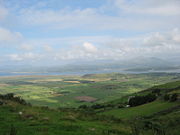
in England. The usurpation and conflict it caused eroded central authority in England. The revolt began in south Wales, as Hywel ap Maredudd, lord of Brycheiniog
Brycheiniog
Brycheiniog was a small independent petty kingdom in South Wales in the Early Middle Ages. It often acted as a buffer state between England to the east and the powerful south Welsh kingdom of Deheubarth to the west. It was conquered and pacified by the Normans between 1088 and 1095, though it...
(Brecknockshire
Brecknockshire
Brecknockshire , also known as the County of Brecknock, Breconshire, or the County of Brecon is one of thirteen historic counties of Wales, and a former administrative county.-Geography:...
), gathered his men and marched to the Gower, defeating the Norman and English colonists there. Inspired by Hywel of Brycheiniog's success, Gruffydd ap Rhys
Gruffydd ap Rhys
Gruffydd ap Rhys was Prince of Deheubarth, in Wales. His sister was the Princess Nest ferch Rhys.-Early life:Following the death of Gruffydd's father Rhys ap Tewdwr in 1093, Deheubarth was taken over by the Normans, and Gruffydd spent much of his early years in exile in Ireland.In 1113 Gruffydd...
, Prince of Deheubarth, hastened to meet with Gruffydd I of Gwynedd, his father-in-law, to enlist his aid in the revolt. However, with Gruffydd ap Rhys' absence the Normans increased their incursions into Deheubarth, and Gwenllian
Gwenllian ferch Gruffydd
Gwenllian ferch Gruffydd was Princess-consort of Deheubarth in Wales, and married to Gruffydd ap Rhys, Prince of Deheubarth. Gwenllian was the daughter of Gruffydd ap Cynan , Prince of Gwynedd, and a member of the princely Aberffraw family of Gwynedd. Gwenllian was the sister of Prince Owain...
, Princess of Deheubarth, gathered a host for the defense of her country.
Gwenllian was the youngest daughter of Gruffydd I of Gwynedd, and after she eloped with the Prince of Deheubarth she joined him resisting Norman occupation in south Wales. Husband and wife led retaliatory strikes on Norman positions in Deheubarth, taking goods from the Norman, English, and Flemish
Flemish people
The Flemings or Flemish are the Dutch-speaking inhabitants of Belgium, where they are mostly found in the northern region of Flanders. They are one of two principal cultural-linguistic groups in Belgium, the other being the French-speaking Walloons...
colonists and redistributing them to Deheubarth's displaced Welsh, "as a pair of Robin Hood
Robin Hood
Robin Hood was a heroic outlaw in English folklore. A highly skilled archer and swordsman, he is known for "robbing from the rich and giving to the poor", assisted by a group of fellow outlaws known as his "Merry Men". Traditionally, Robin Hood and his men are depicted wearing Lincoln green clothes....
s of Wales", wrote historian Philip Warner.
With her husband meeting with her father in Gwynedd, Gwenllian raised an army to counter Norman incursions ravaging Deheubarth. Gwenllian met the Norman army, led by Maurice of London, near Kidwelly Castle, but her forces were routed. Captured, the princess was beheaded by the Normans, the field where she lost her head later remembered as Maes Gwenllain, the 'Field of Gwenllain'.
Though defeated, Gwenllain's 'patriotic revolt' inspired others in south Wales to rise. The Welsh of Gwent, led by Iorwerth ab Owain (grandson of Caradog ap Gruffydd
Caradog ap Gruffydd
Caradog ap Gruffydd was a Prince of Gwent in south-east Wales who made repeated attempts to gain power over all of southern Wales by seizing the Kingdom of Deheubarth.- Lineage :...
, Gwent's Welsh ruler displaced by the Norman invasions), ambushed and slew Richard de Clare
Richard de Clare, 1st Earl of Hertford
Richard fitz Gilbert de Clare was a Norman nobleman, the son of Gilbert Fitz Richard de Clare and Adeliza de Claremont. He founded the priory of St, Mary Magdalene, Tonbridge.-Welsh revolt:Richard held the Lordship of Ceredigion in Wales...
, the grandson of the Norman lord Richard Fitz Gilbert
Richard Fitz Gilbert
Richard fitz Gilbert , was a Norman lord who participated in the Norman conquest of England in 1066. He was also known as "de Bienfaite", "de Clare", and "de Tonbridge".-Biography:...
.
When word reached Gwynedd of Gwenllain's death and the revolt in Gwent, Gruffydd I's sons Owain and Cadwaladr invaded Norman controlled Ceredigion, taking Llanfihangel
Llanfihangel y Creuddyn
Llanfihangel-y-Creuddyn, |hundred]] of Ilar, Ceredigion, West Wales, 7 miles south east from Aberystwyth, on the road to Rhayader, comprising the chapelry of Eglwys Newydd, or Llanfihangel y Creuddyn Uchaf, and the township of Llanfihangel y Creuddyn Isaf. It was also known as Lower Llanfihangel y...
, Aberystwyth
Aberystwyth
Aberystwyth is a historic market town, administrative centre and holiday resort within Ceredigion, Wales. Often colloquially known as Aber, it is located at the confluence of the rivers Ystwyth and Rheidol....
, and Llanbadarn Fawr
Llanbadarn Fawr
Llanbadarn Fawr is an urbanised village and community in Ceredigion, Wales. It is located on the outskirts of Aberystwyth situated next to Penparcau and Southgate. It forms the eastern part of the continually built-up area of Aberystwyth...
. Liberating Llanbadarn, one local chronicler hailed Owain and Cadwaladr both as "bold lions, virtuous, fearless and wise, who guard the churches and their indwellers, defenders of the poor [who] overcome their enemies, affording a safest retreat to all those who seek their protection". The brothers restored the Welsh monks of Llanbadarn, who had been displaced by monks from Gloucester brought there by the Normans who had controlled Ceredigion.
By late September 1136 a vast Welsh host gathered in Ceredigion, which included the combined forces of Gwynedd, Deheubarth, and Powys; and met the Norman army at the Battle of Crug Mawr
Battle of Crug Mawr
The Battle of Crug Mawr took place in September or October 1136, as part of a struggle for control of Ceredigion which had been captured by the Normans....
at Cardigan Castle
Cardigan Castle
Cardigan Castle is a castle located in Cardigan, Ceredigion, Wales.-History:The first motte-and-bailey castle was built a mile away from the present site, probably about the time of the founding of the town by Roger de Montgomery, a Norman baron....
. The battle turned into a rout, and then into a resounding defeat of the Normans.
Realizing how vulnerable they were to a resurgent Wales during the Great Revolt, the Marcher lords became estranged from Stephen de Blois due in large part to his lackluster response to the Welsh resurgence. These lords began shifting their allegiance back to the cause of Empress Matilda and the return of a strong royal government.
Gruffydd's death and legacy, 1137
David the Scot
David the Scot was a Welsh or Irish cleric who was Bishop of Bangor from 1120 to 1138.There is some doubt as to David's nationality, as he is variously described as Irish and Welsh. He was master of the cathedral school of Würzburg before 1110, and in that year accompanied the Emperor Henry V to...
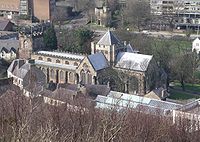
, the archdeacon of the diocese Simon of Clynnog, and the Prior of St Werburgh's in Chestor. Gruffydd bequithed money to many notable churches throughout Gwynedd and in other lands, including the Danish foundation of Christ Church, Dublin
Christ Church Cathedral, Dublin
Christ Church Cathedral is the cathedral of the United Dioceses of Dublin and Glendalough and the cathedral of the Ecclesiastical province of the United Provinces of Dublin and Cashel in the Church of Ireland...
, where he had worshipped as a boy growing up with his mother's people. To his wife Princess Angharad, who survived Gruffydd by twenty-five years, he left an estate and the profits from the port and ferry of Aber Menai, "the scene of many of his youthful adventures". Prince Gruffydd was interned
Internment
Internment is the imprisonment or confinement of people, commonly in large groups, without trial. The Oxford English Dictionary gives the meaning as: "The action of 'interning'; confinement within the limits of a country or place." Most modern usage is about individuals, and there is a distinction...
in a tomb erected in the presbytery of Bangor Cathedral, to the left of the high alter. "So rested at last a man whose life had been troubled and stormy in no common degree", wrote Lloyd. Meilyr Brydydd
Meilyr Brydydd
Meilyr Brydydd is the earliest of the Welsh Poets of the Princes or Gogynfeirdd whose work has survived.Meilyr was the court poet of Gruffudd ap Cynan , king of Gwynedd...
, Gruffydd's Pencerdd of Gwynedd, wrote:
The king of England came with his battalions-
Though he came, he returned not with cattle.
Gruffydd hid himself not, but with open force
Hotly did champion and protect his people.
Gruffydd died knowing that he left to his son Owain a more stable realm than had hitherto existed in Gwynedd for many generations, according to Lloyd. No foreign army was able to cross the Conwy, nor raiders from across the hills, that might disturb Gwynedd's peace. The stability provided by Prince Gruffudd allowed for a generation of Gwynedd's Welsh to settle and plan for the future without fear that their homes and harvests would "go to the flames" from invaders, according to Lloyd. Gwynedd's Welsh "planted orchards and laid out gardens, set up fences and dug out ditches; they ventured to build in stone and, in particular, raised stone churches in place of the old timer oratories", wrote Lloyd paraphrasing the Life of Gruffydd ap Cynan. So many limewashed stone churches, the Eglwys Wen or White Churches, were built across Gwynedd that the principality "[became] bespangled with them as is the firmament
Firmament
The firmament is the vault or expanse of the sky. According to Genesis, God created the firmament to separate the oceans from other waters above.-Etymology:...
with stars". Gruffudd had stone churches built at his princely manors, and Lloyd suggests Gruffudd's example led to the rebuilding of churches with stone in Penmon, Aberdaron
Aberdaron
Aberdaron is a community and former fishing village at the western tip of the Llŷn Peninsula in the Welsh county of Gwynedd. It lies west of Pwllheli and south west of Caernarfon, and has a population of 1,019. It is sometimes referred to as the "Land's End of Wales"...
, and Towyn
Towyn
Towyn , is a seaside resort in the County Borough of Conwy, Wales.It is located between Rhyl, in Denbighshire, and Abergele in Conwy. According to the 2001 Census, together with neighbouring Kinmel Bay , it had a population 7,864, of which 10.7% could speak Welsh...
, all in the Norman fashion
Norman architecture
About|Romanesque architecture, primarily English|other buildings in Normandy|Architecture of Normandy.File:Durham Cathedral. Nave by James Valentine c.1890.jpg|thumb|200px|The nave of Durham Cathedral demonstrates the characteristic round arched style, though use of shallow pointed arches above the...
. Additionally, Gruffydd funded the construction of Bangor Cathedral
Bangor Cathedral
Bangor Cathedral is an ancient place of Christian worship situated in Bangor, Gwynedd, north-west Wales. It is dedicated to its founder, Saint Deiniol....
, dedicated to Saint Deiniol, under the episcopate of Gruffydd's advisor Bishop David the Scot. Gruffydd acquiesced to many of the Latin reforms brought to Wales in the wake of the Norman invaders, reforms such as a more structured episcopate within Gwynedd.
Owain I of Gwynedd
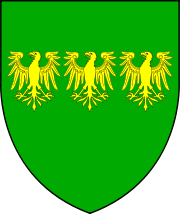
Ystrad Meurig
Ystrad Meurig is a village in Ceredigion, Wales. It lies on the B4340 road northwest of the town of Tregaron.- History & Amenities :...
, Lampeter
Lampeter
Lampeter is a town in Ceredigion, South West Wales, lying at the confluence of the River Teifi and the Afon Dulas.-Demographics:At the 2001 National Census, the population was 2894. Lampeter is therefore the smallest university town in both Wales and the United Kingdom...
(Stephen's Castle), and Castell Hywel (usually known as Humphrey's Castle)
Owain I ap Gruffydd succeeded his father to the greater portion of Gwynedd in accordance to conventional Welsh law
Welsh law
Welsh law was the system of law practised in Wales before the 16th century. According to tradition it was first codified by Hywel Dda during the period between 942 and 950 when he was king of most of Wales; as such it is usually called Cyfraith Hywel, the Law of Hywel, in Welsh...
and custom, the Cyfraith Hywel, the Laws of Hywel. Later historians refer to Owain ap Gruffydd as Owain Gwynedd to differentiate him from another Owain ap Gruffydd, the Mathrafal ruler of Powys, known as Owain Cyfeiliog
Owain Cyfeiliog
Owain ap Gruffydd was a prince of the southern part of Powys and a poet. He is usually known as Owain Cyfeiliog to distinguish him from other rulers named Owain, particularly his contemporary, Owain ap Gruffydd of Gwynedd, who is known as Owain Gwynedd.Owain was the son of Gruffydd ap Maredudd and...
. Cadwaladr, Gruffydd's youngest son, inherited the commote of Aberffraw on Ynys Môn, and the recently conquered Meirionydd and Northern Ceredigion, that is Ceredigion between the rivers Aeron and Dyfi.
By 1141 Cadwaladr and Madog ap Maredudd of Powys led a Welsh vanguard as an ally of the Earl of Chester in the Battle of Lincoln
Battle of Lincoln (1141)
The Battle of Lincoln or First Battle of Lincoln occurred on 2 February 1141. In it Stephen of England was captured, imprisoned and effectively deposed while Empress Matilda ruled for a short time.-Account:...
, and joined in the rout which made Stephen of England prisoner of Matilda of England for a year. Owain, however, did not participate in the battle, keeping the majority of Gwynedd's army at home. Owain, of restrained and prudent temperament, may have judged that aiding Stephen de Blois' capture would lead to the restoration of Empress Matilda and a strong royal government in England; a government which would support Marcher lords, support absent since Stephen's usurpation.
Owain and Cadwaladr came to blows in 1143 when Cadwaladr was implicated in the murder of Prince Anarawd ap Gruffydd of Deheubarth, Owain's ally and intended son-in-law, on the eve of Anarawd's wedding to Owain's daughter. Owain followed a diplomatic policy of binding other Welsh rulers to Gwynedd through dynastic marriages, and Cadwaladr's border dispute and murder of Anarawd threatened Owain's efforts and credibility. As ruler of Gwynedd, Owain stripped Cadwaladr of his lands, with Owain's son Hywel
Hywel ab Owain Gwynedd
Hywel ab Owain Gwynedd Wales Prince of Gwynedd in 1170, a Welsh poet and military leader. Hywel was the son of Owain Gwynedd, prince of Gwynedd, and an Irishwoman named Pyfog. In recognition of this, he was also known as Hywel ap Gwyddeles...
dispatched to Ceredigion, where he burned Cadwaladr's castle at Aberystwyth. Cadwaladr fled to Ireland and hired a Norse fleet from Dublin, bringing the fleet to Abermenai to compel Owain to reinstate him. Taking advantage of the brotherly strife, and perhaps with the tacit understanding of Cadwaladr, the marcher lords mounted incursions into Wales. Realizing the wider ramifications of the war before him, Owain and Cadwaladr came to terms and reconciled, with Cadwaladr restored to his lands. Peace between the brothers held until 1147, when an unrecorded event occurred which led Owain's sons Hywel and Cynan
Cynan ab Owain Gwynedd
Cynan ab Owain Gwynedd was an illegitimate son of Owain Gwynedd, a Prince of the ancient Kingdom of Gwynedd, Wales. He held the title "Lord of Meirionnydd"...
to drive Cadwaladr out of Meirionydd and Ceredigion, with Cadwaladr retreating to Môn. Again an accord was reached, with Cadwaladr retaining Aberffraw until a more serious breach occurred in 1153, when he was forced into exile in England, where his wife was the sister of Gilbert de Clare, 2nd Earl of Hertford
Gilbert de Clare, 2nd Earl of Hertford
Gilbert FitzRichard de Clare, 1st Earl of Hertford was the eldest son of the Richard Fitz Gilbert de Clare and Adeliza. He was created Earl of Hertford, possibly at the same time his uncle was created Earl of Pembroke. He died without issue and was succeeded by his brother Roger de Clare.-...
and the niece of Ranulph de Gernon, 2nd Earl of Chester
Ranulph de Gernon, 2nd Earl of Chester
Ranulf II was an Anglo-Norman potentate who inherited the honour of the palatine county of Chester upon the death of his father Ranulf le Meschin, 3rd Earl of Chester...
.
In 1146 news reached Owain that his favoured eldest son and heir, Rhun
Rhun ab Owain Gwynedd
Rhun ab Owain Gwynedd was the eldest child of Owain Gwynedd . His mother was an Irish woman Pyfog who was one of his father's many mistresses. Despite being illegitimate he was his father's favourite child and chosen successor...
, had died. Owain was overcome with grief, falling into a deep melancholy from which none could console him, until news reached him that Mold castle
Mold, Flintshire
Mold is a town in Flintshire, North Wales, on the River Alyn. It is the administrative seat of Flintshire County Council, and was also the county town of Clwyd from 1974 to 1996...
in Tegeingl (Flintshire) had fallen to Gwynedd, "[reminding Owain] that he had still a country for which to live", wrote historian Sir John Edward Lloyd.
Between 1148 and 1151, Owain I of Gwynedd fought against Madog ap Maredudd of Powys, Owain's son-in-law, and against the Earl of Chester for control of Iâl (Yale, near Wrexham
Wrexham
Wrexham is a town in Wales. It is the administrative centre of the wider Wrexham County Borough, and the largest town in North Wales, located in the east of the region. It is situated between the Welsh mountains and the lower Dee Valley close to the border with Cheshire, England...
), with Owain having secured Rhuddlan Castle and all of Tegeingl from Chester. "By 1154 Owain had brought his men within sight of the red towers of the great city on the Dee", wrote Lloyd."
Henry II's 1157 campaign
Having spent three years consolidating his authority in the vast Angevin EmpireAngevin Empire
The term Angevin Empire is a modern term describing the collection of states once ruled by the Angevin Plantagenet dynasty.The Plantagenets ruled over an area stretching from the Pyrenees to Ireland during the 12th and early 13th centuries, located north of Moorish Iberia. This "empire" extended...
, Henry II of England
Henry II of England
Henry II ruled as King of England , Count of Anjou, Count of Maine, Duke of Normandy, Duke of Aquitaine, Duke of Gascony, Count of Nantes, Lord of Ireland and, at various times, controlled parts of Wales, Scotland and western France. Henry, the great-grandson of William the Conqueror, was the...
resolved on a strategy against Owain I of Gwynedd by 1157. By now, Owain's enemies had joined Henry II's camp, enemies such as his wayward brother Cadwaladr and in particular Madog of Powys. Henry II raised his feudal host and marched into Wales from Chester. Owain positioned himself and his army at Dinas Basing (Basingwerk
Basingwerk Abbey
Basingwerk Abbey is the ruin of an abbey near Holywell, Flintshire, Wales, in the care of Cadw .The abbey was founded in 1132 by Ranulph de Gernon, 2nd Earl of Chester, who brought Benedictine monks from Savigny Abbey in southern Normandy. In 1147, the abbey became part of the Cistercian Order and...
), barring the road to Rhuddlan, setting up a trap in which Henry II would send his army along the direct road along the coast, while he crossed through the woods to outflank Owain. The Prince of Gwynedd anticipated this, and dispatched his sons Dafydd
Dafydd ab Owain Gwynedd
Dafydd ab Owain Gwynedd was Prince of Gwynedd from 1170 to 1195. For a time he ruled jointly with his brothers Maelgwn ab Owain Gwynedd and Rhodri ab Owain Gwynedd....
and Cynan into the woods with an army, catching Henry II unaware. In the melée which followed, known as the Battle of Ewloe
Battle of Ewloe
The Battle of Ewloe was a battle fought in July 1157 between a large army led by Henry II of England and an army led by the Welsh prince Owain Gwynedd.- Background :...
, Henry II would have been slain had not Roger, Earl of Hertford
Roger de Clare, 3rd Earl of Hertford
Roger de Clare was a son of Richard Fitz Gilbert de Clare and Alice de Gernon. He succeeded to the earldom when his brother Gilbert died without issue. In 1164 he assisted with the Constitutions of Clarendon. From his munificence to the Church and his numerous acts of piety, Roger was called the...
rescued him. Henry II retreated and made his way back to his main army, by now slowly advancing towards Rhuddlan. Not wishing to engage the Norman army directly, Owain repositioned himself first at St. Asaph, then further west, clearing the road for Henry II to enter Rhuddlan "ingloriously". Once in Rhuddlan, Henry II received word that his naval expedition had failed. Instead of meeting Henry II at Deganwy or Rhuddlan as the king had commanded, the English fleet had gone to plunder Môn.
The naval expedition was led by Henry II's maternal uncle (Empress Matilda's half-brother), Henry FitzRoy
Henry FitzRoy (d. 1158)
Henry FitzRoy was an illegitimate son of Henry I of England by Nest, daughter of Rhys ap Tewdwr, last king of Deheubarth , and his wife, Gwladys ferch Rhiwallon ap Cynfyn. He held lands from his royal father in Narberth and Pebidiog...
; and when they landed on Môn, Henry FitzRoy had the churches of Llanbedr Goch and Llanfair Mathafarn Eithaf torched. During the night the men of Môn gathered together, and the next morning fought and defeated the Norman army, with Henry FitzRoy falling under a shower of lances. The defeat of his navy and his own military difficulties had convinced Henry II that he had "gone as far as was practical that year" in his effort to subject Owain, and the king offered terms to the prince. Owain I of Gwynedd, "ever prudent and sagacious", wrote Lloyd, recognized that he needed time to consolidate power further, and agreed to the terms. Owain was to render homage and fealty to the King, and resign Tegeingl and Rhuddlan to Chester, and restore Cadwaladr to his possessions in Gwynedd.
The death of Madog ap Meredudd of Powys in 1160 opened an opportunity for Owain I of Gwynedd to press Gwynedd's influence further at the expense of Powys. However, Owain continued to further Gwynedd's expansion without rousing the English crown and maintaining his 'prudent policy' of Quieta non movere (don't move settled things), according to Lloyd. It was a policy of outward conciliation, while masking his own consolidation of authority. To further demonstrate his goodwill, in 1160 Owain handed over to the English crown the fugitive Einion Clud. By 1162 Owain was in possession of the Powys cantref of Cyfeiliog, and its castle of Tafolwern; and ravaged another Powys cantref of Arwystli, slaying its lord, Hywel ab Ieuaf, with both actions causing little apparent reaction from the Norman occupiers. Owain's strategy was in sharp contrast to Rhys ap Gruffydd, prince of Deheubarth, who in 1162 rose in open revolt against the Normans in south Wales, drawing Henry II back to England from the continent.
With Owain's growing influence throughout Wales as the premier Welsh ruler, Owain adopted the Latin title Princeps Wallensium, Prince of the Welsh, echoing historic Aberffraw claims as the primary royal family of Wales as senior line descendants of Rhodri the Great
Rhodri the Great
Rhodri the Great was King of Gwynedd from 844 until his death. He was the first Welsh ruler to be called 'Great', and the first to rule most of present-day Wales...
. The title was later given substance following the outcome of Great Revolt of 1166, wrote Professor John Davies.
Great Revolt of 1166
In 1163 Henry II quarrelled with Thomas Becket, the Archbishop of CanterburyThomas Becket
Thomas Becket was Archbishop of Canterbury from 1162 until his murder in 1170. He is venerated as a saint and martyr by both the Roman Catholic Church and the Anglican Communion...
, causing growing divisions between the king's supporters and the archbishop's supporters. With discontent mounting in England, Owain I of Gwynedd joined with Rhys ap Gruffydd of Deheubarth in a second grand Welsh revolt against Henry II. England's king, who only the previous year had pardoned Rhys ap Gruffydd for his 1162 revolt, assembled a vast host against the allied Welsh, with troops drawn from all over the Angevin empire assembling in Shrewsbury, and with the Norse of Dublin paid to harass the Welsh coast. While his army gathered on the Welsh frontier, Henry II left for the continent to negotiate a truce with France and Flanders in order for them to not disturb his peace while campaigning in Wales. However, when Henry II returned to England he found that the war had already begun, with Owain's son Dafydd raiding Angevin positions in Tegeingl, exposing the castles of Rhuddlan and Basingwerk to "serious dangers", wrote Lloyd. Henry II rushed to north Wales for a few days to shore up defences there, before returning to his main army now gathering in Croesoswallt (Oswestry).
The vast host gathered before the allied Welsh principalities represented the largest army yet assembled for their conquest, a circumstance which further drew the Welsh allies into a closer confederacy, wrote Lloyd. With Owain I of Gwynedd the overall battle commander, and with his brother Cadwaladr as his second, Owain assembled the Welsh host at Corwen in the vale of Edeyrion where he could best resist Henry II's advance. The Angevin army advanced from Oswestry into Wales crossing the mountains towards Mur Castell and found itself in the thick forest of the Ceiriog Valley
Ceiriog Valley
The Ceiriog Valley or Dyffryn Ceiriog is the valley of the River Ceiriog in north-east Wales. It is also the name of a ward of the County Borough of Wrexham Until 1974 the valley was part of the traditional county of Denbighshire; then it became part of the short-lived county of Clwyd, which was...
where it was forced into a narrow thin line. In the Battle of Crogen
Battle of Crogen
The Battle of Crogen took place in Wales in 1165, between the vanguard of the forces of Henry II of England and an alliance of Welsh princes led by Owain Gwynedd. The battle was fought in north-east Wales, in the Ceiriog Valley. Although outnumbered, the ambush tactics and valour of the Welsh...
which followed; Owain I positioned a band of skirmishers in the thick woods overlooking the pass, where they harassed the exposed Angevin army from secured positions. Henry II ordered the clearing of the woods on either side to widen the passage through the valley and to lessen the exposure of his army. The road his army travelled later became known as the Ffordd y Saeson, the Englishmen's Road; it led through heath and bog towards the Dee. In a dry summer the mountain moors may have been passable, however "on this occasion the skies put on their most wintry aspect; and the rain fell in torrents [...] flooding the mountain meadows" until the great Angevin encampment became a "morass
Marsh
In geography, a marsh, or morass, is a type of wetland that is subject to frequent or continuous flood. Typically the water is shallow and features grasses, rushes, reeds, typhas, sedges, other herbaceous plants, and moss....
", wrote Lloyd.
Having suffered many setbacks, and in the face of "hurricane" force wind and rain, diminishing provisions and an exposed supply line stretching through hostile country subject to enemy raids, and with a demoralized army, Henry II was forced into a complete retreat without even a semblance of a victory. In frustration, Henry II had twenty-two Welsh hostages mutilated; the sons of Owain' supporters and allies, including two of Owain's own sons. In addition to his failed campaign in Wales, Henry's mercenary Norse navy, which he had hired to harass the Welsh coast, turned out to be too small to be useful, and was disbanded without engagement. Henry II's Welsh campaign was a complete failure, with the king abandoning all plans for the conquest of Wales, returning to his court in Anjou and not returning to England for another four years. Lloyd wrote;
It is true that [Henry II] did not cross swords with [Owain I], but the elements had done their work for [the Welsh]; the stars in their courses had fought against the pride of England and humbled it to the very dust. To conquer a land which was defended, not merely by the arms of its valiant and audacious sons, but also by tangled woods and impassable bogs, by piercing winds and pitiless storms of rain, seemed a hopeless task, and Henry resolved to no longer attempt it.
Owain expanded his international diplomatic offensive against Henry II by sending an embassy to Louis VII of France
Louis VII of France
Louis VII was King of France, the son and successor of Louis VI . He ruled from 1137 until his death. He was a member of the House of Capet. His reign was dominated by feudal struggles , and saw the beginning of the long rivalry between France and England...
in 1168, led by Arthur of Bardsey, Bishop of Bangor (1166–1177), who was charged with negotiating a joint alliance against Henry II. With Henry II distracted by his widening quarrel with Thomas Becket, Owain's army recovered Tegeingl for Gwynedd by 1169.
The following year, Prince Owain ap Gruffydd died and was interred in Bangor Cathedrial, near his father Gruffydd ap Cynan.
Poet-Prince and Gwynedd interregnum; 1170–1200

Heir apparent
An heir apparent or heiress apparent is a person who is first in line of succession and cannot be displaced from inheriting, except by a change in the rules of succession....
, Hywel
Hywel ab Owain Gwynedd
Hywel ab Owain Gwynedd Wales Prince of Gwynedd in 1170, a Welsh poet and military leader. Hywel was the son of Owain Gwynedd, prince of Gwynedd, and an Irishwoman named Pyfog. In recognition of this, he was also known as Hywel ap Gwyddeles...
succeeded his father in 1170 as Prince of Gwynedd in accordance with Welsh law and custom. However, the new prince was immediately confronted by a coup d'état
Coup d'état
A coup d'état state, literally: strike/blow of state)—also known as a coup, putsch, and overthrow—is the sudden, extrajudicial deposition of a government, usually by a small group of the existing state establishment—typically the military—to replace the deposed government with another body; either...
instigated by his step-mother Cristin, Princess Dowager of Gwynedd
Queen Dowager
A queen dowager or dowager queen is a title or status generally held by the widow of a deceased king. In the case of the widow of a deceased emperor, the title of empress dowager is used...
. The dowager princess plotted to have her eldest son by Owain, Dafydd
Dafydd ab Owain Gwynedd
Dafydd ab Owain Gwynedd was Prince of Gwynedd from 1170 to 1195. For a time he ruled jointly with his brothers Maelgwn ab Owain Gwynedd and Rhodri ab Owain Gwynedd....
, usurp the Crown and Throne of Gwynedd from Hywel; and with Gwynedd divided between Dafydd and her other sons Rhodri
Rhodri ab Owain Gwynedd
Rhodri ab Owain Gwynedd was prince of part of Gwynedd, one of the kingdoms of medieval Wales. He ruled from 1175 to 1195.On the death of Owain Gwynedd in 1170, fighting broke out among his nineteen sons over the division of his kingdom...
and Cynan
Cynan ab Owain Gwynedd
Cynan ab Owain Gwynedd was an illegitimate son of Owain Gwynedd, a Prince of the ancient Kingdom of Gwynedd, Wales. He held the title "Lord of Meirionnydd"...
. The speed with which Cristin and her sons acted suggest that the conspiracy may have had roots before Owain's death. Additionally, the complete surprise of the elder sons of Owain suggests that the scheme had been a well kept secret.
Within months of his succession Hywel was forced to flee to Ireland, returning later that year with a Hiberno-Norse army and landing on Môn, where he may have had his younger half brother Maelgwn
Maelgwn ab Owain Gwynedd
Maelgwn ab Owain Gwynedd was a prince of part of Gwynedd.Maelgwn was the son of Owain Gwynedd and Gwladus ferch Llywarch ap Trahaearn, and therefore full brother to Iorwerth Drwyndwn, the father of Llywelyn the Great...
's support. Dafydd himself landed his army on the island and caught Hywel off guard at Pentraeth
Pentraeth
Pentraeth is a village on the island of Anglesey , north Wales, at . The Royal Mail postcode begins LL75.Its Welsh name means at the end of a beach, and it is located near Traeth Coch . There is a small river, Afon Nodwydd which runs through it. The village's ancient name was Llanfair Betws Geraint...
, defeating his army and killing Hywel. Following Hywel's death and the defeat of the legitimist army, the surviving sons of Owain came to terms with Dafydd. Iorwerth
Iorwerth Drwyndwn
Iorwerth ab Owain Gwynedd , meaning "the broken-nosed", was the eldest legitimate son of Owain Gwynedd and his first wife Gwladys ferch Llywarch. He married Marared ferch Madog. His son Llywelyn the Great eventually united the realm and became known as Llywelyn Fawr and is one of Wales's most...
- who was next in line of succession after his slain brother Hywel- was apportioned the commotes of Arfon
Arfon
Arfon was one of five districts of Gwynedd, Wales, from 1974 to 1996.It was created by the Local Government Act 1972 on 1 April 1974 from part of the administrative county of Caernarfonshire, namely the municipal boroughs of Bangor and Caernarfon, the Bethesda urban district, the rural districts...
and Arllechwedd
Arllechwedd
The ancient Welsh cantref of Arllechwedd in north-west Wales was part of the kingdom of Gwynedd for much of its history until it was included in the new county of Caernarfonshire, together with Arfon and Llŷn under the terms of the Statute of Rhuddlan in 1284.In the middle ages the Cantref...
, with his seat at Dolwyddelan
Dolwyddelan
Dolwyddelan, Welsh language : 'the meadow of Gwyddelan', is a village and community in Conwy county borough, north Wales, on the main A470 road between Blaenau Ffestiniog and Betws-y-Coed...
, with Maelgwn retaining Ynys Môn, and with Cynan receiving Meirionydd. However by 1174 Iorwerth and Cynan were both dead and Maelgwn and Rhodri were imprisoned by Dafydd, who was now master over the whole of Gwynedd.
During the upheavals of 1173–74 Dafydd had remained loyal to Henry II, and as if in reward for his loyalty, but also in recognition of Dafydd's apparent supremacy in north Wales, Dafydd married the king's half-sister Emma of Anjou. Henry II did not approve of the match, but needed a Welsh ally to distract from the resurgent Welsh of South Wales under The Lord Rhys, Prince of Deheubarth
Rhys ap Gruffydd
Rhys ap Gruffydd or ap Gruffudd was the ruler of the kingdom of Deheubarth in south Wales. He is commonly known as The Lord Rhys, in Welsh Yr Arglwydd Rhys, but this title may not have been used in his lifetime...
and rebellious marcher lords. However, Dafydd's ascendency was short-lived as Rhodri had escaped his imprisonment and took Arfon, Llŷn, Ynys Môn, and Arllechwedd, with Meirionydd, Ardydwy, and Eifionydd returned to Gruffydd and Meredudd ap Cynan. Though Henry II continued to recognize his brother-in-law Dafydd as Prince of Gwynedd he did not send aid to him, and Dafydd effectively had to content himself with the rule of lower Gwynedd, the Perfeddwlad, establishing court at Rhuddlan Castle. The following year Dafydd joined with other Welsh rulers in swearing fealty to Henry II at Oxford
Oxford
The city of Oxford is the county town of Oxfordshire, England. The city, made prominent by its medieval university, has a population of just under 165,000, with 153,900 living within the district boundary. It lies about 50 miles north-west of London. The rivers Cherwell and Thames run through...
.
Rise of Llywelyn the Great
By 1187, on reaching his majority in Welsh law at age 14, Llywelyn ab Iorwerth began asserting his senior claim as Prince of Gwynedd over those of his paternal uncles Dafydd and Rhodri, harassing their positions with the aid of Gruffydd Maelor
Gruffydd Maelor
Gruffydd Maelor was Prince of Powys Fadog in Wales.He is known as Gruffydd Maelor I to distinguish him from his grandson, Gruffydd Maelor II .- Lineage :He was a son of Madog ap Maredudd by Susanna, daughter of Gruffudd ap Cynan...
, lord of Powys Fadog
Powys Fadog
Powys Fadog or Lower Powys was the northern portion of the former princely realm of Powys which split in two following the death of Madog ap Maredudd of Powys in 1160...
and Llywelyn's maternal uncle; as attested to by Gerald of Wales who was traveling through north Wales in 1188 recruiting soldiers for the Third Crusade
Third Crusade
The Third Crusade , also known as the Kings' Crusade, was an attempt by European leaders to reconquer the Holy Land from Saladin...
. Llywelyn ab Iorwerth was raised in exile with his mother's Mathrafal family in Powys, primarily in the court of Powys Fadog in Maelor
Maelor
Maelor is a border area of north-east Wales. It originated as a Cantref of the Kingdom of Powys, focused on Bangor-on-Dee.-History:The Maelor was first divided from the rest of Wales by the construction of Offa's Dyke in the eighth century, but was reclaimed for Wales during the reign of Stephen...
.
While Dafydd maintained his alliance with the English Crown, Rhodri allied with The Lord Rhys, Prince of Deheubarth, who was now the pre-eminent prince in Wales and now styled himself Princeps Wallensium, or Prince of the Welsh, in the tradition of Owain Gwynedd. Rhodri was beset by his nephews Gruffydd and Meredudd ap Cynan, the two brothers ejecting Rhodri from Môn in 1190. That same year, Rhodri allied with Ragnvald Godredsson, King of the Isles
Ragnald IV of the Isle of Man
Rögnvaldr Guðrøðarson was a late 12th century and early 13th century sea-king who ruled a kingdom which encompassed the Isle of Man and parts of the Hebrides...
, solidifying their alliance with a diplomatic marriage. By summer of 1193 Rhodri and a contingent of allied Manx forces recovered Môn, a period known as the 'Gaelic Summer' "so called, no doubt, because of the influx of Gaelic-speaking allies from Man into Gwynedd", argued J.E. Lloyd.
In 1194 the brothers Gruffydd and Meredudd ap Cynan recovered Môn ejecting Rhodri for the second time. Then they allied with their paternal cousin Llywelyn ab Iorwerth in his bid to reclaim his inheritance. Llywelyn and his allied cousins defeated their uncle Dafydd, the usurper Prince of Gwynedd, at the Battle of Aberconwy
Battle of Aberconwy
The Battle of Aberconwy was fought in 1194 between the forces of Llywelyn ap Iorwerth and Dafydd ab Owain Gwynedd for control of Gwynedd. Llywelyn's victory allowed him to claim the title of prince of Gwynedd and, in turn, prince of Wales; ejected from his lands, Dafydd went to live in England and...
and taking lower Gwynedd. The allies continued to win victories at Porthaethwy on the Menai and at Coedeneu on Môn. By 1195 Llywelyn controlled all of lower Gwynedd (the Perfeddwlad), with his cousin Gruffydd ap Cynan retaining Môn, and the commotes of Arfon, Arllechwedd, and Llŷn, and with Maredudd ap Cynan given Meirionydd and the lands just north as his share.
Llywelyn pursued a policy of consolidation for the next five years, first with his capture of Dafydd in 1197, and then in 1198 when he sent a vanguard to the assistance of his then ally Gwenwynwyn of Powys in his campaign to take Painscastle
Painscastle
Painscastle is a castle in Powys in mid Wales and also a village which takes its name from the castle. It lies between Builth and Hay-on-Wye, approximately 3 miles from the Wales-England border today.- Early history:...
; but it was Llywelyn's capture of Mold Castle
Mold Castle
Mold Castle, on Bailey Hill in the town of Mold, Flintshire, Northeast Wales, was an earthwork motte and bailey fortress probably founded by Robert de Montalt around the year 1140. In 1147 it was captured by Owain Gwynedd. It switched hands on several occasions before a long period under Welsh...
in 1199 which was his most significant achievement at the close of the 12th century, argued Lloyd.
Llywelyn, John, and the Magna Carta; 1200-1216

In 1200 Llywelyn ab Iorwerth recovered upper Gwynedd on the death of his cousin Gruffydd ap Cynan, with Gruffydd's son Hywel swearing fealty to Llywelyn as his lord and receiving Meirionydd as his portion by 1202.
As Llywellyn ruled over all of Gwynedd by the end of 1200, the English crown was compelled to endorse all of Llywellyn's holdings that year. However, England's endorsement was part of a larger strategy of reducing the influence of Gwenwynwyn ab Owain
Gwenwynwyn ab Owain
Gwenwynwyn ab Owain Cyfeiliog was the last major ruler of mid Wales before the completion of the Norman English invasion.- Lineage :...
of upper Powys
Powys Wenwynwyn
Powys Wenwynwyn or Powys Cyfeiliog was the southern portion of the former princely state of Powys which split following the death of Madog ap Maredudd of Powys in 1160...
, whom had filled the power vacuum left with the death of the Lord Rhys, Prince of Deheubarth, in 1197; and with Gwynedd divided over the past generation. John of England
John of England
John , also known as John Lackland , was King of England from 6 April 1199 until his death...
had given William de Breos license in 1200 to "seize as much as he could" from the native Welsh, particularly from Powys. De Breos held lordship over Abergavenny
Abergavenny
Abergavenny , meaning Mouth of the River Gavenny, is a market town in Monmouthshire, Wales. It is located 15 miles west of Monmouth on the A40 and A465 roads, 6 miles from the English border. Originally the site of a Roman fort, Gobannium, it became a medieval walled town within the Welsh Marches...
, Brecon
Brecon
Brecon is a long-established market town and community in southern Powys, Mid Wales, with a population of 7,901. It was the county town of the historic county of Brecknockshire; although its role as such was eclipsed with the formation of Powys, it remains an important local centre...
, Builth, and Radnor
Radnorshire
Radnorshire is one of thirteen historic and former administrative counties of Wales. It is represented by the Radnorshire area of Powys, which according to the 2001 census, had a population of 24,805...
, and was one of the most powerful Marcher barons. However, de Breos was out of favor with King John by 1208, and with de Breos and the king quarreling Llywelyn took the opportunity to seize both southern Powys and northern Ceredigion. Llywellyn's expansion was a "bold demonstration of the determination of the ruler of Gwynedd to be master of Pura Wallia", and echoed historic Aberffraw claims as primary rulers of Wales since Rhodri the Great
Rhodri the Great
Rhodri the Great was King of Gwynedd from 844 until his death. He was the first Welsh ruler to be called 'Great', and the first to rule most of present-day Wales...
in the 10th century, argued John Davies.
In his expansion, the Welsh prince was careful not to antagonise the English king, his father-in-law. Llywelyn had married Joan
Joan, Lady of Wales
Joan, Princess of Wales and Lady of Snowdon was the wife of Llywelyn the Great, Prince of Wales and Gwynedd and effective ruler of most of Wales.-Early life:...
, King John's illegitimate daughter, in 1204. In 1209 Prince Llywelyn joined King John on his campaign in Scotland, a "repayment of an old debt", argued Davies, for Alexander I, King of Scots, had joined Henry I on his campaign against the Welsh in 1114. However, by 1211 King John perceived the growing influence of Llywelyn as a threat to English authority in Wales, and invaded Gwynedd reaching the banks of the Menai. Llywelyn was forced to cede the Perfeddwlad and recognize John as his heir if Llywelyn's marriage with Joan did not produce any legitimate successors. Welsh law recognized children born out of wedlock as equal to those in born in wedlock, and according to Welsh custom Llywelyn's eldest son Gruffydd, by his long time companion Tangwystl, may have expected to be his father's heir.
Many of Llywelyn's Welsh allies had abandoned him during England's invasion of Gwynedd, preferring an overlord far away rather than one nearby. These Welsh lords expected an unobtrusive English crown, however King John had castles built in Ystwyth in Ceredigion, and John's direct interference in Powys and the Perfeddwlad caused many of these Welsh lords to rethink their position. John's policy in Wales demonstrated his resolve to subject the Welsh, argued Professor John Davies.
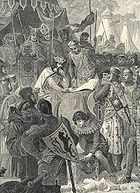
Interdict (Roman Catholic Church)
In Roman Catholic canon law, an interdict is an ecclesiastical censure that excludes from certain rites of the Church individuals or groups, who nonetheless do not cease to be members of the Church.-Distinctions in canon law:...
. Early in 1212 Llywelyn had regained the Perfeddwlad, striking at Marcher positions in Wales, and burned the castle at Ystwyth, with the Cronica de Wallia
Annales Cambriae
Annales Cambriae, or The Annals of Wales, is the name given to a complex of Cambro-Latin chronicles deriving ultimately from a text compiled from diverse sources at St David's in Dyfed, Wales, not later than the 10th century...
(Chronicle of Wales) recording that the Welsh lords chose Llywelyn as their 'one leader'. Llywelyn's revolt caused John to postpone his invasion of France, with Philip II of France
Philip II of France
Philip II Augustus was the King of France from 1180 until his death. A member of the House of Capet, Philip Augustus was born at Gonesse in the Val-d'Oise, the son of Louis VII and his third wife, Adela of Champagne...
so moved as to contact Prince Llywelyn and propose that they ally against the English king King John ordered the execution by hanging of his Welsh hostages, the sons of many of Llywelyn's supporters
John's relationship with his nobles deteriorated further following the king's disastrous campaign to reconquer Normandy and Anjou from France in 1213, with the nobles eager to ally with Prince Llywelyn. Llywelyn's aid to England's nobles, in particular Llywelyn's seizure of Shrewsbury
Shrewsbury
Shrewsbury is the county town of Shropshire, in the West Midlands region of England. Lying on the River Severn, it is a civil parish home to some 70,000 inhabitants, and is the primary settlement and headquarters of Shropshire Council...
in May 1215, was one of the major factors which persuaded John to seal the Magna Carta
Magna Carta
Magna Carta is an English charter, originally issued in the year 1215 and reissued later in the 13th century in modified versions, which included the most direct challenges to the monarch's authority to date. The charter first passed into law in 1225...
in June 1215. Llywelyn wrestled significant concessions from the English Crown in the Magna Carta. Land seized unjustly during the conflict would be returned to the other, and the primacy of Welsh law
Welsh law
Welsh law was the system of law practised in Wales before the 16th century. According to tradition it was first codified by Hywel Dda during the period between 942 and 950 when he was king of most of Wales; as such it is usually called Cyfraith Hywel, the Law of Hywel, in Welsh...
to apply in Pura Wallia (two-thirds of the surface area of Wales)- particularly with succession to land and title- was reaffirmed, and with Marcher Law to determine rights to land held in the March. The use of the term 'Marcher Law' in the Magna Carta was the first clear reference to the hybrid of Welsh and English law used in the march. The signing of the Magna Carta did not end the conflict between John and England's nobles sparking First Barons' War
First Barons' War
The First Barons' War was a civil war in the Kingdom of England, between a group of rebellious barons—led by Robert Fitzwalter and supported by a French army under the future Louis VIII of France—and King John of England...
, and Llywelyn continued to press his advantages in south and mid Wales by taking many English castles between 1215 and 1216, including the important Carmarthen and Cardigan
Cardigan Castle
Cardigan Castle is a castle located in Cardigan, Ceredigion, Wales.-History:The first motte-and-bailey castle was built a mile away from the present site, probably about the time of the founding of the town by Roger de Montgomery, a Norman baron....
castles among them.
Aberdyfi, Worcester, and Strata Florida; 1216-1240
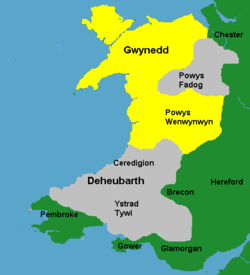
Homage (medieval)
Homage in the Middle Ages was the ceremony in which a feudal tenant or vassal pledged reverence and submission to his feudal lord, receiving in exchange the symbolic title to his new position . It was a symbolic acknowledgment to the lord that the vassal was, literally, his man . The oath known as...
from the rulers of Powys Fadog, Powys Wenwynwyn, Maelgwn of Deheubarth, and the Welsh in Gwent and the uplands of Glamorgan, and the Welsh barons in the region between the Wye and Severn. Additionally, Llywelyn threatened the long occupied Marcher positions in Haverfordwest
Haverfordwest
Haverfordwest is the county town of Pembrokeshire, Wales and serves as the County's principal commercial and administrative centre. Haverfordwest is the most populous urban area in Pembrokeshire, with a population of 13,367 in 2001; though its community boundaries make it the second most populous...
in Pembroke, and the de Breos controlled Swansea
Swansea
Swansea is a coastal city and county in Wales. Swansea is in the historic county boundaries of Glamorgan. Situated on the sandy South West Wales coast, the county area includes the Gower Peninsula and the Lliw uplands...
and Brecon. In 1216 Llywelyn conviened the Council of Aberdyfi
Aberdyfi
Aberdyfi , or Aberdovey is a village on the north side of the estuary of the River Dyfi in Gwynedd, on the west coast of Wales....
with all the Welsh lords in Pura Wallia in attendance. The choice of Aberdyfi as the place to hold the assembly was significant as the location was where Llywelyn's direct paternal ancestor, Maelgwen the Great, had been recognized as overlord and king of Wales in the 6th century. At Aberdyfi, Llywelyn held court and presided over the division of Deheubarth between the descendants of Rhys ap Gruffydd
Rhys ap Gruffydd
Rhys ap Gruffydd or ap Gruffudd was the ruler of the kingdom of Deheubarth in south Wales. He is commonly known as The Lord Rhys, in Welsh Yr Arglwydd Rhys, but this title may not have been used in his lifetime...
, with the rulers of Pura Wallia reaffirming their homage and oath of alliagence. Effectively all other rulers of Pura Wallia were mediatized
Mediatization
Mediatisation is the loss of imperial immediacy. Broadly defined it is the subsumption of one monarchy into another monarchy in such a way that the ruler of the annexed state keeps his sovereign title and, sometimes, a measure of local power...
and subsumed into the defacto Principality of Wales
Principality of Wales
The Principality of Wales existed between 1216 and 1542, encompassing two-thirds of modern Wales.It was formally founded in 1216 at the Council of Aberdyfi, and later recognised by the 1218 Treaty of Worcester between Llywelyn the Great of Wales and Henry III of England...
, according to Dr. John Davies. Author and historian Beverly Smith wrote of the Council of Aberdyfi, "Henceforth, the leader would be lord, and the allies would be subjects". However, when hostilities broke out between King John and his barons again later that year, Gwenwynwyn of Powys Wenwynwyn broke his oath of allegiance to Llywelyn and sided with the king. Llywelyn reacted by seizing Powys Wenwynwyn "in accordance with the rights of a feudal overlord", according to Davies.
While on punitive campaigns in mid Wales in 1216, King John died leaving his nine-year-old son Henry III
Henry III of England
Henry III was the son and successor of John as King of England, reigning for 56 years from 1216 until his death. His contemporaries knew him as Henry of Winchester. He was the first child king in England since the reign of Æthelred the Unready...
as king of England; and the coalition against royal authority in England collapsed. The election Honorius III as pope, an ally of the House of Plantagenet
House of Plantagenet
The House of Plantagenet , a branch of the Angevins, was a royal house founded by Geoffrey V of Anjou, father of Henry II of England. Plantagenet kings first ruled the Kingdom of England in the 12th century. Their paternal ancestors originated in the French province of Gâtinais and gained the...
, transferred the full weight of ecclesiastical Roman power away from the baronial party in favor of the royalists, with the pope now excommunicating all the barons who had previously sided against King John. Papal legat Guala Bicchieri
Guala Bicchieri
Guala Bicchieri was an Italian diplomat and papal official, and Cardinal. He was the papal legate in England from 1216 to 1218, and took a prominent role in the politics of England during King John’s last years and Henry III’s early minority....
pronounced the whole of Wales under interdict for Llywelyn's support of King Louis VIII of France
Louis VIII of France
Louis VIII the Lion reigned as King of France from 1223 to 1226. He was a member of the House of Capet. Louis VIII was born in Paris, France, the son of Philip II Augustus and Isabelle of Hainaut. He was also Count of Artois, inheriting the county from his mother, from 1190–1226...
, and the Welsh prince was deprived of valuable allies in the upcoming year. "Each one", wrote Lloyd, "an ally lost to Llywelyn in his contest with the [English] Crown". Complicating matters was the successful recasting of the struggle from one of a civil war between the English King and his barons to one between the English against "foreign" French rule.
Henry III's regents, including William Marshal
William Marshal, 1st Earl of Pembroke
Sir William Marshal, 1st Earl of Pembroke , also called William the Marshal , was an Anglo-Norman soldier and statesman. He was described as the "greatest knight that ever lived" by Stephen Langton...
, were anxious to reach a settlement with Llywelyn and endorsed much of Llywelyn's achievements after lengthy negotiations with the 1218 Treaty of Worcester. However William Marshal was also the Marcher Earl of Pembroke
Earl of Pembroke
Earl of Pembroke is a title created ten times, all in the Peerage of England. It was first created in the 12th century by King Stephen of England. The title is associated with Pembroke, Pembrokeshire in West Wales, which is the site of Earldom's original seat Pembroke Castle...
(by marriage
Jure uxoris
Jure uxoris is a Latin term that means "by right of his wife" or "in right of a wife". It is commonly used to refer to a title held by a man whose wife holds it in her own right. In other words, he acquired the title simply by being her husband....
to the de Clare heiress Isabel), and insisted on certain restrictions to curb Llywelyn's expansion. Llywelyn was not to retain the direct vassalage of the Dinefwr lords of Ceredigion and of Ystrad Tywi
Ystrad Tywi
Ystrad Tywi is an area of south-west Wales situated on the banks of the Tywi river as it approaches the sea to join the Bristol Channel at Carmarthen...
(Cantref Mawr
Cantref Mawr
Cantref Mawr was a cantref in south-west Wales. It was of strategic importance in medieval Wales as the location of the main seat of the princes of Deheubarth at Dinefwr....
and Cantref Bychen), or of Powys, and Llywelyn could garrison the castles of Carmarthen and Cardigan only until Henry III came of age. Nor was Llywelyn able to restore his ally Morgan ap Hywel to his ancestral seat of Caerleon in Gwent. However, because Powys' new lord Gruffydd ap Gwenwynwyn
Gruffydd ap Gwenwynwyn
Gruffydd ap Gwenwynwyn was a Welsh prince who was lord of the part of Powys known as Powys Wenwynwyn.Gruffydd was the son of Gwenwynwyn ab Owain and Margaret Corbet. He was still a child when his father, who had been driven out of his princedom by Llywelyn the Great, died in exile in 1216...
was himself in his minority, Llywelyn would be able to govern Powys and Maeliennydd until Gruffydd ap Gwenwynwyn came of age.
Within five years English officials sought to reverse Welsh gains of the Treaty of Worcester, and in 1223 Earl William Marshal of Pembroke, now the rector
Rector
The word rector has a number of different meanings; it is widely used to refer to an academic, religious or political administrator...
of England, took the castles of Carmarthen and Cardigan. That same year Hubert de Burgh, justicar of England, ordered a more defensible castle to be built in Montgomery
Montgomery Castle
Montgomery Castle is a stone masonry castle looking over the town of Montgomery in Powys, mid Wales. It is one of many Norman castles on the border between Wales and England.- Motte & Bailey Castle :...
. However, as de Burgh sought to expand his influence in Powys he was met by Llywelyn and utterly trounced in battle at Ceri
Kerry, Powys
Kerry is a small village in Powys, Mid Wales. The area around the village was the Welsh Commote and Lordship of Ceri, part of the region of Rhwng Gwy a Hafren, and it was originally ruled by the Princes of Maelienydd and their descendants....
in 1228. De Burgh's defeat did not stop him from winning control of other Marcher lordships, further provoking Llywelyn. The Welsh prince led his armies into regions "where a Welsh army had not been seen for a century or more", wrote Davies. Llywelyn burned Brecon, marched through Glamorgan and destroyed Neath. Alarmed, Henry III appealed to Hiberno-Norman
Hiberno-Norman
The Hiberno-Normans are those Norman lords who settled in Ireland who admitted little if any real fealty to the Anglo-Norman settlers in England, and who soon began to interact and intermarry with the Gaelic nobility of Ireland. The term embraces both their origins as a distinct community with...
knights in Norman colonized Ireland
Norman Ireland
The History of Ireland 1169–1536 covers the period from the arrival of the Cambro-Normans to the reign of Henry VIII of England, who made himself King of Ireland. After the Norman invasion of 1171, Ireland was under an alternating level of control from Norman lords and the King of England...
and offered them any lands in Wales they might win from Llywelyn. However, Henry's efforts proved too ineffective against Llywelyn, and by 1232 the Peace of the Middle was signed restoring the Welsh prince to the position he enjoyed in 1216. With the Middle Peace, Llywelyn adopted a new title Prince of Aberffraw and Lord of Snowdonia, emphasizing his preeminent position as overlord of all Wales.
The question of succession came to occupy much of Llywelyn's domestic and foreign policies following the 1216 Council of Aberdyfi. Llywelyn had an elder son, Gruffydd the Red, who according to Welsh custom was considered by many as the heir apparent
Heir apparent
An heir apparent or heiress apparent is a person who is first in line of succession and cannot be displaced from inheriting, except by a change in the rules of succession....
. However, the now defunct 1211 treaty, in which the English crown would only recognize legitimate issue born of Llywelyn and Joan as heirs of Gwynedd, demonstrated to Llywelyn the value the wider Western polity placed on legitimate birth. Additionally, Llywelyn's own successes, chiefly overcoming his usurper uncle, could be viewed as a triumph for legitimacy, argued Lloyd. Considering this, Llywelyn went to great lengths to secure the succession of his second but legitimate son Dafydd
Dafydd ap Llywelyn
Dafydd ap Llywelyn was Prince of Gwynedd from 1240 to 1246. He was for a time recognised as Prince of Wales.- Descent :...
, born to Joan. In amending Welsh custom, Llywelyn had an example from which to draw from. The Lord Rhys, Prince of Deheubarth, had reached a similar conclusion about legitamcy in the latter part of the 12th century, and had set aside his eldest illegitimate son Maelgwn in favor of his legitimate second son Gruffydd. However, Rhys' untimely death in 1197 and the two Dinefwr brother's rivalry over the succession plunged Deheubarth into a disastrous civil war not settled until its full division in 1216.
Llywelyn sought to avoid the pitfalls the Dinefwr example revealed and curried favor with his brother-in-law Henry III of England. Despite the occasional conflict between the Welsh prince and the English king, their personal relationship as brothers-in-law was not one of constant discord, and for the greater period between 1218 and 1240 there was a sense of amenity between the two. Henry III fully endorsed Dafydd as Llywelyn's heir, and in 1226 Henry III had successfully petitioned the Papacy to free his sister Joan from any stigma of illegitimacy. In 1229, Dafydd traveled to London to do homage for the lands he would inherit, and Llywelyn arranged for the advantageous marriage between Dafydd and Isabella de Braose
Isabella de Braose
Isabella, Princess of Wales and Lady of Snowdon was the eldest daughter of William de Braose, Lord of Abergavenny, and his wife Eva Marshal...
, daughter and co-heiress
Abeyance
Abeyance is a state of expectancy in respect of property, titles or office, when the right to them is not vested in any one person, but awaits the appearance or determination of the true owner. In law, the term abeyance can only be applied to such future estates as have not yet vested or possibly...
of Llywelyn's powerful ally the Marcher lord William de Breos.
Shortly before 1238 Llywelyn, now aged 65, suffered a slight paralytic stroke. In an effort to assure a smooth transition from his rule to that of his son's rule, the prince assembled his vassals and bishops at the Assembly of Strata Florida in Ceredigion. The choice of Strata Florida as the venue for the ceremony was significant as a gauge of how complete the Aberffraw victory was in their claim as the primary princes of Wales and heirs of Rhodri the Great. The Cistercian abby, founded in 1164, was under the patronage of the Dinefwr family, dynastically junior rivals (but also, at times, allies of necessity) of the Aberffraw family. In a ceremony rich in feudal pagentry and with an act of homage reminiscent of Capetian France, the leading magnats of Wales swore fealty and allegiance to Dafydd as their future feudal overlord, suzerain, and prince.
Llywelyn's death and legacy
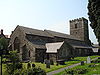
Though the prince was often engaged in conflicts, his battles were largely in Marcher controlled territories and directed against Marcher positions. For the greater period of Llewellyn's reign, the lands under his rule were at peace, a peace for which his vassals sought his protection. "Hardly a ripple disturbed the face of the waters [and] Welsh society followed the lines of its natural development", according to J.E. Lloyd.
The prince was an experienced and astute politician, according to Professor John Davies, whose legacy for Wales in law and government included the continued refinement and sophistication of his government's administration and with the legal system within the principality. Though the principality's archive has disappeared, what remains of Llywelyn's correspondence with English and French counterparts reveal that the prince's chancery
Chancery (medieval office)
Chancery is a general term for a medieval writing office, responsible for the production of official documents. The title of chancellor, for the head of the office, came to be held by important ministers in a number of states, and remains the title of the heads of government in modern Germany,...
produced documents of high quality in both Latin
Latin
Latin is an Italic language originally spoken in Latium and Ancient Rome. It, along with most European languages, is a descendant of the ancient Proto-Indo-European language. Although it is considered a dead language, a number of scholars and members of the Christian clergy speak it fluently, and...
and in French
French language
French is a Romance language spoken as a first language in France, the Romandy region in Switzerland, Wallonia and Brussels in Belgium, Monaco, the regions of Quebec and Acadia in Canada, and by various communities elsewhere. Second-language speakers of French are distributed throughout many parts...
, the lingua franca
Lingua franca
A lingua franca is a language systematically used to make communication possible between people not sharing a mother tongue, in particular when it is a third language, distinct from both mother tongues.-Characteristics:"Lingua franca" is a functionally defined term, independent of the linguistic...
of the era, with the volume of documents increasing substantially after 1200. T. Jones Price notes that the Welsh principality was developing the prerequisites characteristic of a cohesive state
Sovereign state
A sovereign state, or simply, state, is a state with a defined territory on which it exercises internal and external sovereignty, a permanent population, a government, and the capacity to enter into relations with other sovereign states. It is also normally understood to be a state which is neither...
, along similar lines to continental kingdoms such as France, Navarra, and León
Kingdom of León
The Kingdom of León was an independent kingdom situated in the northwest region of the Iberian Peninsula. It was founded in AD 910 when the Christian princes of Asturias along the northern coast of the peninsula shifted their capital from Oviedo to the city of León...
. As in England and elsewhere, the prince issued charters, diplomas, grants, and summons, each affixed with the prince's great seal
Great Seal
- Countries :* Great Seal of Canada** Great Seal of Ontario* Great Seal of France* Seal of the President of Ireland* Great Seal of the Realm ** Great Seal of Northern Ireland** Great Seal of Scotland**Welsh Seal* Great Seal of the State...
. Political offices emerged out of the prince's household, as in other realms, which formed the nucleus of the Welsh government. The distain was a kind of prime minister
Prime minister
A prime minister is the most senior minister of cabinet in the executive branch of government in a parliamentary system. In many systems, the prime minister selects and may dismiss other members of the cabinet, and allocates posts to members within the government. In most systems, the prime...
, the chamberlain
Chamberlain (office)
A chamberlain is an officer in charge of managing a household. In many countries there are ceremonial posts associated with the household of the sovereign....
as the treasurer
Treasurer
A treasurer is the person responsible for running the treasury of an organization. The adjective for a treasurer is normally "tresorial". The adjective "treasurial" normally means pertaining to a treasury, rather than the treasurer.-Government:...
, and with clerks as chancellors. Localized communities became increasingly dependent on the prince's administration, with the prince's appointed judges adjudicating and passing sentences at the commote court. Under the prince's patronage, Welsh law was further codified by the Welsh jurist
Jurist
A jurist or jurisconsult is a professional who studies, develops, applies, or otherwise deals with the law. The term is widely used in American English, but in the United Kingdom and many Commonwealth countries it has only historical and specialist usage...
Iorwerth ap Madog and published sometime around 1240, and known as the Book of Iorwerth, or the Iorwerth Redaction.
As with much of Europe, Wales remained predominatly rural at the turn of the 13th century, but Llywelyn encouraged the growth of quasi-urban settlements within the Welsh principality which served as centres of trade and commerce. Money grew in circulation, with freemen and nobles paying their taxes in the form of money rather than in produce, at least in the more fertile of the principality's commotes.
Llywelyn was no less influential in matters of the Welsh Church as he was in war and politics, and demonstrated that he was open to religious reforms and "accessible to new impulses and ideas", according to Lloyd. Llywelyn lent his support to Gerald of Wales' efforts in elevating St. David's into a metropolitan
Metropolitan bishop
In Christian churches with episcopal polity, the rank of metropolitan bishop, or simply metropolitan, pertains to the diocesan bishop or archbishop of a metropolis; that is, the chief city of a historical Roman province, ecclesiastical province, or regional capital.Before the establishment of...
archbishopric with jurisdiction over all of Wales, though he would not directly benefit from having the Bangor diocese
Bishop of Bangor
The Bishop of Bangor is the Ordinary of the Church in Wales Diocese of Bangor.The diocese covers the counties of Anglesey, most of Caernarfonshire and Merionethshire and a small part of Montgomeryshire...
subject to it. Llywelyn secured the election of Welshmen to vacant Welsh dioceses, largely filled with Anglo-Normans following the Norman invasion of Wales. However, by 1216 Llywelyn's influence in Wales was so wide that he encouraged the election of Iorwerth, abbot of Talley
Talley Abbey
Talley Abbey is a former monastery of the Premonstratensians in the village of Talley in Carmarthenshire, Wales, six miles north of the market town of Llandeilo. It lies in the River Cothi valley. Access to the site of the abbey is free.The Order was founded in 1120...
(Abaty Talyllychau), as Bishop of St David's
Bishop of St David's
The Bishop of St David's is the ordinary of the Church in Wales Diocese of St David's.The succession of bishops stretches back to Saint David who in the 6th century established his seat in what is today the city of St David's in Pembrokeshire, founding St David's Cathedral. The current Bishop of St...
in 1214, the first Welshman successfully elected and consecrated there in 100 years. In 1215, Llywelyn had encouraged the election of Cadwgan of Llandyfai
Cadwgan of Llandyfai
Cadwgan also known as Cadwgan of Llandyfái was a Welsh cleric who was Bishop of Bangor from 1215 to 1236.According to Giraldus Cambrensis, Cadwgan was the son of an Irish priest and a Welsh mother. The annals state that he was the son of a priest famous for the eloquence of his Welsh preaching. He...
, Cistercian abbot of Whitland Abbey
Whitland Abbey
Whitland Abbey was a Cistercian abbey near Whitland in south-west Wales, now in Carmarthenshire.Whitland was founded on 16 September 1140 by monks from the mother house of Clairvaux. In 1144 it was located at Little Trefgarn near Haverfordwest. It moved to Whitland in about 1155, a site having...
(Abaty Hendy-gwyn ar Daf) and son of a famous Welsh priest, as Bishop of Bangor. Llywelyn befriended the monks of Ynys Lannog (Prestholm), who were not members of any religious order but "anchorites of the old Welsh pattern," according to Lloyd. However it was the Cistercian order with its ascetic values
Asceticism
Asceticism describes a lifestyle characterized by abstinence from various sorts of worldly pleasures often with the aim of pursuing religious and spiritual goals...
approximating the Rule of Saint David
Saint David
Saint David was a Welsh Bishop during the 6th century; he was later regarded as a saint and as the patron saint of Wales. David was a native of Wales, and a relatively large amount of information is known about his life. However, his birth date is still uncertain, as suggestions range from 462 to...
of which Llywelyn became most fond of. The prince donated great tracks of land to the Cistercians, particularly in Cymer
Cymer Abbey
Cymer Abbey is a ruined Cistercian abbey near the village of Llanelltyd, just north of Dolgellau, Gwynedd, in north-west Wales, United Kingdom.- History :It was founded in 1198 and is now in the care of Cadw...
and Aberconwy
Aberconwy Abbey
Aberconwy Abbey was a Cistercian foundation at Conwy, later transferred to Maenan near Llanrwst and in the 13th century was the most important abbey in North Wales....
. Additionally, Llywelyn patronized the Knights Hospitallers and donated lands to them at Dôl Gynwal
Ysbyty Ifan
Ysbyty Ifan is a small but historic village in Conwy County Borough, north Wales. Nearly all the population speak Welsh.-History:Ysbyty Ifan, until 1189, was known as Dôl Gynwal. Then, it came to the attention of the Knights of St John, who set up a hospice...
, subsequently known as Ysbyty Ifan (Hospital of John), on the banks of the Conwy. Additionally, Llywelyn warmly welcomed the new order of Franciscans, who had come to Britain and Ireland only after 1200, to Wales.
Dafydd II, the Buckler of Wales; 1240-1246
Dafydd II succeeded his father with ease as he had the support of his father's chief advisors and the principality's leading magnates, including support from Ednyfed FychanEdnyfed Fychan
Ednyfed Fychan , full name Ednyfed Fychan ap Cynwrig, was a Welsh warrior who became seneschal to the Kingdom of Gwynedd in Northern Wales, serving Llywelyn the Great and his son Dafydd ap Llywelyn...
, Bishop Hywel of St. Asaph, and Einion Fychan. Dafydd's half-brother Gruffydd was closely guarded, and his supporters were all but silenced with the exception of Bishop Richard of Bangor who spoke publicly on Gruffydd's behalf. Shortly after his ascension, Dafydd attended the royal court in Gloucester where he performed homage for his inheritance and wearing Gwynedd's talaith, or coronet, the special symbol of his rank, according to Lloyd.
However, though Dafydd's rule began auspiciously and in "peace and security", there were plots devised to reduce his and his house's influence, both in Gwynedd and over the whole of Wales. Claimants to the lands Llywelyn incorporated into his expanded principality petitioned the English king for redress. Diplomatic and legal battles ensued through-out 1241 as Dafydd agreed to put the matter of the disputed lands to a committee of arbitrators, partly English and partly Welsh, and headed by the pope's legate Otto. Collectively the arbitrators were deputized to adjudicate on the legal possessors of the lands in question. However, Dafydd subsequently failed to appear at three of the designated hearings, which delayed the proceedings. Patience exhausted, Henry III gathered a host and prepared to invade Wales in July and August in direct violation to the church sanctioned arbitration agreement. In the face of the military intervention before him, Prince Dafydd was almost bereft of any allies. Gruffydd ap Madog of upper Powys (son of Madog, who had been an ardent supporter and vassal of Dafydd's father Llywelyn), Maredudd ap Rhotpert, and Maelgwn Fychan all deserted him. Additionally, Henry III granted the petition of Senena, wife of Gruffydd ap Llywelyn, to force Dafydd to release her husband from confinement and to be restored to a portion of Gwynedd as was due his inheritance. With the summer of 1241 remarkably dry, Dafydd found himself abandoned of yet another ally which, as Lloyd wrote, "rarely failed a Welsh chief in his hour of need, the Welsh climate." Marshes dried up, rivers became fordable while lakes shrank into shallow pools, and the natural obstacles which usually made campaigning in Wales most difficult all but disappeared. Within four weeks Henry was at Rhuddlan and Dafydd agreed to submit before him.
Henry would allow his nephew to retain the title and rank of prince, but otherwise the treaty terms were harsh. Gruffydd and his son Owain
Owain ap Gruffydd
Owain ap Gruffydd may refer to:*Owain Gwynedd Prince of Gwynedd*Owain Cyfeiliog Prince of part of Powys*Owain Goch ap Gruffydd Brother of Llywelyn the Last of Gwynedd*Owain Glyndŵr Prince of Wales...
would be turned over to the king with the plan to have Gruffydd established as an independent ruler somewhere in North Wales as a counterweight to Dafydd. All of the conquests of Llywelyn, including of Meirionydd, Maelienydd, Mold, and of lower Powys, were returned to other claimants; and all homages of Welsh vassals were to be transferred back to the English crown. Dafydd was to pay for the expenses of the war (eventually having to ced Tegeingle and Degannwy, both in lower Gwynedd, to England to cover war expenses) and lost his inheritance of Ellesmere in England, his late mother's marriage dowry. Henry III repossessed Cardigian and Carmarthen in Deheubarth, while John of Monmouth occupied Builth, Dafydd's wife's dowry. Lastly, Dafydd's ally Maredudd ap Rhys Gryg was forced out of Kidwelly and Widigada. Most importantly, however, Henry III insisted that Gwynedd would pass to the English crown if Dafydd II were to dies without an heir.
Though Henry III did initially intend to install Gruffydd ‘somewhere’ in North Wales as a counterweight to Dafydd, in the end Henry "spared [Dafydd] the last humiliation" of dividing Gwynedd to share between the brothers, and Gruffydd and his son Owain were installed instead in the Tower of London
Tower of London
Her Majesty's Royal Palace and Fortress, more commonly known as the Tower of London, is a historic castle on the north bank of the River Thames in central London, England. It lies within the London Borough of Tower Hamlets, separated from the eastern edge of the City of London by the open space...
, "trading a Welsh prison for an English one", wrote Lloyd. Gruffydd remained popular amongst some traditionalist Welsh, and a ‘legitimist’ faction had emerged to promote his rights above those of Dafydd. Henry III thought to keep Gruffydd as prisoner and as leverage against Dafydd for ‘good behavior’. If Dafydd were to rebel then Henry III would release Gruffydd into Gwynedd to attract his supporters and causing a dynastic civil war in Gwynedd. Dafydd's policy therefore was one of prudence and self restraint as he maintained the status que. Then, on St. David's Day
Saint David's Day
Saint David's Day is the feast day of Saint David, the patron saint of Wales, and falls on 1 March each year. The date of 1 March was chosen in remembrance of the death of Saint David. Tradition holds that he died on that day in 589...
1244, in a daring escape attempt Gruffydd fell to his death when his improvised rope of torn bed sheets and table lenins gave way as he tried to propel from the White Tower
White Tower (Tower of London)
The White Tower is a central tower, the old keep, at the Tower of London.-History:The castle which later became known as the Tower of London was built by William the Conqueror in 1066. It began as a timber fortification enclosed by a palisade. In the next decade work began on the White Tower, the...
.
Gruffydd's death released Dafydd from the threat of rival and within a few weeks the flag of revolt was flown across Wales. Dafydd emerged as the popular leader as he publicly lamented the indignant treatment of his brother, and with Gruffydd's second eldest son Llywelyn
Llywelyn ap Gruffydd
Llywelyn ap Gruffydd may refer to:*Llywelyn the Last *Llywelyn ap Gruffydd Fychan...
beside and supporting his uncle. The lesser Welsh lords again swore fealty to Dafydd as their leige lord, including the Dinefwr lords in Deheubarth. However, the two lords of upper and lower Powys, and Morgan of Gwenllwg, remained aloof to the revolt. The summer of 1244 emerged as one of unrest and strife as Dafydd stirred up his supporters the length and breadth of Wales. Nightly Welsh soldiers raided English positions, Diserth was under siege, and Powys’ province of Cyfeiliog was raided as punishment for Gwenwynwyn's support for the English king. In addition to military strikes on English positions, Dafydd opened a diplomatic offensive against the English crown by appealing directly to Pope Innocent IV
Pope Innocent IV
Pope Innocent IV , born Sinibaldo Fieschi, was pope from June 25, 1243 until his death in 1254.-Early life:...
, a "bold and original strategy", according to Lloyd. In his plea to the pope, Dafydd offered to hold the Welsh principality as a Papal vassal, noting that Rome had acknowladged his rights as heir. Dafydd's plan had precedents, according to Davies, as "by 1244 about a dozen European rulers have become direct vassals of the Papacy, and the Pope had proved his ability to make and unmake kingdoms." While awaiting the Pope's reply, Dafydd had begun to style himself formally as Prince of Wales, denoting not only the popular monarchy
Popular monarchy
Popular monarchy is a system of monarchical governance in which the monarch's title is linked with a popular mandate rather than a constitutional state. It was the norm in some places from the Middle Ages, and was occasionally used in 19th- and 20th-century Europe, often reflecting the results of...
over the Welsh which his earlier forefathers had taken with the title Prince of the Welsh and the title Prince of Aberffraw and Lord of Snowdon, but over a clearly defined and challenging territorial principality incorporating the whole of Wales as distinct from England.
A sympathetic Innocent IV appointed the abbots of Cymer and Aberconwy as papal commissioners charged with summoning Henry III to answer charges of wantonly casting aside arbitration in his 1241 campaign in Wales in favor of war. Henry III ignored the sommons and sent his own envoy to Rome with the royal version of events, which sent word by 1245 transferring jurisdiction from the Welsh abbots to the Archbishop of Canterbury, "revealing not obscurely the influence of the weightier purse", according to Lloyd.
Initially Henry took little interest in Dafydd's revolt as he was distracted by possible Scottish plans at an invasion in northern England, and deputized the marcher lords the earls of Gloucester and Hereford, and the two wardens of the March, John of Monmouth and John Lestrange, and later a contingent of knights under the command of Herbert fitz Mathew, with all five proving ineffective against the Welsh prince. Fustrated, Henry III released Owain the Red into Gwynedd, hoping that the affection Gruffydd had held among some Welsh would transfer to Owain and divide the Welsh in their loyalties. However, the Welsh fully backed Dafydd who continued to win victories in the spring of 1245. Herbert fitz Mathew was killed by a force of Welsh of Rhwng Nedd ac Afan, and though 300 Welsh soldiers were killed in an ambush near Montgomery, Dafydd took Mold castle on 28 March.
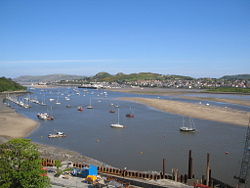
Matthew Paris
Matthew Paris was a Benedictine monk, English chronicler, artist in illuminated manuscripts and cartographer, based at St Albans Abbey in Hertfordshire...
, a soldier wrote,
Henry's army, deep behind enemy lines, was ill provisioned by sea with the road from Chester routinely raided by Welsh skirmishers. As the summer turned to fall, the war raged on ruthlessly. English forces sacked the Cistercian Monastery of Aberconwy (now Conwy Castle
Conwy Castle
Conwy Castle is a castle in Conwy, on the north coast of Wales.It was built between 1283 and 1289 during King Edward I's second campaign in North Wales....
), almost directly opposite the Conwy River from Degannwy, and executed Welsh hostages, including the young son of Ednyfed Fychan. In retaliation, the Welsh hung and beheaded their captives. Irish mercenaries in Henry's service raided Ynys Mon destroying the harvest. By late October Henry retreated from Degannwy and returned to England, his campaign of 1245 a failure. But if Henry's campaign was a defeat, Dafydd's wasn’t a clear victory either, as Henry left behind a new castle at Degannwy which was- for Dafydd- a ‘throne in the eye’ and a clear sign by Henry for the speedy renewal of the war at another time.
Before the war could be renewed, Dafydd II died at his court in Aber, 25 February 1246, survived by his wife Princess Isabella, but no heirs to transmit his claim to. The question of whether or not Prince Dafydd II could have maintained his position indefinably against Henry III will always be uncertain, according to Lloyd, but what can be said of Dafydd II was that during his brief rule Dafydd "showed himself, in courage, prudence, and leadership, no unworthy son of the great Llywelyn. The chronicler mourned the loss of the buckler of Wales
Buckler
A buckler is a small shield, 15 to 45 cm in diameter, gripped in the fist; it was generally used as a companion weapon in hand-to-hand combat during the Medieval and Renaissance, as its size made it poor protection against missile weapons but useful in deflecting the blow of...
; and Dafydd Benfras
Dafydd Benfras
Dafydd Benfras was a Welsh language court poet regarded by Saunders Lewis and others as one of the greatest of the 'Poets of the Princes' ....
set his harp to plaintive strains in honor of the fallen chief;
He was a man who sowed the seed of joy for his people,
Of the right lineage of kings,.
So lordly his gifts, ‘twas strange
He gave not the moon in heaven!
Ashen of hue this day is the hand of bounty
The hand that last year kept the pass of Aberconwy.