

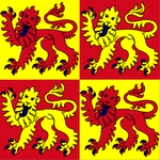
Principality of Wales

Encyclopedia
The Principality of Wales (Welsh
: Tywysogaeth Cymru) existed between 1216 and 1542, encompassing two-thirds of modern Wales
.
It was formally founded in 1216 at the Council of Aberdyfi, and later recognised by the 1218 Treaty of Worcester between Llywelyn the Great
of Wales and Henry III
of England
. The treaty gave substance to the political reality of 13th century Wales and England, and the relationship of the former with the Angevin Empire
. The principality retained a great degree of autonomy, characterized by a separate legal jurisprudence based on the well established laws of Cyfraith Hywel
, and by the increasingly sophisticated court
of the House of Aberffraw
. Although it owed fealty
to the Angevin king of England, the principality was de facto
independent, with a similar status in the empire to the Kingdom of Scotland
. Its existence has been seen as proof that all the elements necessary for the growth of Welsh statehood
were in place.
Since the Laws in Wales Acts 1535–1542, which formally incorporated all of Wales within the Kingdom of England
, there has been no geographical or constitutional basis for describing any of the territory of Wales as a principality, although the term has occasionally been used in an informal sense to describe the country, and in relation to the honorary title of Prince of Wales.
and the other sovereign princes among the Welsh that he was the paramount ruler amongst them, and they would pay homage to him. Later he obtained recognition, at least in part, of this agreement from the King of England, who agreed that Llywelyn's heirs and successors would enjoy the title "Prince of Wales" but with certain limitations to his realm and other conditions, including homage to the King of England as vassal, and adherence to rules regarding a legitimate succession. Llywelyn had been at pains to ensure that his heirs and successors would follow the "approved" (by the Pope at least) system of inheritance which excluded illegitimate sons. In so doing he excluded his elder bastard son Gruffydd ap Llywelyn
from the inheritance, a decision which would have later ramifications. In 1240 Llywelyn died and Henry III of England
(who succeeded John) promptly invaded large areas of his former realm, usurping them from him. However, the two sides came to peace and Henry honoured at least part of the agreement and bestowed upon Dafydd ap Llywelyn
the title 'Prince of Wales'. This title would be granted to his successor Llywelyn in 1267 (after a campaign by him to achieve it) and was later claimed by his brother Dafydd and other members of the princely House of Aberffraw
.
Following the conquest of Gwynedd, Wales was divided between territory under the direct control of the English monarch, sometimes referred to as the principality of North Wales or the Principality of Wales, and the March of Wales
which remained under the rule of Anglo-Norman Marcher Lords. In 1284 Edward (the future Edward II
) was born at Caernarfon Castle
. According to legend Edward I is said to have presented his son to the Welsh claiming here is a prince who speaks no English; however this story does not appear until the 16th century and is more than likely a fabrication. Edward Caernarfon was not heir to the throne at the time of his birth, having an elder brother, Alphonso Earl of Chester, who died shortly after. In 1400 the title of Prince of Wales was claimed for a final time by Owain Glyndŵr
who led a vigorous but ultimately doomed campaign to secure independence for Wales.
family
, lands in north Wales
traditionally including Ynys Môn, Gwynedd-Uwch-Conwy (Gwynedd above the Conwy, or Upper Gwynedd), and the Perfeddwlad
(the Middle Country) also known as Gwynedd-Is-Conwy (Gwynedd below the Conwy, or Lower Gwynedd). Additional lands were acquired through vassalage or conquest, and by regaining lands lost to Marcher lords
, particularly that of the Perfeddwlad, Powys Fadog
, Powys Wenwynwyn
, and Ceredigion
.
Previous Welsh rulers had styled themselves in a variety of ways, usually in relation to a certain patrimony like "Lord of Ceredigion" or "King of Builth". The most powerful were often referred to (by others at least) as "King of the Britons". As Wales was a defined geographical area with agreed borders, yet outside the bounds of England, anyone bestowed with the title Prince of Wales would have suzerainty
over any local Welsh ruler but without the territorial ambitions on England of a King of the Britons - which implied "liberating" the Britons who still resided in places long considered a part of England such as Devon, Cornwall, Cumberland and other places, albeit in fewer and fewer numbers.
The Aberffraw family had long claimed primacy
over all other Welsh lords, including those of Powys and of Deheubarth.
In The History of Gruffydd ap Cynan, written in the late 12th century, the family asserted its rights as the senior line of descendants from Rhodri the Great
who had conquered most of Wales during his lifetime. Gruffydd ap Cynan
's biography was first written in Latin
and intended for a wider audience outside Wales. The significance of this claim was that the Aberffraw family owed nothing to the English king for its position in Wales, and that they held authority in Wales "by absolute right through descent," wrote historian John Davies.
who ruled from 1137 until 1170. He was never acknowledged as Prince of Wales, and in fact never used that title; however he was considered by later chroniclers to have been the first Welsh prince to unite Wales. This was demonstrated when Owain Glyndŵr
was explicitly crowned as Owain IV of Wales in 1404. The English viewed it very differently and considered the title to be bestowed by them and with their grace on only Dafydd ap Llywelyn
in 1240 and Llywelyn ap Gruffudd in 1267. After 1301 the title was granted to the eldest son and heir of an English sovereign.
managed to maintain the primary position in Wales for his family which his father had achieved. In 1154 he defeated an English and Powysian invasion but was forced to give up some territory bordering the River Dee
, In later years he recaptured these areas and achieved a dominant position for Gwynedd in Wales which had not been seen for centuries. During Owain's reign he chose to change his title from King of Gwynedd to Prince of the Welsh (J. B. Smith, 'Owain Gwynedd', 14-16).
had usurped the crown from his siblings in a debilitating civil war within Gwynedd. He married the half-sister of king Henry II of England
in 1174. He was eventually ousted in 1195 from his much reduced domain by his nephew Llywelyn.

By 1200 Owain Gwynedd's grandson Llywelyn Fawr (the Great) ap Iorwerth ruled over all of Gwynedd, with England endorsing all of Llywellyns holdings that year. England's endorsement was part of a larger strategy of reducing the influence of Powys Wenwynwyn, as King John had given William de Breos license in 1200 to "seize as much as he could" from the native Welsh. However, de Breos was in disgrace by 1208, and Llywelyn seized both Powys Wenwynwyn and northern Ceredigon.
In his expansion, the Prince was careful not to antagonise King John, his father-in-law. Llywelyn had married Joan
, King John's illegitimate daughter, in 1204. In 1209 Prince Llywelyn joined King John on his campaign in Scotland. However, by 1211 King John recognised the growing influence of Prince Llywellyn as a threat to English authority in Wales. King John invaded Gwynedd and reached the banks of the Menai, and Llywelyn was forced to cede the Perfeddwlad, and recognize John as his heir if Llywelyn's marriage with Joan did not produce any legitimate successors. Succession was a complicated matter given that Welsh law recognized children born out of wedlock as equal to those in born in wedlock and sometimes accepted claims through the female line. Llywelyn had several children by then with a mistress. Many of Llywelyn's Welsh allies had abandoned him during England's invasion of Gwynedd, preferring an overlord far away rather than one nearby. These Welsh lords expected an unobtrusive English crown; however King John had a castle built at Aberystwyth
, and his direct interference in Powys and the Perfeddwlad caused many of these Welsh lords to rethink their position. Llywelyn capitalised on Welsh resentment against King John, and led a church sanctioned revolt against him. As King John was an enemy of the church
, Pope Innocent III
gave his blessing to Llywelyn's revolt.
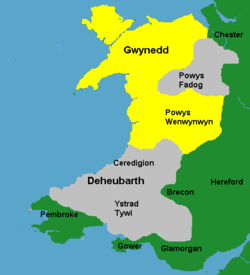 Early in 1212 Llywelyn had regained the Perfeddwlad and burned the castle at Ystwyth.Llywelyn's revolt caused John to postpone his invasion of France, and Philip Augustus
, the King of France, was so moved as to contact Prince Llywelyn I and proposed they ally against the English king King John ordered the execution by hanging of his Welsh hostages, the sons of many of Llywelyn's supporters Llywelyn I was the first prince to receive the fealty of other Welsh lords with the 1216 Council of Aberdyfi, thus becoming the de facto Prince of Wales and giving substance to the Aberffraw claims.
, further restricting his powers. By 1244, however, Gruffudd was dead, and Dafydd seems to have benefited from the backing of many of his brother's erstwhile supporters. He was acknowledged by the Vatican as Prince of Wales
for a time, and defeated Henry III in battle in 1245 during the English king's second invasion of Wales. A truce was agreed in the autumn, and Henry withdrew; but Dafydd died unexpectedly in 1246 without issue. His wife, Isabella de Braose
, returned to England; she was dead by 1248.
Dafydd married Isabella de Braose in 1231. Their marriage produced no children, and there is no contemporary evidence that Dafydd sired any heirs. According to late genealogical sources collected by Bartrum (1973), Dafydd had two children by an unknown woman (or women), a daughter, Annes, and a son, Llywelyn ap Dafydd, who apparently later became Constable of Rhuddlan and was succeeded in that post by his son Cynwrig ap Llywelyn.
, in 1265 against King Henry III of England
allowed him to reconquer large areas of mid Wales from the English Marcher Lords. At the Treaty of Montgomery
between England and Wales in 1267 Llywelyn was granted the title "Prince of Wales" for his heirs and successors and allowed to keep the lands he had conquered as well as the homage of lesser Welsh princes in return for his own homage to the King of England and payment of a substantial fee. Disputes between him, his brother Dafydd and English lords bordering his own led to renewed conflict with England (now ruled by Edward I
) in 1277. Following the Treaty of Aberconwy
Llywelyn was confined to Gwynedd-uwch-Conwy. He joined a revolt instigated by his brother Dafydd in 1282 in which he died in battle.
 Owain was the great-nephew of Llywelyn ap Gruffudd and Dafydd ap Gruffudd. He claimed the title in exile in France
and loyalists revolted in his name across Wales. He was assassinated before being able to return to Wales to lead them.
in 1404 during a revolt
against the usurper Henry IV of England
. He claimed descent from Rhodri Mawr through the House of Powys Fadog
. He went on to establish diplomatic relations with foreign powers and liberated Wales from English rule. He was ultimately unsuccessful and was driven to the mountains where he led a guerilla war. When and where he died is not known, but it is believed he died disguised as a friar
in the company of his daughter, Alys, at Monnington Straddle in Herefordshire
.
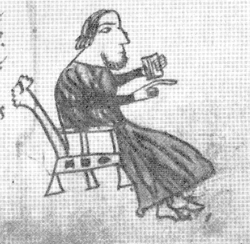
The political maturation of the principality's government fostered a more defined relationship between prince and the people. Emphasis was placed on the territorial integrity of the principality, with the prince as lord of all the land, and other Welsh lords swearing fealty to the prince directly, a distinction with which the Prince of Wales paid yearly tribute to the King of England. By treaty the principality was obliged to pay the kingdom large annual sums. Between 1267 and 1272 Wales made a total payment of $11,500, "proof of a growing money economy... and testimony of the effectiveness of the principality's financial administration," wrote historian Dr. John Davies. Additionally, modifications and amendments to the Law Codes of Hywl Dda encouraged the declined of the galanas (blood-fine) and the use of the jury system. The Aberffraw dynasty maintained vigorous diplomatic and domestic policies; and patronized the Church in Wales
, particularly that of the Cistercian Order.
, known as Tŷ Hir, the Long House, in later documents. To the east was the newly endowed Cistercian Monastery of Aberconwy
; to the west the cathedral city of Bangor
. In 1211 King John of England
brought an army across the river Conwy, and occupied the royal home for a brief period; his troops went on to burn Bangor. Llywelyn's wife, John's daughter Joan
, also known as Joanna, negotiated between the two men, and John withdrew. Joan died at Abergwyngregyn in 1237; Dafydd ap Llywelyn died there in 1246; Eleanor de Montfort, Lady of Wales, wife of Llywelyn ap Gruffudd, died there on 19 June 1282, giving birth to a baby, Gwenllian of Wales
, from the outskirts of Chester
to the outskirts of Cydweli," wrote Davies. By 1271, Prince Llywelyn II could claim a growing population of about 200,000 people, or a little less than three quarters of the total Welsh population. The population increase was common throughout Europe in the 13th century, but in Wales it was more pronounced. By Llywelyn II's reign as much as 10 per cent of the population were town-dwellers. Additionally, "unfree slaves... had long disappeared" from within the territory of the principality, wrote Davies. The increase in men allowed the prince to call on and field a far more substantial army.
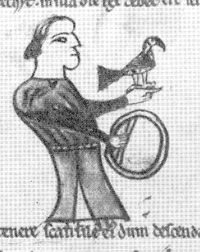 A more stable social and political environment provided by the Aberffraw administration allowed for the natural development of Welsh culture, particularly in literature, law, and religion. Tradition originating from The History of Gruffydd ap Cynan attributes Gruffydd I as reforming the orders of bard
s and musician
s; Welsh literature
demonstrated "vigor and a sense of commitment" as new ideas reached Wales, even in "the wake of the invaders", according to historian John Davies. Contacts with continental Europe "sharpened Welsh pride", wrote Davies in his History of Wales.
s, four bards (poets) by trade, 26 shoemakers, a doctor in Cynwyd
and a hotel
keeper in Maentwrog
, and 28 priests; two of whom were university graduates. Also present were a significant number of fishermen
, administrators, professional men and craftsmen.
With the average temperature of Wales a degree or two higher than it is today, more Welsh lands were arable
for agriculture, "a crucial bonus for a country like Wales," wrote historian Dr John Davies. Of significant importance for the principality included more developed trade routes, which allowed for the introduction of new energy sources such as the windmill
, the fulling mill
and the horse collar
(which doubled the efficiency of horse-power).
The principality traded cattle
, skins, cheese
, timber
, horses, wax
, dogs, hawks, and fleeces, but also flannel
(with the growth of fulling mills). Flannel was second only to cattle among the principality's exports. In exchange, the principality imported salt, wine, wheat, and other luxuries from London
and Paris
. But most importantly for the defence of the principality, iron
and specialised weapon
ry were also imported. Welsh dependence on foreign imports was a tool that England used to wear down the principality during times of conflict between the two countries.
for his heir, Prince Arthur
. The Council was place on a statutory basis in 1543 and played a central role in co-ordinating law and administration. It declined in the early 17th century and was abolished by Parliament in 1641. It was revived at the Restoration before being finally abolished in 1689.
For the period following 1689 and ending in 1948 there was no differentiation between the government of England and government in Wales. All laws relating to England included Wales and Wales was considered by the British Government as an indivisible part of England
within the United Kingdom
. The first piece of legislation to relate specifically to Wales was the Sunday Closing (Wales) Act 1881
. A further exception was the Welsh Church Act 1914
, which disestablished the Church in Wales
in 1920 (which had formerly been part of the Church of England
).
In 1948 the practice was established that all laws passed in the Parliament of the United Kingdom
were designated as applicable to either "England and Wales
" or "Scotland
", thus returning a legal identity to Wales which had not existed for hundreds of years following the Act of Union
with Scotland in 1707. Also in 1948 a new Council for Wales was established as a parliamentary committee. In 1964 the Welsh Office
was established, based in London, to oversee and recommend improvements to the application of laws in Wales. This situation would continue until the devolution of government in Wales and the establishment of the autonomous National Assembly for Wales
in 1998.
of Wales, by Thomas Taylor in 1718, was titled The Principality of Wales exactly described ..., and the term is still used by such publications as Burke's Landed Gentry
. However, The Guardian
style guide advises writers to "avoid the word 'principality'" in relation to Wales.
The use of the term to refer to the territory of Wales should be distinguished from its use to refer to the title of Prince of Wales
in the Peerage of the United Kingdom
, which has been traditionally granted (together with the title Duke of Cornwall
) to the heir apparent
to the reigning monarch. It confers no responsibilities for government in Wales, and has no constitutional meaning outside the peerage
. The value of the position is contested in modern politics. The Honours of the Principality of Wales
refer to the Crown Jewels
used at the investiture of Princes of Wales.
Welsh language
Welsh is a member of the Brythonic branch of the Celtic languages spoken natively in Wales, by some along the Welsh border in England, and in Y Wladfa...
: Tywysogaeth Cymru) existed between 1216 and 1542, encompassing two-thirds of modern Wales
Wales
Wales is a country that is part of the United Kingdom and the island of Great Britain, bordered by England to its east and the Atlantic Ocean and Irish Sea to its west. It has a population of three million, and a total area of 20,779 km²...
.
It was formally founded in 1216 at the Council of Aberdyfi, and later recognised by the 1218 Treaty of Worcester between Llywelyn the Great
Llywelyn the Great
Llywelyn the Great , full name Llywelyn ab Iorwerth, was a Prince of Gwynedd in north Wales and eventually de facto ruler over most of Wales...
of Wales and Henry III
Henry III of England
Henry III was the son and successor of John as King of England, reigning for 56 years from 1216 until his death. His contemporaries knew him as Henry of Winchester. He was the first child king in England since the reign of Æthelred the Unready...
of England
England
England is a country that is part of the United Kingdom. It shares land borders with Scotland to the north and Wales to the west; the Irish Sea is to the north west, the Celtic Sea to the south west, with the North Sea to the east and the English Channel to the south separating it from continental...
. The treaty gave substance to the political reality of 13th century Wales and England, and the relationship of the former with the Angevin Empire
Angevin Empire
The term Angevin Empire is a modern term describing the collection of states once ruled by the Angevin Plantagenet dynasty.The Plantagenets ruled over an area stretching from the Pyrenees to Ireland during the 12th and early 13th centuries, located north of Moorish Iberia. This "empire" extended...
. The principality retained a great degree of autonomy, characterized by a separate legal jurisprudence based on the well established laws of Cyfraith Hywel
Welsh law
Welsh law was the system of law practised in Wales before the 16th century. According to tradition it was first codified by Hywel Dda during the period between 942 and 950 when he was king of most of Wales; as such it is usually called Cyfraith Hywel, the Law of Hywel, in Welsh...
, and by the increasingly sophisticated court
Curia Regis
Curia regis is a Latin term meaning "royal council" or "king's court."- England :The Curia Regis, in the Kingdom of England, was a council of tenants-in-chief and ecclesiastics that advised the king of England on legislative matters...
of the House of Aberffraw
House of Aberffraw
The House of Aberffraw is a historiographical and genealogical term historians use to illustrate the clear line of succession from Rhodri the Great of Wales through his eldest son Anarawd....
. Although it owed fealty
Fealty
An oath of fealty, from the Latin fidelitas , is a pledge of allegiance of one person to another. Typically the oath is made upon a religious object such as a Bible or saint's relic, often contained within an altar, thus binding the oath-taker before God.In medieval Europe, fealty was sworn between...
to the Angevin king of England, the principality was de facto
De facto
De facto is a Latin expression that means "concerning fact." In law, it often means "in practice but not necessarily ordained by law" or "in practice or actuality, but not officially established." It is commonly used in contrast to de jure when referring to matters of law, governance, or...
independent, with a similar status in the empire to the Kingdom of Scotland
Kingdom of Scotland
The Kingdom of Scotland was a Sovereign state in North-West Europe that existed from 843 until 1707. It occupied the northern third of the island of Great Britain and shared a land border to the south with the Kingdom of England...
. Its existence has been seen as proof that all the elements necessary for the growth of Welsh statehood
Sovereign state
A sovereign state, or simply, state, is a state with a defined territory on which it exercises internal and external sovereignty, a permanent population, a government, and the capacity to enter into relations with other sovereign states. It is also normally understood to be a state which is neither...
were in place.
Since the Laws in Wales Acts 1535–1542, which formally incorporated all of Wales within the Kingdom of England
Kingdom of England
The Kingdom of England was, from 927 to 1707, a sovereign state to the northwest of continental Europe. At its height, the Kingdom of England spanned the southern two-thirds of the island of Great Britain and several smaller outlying islands; what today comprises the legal jurisdiction of England...
, there has been no geographical or constitutional basis for describing any of the territory of Wales as a principality, although the term has occasionally been used in an informal sense to describe the country, and in relation to the honorary title of Prince of Wales.
History
The Principality of Wales was created in 1216 at the Council of Aberdyfi, when it was agreed between Llywelyn the GreatLlywelyn the Great
Llywelyn the Great , full name Llywelyn ab Iorwerth, was a Prince of Gwynedd in north Wales and eventually de facto ruler over most of Wales...
and the other sovereign princes among the Welsh that he was the paramount ruler amongst them, and they would pay homage to him. Later he obtained recognition, at least in part, of this agreement from the King of England, who agreed that Llywelyn's heirs and successors would enjoy the title "Prince of Wales" but with certain limitations to his realm and other conditions, including homage to the King of England as vassal, and adherence to rules regarding a legitimate succession. Llywelyn had been at pains to ensure that his heirs and successors would follow the "approved" (by the Pope at least) system of inheritance which excluded illegitimate sons. In so doing he excluded his elder bastard son Gruffydd ap Llywelyn
Gruffydd ap Llywelyn
Gruffydd ap Llywelyn was the ruler of all Wales from 1055 until his death, the only Welsh monarch able to make this boast...
from the inheritance, a decision which would have later ramifications. In 1240 Llywelyn died and Henry III of England
Henry III of England
Henry III was the son and successor of John as King of England, reigning for 56 years from 1216 until his death. His contemporaries knew him as Henry of Winchester. He was the first child king in England since the reign of Æthelred the Unready...
(who succeeded John) promptly invaded large areas of his former realm, usurping them from him. However, the two sides came to peace and Henry honoured at least part of the agreement and bestowed upon Dafydd ap Llywelyn
Dafydd ap Llywelyn
Dafydd ap Llywelyn was Prince of Gwynedd from 1240 to 1246. He was for a time recognised as Prince of Wales.- Descent :...
the title 'Prince of Wales'. This title would be granted to his successor Llywelyn in 1267 (after a campaign by him to achieve it) and was later claimed by his brother Dafydd and other members of the princely House of Aberffraw
House of Aberffraw
The House of Aberffraw is a historiographical and genealogical term historians use to illustrate the clear line of succession from Rhodri the Great of Wales through his eldest son Anarawd....
.
Following the conquest of Gwynedd, Wales was divided between territory under the direct control of the English monarch, sometimes referred to as the principality of North Wales or the Principality of Wales, and the March of Wales
Welsh Marches
The Welsh Marches is a term which, in modern usage, denotes an imprecisely defined area along and around the border between England and Wales in the United Kingdom. The precise meaning of the term has varied at different periods...
which remained under the rule of Anglo-Norman Marcher Lords. In 1284 Edward (the future Edward II
Edward II of England
Edward II , called Edward of Caernarfon, was King of England from 1307 until he was deposed by his wife Isabella in January 1327. He was the sixth Plantagenet king, in a line that began with the reign of Henry II...
) was born at Caernarfon Castle
Caernarfon Castle
Caernarfon Castle is a medieval building in Gwynedd, north-west Wales. There was a motte-and-bailey castle in the town of Caernarfon from the late 11th century until 1283 when King Edward I of England began replacing it with the current stone structure...
. According to legend Edward I is said to have presented his son to the Welsh claiming here is a prince who speaks no English; however this story does not appear until the 16th century and is more than likely a fabrication. Edward Caernarfon was not heir to the throne at the time of his birth, having an elder brother, Alphonso Earl of Chester, who died shortly after. In 1400 the title of Prince of Wales was claimed for a final time by Owain Glyndŵr
Owain Glyndwr
Owain Glyndŵr , or Owain Glyn Dŵr, anglicised by William Shakespeare as Owen Glendower , was a Welsh ruler and the last native Welshman to hold the title Prince of Wales...
who led a vigorous but ultimately doomed campaign to secure independence for Wales.
Foundations
The 13th century Principality of Wales was based on the historic lands ruled by the AberffrawHouse of Aberffraw
The House of Aberffraw is a historiographical and genealogical term historians use to illustrate the clear line of succession from Rhodri the Great of Wales through his eldest son Anarawd....
family
Dynasty
A dynasty is a sequence of rulers considered members of the same family. Historians traditionally consider many sovereign states' history within a framework of successive dynasties, e.g., China, Ancient Egypt and the Persian Empire...
, lands in north Wales
North Wales
North Wales is the northernmost unofficial region of Wales. It is bordered to the south by the counties of Ceredigion and Powys in Mid Wales and to the east by the counties of Shropshire in the West Midlands and Cheshire in North West England...
traditionally including Ynys Môn, Gwynedd-Uwch-Conwy (Gwynedd above the Conwy, or Upper Gwynedd), and the Perfeddwlad
Perfeddwlad
Perfeddwlad, , , was a name adopted during the twelfth century for the territories in north-east Wales lying between the rivers Conwy and Dee, and comprised the cantrefi of Rhos, Rhufoniog, Dyffryn Clwyd and Tegeingl...
(the Middle Country) also known as Gwynedd-Is-Conwy (Gwynedd below the Conwy, or Lower Gwynedd). Additional lands were acquired through vassalage or conquest, and by regaining lands lost to Marcher lords
Welsh Marches
The Welsh Marches is a term which, in modern usage, denotes an imprecisely defined area along and around the border between England and Wales in the United Kingdom. The precise meaning of the term has varied at different periods...
, particularly that of the Perfeddwlad, Powys Fadog
Powys Fadog
Powys Fadog or Lower Powys was the northern portion of the former princely realm of Powys which split in two following the death of Madog ap Maredudd of Powys in 1160...
, Powys Wenwynwyn
Powys Wenwynwyn
Powys Wenwynwyn or Powys Cyfeiliog was the southern portion of the former princely state of Powys which split following the death of Madog ap Maredudd of Powys in 1160...
, and Ceredigion
Ceredigion
Ceredigion is a county and former kingdom in mid-west Wales. As Cardiganshire , it was created in 1282, and was reconstituted as a county under that name in 1996, reverting to Ceredigion a day later...
.
Previous Welsh rulers had styled themselves in a variety of ways, usually in relation to a certain patrimony like "Lord of Ceredigion" or "King of Builth". The most powerful were often referred to (by others at least) as "King of the Britons". As Wales was a defined geographical area with agreed borders, yet outside the bounds of England, anyone bestowed with the title Prince of Wales would have suzerainty
Suzerainty
Suzerainty occurs where a region or people is a tributary to a more powerful entity which controls its foreign affairs while allowing the tributary vassal state some limited domestic autonomy. The dominant entity in the suzerainty relationship, or the more powerful entity itself, is called a...
over any local Welsh ruler but without the territorial ambitions on England of a King of the Britons - which implied "liberating" the Britons who still resided in places long considered a part of England such as Devon, Cornwall, Cumberland and other places, albeit in fewer and fewer numbers.
The Aberffraw family had long claimed primacy
Primacy
Primacy Effect may refer to:The tendency to form impressions of people based on the first information we receive about them. The primacy effect has most effect during repeated message when there is little or no delay between the messages....
over all other Welsh lords, including those of Powys and of Deheubarth.
In The History of Gruffydd ap Cynan, written in the late 12th century, the family asserted its rights as the senior line of descendants from Rhodri the Great
Rhodri the Great
Rhodri the Great was King of Gwynedd from 844 until his death. He was the first Welsh ruler to be called 'Great', and the first to rule most of present-day Wales...
who had conquered most of Wales during his lifetime. Gruffydd ap Cynan
Gruffydd ap Cynan
Gruffydd ap Cynan was a King of Gwynedd. In the course of a long and eventful life, he became a key figure in Welsh resistance to Norman rule, and was remembered as King of all Wales...
's biography was first written in Latin
Latin
Latin is an Italic language originally spoken in Latium and Ancient Rome. It, along with most European languages, is a descendant of the ancient Proto-Indo-European language. Although it is considered a dead language, a number of scholars and members of the Christian clergy speak it fluently, and...
and intended for a wider audience outside Wales. The significance of this claim was that the Aberffraw family owed nothing to the English king for its position in Wales, and that they held authority in Wales "by absolute right through descent," wrote historian John Davies.
The Princes of Wales
The traditional numbering of the Princes of Wales (according to Welsh sources) begins with Owain GwyneddOwain Gwynedd
Owain Gwynedd ap Gruffydd , in English also known as Owen the Great, was King of Gwynedd from 1137 until his death in 1170. He is occasionally referred to as "Owain I of Gwynedd"; and as "Owain I of Wales" on account of his claim to be King of Wales. He is considered to be the most successful of...
who ruled from 1137 until 1170. He was never acknowledged as Prince of Wales, and in fact never used that title; however he was considered by later chroniclers to have been the first Welsh prince to unite Wales. This was demonstrated when Owain Glyndŵr
Owain Glyndwr
Owain Glyndŵr , or Owain Glyn Dŵr, anglicised by William Shakespeare as Owen Glendower , was a Welsh ruler and the last native Welshman to hold the title Prince of Wales...
was explicitly crowned as Owain IV of Wales in 1404. The English viewed it very differently and considered the title to be bestowed by them and with their grace on only Dafydd ap Llywelyn
Dafydd ap Llywelyn
Dafydd ap Llywelyn was Prince of Gwynedd from 1240 to 1246. He was for a time recognised as Prince of Wales.- Descent :...
in 1240 and Llywelyn ap Gruffudd in 1267. After 1301 the title was granted to the eldest son and heir of an English sovereign.
Owain Gwynedd 1137–70
The prodigious Owain GwyneddOwain Gwynedd
Owain Gwynedd ap Gruffydd , in English also known as Owen the Great, was King of Gwynedd from 1137 until his death in 1170. He is occasionally referred to as "Owain I of Gwynedd"; and as "Owain I of Wales" on account of his claim to be King of Wales. He is considered to be the most successful of...
managed to maintain the primary position in Wales for his family which his father had achieved. In 1154 he defeated an English and Powysian invasion but was forced to give up some territory bordering the River Dee
River Dee, Wales
The River Dee is a long river in the United Kingdom. It travels through Wales and England and also forms part of the border between the two countries....
, In later years he recaptured these areas and achieved a dominant position for Gwynedd in Wales which had not been seen for centuries. During Owain's reign he chose to change his title from King of Gwynedd to Prince of the Welsh (J. B. Smith, 'Owain Gwynedd', 14-16).
Dafydd ab Owain Gwynedd c.1170–95
Dafydd ab Owain GwyneddDafydd ab Owain Gwynedd
Dafydd ab Owain Gwynedd was Prince of Gwynedd from 1170 to 1195. For a time he ruled jointly with his brothers Maelgwn ab Owain Gwynedd and Rhodri ab Owain Gwynedd....
had usurped the crown from his siblings in a debilitating civil war within Gwynedd. He married the half-sister of king Henry II of England
Henry II of England
Henry II ruled as King of England , Count of Anjou, Count of Maine, Duke of Normandy, Duke of Aquitaine, Duke of Gascony, Count of Nantes, Lord of Ireland and, at various times, controlled parts of Wales, Scotland and western France. Henry, the great-grandson of William the Conqueror, was the...
in 1174. He was eventually ousted in 1195 from his much reduced domain by his nephew Llywelyn.
Llywelyn ap Iorwerth 1195–1240
By 1200 Owain Gwynedd's grandson Llywelyn Fawr (the Great) ap Iorwerth ruled over all of Gwynedd, with England endorsing all of Llywellyns holdings that year. England's endorsement was part of a larger strategy of reducing the influence of Powys Wenwynwyn, as King John had given William de Breos license in 1200 to "seize as much as he could" from the native Welsh. However, de Breos was in disgrace by 1208, and Llywelyn seized both Powys Wenwynwyn and northern Ceredigon.
In his expansion, the Prince was careful not to antagonise King John, his father-in-law. Llywelyn had married Joan
Joan, Lady of Wales
Joan, Princess of Wales and Lady of Snowdon was the wife of Llywelyn the Great, Prince of Wales and Gwynedd and effective ruler of most of Wales.-Early life:...
, King John's illegitimate daughter, in 1204. In 1209 Prince Llywelyn joined King John on his campaign in Scotland. However, by 1211 King John recognised the growing influence of Prince Llywellyn as a threat to English authority in Wales. King John invaded Gwynedd and reached the banks of the Menai, and Llywelyn was forced to cede the Perfeddwlad, and recognize John as his heir if Llywelyn's marriage with Joan did not produce any legitimate successors. Succession was a complicated matter given that Welsh law recognized children born out of wedlock as equal to those in born in wedlock and sometimes accepted claims through the female line. Llywelyn had several children by then with a mistress. Many of Llywelyn's Welsh allies had abandoned him during England's invasion of Gwynedd, preferring an overlord far away rather than one nearby. These Welsh lords expected an unobtrusive English crown; however King John had a castle built at Aberystwyth
Aberystwyth Castle
Aberystwyth Castle is an Edwardian fortress located in Aberystwyth, Ceredigion, Mid Wales that was built during the First Welsh War in the late 13th century. It was begun during Edward I's first Welsh campaign at the same time as work started at Flint, Rhuddlan and Builth...
, and his direct interference in Powys and the Perfeddwlad caused many of these Welsh lords to rethink their position. Llywelyn capitalised on Welsh resentment against King John, and led a church sanctioned revolt against him. As King John was an enemy of the church
Excommunication
Excommunication is a religious censure used to deprive, suspend or limit membership in a religious community. The word means putting [someone] out of communion. In some religions, excommunication includes spiritual condemnation of the member or group...
, Pope Innocent III
Pope Innocent III
Pope Innocent III was Pope from 8 January 1198 until his death. His birth name was Lotario dei Conti di Segni, sometimes anglicised to Lothar of Segni....
gave his blessing to Llywelyn's revolt.
Philip II of France
Philip II Augustus was the King of France from 1180 until his death. A member of the House of Capet, Philip Augustus was born at Gonesse in the Val-d'Oise, the son of Louis VII and his third wife, Adela of Champagne...
, the King of France, was so moved as to contact Prince Llywelyn I and proposed they ally against the English king King John ordered the execution by hanging of his Welsh hostages, the sons of many of Llywelyn's supporters Llywelyn I was the first prince to receive the fealty of other Welsh lords with the 1216 Council of Aberdyfi, thus becoming the de facto Prince of Wales and giving substance to the Aberffraw claims.
Dafydd ap Llywelyn 1240–46
On succeeding his father Dafydd immediately had to contend with the claims of his half-brother, Gruffudd, to the throne. Having imprisoned Gruffudd, his ambitions were curbed by an invasion of Wales led by Henry III in league with a number of the captive Gruffudd's supporters. In August 1241 Dafydd capitulated and signed the Treaty of GwerneigronTreaty of Gwerneigron
Treaty of Gwerneigron was a peace treaty signed by Henry III, king of England and Dafydd ap Llywelyn, prince of Wales of the House of Gwynedd, on 29 August 1241. The treaty brought to an end Henry's invasion of Wales begun earlier that month....
, further restricting his powers. By 1244, however, Gruffudd was dead, and Dafydd seems to have benefited from the backing of many of his brother's erstwhile supporters. He was acknowledged by the Vatican as Prince of Wales
Prince of Wales
Prince of Wales is a title traditionally granted to the heir apparent to the reigning monarch of the United Kingdom of Great Britain and Northern Ireland and the 15 other independent Commonwealth realms...
for a time, and defeated Henry III in battle in 1245 during the English king's second invasion of Wales. A truce was agreed in the autumn, and Henry withdrew; but Dafydd died unexpectedly in 1246 without issue. His wife, Isabella de Braose
Isabella de Braose
Isabella, Princess of Wales and Lady of Snowdon was the eldest daughter of William de Braose, Lord of Abergavenny, and his wife Eva Marshal...
, returned to England; she was dead by 1248.
Dafydd married Isabella de Braose in 1231. Their marriage produced no children, and there is no contemporary evidence that Dafydd sired any heirs. According to late genealogical sources collected by Bartrum (1973), Dafydd had two children by an unknown woman (or women), a daughter, Annes, and a son, Llywelyn ap Dafydd, who apparently later became Constable of Rhuddlan and was succeeded in that post by his son Cynwrig ap Llywelyn.
Owain Goch ap Gruffydd 1246–53 (d.1282)
Following Dafydd's death, Gwynedd was divided between Owain Goch and his younger brother Llywelyn. This situation lasted until 1252 when their younger brother Dafydd ap Gruffudd reached his majority. Disageement about how to further divide the realm led to conflict in 1253 in which Llywelyn was victorious. Owain spent the remainder of his days a prisoner of his brother.Llywelyn ap Gruffudd 1246–82
After achieving victory over his brothers, Llywelyn went on to reconquer the areas of Gwynedd occupied by England (the Perfeddwlad and others). His alliance with Simon de Montfort, 6th Earl of LeicesterSimon de Montfort, 6th Earl of Leicester
Simon de Montfort, 6th Earl of Leicester, 1st Earl of Chester , sometimes referred to as Simon V de Montfort to distinguish him from other Simon de Montforts, was an Anglo-Norman nobleman. He led the barons' rebellion against King Henry III of England during the Second Barons' War of 1263-4, and...
, in 1265 against King Henry III of England
Henry III of England
Henry III was the son and successor of John as King of England, reigning for 56 years from 1216 until his death. His contemporaries knew him as Henry of Winchester. He was the first child king in England since the reign of Æthelred the Unready...
allowed him to reconquer large areas of mid Wales from the English Marcher Lords. At the Treaty of Montgomery
Treaty of Montgomery
By means of the Treaty of Montgomery , Llywelyn ap Gruffydd was acknowledged as Prince of Wales by the English king Henry III, the only time in history that an English ruler would recognise the right of a ruler of Gwynedd over Wales...
between England and Wales in 1267 Llywelyn was granted the title "Prince of Wales" for his heirs and successors and allowed to keep the lands he had conquered as well as the homage of lesser Welsh princes in return for his own homage to the King of England and payment of a substantial fee. Disputes between him, his brother Dafydd and English lords bordering his own led to renewed conflict with England (now ruled by Edward I
Edward I of England
Edward I , also known as Edward Longshanks and the Hammer of the Scots, was King of England from 1272 to 1307. The first son of Henry III, Edward was involved early in the political intrigues of his father's reign, which included an outright rebellion by the English barons...
) in 1277. Following the Treaty of Aberconwy
Treaty of Aberconwy
The Treaty of Aberconwy was signed in 1277 by King Edward I of England and Llewelyn the Last of modern-day Wales, who had fought each other on and off for years over control of the Welsh countryside...
Llywelyn was confined to Gwynedd-uwch-Conwy. He joined a revolt instigated by his brother Dafydd in 1282 in which he died in battle.
Dafydd ap Gruffudd 1282–83
Dafydd assumed his elder brother's title in 1282 and led a brief period of continued resistance against England. He was captured and executed in 1283.Owain Lawgoch 1372–78
France
The French Republic , The French Republic , The French Republic , (commonly known as France , is a unitary semi-presidential republic in Western Europe with several overseas territories and islands located on other continents and in the Indian, Pacific, and Atlantic oceans. Metropolitan France...
and loyalists revolted in his name across Wales. He was assassinated before being able to return to Wales to lead them.
Owain Glyndŵr 1400–c.1415
Glyndŵr was crowned at MachynllethMachynlleth
Machynlleth is a market town in Powys, Wales. It is in the Dyfi Valley at the intersection of the A487 and the A489 roads.Machynlleth was the seat of Owain Glyndŵr's Welsh Parliament in 1404, and as such claims to be the "ancient capital of Wales". However, it has never held any official...
in 1404 during a revolt
Glyndwr Rising
The Glyndŵr Rising, Welsh Revolt or Last War of Independence was an uprising of the Welsh, led by Owain Glyndŵr, against England. It was the last major manifestation of a Welsh independence movement before the incorporation of Wales into England by the Laws in Wales Acts 1535–1542.- The Fall of...
against the usurper Henry IV of England
Henry IV of England
Henry IV was King of England and Lord of Ireland . He was the ninth King of England of the House of Plantagenet and also asserted his grandfather's claim to the title King of France. He was born at Bolingbroke Castle in Lincolnshire, hence his other name, Henry Bolingbroke...
. He claimed descent from Rhodri Mawr through the House of Powys Fadog
Powys Fadog
Powys Fadog or Lower Powys was the northern portion of the former princely realm of Powys which split in two following the death of Madog ap Maredudd of Powys in 1160...
. He went on to establish diplomatic relations with foreign powers and liberated Wales from English rule. He was ultimately unsuccessful and was driven to the mountains where he led a guerilla war. When and where he died is not known, but it is believed he died disguised as a friar
Friar
A friar is a member of one of the mendicant orders.-Friars and monks:...
in the company of his daughter, Alys, at Monnington Straddle in Herefordshire
Herefordshire
Herefordshire is a historic and ceremonial county in the West Midlands region of England. For Eurostat purposes it is a NUTS 3 region and is one of three counties that comprise the "Herefordshire, Worcestershire and Gloucestershire" NUTS 2 region. It also forms a unitary district known as the...
.
Government, administration and law
The political maturation of the principality's government fostered a more defined relationship between prince and the people. Emphasis was placed on the territorial integrity of the principality, with the prince as lord of all the land, and other Welsh lords swearing fealty to the prince directly, a distinction with which the Prince of Wales paid yearly tribute to the King of England. By treaty the principality was obliged to pay the kingdom large annual sums. Between 1267 and 1272 Wales made a total payment of $11,500, "proof of a growing money economy... and testimony of the effectiveness of the principality's financial administration," wrote historian Dr. John Davies. Additionally, modifications and amendments to the Law Codes of Hywl Dda encouraged the declined of the galanas (blood-fine) and the use of the jury system. The Aberffraw dynasty maintained vigorous diplomatic and domestic policies; and patronized the Church in Wales
Church in Wales
The Church in Wales is the Anglican church in Wales, composed of six dioceses.As with the primus of the Scottish Episcopal Church, the Archbishop of Wales serves concurrently as one of the six diocesan bishops. The current archbishop is Barry Morgan, the Bishop of Llandaff.In contrast to the...
, particularly that of the Cistercian Order.
The princely court
At the end of the twelfth century, beginning of the thirteenth century, Llywelyn ab Iorwerth (Llywelyn Fawr or Llywelyn the Great), built a royal home at AbergwyngregynAbergwyngregyn
Abergwyngregyn is a village of historical note in Gwynedd, a county and principal area in Wales. Under its historic name of Aber Garth Celyn it was the seat of Llywelyn ap Gruffudd....
, known as Tŷ Hir, the Long House, in later documents. To the east was the newly endowed Cistercian Monastery of Aberconwy
Aberconwy
Aberconwy may refer to:*Aberconwy *Aberconwy *Aberconwy , a defunct administrative division of Gwynedd*Battle of Aberconwy See Also...
; to the west the cathedral city of Bangor
Bangor, Gwynedd
Bangor is a city in Gwynedd, north west Wales, and one of the smallest cities in Britain. It is a university city with a population of 13,725 at the 2001 census, not including around 10,000 students at Bangor University. Including nearby Menai Bridge on Anglesey, which does not however form part of...
. In 1211 King John of England
John of England
John , also known as John Lackland , was King of England from 6 April 1199 until his death...
brought an army across the river Conwy, and occupied the royal home for a brief period; his troops went on to burn Bangor. Llywelyn's wife, John's daughter Joan
Joan, Lady of Wales
Joan, Princess of Wales and Lady of Snowdon was the wife of Llywelyn the Great, Prince of Wales and Gwynedd and effective ruler of most of Wales.-Early life:...
, also known as Joanna, negotiated between the two men, and John withdrew. Joan died at Abergwyngregyn in 1237; Dafydd ap Llywelyn died there in 1246; Eleanor de Montfort, Lady of Wales, wife of Llywelyn ap Gruffudd, died there on 19 June 1282, giving birth to a baby, Gwenllian of Wales
Gwenllian of Wales
Gwenllian ferch Llywelyn was the only child of Llywelyn ap Gruffudd, the last native Tywysog Cymru . She is sometimes confused with Gwenllian ferch Gruffudd, who lived two centuries earlier.- Lineage :...
Population, culture and society
The 13th century Principality of Wales encompassed three quarters of the surface area of modern Wales; "from Anglesea to MachenMachen
Machen is a large village 3 miles east of Caerphilly, south Wales, situated in the Caerphilly borough within the historic boundaries of Monmouthshire. It neighbours Bedwas and Trethomas, and forms a council ward in conjunction with those communities. It lies on the Rhymney River.-Mynydd...
, from the outskirts of Chester
Chester
Chester is a city in Cheshire, England. Lying on the River Dee, close to the border with Wales, it is home to 77,040 inhabitants, and is the largest and most populous settlement of the wider unitary authority area of Cheshire West and Chester, which had a population of 328,100 according to the...
to the outskirts of Cydweli," wrote Davies. By 1271, Prince Llywelyn II could claim a growing population of about 200,000 people, or a little less than three quarters of the total Welsh population. The population increase was common throughout Europe in the 13th century, but in Wales it was more pronounced. By Llywelyn II's reign as much as 10 per cent of the population were town-dwellers. Additionally, "unfree slaves... had long disappeared" from within the territory of the principality, wrote Davies. The increase in men allowed the prince to call on and field a far more substantial army.
Bard
In medieval Gaelic and British culture a bard was a professional poet, employed by a patron, such as a monarch or nobleman, to commemorate the patron's ancestors and to praise the patron's own activities.Originally a specific class of poet, contrasting with another class known as fili in Ireland...
s and musician
Musician
A musician is an artist who plays a musical instrument. It may or may not be the person's profession. Musicians can be classified by their roles in performing music and writing music.Also....* A person who makes music a profession....
s; Welsh literature
Medieval Welsh literature
Medieval Welsh literature is the literature written in the Welsh language during the Middle Ages. This includes material from the fifth century, when Welsh was in the process of becoming distinct from the British language, to the works of the 16th century....
demonstrated "vigor and a sense of commitment" as new ideas reached Wales, even in "the wake of the invaders", according to historian John Davies. Contacts with continental Europe "sharpened Welsh pride", wrote Davies in his History of Wales.
Economy and trade
The increase in the Welsh population, especially in the lands of the principality, allowed for a greater diversification of the economy. The Meirionnydd tax rolls give evidence to the thirty-seven various professions present in Meirionnydd directly before the conquest. Of these professions, there were eight goldsmithGoldsmith
A goldsmith is a metalworker who specializes in working with gold and other precious metals. Since ancient times the techniques of a goldsmith have evolved very little in order to produce items of jewelry of quality standards. In modern times actual goldsmiths are rare...
s, four bards (poets) by trade, 26 shoemakers, a doctor in Cynwyd
Cynwyd
Cynwyd is a small village and community in the Edeirnion area of Denbighshire in Wales, located about south west of the town of Corwen. It had a population of 528 in 2001, and is home to a large factory, run by Ifor Williams Trailers....
and a hotel
Hotel
A hotel is an establishment that provides paid lodging on a short-term basis. The provision of basic accommodation, in times past, consisting only of a room with a bed, a cupboard, a small table and a washstand has largely been replaced by rooms with modern facilities, including en-suite bathrooms...
keeper in Maentwrog
Maentwrog
Maentwrog is a village and community in the Welsh county of Gwynedd, lying in the Vale of Ffestiniog, within the Snowdonia National Park. The River Dwyryd runs alongside the village...
, and 28 priests; two of whom were university graduates. Also present were a significant number of fishermen
Fisherman
A fisherman or fisher is someone who captures fish and other animals from a body of water, or gathers shellfish. Worldwide, there are about 38 million commercial and subsistence fishermen and fish farmers. The term can also be applied to recreational fishermen and may be used to describe both men...
, administrators, professional men and craftsmen.
With the average temperature of Wales a degree or two higher than it is today, more Welsh lands were arable
Arable land
In geography and agriculture, arable land is land that can be used for growing crops. It includes all land under temporary crops , temporary meadows for mowing or pasture, land under market and kitchen gardens and land temporarily fallow...
for agriculture, "a crucial bonus for a country like Wales," wrote historian Dr John Davies. Of significant importance for the principality included more developed trade routes, which allowed for the introduction of new energy sources such as the windmill
Windmill
A windmill is a machine which converts the energy of wind into rotational energy by means of vanes called sails or blades. Originally windmills were developed for milling grain for food production. In the course of history the windmill was adapted to many other industrial uses. An important...
, the fulling mill
Fulling
Fulling or tucking or walking is a step in woolen clothmaking which involves the cleansing of cloth to eliminate oils, dirt, and other impurities, and making it thicker. The worker who does the job is a fuller, tucker, or walker...
and the horse collar
Horse collar
A horse collar is a part of a horse harness device used to distribute load around a horse's neck and shoulders when pulling a wagon or plow. The collar often supports and pads a pair of curved metal or wood pieces, called hames, to which the traces of the harness are attached...
(which doubled the efficiency of horse-power).
The principality traded cattle
Cattle
Cattle are the most common type of large domesticated ungulates. They are a prominent modern member of the subfamily Bovinae, are the most widespread species of the genus Bos, and are most commonly classified collectively as Bos primigenius...
, skins, cheese
Cheese
Cheese is a generic term for a diverse group of milk-based food products. Cheese is produced throughout the world in wide-ranging flavors, textures, and forms....
, timber
Lumber
Lumber or timber is wood in any of its stages from felling through readiness for use as structural material for construction, or wood pulp for paper production....
, horses, wax
Wax
thumb|right|[[Cetyl palmitate]], a typical wax ester.Wax refers to a class of chemical compounds that are plastic near ambient temperatures. Characteristically, they melt above 45 °C to give a low viscosity liquid. Waxes are insoluble in water but soluble in organic, nonpolar solvents...
, dogs, hawks, and fleeces, but also flannel
Flannel
Flannel is a soft woven fabric, of various fineness. Flannel was originally made from carded wool or worsted yarn, but is now often made from either wool, cotton, or synthetic fibre. Flannel may be brushed to create extra softness or remain unbrushed. The brushing process is a mechanical process...
(with the growth of fulling mills). Flannel was second only to cattle among the principality's exports. In exchange, the principality imported salt, wine, wheat, and other luxuries from London
London
London is the capital city of :England and the :United Kingdom, the largest metropolitan area in the United Kingdom, and the largest urban zone in the European Union by most measures. Located on the River Thames, London has been a major settlement for two millennia, its history going back to its...
and Paris
Paris
Paris is the capital and largest city in France, situated on the river Seine, in northern France, at the heart of the Île-de-France region...
. But most importantly for the defence of the principality, iron
Iron
Iron is a chemical element with the symbol Fe and atomic number 26. It is a metal in the first transition series. It is the most common element forming the planet Earth as a whole, forming much of Earth's outer and inner core. It is the fourth most common element in the Earth's crust...
and specialised weapon
Weapon
A weapon, arm, or armament is a tool or instrument used with the aim of causing damage or harm to living beings or artificial structures or systems...
ry were also imported. Welsh dependence on foreign imports was a tool that England used to wear down the principality during times of conflict between the two countries.
The Principality after 1542
The Principality of Wales came to an end as a legally defined territory with the Laws in Wales Acts 1535–1542.Later administration
The Encyclopaedia of Wales notes that the Council of Wales and the Marches was created by Edward IV in 1471 as a household institution to manage the Prince of Wales's lands and finances. In 1473 it was enlarged and given the additional duty of maintaining law and order in the Principality and the Marches of Wales. Its meetings appear to have been intermittent, but it was revived by Henry VIIHenry VII of England
Henry VII was King of England and Lord of Ireland from his seizing the crown on 22 August 1485 until his death on 21 April 1509, as the first monarch of the House of Tudor....
for his heir, Prince Arthur
Arthur, Prince of Wales
Arthur Tudor, Prince of Wales was the first son of King Henry VII of England and Elizabeth of York, and therefore, heir to the throne of England. As he predeceased his father, Arthur never became king...
. The Council was place on a statutory basis in 1543 and played a central role in co-ordinating law and administration. It declined in the early 17th century and was abolished by Parliament in 1641. It was revived at the Restoration before being finally abolished in 1689.
For the period following 1689 and ending in 1948 there was no differentiation between the government of England and government in Wales. All laws relating to England included Wales and Wales was considered by the British Government as an indivisible part of England
England
England is a country that is part of the United Kingdom. It shares land borders with Scotland to the north and Wales to the west; the Irish Sea is to the north west, the Celtic Sea to the south west, with the North Sea to the east and the English Channel to the south separating it from continental...
within the United Kingdom
United Kingdom
The United Kingdom of Great Britain and Northern IrelandIn the United Kingdom and Dependencies, other languages have been officially recognised as legitimate autochthonous languages under the European Charter for Regional or Minority Languages...
. The first piece of legislation to relate specifically to Wales was the Sunday Closing (Wales) Act 1881
Sunday Closing (Wales) Act 1881
The Sunday Closing Act 1881 was an Act of the Parliament of the United Kingdom. It required the closure of all public houses in Wales on Sundays. The Act had considerable political importance as a formal acknowledgement of the separate character of Wales, setting a precedent for future...
. A further exception was the Welsh Church Act 1914
Welsh Church Act 1914
The Welsh Church Act 1914 is an Act of the Parliament of the United Kingdom under which the Welsh part of the Church of England was separated and disestablished, leading to the creation of the Church in Wales...
, which disestablished the Church in Wales
Church in Wales
The Church in Wales is the Anglican church in Wales, composed of six dioceses.As with the primus of the Scottish Episcopal Church, the Archbishop of Wales serves concurrently as one of the six diocesan bishops. The current archbishop is Barry Morgan, the Bishop of Llandaff.In contrast to the...
in 1920 (which had formerly been part of the Church of England
Church of England
The Church of England is the officially established Christian church in England and the Mother Church of the worldwide Anglican Communion. The church considers itself within the tradition of Western Christianity and dates its formal establishment principally to the mission to England by St...
).
In 1948 the practice was established that all laws passed in the Parliament of the United Kingdom
Parliament of the United Kingdom
The Parliament of the United Kingdom of Great Britain and Northern Ireland is the supreme legislative body in the United Kingdom, British Crown dependencies and British overseas territories, located in London...
were designated as applicable to either "England and Wales
England and Wales
England and Wales is a jurisdiction within the United Kingdom. It consists of England and Wales, two of the four countries of the United Kingdom...
" or "Scotland
Scotland
Scotland is a country that is part of the United Kingdom. Occupying the northern third of the island of Great Britain, it shares a border with England to the south and is bounded by the North Sea to the east, the Atlantic Ocean to the north and west, and the North Channel and Irish Sea to the...
", thus returning a legal identity to Wales which had not existed for hundreds of years following the Act of Union
Acts of Union 1707
The Acts of Union were two Parliamentary Acts - the Union with Scotland Act passed in 1706 by the Parliament of England, and the Union with England Act passed in 1707 by the Parliament of Scotland - which put into effect the terms of the Treaty of Union that had been agreed on 22 July 1706,...
with Scotland in 1707. Also in 1948 a new Council for Wales was established as a parliamentary committee. In 1964 the Welsh Office
Welsh Office
The Welsh Office was a department in the Government of the United Kingdom with responsibilities for Wales. It was established in April 1965 to execute government policy in Wales, and was headed by the Secretary of State for Wales, a post which had been created in October 1964...
was established, based in London, to oversee and recommend improvements to the application of laws in Wales. This situation would continue until the devolution of government in Wales and the establishment of the autonomous National Assembly for Wales
National Assembly for Wales
The National Assembly for Wales is a devolved assembly with power to make legislation in Wales. The Assembly comprises 60 members, who are known as Assembly Members, or AMs...
in 1998.
Other uses of the term
Although no principality has ever been created that covers Wales as a whole, the term "Principality" has been occasionally used since the sixteenth century as a synonym for Wales. For instance, the first atlasAtlas
An atlas is a collection of maps; it is typically a map of Earth or a region of Earth, but there are atlases of the other planets in the Solar System. Atlases have traditionally been bound into book form, but today many atlases are in multimedia formats...
of Wales, by Thomas Taylor in 1718, was titled The Principality of Wales exactly described ..., and the term is still used by such publications as Burke's Landed Gentry
Burke's Landed Gentry
Burke's Landed Gentry is the result of nearly two centuries of intense work by the Burke family, and others since, in building a collection of books of genealogical and heraldic interest,...
. However, The Guardian
The Guardian
The Guardian, formerly known as The Manchester Guardian , is a British national daily newspaper in the Berliner format...
style guide advises writers to "avoid the word 'principality'" in relation to Wales.
The use of the term to refer to the territory of Wales should be distinguished from its use to refer to the title of Prince of Wales
Prince of Wales
Prince of Wales is a title traditionally granted to the heir apparent to the reigning monarch of the United Kingdom of Great Britain and Northern Ireland and the 15 other independent Commonwealth realms...
in the Peerage of the United Kingdom
Peerage of the United Kingdom
The Peerage of the United Kingdom comprises most peerages created in the United Kingdom of Great Britain and Ireland after the Act of Union in 1801, when it replaced the Peerage of Great Britain...
, which has been traditionally granted (together with the title Duke of Cornwall
Duke of Cornwall
The Duchy of Cornwall was the first duchy created in the peerage of England.The present Duke of Cornwall is The Prince of Wales, the eldest son of Queen Elizabeth II, the reigning British monarch .-History:...
) to the heir apparent
Heir apparent
An heir apparent or heiress apparent is a person who is first in line of succession and cannot be displaced from inheriting, except by a change in the rules of succession....
to the reigning monarch. It confers no responsibilities for government in Wales, and has no constitutional meaning outside the peerage
Peerage
The Peerage is a legal system of largely hereditary titles in the United Kingdom, which constitute the ranks of British nobility and is part of the British honours system...
. The value of the position is contested in modern politics. The Honours of the Principality of Wales
Honours of the Principality of Wales
The Honours of the Principality of Wales are the Crown Jewels used at the investiture of Princes of Wales. They include a coronet, a ring, a rod, a sword, a girdle, and a mantle....
refer to the Crown Jewels
Crown jewels
Crown jewels are jewels or artifacts of the reigning royal family of their respective country. They belong to monarchs and are passed to the next sovereign to symbolize the right to rule. They may include crowns, sceptres, orbs, swords, rings, and other objects...
used at the investiture of Princes of Wales.
Sources
- BBC WalesBBC WalesBBC Cymru Wales is a division of the British Broadcasting Corporation for Wales. Based at Broadcasting House in the Llandaff area of Cardiff, it directly employs over 1200 people, and produces a broad range of television, radio and online services in both the Welsh and English languages.Outside...
: History, The emergence of the principality of Wales; extracted 26 March 2008