

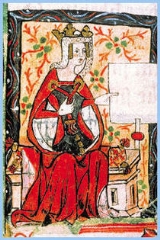
Empress Matilda

Encyclopedia
Empress Matilda also known as Matilda of England or Maude, was the daughter and heir of King Henry I of England
. Matilda and her younger brother, William Adelin
, were the only legitimate children of King Henry to survive to adulthood. William's early death in the White ship disaster
in 1120 made Matilda the last heir from the paternal line of her grandfather William the Conqueror
.
As a child, Matilda was betrothed to and later married Henry V, Holy Roman Emperor
, acquiring the title Empress. The couple had no known children. After being widowed for a few years, she was married to Geoffrey count of Anjou, with whom she had three sons, the eldest of whom became King Henry II of England
.
Matilda was the first female ruler of the Kingdom of England
. The length of her effective rule was brief, however—a few months in 1141. She was never crowned and failed to consolidate her rule (legally and politically). For this reason, she is normally excluded from lists of English monarchs, and her rival (and cousin) Stephen of Blois
is listed as monarch for the period 1135–1154. Their rivalry for the throne led to years of unrest and civil war in England that have been called The Anarchy
. She did secure her inheritance of the Duchy of Normandy
—through the military feats of her husband, Geoffrey—and campaigned unstintingly for her oldest son's inheritance, living to see him ascend the throne of England in 1154.
and his wife Matilda of Scotland (also known as Edith) who survived infancy; her younger brother was William Adelin
.
Her maternal grandparents were Malcolm III of Scotland
and Saint Margaret of Scotland
. Margaret was daughter of Edward the Exile
and granddaughter of Edmund II of England. Most historians believe Matilda was born in Winchester
, but one, John M. Fletcher, argues for the possibility of the royal palace at Sutton (now Sutton Courtenay
) in Berkshire
. Her paternal grandparents were William the Conqueror and Matilda of Flanders
.
; at eight, she was sent to the Holy Roman Empire
(Germany) to begin training for the life of an empress consort
. The eight-year-old Matilda was crowned Queen of the Romans in Mainz
on 25 July 1110. Aged 12, Matilda was made a child bride
as the royal couple were married at Mainz on 7 January 1114. Matilda accompanied Henry on tours to Rome
and Tuscany
. Matilda later acted as regent
, mainly in Italy, in his absence. Emperor Henry died on 23 May 1125. The imperial couple had no surviving offspring, but Herman of Tournai states that Matilda bore a son who lived only a short while.
Matilda returned to England. Henry I then arranged a second marriage for Matilda, to ensure peace between Normandy and Anjou. On 17 June 1128, Matilda, then 26, was married to Geoffrey of Anjou
, then 14. He was also Count of Maine and heir apparent to (his father) the Count of Anjou — whose title he soon acquired, making Matilda Countess of Anjou. It was a title she rarely used. Geoffrey called himself "Plantagenet" from the broom
flower (planta genista) he adopted as his personal emblem. Plantagenet became the dynastic name of the powerful line of English kings descended from Matilda and Geoffrey.
Matilda's marriage with Geoffrey was troubled, with frequent long separations, but they had three sons. The eldest, Henry
, was born on 5 March 1133. In 1134, she almost died in childbirth, following the birth of Geoffrey, Count of Nantes. A third son, William X, Count of Poitou, was born in 1136. She survived her second husband, who died in Sept. 1151.
drowned in the disastrous wreck of the White Ship
, making Matilda the only surviving legitimate child of her father King Henry
. Her cousin Stephen of Blois
was, like her, a grandchild of William (the Conqueror) of Normandy
; but her paternal line meant she was senior to Stephen in the line of succession.
After Matilda returned to England, Henry
named her as his heir to the English throne and Duchy of Normandy
. Henry saw to it that the Anglo-Norman barons, including Stephen
, twice swore to accept Matilda as ruler if Henry died without a male heir of his body.
When her father died in Normandy, on 1 December 1135, Matilda was with Geoffrey in Anjou
, and, crucially, too far away from events rapidly unfolding in England and Normandy. She and Geoffrey were also at odds with her father over border castles. Stephen of Blois rushed to England upon learning of Henry's death and moved quickly to seize the crown from the appointed heir. He was supported by most of the barons and his brother, Henry, bishop of Winchester
, breaking his oath to defend her rights. Matilda, however, contested Stephen in both realms. She and her husband Geoffrey entered Normandy and began military campaigns to claim her inheritance there. Progress was uneven at first, but she persevered. In Normandy, Geoffrey secured all fiefdoms west and south of the Seine
by 1143; in January 1144, he crossed the Seine and took Rouen
without resistance. He assumed the title Duke of Normandy
, and Matilda became Duchess of Normandy. Geoffrey and Matilda held the duchy conjointly until 1149, then ceded it to their son, Henry, which event was soon ratified by King Louis VII of France
. It was not until 1139, however, that Matilda commanded the military strength necessary to challenge Stephen within England.
During the war, Matilda's most loyal and capable supporter was her illegitimate half-brother, Robert, 1st Earl of Gloucester
.
Matilda's greatest triumph came in February 1141, when her forces defeated and captured King Stephen at the Battle of Lincoln
. He was made a prisoner and effectively deposed. Her advantage lasted only a few months. When she arrived in London
, the city was ready to welcome her and support her coronation
. She used the title of Lady of the English and planned to assume the title of queen upon coronation (the custom which was followed by her grandsons, Richard
and John
). However, she refused the citizens' request to halve their taxes and, because of her own arrogance, they closed the city gates to her and reignited the civil war on 24 June 1141.
By November, Stephen was free (exchanged for the captured Robert of Gloucester) and a year later, the tables were turned when Matilda was besieged at Oxford
but escaped to Wallingford, supposedly by fleeing across snow-covered land in a white cape. In 1141, she escaped Devizes
in a similar manner, by disguising herself as a corpse and being carried out for burial.
In 1148, Matilda and Henry returned to Normandy
, following the death of Robert of Gloucester, and the reconquest of Normandy by Geoffrey. Upon their arrival, Geoffrey turned Normandy over to Henry and retired to Anjou
.
, was showing signs of becoming a successful leader. It was 1147 when Henry, aged 14, had accompanied Matilda on an invasion of England. It soon failed due to lack of preparation but it made him determined that England was his mother's right, and so his own. He returned to England again between 1149 and 1150. On 22 May 1149 he was knight
ed by King David I of Scotland
, his great uncle, at Carlisle. Although the civil war had been decided in Stephen's favour, his reign was troubled. In 1153, the death of Stephen's son Eustace
, combined with the arrival of a military expedition led by Henry, led him to acknowledge the latter as his heir by the Treaty of Wallingford
.
Matilda retired to Rouen
in Normandy
during her last years, where she maintained her own court and presided over the government of the duchy
in the absence of Henry. She intervened in the quarrels between her eldest son Henry and her second son Geoffrey, Count of Nantes, but peace between the brothers was brief. Geoffrey rebelled against Henry twice before his sudden death in 1158. Relations between Henry and his youngest brother, William X, Count of Poitou, were more cordial, and William was given vast estates in England. Archbishop
Thomas Becket
refused to allow William to marry the Countess of Surrey and the young man fled to Matilda's court at Rouen. William died there in January 1164, reportedly of disappointment and sorrow. She attempted to mediate in the quarrel between her son Henry and Becket, but was unsuccessful.
Although she gave up hope of being crowned in 1141, her name always preceded that of her son Henry, even after he became king. Matilda died at Notre Dame du Pré near Rouen in 1167 and was buried in the Abbey of Bec-Hellouin, Normandy. Her body was transferred to Rouen Cathedral
in 1847; her epitaph
reads: "Great by Birth, Greater by Marriage, Greatest in her Offspring: Here lies Matilda, the daughter, wife, and mother of Henry."
Indeed, some novels go so far as to posit a love-affair between Matilda and Stephen, e.g. the Janna Mysteries
by Felicity Pulman
, set during the civil war between Stephen and Matilda.
Matilda is a character in Jean Anouilh
's play Becket
. In the 1964 film adaptation she was portrayed by Martita Hunt
. She was also portrayed by Brenda Bruce
in the 1978 BBC
TV series The Devil's Crown
, which dramatised the reigns of her son and grandsons.
Finally, Alison Pill
portrayed her in the 2010 TV miniseries The Pillars of the Earth
, an adaptation of Follett's novel, although she is initially known in this as Princess Maud not Empress Matilda.
Henry I of England
Henry I was the fourth son of William I of England. He succeeded his elder brother William II as King of England in 1100 and defeated his eldest brother, Robert Curthose, to become Duke of Normandy in 1106...
. Matilda and her younger brother, William Adelin
William Adelin
William , surnamed Adelin , was the son of Henry I of England by his wife Matilda of Scotland, and was thus heir-apparent to the throne. His early death without issue caused a succession crisis.William was born in Winchester...
, were the only legitimate children of King Henry to survive to adulthood. William's early death in the White ship disaster
White Ship
The White Ship was a vessel that sank in the English Channel near the Normandy coast off Barfleur, on 25 November 1120. Only one of those aboard survived. Those who drowned included William Adelin, the only surviving legitimate son and heir of King Henry I of England...
in 1120 made Matilda the last heir from the paternal line of her grandfather William the Conqueror
William I of England
William I , also known as William the Conqueror , was the first Norman King of England from Christmas 1066 until his death. He was also Duke of Normandy from 3 July 1035 until his death, under the name William II...
.
As a child, Matilda was betrothed to and later married Henry V, Holy Roman Emperor
Henry V, Holy Roman Emperor
Henry V was King of Germany and Holy Roman Emperor , the fourth and last ruler of the Salian dynasty. Henry's reign coincided with the final phase of the great Investiture Controversy, which had pitted pope against emperor...
, acquiring the title Empress. The couple had no known children. After being widowed for a few years, she was married to Geoffrey count of Anjou, with whom she had three sons, the eldest of whom became King Henry II of England
Henry II of England
Henry II ruled as King of England , Count of Anjou, Count of Maine, Duke of Normandy, Duke of Aquitaine, Duke of Gascony, Count of Nantes, Lord of Ireland and, at various times, controlled parts of Wales, Scotland and western France. Henry, the great-grandson of William the Conqueror, was the...
.
Matilda was the first female ruler of the Kingdom of England
Kingdom of England
The Kingdom of England was, from 927 to 1707, a sovereign state to the northwest of continental Europe. At its height, the Kingdom of England spanned the southern two-thirds of the island of Great Britain and several smaller outlying islands; what today comprises the legal jurisdiction of England...
. The length of her effective rule was brief, however—a few months in 1141. She was never crowned and failed to consolidate her rule (legally and politically). For this reason, she is normally excluded from lists of English monarchs, and her rival (and cousin) Stephen of Blois
Stephen of England
Stephen , often referred to as Stephen of Blois , was a grandson of William the Conqueror. He was King of England from 1135 to his death, and also the Count of Boulogne by right of his wife. Stephen's reign was marked by the Anarchy, a civil war with his cousin and rival, the Empress Matilda...
is listed as monarch for the period 1135–1154. Their rivalry for the throne led to years of unrest and civil war in England that have been called The Anarchy
The Anarchy
The Anarchy or The Nineteen-Year Winter was a period of English history during the reign of King Stephen, which was characterised by civil war and unsettled government...
. She did secure her inheritance of the Duchy of Normandy
Duchy of Normandy
The Duchy of Normandy stems from various Danish, Norwegian, Hiberno-Norse, Orkney Viking and Anglo-Danish invasions of France in the 9th century...
—through the military feats of her husband, Geoffrey—and campaigned unstintingly for her oldest son's inheritance, living to see him ascend the throne of England in 1154.
Early life
Matilda was the elder of the two children born to Henry I of EnglandHenry I of England
Henry I was the fourth son of William I of England. He succeeded his elder brother William II as King of England in 1100 and defeated his eldest brother, Robert Curthose, to become Duke of Normandy in 1106...
and his wife Matilda of Scotland (also known as Edith) who survived infancy; her younger brother was William Adelin
William Adelin
William , surnamed Adelin , was the son of Henry I of England by his wife Matilda of Scotland, and was thus heir-apparent to the throne. His early death without issue caused a succession crisis.William was born in Winchester...
.
Her maternal grandparents were Malcolm III of Scotland
Malcolm III of Scotland
Máel Coluim mac Donnchada , was King of Scots...
and Saint Margaret of Scotland
Saint Margaret of Scotland
Saint Margaret of Scotland , also known as Margaret of Wessex and Queen Margaret of Scotland, was an English princess of the House of Wessex. Born in exile in Hungary, she was the sister of Edgar Ætheling, the short-ruling and uncrowned Anglo-Saxon King of England...
. Margaret was daughter of Edward the Exile
Edward the Exile
Edward the Exile , also called Edward Ætheling, son of King Edmund Ironside and of Ealdgyth. After the Danish conquest of England in 1016 Canute had him and his brother, Edmund, exiled to the Continent...
and granddaughter of Edmund II of England. Most historians believe Matilda was born in Winchester
Winchester
Winchester is a historic cathedral city and former capital city of England. It is the county town of Hampshire, in South East England. The city lies at the heart of the wider City of Winchester, a local government district, and is located at the western end of the South Downs, along the course of...
, but one, John M. Fletcher, argues for the possibility of the royal palace at Sutton (now Sutton Courtenay
Sutton Courtenay
Sutton Courtenay is a village and civil parish on the River Thames south of Abingdon and northwest of Didcot. It was part of Berkshire until the 1974 boundary changes transferred it to Oxfordshire.-Today:...
) in Berkshire
Berkshire
Berkshire is a historic county in the South of England. It is also often referred to as the Royal County of Berkshire because of the presence of the royal residence of Windsor Castle in the county; this usage, which dates to the 19th century at least, was recognised by the Queen in 1957, and...
. Her paternal grandparents were William the Conqueror and Matilda of Flanders
Matilda of Flanders
Matilda of Flanders was the wife of William the Conqueror and, as such, Queen consort of the Kingdom of England. She bore William nine/ten children, including two kings, William II and Henry I.-Marriage:...
.
Marriages
When she was seven years old, Matilda was betrothed to the 23 year old Henry V, Holy Roman EmperorHenry V, Holy Roman Emperor
Henry V was King of Germany and Holy Roman Emperor , the fourth and last ruler of the Salian dynasty. Henry's reign coincided with the final phase of the great Investiture Controversy, which had pitted pope against emperor...
; at eight, she was sent to the Holy Roman Empire
Holy Roman Empire
The Holy Roman Empire was a realm that existed from 962 to 1806 in Central Europe.It was ruled by the Holy Roman Emperor. Its character changed during the Middle Ages and the Early Modern period, when the power of the emperor gradually weakened in favour of the princes...
(Germany) to begin training for the life of an empress consort
Queen consort
A queen consort is the wife of a reigning king. A queen consort usually shares her husband's rank and holds the feminine equivalent of the king's monarchical titles. Historically, queens consort do not share the king regnant's political and military powers. Most queens in history were queens consort...
. The eight-year-old Matilda was crowned Queen of the Romans in Mainz
Mainz
Mainz under the Holy Roman Empire, and previously was a Roman fort city which commanded the west bank of the Rhine and formed part of the northernmost frontier of the Roman Empire...
on 25 July 1110. Aged 12, Matilda was made a child bride
Child marriage
Child marriage and child betrothal customs occur in various times and places, whereby children are given in matrimony - before marriageable age as defined by the commentator and often before puberty. Today such customs are fairly widespread in parts of Africa, Asia, Oceania and South America: in...
as the royal couple were married at Mainz on 7 January 1114. Matilda accompanied Henry on tours to Rome
Rome
Rome is the capital of Italy and the country's largest and most populated city and comune, with over 2.7 million residents in . The city is located in the central-western portion of the Italian Peninsula, on the Tiber River within the Lazio region of Italy.Rome's history spans two and a half...
and Tuscany
Tuscany
Tuscany is a region in Italy. It has an area of about 23,000 square kilometres and a population of about 3.75 million inhabitants. The regional capital is Florence ....
. Matilda later acted as regent
Regent
A regent, from the Latin regens "one who reigns", is a person selected to act as head of state because the ruler is a minor, not present, or debilitated. Currently there are only two ruling Regencies in the world, sovereign Liechtenstein and the Malaysian constitutive state of Terengganu...
, mainly in Italy, in his absence. Emperor Henry died on 23 May 1125. The imperial couple had no surviving offspring, but Herman of Tournai states that Matilda bore a son who lived only a short while.
Matilda returned to England. Henry I then arranged a second marriage for Matilda, to ensure peace between Normandy and Anjou. On 17 June 1128, Matilda, then 26, was married to Geoffrey of Anjou
Geoffrey V, Count of Anjou
Geoffrey V , called the Handsome and Plantagenet, was the Count of Anjou, Touraine, and Maine by inheritance from 1129 and then Duke of Normandy by conquest from 1144...
, then 14. He was also Count of Maine and heir apparent to (his father) the Count of Anjou — whose title he soon acquired, making Matilda Countess of Anjou. It was a title she rarely used. Geoffrey called himself "Plantagenet" from the broom
Broom (shrub)
Brooms are a group of evergreen, semi-evergreen, and deciduous shrubs in the subfamily Faboideae of the legume family Fabaceae, mainly in the three genera Chamaecytisus, Cytisus and Genista, but also in many other small genera . All genera in this group are from the tribe Genisteae...
flower (planta genista) he adopted as his personal emblem. Plantagenet became the dynastic name of the powerful line of English kings descended from Matilda and Geoffrey.
Matilda's marriage with Geoffrey was troubled, with frequent long separations, but they had three sons. The eldest, Henry
Henry II of England
Henry II ruled as King of England , Count of Anjou, Count of Maine, Duke of Normandy, Duke of Aquitaine, Duke of Gascony, Count of Nantes, Lord of Ireland and, at various times, controlled parts of Wales, Scotland and western France. Henry, the great-grandson of William the Conqueror, was the...
, was born on 5 March 1133. In 1134, she almost died in childbirth, following the birth of Geoffrey, Count of Nantes. A third son, William X, Count of Poitou, was born in 1136. She survived her second husband, who died in Sept. 1151.
Struggle for the throne of England
In 1120, her brother William AdelinWilliam Adelin
William , surnamed Adelin , was the son of Henry I of England by his wife Matilda of Scotland, and was thus heir-apparent to the throne. His early death without issue caused a succession crisis.William was born in Winchester...
drowned in the disastrous wreck of the White Ship
White Ship
The White Ship was a vessel that sank in the English Channel near the Normandy coast off Barfleur, on 25 November 1120. Only one of those aboard survived. Those who drowned included William Adelin, the only surviving legitimate son and heir of King Henry I of England...
, making Matilda the only surviving legitimate child of her father King Henry
Henry I of England
Henry I was the fourth son of William I of England. He succeeded his elder brother William II as King of England in 1100 and defeated his eldest brother, Robert Curthose, to become Duke of Normandy in 1106...
. Her cousin Stephen of Blois
Stephen of England
Stephen , often referred to as Stephen of Blois , was a grandson of William the Conqueror. He was King of England from 1135 to his death, and also the Count of Boulogne by right of his wife. Stephen's reign was marked by the Anarchy, a civil war with his cousin and rival, the Empress Matilda...
was, like her, a grandchild of William (the Conqueror) of Normandy
William I of England
William I , also known as William the Conqueror , was the first Norman King of England from Christmas 1066 until his death. He was also Duke of Normandy from 3 July 1035 until his death, under the name William II...
; but her paternal line meant she was senior to Stephen in the line of succession.
After Matilda returned to England, Henry
Henry I of England
Henry I was the fourth son of William I of England. He succeeded his elder brother William II as King of England in 1100 and defeated his eldest brother, Robert Curthose, to become Duke of Normandy in 1106...
named her as his heir to the English throne and Duchy of Normandy
Duchy of Normandy
The Duchy of Normandy stems from various Danish, Norwegian, Hiberno-Norse, Orkney Viking and Anglo-Danish invasions of France in the 9th century...
. Henry saw to it that the Anglo-Norman barons, including Stephen
Stephen of England
Stephen , often referred to as Stephen of Blois , was a grandson of William the Conqueror. He was King of England from 1135 to his death, and also the Count of Boulogne by right of his wife. Stephen's reign was marked by the Anarchy, a civil war with his cousin and rival, the Empress Matilda...
, twice swore to accept Matilda as ruler if Henry died without a male heir of his body.
When her father died in Normandy, on 1 December 1135, Matilda was with Geoffrey in Anjou
Anjou
Anjou is a former county , duchy and province centred on the city of Angers in the lower Loire Valley of western France. It corresponds largely to the present-day département of Maine-et-Loire...
, and, crucially, too far away from events rapidly unfolding in England and Normandy. She and Geoffrey were also at odds with her father over border castles. Stephen of Blois rushed to England upon learning of Henry's death and moved quickly to seize the crown from the appointed heir. He was supported by most of the barons and his brother, Henry, bishop of Winchester
Henry of Blois
Henry of Blois , often known as Henry of Winchester, was Abbot of Glastonbury Abbey from 1126, and Bishop of Winchester from 1129 to his death.-Early life and education:...
, breaking his oath to defend her rights. Matilda, however, contested Stephen in both realms. She and her husband Geoffrey entered Normandy and began military campaigns to claim her inheritance there. Progress was uneven at first, but she persevered. In Normandy, Geoffrey secured all fiefdoms west and south of the Seine
Seine
The Seine is a -long river and an important commercial waterway within the Paris Basin in the north of France. It rises at Saint-Seine near Dijon in northeastern France in the Langres plateau, flowing through Paris and into the English Channel at Le Havre . It is navigable by ocean-going vessels...
by 1143; in January 1144, he crossed the Seine and took Rouen
Rouen
Rouen , in northern France on the River Seine, is the capital of the Haute-Normandie region and the historic capital city of Normandy. Once one of the largest and most prosperous cities of medieval Europe , it was the seat of the Exchequer of Normandy in the Middle Ages...
without resistance. He assumed the title Duke of Normandy
Duke of Normandy
The Duke of Normandy is the title of the reigning monarch of the British Crown Dependancies of the Bailiwick of Guernsey and the Bailiwick of Jersey. The title traces its roots to the Duchy of Normandy . Whether the reigning sovereign is a male or female, they are always titled as the "Duke of...
, and Matilda became Duchess of Normandy. Geoffrey and Matilda held the duchy conjointly until 1149, then ceded it to their son, Henry, which event was soon ratified by King Louis VII of France
Louis VII of France
Louis VII was King of France, the son and successor of Louis VI . He ruled from 1137 until his death. He was a member of the House of Capet. His reign was dominated by feudal struggles , and saw the beginning of the long rivalry between France and England...
. It was not until 1139, however, that Matilda commanded the military strength necessary to challenge Stephen within England.
During the war, Matilda's most loyal and capable supporter was her illegitimate half-brother, Robert, 1st Earl of Gloucester
Robert, 1st Earl of Gloucester
Robert Fitzroy, 1st Earl of Gloucester was an illegitimate son of King Henry I of England. He was called "Rufus" and occasionally "de Caen", he is also known as Robert "the Consul"...
.
Matilda's greatest triumph came in February 1141, when her forces defeated and captured King Stephen at the Battle of Lincoln
Battle of Lincoln (1141)
The Battle of Lincoln or First Battle of Lincoln occurred on 2 February 1141. In it Stephen of England was captured, imprisoned and effectively deposed while Empress Matilda ruled for a short time.-Account:...
. He was made a prisoner and effectively deposed. Her advantage lasted only a few months. When she arrived in London
London
London is the capital city of :England and the :United Kingdom, the largest metropolitan area in the United Kingdom, and the largest urban zone in the European Union by most measures. Located on the River Thames, London has been a major settlement for two millennia, its history going back to its...
, the city was ready to welcome her and support her coronation
Coronation
A coronation is a ceremony marking the formal investiture of a monarch and/or their consort with regal power, usually involving the placement of a crown upon their head and the presentation of other items of regalia...
. She used the title of Lady of the English and planned to assume the title of queen upon coronation (the custom which was followed by her grandsons, Richard
Richard I of England
Richard I was King of England from 6 July 1189 until his death. He also ruled as Duke of Normandy, Duke of Aquitaine, Duke of Gascony, Lord of Cyprus, Count of Anjou, Count of Maine, Count of Nantes, and Overlord of Brittany at various times during the same period...
and John
John of England
John , also known as John Lackland , was King of England from 6 April 1199 until his death...
). However, she refused the citizens' request to halve their taxes and, because of her own arrogance, they closed the city gates to her and reignited the civil war on 24 June 1141.
By November, Stephen was free (exchanged for the captured Robert of Gloucester) and a year later, the tables were turned when Matilda was besieged at Oxford
Oxford
The city of Oxford is the county town of Oxfordshire, England. The city, made prominent by its medieval university, has a population of just under 165,000, with 153,900 living within the district boundary. It lies about 50 miles north-west of London. The rivers Cherwell and Thames run through...
but escaped to Wallingford, supposedly by fleeing across snow-covered land in a white cape. In 1141, she escaped Devizes
Devizes
Devizes is a market town and civil parish in Wiltshire, England. The town is about southeast of Chippenham and about east of Trowbridge.Devizes serves as a centre for banks, solicitors and shops, with a large open market place where a market is held once a week...
in a similar manner, by disguising herself as a corpse and being carried out for burial.
In 1148, Matilda and Henry returned to Normandy
Normandy
Normandy is a geographical region corresponding to the former Duchy of Normandy. It is in France.The continental territory covers 30,627 km² and forms the preponderant part of Normandy and roughly 5% of the territory of France. It is divided for administrative purposes into two régions:...
, following the death of Robert of Gloucester, and the reconquest of Normandy by Geoffrey. Upon their arrival, Geoffrey turned Normandy over to Henry and retired to Anjou
Anjou
Anjou is a former county , duchy and province centred on the city of Angers in the lower Loire Valley of western France. It corresponds largely to the present-day département of Maine-et-Loire...
.
Later life
Matilda's first son, HenryHenry II of England
Henry II ruled as King of England , Count of Anjou, Count of Maine, Duke of Normandy, Duke of Aquitaine, Duke of Gascony, Count of Nantes, Lord of Ireland and, at various times, controlled parts of Wales, Scotland and western France. Henry, the great-grandson of William the Conqueror, was the...
, was showing signs of becoming a successful leader. It was 1147 when Henry, aged 14, had accompanied Matilda on an invasion of England. It soon failed due to lack of preparation but it made him determined that England was his mother's right, and so his own. He returned to England again between 1149 and 1150. On 22 May 1149 he was knight
Knight
A knight was a member of a class of lower nobility in the High Middle Ages.By the Late Middle Ages, the rank had become associated with the ideals of chivalry, a code of conduct for the perfect courtly Christian warrior....
ed by King David I of Scotland
David I of Scotland
David I or Dabíd mac Maíl Choluim was a 12th-century ruler who was Prince of the Cumbrians and later King of the Scots...
, his great uncle, at Carlisle. Although the civil war had been decided in Stephen's favour, his reign was troubled. In 1153, the death of Stephen's son Eustace
Eustace IV of Boulogne
Eustace IV was a Count of Boulogne and the son and heir of King Stephen of England. He became the Heir Apparent to his father's lands by the death of an elder brother before 1135, and inherited Boulogne through his mother, Matilda of Boulogne.In 1137, he did homage for Normandy to Louis VII of...
, combined with the arrival of a military expedition led by Henry, led him to acknowledge the latter as his heir by the Treaty of Wallingford
Treaty of Wallingford
The Treaty of Wallingford of 1153, aka Treaty of Winchester or as the Treaty of Westminster, was an agreement that effectively ended the civil war known as the Anarchy, caused by a dispute between Empress Matilda and her cousin King Stephen of England over the English crown...
.
Matilda retired to Rouen
Rouen
Rouen , in northern France on the River Seine, is the capital of the Haute-Normandie region and the historic capital city of Normandy. Once one of the largest and most prosperous cities of medieval Europe , it was the seat of the Exchequer of Normandy in the Middle Ages...
in Normandy
Normandy
Normandy is a geographical region corresponding to the former Duchy of Normandy. It is in France.The continental territory covers 30,627 km² and forms the preponderant part of Normandy and roughly 5% of the territory of France. It is divided for administrative purposes into two régions:...
during her last years, where she maintained her own court and presided over the government of the duchy
Duchy
A duchy is a territory, fief, or domain ruled by a duke or duchess.Some duchies were sovereign in areas that would become unified realms only during the Modern era . In contrast, others were subordinate districts of those kingdoms that unified either partially or completely during the Medieval era...
in the absence of Henry. She intervened in the quarrels between her eldest son Henry and her second son Geoffrey, Count of Nantes, but peace between the brothers was brief. Geoffrey rebelled against Henry twice before his sudden death in 1158. Relations between Henry and his youngest brother, William X, Count of Poitou, were more cordial, and William was given vast estates in England. Archbishop
Archbishop
An archbishop is a bishop of higher rank, but not of higher sacramental order above that of the three orders of deacon, priest , and bishop...
Thomas Becket
Thomas Becket
Thomas Becket was Archbishop of Canterbury from 1162 until his murder in 1170. He is venerated as a saint and martyr by both the Roman Catholic Church and the Anglican Communion...
refused to allow William to marry the Countess of Surrey and the young man fled to Matilda's court at Rouen. William died there in January 1164, reportedly of disappointment and sorrow. She attempted to mediate in the quarrel between her son Henry and Becket, but was unsuccessful.
Although she gave up hope of being crowned in 1141, her name always preceded that of her son Henry, even after he became king. Matilda died at Notre Dame du Pré near Rouen in 1167 and was buried in the Abbey of Bec-Hellouin, Normandy. Her body was transferred to Rouen Cathedral
Rouen Cathedral
Rouen Cathedral is a Roman Catholic Gothic cathedral in Rouen, in northwestern France. It is the seat of the Archbishop of Rouen and Normandy.-History:...
in 1847; her epitaph
Epitaph
An epitaph is a short text honoring a deceased person, strictly speaking that is inscribed on their tombstone or plaque, but also used figuratively. Some are specified by the dead person beforehand, others chosen by those responsible for the burial...
reads: "Great by Birth, Greater by Marriage, Greatest in her Offspring: Here lies Matilda, the daughter, wife, and mother of Henry."
Historical fiction
The civil war between supporters of Stephen and the supporters of Matilda has proven popular as a subject in historical fiction. Novels dealing with it include:- Graham ShelbyGraham ShelbyGraham Shelby is a British historical novelist. He worked as a copywriter and book-reviewer before embarking on a series of historical novels, mainly set in the twelfth century.-List of works:...
, The Villains of the Piece (1972) (published in the US as The Oath and the Sword) - The Brother Cadfael series by Ellis PetersEdith PargeterEdith Mary Pargeter, OBE, BEM , also known by her nom de plume Ellis Peters, was a British author of works in many categories, especially history and historical fiction, and was also honoured for her translations of Czech classics; she is probably best known for her murder mysteries, both...
, and the TV series made from them starring Sir Derek JacobiDerek JacobiSir Derek George Jacobi, CBE is an English actor and film director.A "forceful, commanding stage presence", Jacobi has enjoyed a highly successful stage career, appearing in such stage productions as Hamlet, Uncle Vanya, and Oedipus the King. He received a Tony Award for his performance in... - Jean Plaidy, The Passionate Enemies, the third book of her Norman Trilogy
- Sharon Penman, When Christ and His Saints Slept tells the story of the events before, during and after the civil war
- Haley Elizabeth Garwood, Forgotten Queen (1997)
- Ken FollettKen FollettKen Follett is a Welsh author of thrillers and historical novels. He has sold more than 100 million copies of his works. Four of his books have reached the number 1 ranking on the New York Times best-seller list: The Key to Rebecca, Lie Down with Lions, Triple, and World Without End.-Early...
, The Pillars of the EarthThe Pillars of the EarthThe Pillars of the Earth is a historical novel by Ken Follett published in 1989 about the building of a cathedral in the fictional town of Kingsbridge, England. It is set in the middle of the 12th century, primarily during the Anarchy, between the time of the sinking of the White Ship and the... - E. L. KonigsburgE. L. KonigsburgElaine Lobl Konigsburg is an American author and illustrator of children's books and young adult fiction. She is one of five authors to win two Newbery Medals, awarded annually for one contribution to American children's literature.Her first two manuscripts were submitted to editor Jean E...
, A Proud Taste for Scarlet and Miniver - Joan WolfJoan WolfJoan Wolf is an American writer of romance novels.Wolf grew up in the Bronx, New York. She obtained a Bachelor's degree in Mercy College and Master in English and Comparative Literature in Hunter College.-Single novels:...
, No Dark Place and The Poisoned Serpent are medieval romantic mysteries about supporters of both Stephen and Matilda - Ellen Jones, The Fatal Crown (highly inaccurate)
- Juliet Dymoke, The Lion's Legacy (Being part of a trilogy, the first being, Of The Ring Of Earls, the second, Henry Of The High Rock)
- Elizabeth Chadwick, "Lady of the English" (2011)
Indeed, some novels go so far as to posit a love-affair between Matilda and Stephen, e.g. the Janna Mysteries
The Janna Mysteries
The Janna Mysteries is a novel series by Felicity Pulman follow Janna and her quest to find her father in order to seek vengeance for the death of her mother...
by Felicity Pulman
Felicity Pulman
Felicity Pulman is an Australian author with an interest in crime, history and fantasy. Her novels Ghost Boy and the Shalott trilogy reflect her fascination with such possibilities as knowledge travelling through time, ghosts, parallel realities and reincarnation...
, set during the civil war between Stephen and Matilda.
Matilda is a character in Jean Anouilh
Jean Anouilh
Jean Marie Lucien Pierre Anouilh was a French dramatist whose career spanned five decades. Though his work ranged from high drama to absurdist farce, Anouilh is best known for his 1943 play Antigone, an adaptation of Sophocles' Classical drama, that was seen as an attack on Marshal Pétain's...
's play Becket
Becket
Becket or The Honor of God is a play written in French by Jean Anouilh. It is a depiction of the conflict between Thomas Becket and King Henry II of England leading to Becket's murder in 1170. It contains many historical inaccuracies, which the author acknowledged.-Background:Anouilh's...
. In the 1964 film adaptation she was portrayed by Martita Hunt
Martita Hunt
Martita Hunt was an English theatre and film actress.-Early life:Hunt was born in Buenos Aires, Argentina on 30 January 1900 to British parents Alfred and Marta Hunt...
. She was also portrayed by Brenda Bruce
Brenda Bruce
Brenda Bruce was a British actress. She had a long and successful career in the theatre, radio, film, and television.-Early life:Brenda Bruce was born in Manchester...
in the 1978 BBC
BBC
The British Broadcasting Corporation is a British public service broadcaster. Its headquarters is at Broadcasting House in the City of Westminster, London. It is the largest broadcaster in the world, with about 23,000 staff...
TV series The Devil's Crown
The Devil's Crown
The Devil's Crown was a BBC television series which dramatised the reigns of three medieval Kings of England: Henry II and his sons Richard I and John....
, which dramatised the reigns of her son and grandsons.
Finally, Alison Pill
Alison Pill
Alison Courtney Pill is a Canadian actress best known from her roles in Milk, Scott Pilgrim vs. the World and Midnight in Paris.-Life and career:...
portrayed her in the 2010 TV miniseries The Pillars of the Earth
The Pillars of the Earth (TV miniseries)
The Pillars of the Earth is an eight part 2010 TV miniseries, adapted from Ken Follett's novel of the same name. It debuted in the U.S. on Starz and Canada on The Movie Network/Movie Central on July 23, 2010. Its UK premiere was on Channel 4 in October 2010 at 9pm...
, an adaptation of Follett's novel, although she is initially known in this as Princess Maud not Empress Matilda.
See also
- Gervase of CanterburyGervase of CanterburyGervase of Canterbury was an English chronicler.- Life :...
- Gesta Stephani
- Robert of TorigniRobert of TorigniRobert of Torigni was a Norman monk and chronicler. He was born at Torigni-sur-Vire in central Normandy, at an unknown date. He entered the monastery of Le Bec in 1128 and became prior there about 1149. He was elected abbot of Mont-Saint-Michel in 1154, and served there until his death.Robert was...
- Roger of HovedenRoger of HovedenRoger of Hoveden, or Howden , was a 12th-century English chronicler.From Hoveden's name and the internal evidence of his work, he is believed to have been a native of Howden in East Yorkshire. Nothing is known of him before the year 1174. He was then in attendance upon Henry II, by whom he was sent...
- Walter MapWalter MapWalter Map was a medieval writer of works written in Latin. Only one work is attributed to Map with any certainty: De Nugis Curialium.-Life:...
Sources
- Bradbury, J. (1996) Stephen and Matilda: the Civil War of 1139-1153, Sutton Publishing, ISBN 075090612X
- Chibnall,Marjorie (1991) The Empress Matilda:Queen Consort, Queen Mother, and Lady of the English
- Fletcher, John (1990) Sutton Courtenay: The History of a Thameside Village
- Gardener J and Wenborn W the History Today Companion to British History
- Pain, Nesta (1978) Empress Matilda: Uncrowned Queen of England
- Parsons, John Carmi. Medieval Mothering (New Middle Ages), sub. Marjorie Chibnall, "Empress Matilda and Her Sons"