


Giovanni Pico della Mirandola

Encyclopedia
Count
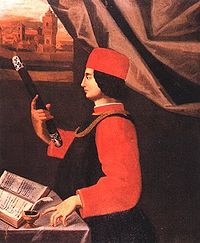
Giovanni Pico della Mirandola (24 February 1463 – 17 November 1494) was an Italian
Renaissance
philosopher. He is famed for the events of 1486, when at the age of 23, he proposed to defend 900 theses on religion
, philosophy
, natural philosophy
and magic
against all comers, for which he wrote the famous Oration on the Dignity of Man
, which has been called the "Manifesto of the Renaissance", and a key text of Renaissance humanism
and of what has been called the “Hermetic Reformation."
, near Modena
, the youngest son of Francesco I, Lord of Mirandola
and Count of Concordia
(1415–1467), by his wife Giulia, daughter of Feltrino Boiardo
, Count di Scandiano
. The family had long dwelt in the Castle of Mirandola (Duchy of Modena), which had become independent in the fourteenth century and had received in 1414 from the Emperor Sigismund the fief of Concordia. Mirandola was a small autonomous county (later, a duchy) in Emilia
, near Ferrara
. The Pico della Mirandola were closely related to the Sforza, Gonzaga
and Este
dynasties, and Giovanni's siblings wed the scions of the hereditary rulers of Corsica
, Ferrara, Bologna
and Forlì
.
Born twenty-three years into his parents' marriage, Giovanni had two much older brothers, both of whom outlived him: Count Galeotto I (1442–1499) continued the dynasty, while Antonio (1444–1501) became a general in the Imperial
army. The Pico family would reign
as duke
s until Mirandola, an ally of Louis XIV of France
, was conquered by his rival, Joseph I, Holy Roman Emperor
, in 1708 and annexed
to Modena by Duke Rinaldo d'Este, the exiled male line
becoming extinct in 1747.
Giovanni's maternal family was singularly distinguished in the arts and scholarship of the Italian Renaissance
. His cousin and contemporary was the poet Matteo Maria Boiardo
, who grew up under the influence of his own uncle, the Florentine patron of the arts
and scholar-poet, Tito Vespasiano Strozzi.
, Giovanni was schooled in Latin
, and possibly Greek, at a very early age. Intended for the Church
by his mother, he was named a papal protonotary at the age of ten and in 1477 he went to Bologna
to study canon law
.
At the sudden death of his mother three years later, Pico renounced canon law and began to study philosophy at the University of Ferrara
. During a brief
trip to Florence, he met Angelo Poliziano, the courtly poet Girolamo Benivieni
, and probably the young Dominican monk Girolamo Savonarola
. For the rest of his life he remained very close friends with all three, including the ascetic and violently anti-humanist
Savonarola.
 From 1480 to 1482, he continued his studies at the University of Padua
, a major center of Aristotelianism
in Italy. Already proficient in Latin
and Greek, he studied Hebrew
and Arabic
in Padua
with Elia del Medigo
, a Jewish Averroist, and read Aramaic
manuscripts with him as well. Del Medigo also translated Judaic manuscripts
from Hebrew into Latin for Pico, as he would continue to do for a number of years. Pico also wrote sonnet
s in Latin and Italian, which because of the influence of Savonarola, he destroyed at the end of his life.
He spent the next four years either at home, or visiting humanist
centres elsewhere in Italy. In 1485 he travelled to the University of Paris
, the most important centre in the whole of Europe for Scholastic
philosophy and theology, and a hotbed of secular Averroism
. It was probably in Paris that Giovanni began his 900 Theses and conceived the idea of defending them in public debate.
During this time two life-changing events occurred. The first was when he returned to settle for a time in Florence
in November 1484 and met Lorenzo de' Medici
and Marsilio Ficino
, on the astrologically
auspicious day Ficino had chosen to publish his translations of the works of Plato
from Greek into Latin
under Lorenzo’s enthusiastic patronage. Giovanni appears to have charmed both men immensely, with Ficino endeared, despite continuing philosophical differences, convinced of their Saturn
ine affinity and the divine provenance of his arrival. Until his death in 1492 Lorenzo supported and protected Giovanni. Without Lorenzo's support it is doubtful that Pico would have survived even the 10 more years that he did.
Soon after this stay in Florence, Pico was travelling on his way to Rome where he intended to publish his 900 Theses and prepare for a “Congress” of scholars from all over Europe to debate them. Stopping in Arezzo
he became embroiled in a love affair with the wife of one of Lorenzo de’ Medici’s cousins. It almost cost him his life. Giovanni attempted to run off with the woman, but he was caught, wounded and thrown into prison by her husband. He was released only upon the intervention of Lorenzo himself. The incident is wholly representative of Pico's often audacious temperament and of the loyalty and affection he nevertheless could inspire.
Pico spent several months in Perugia
and nearby Fratta, recovering from his injuries. It was there, as he wrote to Ficino, that "divine Providence [...] caused certain books to fall into my hands. They are Chaldean
books [...] of Esdras
, of Zoroaster
and of Melchior
, oracles of the magi, which contain a brief and dry interpretation of Chaldean philosophy, but full of mystery." It was also in Perugia that Pico was introduced to the mystical Hebrew Kabbalah
, which fascinated him, as did the late Classical
Hermetic
writers, such as Hermes Trismegistus
. The Kabbalah
and the Hermetica
were thought in Pico's time to be as ancient as the Old Testament, and for that reason, he accorded them an almost scriptural status. It was always Pico's intention to walk completely around a topic and look at it from many possible angles, in order to derive the truest possible vision of the thing itself. Syncretism
, for Pico, was seeing the same absolute from many different points of view, a Scholastic approach with a strong modern resonance.
Pico based his ideas chiefly on Plato
, as did his teacher, Marsilio Ficino
, but retained a deep respect for Aristotle
. Although he was a product of the studia humanitatis, Pico was constitutionally an eclectic
, and in some respects he represented a reaction against the exaggerations of pure humanism
, defending what he believed to be the best of the medieval
and Islam
ic commentators (see Averroes
, Avicenna
) on Aristotle
in a famous long letter to Ermolao Barbaro
in 1485. It was always Pico’s aim to reconcile the schools of Plato
and Aristotle
, since he believed they both used different words to express the same concepts. It was perhaps for this reason his friends called him "Princeps Concordiae, or "Prince of Harmony" (a pun on Prince of Concordia, one of his family’s holdings.) Similarly, Pico believed an educated person should also study the Hebrew and Talmudic sources, and the Hermetics
, because he believed they represented the same view seen in the Old Testament
, in different words, of God.
He finished his Oration on the Dignity of Man
to accompany his 900 Theses and traveled to Rome to continue his plan to defend them. He had them published in December 1486 (Conclusiones philosophicae, cabalasticae et theologicae, Rome, 1486) and offered to pay the expenses of any scholars who came to Rome to debate them publicly.
In February 1487, Pope Innocent VIII
halted the proposed debate, and established a commission to review the orthodoxy of the Theses. Although Pico answered the charges against them, thirteen of the Theses were condemned. Pico agreed in writing to retract them, but he did not change his mind about their validity, and proceeded to write an Apologia ("Apologia J. Pici Mirandolani, Concordiae comitis" published in 1489) defending them, dedicated to Lorenzo. When the Pope was apprised of the circulation of this manuscript, he set up an inquisitorial tribunal, forcing Pico to renounce the Apologia as well which he also agreed to do.
Nevertheless, the Pope declared his Theses unorthodox
calling them "in part heretical, in part the flower of heresy
; several are scandal
ous and offensive to pious ears; most do nothing but reproduce the errors of pagan
philosophers...others are capable of inflaming the impertinence of the Jews
; a number of them, finally, under the pretext
of "natural philosophy
", favor arts that are enemies to the Catholic
faith and to the human race." One of Pico’s detractors maintained that "Kabbala" was the name of an impious writer against Jesus Christ.
Pico fled to France in 1488, where he was arrested by Philip II of Savoy
, at the demand of the papal nuncio
s, and imprisoned at Vincennes
. Through the intercession
of several Italian princes—all instigated by Lorenzo de' Medici
—King Charles VIII
had him released, and the Pope was persuaded to allow Pico to move to Florence and to live under Lorenzo’s protection. But he was not cleared of the papal censures and restrictions until 1493, after the accession of Alexander VI (Rodrigo Borgia) to the papacy.
Pico was deeply shaken by the experience. He reconciled with Savonarola, who remained a very close friend. It was at Pico’s persuasion that Lorenzo invited Savonarola to Florence. But Pico never renounced his syncretist
convictions.
He settled in a villa near Fiesole
prepared for him by Lorenzo, where he wrote and published the Heptaplus id est de Dei creatoris opere (1489) and De Ente et Uno (Of Being and Unity, 1491). It was here that he also wrote his other most celebrated work, the Disputationes adversus astrologiam divinicatrium (Treatise Against Astrology), which was not published until after his death. Traditionally, scholars have viewed this work as a comdemnation of the practices of the astrologer
s of his day, and shredded the intellectual basis of astrology
itself, a view held by the editor of the two-volume work, Eugenio Garin, and supported by the title. However, it should be noted that Pico did not apply this title to his work, but rather it was added posthumously by his cousin and physician, who jointly edited it. More recent scholarship, such as that of Scott E. Hendrix, based on a close reading of the text, has called this traditional understanding into question. While it is true that Pico was interested in high magic that enhanced man's dignity
and strengthened his will and rejected any form of astrological determinism
, he did not question the commonly-held notion that celestial bodies influenced terrestrial events. Nor did he reject the possibility that one might make astrological predictions about the future, so long as it was understood that such predictions represented likelihoods or possibilities rather than absolute determinations about events to come.
After the death of Lorenzo de' Medici
, in 1492, Pico moved to Ferrara
, although he continued to visit Florence. In Florence, political instability gave rise to the increasing influence of Savonarola, whose reactionary opposition to Renaissance expansion and style had already brought about conflict with the Medici
family (they eventually were expelled from Florence) and would lead to the wholesale destruction of books and paintings. Nevertheless, Pico became a follower of Savonarola. Determined to become a monk, he dismissed his former interest in Egyptian and Chaldean texts, destroyed his own poetry and gave away his fortune.
Pico died under very mysterious circumstances in 1494. It was rumored that his own secretary had poison
ed him, because Pico had become too close to Savonarola. He was interred at San Marco and Savonarola delivered the funeral
oration. Ficino
wrote: “Our dear Pico left us on the same day that Charles VIII was entering Florence, and the tears of men of letters compensated for the joy of the people. Without the light brought by the king of France, Florence might perhaps have never seen a more somber day than that which extinguished Mirandola’s light.”
In 2007, the bodies of Poliziano
and Pico della Mirandola were exhumed from St. Mark's Basilica in Florence. Scientists under the supervision of Giorgio Gruppioni, a professor of anthropology
from Bologna
, will use current testing techniques to study the men's lives and establish the causes of their deaths. A TV documentary is being made of this research,
and it was recently announced that these forensic tests showed that both Poliziano and Pico likely died of arsenic poisoning, probably at the order of Lorenzo's successor, Piero de' Medici.
, 1486), Pico justified the importance of the human quest for knowledge within a Neoplatonic framework.
The Oration also served as an introduction to Pico's 900 theses, which he believed to provide a complete and sufficient basis for the discovery of all knowledge, and hence a model for mankind's ascent of the chain of being. The 900 Theses are a good example of humanist syncretism
, because Pico combined Platonism
, Neoplatonism
, Aristotelianism
, Hermeticism
and Kabbalah
. They also included 72 theses describing what Pico believed to be a complete system of physics.
Mirandola's De animae immortalitate (Paris, 1541), and other works developed the view that man's possession of an immortal soul freed him from the hierarchical stasis. Pico may have believed in either universal reconciliation
since one of his 900 theses was "A mortal sin of finite duration is not deserving of eternal but only of temporal punishment;" it was among the theses pronounced heretical by Pope Innocent VIII in his bull of Aug. 4, 1487. In the Oration he writes that "human vocation is a mystical vocation that has to be realized following a three stage way, which comprehends necessarily moral transformation, intellectual research and final perfection in the identity with the absolute reality. This paradigm is universal, because it can be retraced in every tradition."
A portion of his Disputationes adversus astrologiam divinatricem was published in Bologna after his death. In this book Pico presents arguments against the practice of astrology
that have had enormous resonance for centuries, up to our own time. Disputationes is influenced by the arguments against astrology espoused by one of his intellectual heroes, St. Augustine of Hippo, and also by ideas held by his teacher, Marsilio Ficino
, who may have encouraged him to write it. Pico’s antagonism to astrology seems to derive mainly from the conflict of astrology with Christian notions of free will. But Pico’s arguments moved beyond the objections of Ficino (who was himself an astrologer). The manuscript was edited for publication after Pico’s death by his nephew, an ardent follower of Savonarola, and may possibly have been amended to be more forcefully critical. This might possibly explain the fact that Ficino championed the manuscript and enthusiastically endorsed it before its publication.
Pico’s Heptaplus, a mystico-allegorical exposition of the creation according to the seven Biblical senses, elaborates on his idea that different religions and traditions describe the same God. De ente et uno, has explanations of several passages in Moses
, Plato and Aristotle.
He wrote in Italian an imitation of Plato's Symposium. His letters (Aureae ad familiares epistolae, Paris, 1499) are important for the history of contemporary thought. The many editions of his entire works in the sixteenth century sufficiently prove his influence.
Another notorious text by Giovanni Pico della Mirandola is De omnibus rebus et de quibusdam aliis, "of all things that exist and a little more" which is mentioned in some entries on Thomas More's Utopia and makes fun of the title of Lucretius' "De Rerum Natura".
's Ulysses
, the precocious Stephen Dedalus
recalls with disdain his boyhood ambitions, and apparently associates them with the career of Mirandola: "Remember your epiphanies written on green oval leaves, deeply deep...copies to be sent if you died to all the great libraries of the world...Pico della Mirandola like."
Of minor interest is a passing reference to Mirandola by H. P. Lovecraft
, in the story The Case of Charles Dexter Ward
(1927). Mirandola is given as the source of the fearsome incantation used by unknown evil entities as some sort of evocation. However, this "spell" was first depicted (as the key to a rather simple form of divination, not a great and terrible summoning) by, and in all likelihood created by, Heinrich Cornelius Agrippa von Nettesheim in his Three Books of Occult Philosophy. This was written several decades after Mirandola's death and was the first written example of that "spell", so it is almost impossible for Mirandola to have been the source of those "magic words".
Psychologist, Otto Rank
, a rebellious disciple of Sigmund Freud
, chose a substantial excerpt from Mirandola's Oration on the Dignity of Man
as the motto for his book Art and Artist: Creative Urge and Personality Development, including: "...I created thee as a being neither celestial nor earthly... so that thou shouldst be thy own free moulder and overcomer...".
In Umberto Eco
's novel Foucault's Pendulum
the protagonist Casaubon claims that the idea that the Jews were privy to the enigma of the Templars was "a mistake of Pico Della Mirandola" caused by a spelling mistake he made between "Israelites" and "Ismaelites."
Philosopher of social science René Girard
mentions Mirandola passingly in his book Des choses cachées depuis la fondation du monde Things hidden since the foundation of the world, Girard writes in a disparaging tone, "People will accuse us of playing at being Pico della Mirandola-the renaissance man-certainly a temptation to be resisted today, if we wish to be seen in a favourable light." (p. 141, 1987)
In Roberto Bolaño
's novel 2666, the philosophy professor Oscar Amalfitano begins his three-columned list of philosophers with Pico della Mirandola. Adjacent to Mirandola, Amalfitano writes Hobbes, while beneath him he writes Husserl (p. 207, 2008).
In Frédéric Lenoir's novel "L'Oracle della Luna" (2006) the philosophy of Pico della Mirandola forms one of the major teachings acquired by the protagonist, Giovanni, from his main spiritual Master. The year is 1530. The major mentions are:
Count
A count or countess is an aristocratic nobleman in European countries. The word count came into English from the French comte, itself from Latin comes—in its accusative comitem—meaning "companion", and later "companion of the emperor, delegate of the emperor". The adjective form of the word is...
Giovanni Pico della Mirandola (24 February 1463 – 17 November 1494) was an Italian
Italy
Italy , officially the Italian Republic languages]] under the European Charter for Regional or Minority Languages. In each of these, Italy's official name is as follows:;;;;;;;;), is a unitary parliamentary republic in South-Central Europe. To the north it borders France, Switzerland, Austria and...
Renaissance
Renaissance
The Renaissance was a cultural movement that spanned roughly the 14th to the 17th century, beginning in Italy in the Late Middle Ages and later spreading to the rest of Europe. The term is also used more loosely to refer to the historical era, but since the changes of the Renaissance were not...
philosopher. He is famed for the events of 1486, when at the age of 23, he proposed to defend 900 theses on religion
Religion
Religion is a collection of cultural systems, belief systems, and worldviews that establishes symbols that relate humanity to spirituality and, sometimes, to moral values. Many religions have narratives, symbols, traditions and sacred histories that are intended to give meaning to life or to...
, philosophy
Philosophy
Philosophy is the study of general and fundamental problems, such as those connected with existence, knowledge, values, reason, mind, and language. Philosophy is distinguished from other ways of addressing such problems by its critical, generally systematic approach and its reliance on rational...
, natural philosophy
Natural philosophy
Natural philosophy or the philosophy of nature , is a term applied to the study of nature and the physical universe that was dominant before the development of modern science...
and magic
Magic (paranormal)
Magic is the claimed art of manipulating aspects of reality either by supernatural means or through knowledge of occult laws unknown to science. It is in contrast to science, in that science does not accept anything not subject to either direct or indirect observation, and subject to logical...
against all comers, for which he wrote the famous Oration on the Dignity of Man
Oration on the Dignity of Man
The Oration on the Dignity of Man is a famous public discourse pronounced in 1486 by Pico della Mirandola, a philosopher of the Renaissance. It has been called the "Manifesto of the Renaissance"....
, which has been called the "Manifesto of the Renaissance", and a key text of Renaissance humanism
Renaissance humanism
Renaissance humanism was an activity of cultural and educational reform engaged by scholars, writers, and civic leaders who are today known as Renaissance humanists. It developed during the fourteenth and the beginning of the fifteenth centuries, and was a response to the challenge of Mediæval...
and of what has been called the “Hermetic Reformation."
Family
Giovanni was born at MirandolaMirandola
Mirandola is a city and comune of Emilia-Romagna, Italy, in the Province of Modena, 31 km northeast of the provincial capital by railway.- History :Mirandola originated as a Renaissance city-fortress...
, near Modena
Modena
Modena is a city and comune on the south side of the Po Valley, in the Province of Modena in the Emilia-Romagna region of Italy....
, the youngest son of Francesco I, Lord of Mirandola
Duchy of Mirandola
The Duchy of Mirandola was a state which existed in Italy from 1310 until 1711, centered in Mirandola and ruled by the Pico family.-History:...
and Count of Concordia
Concordia sulla Secchia
Concordia sulla Secchia is a comune in the Province of Modena in the Italian region Emilia-Romagna, located about 50 km northwest of Bologna and about 30 km north of Modena....
(1415–1467), by his wife Giulia, daughter of Feltrino Boiardo
Matteo Maria Boiardo
Matteo Maria Boiardo was an Italian Renaissance poet.Boiardo was born at, or near, Scandiano ; the son of Giovanni di Feltrino and Lucia Strozzi, he was of noble lineage, ranking as Count of Scandiano, with seignorial power over Arceto, Casalgrande, Gesso, and Torricella...
, Count di Scandiano
Scandiano
Scandiano is a town and comune in Emilia-Romagna, in the northeast part of Italy country, near Reggio nell'Emilia city and Secchia river . It had some 24,700 inhabitants as of 31 March 2009....
. The family had long dwelt in the Castle of Mirandola (Duchy of Modena), which had become independent in the fourteenth century and had received in 1414 from the Emperor Sigismund the fief of Concordia. Mirandola was a small autonomous county (later, a duchy) in Emilia
Emilia (region of Italy)
Emilia is a historical region of northern Italy which approximately corresponds to the western and north-eastern portions of today’s Emilia-Romagna region...
, near Ferrara
Ferrara
Ferrara is a city and comune in Emilia-Romagna, northern Italy, capital city of the Province of Ferrara. It is situated 50 km north-northeast of Bologna, on the Po di Volano, a branch channel of the main stream of the Po River, located 5 km north...
. The Pico della Mirandola were closely related to the Sforza, Gonzaga
House of Gonzaga
The Gonzaga family ruled Mantua in Northern Italy from 1328 to 1708.-History:In 1433, Gianfrancesco I assumed the title of Marquis of Mantua, and in 1530 Federico II received the title of Duke of Mantua. In 1531, the family acquired the Duchy of Monferrato through marriage...
and Este
Este
The House of Este is a European princely dynasty. It is split into two branches; the elder is known as the House of Welf-Este or House of Welf historically rendered in English, Guelf or Guelph...
dynasties, and Giovanni's siblings wed the scions of the hereditary rulers of Corsica
Corsica
Corsica is an island in the Mediterranean Sea. It is located west of Italy, southeast of the French mainland, and north of the island of Sardinia....
, Ferrara, Bologna
Bologna
Bologna is the capital city of Emilia-Romagna, in the Po Valley of Northern Italy. The city lies between the Po River and the Apennine Mountains, more specifically, between the Reno River and the Savena River. Bologna is a lively and cosmopolitan Italian college city, with spectacular history,...
and Forlì
Forlì
Forlì is a comune and city in Emilia-Romagna, Italy, and is the capital of the province of Forlì-Cesena. The city is situated along the Via Emilia, to the right of the Montone river, and is an important agricultural centre...
.
Born twenty-three years into his parents' marriage, Giovanni had two much older brothers, both of whom outlived him: Count Galeotto I (1442–1499) continued the dynasty, while Antonio (1444–1501) became a general in the Imperial
Holy Roman Empire
The Holy Roman Empire was a realm that existed from 962 to 1806 in Central Europe.It was ruled by the Holy Roman Emperor. Its character changed during the Middle Ages and the Early Modern period, when the power of the emperor gradually weakened in favour of the princes...
army. The Pico family would reign
Reign
A reign is the term used to describe the period of a person's or dynasty's occupation of the office of monarch of a nation or of a people . In most hereditary monarchies and some elective monarchies A reign is the term used to describe the period of a person's or dynasty's occupation of the office...
as duke
Duke
A duke or duchess is a member of the nobility, historically of highest rank below the monarch, and historically controlling a duchy...
s until Mirandola, an ally of Louis XIV of France
Louis XIV of France
Louis XIV , known as Louis the Great or the Sun King , was a Bourbon monarch who ruled as King of France and Navarre. His reign, from 1643 to his death in 1715, began at the age of four and lasted seventy-two years, three months, and eighteen days...
, was conquered by his rival, Joseph I, Holy Roman Emperor
Joseph I, Holy Roman Emperor
Joseph I , Holy Roman Emperor, King of Bohemia, King of Hungary, King of the Romans was the elder son of Emperor Leopold I and his third wife, Eleonor Magdalene of Neuburg....
, in 1708 and annexed
Annexation
Annexation is the de jure incorporation of some territory into another geo-political entity . Usually, it is implied that the territory and population being annexed is the smaller, more peripheral, and weaker of the two merging entities, barring physical size...
to Modena by Duke Rinaldo d'Este, the exiled male line
Patrilineality
Patrilineality is a system in which one belongs to one's father's lineage. It generally involves the inheritance of property, names or titles through the male line as well....
becoming extinct in 1747.
Giovanni's maternal family was singularly distinguished in the arts and scholarship of the Italian Renaissance
Italian Renaissance
The Italian Renaissance began the opening phase of the Renaissance, a period of great cultural change and achievement in Europe that spanned the period from the end of the 13th century to about 1600, marking the transition between Medieval and Early Modern Europe...
. His cousin and contemporary was the poet Matteo Maria Boiardo
Matteo Maria Boiardo
Matteo Maria Boiardo was an Italian Renaissance poet.Boiardo was born at, or near, Scandiano ; the son of Giovanni di Feltrino and Lucia Strozzi, he was of noble lineage, ranking as Count of Scandiano, with seignorial power over Arceto, Casalgrande, Gesso, and Torricella...
, who grew up under the influence of his own uncle, the Florentine patron of the arts
Gaius Maecenas
Gaius Cilnius Maecenas was a confidant and political advisor to Octavian as well as an important patron for the new generation of Augustan poets...
and scholar-poet, Tito Vespasiano Strozzi.
Education
A precocious child with an amazing memoryMemory
In psychology, memory is an organism's ability to store, retain, and recall information and experiences. Traditional studies of memory began in the fields of philosophy, including techniques of artificially enhancing memory....
, Giovanni was schooled in Latin
Latin
Latin is an Italic language originally spoken in Latium and Ancient Rome. It, along with most European languages, is a descendant of the ancient Proto-Indo-European language. Although it is considered a dead language, a number of scholars and members of the Christian clergy speak it fluently, and...
, and possibly Greek, at a very early age. Intended for the Church
Roman Catholic Church
The Catholic Church, also known as the Roman Catholic Church, is the world's largest Christian church, with over a billion members. Led by the Pope, it defines its mission as spreading the gospel of Jesus Christ, administering the sacraments and exercising charity...
by his mother, he was named a papal protonotary at the age of ten and in 1477 he went to Bologna
Bologna
Bologna is the capital city of Emilia-Romagna, in the Po Valley of Northern Italy. The city lies between the Po River and the Apennine Mountains, more specifically, between the Reno River and the Savena River. Bologna is a lively and cosmopolitan Italian college city, with spectacular history,...
to study canon law
Canon law
Canon law is the body of laws & regulations made or adopted by ecclesiastical authority, for the government of the Christian organization and its members. It is the internal ecclesiastical law governing the Catholic Church , the Eastern and Oriental Orthodox churches, and the Anglican Communion of...
.
At the sudden death of his mother three years later, Pico renounced canon law and began to study philosophy at the University of Ferrara
Ferrara
Ferrara is a city and comune in Emilia-Romagna, northern Italy, capital city of the Province of Ferrara. It is situated 50 km north-northeast of Bologna, on the Po di Volano, a branch channel of the main stream of the Po River, located 5 km north...
. During a brief
trip to Florence, he met Angelo Poliziano, the courtly poet Girolamo Benivieni
Girolamo Benivieni
Girolamo Benivieni was a Florentine poet who was an intimate of several great men of the Renaissance.-External links:*http://www.nationalgallery.org.uk/cgi-bin/WebObjects.dll/CollectionPublisher.woa/wa/work?workNumber=NG2491...
, and probably the young Dominican monk Girolamo Savonarola
Girolamo Savonarola
Girolamo Savonarola was an Italian Dominican friar, Scholastic, and an influential contributor to the politics of Florence from 1494 until his execution in 1498. He was known for his book burning, destruction of what he considered immoral art, and what he thought the Renaissance—which began in his...
. For the rest of his life he remained very close friends with all three, including the ascetic and violently anti-humanist
Humanism
Humanism is an approach in study, philosophy, world view or practice that focuses on human values and concerns. In philosophy and social science, humanism is a perspective which affirms some notion of human nature, and is contrasted with anti-humanism....
Savonarola.
University of Padua
The University of Padua is a premier Italian university located in the city of Padua, Italy. The University of Padua was founded in 1222 as a school of law and was one of the most prominent universities in early modern Europe. It is among the earliest universities of the world and the second...
, a major center of Aristotelianism
Aristotelianism
Aristotelianism is a tradition of philosophy that takes its defining inspiration from the work of Aristotle. The works of Aristotle were initially defended by the members of the Peripatetic school, and, later on, by the Neoplatonists, who produced many commentaries on Aristotle's writings...
in Italy. Already proficient in Latin
Latin
Latin is an Italic language originally spoken in Latium and Ancient Rome. It, along with most European languages, is a descendant of the ancient Proto-Indo-European language. Although it is considered a dead language, a number of scholars and members of the Christian clergy speak it fluently, and...
and Greek, he studied Hebrew
Hebrew language
Hebrew is a Semitic language of the Afroasiatic language family. Culturally, is it considered by Jews and other religious groups as the language of the Jewish people, though other Jewish languages had originated among diaspora Jews, and the Hebrew language is also used by non-Jewish groups, such...
and Arabic
Arabic language
Arabic is a name applied to the descendants of the Classical Arabic language of the 6th century AD, used most prominently in the Quran, the Islamic Holy Book...
in Padua
Padua
Padua is a city and comune in the Veneto, northern Italy. It is the capital of the province of Padua and the economic and communications hub of the area. Padua's population is 212,500 . The city is sometimes included, with Venice and Treviso, in the Padua-Treviso-Venice Metropolitan Area, having...
with Elia del Medigo
Elia del Medigo
Elias del Medigo, born under the name Elijah Mi-Qandia or Elijah mi-Qandia ben Moise del Medigo, also called in mauscripts as Elijah Delmedigo or Elias ben Moise del Medigo....
, a Jewish Averroist, and read Aramaic
Aramaic language
Aramaic is a group of languages belonging to the Afroasiatic language phylum. The name of the language is based on the name of Aram, an ancient region in central Syria. Within this family, Aramaic belongs to the Semitic family, and more specifically, is a part of the Northwest Semitic subfamily,...
manuscripts with him as well. Del Medigo also translated Judaic manuscripts
Rabbinic literature
Rabbinic literature, in its broadest sense, can mean the entire spectrum of rabbinic writings throughout Jewish history. However, the term often refers specifically to literature from the Talmudic era, as opposed to medieval and modern rabbinic writing, and thus corresponds with the Hebrew term...
from Hebrew into Latin for Pico, as he would continue to do for a number of years. Pico also wrote sonnet
Sonnet
A sonnet is one of several forms of poetry that originate in Europe, mainly Provence and Italy. A sonnet commonly has 14 lines. The term "sonnet" derives from the Occitan word sonet and the Italian word sonetto, both meaning "little song" or "little sound"...
s in Latin and Italian, which because of the influence of Savonarola, he destroyed at the end of his life.
He spent the next four years either at home, or visiting humanist
Humanism
Humanism is an approach in study, philosophy, world view or practice that focuses on human values and concerns. In philosophy and social science, humanism is a perspective which affirms some notion of human nature, and is contrasted with anti-humanism....
centres elsewhere in Italy. In 1485 he travelled to the University of Paris
University of Paris
The University of Paris was a university located in Paris, France and one of the earliest to be established in Europe. It was founded in the mid 12th century, and officially recognized as a university probably between 1160 and 1250...
, the most important centre in the whole of Europe for Scholastic
Scholasticism
Scholasticism is a method of critical thought which dominated teaching by the academics of medieval universities in Europe from about 1100–1500, and a program of employing that method in articulating and defending orthodoxy in an increasingly pluralistic context...
philosophy and theology, and a hotbed of secular Averroism
Averroism
Averroism is the term applied to either of two philosophical trends among scholastics in the late 13th century: the Arab philosopher Averroës or Ibn Rushd's interpretations of Aristotle and his reconciliation of Aristotelianism with Islamic faith; and the application of these ideas in the Latin...
. It was probably in Paris that Giovanni began his 900 Theses and conceived the idea of defending them in public debate.
During this time two life-changing events occurred. The first was when he returned to settle for a time in Florence
Florence
Florence is the capital city of the Italian region of Tuscany and of the province of Florence. It is the most populous city in Tuscany, with approximately 370,000 inhabitants, expanding to over 1.5 million in the metropolitan area....
in November 1484 and met Lorenzo de' Medici
Lorenzo de' Medici
Lorenzo de' Medici was an Italian statesman and de facto ruler of the Florentine Republic during the Italian Renaissance. Known as Lorenzo the Magnificent by contemporary Florentines, he was a diplomat, politician and patron of scholars, artists and poets...
and Marsilio Ficino
Marsilio Ficino
Marsilio Ficino was one of the most influential humanist philosophers of the early Italian Renaissance, an astrologer, a reviver of Neoplatonism who was in touch with every major academic thinker and writer of his day, and the first translator of Plato's complete extant works into Latin...
, on the astrologically
Astrology
Astrology consists of a number of belief systems which hold that there is a relationship between astronomical phenomena and events in the human world...
auspicious day Ficino had chosen to publish his translations of the works of Plato
Plato
Plato , was a Classical Greek philosopher, mathematician, student of Socrates, writer of philosophical dialogues, and founder of the Academy in Athens, the first institution of higher learning in the Western world. Along with his mentor, Socrates, and his student, Aristotle, Plato helped to lay the...
from Greek into Latin
Latin
Latin is an Italic language originally spoken in Latium and Ancient Rome. It, along with most European languages, is a descendant of the ancient Proto-Indo-European language. Although it is considered a dead language, a number of scholars and members of the Christian clergy speak it fluently, and...
under Lorenzo’s enthusiastic patronage. Giovanni appears to have charmed both men immensely, with Ficino endeared, despite continuing philosophical differences, convinced of their Saturn
Saturn
Saturn is the sixth planet from the Sun and the second largest planet in the Solar System, after Jupiter. Saturn is named after the Roman god Saturn, equated to the Greek Cronus , the Babylonian Ninurta and the Hindu Shani. Saturn's astronomical symbol represents the Roman god's sickle.Saturn,...
ine affinity and the divine provenance of his arrival. Until his death in 1492 Lorenzo supported and protected Giovanni. Without Lorenzo's support it is doubtful that Pico would have survived even the 10 more years that he did.
Soon after this stay in Florence, Pico was travelling on his way to Rome where he intended to publish his 900 Theses and prepare for a “Congress” of scholars from all over Europe to debate them. Stopping in Arezzo
Arezzo
Arezzo is a city and comune in Central Italy, capital of the province of the same name, located in Tuscany. Arezzo is about 80 km southeast of Florence, at an elevation of 296 m above sea level. In 2011 the population was about 100,000....
he became embroiled in a love affair with the wife of one of Lorenzo de’ Medici’s cousins. It almost cost him his life. Giovanni attempted to run off with the woman, but he was caught, wounded and thrown into prison by her husband. He was released only upon the intervention of Lorenzo himself. The incident is wholly representative of Pico's often audacious temperament and of the loyalty and affection he nevertheless could inspire.
Pico spent several months in Perugia
Perugia
Perugia is the capital city of the region of Umbria in central Italy, near the River Tiber, and the capital of the province of Perugia. The city is located about north of Rome. It covers a high hilltop and part of the valleys around the area....
and nearby Fratta, recovering from his injuries. It was there, as he wrote to Ficino, that "divine Providence [...] caused certain books to fall into my hands. They are Chaldean
Chaldean Christians
Chaldean Christians are ethnic Assyrian adherents of the Chaldean Catholic Church, most of whom entered communion with the Catholic Church from the Church of the East, which was already Catholic, but most wanted to stray away from the Catholic Church, causing the split in the 17th and 18th...
books [...] of Esdras
Esdras
Esdras is a Greco-Latin variation of the name of the scribe Ezra. It is found in the titles of several books, associated with the scribe, that are in or related to the Bible.-Differences in names:...
, of Zoroaster
Zoroaster
Zoroaster , also known as Zarathustra , was a prophet and the founder of Zoroastrianism who was either born in North Western or Eastern Iran. He is credited with the authorship of the Yasna Haptanghaiti as well as the Gathas, hymns which are at the liturgical core of Zoroastrianism...
and of Melchior
Biblical Magi
The Magi Greek: μάγοι, magoi), also referred to as the Wise Men, Kings, Astrologers, or Kings from the East, were a group of distinguished foreigners who were said to have visited Jesus after his birth, bearing gifts of gold, frankincense and myrrh...
, oracles of the magi, which contain a brief and dry interpretation of Chaldean philosophy, but full of mystery." It was also in Perugia that Pico was introduced to the mystical Hebrew Kabbalah
Kabbalah
Kabbalah/Kabala is a discipline and school of thought concerned with the esoteric aspect of Rabbinic Judaism. It was systematized in 11th-13th century Hachmei Provence and Spain, and again after the Expulsion from Spain, in 16th century Ottoman Palestine...
, which fascinated him, as did the late Classical
Late Antiquity
Late Antiquity is a periodization used by historians to describe the time of transition from Classical Antiquity to the Middle Ages, in both mainland Europe and the Mediterranean world. Precise boundaries for the period are a matter of debate, but noted historian of the period Peter Brown proposed...
Hermetic
Hermetica
The Hermetica are Greek wisdom texts from the 2nd and 3rd centuries CE, mostly presented as dialogues in which a teacher, generally identified with Hermes Trismegistus or "thrice-greatest Hermes", enlightens a disciple...
writers, such as Hermes Trismegistus
Hermes Trismegistus
Hermes Trismegistus is the eponymous author of the Hermetic Corpus, a sacred text belonging to the genre of divine revelation.-Origin and identity:...
. The Kabbalah
Kabbalah
Kabbalah/Kabala is a discipline and school of thought concerned with the esoteric aspect of Rabbinic Judaism. It was systematized in 11th-13th century Hachmei Provence and Spain, and again after the Expulsion from Spain, in 16th century Ottoman Palestine...
and the Hermetica
Hermetica
The Hermetica are Greek wisdom texts from the 2nd and 3rd centuries CE, mostly presented as dialogues in which a teacher, generally identified with Hermes Trismegistus or "thrice-greatest Hermes", enlightens a disciple...
were thought in Pico's time to be as ancient as the Old Testament, and for that reason, he accorded them an almost scriptural status. It was always Pico's intention to walk completely around a topic and look at it from many possible angles, in order to derive the truest possible vision of the thing itself. Syncretism
Syncretism
Syncretism is the combining of different beliefs, often while melding practices of various schools of thought. The term means "combining", but see below for the origin of the word...
, for Pico, was seeing the same absolute from many different points of view, a Scholastic approach with a strong modern resonance.
Pico based his ideas chiefly on Plato
Plato
Plato , was a Classical Greek philosopher, mathematician, student of Socrates, writer of philosophical dialogues, and founder of the Academy in Athens, the first institution of higher learning in the Western world. Along with his mentor, Socrates, and his student, Aristotle, Plato helped to lay the...
, as did his teacher, Marsilio Ficino
Marsilio Ficino
Marsilio Ficino was one of the most influential humanist philosophers of the early Italian Renaissance, an astrologer, a reviver of Neoplatonism who was in touch with every major academic thinker and writer of his day, and the first translator of Plato's complete extant works into Latin...
, but retained a deep respect for Aristotle
Aristotle
Aristotle was a Greek philosopher and polymath, a student of Plato and teacher of Alexander the Great. His writings cover many subjects, including physics, metaphysics, poetry, theater, music, logic, rhetoric, linguistics, politics, government, ethics, biology, and zoology...
. Although he was a product of the studia humanitatis, Pico was constitutionally an eclectic
Eclecticism
Eclecticism is a conceptual approach that does not hold rigidly to a single paradigm or set of assumptions, but instead draws upon multiple theories, styles, or ideas to gain complementary insights into a subject, or applies different theories in particular cases.It can sometimes seem inelegant or...
, and in some respects he represented a reaction against the exaggerations of pure humanism
Humanism
Humanism is an approach in study, philosophy, world view or practice that focuses on human values and concerns. In philosophy and social science, humanism is a perspective which affirms some notion of human nature, and is contrasted with anti-humanism....
, defending what he believed to be the best of the medieval
Middle Ages
The Middle Ages is a periodization of European history from the 5th century to the 15th century. The Middle Ages follows the fall of the Western Roman Empire in 476 and precedes the Early Modern Era. It is the middle period of a three-period division of Western history: Classic, Medieval and Modern...
and Islam
Islam
Islam . The most common are and . : Arabic pronunciation varies regionally. The first vowel ranges from ~~. The second vowel ranges from ~~~...
ic commentators (see Averroes
Averroes
' , better known just as Ibn Rushd , and in European literature as Averroes , was a Muslim polymath; a master of Aristotelian philosophy, Islamic philosophy, Islamic theology, Maliki law and jurisprudence, logic, psychology, politics, Arabic music theory, and the sciences of medicine, astronomy,...
, Avicenna
Avicenna
Abū ʿAlī al-Ḥusayn ibn ʿAbd Allāh ibn Sīnā , commonly known as Ibn Sīnā or by his Latinized name Avicenna, was a Persian polymath, who wrote almost 450 treatises on a wide range of subjects, of which around 240 have survived...
) on Aristotle
Aristotle
Aristotle was a Greek philosopher and polymath, a student of Plato and teacher of Alexander the Great. His writings cover many subjects, including physics, metaphysics, poetry, theater, music, logic, rhetoric, linguistics, politics, government, ethics, biology, and zoology...
in a famous long letter to Ermolao Barbaro
Ermolao Barbaro
Ermolao or Hermolao Barbaro, also Hermolaus Barbarus , was an Italian Renaissance scholar.-Education:Ermolao Barbaro was born in Venice, the son of Zaccaria Barbaro, and the grandson of Francesco Barbaro...
in 1485. It was always Pico’s aim to reconcile the schools of Plato
Plato
Plato , was a Classical Greek philosopher, mathematician, student of Socrates, writer of philosophical dialogues, and founder of the Academy in Athens, the first institution of higher learning in the Western world. Along with his mentor, Socrates, and his student, Aristotle, Plato helped to lay the...
and Aristotle
Aristotle
Aristotle was a Greek philosopher and polymath, a student of Plato and teacher of Alexander the Great. His writings cover many subjects, including physics, metaphysics, poetry, theater, music, logic, rhetoric, linguistics, politics, government, ethics, biology, and zoology...
, since he believed they both used different words to express the same concepts. It was perhaps for this reason his friends called him "Princeps Concordiae, or "Prince of Harmony" (a pun on Prince of Concordia, one of his family’s holdings.) Similarly, Pico believed an educated person should also study the Hebrew and Talmudic sources, and the Hermetics
Hermetica
The Hermetica are Greek wisdom texts from the 2nd and 3rd centuries CE, mostly presented as dialogues in which a teacher, generally identified with Hermes Trismegistus or "thrice-greatest Hermes", enlightens a disciple...
, because he believed they represented the same view seen in the Old Testament
Old Testament
The Old Testament, of which Christians hold different views, is a Christian term for the religious writings of ancient Israel held sacred and inspired by Christians which overlaps with the 24-book canon of the Masoretic Text of Judaism...
, in different words, of God.
He finished his Oration on the Dignity of Man
Oration on the Dignity of Man
The Oration on the Dignity of Man is a famous public discourse pronounced in 1486 by Pico della Mirandola, a philosopher of the Renaissance. It has been called the "Manifesto of the Renaissance"....
to accompany his 900 Theses and traveled to Rome to continue his plan to defend them. He had them published in December 1486 (Conclusiones philosophicae, cabalasticae et theologicae, Rome, 1486) and offered to pay the expenses of any scholars who came to Rome to debate them publicly.
In February 1487, Pope Innocent VIII
Pope Innocent VIII
Pope Innocent VIII , born Giovanni Battista Cybo , was Pope from 1484 until his death.-Early years:Giovanni Battista Cybo was born at Genoa of Greek extraction...
halted the proposed debate, and established a commission to review the orthodoxy of the Theses. Although Pico answered the charges against them, thirteen of the Theses were condemned. Pico agreed in writing to retract them, but he did not change his mind about their validity, and proceeded to write an Apologia ("Apologia J. Pici Mirandolani, Concordiae comitis" published in 1489) defending them, dedicated to Lorenzo. When the Pope was apprised of the circulation of this manuscript, he set up an inquisitorial tribunal, forcing Pico to renounce the Apologia as well which he also agreed to do.
Nevertheless, the Pope declared his Theses unorthodox
Orthodoxy
The word orthodox, from Greek orthos + doxa , is generally used to mean the adherence to accepted norms, more specifically to creeds, especially in religion...
calling them "in part heretical, in part the flower of heresy
Heresy
Heresy is a controversial or novel change to a system of beliefs, especially a religion, that conflicts with established dogma. It is distinct from apostasy, which is the formal denunciation of one's religion, principles or cause, and blasphemy, which is irreverence toward religion...
; several are scandal
Scandal
A scandal is a widely publicized allegation or set of allegations that damages the reputation of an institution, individual or creed...
ous and offensive to pious ears; most do nothing but reproduce the errors of pagan
Paganism
Paganism is a blanket term, typically used to refer to non-Abrahamic, indigenous polytheistic religious traditions....
philosophers...others are capable of inflaming the impertinence of the Jews
Jews
The Jews , also known as the Jewish people, are a nation and ethnoreligious group originating in the Israelites or Hebrews of the Ancient Near East. The Jewish ethnicity, nationality, and religion are strongly interrelated, as Judaism is the traditional faith of the Jewish nation...
; a number of them, finally, under the pretext
Pretext
A pretext is an excuse to do something or say something. Pretexts may be based on a half-truth or developed in the context of a misleading fabrication. Pretexts have been used to conceal the true purpose or rationale behind actions and words....
of "natural philosophy
Natural philosophy
Natural philosophy or the philosophy of nature , is a term applied to the study of nature and the physical universe that was dominant before the development of modern science...
", favor arts that are enemies to the Catholic
Catholic
The word catholic comes from the Greek phrase , meaning "on the whole," "according to the whole" or "in general", and is a combination of the Greek words meaning "about" and meaning "whole"...
faith and to the human race." One of Pico’s detractors maintained that "Kabbala" was the name of an impious writer against Jesus Christ.
Pico fled to France in 1488, where he was arrested by Philip II of Savoy
Philip II, Duke of Savoy
Philip II , surnamed the Landless was the Duke of Savoy for the brief reign from 1496 to 1497.-Biography:...
, at the demand of the papal nuncio
Nuncio
Nuncio is an ecclesiastical diplomatic title, derived from the ancient Latin word, Nuntius, meaning "envoy." This article addresses this title as well as derived similar titles, all within the structure of the Roman Catholic Church...
s, and imprisoned at Vincennes
Vincennes
Vincennes is a commune in the Val-de-Marne department in the eastern suburbs of Paris, France. It is located from the centre of Paris. It is one of the most densely populated municipalities in Europe.-History:...
. Through the intercession
Intercession
Intercession is the act of interceding between two parties. In both Christian and Islamic religious usage, it is a prayer to God on behalf of others....
of several Italian princes—all instigated by Lorenzo de' Medici
Lorenzo de' Medici
Lorenzo de' Medici was an Italian statesman and de facto ruler of the Florentine Republic during the Italian Renaissance. Known as Lorenzo the Magnificent by contemporary Florentines, he was a diplomat, politician and patron of scholars, artists and poets...
—King Charles VIII
Charles VIII of France
Charles VIII, called the Affable, , was King of France from 1483 to his death in 1498. Charles was a member of the House of Valois...
had him released, and the Pope was persuaded to allow Pico to move to Florence and to live under Lorenzo’s protection. But he was not cleared of the papal censures and restrictions until 1493, after the accession of Alexander VI (Rodrigo Borgia) to the papacy.
Pico was deeply shaken by the experience. He reconciled with Savonarola, who remained a very close friend. It was at Pico’s persuasion that Lorenzo invited Savonarola to Florence. But Pico never renounced his syncretist
Syncretism
Syncretism is the combining of different beliefs, often while melding practices of various schools of thought. The term means "combining", but see below for the origin of the word...
convictions.
He settled in a villa near Fiesole
Fiesole
Fiesole is a town and comune of the province of Florence in the Italian region of Tuscany, on a famously scenic height above Florence, 8 km NE of that city...
prepared for him by Lorenzo, where he wrote and published the Heptaplus id est de Dei creatoris opere (1489) and De Ente et Uno (Of Being and Unity, 1491). It was here that he also wrote his other most celebrated work, the Disputationes adversus astrologiam divinicatrium (Treatise Against Astrology), which was not published until after his death. Traditionally, scholars have viewed this work as a comdemnation of the practices of the astrologer
Astrologer
An astrologer practices one or more forms of astrology. Typically an astrologer draws a horoscope for the time of an event, such as a person's birth, and interprets celestial points and their placements at the time of the event to better understand someone, determine the auspiciousness of an...
s of his day, and shredded the intellectual basis of astrology
Astrology
Astrology consists of a number of belief systems which hold that there is a relationship between astronomical phenomena and events in the human world...
itself, a view held by the editor of the two-volume work, Eugenio Garin, and supported by the title. However, it should be noted that Pico did not apply this title to his work, but rather it was added posthumously by his cousin and physician, who jointly edited it. More recent scholarship, such as that of Scott E. Hendrix, based on a close reading of the text, has called this traditional understanding into question. While it is true that Pico was interested in high magic that enhanced man's dignity
Dignity
Dignity is a term used in moral, ethical, and political discussions to signify that a being has an innate right to respect and ethical treatment. It is an extension of the Enlightenment-era concepts of inherent, inalienable rights...
and strengthened his will and rejected any form of astrological determinism
Determinism
Determinism is the general philosophical thesis that states that for everything that happens there are conditions such that, given them, nothing else could happen. There are many versions of this thesis. Each of them rests upon various alleged connections, and interdependencies of things and...
, he did not question the commonly-held notion that celestial bodies influenced terrestrial events. Nor did he reject the possibility that one might make astrological predictions about the future, so long as it was understood that such predictions represented likelihoods or possibilities rather than absolute determinations about events to come.
After the death of Lorenzo de' Medici
Lorenzo de' Medici
Lorenzo de' Medici was an Italian statesman and de facto ruler of the Florentine Republic during the Italian Renaissance. Known as Lorenzo the Magnificent by contemporary Florentines, he was a diplomat, politician and patron of scholars, artists and poets...
, in 1492, Pico moved to Ferrara
Ferrara
Ferrara is a city and comune in Emilia-Romagna, northern Italy, capital city of the Province of Ferrara. It is situated 50 km north-northeast of Bologna, on the Po di Volano, a branch channel of the main stream of the Po River, located 5 km north...
, although he continued to visit Florence. In Florence, political instability gave rise to the increasing influence of Savonarola, whose reactionary opposition to Renaissance expansion and style had already brought about conflict with the Medici
Medici
The House of Medici or Famiglia de' Medici was a political dynasty, banking family and later royal house that first began to gather prominence under Cosimo de' Medici in the Republic of Florence during the late 14th century. The family originated in the Mugello region of the Tuscan countryside,...
family (they eventually were expelled from Florence) and would lead to the wholesale destruction of books and paintings. Nevertheless, Pico became a follower of Savonarola. Determined to become a monk, he dismissed his former interest in Egyptian and Chaldean texts, destroyed his own poetry and gave away his fortune.
Pico died under very mysterious circumstances in 1494. It was rumored that his own secretary had poison
Poison
In the context of biology, poisons are substances that can cause disturbances to organisms, usually by chemical reaction or other activity on the molecular scale, when a sufficient quantity is absorbed by an organism....
ed him, because Pico had become too close to Savonarola. He was interred at San Marco and Savonarola delivered the funeral
Funeral
A funeral is a ceremony for celebrating, sanctifying, or remembering the life of a person who has died. Funerary customs comprise the complex of beliefs and practices used by a culture to remember the dead, from interment itself, to various monuments, prayers, and rituals undertaken in their honor...
oration. Ficino
Marsilio Ficino
Marsilio Ficino was one of the most influential humanist philosophers of the early Italian Renaissance, an astrologer, a reviver of Neoplatonism who was in touch with every major academic thinker and writer of his day, and the first translator of Plato's complete extant works into Latin...
wrote: “Our dear Pico left us on the same day that Charles VIII was entering Florence, and the tears of men of letters compensated for the joy of the people. Without the light brought by the king of France, Florence might perhaps have never seen a more somber day than that which extinguished Mirandola’s light.”
In 2007, the bodies of Poliziano
Poliziano
Angelo Ambrogini, commonly known by his nickname, anglicized as Politian, Italian Poliziano, Latin Politianus was an Italian Renaissance classical scholar and poet, one of the revivers of Humanist Latin...
and Pico della Mirandola were exhumed from St. Mark's Basilica in Florence. Scientists under the supervision of Giorgio Gruppioni, a professor of anthropology
Anthropology
Anthropology is the study of humanity. It has origins in the humanities, the natural sciences, and the social sciences. The term "anthropology" is from the Greek anthrōpos , "man", understood to mean mankind or humanity, and -logia , "discourse" or "study", and was first used in 1501 by German...
from Bologna
Bologna
Bologna is the capital city of Emilia-Romagna, in the Po Valley of Northern Italy. The city lies between the Po River and the Apennine Mountains, more specifically, between the Reno River and the Savena River. Bologna is a lively and cosmopolitan Italian college city, with spectacular history,...
, will use current testing techniques to study the men's lives and establish the causes of their deaths. A TV documentary is being made of this research,
and it was recently announced that these forensic tests showed that both Poliziano and Pico likely died of arsenic poisoning, probably at the order of Lorenzo's successor, Piero de' Medici.
Writings
In the De hominis dignitate (Oration on the Dignity of ManOration on the Dignity of Man
The Oration on the Dignity of Man is a famous public discourse pronounced in 1486 by Pico della Mirandola, a philosopher of the Renaissance. It has been called the "Manifesto of the Renaissance"....
, 1486), Pico justified the importance of the human quest for knowledge within a Neoplatonic framework.
The Oration also served as an introduction to Pico's 900 theses, which he believed to provide a complete and sufficient basis for the discovery of all knowledge, and hence a model for mankind's ascent of the chain of being. The 900 Theses are a good example of humanist syncretism
Syncretism
Syncretism is the combining of different beliefs, often while melding practices of various schools of thought. The term means "combining", but see below for the origin of the word...
, because Pico combined Platonism
Platonism
Platonism is the philosophy of Plato or the name of other philosophical systems considered closely derived from it. In a narrower sense the term might indicate the doctrine of Platonic realism...
, Neoplatonism
Neoplatonism
Neoplatonism , is the modern term for a school of religious and mystical philosophy that took shape in the 3rd century AD, based on the teachings of Plato and earlier Platonists, with its earliest contributor believed to be Plotinus, and his teacher Ammonius Saccas...
, Aristotelianism
Aristotelianism
Aristotelianism is a tradition of philosophy that takes its defining inspiration from the work of Aristotle. The works of Aristotle were initially defended by the members of the Peripatetic school, and, later on, by the Neoplatonists, who produced many commentaries on Aristotle's writings...
, Hermeticism
Hermeticism
Hermeticism or the Western Hermetic Tradition is a set of philosophical and religious beliefs based primarily upon the pseudepigraphical writings attributed to Hermes Trismegistus...
and Kabbalah
Kabbalah
Kabbalah/Kabala is a discipline and school of thought concerned with the esoteric aspect of Rabbinic Judaism. It was systematized in 11th-13th century Hachmei Provence and Spain, and again after the Expulsion from Spain, in 16th century Ottoman Palestine...
. They also included 72 theses describing what Pico believed to be a complete system of physics.
Mirandola's De animae immortalitate (Paris, 1541), and other works developed the view that man's possession of an immortal soul freed him from the hierarchical stasis. Pico may have believed in either universal reconciliation
Universal reconciliation
In Christian theology, universal reconciliation is the doctrine that all sinful and alienated human souls—because of divine love and mercy—will ultimately be reconciled to God.Universal salvation may be related to the perception of a problem of Hell, standing opposed to ideas...
since one of his 900 theses was "A mortal sin of finite duration is not deserving of eternal but only of temporal punishment;" it was among the theses pronounced heretical by Pope Innocent VIII in his bull of Aug. 4, 1487. In the Oration he writes that "human vocation is a mystical vocation that has to be realized following a three stage way, which comprehends necessarily moral transformation, intellectual research and final perfection in the identity with the absolute reality. This paradigm is universal, because it can be retraced in every tradition."
A portion of his Disputationes adversus astrologiam divinatricem was published in Bologna after his death. In this book Pico presents arguments against the practice of astrology
Astrology
Astrology consists of a number of belief systems which hold that there is a relationship between astronomical phenomena and events in the human world...
that have had enormous resonance for centuries, up to our own time. Disputationes is influenced by the arguments against astrology espoused by one of his intellectual heroes, St. Augustine of Hippo, and also by ideas held by his teacher, Marsilio Ficino
Marsilio Ficino
Marsilio Ficino was one of the most influential humanist philosophers of the early Italian Renaissance, an astrologer, a reviver of Neoplatonism who was in touch with every major academic thinker and writer of his day, and the first translator of Plato's complete extant works into Latin...
, who may have encouraged him to write it. Pico’s antagonism to astrology seems to derive mainly from the conflict of astrology with Christian notions of free will. But Pico’s arguments moved beyond the objections of Ficino (who was himself an astrologer). The manuscript was edited for publication after Pico’s death by his nephew, an ardent follower of Savonarola, and may possibly have been amended to be more forcefully critical. This might possibly explain the fact that Ficino championed the manuscript and enthusiastically endorsed it before its publication.
Pico’s Heptaplus, a mystico-allegorical exposition of the creation according to the seven Biblical senses, elaborates on his idea that different religions and traditions describe the same God. De ente et uno, has explanations of several passages in Moses
Moses
Moses was, according to the Hebrew Bible and Qur'an, a religious leader, lawgiver and prophet, to whom the authorship of the Torah is traditionally attributed...
, Plato and Aristotle.
He wrote in Italian an imitation of Plato's Symposium. His letters (Aureae ad familiares epistolae, Paris, 1499) are important for the history of contemporary thought. The many editions of his entire works in the sixteenth century sufficiently prove his influence.
Another notorious text by Giovanni Pico della Mirandola is De omnibus rebus et de quibusdam aliis, "of all things that exist and a little more" which is mentioned in some entries on Thomas More's Utopia and makes fun of the title of Lucretius' "De Rerum Natura".
Cultural references
In James JoyceJames Joyce
James Augustine Aloysius Joyce was an Irish novelist and poet, considered to be one of the most influential writers in the modernist avant-garde of the early 20th century...
's Ulysses
Ulysses (novel)
Ulysses is a novel by the Irish author James Joyce. It was first serialised in parts in the American journal The Little Review from March 1918 to December 1920, and then published in its entirety by Sylvia Beach on 2 February 1922, in Paris. One of the most important works of Modernist literature,...
, the precocious Stephen Dedalus
Stephen Dedalus
Stephen Dedalus is James Joyce's literary alter ego, appearing as the protagonist and antihero of his first, semi-autobiographical novel of artistic existence A Portrait of the Artist as a Young Man and an important character in Joyce's Ulysses...
recalls with disdain his boyhood ambitions, and apparently associates them with the career of Mirandola: "Remember your epiphanies written on green oval leaves, deeply deep...copies to be sent if you died to all the great libraries of the world...Pico della Mirandola like."
Of minor interest is a passing reference to Mirandola by H. P. Lovecraft
H. P. Lovecraft
Howard Phillips Lovecraft --often credited as H.P. Lovecraft — was an American author of horror, fantasy and science fiction, especially the subgenre known as weird fiction....
, in the story The Case of Charles Dexter Ward
The Case of Charles Dexter Ward
The Case of Charles Dexter Ward is a short novel by H. P. Lovecraft, written in early 1927, but not published during the author's liftetime...
(1927). Mirandola is given as the source of the fearsome incantation used by unknown evil entities as some sort of evocation. However, this "spell" was first depicted (as the key to a rather simple form of divination, not a great and terrible summoning) by, and in all likelihood created by, Heinrich Cornelius Agrippa von Nettesheim in his Three Books of Occult Philosophy. This was written several decades after Mirandola's death and was the first written example of that "spell", so it is almost impossible for Mirandola to have been the source of those "magic words".
Psychologist, Otto Rank
Otto Rank
Otto Rank was an Austrian psychoanalyst, writer, teacher and therapist. Born in Vienna as Otto Rosenfeld, he was one of Sigmund Freud's closest colleagues for 20 years, a prolific writer on psychoanalytic themes, an editor of the two most important analytic journals, managing director of Freud's...
, a rebellious disciple of Sigmund Freud
Sigmund Freud
Sigmund Freud , born Sigismund Schlomo Freud , was an Austrian neurologist who founded the discipline of psychoanalysis...
, chose a substantial excerpt from Mirandola's Oration on the Dignity of Man
Oration on the Dignity of Man
The Oration on the Dignity of Man is a famous public discourse pronounced in 1486 by Pico della Mirandola, a philosopher of the Renaissance. It has been called the "Manifesto of the Renaissance"....
as the motto for his book Art and Artist: Creative Urge and Personality Development, including: "...I created thee as a being neither celestial nor earthly... so that thou shouldst be thy own free moulder and overcomer...".
In Umberto Eco
Umberto Eco
Umberto Eco Knight Grand Cross is an Italian semiotician, essayist, philosopher, literary critic, and novelist, best known for his novel The Name of the Rose , an intellectual mystery combining semiotics in fiction, biblical analysis, medieval studies and literary theory...
's novel Foucault's Pendulum
Foucault's Pendulum
Foucault's Pendulum is a novel by Italian writer and philosopher Umberto Eco. It was first published in 1988; the translation into English by William Weaver appeared a year later....
the protagonist Casaubon claims that the idea that the Jews were privy to the enigma of the Templars was "a mistake of Pico Della Mirandola" caused by a spelling mistake he made between "Israelites" and "Ismaelites."
Philosopher of social science René Girard
René Girard
René Girard is a French historian, literary critic, and philosopher of social science. His work belongs to the tradition of anthropological philosophy...
mentions Mirandola passingly in his book Des choses cachées depuis la fondation du monde Things hidden since the foundation of the world, Girard writes in a disparaging tone, "People will accuse us of playing at being Pico della Mirandola-the renaissance man-certainly a temptation to be resisted today, if we wish to be seen in a favourable light." (p. 141, 1987)
In Roberto Bolaño
Roberto Bolaño
Roberto Bolaño Ávalos was a Chilean novelist and poet. In 1999 he won the Rómulo Gallegos Prize for his novel Los detectives salvajes , and in 2008 he was posthumously awarded the National Book Critics Circle Award for Fiction for his novel 2666, which was described by board member Marcela Valdes...
's novel 2666, the philosophy professor Oscar Amalfitano begins his three-columned list of philosophers with Pico della Mirandola. Adjacent to Mirandola, Amalfitano writes Hobbes, while beneath him he writes Husserl (p. 207, 2008).
In Frédéric Lenoir's novel "L'Oracle della Luna" (2006) the philosophy of Pico della Mirandola forms one of the major teachings acquired by the protagonist, Giovanni, from his main spiritual Master. The year is 1530. The major mentions are:
- at the end of Chapter 21 the sage - a fictitious character - says he has personally met Pico della Mirandola and discusses Mirandola's disagreement with the pope about the 900 Theses (with Lenoir stating that only 7 of them had not been accepted) and the philosopher's later fate. In the words of the sage, the main goal of Ficino and Pico della Mirandola was to acquire universal knowledge, free from prejudice and from linguistic and religious barriers;
- at the end of Chapter 24, having discussed LutherMartin LutherMartin Luther was a German priest, professor of theology and iconic figure of the Protestant Reformation. He strongly disputed the claim that freedom from God's punishment for sin could be purchased with money. He confronted indulgence salesman Johann Tetzel with his Ninety-Five Theses in 1517...
's concept of free will, the sage wants the acquaint Giovanni with Mirandola's ideas on this issue and lets him read "De hominis dignitate"; Giovanni peruses the book with great interest in Chapter 25; - at the beginning of Chapter 26, with Giovanni having now read the Oration on the Dignity of ManOration on the Dignity of ManThe Oration on the Dignity of Man is a famous public discourse pronounced in 1486 by Pico della Mirandola, a philosopher of the Renaissance. It has been called the "Manifesto of the Renaissance"....
, the sage discusses two issues from the book with him. One is Pico della Mirandola's attempt to form one unified and universal philosophy and the difficulties thereof. The other one is Mirandola's concept of free will. Giovanni has learnt one passage from the book by heart, about God addressing man and telling him, that He has made him neither a heavenly nor an earthly creature and that man is the forger of his own fate. This passage is quoted in the novel.
External links
- The Pico Project at the University of BolognaUniversity of BolognaThe Alma Mater Studiorum - University of Bologna is the oldest continually operating university in the world, the word 'universitas' being first used by this institution at its foundation. The true date of its founding is uncertain, but believed by most accounts to have been 1088...
and Brown UniversityBrown UniversityBrown University is a private, Ivy League university located in Providence, Rhode Island, United States. Founded in 1764 prior to American independence from the British Empire as the College in the English Colony of Rhode Island and Providence Plantations early in the reign of King George III ,...
is a project to make accessible a complete resource for the reading and interpretation of the Dignity of Man. - Oration on the Dignity of Man, translated by A. Robert Caponigri (Chicago: Regnery Publishing, 1956).
- Disputationes adversus astrologiam divinatricem http://bivio.signum.sns.it/bvWorkTOC.php?authorSign=PicodellaMirandolaGiovanni&titleSign=DisputationesAdversusAstrologiam&lang=en
- Syncretism in the West Overview of the 900 Theses, with some downloadable texts
- Pico in English: A Bibliography, the works of Giovanni Pico della Mirandola (1463–1494), with a List of Studies and Commentaries.
- Edition of the complete translations by Flavius Mithridates On Flavius MithridatesFlavius MithridatesFlavius Mithridates was an Italian Jewish humanist scholar, who flourished at Rome in the second half of the 15th century. He is said to be from Sicily, and was a Christian convert, known for preaching impressively if tendentiously. He also had a knowledge of Arabic.About 1486 he lived at Fratta,...
' Hebrew-Latin Translations of kabbalisticKabbalahKabbalah/Kabala is a discipline and school of thought concerned with the esoteric aspect of Rabbinic Judaism. It was systematized in 11th-13th century Hachmei Provence and Spain, and again after the Expulsion from Spain, in 16th century Ottoman Palestine...
works for Giovanni Pico della Mirandola Biography - Pico della Mirandola by Richard Hooker, 6 June 1999.
- 999lultimocustode.com