
All Topics  
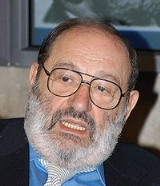
Umberto Eco

 
Umberto Eco

   Email Print
   Bookmark   Link


Umberto Eco


Umberto Eco (born 5 January 1932) is an Italian
Italy

Italy , officially the Italian Republic , is a country located on the Italian Peninsula in Southern Europe and on the two largest islands in the Mediterranean Sea, Sicily and Sardinia....
 medievalist, semiotician
Semiotics

'Semiotics, also called semiotic studies or semiology, is the study of sign processes , or signification and communication, sign and symbols, both individually and grouped into sign systems....
, philosopher, literary critic
Literary criticism

Literary criticism is the study, discussion, evaluation, and interpretation of literature. Modern literary criticism is often informed by literary theory, which is the philosophical discussion of its methods and goals....
 and novelist, best known for his novel The Name of the Rose
The Name of the Rose

The Name of the Rose, a novel by Umberto Eco, is a historical whodunnit ? a murder mystery set in an Italy monastery in the year 1327. It is an intellectual mystery combining semiotics in fiction, biblical analysis, medieval studies and literary theory....
 (Il nome della rosa, 1980), an intellectual mystery combining semiotics
Semiotics

'Semiotics, also called semiotic studies or semiology, is the study of sign processes , or signification and communication, sign and symbols, both individually and grouped into sign systems....
 in fiction, biblical analysis, medieval studies and literary theory
Literary theory

Literary theory in a strict sense is the systematic study of the nature of literature and of the methods for analyzing literature. However, literary scholarship since the 19th century often includes?in addition to, or even instead of literary theory in the strict sense?considerations of intellectual history, moral philosophy, social prophecy,...
. His 1988 novel Foucault's Pendulum
Foucault's Pendulum

Foucault's Pendulum is a novel by Italy novelist and philosopher Umberto Eco. It was first published in 1988; the translation into English by William Weaver appeared a year later....
 has been described as a "thinking person's Da Vinci Code".

Eco is President of the Scuola Superiore di Studi Umanistici, University of Bologna
University of Bologna

The University of Bologna is the oldest continually operating degree-granting university in the world:, the word 'university' being first used by this institution at its foundation....
, and an Honorary Fellow of Kellogg College, University of Oxford
University of Oxford

The University of Oxford , located in the city of Oxford, Oxfordshire, England, is the List of oldest universities in continuous operation in the English-speaking world....
.


Discussion
Ask a question about 'Umberto Eco'
Start a new discussion about 'Umberto Eco'
Answer questions from other users
Full Discussion Forum


Quotations


After all, the cultivated person's first duty is to be always prepared to rewrite the encyclopaedia.

From Serendipities: Language and Lunacy (1998)

William of Baskerville: Books are not made to be believed, but to be subjected to inquiry. original in Italian.

From Il nome della rosa (1980); English edition: The Name of the Rose (1983)

I started to write The Name of the Rose in March of 1978, moved by a seminal idea. I wanted to poison a monk.

From translator Myriem Bouzaher's introduction to the French version of The Name of the Rose, Postille al Nome della Rosa, Page 18 (1985)

In the United States, politics is a profession, whereas in Europe it is a right and a duty.

From the Preface to American ed., Travels in Hyperreality (1986)

Reflecting on these complex relationships between reader and story, fiction and life, can constitute a form of therapy against the sleep of reason, which generates monsters.

From Chapter Six: "Fictional Protocols" in Six Walks in the Fictional Woods (1994).


Encyclopedia


Umberto Eco (born 5 January 1932) is an Italian
Italy

Italy , officially the Italian Republic , is a country located on the Italian Peninsula in Southern Europe and on the two largest islands in the Mediterranean Sea, Sicily and Sardinia....
 medievalist, semiotician
Semiotics

'Semiotics, also called semiotic studies or semiology, is the study of sign processes , or signification and communication, sign and symbols, both individually and grouped into sign systems....
, philosopher, literary critic
Literary criticism

Literary criticism is the study, discussion, evaluation, and interpretation of literature. Modern literary criticism is often informed by literary theory, which is the philosophical discussion of its methods and goals....
 and novelist, best known for his novel The Name of the Rose
The Name of the Rose

The Name of the Rose, a novel by Umberto Eco, is a historical whodunnit ? a murder mystery set in an Italy monastery in the year 1327. It is an intellectual mystery combining semiotics in fiction, biblical analysis, medieval studies and literary theory....
 (Il nome della rosa, 1980), an intellectual mystery combining semiotics
Semiotics

'Semiotics, also called semiotic studies or semiology, is the study of sign processes , or signification and communication, sign and symbols, both individually and grouped into sign systems....
 in fiction, biblical analysis, medieval studies and literary theory
Literary theory

Literary theory in a strict sense is the systematic study of the nature of literature and of the methods for analyzing literature. However, literary scholarship since the 19th century often includes?in addition to, or even instead of literary theory in the strict sense?considerations of intellectual history, moral philosophy, social prophecy,...
. His 1988 novel Foucault's Pendulum
Foucault's Pendulum

Foucault's Pendulum is a novel by Italy novelist and philosopher Umberto Eco. It was first published in 1988; the translation into English by William Weaver appeared a year later....
 has been described as a "thinking person's Da Vinci Code".

Eco is President of the Scuola Superiore di Studi Umanistici, University of Bologna
University of Bologna

The University of Bologna is the oldest continually operating degree-granting university in the world:, the word 'university' being first used by this institution at its foundation....
, and an Honorary Fellow of Kellogg College, University of Oxford
University of Oxford

The University of Oxford , located in the city of Oxford, Oxfordshire, England, is the List of oldest universities in continuous operation in the English-speaking world....
. He has also written academic texts, children’s books and many essays.

Biography

Eco was born in the city of Alessandria
Alessandria

Alessandria is a city in Piedmont, Italy, and the capital of the Province of Alessandria. The city is sited on the alluvial plane between the Tanaro River and the Bormida River rivers, c....
 in the region of Piedmont
Piedmont

Piedmont is one of the 20 Regions of Italy. It has an area of 25,399 km? and a population of about 4.4 million. The capital is Turin. The main local dialect is Piedmontese....
 (northern Italy). His father, Giulio, was an accountant before the government called upon him to serve in three wars. During World War II, Umberto and his mother, Giovanna, moved to a small village in the Piedmontese mountainside. Eco received a Salesian education, and he has made references to the order and its founder in his works and interviews.

His family name is supposedly an acronym of ex caelis oblatus (Latin: a gift from the heavens), which was given to his grandfather (a foundling
Child abandonment

Child abandonment is the practice of abandonment offspring outside of legal adoption. Causes include many social and cultural factors as well as mental illness....
) by a city official.

His father was the son of a family with thirteen children, and urged Umberto to become a lawyer, but he entered the University of Turin
University of Turin

The University of Turin is a university in the city of Turin in the Piedmont region of north-western Italy. It is considered the 4th most important university in Italy....
 in order to take up medieval philosophy
Medieval philosophy

Medieval philosophy is the philosophy of Europe and the Middle East in the era now known as medieval or the Middle Ages, the period roughly extending from the fall of the Roman Empire in the fifth century A.D....
 and literature
Medieval literature

Medieval literature is a broad subject, encompassing essentially all written works available in Europe beyond and during the Middle Ages . The literature of this time was composed of religious writings as well as secular works....
, writing his thesis on Thomas Aquinas
Thomas Aquinas

Saint Thomas Aquinas, Dominican Order was a priest of the Roman Catholic Church in the Dominican Order from Italy, and an immensely influential philosopher and theologian in the tradition of scholasticism, known as Doctor Angelicus and Doctor Communis....
 and earning his Laurea
Laurea

In Italy, the laurea is the main post-secondary academic degree.Until very recently, lauree took much longer to earn than undergraduate degrees elsewhere in Europe and North America....
 in philosophy in 1954. During this time, Eco left the Roman Catholic Church
Roman Catholic Church

The Roman Catholic Church, officially known as the Catholic Church is the world's largest Christianity Ecclesia , representing over half of all Christians and one-sixth of the world population....
 after a crisis of faith.

After this, Eco worked as a cultural editor for the state broadcasting station Radiotelevisione Italiana
Raï

Ra? is a form of traditional music that originated in Oran, Algeria, and then in Oujda from Bedouin shepherds, mixed with Music of Spain, Music of France, African music and Arabic musical forms, which dates back to the 1930s and has been primarily evolved by women in the culture....
 (RAI) and also lectured at the University of Turin (1956–64). A group of avant-garde
Avant-garde

Avant-garde means "advance guard" or "vanguard". The adjective form is used in English, to refer to people or works that are experimental or innovative, particularly with respect to art, culture, and politics....
 artists—painters, musicians, writers—whom he had befriended at RAI (Gruppo 63) became an important and influential component in Eco's future writing career. This was especially true after the publication of his first book in 1956, Il problema estetico in San Tommaso, which was an extension of his doctoral thesis. This also marked the beginning of his lecturing career at his alma mater.

In September 1962, he married Renate Ramge, a German art teacher with whom he has a son and a daughter. He divides his time between an apartment in Milan and a vacation house near Rimini. He has a 30,000 volume library in the former and a 20,000 volume library in the latter.

In 1992-1993 Eco was the Norton professor at Harvard University
Harvard University

Harvard University is a private university in Cambridge, Massachusetts, Massachusetts, United States, and a member of the Ivy League. Founded in 1636 by the colonial Massachusetts legislature, Harvard is the Colonial Colleges institution of higher learning in the United States....
.

Works

In 1959, he published his second book, Sviluppo dell'estetica medievale, which established Eco as a formidable thinker in medievalism
Medievalism

In academic usage, medievalism is the study of the Middle Ages, also referred to as medieval studies. In popular usage, "medievalism" it may refer to a preference for Middle Ages....
 and proved his literary worth to his father. After serving for 18 months in the Italian Army
Italian Army

The Italian Army is the ground defense force of the Military of Italy. On July 29, 2004 it became a professional all-volunteer force of 112,000 active duty personnel....
, he left RAI to become, in 1959, non-fiction senior editor of Casa Editrice Bompiani of Milan
Milan

Milan is the second largest city of Italy, located in the plains of Lombardy. It is the capital in the Province of Milan, as well as the Regions of Italy capital of Lombardy....
, a position he would hold until 1975.

Eco's work on medieval
Middle Ages

File:Karl 1 mit papst gelasius gregor1 sacramentar v karl d kahlen.jpgThe Middle Ages of European history are a period in history which lasted for roughly a millennium, commonly dated from the fall of the Roman Empire in the 5th century to the beginning of the Early Modern Period in the 16th century, marked by the division of Western Christi...
 aesthetics stressed the distinction between theory and practice. About the Middle Ages, he wrote, there was "a geometrically rational schema of what beauty ought to be, and on the other [hand] the unmediated life of art with its dialectic of forms and intentions" — the two cut off from one another as if by a pane of glass. Eco's work in literary theory
Literary theory

Literary theory in a strict sense is the systematic study of the nature of literature and of the methods for analyzing literature. However, literary scholarship since the 19th century often includes?in addition to, or even instead of literary theory in the strict sense?considerations of intellectual history, moral philosophy, social prophecy,...
 has changed focus over time. Initially, he was one of the pioneers of "Reader Response".

During these years, Eco began seriously developing his ideas on the "open" text and on semiotics
Semiotics

'Semiotics, also called semiotic studies or semiology, is the study of sign processes , or signification and communication, sign and symbols, both individually and grouped into sign systems....
, penning many essays on these subjects, and in 1962 he published Opera aperta ("Open Work").

In Opera aperta, Eco argued that literary texts are fields of meaning, rather than strings of meaning, that they are understood as open, internally dynamic and psychologically engaged fields. Those works of literature that limit potential understanding to a single, unequivocal line are the least rewarding, while those that are most open, most active between mind and society and line, are the most lively and best — although valuation terminology is not his business. Eco emphasizes the fact that words do not have meanings that are simply lexical, but rather operate in the context of utterance. So much had been said by I. A. Richards
I. A. Richards

Ivor Armstrong Richards was an influential English literary critic and rhetoric.He was educated at Clifton College where his love of English was nurtured by the scholar 'Cabby' Spence....
 and others, but Eco draws out the implications for literature from this idea. He also extended the axis of meaning from the continually deferred meanings of words in an utterance to a play between expectation and fulfillment of meaning. Eco comes to these positions through study of language and from semiotics, rather than from psychology or historical analysis (as did theorists such as Wolfgang Iser
Wolfgang Iser

Wolfgang Iser was a German literary scholar....
, on the one hand, and Hans-Robert Jauss
Hans-Robert Jauss

Jauss redirects here. See Jauss for other uses of JaussHans Robert Jauss was a German academic, notable for his work in reception theory and medieval and modern French literature....
, on the other). He has also influenced popular culture studies
Popular culture studies

Popular culture studies is the academic discipline studying popular culture. It is generally considered as a combination of communication studies and cultural studies....
 though he did not develop a full-scale theory in this field.

Action in anthropology

Eco co-founded Versus
Versus (journal)

Versus: Quaderni di studi semiotici is an influential semiotic journal in Italy. Founded by Umberto Eco, et al in 1971, it has been an important confrontation space for a large number of scholars of several fields coping with signs and signification....
: Quaderni di studi semiotici
(known as VS in Italian academic jargon), an influential semiotic journal. VS has become an important publication platform for many scholars whose work is related to signs and signification. The journal's foundation and activities have contributed to the growing influence of semiotics as an academic field in its own right, both in Italy and in the rest of Europe.

Most of the well-known European semioticians, among them Umberto Eco, A.J. Greimas, Jean-Marie Floch, Paolo Fabbri, Jacques Fontanille, Claude Zilberberg, Ugo Volli and Patrizia Violi, have published original articles in VS.

Articles by younger, less famous scholars dealing with new research perspectives in semiotics also find place in almost every issue of VS.

In 1988, at the University of Bologna, Eco created an unusual program called Anthropology of the West from the perspective of non-Westerners (African and Chinese scholars), as defined by their own criteria. Eco developed this transcultural international network based on the idea of Alain Le Pichon in West Africa. The Bologna program resulted in a first conference in Guangzhou, China, in 1991 entitled "Frontiers of Knowledge." The first event was soon followed by an Itinerant Euro-Chinese seminar on "Misunderstandings in the Quest for the Universal" along the silk trade route from Canton to Beijing. The latter culminated in a book entitled "The Unicorn and the Dragon" which discussed the question of the creation of knowledge in China and in Europe. Scholars contributing to this volume were from China, including Tang Yijie, Wang Bin and Yue Dayun), as well as from Europe: (Furio Colombo, Antoine Danchin
Antoine Danchin

Antoine Danchin PhD DSc is the director of the Department Genomes and Genetics at the Institut Pasteur in Paris where he heads the Genetics of Bacterial Genomes Unit....
, Jacques Le Goff
Jacques Le Goff

Jacques Le Goff is a prolific France historian specializing in the Middle Ages, particularly the 12th and 13th centuries.Le Goff champions the Annales School movement, which emphasizes long-term trends over politics, diplomacy, and war, which characterized 19th century historical research....
, Paolo Fabbri, Alain Rey
Alain Rey

Alain Rey is a France linguist, lexicographer and radio personality. He is the editor in chief at Dictionnaires Le Robert, the French dictionary publisher....
...)

In 2000 a seminar in Timbuktoo (Mali), was followed by another gathering in Bologna to reflect on the conditions of reciprocal knowledge between East and West. This in turn gave rise to a series of conferences in Brussels, Paris, and Goa, culminating in Beijing in 2007. The topics of the Beijing conference were "Order and Disorder","New Concepts of War and Peace", "Human Rights" and "Social Justice and Harmony". Eco presented the opening lecture. The following anthropologists gave presentations: from India (Balveer Arora, Varun Sahni, Rukmini Bhaya Nair
Rukmini Bhaya Nair

Rukmini Bhaya Nair is a poet and a professor of Linguistics and English in the Department of Humanities and Social Sciences at the Indian Institute of Technology, Delhi....
); from Africa (Moussa Sow
Moussa Sow

Moussa Sow is a France-Senegalese association football player , he currently plays for Stade Rennais F.C. as a striker and was trained at the INF Clairefontaine academy....
); from Europe (Roland Marti, Maurice Olender); from Korea (Cha Insuk); from China (Huang Ping, Zhao Tinyang). Also on the program were scholars from the domains of law or science: (Antoine Danchin
Antoine Danchin

Antoine Danchin PhD DSc is the director of the Department Genomes and Genetics at the Institut Pasteur in Paris where he heads the Genetics of Bacterial Genomes Unit....
, Ahmed Djebbar, Dieter Grimm).

Eco's interest in East/West dialogue to facilitate international communication and understanding also correlates with his related interest in the international auxiliary language Esperanto
Esperanto

is the most widely spoken constructed language international auxiliary language in the world. Its name derives from Doktoro Esperanto, the pseudonym under which L....
.

Novels

Eco's fiction has enjoyed a wide audience around the world, with good sales and many translations. His novels often include references to arcane historical figures and texts and his dense, intricate plots tend to take dizzying turns.

Eco employed his education as a medievalist in his novel The Name of the Rose
The Name of the Rose

The Name of the Rose, a novel by Umberto Eco, is a historical whodunnit ? a murder mystery set in an Italy monastery in the year 1327. It is an intellectual mystery combining semiotics in fiction, biblical analysis, medieval studies and literary theory....
, a historical mystery set in a 14th century monastery. Franciscan friar William of Baskerville
William of Baskerville

William of Baskerville is a fictional Franciscan friar from the novel Il Nome Della Rosa by Umberto Eco. Brother William was an inquisitor, who presided at some trials in England and Italy, where he distinguished himself by his wiktionary:perspicacity along with great humility....
, aided by his assistant Adso, a Benedictine novice, investigates a series of murders at a monastery that is set to host an important religious debate. Eco is particularly good at translating medieval religious controversies and heresies into modern political and economic terms so that the reader can appreciate their substance without being a theologian. The Name of the Rose was later made into a motion picture
The Name of the Rose (film)

The Name of the Rose is a German-French-Italian 1986 in film film, directed by Jean-Jacques Annaud, based on The Name of the Rose by Umberto Eco....
 starring Sean Connery
Sean Connery

Sir Thomas Sean Connery is an Academy Award, Golden Globe, and BAFTA Award winning Scotland actor and film producer who is best known as the first actor to portray James Bond in cinema, starring in seven Bond films....
, F. Murray Abraham
F. Murray Abraham

Fahrid Murray Abraham is an Academy Award-winning United States actor. He became known during the 1980s, after winning the Academy Award for Best Actor for his role in Amadeus , and has since appeared in many roles, both leading and supporting, in films, television, and mainly on stage....
 and Christian Slater
Christian Slater

Christian Michael Leonard Slater is an United States actor who has starred in films such as Heathers, Kuffs, True Romance and He Was a Quiet Man....
. The Name of the Rose is a creative and biographical tribute to Jorge Luis Borges
Jorge Luis Borges

Jorge Francisco Isidoro Luis Borges was an Argentina writer born in Buenos Aires. He was brought up bilingual in Spanish and English. In 1914, his family moved to Switzerland where he attended school, then traveled around Spain....
, represented in the novel and the film by the blind monk and librarian Jorge. Borges, like Jorge, lived a celibate life consecrated to his passion for books, and also went blind in later life.

Foucault's Pendulum, Eco's second novel, has also sold well. In Foucault's Pendulum, three under-employed editors who work for a minor publishing house decide to amuse themselves by inventing a conspiracy theory. Their conspiracy, which they call "The Plan", is about an immense and intricate plot to take over the world by a secret order descended from the Knights Templar
Knights Templar

The Poor Fellow-Soldiers of Christ and of the Temple of Solomon , commonly known as the Knights Templar or the Order of the Temple , were among the most famous of the History of Christianity#Sanctification of knighthood military orders....
. As the game goes on, the three slowly become obsessed with the details of this plan. The game turns dangerous when outsiders learn of The Plan, and believe that the men have really discovered the secret to regaining the lost treasure of the Templars.

The Island of the Day Before

The Island of the Day Before is a 1994 novel by Umberto Eco.It is the story of a 17th century Italian nobility who is the only survivor of a shipwreck during a fierce storm....
 was Eco's third novel. The book is about a man in the Renaissance marooned on a ship within sight of an island which he believes is on the other side of the international date-line. The main character is trapped by his inability to swim and instead spends the bulk of the book reminiscing on his life and the adventures that brought him to be marooned.

Baudolino
Baudolino

Baudolino is a 2000 novel by Umberto Eco about the adventures of a young man named Baudolino in the known and mythical Christianity world of the 12th century....
, a fourth novel by Eco, was published in 2000. Baudolino is a peasant lad endowed with a vivid imagination and a most unusual capacity for learning the many languages which flourished in the Twelfth Century. When he is bought by the Emperor Frederic Barbarossa, his world expands: he is trained as a scholar and called upon to create Authentic documents by diverse authors.

The Mysterious Flame of Queen Loana

La Misteriosa Fiamma della Regina Loana is a novel by Italian people writer Umberto Eco. It was first published in Italian in 2004, and an English language translation by Geoffrey Brock was published in spring 2005....
, is Eco's fifth novel, about Iambo Bodoni, an old bookseller specialized in antiques who emerges from a coma with only memories to recover his past. Umberto Eco declared it would be his last novel.

Eco's work illustrates the concept of intertextuality
Intertextuality

Intertextuality is the shaping of texts' meanings by other texts. It can refer to an author?s borrowing and transformation of a prior text or to a reader?s referencing of one text in reading another....
, or the inter-connectedness of all literary works. His novels are full of subtle, often multilingual, references to literature and history. For instance, the character William of Baskerville
William of Baskerville

William of Baskerville is a fictional Franciscan friar from the novel Il Nome Della Rosa by Umberto Eco. Brother William was an inquisitor, who presided at some trials in England and Italy, where he distinguished himself by his wiktionary:perspicacity along with great humility....
 is a logically-minded Englishman who is a monk and a detective, and his name evokes both William of Ockham
William of Ockham

William of Ockham was an England Franciscan friar and Scholasticism philosopher, from Ockham, Surrey, a small village in Surrey, near East Horsley....
 and Sherlock Holmes
Sherlock Holmes

Sherlock Holmes is a fictional character of the late nineteenth and early twentieth centuries, who first appeared in publication in 1887. He is the creation of Scotland-born author and physician Sir Arthur Conan Doyle....
 (by way of The Hound of the Baskervilles
The Hound of the Baskervilles

The Hound of the Baskervilles is a Detective fiction by Sir Arthur Conan Doyle featuring the detective Sherlock Holmes. Originally serial in the British Strand Magazine from August 1901 to April 1902, it is set mainly on Dartmoor in Devon in England's West Country....
). Eco cites James Joyce
James Joyce

James Augustine Aloysius Joyce was an Ireland expatriate author of the 20th century. He is best known for his landmark novel Ulysses and its controversial successor Finnegans Wake , as well as the short story collection Dubliners and the semi-autobiographical novel A Portrait of the Artist as a Young Man ....
 and Jorge Luis Borges
Jorge Luis Borges

Jorge Francisco Isidoro Luis Borges was an Argentina writer born in Buenos Aires. He was brought up bilingual in Spanish and English. In 1914, his family moved to Switzerland where he attended school, then traveled around Spain....
 as the two modern authors who have influenced his work the most (Source: 'On Literature').

Bibliography


Novels

  • Il nome della rosa (1980; English translation: The Name of the Rose
    The Name of the Rose

    The Name of the Rose, a novel by Umberto Eco, is a historical whodunnit ? a murder mystery set in an Italy monastery in the year 1327. It is an intellectual mystery combining semiotics in fiction, biblical analysis, medieval studies and literary theory....
    , 1983)
  • Il pendolo di Foucault (1988; English translation: Foucault's Pendulum, 1989)
  • L'isola del giorno prima (1994; English translation: The Island of the Day Before
    The Island of the Day Before

    The Island of the Day Before is a 1994 novel by Umberto Eco.It is the story of a 17th century Italian nobility who is the only survivor of a shipwreck during a fierce storm....
    , 1995)
  • Baudolino (2000; English translation: Baudolino
    Baudolino

    Baudolino is a 2000 novel by Umberto Eco about the adventures of a young man named Baudolino in the known and mythical Christianity world of the 12th century....
    , 2001)
  • La misteriosa fiamma della regina Loana (2004; English translation: The Mysterious Flame of Queen Loana
    The Mysterious Flame of Queen Loana

    La Misteriosa Fiamma della Regina Loana is a novel by Italian people writer Umberto Eco. It was first published in Italian in 2004, and an English language translation by Geoffrey Brock was published in spring 2005....
    , 2005)


Books on philosophy

Areas of philosophy
Philosophy

Philosophy is the study of general problems concerning matters such as existence, knowledge, truth, beauty, justice, validity, mind, and language....
 Eco has written most about include semiotics
Semiotics

'Semiotics, also called semiotic studies or semiology, is the study of sign processes , or signification and communication, sign and symbols, both individually and grouped into sign systems....
, linguistics
Linguistics

Linguistics is the science study of natural language. Linguistics encompasses a number of sub-fields. An important topical division is between the study of language structure and the study of Meaning ....
, aesthetics
Aesthetics

Aesthetics or esthetics is commonly known as the study of senses or sensori-emotional values, sometimes called judgments of sentiment and taste ....
 and morality
Morality

Morality has three principal meanings.In its first, descriptive usage, morality means a code of conduct which is held to be authoritative in matters of right and wrong....
.

  • Il problema estetico in San Tommaso (1956 - English translation: The Aesthetics of Thomas Aquinas, 1988, Revised)
  • "Sviluppo dell'estetica medievale", in Momenti e problemi di storia dell'estetica (1959 - Art and Beauty in the Middle Ages, 1985)
  • Opera aperta (1962, rev. 1976 - English translation: The Open Work (1989)
  • Diario Minimo (1963 - English translation: Misreadings, 1993)
  • Apocalittici e integrati (1964 - Partial English translation: Apocalypse Postponed, 1994)
  • Le poetiche di Joyce (1965 - English translations: The Middle Ages of James Joyce, The Aesthetics of Chaosmos, 1989)
  • Il costume di casa (1973 - English translation: Faith in Fakes: Travels in Hyperreality
    Faith in Fakes

    Il costume di casa was originally an essay written in 1975 in literature by the Italy semiotician Umberto Eco, about "America's obsession with simulacra and counterfeit reality", later incorporated as the centrepiece of a collection of articles and essays bearing the same name....
    , 1986)
  • Trattato di semiotica generale (1975 - English translation: A Theory of Semiotics, 1976)
  • Il Superuomo di massa (1976)
  • Dalla periferia dell'impero (1977)
  • Lector in fabula (1979)
  • The Role of the Reader: Explorations in the Semiotics of Texts (1979 - English edition containing essays from Opera aperta, Apocalittici e integrati, Forme del contenuto (1971), Il Superuomo di massa, Lector in Fabula).
  • Sette anni di desiderio (1983)
  • Postille al nome della rosa (1983 - English translation: Postscript to The Name of the Rose, 1984)
  • Semiotica e filosofia del linguaggio (1984 - English translation: Semiotics and the Philosophy of Language, 1984)
  • I limiti dell'interpretazione (1990 - The Limits of Interpretation, 1990)
  • Interpretation and Overinterpretation (1992 - with R. Rorty, J. Culler, C. Brooke-Rose; edited by S. Collini)
  • La ricerca della lingua perfetta nella cultura europea (1993 - English translation: The Search for the Perfect Language (The Making of Europe), 1995)
  • Six Walks in the Fictional Woods
    Six Walks in the Fictional Woods

    Six Walks in the Fictional Woods is a book by Umberto Eco. Originally delivered at Harvard for the Charles Eliot Norton Lectures, 1993, as a series, in the fall of 1994, they were subsequently published in book form in 1994....
     (1994)
  • Incontro - Encounter - Rencontre (1996 - in Italian, English, French)
  • In cosa crede chi non crede? (with Carlo Maria Martini
    Carlo Maria Martini

    Carlo Maria Martini, Society of Jesus is a Latin Rite Italian people Cardinal of the Catholic Church. He was Roman Catholic Archdiocese of Milan from 1980 to 2002, and was elevated to the Cardinal in 1983....
    ), 1996 - English translation: Belief or Nonbelief?: A Dialogue, 2000)
  • Cinque scritti morali (1997 - English translation: Five Moral Pieces, 2001)
  • Kant e l'ornitorinco (1997 - English translation: Kant and the Platypus: Essays on Language and Cognition
    Kant and the Platypus: Essays on Language and Cognition

    Kant and the Platypus : Essays on Language and Cognition is a book by Umberto Eco which was published in Italian language as Kant e l'ornitorinco in 1997....
    , 1999)
  • Serendipities
    Serendipities

    Serendipities: Language and Lunacy is a 1998 book by Umberto Eco, discussing the history of linguistics and pre-modern and Early Modern concepts of a perfect language and the confusion of tongues, partly overlapping with the material presented in his 1993 La ricerca della lingua perfetta....
    : Language and Lunacy
    (1998)
  • How to Travel with a Salmon & Other Essays (1998 - Partial English translation of Il secondo diario minimo, 1994)
  • Experiences in Translation (2000)
  • Sulla letteratura, (2003 - English translation by Martin McLaughlin
    Martin McLaughlin

    Martin L. McLaughlin is Professor of Italian language and Fiat-Serena Professor of Italian Studies at the University of Oxford where he is a Fellow of Magdalen College, Oxford....
    : On Literature, 2004)
  • Mouse or Rat?: Translation as negotiation (2003)
  • Storia della bellezza (2004, co-edited with Girolamo de Michele - English translation: History of Beauty/On Beauty, 2004)
  • A passo di gambero. Guerre calde e populismo mediatico (Bompiani, 2006 - English translation: Turning back the clock: Hot wars and media populism, 2007, Alastair McEwen)
  • Storia della bruttezza (Bompiani, 2007 - English translation: On Ugliness, 2007)
  • Dall'albero al labirinto: studi storici sul segno e l'interpretazione (Bompiani, 2007)


Manual

  • Come si fa una tesi di laurea (1977)


Books for children

(art by Eugenio Carmi)
  • La bomba e il generale (1966, Rev. 1988 - English translation: The Bomb and the General)
  • I tre cosmonauti (1966 - English translation: The Three Astronauts)
  • Gli gnomi di Gnu (1992 - English translation: The Gnomes of Gnu)


External links

  • : An extensive Umberto Eco resource.


Media