


Arezzo

Encyclopedia
Arezzo is a city and comune
in Central Italy
, capital of the province of the same name
, located in Tuscany
. Arezzo is about 80 km southeast of Florence
, at an elevation of 296 m above sea level
. In 2011 the population was about 100,000.
of the River Arno. In the upper part of the town are the cathedral, the town hall and the Medici Fortress (Fortezza Medicea), from which the main streets branch off towards the lower part as far as the gates. The upper part of the town maintains its medieval appearance despite the addition of later structures.
as one of the Capitae Etruriae (Etruscan capitals), Arezzo is believed to have been one of the twelve most important Etruscan
cities—the so-called Dodecapolis. Etruscan remains establish that the acropolis of San Cornelio, a small hill next to that of San Donatus, was occupied and fortified in the Etruscan period. There is other significant Etruscan evidence: parts of walls, an Etruscan necropolis on Poggio del Sole (still named "Hill of the Sun"), and most famously, the two bronzes, the "Chimera of Arezzo
" (5th century BC) and the "Minerva" (4th century BC) which were discovered in the 16th century and taken to Florence
. Increasing trade connections with Greece
also brought some elite goods to the Etruscan nobles of Arezzo: the krater
painted by Euphronios
ca 510 BC with a battle against Amazons (in the Museo Civico, Arezzo 1465) is unsurpassed.
 Conquered by the Romans
in 311 BC, Arretium became a military station on the via Cassia
, the road to expansion by republican Rome into the basin of the Po
. Arretium sided with Marius in the Roman Civil War, and the victorious Sulla planted a colony of his veterans in the half-demolished city, as Arretium Fidens ("Faithful Arretium"). The old Etruscan aristocracy was not extinguished: Gaius Cilnius Maecenas
, whose name is eponym
ous with "patron of the arts", was of the noble Aretine Etruscan stock. The city continued to flourish as Arretium Vetus ("Old Arretium"), the third largest city in Italy in the Augustan period
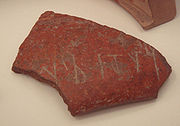
, well known in particular for its widely-exported pottery manufactures, the characteristic moulded and glazed Arretine ware, bucchero-ware of dark clay and red-painted vases (the so-called "coral" vases).
Around 26-261 AD the town council of Arezzo dedicated an inscription to its patron L. Petronius Taurus Volusianus. See that article for discussion of the possible political/military significance of Volusianus's association with the city.
In the 3rd to 4th century, Arezzo became an episcopal seat: it is one of the few cities whose succession of bishops are known by name without interruption to the present day, in part because they were the feudal lords of the city in the Middle Ages
. The Roman city was demolished, partly through the Gothic War
and the invasion of the Lombards
, partly dismantled, as elsewhere throughout Europe
, and the stones reused for fortifications by the Aretines. Only the amphitheater remained.
The commune of Arezzo
threw off the control of its bishop in 1098 and was an independent city-state
until 1384. Generally Ghibelline in tendency, it opposed Guelph
Florence. In 1252 the city founded its university, the Studium. After the rout of the Battle of Campaldino
(1289), which saw the death of Bishop Guglielmino Ubertini, the fortunes of Ghibelline Arezzo started to ebb, apart from a brief period under the Tarlati family, chief among them Guido Tarlati
, who became bishop in 1312 and maintained good relations with the Ghibelline party. The Tarlati sought support in an alliance with Forlì
and its overlords, the Ordelaffi, but failed: Arezzo yielded to Florentine
domination in 1384; its individual history was subsumed by that of Florence and the Medicean Grand Duchy of Tuscany
. During this period Piero della Francesca
worked in the church of San Francesco di Arezzo producing the splendid frescoes, recently restored, which are Arezzo's most famous works. Afterwards the city began an economical and cultural decay, which fortunately ensured that its medieval centre was preserved.
In the 18th century the neighbouring marshes of the Val di Chiana, south of Arezzo, were drained and the region became less malaria
l. At the end of the century French troops led by Napoleon Bonaparte
conquered Arezzo, but the city soon turned into a resistance base against the invaders with the "Viva Maria
" movement, winning the city the role of provincial capital. In 1860 Arezzo became part of the Kingdom of Italy
. City buildings suffered heavy damage during World War II
.


of Santa Maria della Pieve
. Once the main marketplace of the city, it is currently the site of the Giostra del Saracino ("Joust of the Saracen"). It has a sloping pavement in red brick with limestone geometrical lines. Aside from the apse of the church, other landmarks of the square include:
with:
Arezzo participates in town twinning
and friendship links with foreign towns. Bedford
, United Kingdom
(friendship link) Montenars
, Italy
, since 1977 Saint-Priest
, France
, since 1981 Eger
, Hungary
, since 1989 Jaén
, Spain
since 2006 Norman
, USA, since 2009 Oświęcim
, Poland
, since May–June 2009 Mount Pleasant
, USA, since November 27, 2010
Comune
In Italy, the comune is the basic administrative division, and may be properly approximated in casual speech by the English word township or municipality.-Importance and function:...
in Central Italy
Central Italy
Central Italy is one of the five official statistical regions of Italy used by the National Institute of Statistics , a first level NUTS region and a European Parliament constituency...
, capital of the province of the same name
Province of Arezzo
The Province of Arezzo or Arretium is the easternmost province in the Tuscany region of Italy. Its capital is the city of Arezzo.It has an area of 3,232 km², and a total population of 323,288 in 39 comuni . At June 30, 2005, the main comuni by population are:- External links :...
, located in Tuscany
Tuscany
Tuscany is a region in Italy. It has an area of about 23,000 square kilometres and a population of about 3.75 million inhabitants. The regional capital is Florence ....
. Arezzo is about 80 km southeast of Florence
Florence
Florence is the capital city of the Italian region of Tuscany and of the province of Florence. It is the most populous city in Tuscany, with approximately 370,000 inhabitants, expanding to over 1.5 million in the metropolitan area....
, at an elevation of 296 m above sea level
Above mean sea level
The term above mean sea level refers to the elevation or altitude of any object, relative to the average sea level datum. AMSL is used extensively in radio by engineers to determine the coverage area a station will be able to reach...
. In 2011 the population was about 100,000.
Geography
Arezzo is set on a steep hill rising from the floodplainFloodplain
A floodplain, or flood plain, is a flat or nearly flat land adjacent a stream or river that stretches from the banks of its channel to the base of the enclosing valley walls and experiences flooding during periods of high discharge...
of the River Arno. In the upper part of the town are the cathedral, the town hall and the Medici Fortress (Fortezza Medicea), from which the main streets branch off towards the lower part as far as the gates. The upper part of the town maintains its medieval appearance despite the addition of later structures.
History
Described by LivyLivy
Titus Livius — known as Livy in English — was a Roman historian who wrote a monumental history of Rome and the Roman people. Ab Urbe Condita Libri, "Chapters from the Foundation of the City," covering the period from the earliest legends of Rome well before the traditional foundation in 753 BC...
as one of the Capitae Etruriae (Etruscan capitals), Arezzo is believed to have been one of the twelve most important Etruscan
Etruscan civilization
Etruscan civilization is the modern English name given to a civilization of ancient Italy in the area corresponding roughly to Tuscany. The ancient Romans called its creators the Tusci or Etrusci...
cities—the so-called Dodecapolis. Etruscan remains establish that the acropolis of San Cornelio, a small hill next to that of San Donatus, was occupied and fortified in the Etruscan period. There is other significant Etruscan evidence: parts of walls, an Etruscan necropolis on Poggio del Sole (still named "Hill of the Sun"), and most famously, the two bronzes, the "Chimera of Arezzo
Chimera of Arezzo
The bronze "Chimera of Arezzo" is one of the best known examples of the art of the Etruscans. It was found in Arezzo, an ancient Etruscan and Roman city in Tuscany, in 1553 and was quickly claimed for the collection of the Medici Grand Duke of Tuscany Cosimo I, who placed it publicly in the...
" (5th century BC) and the "Minerva" (4th century BC) which were discovered in the 16th century and taken to Florence
Florence
Florence is the capital city of the Italian region of Tuscany and of the province of Florence. It is the most populous city in Tuscany, with approximately 370,000 inhabitants, expanding to over 1.5 million in the metropolitan area....
. Increasing trade connections with Greece
Greece
Greece , officially the Hellenic Republic , and historically Hellas or the Republic of Greece in English, is a country in southeastern Europe....
also brought some elite goods to the Etruscan nobles of Arezzo: the krater
Krater
A krater was a large vase used to mix wine and water in Ancient Greece.-Form and function:...
painted by Euphronios
Euphronios
Euphronios was an ancient Greek vase painter and potter, active in Athens in the late 6th and early 5th centuries BC. As part of the so-called "Pioneer Group,"...
ca 510 BC with a battle against Amazons (in the Museo Civico, Arezzo 1465) is unsurpassed.
Ancient Rome
Ancient Rome was a thriving civilization that grew on the Italian Peninsula as early as the 8th century BC. Located along the Mediterranean Sea and centered on the city of Rome, it expanded to one of the largest empires in the ancient world....
in 311 BC, Arretium became a military station on the via Cassia
Via Cassia
The Via Cassia was an important Roman road striking out of the Via Flaminia near the Milvian Bridge in the immediate vicinity of Rome and, passing not far from Veii traversed Etruria...
, the road to expansion by republican Rome into the basin of the Po
Po River
The Po |Ligurian]]: Bodincus or Bodencus) is a river that flows either or – considering the length of the Maira, a right bank tributary – eastward across northern Italy, from a spring seeping from a stony hillside at Pian del Re, a flat place at the head of the Val Po under the northwest face...
. Arretium sided with Marius in the Roman Civil War, and the victorious Sulla planted a colony of his veterans in the half-demolished city, as Arretium Fidens ("Faithful Arretium"). The old Etruscan aristocracy was not extinguished: Gaius Cilnius Maecenas
Gaius Maecenas
Gaius Cilnius Maecenas was a confidant and political advisor to Octavian as well as an important patron for the new generation of Augustan poets...
, whose name is eponym
Eponym
An eponym is the name of a person or thing, whether real or fictitious, after which a particular place, tribe, era, discovery, or other item is named or thought to be named...
ous with "patron of the arts", was of the noble Aretine Etruscan stock. The city continued to flourish as Arretium Vetus ("Old Arretium"), the third largest city in Italy in the Augustan period
Augustus
Augustus ;23 September 63 BC – 19 August AD 14) is considered the first emperor of the Roman Empire, which he ruled alone from 27 BC until his death in 14 AD.The dates of his rule are contemporary dates; Augustus lived under two calendars, the Roman Republican until 45 BC, and the Julian...
, well known in particular for its widely-exported pottery manufactures, the characteristic moulded and glazed Arretine ware, bucchero-ware of dark clay and red-painted vases (the so-called "coral" vases).
Around 26-261 AD the town council of Arezzo dedicated an inscription to its patron L. Petronius Taurus Volusianus. See that article for discussion of the possible political/military significance of Volusianus's association with the city.
In the 3rd to 4th century, Arezzo became an episcopal seat: it is one of the few cities whose succession of bishops are known by name without interruption to the present day, in part because they were the feudal lords of the city in the Middle Ages
Middle Ages
The Middle Ages is a periodization of European history from the 5th century to the 15th century. The Middle Ages follows the fall of the Western Roman Empire in 476 and precedes the Early Modern Era. It is the middle period of a three-period division of Western history: Classic, Medieval and Modern...
. The Roman city was demolished, partly through the Gothic War
Gothic War (535–552)
The Gothic War between the Eastern Roman Empire and the Ostrogothic Kingdom of Italy was fought from 535 until 554 in Italy, Dalmatia, Sardinia, Sicily and Corsica. It is commonly divided into two phases. The first phase lasted from 535 to 540 and ended with the fall of Ravenna and the apparent...
and the invasion of the Lombards
Lombards
The Lombards , also referred to as Longobards, were a Germanic tribe of Scandinavian origin, who from 568 to 774 ruled a Kingdom in Italy...
, partly dismantled, as elsewhere throughout Europe
Europe
Europe is, by convention, one of the world's seven continents. Comprising the westernmost peninsula of Eurasia, Europe is generally 'divided' from Asia to its east by the watershed divides of the Ural and Caucasus Mountains, the Ural River, the Caspian and Black Seas, and the waterways connecting...
, and the stones reused for fortifications by the Aretines. Only the amphitheater remained.
The commune of Arezzo
Medieval commune
Medieval communes in the European Middle Ages had sworn allegiances of mutual defense among the citizens of a town or city. They took many forms, and varied widely in organization and makeup. Communes are first recorded in the late 11th and early 12th centuries, thereafter becoming a widespread...
threw off the control of its bishop in 1098 and was an independent city-state
City-state
A city-state is an independent or autonomous entity whose territory consists of a city which is not administered as a part of another local government.-Historical city-states:...
until 1384. Generally Ghibelline in tendency, it opposed Guelph
Guelphs and Ghibellines
The Guelphs and Ghibellines were factions supporting the Pope and the Holy Roman Emperor, respectively, in central and northern Italy. During the 12th and 13th centuries, the split between these two parties was a particularly important aspect of the internal policy of the Italian city-states...
Florence. In 1252 the city founded its university, the Studium. After the rout of the Battle of Campaldino
Battle of Campaldino
The Battle of Campaldino was a battle between the Guelphs and Ghibellines on 11 June 1289. Mixed bands of pro-papal Guelf forces of Florence and allies, Pistoia, Lucca, Siena and Prato, all loosely commanded by the paid condottiero Amerigo di Narbona with his own professional following, met a...
(1289), which saw the death of Bishop Guglielmino Ubertini, the fortunes of Ghibelline Arezzo started to ebb, apart from a brief period under the Tarlati family, chief among them Guido Tarlati
Guido Tarlati
thumb|220px|Panel from Guido Tarlati's tomb representing the capture of the castle of [[Caprese Michelangelo|Caprese]].Guido Tarlati was a lord and Bishop of Arezzo....
, who became bishop in 1312 and maintained good relations with the Ghibelline party. The Tarlati sought support in an alliance with Forlì
Forlì
Forlì is a comune and city in Emilia-Romagna, Italy, and is the capital of the province of Forlì-Cesena. The city is situated along the Via Emilia, to the right of the Montone river, and is an important agricultural centre...
and its overlords, the Ordelaffi, but failed: Arezzo yielded to Florentine
Florence
Florence is the capital city of the Italian region of Tuscany and of the province of Florence. It is the most populous city in Tuscany, with approximately 370,000 inhabitants, expanding to over 1.5 million in the metropolitan area....
domination in 1384; its individual history was subsumed by that of Florence and the Medicean Grand Duchy of Tuscany
Grand Duchy of Tuscany
The Grand Duchy of Tuscany was a central Italian monarchy that existed, with interruptions, from 1569 to 1859, replacing the Duchy of Florence. The grand duchy's capital was Florence...
. During this period Piero della Francesca
Piero della Francesca
Piero della Francesca was a painter of the Early Renaissance. As testified by Giorgio Vasari in his Lives of the Artists, to contemporaries he was also known as a mathematician and geometer. Nowadays Piero della Francesca is chiefly appreciated for his art. His painting was characterized by its...
worked in the church of San Francesco di Arezzo producing the splendid frescoes, recently restored, which are Arezzo's most famous works. Afterwards the city began an economical and cultural decay, which fortunately ensured that its medieval centre was preserved.
In the 18th century the neighbouring marshes of the Val di Chiana, south of Arezzo, were drained and the region became less malaria
Malaria
Malaria is a mosquito-borne infectious disease of humans and other animals caused by eukaryotic protists of the genus Plasmodium. The disease results from the multiplication of Plasmodium parasites within red blood cells, causing symptoms that typically include fever and headache, in severe cases...
l. At the end of the century French troops led by Napoleon Bonaparte
Napoleon I of France
Napoleon Bonaparte was a French military and political leader during the latter stages of the French Revolution.As Napoleon I, he was Emperor of the French from 1804 to 1815...
conquered Arezzo, but the city soon turned into a resistance base against the invaders with the "Viva Maria
Viva Maria (movement)
The Viva Maria was one of the anti-French movements, known collectively as the Sanfedisti, which arose in Italy between 1799 and 1800. It operated above all in the town of Arezzo and the rest of Tuscany, but also in the neighboring territories of the Papal States....
" movement, winning the city the role of provincial capital. In 1860 Arezzo became part of the Kingdom of Italy
Kingdom of Italy (1861–1946)
The Kingdom of Italy was a state forged in 1861 by the unification of Italy under the influence of the Kingdom of Sardinia, which was its legal predecessor state...
. City buildings suffered heavy damage during World War II
World War II
World War II, or the Second World War , was a global conflict lasting from 1939 to 1945, involving most of the world's nations—including all of the great powers—eventually forming two opposing military alliances: the Allies and the Axis...
.
Main sights
Piazza Grande
The Piazza Grande is the most noteworthy medieval square in the city, opening behind the 13th century Romanesque apseRomanesque architecture
Romanesque architecture is an architectural style of Medieval Europe characterised by semi-circular arches. There is no consensus for the beginning date of the Romanesque architecture, with proposals ranging from the 6th to the 10th century. It developed in the 12th century into the Gothic style,...
of Santa Maria della Pieve
Santa Maria della Pieve
Santa Maria della Pieve is a church in Arezzo, Tuscany, central Italy.-History:The church is documented since as early as 1008, and, during the communal period of Arezzo, it was the stronghold of the city's struggle against its bishops...
. Once the main marketplace of the city, it is currently the site of the Giostra del Saracino ("Joust of the Saracen"). It has a sloping pavement in red brick with limestone geometrical lines. Aside from the apse of the church, other landmarks of the square include:
- The Palace of the Lay Fraternity (Fraternita dei Laici): 14th-15th century palazzo, with a Gothic ground floor and a quattrocento second floor by Bernardo RossellinoBernardo RossellinoBernardo di Matteo del Borra Gamberelli , better known as Bernardo Rossellino, was an Italian sculptor and architect, the elder brother of the sculptor Antonio Rossellino...
. - The Vasari Loggia along the north side, a flat Mannerist façade designed by Giorgio VasariGiorgio VasariGiorgio Vasari was an Italian painter, writer, historian, and architect, who is famous today for his biographies of Italian artists, considered the ideological foundation of art-historical writing.-Biography:...
. - Episcopal Palace, seat of the bishops, rebuilt in the mid-13th century. The interior has frescoes by Salvi CastellucciSalvi CastellucciSalvi Castellucci was an Italian painter of the Baroque period, active mainly in Arezzo.He trained in Rome with Pietro da Cortona. His son, Pietro Castelllucci painted in his style.-References:...
, Teofilo Torri, and Pietro BenvenutiPietro BenvenutiPietro Benvenuti was an Italian neoclassical painter.Born in Arezzo, he was influenced by the style of Jacques-Louis David. He was a student of the Accademia di Belle Arti in Florence, then studied in Rome, 1792-1803, where he formed an informal academy with his friend of long standing, Vincenzo...
. In front of the Palace is the Monument to Grand Duke Ferdinando I de' Medici (1595), by Pietro FrancavillaPietro FrancavillaPierre Franqueville, generally called Pietro Francavilla , was a Franco-Flemish sculptor trained in Florence, who provided sculpture for Italian and French patrons in the elegant Late Mannerist tradition established by Giambologna....
, following a design of GiambolognaGiambolognaGiambologna, born as Jean Boulogne, incorrectly known as Giovanni da Bologna and Giovanni Bologna , was a sculptor, known for his marble and bronze statuary in a late Renaissance or Mannerist style.- Biography :...
. - Palazzo Cofani-Brizzolari, with the Torre Faggiolana.
- Remains of the Communal Palace and the Palazzo del Popolo can also be seen.
Churches
- RomanesqueRomanesque architectureRomanesque architecture is an architectural style of Medieval Europe characterised by semi-circular arches. There is no consensus for the beginning date of the Romanesque architecture, with proposals ranging from the 6th to the 10th century. It developed in the 12th century into the Gothic style,...
church of Santa Maria della PieveSanta Maria della PieveSanta Maria della Pieve is a church in Arezzo, Tuscany, central Italy.-History:The church is documented since as early as 1008, and, during the communal period of Arezzo, it was the stronghold of the city's struggle against its bishops...
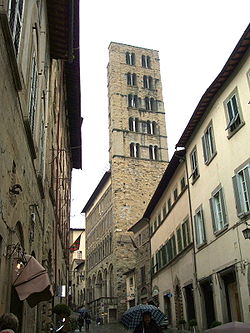
. Its most striking feature is the massive, square-planned bell tower with double orders of mullioned windows. The church was built in the 12th century over a pre-existing Palaeo-Christian edifice, and renovated a century later with the addition of the characteristic façade made of loggiaLoggiaLoggia is the name given to an architectural feature, originally of Minoan design. They are often a gallery or corridor at ground level, sometimes higher, on the facade of a building and open to the air on one side, where it is supported by columns or pierced openings in the wall...
s with small arches surmounted by all different-styled columns. Also from the same century is the lunetteLunetteIn architecture, a lunette is a half-moon shaped space, either filled with recessed masonry or void. A lunette is formed when a horizontal cornice transects a round-headed arch at the level of the imposts, where the arch springs. If a door is set within a round-headed arch, the space within the...
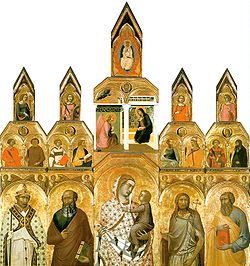
with the Virgin between Two Angels and the sculptures of the months (1216) over the main portal. the interior has a nave and two aisles, with a transept also added in the 13th century. In the following century chapels, niches and frescoes were added, including the polyptych of Virgin with Child and Saints by Pietro LorenzettiPietro LorenzettiPietro Lorenzetti was an Italian painter, active between approximately 1306 and 1345. His younger brother was the painter Ambrogio Lorenzetti....
(1320). In the crypt is a relic bust of St. Donatus (1346). From the same epoch is the hexagonal baptismal font, with panels of the Histories of St. John the Baptist, by Giovanni d'Agostino. The Pieve was again renovated by Giorgio VasariGiorgio VasariGiorgio Vasari was an Italian painter, writer, historian, and architect, who is famous today for his biographies of Italian artists, considered the ideological foundation of art-historical writing.-Biography:...
in 1560. - the GothicGothic architectureGothic architecture is a style of architecture that flourished during the high and late medieval period. It evolved from Romanesque architecture and was succeeded by Renaissance architecture....
CathedralArezzo CathedralArezzo Cathedral is a Roman Catholic cathedral in the city of Arezzo in Tuscany, Italy...
of Saint Donatus (13th-early 16th centuries). The façade remained unfinished, and was added in the 20th century. The interior has a nave and aisles divided by massive pilasters. The left aisle has a fresco by Piero della FrancescaPiero della FrancescaPiero della Francesca was a painter of the Early Renaissance. As testified by Giorgio Vasari in his Lives of the Artists, to contemporaries he was also known as a mathematician and geometer. Nowadays Piero della Francesca is chiefly appreciated for his art. His painting was characterized by its...
portraying the Madeleine. Noteworthy are also the medieval stained glass, the Tarlati Chapel (1334) and the Gothic tomb of Pope Gregory X. - Basilica of San FrancescoBasilica di San Francesco di Arezzothumb|280px|Façade of the church.The Basilica of San Francesco is a late Medieval church in Arezzo, Tuscany, Italy, dedicated to St Francis of Assisi...
(13th-14th centuries), in Tuscan-Gothic style. Of the projectd façade cover in sculpted stone only the lower band was completed. The interior has a single nave: the main attraction is the History of the True CrossThe History of the True CrossThe History of the True Cross or The Legend of the True Cross is a sequence of frescoes painted by Piero della Francesca in the Basilica of San Francesco in Arezzo...
frescoFrescoFresco is any of several related mural painting types, executed on plaster on walls or ceilings. The word fresco comes from the Greek word affresca which derives from the Latin word for "fresh". Frescoes first developed in the ancient world and continued to be popular through the Renaissance...
(1453–1464) cycle by Piero della FrancescaPiero della FrancescaPiero della Francesca was a painter of the Early Renaissance. As testified by Giorgio Vasari in his Lives of the Artists, to contemporaries he was also known as a mathematician and geometer. Nowadays Piero della Francesca is chiefly appreciated for his art. His painting was characterized by its...
in the Bacci Chapel. Under the church is another Basilica with a nave and two aisles (Basilica inferiore), today used for art exhibitions. - Basilica of San Domenico (founded in 1275 and completed in the early 14th century). The interior has a single nave with a Crucifix by CimabueCimabueCimabue , also known as Bencivieni di Pepo or in modern Italian, Benvenuto di Giuseppe, was an Italian painter and creator of mosaics from Florence....
, a masterwork of 13th century Italian art. Other artworks include a Sts. Philip and James the Younger and St. Catherine by Spinello AretinoSpinello AretinoSpinello Aretino was an Italian painter, the son of a Florentine named Luca, who had taken refuge in Arezzo in 1310 when exiled with the rest of the Ghibelline party.-Biography:...
and other 14th century painting and sculpture decorations. - church of San Michele, with a modern façade. Traces of the original Romanesque edifice and the Gothic restoration can be seen in the interior.
- Santa Maria in Gradi is a medieval church from the 11th or the 12th century, but was rebuilt in the late 16th century by Bartolomeo Ammannati. The interior has a single nave with stone altars (17th century) and a Madonna of Misericordia, terracotta by Andrea della RobbiaAndrea della RobbiaAndrea della Robbia was an Italian Renaissance sculptor, especially in ceramics. He was the son of Marco della Robbia. Andrea della Robbia's uncle, Luca della Robbia, popularized the use of glazed terra-cotta for sculpture...
. - Church of St. Augustine, founded in 1257, modified in the late 15th and the late 18h centuries. The façade and the interior decoration are largely from Baroque times. The square plan bell tower is from the 15th century.
- Badia di SS. Flora e Lucilla (12th century). Built by Benedictine monks in the 12th century, it was totally restored in the 16th century under the direction of Giorgio Vasari. The octagonal bell tower is from 1650. The interior, in Mannerist style, has an illusionistic canvas depicting a false dome by Andrea PozzoAndrea PozzoAndrea Pozzo was an Italian Jesuit Brother, Baroque painter and architect, decorator, stage designer, and art theoretician. He was best known for his grandiose frescoes using illusionistic technique called quadratura, in which architecture and fancy are intermixed...
(1702). There are also a St. Lawrence fresco by Bartolomeo della GattaBartolomeo della GattaBartolomeo della Gatta , born Pietro di Antonio Dei, was an Italian painter, illuminator, and architect. He was the son of a goldsmith. He was a colleague of Fra Bartolommeo. In 1468, Bartolomeo became a monk in the Order of Camaldoli, probably in the Church of Santa Maria degli Angeli in...
(1476) and a Crucifix by Segna di Buonaventura (1319). - San Lorenzo, one of the most ancient of the city, having been built before the year 1000, most likely in Palaeo-Christian times. Rebuilt in the 13th century and restored in 1538, it was totally rebuilt in 1705. The apse exterior is in Romanesque style.
- Santa Maria delle GrazieSanta Maria delle Grazie (Arezzo)Santa Maria delle Grazie is a church in Arezzo, Tuscany, central Italy.It is located on the site of an ancient sanctuary with a spring that, in the Etruscan-Roman era, it was consecrated to Apollo. In the Middle Ages it was known as Fonte Tecta....
, a late Gothic sanctuary with a Renaissance portal by Benedetto da MaianoBenedetto da MaianoBenedetto da Maiano was an Italian sculptor of the early Renaissance.Born in the village of Maiano , he started his career as companion of his brother, the architect Giuliano da Maiano. When he reached the age of thirty he started training under the sculptor Antonio Rossellino...
(1490). It has also a marble high altar by Andrea della RobbiaAndrea della RobbiaAndrea della Robbia was an Italian Renaissance sculptor, especially in ceramics. He was the son of Marco della Robbia. Andrea della Robbia's uncle, Luca della Robbia, popularized the use of glazed terra-cotta for sculpture...
including a pre-existing fresco by Parri di Spinello (1428–1431). The sanctuary was built over a font dedicated to Apollo, which was destroyed by San Bernardino of Siena in 1428, building an oratory in its place. The church was erected in 1435–1444 and has a chapel entitled to St. Bernardino. - Santa Maria a Gradi (1591), a monastery existing already in 1043. It has a Baroque interior, but with an altar by a collaborator of Andrea della Robbia.
- Church of Santissima Trinità. Built in 1348, it was totalle renovated in 1723–1748 in Baroque style. It houses a 14th century Crucifix, a banner painted by Giorgio Vasari in 1572, a painting of Noli me tangere by Alessandro AlloriAlessandro AlloriAlessandro di Cristofano di Lorenzo del Bronzino Allori was an Italian portrait painter of the late Mannerist Florentine school....
(1584) and other artworks. - Santa Maria Maddalena, built in 1561 over a pre-14th century structure. It houses a Madonna with Child (Madonna of the Rose) by Spinello Aretino, visible in the high altar (c. 1525) designed by Guillaume de MarcillatGuillaume de MarcillatGuillaume de Marcillat was a French painter and stained glass artist.-Biography:He was born in La Châtre, Indre about 1470. He was in Rome by 1509, where he was employed by the popes Julius II and Leo X in the Vatican and at Santa Maria del Popolo, where the two windows in the choir are his...
. It is now private property. - Pieve di San Paolo, in San Paolo, erected as Palaeo-Christian baptismal church, rebuilt in the 8th-9th centuries and then rebuilt in Romanesque style in the 13th century. The bell tower is from the 14th-15th centuries. The entire church was again renovated after the 1796 earthquake. It has kept 15th-century frescoes by Lorentino d'Andrea and a cyborium. The transept entrance has granite columns with marble capitals from the 5th century AD.
- Pieve di Sant'Eugenia al Bagnoro, in Bagnoro. Documented from 1012, it was one of the most important pievi of the diocese during the Middle Ages. The presbytery area is from the 12th century, while the rest is from the 11th century. The bell tower, partially ruined, stands on one of the three apses.
- Pieve di San Donnino a Maiano, at Palazzo del Pero (6th-9th centuries). Documented from 1064, it replaced a Palaeo-Christian baptismal church. The fronal part was rebuilt in the 14th century. The apse has 15th century frescoes and a wooden Madonna with Child from the same age.
Others
- Roman amphitheatreAmphitheatreAn amphitheatre is an open-air venue used for entertainment and performances.There are two similar, but distinct, types of structure for which the word "amphitheatre" is used: Ancient Roman amphitheatres were large central performance spaces surrounded by ascending seating, and were commonly used...
and museum. - Palazzo dei Priori, erected in 1333, has been the seat of the city's magistratures until today. The edifice was numerous times restored and renovated; the interior has a court from the 16th century, a stone statue portraying a Madonna with Child (1339), frescoes, busts of illustrious Aretines, two paintings by Giorgio Vasari. The square tower is from 1337.
- Medici Fortress (Fortezza Medicea), designed by Antonio da Sangallo the YoungerAntonio da Sangallo the Youngerthumb|250px|The church of Santa Maria di Loreto near the [[Trajan's Market]] in [[Rome]], considered Sangallo's masterwork.thumb|250px|View of St. Patrick's Well in [[Orvieto]]....
and completed in 1538–1560. It was partly dismantled by the French in the early 19th century. - Palazzo Camaiani-Albergotti (14th century, renovated in the 16th century), with the Torre della Bigazza.
- Palazzo Bruni-Ciocchi, Renaissance edifice attributed to Bernardo RossellinoBernardo RossellinoBernardo di Matteo del Borra Gamberelli , better known as Bernardo Rossellino, was an Italian sculptor and architect, the elder brother of the sculptor Antonio Rossellino...
. It is seat of the State Museum of Medieval and Modern Art. - Palazzo Pretorio, which was seat of the People's Captain until 1290. The façade has coat of armas of the captains, podestà and commissaries of the city from 14th to 18th century. Only one of the two original towers remains.
- House of PetrarchPetrarchFrancesco Petrarca , known in English as Petrarch, was an Italian scholar, poet and one of the earliest humanists. Petrarch is often called the "Father of Humanism"...
(Casa del Petrarca). - Casa Vasari (in Via XX Settembre) an older house rebuilt in 1547 by Giorgio VasariGiorgio VasariGiorgio Vasari was an Italian painter, writer, historian, and architect, who is famous today for his biographies of Italian artists, considered the ideological foundation of art-historical writing.-Biography:...
and frescoed by him; now open as a museum, it also contains 16th-century archives. The main rooms were decorated by Vasari in an illusionist manner. the drawing room, where Vasare painted the life journey of an artist, with the artistic virtues protected by the gods of antiquite represented as heavenly bodies, is remarkable. - Ivan Bruschi House and Museum (Casa-Museo "Ivan Bruschi").
- Gaio Cilnio Mecenate Archeological Museum.
- Civic Museum of Modern and Contemporary Art.
- UnoAErreUnoAErreUnoAErre Italia, which is based in Arezzo, is an Italian goldsmith and jewelry company.UnoAErre is one of the world's largest company specializing in the manufacture, distribution and export of gold and jewelry worldwide....
Jewelry Museum
Festivals
- Arezzo is home to an annual international competition of choral singing Concorso Polifónico Guido d'Arezzo (International Guido d'Arezzo Polyphonic Contest)
- Arezzo is home to an annual medieval festival called the Saracen JoustSaracen JoustThe Saracen Joust of Arezzo is an ancient game of chivalry. It dates back to the Middle Ages....
(Giostra del Saracino). In this, "knights" on horseback representing different areas of the town charge at a wooden target attached to a carving of a Saracen king and score points according to accuracy. Virtually all the town's people dress-up in medieval costume and enthusiastically cheer on the competitors. - From 1986 to 2006 Arezzo was also home to an annual popular music and culture festival, each July, called Arezzo WaveArezzo WaveArezzo Wave is a famous Italian festival that takes place every July in Arezzo since 1987.Born exclusively as a launching platform for young Italian rock groups, in its current form, the festival lasts six days and is totally free of charge...
. Publicly funded, it attracts bands of high repute and attendees from all over Europe and North America. It also features literary and film expositions. In 2007 it was replaced by PLAY Arezzo Art Festival, still about rock music. Some artist invited in 2007 and 2008 are: Negrita,Peter Gabriel, Lou Reed, Joan Baez, Ben Harper, Goran Bregovic, Carmen Consoli, Max Gazzè, Peter Brook.
In popular culture
- Arezzo has a starring role in Roberto BenigniRoberto BenigniRoberto Remigio Benigni, Cavaliere di Gran Croce OMRI is an Italian actor, comedian, screenwriter and director of film, theatre and television.- Early years :...
's film Life Is BeautifulLife Is BeautifulLife Is Beautiful is a 1997 Italian film which tells the story of a Jewish Italian, Guido Orefice , who must employ his fertile imagination to help his family during their internment in a Nazi concentration camp.At the 71st Academy Awards in 1999, Benigni won the Academy Award for Best Actor and...
(La vita è bella, 1997). It is the place in which the main characters live before they are shipped off to a NaziNazismNazism, the common short form name of National Socialism was the ideology and practice of the Nazi Party and of Nazi Germany...
concentration camp. - Arretium was used in the PC game Rome: Total WarRome: Total WarRome: Total War is a PC strategy game developed by The Creative Assembly and released on by Activision...
as the Capital of the Roman Faction of Julii. - Dylan and Cole SprouseDylan and Cole SprouseDylan Thomas Sprouse and Cole Mitchell Sprouse are American actors. They are twins and are collectively referred to as Dylan and Cole Sprouse or the Sprouse Bros. Their first prominent major theatrical film role was in Big Daddy, where they starred alongside Adam Sandler...
were born here in 1992.
Famous residents
See :Category:People from Arezzo (city), which includes people actually born in town.- Guido d'Arezzo, the most notable music theorist of the Middle Ages and inventor of modern music notation, was born there around the year 991.
- Bartolomeo di ser GorelloBartolomeo di ser GorelloBartolomeo di ser Gorello , also known by the Latinized name Bartholomeus Gorellus, was an Italian notary who wrote a town chronicle of Arezzo in Italian verse...
, author of the first town chronicle of Arezzo. - Piero della FrancescaPiero della FrancescaPiero della Francesca was a painter of the Early Renaissance. As testified by Giorgio Vasari in his Lives of the Artists, to contemporaries he was also known as a mathematician and geometer. Nowadays Piero della Francesca is chiefly appreciated for his art. His painting was characterized by its...
, the painter, was born in the province of Arezzo and spent most of his life in the city. - PetrarchPetrarchFrancesco Petrarca , known in English as Petrarch, was an Italian scholar, poet and one of the earliest humanists. Petrarch is often called the "Father of Humanism"...
, the poet. - Pietro AretinoPietro AretinoPietro Aretino was an Italian author, playwright, poet and satirist who wielded immense influence on contemporary art and politics and invented modern literate pornography.- Life :...
,author, playwright, poet and satirist who wielded immense influence on contemporary art and politics and invented modern literate pornographyPornographyPornography or porn is the explicit portrayal of sexual subject matter for the purposes of sexual arousal and erotic satisfaction.Pornography may use any of a variety of media, ranging from books, magazines, postcards, photos, sculpture, drawing, painting, animation, sound recording, film, video,...
. - Giorgio VasariGiorgio VasariGiorgio Vasari was an Italian painter, writer, historian, and architect, who is famous today for his biographies of Italian artists, considered the ideological foundation of art-historical writing.-Biography:...
, the painter, architect, and biographer. - Francesco RediFrancesco RediFrancesco Redi was an Italian physician, naturalist, and poet.-Biography:The son of Gregorio Redi and Cecilia de Ghinci was born in Arezzo on February 18, 1626. After schooling with the Jesuits, he attended the University of Pisa...
, a 17th century physician. - In addition, Poggio Bracciolini and MichelangeloMichelangeloMichelangelo di Lodovico Buonarroti Simoni , commonly known as Michelangelo, was an Italian Renaissance painter, sculptor, architect, poet, and engineer who exerted an unparalleled influence on the development of Western art...
were born near the town. - Negrita (band), a Rock, Blues, Latin Music Band.
- Daniele BennatiDaniele BennatiDaniele Bennati is an Italian road racing cyclist specializing in fast sprint finishes. He currently rides for UCI ProTeam . He turned professional in 2002, when he joined the team and wore zebra stripes as part of Mario Cipollini’s leadout train...
, cyclist. - Federico LuzziFederico LuzziFederico Luzzi was a professional tennis player from Italy who had been ranked as high as 92nd in the world. Luzzi had been suspended from professional tennis in 2008 for six months after a determination was made that he had gambled on the outcome of matches over a three-year span. He was...
, Former ATP Tennis Player - Luc FerrariLuc FerrariLuc Ferrari was of an Italian heritage but French born composer, particularly noted for his tape music.-Biography:...
, Avant Garde Composer - Dylan and Cole SprouseDylan and Cole SprouseDylan Thomas Sprouse and Cole Mitchell Sprouse are American actors. They are twins and are collectively referred to as Dylan and Cole Sprouse or the Sprouse Bros. Their first prominent major theatrical film role was in Big Daddy, where they starred alongside Adam Sandler...
, American actors, starring in The Suite Life of Zack and CodyThe Suite Life of Zack and CodyThe Suite Life of Zack & Cody is an American sitcom created by Danny Kallis and Jim Geoghan. The series premiered on Disney Channel on March 18, 2005 with 4 million viewers, making it the most successful premiere for Disney Channel in 2005. It was one of their first five shows available on the...
and Suite Life on Deck
Sports
- Associazione Calcio Arezzo (A.C. ArezzoA.C. ArezzoAssociazione Sportiva Dilettantistica Atletico Arezzo is an Italian association football club based in Arezzo, Tuscany...
) - Vasari Rugby Arezzo
- Club sommozzatori Calypso - Federazione Italiana Attività Subacquee - Sez. Terr. Arezzo (divingDivingDiving is the sport of jumping or falling into water from a platform or springboard, sometimes while performing acrobatics. Diving is an internationally-recognized sport that is part of the Olympic Games. In addition, unstructured and non-competitive diving is a recreational pastime.Diving is one...
)
Hamlets
Agazzi, Antria, Badia San Veriano, Bagnoro, Battifolle, Campoluci, Campriano, Capolona, Ceciliano, Chiani, Chiassa Superiore, Cincelli, Frassineto, Gaville, Giovi, Gragnone, Il Matto, Indicatore, La Pace, Le Poggiola, Meliciano, Misciano, Molinelli, Molin Nuovo, Monte Sopra Rondine, Montione, Mugliano, Olmo, Ottavo, Palazzo del Pero, Patrignone, Pieve a Ranco, Poggio Ciliegio, Policiano, Pomaio, Ponte a Chiani, Ponte alla Chiassa, Pieve a Quarto, Ponte Buriano, Poti, Pratantico, Puglia, Policiano, Quarata, Rigutino, Ripa di Olmo, Rondine, Ruscello, San Firenze, San Giuliano, San Leo, San Marco Vill'Alba, San Polo, Santa Firmina, Santa Maria alla Rassinata, Sant'Andrea a Pigli, San Zeno, Sargiano, Staggiano, Stoppe d'Arca, Subbiano, Torrino, Tregozzano, Venere, Vitiano.International relations
Arezzo is twinnedTown twinning
Twin towns and sister cities are two of many terms used to describe the cooperative agreements between towns, cities, and even counties in geographically and politically distinct areas to promote cultural and commercial ties.- Terminology :...
with:
Arezzo participates in town twinning
Town twinning
Twin towns and sister cities are two of many terms used to describe the cooperative agreements between towns, cities, and even counties in geographically and politically distinct areas to promote cultural and commercial ties.- Terminology :...
and friendship links with foreign towns. Bedford
Bedford
Bedford is the county town of Bedfordshire, in the East of England. It is a large town and the administrative centre for the wider Borough of Bedford. According to the former Bedfordshire County Council's estimates, the town had a population of 79,190 in mid 2005, with 19,720 in the adjacent town...
, United Kingdom
United Kingdom
The United Kingdom of Great Britain and Northern IrelandIn the United Kingdom and Dependencies, other languages have been officially recognised as legitimate autochthonous languages under the European Charter for Regional or Minority Languages...
(friendship link) Montenars
Montenars
Montenars is a comune in the Province of Udine in the Italian region Friuli-Venezia Giulia, located about 80 km northwest of Trieste and about 20 km north of Udine. , it had a population of 554 and an area of 20.6 km²...
, Italy
Italy
Italy , officially the Italian Republic languages]] under the European Charter for Regional or Minority Languages. In each of these, Italy's official name is as follows:;;;;;;;;), is a unitary parliamentary republic in South-Central Europe. To the north it borders France, Switzerland, Austria and...
, since 1977 Saint-Priest
Saint-Priest, Rhône
Saint-Priest is a commune in the Rhône department in eastern France.It is the fourth-largest suburb of the city of Lyon, and is located to its southeast side. The Gare de Saint-Priest railway station is served by local trains to Lyon, Grenoble and Chambéry....
, France
France
The French Republic , The French Republic , The French Republic , (commonly known as France , is a unitary semi-presidential republic in Western Europe with several overseas territories and islands located on other continents and in the Indian, Pacific, and Atlantic oceans. Metropolitan France...
, since 1981 Eger
Eger
Eger is the second largest city in Northern Hungary, the county seat of Heves, east of the Mátra Mountains. Eger is best known for its castle, thermal baths, historic buildings , and red and white wines.- Name :...
, Hungary
Hungary
Hungary , officially the Republic of Hungary , is a landlocked country in Central Europe. It is situated in the Carpathian Basin and is bordered by Slovakia to the north, Ukraine and Romania to the east, Serbia and Croatia to the south, Slovenia to the southwest and Austria to the west. The...
, since 1989 Jaén
Jaén, Spain
Jaén is a city in south-central Spain, the name is derived from the Arabic word Jayyan, . It is the capital of the province of Jaén. It is located in the autonomous community of Andalusia....
, Spain
Spain
Spain , officially the Kingdom of Spain languages]] under the European Charter for Regional or Minority Languages. In each of these, Spain's official name is as follows:;;;;;;), is a country and member state of the European Union located in southwestern Europe on the Iberian Peninsula...
since 2006 Norman
Norman, Oklahoma
Norman is a city in Cleveland County, Oklahoma, United States, and is located south of downtown Oklahoma City. It is part of the Oklahoma City metropolitan area. As of the 2010 census, Norman was to have 110,925 full-time residents, making it the third-largest city in Oklahoma and the...
, USA, since 2009 Oświęcim
Oswiecim
Oświęcim is a town in the Lesser Poland province of southern Poland, situated west of Kraków, near the confluence of the rivers Vistula and Soła.- History :...
, Poland
Poland
Poland , officially the Republic of Poland , is a country in Central Europe bordered by Germany to the west; the Czech Republic and Slovakia to the south; Ukraine, Belarus and Lithuania to the east; and the Baltic Sea and Kaliningrad Oblast, a Russian exclave, to the north...
, since May–June 2009 Mount Pleasant
Mount Pleasant, Michigan
Mount Pleasant is a city in the U.S. state of Michigan and the county seat of Isabella County. As of the 2000 census, the city population was 25,946. The 2008 census estimate places the population at 26,675....
, USA, since November 27, 2010
External links
- Official Website
- Informations about Arezzo and province
- Giostra del Saracino official web site and Photos of Arezzo and the Joust
- Porta Crucifera's Knights the official site of the Porta Crucifera quartiere - Joust of the Saracen
- Bill Thayer's site including George Dennis's chapter on the Etruscan city and further links
- Arezzo Turismo Informations about Arezzo and Province