
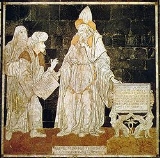
Hermes Trismegistus is the eponymous author of the Hermetic Corpus, a sacred text belonging to the genre of divine revelation.
Origin and identity
He may be a representation of the
syncreticSyncretism is the combining of different beliefs, often while melding practices of various schools of thought. The term means "combining", but see below for the origin of the word...
combination of the
GreekGreek mythology is the body of myths and legends belonging to the ancient Greeks, concerning their gods and heroes, the nature of the world, and the origins and significance of their own cult and ritual practices. They were a part of religion in ancient Greece...
god
HermesHermes is the great messenger of the gods in Greek mythology and a guide to the Underworld. Hermes was born on Mount Kyllini in Arcadia. An Olympian god, he is also the patron of boundaries and of the travelers who cross them, of shepherds and cowherds, of the cunning of thieves, of orators and...
and the Egyptian god
ThothThoth was considered one of the more important deities of the Egyptian pantheon. In art, he was often depicted as a man with the head of an ibis or a baboon, animals sacred to him. His feminine counterpart was Seshat...
. In Hellenistic Egypt, the Greeks recognised the congruence of their god
HermesHermes is the great messenger of the gods in Greek mythology and a guide to the Underworld. Hermes was born on Mount Kyllini in Arcadia. An Olympian god, he is also the patron of boundaries and of the travelers who cross them, of shepherds and cowherds, of the cunning of thieves, of orators and...
with the Egyptian god
ThothThoth was considered one of the more important deities of the Egyptian pantheon. In art, he was often depicted as a man with the head of an ibis or a baboon, animals sacred to him. His feminine counterpart was Seshat...
. Subsequently the two gods were worshipped as one in what had been the Temple of Thoth in
KhemnuHermopolis Magna or simply Hermopolis or Hermopolis Megale or Hermupolis is the site of ancient Khmun, and is located near the modern Egyptian town of El Ashmunein in Al Minya governorate.-Etymology:Khmun, the Ancient Egyptian name of the city, means "eight-town", after the Ogdoad, a group of...
, which the Greeks called
HermopolisHermopolis Magna or simply Hermopolis or Hermopolis Megale or Hermupolis is the site of ancient Khmun, and is located near the modern Egyptian town of El Ashmunein in Al Minya governorate.-Etymology:Khmun, the Ancient Egyptian name of the city, means "eight-town", after the Ogdoad, a group of...
.
Both
ThothThoth was considered one of the more important deities of the Egyptian pantheon. In art, he was often depicted as a man with the head of an ibis or a baboon, animals sacred to him. His feminine counterpart was Seshat...
and
HermesHermes is the great messenger of the gods in Greek mythology and a guide to the Underworld. Hermes was born on Mount Kyllini in Arcadia. An Olympian god, he is also the patron of boundaries and of the travelers who cross them, of shepherds and cowherds, of the cunning of thieves, of orators and...
were gods of
writingWriting is the representation of language in a textual medium through the use of a set of signs or symbols . It is distinguished from illustration, such as cave drawing and painting, and non-symbolic preservation of language via non-textual media, such as magnetic tape audio.Writing most likely...
and of
magicMagical thinking in various forms is a cultural universal and an important aspect of religion.In many cases it becomes difficult or impossible to draw any meaningful line between beliefs and practices that are magical versus those that are religious, but in general the term religion is reserved for...
in their respective cultures. Thus, the Greek god of interpretive communication was combined with the Egyptian god of wisdom as a patron of
astrologyAstrology consists of a number of belief systems which hold that there is a relationship between astronomical phenomena and events in the human world...
and alchemy. In addition, both gods were
psychopompPsychopomps are creatures, spirits, angels, or deities in many religions whose responsibility is to escort newly deceased souls to the afterlife. Their role is not to judge the deceased, but simply provide safe passage...
s; guiding souls to the afterlife. The Egyptian Priest and Polymath
ImhotepImhotep , fl. 27th century BC was an Egyptian polymath, who served under the Third Dynasty king Djoser as chancellor to the pharaoh and high priest of the sun god Ra at Heliopolis...
had been deified long after his death and therefore assimilated to Thoth in the classical and hellenistic period. The renowned scribe Amenhotep and a wise man named Teôs were equally deified as gods of wisdom, science and medicine and thus placed alongside to Imhotep in shrines dedicated to Thoth-Hermes during the
PtolemaicThe Ptolemaic dynasty, was a Macedonian Greek royal family which ruled the Ptolemaic Empire in Egypt during the Hellenistic period. Their rule lasted for 275 years, from 305 BC to 30 BC...
period These associations to Thoth-Hermes could partially explain why some later greek scholars linked Hermes Trismegistus to a hypothetical historical figure, given the numerous deifications.
A
MycenaeanMycenaean Greek is the most ancient attested form of the Greek language, spoken on the Greek mainland, Crete and Cyprus in the 16th to 12th centuries BC, before the hypothesised Dorian invasion which was often cited as the terminus post quem for the coming of the Greek language to Greece...
Greek reference found on a
Linear BLinear B is a syllabic script that was used for writing Mycenaean Greek, an early form of Greek. It pre-dated the Greek alphabet by several centuries and seems to have died out with the fall of Mycenaean civilization...
clay tablet at
PylosPylos , historically known under its Italian name Navarino, is a town and a former municipality in Messenia, Peloponnese, Greece. Since the 2011 local government reform it is part of the municipality Pylos-Nestoras, of which it is the seat and a municipal unit. It was the capital of the former...
to a deity or semi-deity called
TI-RI-SE-RO-E, Trisheros (the "thrice or triple hero") could be connected to the later epithet "thrice wise" "Trismegistos", applied to Hermes/Thoth. On the same Tn 316 tablet as well as other
Linear BLinear B is a syllabic script that was used for writing Mycenaean Greek, an early form of Greek. It pre-dated the Greek alphabet by several centuries and seems to have died out with the fall of Mycenaean civilization...
tablets, found in Pylos and Knossos, appears the name of the deity "Hermes" as E-MA-A, but not in any apparent connection with the "Trisheros". This interpretation of poorly understood Mycenaean material is disputed, since Hermes Trismegistus is not referenced in any of the copious sources before he emerges in Hellenistic Egypt.
The majority of
GreeksAncient Greece is a civilization belonging to a period of Greek history that lasted from the Archaic period of the 8th to 6th centuries BC to the end of antiquity. Immediately following this period was the beginning of the Early Middle Ages and the Byzantine era. Included in Ancient Greece is the...
, and later
RomansAncient Rome was a thriving civilization that grew on the Italian Peninsula as early as the 8th century BC. Located along the Mediterranean Sea and centered on the city of Rome, it expanded to one of the largest empires in the ancient world....
, did not accept Hermes Trismegistos in the place of Hermes. The two gods remained distinct from one another. Cicero noted several individuals referred to as "Hermes": "the fifth, who is worshipped by the people of Pheneus [in
ArcadiaArcadia is one of the regional units of Greece. It is part of the administrative region of Peloponnese. It is situated in the central and eastern part of the Peloponnese peninsula. It takes its name from the mythological character Arcas. In Greek mythology, it was the home of the god Pan...
], is said to have killed
ArgusIn Greek mythology, Argus Panoptes or Argos, guardian of the heifer-nymph Io and son of Arestor, was a primordial giant whose epithet "Panoptes", "all-seeing", led to his being described with multiple, often one hundred, eyes. The epithet Panoptes was applied to the Titan of the Sun, Helios, and...
, and for this reason to have fled to Egypt, and to have given the Egyptians their laws and alphabet: he it is whom the Egyptians call
TheytThoth was considered one of the more important deities of the Egyptian pantheon. In art, he was often depicted as a man with the head of an ibis or a baboon, animals sacred to him. His feminine counterpart was Seshat...
." In the same place, Cicero mentions a "fourth
MercuryMercury was a messenger who wore winged sandals, and a god of trade, the son of Maia Maiestas and Jupiter in Roman mythology. His name is related to the Latin word merx , mercari , and merces...
(Hermes) was the son of the Nile, whose name may not be spoken by the Egyptians." The most likely interpretation of this passage is as two variants on the same
syncretismSyncretism is the combining of different beliefs, often while melding practices of various schools of thought. The term means "combining", but see below for the origin of the word...
of Greek Hermes and Egyptian Thoth (or sometimes other gods); the one viewed from the Greek-Arcadian perspective (the fifth, who went from Greece to Egypt), the other viewed from the Egyptian perspective (the fourth, where Hermes turns out "actually" to have been a "son of the Nile," i.e. a native god). Both these very good early references in Cicero (most ancient Trismegistus material is from early centuries CE) corroborate the view that Thrice-Great Hermes originated in Hellenistic Egypt through syncretism with Egyptian gods (the
Hermetica refer most often to Thoth and Amun).
The Hermetic literature added to the Egyptian concerns with conjuring spirits and animating statues that inform the oldest texts, Hellenistic writings of Greco-
BabylonBabylon was an Akkadian city-state of ancient Mesopotamia, the remains of which are found in present-day Al Hillah, Babil Province, Iraq, about 85 kilometers south of Baghdad...
ian astrology and the newly developed practice of alchemy (Fowden 1993: pp65–68). In a parallel tradition, Hermetic philosophy rationalized and systematized religious
cult practicesThe word cult in current popular usage usually refers to a group whose beliefs or practices are considered abnormal or bizarre. The word originally denoted a system of ritual practices...
and offered the adept a method of personal ascension from the constraints of physical being, which has led to confusion of Hermeticism with
GnosticismGnosticism is a scholarly term for a set of religious beliefs and spiritual practices common to early Christianity, Hellenistic Judaism, Greco-Roman mystery religions, Zoroastrianism , and Neoplatonism.A common characteristic of some of these groups was the teaching that the realisation of Gnosis...
, which was developing contemporaneously.
As a divine source of wisdom, Hermes Trismegistus was credited with tens of thousands of writings of high standing, reputed to be of immense antiquity.
PlatoPlato , was a Classical Greek philosopher, mathematician, student of Socrates, writer of philosophical dialogues, and founder of the Academy in Athens, the first institution of higher learning in the Western world. Along with his mentor, Socrates, and his student, Aristotle, Plato helped to lay the...
's
TimaeusTimaeus is one of Plato's dialogues, mostly in the form of a long monologue given by the title character, written circa 360 BC. The work puts forward speculation on the nature of the physical world and human beings. It is followed by the dialogue Critias.Speakers of the dialogue are Socrates,...
and
CritiasCritias, one of Plato's late dialogues, contains the story of the mighty island kingdom Atlantis and its attempt to conquer Athens, which failed due to the ordered society of the Athenians...
state that in the temple of
NeithIn Egyptian mythology, Neith was an early goddess in the Egyptian pantheon. She was the patron deity of Sais, where her cult was centered in the Western Nile Delta of Egypt and attested as early as the First Dynasty...
at
SaisSAIS can refer to:* Paul H. Nitze School of Advanced International Studies, part of The Johns Hopkins University.* Sharjah American International School* Southern Association of Independent Schools...
, there were secret halls containing historical records which had been kept for 9,000 years.
Clement of AlexandriaTitus Flavius Clemens , known as Clement of Alexandria , was a Christian theologian and the head of the noted Catechetical School of Alexandria. Clement is best remembered as the teacher of Origen...
was under the impression that the Egyptians had forty-two sacred writings by Hermes, encapsulating all the training of Egyptian priests. Siegfried Morenz has suggested (
Egyptian Religion) "The reference to Thoth's authorship...is based on ancient tradition; the figure forty-two probably stems from the number of Egyptian
nomesA nome was a subnational administrative division of ancient Egypt. Today's use of the Greek nome rather than the Egyptian term sepat came about during the Ptolemaic period. Fascinated with Egypt, Greeks created many historical records about the country...
, and thus conveys the notion of completeness." The
Neo-PlatonicNeoplatonism , is the modern term for a school of religious and mystical philosophy that took shape in the 3rd century AD, based on the teachings of Plato and earlier Platonists, with its earliest contributor believed to be Plotinus, and his teacher Ammonius Saccas...
writers took up Clement's "forty-two essential texts".
The
HermeticaThe Hermetica are Greek wisdom texts from the 2nd and 3rd centuries CE, mostly presented as dialogues in which a teacher, generally identified with Hermes Trismegistus or "thrice-greatest Hermes", enlightens a disciple...
, is a category of
papyriPapyrus is a thick paper-like material produced from the pith of the papyrus plant, Cyperus papyrus, a wetland sedge that was once abundant in the Nile Delta of Egypt....
containing spells and initiatory induction procedures. In the dialogue called the
AsclepiusAsclepius is the God of Medicine and Healing in ancient Greek religion. Asclepius represents the healing aspect of the medical arts; his daughters are Hygieia , Iaso , Aceso , Aglæa/Ægle , and Panacea...
(after the Greek god of healing) the art of imprisoning the souls of demons or of angels in statues with the help of herbs, gems and odors, is described, such that the statue could speak and engage in prophecy. In other papyri, there are recipes for constructing such images and animating them, such as when images are to be fashioned hollow so as to enclose a
magicMagic is the claimed art of manipulating aspects of reality either by supernatural means or through knowledge of occult laws unknown to science. It is in contrast to science, in that science does not accept anything not subject to either direct or indirect observation, and subject to logical...
name inscribed on gold leaf.
Thrice Great
The origin of the description
Trismegistus or "thrice great" is unclear. Copenhaver reports that this name is first found in the minutes of a meeting of the council of the
IbisThe ibises are a group of long-legged wading birds in the family Threskiornithidae....
cultThe word cult in current popular usage usually refers to a group whose beliefs or practices are considered abnormal or bizarre. The word originally denoted a system of ritual practices...
, held in 172 BCE near
MemphisMemphis was the ancient capital of Aneb-Hetch, the first nome of Lower Egypt. Its ruins are located near the town of Helwan, south of Cairo.According to legend related by Manetho, the city was founded by the pharaoh Menes around 3000 BC. Capital of Egypt during the Old Kingdom, it remained an...
in Egypt. Fowden however asserts that the earliest occurrence of the name was in the Athenagora by
Philo of ByblosPhilo of Byblos was an antiquarian writer of grammatical, lexical and historical works in Greek. He is chiefly known for his Phoenician history assembled from the writings of Sanchuniathon.-Life:...
circa 64–141 CE. Another explanation is that the name is derived from an epithet of Thoth found at the Temple of
EsnaEsna , known to the ancient Egyptians as Egyptian: Iunyt or Ta-senet; Greek: or or ; Latin: Lato, is a city in Egypt. It is located on the west bank of the River Nile, some 55 km south of Luxor...
, "Thoth the great, the great, the great." The date of his sojourn in Egypt in his last incarnation is not now known, but it has been fixed at the early days of the oldest dynasties of Egypt, long before the days of
MosesMoses was, according to the Hebrew Bible and Qur'an, a religious leader, lawgiver and prophet, to whom the authorship of the Torah is traditionally attributed...
. Some authorities regard him as a contemporary of
AbrahamAbraham , whose birth name was Abram, is the eponym of the Abrahamic religions, among which are Judaism, Christianity and Islam...
, and some Jewish traditions go so far as to claim that Abraham acquired a portion of his mystical knowledge from Hermes himself (
KybalionThe Kybalion: Hermetic Philosophy is a 1908 book claiming to be the essence of the teachings of Hermes Trismegistus, published anonymously by a group or person under the pseudonym of "the Three Initiates".- General description :...
).
Many Christian writers, including
LactantiusLucius Caecilius Firmianus Lactantius was an early Christian author who became an advisor to the first Christian Roman emperor, Constantine I, guiding his religious policy as it developed, and tutor to his son.-Biography:...
, Augustine,
Giordano BrunoGiordano Bruno , born Filippo Bruno, was an Italian Dominican friar, philosopher, mathematician and astronomer. His cosmological theories went beyond the Copernican model in proposing that the Sun was essentially a star, and moreover, that the universe contained an infinite number of inhabited...
,
Marsilio FicinoMarsilio Ficino was one of the most influential humanist philosophers of the early Italian Renaissance, an astrologer, a reviver of Neoplatonism who was in touch with every major academic thinker and writer of his day, and the first translator of Plato's complete extant works into Latin...
,
CampanellaTommaso Campanella OP , baptized Giovanni Domenico Campanella, was an Italian philosopher, theologian, astrologer, and poet.-Biography:...
and
Giovanni Pico della MirandolaCount Giovanni Pico della Mirandola was an Italian Renaissance philosopher. He is famed for the events of 1486, when at the age of 23, he proposed to defend 900 theses on religion, philosophy, natural philosophy and magic against all comers, for which he wrote the famous Oration on the Dignity of...
considered Hermes Trismegistus to be a wise pagan prophet who foresaw the coming of Christianity. They believed in a
prisca theologiaPrisca theologia is the doctrine within the field of comparative religious studies that asserts that a single, true, theology exists, which threads through all religions, and which was given by god to man in antiquity...
, the doctrine that a single, true theology exists, which threads through all religions, and which was given by God to man in antiquity and passed through a series of prophets, which included
ZoroasterZoroaster , also known as Zarathustra , was a prophet and the founder of Zoroastrianism who was either born in North Western or Eastern Iran. He is credited with the authorship of the Yasna Haptanghaiti as well as the Gathas, hymns which are at the liturgical core of Zoroastrianism...
and
PlatoPlato , was a Classical Greek philosopher, mathematician, student of Socrates, writer of philosophical dialogues, and founder of the Academy in Athens, the first institution of higher learning in the Western world. Along with his mentor, Socrates, and his student, Aristotle, Plato helped to lay the...
. In order to demonstrate the verity of the
prisca theologia Christians appropriated the Hermetic teachings for their own purposes. By this account Hermes Trismegistus was either, according to the fathers of the Christian church, a contemporary of Moses or the third in a line of men named Hermes, i.e. Enoch, Noah and the Egyptian priest king who is known to us as Hermes Trismegistus, or "thrice great" on account of being the greatest priest, philosopher and king.
This last account of how Hermes Trismegistus received the appellation "Trismegistus," meaning "Thrice Great," is derived from statements in the
The Emerald Tablet of Hermes TrismegistusThe Emerald Tablet, also known as Smaragdine Table, Tabula Smaragdina, or The Secret of Hermes, is a text purporting to reveal the secret of the primordial substance and its transmutations...
, that he knows the three parts of the wisdom of the whole universe. The three parts of the wisdom are
alchemyAlchemy is an influential philosophical tradition whose early practitioners’ claims to profound powers were known from antiquity. The defining objectives of alchemy are varied; these include the creation of the fabled philosopher's stone possessing powers including the capability of turning base...
,
astrologyAstrology consists of a number of belief systems which hold that there is a relationship between astronomical phenomena and events in the human world...
, and
theurgyTheurgy describes the practice of rituals, sometimes seen as magical in nature, performed with the intention of invoking the action or evoking the presence of one or more gods, especially with the goal of uniting with the divine, achieving henosis, and perfecting oneself.- Definitions :*Proclus...
. The pymander, from which Marsilio Ficino formed his opinion, states that "they called him Trismegistus because he was the greatest philosopher and the greatest priest and the greatest king".
Another explanation, in the
SudaThe Suda or Souda is a massive 10th century Byzantine encyclopedia of the ancient Mediterranean world, formerly attributed to an author called Suidas. It is an encyclopedic lexicon, written in Greek, with 30,000 entries, many drawing from ancient sources that have since been lost, and often...
(10th century), is that "He was called Trismegistus on account of his praise of the trinity, saying there is one divine nature in the trinity."
Hermetic writings
The
AsclepiusAsclepius is the God of Medicine and Healing in ancient Greek religion. Asclepius represents the healing aspect of the medical arts; his daughters are Hygieia , Iaso , Aceso , Aglæa/Ægle , and Panacea...
and the
Corpus HermeticumThe Hermetica are Greek wisdom texts from the 2nd and 3rd centuries CE, mostly presented as dialogues in which a teacher, generally identified with Hermes Trismegistus or "thrice-greatest Hermes", enlightens a disciple...
are the most important of the
HermeticaThe Hermetica are Greek wisdom texts from the 2nd and 3rd centuries CE, mostly presented as dialogues in which a teacher, generally identified with Hermes Trismegistus or "thrice-greatest Hermes", enlightens a disciple...
, writings attributed to Hermes Trismegistus, which survive. During the
RenaissanceThe Renaissance was a cultural movement that spanned roughly the 14th to the 17th century, beginning in Italy in the Late Middle Ages and later spreading to the rest of Europe. The term is also used more loosely to refer to the historical era, but since the changes of the Renaissance were not...
it was accepted that Hermes Trismegistus was a contemporary of Moses, however after
Casaubon’sIsaac Casaubon was a classical scholar and philologist, first in France and then later in England, regarded by many of his time as the most learned in Europe.-Early life:...
dating of the Hermetic writings as no earlier than the second or third century CE, the whole of Renaissance Hermeticism collapsed. As to their actual authorship:
Hermes Trismegistus is described in the Corpus Hermeticum in a
EuhemeristEuhemerus was a Greek mythographer at the court of Cassander, the king of Macedon. Euhemerus' birthplace is disputed, with Messina in Sicily as the most probable location, while others champion Chios, or Tegea.-Life:...
fashion, as a man who became a god, or as a man who was the son of a god.
Hermetic revival
- For the main article, see Hermeticism
Hermeticism or the Western Hermetic Tradition is a set of philosophical and religious beliefs based primarily upon the pseudepigraphical writings attributed to Hermes Trismegistus...
. For the texts of the Corpus Hermeticum, see HermeticaThe Hermetica are Greek wisdom texts from the 2nd and 3rd centuries CE, mostly presented as dialogues in which a teacher, generally identified with Hermes Trismegistus or "thrice-greatest Hermes", enlightens a disciple...
.
During the
Middle AgesThe Middle Ages is a periodization of European history from the 5th century to the 15th century. The Middle Ages follows the fall of the Western Roman Empire in 476 and precedes the Early Modern Era. It is the middle period of a three-period division of Western history: Classic, Medieval and Modern...
and the
RenaissanceThe Renaissance was a cultural movement that spanned roughly the 14th to the 17th century, beginning in Italy in the Late Middle Ages and later spreading to the rest of Europe. The term is also used more loosely to refer to the historical era, but since the changes of the Renaissance were not...
, the writings attributed to Hermes Trismegistus, known as
HermeticaThe Hermetica are Greek wisdom texts from the 2nd and 3rd centuries CE, mostly presented as dialogues in which a teacher, generally identified with Hermes Trismegistus or "thrice-greatest Hermes", enlightens a disciple...
, enjoyed great prestige and were popular among alchemists. The "hermetic tradition" consequently refers to alchemy, magic, astrology and related subjects. The texts are usually divided into two categories: the "philosophical", and the "technical" hermetica. The former deals mainly with issues of
philosophyPhilosophy is the study of general and fundamental problems, such as those connected with existence, knowledge, values, reason, mind, and language. Philosophy is distinguished from other ways of addressing such problems by its critical, generally systematic approach and its reliance on rational...
, and the latter with practical magic, potions and alchemy. Spells to magically protect objects, for example, are the origin of the expression "Hermetically sealed".
The classical scholar
Isaac CasaubonIsaac Casaubon was a classical scholar and philologist, first in France and then later in England, regarded by many of his time as the most learned in Europe.-Early life:...
in
De rebus sacris et ecclesiasticis exercitationes XVI (1614) showed, through an analysis of the Greek language used in the texts, that those texts which were believed to be of ancient origin were in fact much more recent: most of the "philosophical"
Corpus Hermeticum can be dated to around AD 300. However, flaws in this dating were discerned by the 17th century scholar
Ralph CudworthRalph Cudworth was an English philosopher, the leader of the Cambridge Platonists.-Life:Born at Aller, Somerset, he was educated at Emmanuel College, Cambridge, gaining his MA and becoming a Fellow of Emmanuel in 1639. In 1645, he became master of Clare Hall and professor of Hebrew...
, who argued that Casaubon's allegation of forgery could only be applied to three of the seventeen treatises contained within the
Corpus Hermeticum. Moreover, Cudworth noted Casaubon's failure to acknowledge the codification of these treatises as a late formulation of a pre-existing oral tradition. According to Cudworth, the texts must be viewed as a
terminus ad quemTerminus post quem and terminus ante quem specify approximate dates for events...
and not
a quo.
In Islamic tradition
Antoine FaivreAntoine Faivre is a prominent French scholar of esoterism. Until his retirement, he held a chair in the École Pratique des Hautes Études at the Sorbonne, University Professor of Germanic Studies at the University of Haute-Normandie, director of the Cahiers del Hermétisme and of Bibliothèque de...
, in
The Eternal Hermes (1995) has pointed out that Hermes Trismegistus has a place in the
IslamIslam . The most common are and . : Arabic pronunciation varies regionally. The first vowel ranges from ~~. The second vowel ranges from ~~~...
ic tradition, though the name
HermesHermes is the great messenger of the gods in Greek mythology and a guide to the Underworld. Hermes was born on Mount Kyllini in Arcadia. An Olympian god, he is also the patron of boundaries and of the travelers who cross them, of shepherds and cowherds, of the cunning of thieves, of orators and...
does not appear in the
Qur'anThe Quran , also transliterated Qur'an, Koran, Alcoran, Qur’ān, Coran, Kuran, and al-Qur’ān, is the central religious text of Islam, which Muslims consider the verbatim word of God . It is regarded widely as the finest piece of literature in the Arabic language...
. Hagiographers and chroniclers of the first centuries of the Islamic
HegiraThe Hijra is the migration or journey of the Islamic prophet Muhammad and his followers from Mecca to Medina in 622 CE. Alternate spellings of this Arabic word are Hijrah, Hijrat or Hegira, the latter following the spelling rules of Latin.- Hijra of Muhammad :In September 622, warned of a plot to...
quickly identified Hermes Trismegistus with
IdrisIdris‘ is an Islamic prophet mentioned in the Qur'an whom the Qur'an says was exalted by God to a high station in life. Although Idris is, at times, identified with the Biblical Enoch, the true Biblical identity of Idris remains uncertain...
, the
nabiMuslims identify the Prophets of Islam as those humans chosen by God and given revelation to deliver to mankind. Muslims believe that every prophet was given a belief to worship God and their respective followers believed it as well...
of
suraA sura is a division of the Qur'an, often referred to as a chapter. The term chapter is sometimes avoided, as the suras are of unequal length; the shortest sura has only three ayat while the longest contains 286 ayat...
hs 19.57 and 21.85, whom the
Arabs also identified with
EnochEnoch is a figure in the Generations of Adam. Enoch is described as Adam's greatx4 grandson , the son of Jared, the father of Methuselah, and the great-grandfather of Noah...
(cf. Genesis 5.18–24). Idris/Hermes was termed "Thrice-Wise" Hermes Trismegistus because he had a threefold origin: the first Hermes, comparable to
ThothThoth was considered one of the more important deities of the Egyptian pantheon. In art, he was often depicted as a man with the head of an ibis or a baboon, animals sacred to him. His feminine counterpart was Seshat...
, was a "civilizing hero," an initiator into the mysteries of the divine science and wisdom that animate the world: he carved the principles of this sacred science in hieroglyphs. The second Hermes, in
BabylonBabylon was an Akkadian city-state of ancient Mesopotamia, the remains of which are found in present-day Al Hillah, Babil Province, Iraq, about 85 kilometers south of Baghdad...
, was the initiator of
PythagorasPythagoras of Samos was an Ionian Greek philosopher, mathematician, and founder of the religious movement called Pythagoreanism. Most of the information about Pythagoras was written down centuries after he lived, so very little reliable information is known about him...
. The third Hermes was the first teacher of
alchemyAlchemy is an influential philosophical tradition whose early practitioners’ claims to profound powers were known from antiquity. The defining objectives of alchemy are varied; these include the creation of the fabled philosopher's stone possessing powers including the capability of turning base...
. "A faceless prophet," writes the Islamicist Pierre Lory, "Hermes possesses no concrete or salient characteristics, differing in this regard from most of the major figures of the Bible and the Quran." A common interpretation of the representation of "Trismegistus" as "thrice great" recalls the three characterizations of Idris: as a messenger of god, or a prophet; as a source of wisdom, or
hikmet (wisdom from
hokmah); and as a king of the world order, or a "sultanate." These are referred to as,
müselles bin ni'me.
In the Bahá'í writings
Bahá'u'lláhBahá'u'lláh , born ' , was the founder of the Bahá'í Faith. He claimed to be the prophetic fulfilment of Bábism, a 19th-century outgrowth of Shí‘ism, but in a broader sense claimed to be a messenger from God referring to the fulfilment of the eschatological expectations of Islam, Christianity, and...
, founder of the
Bahá'í FaithThe Bahá'í Faith is a monotheistic religion founded by Bahá'u'lláh in 19th-century Persia, emphasizing the spiritual unity of all humankind. There are an estimated five to six million Bahá'ís around the world in more than 200 countries and territories....
, in a
TabletA tablet, in the religious context, is a term traditionally used for religious texts.Jews and Christians believe that Moses brought the Ten Commandments from Mount Sinai in the form of two stone tablets. According to the Book of Exodus, God delivered the tablets twice, the first set having been...
identifies Idris with Hermes. He does not, however, specifically name Idris as the prophet of the
SabiansThe Sabians of Middle Eastern tradition were a monotheistic Abrahamic religious group mentioned three times in the Quran: "the Jews, the Sabians, and the Christians." In the Hadith they are nothing but converts to Islam, while their identity in later Islamic literature became a matter of...
.
New Age revival
Modern occultists suggest that some Hermetic texts may be of Pharaonic origin, and that the legendary "forty-two essential texts" that contain the core Hermetic religious beliefs and philosophy of life remain hidden in a secret library.
In some trance "readings" of
Edgar CayceEdgar Cayce was an American psychic who allegedly had the ability to give answers to questions on subjects such as healing or Atlantis while in a hypnotic trance...
, Hermes or Thoth was an engineer from the submerged
AtlantisAtlantis is a legendary island first mentioned in Plato's dialogues Timaeus and Critias, written about 360 BC....
, who also built, designed or directed the construction of the
Pyramids of EgyptThe Egyptian pyramids are ancient pyramid-shaped masonry structures located in Egypt.There are 138 pyramids discovered in Egypt as of 2008. Most were built as tombs for the country's Pharaohs and their consorts during the Old and Middle Kingdom periods.The earliest known Egyptian pyramids are found...
.
Spiritual writer Tom DeLiso claims that Hermes Trismegistus taught him in out of body states and that Hermes Trismegistus is a newer incarnation of Thoth. Both are conscious energy constructs without bodies.
The book
KybalionThe Kybalion: Hermetic Philosophy is a 1908 book claiming to be the essence of the teachings of Hermes Trismegistus, published anonymously by a group or person under the pseudonym of "the Three Initiates".- General description :...
, by "The Three Initiates", addresses Hermetic principles.
Within the occult tradition, Hermes Trismegistus is associated with several wives, and more than one son who took his name, as well as more than one grandson. This repetition of given name and surname throughout the generations may at least partially account for the legend of his longevity, especially as it is believed that many of his children pursued careers as priests in mystery religions.
See also
- Alchemy
Alchemy is an influential philosophical tradition whose early practitioners’ claims to profound powers were known from antiquity. The defining objectives of alchemy are varied; these include the creation of the fabled philosopher's stone possessing powers including the capability of turning base...
- Astrology
Astrology consists of a number of belief systems which hold that there is a relationship between astronomical phenomena and events in the human world...
- Emerald Tablet
The Emerald Tablet, also known as Smaragdine Table, Tabula Smaragdina, or The Secret of Hermes, is a text purporting to reveal the secret of the primordial substance and its transmutations...
- Hermetic (disambiguation)
- Hermetica
The Hermetica are Greek wisdom texts from the 2nd and 3rd centuries CE, mostly presented as dialogues in which a teacher, generally identified with Hermes Trismegistus or "thrice-greatest Hermes", enlightens a disciple...
- Hermeticism
Hermeticism or the Western Hermetic Tradition is a set of philosophical and religious beliefs based primarily upon the pseudepigraphical writings attributed to Hermes Trismegistus...
- Hermetic Qabalah
Hermetic Qabalah is a Western esoteric and mystical tradition...
- Kybalion
The Kybalion: Hermetic Philosophy is a 1908 book claiming to be the essence of the teachings of Hermes Trismegistus, published anonymously by a group or person under the pseudonym of "the Three Initiates".- General description :...
- Occultism
- Herbert Silberer
Herbert Silberer was a Viennese psychoanalyst involved with the professional circle surrounding Sigmund Freud which included other pioneers of psychological study as Carl Jung, Alfred Adler and others...
Further reading
- Copenhaver, Brian P. 1995.Hermetica: the Greek Corpus Hermeticum and the Latin Asclepius in a new English translation, with notes and introduction, Cambridge; New York, NY, USA: Cambridge University Press, 1995 ISBN 0-521-42543-3.
External links