

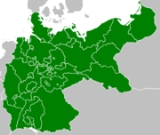
Geopolitik

Encyclopedia
Geopolitik is the branch of uniquely German geostrategy
. It developed as a distinct strain of thought after Otto von Bismarck
's unification of the German states but began its development in earnest only under Emperor Wilhelm II. Central concepts concerning the German race
, and regarding economic space, demonstrate continuity from the German Imperial
time up through Adolf Hitler
's Third Reich. However, Imperial geostrategist, German geopoliticians, and Nazi
strategists did not have extensive contacts with one another, suggesting that German geopolitik was not copied or passed on to successive generations, but perhaps reflected the more permanent aspects of German geography
, political geography
, and cultural geography
.
Geopolitik developed from widely varied sources, including the writings of Oswald Spengler
, Alexander Humboldt, Karl Ritter
, Friedrich Ratzel
, Rudolf Kjellén
, and Karl Haushofer
. It was eventually adapted to accommodate the ideology of Adolf Hitler
.
Its defining characteristic is the inclusion of organic
state theory, informed by Social Darwinism
. It was characterized by clash of civilizations
-style theorizing. It is perhaps the closest of any school of geostrategy to a purely nationalistic
conception of geostrategy, which ended up masking other more universal
elements.
Germany acted as a revisionist state within the international system
during both World Wars, attempting to overthrow British domination, and counter what it saw as rising American and Russian hegemony
. As a latecomer to nation
hood proper, lacking colonies
or market
s for industrial
output, but also experiencing rapid population growth
, Germany desired a more equitable distribution of wealth and territory within the international system. Modern scholars have begun to treat the two World Wars caused by Germany as one single war, in which the revisionist Germany attempted to bid for hegemonic control with which to reorder the international system. While the overt motivations were racial, as was the case with most conflicts in this time period, German foreign policy was largely consistent in both wars. The Nazi foreign policy was unique insofar as it learned from what it saw as past imperial mistakes, but essentially followed the very same designs laid out by German geopolitik and the historical record of the empire.
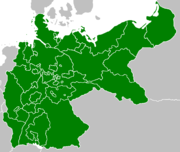 The origins of much of the policy later advocated by geopoliticians and implemented by the National Socialists would come out of the pre–World War I German imperial ambitions. They crafted the idea of Mitteleuropa
which would provide the foundation for later conceptions of lebensraum
and economic domination which would later inform geopolitician's theories on pan-region
s.
The accession of Wilhelm II to power released much of the German desire for "a place in the sun", demanding a policy of annexation to increase Germany's resources and prestige in Europe. Having come late to proper nationhood, Germany perceived itself as in a vulnerable position compared to the older and more established colonial nation-states. An anti-liberal
and anti-socialist
campaign was led to mobilize the petty bourgeois, those who lost the most to industrialization's fluctuations. This movement was linked to anti-Semitism
, first on a religious basis, then racial, then fused into a new racial nationalism
. The effort to create a Central Europe
an customs union
was justified as an attempt to save German culture
from the British, American, Russian and possibly Chinese
domination. Not simply economic in motivation, it was had a cultural, will to power
dimension. Wilhelm himself saw Germany's struggle as a conflict for existence against the races that feared German growth. He fully expected the "Anglo-Saxons
" to side with the "Gaul
s and Slav
s" in what he thought would be the last great war between the "Teuton and the Slav." He saw no hope in diplomacy
—this struggle was not a question of politics but of race. The racial mobilization of the petty bourgeois into a racially nationalist movement for expansionism, the conception of international politics as a struggle to save racial culture and values, and Germany's racial conflict being against the Slavs primarily, informed Germany's perception of its own place in Europe.
Germany's justification for seeking world power was based on being a young nation with high population growth, a low average national age, significant immigration
and urban expansion
. Germany was thus stirred to begin pushing for greater lebensraum and markets to accommodate their industrial expansion. Its borders were perceived to be too small to sustain its rapid growth, leading to a desire to split the entente
that was encircling it and preventing expansion. The most prominent German academic thought, including that of Friedrich Ratzel, declared dead peaceful competition between European states. Not top-down influences on the population, the academics were serving more as mouthpieces for larger societal forces. Mitteleuropa emerged as a concept in an attempt to reassert German power in the European system, and in a sense undo the decision to fall under Prussia
's small-Germany solution rather than Austro-Hungary's big-Germany plan. To secure Germany's place in Europe, many German people viewed World War I as simply defensive action against the victimization of encirclement and assault waged by the European Great Power
s, pushing until the end for safeguards and guarantees for the future of the German Empire.
 German nationalist sentiments were roused in the pre–World War I years by books like General Friedrich von Bernhardi
's Deutschland und der nächste Krieg clamoring for the elimination of France, the establishment of a Central European federation
, and the assumption of world power through colonial acquisitions. The core of the Second Reich's program was to create a Mitteleuropa of economic domination under German hegemony safe from France and Russia. This would be augmented by colonies chiefly in Central Africa
. Not only would fear of French and Russian power drive German imperialism but also growing American power was a further cause to unite Mitteleuropa under Germany, according to Walther Rathenau
's 1912 report, augmented by the resources from Mittelafrika
and Asia Minor
after the disarmament of Britain.
 Germany would display a consistent policy of annexation toward Mitteleuropa, attempting to establish a core consisting of a customs union with Austro-Hungary, to which smaller states would have to adhere. Conceived by Rathenau and Arthur von Gwinner, Theobald von Bethmann Hollweg would later adopt it, followed by Hans Delbrück
and Johannes Bell under the orders of the Chancellor. Mitteleuropa was pushed over the protests of the industrialists for essentially political reasons. Germany needed to be able to effectively compete with larger trading nations, so that this Austro-Hungarian Germany would not be dependent on imports, with the additional benefit that Germany would have a claim to successor
status if Austro-Hungary were to disintegrate. This would allow Germany to move away from protectionism
in their internal markets, toward aggression in the international markets, according to Delbrück. Further, German leaders had a desire to spread their values and cultural cohesion, in effect establishing something like the Anglo-Saxon world
, whose culture was viewed as a more important force than their unrivalled fleet
. What was essentially being pursued was autarky
, free from dependence on imports, with political and cultural rather than economic goals.
, much like Belgium in plans in the West. Even by 1917, Poland as a German satellite was an undiminished goal, even surpassing the desire for an Austro-Hungary dependent on the German economy. Hollweg would bring the frontier-strip policy toward Poland into the political arena by 1914. Poland would become Germany's strategic focus against Russia, serving as a front-line defense against the Slavs once settled with Germanic peoples. More than strategic, the Germans has a Völkish mission
to settle the land with German nationalists, and deport the Poles and Jews from the land, as a direct continuation of the historical Prusso-German Ostmark policy.
When no solution to the Polish question could be reached with Austria after the Brest-Litovsk treaty, Germany essentially dropped a pure Mitteleuropa plan in favor of a policy of Ostraum, because Poland was still the key to the Ukraine
, Russia and Southeast Europe
an states that were the goal of German economic domination. When total annexation of the East was denied Germany by Russia, Germany accepted the idea of small, autonomous middle-tier states, free from Russian troops, but associated with Germany economically. The Austro-Hungarian problem was solved with a long-term close political, military and economic alliance. Instead of a formal Mitteleuropa, Germany pushed for control over resource rich areas on its borders, which would push France, Belgium, Poland and Austro-Hungary into de facto dependency. Thus, the central piece of Germany's Mitteleuropa was the desire for economic domination of the Eastern Slavic countries, with a central focus on Poland as the strategic key.
in favor of nationalist tariff
protectionism for heavy industry
and large-scale agriculture
. However, the center of Wilhelm's policy would be the construction of a new fleet—sea power being the key to Great Power status—with a revisionist eye toward existing colonial possessions around the world. Still, Germany would pursue a mercantilist
economic policy with state support for large industry, intervention into markets, and the nationalization of public good
s. Rudolph Kjellén would call for an economic federation in Central Europe for the purpose of extending German colonial possessions, a sentiment endorsed by many Germans before 1914.
However, economic growth
would increasingly bring Germany into conflict with England, with two distinct paths open to the empire: naval conflict with England; or land expansion within Europe. German industry demanded political independence from British hegemony in world politics, the shattering of Russian influence, and the annexation of weak states on Germany's border for their resources. But to break dependency on Britain, Germany required a formidable merchant marine force, which it would not have despite Wilhelm's aims. As a kind of half-measure, Germany realized that it should pursue alliance with Italy, and encourage the strengthening of its naval presence in the Mediterranean in order to counter what British influence they could.
.
Geostrategy as a political science
is both descriptive and analytical like Political Geography, but adds a normative
element in its strategic prescriptions for national policy. While it stems from earlier American and British geostrategy, German geopolitik adopts an essentialist outlook toward the national interest, oversimplifying issues and representing itself as a panacea
. As a new and essentialist ideology
, geopolitik found itself in a position to prey upon the post–World War I insecurity
of the populace.
In 1919, General Karl Haushofer would become professor of geography at the University of Munich. This would serve as a platform for the spread of his geopolitical ideas, magazine articles and books. By 1924, as the leader of the German geopolitik school of thought, Haushofer would establish the Zeitschrift für Geopolitik monthly devoted to geopolitik. His ideas would reach a wider audience with the publication of Volk ohne Raum by Hans Grimm
in 1926, popularizing his concept of lebensraum. Haushofer exercised influence both through his academic teachings, urging his students to think in terms of continent
s and emphasizing motion in international politics, and through his political activities. While Hitler's speeches would attract the masses, Haushofer's works served to bring the remaining intellectual
s into the fold.
Geopolitik was in essence a consolidation and codification of older ideas, given a scientific gloss:
The key reorientation in each dyad
is that the focus is on land-based empire
rather than naval imperialism.
Ostensibly based upon the geopolitical theory of American naval
officer Alfred Thayer Mahan
, and British geographer Halford J. Mackinder, German geopolitik adds older German ideas. Enunciated most forcefully by Friedrich Ratzel and his Swedish student Rudolf Kjellén, they include an organic or anthropomorphized conception of the state, and the need for self-sufficiency through the top-down organization of society. The root of uniquely German geopolitik rests in the writings of Karl Ritter who first developed the organic conception of the state that would later by elaborated upon by Ratzel and accepted by Hausfhofer. He justified lebensraum, even at the cost of other nation's existence because conquest was a biological necessity for a state's growth.
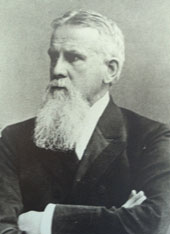 Ratzel's writings coincided with the growth of German industrialism after the Franco-Prussian war
and the subsequent search for markets that brought it into competition with England. His writings served as welcome justification for imperial expansion. Influenced by Mahan, Ratzel wrote of aspirations for German naval reach, agreeing that sea power was self-sustaining, as the profit from trade would pay for the merchant marine, unlike land power. Haushofer was exposed to Ratzel, who was friends with Haushofer's father, a teacher of economic geography
, and would integrate Ratzel's ideas on the division between sea and land powers into his theories, saying that only a country with both of those could overcome this conflict. Here, Hitler diverged with Haushofer's writings, in consigning Germany to sole pursuit of landpower.
Ratzel's key contribution was the expansion on the biological conception of geography, without a static conception of border
s. States are instead organic and growing, with borders representing only a temporary stop in their movement. It is not the state proper that is the organism, but the land in its spiritual
bond with the people who draw sustenance from it. The expanse of a state's borders is a reflection of the health of the nation. Haushofer adopts the view that borders are largely insignificant in his writings, especially as the nation ought to be in a frequent state of struggle with those around it.
Ratzel's idea of Raum would grow out of his organic state conception. This early lebensraum was not political or economic, but spiritual and racial nationalist expansion. The Raum-motiv is a historically driving force, pushing peoples with great Kultur to naturally expand. Space for Ratzel was a vague concept, theoretically unbounded just as was Hitler's. Raum was defined by where German peoples live, where other inferior states could serve to support German peoples economically, and where German culture could fertilize other cultures. Haushofer would adopt this conception of Raum as the central program for German geopolitik, while Hitler's policy would reflect the spiritual and cultural drive to expansion.
Kjellén disputed the solely legalistic
characterization of states, arguing that state and society
are not opposites, but rather a synthesis of the two elements. The state did have a responsibility for law and order
, but also for social welfare/progress
, and economic welfare
/progress.
Autarky, for Kjellén, was a solution to a political problem, not an economic policy
proper. Dependence on imports would mean that a country would never be independent. Territory would provide for internal production. For Germany, Central and Southeastern Europe were key, along with the Near East
and Africa. Haushofer was not interested in economic policy, but advocated autarky as well; a nation constantly in struggle would demand self-sufficiency.
s for action on lebensraum and world power.
Haushofer defined geopolitik in 1935 as "the duty to safeguard the right to the soil, to the land in the widest sense, not only the land within the frontiers of the Reich
but also the right to the more extensive Volk
and cultural lands." Culture itself was seen as the most conducive element to dynamic special expansion. It provided a guide as to the best areas for expansion, and could make expansion safe, whereas projected military or commercial power could not. Haushofer even held that urbanization was a symptom of a nation's decline by giviing evidence a decreasing soil mastery, birthrate, and effectiveness of centralized rule.
To Haushofer, the existence of a state depended on living space, the pursuit of which must serve as the basis for all policies. Germany had a high population density
, whereas the old colonial powers had a much lower density, a virtual mandate
for German expansion into resource-rich areas. Space was seen as military protection against initial assaults from hostile neighbors with long-range weaponry. A buffer zone of territories or insignificant states on one's borders would serve to protect Germany. Closely linked to this need, was Haushofer's assertion that the existence of small states was evidence of political regression and disorder in the international system. The small states surrounding Germany ought to be brought into the vital German order. These states were seen as being too small to maintain practical autonomy, even if they maintained large colonial possessions, and would be better served by protection and organization within Germany. In Europe, he saw Belgium, the Netherlands, Portugal, Denmark, Switzerland, Greece and the "mutilated alliance" of Austro-Hungary as supporting his assertion.
Haushofer's version of autarky was based on the quasi-Malthusian idea that the earth would become saturated with people and no longer able to provide food for all. There would essentially be no increases in productivity
.
Haushofer and the Munich school of geopolitik would eventually expand their conception of lebensraum and autarky well past the borders of 1914 and "a place in the sun" to a New European Order, then to a New Afro-European Order, and eventually to a Eurasia
n Order. This concept became known as a pan-region, taken from the American Monroe Doctrine, and the idea of national and continental self-sufficiency. This was a forward-looking refashioning of the drive for colonies, something that geopoliticians did not see as an economic necessity, but more as a matter of prestige, and putting pressure on older colonial powers. The fundamental motivating force would not be economic, but cultural and spiritual.
Beyond being an economic concept, pan-regions were a strategic concept as well. Haushofer acknowledges the strategic concept of the Heartland
put forward by the British geopolitician Halford Mackinder. If Germany could control Eastern Europe and subsequently Russian territory, it could control a strategic area to which hostile seapower could be denied. Allying with Italy and Japan would further augment German strategic control of Eurasia, with those states becoming the naval arms protecting Germany's insular position.
Rudolf Hess
, Hitler's secretary who would assist in the writing of Mein Kampf
, was a close student of Haushofer's. While Hess and Hitler were imprisoned after the Munich Putsch in 1923, Haushofer spent six hours visiting the two, bringing along a copy of Friedrich Ratzel's Political Geography and Carl von Clausewitz
's Vom Kriege
. After World War II, Haushofer would deny that he had taught Hitler, and claimed that the National Socialist party perverted Hess's study of geopolitik. He viewed Hitler as a half-educated man who never correctly understood the principles of geopolitik passed onto him by Hess, and Foreign Minister Joachim Ribbentrop as the principle distorter of geopolitik in Hitler's mind. While Haushofer accompanies Hess on numerous propaganda
missions, and participated in consultations between Nazis and Japanese leaders, he claimed that Hitler and the Nazis only seized upon half-developed ideas and catchword
s. Furthermore, the Nazi party and government lacked any official organ that was receptive to geopolitik, leading to selective adoption and poor interpretation of Haushofer's theories. Ultimately, Hess and Von Neurath, Nazi Minister of Foreign Affairs, were the only officials Haushofer judged to have had a proper understanding of geopolitik.
Father Edmund A. Walsh
S.J.
, professor of geopolitics
and dean
at Georgetown University
, who interviewed Haushofer after the allied victory in preparation for the Nuremberg trials
, disagreed with Haushofer's assessment that geopolitik was terribly distorted by Hitler and the Nazis. He cites Hitler's speeches declaring that small states have no right to exist and the Nazi use of Haushofer's maps, language and arguments. Even if distorted somewhat, Fr. Walsh felt that was enough to implicate Haushofer's geopolitik.
Haushofer also denied assisting Hitler in writing Mein Kampf, saying that he knew of it only once it was in print and never read it. Fr. Walsh found that even if Haushofer did not directly assist Hitler, discernible new elements appeared in Mein Kampf, as compared to previous speeches made by Hitler. Geopolitical ideas of lebensraum, space for depth of defense, appeals for natural frontiers, balancing land and seapower, and geographic analysis of military strategy entered Hitler's thought between his imprisonment and publishing of Mein Kampf. Chapter XIV, on German policy in Eastern Europe, in particular displays the influence of the materials Haushofer brought Hitler and Hess while they were imprisoned.
Haushofer was never an ardent Nazi, and did voice disagreements with the party, leading to his brief imprisonment. He did profess loyalty to the Führer
and make anti-Semitic remarks on occasion. However, his emphasis was always on space over race. He refused to associate himself with anti-Semitism as a policy, especially because his wife was half-Jewish. Haushofer admits that after 1933 much of what he wrote was distorted under duress: his wife had to be protected by Hess's influence; his son was murdered by the Gestapo
; he himself was imprisoned in Dachau concentration camp for eight months; and his son and grandson were imprisoned for two-and-a-half months.
' legalistic framework for European state relations, states had been drawn upon ethnically determined boundaries, following the tenets of Wilson
's Fourteen Points
speech. The first priority of the National Socialists was to focus on the racial aspects of foreign policy. Socialism
, on the other hand, is focused on the equitable distribution and redistribution of material goods within an economic system. As a latecomer to nationhood proper and industrialization, Germany was far behind other older colonial powers in the acquisition of territory abroad. Burdened with a burgeoning population, Germany had lagging ability to raise agricultural production to meet food demands, compete in markets for industrial goods, obtain cheap sources of raw materials, and find an acceptable outlet for emigration
. National Socialist foreign policy thus focused on what they perceived as a more equitable international redistribution of material resources and markets.
Hitler's foreign policy strategy can be divided into two main concepts: race and space. In 1928, Hitler dictated the text of a follow-up text to Mein Kampf focused on the elaboration of the foreign policy concepts he had previously set forth. Unedited and unpublished it allows a clearer picture of Hitler's thoughts than the edited and revised Mein Kampf, or his populist
and over-simplified speeches. There is a lack of development or major shifts in his worldview between the 1926 volume and his assumption of power in 1933, supporting the idea that Hitler was not a foreign policy opportunist, but that his ideas were specific and formed before he had the power to implement his designs.
Hitler outlined eight principles and four goals that were to guide his foreign policy. The principles were concerned with the German military, the League of Nations and the situation with France. Hitler's first concern was the reinvigoration of the German military, without which all other aims could not be achieved. The League of Nations was a prohibitive factor in the development and change of Germany because those with influence in the League were the very same states that had demanded Germany's crippling. Germany could not hope for allies found outside the League but for only discontent states that would be willing to break away. Those states would not be willing to leave unless Germany established a clear and articulated foreign policy, with clear costs and consequences, which the others could then follow. He cautions, however, that Germany cannot rely upon inferior allies (undesirable either by dint of their race or past military weakness). France, and the containment alliance it led against Germany, could not be challenged without the strong military Hitler envisioned and a decisive preemptive strike
. He recognized that no matter what path Germany takes to regain its strength, France would always assist or even lead a coalition
against it.
Hitler's goals for Nazi foreign policy were more straightforward, focusing on German space, rather than the strictly racial aspects of his policy. His designs are meant to give Germany the focus that it lacked in the previous thirty-five years of "aimlessness." He calls for a clear foreign policy of space, not international trade
or industry. The concept of lebensraum in the East overrided any perceived need for naval power, which would only bring Germany into conflict with England and Italy. Industrial exports and trade would require a merchant marine force, meeting most directly with the enmity of England, and France its willing ally. Therefore, land expansion was Hitler's primary goal, eschewing the borders of 1914, calling them nationally inadequate, militarily unsatisfactory, ethnically impossible, and insane when considered in light of Germany's opposition in Europe.
to remove them from power. He saw history as governed by the racial aspects of society, both internal and national. In his mind, a vulgar
ized sort of Social Darwinism determined the rise and fall of civilizations. The world was composed not of states, but of competing races of different values, and politics was fundamentally a struggle led by those with the greatest capacity for organization, a characteristic held by Germanic peoples more than any other. Nations of pure and strong racial makeup would eventually prosper over those with ideas of racial equality—France was condemned in this regard because of its acceptance of blacks
, and the use of black units in World War I against German troops. Acceptance of inferior races was intimately connected to the Jewish menace, and its threat to the strength of the Germanic race.
The vital strength of a race and its will to survive were the most important conditions which would lead to a resurgence of Germany, despite its lack of resources and materiel
. The reestablishment of a truly nationalist German army, free from the hired mercenaries of the imperial era, was Hitler's first goal. With the threat or use of force, Germany would be able to move forward in achieving its goals for space. Thus, he implemented the Four Year Plan
in order to overcome internal obstacles to military growth. A German army of considerable size would push its neighbors into conciliation and negotiation without the need for actual military adventures. In justifying the need for decisive military action, Hitler cites a lesson from World War I: those who are neutral
gain a little in trade, but lose their seat at the victor's table, and thus their right to decide the structure of the peace to follow. He thus renounced neutrality, and committed his country to taking vital risks that would lead to greater gains.
, not in trade and industry outlets that required a maritime orientation. He had no faith in increasing productivity
, thus leading to the need to expand within Europe. Lebensraum for Germany required moving beyond the "arbitrary" goal of the border of 1914, expanding into the East, and adopting policies toward the Western Europe
an nations, Great Powers, and treaty
arrangements, which would facilitate this land redistribution.
A lack of space for a race's growth would lead to its decay through degenerate population control
methods and dependence upon other nations' imports. Expansion is directly correlated to the race's vitality, space allowing for larger families that would repopulate the nation from the losses it incurs fighting wars for territory. Where Hitler's expansionism differed greatly from that of imperial nations was his idea of racial purity, which required driving out or exterminating the native populations of any conquered territory. Industry and trade were only transient solutions, subject to the vicissitudes of the market, and likely leading to war as economic competition escalates. Lebensraum was thus the only permanent solution for securing the German race's vitality. Colonies would take far too long to solve the Reich's agriculture and space problem; furthermore, they constitute a naval and industrial policy rather than a land-based agricultural policy, which is where Germany's strength lies. Thus, Hitler committed Germany to a role as a land power rather than a sea power, and focused his foreign policy on attaining the highest possible concentration of land power resources for a future that lay in Europe.
The racial struggle for space envisioned by Hitler was essentially unlimited, a policy that could only have two results: total defeat or total conquest. Rudolf Hess discovered in 1927, while the two were imprisoned at Landsberg prison, that Hitler believed only one race with total hegemony could bring about world peace. Hitler confirmed this attitude, regarding Europe specifically, in August 1943 speaking to his naval advisors, declaring, "Only if all of Europe is united under a strong central power can there be any security for Europe from now on. Small sovereign states no longer have a right to exist." In Mein Kampf, Hitler states his view that the total (but, as he saw it, temporary) destruction of civilization was, to him, an acceptable condition of final Aryan victory.
Lebensraum as a foreign policy concept was based upon domestic considerations, especially that of population growth and the pressure it placed upon existing German resources. War for lebensraum was justified by this need to reestablish an acceptable ratio between land and people. Whereas the Weimar
foreign policy was based on borders, the National Socialist foreign policy would be based on space and expansionism, pointing to fundamentally different conceptions of world order—the bourgeois saw in terms of states and law, whereas Hitler maintained an image of ethnic or racially defined nationhood. Lebensraum served to create the economic condition of autarky, in which the German people would be self-sufficient, no longer dependent on imports, or subject to demand shifts in international markets, which had been forcing industry to struggle against other nations.
To achieve Lebensraum, Hitler cautioned against what he saw as a dangerous Weimar policy of demanding a return to the 1914 borders. Foremost, and inexcusable in his mind, those borders would not unite all ethnic Germans under the Reich. In order to commit to a nation of all German-speaking peoples, the borders of 1914 must be abandoned as incompatible with racial unity and their arbitrary nature. Open advocacy of border restoration would only urge a coalition to form against Germany before it could raise an army to achieve its ends. Further, he believed that empty saber-rattling on this issue would shift public opinion against Germany, in support of France's anti-German measures and, even if achieved, would guarantee only instability without achieving the racial goals he sees as so central to German vitality.
This doctrine of space focused on Eastern Europe, taking territory from the ethnically inferior Slavs. While Western European nations were despised for allowing racial impurity, they were still essentially Aryan
nations, but the small and weak Slavic nations to the East were legitimate targets. In talking to the Associated Press
, Hitler commented that if Germany acquired the Ukraine, Urals and territory into the heartland of Siberia
it would be able to have surplus prosperity. Thus, Germany would have to be concerned about the newly independent states to the East, sitting between Germany and its goal of Russian territory. These states, especially the reconstituted Poland, were viewed as Saisonstaat, or states that exist for no enduring reason. No alliance with Russia would be possible either, because of German designs on Eastern territory. Still, Hitler maintained faith that if Germany were to make clear its aspirations for space in the inferior East, the Great Powers in Europe would not intervene with the possible exception of France.
, a supporter of racial equality, and a constant opponent of German designs, action against France was deemed the highest priority in allowing those designs to come to fruition. By allying with states hostile to France and its coalition, Germany's military first-strike would be quickly successful.
Britain was supposed to be Germany's natural ally, according to Hitler. It maintained good relations with Italy, while sharing key German interests, foremost of which was that neither country desired a French continental hegemon. Since Hitler had decided to abandon Germany's naval power, trade and colonial ambitions, he believed that they would be likely to ally with Germany against France, which still maintained conflicting interests with Britain. And because Russia threatened British interests in Middle Eastern oil and India, action against Russia ought to also find German and Britain on the same side.
Italy would serve as Germany's other natural ally. Hitler perceived their interests as being far enough apart that they would not come into conflict. Germany was concerned primarily with Eastern Europe, while Italy's natural domain was the Mediterranean. Still, their divergent interests both led them into conflict with France. Ideological ties were supposed to ease their relations, providing than something more than simply shared interests to bind them together. The major sticking point between the two countries was the province of South Tyrol
. Hitler believed (incorrectly in retrospect) that if he were to cede this territory, then Italy would drop its objections to the Anschluss
.
Hitler repeatedly stressed another long-term fear, apparently driving his desire for German economic domination of European resources, which was the rise of America as a Great Power. Underlining his lack of faith in the ability to increase agricultural or industrial productivity, he cites America's vast size as the reason that economic policy will fail and expansionism can be the only route for Germany. He rejects popular conceptions of a Pan-European economic union designed to counter American economic power by saying that life is not measured by quantity of material goods, but by the quality of a nation's race and organization. Instead of this Pan-Europe, Hitler desires a free association of superior nations bound by their shared interest in challenging America's domination of the world. In his mind, American economic power is more threatening than English domination of the world. Only after defeating France and Russia could Germany establish its Eurasian empire that would lead nations against America, whose power he saw as undermined by its acceptance of Jews and Blacks.
Hitler had not traveled abroad or read extensively, and as such his foreign policy grew out of his domestic concerns. Foreign policy's ultimate goal was the sustenance of its people, and so domestic concerns were tightly connected and complimentary to foreign policy initiatives. Thus, the traditional separation of domestic and foreign policy do not apply in the same way to German policy under the National Socialists. The domestic situation informed foreign policy goals, and foreign policy requirements demanded certain domestic organization and mobilization. It is clear, however, that what appears as opportunism in the conduct of Nazi foreign policy was actually the result of plans conceived well before Hitler assumed power, and in line with his long-term theories of political vitality based on historical experience.
Hitler idolized Germany in the times of Bismarck's Prussia, before the democratic
Reich botched treaties and alliances, ultimately undermining German ethnic goals. Bismarck succeeded in giving Germany a suitably "organic" state, such that the German race could realize its "right to life." He achieved prestige for Germany by uniting the varied German states into the Reich, but was unable to unite the whole German nation or pursue a truly ethnic foreign policy. Hitler perceived the Reich's rallying cry of peace as giving it no goal, consistency or stability in foreign policy, and allowing it no options to take aggressive steps to realize those goals. He cites the warning of the Pan-German League
against the "disastrous" policy of the Wilheminian period. The borders of the Reich were inherently unstable in his opinion, allowing for easy avenues of attack by hostile powers, with no natural geographic barriers for protection, and incapable of feeding the German people. His central criticism of the Reich was that it too failed to unify the German people, and failed to pursue a policy that would solve the agricultural problem, in lieu of policies aimed at attaining international prestige and recognition.
The Weimar government, which could do no good in Hitler's eyes, was centrally responsible for the treasonous act of signing the peace at Versailles
, which he held crippled Germany and placed it at the mercy of hostile powers. In fact, Versailles had not significantly weakened Germany, as it still had the largest population in Europe, with skilled workers and substantial resources. Russia, which Bismarck had feared and allied with Austro-Hungary against, had been defeated in World War I and then underwent a destabilizing revolution. Austro-Hungary itself had been divided into a number of small weak states. If not absolutely, Germany was in a relatively better position than most states after World War I.
considerations, Hitler's ideas stemmed almost exclusively from his conception of racial struggle and the natural consequences of the need for German expansion. The historical record shows that German geopoliticians, chief among them General Karl Haushofer, were in contact with and taught Nazi officials, including Adolf Hitler
, Rudolf Hess
and Konstantin von Neurath
. Furthermore, Nazi leaders used the language of geopolitik, along with Haushofer's maps, and reasoning in their public propaganda. How receptive they were to the true intent of Haushofer's geopolitik, and what that intent was exactly, is unclear. The ideas of racial organic states, lebensraum, and autarky clearly found their way into Hitler's thinking, whereas pan-regions and the landpower-seapower dichotomy did not appear prominently, much less correctly, in National Socialist strategy. Examination of Germany's pre–World War I imperial aims demonstrates that many of the ideas which would later surface in Nazi thought were not novel, but simply continuations of the same revisionist strategic aims. Racially motivated autarky, achieved by annexation, especially in the East, found its way into National Socialist policy as a continuous and coherent whole. However, Hitler along with the geopoliticians would drop the imperial focus on industry, trade and naval power. The practical outcomes of Imperial, geostrategic, and Nazi foreign policy plans were all largely the same.
Geostrategy
Geostrategy, a subfield of geopolitics, is a type of foreign policy guided principally by geographical factors as they inform, constrain, or affect political and military planning...
. It developed as a distinct strain of thought after Otto von Bismarck
Otto von Bismarck
Otto Eduard Leopold, Prince of Bismarck, Duke of Lauenburg , simply known as Otto von Bismarck, was a Prussian-German statesman whose actions unified Germany, made it a major player in world affairs, and created a balance of power that kept Europe at peace after 1871.As Minister President of...
's unification of the German states but began its development in earnest only under Emperor Wilhelm II. Central concepts concerning the German race
Ethnic German
Ethnic Germans historically also ), also collectively referred to as the German diaspora, refers to people who are of German ethnicity. Many are not born in Europe or in the modern-day state of Germany or hold German citizenship...
, and regarding economic space, demonstrate continuity from the German Imperial
German Empire
The German Empire refers to Germany during the "Second Reich" period from the unification of Germany and proclamation of Wilhelm I as German Emperor on 18 January 1871, to 1918, when it became a federal republic after defeat in World War I and the abdication of the Emperor, Wilhelm II.The German...
time up through Adolf Hitler
Adolf Hitler
Adolf Hitler was an Austrian-born German politician and the leader of the National Socialist German Workers Party , commonly referred to as the Nazi Party). He was Chancellor of Germany from 1933 to 1945, and head of state from 1934 to 1945...
's Third Reich. However, Imperial geostrategist, German geopoliticians, and Nazi
Nazism
Nazism, the common short form name of National Socialism was the ideology and practice of the Nazi Party and of Nazi Germany...
strategists did not have extensive contacts with one another, suggesting that German geopolitik was not copied or passed on to successive generations, but perhaps reflected the more permanent aspects of German geography
Geography of Germany
Germany is a country in Central Europe, stretching from the Alps, across the North European Plain to the North Sea and the Baltic Sea. Germany has the second largest population in Europe and is seventh largest in area. The territory of Germany covers , consisting of of land and of water...
, political geography
Political geography
Political geography is the field of human geography that is concerned with the study of both the spatially uneven outcomes of political processes and the ways in which political processes are themselves affected by spatial structures...
, and cultural geography
Cultural geography
Cultural geography is a sub-field within human geography. Cultural geography is the study of cultural products and norms and their variations across and relations to spaces and places...
.
Geopolitik developed from widely varied sources, including the writings of Oswald Spengler
Oswald Spengler
Oswald Manuel Arnold Gottfried Spengler was a German historian and philosopher whose interests also included mathematics, science, and art. He is best known for his book The Decline of the West , published in 1918, which puts forth a cyclical theory of the rise and decline of civilizations...
, Alexander Humboldt, Karl Ritter
Carl Ritter
Carl Ritter was a German geographer. Along with Alexander von Humboldt, he is considered one of the founders of modern geography. From 1825 until his death, he occupied the first chair in geography at the University of Berlin.-Biography:Ritter was born in Quedlinburg, one of the six children of a...
, Friedrich Ratzel
Friedrich Ratzel
Friedrich Ratzel was a German geographer and ethnographer, notable for first using the term Lebensraum in the sense that the National Socialists later would.-Life:...
, Rudolf Kjellén
Rudolf Kjellén
Johan Rudolf Kjellén was a Swedish political scientist and politician who first coined the term "geopolitics". His work was influenced by Friedrich Ratzel...
, and Karl Haushofer
Karl Haushofer
Karl Ernst Haushofer was a German general, geographer and geopolitician. Through his student Rudolf Hess, Haushofer's ideas may have influenced the development of Adolf Hitler's expansionist strategies, although Haushofer denied direct influence on the Nazi regime.-Biography:Haushofer belonged to...
. It was eventually adapted to accommodate the ideology of Adolf Hitler
Adolf Hitler
Adolf Hitler was an Austrian-born German politician and the leader of the National Socialist German Workers Party , commonly referred to as the Nazi Party). He was Chancellor of Germany from 1933 to 1945, and head of state from 1934 to 1945...
.
Its defining characteristic is the inclusion of organic
Organic (model)
Organic describes forms, methods and patterns found in living systems such as the organisation of cells, to populations, communities, and ecosystems.Typically organic models stress the interdependence of the component parts, as well as their differentiation...
state theory, informed by Social Darwinism
Social Darwinism
Social Darwinism is a term commonly used for theories of society that emerged in England and the United States in the 1870s, seeking to apply the principles of Darwinian evolution to sociology and politics...
. It was characterized by clash of civilizations
Clash of Civilizations
The Clash of Civilizations is a theory, proposed by political scientist Samuel P. Huntington, that people's cultural and religious identities will be the primary source of conflict in the post-Cold War world....
-style theorizing. It is perhaps the closest of any school of geostrategy to a purely nationalistic
Nationalism
Nationalism is a political ideology that involves a strong identification of a group of individuals with a political entity defined in national terms, i.e. a nation. In the 'modernist' image of the nation, it is nationalism that creates national identity. There are various definitions for what...
conception of geostrategy, which ended up masking other more universal
Universality (philosophy)
In philosophy, universalism is a doctrine or school claiming universal facts can be discovered and is therefore understood as being in opposition to relativism. In certain religions, universality is the quality ascribed to an entity whose existence is consistent throughout the universe...
elements.
Germany acted as a revisionist state within the international system
International system
The term international system may refer to:* In politics, international relations* In the sciences, the International System of Units...
during both World Wars, attempting to overthrow British domination, and counter what it saw as rising American and Russian hegemony
Hegemony
Hegemony is an indirect form of imperial dominance in which the hegemon rules sub-ordinate states by the implied means of power rather than direct military force. In Ancient Greece , hegemony denoted the politico–military dominance of a city-state over other city-states...
. As a latecomer to nation
Nation
A nation may refer to a community of people who share a common language, culture, ethnicity, descent, and/or history. In this definition, a nation has no physical borders. However, it can also refer to people who share a common territory and government irrespective of their ethnic make-up...
hood proper, lacking colonies
Colony
In politics and history, a colony is a territory under the immediate political control of a state. For colonies in antiquity, city-states would often found their own colonies. Some colonies were historically countries, while others were territories without definite statehood from their inception....
or market
Market
A market is one of many varieties of systems, institutions, procedures, social relations and infrastructures whereby parties engage in exchange. While parties may exchange goods and services by barter, most markets rely on sellers offering their goods or services in exchange for money from buyers...
s for industrial
Industry
Industry refers to the production of an economic good or service within an economy.-Industrial sectors:There are four key industrial economic sectors: the primary sector, largely raw material extraction industries such as mining and farming; the secondary sector, involving refining, construction,...
output, but also experiencing rapid population growth
Population growth
Population growth is the change in a population over time, and can be quantified as the change in the number of individuals of any species in a population using "per unit time" for measurement....
, Germany desired a more equitable distribution of wealth and territory within the international system. Modern scholars have begun to treat the two World Wars caused by Germany as one single war, in which the revisionist Germany attempted to bid for hegemonic control with which to reorder the international system. While the overt motivations were racial, as was the case with most conflicts in this time period, German foreign policy was largely consistent in both wars. The Nazi foreign policy was unique insofar as it learned from what it saw as past imperial mistakes, but essentially followed the very same designs laid out by German geopolitik and the historical record of the empire.
Wilhelmine geopolitics
Mitteleuropa
Mitteleuropa is the German term equal to Central Europe. The word has political, geographic and cultural meaning. While it describes a geographical location, it also is the word denoting a political concept of a German-dominated and exploited Central European union that was put into motion during...
which would provide the foundation for later conceptions of lebensraum
Lebensraum
was one of the major political ideas of Adolf Hitler, and an important component of Nazi ideology. It served as the motivation for the expansionist policies of Nazi Germany, aiming to provide extra space for the growth of the German population, for a Greater Germany...
and economic domination which would later inform geopolitician's theories on pan-region
Pan-region
A pan-region is a geographic region or state’s sphere of economic, political and cultural influence extending beyond that states borders. For example the pan-region of the United States of America includes regions both bordering the USA and its close neighbors including, Canada, Mexico, and many...
s.
The accession of Wilhelm II to power released much of the German desire for "a place in the sun", demanding a policy of annexation to increase Germany's resources and prestige in Europe. Having come late to proper nationhood, Germany perceived itself as in a vulnerable position compared to the older and more established colonial nation-states. An anti-liberal
Liberalism
Liberalism is the belief in the importance of liberty and equal rights. Liberals espouse a wide array of views depending on their understanding of these principles, but generally, liberals support ideas such as constitutionalism, liberal democracy, free and fair elections, human rights,...
and anti-socialist
Socialism
Socialism is an economic system characterized by social ownership of the means of production and cooperative management of the economy; or a political philosophy advocating such a system. "Social ownership" may refer to any one of, or a combination of, the following: cooperative enterprises,...
campaign was led to mobilize the petty bourgeois, those who lost the most to industrialization's fluctuations. This movement was linked to anti-Semitism
Anti-Semitism
Antisemitism is suspicion of, hatred toward, or discrimination against Jews for reasons connected to their Jewish heritage. According to a 2005 U.S...
, first on a religious basis, then racial, then fused into a new racial nationalism
Nationalism
Nationalism is a political ideology that involves a strong identification of a group of individuals with a political entity defined in national terms, i.e. a nation. In the 'modernist' image of the nation, it is nationalism that creates national identity. There are various definitions for what...
. The effort to create a Central Europe
Central Europe
Central Europe or alternatively Middle Europe is a region of the European continent lying between the variously defined areas of Eastern and Western Europe...
an customs union
Zollverein
thumb|upright=1.2|The German Zollverein 1834–1919blue = Prussia in 1834 grey= Included region until 1866yellow= Excluded after 1866red = Borders of the German Union of 1828 pink= Relevant others until 1834...
was justified as an attempt to save German culture
Culture of Germany
German culture began long before the rise of Germany as a nation-state and spanned the entire German-speaking world. From its roots, culture in Germany has been shaped by major intellectual and popular currents in Europe, both religious and secular...
from the British, American, Russian and possibly Chinese
China
Chinese civilization may refer to:* China for more general discussion of the country.* Chinese culture* Greater China, the transnational community of ethnic Chinese.* History of China* Sinosphere, the area historically affected by Chinese culture...
domination. Not simply economic in motivation, it was had a cultural, will to power
Will to power
The will to power is widely seen as a prominent concept in the philosophy of Friedrich Nietzsche. The will to power describes what Nietzsche may have believed to be the main driving force in man; achievement, ambition, the striving to reach the highest possible position in life; these are all...
dimension. Wilhelm himself saw Germany's struggle as a conflict for existence against the races that feared German growth. He fully expected the "Anglo-Saxons
British people
The British are citizens of the United Kingdom, of the Isle of Man, any of the Channel Islands, or of any of the British overseas territories, and their descendants...
" to side with the "Gaul
Gaul
Gaul was a region of Western Europe during the Iron Age and Roman era, encompassing present day France, Luxembourg and Belgium, most of Switzerland, the western part of Northern Italy, as well as the parts of the Netherlands and Germany on the left bank of the Rhine. The Gauls were the speakers of...
s and Slav
Slavic peoples
The Slavic people are an Indo-European panethnicity living in Eastern Europe, Southeast Europe, North Asia and Central Asia. The term Slavic represents a broad ethno-linguistic group of people, who speak languages belonging to the Slavic language family and share, to varying degrees, certain...
s" in what he thought would be the last great war between the "Teuton and the Slav." He saw no hope in diplomacy
Diplomacy
Diplomacy is the art and practice of conducting negotiations between representatives of groups or states...
—this struggle was not a question of politics but of race. The racial mobilization of the petty bourgeois into a racially nationalist movement for expansionism, the conception of international politics as a struggle to save racial culture and values, and Germany's racial conflict being against the Slavs primarily, informed Germany's perception of its own place in Europe.
Germany's justification for seeking world power was based on being a young nation with high population growth, a low average national age, significant immigration
Immigration
Immigration is the act of foreigners passing or coming into a country for the purpose of permanent residence...
and urban expansion
Urbanization
Urbanization, urbanisation or urban drift is the physical growth of urban areas as a result of global change. The United Nations projected that half of the world's population would live in urban areas at the end of 2008....
. Germany was thus stirred to begin pushing for greater lebensraum and markets to accommodate their industrial expansion. Its borders were perceived to be too small to sustain its rapid growth, leading to a desire to split the entente
Triple Entente
The Triple Entente was the name given to the alliance among Britain, France and Russia after the signing of the Anglo-Russian Entente in 1907....
that was encircling it and preventing expansion. The most prominent German academic thought, including that of Friedrich Ratzel, declared dead peaceful competition between European states. Not top-down influences on the population, the academics were serving more as mouthpieces for larger societal forces. Mitteleuropa emerged as a concept in an attempt to reassert German power in the European system, and in a sense undo the decision to fall under Prussia
Prussia
Prussia was a German kingdom and historic state originating out of the Duchy of Prussia and the Margraviate of Brandenburg. For centuries, the House of Hohenzollern ruled Prussia, successfully expanding its size by way of an unusually well-organized and effective army. Prussia shaped the history...
's small-Germany solution rather than Austro-Hungary's big-Germany plan. To secure Germany's place in Europe, many German people viewed World War I as simply defensive action against the victimization of encirclement and assault waged by the European Great Power
Great power
A great power is a nation or state that has the ability to exert its influence on a global scale. Great powers characteristically possess military and economic strength and diplomatic and cultural influence which may cause small powers to consider the opinions of great powers before taking actions...
s, pushing until the end for safeguards and guarantees for the future of the German Empire.
Friedrich von Bernhardi
Friedrich Adolf Julius von Bernhardi was a Prussian general and military historian. He was one of the best-selling authors prior to World War I. A militarist, he is perhaps best known for his bellicose book Deutschland und der Nächste Krieg , printed in 1911...
's Deutschland und der nächste Krieg clamoring for the elimination of France, the establishment of a Central European federation
Federation
A federation , also known as a federal state, is a type of sovereign state characterized by a union of partially self-governing states or regions united by a central government...
, and the assumption of world power through colonial acquisitions. The core of the Second Reich's program was to create a Mitteleuropa of economic domination under German hegemony safe from France and Russia. This would be augmented by colonies chiefly in Central Africa
Central Africa
Central Africa is a core region of the African continent which includes Burundi, the Central African Republic, Chad, the Democratic Republic of the Congo, and Rwanda....
. Not only would fear of French and Russian power drive German imperialism but also growing American power was a further cause to unite Mitteleuropa under Germany, according to Walther Rathenau
Walther Rathenau
Walther Rathenau was a German Jewish industrialist, politician, writer, and statesman who served as Foreign Minister of Germany during the Weimar Republic...
's 1912 report, augmented by the resources from Mittelafrika
Mittelafrika
Mittelafrika is the name created for a geostrategic region in central and east Africa. Much like Mitteleuropa, it articulated Germany's foreign policy aim, prior to World War I, of bringing the region under German domination...
and Asia Minor
Asia Minor
Asia Minor is a geographical location at the westernmost protrusion of Asia, also called Anatolia, and corresponds to the western two thirds of the Asian part of Turkey...
after the disarmament of Britain.
Hans Delbrück
Hans Delbrück was a German historian. Delbrück was one of the first modern military historians, basing his method of research on the critical examination of ancient sources, the use of auxiliary disciplines, like demography and economics, to complete the analysis and the comparison between...
and Johannes Bell under the orders of the Chancellor. Mitteleuropa was pushed over the protests of the industrialists for essentially political reasons. Germany needed to be able to effectively compete with larger trading nations, so that this Austro-Hungarian Germany would not be dependent on imports, with the additional benefit that Germany would have a claim to successor
Successor
A successor can refer to* Someone who, or something which succeeds or comes after * Successor , an American Thoroughbred racehorseIn history:* The Diadochi, or Successors to Alexander the GreatIn mathematics:...
status if Austro-Hungary were to disintegrate. This would allow Germany to move away from protectionism
Protectionism
Protectionism is the economic policy of restraining trade between states through methods such as tariffs on imported goods, restrictive quotas, and a variety of other government regulations designed to allow "fair competition" between imports and goods and services produced domestically.This...
in their internal markets, toward aggression in the international markets, according to Delbrück. Further, German leaders had a desire to spread their values and cultural cohesion, in effect establishing something like the Anglo-Saxon world
Anglosphere
Anglosphere is a neologism which refers to those nations with English as the most common language. The term can be used more specifically to refer to those nations which share certain characteristics within their cultures based on a linguistic heritage, through being former British colonies...
, whose culture was viewed as a more important force than their unrivalled fleet
Royal Navy
The Royal Navy is the naval warfare service branch of the British Armed Forces. Founded in the 16th century, it is the oldest service branch and is known as the Senior Service...
. What was essentially being pursued was autarky
Autarky
Autarky is the quality of being self-sufficient. Usually the term is applied to political states or their economic policies. Autarky exists whenever an entity can survive or continue its activities without external assistance. Autarky is not necessarily economic. For example, a military autarky...
, free from dependence on imports, with political and cultural rather than economic goals.
Poland
Poland was the strategic linchpin to German imperial designs in Eastern EuropeEastern Europe
Eastern Europe is the eastern part of Europe. The term has widely disparate geopolitical, geographical, cultural and socioeconomic readings, which makes it highly context-dependent and even volatile, and there are "almost as many definitions of Eastern Europe as there are scholars of the region"...
, much like Belgium in plans in the West. Even by 1917, Poland as a German satellite was an undiminished goal, even surpassing the desire for an Austro-Hungary dependent on the German economy. Hollweg would bring the frontier-strip policy toward Poland into the political arena by 1914. Poland would become Germany's strategic focus against Russia, serving as a front-line defense against the Slavs once settled with Germanic peoples. More than strategic, the Germans has a Völkish mission
Völkisch movement
The volkisch movement is the German interpretation of the populist movement, with a romantic focus on folklore and the "organic"...
to settle the land with German nationalists, and deport the Poles and Jews from the land, as a direct continuation of the historical Prusso-German Ostmark policy.
When no solution to the Polish question could be reached with Austria after the Brest-Litovsk treaty, Germany essentially dropped a pure Mitteleuropa plan in favor of a policy of Ostraum, because Poland was still the key to the Ukraine
Ukraine
Ukraine is a country in Eastern Europe. It has an area of 603,628 km², making it the second largest contiguous country on the European continent, after Russia...
, Russia and Southeast Europe
Southeast Europe
Southeast Europe or Southeastern Europe is a relatively recent political designation for the states of the Balkans. Writers such as Maria Todorova and Vesna Goldsworthy have suggested the use of the term Southeastern Europe to replace the word Balkans for the region, to minimize potential...
an states that were the goal of German economic domination. When total annexation of the East was denied Germany by Russia, Germany accepted the idea of small, autonomous middle-tier states, free from Russian troops, but associated with Germany economically. The Austro-Hungarian problem was solved with a long-term close political, military and economic alliance. Instead of a formal Mitteleuropa, Germany pushed for control over resource rich areas on its borders, which would push France, Belgium, Poland and Austro-Hungary into de facto dependency. Thus, the central piece of Germany's Mitteleuropa was the desire for economic domination of the Eastern Slavic countries, with a central focus on Poland as the strategic key.
Economics
Economically, Imperial Germany would vary between a focus on internal land-based markets, and international trade based on colonialism. Bismarck, from 1867 to 1878 would abandon free tradeFree trade
Under a free trade policy, prices emerge from supply and demand, and are the sole determinant of resource allocation. 'Free' trade differs from other forms of trade policy where the allocation of goods and services among trading countries are determined by price strategies that may differ from...
in favor of nationalist tariff
Tariff
A tariff may be either tax on imports or exports , or a list or schedule of prices for such things as rail service, bus routes, and electrical usage ....
protectionism for heavy industry
Heavy industry
Heavy industry does not have a single fixed meaning as compared to light industry. It can mean production of products which are either heavy in weight or in the processes leading to their production. In general, it is a popular term used within the name of many Japanese and Korean firms, meaning...
and large-scale agriculture
Agriculture
Agriculture is the cultivation of animals, plants, fungi and other life forms for food, fiber, and other products used to sustain life. Agriculture was the key implement in the rise of sedentary human civilization, whereby farming of domesticated species created food surpluses that nurtured the...
. However, the center of Wilhelm's policy would be the construction of a new fleet—sea power being the key to Great Power status—with a revisionist eye toward existing colonial possessions around the world. Still, Germany would pursue a mercantilist
Mercantilism
Mercantilism is the economic doctrine in which government control of foreign trade is of paramount importance for ensuring the prosperity and security of the state. In particular, it demands a positive balance of trade. Mercantilism dominated Western European economic policy and discourse from...
economic policy with state support for large industry, intervention into markets, and the nationalization of public good
Public good
In economics, a public good is a good that is non-rival and non-excludable. Non-rivalry means that consumption of the good by one individual does not reduce availability of the good for consumption by others; and non-excludability means that no one can be effectively excluded from using the good...
s. Rudolph Kjellén would call for an economic federation in Central Europe for the purpose of extending German colonial possessions, a sentiment endorsed by many Germans before 1914.
However, economic growth
Economic growth
In economics, economic growth is defined as the increasing capacity of the economy to satisfy the wants of goods and services of the members of society. Economic growth is enabled by increases in productivity, which lowers the inputs for a given amount of output. Lowered costs increase demand...
would increasingly bring Germany into conflict with England, with two distinct paths open to the empire: naval conflict with England; or land expansion within Europe. German industry demanded political independence from British hegemony in world politics, the shattering of Russian influence, and the annexation of weak states on Germany's border for their resources. But to break dependency on Britain, Germany required a formidable merchant marine force, which it would not have despite Wilhelm's aims. As a kind of half-measure, Germany realized that it should pursue alliance with Italy, and encourage the strengthening of its naval presence in the Mediterranean in order to counter what British influence they could.
Geopolitik rises
German geopolitik contributed to Nazi foreign policy chiefly in the strategy and justifications for lebensraum. Geopolitik contributed five ideas to German foreign policy in the interwar period: the organic state; lebensraum; autarky; pan-regions; and the land power/sea power dichotomyDichotomy
A dichotomy is any splitting of a whole into exactly two non-overlapping parts, meaning it is a procedure in which a whole is divided into two parts...
.
Geostrategy as a political science
Political science
Political Science is a social science discipline concerned with the study of the state, government and politics. Aristotle defined it as the study of the state. It deals extensively with the theory and practice of politics, and the analysis of political systems and political behavior...
is both descriptive and analytical like Political Geography, but adds a normative
Norm (sociology)
Social norms are the accepted behaviors within a society or group. This sociological and social psychological term has been defined as "the rules that a group uses for appropriate and inappropriate values, beliefs, attitudes and behaviors. These rules may be explicit or implicit...
element in its strategic prescriptions for national policy. While it stems from earlier American and British geostrategy, German geopolitik adopts an essentialist outlook toward the national interest, oversimplifying issues and representing itself as a panacea
Panacea
In Greek mythology, Panacea was a goddess of healing. She was the daughter of Asclepius and Epione. Panacea and her five sisters each performed a facet of Apollo's art: Panacea was the goddess of cures, Iaso was the goddess of recuperation, Hygieia was the goddess of disease prevention, Aceso was...
. As a new and essentialist ideology
Ideology
An ideology is a set of ideas that constitutes one's goals, expectations, and actions. An ideology can be thought of as a comprehensive vision, as a way of looking at things , as in common sense and several philosophical tendencies , or a set of ideas proposed by the dominant class of a society to...
, geopolitik found itself in a position to prey upon the post–World War I insecurity
Weimar Republic
The Weimar Republic is the name given by historians to the parliamentary republic established in 1919 in Germany to replace the imperial form of government...
of the populace.
In 1919, General Karl Haushofer would become professor of geography at the University of Munich. This would serve as a platform for the spread of his geopolitical ideas, magazine articles and books. By 1924, as the leader of the German geopolitik school of thought, Haushofer would establish the Zeitschrift für Geopolitik monthly devoted to geopolitik. His ideas would reach a wider audience with the publication of Volk ohne Raum by Hans Grimm
Hans Grimm
Hans Grimm was a German writer.His father, Julius Grimm, was a professor of law who retired early and devoted his time to private historical and literary studies and to political activity as a founder member of the National Liberal party, which he represented in the Prussian parliament, and was a...
in 1926, popularizing his concept of lebensraum. Haushofer exercised influence both through his academic teachings, urging his students to think in terms of continent
Continent
A continent is one of several very large landmasses on Earth. They are generally identified by convention rather than any strict criteria, with seven regions commonly regarded as continents—they are : Asia, Africa, North America, South America, Antarctica, Europe, and Australia.Plate tectonics is...
s and emphasizing motion in international politics, and through his political activities. While Hitler's speeches would attract the masses, Haushofer's works served to bring the remaining intellectual
Intellectual
An intellectual is a person who uses intelligence and critical or analytical reasoning in either a professional or a personal capacity.- Terminology and endeavours :"Intellectual" can denote four types of persons:...
s into the fold.
Geopolitik was in essence a consolidation and codification of older ideas, given a scientific gloss:
- Lebensraum was a revised colonial imperialism;
- Autarky a new expression of tariff protectionism;
- Strategic control of key geographic territories exhibiting the same thought behind earlier designs on the SuezSuez CanalThe Suez Canal , also known by the nickname "The Highway to India", is an artificial sea-level waterway in Egypt, connecting the Mediterranean Sea and the Red Sea. Opened in November 1869 after 10 years of construction work, it allows water transportation between Europe and Asia without navigation...
and Panama canalPanama CanalThe Panama Canal is a ship canal in Panama that joins the Atlantic Ocean and the Pacific Ocean and is a key conduit for international maritime trade. Built from 1904 to 1914, the canal has seen annual traffic rise from about 1,000 ships early on to 14,702 vessels measuring a total of 309.6...
s; and - Pan-regions based upon the British EmpireBritish EmpireThe British Empire comprised the dominions, colonies, protectorates, mandates and other territories ruled or administered by the United Kingdom. It originated with the overseas colonies and trading posts established by England in the late 16th and early 17th centuries. At its height, it was the...
, and the American Monroe DoctrineMonroe DoctrineThe Monroe Doctrine is a policy of the United States introduced on December 2, 1823. It stated that further efforts by European nations to colonize land or interfere with states in North or South America would be viewed as acts of aggression requiring U.S. intervention...
, Pan-American Union and hemispheric defense.
The key reorientation in each dyad
Dyad
Dyad may refer to:*Dyad , a pair of sister chromatids occurring in prophase I of meiosis; may also be used to describe protein morphology*Dyad , Greek philosophers' principle of "twoness" or "otherness"...
is that the focus is on land-based empire
Empire
The term empire derives from the Latin imperium . Politically, an empire is a geographically extensive group of states and peoples united and ruled either by a monarch or an oligarchy....
rather than naval imperialism.
Ostensibly based upon the geopolitical theory of American naval
United States Navy
The United States Navy is the naval warfare service branch of the United States Armed Forces and one of the seven uniformed services of the United States. The U.S. Navy is the largest in the world; its battle fleet tonnage is greater than that of the next 13 largest navies combined. The U.S...
officer Alfred Thayer Mahan
Alfred Thayer Mahan
Alfred Thayer Mahan was a United States Navy flag officer, geostrategist, and historian, who has been called "the most important American strategist of the nineteenth century." His concept of "sea power" was based on the idea that countries with greater naval power will have greater worldwide...
, and British geographer Halford J. Mackinder, German geopolitik adds older German ideas. Enunciated most forcefully by Friedrich Ratzel and his Swedish student Rudolf Kjellén, they include an organic or anthropomorphized conception of the state, and the need for self-sufficiency through the top-down organization of society. The root of uniquely German geopolitik rests in the writings of Karl Ritter who first developed the organic conception of the state that would later by elaborated upon by Ratzel and accepted by Hausfhofer. He justified lebensraum, even at the cost of other nation's existence because conquest was a biological necessity for a state's growth.
Friedrich Ratzel
Franco-Prussian War
The Franco-Prussian War or Franco-German War, often referred to in France as the 1870 War was a conflict between the Second French Empire and the Kingdom of Prussia. Prussia was aided by the North German Confederation, of which it was a member, and the South German states of Baden, Württemberg and...
and the subsequent search for markets that brought it into competition with England. His writings served as welcome justification for imperial expansion. Influenced by Mahan, Ratzel wrote of aspirations for German naval reach, agreeing that sea power was self-sustaining, as the profit from trade would pay for the merchant marine, unlike land power. Haushofer was exposed to Ratzel, who was friends with Haushofer's father, a teacher of economic geography
Economic geography
Economic geography is the study of the location, distribution and spatial organization of economic activities across the world. The subject matter investigated is strongly influenced by the researcher's methodological approach. Neoclassical location theorists, following in the tradition of Alfred...
, and would integrate Ratzel's ideas on the division between sea and land powers into his theories, saying that only a country with both of those could overcome this conflict. Here, Hitler diverged with Haushofer's writings, in consigning Germany to sole pursuit of landpower.
Ratzel's key contribution was the expansion on the biological conception of geography, without a static conception of border
Border
Borders define geographic boundaries of political entities or legal jurisdictions, such as governments, sovereign states, federated states and other subnational entities. Some borders—such as a state's internal administrative borders, or inter-state borders within the Schengen Area—are open and...
s. States are instead organic and growing, with borders representing only a temporary stop in their movement. It is not the state proper that is the organism, but the land in its spiritual
Spirituality
Spirituality can refer to an ultimate or an alleged immaterial reality; an inner path enabling a person to discover the essence of his/her being; or the “deepest values and meanings by which people live.” Spiritual practices, including meditation, prayer and contemplation, are intended to develop...
bond with the people who draw sustenance from it. The expanse of a state's borders is a reflection of the health of the nation. Haushofer adopts the view that borders are largely insignificant in his writings, especially as the nation ought to be in a frequent state of struggle with those around it.
Ratzel's idea of Raum would grow out of his organic state conception. This early lebensraum was not political or economic, but spiritual and racial nationalist expansion. The Raum-motiv is a historically driving force, pushing peoples with great Kultur to naturally expand. Space for Ratzel was a vague concept, theoretically unbounded just as was Hitler's. Raum was defined by where German peoples live, where other inferior states could serve to support German peoples economically, and where German culture could fertilize other cultures. Haushofer would adopt this conception of Raum as the central program for German geopolitik, while Hitler's policy would reflect the spiritual and cultural drive to expansion.
Rudolph Kjellén
Rudolph Kjellén was Ratzel's Swedish student who would further elaborate on organic state theory and first coined the term "geopolitics." Kjellén's State as a Form of Life would outline five key concepts that would shape German geopolitik.- Reich was a territorial concept that comprised Raum, Lebensraum, and strategic military shape.
- Volk was a racial conception of the state.
- Haushalt was a call for autarky based on land, formulated in reaction to the vicissitudes of international markets.
- Gesellschaft was the social aspect of a nation's organization and cultural appeal, Kjellén going further than Ratzel in his anthropomorphic view of states relative to each other. And finally,
- Regierung was the form of government whose bureaucracyBureaucracyA bureaucracy is an organization of non-elected officials of a governmental or organization who implement the rules, laws, and functions of their institution, and are occasionally characterized by officialism and red tape.-Weberian bureaucracy:...
and armyArmyAn army An army An army (from Latin arma "arms, weapons" via Old French armée, "armed" (feminine), in the broadest sense, is the land-based military of a nation or state. It may also include other branches of the military such as the air force via means of aviation corps...
would contribute to the people's pacification and coordination.
Kjellén disputed the solely legalistic
Legalism (Western philosophy)
Legalism, in the Western sense, is an approach to the analysis of legal questions characterized by abstract logical reasoning focusing on the applicable legal text, such as a constitution, legislation, or case law, rather than on the social, economic, or political context...
characterization of states, arguing that state and society
Society
A society, or a human society, is a group of people related to each other through persistent relations, or a large social grouping sharing the same geographical or virtual territory, subject to the same political authority and dominant cultural expectations...
are not opposites, but rather a synthesis of the two elements. The state did have a responsibility for law and order
Law and order (politics)
In politics, law and order refers to demands for a strict criminal justice system, especially in relation to violent and property crime, through harsher criminal penalties...
, but also for social welfare/progress
Social progress
Social progress is the idea that societies can or do improve in terms of their social, political, and economic structures. This may happen as a result of direct human action, as in social enterprise or through social activism, or as a natural part of sociocultural evolution...
, and economic welfare
Welfare economics
Welfare economics is a branch of economics that uses microeconomic techniques to evaluate economic well-being, especially relative to competitive general equilibrium within an economy as to economic efficiency and the resulting income distribution associated with it...
/progress.
Autarky, for Kjellén, was a solution to a political problem, not an economic policy
Economic policy
Economic policy refers to the actions that governments take in the economic field. It covers the systems for setting interest rates and government budget as well as the labor market, national ownership, and many other areas of government interventions into the economy.Such policies are often...
proper. Dependence on imports would mean that a country would never be independent. Territory would provide for internal production. For Germany, Central and Southeastern Europe were key, along with the Near East
Near East
The Near East is a geographical term that covers different countries for geographers, archeologists, and historians, on the one hand, and for political scientists, economists, and journalists, on the other...
and Africa. Haushofer was not interested in economic policy, but advocated autarky as well; a nation constantly in struggle would demand self-sufficiency.
Haushofer's contribution
Haushofer's geopolitik expands upon that of Ratzel and Kjellén. While the latter two conceive of geopolitik as the state as an organism in space put to the service of a leader, Haushofer's Munich school specifically studies geography as it relates to war and designs for empire. The behavioral rules of previous geopoliticians were thus turned into dynamic normative doctrineDoctrine
Doctrine is a codification of beliefs or a body of teachings or instructions, taught principles or positions, as the body of teachings in a branch of knowledge or belief system...
s for action on lebensraum and world power.
Haushofer defined geopolitik in 1935 as "the duty to safeguard the right to the soil, to the land in the widest sense, not only the land within the frontiers of the Reich
Reich
Reich is a German word cognate with the English rich, but also used to designate an empire, realm, or nation. The qualitative connotation from the German is " sovereign state." It is the word traditionally used for a variety of sovereign entities, including Germany in many periods of its history...
but also the right to the more extensive Volk
Volksdeutsche
Volksdeutsche - "German in terms of people/folk" -, defined ethnically, is a historical term from the 20th century. The words volk and volkische conveyed in Nazi thinking the meanings of "folk" and "race" while adding the sense of superior civilization and blood...
and cultural lands." Culture itself was seen as the most conducive element to dynamic special expansion. It provided a guide as to the best areas for expansion, and could make expansion safe, whereas projected military or commercial power could not. Haushofer even held that urbanization was a symptom of a nation's decline by giviing evidence a decreasing soil mastery, birthrate, and effectiveness of centralized rule.
To Haushofer, the existence of a state depended on living space, the pursuit of which must serve as the basis for all policies. Germany had a high population density
Population density
Population density is a measurement of population per unit area or unit volume. It is frequently applied to living organisms, and particularly to humans...
, whereas the old colonial powers had a much lower density, a virtual mandate
Mandate (politics)
In politics, a mandate is the authority granted by a constituency to act as its representative.The concept of a government having a legitimate mandate to govern via the fair winning of a democratic election is a central idea of democracy...
for German expansion into resource-rich areas. Space was seen as military protection against initial assaults from hostile neighbors with long-range weaponry. A buffer zone of territories or insignificant states on one's borders would serve to protect Germany. Closely linked to this need, was Haushofer's assertion that the existence of small states was evidence of political regression and disorder in the international system. The small states surrounding Germany ought to be brought into the vital German order. These states were seen as being too small to maintain practical autonomy, even if they maintained large colonial possessions, and would be better served by protection and organization within Germany. In Europe, he saw Belgium, the Netherlands, Portugal, Denmark, Switzerland, Greece and the "mutilated alliance" of Austro-Hungary as supporting his assertion.
Haushofer's version of autarky was based on the quasi-Malthusian idea that the earth would become saturated with people and no longer able to provide food for all. There would essentially be no increases in productivity
Productivity
Productivity is a measure of the efficiency of production. Productivity is a ratio of what is produced to what is required to produce it. Usually this ratio is in the form of an average, expressing the total output divided by the total input...
.
Haushofer and the Munich school of geopolitik would eventually expand their conception of lebensraum and autarky well past the borders of 1914 and "a place in the sun" to a New European Order, then to a New Afro-European Order, and eventually to a Eurasia
Eurasia
Eurasia is a continent or supercontinent comprising the traditional continents of Europe and Asia ; covering about 52,990,000 km2 or about 10.6% of the Earth's surface located primarily in the eastern and northern hemispheres...
n Order. This concept became known as a pan-region, taken from the American Monroe Doctrine, and the idea of national and continental self-sufficiency. This was a forward-looking refashioning of the drive for colonies, something that geopoliticians did not see as an economic necessity, but more as a matter of prestige, and putting pressure on older colonial powers. The fundamental motivating force would not be economic, but cultural and spiritual.
Beyond being an economic concept, pan-regions were a strategic concept as well. Haushofer acknowledges the strategic concept of the Heartland
Heartland
- Education :* Heartland Baptist Bible College, in Oklahoma City, Oklahoma* Heartland Community College, in Illinois* Heartland Elementary School, public school, Kansas- Film :* Heartland , a 1979 film starring Rip Torn and Conchata Ferrell...
put forward by the British geopolitician Halford Mackinder. If Germany could control Eastern Europe and subsequently Russian territory, it could control a strategic area to which hostile seapower could be denied. Allying with Italy and Japan would further augment German strategic control of Eurasia, with those states becoming the naval arms protecting Germany's insular position.
Contacts with Nazi leadership
Evidence points to a disconnect between geopoliticians and the Nazi leadership, although their practical tactical goals were nearly indistinguishable.Rudolf Hess
Rudolf Hess
Rudolf Walter Richard Hess was a prominent Nazi politician who was Adolf Hitler's deputy in the Nazi Party during the 1930s and early 1940s...
, Hitler's secretary who would assist in the writing of Mein Kampf
Mein Kampf
Mein Kampf is a book written by Nazi leader Adolf Hitler. It combines elements of autobiography with an exposition of Hitler's political ideology. Volume 1 of Mein Kampf was published in 1925 and Volume 2 in 1926...
, was a close student of Haushofer's. While Hess and Hitler were imprisoned after the Munich Putsch in 1923, Haushofer spent six hours visiting the two, bringing along a copy of Friedrich Ratzel's Political Geography and Carl von Clausewitz
Carl von Clausewitz
Carl Philipp Gottfried von Clausewitz was a Prussian soldier and German military theorist who stressed the moral and political aspects of war...
's Vom Kriege
On War
Vom Kriege is a book on war and military strategy by Prussian general Carl von Clausewitz , written mostly after the Napoleonic wars, between 1816 and 1830, and published posthumously by his wife in 1832. It has been translated into English several times as On War...
. After World War II, Haushofer would deny that he had taught Hitler, and claimed that the National Socialist party perverted Hess's study of geopolitik. He viewed Hitler as a half-educated man who never correctly understood the principles of geopolitik passed onto him by Hess, and Foreign Minister Joachim Ribbentrop as the principle distorter of geopolitik in Hitler's mind. While Haushofer accompanies Hess on numerous propaganda
Propaganda
Propaganda is a form of communication that is aimed at influencing the attitude of a community toward some cause or position so as to benefit oneself or one's group....
missions, and participated in consultations between Nazis and Japanese leaders, he claimed that Hitler and the Nazis only seized upon half-developed ideas and catchword
Catchword
A catchword is a word placed at the foot of a handwritten or printed page that is meant to be bound along with other pages in a book. The word anticipates the first word of the following page. It was meant to help the bookbinder or printer make sure that the leaves were bound in the right order or...
s. Furthermore, the Nazi party and government lacked any official organ that was receptive to geopolitik, leading to selective adoption and poor interpretation of Haushofer's theories. Ultimately, Hess and Von Neurath, Nazi Minister of Foreign Affairs, were the only officials Haushofer judged to have had a proper understanding of geopolitik.
Father Edmund A. Walsh
Edmund A. Walsh
Fr. Edmund Aloysius Walsh, S.J. was an American Jesuit Catholic priest, professor of geopolitics and founder of the Georgetown University School of Foreign Service, which he founded in 1919–six years before the U.S...
S.J.
Society of Jesus
The Society of Jesus is a Catholic male religious order that follows the teachings of the Catholic Church. The members are called Jesuits, and are also known colloquially as "God's Army" and as "The Company," these being references to founder Ignatius of Loyola's military background and a...
, professor of geopolitics
Geopolitics
Geopolitics, from Greek Γη and Πολιτική in broad terms, is a theory that describes the relation between politics and territory whether on local or international scale....
and dean
Dean (education)
In academic administration, a dean is a person with significant authority over a specific academic unit, or over a specific area of concern, or both...
at Georgetown University
Georgetown University
Georgetown University is a private, Jesuit, research university whose main campus is in the Georgetown neighborhood of Washington, D.C. Founded in 1789, it is the oldest Catholic university in the United States...
, who interviewed Haushofer after the allied victory in preparation for the Nuremberg trials
Nuremberg Trials
The Nuremberg Trials were a series of military tribunals, held by the victorious Allied forces of World War II, most notable for the prosecution of prominent members of the political, military, and economic leadership of the defeated Nazi Germany....
, disagreed with Haushofer's assessment that geopolitik was terribly distorted by Hitler and the Nazis. He cites Hitler's speeches declaring that small states have no right to exist and the Nazi use of Haushofer's maps, language and arguments. Even if distorted somewhat, Fr. Walsh felt that was enough to implicate Haushofer's geopolitik.
Haushofer also denied assisting Hitler in writing Mein Kampf, saying that he knew of it only once it was in print and never read it. Fr. Walsh found that even if Haushofer did not directly assist Hitler, discernible new elements appeared in Mein Kampf, as compared to previous speeches made by Hitler. Geopolitical ideas of lebensraum, space for depth of defense, appeals for natural frontiers, balancing land and seapower, and geographic analysis of military strategy entered Hitler's thought between his imprisonment and publishing of Mein Kampf. Chapter XIV, on German policy in Eastern Europe, in particular displays the influence of the materials Haushofer brought Hitler and Hess while they were imprisoned.
Haushofer was never an ardent Nazi, and did voice disagreements with the party, leading to his brief imprisonment. He did profess loyalty to the Führer
Führer
Führer , alternatively spelled Fuehrer in both English and German when the umlaut is not available, is a German title meaning leader or guide now most associated with Adolf Hitler, who modelled it on Benito Mussolini's title il Duce, as well as with Georg von Schönerer, whose followers also...
and make anti-Semitic remarks on occasion. However, his emphasis was always on space over race. He refused to associate himself with anti-Semitism as a policy, especially because his wife was half-Jewish. Haushofer admits that after 1933 much of what he wrote was distorted under duress: his wife had to be protected by Hess's influence; his son was murdered by the Gestapo
Gestapo
The Gestapo was the official secret police of Nazi Germany. Beginning on 20 April 1934, it was under the administration of the SS leader Heinrich Himmler in his position as Chief of German Police...
; he himself was imprisoned in Dachau concentration camp for eight months; and his son and grandson were imprisoned for two-and-a-half months.
Hitler's geostrategy
The name "National Socialism" itself describes the fundamental orientation of Hitler's foreign policy. The nation, as a concept, was historically used almost interchangeably with race or ethnicity. Even under the League of NationsLeague of Nations
The League of Nations was an intergovernmental organization founded as a result of the Paris Peace Conference that ended the First World War. It was the first permanent international organization whose principal mission was to maintain world peace...
' legalistic framework for European state relations, states had been drawn upon ethnically determined boundaries, following the tenets of Wilson
Woodrow Wilson
Thomas Woodrow Wilson was the 28th President of the United States, from 1913 to 1921. A leader of the Progressive Movement, he served as President of Princeton University from 1902 to 1910, and then as the Governor of New Jersey from 1911 to 1913...
's Fourteen Points
Fourteen Points
The Fourteen Points was a speech given by United States President Woodrow Wilson to a joint session of Congress on January 8, 1918. The address was intended to assure the country that the Great War was being fought for a moral cause and for postwar peace in Europe...
speech. The first priority of the National Socialists was to focus on the racial aspects of foreign policy. Socialism
Socialism
Socialism is an economic system characterized by social ownership of the means of production and cooperative management of the economy; or a political philosophy advocating such a system. "Social ownership" may refer to any one of, or a combination of, the following: cooperative enterprises,...
, on the other hand, is focused on the equitable distribution and redistribution of material goods within an economic system. As a latecomer to nationhood proper and industrialization, Germany was far behind other older colonial powers in the acquisition of territory abroad. Burdened with a burgeoning population, Germany had lagging ability to raise agricultural production to meet food demands, compete in markets for industrial goods, obtain cheap sources of raw materials, and find an acceptable outlet for emigration
Emigration
Emigration is the act of leaving one's country or region to settle in another. It is the same as immigration but from the perspective of the country of origin. Human movement before the establishment of political boundaries or within one state is termed migration. There are many reasons why people...
. National Socialist foreign policy thus focused on what they perceived as a more equitable international redistribution of material resources and markets.
Hitler's foreign policy strategy can be divided into two main concepts: race and space. In 1928, Hitler dictated the text of a follow-up text to Mein Kampf focused on the elaboration of the foreign policy concepts he had previously set forth. Unedited and unpublished it allows a clearer picture of Hitler's thoughts than the edited and revised Mein Kampf, or his populist
Populism
Populism can be defined as an ideology, political philosophy, or type of discourse. Generally, a common theme compares "the people" against "the elite", and urges social and political system changes. It can also be defined as a rhetorical style employed by members of various political or social...
and over-simplified speeches. There is a lack of development or major shifts in his worldview between the 1926 volume and his assumption of power in 1933, supporting the idea that Hitler was not a foreign policy opportunist, but that his ideas were specific and formed before he had the power to implement his designs.
Hitler outlined eight principles and four goals that were to guide his foreign policy. The principles were concerned with the German military, the League of Nations and the situation with France. Hitler's first concern was the reinvigoration of the German military, without which all other aims could not be achieved. The League of Nations was a prohibitive factor in the development and change of Germany because those with influence in the League were the very same states that had demanded Germany's crippling. Germany could not hope for allies found outside the League but for only discontent states that would be willing to break away. Those states would not be willing to leave unless Germany established a clear and articulated foreign policy, with clear costs and consequences, which the others could then follow. He cautions, however, that Germany cannot rely upon inferior allies (undesirable either by dint of their race or past military weakness). France, and the containment alliance it led against Germany, could not be challenged without the strong military Hitler envisioned and a decisive preemptive strike
Preemptive war
A preemptive war is a war that is commenced in an attempt to repel or defeat a perceived inevitable offensive or invasion, or to gain a strategic advantage in an impending war before that threat materializes. It is a war which preemptively 'breaks the peace'. The term: 'preemptive war' is...
. He recognized that no matter what path Germany takes to regain its strength, France would always assist or even lead a coalition
Coalition
A coalition is a pact or treaty among individuals or groups, during which they cooperate in joint action, each in their own self-interest, joining forces together for a common cause. This alliance may be temporary or a matter of convenience. A coalition thus differs from a more formal covenant...
against it.
Hitler's goals for Nazi foreign policy were more straightforward, focusing on German space, rather than the strictly racial aspects of his policy. His designs are meant to give Germany the focus that it lacked in the previous thirty-five years of "aimlessness." He calls for a clear foreign policy of space, not international trade
International trade
International trade is the exchange of capital, goods, and services across international borders or territories. In most countries, such trade represents a significant share of gross domestic product...
or industry. The concept of lebensraum in the East overrided any perceived need for naval power, which would only bring Germany into conflict with England and Italy. Industrial exports and trade would require a merchant marine force, meeting most directly with the enmity of England, and France its willing ally. Therefore, land expansion was Hitler's primary goal, eschewing the borders of 1914, calling them nationally inadequate, militarily unsatisfactory, ethnically impossible, and insane when considered in light of Germany's opposition in Europe.
Race
While the goals and principles Hitler enunciated were primarily focused on the redistribution of space, they grew out of his focus on race. By 1923, Hitler had outlined his basic ideas on race. The Jews had betrayed Germany in World War I, a fact that necessitated a domestic revolutionRevolution
A revolution is a fundamental change in power or organizational structures that takes place in a relatively short period of time.Aristotle described two types of political revolution:...
to remove them from power. He saw history as governed by the racial aspects of society, both internal and national. In his mind, a vulgar
VULGAR
Vulgar is the fourth studio album released by Dir En Grey on September 10, 2003 in Japan and on February 21, 2006 in Europe. A limited edition containing an additional DVD was also released. It featured the video of the song "Obscure", albeit a censored version...
ized sort of Social Darwinism determined the rise and fall of civilizations. The world was composed not of states, but of competing races of different values, and politics was fundamentally a struggle led by those with the greatest capacity for organization, a characteristic held by Germanic peoples more than any other. Nations of pure and strong racial makeup would eventually prosper over those with ideas of racial equality—France was condemned in this regard because of its acceptance of blacks
Black people
The term black people is used in systems of racial classification for humans of a dark skinned phenotype, relative to other racial groups.Different societies apply different criteria regarding who is classified as "black", and often social variables such as class, socio-economic status also plays a...
, and the use of black units in World War I against German troops. Acceptance of inferior races was intimately connected to the Jewish menace, and its threat to the strength of the Germanic race.
The vital strength of a race and its will to survive were the most important conditions which would lead to a resurgence of Germany, despite its lack of resources and materiel
Materiel
Materiel is a term used in English to refer to the equipment and supplies in military and commercial supply chain management....
. The reestablishment of a truly nationalist German army, free from the hired mercenaries of the imperial era, was Hitler's first goal. With the threat or use of force, Germany would be able to move forward in achieving its goals for space. Thus, he implemented the Four Year Plan
Four year plan
The Four Year Plan was a series of economic reforms created by the Nazi Party. The main aim of the four year plan was to prepare Germany for war in four years...
in order to overcome internal obstacles to military growth. A German army of considerable size would push its neighbors into conciliation and negotiation without the need for actual military adventures. In justifying the need for decisive military action, Hitler cites a lesson from World War I: those who are neutral
Neutral country
A neutral power in a particular war is a sovereign state which declares itself to be neutral towards the belligerents. A non-belligerent state does not need to be neutral. The rights and duties of a neutral power are defined in Sections 5 and 13 of the Hague Convention of 1907...
gain a little in trade, but lose their seat at the victor's table, and thus their right to decide the structure of the peace to follow. He thus renounced neutrality, and committed his country to taking vital risks that would lead to greater gains.
Space
Hitler's racial ideas were indirectly expressed in his concept of space for German foreign policy. Space was not a global concept in the same way that older imperial states conceived of it, with their massive colonial empires carving up the world abroad. Hitler saw value in only adjacent and agriculturally viable landArable land
In geography and agriculture, arable land is land that can be used for growing crops. It includes all land under temporary crops , temporary meadows for mowing or pasture, land under market and kitchen gardens and land temporarily fallow...
, not in trade and industry outlets that required a maritime orientation. He had no faith in increasing productivity
Productivity
Productivity is a measure of the efficiency of production. Productivity is a ratio of what is produced to what is required to produce it. Usually this ratio is in the form of an average, expressing the total output divided by the total input...
, thus leading to the need to expand within Europe. Lebensraum for Germany required moving beyond the "arbitrary" goal of the border of 1914, expanding into the East, and adopting policies toward the Western Europe
Western Europe
Western Europe is a loose term for the collection of countries in the western most region of the European continents, though this definition is context-dependent and carries cultural and political connotations. One definition describes Western Europe as a geographic entity—the region lying in the...
an nations, Great Powers, and treaty
Treaty
A treaty is an express agreement under international law entered into by actors in international law, namely sovereign states and international organizations. A treaty may also be known as an agreement, protocol, covenant, convention or exchange of letters, among other terms...
arrangements, which would facilitate this land redistribution.
A lack of space for a race's growth would lead to its decay through degenerate population control
Population control
Human population control is the practice of artificially altering the rate of growth of a human population.Historically, human population control has been implemented by limiting the population's birth rate, usually by government mandate, and has been undertaken as a response to factors including...
methods and dependence upon other nations' imports. Expansion is directly correlated to the race's vitality, space allowing for larger families that would repopulate the nation from the losses it incurs fighting wars for territory. Where Hitler's expansionism differed greatly from that of imperial nations was his idea of racial purity, which required driving out or exterminating the native populations of any conquered territory. Industry and trade were only transient solutions, subject to the vicissitudes of the market, and likely leading to war as economic competition escalates. Lebensraum was thus the only permanent solution for securing the German race's vitality. Colonies would take far too long to solve the Reich's agriculture and space problem; furthermore, they constitute a naval and industrial policy rather than a land-based agricultural policy, which is where Germany's strength lies. Thus, Hitler committed Germany to a role as a land power rather than a sea power, and focused his foreign policy on attaining the highest possible concentration of land power resources for a future that lay in Europe.
The racial struggle for space envisioned by Hitler was essentially unlimited, a policy that could only have two results: total defeat or total conquest. Rudolf Hess discovered in 1927, while the two were imprisoned at Landsberg prison, that Hitler believed only one race with total hegemony could bring about world peace. Hitler confirmed this attitude, regarding Europe specifically, in August 1943 speaking to his naval advisors, declaring, "Only if all of Europe is united under a strong central power can there be any security for Europe from now on. Small sovereign states no longer have a right to exist." In Mein Kampf, Hitler states his view that the total (but, as he saw it, temporary) destruction of civilization was, to him, an acceptable condition of final Aryan victory.
Lebensraum as a foreign policy concept was based upon domestic considerations, especially that of population growth and the pressure it placed upon existing German resources. War for lebensraum was justified by this need to reestablish an acceptable ratio between land and people. Whereas the Weimar
Weimar
Weimar is a city in Germany famous for its cultural heritage. It is located in the federal state of Thuringia , north of the Thüringer Wald, east of Erfurt, and southwest of Halle and Leipzig. Its current population is approximately 65,000. The oldest record of the city dates from the year 899...
foreign policy was based on borders, the National Socialist foreign policy would be based on space and expansionism, pointing to fundamentally different conceptions of world order—the bourgeois saw in terms of states and law, whereas Hitler maintained an image of ethnic or racially defined nationhood. Lebensraum served to create the economic condition of autarky, in which the German people would be self-sufficient, no longer dependent on imports, or subject to demand shifts in international markets, which had been forcing industry to struggle against other nations.
To achieve Lebensraum, Hitler cautioned against what he saw as a dangerous Weimar policy of demanding a return to the 1914 borders. Foremost, and inexcusable in his mind, those borders would not unite all ethnic Germans under the Reich. In order to commit to a nation of all German-speaking peoples, the borders of 1914 must be abandoned as incompatible with racial unity and their arbitrary nature. Open advocacy of border restoration would only urge a coalition to form against Germany before it could raise an army to achieve its ends. Further, he believed that empty saber-rattling on this issue would shift public opinion against Germany, in support of France's anti-German measures and, even if achieved, would guarantee only instability without achieving the racial goals he sees as so central to German vitality.
This doctrine of space focused on Eastern Europe, taking territory from the ethnically inferior Slavs. While Western European nations were despised for allowing racial impurity, they were still essentially Aryan
Aryan
Aryan is an English language loanword derived from Sanskrit ārya and denoting variously*In scholarly usage:**Indo-Iranian languages *in dated usage:**the Indo-European languages more generally and their speakers...
nations, but the small and weak Slavic nations to the East were legitimate targets. In talking to the Associated Press
Associated Press
The Associated Press is an American news agency. The AP is a cooperative owned by its contributing newspapers, radio and television stations in the United States, which both contribute stories to the AP and use material written by its staff journalists...
, Hitler commented that if Germany acquired the Ukraine, Urals and territory into the heartland of Siberia
Siberia
Siberia is an extensive region constituting almost all of Northern Asia. Comprising the central and eastern portion of the Russian Federation, it was part of the Soviet Union from its beginning, as its predecessor states, the Tsardom of Russia and the Russian Empire, conquered it during the 16th...
it would be able to have surplus prosperity. Thus, Germany would have to be concerned about the newly independent states to the East, sitting between Germany and its goal of Russian territory. These states, especially the reconstituted Poland, were viewed as Saisonstaat, or states that exist for no enduring reason. No alliance with Russia would be possible either, because of German designs on Eastern territory. Still, Hitler maintained faith that if Germany were to make clear its aspirations for space in the inferior East, the Great Powers in Europe would not intervene with the possible exception of France.
Great Power relationships
Because of French opposition, it was crucial for Germany's plans to defeat France before moving against the states in the East and Russia. As an ally of Poland and YugoslaviaYugoslavia
Yugoslavia refers to three political entities that existed successively on the western part of the Balkans during most of the 20th century....
, a supporter of racial equality, and a constant opponent of German designs, action against France was deemed the highest priority in allowing those designs to come to fruition. By allying with states hostile to France and its coalition, Germany's military first-strike would be quickly successful.
Britain was supposed to be Germany's natural ally, according to Hitler. It maintained good relations with Italy, while sharing key German interests, foremost of which was that neither country desired a French continental hegemon. Since Hitler had decided to abandon Germany's naval power, trade and colonial ambitions, he believed that they would be likely to ally with Germany against France, which still maintained conflicting interests with Britain. And because Russia threatened British interests in Middle Eastern oil and India, action against Russia ought to also find German and Britain on the same side.
Italy would serve as Germany's other natural ally. Hitler perceived their interests as being far enough apart that they would not come into conflict. Germany was concerned primarily with Eastern Europe, while Italy's natural domain was the Mediterranean. Still, their divergent interests both led them into conflict with France. Ideological ties were supposed to ease their relations, providing than something more than simply shared interests to bind them together. The major sticking point between the two countries was the province of South Tyrol
South Tyrol
South Tyrol , also known by its Italian name Alto Adige, is an autonomous province in northern Italy. It is one of the two autonomous provinces that make up the autonomous region of Trentino-Alto Adige/Südtirol. The province has an area of and a total population of more than 500,000 inhabitants...
. Hitler believed (incorrectly in retrospect) that if he were to cede this territory, then Italy would drop its objections to the Anschluss
Anschluss
The Anschluss , also known as the ', was the occupation and annexation of Austria into Nazi Germany in 1938....
.
Hitler repeatedly stressed another long-term fear, apparently driving his desire for German economic domination of European resources, which was the rise of America as a Great Power. Underlining his lack of faith in the ability to increase agricultural or industrial productivity, he cites America's vast size as the reason that economic policy will fail and expansionism can be the only route for Germany. He rejects popular conceptions of a Pan-European economic union designed to counter American economic power by saying that life is not measured by quantity of material goods, but by the quality of a nation's race and organization. Instead of this Pan-Europe, Hitler desires a free association of superior nations bound by their shared interest in challenging America's domination of the world. In his mind, American economic power is more threatening than English domination of the world. Only after defeating France and Russia could Germany establish its Eurasian empire that would lead nations against America, whose power he saw as undermined by its acceptance of Jews and Blacks.
Bases for Hitler's strategies
In constructing these designs for Europe, Hitler realized that treaties would serve him as only short-term measures. They could be used for immediate space-gaining instruments, partitioning third countries between Germany and another power, or they could function as a means of delaying a problem until it could be dealt with safely. Treaties of alliance were regarded as viable only if both parties clearly gained; otherwise, they could legitimately be dropped. Multilateral treaties were to be strenuously avoided. Even among countries that shared interests, alliances could never be planned on being permanent, as the allied state could become the enemy at short notice. Still, Hitler realized that Germany would need allies in order to successfully leave the League of Nations and pursue its goals.Hitler had not traveled abroad or read extensively, and as such his foreign policy grew out of his domestic concerns. Foreign policy's ultimate goal was the sustenance of its people, and so domestic concerns were tightly connected and complimentary to foreign policy initiatives. Thus, the traditional separation of domestic and foreign policy do not apply in the same way to German policy under the National Socialists. The domestic situation informed foreign policy goals, and foreign policy requirements demanded certain domestic organization and mobilization. It is clear, however, that what appears as opportunism in the conduct of Nazi foreign policy was actually the result of plans conceived well before Hitler assumed power, and in line with his long-term theories of political vitality based on historical experience.
Hitler idolized Germany in the times of Bismarck's Prussia, before the democratic
Democracy
Democracy is generally defined as a form of government in which all adult citizens have an equal say in the decisions that affect their lives. Ideally, this includes equal participation in the proposal, development and passage of legislation into law...
Reich botched treaties and alliances, ultimately undermining German ethnic goals. Bismarck succeeded in giving Germany a suitably "organic" state, such that the German race could realize its "right to life." He achieved prestige for Germany by uniting the varied German states into the Reich, but was unable to unite the whole German nation or pursue a truly ethnic foreign policy. Hitler perceived the Reich's rallying cry of peace as giving it no goal, consistency or stability in foreign policy, and allowing it no options to take aggressive steps to realize those goals. He cites the warning of the Pan-German League
Pan-German League
The Pan-German League was an extremist, ultra-nationalist political interest organization which was officially founded in 1891, a year after the Zanzibar Treaty was signed. It was concerned with a host of issues, concentrating on imperialism, anti-semitism, the so called Polish Question, and...
against the "disastrous" policy of the Wilheminian period. The borders of the Reich were inherently unstable in his opinion, allowing for easy avenues of attack by hostile powers, with no natural geographic barriers for protection, and incapable of feeding the German people. His central criticism of the Reich was that it too failed to unify the German people, and failed to pursue a policy that would solve the agricultural problem, in lieu of policies aimed at attaining international prestige and recognition.
The Weimar government, which could do no good in Hitler's eyes, was centrally responsible for the treasonous act of signing the peace at Versailles
Treaty of Versailles
The Treaty of Versailles was one of the peace treaties at the end of World War I. It ended the state of war between Germany and the Allied Powers. It was signed on 28 June 1919, exactly five years after the assassination of Archduke Franz Ferdinand. The other Central Powers on the German side of...
, which he held crippled Germany and placed it at the mercy of hostile powers. In fact, Versailles had not significantly weakened Germany, as it still had the largest population in Europe, with skilled workers and substantial resources. Russia, which Bismarck had feared and allied with Austro-Hungary against, had been defeated in World War I and then underwent a destabilizing revolution. Austro-Hungary itself had been divided into a number of small weak states. If not absolutely, Germany was in a relatively better position than most states after World War I.
Overview
Hitler's National Socialist foreign policy contained four broad goals: racial unification, agricultural autarky, lebensraum in the East, culminating in a Eurasian land-based empire. Not justified by strategic or realpolitikRealpolitik
Realpolitik refers to politics or diplomacy based primarily on power and on practical and material factors and considerations, rather than ideological notions or moralistic or ethical premises...
considerations, Hitler's ideas stemmed almost exclusively from his conception of racial struggle and the natural consequences of the need for German expansion. The historical record shows that German geopoliticians, chief among them General Karl Haushofer, were in contact with and taught Nazi officials, including Adolf Hitler
Adolf Hitler
Adolf Hitler was an Austrian-born German politician and the leader of the National Socialist German Workers Party , commonly referred to as the Nazi Party). He was Chancellor of Germany from 1933 to 1945, and head of state from 1934 to 1945...
, Rudolf Hess
Rudolf Hess
Rudolf Walter Richard Hess was a prominent Nazi politician who was Adolf Hitler's deputy in the Nazi Party during the 1930s and early 1940s...
and Konstantin von Neurath
Konstantin von Neurath
Konstantin Freiherr von Neurath was a German diplomat remembered mostly for having served as Foreign minister of Germany between 1932 and 1938...
. Furthermore, Nazi leaders used the language of geopolitik, along with Haushofer's maps, and reasoning in their public propaganda. How receptive they were to the true intent of Haushofer's geopolitik, and what that intent was exactly, is unclear. The ideas of racial organic states, lebensraum, and autarky clearly found their way into Hitler's thinking, whereas pan-regions and the landpower-seapower dichotomy did not appear prominently, much less correctly, in National Socialist strategy. Examination of Germany's pre–World War I imperial aims demonstrates that many of the ideas which would later surface in Nazi thought were not novel, but simply continuations of the same revisionist strategic aims. Racially motivated autarky, achieved by annexation, especially in the East, found its way into National Socialist policy as a continuous and coherent whole. However, Hitler along with the geopoliticians would drop the imperial focus on industry, trade and naval power. The practical outcomes of Imperial, geostrategic, and Nazi foreign policy plans were all largely the same.
Further reading
- Carr, William. Arms, Autarky and Aggression: A Study in German Foreign Policy, 1933–1939. W.W. Norton & Company, Inc., New York: 1972.
- Chauprade, Aymeric, Géopolitique – Constantes et changements dans l'histoire, Ellipses, Parijs, 2003. ISBN 2-7298-1122-2
- Criekemans, David, Geopolitiek, 'geografisch geweten' van de buitenlandse politiek?, Garant, Antwerpen/Apeldoorn, 2007.- 848 p.: ill..- ISBN 90-441-1969-9
- Criekemans, David. "Geopolitical schools of thought: a concise overview from 1890 till 2015 and beyond". In: Csurgai, Gyula (ed.): Geopolitics: schools of thought, method of analysis and case studies. Geneva: Editions de Penthes & International Centre for Geopolitical Studies, 2009, pp. 5–47
- Dickenson, Robert E. The German Lebensraum. Penguin Books, New York: 1943.
- Herb, Guntram Henrik. Under the Map of Germany: Nationalism & Propaganda, 1918–1945. Routledge, New York: 1997.
- Hitler, Adolph. Mein Kampf. Munich, Germany: 1927.
- Hoetzsch, Otto. Germany's Domestic and Foreign Policies. Yale University Press, New Haven, Massachusetts: 1929.
- Maull, Otto. " Das Wesen der Geopolitik" B.G. Taubner,Leipzig: 1941.
- Murphy, David Thomas. The Heroic Earth: Geopolitical Thought in Weimar Germany, 1918–1933. The Kent State University Press, Kent, Ohio: 1997.
- Sheenan, James J. et al. Imperial Germany. New Viewpoints, New York: 1976.