


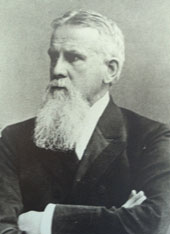
Friedrich Ratzel

Encyclopedia
Germany
Germany , officially the Federal Republic of Germany , is a federal parliamentary republic in Europe. The country consists of 16 states while the capital and largest city is Berlin. Germany covers an area of 357,021 km2 and has a largely temperate seasonal climate...
geographer
Geographer
A geographer is a scholar whose area of study is geography, the study of Earth's natural environment and human society.Although geographers are historically known as people who make maps, map making is actually the field of study of cartography, a subset of geography...
and ethnographer, notable for first using the term Lebensraum
Lebensraum
was one of the major political ideas of Adolf Hitler, and an important component of Nazi ideology. It served as the motivation for the expansionist policies of Nazi Germany, aiming to provide extra space for the growth of the German population, for a Greater Germany...
("living space") in the sense that the National Socialists later would.
Life
Ratzel's father was the head of the household staff of the Grand Duke of Baden. He attended high school in Karlsruhe for six years before being apprenticed at age 15 to apothecariesApothecary
Apothecary is a historical name for a medical professional who formulates and dispenses materia medica to physicians, surgeons and patients — a role now served by a pharmacist and some caregivers....
. In 1863, he went to Rapperswil
Rapperswil
Rapperswil-Jona is a municipality in the Wahlkreis of See-Gaster in the canton of St. Gallen in Switzerland.Besides Rapperswil and Jona, which were separate municipalities until 2006, the municipality includes Bollingen, Busskirch, Curtiberg, Kempraten-Lenggis, Wagen, and Wurmsbach.-Today:On...
on the Lake of Zurich, Switzerland
Switzerland
Switzerland name of one of the Swiss cantons. ; ; ; or ), in its full name the Swiss Confederation , is a federal republic consisting of 26 cantons, with Bern as the seat of the federal authorities. The country is situated in Western Europe,Or Central Europe depending on the definition....
, where he began to study the classics
Classics
Classics is the branch of the Humanities comprising the languages, literature, philosophy, history, art, archaeology and other culture of the ancient Mediterranean world ; especially Ancient Greece and Ancient Rome during Classical Antiquity Classics (sometimes encompassing Classical Studies or...
. After a further year as an apothecary at Mörs
Mors
Mors may refer to:*Mors , the personification of death in Roman mythology*Mors, Latin for death and is a feminine gender noun*Mors , a French car manufacturer from 1895-1925...
near Krefeld
Krefeld
Krefeld , also known as Crefeld until 1929, is a city in North Rhine-Westphalia, Germany. It is located northwest of Düsseldorf, its centre lying just a few kilometres to the west of the River Rhine; the borough of Uerdingen is situated directly on the Rhine...
in the Ruhr
Ruhr
The Ruhr is a medium-size river in western Germany , a right tributary of the Rhine.-Description:The source of the Ruhr is near the town of Winterberg in the mountainous Sauerland region, at an elevation of approximately 2,200 feet...
area (1865–1866), he spent a short time at the high school in Karlsruhe and became a student of zoology
Zoology
Zoology |zoölogy]]), is the branch of biology that relates to the animal kingdom, including the structure, embryology, evolution, classification, habits, and distribution of all animals, both living and extinct...
at the universities of Heidelberg, Jena and Berlin
Humboldt University of Berlin
The Humboldt University of Berlin is Berlin's oldest university, founded in 1810 as the University of Berlin by the liberal Prussian educational reformer and linguist Wilhelm von Humboldt, whose university model has strongly influenced other European and Western universities...
, finishing in 1868. He studied zoology in 1869, publishing Sein und Werden der organischen Welt on Darwin
Charles Darwin
Charles Robert Darwin FRS was an English naturalist. He established that all species of life have descended over time from common ancestry, and proposed the scientific theory that this branching pattern of evolution resulted from a process that he called natural selection.He published his theory...
.
After the completion of his schooling, Ratzel began a period of travels that saw him transform from zoologist/biologist to geographer. He began field work in the Mediterranean, writing letters of his experiences. These letters led to a job as a traveling reporter for the Kölnische Zeitung ("Cologne Journal"), which provided him the means for further travel. Ratzel embarked on several expeditions, the lengthiest and most important being his 1874-1875 trip to North America
North America
North America is a continent wholly within the Northern Hemisphere and almost wholly within the Western Hemisphere. It is also considered a northern subcontinent of the Americas...
, Cuba
Cuba
The Republic of Cuba is an island nation in the Caribbean. The nation of Cuba consists of the main island of Cuba, the Isla de la Juventud, and several archipelagos. Havana is the largest city in Cuba and the country's capital. Santiago de Cuba is the second largest city...
, and Mexico
Mexico
The United Mexican States , commonly known as Mexico , is a federal constitutional republic in North America. It is bordered on the north by the United States; on the south and west by the Pacific Ocean; on the southeast by Guatemala, Belize, and the Caribbean Sea; and on the east by the Gulf of...
. This trip was a turning point in Ratzel’s career. He studied the influence of people of German origin in America
United States
The United States of America is a federal constitutional republic comprising fifty states and a federal district...
, especially in the Midwest, as well as other ethnic groups in North America.
He produced a written work of his account in 1876, Städte-und Kulturbilder aus Nordamerika (Profile of Cities and Cultures in North America), which would help establish the field of cultural geography
Cultural geography
Cultural geography is a sub-field within human geography. Cultural geography is the study of cultural products and norms and their variations across and relations to spaces and places...
. According to Ratzel, cities are the best place to study people because life is "blended, compressed, and accelerated" in cities, and they bring out the "greatest, best, most typical aspects of people". Ratzel had traveled to cities such as New York
New York City
New York is the most populous city in the United States and the center of the New York Metropolitan Area, one of the most populous metropolitan areas in the world. New York exerts a significant impact upon global commerce, finance, media, art, fashion, research, technology, education, and...
, Boston
Boston
Boston is the capital of and largest city in Massachusetts, and is one of the oldest cities in the United States. The largest city in New England, Boston is regarded as the unofficial "Capital of New England" for its economic and cultural impact on the entire New England region. The city proper had...
, Philadelphia, Washington
Washington, D.C.
Washington, D.C., formally the District of Columbia and commonly referred to as Washington, "the District", or simply D.C., is the capital of the United States. On July 16, 1790, the United States Congress approved the creation of a permanent national capital as permitted by the U.S. Constitution....
, Richmond
Richmond, Virginia
Richmond is the capital of the Commonwealth of Virginia, in the United States. It is an independent city and not part of any county. Richmond is the center of the Richmond Metropolitan Statistical Area and the Greater Richmond area...
, Charleston
Charleston, South Carolina
Charleston is the second largest city in the U.S. state of South Carolina. It was made the county seat of Charleston County in 1901 when Charleston County was founded. The city's original name was Charles Towne in 1670, and it moved to its present location from a location on the west bank of the...
, New Orleans, and San Francisco.
Upon his return in 1875, Ratzel became a lecturer in geography at the Technical High School in Munich
Munich
Munich The city's motto is "" . Before 2006, it was "Weltstadt mit Herz" . Its native name, , is derived from the Old High German Munichen, meaning "by the monks' place". The city's name derives from the monks of the Benedictine order who founded the city; hence the monk depicted on the city's coat...
. In 1876, he was promoted to assistant professor, then rose to full professor in 1880. While at Munich, Ratzel produced several books and established his career as an academic. In 1886, he accepted an appointment at Leipzig
Leipzig
Leipzig Leipzig has always been a trade city, situated during the time of the Holy Roman Empire at the intersection of the Via Regia and Via Imperii, two important trade routes. At one time, Leipzig was one of the major European centres of learning and culture in fields such as music and publishing...
. His lectures were widely attended, notably by the influential American geographer Ellen Churchill Semple
Ellen Churchill Semple
Ellen Churchill Semple was an American geographer. Ellen was born in Louisville, Kentucky, the youngest of five children by Alexander Bonner Semple and Emerine Price. She is most closely associated with work in anthropogeography and environmentalism...
.
Ratzel produced the foundations of human geography
Human geography
Human geography is one of the two major sub-fields of the discipline of geography. Human geography is the study of the world, its people, communities, and cultures. Human geography differs from physical geography mainly in that it has a greater focus on studying human activities and is more...
in his two-volume Anthropogeographie in 1882 and 1891. This work was misinterpreted by many of his students, creating a number of environmental determinists
Environmental determinism
Environmental determinism, also known as climatic determinism or geographical determinism, is the view that the physical environment, rather than social conditions, determines culture...
. He published his work on political geography
Political geography
Political geography is the field of human geography that is concerned with the study of both the spatially uneven outcomes of political processes and the ways in which political processes are themselves affected by spatial structures...
, Politische Geographie, in 1897. It was in this work that Ratzel introduced concepts that contributed to Lebensraum
Lebensraum
was one of the major political ideas of Adolf Hitler, and an important component of Nazi ideology. It served as the motivation for the expansionist policies of Nazi Germany, aiming to provide extra space for the growth of the German population, for a Greater Germany...
and Social Darwinism
Social Darwinism
Social Darwinism is a term commonly used for theories of society that emerged in England and the United States in the 1870s, seeking to apply the principles of Darwinian evolution to sociology and politics...
. His three volume work The History of Mankind was published in English in 1896 and contained over 1100 excellent engravings and remarkable chromolithography
Chromolithography
Chromolithography is a method for making multi-color prints. This type of color printing stemmed from the process of lithography, and it includes all types of lithography that are printed in color. When chromolithography is used to reproduce photographs, the term photochrom is frequently used...
.
Ratzel continued his work at Leipzig until his sudden death on August 9, 1904 in Ammerland
Ammerland
Ammerland is a district in Lower Saxony, Germany. It is bounded by the city of Oldenburg and the districts of Oldenburg, Cloppenburg, Leer, Friesland and Wesermarsch.- History :...
, Germany.
Ratzel, a scholar of versatile academic interest, was a staunch German. During the outbreak of Franco-Prussian war in 1870, he joined the Prussian army and was wounded twice during the war.
Writings
Influenced by thinkers like Darwin and zoologist Ernst Heinrich Haeckel, he published several papers. Among them is the essay Lebensraum (1901) concerning biogeographyBiogeography
Biogeography is the study of the distribution of species , organisms, and ecosystems in space and through geological time. Organisms and biological communities vary in a highly regular fashion along geographic gradients of latitude, elevation, isolation and habitat area...
, creating a foundation for the uniquely German variant of geopolitics
Geopolitics
Geopolitics, from Greek Γη and Πολιτική in broad terms, is a theory that describes the relation between politics and territory whether on local or international scale....
: geopolitik
Geopolitik
Geopolitik is the branch of uniquely German geostrategy. It developed as a distinct strain of thought after Otto von Bismarck's unification of the German states but began its development in earnest only under Emperor Wilhelm II...
.
Ratzel’s writings coincided with the growth of German industrialism
Second Industrial Revolution
The Second Industrial Revolution, also known as the Technological Revolution, was a phase of the larger Industrial Revolution corresponding to the latter half of the 19th century until World War I...
after the Franco-Prussian war
Franco-Prussian War
The Franco-Prussian War or Franco-German War, often referred to in France as the 1870 War was a conflict between the Second French Empire and the Kingdom of Prussia. Prussia was aided by the North German Confederation, of which it was a member, and the South German states of Baden, Württemberg and...
and the subsequent search for market
Market
A market is one of many varieties of systems, institutions, procedures, social relations and infrastructures whereby parties engage in exchange. While parties may exchange goods and services by barter, most markets rely on sellers offering their goods or services in exchange for money from buyers...
s that brought it into competition with England
England
England is a country that is part of the United Kingdom. It shares land borders with Scotland to the north and Wales to the west; the Irish Sea is to the north west, the Celtic Sea to the south west, with the North Sea to the east and the English Channel to the south separating it from continental...
. His writings served as welcome justification for imperial expansion
Imperialism
Imperialism, as defined by Dictionary of Human Geography, is "the creation and/or maintenance of an unequal economic, cultural, and territorial relationships, usually between states and often in the form of an empire, based on domination and subordination." The imperialism of the last 500 years,...
. Influenced by the American
United States
The United States of America is a federal constitutional republic comprising fifty states and a federal district...
geostrategist
Geostrategy
Geostrategy, a subfield of geopolitics, is a type of foreign policy guided principally by geographical factors as they inform, constrain, or affect political and military planning...
Alfred Thayer Mahan
Alfred Thayer Mahan
Alfred Thayer Mahan was a United States Navy flag officer, geostrategist, and historian, who has been called "the most important American strategist of the nineteenth century." His concept of "sea power" was based on the idea that countries with greater naval power will have greater worldwide...
, Ratzel wrote of aspirations for German naval reach, agreeing that sea power was self-sustaining, as the profit from trade
International trade
International trade is the exchange of capital, goods, and services across international borders or territories. In most countries, such trade represents a significant share of gross domestic product...
would pay for the merchant marine, unlike land power.
Ratzel’s key contribution to geopolitik was the expansion on the biological conception of geography
Geography
Geography is the science that studies the lands, features, inhabitants, and phenomena of Earth. A literal translation would be "to describe or write about the Earth". The first person to use the word "geography" was Eratosthenes...
, without a static conception of borders. States are instead organic and growing, with borders representing only a temporary stop in their movement. It is not the state proper that is the organism, but the land in its spiritual
Spirituality
Spirituality can refer to an ultimate or an alleged immaterial reality; an inner path enabling a person to discover the essence of his/her being; or the “deepest values and meanings by which people live.” Spiritual practices, including meditation, prayer and contemplation, are intended to develop...
bond with the people who draw sustenance from it. The expanse of a state’s borders is a reflection of the health of the nation.
Ratzel’s idea of Raum (space) would grow out of his organic state conception. This early concept of lebensraum was not political or economic, but spiritual and racial nationalist
Nationalism
Nationalism is a political ideology that involves a strong identification of a group of individuals with a political entity defined in national terms, i.e. a nation. In the 'modernist' image of the nation, it is nationalism that creates national identity. There are various definitions for what...
expansion. The Raum-motiv is a historically driving force, pushing peoples with great Kultur to naturally expand. Space, for Ratzel, was a vague concept, theoretically unbounded. Raum was defined by where German peoples live, where other weaker states could serve to support German peoples economically, and where German culture
Culture of Germany
German culture began long before the rise of Germany as a nation-state and spanned the entire German-speaking world. From its roots, culture in Germany has been shaped by major intellectual and popular currents in Europe, both religious and secular...
could fertilize other cultures. However, it ought to be noted that Ratzel's concept of raum was not overtly aggressive, but theorized simply as the natural expansion of strong states into areas controlled by weaker states.
The book for which Ratzel is acknowledged all over the world is 'Anthropogeographie'. It was completed between 1872 to 1899. The main focus of this monumental work is on the effects of different physical features and locations on the style and life of the people.
Influence
Rudolf KjellénRudolf Kjellén
Johan Rudolf Kjellén was a Swedish political scientist and politician who first coined the term "geopolitics". His work was influenced by Friedrich Ratzel...
was Ratzel’s Swedish
Sweden
Sweden , officially the Kingdom of Sweden , is a Nordic country on the Scandinavian Peninsula in Northern Europe. Sweden borders with Norway and Finland and is connected to Denmark by a bridge-tunnel across the Öresund....
student who would further elaborate on organic state theory and who coined the term “geopolitics”.
The German geostrategist General Karl Haushofer was exposed to Ratzel, who was friends with Haushofer’s father, and would integrate Ratzel’s ideas on the division between sea and land powers into his theories, saying that only a country with both could overcome this conflict. In his writings, Haushofer also adopted the view that borders are largely insignificant, especially as the nation ought to be in a frequent state of struggle with those around it. Further, Haushofer would adopt Ratzel's conception of Raum as the central program for German geopolitik.
Quotations
- "A philosophy of the history of the human race, worthy of its name, must begin with the heavens and descend to the earth, must be charged with the conviction that all existence is one—a single conception sustained from beginning to end upon one identical law."
- "Culture grows in places that can support dense labor populations."
Writings
Other notable writings besides those mentioned above are:- Wandertage eines Naturforschers (Days of wandering of a student of nature, 1873-74)
- Vorgeschichte des europäischen Menschen (Prehistory of Europeans, 1875)
- Die Vereinigten Staaten von Nordamerika (The United States of North America, 1878-80)
- Die Erde, in 24 Vorträgen (The Earth in 24 lectures, 1881)
- Völkerkunde (Information on peoples, 1895)
- Die Erde und das Leben (The Earth and life, 1902)
Further reading
- Dorpalen, Andreas. The World of General Haushofer. Farrar & Rinehart, Inc., New York: 1984.
- Martin, Geoffrey J. and Preston E. James. All Possible Worlds. New York, John Wiley and Sons, Inc: 1993.
- Mattern, Johannes. Geopolitik: Doctrine of National Self-Sufficiency and Empire. The Johns Hopkins Press, Baltimore: 1942.
- Wanklyn, Harriet. Friedrich Ratzel, a Biographical Memoir and Bibliography. Cambridge, Cambridge University Press: 1961.