


Konstantin von Neurath

Encyclopedia
Konstantin Freiherr von Neurath (2 February 1873 – 14 August 1956) was a German
diplomat
remembered mostly for having served as Foreign minister of Germany
between 1932 and 1938. Holding this post in the early years of Adolf Hitler
's regime, Neurath was regarded as playing a key role in the foreign policy pursuits of the Nazi dictator in undermining the Treaty of Versailles
and territorial expansion in the prelude to World War II
, although he was often averse tactically if not necessarily ideologically. This aversion would result in Hitler replacing Neurath with the more compliant and fervent Nazi Joachim von Ribbentrop
.
Neurath served as "Reichsprotektor of Bohemia and Moravia" between 1939 and 1943, but after being sidelined for SS-Obergruppenführer Reinhard Heydrich
his authority became nominal. He was tried as war criminal in Nuremberg and sentenced to fifteen years imprisonment for his compliance and actions in the Nazi regime.
, the scion of a Swabia
n dynasty of Freiherr
en. His grandfather Constantin Franz von Neurath had served as Foreign Minister under King Charles I of Württemberg
(reigned 1864-1891); his father Konstantin Sebastian von Neurath (d. 1912) had been a Free Conservative
member of the German Reichstag
parliament and Chamberlain
of King William II of Württemberg
.
He studied law
in Tübingen and in Berlin
. After graduating in 1897 he initially joined a local law firm in his home town. In 1901 he entered into civil service
and worked for the Foreign Office
in Berlin
. In 1903 he was assigned to the German embassy in London, at first as Vice-Consul and from 1909 as Legationsrat (legation counsel). Following the visit of the Prince of Wales
to the Kingdom Württemberg in 1904, as Lord Chamberlain to King William II, he was created an Honorary Knight Grand Cross of the Royal Victorian Order
. Neurath's career was decisively advanced by Secretary of State Alfred von Kiderlen-Waechter
. In 1914 he was sent to the embassy in Constantinople
.
On 30 May 1901 Neurath married Marie Auguste Moser von Filseck (1875–1960) in Stuttgart
. His son Konstantin was born in 1902, followed by his daughter Winifred in 1904.
During World War I
he served as an officer with an infantry
regiment until 1916 when he was badly wounded. In December 1914 he was awarded the Iron Cross
. He returned to the German diplomatic service in the Ottoman Empire
(1914–1916), where he witnessed the Armenian Genocide
. In 1917 he temporarily quit the diplomatic service to succeed his uncle Julius von Soden
as head of the royal Württemberg government.
returned to diplomacy, joining the embassy in Copenhagen
as Minister to Denmark
. From 1921 until 1930 he was the ambassador to Rome
; he was not overly impressed with Italian Fascism
. After the death of Gustav Stresemann
in 1929, he was already considered for the post of Foreign Minister in the cabinet of Chancellor Hermann Müller
by President Paul von Hindenburg
, but his appointment failed due to the objections raised by the governing parties. In 1930 he returned to head the embassy in London.
Neurath was recalled to Germany in 1932 and became Minister of Foreign Affairs in the "Cabinet of Barons" under Chancellor Franz von Papen
in June. He continued to hold that position under Chancellor Kurt von Schleicher
and then under Adolf Hitler
from the Machtergreifung
on 30 January 1933. During the early days of Hitler's rule, Neurath lent an aura of respectability to Hitler's expansionist foreign policy.
In May 1933, the American chargé d'affaires
reported that "Baron von Neurath has shown such a remarkable capacity for submitting to what in normal times could only be considered as affronts and indignities on the part of the Nazis, that it is still quite a possibility that the latter should be content to have him remain as a figurehead for some time yet". He was involved in the German withdrawal from the League of Nations
in 1933, the negotiations of the Anglo-German Naval Accord
(1935) and the remilitarization of the Rhineland
. Not before 1937 Neurath became a member of the Nazi Party by the awarding of the Golden Party Badge
combined with the honorary rank of a Gruppenführer
in the SS
.
Nevertheless on 4 February 1938, Neurath was sacked as Foreign Minister in the course of the Blomberg–Fritsch Affair. He felt his office was marginalised and was not in favor of Hitler's aggressive war plans, which were detailed in the Hossbach Memorandum
of 5 November 1937. He was succeeded by Joachim von Ribbentrop
, but remained in government as a minister without portfolio
.
In March 1939, Neurath was appointed Reichsprotektor of occupied Bohemia and Moravia
, serving as Hitler's personal representative in the protectorate. Hitler chose Neurath in part to pacify the international outrage over the German occupation of Czechoslovakia
. Soon after his arrival at Prague Castle
, Neurath instituted harsh press censorship and banned political parties and trade unions. He ordered a harsh crackdown on protesting students in October and November 1939 (1200 student protesters went to concentration camps and nine were executed). He also supervised the persecution of Jews
according to the Nuremberg Laws
. Draconian as these measures were, Hitler felt his rule was too lenient, and in September 1941 he was relieved of his day-to-day powers and replaced by Reinhard Heydrich
and Kurt Daluege
. Neurath already attempted to resign in 1941 but his resignation was not accepted until August 1943, when he was succeeded by the former Minister of the Interior Wilhelm Frick
. In June of that year he had been raised to the rank of an SS-Obergruppenführer
.
Late in the war, Neurath had contacts with the German resistance
.
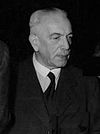
in 1946, where he was defended by Otto von Lüdinghausen. The Allies
accused him of "conspiracy
to commit crimes against peace; planning, initiating and waging wars of aggression; war crime
s and crimes against humanity
". Konstantin von Neurath's chief defence strategy was predicated on the fact that his successor and fellow defendant Joachim von Ribbentrop was more culpable for the atrocities committed in the Nazi state. The International Military Tribunal acknowledged the fact that von Neurath's crimes against humanity were mostly conducted during his short tenure as actual Protector of Bohemia and Moravia, especially in quelling Czech resistance
and the summary execution of several university students. The tribunal came to the consensus that Neurath, though a willing and active participant in war crimes, held no such prominent position during the height of the Third Reich's tyranny and was therefore only a minor adherent to the atrocities committed. He was found guilty by the Allied powers on all four counts and was sentenced to fifteen years imprisonment.
Neurath was held as a war criminal in Spandau Prison
until November 1954, when he was released in the wake of the Paris Conference
, officially due to his ill health, having suffered a heart attack
. He retired to his family's estates in Enzweihingen, where he died two years later, aged 83.
Germany
Germany , officially the Federal Republic of Germany , is a federal parliamentary republic in Europe. The country consists of 16 states while the capital and largest city is Berlin. Germany covers an area of 357,021 km2 and has a largely temperate seasonal climate...
diplomat
Diplomacy
Diplomacy is the art and practice of conducting negotiations between representatives of groups or states...
remembered mostly for having served as Foreign minister of Germany
Minister for Foreign Affairs (Germany)
The Federal Minister for Foreign Affairs is the head of the Federal Foreign Office and a member of the Cabinet of Germany. The current office holder is Guido Westerwelle...
between 1932 and 1938. Holding this post in the early years of Adolf Hitler
Adolf Hitler
Adolf Hitler was an Austrian-born German politician and the leader of the National Socialist German Workers Party , commonly referred to as the Nazi Party). He was Chancellor of Germany from 1933 to 1945, and head of state from 1934 to 1945...
's regime, Neurath was regarded as playing a key role in the foreign policy pursuits of the Nazi dictator in undermining the Treaty of Versailles
Treaty of Versailles
The Treaty of Versailles was one of the peace treaties at the end of World War I. It ended the state of war between Germany and the Allied Powers. It was signed on 28 June 1919, exactly five years after the assassination of Archduke Franz Ferdinand. The other Central Powers on the German side of...
and territorial expansion in the prelude to World War II
World War II
World War II, or the Second World War , was a global conflict lasting from 1939 to 1945, involving most of the world's nations—including all of the great powers—eventually forming two opposing military alliances: the Allies and the Axis...
, although he was often averse tactically if not necessarily ideologically. This aversion would result in Hitler replacing Neurath with the more compliant and fervent Nazi Joachim von Ribbentrop
Joachim von Ribbentrop
Ulrich Friedrich Wilhelm Joachim von Ribbentrop was Foreign Minister of Germany from 1938 until 1945. He was later hanged for war crimes after the Nuremberg Trials.-Early life:...
.
Neurath served as "Reichsprotektor of Bohemia and Moravia" between 1939 and 1943, but after being sidelined for SS-Obergruppenführer Reinhard Heydrich
Reinhard Heydrich
Reinhard Tristan Eugen Heydrich , also known as The Hangman, was a high-ranking German Nazi official.He was SS-Obergruppenführer and General der Polizei, chief of the Reich Main Security Office and Stellvertretender Reichsprotektor of Bohemia and Moravia...
his authority became nominal. He was tried as war criminal in Nuremberg and sentenced to fifteen years imprisonment for his compliance and actions in the Nazi regime.
Early life
Neurath was born at the manor of Kleinglattbach (since 1972 part of Vaihingen an der Enz) in WürttembergKingdom of Württemberg
The Kingdom of Württemberg was a state that existed from 1806 to 1918, located in present-day Baden-Württemberg, Germany. It was a continuation of the Duchy of Württemberg, which came into existence in 1495...
, the scion of a Swabia
Swabia
Swabia is a cultural, historic and linguistic region in southwestern Germany.-Geography:Like many cultural regions of Europe, Swabia's borders are not clearly defined...
n dynasty of Freiherr
Freiherr
The German titles Freiherr and Freifrau and Freiin are titles of nobility, used preceding a person's given name or, after 1919, before the surname...
en. His grandfather Constantin Franz von Neurath had served as Foreign Minister under King Charles I of Württemberg
Charles I of Württemberg
Charles was the third King of Württemberg, from 25 June 1864 until his death in 1891.-Early life:He was born 6 March 1823 at Stuttgart, as HRH Charles Frederick Alexander, Crown Prince of Württemberg the son of William I, King of Württemberg and his third wife Pauline Therese of Württemberg .He...
(reigned 1864-1891); his father Konstantin Sebastian von Neurath (d. 1912) had been a Free Conservative
Free Conservative Party
The Free Conservative Party was a right-wing political party in Prussia and the German Empire, which emerged from the Conservatives in the Prussian Landtag in 1866...
member of the German Reichstag
Reichstag (German Empire)
The Reichstag was the parliament of the North German Confederation , and of the German Reich ....
parliament and Chamberlain
Chamberlain (office)
A chamberlain is an officer in charge of managing a household. In many countries there are ceremonial posts associated with the household of the sovereign....
of King William II of Württemberg
William II of Württemberg
William II was the fourth King of Württemberg, from 6 October 1891 until the abolition of the kingdom on 30 November 1918...
.
He studied law
Law
Law is a system of rules and guidelines which are enforced through social institutions to govern behavior, wherever possible. It shapes politics, economics and society in numerous ways and serves as a social mediator of relations between people. Contract law regulates everything from buying a bus...
in Tübingen and in Berlin
Humboldt University of Berlin
The Humboldt University of Berlin is Berlin's oldest university, founded in 1810 as the University of Berlin by the liberal Prussian educational reformer and linguist Wilhelm von Humboldt, whose university model has strongly influenced other European and Western universities...
. After graduating in 1897 he initially joined a local law firm in his home town. In 1901 he entered into civil service
Civil service
The term civil service has two distinct meanings:* A branch of governmental service in which individuals are employed on the basis of professional merit as proven by competitive examinations....
and worked for the Foreign Office
Foreign Office (Germany)
The Foreign Office is the foreign ministry of Germany, a federal agency responsible for both the country's foreign politics and its relationship with the European Union. From 1871 to 1919, it was led by a Foreign Secretary, and since 1919, it has been led by the Foreign Minister of Germany...
in Berlin
Berlin
Berlin is the capital city of Germany and is one of the 16 states of Germany. With a population of 3.45 million people, Berlin is Germany's largest city. It is the second most populous city proper and the seventh most populous urban area in the European Union...
. In 1903 he was assigned to the German embassy in London, at first as Vice-Consul and from 1909 as Legationsrat (legation counsel). Following the visit of the Prince of Wales
Prince of Wales
Prince of Wales is a title traditionally granted to the heir apparent to the reigning monarch of the United Kingdom of Great Britain and Northern Ireland and the 15 other independent Commonwealth realms...
to the Kingdom Württemberg in 1904, as Lord Chamberlain to King William II, he was created an Honorary Knight Grand Cross of the Royal Victorian Order
Royal Victorian Order
The Royal Victorian Order is a dynastic order of knighthood and a house order of chivalry recognising distinguished personal service to the order's Sovereign, the reigning monarch of the Commonwealth realms, any members of her family, or any of her viceroys...
. Neurath's career was decisively advanced by Secretary of State Alfred von Kiderlen-Waechter
Alfred von Kiderlen-Waechter
Alfred von Kiderlen-Waechter was a German diplomat and politician, who served as Foreign Secretary and head of the Foreign Office from 27 June 1910 to 30 December 1912.-Biography:...
. In 1914 he was sent to the embassy in Constantinople
Constantinople
Constantinople was the capital of the Roman, Eastern Roman, Byzantine, Latin, and Ottoman Empires. Throughout most of the Middle Ages, Constantinople was Europe's largest and wealthiest city.-Names:...
.
On 30 May 1901 Neurath married Marie Auguste Moser von Filseck (1875–1960) in Stuttgart
Stuttgart
Stuttgart is the capital of the state of Baden-Württemberg in southern Germany. The sixth-largest city in Germany, Stuttgart has a population of 600,038 while the metropolitan area has a population of 5.3 million ....
. His son Konstantin was born in 1902, followed by his daughter Winifred in 1904.
During World War I
World War I
World War I , which was predominantly called the World War or the Great War from its occurrence until 1939, and the First World War or World War I thereafter, was a major war centred in Europe that began on 28 July 1914 and lasted until 11 November 1918...
he served as an officer with an infantry
Infantry
Infantrymen are soldiers who are specifically trained for the role of fighting on foot to engage the enemy face to face and have historically borne the brunt of the casualties of combat in wars. As the oldest branch of combat arms, they are the backbone of armies...
regiment until 1916 when he was badly wounded. In December 1914 he was awarded the Iron Cross
Iron Cross
The Iron Cross is a cross symbol typically in black with a white or silver outline that originated after 1219 when the Kingdom of Jerusalem granted the Teutonic Order the right to combine the Teutonic Black Cross placed above a silver Cross of Jerusalem....
. He returned to the German diplomatic service in the Ottoman Empire
Ottoman Empire
The Ottoman EmpireIt was usually referred to as the "Ottoman Empire", the "Turkish Empire", the "Ottoman Caliphate" or more commonly "Turkey" by its contemporaries...
(1914–1916), where he witnessed the Armenian Genocide
Armenian Genocide
The Armenian Genocide—also known as the Armenian Holocaust, the Armenian Massacres and, by Armenians, as the Great Crime—refers to the deliberate and systematic destruction of the Armenian population of the Ottoman Empire during and just after World War I...
. In 1917 he temporarily quit the diplomatic service to succeed his uncle Julius von Soden
Julius von Soden
Julius Freiherr von Soden was a German colonial official and politician. He was Governor of the colonies of Kamerun and German East Africa, and later became Chef de Cabinet and Foreign Minister of the King of Württemberg....
as head of the royal Württemberg government.
Political career
In 1919 Neurath with approval by President Friedrich EbertFriedrich Ebert
Friedrich Ebert was a German politician of the Social Democratic Party of Germany .When Ebert was elected as the leader of the SPD after the death of August Bebel, the party members of the SPD were deeply divided because of the party's support for World War I. Ebert supported the Burgfrieden and...
returned to diplomacy, joining the embassy in Copenhagen
Copenhagen
Copenhagen is the capital and largest city of Denmark, with an urban population of 1,199,224 and a metropolitan population of 1,930,260 . With the completion of the transnational Øresund Bridge in 2000, Copenhagen has become the centre of the increasingly integrating Øresund Region...
as Minister to Denmark
Denmark
Denmark is a Scandinavian country in Northern Europe. The countries of Denmark and Greenland, as well as the Faroe Islands, constitute the Kingdom of Denmark . It is the southernmost of the Nordic countries, southwest of Sweden and south of Norway, and bordered to the south by Germany. Denmark...
. From 1921 until 1930 he was the ambassador to Rome
Rome
Rome is the capital of Italy and the country's largest and most populated city and comune, with over 2.7 million residents in . The city is located in the central-western portion of the Italian Peninsula, on the Tiber River within the Lazio region of Italy.Rome's history spans two and a half...
; he was not overly impressed with Italian Fascism
Italian Fascism
Italian Fascism also known as Fascism with a capital "F" refers to the original fascist ideology in Italy. This ideology is associated with the National Fascist Party which under Benito Mussolini ruled the Kingdom of Italy from 1922 until 1943, the Republican Fascist Party which ruled the Italian...
. After the death of Gustav Stresemann
Gustav Stresemann
was a German politician and statesman who served as Chancellor and Foreign Minister during the Weimar Republic. He was co-laureate of the Nobel Peace Prize in 1926.Stresemann's politics defy easy categorization...
in 1929, he was already considered for the post of Foreign Minister in the cabinet of Chancellor Hermann Müller
Hermann Müller (politician)
' , born in Mannheim, was a German Social Democratic politician who served as Foreign Minister , and twice as Chancellor of Germany under the Weimar Republic...
by President Paul von Hindenburg
Paul von Hindenburg
Paul Ludwig Hans Anton von Beneckendorff und von Hindenburg , known universally as Paul von Hindenburg was a Prussian-German field marshal, statesman, and politician, and served as the second President of Germany from 1925 to 1934....
, but his appointment failed due to the objections raised by the governing parties. In 1930 he returned to head the embassy in London.
Neurath was recalled to Germany in 1932 and became Minister of Foreign Affairs in the "Cabinet of Barons" under Chancellor Franz von Papen
Franz von Papen
Lieutenant-Colonel Franz Joseph Hermann Michael Maria von Papen zu Köningen was a German nobleman, Roman Catholic monarchist politician, General Staff officer, and diplomat, who served as Chancellor of Germany in 1932 and as Vice-Chancellor under Adolf Hitler in 1933–1934...
in June. He continued to hold that position under Chancellor Kurt von Schleicher
Kurt von Schleicher
Kurt von Schleicher was a German general and the last Chancellor of Germany during the era of the Weimar Republic. Seventeen months after his resignation, he was assassinated by order of his successor, Adolf Hitler, in the Night of the Long Knives....
and then under Adolf Hitler
Adolf Hitler
Adolf Hitler was an Austrian-born German politician and the leader of the National Socialist German Workers Party , commonly referred to as the Nazi Party). He was Chancellor of Germany from 1933 to 1945, and head of state from 1934 to 1945...
from the Machtergreifung
Machtergreifung
Machtergreifung is a German word meaning "seizure of power". It is normally used specifically to refer to the Nazi takeover of power in the democratic Weimar Republic on 30 January 1933, the day Hitler was sworn in as Chancellor of Germany, turning it into the Nazi German dictatorship.-Term:The...
on 30 January 1933. During the early days of Hitler's rule, Neurath lent an aura of respectability to Hitler's expansionist foreign policy.
In May 1933, the American chargé d'affaires
Chargé d'affaires
In diplomacy, chargé d’affaires , often shortened to simply chargé, is the title of two classes of diplomatic agents who head a diplomatic mission, either on a temporary basis or when no more senior diplomat has been accredited.-Chargés d’affaires:Chargés d’affaires , who were...
reported that "Baron von Neurath has shown such a remarkable capacity for submitting to what in normal times could only be considered as affronts and indignities on the part of the Nazis, that it is still quite a possibility that the latter should be content to have him remain as a figurehead for some time yet". He was involved in the German withdrawal from the League of Nations
League of Nations
The League of Nations was an intergovernmental organization founded as a result of the Paris Peace Conference that ended the First World War. It was the first permanent international organization whose principal mission was to maintain world peace...
in 1933, the negotiations of the Anglo-German Naval Accord
Anglo-German Naval Agreement
The Anglo-German Naval Agreement of June 18, 1935 was a bilateral agreement between the United Kingdom and German Reich regulating the size of the Kriegsmarine in relation to the Royal Navy. The A.G.N.A fixed a ratio whereby the total tonnage of the Kriegsmarine was to be 35% of the total tonnage...
(1935) and the remilitarization of the Rhineland
Remilitarization of the Rhineland
The Remilitarization of the Rhineland by the German Army took place on 7 March 1936 when German military forces entered the Rhineland. This was significant because it violated the terms of the Locarno Treaties and was the first time since the end of World War I that German troops had been in this...
. Not before 1937 Neurath became a member of the Nazi Party by the awarding of the Golden Party Badge
Golden Party Badge
The Golden Party Badge was a special badge of the Nazi Party. The first 100,000 members who had joined and had uninterrupted service in the Party were given the right to wear it...
combined with the honorary rank of a Gruppenführer
Gruppenführer
Gruppenführer was an early paramilitary rank of the Nazi Party, first created in 1925 as a senior rank of the SA.-SS rank:...
in the SS
Schutzstaffel
The Schutzstaffel |Sig runes]]) was a major paramilitary organization under Adolf Hitler and the Nazi Party. Built upon the Nazi ideology, the SS under Heinrich Himmler's command was responsible for many of the crimes against humanity during World War II...
.
Nevertheless on 4 February 1938, Neurath was sacked as Foreign Minister in the course of the Blomberg–Fritsch Affair. He felt his office was marginalised and was not in favor of Hitler's aggressive war plans, which were detailed in the Hossbach Memorandum
Hossbach Memorandum
The Hossbach Memorandum was the summary of a meeting on November 5, 1937 between German dictator Adolf Hitler and his military and foreign policy leadership where Hitler's future expansionist policies were outlined. The meeting marked a turning point in Hitler's foreign policies, which then began...
of 5 November 1937. He was succeeded by Joachim von Ribbentrop
Joachim von Ribbentrop
Ulrich Friedrich Wilhelm Joachim von Ribbentrop was Foreign Minister of Germany from 1938 until 1945. He was later hanged for war crimes after the Nuremberg Trials.-Early life:...
, but remained in government as a minister without portfolio
Minister without Portfolio
A minister without portfolio is either a government minister with no specific responsibilities or a minister that does not head a particular ministry...
.
In March 1939, Neurath was appointed Reichsprotektor of occupied Bohemia and Moravia
Protectorate of Bohemia and Moravia
The Protectorate of Bohemia and Moravia was the majority ethnic-Czech protectorate which Nazi Germany established in the central parts of Bohemia, Moravia and Czech Silesia in what is today the Czech Republic...
, serving as Hitler's personal representative in the protectorate. Hitler chose Neurath in part to pacify the international outrage over the German occupation of Czechoslovakia
German occupation of Czechoslovakia
German occupation of Czechoslovakia began with the Nazi annexation of Czechoslovakia's northern and western border regions, known collectively as the Sudetenland, under terms outlined by the Munich Agreement. Nazi leader Adolf Hitler's pretext for this effort was the alleged privations suffered by...
. Soon after his arrival at Prague Castle
Prague Castle
Prague Castle is a castle in Prague where the Kings of Bohemia, Holy Roman Emperors and presidents of Czechoslovakia and the Czech Republic have had their offices. The Czech Crown Jewels are kept here...
, Neurath instituted harsh press censorship and banned political parties and trade unions. He ordered a harsh crackdown on protesting students in October and November 1939 (1200 student protesters went to concentration camps and nine were executed). He also supervised the persecution of Jews
History of the Jews in the Czech Republic
Jews in the Czech Republic are predominantly Ashkenazic Jews, and the current Jewish population is only a fraction of the First republic's Jewish population. As of 2005, there were approximately 4,000 Jews living in the Czech Republic. There are ten small Jewish communities all around the country...
according to the Nuremberg Laws
Nuremberg Laws
The Nuremberg Laws of 1935 were antisemitic laws in Nazi Germany introduced at the annual Nuremberg Rally of the Nazi Party. After the takeover of power in 1933 by Hitler, Nazism became an official ideology incorporating scientific racism and antisemitism...
. Draconian as these measures were, Hitler felt his rule was too lenient, and in September 1941 he was relieved of his day-to-day powers and replaced by Reinhard Heydrich
Reinhard Heydrich
Reinhard Tristan Eugen Heydrich , also known as The Hangman, was a high-ranking German Nazi official.He was SS-Obergruppenführer and General der Polizei, chief of the Reich Main Security Office and Stellvertretender Reichsprotektor of Bohemia and Moravia...
and Kurt Daluege
Kurt Daluege
Kurt Daluege was a German Nazi SS-Oberstgruppenführer and Generaloberst der Polizei as chief of the Ordnungspolizei and ruled the Protectorate Bohemia and Moravia as Deputy Protector after Reinhard Heydrich's assassination.-Early life and career:Kurt Daluege, a son of a Prussian state official,...
. Neurath already attempted to resign in 1941 but his resignation was not accepted until August 1943, when he was succeeded by the former Minister of the Interior Wilhelm Frick
Wilhelm Frick
Wilhelm Frick was a prominent German Nazi official serving as Minister of the Interior of the Third Reich. After the end of World War II, he was tried for war crimes at the Nuremberg Trials and executed...
. In June of that year he had been raised to the rank of an SS-Obergruppenführer
Obergruppenführer
Obergruppenführer was a Nazi Party paramilitary rank that was first created in 1932 as a rank of the SA and until 1942 it was the highest SS rank inferior only to Reichsführer-SS...
.
Late in the war, Neurath had contacts with the German resistance
German Resistance
The German resistance was the opposition by individuals and groups in Germany to Adolf Hitler or the National Socialist regime between 1933 and 1945. Some of these engaged in active plans to remove Adolf Hitler from power and overthrow his regime...
.
Trial and imprisonment
Neurath was tried at the Nuremberg TrialsNuremberg Trials
The Nuremberg Trials were a series of military tribunals, held by the victorious Allied forces of World War II, most notable for the prosecution of prominent members of the political, military, and economic leadership of the defeated Nazi Germany....
in 1946, where he was defended by Otto von Lüdinghausen. The Allies
Allies of World War II
The Allies of World War II were the countries that opposed the Axis powers during the Second World War . Former Axis states contributing to the Allied victory are not considered Allied states...
accused him of "conspiracy
Conspiracy (crime)
In the criminal law, a conspiracy is an agreement between two or more persons to break the law at some time in the future, and, in some cases, with at least one overt act in furtherance of that agreement...
to commit crimes against peace; planning, initiating and waging wars of aggression; war crime
War crime
War crimes are serious violations of the laws applicable in armed conflict giving rise to individual criminal responsibility...
s and crimes against humanity
Crime against humanity
Crimes against humanity, as defined by the Rome Statute of the International Criminal Court Explanatory Memorandum, "are particularly odious offenses in that they constitute a serious attack on human dignity or grave humiliation or a degradation of one or more human beings...
". Konstantin von Neurath's chief defence strategy was predicated on the fact that his successor and fellow defendant Joachim von Ribbentrop was more culpable for the atrocities committed in the Nazi state. The International Military Tribunal acknowledged the fact that von Neurath's crimes against humanity were mostly conducted during his short tenure as actual Protector of Bohemia and Moravia, especially in quelling Czech resistance
Czech resistance to Nazi occupation
Czech resistance to German Nazi occupation during World War II is a scarcely documented subject, by and large a result of little formal resistance and an effective German policy that deterred acts of resistance or annihilated organizations of resistance...
and the summary execution of several university students. The tribunal came to the consensus that Neurath, though a willing and active participant in war crimes, held no such prominent position during the height of the Third Reich's tyranny and was therefore only a minor adherent to the atrocities committed. He was found guilty by the Allied powers on all four counts and was sentenced to fifteen years imprisonment.
Neurath was held as a war criminal in Spandau Prison
Spandau Prison
Spandau Prison was a prison situated in the borough of Spandau in western Berlin, constructed in 1876 and demolished in 1987 after the death of its last prisoner, Rudolf Hess, to prevent it from becoming a neo-Nazi shrine. The prison was near, though not part of, the Renaissance-era Spandau Citadel...
until November 1954, when he was released in the wake of the Paris Conference
London and Paris Conferences
The London and Paris Conferences were two related conferences in London and Paris in late September and October 1954 to determine the status of West Germany...
, officially due to his ill health, having suffered a heart attack
Myocardial infarction
Myocardial infarction or acute myocardial infarction , commonly known as a heart attack, results from the interruption of blood supply to a part of the heart, causing heart cells to die...
. He retired to his family's estates in Enzweihingen, where he died two years later, aged 83.