


Treaty of Utrecht

Encyclopedia
The Treaty of Utrecht, which established the Peace of Utrecht, comprises a series of individual peace treaties
, rather than a single document, signed by the belligerents in the War of Spanish Succession, in the Dutch
city of Utrecht
in March and April 1713. The treaties between several European states, including Spain, Great Britain, France, Portugal, Savoy and the Dutch Republic, helped end the war. The treaties were concluded between the representatives of Louis XIV of France
and Philip V of Spain
on the one hand, and representatives of Queen Anne
of Great Britain
, the Duke of Savoy
, the King of Portugal
and the United Provinces
on the other.
The treaty registered the defeat of French ambitions expressed in the wars of Louis XIV
and preserved the European system based on the balance of power
.
, Bishop of Bristol, and Thomas Wentworth, Lord Strafford
. Reluctantly the United Provinces accepted the preliminaries and sent representatives, but the Emperor refused to do so until he was assured that these preliminaries were not binding. This assurance was given, and so in February the Imperial representatives made their appearance. As Philip was not yet recognized as its king, Spain did not at first send plenipotentiaries, but the Duke of Savoy sent one, and Portugal was also represented.
One of the first questions discussed was the nature of the guarantees to be given by France and Spain that their crowns would be kept separate, and matters did not make much progress until after 10 July 1712, when Philip signed a renunciation. With Great Britain and France having agreed a truce, the pace of negotiation now quickened, and the main treaties were finally signed on 11 April 1713.
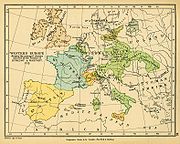
By the treaties' provisions, Louis XIV's grandson Philip, Duke of Anjou
was recognized as King of Spain (as Philip V), thus confirming the succession as stipulated in the will of the late King Charles II
. However, Philip was compelled to renounce for himself and his descendants any right to the French throne, despite some doubts as to the lawfulness of such an act. In similar fashion various French princelings, including most notably the Duke of Berry
(Louis XIV's youngest grandson) and the Duke of Orléans (Louis's nephew), renounced for themselves and their descendants any claim to the Spanish throne.
Spain's European empire was also divided: Savoy
received Sicily
and parts of the Duchy of Milan
, while Charles VI
(the Holy Roman Emperor
and Archduke of Austria), received the Spanish Netherlands, the Kingdom of Naples
, Sardinia
, and the bulk of the Duchy of Milan. Portugal had its sovereignty recognised over the lands between the Amazon
and Oyapock rivers, in Brazil. In 1715, the Portuguese also recovered Colonia del Sacramento
, taken by Spain in Uruguay
.
In addition, Spain ceded Gibraltar
and Minorca
to Great Britain and agreed to give to the British the Asiento
, a valuable monopoly slave-trading contract. In North America, France ceded to Great Britain its claims to the Hudson's Bay Company
territories in Rupert's Land
, Newfoundland and Acadia
. The formerly partitioned island of Saint Kitts
was also ceded in its entirety to Britain. France was required to recognize British suzerainty
over the Iroquois
and commerce with the Far Indians was to be open to traders of all nations. France retained its other pre-war North American possessions, including Île-Saint-Jean (now Prince Edward Island
) as well as Île Royale (now Cape Breton Island
), on which it erected the Fortress of Louisbourg
.
A series of commercial treaties were signed also.
After the signing of the Utrecht treaties, the French continued to be at war with Emperor Charles VI and with the Holy Roman Empire
itself until 1714, when hostilities were ended with the Treaty of Rastatt
and the Treaty of Baden
. Spain and Portugal remained formally at war with each other until the Treaty of Madrid
in 1750, while the Empire and the now-Bourbon
Spain did not conclude peace until 1720.
in Britain would have liked, considering that the French had made overtures for peace in 1706 and again in 1709. The Whigs considered themselves the heirs of the staunch anti-French policies of William III
and the Duke of Marlborough
. Indeed, later in the century the Whig John Wilkes
contemptuously described it as like "[the] Peace of God, for it passeth all understanding". However, in the Parliament of 1710 the Tories
had gained control of the House of Commons
, and they wished for an end to Great Britain's participation in a European war; Queen Anne
and her advisors had also come to the same position.
The party in the administration of Robert Harley
(created Earl of Oxford and Mortimer on 23 May 1711) and the Viscount Bolingbroke
proved more flexible at the bargaining table and were characterised by the Whigs as "pro-French"; Oxford and Bolingbroke persuaded the Queen to create twelve new "Tory peers" to ensure ratification of the treaty in the House of Lords
.
Although the fate of the Spanish Netherlands in particular was of interest to the United Provinces, Dutch influence on the outcome of the negotiations was fairly insignificant, even though the talks were held on their territory. The French negotiator Melchior de Polignac
taunted the Dutch with the bon mot De vous, chez vous, sans vous, meaning that negotiations would be held "about you, in your country, without you." The fact that Bolingbroke had secretly ordered the British commander, the Duke of Ormonde
, to withdraw from the Allied forces before the Battle of Denain
(informing the French, but not the Allies), and the fact that the secretly arrived at separate peace with France was a fait accompli, made the objections of the Allies pointless. In any case, the Dutch achieved their condominium
in the Austrian Netherlands with the Austro-Dutch Barrier Treaty of 1715
.
, first mentioned in 1701 by Charles Davenant
in Essays on the Balance of Power, became a common topic of debate during the war and the conferences that led to signing of the treaties. Boosted by 19 April 1709 issue of Daniel Defoe
's A Review of the Affairs of France, a periodical that supported the Harley ministry, the concept was a key factor in British negotiations, and was reflected in the final treaties. This theme would continue to be a significant factor in European politics until the time of the French Revolution
(and was to resurface in the nineteenth century).
Peace treaty
A peace treaty is an agreement between two or more hostile parties, usually countries or governments, that formally ends a state of war between the parties...
, rather than a single document, signed by the belligerents in the War of Spanish Succession, in the Dutch
Dutch Republic
The Dutch Republic — officially known as the Republic of the Seven United Netherlands , the Republic of the United Netherlands, or the Republic of the Seven United Provinces — was a republic in Europe existing from 1581 to 1795, preceding the Batavian Republic and ultimately...
city of Utrecht
Utrecht (city)
Utrecht city and municipality is the capital and most populous city of the Dutch province of Utrecht. It is located in the eastern corner of the Randstad conurbation, and is the fourth largest city of the Netherlands with a population of 312,634 on 1 Jan 2011.Utrecht's ancient city centre features...
in March and April 1713. The treaties between several European states, including Spain, Great Britain, France, Portugal, Savoy and the Dutch Republic, helped end the war. The treaties were concluded between the representatives of Louis XIV of France
Louis XIV of France
Louis XIV , known as Louis the Great or the Sun King , was a Bourbon monarch who ruled as King of France and Navarre. His reign, from 1643 to his death in 1715, began at the age of four and lasted seventy-two years, three months, and eighteen days...
and Philip V of Spain
Philip V of Spain
Philip V was King of Spain from 15 November 1700 to 15 January 1724, when he abdicated in favor of his son Louis, and from 6 September 1724, when he assumed the throne again upon his son's death, to his death.Before his reign, Philip occupied an exalted place in the royal family of France as a...
on the one hand, and representatives of Queen Anne
Anne of Great Britain
Anne ascended the thrones of England, Scotland and Ireland on 8 March 1702. On 1 May 1707, under the Act of Union, two of her realms, England and Scotland, were united as a single sovereign state, the Kingdom of Great Britain.Anne's Catholic father, James II and VII, was deposed during the...
of Great Britain
Kingdom of Great Britain
The former Kingdom of Great Britain, sometimes described as the 'United Kingdom of Great Britain', That the Two Kingdoms of Scotland and England, shall upon the 1st May next ensuing the date hereof, and forever after, be United into One Kingdom by the Name of GREAT BRITAIN. was a sovereign...
, the Duke of Savoy
Duchy of Savoy
From 1416 to 1847, the House of Savoy ruled the eponymous Duchy of Savoy . The Duchy was a state in the northern part of the Italian Peninsula, with some territories that are now in France. It was a continuation of the County of Savoy...
, the King of Portugal
Kingdom of Portugal
The Kingdom of Portugal was Portugal's general designation under the monarchy. The kingdom was located in the west of the Iberian Peninsula, Europe and existed from 1139 to 1910...
and the United Provinces
Dutch Republic
The Dutch Republic — officially known as the Republic of the Seven United Netherlands , the Republic of the United Netherlands, or the Republic of the Seven United Provinces — was a republic in Europe existing from 1581 to 1795, preceding the Batavian Republic and ultimately...
on the other.
The treaty registered the defeat of French ambitions expressed in the wars of Louis XIV
Louis XIV of France
Louis XIV , known as Louis the Great or the Sun King , was a Bourbon monarch who ruled as King of France and Navarre. His reign, from 1643 to his death in 1715, began at the age of four and lasted seventy-two years, three months, and eighteen days...
and preserved the European system based on the balance of power
Balance of power in international relations
In international relations, a balance of power exists when there is parity or stability between competing forces. The concept describes a state of affairs in the international system and explains the behavior of states in that system...
.
The negotiations
France and Great Britain had come to terms in October 1711, when the preliminaries of peace had been signed in London. This initial agreement was based on a tacit acceptance of the partition of Spain's European possessions. Following this, a congress opened at Utrecht on 29 January 1712, with the British representatives being John RobinsonJohn Robinson (1650-1723)
John Robinson was an English diplomat and prelate.-Early life:Robinson was born at Cleasby, North Yorkshire, near Darlington, a son of John Robinson . Educated at Brasenose College, Oxford, he became a fellow of Oriel College, and about 1680 chaplain to the British embassy to Stockholm, and...
, Bishop of Bristol, and Thomas Wentworth, Lord Strafford
Thomas Wentworth, 1st Earl of Strafford (1672-1739)
Lieutenant-General Thomas Wentworth, 1st Earl of Strafford , KG , known as Thomas Wentworth, 3rd Baron Raby from 1695 to 1711, was a diplomat and First Lord of the Admiralty....
. Reluctantly the United Provinces accepted the preliminaries and sent representatives, but the Emperor refused to do so until he was assured that these preliminaries were not binding. This assurance was given, and so in February the Imperial representatives made their appearance. As Philip was not yet recognized as its king, Spain did not at first send plenipotentiaries, but the Duke of Savoy sent one, and Portugal was also represented.
One of the first questions discussed was the nature of the guarantees to be given by France and Spain that their crowns would be kept separate, and matters did not make much progress until after 10 July 1712, when Philip signed a renunciation. With Great Britain and France having agreed a truce, the pace of negotiation now quickened, and the main treaties were finally signed on 11 April 1713.
Principal provisions
By the treaties' provisions, Louis XIV's grandson Philip, Duke of Anjou
Philip V of Spain
Philip V was King of Spain from 15 November 1700 to 15 January 1724, when he abdicated in favor of his son Louis, and from 6 September 1724, when he assumed the throne again upon his son's death, to his death.Before his reign, Philip occupied an exalted place in the royal family of France as a...
was recognized as King of Spain (as Philip V), thus confirming the succession as stipulated in the will of the late King Charles II
Charles II of Spain
Charles II was the last Habsburg King of Spain and the ruler of large parts of Italy, the Spanish territories in the Southern Low Countries, and Spain's overseas Empire, stretching from the Americas to the Spanish East Indies...
. However, Philip was compelled to renounce for himself and his descendants any right to the French throne, despite some doubts as to the lawfulness of such an act. In similar fashion various French princelings, including most notably the Duke of Berry
Duke of Berry
The title of Duke of Berry in the French nobility was frequently created for junior members of the French royal family. The Berry region now consists of the départements of Cher, Indre and parts of Vienne. The capital of Berry is Bourges. The first creation was for John, third son of John II, King...
(Louis XIV's youngest grandson) and the Duke of Orléans (Louis's nephew), renounced for themselves and their descendants any claim to the Spanish throne.
Spain's European empire was also divided: Savoy
House of Savoy
The House of Savoy was formed in the early 11th century in the historical Savoy region. Through gradual expansion, it grew from ruling a small county in that region to eventually rule the Kingdom of Italy from 1861 until the end of World War II, king of Croatia and King of Armenia...
received Sicily
Sicily
Sicily is a region of Italy, and is the largest island in the Mediterranean Sea. Along with the surrounding minor islands, it constitutes an autonomous region of Italy, the Regione Autonoma Siciliana Sicily has a rich and unique culture, especially with regard to the arts, music, literature,...
and parts of the Duchy of Milan
Duchy of Milan
The Duchy of Milan , was created on the 1st of may 1395, when Gian Galeazzo Visconti, Lord of Milan, purchased a diploma for 100,000 Florins from King Wenceslaus. It was this diploma that installed, Gian Galeazzo as Duke of Milan and Count of Pavia...
, while Charles VI
Charles VI, Holy Roman Emperor
Charles VI was the penultimate Habsburg sovereign of the Habsburg Empire. He succeeded his elder brother, Joseph I, as Holy Roman Emperor, King of Bohemia , Hungary and Croatia , Archduke of Austria, etc., in 1711...
(the Holy Roman Emperor
Holy Roman Emperor
The Holy Roman Emperor is a term used by historians to denote a medieval ruler who, as German King, had also received the title of "Emperor of the Romans" from the Pope...
and Archduke of Austria), received the Spanish Netherlands, the Kingdom of Naples
Kingdom of Naples
The Kingdom of Naples, comprising the southern part of the Italian peninsula, was the remainder of the old Kingdom of Sicily after secession of the island of Sicily as a result of the Sicilian Vespers rebellion of 1282. Known to contemporaries as the Kingdom of Sicily, it is dubbed Kingdom of...
, Sardinia
Sardinia
Sardinia is the second-largest island in the Mediterranean Sea . It is an autonomous region of Italy, and the nearest land masses are the French island of Corsica, the Italian Peninsula, Sicily, Tunisia and the Spanish Balearic Islands.The name Sardinia is from the pre-Roman noun *sard[],...
, and the bulk of the Duchy of Milan. Portugal had its sovereignty recognised over the lands between the Amazon
Amazon River
The Amazon of South America is the second longest river in the world and by far the largest by waterflow with an average discharge greater than the next seven largest rivers combined...
and Oyapock rivers, in Brazil. In 1715, the Portuguese also recovered Colonia del Sacramento
Colonia del Sacramento
Colonia del Sacramento is a city in southwestern Uruguay, by the Río de la Plata, facing Buenos Aires, Argentina. It is the oldest town in Uruguay and capital of the departamento of Colonia. It has a population of around 22,000.It is renowned for its historic quarter, a World Heritage Site...
, taken by Spain in Uruguay
Uruguay
Uruguay ,officially the Oriental Republic of Uruguay,sometimes the Eastern Republic of Uruguay; ) is a country in the southeastern part of South America. It is home to some 3.5 million people, of whom 1.8 million live in the capital Montevideo and its metropolitan area...
.
In addition, Spain ceded Gibraltar
Gibraltar
Gibraltar is a British overseas territory located on the southern end of the Iberian Peninsula at the entrance of the Mediterranean. A peninsula with an area of , it has a northern border with Andalusia, Spain. The Rock of Gibraltar is the major landmark of the region...
and Minorca
Minorca
Min Orca or Menorca is one of the Balearic Islands located in the Mediterranean Sea belonging to Spain. It takes its name from being smaller than the nearby island of Majorca....
to Great Britain and agreed to give to the British the Asiento
Asiento
The Asiento in the history of slavery refers to the permission given by the Spanish government to other countries to sell people as slaves to the Spanish colonies, between the years 1543 and 1834...
, a valuable monopoly slave-trading contract. In North America, France ceded to Great Britain its claims to the Hudson's Bay Company
Hudson's Bay Company
The Hudson's Bay Company , abbreviated HBC, or "The Bay" is the oldest commercial corporation in North America and one of the oldest in the world. A fur trading business for much of its existence, today Hudson's Bay Company owns and operates retail stores throughout Canada...
territories in Rupert's Land
Rupert's Land
Rupert's Land, or Prince Rupert's Land, was a territory in British North America, consisting of the Hudson Bay drainage basin that was nominally owned by the Hudson's Bay Company for 200 years from 1670 to 1870, although numerous aboriginal groups lived in the same territory and disputed the...
, Newfoundland and Acadia
Acadia
Acadia was the name given to lands in a portion of the French colonial empire of New France, in northeastern North America that included parts of eastern Quebec, the Maritime provinces, and modern-day Maine. At the end of the 16th century, France claimed territory stretching as far south as...
. The formerly partitioned island of Saint Kitts
Saint Kitts
Saint Kitts Saint Kitts Saint Kitts (also known more formally as Saint Christopher Island (Saint-Christophe in French) is an island in the West Indies. The west side of the island borders the Caribbean Sea, and the eastern coast faces the Atlantic Ocean...
was also ceded in its entirety to Britain. France was required to recognize British suzerainty
Suzerainty
Suzerainty occurs where a region or people is a tributary to a more powerful entity which controls its foreign affairs while allowing the tributary vassal state some limited domestic autonomy. The dominant entity in the suzerainty relationship, or the more powerful entity itself, is called a...
over the Iroquois
Iroquois
The Iroquois , also known as the Haudenosaunee or the "People of the Longhouse", are an association of several tribes of indigenous people of North America...
and commerce with the Far Indians was to be open to traders of all nations. France retained its other pre-war North American possessions, including Île-Saint-Jean (now Prince Edward Island
Prince Edward Island
Prince Edward Island is a Canadian province consisting of an island of the same name, as well as other islands. The maritime province is the smallest in the nation in both land area and population...
) as well as Île Royale (now Cape Breton Island
Cape Breton Island
Cape Breton Island is an island on the Atlantic coast of North America. It likely corresponds to the word Breton, the French demonym for Brittany....
), on which it erected the Fortress of Louisbourg
Fortress of Louisbourg
The Fortress of Louisbourg is a national historic site and the location of a one-quarter partial reconstruction of an 18th century French fortress at Louisbourg, Nova Scotia...
.
A series of commercial treaties were signed also.
After the signing of the Utrecht treaties, the French continued to be at war with Emperor Charles VI and with the Holy Roman Empire
Holy Roman Empire
The Holy Roman Empire was a realm that existed from 962 to 1806 in Central Europe.It was ruled by the Holy Roman Emperor. Its character changed during the Middle Ages and the Early Modern period, when the power of the emperor gradually weakened in favour of the princes...
itself until 1714, when hostilities were ended with the Treaty of Rastatt
Treaty of Rastatt
The Treaty of Rastatt of 7 March 1714, ended hostilities between France and Austria at the end of the War of the Spanish Succession. It complemented the Treaty of Utrecht, which had, the previous year, ended hostilities with Britain and the Dutch Republic...
and the Treaty of Baden
Treaty of Baden
The Treaty of Baden was the treaty that ended hostilities between France and the Holy Roman Empire, who had been at war since the start of the War of the Spanish Succession. It was signed on 7 September 1714 in Baden, Switzerland and complemented the Treaty of Utrecht, and the Treaty of Rastatt by...
. Spain and Portugal remained formally at war with each other until the Treaty of Madrid
Treaty of Madrid (1750)
The Spanish–Portuguese treaty of 1750 or Treaty of Madrid was a document signed by Ferdinand VI of Spain and John V of Portugal on January 13, 1750, concerning their empires and status of their territories in what is now Brazil....
in 1750, while the Empire and the now-Bourbon
House of Bourbon
The House of Bourbon is a European royal house, a branch of the Capetian dynasty . Bourbon kings first ruled Navarre and France in the 16th century. By the 18th century, members of the Bourbon dynasty also held thrones in Spain, Naples, Sicily, and Parma...
Spain did not conclude peace until 1720.
Responses to the treaties
The treaty's territorial provisions did not go as far as the WhigsBritish Whig Party
The Whigs were a party in the Parliament of England, Parliament of Great Britain, and Parliament of the United Kingdom, who contested power with the rival Tories from the 1680s to the 1850s. The Whigs' origin lay in constitutional monarchism and opposition to absolute rule...
in Britain would have liked, considering that the French had made overtures for peace in 1706 and again in 1709. The Whigs considered themselves the heirs of the staunch anti-French policies of William III
William III of England
William III & II was a sovereign Prince of Orange of the House of Orange-Nassau by birth. From 1672 he governed as Stadtholder William III of Orange over Holland, Zeeland, Utrecht, Guelders, and Overijssel of the Dutch Republic. From 1689 he reigned as William III over England and Ireland...
and the Duke of Marlborough
John Churchill, 1st Duke of Marlborough
John Churchill, 1st Duke of Marlborough, Prince of Mindelheim, KG, PC , was an English soldier and statesman whose career spanned the reigns of five monarchs through the late 17th and early 18th centuries...
. Indeed, later in the century the Whig John Wilkes
John Wilkes
John Wilkes was an English radical, journalist and politician.He was first elected Member of Parliament in 1757. In the Middlesex election dispute, he fought for the right of voters—rather than the House of Commons—to determine their representatives...
contemptuously described it as like "[the] Peace of God, for it passeth all understanding". However, in the Parliament of 1710 the Tories
Tory
Toryism is a traditionalist and conservative political philosophy which grew out of the Cavalier faction in the Wars of the Three Kingdoms. It is a prominent ideology in the politics of the United Kingdom, but also features in parts of The Commonwealth, particularly in Canada...
had gained control of the House of Commons
House of Commons of Great Britain
The House of Commons of Great Britain was the lower house of the Parliament of Great Britain between 1707 and 1801. In 1707, as a result of the Acts of Union of that year, it replaced the House of Commons of England and the third estate of the Parliament of Scotland, as one of the most significant...
, and they wished for an end to Great Britain's participation in a European war; Queen Anne
Anne of Great Britain
Anne ascended the thrones of England, Scotland and Ireland on 8 March 1702. On 1 May 1707, under the Act of Union, two of her realms, England and Scotland, were united as a single sovereign state, the Kingdom of Great Britain.Anne's Catholic father, James II and VII, was deposed during the...
and her advisors had also come to the same position.
The party in the administration of Robert Harley
Robert Harley, 1st Earl of Oxford and Mortimer
Robert Harley, 1st Earl of Oxford and Earl Mortimer KG was a British politician and statesman of the late Stuart and early Georgian periods. He began his career as a Whig, before defecting to a new Tory Ministry. Between 1711 and 1714 he served as First Lord of the Treasury, effectively Queen...
(created Earl of Oxford and Mortimer on 23 May 1711) and the Viscount Bolingbroke
Henry St John, 1st Viscount Bolingbroke
Henry St John, 1st Viscount Bolingbroke was an English politician, government official and political philosopher. He was a leader of the Tories, and supported the Church of England politically despite his atheism. In 1715 he supported the Jacobite rebellion of 1715 which sought to overthrow the...
proved more flexible at the bargaining table and were characterised by the Whigs as "pro-French"; Oxford and Bolingbroke persuaded the Queen to create twelve new "Tory peers" to ensure ratification of the treaty in the House of Lords
House of Lords
The House of Lords is the upper house of the Parliament of the United Kingdom. Like the House of Commons, it meets in the Palace of Westminster....
.
Although the fate of the Spanish Netherlands in particular was of interest to the United Provinces, Dutch influence on the outcome of the negotiations was fairly insignificant, even though the talks were held on their territory. The French negotiator Melchior de Polignac
Melchior de Polignac
Melchior de Polignac was a French diplomat, Roman Catholic cardinal and neo-Latin poet.A younger son of Armand XVI, marquis de Polignac, he was born at Lavoûte-sur-Loire, Haute-Loire, Auvergne. At an early age he achieved distinction as a diplomat...
taunted the Dutch with the bon mot De vous, chez vous, sans vous, meaning that negotiations would be held "about you, in your country, without you." The fact that Bolingbroke had secretly ordered the British commander, the Duke of Ormonde
James Butler, 2nd Duke of Ormonde
James Butler, 2nd Duke of Ormonde KG KT was an Irish statesman and soldier. He was the third of the Kilcash branch of the family to inherit the earldom of Ormonde...
, to withdraw from the Allied forces before the Battle of Denain
Battle of Denain
The Battle of Denain was fought on 24 July 1712, as part of the War of the Spanish Succession, and resulted in a French victory under Marshal Villars against Austrian and Dutch forces under Prince Eugene of Savoy.-Prelude:...
(informing the French, but not the Allies), and the fact that the secretly arrived at separate peace with France was a fait accompli, made the objections of the Allies pointless. In any case, the Dutch achieved their condominium
Condominium (international law)
In international law, a condominium is a political territory in or over which two or more sovereign powers formally agree to share equally dominium and exercise their rights jointly, without dividing it up into 'national' zones.Although a condominium has always been...
in the Austrian Netherlands with the Austro-Dutch Barrier Treaty of 1715
Barrier Treaty
The "Barrier Treaties" were the names of three agreements signed and ratified during or immediately after the War of Spanish Succession.-First:...
.
Balance of power
The European concept of the balance of powerBalance of power in international relations
In international relations, a balance of power exists when there is parity or stability between competing forces. The concept describes a state of affairs in the international system and explains the behavior of states in that system...
, first mentioned in 1701 by Charles Davenant
Charles Davenant
Charles Davenant , English economist, eldest son of Sir William Davenant, the poet, was born in London.-Overview:He was educated at Cheam grammar school and Balliol College, Oxford, but left the university without taking a degree...
in Essays on the Balance of Power, became a common topic of debate during the war and the conferences that led to signing of the treaties. Boosted by 19 April 1709 issue of Daniel Defoe
Daniel Defoe
Daniel Defoe , born Daniel Foe, was an English trader, writer, journalist, and pamphleteer, who gained fame for his novel Robinson Crusoe. Defoe is notable for being one of the earliest proponents of the novel, as he helped to popularise the form in Britain and along with others such as Richardson,...
's A Review of the Affairs of France, a periodical that supported the Harley ministry, the concept was a key factor in British negotiations, and was reflected in the final treaties. This theme would continue to be a significant factor in European politics until the time of the French Revolution
French Revolution
The French Revolution , sometimes distinguished as the 'Great French Revolution' , was a period of radical social and political upheaval in France and Europe. The absolute monarchy that had ruled France for centuries collapsed in three years...
(and was to resurface in the nineteenth century).
See also
- Disputed status of GibraltarDisputed status of GibraltarGibraltar is a British overseas territory, near the southernmost tip of the Iberian peninsula, which is the subject of a disputed irredentist claim by Spain....
- French ShoreFrench ShoreThe French Treaty Shore resulted from the 1713 ratification of the Treaty of Utrecht. The provisions of the treaty allowed the French to fish in season along the north coast of Newfoundland between Cape Bonavista and Point Riche. This area had been frequented by fishermen from Brittany since the...
- List of treaties
External links
- "The Treaties of Utrecht (1713)" - Brief discussion and extracts of the various treaties on François Velde's Heraldica website, with particular focus on the renunciations and their later reconfirmations.
- Article X of the treaty between Great Britain and Spain - Article X; Concerning the cession of Gibraltar (text in English, Spanish, and the original Latin).