


Baltic countries

Encyclopedia
The term Baltic states (also Baltics, Baltic nations or Baltic countries) refers to the Baltic territories which gained independence from the Russian Empire
in the wake of World War I: primarily the contiguous trio of Estonia
, Latvia
, Lithuania
(from north to south); Finland
also fell within the scope of the term after initially gaining independence in the 1920s.
The term in the indigenous languages of the Baltic states is:,, and.
dating back to the 11th century (Adam of Bremen
mentioned ) and earlier.
The Latvian and Lithuanian term Baltija most likely originates from the Indo-European
root *bhel meaning white, fair.
Beginning in the Middle Ages
and through the present day, the Baltic Sea
appears on the maps subscribed in Germanic languages
as , , , , etc. In English "Ost" is "East", and in fact, the Baltic Sea mostly lies to the east for Germany
, Denmark
, Norway
, and Sweden
. Clearly, part of the Baltic Sea lies to the east of Germany and Sweden, and due north of parts of Germany.
In the 17th century, the Kingdom of Sweden grew to be one of the great power
s of Northern Europe
. However, at the beginning of the 18th Century
"the Great Power Era" of the Swedish Empire
was challenged by the Russian Empire
which was seeking to restore its access to the Varangians
Sea -- as the Baltic Sea was called in the Land of Novgorod
. De facto in 1700 - 09, and de jure beginning in 1721, Swedish Livonia
(today the northern parts of Latvia
and Estonia
, and the western part of the Leningrad Oblast
) which had been acquired by Sweden in accordance with Treaty of Oliva
of 1660, came under the rule of the Russian Empire. Legalizing this acquisition by the Treaty of Nystad
, instead of taking an indemnity from the defeated Swedes, the Russian Empire paid Sweden two million jefimoks, or about 980 kilograms of silver. The first collective name for two administrative units established here in 1713 was Ostsee Governorates .
 Initially these were two governorates named after the largest cities: Riga and Reval
(now Tallinn
). After the Partitions of Poland
which took place in the last quarter of the 18th century the third Ostsee Governorate was set, the one of Courland
(presently a part of Latvia). This toponym stems from Curonians
, one of Finnic
or Baltic
indigenous tribes. Accordingly, two others were renamed to the Governorate of Livland and the Governorate of Estland.
The presence of the Germanic morpheme
"Ostsee" within the Russian collective name of those provinces is not limited to the personal inclination to the Western lexics which was showed by Peter the Great who conquered these lands from the Swedes
. In fact, since the Livonian Crusade
at the turn of the 13th century "Terra Mariana", Livland and Estland were under the German influence. These were Germans who formed the backbone of the local gentry, and for centuries German was the language of international communication and record keeping there.
By coincidence, it was German philologist Georg Nesselmann living at the Baltics (in East Prussia
) who in the middle of the 19th century substantiated the concept of Baltic languages
using the name of one of the local pagan tribes, the Balts
. Endre Bojtár (1999) argues that it was around 1840s when the German gentry of the Governorate of Livonia devised the term "Balts" to mean themselves, the German upper classes of Livonia, excluding the Latvian and Estonian lower classes. They spoke an exclusive dialect, baltisch-deutsch, legally spoken by them alone. Thus the usage of "Baltic" and similar terms to denote this region dates back not earlier than 1840s.
Simultaneously, in 1840s the usage "Ostsee" was superseded by "Baltic" in Russian. The article "Прибалтийский край" ("Baltic Krai
") in the Brockhaus
encyclopedia and other sources notes that 1840s mark a shift of the local population towards Russian language and, to a certain extent, to orthodoxy
.
Lithuania occupies a specific place within the scope of the region named "Baltic states". Through many centuries of its history Lithuania was more than a state at a Baltic seacoast. Born at a turn of the 13th century the Grand Duchy of Lithuania
encompassed most part of Kievan Rus'
and by the middle of 16th century stretched to the Black Sea
. From 1569 it has been a backbone element of such large and strong geo-political power as Polish–Lithuanian Commonwealth, so it is not incidental that up to 1920s Lithuania was treated separately from the Baltic states. Only after Lietuvos Taryba
proclaimed its independence in 1918, Lithuania began to be mentioned in the same list with her two northern neighbours.
In the 1920s, the newly-established countries of Estonia, Latvia, Lithuania and Finland
, formerly territories of the Russian empire, were referred to as the Baltic states.
The United Nations Group of Experts on Geographical Names defines a Baltic Division.
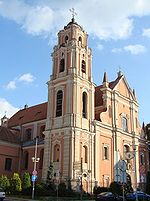
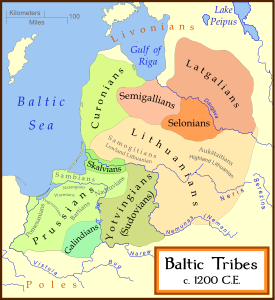
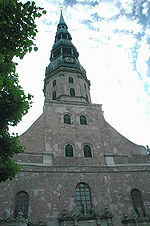 Estonians
and the nearly linguistically extinct Livonian people
in Latvia are descended from the Baltic Finns
, sharing closely related languages and a common cultural ancestry. The Latvians
and Lithuanians
, linguistically and culturally related to each other, are descended from the Balts
, an Indo-European
people and culture. The peoples comprising the Baltic states have together inhabited the eastern coast of the Baltic Sea
for millennia, although not always peacefully in ancient times, over which period their populations, Estonian, Latvian, and Lithuanian, have remained remarkably stable within the approximate territorial boundaries of the current Baltic states. While separate peoples with their own customs and traditions, historical factors have introduced cultural commonalities across and differences within them.
The peoples of the Baltic countries belong to different Christian denominations, a reflection of historical circumstances. Both Western and Eastern Christianity had been introduced by the end of the first millennium. The current divide between Lutheranism
to the north and Catholicism to the south is the remnant of Swedish
and Polish hegemony, respectively, with Orthodox Christianity
remaining the dominant faith among Russian and other Slavic minorities.
The languages of Baltic nations belong to two distinct language families. The Latvian
and Lithuanian
languages make up the group of Baltic languages
which belongs to the Indo-European
language family
. The Estonian language
and the nearly-extinct Livonian language
, on the other hand, are not Indo-European languages and instead they belong to the Baltic-Finnic subgroup of the Finno-Ugric languages
, sharing close ethnic and historical ties with the Finnish language
and people.
The Baltic states have historically been in the Swedish (or, in Lithuania's case, Polish), German (historically: The Holy Roman Empire
and Saxony
), Danish, and Russian spheres of influence.
Apart from the indigenous languages, German was the dominant language in Estonia and Latvia in academics, professional life, and upper society from the 13th century until World War I. Polish
served a similar function in Lithuania. Swedish
remains spoken in Estonia, particularly among the Estonian Swedes
of northern Estonia and the islands. Numerous Swedish loanwords have made it into the Estonian language; it was under the Swedish rule that schools were established and education propagated in 17th century. There is also significant proficiency in Finnish in Estonia owing to its closeness to the native Estonian and also the widespread practice of listening to Finnish broadcasts during the Soviet era. Russian also achieved significant usage particularly in commerce.
Russian was the most commonly studied foreign language at all levels of schooling during the Soviet era. The Soviet Union conducted a policy of Russification by encouraging Russians and other Russian-speaking ethnic groups of the Soviet Union to settle in the Baltic Republics. As they were neither encouraged nor motivated to learn the official local languages, knowledge of Russian became a practical necessity in daily life despite schooling available and administration conducted in local languages. Today ethnic Russian immigrants
from former Soviet Union. and their descendants make up a sizable minority in the Baltic states, particularly in Latvia (about one-third of the total population and majority in the capital Riga) and Estonia (one-quarter of the population).
Currently, the Baltic states have considerable Slavic populations, and knowledge of Slavic languages (particularly Russian). Latvia is 35.9% Slavic (including 27.5% Russian, 3.6% Belarusian
, 2.5% Ukrainian
, and 2.3% Polish
), and 1,822,327 (76.7% of the population of Latvia) can fluently speak Russian. 28.8% of Estonia is Slavic (mostly Russian), and 12.3% of Lithuania is Slavic (mostly Polish).
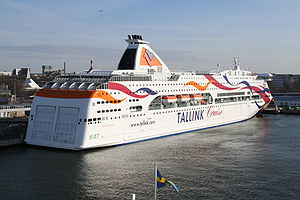 Estonia, Latvia, and Lithuania have been members of both the European Union
and the North Atlantic Treaty Organization since 2004. Today the three countries are liberal democracies
and their market economies
in recent years have undergone rapid expansion
in early 2000s. However, the economies were hard-hit by the financial crisis of 2007–2010. According to projections by the International Monetary Fund
(IMF), the GDP based on purchasing-power-parity decreased by 13% to 17% from 2008 to 2009.
The Baltic states had the highest growth rates in Europe between 2000 and 2006, and this continued in 2007. In 2006 the economy in Estonia grew by 11.2% in gross domestic product, while the Latvian economy grew by 11.9% and Lithuania by 7.5%. All three countries saw their rates of unemployment fall below the EU average by February 2006. Additionally, Estonia is among the ten most liberal economies in the world and in 2006 switched from being classified as an upper-middle income economy to a high-income economy by the World Bank
. Estonia adopted the euro in January 2011 whilst Latvia and Lithuania do not have a specified date, but Lithuania hopes to do the same in the following years and Latvia in 2014.
However, due to the global economic crisis, the Baltic economies in 2008 were fragile and the previous fast growth had switched to recession in Estonia and Latvia by the end of 2008, followed by Lithuania in 2009.
In 2009, unemployment rate rose to 13.7% in Lithuania, 17.3% in Latvia and 13.8% in Estonia, as compared to a "Advanced Europe" level of 8.8% (the 2009 unemployment rate in so called "Emerging Europe" countries was higher but still below that found in the Baltic states). Over the course of 2011, the unemployment rates are expected to rise even further, despite an expected recovery in output
.
In 2009, real aggregate GDP fell by 14.8% in Lithuania, by 18% in Latvia and 13.9% in Estonia, compared to an overall fall of 3.7% among all countries in the "Emerging Europe" group. Output is expected to recover somewhat in Lithuania and Estonia, with projected growth rates of 1.3% and 1.8% respectively, while in Latvia GDP is expected to fall by further 1%.
Although Estonia has so far succeeded on keeping its debt-levels one of the lowest in the European Union, the southern Baltic states are in a more difficult situation. Rather defaulting on debt in the lead-up to the sub-prime mortgage crash, the Latvian government has responded to EU and IMF pressure by taking on private debt. Latvia accepted a 7.5 billion euro EU-IMF loan.
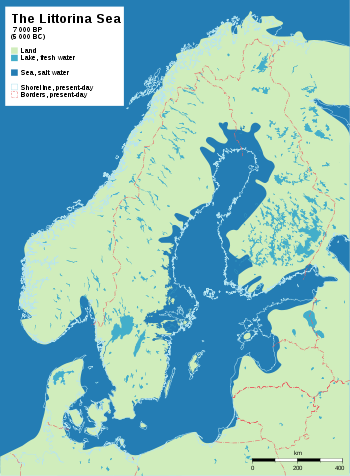 At 8000–5000 BC mesolithic
hunter-gatherer
communities of the Kunda culture
at the southern shores of the Mastogloia Sea
may have witnessed its transfiguration into Littorina Sea
and finally to what is the Baltic Sea
now. Traces of Comb Ceramic Culture found on these territories date back to the beginning of the 4th millennium BC
, and of the Corded Ware culture
(pottery with corded decoration and well-polished boat-shape stone axes) to the beginning of the Late Neolithic Period. Fossils of the Bronze Age
show the separation between the Finnic peoples
and the Balts
.
 In the 1st century, AD the people living in the area were first denoted by Tacitus
as a form of Aestii.
In the 13th century, Christianity and feudalism
were effectively forced upon modern Estonia and Latvia by the invasion of the crusaders
from the west (German Sword Brethren
, Denmark) and the conversion of Lithuania's rulers from Paganism
to Christianity. While in Latvia and most of Estonia Livonian Confederation
was established, Lithuania established its own state as the Grand Duchy of Lithuania
some time before 1252. It later was a major political power of the region.
After the Livonian War
in the 16th century, the Confederation ceased to exist, and its lands were incorporated into the Polish–Lithuanian Commonwealth. In 1621 most of the Duchy of Livonia
was incorporated into the Swedish empire
. During the Great Northern War
the Dominions of Sweden
of Swedish Estonia
and Swedish Livonia
were conquered by Russia and then ceded by Sweden in the Treaty of Nystad
in 1721.
The Russian Empire gained control of most of the present-day Baltic states in the 18th century when the Polish–Lithuanian Commonwealth was partitioned in three stages by the Russian Empire, the Kingdom of Prussia, and the Habsburg Monarchy, while western parts of Lithuania were incorporated into Prussia.
Estonia, Latvia and Lithuania became sovereign nations in the aftermath of World War I. They declared independence in 1918, fought independence war
s against German Freikorps
and Bolshevist Russia
, and were recognized as independent countries in 1920.
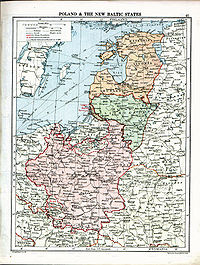 After independence, the Baltic States were sometimes referred to as limitrophe states
between the two World Wars, from the French, indicating their collectively forming a rim along Bolshevik Russia's, later the Soviet Union's, western border. They were also part of what Clemenceau considered a strategic cordon sanitaire
, the entire territory from Finland in the north to Romania in the south, standing between Western Europe and potential Bolshevik territorial ambitions.
Following the Molotov-Ribbentrop Pact
of 1939, the Soviet Army
entered eastern Poland as well as military bases in the Baltic states which were granted after U.S.S.R. had threatened the three countries with military invasion. In June 1940, the Red Army occupied all of the territory of Estonia, Latvia, and Lithuania, and the Red Army installed new, pro-Soviet governments in all three countries. Following rigged elections, in which only pro-communist candidates were allowed to run, the newly "elected" parliaments of the three countries formally applied to "join" the Soviet Union in August 1940 and were annexed into it as the Estonian SSR, the Latvian SSR
, and the Lithuanian SSR
.
The Soviet control of the Baltic states was interrupted by Nazi German
invasion of this region in 1941. The German occupation lasted until late 1944 (in Courland, until early 1945), when the countries were reoccupied by the Red Army. In all three countries, Baltic partisans
, known colloquially as the Forest Brothers
, Latvian national partisans
, and Lithuanian partisans (1944–53), waged unsuccessful guerrilla warfare against the Soviet occupation for the next eight years in a bid to regain their nations' independence.
In the late 1980s a massive campaign of civil resistance
against Soviet rule, known as the Singing revolution
, began. Baltic Way
was one of the most spectacular events when a two-million-strong human chain stretched for 600 km from Tallinn to Vilnius on . In the wake of this campaign «at least one of Gorbachev's
had privately concluded that the departure of the Baltic republics had become ‘inevitable’». This process contributed to the dissolution of the Soviet Union
setting a precedent for the other Soviet republics to secede from the USSR. Soviet Union recognized the independence of three Baltic states on . The last Russian troops were withdrawn from there in August 1994.
Lithuania, Latvia and Estonia were considered to be under Soviet occupation by the United States, the United Kingdom, Canada, NATO, and many other countries and international organizations. the United Kingdom,.
, which have unicameral parliaments that are elected by popular vote to serve four-year terms – Riigikogu
of Estonia, Saeima
of Latvia and Seimas
of Lithuania. In Latvia and Estonia, the president is elected by parliament while Lithuania has a semi-presidential system and the president is elected by popular vote.
Each of the three countries has declared itself to be the restoration of the sovereign nations which existed already in 1918 – 40, emphasizing their contention that Soviet domination over the Baltic nations during the Cold War
period had been an illegal occupation and annexation.
The same legal interpretation is shared by the United States, the United Kingdom, and all other Western democracies, who always considered the forcible incorporation of Estonia, Latvia, and Lithuania into the Soviet Union
to be illegal. At least formally, the Western democracies never considered the three Baltic states to be constituent parts of the Soviet Union. Australia was a brief exception to this support of Baltic freedom: in 1974, the Labor government of Australia did recognize Soviet dominion, but this decision was reversed by the next Australian Parliament.
After the Baltic states had restored independence, integration with Western Europe was chosen as the main strategic goal. In 2002 the Baltic nations applied to become members of the North Atlantic Treaty Organization (NATO) and the European Union
(EU). Membership of NATO was duly achieved on 29 March 2004, and accession to the EU took place on 1 May 2004. The Batic States have been the only former-Soviet states to join either NATO or the EU thus far.
Currently governments of Baltic states cooperate in multiple ways. There is active cooperation among Presidents, parliament speakers, heads of government, and foreign ministers. On 8 November 1991, the Baltic Assembly
was established for co-operation among parliaments. 15 to 20 MPs from each parliament represent their countries in the Assembly. For co-operation among governments Baltic Council of Ministers was established on 13 June 1994. Since 2003 Baltic Assembly is co-ordinated with the Baltic Council of Ministers.
The largest cities by population (2010)
Russian Empire
The Russian Empire was a state that existed from 1721 until the Russian Revolution of 1917. It was the successor to the Tsardom of Russia and the predecessor of the Soviet Union...
in the wake of World War I: primarily the contiguous trio of Estonia
Estonia
Estonia , officially the Republic of Estonia , is a state in the Baltic region of Northern Europe. It is bordered to the north by the Gulf of Finland, to the west by the Baltic Sea, to the south by Latvia , and to the east by Lake Peipsi and the Russian Federation . Across the Baltic Sea lies...
, Latvia
Latvia
Latvia , officially the Republic of Latvia , is a country in the Baltic region of Northern Europe. It is bordered to the north by Estonia , to the south by Lithuania , to the east by the Russian Federation , to the southeast by Belarus and shares maritime borders to the west with Sweden...
, Lithuania
Lithuania
Lithuania , officially the Republic of Lithuania is a country in Northern Europe, the biggest of the three Baltic states. It is situated along the southeastern shore of the Baltic Sea, whereby to the west lie Sweden and Denmark...
(from north to south); Finland
Finland
Finland , officially the Republic of Finland, is a Nordic country situated in the Fennoscandian region of Northern Europe. It is bordered by Sweden in the west, Norway in the north and Russia in the east, while Estonia lies to its south across the Gulf of Finland.Around 5.4 million people reside...
also fell within the scope of the term after initially gaining independence in the 1920s.
The term in the indigenous languages of the Baltic states is:,, and.
Etymology and toponymic history
The term "Baltic" stems from the name of the Baltic Sea – a hydronymHydronym
A hydronym is a proper name of a body of water. Hydronymy is the study of hydronyms and of how bodies of water receive their names and how they are transmitted through history...
dating back to the 11th century (Adam of Bremen
Adam of Bremen
Adam of Bremen was a German medieval chronicler. He lived and worked in the second half of the eleventh century. He is most famous for his chronicle Gesta Hammaburgensis Ecclesiae Pontificum .-Background:Little is known of his life other than hints from his own chronicles...
mentioned ) and earlier.
The Latvian and Lithuanian term Baltija most likely originates from the Indo-European
Proto-Indo-European language
The Proto-Indo-European language is the reconstructed common ancestor of the Indo-European languages, spoken by the Proto-Indo-Europeans...
root *bhel meaning white, fair.
Beginning in the Middle Ages
Middle Ages
The Middle Ages is a periodization of European history from the 5th century to the 15th century. The Middle Ages follows the fall of the Western Roman Empire in 476 and precedes the Early Modern Era. It is the middle period of a three-period division of Western history: Classic, Medieval and Modern...
and through the present day, the Baltic Sea
Baltic Sea
The Baltic Sea is a brackish mediterranean sea located in Northern Europe, from 53°N to 66°N latitude and from 20°E to 26°E longitude. It is bounded by the Scandinavian Peninsula, the mainland of Europe, and the Danish islands. It drains into the Kattegat by way of the Øresund, the Great Belt and...
appears on the maps subscribed in Germanic languages
Germanic languages
The Germanic languages constitute a sub-branch of the Indo-European language family. The common ancestor of all of the languages in this branch is called Proto-Germanic , which was spoken in approximately the mid-1st millennium BC in Iron Age northern Europe...
as , , , , etc. In English "Ost" is "East", and in fact, the Baltic Sea mostly lies to the east for Germany
Germany
Germany , officially the Federal Republic of Germany , is a federal parliamentary republic in Europe. The country consists of 16 states while the capital and largest city is Berlin. Germany covers an area of 357,021 km2 and has a largely temperate seasonal climate...
, Denmark
Denmark
Denmark is a Scandinavian country in Northern Europe. The countries of Denmark and Greenland, as well as the Faroe Islands, constitute the Kingdom of Denmark . It is the southernmost of the Nordic countries, southwest of Sweden and south of Norway, and bordered to the south by Germany. Denmark...
, Norway
Norway
Norway , officially the Kingdom of Norway, is a Nordic unitary constitutional monarchy whose territory comprises the western portion of the Scandinavian Peninsula, Jan Mayen, and the Arctic archipelago of Svalbard and Bouvet Island. Norway has a total area of and a population of about 4.9 million...
, and Sweden
Sweden
Sweden , officially the Kingdom of Sweden , is a Nordic country on the Scandinavian Peninsula in Northern Europe. Sweden borders with Norway and Finland and is connected to Denmark by a bridge-tunnel across the Öresund....
. Clearly, part of the Baltic Sea lies to the east of Germany and Sweden, and due north of parts of Germany.
In the 17th century, the Kingdom of Sweden grew to be one of the great power
Great power
A great power is a nation or state that has the ability to exert its influence on a global scale. Great powers characteristically possess military and economic strength and diplomatic and cultural influence which may cause small powers to consider the opinions of great powers before taking actions...
s of Northern Europe
Northern Europe
Northern Europe is the northern part or region of Europe. Northern Europe typically refers to the seven countries in the northern part of the European subcontinent which includes Denmark, Estonia, Latvia, Lithuania, Norway, Finland and Sweden...
. However, at the beginning of the 18th Century
18th century
The 18th century lasted from 1701 to 1800 in the Gregorian calendar.During the 18th century, the Enlightenment culminated in the French and American revolutions. Philosophy and science increased in prominence. Philosophers were dreaming about a better age without the Christian fundamentalism of...
"the Great Power Era" of the Swedish Empire
Swedish Empire
The Swedish Empire refers to the Kingdom of Sweden between 1561 and 1721 . During this time, Sweden was one of the great European powers. In Swedish, the period is called Stormaktstiden, literally meaning "the Great Power Era"...
was challenged by the Russian Empire
Russian Empire
The Russian Empire was a state that existed from 1721 until the Russian Revolution of 1917. It was the successor to the Tsardom of Russia and the predecessor of the Soviet Union...
which was seeking to restore its access to the Varangians
Varangians
The Varangians or Varyags , sometimes referred to as Variagians, were people from the Baltic region, most often associated with Vikings, who from the 9th to 11th centuries ventured eastwards and southwards along the rivers of Eastern Europe, through what is now Russia, Belarus and Ukraine.According...
Sea -- as the Baltic Sea was called in the Land of Novgorod
Novgorod Republic
The Novgorod Republic was a large medieval Russian state which stretched from the Baltic Sea to the Ural Mountains between the 12th and 15th centuries, centred on the city of Novgorod...
. De facto in 1700 - 09, and de jure beginning in 1721, Swedish Livonia
Swedish Livonia
- Swedish infantry and cavalry regiments:Infantry regiments:* Garnisonsregementet i Riga * Guvenörsregementet i Riga * Livländsk infanteribataljon I...
(today the northern parts of Latvia
Latvia
Latvia , officially the Republic of Latvia , is a country in the Baltic region of Northern Europe. It is bordered to the north by Estonia , to the south by Lithuania , to the east by the Russian Federation , to the southeast by Belarus and shares maritime borders to the west with Sweden...
and Estonia
Estonia
Estonia , officially the Republic of Estonia , is a state in the Baltic region of Northern Europe. It is bordered to the north by the Gulf of Finland, to the west by the Baltic Sea, to the south by Latvia , and to the east by Lake Peipsi and the Russian Federation . Across the Baltic Sea lies...
, and the western part of the Leningrad Oblast
Leningrad Oblast
Leningrad Oblast is a federal subject of Russia . It was established on August 1, 1927, although it was not until 1946 that the oblast's borders had been mostly settled in their present position...
) which had been acquired by Sweden in accordance with Treaty of Oliva
Treaty of Oliva
The Treaty or Peace of Oliva of 23 April /3 May 1660 was one of the peace treaties ending the Second Northern War...
of 1660, came under the rule of the Russian Empire. Legalizing this acquisition by the Treaty of Nystad
Treaty of Nystad
The Treaty of Nystad was the last peace treaty of the Great Northern War. It was concluded between the Tsardom of Russia and Swedish Empire on 30 August / 10 September 1721 in the then Swedish town of Nystad , after Sweden had settled with the other parties in Stockholm and Frederiksborg.During...
, instead of taking an indemnity from the defeated Swedes, the Russian Empire paid Sweden two million jefimoks, or about 980 kilograms of silver. The first collective name for two administrative units established here in 1713 was Ostsee Governorates .
Reval Governorate
The Governorate of Estonia or Estland, also known as the Government of Estonia or Province of Estonia, was a governorate of the Russian Empire in what is now northern Estonia.-Historical overview:...
(now Tallinn
Tallinn
Tallinn is the capital and largest city of Estonia. It occupies an area of with a population of 414,940. It is situated on the northern coast of the country, on the banks of the Gulf of Finland, south of Helsinki, east of Stockholm and west of Saint Petersburg. Tallinn's Old Town is in the list...
). After the Partitions of Poland
Partitions of Poland
The Partitions of Poland or Partitions of the Polish–Lithuanian Commonwealth took place in the second half of the 18th century and ended the existence of the Polish–Lithuanian Commonwealth, resulting in the elimination of sovereign Poland for 123 years...
which took place in the last quarter of the 18th century the third Ostsee Governorate was set, the one of Courland
Courland Governorate
Courland Governorate, also known as the Province of Courland, Governorate of Kurland , and Government of Courland , was one of the Baltic governorates of the Russian Empire, that is now part of the Republic of Latvia....
(presently a part of Latvia). This toponym stems from Curonians
Curonians
The Curonians or Kurs were a Baltic tribe living on the shores of the Baltic sea in what are now the western parts of Latvia and Lithuania from the 5th to the 16th centuries, when they merged with other Baltic tribes. They gave their name to the region of Courland , and they spoke the Old...
, one of Finnic
Baltic Finns
The Baltic Finns are a historical linguistic group of peoples of northern Europe whose modern descendants include the Finns proper, Karelians , Izhorians, Veps, Votes, Livonians and Estonians who speak Baltic-Finnic languages and have inhabited the Baltic Sea region for 3,000 years according to...
or Baltic
Balts
The Balts or Baltic peoples , defined as speakers of one of the Baltic languages, a branch of the Indo-European language family, are descended from a group of Indo-European tribes who settled the area between the Jutland peninsula in the west and Moscow, Oka and Volga rivers basins in the east...
indigenous tribes. Accordingly, two others were renamed to the Governorate of Livland and the Governorate of Estland.
The presence of the Germanic morpheme
Morpheme
In linguistics, a morpheme is the smallest semantically meaningful unit in a language. The field of study dedicated to morphemes is called morphology. A morpheme is not identical to a word, and the principal difference between the two is that a morpheme may or may not stand alone, whereas a word,...
"Ostsee" within the Russian collective name of those provinces is not limited to the personal inclination to the Western lexics which was showed by Peter the Great who conquered these lands from the Swedes
Swedes
Swedes are a Scandinavian nation and ethnic group native to Sweden, mostly inhabiting Sweden and the other Nordic countries, with descendants living in a number of countries.-Etymology:...
. In fact, since the Livonian Crusade
Livonian Crusade
The Livonian Crusade refers to the German and Danish conquest and colonization of medieval Livonia, the territory constituting modern Latvia and Estonia, during the Northern Crusades...
at the turn of the 13th century "Terra Mariana", Livland and Estland were under the German influence. These were Germans who formed the backbone of the local gentry, and for centuries German was the language of international communication and record keeping there.
By coincidence, it was German philologist Georg Nesselmann living at the Baltics (in East Prussia
East Prussia
East Prussia is the main part of the region of Prussia along the southeastern Baltic Coast from the 13th century to the end of World War II in May 1945. From 1772–1829 and 1878–1945, the Province of East Prussia was part of the German state of Prussia. The capital city was Königsberg.East Prussia...
) who in the middle of the 19th century substantiated the concept of Baltic languages
Baltic languages
The Baltic languages are a group of related languages belonging to the Balto-Slavic branch of the Indo-European language family and spoken mainly in areas extending east and southeast of the Baltic Sea in Northern Europe...
using the name of one of the local pagan tribes, the Balts
Balts
The Balts or Baltic peoples , defined as speakers of one of the Baltic languages, a branch of the Indo-European language family, are descended from a group of Indo-European tribes who settled the area between the Jutland peninsula in the west and Moscow, Oka and Volga rivers basins in the east...
. Endre Bojtár (1999) argues that it was around 1840s when the German gentry of the Governorate of Livonia devised the term "Balts" to mean themselves, the German upper classes of Livonia, excluding the Latvian and Estonian lower classes. They spoke an exclusive dialect, baltisch-deutsch, legally spoken by them alone. Thus the usage of "Baltic" and similar terms to denote this region dates back not earlier than 1840s.
Simultaneously, in 1840s the usage "Ostsee" was superseded by "Baltic" in Russian. The article "Прибалтийский край" ("Baltic Krai
Krai
Krai or kray was a type of an administrative division in the Russian Empire and the Russian SFSR, and is one of the types of the federal subjects of modern Russia ....
") in the Brockhaus
Brockhaus and Efron Encyclopedic Dictionary
The Brockhaus and Efron Encyclopedic Dictionary is, in its scope and style, the Russian counterpart to the Encyclopædia Britannica. It contains 121,240 articles, 7,800 images, and 235 maps...
encyclopedia and other sources notes that 1840s mark a shift of the local population towards Russian language and, to a certain extent, to orthodoxy
Russian Orthodox Church
The Russian Orthodox Church or, alternatively, the Moscow Patriarchate The ROC is often said to be the largest of the Eastern Orthodox churches in the world; including all the autocephalous churches under its umbrella, its adherents number over 150 million worldwide—about half of the 300 million...
.
Lithuania occupies a specific place within the scope of the region named "Baltic states". Through many centuries of its history Lithuania was more than a state at a Baltic seacoast. Born at a turn of the 13th century the Grand Duchy of Lithuania
Grand Duchy of Lithuania
The Grand Duchy of Lithuania was a European state from the 12th /13th century until 1569 and then as a constituent part of Polish-Lithuanian Commonwealth until 1791 when Constitution of May 3, 1791 abolished it in favor of unitary state. It was founded by the Lithuanians, one of the polytheistic...
encompassed most part of Kievan Rus'
Kievan Rus'
Kievan Rus was a medieval polity in Eastern Europe, from the late 9th to the mid 13th century, when it disintegrated under the pressure of the Mongol invasion of 1237–1240....
and by the middle of 16th century stretched to the Black Sea
Black Sea
The Black Sea is bounded by Europe, Anatolia and the Caucasus and is ultimately connected to the Atlantic Ocean via the Mediterranean and the Aegean seas and various straits. The Bosphorus strait connects it to the Sea of Marmara, and the strait of the Dardanelles connects that sea to the Aegean...
. From 1569 it has been a backbone element of such large and strong geo-political power as Polish–Lithuanian Commonwealth, so it is not incidental that up to 1920s Lithuania was treated separately from the Baltic states. Only after Lietuvos Taryba
Council of Lithuania
The Council of Lithuania , after July 11, 1918 The State Council of Lithuania , was convened at the Vilnius Conference that took place between September 18 and 23, 1917. The council was granted the executive authority of the Lithuanian people and was entrusted to establish an independent...
proclaimed its independence in 1918, Lithuania began to be mentioned in the same list with her two northern neighbours.
In the 1920s, the newly-established countries of Estonia, Latvia, Lithuania and Finland
Finland
Finland , officially the Republic of Finland, is a Nordic country situated in the Fennoscandian region of Northern Europe. It is bordered by Sweden in the west, Norway in the north and Russia in the east, while Estonia lies to its south across the Gulf of Finland.Around 5.4 million people reside...
, formerly territories of the Russian empire, were referred to as the Baltic states.
The United Nations Group of Experts on Geographical Names defines a Baltic Division.
Cultures and languages
Estonians
Estonians are a Finnic people closely related to the Finns and inhabiting, primarily, the country of Estonia. They speak a Finnic language known as Estonian...
and the nearly linguistically extinct Livonian people
Livonian people
The Livonians or Livs are the indigenous inhabitants of Livonia, a large part of what is today northwestern Latvia and southwestern Estonia. They spoke the Uralic Livonian language, a language which is closely related to Estonian and Finnish...
in Latvia are descended from the Baltic Finns
Baltic Finns
The Baltic Finns are a historical linguistic group of peoples of northern Europe whose modern descendants include the Finns proper, Karelians , Izhorians, Veps, Votes, Livonians and Estonians who speak Baltic-Finnic languages and have inhabited the Baltic Sea region for 3,000 years according to...
, sharing closely related languages and a common cultural ancestry. The Latvians
Latvians
Latvians or Letts are the indigenous Baltic people of Latvia.-History:Latvians occasionally refer to themselves by the ancient name of Latvji, which may have originated from the word Latve which is a name of the river that presumably flowed through what is now eastern Latvia...
and Lithuanians
Lithuanians
Lithuanians are the Baltic ethnic group native to Lithuania, where they number around 2,765,600 people. Another million or more make up the Lithuanian diaspora, largely found in countries such as the United States, Brazil, Canada, Colombia, Russia, United Kingdom and Ireland. Their native language...
, linguistically and culturally related to each other, are descended from the Balts
Balts
The Balts or Baltic peoples , defined as speakers of one of the Baltic languages, a branch of the Indo-European language family, are descended from a group of Indo-European tribes who settled the area between the Jutland peninsula in the west and Moscow, Oka and Volga rivers basins in the east...
, an Indo-European
Indo-European
Indo-European may refer to:* Indo-European languages** Aryan race, a 19th century and early 20th century term for those peoples who are the native speakers of Indo-European languages...
people and culture. The peoples comprising the Baltic states have together inhabited the eastern coast of the Baltic Sea
Baltic Sea
The Baltic Sea is a brackish mediterranean sea located in Northern Europe, from 53°N to 66°N latitude and from 20°E to 26°E longitude. It is bounded by the Scandinavian Peninsula, the mainland of Europe, and the Danish islands. It drains into the Kattegat by way of the Øresund, the Great Belt and...
for millennia, although not always peacefully in ancient times, over which period their populations, Estonian, Latvian, and Lithuanian, have remained remarkably stable within the approximate territorial boundaries of the current Baltic states. While separate peoples with their own customs and traditions, historical factors have introduced cultural commonalities across and differences within them.
The peoples of the Baltic countries belong to different Christian denominations, a reflection of historical circumstances. Both Western and Eastern Christianity had been introduced by the end of the first millennium. The current divide between Lutheranism
Lutheranism
Lutheranism is a major branch of Western Christianity that identifies with the theology of Martin Luther, a German reformer. Luther's efforts to reform the theology and practice of the church launched the Protestant Reformation...
to the north and Catholicism to the south is the remnant of Swedish
Swedish Empire
The Swedish Empire refers to the Kingdom of Sweden between 1561 and 1721 . During this time, Sweden was one of the great European powers. In Swedish, the period is called Stormaktstiden, literally meaning "the Great Power Era"...
and Polish hegemony, respectively, with Orthodox Christianity
Russian Orthodox Church
The Russian Orthodox Church or, alternatively, the Moscow Patriarchate The ROC is often said to be the largest of the Eastern Orthodox churches in the world; including all the autocephalous churches under its umbrella, its adherents number over 150 million worldwide—about half of the 300 million...
remaining the dominant faith among Russian and other Slavic minorities.
The languages of Baltic nations belong to two distinct language families. The Latvian
Latvian language
Latvian is the official state language of Latvia. It is also sometimes referred to as Lettish. There are about 1.4 million native Latvian speakers in Latvia and about 150,000 abroad. The Latvian language has a relatively large number of non-native speakers, atypical for a small language...
and Lithuanian
Lithuanian language
Lithuanian is the official state language of Lithuania and is recognized as one of the official languages of the European Union. There are about 2.96 million native Lithuanian speakers in Lithuania and about 170,000 abroad. Lithuanian is a Baltic language, closely related to Latvian, although they...
languages make up the group of Baltic languages
Baltic languages
The Baltic languages are a group of related languages belonging to the Balto-Slavic branch of the Indo-European language family and spoken mainly in areas extending east and southeast of the Baltic Sea in Northern Europe...
which belongs to the Indo-European
Indo-European languages
The Indo-European languages are a family of several hundred related languages and dialects, including most major current languages of Europe, the Iranian plateau, and South Asia and also historically predominant in Anatolia...
language family
Language family
A language family is a group of languages related through descent from a common ancestor, called the proto-language of that family. The term 'family' comes from the tree model of language origination in historical linguistics, which makes use of a metaphor comparing languages to people in a...
. The Estonian language
Estonian language
Estonian is the official language of Estonia, spoken by about 1.1 million people in Estonia and tens of thousands in various émigré communities...
and the nearly-extinct Livonian language
Livonian language
Livonian belongs to the Finnic branch of the Uralic languages. It is a nearly extinct language, with one of its last native speakers having died in February 2009. It is closely related to Estonian...
, on the other hand, are not Indo-European languages and instead they belong to the Baltic-Finnic subgroup of the Finno-Ugric languages
Finno-Ugric languages
Finno-Ugric , Finno-Ugrian or Fenno-Ugric is a traditional group of languages in the Uralic language family that comprises the Finno-Permic and Ugric language families....
, sharing close ethnic and historical ties with the Finnish language
Finnish language
Finnish is the language spoken by the majority of the population in Finland Primarily for use by restaurant menus and by ethnic Finns outside Finland. It is one of the two official languages of Finland and an official minority language in Sweden. In Sweden, both standard Finnish and Meänkieli, a...
and people.
The Baltic states have historically been in the Swedish (or, in Lithuania's case, Polish), German (historically: The Holy Roman Empire
Holy Roman Empire
The Holy Roman Empire was a realm that existed from 962 to 1806 in Central Europe.It was ruled by the Holy Roman Emperor. Its character changed during the Middle Ages and the Early Modern period, when the power of the emperor gradually weakened in favour of the princes...
and Saxony
Saxony
The Free State of Saxony is a landlocked state of Germany, contingent with Brandenburg, Saxony Anhalt, Thuringia, Bavaria, the Czech Republic and Poland. It is the tenth-largest German state in area, with of Germany's sixteen states....
), Danish, and Russian spheres of influence.
Apart from the indigenous languages, German was the dominant language in Estonia and Latvia in academics, professional life, and upper society from the 13th century until World War I. Polish
Polish language
Polish is a language of the Lechitic subgroup of West Slavic languages, used throughout Poland and by Polish minorities in other countries...
served a similar function in Lithuania. Swedish
Swedish language
Swedish is a North Germanic language, spoken by approximately 10 million people, predominantly in Sweden and parts of Finland, especially along its coast and on the Åland islands. It is largely mutually intelligible with Norwegian and Danish...
remains spoken in Estonia, particularly among the Estonian Swedes
Estonian Swedes
The Estonian Swedes, Estonia-Swedes, or Coastal Swedes are a Swedish-speaking linguistic minority traditionally residing in the coastal areas and islands of what is now western and northern Estonia...
of northern Estonia and the islands. Numerous Swedish loanwords have made it into the Estonian language; it was under the Swedish rule that schools were established and education propagated in 17th century. There is also significant proficiency in Finnish in Estonia owing to its closeness to the native Estonian and also the widespread practice of listening to Finnish broadcasts during the Soviet era. Russian also achieved significant usage particularly in commerce.
Russian was the most commonly studied foreign language at all levels of schooling during the Soviet era. The Soviet Union conducted a policy of Russification by encouraging Russians and other Russian-speaking ethnic groups of the Soviet Union to settle in the Baltic Republics. As they were neither encouraged nor motivated to learn the official local languages, knowledge of Russian became a practical necessity in daily life despite schooling available and administration conducted in local languages. Today ethnic Russian immigrants
Baltic Russians
The term Baltic Russians is usually used to refer to the Russian-speaking communities in the Baltic states: Estonia, Latvia, and Lithuania.The term "Baltic Russians" does not imply a separate ethnic subcategory among the Russians. It came into use in the context of discussions of their fate after...
from former Soviet Union. and their descendants make up a sizable minority in the Baltic states, particularly in Latvia (about one-third of the total population and majority in the capital Riga) and Estonia (one-quarter of the population).
Currently, the Baltic states have considerable Slavic populations, and knowledge of Slavic languages (particularly Russian). Latvia is 35.9% Slavic (including 27.5% Russian, 3.6% Belarusian
Belarusian language
The Belarusian language , sometimes referred to as White Russian or White Ruthenian, is the language of the Belarusian people...
, 2.5% Ukrainian
Ukrainian language
Ukrainian is a language of the East Slavic subgroup of the Slavic languages. It is the official state language of Ukraine. Written Ukrainian uses a variant of the Cyrillic alphabet....
, and 2.3% Polish
Polish language
Polish is a language of the Lechitic subgroup of West Slavic languages, used throughout Poland and by Polish minorities in other countries...
), and 1,822,327 (76.7% of the population of Latvia) can fluently speak Russian. 28.8% of Estonia is Slavic (mostly Russian), and 12.3% of Lithuania is Slavic (mostly Polish).
Economies
European Union
The European Union is an economic and political union of 27 independent member states which are located primarily in Europe. The EU traces its origins from the European Coal and Steel Community and the European Economic Community , formed by six countries in 1958...
and the North Atlantic Treaty Organization since 2004. Today the three countries are liberal democracies
Liberal democracy
Liberal democracy, also known as constitutional democracy, is a common form of representative democracy. According to the principles of liberal democracy, elections should be free and fair, and the political process should be competitive...
and their market economies
Market economy
A market economy is an economy in which the prices of goods and services are determined in a free price system. This is often contrasted with a state-directed or planned economy. Market economies can range from hypothetically pure laissez-faire variants to an assortment of real-world mixed...
in recent years have undergone rapid expansion
Baltic Tiger
Baltic Tiger is a term used to refer to any of the three Baltic states of Estonia, Latvia, and Lithuania during their periods of economic boom, which started after the year 2000 and continued until 2006–2007...
in early 2000s. However, the economies were hard-hit by the financial crisis of 2007–2010. According to projections by the International Monetary Fund
International Monetary Fund
The International Monetary Fund is an organization of 187 countries, working to foster global monetary cooperation, secure financial stability, facilitate international trade, promote high employment and sustainable economic growth, and reduce poverty around the world...
(IMF), the GDP based on purchasing-power-parity decreased by 13% to 17% from 2008 to 2009.
The Baltic states had the highest growth rates in Europe between 2000 and 2006, and this continued in 2007. In 2006 the economy in Estonia grew by 11.2% in gross domestic product, while the Latvian economy grew by 11.9% and Lithuania by 7.5%. All three countries saw their rates of unemployment fall below the EU average by February 2006. Additionally, Estonia is among the ten most liberal economies in the world and in 2006 switched from being classified as an upper-middle income economy to a high-income economy by the World Bank
World Bank
The World Bank is an international financial institution that provides loans to developing countries for capital programmes.The World Bank's official goal is the reduction of poverty...
. Estonia adopted the euro in January 2011 whilst Latvia and Lithuania do not have a specified date, but Lithuania hopes to do the same in the following years and Latvia in 2014.
However, due to the global economic crisis, the Baltic economies in 2008 were fragile and the previous fast growth had switched to recession in Estonia and Latvia by the end of 2008, followed by Lithuania in 2009.
In 2009, unemployment rate rose to 13.7% in Lithuania, 17.3% in Latvia and 13.8% in Estonia, as compared to a "Advanced Europe" level of 8.8% (the 2009 unemployment rate in so called "Emerging Europe" countries was higher but still below that found in the Baltic states). Over the course of 2011, the unemployment rates are expected to rise even further, despite an expected recovery in output
Jobless recovery
A jobless recovery or jobless growth is an economic phenomon in which a macroeconomy experiences growth while maintaining or decreasing its level of employment...
.
In 2009, real aggregate GDP fell by 14.8% in Lithuania, by 18% in Latvia and 13.9% in Estonia, compared to an overall fall of 3.7% among all countries in the "Emerging Europe" group. Output is expected to recover somewhat in Lithuania and Estonia, with projected growth rates of 1.3% and 1.8% respectively, while in Latvia GDP is expected to fall by further 1%.
Although Estonia has so far succeeded on keeping its debt-levels one of the lowest in the European Union, the southern Baltic states are in a more difficult situation. Rather defaulting on debt in the lead-up to the sub-prime mortgage crash, the Latvian government has responded to EU and IMF pressure by taking on private debt. Latvia accepted a 7.5 billion euro EU-IMF loan.
Histories
Mesolithic
The Mesolithic is an archaeological concept used to refer to certain groups of archaeological cultures defined as falling between the Paleolithic and the Neolithic....
hunter-gatherer
Hunter-gatherer
A hunter-gatherer or forage society is one in which most or all food is obtained from wild plants and animals, in contrast to agricultural societies which rely mainly on domesticated species. Hunting and gathering was the ancestral subsistence mode of Homo, and all modern humans were...
communities of the Kunda culture
Kunda culture
Kunda Culture, with its roots in Swiderian culture is a mesolithic hunter-gatherer communities of the Baltic forest zone extending eastwards through Latvia into northern Russia dating to the period 8000–5000 BC by calibrated radiocarbon dating...
at the southern shores of the Mastogloia Sea
Mastogloia Sea
The Mastogloia Sea is one of the prehistoric stages of the Baltic Sea in its development after the last ice age. This took place ca. 8000 years ago following the Ancylus Lake stage and preceding the Littorina Sea stage....
may have witnessed its transfiguration into Littorina Sea
Littorina Sea
Littorina Sea is a geological brackish-water stage of the Baltic Sea, which existed around 7500–4000 BP and followed the Mastogloia Sea, transitional stage of the Ancylus Lake...
and finally to what is the Baltic Sea
Baltic Sea
The Baltic Sea is a brackish mediterranean sea located in Northern Europe, from 53°N to 66°N latitude and from 20°E to 26°E longitude. It is bounded by the Scandinavian Peninsula, the mainland of Europe, and the Danish islands. It drains into the Kattegat by way of the Øresund, the Great Belt and...
now. Traces of Comb Ceramic Culture found on these territories date back to the beginning of the 4th millennium BC
4th millennium BC
The 4th millennium BC saw major changes in human culture. It marked the beginning of the Bronze Age and of writing.The city states of Sumer and the kingdom of Egypt were established and grew to prominence. Agriculture spread widely across Eurasia...
, and of the Corded Ware culture
Corded Ware culture
The Corded Ware culture , alternatively characterized as the Battle Axe culture or Single Grave culture, is an enormous European archaeological horizon that begins in the late Neolithic , flourishes through the Copper Age and culminates in the early Bronze Age.Corded Ware culture is associated with...
(pottery with corded decoration and well-polished boat-shape stone axes) to the beginning of the Late Neolithic Period. Fossils of the Bronze Age
Bronze Age
The Bronze Age is a period characterized by the use of copper and its alloy bronze as the chief hard materials in the manufacture of some implements and weapons. Chronologically, it stands between the Stone Age and Iron Age...
show the separation between the Finnic peoples
Finnic peoples
The Finnic or Fennic peoples were historic ethnic groups who spoke various languages traditionally classified as Finno-Permic...
and the Balts
Balts
The Balts or Baltic peoples , defined as speakers of one of the Baltic languages, a branch of the Indo-European language family, are descended from a group of Indo-European tribes who settled the area between the Jutland peninsula in the west and Moscow, Oka and Volga rivers basins in the east...
.
Tacitus
Publius Cornelius Tacitus was a senator and a historian of the Roman Empire. The surviving portions of his two major works—the Annals and the Histories—examine the reigns of the Roman Emperors Tiberius, Claudius, Nero and those who reigned in the Year of the Four Emperors...
as a form of Aestii.
In the 13th century, Christianity and feudalism
Feudalism
Feudalism was a set of legal and military customs in medieval Europe that flourished between the 9th and 15th centuries, which, broadly defined, was a system for ordering society around relationships derived from the holding of land in exchange for service or labour.Although derived from the...
were effectively forced upon modern Estonia and Latvia by the invasion of the crusaders
Northern Crusades
The Northern Crusades or Baltic Crusades were crusades undertaken by the Christian kings of Denmark and Sweden, the German Livonian and Teutonic military orders, and their allies against the pagan peoples of Northern Europe around the southern and eastern shores of the Baltic Sea...
from the west (German Sword Brethren
Livonian Brothers of the Sword
The Livonian Brothers of the Sword were a military order founded by Bishop Albert of Riga in 1202. Pope Innocent III sanctioned the establishment in 1204. The membership of the order comprised German "warrior monks"...
, Denmark) and the conversion of Lithuania's rulers from Paganism
Paganism
Paganism is a blanket term, typically used to refer to non-Abrahamic, indigenous polytheistic religious traditions....
to Christianity. While in Latvia and most of Estonia Livonian Confederation
Livonian Confederation
Terra Mariana was the official name for Medieval Livonia or Old Livonia which was formed in the aftermath of the Livonian Crusade in the territories comprising present day Estonia and Latvia...
was established, Lithuania established its own state as the Grand Duchy of Lithuania
Grand Duchy of Lithuania
The Grand Duchy of Lithuania was a European state from the 12th /13th century until 1569 and then as a constituent part of Polish-Lithuanian Commonwealth until 1791 when Constitution of May 3, 1791 abolished it in favor of unitary state. It was founded by the Lithuanians, one of the polytheistic...
some time before 1252. It later was a major political power of the region.
After the Livonian War
Livonian War
The Livonian War was fought for control of Old Livonia in the territory of present-day Estonia and Latvia when the Tsardom of Russia faced a varying coalition of Denmark–Norway, the Kingdom of Sweden, the Union of the Grand Duchy of Lithuania and the Kingdom of Poland.During the period 1558–1578,...
in the 16th century, the Confederation ceased to exist, and its lands were incorporated into the Polish–Lithuanian Commonwealth. In 1621 most of the Duchy of Livonia
Duchy of Livonia
The Duchy of Livonia was a territory of the Grand Duchy of Lithuania — and later the Polish–Lithuanian Commonwealth — that existed from 1561 to 1621...
was incorporated into the Swedish empire
Swedish Empire
The Swedish Empire refers to the Kingdom of Sweden between 1561 and 1721 . During this time, Sweden was one of the great European powers. In Swedish, the period is called Stormaktstiden, literally meaning "the Great Power Era"...
. During the Great Northern War
Great Northern War
The Great Northern War was a conflict in which a coalition led by the Tsardom of Russia successfully contested the supremacy of the Swedish Empire in northern Central Europe and Eastern Europe. The initial leaders of the anti-Swedish alliance were Peter I the Great of Russia, Frederick IV of...
the Dominions of Sweden
Dominions of Sweden
The Dominions of Sweden or Svenska besittningar were territories that historically came under control of the Swedish Crown, but never became fully integrated with Sweden. This generally meant that they were ruled by Governors-General under the Swedish monarch, but within certain limits retained...
of Swedish Estonia
Swedish Estonia
The Duchy of Estonia , also known as Swedish Estonia, was a dominion of the Swedish Empire from 1561 until 1721, when it was ceded to Russia in the Treaty of Nystad, following its capitulation in the Great Northern War. The dominion arose when the northern parts of present-day Estonia were united...
and Swedish Livonia
Swedish Livonia
- Swedish infantry and cavalry regiments:Infantry regiments:* Garnisonsregementet i Riga * Guvenörsregementet i Riga * Livländsk infanteribataljon I...
were conquered by Russia and then ceded by Sweden in the Treaty of Nystad
Treaty of Nystad
The Treaty of Nystad was the last peace treaty of the Great Northern War. It was concluded between the Tsardom of Russia and Swedish Empire on 30 August / 10 September 1721 in the then Swedish town of Nystad , after Sweden had settled with the other parties in Stockholm and Frederiksborg.During...
in 1721.
The Russian Empire gained control of most of the present-day Baltic states in the 18th century when the Polish–Lithuanian Commonwealth was partitioned in three stages by the Russian Empire, the Kingdom of Prussia, and the Habsburg Monarchy, while western parts of Lithuania were incorporated into Prussia.
Estonia, Latvia and Lithuania became sovereign nations in the aftermath of World War I. They declared independence in 1918, fought independence war
Independence war
Independence war may refer to:* War of independence* I-War , a 1997 space combat simulator...
s against German Freikorps
Freikorps
Freikorps are German volunteer military or paramilitary units. The term was originally applied to voluntary armies formed in German lands from the middle of the 18th century onwards. Between World War I and World War II the term was also used for the paramilitary organizations that arose during...
and Bolshevist Russia
Russian Soviet Federative Socialist Republic
The Russian Soviet Federative Socialist Republic , commonly referred to as Soviet Russia, Bolshevik Russia, or simply Russia, was the largest, most populous and economically developed republic in the former Soviet Union....
, and were recognized as independent countries in 1920.
Limitrophe states
Limitrophe states:#historically — from , provinces at the borders of the Roman Empire, which were obliged to provide billeting of the limitanei legions deployed on their territory, mostly in limes....
between the two World Wars, from the French, indicating their collectively forming a rim along Bolshevik Russia's, later the Soviet Union's, western border. They were also part of what Clemenceau considered a strategic cordon sanitaire
Cordon sanitaire
Cordon sanitaire — or quarantine line — is a French phrase that, literally translated, means "sanitary cordon". Though in French it originally denoted a barrier implemented to stop the spread of disease, it has often been used in English in a metaphorical sense to refer to attempts to prevent the...
, the entire territory from Finland in the north to Romania in the south, standing between Western Europe and potential Bolshevik territorial ambitions.
Following the Molotov-Ribbentrop Pact
Molotov-Ribbentrop Pact
The Molotov–Ribbentrop Pact, named after the Soviet foreign minister Vyacheslav Molotov and the German foreign minister Joachim von Ribbentrop, was an agreement officially titled the Treaty of Non-Aggression between Germany and the Soviet Union and signed in Moscow in the late hours of 23 August 1939...
of 1939, the Soviet Army
Red Army
The Workers' and Peasants' Red Army started out as the Soviet Union's revolutionary communist combat groups during the Russian Civil War of 1918-1922. It grew into the national army of the Soviet Union. By the 1930s the Red Army was among the largest armies in history.The "Red Army" name refers to...
entered eastern Poland as well as military bases in the Baltic states which were granted after U.S.S.R. had threatened the three countries with military invasion. In June 1940, the Red Army occupied all of the territory of Estonia, Latvia, and Lithuania, and the Red Army installed new, pro-Soviet governments in all three countries. Following rigged elections, in which only pro-communist candidates were allowed to run, the newly "elected" parliaments of the three countries formally applied to "join" the Soviet Union in August 1940 and were annexed into it as the Estonian SSR, the Latvian SSR
Latvian SSR
The Latvian Soviet Socialist Republic , also known as the Latvian SSR for short, was one of the republics that made up the Soviet Union. Established on 21 July 1940 as a puppet state during World War II in the territory of the previously independent Republic of Latvia after it had been occupied by...
, and the Lithuanian SSR
Lithuanian SSR
The Lithuanian Soviet Socialist Republic , also known as the Lithuanian SSR, was one of the republics that made up the former Soviet Union...
.
The Soviet control of the Baltic states was interrupted by Nazi German
Nazi Germany
Nazi Germany , also known as the Third Reich , but officially called German Reich from 1933 to 1943 and Greater German Reich from 26 June 1943 onward, is the name commonly used to refer to the state of Germany from 1933 to 1945, when it was a totalitarian dictatorship ruled by...
invasion of this region in 1941. The German occupation lasted until late 1944 (in Courland, until early 1945), when the countries were reoccupied by the Red Army. In all three countries, Baltic partisans
Partisan (military)
A partisan is a member of an irregular military force formed to oppose control of an area by a foreign power or by an army of occupation by some kind of insurgent activity...
, known colloquially as the Forest Brothers
Forest Brothers
The Forest Brothers were Estonian, Latvian, and Lithuanian partisans who waged a guerrilla war against Soviet rule during the Soviet invasion and occupation of the three Baltic states during, and after, World War II...
, Latvian national partisans
Latvian national partisans
Latvian national partisans were the Latvian national partisans who waged guerrilla warfare against Soviet rule.- Aftermath of World War I :...
, and Lithuanian partisans (1944–53), waged unsuccessful guerrilla warfare against the Soviet occupation for the next eight years in a bid to regain their nations' independence.
In the late 1980s a massive campaign of civil resistance
Civil resistance
The term civil resistance, alongside the term nonviolent resistance, is used to describe political action that relies on the use of non-violent methods by civil groups to challenge a particular power, force, policy or regime. Civil resistance operates through appeals to the adversary, pressure and...
against Soviet rule, known as the Singing revolution
Singing Revolution
The Singing Revolution is a commonly used name for events between 1987 and 1991 that led to the restoration of the independence of Estonia, Latvia and Lithuania...
, began. Baltic Way
Baltic Way
The Baltic Way or Baltic Chain was a peaceful political demonstration that occurred on August 23, 1989. Approximately two million people joined their hands to form a human chain spanning over across the three Baltic states – Estonian SSR, Latvian SSR, and Lithuanian SSR, republics of the Soviet...
was one of the most spectacular events when a two-million-strong human chain stretched for 600 km from Tallinn to Vilnius on . In the wake of this campaign «at least one of Gorbachev's
Mikhail Gorbachev
Mikhail Sergeyevich Gorbachev is a former Soviet statesman, having served as General Secretary of the Communist Party of the Soviet Union from 1985 until 1991, and as the last head of state of the USSR, having served from 1988 until its dissolution in 1991...
had privately concluded that the departure of the Baltic republics had become ‘inevitable’». This process contributed to the dissolution of the Soviet Union
Dissolution of the Soviet Union
The dissolution of the Soviet Union was the disintegration of the federal political structures and central government of the Union of Soviet Socialist Republics , resulting in the independence of all fifteen republics of the Soviet Union between March 11, 1990 and December 25, 1991...
setting a precedent for the other Soviet republics to secede from the USSR. Soviet Union recognized the independence of three Baltic states on . The last Russian troops were withdrawn from there in August 1994.
Lithuania, Latvia and Estonia were considered to be under Soviet occupation by the United States, the United Kingdom, Canada, NATO, and many other countries and international organizations. the United Kingdom,.
Politics
All three countries are parliamentary democraciesParliamentary system
A parliamentary system is a system of government in which the ministers of the executive branch get their democratic legitimacy from the legislature and are accountable to that body, such that the executive and legislative branches are intertwined....
, which have unicameral parliaments that are elected by popular vote to serve four-year terms – Riigikogu
Riigikogu
The Riigikogu is the unicameral parliament of Estonia. All important state-related questions pass through the Riigikogu...
of Estonia, Saeima
Saeima
Saeima is the parliament of the Republic of Latvia. It is a unicameral parliament consisting of 100 members who are elected by proportional representation, with seats allocated to political parties which gain at least 5% of the popular vote. Elections are scheduled to be held once every four years,...
of Latvia and Seimas
Seimas
The Seimas is the unicameral Lithuanian parliament. It has 141 members that are elected for a four-year term. About half of the members of this legislative body are elected in individual constituencies , and the other half are elected by nationwide vote according to proportional representation...
of Lithuania. In Latvia and Estonia, the president is elected by parliament while Lithuania has a semi-presidential system and the president is elected by popular vote.
Each of the three countries has declared itself to be the restoration of the sovereign nations which existed already in 1918 – 40, emphasizing their contention that Soviet domination over the Baltic nations during the Cold War
Cold War
The Cold War was the continuing state from roughly 1946 to 1991 of political conflict, military tension, proxy wars, and economic competition between the Communist World—primarily the Soviet Union and its satellite states and allies—and the powers of the Western world, primarily the United States...
period had been an illegal occupation and annexation.
The same legal interpretation is shared by the United States, the United Kingdom, and all other Western democracies, who always considered the forcible incorporation of Estonia, Latvia, and Lithuania into the Soviet Union
Soviet Union
The Soviet Union , officially the Union of Soviet Socialist Republics , was a constitutionally socialist state that existed in Eurasia between 1922 and 1991....
to be illegal. At least formally, the Western democracies never considered the three Baltic states to be constituent parts of the Soviet Union. Australia was a brief exception to this support of Baltic freedom: in 1974, the Labor government of Australia did recognize Soviet dominion, but this decision was reversed by the next Australian Parliament.
After the Baltic states had restored independence, integration with Western Europe was chosen as the main strategic goal. In 2002 the Baltic nations applied to become members of the North Atlantic Treaty Organization (NATO) and the European Union
European Union
The European Union is an economic and political union of 27 independent member states which are located primarily in Europe. The EU traces its origins from the European Coal and Steel Community and the European Economic Community , formed by six countries in 1958...
(EU). Membership of NATO was duly achieved on 29 March 2004, and accession to the EU took place on 1 May 2004. The Batic States have been the only former-Soviet states to join either NATO or the EU thus far.
Currently governments of Baltic states cooperate in multiple ways. There is active cooperation among Presidents, parliament speakers, heads of government, and foreign ministers. On 8 November 1991, the Baltic Assembly
Baltic Assembly
The Baltic Assembly is an international organisation which aims to promote co-operation between the parliaments of the Republics of Estonia, Latvia and Lithuania. It attempts to find a common position in relation to many international issues, including economic, political and cultural issues...
was established for co-operation among parliaments. 15 to 20 MPs from each parliament represent their countries in the Assembly. For co-operation among governments Baltic Council of Ministers was established on 13 June 1994. Since 2003 Baltic Assembly is co-ordinated with the Baltic Council of Ministers.
Statistics
| Flag |  |
 |
 |
| Country | Estonia Estonia Estonia , officially the Republic of Estonia , is a state in the Baltic region of Northern Europe. It is bordered to the north by the Gulf of Finland, to the west by the Baltic Sea, to the south by Latvia , and to the east by Lake Peipsi and the Russian Federation . Across the Baltic Sea lies... |
Latvia Latvia Latvia , officially the Republic of Latvia , is a country in the Baltic region of Northern Europe. It is bordered to the north by Estonia , to the south by Lithuania , to the east by the Russian Federation , to the southeast by Belarus and shares maritime borders to the west with Sweden... |
Lithuania Lithuania Lithuania , officially the Republic of Lithuania is a country in Northern Europe, the biggest of the three Baltic states. It is situated along the southeastern shore of the Baltic Sea, whereby to the west lie Sweden and Denmark... |
| Capital | Tallinn Tallinn Tallinn is the capital and largest city of Estonia. It occupies an area of with a population of 414,940. It is situated on the northern coast of the country, on the banks of the Gulf of Finland, south of Helsinki, east of Stockholm and west of Saint Petersburg. Tallinn's Old Town is in the list... |
Riga Riga Riga is the capital and largest city of Latvia. With 702,891 inhabitants Riga is the largest city of the Baltic states, one of the largest cities in Northern Europe and home to more than one third of Latvia's population. The city is an important seaport and a major industrial, commercial,... |
Vilnius Vilnius Vilnius is the capital of Lithuania, and its largest city, with a population of 560,190 as of 2010. It is the seat of the Vilnius city municipality and of the Vilnius district municipality. It is also the capital of Vilnius County... |
| Independence | |||
| Current leaders | Toomas Hendrik Ilves Toomas Hendrik Ilves Toomas Hendrik Ilves is the fourth and current President of Estonia. He is a former diplomat and journalist, was the leader of the Social Democratic Party in the 1990s and later a member of the European Parliament... |
Andris Bērziņš Andris Bērziņš (Latvian President) Andris Bērziņš is a Latvian businessman and politician. He is the President of Latvia, having won the presidential election held on 2 June 2011.From 1993 to 2004, Bērziņš was the President of Unibanka.- Early career :... |
Dalia Grybauskaitė Dalia Grybauskaitė Dalia Grybauskaitė is the current President of Lithuania, inaugurated on 12 July 2009. She had previously been Vice-Minister of Foreign Affairs, Finance Minister, and European Commissioner for Financial Programming and the Budget... |
| Population (2010) | 1 340 300 (2010) | 2 227 700 (2010) | 3 244 500 (2010) |
| Population (2000) | 1,376,743 | 2,375,000 | 3,490,800 |
| Density | 29/km² = 75/sq mi | 36/km² = 93/sq mi | 52/km² = 134/sq mi |
| Area | 45,227 km² = 17,413 sq mi | 64,589 km² = 24,937 sq mi | 65,200 km² = 25,173 sq mi |
| Water area % | 4.56% | 1.5% | 1.35% |
| GDP (PPP Purchasing power parity In economics, purchasing power parity is a condition between countries where an amount of money has the same purchasing power in different countries. The prices of the goods between the countries would only reflect the exchange rates... ) total |
$26.85 billion (2007) | $41.108 billion (2007) | $66 billion (2008) |
| GDP (PPP Purchasing power parity In economics, purchasing power parity is a condition between countries where an amount of money has the same purchasing power in different countries. The prices of the goods between the countries would only reflect the exchange rates... ) per capita |
$21,800 | $18,103 | $19,730 |
| GDP (nominal) total(2009) | $19.100 billion | $26.200 billion | $37.200 billion |
| GDP (nominal) per capita | $18,274(2010) | $14,330(2010) | $16,997(2010) |
| Gini Index Gini coefficient The Gini coefficient is a measure of statistical dispersion developed by the Italian statistician and sociologist Corrado Gini and published in his 1912 paper "Variability and Mutability" .... |
34 | 37.7 | 36 |
| HDI Human Development Index The Human Development Index is a composite statistic used to rank countries by level of "human development" and separate "very high human development", "high human development", "medium human development", and "low human development" countries... |
0.835 (Very High Developed country A developed country is a country that has a high level of development according to some criteria. Which criteria, and which countries are classified as being developed, is a contentious issue... ) |
0.805 (Very High Developed country A developed country is a country that has a high level of development according to some criteria. Which criteria, and which countries are classified as being developed, is a contentious issue... ) |
0.810 (Very High Developed country A developed country is a country that has a high level of development according to some criteria. Which criteria, and which countries are classified as being developed, is a contentious issue... ) |
| Internet TLD Country code top-level domain A country code top-level domain is an Internet top-level domain generally used or reserved for a country, a sovereign state, or a dependent territory.... |
.ee | .lv | .lt |
| Calling code | +372 | +371 | +370 |
| Currency | EUR | LVL | LTL |
The largest cities by population (2010)
- RigaRigaRiga is the capital and largest city of Latvia. With 702,891 inhabitants Riga is the largest city of the Baltic states, one of the largest cities in Northern Europe and home to more than one third of Latvia's population. The city is an important seaport and a major industrial, commercial,...
(703 581) - VilniusVilniusVilnius is the capital of Lithuania, and its largest city, with a population of 560,190 as of 2010. It is the seat of the Vilnius city municipality and of the Vilnius district municipality. It is also the capital of Vilnius County...
(548 816) - TallinnTallinnTallinn is the capital and largest city of Estonia. It occupies an area of with a population of 414,940. It is situated on the northern coast of the country, on the banks of the Gulf of Finland, south of Helsinki, east of Stockholm and west of Saint Petersburg. Tallinn's Old Town is in the list...
(413,727) - KaunasKaunasKaunas is the second-largest city in Lithuania and has historically been a leading centre of Lithuanian economic, academic, and cultural life. Kaunas was the biggest city and the center of a powiat in Trakai Voivodeship of the Grand Duchy of Lithuania since 1413. During Russian Empire occupation...
(348 635) - KlaipėdaKlaipedaKlaipėda is a city in Lithuania situated at the mouth of the Nemunas River where it flows into the Baltic Sea. It is the third largest city in Lithuania and the capital of Klaipėda County....
(182 752) - ŠiauliaiŠiauliaiŠiauliai , is the fourth largest city in Lithuania, with a population of 133,900. It is the capital of Šiauliai County. Unofficially, the city is the capital of Northern Lithuania.-Names:...
(125 461) - PanevėžysPanevežysPanevėžys see also other names, is the fifth largest city in Lithuania. As of 2008, it occupied 50 square kilometers with 113,653 inhabitants. The largest multifunctional arena in Panevėžys is the Cido Arena...
(109 999) - TartuTartuTartu is the second largest city of Estonia. In contrast to Estonia's political and financial capital Tallinn, Tartu is often considered the intellectual and cultural hub, especially since it is home to Estonia's oldest and most renowned university. Situated 186 km southeast of Tallinn, the...
(103 284) - DaugavpilsDaugavpilsDaugavpils is a city in southeastern Latvia, located on the banks of the Daugava River, from which the city gets its name. Daugavpils literally means "Daugava Castle". With a population of over 100,000, it is the second largest city in the country after the capital Riga, which is located some...
(103 053 ) - LiepājaLiepajaLiepāja ; ), is a republican city in western Latvia, located on the Baltic Sea directly at 21°E. It is the largest city in the Kurzeme Region of Latvia, the third largest city in Latvia after Riga and Daugavpils and an important ice-free port...
(83 884)
See also
- BaltsBaltsThe Balts or Baltic peoples , defined as speakers of one of the Baltic languages, a branch of the Indo-European language family, are descended from a group of Indo-European tribes who settled the area between the Jutland peninsula in the west and Moscow, Oka and Volga rivers basins in the east...
, Baltic Germans and Baltic RussiansBaltic RussiansThe term Baltic Russians is usually used to refer to the Russian-speaking communities in the Baltic states: Estonia, Latvia, and Lithuania.The term "Baltic Russians" does not imply a separate ethnic subcategory among the Russians. It came into use in the context of discussions of their fate after... - Baltic regionBaltic regionThe terms Baltic region, Baltic Rim countries, and Baltic Rim refer to slightly different combinations of countries in the general area surrounding the Baltic Sea.- Etymology :...
- BaltiaBaltiaBaltia or Basilia is a legendary island in Roman mythology, said to be in northern Europe.-Sources:Pliny the Elder :Diodorus Siculus :...
- Baltoscandia
- List of cities in the Baltic states by population
- ScandinaviaScandinaviaScandinavia is a cultural, historical and ethno-linguistic region in northern Europe that includes the three kingdoms of Denmark, Norway and Sweden, characterized by their common ethno-cultural heritage and language. Modern Norway and Sweden proper are situated on the Scandinavian Peninsula,...
- Baltic provincesBaltic provincesThe Baltic governorates , originally the Ostsee governorates is a collective name for the administrative units of the Russian Empire set up at the territories of Swedish Estonia, Swedish Livonia and, afterwards, of Duchy of Courland and Semigallia .-History:The Treaty of Vilnius of 1561 included...
- United Baltic DuchyUnited Baltic DuchyThe proposed United Baltic Duchy also known as the Grand Duchy of Livonia was a state proposed by the Baltic German nobility and exiled Russian nobility after the Russian revolution and German occupation of the Courland, Livonian and Estonian governorates of the Russian Empire.The idea comprised...
- Occupation of Baltic states
- Baltic WayBaltic WayThe Baltic Way or Baltic Chain was a peaceful political demonstration that occurred on August 23, 1989. Approximately two million people joined their hands to form a human chain spanning over across the three Baltic states – Estonian SSR, Latvian SSR, and Lithuanian SSR, republics of the Soviet...
- Baltic TigerBaltic TigerBaltic Tiger is a term used to refer to any of the three Baltic states of Estonia, Latvia, and Lithuania during their periods of economic boom, which started after the year 2000 and continued until 2006–2007...
- Baltic EntenteBaltic EntenteThe Baltic Entente was based on Treaty of Understanding and Collaboration signed between Lithuania, Latvia, and Estonia on September 12, 1934 in Geneva. The main objective of the agreement was joint action in foreign policy. It also included mutual commitments to support each other politically, and...
- Baltic Free Trade Area
Journals, book series, media
International peer-reviewed journals and book series dedicated to the Baltic region include:- On the Boundary of Two Worlds: Identity, Freedom, and Moral Imagination in the BalticsOn the Boundary of Two Worlds: Identity, Freedom, and Moral Imagination in the BalticsOn the Boundary of Two Worlds: Identity, Freedom, and Moral Imagination in the Baltics is an academic book series focused on the critical examination of identity, politics, and culture in the Baltic countries...
(book series) - Journal of Baltic StudiesJournal of Baltic StudiesThe Journal of Baltic Studies, the official journal of the Association for the Advancement of Baltic Studies , is a peer-reviewed multidisciplinary academic journal founded in 1970 and published quarterly by Routledge, dedicated to the political, social, economic, and cultural life of the Baltic...
, journal of the Association for the Advancement of Baltic Studies (AABS) - Lituanus, journal dedicated to Lithuanian and Baltic art, history, language, literature and related cultural topics
- The Baltic Course, International Internet Magazine. Analysis and background information on Baltic markets
- Baltic Reports, English-language daily news website that covers all three Baltic states
- The Baltic Times, independent weekly newspaper that covers latest political, economic, business, and cultural events in Estonia, Latvia and Lithuania
External links
- The Baltic Sea Information Centre
- GDP in the Baltic States and international comparison chart.
- Statistical data based on 2000/2001 censuses
- vifanord – a digital library that provides scientific information on the Nordic and Baltic countries as well as the Baltic region as a whole.