


Burgundian Circle

Encyclopedia
The Burgundian Circle was an Imperial Circle
of the Holy Roman Empire
created in 1512 and significantly enlarged in 1548. In addition to the Free County of Burgundy
(present-day Franche-Comté
), the circle roughly covered the Low Countries
, i.e. the areas currently known as the Netherlands
, Belgium
and Luxembourg
and two northern districts of France
(Artois
, Nord).
The circle's territorial scope was reduced considerably in the 17th century with the secession of the Seven United Provinces
in 1581 (recognized 1648) and the annexation of the Free County of Burgundy by France
in 1678. The occupation and subsequent annexation of Imperial territory to the west of the Rhine river by Revolutionary France
in the 1790s effectively brought an end to the circle's existence.
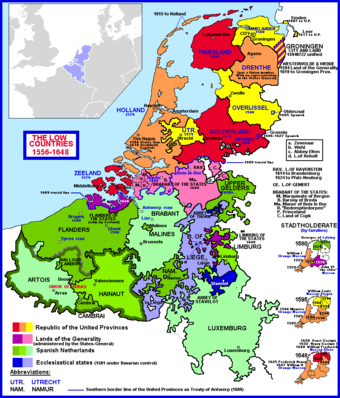 After the 1548 Diet of Augsburg
, the circle was made up of the following territories:
both annexed by France according to the 1678 Treaty of Nijmegen
.
The Prince-bishopric of Liège remained a part of the Lower Rhenish-Westphalian Circle
until its dissolution in 1795.
emerged from the Burgundian Netherlands
ruled in personal union
by the French Dukes of Burgundy
. Most of them had been fiefs of the Holy Roman Empire on the territory of Lower Lorraine
, except for Flanders
and Artois
. In 1477 they fell to the House of Habsburg.
In 1363 the French king John II of Valois
enfeoffed his youngest son Philip the Bold
with the Duchy of Burgundy
(Bourgogne). Philip in 1369 married Margaret of Dampierre
, only child of Count Louis II of Flanders
(d. 1384), whose immense dowry not only comprised Flanders and Artois but also the Imperial County of Burgundy
. He thereby became the progenitor of the House of Valois-Burgundy
who systematically came into possession of different Imperial fiefs: his grandson Philip the Good, Duke of Burgundy from 1419, purchased Namur in 1429, inherited the duchies of Brabant
and Limburg
from his cousin Philip of Saint-Pol
in 1430. In 1432 he forced Jacqueline of Wittelsbach
to cede him the counties of Hainaut
and Holland
with Zeeland
according to the Treaty of Delft
and finally occupied Luxembourg
, exiling Duchess Elisabeth of Görlitz
in 1443.
 The Burgundian realm then bore a faint resemblance to the early medieval Lotharingia
, it however fell suddenly with the death of the ambitious Charles the Bold. In 1473 he had made an agreement with Emperor Frederick III of Habsburg
according to which he would marry his daughter Mary the Rich
to the Emperor's son Archduke Maximilian I of Austria
in exchange for the elevation of his Imperial territories to a "Kingdom of Burgundy", co-equal to the French kingdom of his Valois cousins. The Prince-electors, however, forestalled these plans, and the deprived Duke Charles started a desperate campaign against the Duchy of Lorraine and was killed at the 1477 Battle of Nancy
. To secure her heritage against King Louis XI of France
, his daughter Mary nevertheless married Maximilian in the same year. The Archduke defeated the French troops at the 1479 Battle of Guinegate
and by the 1482 Treaty of Senlis
annexed the Seventeen Provinces - including the French fiefs of Flanders and Artois - for the House of Habsburg. The sovereignty finally passed to the Empire in the Treaty of Cambrai in 1529. The Duchy of Burgundy proper was seized as a reverted fief by the French crown.
Maximilian's grandson and successor, Emperor Charles V of Habsburg
eventually united all seventeen provinces under his rule, the last one being the Duchy of Guelders
in 1543. The Pragmatic Sanction of 1549
determined that the Provinces should remain united in the future and inherited by the same monarch. Therefore, Charles V introduced the title of Heer der Nederlanden ("Lord of the Netherlands"). Only he and his son ever used this title. After Charles V's abdication in 1556, his realms became divided between his son, King Philip II of Spain
, and his brother, Emperor Ferdinand I
. The Seventeen Provinces went to his son Philip.
Conflicts between Philip II and his Dutch subjects led to the Eighty Years' War, which started in 1568. The seven northern provinces gained their independence as a republic called the Seven United Provinces
. They were:
The southern provinces - Flanders, Brabant, Namur, Hainaut, Luxembourg and so forth - were restored to Spanish rule thanks to the military and political talent of the Duke of Parma
, especially at the siege of Antwerp (1584-1585)
. Hence, these Provinces became known as the Spanish Netherlands or the Southern Netherlands
.
The northern Seven United Provinces kept parts of Limburg, Brabant and Flanders during and after the Eighty Years' War (see Generality Lands
), which ended with the Treaty of Westphalia in 1648.
Artois, and parts of Flanders and Hainaut were ceded to France
in the course of the 17th and 18th century.
Imperial Circle
An Imperial Circle comprised a regional grouping of territories of the Holy Roman Empire, primarily for the purpose of organizing a common defensive structure and of collecting the imperial taxes, but also as a means of organization within the Imperial Diet and the Imperial Chamber Court.Each...
of the Holy Roman Empire
Holy Roman Empire
The Holy Roman Empire was a realm that existed from 962 to 1806 in Central Europe.It was ruled by the Holy Roman Emperor. Its character changed during the Middle Ages and the Early Modern period, when the power of the emperor gradually weakened in favour of the princes...
created in 1512 and significantly enlarged in 1548. In addition to the Free County of Burgundy
County of Burgundy
The Free County of Burgundy , was a medieval county , within the traditional province and modern French region Franche-Comté, whose very French name is still reminiscent of the unusual title of its count: Freigraf...
(present-day Franche-Comté
Franche-Comté
Franche-Comté the former "Free County" of Burgundy, as distinct from the neighbouring Duchy, is an administrative region and a traditional province of eastern France...
), the circle roughly covered the Low Countries
Low Countries
The Low Countries are the historical lands around the low-lying delta of the Rhine, Scheldt, and Meuse rivers, including the modern countries of Belgium, the Netherlands, Luxembourg and parts of northern France and western Germany....
, i.e. the areas currently known as the Netherlands
Netherlands
The Netherlands is a constituent country of the Kingdom of the Netherlands, located mainly in North-West Europe and with several islands in the Caribbean. Mainland Netherlands borders the North Sea to the north and west, Belgium to the south, and Germany to the east, and shares maritime borders...
, Belgium
Belgium
Belgium , officially the Kingdom of Belgium, is a federal state in Western Europe. It is a founding member of the European Union and hosts the EU's headquarters, and those of several other major international organisations such as NATO.Belgium is also a member of, or affiliated to, many...
and Luxembourg
Luxembourg
Luxembourg , officially the Grand Duchy of Luxembourg , is a landlocked country in western Europe, bordered by Belgium, France, and Germany. It has two principal regions: the Oesling in the North as part of the Ardennes massif, and the Gutland in the south...
and two northern districts of France
France
The French Republic , The French Republic , The French Republic , (commonly known as France , is a unitary semi-presidential republic in Western Europe with several overseas territories and islands located on other continents and in the Indian, Pacific, and Atlantic oceans. Metropolitan France...
(Artois
Artois
Artois is a former province of northern France. Its territory has an area of around 4000 km² and a population of about one million. Its principal cities are Arras , Saint-Omer, Lens and Béthune.-Location:...
, Nord).
The circle's territorial scope was reduced considerably in the 17th century with the secession of the Seven United Provinces
Dutch Republic
The Dutch Republic — officially known as the Republic of the Seven United Netherlands , the Republic of the United Netherlands, or the Republic of the Seven United Provinces — was a republic in Europe existing from 1581 to 1795, preceding the Batavian Republic and ultimately...
in 1581 (recognized 1648) and the annexation of the Free County of Burgundy by France
Early Modern France
Kingdom of France is the early modern period of French history from the end of the 15th century to the end of the 18th century...
in 1678. The occupation and subsequent annexation of Imperial territory to the west of the Rhine river by Revolutionary France
French First Republic
The French First Republic was founded on 22 September 1792, by the newly established National Convention. The First Republic lasted until the declaration of the First French Empire in 1804 under Napoleon I...
in the 1790s effectively brought an end to the circle's existence.
Composition
Diet of Augsburg
The Diet of Augsburg were the meetings of the Imperial Diet of the Holy Roman Empire in the German city of Augsburg. There were many such sessions, but the three meetings during the Reformation and the ensuing religious wars between the Roman Catholic emperor Charles V and the Protestant...
, the circle was made up of the following territories:
The Seventeen Provinces
- the County of ArtoisCounty of ArtoisThe County of Artois was an historic province of the Kingdom of France, held by the Dukes of Burgundy from 1384 until 1477/82, and a state of the Holy Roman Empire from 1493 until 1659....
, cededTreaty of SenlisThe Treaty of Senlis concerning the Burgundian succession was signed at Senlis, Oise in May of 1493 between Maximilian I, Holy Roman Emperor and King Charles VIII of France....
by France in 1493, annexedTreaty of the PyreneesThe Treaty of the Pyrenees was signed to end the 1635 to 1659 war between France and Spain, a war that was initially a part of the wider Thirty Years' War. It was signed on Pheasant Island, a river island on the border between the two countries...
by France in 1659. - the Duchy of BrabantDuchy of BrabantThe Duchy of Brabant was a historical region in the Low Countries. Its territory consisted essentially of the three modern-day Belgian provinces of Flemish Brabant, Walloon Brabant and Antwerp, the Brussels-Capital Region and most of the present-day Dutch province of North Brabant.The Flag of...
, including the Margraviate of Antwerp. - the County of DrentheDrentheDrenthe is a province of the Netherlands, located in the north-east of the country. The capital city is Assen. It is bordered by Overijssel to the south, Friesland to the west, Groningen to the north, and Germany to the east.-History:Drenthe, unlike many other parts of the Netherlands, has been a...
, which seceded to form part of the United Provinces from 1579. - the County of FlandersCounty of FlandersThe County of Flanders was one of the territories constituting the Low Countries. The county existed from 862 to 1795. It was one of the original secular fiefs of France and for centuries was one of the most affluent regions in Europe....
. - the Lordship of West-FrisiaFrieslandFriesland is a province in the north of the Netherlands and part of the ancient region of Frisia.Until the end of 1996, the province bore Friesland as its official name. In 1997 this Dutch name lost its official status to the Frisian Fryslân...
, which seceded to form part of the United Provinces from 1579. - the Lordship of GroningenGroningen (province)Groningen [] is the northeasternmost province of the Netherlands. In the east it borders the German state of Niedersachsen , in the south Drenthe, in the west Friesland and in the north the Wadden Sea...
(former OmmelandenOmmelandenThe Ommelanden are the parts of Groningen province that surround Groningen city. Usually mentioned as synonym for the province in the expression Stad en Ommeland ....
), which, with the exception of the City of Groningen, seceded to form part of the United Provinces from 1579. The City of Groningen joined the United Provinces in 1594. - the Duchy of Guelders, which, with the exception of Upper GueldersUpper GueldersUpper Guelders or Spanish Guelders was one of the four quarters in the Imperial Duchy of Guelders. In the Dutch Revolt, it was the only quarter that did not secede from the Habsburg Monarchy to become part of the Seven United Netherlands, but remained under Spanish rule during the Eighty Years'...
, seceded to form part of the United Provinces from 1579. - the County of HainautCounty of HainautThe County of Hainaut was a historical region in the Low Countries with its capital at Mons . In English sources it is often given the archaic spelling Hainault....
. - the County of HollandCounty of HollandThe County of Holland was a county in the Holy Roman Empire and from 1482 part of the Habsburg Netherlands in what is now the Netherlands. It covered an area roughly corresponding to the current Dutch provinces of North-Holland and South-Holland, as well as the islands of Terschelling, Vlieland,...
, which seceded to form part of the United Provinces from 1579. - the Duchy of LimburgDuchy of LimburgThe Duchy of Limburg, situated in the Low Countries between the river Meuse and the city of Aachen, was a state of the Holy Roman Empire. Its territory is now divided between the Belgian provinces of Liège and Limburg , the Dutch province of Limburg , and a small part of North Rhine-Westphalia in...
, held by the Dukes of Brabant. - the Duchy of Luxembourg.
- the Lordship of MechelenMechelenMechelen Footnote: Mechelen became known in English as 'Mechlin' from which the adjective 'Mechlinian' is derived...
, held by the Dukes of Brabant. - the County of Namur.
- the Lordship of OverijsselOverijsselOverijssel is a province of the Netherlands in the central eastern part of the country. The region has a NUTS classification of NL21. The province's name means "Lands across river IJssel". The capital city of Overijssel is Zwolle and the largest city is Enschede...
, which seceded to form part of the United Provinces from 1579. - the Prince-Bishopric, later Lordship of UtrechtUtrecht (province)Utrecht is the smallest province of the Netherlands in terms of area, and is located in the centre of the country. It is bordered by the Eemmeer in the north, Gelderland in the east, the river Rhine in the south, South Holland in the west, and North Holland in the northwest...
, which seceded to form part of the United Provinces from 1579. - the County of ZeelandCounty of ZeelandThe County of Zeeland was a county of the Holy Roman Empire in what is now the Netherlands. It covered an area in the Scheldt and Meuse delta roughly corresponding to the current Dutch province of Zeeland, though it did not include the region of Zeeuws-Vlaanderen which was part of...
, held by the Counts of Holland; seceded to form part of the United Provinces from 1579. - the County of Zutphen, held by the Dukes of Guelders; seceded to form part of the United Provinces from 1579.
The County of Burgundy
- the Free County of Burgundy and
- the Imperial City of Besançon
both annexed by France according to the 1678 Treaty of Nijmegen
Treaties of Nijmegen
The Treaties of Peace of Nijmegen were a series of treaties signed in the Dutch city of Nijmegen between August 1678 and December 1679...
.
The Prince-bishopric of Liège remained a part of the Lower Rhenish-Westphalian Circle
Lower Rhenish-Westphalian Circle
The Lower Rhenish–Westphalian Circle was an Imperial Circle of the Holy Roman Empire. It comprised territories of the former Duchy of Lower Lorraine, Frisia and the Westphalian part of the former Duchy of Saxony....
until its dissolution in 1795.
History
The Imperial Seventeen ProvincesSeventeen Provinces
The Seventeen Provinces were a personal union of states in the Low Countries in the 15th century and 16th century, roughly covering the current Netherlands, Belgium, Luxembourg, a good part of the North of France , and a small part of Western Germany.The Seventeen Provinces were originally held by...
emerged from the Burgundian Netherlands
Burgundian Netherlands
In the history of the Low Countries, the Burgundian Netherlands refers to a number of Imperial and French fiefs ruled in personal union by the House of Valois-Burgundy and their Habsburg heirs in the period from 1384 to 1482...
ruled in personal union
Personal union
A personal union is the combination by which two or more different states have the same monarch while their boundaries, their laws and their interests remain distinct. It should not be confused with a federation which is internationally considered a single state...
by the French Dukes of Burgundy
Duchy of Burgundy
The Duchy of Burgundy , was heir to an ancient and prestigious reputation and a large division of the lands of the Second Kingdom of Burgundy and in its own right was one of the geographically larger ducal territories in the emergence of Early Modern Europe from Medieval Europe.Even in that...
. Most of them had been fiefs of the Holy Roman Empire on the territory of Lower Lorraine
Lower Lorraine
The Duchy of Lower Lorraine or Lower Lotharingia , established in 959 was a stem duchy of the medieval German kingdom, which encompassed part of modern-day Belgium, the Netherlands, the northern part of the German Rhineland and a part of northern France east of the Schelde river.It was created out...
, except for Flanders
County of Flanders
The County of Flanders was one of the territories constituting the Low Countries. The county existed from 862 to 1795. It was one of the original secular fiefs of France and for centuries was one of the most affluent regions in Europe....
and Artois
County of Artois
The County of Artois was an historic province of the Kingdom of France, held by the Dukes of Burgundy from 1384 until 1477/82, and a state of the Holy Roman Empire from 1493 until 1659....
. In 1477 they fell to the House of Habsburg.
In 1363 the French king John II of Valois
John II of France
John II , called John the Good , was the King of France from 1350 until his death. He was the second sovereign of the House of Valois and is perhaps best remembered as the king who was vanquished at the Battle of Poitiers and taken as a captive to England.The son of Philip VI and Joan the Lame,...
enfeoffed his youngest son Philip the Bold
Philip the Bold
Philip the Bold , also Philip II, Duke of Burgundy , was the fourth and youngest son of King John II of France and his wife, Bonne of Luxembourg. By his marriage to Margaret III, Countess of Flanders, he also became Count Philip II of Flanders, Count Philip IV of Artois and Count-Palatine Philip IV...
with the Duchy of Burgundy
Duchy of Burgundy
The Duchy of Burgundy , was heir to an ancient and prestigious reputation and a large division of the lands of the Second Kingdom of Burgundy and in its own right was one of the geographically larger ducal territories in the emergence of Early Modern Europe from Medieval Europe.Even in that...
(Bourgogne). Philip in 1369 married Margaret of Dampierre
Margaret III, Countess of Flanders
Margaret of Dampierre was Countess of Flanders , Countess of Artois and Countess Palatine of Burgundy and twice Duchess consort of Burgundy...
, only child of Count Louis II of Flanders
Louis II of Flanders
Louis II of Flanders , also Louis III of Artois and Louis I of Palatine Burgundy, known as Louis of Male, was the son of Louis I of Flanders and Margaret I of Burgundy, and Count of Flanders.On his father's death at the Battle of Crécy in 1346, he inherited the counties of Flanders, Nevers, and...
(d. 1384), whose immense dowry not only comprised Flanders and Artois but also the Imperial County of Burgundy
County of Burgundy
The Free County of Burgundy , was a medieval county , within the traditional province and modern French region Franche-Comté, whose very French name is still reminiscent of the unusual title of its count: Freigraf...
. He thereby became the progenitor of the House of Valois-Burgundy
House of Valois-Burgundy
The term "Valois Dukes of Burgundy" is employed to refer to the dynasty which began after John II of France granted the Duchy of Burgundy to his youngest son, Philip the Bold...
who systematically came into possession of different Imperial fiefs: his grandson Philip the Good, Duke of Burgundy from 1419, purchased Namur in 1429, inherited the duchies of Brabant
Duchy of Brabant
The Duchy of Brabant was a historical region in the Low Countries. Its territory consisted essentially of the three modern-day Belgian provinces of Flemish Brabant, Walloon Brabant and Antwerp, the Brussels-Capital Region and most of the present-day Dutch province of North Brabant.The Flag of...
and Limburg
Duchy of Limburg
The Duchy of Limburg, situated in the Low Countries between the river Meuse and the city of Aachen, was a state of the Holy Roman Empire. Its territory is now divided between the Belgian provinces of Liège and Limburg , the Dutch province of Limburg , and a small part of North Rhine-Westphalia in...
from his cousin Philip of Saint-Pol
Philip of Saint-Pol, Duke of Brabant
Philip of Saint Pol , younger son of Antoine, Duke of Brabant and Jeanne of Saint-Pol, succeeded his brother John as Duke of Brabant in 1427...
in 1430. In 1432 he forced Jacqueline of Wittelsbach
Jacqueline, Countess of Hainaut
Jacqueline of Wittelsbach was Duchess of Bavaria-Straubing, Countess of Hainaut and Holland from 1417 to 1432...
to cede him the counties of Hainaut
County of Hainaut
The County of Hainaut was a historical region in the Low Countries with its capital at Mons . In English sources it is often given the archaic spelling Hainault....
and Holland
County of Holland
The County of Holland was a county in the Holy Roman Empire and from 1482 part of the Habsburg Netherlands in what is now the Netherlands. It covered an area roughly corresponding to the current Dutch provinces of North-Holland and South-Holland, as well as the islands of Terschelling, Vlieland,...
with Zeeland
County of Zeeland
The County of Zeeland was a county of the Holy Roman Empire in what is now the Netherlands. It covered an area in the Scheldt and Meuse delta roughly corresponding to the current Dutch province of Zeeland, though it did not include the region of Zeeuws-Vlaanderen which was part of...
according to the Treaty of Delft
Treaty of Delft
The Treaty of Delft, also called the Reconciliation of Delft, was signed on 3 July 1428 between Jacqueline of Bavaria and Philip the Good, Count of Flanders and Duke of Burgundy. The agreement ended hostilities between the kingdom of England and the county of Flanders...
and finally occupied Luxembourg
Luxembourg
Luxembourg , officially the Grand Duchy of Luxembourg , is a landlocked country in western Europe, bordered by Belgium, France, and Germany. It has two principal regions: the Oesling in the North as part of the Ardennes massif, and the Gutland in the south...
, exiling Duchess Elisabeth of Görlitz
Elisabeth, Duchess of Luxembourg
Elisabeth of Görlitz was Duchess regnant of Luxembourg from 1411 to 1443.-Life:Elisabeth was the only daughter and heiress of John of Görlitz, the third son of Charles IV, Holy Roman Emperor. He was Duke of Lusatia and Görlitz, and also Elector of Brandenburg for a brief period...
in 1443.
Lotharingia
Lotharingia was a region in northwest Europe, comprising the Low Countries, the western Rhineland, the lands today on the border between France and Germany, and what is now western Switzerland. It was born of the tripartite division in 855, of the kingdom of Middle Francia, itself formed of the...
, it however fell suddenly with the death of the ambitious Charles the Bold. In 1473 he had made an agreement with Emperor Frederick III of Habsburg
Frederick III, Holy Roman Emperor
Frederick the Peaceful KG was Duke of Austria as Frederick V from 1424, the successor of Albert II as German King as Frederick IV from 1440, and Holy Roman Emperor as Frederick III from 1452...
according to which he would marry his daughter Mary the Rich
Mary of Burgundy
Mary of Burgundy ruled the Burgundian territories in Low Countries and was suo jure Duchess of Burgundy from 1477 until her death...
to the Emperor's son Archduke Maximilian I of Austria
Maximilian I, Holy Roman Emperor
Maximilian I , the son of Frederick III, Holy Roman Emperor and Eleanor of Portugal, was King of the Romans from 1486 and Holy Roman Emperor from 1493 until his death, though he was never in fact crowned by the Pope, the journey to Rome always being too risky...
in exchange for the elevation of his Imperial territories to a "Kingdom of Burgundy", co-equal to the French kingdom of his Valois cousins. The Prince-electors, however, forestalled these plans, and the deprived Duke Charles started a desperate campaign against the Duchy of Lorraine and was killed at the 1477 Battle of Nancy
Battle of Nancy
The Battle of Nancy was the final and decisive battle of the Burgundian Wars, fought outside the walls of Nancy on 5 January 1477 between Charles the Bold, Duke of Burgundy, and René II, Duke of Lorraine...
. To secure her heritage against King Louis XI of France
Louis XI of France
Louis XI , called the Prudent , was the King of France from 1461 to 1483. He was the son of Charles VII of France and Mary of Anjou, a member of the House of Valois....
, his daughter Mary nevertheless married Maximilian in the same year. The Archduke defeated the French troops at the 1479 Battle of Guinegate
Battle of Guinegate (1479)
The First Battle of Guinegate took place on August 7, 1479. French troops of King Louis XI were defeated by the Burgundians led by Archduke Maximilian of Habsburg...
and by the 1482 Treaty of Senlis
Treaty of Senlis
The Treaty of Senlis concerning the Burgundian succession was signed at Senlis, Oise in May of 1493 between Maximilian I, Holy Roman Emperor and King Charles VIII of France....
annexed the Seventeen Provinces - including the French fiefs of Flanders and Artois - for the House of Habsburg. The sovereignty finally passed to the Empire in the Treaty of Cambrai in 1529. The Duchy of Burgundy proper was seized as a reverted fief by the French crown.
Maximilian's grandson and successor, Emperor Charles V of Habsburg
Charles V, Holy Roman Emperor
Charles V was ruler of the Holy Roman Empire from 1519 and, as Charles I, of the Spanish Empire from 1516 until his voluntary retirement and abdication in favor of his younger brother Ferdinand I and his son Philip II in 1556.As...
eventually united all seventeen provinces under his rule, the last one being the Duchy of Guelders
Guelders
Guelders or Gueldres is the name of a historical county, later duchy of the Holy Roman Empire, located in the Low Countries.-Geography:...
in 1543. The Pragmatic Sanction of 1549
Pragmatic Sanction of 1549
The Pragmatic Sanction of 1549 was an edict, promulgated by Charles V, Holy Roman Emperor, reorganizing the Seventeen Provinces.It was his plan to centralize the administrative units of Holy Roman Empire. The Pragmatic Sanction transformed this agglomeration of lands into a unified entity, of which...
determined that the Provinces should remain united in the future and inherited by the same monarch. Therefore, Charles V introduced the title of Heer der Nederlanden ("Lord of the Netherlands"). Only he and his son ever used this title. After Charles V's abdication in 1556, his realms became divided between his son, King Philip II of Spain
Philip II of Spain
Philip II was King of Spain, Portugal, Naples, Sicily, and, while married to Mary I, King of England and Ireland. He was lord of the Seventeen Provinces from 1556 until 1581, holding various titles for the individual territories such as duke or count....
, and his brother, Emperor Ferdinand I
Ferdinand I, Holy Roman Emperor
Ferdinand I was Holy Roman Emperor from 1558 and king of Bohemia and Hungary from 1526 until his death. Before his accession, he ruled the Austrian hereditary lands of the Habsburgs in the name of his elder brother, Charles V, Holy Roman Emperor.The key events during his reign were the contest...
. The Seventeen Provinces went to his son Philip.
Conflicts between Philip II and his Dutch subjects led to the Eighty Years' War, which started in 1568. The seven northern provinces gained their independence as a republic called the Seven United Provinces
Dutch Republic
The Dutch Republic — officially known as the Republic of the Seven United Netherlands , the Republic of the United Netherlands, or the Republic of the Seven United Provinces — was a republic in Europe existing from 1581 to 1795, preceding the Batavian Republic and ultimately...
. They were:
- the Lordship of Groningen and of the Ommelanden
- the Lordship of Friesland
- the Lordship of Overijssel
- the duchy of Guelders (except its upper quarter) and the county of Zutphen
- the prince-bishopric, later lordship of Utrecht
- the county of Holland
- the county of Zeeland
The southern provinces - Flanders, Brabant, Namur, Hainaut, Luxembourg and so forth - were restored to Spanish rule thanks to the military and political talent of the Duke of Parma
Alexander Farnese, Duke of Parma
Alexander Farnese was Duke of Parma and Piacenza from 1586 to 1592, and Governor of the Spanish Netherlands from 1578 to 1592.-Biography:...
, especially at the siege of Antwerp (1584-1585)
Siege of Antwerp (1584-1585)
This Siege of Antwerp took place during the Eighty Years' War from July 1584 until August 1585. At the time Antwerp was not only the largest Dutch city but was also the cultural, economic and financial centre of the Seventeen Provinces and of north-western Europe...
. Hence, these Provinces became known as the Spanish Netherlands or the Southern Netherlands
Southern Netherlands
Southern Netherlands were a part of the Low Countries controlled by Spain , Austria and annexed by France...
.
The northern Seven United Provinces kept parts of Limburg, Brabant and Flanders during and after the Eighty Years' War (see Generality Lands
Generality Lands
The Generality Lands, Lands of the Generality or Common Lands were about one fifth of the territories of the United Provinces of the Netherlands, that were directly governed by the States-General...
), which ended with the Treaty of Westphalia in 1648.
Artois, and parts of Flanders and Hainaut were ceded to France
France
The French Republic , The French Republic , The French Republic , (commonly known as France , is a unitary semi-presidential republic in Western Europe with several overseas territories and islands located on other continents and in the Indian, Pacific, and Atlantic oceans. Metropolitan France...
in the course of the 17th and 18th century.
See also
- Seventeen ProvincesSeventeen ProvincesThe Seventeen Provinces were a personal union of states in the Low Countries in the 15th century and 16th century, roughly covering the current Netherlands, Belgium, Luxembourg, a good part of the North of France , and a small part of Western Germany.The Seventeen Provinces were originally held by...
- Burgundian NetherlandsBurgundian NetherlandsIn the history of the Low Countries, the Burgundian Netherlands refers to a number of Imperial and French fiefs ruled in personal union by the House of Valois-Burgundy and their Habsburg heirs in the period from 1384 to 1482...
- Governors of the Habsburg NetherlandsGovernors of the Habsburg NetherlandsThe Governor of the Habsburg Netherlands ruled the Habsburg Netherlands as a representative of the Duke of Burgundy .- Habsburg Netherlands :...