
All Topics  
Space Shuttle Challenger disaster


   Email Print
   Bookmark   Link


Space Shuttle Challenger disaster


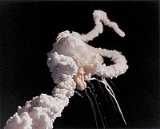
The Space Shuttle Challenger Disaster took place on January 28 1986 when ChallengerSpace Shuttle Challenger

Space Shuttle Challenger was NASA's second Space Shuttle orbiter to be put into service, after Columbia....
, a Space ShuttleSpace Shuttle

NASA's Space Shuttle, officially called Space Transportation System , is the United States government's current manned...
 operated by NASANASA Summary

The National Aeronautics and Space Administration is an agency of the United States Government, responsible for the nation'...
, broke apart 73 seconds into its flight leading to the deaths of its seven crew members. The spacecraftSpacecraft

A spacecraft is a vehicle designed to operate beyond the surface of the Earth in outer space....
 disintegrated over the Atlantic OceanAtlantic Ocean

The Atlantic Ocean is the second-largest ocean, covering approximately one-fifth of the Earth's surface....
, off the coast of central FloridaFlorida

Florida is a U.S. state located in the southeastern United States....
, United States at 11:39 a.m. ESTNorth American Eastern Time Zone

The Eastern Time Zone of the Western Hemisphere falls mostly along the east coast of Northern America and the west coast of ...
 (16:39 UTCCoordinated Universal Time

Coordinated Universal Time is a high-precision atomic time standard....
). Disintegration of the shuttle stack began 73 seconds into its flight after an O-ringO-ring

An O-ring is a loop of elastomer with a round cross-section used as a mechanical seal or gasket....
 seal in its right solid rocket booster (SRB)Space Shuttle Solid Rocket Booster

The Space Shuttle Solid Rocket Booster is the rocket that provides 83% of liftoff thrust for the Space Shuttle....
 failed at liftoff. The seal failure caused a breach in the SRB joint it filled, allowing a flare to reach the outside and impinge upon the adjacent attachment hardware and external fuel tankSpace Shuttle external tank

The Space Shuttle External Tank contains the liquid hydrogen fuel and liquid oxygen oxidizer and supplies them under pressur...
. The SRB breach flare led to the separation of the right-hand SRB and the structural failureStructural failure

Structural failure refers to loss of the load-carrying capacity of a component or member within the structure or of the stru...
 of the external tank. AerodynamicAerodynamics

Aerodynamics is a branch of fluid dynamics concerned with the study of forces and gas flows....
 forces promptly broke up the orbiter. The crew compartment and many other vehicle fragments were eventually recovered from the ocean floor after a lengthy search and recovery operation.

The disaster resulted in a 32-month hiatus in the shuttle program and the formation of the Rogers Commission, a special commission appointed by United States PresidentPresident of the United States Summary

The President of the United States of America is the head of state of the United States....
 Ronald ReaganRonald Reagan

Ronald Wilson Reagan was the 40th President of the United States and the 33rd Governor of California ....
 to investigate the accident. The Rogers Commission found that NASANASA

The National Aeronautics and Space Administration is an agency of the United States Government, responsible for the nation'...
's organizational cultureOrganizational culture

Organizational culture comprises the attitudes, experiences, beliefs and values....
 and decision-making processes had been a key contributing factor to the accident. NASA managers had known that contractor Morton Thiokol's design of the SRBs contained a potentially catastrophic flaw in the O-rings since 1977, but they failed to address it properly. They also ignored warnings from engineers about the dangers of launching on such a cold day and had failed to adequately report these technical concerns to their superiors. The Rogers Commission offered NASA nine recommendations that were to be implemented before shuttle flights resumed.

Many viewed the launch live due to the presence on the crew of Christa McAuliffeChrista McAuliffe

Sharon Christa Corrigan McAuliffe Opal, better known simply as Christa McAuliffe, and prior to her marriage, Christ...
, the first member of the Teacher in Space ProjectTeacher in Space Project

The Teacher in Space Program was a NASA program designed to educate students and spur excitement in math, science, and space...
. Media coverage of the accident was extensive: one study reported that 85 percent of Americans surveyed had heard the news within an hour of the accident. The Challenger disaster has been used as a case study in many discussions of engineering safety and workplace ethics and inspired the 1990 television movie, ChallengerChallenger (TV film)

Challenger is a film based on the events surrounding the Space Shuttle Challenger disaster....
.

Pre-launch conditions and delays

Challenger was originally set to launch from Kennedy Space CenterKennedy Space Center

The John F. Kennedy Space Center is the NASA space vehicle launch facility near Cape Canaveral on Merritt Island in Florid...
 in FloridaFlorida

Florida is a U.S. state located in the southeastern United States....
 at 2:42 p.m. Eastern Standard Time (EST) on January 22. However, delays suffered by the previous mission, STS-61-CSTS-61-C

colspan="2" cellspacing="0" cellpadding="2">...
, caused the launch date to be pushed back to January 23 and then to January 24. Launch was then rescheduled to January 25 due to bad weatherStorm

A storm is any disturbed state of a planet's atmosphere, especially affecting its surface, and strongly implying severe weat...
 at the Transoceanic Abort Landing (TAL)Space Shuttle abort modes

A space shuttle abort is an emergency procedure due to equipment failure, most commonly during ascent....
 site in DakarDakar

Dakar is the capital city of Senegal, located on the Cape Verde Peninsula, on the country's Atlantic coast....
, SenegalSenegal

Senegal , officially the Republic of Senegal, is a country south of the Sngal River in western Africa....
. NASA decided to use CasablancaCasablanca

Casablanca is a city in western Morocco, located on the Atlantic Ocean....
 as the TAL site, but because it was not equipped for night landings, the launch had to be moved to the morning. Predictions of unacceptable weather at Kennedy Space CenterKennedy Space Center

The John F. Kennedy Space Center is the NASA space vehicle launch facility near Cape Canaveral on Merritt Island in Florid...
 (KSC) caused the launch to be rescheduled for 9:37 a.m. EST on January 27. According to Malcolm McConnell's book, Challenger: A Major Malfunction, NASA normally would have launched with the predicted forecast of a 50 percent chance of rain if not for plans to have Vice PresidentVice President of the United States

The Vice President of the United States is the second-highest executive official of the United States government....
 George H. W. BushGeorge H. W. Bush

George Herbert Walker Bush was the 41st President of the United States of America ....
 stop over and watch the launch on his way to HondurasHonduras

Honduras, officially the Republic of Honduras, is a country in Central America, bordered to the west by Guatemala, to ...
.

The launch was delayed the next day by problems with the exterior access hatchSpace Shuttle Orbiter

The Space Shuttle Orbiter is the orbital vehicle of the Space Shuttle....
. First, one of the microswitch indicators used to verify that the hatch was safely locked malfunctioned. Then, a stripped bolt prevented the closeout crew from removing a closing fixture from the orbiter's hatch. When the fixture was finally sawn off, crosswinds at the Shuttle Landing Facility exceeded the limits for a Return to Launch Site (RTLS)Space Shuttle abort modes

A space shuttle abort is an emergency procedure due to equipment failure, most commonly during ascent....
 abort. The crew waited for the winds to die down until the launch window finally ran out, forcing yet another scrub.

Forecasts for January 28 predicted an unusually cold morning, with temperatures close to , the minimum temperature permitted for launch. The low temperature had prompted concern from engineers at Morton Thiokol, the contractor responsible for the construction and maintenance of the shuttle's SRBs. At a teleconference which took place on the evening of January 27, Thiokol engineers and managers discussed the weather conditions with NASA managers from Kennedy Space Center and Marshall Space Flight CenterMarshall Space Flight Center

...
. Several engineers—most notably Roger BoisjolyRoger Boisjoly

Roger Boisjoly was an engineer who worked for Morton Thiokol, the manufacturer of the solid rocket boosters of the space shu...
, who had voiced similar concerns previously—expressed their concern about the effect of the temperature on the resilience of the rubber O-rings that sealed the joints of the SRBs. They argued that if the O-rings were colder than , there was no guarantee they would seal properly. This was an important consideration, since the O-rings had been designated as a "Criticality 1" component—meaning that there was no backup for them and their failure would destroy Challenger and its crew. They also argued that the low overnight temperatures would almost certainly result in SRB temperatures below their redline of . However, they were overruled by Morton Thiokol management, who recommended that the launch proceed as scheduled.

Due to the low temperature, a significant amount of ice built up on the fixed service structureKennedy Space Center Launch Complex 39

Launch Complex 39 is a large site and a collection of facilities at the John F....
 that stood beside the shuttle. The Kennedy Ice Team inadvertently pointed an infrared camera at the aft field joint of the right SRB and found the temperature to be only . This was believed to be the result of supercooled air blowing on the joint from the liquid oxygen tank vent. It was much lower than the air temperature and far below the design specifications for the O-rings. However, the reading was later determined to be erroneous, the error caused by not following the temperature probe manufacturer's instructions. Tests and adjusted calculations later confirmed that the temperature of the joint was not substantially different than the ambient temperature.

Although the Ice Team had worked through the night removing ice, engineers at Rockwell InternationalRockwell International

Rockwell International was the ultimate incarnation of a series of companies under the sphere of influence of Willard Rockwe...
, the shuttle's prime contractor, still expressed concern. Rockwell engineers watching the pad from their headquarters in Downey, CaliforniaDowney, California Summary

Downey is a city located in southeastern Los Angeles County, California, United States, 21 km southeast of downtown Los Ange...
 were horrified when they saw the amount of ice. They feared that during launch, ice might be shaken loose and strike the shuttle's thermal protection tiles, possibly due to the aspiration induced by the jetJet (fluid)

A jet is a coherent stream of fluid that is projected into a surrounding medium, usually from some kind of a nozzle or apert...
 of exhaust gasExhaust gas

Exhaust gas is gas which occurs as a result of combustion of fuel such as gasoline/petrol, diesel or coal....
 from the SRBs. Rocco PetroneRocco Petrone

Rocco Anthony Petrone was an American engineer who was the third director of the NASA's Marshall Space Flight Center from 19...
, the head of Rockwell's space transportation division, and his colleagues viewed this situation as a launch constraint, and told Rockwell's managers at the Cape that Rockwell could not support a launch. However, Rockwell's managers at the Cape voiced their concerns in a manner that led Houston-based mission manager Arnold Aldrich to go ahead with the launch. Aldrich decided to postpone the shuttle launch by an hour in order to give the Ice Team time to perform another inspection. After that last inspection, during which the ice appeared to be melting, Challenger was finally cleared to launch at 11:38 a.m. EST.

January 28 launch and failure

Liftoff and initial ascent

The following account of the accident is derived from real time telemetryTelemetry

Telemetry is a technology that allows the remote measurement and reporting of information of interest to the system designer...
 data and photographic analysis, as well as from transcripts of air-to-ground and mission controlMission Control Center

Mission Control Center is a unit that manages aerospace flights....
 voice communications. All times are given in seconds after launch and correspond to the telemetry time-codes from the closest instrumented event to each described event.

At 6.6 seconds before liftoff, the three space shuttle main engineSpace Shuttle main engine

The Space Shuttle Main Engines are the three main engines on the Space Shuttle orbiter....
s (SSME) ignited. Until liftoff actually occurs, the SSMEs can be safely shut down and the launch aborted if necessary. At liftoff time (T=0, which was at 11:38:00.010 EST), the three SSMEs were at 100% of their original rated performance, and began throttling up to 104% under computer control. At this moment, the two SRBs were ignited and hold-down bolts were released with explosives, freeing the vehicle from the pad. With the first vertical motion of the vehicle, the gaseous hydrogen vent arm retracted from the External Tank (ET)Space Shuttle external tank

The Space Shuttle External Tank contains the liquid hydrogen fuel and liquid oxygen oxidizer and supplies them under pressur...
 but failed to latch back. Review of film shot by pad cameras showed that the arm did not re-contact the vehicle, and thus it was ruled out as a contributing factor in the accident. The post-launch inspection of the pad also revealed that kick springs on four of the hold-down bolts were missing, but they were similarly ruled out as a possible cause.

Later review of launch film showed that at T+0.678, strong puffs of dark grey smoke were emitted from the right-hand SRB near the aftAFT

AFT may refer to:*The aft portion of a ship...
 strut that attaches the booster to the ET. The last smoke puff occurred at about T+2.733. The last view of smoke around the strut was at T+3.375. It was later determined that these smoke puffs were caused by the opening and closing of the aft field joint of the right-hand SRB. The booster's casing had ballooned under the stress of ignition. As a result of this ballooning, the metal parts of the casing bent away from each other, opening a gap through which hot gases above 5,000 °F (2,760 °C) leaked out. This had occurred in previous launches, but each time the primary o-ring had shifted out of its groove and formed a seal. Although the SRB was not designed to function this way, it appeared to work well enough and Morton-Thiokol changed the design specs to accommodate this process, known as extrusion.

Unfortunately, while extrusion was taking place, hot gases would leak past, a process called blow-by, damaging the o-rings until a seal was made. Investigations into the matter by Morton-Thiokol engineers determined that the amount of damage to the o-rings was directly related to the time it took for extrusion to occur, and that cold weather, by causing the o-rings to harden, lengthened the time of extrusion.

The morning of the disaster the O-ring was too cold to seal in time. The secondary O-ring was not in its seated position due to the metal bending. There was now no barrier to the gases, and both O-rings were vaporized across 70 degrees of arc. However, aluminium oxideAluminium oxide

Aluminium oxide is a chemical compound of aluminium and oxygen with the chemical formula 23....
s from the burned solid propellant sealed the damaged joint, temporarily replacing the O-ring seal before actual flame rushed through the joint.

As the vehicle cleared the tower, the SSMEs were operating at 104% of their rated maximum thrust, and control switched from the Launch Control CenterLaunch Control Center

This article is about the Launch Control Center at Kennedy Space Center....
 (LCC) at Kennedy to the Mission Control Center (MCC) in Houston, TexasHouston, Texas

Houston is the largest city in the state of Texas and the fourth-largest in the United States....
. To prevent aerodynamicAerodynamics

Aerodynamics is a branch of fluid dynamics concerned with the study of forces and gas flows....
 forces from structurally overloading the orbiter, at T+28 the SSMEs began throttling down to limit the velocity of the shuttle in the dense lower atmosphereTroposphere

The Troposphere is the lowermost portion of Earth's atmosphere....
. At T+35.379, the SSMEs throttled back further to the planned 65%. Five seconds later, at about 19,000 feet (5800 m), Challenger passed through Mach 1Mach number Summary

Mach number is defined as a ratio of the speed of an object or flow relative to the speed of sound in the medium through w...
. At T+51.860, the SSMEs began throttling back up to 104% as the vehicle passed beyond Max QMax Q

Max Q is an aeronautical engineering term for Maximum Quotient, the maximum Aerodynamics stress on a spacecraft in atmos...
, the period of maximum aerodynamic pressure on the vehicle.

Plume

Just as the shuttle approached Max QMax Q

Max Q is an aeronautical engineering term for Maximum Quotient, the maximum Aerodynamics stress on a spacecraft in atmos...
, it slammed through the most intense wind shearWind shear

Wind shear is a difference in wind speed and/or direction between two points in the atmosphere....
 ever experienced to date in the space shuttle program.

At T+58.788, a tracking film camera captured the beginnings of a plumePlume (hydrodynamics)

In hydrodynamics, a plume is a column of one fluid moving through another....
 near the aft attach strut on the right SRB. Unknown to those on Challenger or in Houston, hot gas had begun to leak through a growing hole in one of the right-hand SRB's joints. The force of the wind shear shattered the temporary oxide seal that had taken the place of the damaged O-rings, removing the last barrier to flame rushing through the joint. Had it not been for the wind shear, the oxide seal might have held through booster burnout.

Within a second, the plume became well defined and intense. Internal pressure in the right SRB began to drop because of the rapidly enlarging hole in the failed joint, and at T+60.238 there was visual evidence of flame coming through the joint and impinging on the external tank.

At T+64.660, the plume suddenly changed shape, indicating that a leak had begun in the liquid hydrogenLiquid hydrogen

Liquid hydrogen is the element hydrogen, in the liquid state....
 tank, located in the aft portion of the external tank. The nozzles of the main engines pivoted under computer control to compensate for the unbalanced thrust produced by the booster burn-through. The pressure in the shuttle's external liquid hydrogen tank began to drop at T+66.764, indicating the effect of the leak.

At this stage the situation still seemed normal both to the astronauts and to flight controllers. At T+68, the CAPCOMFlight controller

Flight controllers are personnel who aid in the operations of a space flight, working in Mission Control Centers such as NAS...
 Richard Covey informed the crew that they were "go at throttle up", and Commander Dick ScobeeDick Scobee

Francis Richard "Dick" Scobee was an American astronaut who died commanding the Space Shuttle Challenger, which suffered cat...
 confirmed the call. His response, "Roger, go at throttle up," was the last communication from Challenger on the air-to-ground loop.

Vehicle breakup

At T+72.284, the right SRB apparently pulled away from the aft strut attaching it to the external tank. Later analysis of telemetry data showed a sudden lateral acceleration to the right at T+72.525, which may have been felt by the crew. The last statement captured by the crew cabin recorder came just half a second after this acceleration, when Pilot Michael J. Smith said "Uh oh." Smith may also have been responding to onboard indications of main engine performance, or to falling pressures in the external fuel tank.

At T+73.124, the aft dome of the liquid hydrogen tank failed, producing a propulsive force that pushed the hydrogen tank into the liquid oxygen tank in the forward part of the ET. At the same time, the right SRB rotated about the forward attach strut, and struck the intertankSpace Shuttle external tank

The Space Shuttle External Tank contains the liquid hydrogen fuel and liquid oxygen oxidizer and supplies them under pressur...
 structure.

The breakup of the vehicle began at T+73.162 seconds and at an altitude of 48,000 feetFoot (unit of length)

A foot is the name of a unit of length, in a number of different systems, including English units, Imperial units, and Unite...
 (14.6 kmKilometre

A kilometre is a unit of length that is equal to 1,000 metres, the current International System of Units base unit of leng...
). With the external tank disintegrating, Challenger veered from its correct attitude with respect to the local air flow and was immediately torn apart by abnormal aerodynamic forces resulting in a load factorLoad factor (aerodynamics)

Load factor is the ratio of the lift on an aircraft to the weight of the aircraft....
 of up to 20gG-force

g-force is a measurement of an object's acceleration expressed in gs....
 — well over its design limit of 5 g. The two SRBs, which can withstand greater aerodynamic loads, separated from the ET and continued in uncontrolled powered flight for another 37 seconds. The SRB casings were made of half-inch (12.7 mm) thick steel and were much stronger than the orbiter and ET; thus, both SRBs survived the breakup of the space shuttle stack, even though the right SRB was still suffering the effects of the joint burn-through that had set the destruction of Challenger in motion.

Post-breakup flight controller dialog

In Mission Control, there was a burst of static on the air-to-ground loop as Challenger disintegrated. Television screens showed a cloud of smoke and vapor where Challenger had been, with pieces of debris falling toward the ocean. At about T+89, flight director Jay GreeneFacts About Jay Greene

Jay Greene is a retired NASA engineer....
 prompted his flight dynamics officer for information. The response was that "...the radarRadar

RADAR is a system that uses radio waves to detect, determine the direction and distance and/or speed of objects such as airc...
 filters have discreting sources", a further indication that Challenger had broken into multiple pieces. The ground controllerFlight controller

Flight controllers are personnel who aid in the operations of a space flight, working in Mission Control Centers such as NAS...
 reported "negative contact, loss of downlink" of radio and telemetry data from Challenger. Greene ordered his team to "watch your data carefully" and look for any sign that the Orbiter had escaped.

At T+110.250, the Range Safety OfficerRange Safety Officer

In the field of rocketry, Range Safety Officer is a generic term referring to an individual who monitors the performance of ...
 (RSO) at the Cape Canaveral Air Force StationCape Canaveral Air Force Station

The Cape Canaveral Air Force Station is the East Coast launch facility of the United States Department of Defense....
 sent radio signals that activated the range safety system'sSpace Shuttle Solid Rocket Booster

The Space Shuttle Solid Rocket Booster is the rocket that provides 83% of liftoff thrust for the Space Shuttle....
 "destruct" packages on board both solid rocket boosters. This was a normal contingency procedure, undertaken because the RSO judged the free-flying SRBs a possible threat to land or sea. The same destruct signal would have destroyed the External Tank had it not already disintegrated.

"Flight controllers here looking very carefully at the situation," reported public affairs officer Steve Nesbitt. "Obviously a major malfunction. We have no downlink." After a pause, Nesbitt said, "We have a report from the Flight Dynamics Officer that the vehicle has exploded."

Greene ordered that contingency procedures be put into effect at Mission Control; these procedures included locking the doors of the control center, shutting down telephone communications with the outside world, and following checklists that ensured that the relevant data were correctly recorded and preserved.

No "explosion"

Contrary to the flight dynamics officer's initial statement, the shuttle and external tank did not actually "explodeExplosion

An explosion is a sudden increase in volume and release of energy in a violent manner, usually with the generation of high t...
". Instead they rapidly disintegrated under tremendous aerodynamic forces, since the shuttle was slightly past "Max QMax Q

Max Q is an aeronautical engineering term for Maximum Quotient, the maximum Aerodynamics stress on a spacecraft in atmos...
", or maximum aerodynamic pressure. When the external tank disintegrated, the fuel and oxidizer stored within it were released, producing the appearance of a massive fireball. However, according to the NASA team that analyzed imagery after the accident, there was only "localized combustion" of propellant. Instead, the visible cloud was primarily composed of vapor and gases resulting from the release of the shuttle's liquid oxygenLiquid oxygen

Liquid Oxygen has an expansion ratio of 860:1, and because of this, is used in commercial and military aircraft today....
 and liquid hydrogen propellant. Stored in cryogenicCryogenics

Cryogenics is a branch of physics that studies the production of very low temperatures and the behavior of materials at th...
 conditions, the liquid hydrogen could not have ignited rapidly enough to trigger an "explosion" in the traditional sense of a detonationDetonation

Detonation is a process of supersonic combustion in which a shock wave is propagated forward due to energy release in a reac...
(as opposed to a deflagrationDeflagration

Deflagration is a process of subsonic combustion that usually propagates through thermal conductivity....
, which was what occurred). Had there been a true explosion, the entire shuttle would have been instantly destroyed, killing the crew at that moment. The more robustly constructed crew cabin and SRBs survived the breakup of the launch vehicle; while the SRBs were subsequently detonated remotely, the detached cabin continued along a ballisticBallistics

Ballistics is the science that deals with the motion, behavior, and effects of projectiles, especially bullets, gravity bomb...
 trajectory, and was observed exiting the cloud of gases at T+75.237. Twenty-five seconds after the breakup of the vehicle, which occurred at 48,000 feet (14.6 km), the trajectory of the crew compartment peaked at a height of 65,000 feet (19.8 km).

Cause and time of death

During vehicle breakup, the crew cabin detached in one piece and slowly tumbled. NASA estimated separation forces at about 12 to 20 times the force of gravity (g)Facts About G-force

g-force is a measurement of an object's acceleration expressed in gs....
 very briefly; however, within two seconds, the forces on the cabin had already dropped to below 4 g, and within ten seconds the cabin was in free fall. These forces were likely insufficient to cause major injury. At least some of the astronauts were likely alive and briefly conscious after the breakup, because three of the four Personal Egress Air PacksPersonal Egress Air Packs

PEAP is also an acronym for Protected Extensible Authentication Protocol...
 (PEAPs) on the flight deck were found to have been activated. Investigators found their remaining unused air supply roughly consistent with the expected consumption during the 2 minute 45 second post-breakup trajectory. Whether the astronauts remained conscious long after the breakup is unknown, and largely depends on whether the detached crew cabin maintained pressure integrity. If it did not, time of useful consciousness at that altitude is just a few seconds; the PEAPs supplied only unpressurized airAIR

AIR is a three-letter abbreviation with multiple meanings, as described below:...
, and hence would not have helped the crew to retain consciousness. The crew cabin hit the ocean surface at roughly , causing an instantaneous deceleration of over 200 g, far beyond the structural limits of the crew compartment or crew survivability levels.

On July 28 1986, Rear Admiral Richard H. TrulyRichard H. Truly Summary

Richard Harrison Truly is a retired Vice Admiral in the United States Navy, former astronaut, and was the 8th Administrator ...
, NASA's Associate Administrator for Space Flight and a former astronaut, released a report from Joseph P. KerwinJoseph P. Kerwin

Joseph Peter Kerwin, M.D. is a physician and former NASA astronaut....
, biomedical specialist from the Johnson Space CenterLyndon B. Johnson Space Center

The Lyndon B. Johnson Space Center is NASA's center for human spaceflight located in southeast Houston, Texas....
 in Houston, relating to the deaths of the astronauts in the accident. Dr. Kerwin, a veteran of the Skylab 2Skylab 2

Skylab 2|-!colspan="2" cellspacing="0" cellpadding="2" bgcolor="#FFDEAD"|Mission Insignia...
 mission, had been commissioned to undertake the study soon after the accident. According to the Kerwin Report:

Crew escape was not possible

.

During powered flight of the space shuttle, crew escape was not possible. While launch escape systems were considered several times during shuttle development, NASA's conclusion was that the shuttle's expected high reliability would preclude the need for one. Modified SR-71 BlackbirdSR-71 Blackbird

The Lockheed SR-71, unofficially known as the Blackbird and by its crews as the Habu, was an advanced, long-rang...
 ejection seats and full pressure suitPressure suit Summary

A pressure suit is a pressurized suit worn by high-altitude reconnaissance pilots who may fly so high that even breathing pu...
s were used on the first four shuttle orbital missions, which were considered test flights, but they were removed for the operational missions that followed. Providing a launch escape system for larger crews was considered undesirable due to "limited utility, technical complexity and excessive cost in dollars, weight or schedule delays."

After the loss of Challenger, the question was re-opened, and NASA considered several different options, including ejector seats, tractor rockets and bailing out through the bottom of the orbiter. However, NASA once again concluded that all of the launch escape systems considered would be impractical due to the sweeping vehicle modifications that would have been necessary and the resultant limitations on crew size. A bail-out system was designed to give the crew the option to leave the shuttle during gliding flight; however, this system would not have been available in the Challenger scenario.

Aftermath


In the aftermath of the disaster, NASA was criticized for its lack of openness with the press. The New York TimesThe New York Times

The New York Times is a newspaper published in New York City by Arthur Ochs Sulzberger Jr....
noted on the day after the disaster that "neither Jay Greene, flight director for the ascent, nor any other person in the control room, was made available to the press by the space agency." In the absence of reliable sources, the press turned to speculation; both The New York Times and United Press InternationalUnited Press International

United Press International is a global news agency headquartered in the United States....
 ran stories suggesting that a fault with the external tank had caused an explosion, despite the fact that NASA's internal investigation had quickly focused in on the solid rocket boosters. "The space agency," wrote space reporter William Harwood, "stuck to its policy of strict secrecy about the details of the investigation, an uncharacteristic stance for an agency that long prided itself on openness."

Tributes

On the night of the disaster, PresidentPresident of the United States

The President of the United States of America is the head of state of the United States....
 Ronald ReaganRonald Reagan

Ronald Wilson Reagan was the 40th President of the United States and the 33rd Governor of California ....
 had been scheduled to give his annual State of the Union AddressState of the Union Address

The State of the Union Address is an annual event in which the President of the United States reports on the status of the c...
. He initially announced that the address would go on as scheduled, but under mounting pressure he postponed the State of the Union Address for a week and gave a national address on the Challenger disaster from the Oval OfficeOval Office Overview

The Oval Office is the official office of the President of the United States....
 of the White HouseWhite House

The White House is the official home and principal workplace of the President of the United States of America....
. It was written by Peggy NoonanPeggy Noonan

Peggy Noonan is an author, political analyst and pundit for the Republican Party....
, and finished with the following statement, which quoted from the poem "High Flight" by John Gillespie Magee, Jr.John Gillespie Magee, Jr.

Pilot Officer John Gillespie Magee, Junior was an American aviator and poet who died fighting in World War II while serving ...
:

Three days later, President Reagan with his wife NancyNancy Reagan

Nancy Davis Reagan is the widow of Ronald Reagan and was First Lady of the United States from 1981 to 1989....
 traveled to the Johnson Space Center to speak at a memorial service honoring the astronauts where he stated
It was attended by 6,000 NASA employees and 4,000 guests,
as well as by the families of the crew. During the carefully planned ceremony, an Air Force band led the singing of "God Bless America" as NASA T-38 TalonT-38 Talon Summary

The Northrop T-38 Talon is a US-built supersonic jet trainer for military pilots and NASA astronauts....
 jets flew directly over the scene, in the traditional missing-man formationMissing man formation

The missing man formation is an aerial salute performed as part of a fly-over of aircraft at a funeral....
. All activities were broadcast live by the national television networks.

The families of the Challenger crew organized the Challenger Center for Space Science EducationChallenger Center for Space Science Education

Challenger Center for Space Science Education is an international, not-for-profit educational organization founded by the fa...
 as a permanent memorial to the crew. Fifty-two learning centers have been established by this non-profit organization.

In Huntsville, AlabamaHuntsville, Alabama

Huntsville is the county seat of Madison County, Alabama....
, a city known for its strong association with NASA, the newest public middle school in the Huntsville City Schools system was named Challenger Middle School.

The City of PalmdalePalmdale, California

|-| align="center" colspan="2" | City nickname:"Aerospace Capital of America"...
, the birthplace of the entire shuttle fleet, and its neighbor City of Lancaster, CaliforniaLancaster, California

Lancaster, California, USA, the eighth-largest city in Los Angeles County is also the countys fastest growing city....
, both renamed 10th Street East, from Avenue M to Edwards Air Force BaseEdwards Air Force Base

Edwards Air Force Base is a USAF airbase located on the border of Kern County and Los Angeles County, California in the Ant...
, to Challenger Way in honor of the lost shuttle and its crew. This was the road that the Challenger, Enterprise, and Columbia all were towed along in their initial move from U.S. Air Force Plant 42 Plant 42

United States Air Force Plant 42 is a federally-owned military aerospace facility in Palmdale, California where aerospace c...
 to Edwards AFB after completion since Palmdale airport had not yet installed the shuttle crane for placement on the 747Shuttle Carrier Aircraft

The Shuttle Carrier Aircraft are two extensively modified Boeing 747 jetliners that NASA uses to transport a space shuttle o...
.

In addition, the City of Lancaster has built Challenger Middle School, and Challenger Memorial Hall at the former site of the Antelope Valley Fairgrounds, all in tribute to the Challenger shuttle and crew.

Recovery of debris

In the first minutes after the accident, recovery efforts were begun by NASA's Launch Recovery Director, who ordered the ships used by NASA for recovery of the solid rocket boosters to be sent to the location of the water impact. Search and rescueSearch and rescue

Search and rescue is an operation mounted by emergency services, often well-trained volunteers, to find someone believed to ...
 aircraft were also dispatched. At this stage, however, debris was still falling, and the Range Safety Officer (RSO) held both aircraft and ships out of the impact area until it was safe for them to enter. It was about an hour until the RSO allowed the recovery forces to begin their work.

The search and rescue operations which took place in the first week after the Challenger accident were managed by the Department of DefenseUnited States Department of Defense

The United States Department of Defense is the federal department charged with coordinating and supervising all agencies an...
 on behalf of NASA, with assistance from the United States Coast GuardUnited States Coast Guard Overview

The United States Coast Guard is a branch of the United States armed forces involved in maritime law, mariner assistance, a...
, and mostly involved surface searches. According to the Coast Guard, "the operation was the largest surface search in which they had participated." This phase of operations lasted until February 7. Thereafter, recovery efforts were managed by a Search, Recovery, and Reconstruction team; its aim was to salvageMarine salvage

Marine salvage is the process of rescuing the hull, equipment or cargo of a shipwreck or abandoned vessel....
 debris that would help in determining the cause of the accident. SonarSonar

SONAR  — or sonar — is a technique that uses sound propagation under water to navigate or to de...
, divers, remotely-operated submersibleSubmersible Overview

A submersible is a type of underwater vessel with limited mobility which is typically transported to its area of operation b...
s and manned submersibles were all used during the search, which covered an area of 480 square nautical miles (1600 km²), and took place at depths of up to 1200 feet (370 m).

By May 1, enough of the right solid rocket booster had been recovered to determine the original cause of the accident, and the major salvage operations were concluded. While some shallow-water recovery efforts continued, this was unconnected with the accident investigation; it aimed to recover debris for use in NASA's studies of the properties of materials used in spacecraft and launch vehicles. The recovery operation was able to pull 15 tons of debris from the ocean; 55% of Challenger, 5% of the crew cabin and 65% of the satellite cargo is still missing. Some of the missing debris still washes up on Florida shores, such as on December 17 1996, nearly eleven years after the incident, when two large pieces of the shuttle were found at Cocoa BeachCocoa Beach, Florida

Cocoa Beach is a city in Brevard County, Florida, United States....
. Under Title 18, United States Code, Section 641 it is against the law to be in possession of Challenger debris and any newly discovered pieces have to be turned in to NASA.

On board Challenger was an American flag, dubbed the Challenger flagChallenger flag

The Challenger flag was an American flag that was in the flight kit of the final Challenger mission....
, that was sponsored by Boy ScoutScouting in Colorado

Scouting in Colorado has a long history, from the 1910s to the present day, serving thousands of youth in programs that suit...
 Troop 514 of Monument, ColoradoMonument, Colorado

Monument is a town in El Paso County, Colorado, United States....
. It was recovered intact, still sealed in its cargo bag.

The AustraliaFacts About Australia

Australia, officially the Commonwealth of Australia, is a country in the Southern Hemisphere comprising the mainland o...
n aviator Bert HinklerBert Hinkler

Herbert John Louis Hinkler DSM - better known as Bert Hinkler, was a pioneer Australian aviator....
, the second person (after Charles LindberghCharles Lindbergh

Charles Augustus Lindbergh, Jr., known as "Lucky Lindy" and "The Lone Eagle", was an American aviator famous for piloting th...
) to fly solo across the Atlantic, had a connection with the Challenger disaster. A small piece of wood, a relic from one of Hinkler's hand-made gliders, was presented to the astronaut Don Lind in early 1986 as a token of appreciation for his coming to Bundaberg to contribute to the Hinkler Memorial Lectures. Lind in turn gave it to Dick ScobeeDick Scobee

Francis Richard "Dick" Scobee was an American astronaut who died commanding the Space Shuttle Challenger, which suffered cat...
, who took it with him on board the Challenger, inside a small plastic bag that he placed in his locker. After the explosion, the bag and the wood were recovered from the sea, identified, mounted, and later returned to the Hinkler Memorial Museum in Bundaberg. .

Funeral ceremonies


The remains of the crew that were identifiable were returned to their families on April 29 1986. Two of the crew members, Dick ScobeeFacts About Dick Scobee

Francis Richard "Dick" Scobee was an American astronaut who died commanding the Space Shuttle Challenger, which suffered cat...
 and Michael J. Smith, were buried by their families at Arlington National CemeteryArlington National Cemetery

Arlington National Cemetery, in Arlington, Virginia, is an American military cemetery established during the American Civil ...
 at individual grave sites. Mission Specialist Lt. Col. Ellison OnizukaEllison Onizuka

Ellison Shoji Onizuka was a Japanese-American astronaut from Kealakekua, Kona, Hawai'i who died during the destruction of th...
 was buried at the National Memorial Cemetery of the PacificNational Memorial Cemetery of the Pacific

The National Memorial Cemetery of the Pacific is a cemetery located in Honolulu, Hawai'i that serves a memorial to those men...
 (also known as the "Punchbowl") in Honolulu, HawaiiHawaii

Hawaii became the 50th state of the United States on August 21, 1959....
. Unidentified crew remains were buried communally at the Space Shuttle Challenger Memorial in Arlington on May 20 1986.

Rogers Commission investigation

The Presidential Commission on the Space Shuttle Challenger Accident, also known as the Rogers Commission (after its chairman), was formed to investigate the disaster. The commission members were chairman and former Secretary of State William P. RogersWilliam P. Rogers

William Pierce Rogers was an American politician, who served as a Cabinet officer in the administrations of two U.S....
, astronauts Neil ArmstrongNeil Armstrong

Neil Alden Armstrong is a former American astronaut, test pilot, and Naval Aviator who is widely known for being the first ...
 (Vice Chairman) and Sally RideSally Ride

Sally Kristen Ride is a former astronaut and became the first American woman to reach outer space, in 1983....
, lawyer David C. Acheson, aviation specialists Eugene CovertEugene E. Covert

Eugene E. Covert was an aeronautics specialist credited with the world's first practical wind tunnel magnetic suspension sys...
 and Robert Hotz, physicists Richard FeynmanRichard Feynman Overview

Richard Phillips Feynman was an influential American physicist known for expanding greatly on the theory of quantum electr...
, Albert Wheelon, and Arthur B. C. Walker, Jr.Arthur B. C. Walker, Jr.

Arthur Bertram Cuthbert Walker, Jr. was a solar physicist and a pioneer of EUV/XUV optics....
, former Air Force general Donald Kutyna, Robert Rummel, Joseph Sutter, and test pilot Chuck YeagerFacts About Chuck Yeager

Charles Elwood "Chuck" Yeager was a general officer in the United States Air Force and a noted test pilot....
. The commission worked for several months and published a report of its findings.

It found that the Challenger accident was caused by a failure in the O-ringO-ring Overview

An O-ring is a loop of elastomer with a round cross-section used as a mechanical seal or gasket....
s sealing the aft field joint on the right solid rocket booster, which allowed pressurized hot gases and eventually flame to "blow by" the O-ring and make contact with the adjacent external tank, causing structural failure. The failure of the O-rings was attributed to a design flaw, as their performance could be too easily compromised by factors including the low temperature on the day of launch. More broadly, the report also considered the contributing causes of the accident. Most salient was the failure of both NASA and its contractor, Morton Thiokol, to respond adequately to the design flaw. This led the Rogers Commission to conclude that the Challenger disaster was "an accident rooted in history."

The report also strongly criticized the decision making process that led to the launch of Challenger, saying that it was seriously flawed. The report cited evidence that NASA managers did not know of Thiokol's initial concerns about the effects of the cold on the O-rings, and did not understand that RockwellRockwell International

Rockwell International was the ultimate incarnation of a series of companies under the sphere of influence of Willard Rockwe...
 viewed the large amount of ice present on the pad as a constraint to launch. It concluded that:

U.S. House Committee hearings

The U.S. House Committee on Science and TechnologyUnited States House Committee on Science

The Committee on Science is a standing committee of the United States House of Representatives....
 also conducted hearings, and on October 29 1986 released its own report on the Challenger accident. The committee reviewed the findings of the Rogers Commission as part of its investigation, and agreed with the Rogers Commission as to the technical causes of the accident. However, it differed from the committee in its assessment of the accident's contributing causes.

NASA response

After the Challenger accident, further shuttle flights were suspended, pending the results of the Rogers Commission investigation. Whereas NASA had held an internal inquiry into the Apollo 1Apollo 1

Apollo One is the official name given retroactively to the Apollo/Saturn 204 spacecraft, destroyed by fire during a t...
 fire in 1967, its actions after Challenger were more constrained by the judgments of outside bodies. The Rogers Commission offered nine recommendations on improving safety in the space shuttle program, and NASA was directed by President Reagan to report back within thirty days as to how it planned to implement those recommendations.

In response to the commission's recommendation, NASA initiated a total redesign of the space shuttle's solid rocket boosters, which was watched over by an independent oversight group as stipulated by the commission. NASA's contract with Morton Thiokol, the contractor responsible for the solid rocket boosters, included a clause stating that in the event of a failure leading to "loss of life or mission," Thiokol would forfeit $10 million of its incentive fee and formally accept legal liability for the failure. After the Challenger accident, Thiokol agreed to "voluntarily accept" the monetary penalty in exchange for not being forced to accept liability.

NASA also created a new Office of Safety, Reliability and Quality Assurance, headed as the commission had specified by a NASA associate administrator who reported directly to the NASA administrator. George Martin, formerly of Martin MariettaMartin Marietta

Martin Marietta Corporation was founded in 1961 through the merger of The Martin Company and American-Marietta Corporation....
, was appointed to this position. Former Challenger flight director Jay GreeneJay Greene

Jay Greene is a retired NASA engineer....
 became chief of the Safety Division of the directorate.

The unrealistically optimistic launch schedule pursued by NASA had been criticized by the Rogers Commission as a possible contributing cause to the accident. After the accident, NASA attempted to aim at a more realistic shuttle flight rate: it added another orbiter, EndeavourFacts About Space Shuttle Endeavour

Space Shuttle Orbiter Endeavour , is the fifth and final operational NASA space shuttle to be built....
, to the space shuttle fleet in order to replace Challenger, and it worked with the Department of Defense in order to put more satellites in orbit using expendable launch vehicles rather than the shuttle. In August 1986, President Reagan also announced that the shuttle would no longer carry commercial satelliteSatellite

A satellite is any object that orbits another object ....
 payloads. After a 32-month hiatus, the next shuttle mission, STS-26Facts About STS-26

colspan="2" cellspacing="0" cellpadding="2">...
, was launched on September 29 1988.

Although significant changes were made by NASA after the Challenger accident, many commentators have argued that the changes in its management structure and organizational culture were neither deep nor long-lasting. After the Space Shuttle Columbia disasterFacts About Space Shuttle Columbia disaster

The Space Shuttle Columbia disaster refers to the complete destruction of the Space Shuttle Columbia, which disinteg...
 in 2003, attention once again focused on the attitude of NASA management towards safety issues. The Columbia Accident Investigation BoardColumbia Accident Investigation Board

The Columbia Accident Investigation Board was convened by NASA to investigate the loss of the Space Shuttle Columbia on...
 (CAIB) concluded that NASA had failed to learn many of the lessons of Challenger. In particular, the agency had not set up a truly independent office for safety oversight; the CAIB felt that in this area, "NASA's response to the Rogers Commission did not meet the Commission's intent". The CAIB believed that "the causes of the institutional failure responsible for Challenger have not been fixed," saying that the same "flawed decision making process" that had resulted in the Challenger accident was responsible for ColumbiasSpace Shuttle Columbia

Space Shuttle Columbia was the first space shuttle in NASA's orbital fleet....
 destruction seventeen years later.

Impact

Media coverage

While the presence of New HampshireNew Hampshire

The State of New Hampshire is a state in the New England region of the northeastern United States....
 schoolteacher Christa McAuliffeChrista McAuliffe

Sharon Christa Corrigan McAuliffe Opal, better known simply as Christa McAuliffe, and prior to her marriage, Christ...
 on the
Challenger crew had provoked some media interest, there was little live coverage of the launch. The only public live national coverage was provided by CNNCNN

The Cable News Network, commonly known as CNN, is a major cable television network founded in 1980 by Ted Turner....
. Due to McAuliffe's presence on the mission, NASA arranged for many U.S. public schools to view the launch live on NASA TVNASA TV

NASA TV is the television network of the US space agency, NASA....
. As a result, many who were schoolchildren in the US in 1986 did in fact have the opportunity to view the launch live. After the accident, however, seventeen percent of respondents in one study reported that they had seen the shuttle launch, while eighty-five percent said that they had learned of the accident within an hour. As the authors of the paper reported, "only two studies have revealed more rapid dissemination [of news]." (One of those studies was of the spread of news in DallasDallas, Texas

Dallas is the third-largest city in the state of Texas and the ninth-largest in the United States....
 after President Kennedy's assassinationJohn F. Kennedy assassination

SS 100 X, a 1961 Lincoln Continental: Agent Bill Greer, Agent Roy Kellerman, Nellie Connally, Texas Governor John Connally, First ...
, while the other was the spread of news among students at Kent StateKent State University Summary

Kent State University is an institution of higher learning located in Kent, Ohio, United States, which is about 40 miles so...
 regarding President Franklin D. Roosevelt'sFranklin D. Roosevelt

Franklin Delano Roosevelt served as the 32nd President of the United States and was elected to four terms in office....
 death.) Another study noted that "even those who were not watching television at the time of the disaster were almost certain to see the graphic pictures of the accident replayed as the television networks reported the story almost continuously for the rest of the day." Children were even more likely than adults to have seen the accident live, since many children—forty-eight percent of nine to thirteen-year-olds, according to a New York Times poll—watched the launch at school.

Following the day of the accident, press interest remained high. While only 535 reporters were accredited to cover the launch, three days later there were 1467 reporters at Kennedy Space Center and another 1040 at Johnson Space Center. The event made headlines in newspapers worldwide.

Use as case study

The Challenger accident has frequently been used as a case study in the study of subjects such as engineering safety, the ethics of whistle-blowing, communications, and group decision-making. It is part of the required readings for engineers seeking a professional license in Canada and other countries. Roger BoisjolyRoger Boisjoly

Roger Boisjoly was an engineer who worked for Morton Thiokol, the manufacturer of the solid rocket boosters of the space shu...
, the engineer who had warned about the effect of cold weather on the O-rings, left his job at Morton Thiokol and became a speaker on workplace ethics. He argues that the caucus called by Morton Thiokol managers, which resulted in a recommendation to launch, "constituted the unethical decision-making forum resulting from intense customer intimidation." Many colleges and universities have also used the accident in classes on the ethics of engineeringEngineering ethics

Engineering ethics is the field of ethics describing the obligations of those who are professional engineers to their client...
.

Information designer Edward TufteEdward Tufte

Edward Rolf Tufte is a professor emeritus of statistics, graphic design, and political economy at Yale University, and an ex...
 has used the Challenger accident as an example of the problems that can occur when information is presented unclearly. He argues that if Morton Thiokol engineers had more clearly presented the data that they had on the relationship between cold temperatures and burn-through in the solid rocket booster joints, they might have succeeded in persuading NASA managers to cancel the launch. Tufte has also argued that poor presentation of information may have affected NASA decisions during the last flight of the ColumbiaSpace Shuttle Columbia disaster

The Space Shuttle Columbia disaster refers to the complete destruction of the Space Shuttle Columbia, which disinteg...
.

External links

**
  • (Video)
  • CBS Radio news Bulletin of the Challenger Disaster Anchored by Christopher Glenn from 1/28/86 , , , .*


See also

  • Space Shuttle Columbia disasterSpace Shuttle Columbia disaster

    The Space Shuttle Columbia disaster refers to the complete destruction of the Space Shuttle Columbia, which disinteg...
  • Apollo 1Apollo 1

    Apollo One is the official name given retroactively to the Apollo/Saturn 204 spacecraft, destroyed by fire during a t...