


Camille Flammarion

Encyclopedia
France
The French Republic , The French Republic , The French Republic , (commonly known as France , is a unitary semi-presidential republic in Western Europe with several overseas territories and islands located on other continents and in the Indian, Pacific, and Atlantic oceans. Metropolitan France...
astronomer
Astronomer
An astronomer is a scientist who studies celestial bodies such as planets, stars and galaxies.Historically, astronomy was more concerned with the classification and description of phenomena in the sky, while astrophysics attempted to explain these phenomena and the differences between them using...
and author. He was a prolific author of more than fifty titles, including popular science
Popular science
Popular science, sometimes called literature of science, is interpretation of science intended for a general audience. While science journalism focuses on recent scientific developments, popular science is broad-ranging, often written by scientists as well as journalists, and is presented in many...
works about astronomy
Astronomy
Astronomy is a natural science that deals with the study of celestial objects and phenomena that originate outside the atmosphere of Earth...
, several notable early science fiction
Science fiction
Science fiction is a genre of fiction dealing with imaginary but more or less plausible content such as future settings, futuristic science and technology, space travel, aliens, and paranormal abilities...
novels, and several works about Spiritism
Spiritism
Spiritism is a loose corpus of religious faiths having in common the general belief in the survival of a spirit after death. In a stricter sense, it is the religion, beliefs and practices of the people affiliated to the International Spiritist Union, based on the works of Allan Kardec and others...
and related topics. He also published the magazine L'Astronomie, starting in 1882. He maintained a private observatory at Juvisy-sur-Orge
Juvisy-sur-Orge
Juvisy-sur-Orge is a commune in the Essonne department in Île-de-France in northern France.Inhabitants of Juvisy-sur-Orge are known as Juvisiens.-Geography:Neighboring communes:* Athis-Mons* Draveil* Savigny-sur-Orge* Viry-Châtillon...
, France.
Biography
Camille Flammarion was born in Montigny-le-RoiVal-de-Meuse
Val-de-Meuse is a commune in the Haute-Marne department in north-eastern France.Val-de-Meuse was created in 1972 by the merger of the former communes of Avrecourt, Épinant, Lécourt, Maulain, Montigny-le-Roi , Provenchères-sur-Meuse, Ravennefontaines, Récourt et Saulxures and in 1974 Lénizeul.-See...
, Haute-Marne
Haute-Marne
Haute-Marne is a department in the northeast of France named after the Marne River.-History:Haute-Marne is one of the original 83 departments created during the French Revolution on March 4, 1790...
, France. He was the brother of Ernest Flammarion (1846–1936), founder of the Groupe Flammarion
Groupe Flammarion
Groupe Flammarion is the fourth largest publishing group in France, comprising many units, including its namesake, founded in 1876 by Ernest Flammarion, as well as units in distribution, sales, printing and bookshops . Flammarion became part of the Italian media conglomerate RCS MediaGroup in 2000...
publishing house. He was a founder and the first president of the Société Astronomique de France
Société Astronomique de France
The Société Astronomique de France is a French astronomical society that was founded by the astronomer Camille Flammarion....
, which originally had its own independent journal, BSAF (Bulletin de la Société astronomique de France), first published in 1887. In January, 1895, after 13 volumes of L'Astronomie and 8 of BSAF, the two merged, making L'Astronomie the Bulletin of the Societé. The 1895 volume of the combined journal was numbered 9, to preserve the BSAF volume numbering, but this had the consequence that volumes 9 to 13 of L'Astronomie can each refer to two different publications, five years apart of each other.
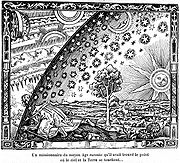
The "Flammarion engraving" first appeared in Flammarion's 1888 edition of L'Atmosphère. In 1907 he wrote that he believed that dwellers on Mars had tried to communicate with the Earth in the past. He also believed in 1907 that a seven tailed comet was heading toward Earth. In 1910 for the appearance of Halley's Comet, he believed the gas from the comet's tail "would impregnate [the Earth's] atmosphere and possibly snuff out all life on the planet."
His second wife was Gabrielle Renaudot Flammarion
Gabrielle Renaudot Flammarion
Gabrielle Renaudot Flammarion was a French astronomer. She worked at the observatory at Juvisy-sur-Orge, France, and was General Secretary of the Société Astronomique de France....
, also a noted astronomer.
Flammarion died in Juvisy-sur-Orge
Juvisy-sur-Orge
Juvisy-sur-Orge is a commune in the Essonne department in Île-de-France in northern France.Inhabitants of Juvisy-sur-Orge are known as Juvisiens.-Geography:Neighboring communes:* Athis-Mons* Draveil* Savigny-sur-Orge* Viry-Châtillon...
.
Spiritism
Because of his scientific background, he approached spiritismSpiritism
Spiritism is a loose corpus of religious faiths having in common the general belief in the survival of a spirit after death. In a stricter sense, it is the religion, beliefs and practices of the people affiliated to the International Spiritist Union, based on the works of Allan Kardec and others...
and reincarnation
Reincarnation
Reincarnation best describes the concept where the soul or spirit, after the death of the body, is believed to return to live in a new human body, or, in some traditions, either as a human being, animal or plant...
from the viewpoint of the scientific method
Scientific method
Scientific method refers to a body of techniques for investigating phenomena, acquiring new knowledge, or correcting and integrating previous knowledge. To be termed scientific, a method of inquiry must be based on gathering empirical and measurable evidence subject to specific principles of...
, writing, "It is by the scientific method alone that we may make progress in the search for truth. Religious belief must not take the place of impartial analysis. We must be constantly on our guard against illusions.". He was chosen to speak at the funerals of Allan Kardec
Allan Kardec
Allan Kardec is the pen name of the French teacher and educator Hippolyte Léon Denizard Rivail . He is known today as the systematizer of Spiritism for which he laid the foundation with the five books of the Spiritist Codification.-Early life:Rivail was born in Lyon in 1804...
, codifier of Spiritism, on 2 April 1869, when he re-affirmed that "spiritism is not a religion but a science"
His spiritist studies also influenced some of his science fiction
Science fiction
Science fiction is a genre of fiction dealing with imaginary but more or less plausible content such as future settings, futuristic science and technology, space travel, aliens, and paranormal abilities...
. In "Lumen", a human character meets the soul of an alien, able to cross the universe faster than light, that has been reincarnated on many different worlds, each with their own gallery of organisms and their evolutionary history. Other than that, his writing about other worlds adhered fairly closely to then current ideas in evolutionary theory and astronomy
Astronomy
Astronomy is a natural science that deals with the study of celestial objects and phenomena that originate outside the atmosphere of Earth...
.
Legacy
He was the first to suggest the names TritonTriton (moon)
Triton is the largest moon of the planet Neptune, discovered on October 10, 1846, by English astronomer William Lassell. It is the only large moon in the Solar System with a retrograde orbit, which is an orbit in the opposite direction to its planet's rotation. At 2,700 km in diameter, it is...
and Amalthea
Amalthea (moon)
Amalthea is the third moon of Jupiter in order of distance from the planet. It was discovered on September 9, 1892, by Edward Emerson Barnard and named after Amalthea, a nymph in Greek mythology. It is also known as '....
for moons of Neptune
Neptune
Neptune is the eighth and farthest planet from the Sun in the Solar System. Named for the Roman god of the sea, it is the fourth-largest planet by diameter and the third largest by mass. Neptune is 17 times the mass of Earth and is slightly more massive than its near-twin Uranus, which is 15 times...
and Jupiter
Jupiter
Jupiter is the fifth planet from the Sun and the largest planet within the Solar System. It is a gas giant with mass one-thousandth that of the Sun but is two and a half times the mass of all the other planets in our Solar System combined. Jupiter is classified as a gas giant along with Saturn,...
, respectively, although these names were not officially adopted until many decades later.
Honors
Named after him- Flammarion (lunar crater)Flammarion (lunar crater)Flammarion is a lunar crater on the south edge of Sinus Medii. It is located between the crater Mösting to the northwest and Herschel to the southeast. The bowl-shaped Mösting A intersects the western rim of Flammarion....
. - Flammarion (crater on Mars).
- AsteroidsAsteroidAsteroids are a class of small Solar System bodies in orbit around the Sun. They have also been called planetoids, especially the larger ones...
: 1021 Flammario1021 Flammario1021 Flammario is an asteroid. It was discovered by Max Wolf on March 11, 1924. Its provisional designation was 1924 RG. It was named after the celebrated French astronomer Camille Flammarion....
is named in his honour, and it is believed that 107 Camilla107 Camilla107 Camilla is one of the largest main-belt asteroids. It orbits within the Cybele Group, beyond most main-belt asteroids. It has a very dark surface and primitive carbonaceous composition. It was discovered by N. R...
derives from Flammarion's first name. In addition, 154 Bertha154 Bertha154 Bertha is a very dark and very large outer main-belt asteroid.It was discovered by brothers Paul Henry and Prosper Henry on November 4, 1875, but the credit from the discovery was given to Prosper. It is probably named after Berthe Martin-Flammarion, sister of the astronomer Camille Flammarion....
commemorates his sister, Berthe Martin-Flammarion; 654 Zelinda654 Zelinda654 Zelinda is a minor planet orbiting the Sun. It was discovered on January 4th, 2008 by August Kopff.On favorable oppositions, it can be as bright as magnitude 10.0, as on January 30th, 2016.-External links:*...
his niece; and 87 Sylvia87 Sylvia87 Sylvia is one of the largest main-belt asteroids. It is a member of the Cybele group located beyond the core of the belt . Sylvia is remarkable for being the first asteroid known to possess more than one moon....
possibly his first wife, Sylvie Petiaux-Hugo Flammarion. 141 Lumen141 Lumen141 Lumen is a dark , large rocky asteroid 130 km in diameter orbiting in the main belt near the Eunomia family of asteroids. It is not, however, physically related to the group, being of the wrong spectral class...
is named after Flammarion's book Lumen : Récits de l'infini; 286 Iclea286 Iclea286 Iclea is a large Main belt asteroid.It was discovered by Johann Palisa on August 3, 1889 in Vienna....
for the heroine of his novel Uranie; and 605 Juvisia605 Juvisia-External links:*...
after Juvisy-sur-OrgeJuvisy-sur-OrgeJuvisy-sur-Orge is a commune in the Essonne department in Île-de-France in northern France.Inhabitants of Juvisy-sur-Orge are known as Juvisiens.-Geography:Neighboring communes:* Athis-Mons* Draveil* Savigny-sur-Orge* Viry-Châtillon...
, France, where his observatory was located
Quotations
"What intelligent being, what being capable of responding emotionally to a beautiful sight, can look at the jagged, silvery lunar crescent trembling in the azure sky, even through the weakest of telescopes, and not be struck by it in an intensely pleasurable way, not feel cut off from everyday life here on earth and transported toward that first stop on the celestial journeys? What thoughtful soul could look at brilliant Jupiter with its four attendant satellites, or splendid Saturn encircled by its mysterious ring, or a double star glowing scarlet and sapphire in the infinity of night, and not be filled with a sense of wonder? Yes, indeed, if humankind — from humble farmers in the fields and toiling workers in the cities to teachers, people of independent means, those who have reached the pinnacle of fame or fortune, even the most frivolous of society women — if they knew what profound inner pleasure await those who gaze at the heavens, then France, nay, the whole of Europe, would be covered with telescopes instead of bayonets, thereby promoting universal happiness and peace."
— Camille Flammarion, 1880
"This end of the world will occur without noise, without revolution, without cataclysm. Just as a tree loses leaves in the autumn wind, so the earth will see in succession the falling and perishing all its children, and in this eternal winter, which will envelop it from then on, she can no longer hope for either a new sun or a new spring. She will purge herself of the history of the worlds. The millions or billions of centuries that she had seen will be like a day. It will be only a detail completely insignificant in the whole of the universe. Presently the earth is only an invisible point among all the stars, because, at this distance, it is lost through its infinite smallness in the vicinity of the sun, which itself is by far only a small star. In the future, when the end of things will arrive on this earth, the event will then pass completely unperceived in the universe. The stars will continue to shine after the extinction of our sun, as they already shone before our existence. When there will no longer be on the earth a sole concern to contemplate, the constellations will reign again in the noise as they reigned before the appearance of man on this tiny globule. There are stars whose light shone some millions of years before we arrived … The luminous rays that we receive actually then departed from their bosom before the time of the appearance of man on the earth. The universe is so immense that it appears immutable, and that the duration of a planet such as that of the earth is only a chapter, less than that, a phrase, less still, only a word of the universe’s history."
— Camille Flammarion, Le Fin du Monde (The End of the World)
Works
- La pluralité des mondes habités (The Plurality of Inhabited Worlds), 18621862 in literatureThe year 1862 in literature involved some significant new books.-Events:*February - Ambrose Bierce joins the staff of General William Badcock Hazen....
. - Real and Imaginary Worlds, 18651865 in literatureThe year 1865 in literature involved some significant new books.-Events:* June 9 - Charles Dickens is involved in the Staplehurst rail crash....
. - God in nature, 18661866 in literatureThe year 1866 in literature involved some significant new books.-Events:*Ludwig Anzengruber returns to Vienna after working as a travelling actor.*Luigi Capuana becomes theatre critic for Italian newspaper The Nation....
. - Lumen, 18671867 in literatureThe year 1867 in literature involved some significant new books.-Events:* Three new American periodicals for children — Oliver Optic's Magazine, Frank Leslie's Boys' and Girls' Weekly, and the Riverside Magazine for Young People — all begin publishing.-New books:*Mary Elizabeth Braddon...
. - Récits de l'infini, 18721872 in literatureThe year 1872 in literature involved some significant new books.-Events:*Paul Verlaine abandons his family to go to London with Arthur Rimbaud....
. - L'atmosphère: météorologie populaire, 18881888 in literatureThe year 1888 in literature involved some significant new books.-New books:*Grant Allen - The Devil's Die**The White Man's Foot*Edward Bellamy - Looking Backward*Rolf Boldrewood - Robbery Under Arms...
. - Astronomie populaire, 18801880 in literatureThe year 1880 in literature involved some significant new books.-New books:*Henry Adams - Democracy: An American Novel *Rhoda Broughton - Second Thoughts*Wilkie Collins - Jezebel's Daughter...
. His best-selling work, it was translated into EnglishEnglish languageEnglish is a West Germanic language that arose in the Anglo-Saxon kingdoms of England and spread into what was to become south-east Scotland under the influence of the Anglian medieval kingdom of Northumbria...
as Popular Astronomy in 18941894 in literatureThe year 1894 in literature involved some significant new books.-Events:*Robert Frost sells his first poem, "My Butterfly", to The New York Independent for fifteen dollars.*Hermann Hesse begins his apprenticeship at a factory in Calw....
. - Les Étoiles et les Curiosités du Ciel, 18821882 in literatureThe year 1882 in literature involved some significant new books.-New books:*F. Anstey - Vice Versa*Walter Besant - The Revolt of Man*Bankim Chatterjee - Anandmath*Richard Doddridge Blackmore -Christowell*Wilkie Collins - After Dark...
. A supplement of the L'Astronomie Populaire works. An observer's handbook of its day. - Uranie, 18901890 in literatureThe year 1890 in literature involved some significant new books.-Events:* Bram Stoker begins work on Dracula.*Arthur Morrison joins the staff of the Evening Globe newspaper.-New books:*Rolf Boldrewood - The Squatter's Dream...
. - La planète Mars et ses conditions d'habitabilité, 18921892 in literatureThe year 1892 in literature involved some significant new books.-Events:*Shadows Uplifted by Frances Ellen Watkins Harper becomes the second novel by an African-American woman published in the United States-New books:...
. - La Fin du Monde (The End of the World), 18931893 in literatureThe year 1893 in literature involved some significant new books.-Events:*André Gide begins his travels in North Africa.*Jerome K. Jerome founds the magazine To-Day.-New books:*Byron A...
, is a science fiction novel about a cometCometA comet is an icy small Solar System body that, when close enough to the Sun, displays a visible coma and sometimes also a tail. These phenomena are both due to the effects of solar radiation and the solar wind upon the nucleus of the comet...
colliding with the EarthEarthEarth is the third planet from the Sun, and the densest and fifth-largest of the eight planets in the Solar System. It is also the largest of the Solar System's four terrestrial planets...
, followed by several million years leading up to the gradual death of the planetDying Earth (subgenre)The Dying Earth subgenre is a sub-category of science fiction or science fantasy which takes place in the far future at either the end of life on Earth or the End of Time, when the laws of the universe themselves fail...
. It has recently been brought back into print as Omega: The Last Days of the WorldOmega: The Last Days of the WorldOmega: The Last Days of the World is a science fiction novel published in 1894 by Camille Flammarion. ISBN 0-8032-6898-X.On 25th century Earth, a comet made mostly of Carbonic-Oxide could possibly collide with the Earth...
. It was adapted into a film in 1931End of the World (1931 film)End of the World is a 1931 science fiction film directed by Abel Gance based on the novel Omega: The Last Days of the World by Camille Flammarion. The film stars Victor Francen as Martial Novalic, Colette Darfeuil as Genevieve de Murcie, Abel Gance as Jean Novalic, and Jeanne Brindau as Madame...
by Abel GanceAbel GanceAbel Gance was a French film director and producer, writer and actor. He is best known for three major silent films: J'accuse , La Roue , and the monumental Napoléon .-Early life:...
. - L’inconnu et les problèmes psychiques (published in English as: L’inconnu: The Unknown), 19001900 in literatureThe year 1900 in literature involved some significant new books and publications, as well as the deaths of several highly prominent writers, including among them the late Irish poet Oscar Wilde and the German philosopher Friedrich Nietzsche....
, a collection of psychic experiences.