
All Topics  
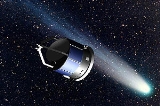
Giotto mission

 
Giotto Mission

   Email Print
   Bookmark   Link


Giotto mission


Giotto was a Europe
Europe

Europe is, conventionally, one of the world's seven continents. Comprising the westernmost peninsula of Eurasia, Europe is generally divided from Asia to its east by the water divide of the Ural Mountains, the Ural , the Caspian Sea, and by the Caucasus Mountains to the southeast....
an robotic spacecraft mission from the European Space Agency
European Space Agency

The European Space Agency , established in 1975, is an intergovernmentalism organisation dedicated to the Space exploration, currently with 18 member states....
, intended to fly by and study Halley's Comet
Comet Halley

Halley's Comet or Comet Halley is the most famous of the periodic comets and can currently be seen every 75?76 years. Many comets with long orbital periods may appear brighter and more spectacular, but Halley is the only short-period comet that is clearly visible to the naked eye, and thus, the only naked-eye comet certain to return wi...
. On 13 March 1986, the mission succeeded in approaching Halley's nucleus at a distance of 596 kilometers. The spacecraft was named after the medieval Italian
Italy

Italy , officially the Italian Republic , is a country located on the Italian Peninsula in Southern Europe and on the two largest islands in the Mediterranean Sea, Sicily and Sardinia....
 painter
Painting

Painting is the practice of applying paint, pigment, color or other medium to a surface . In art, the term describes both the act and the result, which is called a painting....
 Giotto di Bondone
Giotto di Bondone

Giotto di Bondone , better known simply as Giotto, was an italy Painting and architect from Florence. He is generally considered the first in a line of great artists who contributed to the Italian Renaissance....
. He had observed Halley's Comet in 1301 and was inspired to depict it as the star of Bethlehem
Star of Bethlehem

The Star of Bethlehem, also called the Christmas Star, is a star in Christianity tradition that revealed the birth of Jesus to the Biblical Magi and later led them to Bethlehem....
 in his painting Adoration of the Magi.

inally a United States partner probe was planned that would accompany Giotto, but this fell through due to budget cuts at NASA
NASA

The National Aeronautics and Space Administration is an agency of the Federal government of the United States, responsible for the nation's public list of space agencies....
.


Discussion
Ask a question about 'Giotto mission'
Start a new discussion about 'Giotto mission'
Answer questions from other users
Full Discussion Forum


Encyclopedia


Giotto was a Europe
Europe

Europe is, conventionally, one of the world's seven continents. Comprising the westernmost peninsula of Eurasia, Europe is generally divided from Asia to its east by the water divide of the Ural Mountains, the Ural , the Caspian Sea, and by the Caucasus Mountains to the southeast....
an robotic spacecraft mission from the European Space Agency
European Space Agency

The European Space Agency , established in 1975, is an intergovernmentalism organisation dedicated to the Space exploration, currently with 18 member states....
, intended to fly by and study Halley's Comet
Comet Halley

Halley's Comet or Comet Halley is the most famous of the periodic comets and can currently be seen every 75?76 years. Many comets with long orbital periods may appear brighter and more spectacular, but Halley is the only short-period comet that is clearly visible to the naked eye, and thus, the only naked-eye comet certain to return wi...
. On 13 March 1986, the mission succeeded in approaching Halley's nucleus at a distance of 596 kilometers. The spacecraft was named after the medieval Italian
Italy

Italy , officially the Italian Republic , is a country located on the Italian Peninsula in Southern Europe and on the two largest islands in the Mediterranean Sea, Sicily and Sardinia....
 painter
Painting

Painting is the practice of applying paint, pigment, color or other medium to a surface . In art, the term describes both the act and the result, which is called a painting....
 Giotto di Bondone
Giotto di Bondone

Giotto di Bondone , better known simply as Giotto, was an italy Painting and architect from Florence. He is generally considered the first in a line of great artists who contributed to the Italian Renaissance....
. He had observed Halley's Comet in 1301 and was inspired to depict it as the star of Bethlehem
Star of Bethlehem

The Star of Bethlehem, also called the Christmas Star, is a star in Christianity tradition that revealed the birth of Jesus to the Biblical Magi and later led them to Bethlehem....
 in his painting Adoration of the Magi.

Mission

Giotto Halley E Grigg Skjellerup
Originally a United States partner probe was planned that would accompany Giotto, but this fell through due to budget cuts at NASA
NASA

The National Aeronautics and Space Administration is an agency of the Federal government of the United States, responsible for the nation's public list of space agencies....
. There were plans to have observation equipment on-board a Space Shuttle
Space Shuttle

NASA's Space Shuttle, officially called the Space Transportation System , is the spacecraft currently used by the United States government for its human spaceflight missions....
 in low-Earth orbit around the time of Giotto's fly-by, but they fell through with the Challenger disaster
STS-51-L

STS-51-L was the twenty-fifth flight of the American Space Shuttle program, which marked the first time a civilian had flown aboard the Space Shuttle....
.

The plan then became a cooperative armada of five spaceprobes including Giotto, two from the Soviet Union
Soviet Union

The Union of Soviet Socialist Republics was a Constitution of the Soviet Union socialist state that existed in Eurasia from 1922 to 1991.The name is a translation of the , romanization of Russian Soyuz Sovetskikh Sotsialisticheskikh Respublik, abbreviated ????, SSSR....
's Vega program
Vega program

The Vega program were a series of Venus missions which also took advantage of the appearance of Comet Halley in 1986. Vega 1 and Vega 2 were unmanned spacecraft launched in a cooperative effort among the Soviet Union and Austria, Bulgaria, Hungary, the German Democratic Republic, Poland, Czechoslovakia, France, and the Federal Republic of Ge...
 and two from Japan
Japan

Japan is an island country in East Asia. Located in the Pacific Ocean, it lies to the east of the Sea of Japan, People's Republic of China, North Korea, South Korea and Russia, stretching from the Sea of Okhotsk in the north to the East China Sea and Taiwan in the south....
: the Sakigake
Sakigake

Sakigake , pre-launch codename MS-T5, was Japan first Unmanned space mission, and the first deep space probe to be launched by any country other than the USA or the Soviet Union....
 and Suisei probe
Suisei probe

Suisei , originally known as Planet-A, was an unmanned space probe developed by the Institute of Space and Astronautical Science . It constituted a part of the Halley Armada together with Sakigake, the Soviet Union/France Vega program probes, the European Space Agency Giotto mission and the National Aeronautics and Space Administration...
s. The idea was for Japanese probes and the pre-existing American
United States

The United States of America is a Federal government constitutional republic comprising U.S. state and a federal district. The country is situated mostly in central North America, where its Contiguous United States and Washington, D.C., the Capital districts and territories, lie between the Pacific Ocean and Atlantic Oceans, Borders of the U...
 probe International Cometary Explorer
International Cometary Explorer

The International Cometary Explorer spacecraft was originally known as International Sun/Earth Explorer 3 satellite, launched August 12, 1978....
 to make long distance measurements, followed by the Russian Vegas which would locate the nucleus, and the resulting information sent back would allow Giotto to precisely target very close to the nucleus. Because Giotto would pass so very close to the nucleus ESA was mostly convinced it would not survive the encounter due to bombardment from the many high speed cometary particles. The coordinated group of probes became known as the Halley Armada
Halley Armada

The Halley Armada is a group of space probes sent to examine Halley's Comet during its 1986 sojourn through the inner solar system. The armada consisted of one probe from the European Space Agency, two probes that were joint projects between the Soviet space program and France and two probes from the Institute of Space and Astronautical Scie...
.

The craft

The spacecraft was derived from the GEOS research satellite built by British Aerospace, and modified with the addition of a dust shield as proposed by Fred Whipple which comprised a thin (1 mm) aluminium sheet separated by a space and a thicker Kevlar
Kevlar

Kevlar is the registered trademark for a light, strong aramid synthetic fiber, related to other aramids such as Nomex and Technora.Developed at DuPont in 1965 by Stephanie Kwolek it was first commercially used in the early 1970s as a replacement for steel in racing tires....
 sheet. The later Stardust spacecraft
Stardust (spacecraft)

Stardust is an United States interplanetary mission of the NASA Jet Propulsion Laboratory, whose primary purpose was to investigate the makeup of the comet Comet Wild 2 and its coma ....
 would use a similar Whipple shield.

Timeline


Launch

The mission was given the go-ahead by ESA in 1980, and launched on an Ariane 1
Ariane 1

Ariane I is the first version of the Ariane launcher family....
 rocket (flight V14) on 2 July 1985 from Kourou
Kourou

Kourou is a town and commune in France in French Guiana, an overseas region and Overseas department of France located in South America.Kourou is the location of the Guiana Space Centre, France and ESA's main spaceport....
. The craft was controlled from the European Space Agency ESOC facilities
European Space Operations Centre

The European Space Operations Centre is responsible for controlling European Space Agency satellites and space probes. The centre is located in Darmstadt, Germany....
 in Darmstadt
Darmstadt

Darmstadt is a city in the States of Germany of Hesse in Germany, located in the southern part of the Frankfurt Rhine Main Area.The city of Darmstadt was founded by the Counts of Katzenelnbogen in 1330, though settlement in the area is known to have been present as early as the late 11th century....
 (then West Germany) initially in Geostationary Transfer Orbit (GTO) then in the Near Earth Phase (NEP) before the longer Cruise Phase through to the encounter. While in GTO a number of slew and spin-up manoeuvres (to 90 [[RPM]]) were carried out in preparation for the firing of the Apogee Boost Motor (ABM), although unlike orbit circularisations for [[geostationary orbit]], the ABM for Giotto was fired at [[perigee]]. Attitude determination and control used sun pulse and IR earth sensor data in the telemetry to determine the spacecraft orientation.

Halley encounter

The Soviet
Soviet Union

The Union of Soviet Socialist Republics was a Constitution of the Soviet Union socialist state that existed in Eurasia from 1922 to 1991.The name is a translation of the , romanization of Russian Soyuz Sovetskikh Sotsialisticheskikh Respublik, abbreviated ????, SSSR....
 Vega 1
Vega 1

Vega 1 is a soviet space probe part of the Vega program. The spacecraft was a development of the earlier Venera craft. They were designed by Babakin Space Center and constructed as 5VK by Lavochkin at Khimki....
 starts returning images of Halley on 1986 4 March, and the first ever of its nucleus, and made its flyby on 6 March, followed by Vega 2
Vega 2

Vega 2 is a Soviet space probe part of the Vega program. The spacecraft was a development of the earlier Venera craft. They were designed by Babakin Space Center and constructed as 5VK by Lavochkin at Khimki....
 making its flyby on 9 March.

Giotto passed Halley successfully on 14 March 1986 at 600 km distance, and surprisingly survived despite being hit by some small particles. One impact sent it spinning off its stabilized spin axis so that its antenna no longer always pointed at the Earth, and importantly, its dust shield no longer protected its instruments. After 32 minutes Giotto re-stabilized itself and continued gathering science data.

Another impact destroyed the Halley Multicolor Camera, but not before it took spectacular pictures of the nucleus at closest approach.

First Earth flyby

Giotto's trajectory was adjusted for an Earth flyby and its science instruments were turned off on 1986 15 March at 02:00 UT.

Grigg-Skjellerup encounter

Giotto was commanded to wake up on 2 July 1990 when it flew by Earth in order to sling shot to its next cometary encounter.

The probe then flew by the Comet Grigg-Skjellerup
26P/Grigg-Skjellerup

Comet Grigg-Skjellerup is a periodic comet.Discovered in 1902 by John Grigg of New Zealand, and rediscovered in its next appearance in 1922 by John Francis Skjellerup, an Australian then living and working for about two decades in South Africa where he was a founder member of the Astronomical Society of Southern Africa....
 in 10 July 1992 which it approached to a distance of about 200 kilometres. Afterwards, Giotto was again switched off on 23 July 1992.

Second Earth flyby

In 1999 Giotto made another Earth flyby but was not reactivated.

Results


Scientific results

Images showed Halley's nucleus to be a dark peanut-shaped body, 15 km long, 7 to 10 km wide. Only 10% of the surface was active, with at least three outgassing jets seen on the sunlit side. Analysis showed the comet formed 4.5 billion years ago from volatiles (mainly ice) that had condensed onto interstellar dust particles. It had remained practically unaltered since its formation.

Measured volume of material ejected by Halley:
  • 80% water
    Water

    Water is a common chemical substance that is essential for the survival of all known forms of life. In typical usage, water refers only to its liquid form or States of matter, but the substance also has a solid state, ice, and a gaseous state, water vapor or steam....
    ,
  • 10% carbon monoxide
    Carbon monoxide

    Carbon monoxide, with the chemical formula CO, is a colorless and odorless, tasteless, yet highly toxic gas. Its molecules consist of one carbon atom covalent bond to one oxygen atom....
  • 2.5% a mix of methane
    Methane

    Methane is a chemical compound with the molecular formula . It is the simplest alkane, and the principal component of natural gas. Methane's bond angles are 109.5 degrees....
     and ammonia
    Ammonia

    Ammonia is a chemical compound with the chemical formula nitrogenhydrogen. It is normally encountered as a gas with a characteristic pungent odor....
    .
  • Other hydrocarbon
    Hydrocarbon

    In organic chemistry, a hydrocarbon is an organic compound consisting entirely of hydrogen and carbon. With relation to chemical terminology, aromatic hydrocarbons or arenes, alkanes, alkenes and alkyne-based compounds composed entirely of carbon or hydrogen are referred to as "pure" hydrocarbons, whereas other hydrocarbons with bonded com...
    s, iron
    Iron

    Iron is a chemical element with the symbol Fe and atomic number 26. Iron is a Group 8 element and period 4 element. Iron is lustrous and silvery in color....
    , and sodium
    Sodium

    Sodium is an element which has the symbol Na , atomic number 11, atomic mass 23 amu , and a common oxidation number +1. Sodium is a soft, silvery white, highly reactive element and is a member of the alkali metals within "group 1" ....
     were detected in trace amounts.


Giotto found Halley's nucleus was blacker than coal, which suggested a thick covering of dust.

The nucleus's surface was rough and of a porous quality, with the density of the whole nucleus as low as 0.3
Orders of magnitude (density)

NotesExternal links...
 gram
Gram

The gram , ; symbol g, is a Physical unit of mass.Originally defined as "the absolute weight of a volume of pure water equal to the cube of the hundredth part of a metre, and at the temperature of melting ice" , a gram is now defined as one one-thousandth of the SI base unit, the kilogram, or Scientific notation kg, which itself is...
 per cubic centimetre
Cubic centimetre

A cubic centimetre or cubic centimeter is a commonly used unit of volume extending the derived International System of Units-unit cubic metre and corresponds to the volume of a cube measuring 1?1?1 cm....
 (g/cm³). Sagdeev's team estimated a density of 0.6 g/cm³, but S. J. Peale warned that all estimates had error bars too large to be informative.

The quantity of material ejected was found to be 3 tonnes per second for seven jets, and these caused the comet to wobble over long time periods.

The dust ejected was mostly only the size of cigarette smoke particles, with masses ranging from
Orders of magnitude (mass)

To help compare different Order of magnitude, the following list describes various mass levels between 10−36 kilogram and 1053 kg....
 10−20 kg to 40x10−5 kg (10 attograms to 40 milligrams). (See Orders of magnitude (mass)
Orders of magnitude (mass)

To help compare different Order of magnitude, the following list describes various mass levels between 10−36 kilogram and 1053 kg....
.) Although the one particle impact that sent Giotto spinning was not measured, from its effects - it also probably broke off a piece of Giotto - its mass has been estimated to lie between 0.1 and 1 gram.

Two kinds of dust were seen: one with carbon, hydrogen, nitrogen and oxygen; the other with calcium, iron, magnesium, silicon and sodium.

The ratio of abundances of the comet's light elements excluding nitrogen (ie. hydrogen, carbon, oxygen) were the same as the Sun's. The implication is that the constituents of Halley are among the most primitive in the solar system.

The plasma and ion mass spectrometer instruments showed Halley has a carbon-rich surface.

Spacecraft achievements

  • Giotto made the closest approach to Halley comet and provided the best data for this comet.
  • Giotto was the first spacecraft to provide pictures of a cometary nucleus.
  • Giotto was the first spacecraft do a close flyby of two comets. Young and active comet Halley could be compared to old Grigg-Skjellerup.
  • Giotto was the first spacecraft to return from interplanetary space and perform an Earth swing by.
  • Giotto was the first spacecraft to be re-activated from hibernation mode.


External links

  • by