
All Topics  
Very Large Telescope

 
Very Large Telescope

   Email Print
   Bookmark   Link


Very Large Telescope


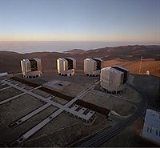
The Very Large Telescope (VLT) is a system of four separate optical telescope
Optical telescope

An optical telescope is a telescope which is used to gather and Focus light mainly from the Visible spectrum part of the electromagnetic spectrum for directly viewing a magnification image for making a photograph, or collecting data through electronic s....
s (the Antu telescope, the Kueyen telescope, the Melipal telescope, and the Yepun telescope) organized in an array formation, built and operated by the European Southern Observatory
European Southern Observatory

The European Southern Observatory , is an intergovernmental research organization for astronomy, composed and supported by fourteen countries from Europe....
 (ESO) at the Paranal Observatory
Paranal Observatory

Paranal Observatory is an astronomical observatory located on Cerro Paranal at 2,635 mts. altitude and operated by the European Southern Observatory....
 on Cerro Paranal
Cerro Paranal

Cerro Paranal , also known as Paranal Mountain is a mountain in the Atacama desert of northern Chile that is home to the Paranal Observatory....
, a 2,635 m high mountain in the Atacama desert
Atacama Desert

The Atacama Desert is a virtually rainless plateau in South America, covering a 966 km strip of land on the Pacific Ocean coast of South America, west of the Andes mountains....
 in northern Chile
Chile

Chile, officially the Republic of Chile , is a country in South America occupying a long and narrow coastal strip wedged between the Andes mountains and the Pacific Ocean....
. Each telescope has an 8.2 m aperture
Aperture

In optics, an aperture is a hole or an opening through which light is admitted. More specifically, the aperture of an optical system is the opening that determines the cone angle of a bundle of ray that come to a focus in the ....
. The array is complemented by four movable Auxiliary Telescopes (ATs) of 1.8 m aperture.

General information
The VLT consists of an arrangement of four large (8.2 meter diameter) telescopes, and optical elements which can combine them into an astronomical interferometer
Astronomical interferometer

An astronomical interferometer is an array of telescopes or mirror segments acting together to probe structures with higher resolution. Astronomical interferometers are widely used for optical astronomy, infrared astronomy, submillimetre astronomy and radio astronomy....
 (VLTI) which is used to resolve small objects.


Discussion
Ask a question about 'Very Large Telescope'
Start a new discussion about 'Very Large Telescope'
Answer questions from other users
Full Discussion Forum


Encyclopedia


The Very Large Telescope (VLT) is a system of four separate optical telescope
Optical telescope

An optical telescope is a telescope which is used to gather and Focus light mainly from the Visible spectrum part of the electromagnetic spectrum for directly viewing a magnification image for making a photograph, or collecting data through electronic s....
s (the Antu telescope, the Kueyen telescope, the Melipal telescope, and the Yepun telescope) organized in an array formation, built and operated by the European Southern Observatory
European Southern Observatory

The European Southern Observatory , is an intergovernmental research organization for astronomy, composed and supported by fourteen countries from Europe....
 (ESO) at the Paranal Observatory
Paranal Observatory

Paranal Observatory is an astronomical observatory located on Cerro Paranal at 2,635 mts. altitude and operated by the European Southern Observatory....
 on Cerro Paranal
Cerro Paranal

Cerro Paranal , also known as Paranal Mountain is a mountain in the Atacama desert of northern Chile that is home to the Paranal Observatory....
, a 2,635 m high mountain in the Atacama desert
Atacama Desert

The Atacama Desert is a virtually rainless plateau in South America, covering a 966 km strip of land on the Pacific Ocean coast of South America, west of the Andes mountains....
 in northern Chile
Chile

Chile, officially the Republic of Chile , is a country in South America occupying a long and narrow coastal strip wedged between the Andes mountains and the Pacific Ocean....
. Each telescope has an 8.2 m aperture
Aperture

In optics, an aperture is a hole or an opening through which light is admitted. More specifically, the aperture of an optical system is the opening that determines the cone angle of a bundle of ray that come to a focus in the ....
. The array is complemented by four movable Auxiliary Telescopes (ATs) of 1.8 m aperture.

General information


The VLT consists of an arrangement of four large (8.2 meter diameter) telescopes, and optical elements which can combine them into an astronomical interferometer
Astronomical interferometer

An astronomical interferometer is an array of telescopes or mirror segments acting together to probe structures with higher resolution. Astronomical interferometers are widely used for optical astronomy, infrared astronomy, submillimetre astronomy and radio astronomy....
 (VLTI) which is used to resolve small objects. The interferometer also includes a set of four 1.8 meter diameter movable telescopes dedicated to interferometric observations. The 8.2 meter telescopes have been named after some astronomical objects in the local Mapuche
Mapuche

The Mapuche are the Indigenous peoples of the Americas inhabitants of Central and Southern Chile and Southern Argentina. They were known as Araucanians by the Spaniards....
 language: Antu (The Sun
Sun

The Sun , a G V star, is the star at the center of the Solar System. The Earth and other matter orbit the Sun, which by itself accounts for about 98.6% of the Solar System's mass....
), Kueyen (The Moon
Moon

The Moon is Earth's only natural satellite and the List of natural satellites by diameter satellite in the Solar System. The average centre-to-centre distance from the Earth to the Moon is km, about thirty times the diameter of the Earth....
), Melipal (The Southern Cross
Crux

Crux is the List of constellations by area of the 88 modern constellations, but is one of the most distinctive. Its name is Latin for cross, and it is dominated by a cross-shaped Asterism and is commonly known as the Southern Cross because it is today visible only from the southern hemisphere, although it was visible near the horizon...
), and Yepun (Venus
Venus

Venus is the second-closest planet to the Sun, orbiting it every 224.7 Earth days. The planet is named after Venus , the Roman mythology goddess of love....
).

The VLT 8.2 meter telescopes was originally designed to be operated in three modes:
  • as a set of four independent telescopes (this is the primary mode of operation). With one such telescope, images of celestial objects as faint as magnitude 30 can be obtained in a one-hour exposure. This corresponds to seeing objects that are four billion times fainter than what can be seen with the unaided eye.
  • as a single large coherent
    Coherence (physics)

    In physics, coherence is a property of waves, that enables stationary interference. More generally, coherence describes all correlation properties between physical quantities of a wave....
     interferometric instrument
    Astronomical interferometer

    An astronomical interferometer is an array of telescopes or mirror segments acting together to probe structures with higher resolution. Astronomical interferometers are widely used for optical astronomy, infrared astronomy, submillimetre astronomy and radio astronomy....
     (the VLT Interferometer or VLTI), for extra resolution. This mode is occasionally used, only for observations of relatively bright sources with small angular extent.
  • as a single large incoherent instrument, for extra light-gathering capacity. The instrumentation required for bring the light to a combined incoherent focus was not built. Recently, new instrumentation proposals have been put forward for making this observing mode available. Multiple telescopes are sometimes independently pointed at the same object, either to increase the total light-gathering power, or to provide simultaneous observations with complementary instruments.


The VLTs are equipped with a large set of instruments permitting observations to be performed from the near-UV to the mid-IR (ie a large fraction of the light wavelengths accessible from the surface of the Earth
Infrared astronomy

Infrared astronomy is the branch of astronomy and astrophysics which deals with objects visible in infrared radiation. Visible radiation ranges from 400 nanometre to 700 nm ....
), with the full range of techniques including high-resolution spectroscopy, multi-object spectroscopy, imaging, and high-resolution imaging. In particular, the VLT has several Adaptive optics
Adaptive optics

Adaptive optics is a technology used to improve the performance of optics by reducing the effects of rapidly changing optical distortion. It is used in astronomical telescopes and laser communication systems to remove the effects of atmospheric distortion, and in retinal imaging systems to reduce the impact of ocular aberrations....
 systems, which at infrared
Infrared

Infrared radiation is electromagnetic radiation whose wavelength is longer than that of visible light , but shorter than that of terahertz radiation and microwaves ....
 wavelengths correct for the effects of the atmospheric turbulence, providing images almost as sharp as if the telescope were in space. In the near-IR, the Adaptive Optics images of the VLT are up to three times sharper than those of the Hubble Space Telescope
Hubble Space Telescope

The Hubble Space Telescope is a Space observatory that was carried into Low Earth orbit STS-31 in April 1990. It is named after the American astronomer Edwin Hubble....
, and the spectroscopic resolution is many times better than Hubble. The VLTs are noted for their high level of observing efficiency and automation.

The principal role of the main VLT telescopes is to operate as four independent telescopes. The interferometry (combining light from multiple telescopes) is used about 20 percent of the time for very high-resolution on bright objects.

Additionally, the four 8.2 m telescopes are accompanied by four smaller Auxiliary Telescopes of 1.8 m each (two operational in 2005, the other two in 2006), which can be placed on different positions around the four big telescopes in order to provide better interferometric observations.

The VLT is operated by the European Southern Observatory
European Southern Observatory

The European Southern Observatory , is an intergovernmental research organization for astronomy, composed and supported by fourteen countries from Europe....
.

In 2004, VLT telescopes produced some of the first infrared
Infrared

Infrared radiation is electromagnetic radiation whose wavelength is longer than that of visible light , but shorter than that of terahertz radiation and microwaves ....
 images of extrasolar planets GQ Lupi b
GQ Lupi b

GQ Lupi b is a possible extrasolar planet orbiting the star GQ Lupi. Its discovery was announced in April 2005. Along with 2M1207b, this was one of the first extrasolar planet candidates to be directly imaged....
 and 2M1207b
2M1207b

2M1207b is a planetary mass object planetary orbit the brown dwarf 2M1207, in the constellation Centaurus, approximately 170 light-years from Earth....
. Among the more recent discoveries is the discovery of the farthest gamma-ray burst and the evidence for a black hole at the centre of our Galaxy, the Milky Way. The VLT has also discovered the candidate farthest galaxy ever seen by humans, Abell 1835 IR1916.

Instruments

Instruments on the VLT:

Instruments on the VLT
Telescope Cassegrain-Focus Nasmyth-Focus A Nasmyth-Focus B
Antu (UT1) FORS 2 CRIRES ISAAC
Kueyen (UT2) FORS 1 FLAMES UVES
Melipal (UT3) VISIR Guest focus VIMOS
Yepun (UT4) SINFONI HAWK-I NACO


  • FORS 1 (FOcal Reducer and low dispersion Spectrograph) is a visible light camera and Multi Object Spectrograph with a 6.8 arcminute field of view.
  • FORS 2. Like FORS 1, but with further multi-object spectroscopy.
  • ISAAC (Infrared Spectrometer And Array Camera) is a near infrared imager and spectrograph
  • UVES (Ultraviolet and Visual Echelle Spectrograph) is an ultraviolet
    Ultraviolet

    Ultraviolet light is electromagnetic radiation with a wavelength shorter than that of visible light, but longer than x-rays, in the range 400 nanometer to 10 nm, and energies from 3 Electron volt to 124 eV....
     and visible light spectrograph.
  • FLAMES (Fibre Large Area Multi-Element Spectrograph) is a multi-object fibre feed unit for UVES and GIRAFFE, the latter allowing the capability for simultaneously studying hundreds of individual stars in nearby galaxies at moderate spectral resolution in the visible.
  • NACO (NAOS-CONICA, NAOS meaning Nasmyth Adaptive Optics System and CONICA meaning COude Near Infrared CAmera) is an adaptive optics
    Adaptive optics

    Adaptive optics is a technology used to improve the performance of optics by reducing the effects of rapidly changing optical distortion. It is used in astronomical telescopes and laser communication systems to remove the effects of atmospheric distortion, and in retinal imaging systems to reduce the impact of ocular aberrations....
     facility which produces infrared images as sharp as if taken in space and includes spectroscopic, polarimetric and coronagraphic capabilities.
  • VISIR (VLT spectrometer and imager for the mid-infrared) provides diffraction-limited imaging and spectroscopy at a range of resolutions in the 10 and 20 micrometre mid-infrared (MIR) atmospheric windows.
  • SINFONI is a medium resolution, near-infrared (1-2.5 micrometres) integral field spectrograph fed by an adaptive optics module.
  • CRIRES (CRyogenic InfraRed Echelle Spectrograph) is adaptive optics assisted and provides a resolving power of up to 100,000 in the infrared spectral range from 1 to 5 micrometres.
  • HAWK-I (High Acuity Wide field K-band Imager) is a near-infrared imager with a relatively large field of view.
  • VIMOS (VIsible Multi-Object Spectrograph) delivers visible images and spectra of up to 1,000 galaxies at a time in a 14 x 14 arcmin field of view.
  • Guest focus available for visitor instruments, such as ULTRACAM or DAZZLE.


Several second-generation VLT instruments are now under development:
  • X-Shooter, a wide-band [UV to near infrared] spectrometer designed to explore the properties of rare, unusual or unidentified sources
  • KMOS, a cryogenic infrared multi-object spectrometer intended primarily for the study of distant galaxies
  • MUSE a huge "3-dimensional" spectroscopic explorer which will provide complete visible spectra of all objects contained in "pencil beams" through the Universe
  • SPHERE, a high-contrast adaptive optics system) dedicated to the discovery and study of exoplanets.


Interferometry and the VLTI

In its interferometric operating mode, the light from the telescopes is reflected off mirrors and directed through tunnels to a central beam combining laboratory. The VLTI is intended to achieve an effective angular resolution
Angular resolution

Angular resolution describes the resolving power of any such as an Optical telescope or radio telescope, a microscope, a camera, or an eye....
 of 0.002 arcsecond at a wavelength
Wavelength

In physics, wavelength is the distance between repeating units of a propagating wave of a given frequency. It is commonly designated by the Greek language letter lambda ....
 of 2 µm. This is comparable to the resolution achieved using other arrays such as the Navy Prototype Optical Interferometer
Navy Prototype Optical Interferometer

The Navy Prototype Optical Interferometer is an interferometer operated by the US Naval Observatory, the Naval Research Laboratory and The Lowell Observatory....
 and the CHARA array
CHARA array

The CHARA Array is an optical astronomical interferometer operated by The Center for High Angular Resolution Astronomy of the Georgia State University ....
. Using the big telescopes the faintest object the VLTI can observe is magnitude
Apparent magnitude

The apparent magnitude of a celestial body is a measurement of its brightness as seen by an observer on Earth, normalized to the value it would have in the absence of the Earth's atmosphere....
 7 in the near infrared for broadband observations, similar to many other near infrared / optical interferometers without fringe tracking2
List of astronomical interferometers at visible and infrared wavelengths

Current Performance of Ground-Based Interferometers Here is a list of currently existing astronomical interferometer , and some parameters describing their performance....
. At more challenging mid-infrared wavelengths, the VLTI can reach magnitude 4.5, significantly fainter than the Infrared Spatial Interferometer
Infrared Spatial Interferometer

The Infrared Spatial Interferometer is an astronomical interferometer array of three 65 inch telescopes operating in the mid-infrared. The telescopes are fully mobile and their current site on Mount Wilson allows for placements as far as 70 m apart, giving the resolution of a telescope of that diameter....
. When fringe tracking is introduced, the limiting magnitude of the VLTI is expected to improve by a factor of almost 1000, reaching a magnitude of about 14. This is similar to what is expected for other fringe tracking interferometers. In spectroscopic mode, the VLTI can currently reach a magnitude of 1.5. The VLTI can work in a fully integrated way, so that interferometric observations are actually quite simple to prepare and execute. The VLTI has become worldwide the first general user optical/infrared interferometric facility offered with this kind of service to the astronomical community.

Because of the many mirrors involved in the VLTI system, about 99 percent of the light is lost before reaching the detector. Additionally, the interferometric technique is such that it is very efficient only of objects that are small enough that all their light is concentrated. For instance, an object with a relatively low surface brightness
Surface brightness

Surface brightness is a concept used in astronomy when describing extended astronomical objects such as galaxy and nebulae....
 such as the moon cannot be observed, because its light is too diluted. Only targets which are at temperatures of more than 1,000°C
Celsius

Celsius is a temperature scale that is named after the Swedish astronomer Anders Celsius , who developed a similar temperature scale two years before his death....
 have a surface brightness
Surface brightness

Surface brightness is a concept used in astronomy when describing extended astronomical objects such as galaxy and nebulae....
 high enough to be observed in the mid-infrared, and objects must be at several thousands of degrees Celsius for near-infrared observations using the VLTI. This includes most of the stars in the solar neighborhood and many extragalactic objects such as bright active galactic nuclei
Active galactic nucleus

An active galactic nucleus is a compact region at the centre of a galaxy which has a much higher than normal luminosity over some or all of the electromagnetic spectrum ....
, but this sensitivity limit rules out interferometric
Interferometry

Interferometry is the technique of diagnosing the properties of two or more waves by studying the pattern of interference created by their Superposition principle....
 observations of most solar-system objects. Although the use of large telescope diameters and adaptive optics
Adaptive optics

Adaptive optics is a technology used to improve the performance of optics by reducing the effects of rapidly changing optical distortion. It is used in astronomical telescopes and laser communication systems to remove the effects of atmospheric distortion, and in retinal imaging systems to reduce the impact of ocular aberrations....
 correction can improve the sensitivity a small amount, this cannot extend the reach of optical interferometry beyond nearby stars and the brightest active galactic nuclei
Active galactic nucleus

An active galactic nucleus is a compact region at the centre of a galaxy which has a much higher than normal luminosity over some or all of the electromagnetic spectrum ....
.

Because the Unit Telescopes are used most of the time independently,they are used in the interferometric mode mostly during bright time (that is, close to Full Moon). At other times, interferometry
Astronomical interferometer

An astronomical interferometer is an array of telescopes or mirror segments acting together to probe structures with higher resolution. Astronomical interferometers are widely used for optical astronomy, infrared astronomy, submillimetre astronomy and radio astronomy....
 is done using 1.8 meter Auxiliary Telescopes (ATs), which are dedicated to full-time interferometric measurements. The first observations using a pair of ATs were conducted in February 2005, and all the four ATs have now been commissioned. For interferometric observations on the brightest objects, there is little benefit in using 8 meter telescopes rather than 1.8 meter telescopes.

The first two instruments at the VLTI were VINCI (a test instrument used to set-up the system) and MIDI, which only allowed two telescopes to be used at any one time. With the installation of the three-telescope AMBER closure-phase instrument in 2005, the first imaging observations from the VLTI are expected soon. In 2008 the Phase Referenced Imaging and Microarcsecond Astrometry (PRIMA) instrument further enhanced the imaging capabilities of the VLTI by allowing phase-referenced imaging, although PRIMA is not expected to be available for use by the astronomic community until at least April 2009.

After falling drastically behind schedule and failing to meet some specifications, in December 2004 the VLT Interferometer became the target of a second ESO
ESO

ESO, as a three-letter abbreviation, may stand for:*European Southern Observatory*Ensemble Studios Online*English Symphony Orchestra*Edmonton Symphony Orchestra...
 "recovery plan". This involves additional effort concentrated on more rapid improvements to fringe tracking and the performance of the main delay lines
Optical cavity

An optical cavity or optical resonator is an arrangement of mirrors that forms a standing wave cavity resonator for light waves. Optical cavities are a major component of lasers, surrounding the gain medium and providing feedback of the laser light....
. Note that this only applies to the interferometer and not other instruments on Paranal. In 2005, the VLTI was routinely producing observations, although with a brighter limiting magnitude and poorer observing efficiency than expected.

As of March 2008, the VLTI had already led to the publication of 89 peer-reviewed publications.

In popular culture

One of the large mirrors of the telescopes was a focus of an episode of American reality series World's Toughest Fixes
World's Toughest Fixes

World's Toughest Fixes is an United States reality series that premiered on the National Geographic Channel on September 28, 2008. It features Sean Riley participating in various "tough fixes"; repairs and renovations done on equipment that is very large or dangerous....
, where a crew of engineers transported the large mirror to be cleaned and re-coated.

See also


  • List of observatories
  • List of optical telescopes
    List of optical telescopes

    Several hundred more observatories are listed .Telescopes in operation or construction'Telescope projects not fully funded yet...
  • List of largest optical reflecting telescopes
    List of largest optical reflecting telescopes

    The following is a list of the largest optical reflecting telescopes, sorted by mirror diameter. Aperture rank currently goes approximately by the usable physical mirror size and not by aperture synthesis, from List of astronomical interferometers at visible and infrared wavelengths or equivalent optical aperture area arrays....
  • List of astronomical interferometers at visible and infrared wavelengths
    List of astronomical interferometers at visible and infrared wavelengths

    Current Performance of Ground-Based Interferometers Here is a list of currently existing astronomical interferometer , and some parameters describing their performance....
  • Extremely Large Telescope
    Extremely Large Telescope

    The European Extremely Large Telescope is an extremely large telescope design proposed for the next-generation European Southern Observatory optical telescope with a mirror diameter of ....
  • Giant Magellan Telescope
    Giant Magellan Telescope

    The Giant Magellan Telescope is a ground-based telescope planned for completion in 2018. It will consist of 7 , diameter primary segments, with the resolving power of a primary mirror....


External links

  • official site for the 8 m telescopes.
  • official site for the interferometer (combining the telescopes)
  • @Dutch Space
  • @TNO
  • Article and images by Fred Kamphues/Mill House Engineering
  • including archives from the VLT
  • -- note description of VLTI capabilities is inaccurate