

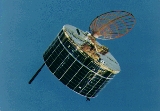
Sakigake

Encyclopedia
Sakigake pre-launch codename MS-T5, was Japan's
first interplanetary spacecraft, and the first deep space probe to be launched by any country other than the USA or the Soviet Union. It aimed to demonstrate the performance of the new launch vehicle, test the schemes of the first escape from the Earth
gravitation
for Japan
on engineering
basis, observing space plasma
and magnetic field
in interplanetary space
. Sakigake was also supposed to get references for scientists. Early measurements would be used to improve the mission of the Suisei probe
several months later.
Sakigake developed by the Institute of Space and Astronautical Science
for the National Space Development Agency (both of which are now part of the Japanese Aerospace Exploration Agency, or JAXA). It became a part of the Halley Armada
together with Suisei, the Soviet
/French
Vega
probes, the ESA
Giotto
and the NASA International Cometary Explorer
, to explore Halley's Comet during its 1986 sojourn through the inner solar system.
, it carried no imaging instruments in its instrument
payload.
by M-3SII-1
launch vehicle.
.
to go on to an encounter with 21P/Giacobini-Zinner
in 1998 but they had to be abandoned due to lack of propellant
.
Japan
Japan is an island nation in East Asia. Located in the Pacific Ocean, it lies to the east of the Sea of Japan, China, North Korea, South Korea and Russia, stretching from the Sea of Okhotsk in the north to the East China Sea and Taiwan in the south...
first interplanetary spacecraft, and the first deep space probe to be launched by any country other than the USA or the Soviet Union. It aimed to demonstrate the performance of the new launch vehicle, test the schemes of the first escape from the Earth
Earth
Earth is the third planet from the Sun, and the densest and fifth-largest of the eight planets in the Solar System. It is also the largest of the Solar System's four terrestrial planets...
gravitation
Gravitation
Gravitation, or gravity, is a natural phenomenon by which physical bodies attract with a force proportional to their mass. Gravitation is most familiar as the agent that gives weight to objects with mass and causes them to fall to the ground when dropped...
for Japan
Japan
Japan is an island nation in East Asia. Located in the Pacific Ocean, it lies to the east of the Sea of Japan, China, North Korea, South Korea and Russia, stretching from the Sea of Okhotsk in the north to the East China Sea and Taiwan in the south...
on engineering
Engineering
Engineering is the discipline, art, skill and profession of acquiring and applying scientific, mathematical, economic, social, and practical knowledge, in order to design and build structures, machines, devices, systems, materials and processes that safely realize improvements to the lives of...
basis, observing space plasma
Plasma (physics)
In physics and chemistry, plasma is a state of matter similar to gas in which a certain portion of the particles are ionized. Heating a gas may ionize its molecules or atoms , thus turning it into a plasma, which contains charged particles: positive ions and negative electrons or ions...
and magnetic field
Magnetic field
A magnetic field is a mathematical description of the magnetic influence of electric currents and magnetic materials. The magnetic field at any given point is specified by both a direction and a magnitude ; as such it is a vector field.Technically, a magnetic field is a pseudo vector;...
in interplanetary space
Space
Space is the boundless, three-dimensional extent in which objects and events occur and have relative position and direction. Physical space is often conceived in three linear dimensions, although modern physicists usually consider it, with time, to be part of a boundless four-dimensional continuum...
. Sakigake was also supposed to get references for scientists. Early measurements would be used to improve the mission of the Suisei probe
Suisei probe
Suisei , originally known as Planet-A, was an unmanned space probe developed by the Institute of Space and Astronautical Science ....
several months later.
Sakigake developed by the Institute of Space and Astronautical Science
Institute of Space and Astronautical Science
is a Japanese national research organization of astrophysics using rockets, astronomical satellites and interplanetary probes. It is a division of Japan Aerospace Exploration Agency .- History :...
for the National Space Development Agency (both of which are now part of the Japanese Aerospace Exploration Agency, or JAXA). It became a part of the Halley Armada
Halley Armada
The Halley Armada is the generally accepted and popularly used name of five space probes sent to examine Halley's Comet during its 1986 sojourn through the inner solar system, connected with apparition "1P/1982 U1"...
together with Suisei, the Soviet
Soviet Union
The Soviet Union , officially the Union of Soviet Socialist Republics , was a constitutionally socialist state that existed in Eurasia between 1922 and 1991....
/French
France
The French Republic , The French Republic , The French Republic , (commonly known as France , is a unitary semi-presidential republic in Western Europe with several overseas territories and islands located on other continents and in the Indian, Pacific, and Atlantic oceans. Metropolitan France...
Vega
Vega program
The Vega program was a series of Venus missions which also took advantage of the appearance of Comet Halley in 1986. Vega 1 and Vega 2 were unmanned spacecraft launched in a cooperative effort among the Soviet Union and Austria, Bulgaria, Hungary, the German Democratic Republic, Poland,...
probes, the ESA
European Space Agency
The European Space Agency , established in 1975, is an intergovernmental organisation dedicated to the exploration of space, currently with 18 member states...
Giotto
Giotto mission
Giotto was a European robotic spacecraft mission from the European Space Agency, intended to fly by and study Halley's Comet. On 13 March 1986, the mission succeeded in approaching Halley's nucleus at a distance of 596 kilometers....
and the NASA International Cometary Explorer
International Cometary Explorer
The International Cometary Explorer spacecraft was originally known as International Sun/Earth Explorer 3 satellite, launched August 12, 1978. It was part of the ISEE international cooperative program between NASA and ESRO/ESA to study the interaction between the Earth's magnetic field and the...
, to explore Halley's Comet during its 1986 sojourn through the inner solar system.
Design
Unlike its twin SuiseiSuisei probe
Suisei , originally known as Planet-A, was an unmanned space probe developed by the Institute of Space and Astronautical Science ....
, it carried no imaging instruments in its instrument
Measuring instrument
In the physical sciences, quality assurance, and engineering, measurement is the activity of obtaining and comparing physical quantities of real-world objects and events. Established standard objects and events are used as units, and the process of measurement gives a number relating the item...
payload.
Launch
Sakigake was launched January 7, 1985 from Kagoshima Space CenterUchinoura Space Center
The is a space launch facility close to the Japanese town of Kimotsuki, in Kagoshima Prefecture. Before the establishment of the JAXA space agency in 2003, it was simply called the . All Japan's scientific satellites were launched from Uchinoura prior to the M-V launch vehicles being decommissioned...
by M-3SII-1
Mu (rocket)
The Mu, also known as M, was a series of Japanese solid-fuelled carrier rockets, which were launched from Uchinoura between 1966 and 2006...
launch vehicle.
Halley encounter
It carried out a flyby of Halley's Comet on March 11, 1986 at a distance of 6.99 million km1 E9 m
To help compare different distances this page lists lengths starting at 109 metres .Distances shorter than 109 metres* 1.4 Gm — Diameter of Sun...
.
Giacobini-Zinner encounter
There were plans for the spacecraftSpacecraft
A spacecraft or spaceship is a craft or machine designed for spaceflight. Spacecraft are used for a variety of purposes, including communications, earth observation, meteorology, navigation, planetary exploration and transportation of humans and cargo....
to go on to an encounter with 21P/Giacobini-Zinner
21P/Giacobini-Zinner
Comet Giacobini–Zinner is a periodic comet in our solar system.It was discovered by Michel Giacobini from , who observed the comet in the constellation of Aquarius on December 20, 1900...
in 1998 but they had to be abandoned due to lack of propellant
Propellant
A propellant is a material that produces pressurized gas that:* can be directed through a nozzle, thereby producing thrust ;...
.