
All Topics  
Pluto


Pluto


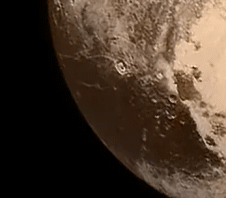
Pluto (pronounced
Like other members of the Kuiper beltKuiper belt Overview

The Kuiper belt is an area of the solar system extending from the orbit of Neptune to 50 AU from the Sun....
, Pluto is composed primarily of rock and ice and is relatively small: approximately a fifth the mass of the EarthEarth

Earth is the third planet in the solar system in terms of distance from the Sun, and the fifth largest....
's moonMoon

The Moon is Earth's only natural satellite....
 and a third its volume. It has a highly eccentricOrbital eccentricity

In astrodynamics, under standard assumptions any orbit must be of conic section shape....
 and highly inclined orbit.

Pluto's eccentricity takes it from 30 to 49 AUAstronomical unit

The astronomical unit is a unit of length....
 (4.4–7.4 billion km) from the Sun, causing Pluto to occasionally come closer to the Sun than Neptune. Pluto and its largest moon, CharonCharon (moon)

Charon|-| bgcolor="#000000" colspan="2" align="center"| br /> Artist's concept of Charon seen from the surface of Pluto....
, are often treated together as a binary systemBinary system (astronomy)

A binary system is an astronomic term referring to two objects in space which are so close that their gravitational interact...
 because the barycentreCenter of mass

In physics, the center of mass of a system of particles is a specific point at which, for many purposes, the system's mass b...
 of their orbits does not lie within either body. The International Astronomical UnionInternational Astronomical Union

The International Astronomical Union unites national astronomical societies from around the world....
 (IAU) has yet to formalise a definition for binary dwarf planets, and until it passes such a ruling, Charon is classified as a moonNatural satellite

A natural satellite is a non-man-made object that orbits a planet or other body larger than itself....
 of Pluto.


Discussion
Ask a question about 'Pluto'
Start a new discussion about 'Pluto'
Answer questions from other users
Full Discussion Forum


Recent Posts


Timeline

1483   Orbital calculations suggest that on this day Pluto moved inside Neptune's orbit until July 23, 1503.

1503   Orbital calculations suggest that on this day Pluto moved outside Neptune's orbit, remaining there for 233 years.

1618   Pluto reached, according to sophisticated mathematical calculations, its second most recent aphelion. The next one occurred in 1866, and the following one will occur in ''2113''.

1735   Mathematical calculations suggest it was on this day that Pluto moved closer to the Sun than Neptune for the last time before 1979.

1866   Calculations indicate Pluto reached its most recent aphelion (furthest point from Sun) on this day. The next aphelion will occur in ''August 2113''.

1979   Pluto moves inside Neptune's orbit for the first time since either was known to scien

1999   Pluto, a dwarf planet with an eccentric orbit, moves further from the Sun than Neptune. It had been nearer than Neptune since 1979, and will become again in ''2231''.


Encyclopedia


Pluto (pronounced
Like other members of the Kuiper beltKuiper belt Overview

The Kuiper belt is an area of the solar system extending from the orbit of Neptune to 50 AU from the Sun....
, Pluto is composed primarily of rock and ice and is relatively small: approximately a fifth the mass of the EarthEarth

Earth is the third planet in the solar system in terms of distance from the Sun, and the fifth largest....
's moonMoon

The Moon is Earth's only natural satellite....
 and a third its volume. It has a highly eccentricOrbital eccentricity

In astrodynamics, under standard assumptions any orbit must be of conic section shape....
 and highly inclined orbit.

Pluto's eccentricity takes it from 30 to 49 AUAstronomical unit

The astronomical unit is a unit of length....
 (4.4–7.4 billion km) from the Sun, causing Pluto to occasionally come closer to the Sun than Neptune. Pluto and its largest moon, CharonCharon (moon)

Charon|-| bgcolor="#000000" colspan="2" align="center"| br /> Artist's concept of Charon seen from the surface of Pluto....
, are often treated together as a binary systemBinary system (astronomy)

A binary system is an astronomic term referring to two objects in space which are so close that their gravitational interact...
 because the barycentreCenter of mass

In physics, the center of mass of a system of particles is a specific point at which, for many purposes, the system's mass b...
 of their orbits does not lie within either body. The International Astronomical UnionInternational Astronomical Union

The International Astronomical Union unites national astronomical societies from around the world....
 (IAU) has yet to formalise a definition for binary dwarf planets, and until it passes such a ruling, Charon is classified as a moonNatural satellite

A natural satellite is a non-man-made object that orbits a planet or other body larger than itself....
 of Pluto. Pluto has two known smaller moons, NixNix (moon)

Nix ' is a natural satellite of Pluto....
 and HydraHydra (moon)

Hydra is a natural satellite of Pluto....
, discovered in 2005.

From its discovery in 1930 until 2006, Pluto was counted as the Solar System's ninth planet. In the late 20th and early 21st centuries, however, many objects similar to Pluto were discovered in the outer solar system, notably the scattered disc objectScattered disc

The scattered disc is a distant region of our solar system, thinly populated by icy planetoids known as scattered disc ob...
 Eris, which is 27% more massive than Pluto. On August 24, 2006 the IAU defined the term "planet" for the first time. This definition excluded Pluto, which the IAU reclassified as a member of the new category of dwarf planets along with ErisFacts About Eris (dwarf planet)

Eris, officially designated 136199 Eris, is the largest known dwarf planet in the solar system....
 and Ceres. After the reclassification, Pluto was added to the list of minor planetMinor planet

Minor planets, or asteroids or planetoids, are minor celestial bodies of the Solar system orbiting the Sun that...
s and given the numberAstronomical naming conventions

In ancient times, only the Sun and Moon, a few hundred stars and the most easily visible planets had names....
 134340.

Discovery


In the 1840s, using Newtonian mechanics, Urbain Le VerrierUrbain Le Verrier Overview

Urbain Jean Joseph Le Verrier was a French mathematician who specialized in celestial mechanics....
  predicted the position of the then-undiscovered planet NeptuneNeptune

Neptune is the eighth and outermost planet in our solar system....
 after analysing perturbations in the orbit of UranusUranus

Uranus is the seventh planet from the Sun....
. Subsequent observations of Neptune in the late 19th century caused astronomers to speculate that Uranus' orbit was being disturbed by another planet in addition to Neptune. In 1906, Percival LowellPercival Lowell

Percival Lowell was an author, mathematician, and esteemed astronomer who fueled speculation that there were canals on Mars...
, a wealthy Bostonian who had founded the Lowell ObservatoryLowell Observatory

Lowell Observatory is an astronomical observatory in Flagstaff, Arizona....
 in Flagstaff, ArizonaFlagstaff, Arizona

Flagstaff is a city located in northern Arizona, in the southwestern United States....
 in 1894, started an extensive project in search of a possible ninth planet, which he termed "Planet XFacts About Planet X

Planet X is a large hypothetical planet with an orbit beyond that of Neptune....
". By 1909, Lowell and William H. PickeringWilliam Henry Pickering

William Henry Pickering was an American astronomer, brother of Edward Charles Pickering....
 had suggested several possible celestial coordinates for such a planet. Lowell and his observatory conducted his search until his death in 1916, but to no avail. Unbeknownst to Lowell, on March 19, 1915, his observatory would capture two faint images of Pluto, but would not recognise them for what they were.

Due to a ten-year legal battle with Constance Lowell, Percival's widow, who attempted to wrest the observatory's million-dollar portion of his legacy for herself, the search for Planet X did not resume until 1929, when its director, Vesto Melvin Slipher, summarily handed the job of locating Planet X to Clyde TombaughClyde Tombaugh

Clyde William Tombaugh was an American astronomer who discovered the dwarf planet Pluto in 1930....
, a 23-year-old Kansas man who had just arrived at the Lowell Observatory after Slipher had been impressed by a sample of his astronomical drawings.

Tombaugh's task was systematically to image the night sky in pairs of photographs taken two weeks apart, then examine each pair and determine whether any objects had shifted position. Using a machine called a blink comparatorBlink comparator

A blink comparator was a viewing apparatus used by astronomers to find differences between photographic plates taken of the ...
, he rapidly shifted back and forth between views of each of the plates, to create the illusion of movement of any objects that had changed position or appearance between photographs. On February 18, 1930, after nearly a year of searching, Tombaugh discovered a possible moving object on photographic plates taken on January 23 and January 29 of that year. A lesser-quality photograph taken on January 21 helped confirm the movement. After the observatory obtained further confirmatory photographs, news of the discovery was telegraphed to the Harvard College ObservatoryFacts About Harvard College Observatory

The Harvard College Observatory is an institution managing a complex of buildings and multiple instruments used for astronom...
 on March 13, 1930.

Naming


The right to name the new object belonged to the Lowell Observatory. Tombaugh urged Slipher to suggest a name for the new object quickly before someone else did. Name suggestions poured in from all over the world. Constance Lowell proposed ZeusZeus Overview

In Greek mythology, Zeus is the highest ranking god among the Olympian gods, the ruler of Mount Olympus, and god of the sky...
,
then Lowell, and finally her own first name. These suggestions were disregarded.

The name Pluto was first suggested by Venetia BurneyVenetia Phair

...
 (later Venetia Phair), an eleven-year-old schoolgirl in Oxford, EnglandEngland

England is the largest and most populous constituent country of the United Kingdom....
. Venetia was interested in classical mythologyClassical mythology

Classical or Greco-Roman mythology usually refers to the mythology, and the associated polytheistic rituals and practi...
 as well as astronomy, and considered the name, one of the alternate names of HadesHades

Hades refers to both the ancient Greek Underworld and the God of the Dead....
, the Greek god of the Underworld, appropriate for such a presumably dark and cold world. She suggested it in a conversation with her grandfather Falconer MadanFalconer Madan

Falconer Madan was Librarian of the Bodleian Library of Oxford University....
, a former librarian of Oxford University's Bodleian LibraryBodleian Library

The Bodleian Library, the main research library of the University of Oxford, is one of the oldest libraries in Europe, and i...
. Madan passed the name to Professor Herbert Hall TurnerHerbert Hall Turner

Herbert Hall Turner was a British astronomer and seismologist....
, who then cabled it to colleagues in America.

The object was officially named on March 24, 1930. Each member of the Lowell Observatory was allowed to vote on a short-list of three: "MinervaMinerva

Minerva was a Roman goddess of crafts and wisdom....
" (which was already the name for an asteroid), "CronusCronus

Cronus , also called Cronos or Kronos, was the leader and the youngest of the first generation of Titans, divine...
" (which had garnered a bad reputation after being suggested by an unpopular astronomer named Thomas Jefferson Jackson SeeThomas Jefferson Jackson See

Thomas Jefferson Jackson See,. An American Astronomer, who received his Ph.D....
), and Pluto. Pluto received every vote. The name was announced on May 1, 1930. Upon the announcement, Madan gave Venetia five poundsPound sterling

The pound, divided into 100 pence, is the official currency of the United Kingdom and the Crown Dependencies....
 as a reward.

The name Pluto was intended to evoke the initials of the astronomer Percival LowellPercival Lowell Overview

Percival Lowell was an author, mathematician, and esteemed astronomer who fueled speculation that there were canals on Mars...
, a desire echoed in the P-L monogramMonogram

A monogram is a motif made by overlapping or combining two or more letters or other graphemes to form one symbol....
 that is Pluto's astronomical symbol.
Pluto's astrological symbol resembles that of NeptuneNeptune

Neptune is the eighth and outermost planet in our solar system....
, but has a circle in place of the middle prong of the trident.

In ChineseChinese language

Chinese is a language that forms part of the Sino-Tibetan family of languages....
, JapaneseJapanese language

Japanese is a language spoken by over 127 million people, mainly in Japan, but also by Japanese emigrant communities around...
, KoreanKorean language

The Korean language is the official language of both North and South Korea....
 and VietnameseFacts About Vietnamese language

Vietnamese , formerly known under the French colonization as Annamese , is the national and official language of Vietn...
, the name was translated as underworld king star (???), as suggested by Houei NojiriHouei Nojiri

Houei Nojiri was a Japanese essayist and astronomer....
 in 1930. Many other non-European languages use a transliteration of "Pluto" as their name for the object; however, some Indian languages may use a form of YamaYama (Buddhism and Chinese mythology)

This article is about the deity Yama in Buddhism and Chinese mythology....
, the Guardian of Hell in HinduHindu

A Hindu , as per modern definition, is an adherent of the philosophies and scriptures of Hinduism, the religious, phi...
 mythology, such as the GujaratiGujarati language

Gujarati is an Indo-Aryan language, part of the greater Indo-European language family....
 Yamdev.

Demise of Planet X

Once found, Pluto's faintness and lack of a resolvable disc cast doubt on the idea that it could be Lowell's Planet X. Throughout the mid-20th century, estimates of Pluto's mass were often revised downward. In 1978, the discovery of Pluto's moon CharonCharon (moon)

Charon|-| bgcolor="#000000" colspan="2" align="center"| br /> Artist's concept of Charon seen from the surface of Pluto....
 allowed the measurement of Pluto's mass for the first time. Its mass, roughly 0.2 percent that of the Earth, was far too small to account for the discrepancies in Uranus. Subsequent searches for an alternate Planet X, notably by Robert HarringtonRobert Harrington

There are a number of people named Robert Harrington, including two astronomers:...
, failed. In 1993, Myles Standish used data from Voyager 2Voyager 2

Voyager 2 is an unmanned interplanetary spacecraft....
s 1989 flyby of NeptuneNeptune Summary

Neptune is the eighth and outermost planet in our solar system....
, which had revised the planet's total mass downward by 0.5 percent, to recalculate its gravitational effect on Uranus. With the new figures added in, the discrepancies, and with them the need for a Planet X, vanished. Today the overwhelming consensus among astronomers is that Planet X, as Lowell defined it, does not exist. Lowell had made a prediction of Planet X's position in 1915 that was fairly close to Pluto's actual position at that time; however, Ernest W. Brown concluded almost immediately that this was a coincidence, a view still held today.

Physical characteristics


Pluto's distance from Earth makes in-depth investigation difficult. Many details about Pluto will remain unknown until 2015, when the New HorizonsNew Horizons

New Horizons is a NASA unmanned mission to fly by Pluto and its moons....
 spacecraft is expected to arrive there.

Appearance and composition

Pluto's apparent magnitudeApparent magnitude

The apparent magnitude of a star, planet or other celestial body is a measure of its apparent brightness as seen by an obse...
 averages 15.1, brightening to 13.65 at perihelion. To see it, a telescope is required; around 30 cm (12 in) aperture being desirable. It looks indistinct and star-like even in very large telescopes because its angular diameterAngular diameter

The angular diameter of an object as seen from a given position is the diameter measured as an angle....
 is only 0.11". It is light brown with a very slight tint of yellow.

Spectroscopic analysis of Pluto's surface reveals it to be composed of more than 98 percent nitrogenNitrogen

Nitrogen is a chemical element which has the symbol N and atomic number 7 in the periodic table....
 ice, with traces of methane and carbon monoxide. Distance and current limits on telescope technology make it impossible to directly photograph surface details on Pluto. Images from the Hubble Space TelescopeHubble Space Telescope

The Hubble Space Telescope is a telescope in orbit around the Earth....
 barely show any distinguishable surface definitions or markings.

The best images of Pluto derive from brightness maps created from close observations of eclipses by its largest moon, Charon. Using computer processing, observations are made in brightness factors as Pluto is eclipsed by Charon. For example, eclipsing a bright spot on Pluto makes a bigger total brightness change than eclipsing a dark spot. Using this technique, one can measure the total average brightness of the Pluto-Charon system and track changes in brightness over time. Maps composed by the Hubble Space TelescopeHubble Space Telescope

The Hubble Space Telescope is a telescope in orbit around the Earth....
 reveal that Pluto's surface is remarkably heterogeneousHeterogeneous

Heterogeneous means that something consists of a diverse range of different items....
, a fact also evidenced by its lightcurve and by periodic variations in its infrared spectra. The face of Pluto oriented toward Charon contains more methaneMethane

The simplest hydrocarbon, methane, is a gas with a chemical formula of CH4....
 ice, while the opposite face contains more nitrogenNitrogen

Nitrogen is a chemical element which has the symbol N and atomic number 7 in the periodic table....
 and carbon monoxideCarbon monoxide

Carbon monoxide, with the chemical formula CO, is a colourless, odourless, and tasteless gas....
 ice. This makes Pluto the second most contrasted body in the Solar System after IapetusIapetus (moon)

Iapetus, sometimes spelled Japetus, is the third-largest moon of Saturn, discovered by Giovanni Domenico Cassini in 16...
.

The Hubble Space TelescopeHubble Space Telescope Overview

The Hubble Space Telescope is a telescope in orbit around the Earth....
 places Pluto's density at between 1.8 and 2.1 g/cm³, suggesting its internal composition consists of roughly 50–70 percent rock and 30–50 percent ice. Because decay of radioactive minerals would eventually heat the ices enough for them to separate from rock, scientists expect that Pluto's internal structure is differentiated, with the rocky material having settled into a dense core surrounded by a mantleMantle (geology)

Earth's mantle is the thick shell of dense rock surrounding the liquid metallic Earth's outer core, and lies directly beneat...
 of ice. It is also possible that such heating may continue today, creating a subsurface ocean of liquid water.

Mass and size


Astronomers, assuming Pluto to be Lowell's Planet X, initially calculated its mass on the basis of its presumed effect on Neptune and Uranus. In 1955 Pluto was calculated to be roughly the mass of the Earth, with further calculations in 1971 bringing the mass down to roughly that of Mars. However, in 1976, Dale Cruikshank, Carl Pilcher and David Morrison of the University of HawaiiUniversity of Hawaii

The University of Hawaii, formally the University of Hawaii System and popularly known as UH, is a public, co-ed...
 calculated Pluto's albedoAlbedo

Albedo is a ratio of scattered to incident electromagnetic radiation power, most commonly light....
 for the first time, finding that it matched that for methaneMethane

The simplest hydrocarbon, methane, is a gas with a chemical formula of CH4....
 ice; this meant Pluto had to be exceptionally luminous for its size and therefore could not be more than 1 percent the mass of the Earth.

The discovery of Pluto's satellite CharonCharon (moon)

Charon|-| bgcolor="#000000" colspan="2" align="center"| br /> Artist's concept of Charon seen from the surface of Pluto....
 in 1978 enabled a determination of the mass of the Pluto–Charon system by application of Newton's formulation of Kepler's third lawKepler's laws of planetary motion

Johannes Kepler's primary contributions to astronomy/astrophysics were his three laws of planetary motion....
. Once Charon's gravitational effect on Pluto was measured, estimates of Pluto's mass fell to 1.31×10²² kg—less than 0.24 percent that of the Earth. Observations of Pluto in occultation with Charon were able to fix Pluto's diameter at roughly 2,390 km. With the invention of adaptive opticsAdaptive optics

Adaptive optics is a technology to improve the performance of optical systems by reducing the effects of rapidly changing op...
 astronomers were able to determine its shape accurately.

Among the objects of the Solar System, Pluto is not only smaller and much less massive than any planet, but at less than 0.2 lunar masses it is also smaller than seven of the moonNatural satellite

A natural satellite is a non-man-made object that orbits a planet or other body larger than itself....
s: GanymedeGanymede (moon)

|-! bgcolor="#a0ffa0" colspan="2" | Atmospheric characteristics...
, TitanTitan (moon)

|-! bgcolor="#FFA812" colspan="2" | Atmospheric characteristics...
, CallistoCallisto (moon)

|-! bgcolor="#a0ffa0" colspan="2" | Atmospheric characteristics...
, IoIo (moon)

|-! bgcolor="#a0ffa0" colspan="2" | Atmospheric characteristics...
, Earth's MoonMoon

The Moon is Earth's only natural satellite....
, EuropaEuropa (moon)

|-! bgcolor="#a0ffa0" colspan="2" | Atmospheric characteristics...
 and TritonTriton (moon)

Triton , or Neptune I, is the planet Neptune's largest moon....
. Pluto is more than twice the diameter and a dozen times the mass of the dwarf planetDwarf planet

A dwarf planet is a category of celestial bodies in the solar system as introduced in a resolution by the International Astr...
 Ceres, the largest object in the asteroid beltAsteroid belt

The asteroid belt is a region of the solar system falling roughly between the planets Mars and Jupiter where the greatest co...
. However, it is smaller than the dwarf planet ErisEris (dwarf planet)

Eris, officially designated 136199 Eris, is the largest known dwarf planet in the solar system....
, a trans-Neptunian objectTrans-Neptunian object

A trans-Neptunian object is any object in the solar system that orbits the sun at a greater distance on average than Neptun...
 discovered in 2005.

Atmosphere


Pluto's atmosphere consists of a thin envelope of nitrogenNitrogen

Nitrogen is a chemical element which has the symbol N and atomic number 7 in the periodic table....
, methaneMethane

The simplest hydrocarbon, methane, is a gas with a chemical formula of CH4....
, and carbon monoxideCarbon monoxide

Carbon monoxide, with the chemical formula CO, is a colourless, odourless, and tasteless gas....
, derived from the ices on its surface. As Pluto moves away from the Sun, its atmosphereFacts About Atmosphere

Atmosphere is the general name for a layer of gases that may surround a material body of sufficient mass....
 gradually freezes and falls to the ground. As it edges closer to the Sun, the temperature of Pluto's solid surface increases, causing the ices to sublimateSublimation (physics)

Sublimation of an element or substance is a conversion between the solid and the gas phases with no intermediate liquid stag...
 into gas. This creates an anti-greenhouse effectAnti-Greenhouse Effect

The Anti-Greenhouse Effect is a neologism used to describe two different effects, coming under the header of "the cooling ef...
; much like sweatSWEAT

SWEAT is an OLN/TSN show hosted by Julie Zwillich that aired in 2003-2004....
 cools the body as it evaporates from the surface of the skin, this sublimation has a cooling effect on the surface of Pluto. Scientists have recently discovered, by use of the Submillimeter ArraySubmillimeter Array

The Submillimeter Array consists of eight 6 m diameter radio telescopes arranged as an interferometer for submillimeter wave...
, that Pluto's temperature is 43 kelvinKelvin

The Kelvin scale is a temperature scale where absolute zero—the coldest possible temperature where there is no heat en...
s, 10 K colder than expected.

Pluto was found to have an atmosphere from an occultationOccultation

An occultation is an astronomical event that occurs when one celestial object is hidden by another celestial object that pas...
 observation in 1985; the finding was confirmed and significantly strengthened by extensive observations of another occultation in 1988. When an object with no atmosphere occults a star, the star abruptly disappears; in the case of Pluto, the star dimmed out gradually. From the rate of dimming, the atmospheric pressure was determined to be 0.15 pascalPascal (unit)

The pascal is the SI derived unit of pressure or stress ....
, roughly 1/700,000 that of Earth.

In 2002, another occultation of a star by Pluto was observed and analysed by teams led by Bruno Sicardy of the Paris ObservatoryParis Observatory

The Paris Observatory is the foremost astronomical observatory of France, and one of the largest astronomical centers in the...
, James L. ElliotJames L. Elliot

James L. Elliot is a Professor of Physics; Professor of Earth, Atmospheric, and Planetary Sciences; and the Director, George...
 of MIT, and Jay PasachoffJay Pasachoff

Jay Myron Pasachoff is an American astronomer....
 of Williams CollegeWilliams College Summary

Williams College is a private, coeducational, highly selective liberal arts college located in Williamstown, Massachusetts....
. The atmospheric pressure was estimated to be 0.3 pascal, even though Pluto was farther from the Sun than in 1988 and thus should have been colder and had a more rarefied atmosphere. One explanation for the discrepancy is that in 1987 the south pole of Pluto came out of shadow for the first time in 120 years, causing extra nitrogen to sublimate from the polar cap. It will take decades for the excess nitrogen to condense out of the atmosphere. Another stellar occultation was observed by the MIT-Williams College team of James Elliot, Jay PasachoffJay Pasachoff

Jay Myron Pasachoff is an American astronomer....
, and a Southwest Research InstituteSouthwest Research Institute

Southwest Research Institute, headquartered in San Antonio, Texas, is one of the oldest and largest independent, nonprofit, ...
 team led by Leslie Young on 12 June, 2006 from sites in Australia.

In October 2006, Dale Cruikshank of NASA/Ames Research Center (a New Horizons co-investigator) and his colleagues announced the spectroscopic discovery of ethaneEthane

Ethane is a chemical compound with chemical formula C2H6....
 on Pluto's surface. This ethane is produced from the photolysis or radiolysis (i.e., the chemical conversion driven by sunlight and charged particles) of frozen methane on Pluto's surface and suspended in its atmosphere.

Orbit


Pluto's orbit is markedly different from those of the planets. The planets all orbit the Sun close to a flat reference planePlane (mathematics)

In mathematics, a plane is a fundamental two-dimensional object....
 called the eclipticEcliptic

The ecliptic is the apparent path the Sun traces out along the sky — independent of Earth's rotation — in the co...
 and have nearly circular orbits. In contrast, Pluto's orbit is highly inclined relative to the ecliptic (over 17°) and highly eccentricOrbital eccentricity

In astrodynamics, under standard assumptions any orbit must be of conic section shape....
. This high eccentricity leads to a small region of Pluto's orbit lying closer to the Sun than NeptuneNeptune

Neptune is the eighth and outermost planet in our solar system....
's. Pluto was last interior to Neptune's orbit between February 7, 1979 and February 11, 1999. Detailed calculations indicate that the previous such occurrence lasted only fourteen years, from July 11, 1735 to September 15, 1749, whereas between April 30, 1483 and July 23, 1503, it had also lasted 20 years.

Although this repeating pattern may suggest a regular structure, in the long term Pluto's orbit is in fact chaoticChaos theory

In mathematics and physics, chaos theory describes the behavior of certain nonlinear dynamical systems that under certain co...
. While computer simulations can be used to predict its position for several million years (both forward and backwardTime reversibility Overview

Time reversibility is an attribute of some stochastic processes and some deterministic processes....
 in time), after intervals longer than the Lyapunov timeLyapunov time

In mathematics, the Lyapunov time is the length of time for a dynamical system to become chaotic....
 of 10–20 million years, it is impossible to determine exactly where Pluto will be because its position becomes too sensitive to unmeasurably small details of the present state of the solar system. For example, at any specific time many millions of years from now, Pluto may be at aphelion or perihelion (or anywhere in between), with no way for us to predict which. This does not mean that the orbit of Pluto itself is unstable, however, only that its position along that orbit is impossible to determine far into the future. In fact, several resonances and other dynamical effects conspire to keep Pluto's orbit stable, safe from planetary collision or scattering.

Neptune-avoiding orbit


Despite Pluto's orbit apparently crossing that of Neptune when viewed from directly above the eclipticEcliptic Overview

The ecliptic is the apparent path the Sun traces out along the sky — independent of Earth's rotation — in the co...
, the two objects cannot collide. This is because their orbits are aligned so that Pluto and Neptune can never approach closely. Several factors contribute to this.

At the simplest level, one can examine the two orbits and see that they do not intersect. When Pluto is closest to the Sun, and hence closest to Neptune's orbit as viewed in a top-down projection, it is also the farthest above the ecliptic. This means Pluto's orbit actually passes above that of Neptune, preventing a collision. Indeed, the part of Pluto's orbit that lies as close or closer to the Sun than that of Neptune lies about 8 AUAstronomical unit Overview

The astronomical unit is a unit of length....
 above the ecliptic, and so a similar distance above Neptune's orbit. Pluto's ascending nodeOrbital node

An orbital node is one of the two points where an inclined orbit crosses a plane of reference....
, the point at which the orbit crosses the ecliptic, is currently separated from Neptune's by over 21°; their descending nodes are separated by a similar angular distance (see diagram). Since Neptune's orbit is almost flat with respect to the ecliptic, Pluto is far above it by the time the two orbits cross.

This alone is not enough to protect Pluto; perturbationsPerturbation (astronomy)

Perturbation is a term used in astronomy to describe alterations to an object's orbit caused by gravitational interactions w...
 (e.g., orbital precessionPrecession

Precession refers to a change in the direction of the axis of a rotating object....
) from the planets, particularly Neptune, would adjust Pluto's orbit, so that over millions of years a collision could be possible. Some other mechanism or mechanisms must therefore be at work. The most significant of these is a mean motion resonanceFacts About Orbital resonance

In celestial mechanics, an orbital resonance occurs when two orbiting bodies exert a regular, periodic gravitational influen...
 with Neptune.


Pluto lies in the 3:2 mean motion resonance of NeptuneNeptune

Neptune is the eighth and outermost planet in our solar system....
: for every three orbits of Neptune around the Sun, Pluto makes two. The two objects then return to their initial positions and the cycle repeats, each cycle lasting about 500 years. This pattern is configured so that, in each 500-year cycle, the first time Pluto is near perihelion Neptune is over 50° behind Pluto. By Pluto's second perihelion, Neptune will have completed a further one and a half of its own orbits, and so will be a similar distance ahead of Pluto. In fact, the minimum separation of Pluto and Neptune is over 17 AU; Pluto actually comes closer (11 AU) to UranusUranus

Uranus is the seventh planet from the Sun....
 than it does to Neptune.

The 3:2 resonance between the two bodies is highly stable, and is preserved over millions of years. This prevents their orbits from changing relative to one another — the cycle always repeats in the same way — and so the two bodies can never pass near to each other. Thus, even if Pluto's orbit were not highly inclined the two bodies could never collide.

Other factors governing Pluto's orbit


Numerical studies have shown that over periods of millions of years, the general nature of the alignment between Pluto's and Neptune's orbits does not change. However, there are several other resonances and interactions that govern the details of their relative motion, and enhance Pluto's stability. These arise principally from two additional mechanisms (in addition to the 3:2 mean motion resonance).

First, Pluto's argument of perihelion, the angle between the point where it crosses the ecliptic and the point where it is closest to the Sun, libratesLibration

In astronomy a libration is a very slow oscillation, real or apparent, of a satellite as viewed from the larger celestial bo...
 around 90°. This means that when Pluto is nearest the Sun, it is at its farthest above the plane of the solar system, preventing encounters with Neptune. This is a direct consequence of the Kozai mechanismKozai mechanism

In celestial mechanics, the Kozai mechanism is a secular perturbative effect resulting in the periodic sychronised changes ...
, which relates the eccentricity of an orbit to its inclination, relative to a larger perturbing body — in this case Neptune. Relative to Neptune, the amplitude of libration is 38°, and so the angular separation of Pluto's perihelion to the orbit of Neptune is always greater than 52° (= 90°–38°). The closest such angular separation occurs every 10,000 years.

Second, the longitudes of ascending node of the two bodies — the points where they cross the ecliptic - are in near-resonance with the above libration. When the two longitudes are the same — that is, when one could draw a straight line through both nodes and the Sun — Pluto's perihelion lies exactly at 90°, and it comes closest to the Sun at its peak above Neptune's orbit. In other words, when Pluto most closely intersects the plane of Neptune's orbit, it must be at its farthest beyond it. This is known as the 1:1 superresonance.

To understand the nature of the libration, imagine a polar point of view, looking down on the ecliptic from a distant vantage point where the planets orbit counter-clockwise. After passing the ascending node, Pluto is interior to Neptune's orbit and moving faster, approaching Neptune from behind. The strong gravitational pull between the two causes angular momentumAngular momentum

In physics the angular momentum of an object with respect to a reference point is a measure for the extent to which, and the...
 to be transferred to Pluto, at Neptune's expense. This moves Pluto into a slightly larger orbit, where it travels slightly slower, in accordance with Kepler's third law. As its orbit changes, this has the gradual effect of changing the pericentre and longitudes of Pluto (and, to a lesser degree, of Neptune). After many such repetitions, Pluto is sufficiently slowed, and Neptune sufficiently speeded up, that Neptune begins to catch Pluto at the opposite side of its orbit (near the opposing node to where we began). The process is then reversed, and Pluto loses angular momentum to Neptune, until Pluto is sufficiently speeded up that it begins to catch Neptune once again at the original node. The whole process takes about 20,000 years to complete.

Moons


Pluto has three known natural satelliteNatural satellite

A natural satellite is a non-man-made object that orbits a planet or other body larger than itself....
s: CharonCharon (moon)

Charon|-| bgcolor="#000000" colspan="2" align="center"| br /> Artist's concept of Charon seen from the surface of Pluto....
, first identified in 1978 by astronomer James ChristyJames W. Christy

James Walter Christy is an American astronomer....
; and two smaller moons, NixNix (moon)

Nix ' is a natural satellite of Pluto....
 and HydraHydra (moon)

Hydra is a natural satellite of Pluto....
, both discovered in 2005.

The Plutonian moons are unusually close to Pluto, compared to other observed systems. Moons could potentially orbit Pluto up to 53% (or 69%, if retrograde) of the Hill sphereHill sphere

A Hill sphere approximates the gravitational sphere of influence of one astronomical body in the face of perturbations from ...
 radius, the stable gravitational zone of Pluto's influence. For example, PsamatheFacts About Psamathe (moon)

Psamathe or Neptune X, is a retrograde irregular satellite of Neptune....
 orbits Neptune at 40% of the Hill radius. In the case of Pluto, only the inner 3% of the zone is known to be occupied by satellites. In the discoverers’ terms, the Plutonian system appears to be "highly compact and largely empty."

Charon

The Pluto-Charon system is noteworthy for being the largest of the solar system's few binary systems, defined as those whose barycentreCenter of mass

In physics, the center of mass of a system of particles is a specific point at which, for many purposes, the system's mass b...
 lies above the primary's surface. This and the large size of Charon relative to Pluto has led some astronomers to call it a dwarf double planetDouble planet

A double planet is an informal term used to describe two planets that orbit each other about a common center of mass that i...
. The system is also unusual among planetary systems in that each is tidally lockedTidal locking

Tidal locking makes one side of an astronomical body always face another, like the Moon facing the Earth....
 to the other: Charon always presents the same face to Pluto, and Pluto always presents the same face to Charon. If one were standing on Pluto's near side, Charon would hover in the sky without moving; if one were to travel to the far side, one would never see Charon at all. In 2007, observations by the Gemini ObservatoryGemini Observatory

n>Gemini Observatory...
 of patches of ammonia hydrates and water crystals on the surface of Charon suggested the presence of active cryo-geysers.


Pluto and Charon, compared to Earth's Moon
Name

()
Diameter (km) Mass (kg) Orbital radius (km)
(barycentric)
Orbital period (d)
Pluto 2,306
(65% Moon)
(18% Moon) 2,040 (100)
(0.6% Moon)
6.3872
(25% Moon)
CharonCharon (moon)

Charon|-| bgcolor="#000000" colspan="2" align="center"| br /> Artist's concept of Charon seen from the surface of Pluto....
1,205
(35% Moon)
(2% Moon) 17,530 (90)
(5% Moon)


Nix and Hydra


Two additional moons of Pluto were imaged by astronomers working with the Hubble Space TelescopeHubble Space Telescope Summary

The Hubble Space Telescope is a telescope in orbit around the Earth....
 on May 15, 2005, and received provisional designationsProvisional designation in astronomy

Provisional designation in astronomy is the naming convention applied to astronomical objects immediately following their di...
 of S/2005 P 1 and S/2005 P 2. The International Astronomical Union officially named Pluto's newest moons NixNix (moon)

Nix ' is a natural satellite of Pluto....
 (or Pluto II, the inner of the two moons, formerly P 2) and HydraHydra (moon)

Hydra is a natural satellite of Pluto....
 (Pluto III, the outer moon, formerly P 1), on June 21, 2006.

These small moons orbit Pluto at approximately two and three times the distance of Charon: Nix at 48,700 kilometres and Hydra at 64,800 kilometres from the barycenter of the system. They have nearly circular prograde orbits in the same orbital plane as Charon, and are very close to (but not in) 4:1 and 6:1 mean motion orbital resonanceOrbital resonance

In celestial mechanics, an orbital resonance occurs when two orbiting bodies exert a regular, periodic gravitational influen...
s with Charon.

Observations of Nix and Hydra to determine individual characteristics are ongoing. Hydra is sometimes brighter than Nix, suggesting either that it is larger or that different parts of its surface may vary in brightness. Sizes are estimated from albedos. The moons' spectral similarity to Charon suggests a 35% albedo similar to Charon's; this value results in diameter estimates of 46 kilometres for Nix and 61 kilometres for the brighter Hydra. Upper limits on their diameters can be estimated by assuming the 4% albedo of the darkest Kuiper Belt objects; these bounds are 137 ± 11 km and 167 ± 10 km, respectively. At the larger end of this range, the inferred masses are less than 0.3% that of Charon, or 0.03% of Pluto's.

The discovery of the two small moons suggests that Pluto may possess a variable ring system. Small body impacts can create debris that can form into planetary rings. Data from a deep optical survey by the Advanced Camera for SurveysAdvanced Camera for Surveys

The Advanced Camera for Surveys is a third generation axial instrument aboard the Hubble Space Telescope....
 on the Hubble Space TelescopeHubble Space Telescope

The Hubble Space Telescope is a telescope in orbit around the Earth....
 suggest that no ring system is present. If such a system exists, it is either tenuous like the rings of JupiterRings of Jupiter Summary

FormationJupiter has a faint planetary ring system composed of smoke-like dust particles knocked off of its moons by meteor impa...
 or is tightly confined to less than 1,000 km in width.

In imaging the Plutonian system, observations from Hubble placed limits on any additional moons. With 90% confidence, no additional moons larger than 12 km (or a maximum of 37 km with an albedo of 0.041) exist beyond the glare of Pluto 5 arcseconds from the dwarf planet. This assumes a Charon-like albedo of 0.38; at a 50% confidence level the limit is 8 kilometres.

Kuiper belt


Pluto's origin and identity have long puzzled astronomers. In the 1950s it was suggested that Pluto was an escaped moon of Neptune, knocked out of orbit by its largest current moon, TritonTriton (moon)

Triton , or Neptune I, is the planet Neptune's largest moon....
. This notion has been heavily criticised because, as explained above, Pluto never actually comes near the planet.

Beginning in 1992, astronomers began to discover a large population of small icy objects beyond Neptune that were similar to Pluto not only in orbit but also in size and composition. This belt, known as the Kuiper beltKuiper belt

The Kuiper belt is an area of the solar system extending from the orbit of Neptune to 50 AU from the Sun....
 after one of the astronomersGerard Kuiper

Gerard Peter Kuiper , born Gerrit Pieter Kuiper was a Dutch-American astronomer....
 who first speculated on the nature of a trans-Neptunian population, is believed to be the source of many short-period comets. Astronomers now believe Pluto to be the largest of the known Kuiper belt objects (KBOs). Like other KBOs, Pluto shares features with comets; for example, the solar windSolar wind

Soup alla Canavese is a soup made from white stock, butter, onions, carrot, celery, tomato puree, cauliflower, fat bacon, pa...
 is gradually blowing Pluto's surface into space, in the manner of a comet. If Pluto were placed as near to the Sun as Earth, it would develop a tail, as comets do.

Though Pluto is the largest of the Kuiper belt objects discovered so far, TritonTriton (moon)

Triton , or Neptune I, is the planet Neptune's largest moon....
, which is slightly larger than Pluto, shares many atmospherical and geological composition similarities with Pluto and is believed to be a captured Kuiper belt object. Eris is also larger than Pluto but is not strictly considered a member of the Kuiper belt population. Rather, it is considered a member of a linked population called the scattered discScattered disc Overview

The scattered disc is a distant region of our solar system, thinly populated by icy planetoids known as scattered disc ob...
.

A large number of Kuiper belt objects, like Pluto, possess a 3:2 orbital resonance with Neptune. KBOs with this orbital resonance are called "plutinoPlutino

In astronomy, a plutino is a trans-Neptunian object in 2:3 mean motion resonance with Neptune....
s", after Pluto.

Exploration of Pluto


Pluto presents significant challenges for spacecraft because of its small mass and great distance from Earth. Voyager 1Voyager 1

The Voyager 1 spacecraft is an 815-kilogram unmanned probe of the outer solar system and beyond, launched September 5, 1...
could have visited Pluto, but controllers opted instead for a close flyby of Saturn'sSaturn

Saturn is the sixth planet from the Sun....
 moon Titan, resulting in a trajectory incompatible with a Pluto flyby. Voyager 2Voyager 2

Voyager 2 is an unmanned interplanetary spacecraft....
never had a plausible trajectory for reaching Pluto. No serious attempt to explore Pluto via spacecraft occurred until the last decade of the 20th century. In August 1992, JPL scientist Robert Staehle telephoned Pluto's discoverer, Clyde Tombaugh, requesting permission to visit his planet. "I told him he was welcome to it," Tombaugh later remembered, "though he's got to go one long, cold trip." Despite this early momentum, in 2000, NASA cancelled the Pluto Kuiper ExpressPluto Kuiper Express

The Pluto Kuiper Express mission was a space mission designed to fly by the Pluto-Charon system and at least one large objec...
mission, citing increasing costs and launch vehicle delays.

After an intense political battle, a revised mission to Pluto, dubbed New HorizonsNew Horizons

New Horizons is a NASA unmanned mission to fly by Pluto and its moons....
, was granted funding from the US government in 2003. New Horizons was launched successfully on January 19, 2006. The mission leader, S. Alan Stern, confirmed that some of the ashes of Clyde Tombaugh, who died in 1997, had been placed aboard the spacecraft.

In early 2007 the craft made use of a gravity assist from JupiterJupiter

Jupiter is the fifth planet from the Sun and the largest within the solar system....
. Its closest approach to Pluto will be on July 14, 2015; scientific observations of Pluto will begin 5 months prior to closest approach and will continue for at least a month after the encounter. New Horizons captured its first (distant) images of Pluto in late September 2006, during a test of the Long Range Reconnaissance Imager (LORRI). The images, taken from a distance of approximately 4.2 billion kilometres, confirm the spacecraft's ability to track distant targets, critical for maneuvering toward Pluto and other Kuiper Belt objects.

New Horizons will use a remote sensing package that includes imaging instruments and a radio science investigation tool, as well as spectroscopic and other experiments, to characterise the global geology and morphology of Pluto and its moon Charon, map their surface composition and analyse Pluto's neutral atmosphere and its escape rate. New Horizons will also photograph the surfaces of Pluto and Charon.

Discovery of moons Nix and Hydra may present unforeseen challenges for the probe. Debris from collisions between Kuiper belt objects and the smaller moons, with their relatively low escape velocities, may produce a tenuous dusty ring. Were New Horizons to fly through such a ring system, there would be an increased potential for micrometeorite damage that could disable the probe.

Planetary status controversy

Pluto's official status as a planet has been a subject of controversy since at least 1992, when the first Kuiper Belt Object, , was discovered. Since then, further discoveries have intensified the debate.

Commemoration as a planet

Pluto is shown as a planet on the Pioneer plaquePioneer plaque

On board each of the unmanned spacecraft Pioneer 10 and Pioneer 11 is a plaque with a pictorial message from mankind...
, an inscription on the space probes Pioneer 10Facts About Pioneer 10

Pioneer 10 was the first spacecraft to travel through the asteroid belt, and was the first spacecraft to make direct obs...
and Pioneer 11Pioneer 11

Pioneer 11 was the second mission to investigate Jupiter and the outer solar system and the first to explore the planet Satur...
, launched in the early 1970s. The plaque, intended to give information about the origin of the probes to any alien civilization that might in the future encounter the vehicles, includes a diagram of our solar system, showing nine planets. Similarly, an analog image contained within the Voyager Golden RecordVoyager Golden Record

The Voyager Golden Record is a gramophone record, attached to the two Voyager spacecraft launched in 1977, containing sounds...
 included on the probes Voyager 1Facts About Voyager 1

The Voyager 1 spacecraft is an 815-kilogram unmanned probe of the outer solar system and beyond, launched September 5, 1...
and Voyager 2Voyager 2

Voyager 2 is an unmanned interplanetary spacecraft....
(also launched in the 1970s) includes data regarding Pluto and again shows it as the ninth planet. The Disney character PlutoPluto (Disney) Summary

Pluto is a fictional character made famous in a series of Disney short cartoons....
, introduced in 1930, was also named in honour of the planet. In 1941, Glenn T. SeaborgGlenn T. Seaborg Overview

Glenn Theodore Seaborg was an American chemist prominent in the discovery and isolation of ten transuranic elements includi...
 named the newly created elementElement

The name element may refer to:In p2p:...
 plutoniumPlutonium

Plutonium is a radioactive, metallic chemical element....
 in Pluto's honour, in keeping with the tradition of naming elements after newly discovered planets|Ceres]] and palladiumPalladium

Palladium is a chemical element with symbol Pd and atomic number 46....
 after Pallas2 Pallas

2 Pallas ' was the second asteroid discovered, following 1 Ceres....
).

IAU decision to reclassify Pluto


The debate came to a head in 2006 with an IAU resolution that created an official definition for the term "planet". According to this resolution, there are three main conditions for an object to be considered a 'planet':
  1. The object must be in orbit around the SunSun

    |+ The Sun   |+|-| colspan="2" align="center" | |-...
    .
  2. The object must be massive enough to be a sphere by its own gravitational force. More specifically, its own gravity should pull it into a shape of hydrostatic equilibriumHydrostatic equilibrium Summary

    Hydrostatic equilibrium occurs when compression due to gravity is balanced by a pressure gradient which creates a pressure g...
    .
  3. It must have cleared the neighbourhoodClearing the neighbourhood Summary

    "Clearing the neighbourhood" is an informal description of part of the process of planet formation....
     around its orbit.


Pluto fails to meet the third condition, since its mass was only 0.07 times that of the mass of the other objects in its orbit (Earth's mass, by contrast, is 1.7 million times the remaining mass in its own orbit). The IAU further resolved that Pluto be classified in the simultaneously created dwarf planetDwarf planet

A dwarf planet is a category of celestial bodies in the solar system as introduced in a resolution by the International Astr...
 category, and that it act as the prototype for the plutoid category of trans-Neptunian objectTrans-Neptunian object

A trans-Neptunian object is any object in the solar system that orbits the sun at a greater distance on average than Neptun...
s, in which it would be separately, but concurrently, classified.

On September 13, 2006, the IAU included Pluto, ErisFacts About Eris (dwarf planet)

Eris, officially designated 136199 Eris, is the largest known dwarf planet in the solar system....
, and the Eridian moon DysnomiaDysnomia (moon)

Dysnomia officially designated Eris I Dysnomia, is a moon of the dwarf planet Eris....
 in their Minor Planet Catalogue, giving them the official minor planet designations "(134340) Pluto", "(136199) Eris", and "(136199) Eris I Dysnomia". If Pluto had been given a minor planet name upon its discovery, the number would have been a little over a thousand rather than over 100,000. The first minor planet to be found after Pluto was 1164 Kobolda1164 Kobolda

1164 Kobolda is a main belt asteroid orbiting the Sun....
, a month later.

There has been some resistance within the astronomical community toward the reclassification. Alan SternAlan Stern

S. Alan Stern is a planetary scientist at the Southwest Research Institute....
, principal investigator with NASANASA

The National Aeronautics and Space Administration is an agency of the United States Government, responsible for the nation'...
's New HorizonsNew Horizons

New Horizons is a NASA unmanned mission to fly by Pluto and its moons....
mission to Pluto, has publicly derided the IAU resolution, stating that "the definition stinks, for technical reasons." Stern's current contention is that by the terms of the new definition Earth, Mars, Jupiter, and Neptune, all of which share their orbits with asteroids, would be excluded. His other claim is that because less than five percent of astronomers voted for it, the decision was not representative of the entire astronomical community. Marc W. BuieMarc W. Buie

Marc W. Buie is an American astronomer....
 of the Lowell observatory has voiced his opinion on the new definition on his website and is one of the petitioners against the definition. Others have supported the IAU. Mike Brown, the astronomer who discovered ErisEris (dwarf planet) Overview

Eris, officially designated 136199 Eris, is the largest known dwarf planet in the solar system....
, said "through this whole crazy circus-like procedure, somehow the right answer was stumbled on. It’s been a long time coming. Science is self-correcting eventually, even when strong emotions are involved."


Among the general public, reception is mixed. Some have accepted the reclassification; others seek to overturn the decision with online petitions urging the IAU to consider reinstatement. A resolution introduced by some members of the California state assembly light-heartedly denounces the IAU for "scientific heresy," among other crimes. The U.S. state of New Mexico's House of Representatives passed a resolution declaring that, in honour of Tombaugh, a longtime resident of that state, Pluto will always be considered a planet while in New Mexican skies, with March 13 being known as "Pluto Planet Day". Some reject the change for sentimental reasons, citing that they have always known Pluto as a planet and will continue to do so regardless of the IAU decision. Others view this rejection as an attempt to bend the rules in order to keep the only planet discovered by an American classified as such.

The ongoing debate over the status of Pluto continues to be acknowledged by the Jet Propulsion LaboratoryJet Propulsion Laboratory

The NASA Jet Propulsion Laboratory , in Pasadena and La Caada Flintridge, near Los Angeles, California, USA, builds and oper...
 which, as recently as January 2008, continued to reference it on JPL Photojournal webpages dedicated to Pluto. Researchers on both sides of the debate will gather in August 2008 at Johns Hopkins University for a conference that includes back-to-back talks on the current IAU definition of a planet.
"Plutoed"
The verb "to pluto" is a neologismNeologism Summary

A neologism is a word, term, or phrase which has been recently created — often to apply to new concepts, or to reshape...
 coined in the aftermath of the decision. In January 2007, the American Dialect SocietyAmerican Dialect Society

The American Dialect Society, founded in 1889, is a learned society "dedicated to the study of the English language in North...
 chose "plutoed" as its 2006 Word of the Year, defining "to pluto" as "to demote or devalue someone or something", "as happened to the former planet Pluto when the General Assembly of the International Astronomical Union decided Pluto no longer met its definition of a planet."

Society president Cleveland Evans stated the reason for the organization's selection of "plutoed": "Our members believe the great emotional reaction of the public to the demotion of Pluto shows the importance of Pluto as a name. We may no longer believe in the Roman god PlutoPluto (mythology) Overview

Pluto is an alternate name for the Greek god Hades, but was more often used in Roman mythology in their presentation of the ...
, but we still have a sense of connection with the former planet."

See also

  • Jovian-Plutonian gravitational effectJovian-Plutonian gravitational effect

    The Jovian-Plutonian gravitational effect, a hoax phenomenon stated to cause a noticeable short-term reduction in gravity on...
  • PlutinoPlutino

    In astronomy, a plutino is a trans-Neptunian object in 2:3 mean motion resonance with Neptune....
  • Pluto in astrologyPlanets in astrology

    In astrology, planet differs from its modern usage....
  • Pluto in fictionPluto in fiction

    Dwarf planet 134340 Pluto, declassified as a planet in August 2006, has been featured in many instances of popular culture....
  • Solar eclipses on PlutoSolar eclipses on Pluto

    Eclipses of the Sun on 134340 Pluto are caused when one of its three natural satellites Charon, Nix and Hydra passes in fr...
  • Solar System bodies formerly considered to be planetsPlanet

    The International Astronomical Union , the official scientific body for astronomical nomenclature, currently defines "plane...


External links

An examination of the redefinition of Pluto from a linguistic perspective.
  • by

Website of the observatory that discovered Pluto
Series of personal articles written by astronomers involved in the debate.
  • - entries in the Urban DictionaryUrban Dictionary

    Urban Dictionary is an online internet dictionary whose definitions are written by users....


als Pluto


fr Pluton