
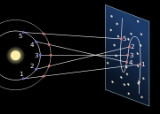
Apparent retrograde motion is the motion of a
planetA planet , is a celestial body orbiting a star or stellar remnant that is massive enough to be rounded by its own gravity, is not massive enough to cause thermonuclear fusion, and has cleared its neighbouring region of planetesimals.The term planet is ancient, with ties to history, science,...
ary body in a direction opposite to that of other bodies within its system as observed from a particular vantage point.
Direct motion or
prograde motion is motion in the same direction as other bodies.
While the terms
direct and
prograde are equivalent in this context, the former is the traditional term in astronomy.
Prograde was first seen in an abstract of an astronomy-related professional article in 1963.
Etymology
The term
retrograde is from the Latin word
retrogradus–
"backward-step". The affix
retro- meaning
backwards and
gradi step or
to go. Retrograde is most commonly an
adjectiveIn grammar, an adjective is a word whose main syntactic role is to modify a noun or pronoun, giving more information about the noun or pronoun's referent...
used to describe the path of a planet as it travels through the night sky, with respect to the
zodiacIn astronomy, the zodiac is the ring of constellations that lines the ecliptic, which is the apparent path of the Sun across the sky over the course of the year. The Moon and planets also lie within the ecliptic, and so are also within the constellations of the zodiac. In astrology, the zodiac...
, stars, and other bodies of the celestial canopy. In this context, the term refers to planets as they appear from Earth, to briefly stop and reverse direction at certain times, though in reality they perpetually orbit in the same uniform direction.
"Mercury in retrograde" is a good example of the term used as a
nounIn linguistics, a noun is a member of a large, open lexical category whose members can occur as the main word in the subject of a clause, the object of a verb, or the object of a preposition....
for retrograde
motion.
Retrograde is also sometimes used as an intransitive
verbkalleah hit meIn syntax, a verb is a word that usually denotes an action , an occurrence , or a state of being . Depending on the language, a verb may vary in form according to many factors, possibly including its tense, aspect, mood and voice...
meaning to become, to appear, to behave—or appear to move—in a retrograde fashion.
Although planets can sometimes be mistaken for stars as we observe the night sky, the planets actually change position from night to night in relation to the stars.
Retrograde (backward) and
prograde (forward) are observed as though the stars revolve around the earth. Ancient Greek Astronomer Ptolemy in 150 AD believed that the earth was the center of the solar system but still used the terms
retrograde and
prograde to describe the movement of the planets in relation to the stars. Although we know today that the planets revolve around the sun, we continue to use the same terms in order to describe the movement of the planets in relation to the stars as we observe them from Earth. Like the sun, the planets appear to rise in the East and set in the West. When a planet travels eastward in relation to the stars, it is called
prograde. When the planet travels westward in relation to the stars (opposite path) it is called
retrograde.
Apparent motion
When we observe the sky, the Sun, Moon, and stars appear to move from
eastEast is a direction in geography. It is one of the four cardinal directions or compass points, opposite of west and at right angles to north and south. East is the direction toward which the Earth rotates about its axis, and therefore the general direction from which the Sun appears to rise...
to
westWest is most commonly a noun, adjective, or adverb indicating direction or geography.West is one of the four cardinal directions or compass points...
because of the rotation of Earth (so-called
diurnal motionDiurnal motion is an astronomical term referring to the apparent daily motion of stars around the Earth, or more precisely around the two celestial poles. It is caused by the Earth's rotation on its axis, so every star apparently moves on a circle, that is called the diurnal circle...
). However,
orbiterAn orbiter is a space probe that orbits a planet or natural satellite without landing on it in order to study its surface from a distance.-Asteroids:*NEAR Shoemaker...
s such as the
Space ShuttleThe Space Shuttle, part of the Space Transportation System , is a spacecraft operated by NASA for orbital human spaceflight missions. It began operations in the 1980s and is scheduled to be retired from service in 2010 after 134 launches...
and many artificial
satelliteIn the context of spaceflight, a satellite is an object which has been placed into orbit by human endeavor. Such objects are sometimes called artificial satellites to distinguish them from natural satellites such as the Moon....
s appear to move from west to east. These are direct satellites (they actually orbit Earth in the same direction as the Moon), but they orbit Earth faster than Earth itself rotates, and so appear to move in the opposite direction.
MarsMars is the fourth planet from the Sun in the Solar System. The planet is named after Mars, the Roman god of war. It is also referred to as the "Red Planet" because of its reddish appearance, due to iron oxide prevalent on its surface....
has a natural satellite
PhobosPhobos is the larger and closer of two small moons of Mars, the other being Deimos. It is named after the Greek god Phobos , a son of Ares...
, with a similar orbit. From the surface of Mars it appears to move in the opposite direction to Earth's moon (Luna), even though both Phobos and Luna have direct orbits, because its orbital period is less than a Martian day, whereas Luna's orbital period (one month) is longer than a Terrestrial day. There are also smaller numbers of truly retrograde artificial satellites orbiting Earth which counter-intuitively appear to move westward, in the same direction as the Moon.

As seen from Earth, all the planets appear to periodically switch direction as they cross the sky. Though all stars and planets appear to move from east to west on a nightly basis in response to the rotation of Earth, the outer planets generally drift slowly eastward relative to the stars. This motion is normal for the planets, and so is considered direct motion. However, since Earth completes its orbit in a shorter period of time than the planets outside its orbit, we periodically overtake them, like a faster car on a multi-lane highway. When this occurs, the planet we are passing will first appear to stop its eastward drift, and then drift back toward the west. Then, as Earth swings past the planet in its orbit, it appears to resume its normal motion west to east. Inner planets
VenusVenus is the second-closest planet to the Sun, orbiting it every 224.7 Earth days. The planet is named after Venus, the Roman goddess of love and beauty. After the Moon, it is the brightest natural object in the night sky, reaching an apparent magnitude of −4.6...
and
MercuryFor the liquid metallic element, see Mercury .Mercury is the innermost and smallest planet in the Solar System, orbiting the Sun once every 87.969 days. The orbit of Mercury has the highest eccentricity of all the Solar System planets, and it has the smallest axial tilt. It completes three...
appear to move in retrograde in a similar mechanism, though their retrograde cycles are also tied to their conjunctions with the
SunThe Sun is the star at the center of the Solar System. The Earth and other matter orbit the Sun, which by itself accounts for about 99.86% of the Solar System's mass....
. The apparent retrograde motion is explained by the same mechanism as the outer planets. Asteroids and
Kuiper BeltThe Kuiper belt , sometimes called the Edgeworth-Kuiper belt, is a region of the Solar System beyond the planets extending from the orbit of Neptune to approximately 55 AU from the Sun. It is similar to the asteroid belt, although it is far larger—20 times as wide and 20–200 times as massive...
Objects (including
PlutoPluto, formal designation 134340 Pluto, is the second-largest known dwarf planet in the Solar System and the tenth-largest body observed directly orbiting the Sun...
) also exhibit apparent retrogradation.
Interestingly, Galileo's drawings show that he first observed
NeptuneNeptune is the eighth planet from the Sun in our Solar System. Named for the Roman god of the sea, it is the fourth-largest planet by diameter and the third-largest by mass. Neptune is 17 times the mass of Earth and is slightly more massive than its near-twin Uranus, which is 15 Earth masses and...
on December 28, 1612, and again on January 27, 1613. On both occasions, Galileo mistook Neptune for a fixed star when it appeared very close—in conjunction—to
JupiterJupiter is the fifth planet from the Sun and the largest planet within the Solar System. It is a gas giant with a mass slightly less than one-thousandth that of the Sun but is two and a half times the mass of all of the other planets in our Solar System combined. Jupiter is classified as a gas...
in the night sky, hence, he is not credited with Neptune's discovery. During the period of his first observation in December 1612, Neptune was stationary in the sky because it had just turned retrograde that very day. This apparent backward motion is created when the orbit of the
EarthEarth is the third planet from the Sun. It is the fifth largest of the eight planets in the solar system, and the largest of the terrestrial planets in the Solar System in terms of diameter, mass and density...
takes it past an outer planet. Since Neptune was only beginning its yearly retrograde cycle, the motion of the planet was far too slight to be detected with Galileo's small
telescopeA telescope is an instrument designed for the observation of remote objects by the collection of electromagnetic radiation. The first known practically functioning telescopes were invented in the Netherlands at the beginning of the 17th century...
.
The more distant planets retrograde more frequently:
- Mars retrogrades for 72 days every 25.6 months.
- Jupiter for 121 days every 13.1 months.
- Saturn for 138 days every 12.4 months.
- Uranus for 151 days every 12.15 months and
- Neptune for 158 days every 12.07 months.
The period between such retrogradations is the synodic period of the planet.
This apparent retrogradation puzzled ancient astronomers, and was one reason they named these bodies 'planets' in the first place: 'Planet' comes from the Greek word for 'wanderer'. In the geocentric model of the solar system, retrograde motion was explained by having the planets travel in
deferents and epicycleIn the Ptolemaic system of astronomy, the epicycle was a geometric model used to explain the variations in speed and direction of the apparent motion of the Moon, Sun, and planets...
s. It was not understood to be an illusion until the time of Copernicus. The accompanying animated diagram shows the retrograde motion of Mars for the year 2003, which occurs against the background of the constellation
AquariusAquarius, or the "Water-Bearer", is a star constellation in the zodiac between Pisces and Capricornus. See: Aquarius .Aquarius may also refer to:* Aquarius , the astrological sign...
.
See also
- Actual Retrograde motion
Retrograde motion is in the direction opposite to the movement of something else, and is the contrary of direct or prograde motion. The idea of retrograde or prograde motion is useful in three contexts: for describing the orbits of celestial bodies, for describing the rotations of celestial...
- Hipparchus
Hipparchus, the common Latinization of the Greek Hipparkhos, can mean:* Hipparchus, the ancient Greek astronomer** Hipparchic cycle, an astronomical cycle he created** Hipparchus , a lunar crater named in his honour...
- Ptolemy
Claudius Ptolemaeus , known in English as Ptolemy , was a Roman citizen of Greek ancestry. He was a mathematician, astronomer, geographer, astrologer and a poet of a single epigram in the Greek Anthology. He lived in Egypt under the Roman Empire, and is believed to have been born in the town of...
- Shen Kuo
Shen Kuo or Shen Gua , style name Cunzhong and pseudonym Mengqi Weng , was a polymathic Chinese scientist and statesman of the Song Dynasty...
- Spherical astronomy
Spherical astronomy or positional astronomy is the branch of astronomy that is used to determine the location of objects on the celestial sphere, as seen at a particular date, time, and location on the Earth. It relies on the mathematical methods of spherical geometry and the measurements of...
- Wei Pu
Wei Pu was an 11th century Chinese astronomer of the Song Dynasty . He was born a commoner, but eventually rose to prominence as an astronomer working for the imperial court at the capital of Kaifeng...
External links