


Volatiles

Encyclopedia
In planetary science
, volatiles are that group of chemical elements and chemical compounds with low boiling points
that are associated with a planet
's or moon
's crust
and/or atmosphere
. Examples include nitrogen
, water
, carbon dioxide
, ammonia
, hydrogen
, and methane
, all compounds of C, H, O and/or N, as well as sulfur dioxide
. In astrogeology, these compounds, in their solid state, often comprise large proportions of the crusts of moons and dwarf planet
s.
 In contrast with volatiles, those elements and compounds with high boiling points are known as refractory substances.
Planetary scientists often class volatiles with exceptionally low melting points, such as hydrogen
and helium
, as gases (as in gas giant
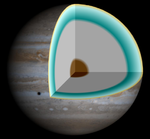
), while those volatiles with melting points above about 100 K are referred to as ices. The terms "gas" and "ice" in this context can apply to compounds that may be solids, liquids or gases. Thus, Jupiter
and Saturn
are referred to as "gas giants", and Uranus
and Neptune
are referred to as "ice giants", even though the vast majority of the "gas" and "ice" in their interiors is a hot, highly dense fluid
that gets denser as the center of the planet is approached.
The Earth's Moon
is considered very low in volatiles: its crust contains oxygen chemically bound into the rocks (as e.g. silicates), but negligible amounts of hydrogen, nitrogen or carbon.
the term more specifically refers to the volatile components of magma
(mostly water vapor
and carbon dioxide) that affect the appearance and explosivity of volcanoes. Volatiles in a magma with a high viscosity, generally felsic
with a higher silica (SiO2) content, tend to produce eruptions that are explosive. Volatiles in a magma with a low viscosity, generally mafic
with a lower silica content, tend to vent and can give rise to a lava fountain
.
Planetary science
Planetary science is the scientific study of planets , moons, and planetary systems, in particular those of the Solar System and the processes that form them. It studies objects ranging in size from micrometeoroids to gas giants, aiming to determine their composition, dynamics, formation,...
, volatiles are that group of chemical elements and chemical compounds with low boiling points
Volatility (chemistry)
In chemistry and physics, volatility is the tendency of a substance to vaporize. Volatility is directly related to a substance's vapor pressure. At a given temperature, a substance with higher vapor pressure vaporizes more readily than a substance with a lower vapor pressure.The term is primarily...
that are associated with a planet
Planet
A planet is a celestial body orbiting a star or stellar remnant that is massive enough to be rounded by its own gravity, is not massive enough to cause thermonuclear fusion, and has cleared its neighbouring region of planetesimals.The term planet is ancient, with ties to history, science,...
's or moon
Moon
The Moon is Earth's only known natural satellite,There are a number of near-Earth asteroids including 3753 Cruithne that are co-orbital with Earth: their orbits bring them close to Earth for periods of time but then alter in the long term . These are quasi-satellites and not true moons. For more...
's crust
Crust (geology)
In geology, the crust is the outermost solid shell of a rocky planet or natural satellite, which is chemically distinct from the underlying mantle...
and/or atmosphere
Atmosphere
An atmosphere is a layer of gases that may surround a material body of sufficient mass, and that is held in place by the gravity of the body. An atmosphere may be retained for a longer duration, if the gravity is high and the atmosphere's temperature is low...
. Examples include nitrogen
Nitrogen
Nitrogen is a chemical element that has the symbol N, atomic number of 7 and atomic mass 14.00674 u. Elemental nitrogen is a colorless, odorless, tasteless, and mostly inert diatomic gas at standard conditions, constituting 78.08% by volume of Earth's atmosphere...
, water
Water
Water is a chemical substance with the chemical formula H2O. A water molecule contains one oxygen and two hydrogen atoms connected by covalent bonds. Water is a liquid at ambient conditions, but it often co-exists on Earth with its solid state, ice, and gaseous state . Water also exists in a...
, carbon dioxide
Carbon dioxide
Carbon dioxide is a naturally occurring chemical compound composed of two oxygen atoms covalently bonded to a single carbon atom...
, ammonia
Ammonia
Ammonia is a compound of nitrogen and hydrogen with the formula . It is a colourless gas with a characteristic pungent odour. Ammonia contributes significantly to the nutritional needs of terrestrial organisms by serving as a precursor to food and fertilizers. Ammonia, either directly or...
, hydrogen
Hydrogen
Hydrogen is the chemical element with atomic number 1. It is represented by the symbol H. With an average atomic weight of , hydrogen is the lightest and most abundant chemical element, constituting roughly 75% of the Universe's chemical elemental mass. Stars in the main sequence are mainly...
, and methane
Methane
Methane is a chemical compound with the chemical formula . It is the simplest alkane, the principal component of natural gas, and probably the most abundant organic compound on earth. The relative abundance of methane makes it an attractive fuel...
, all compounds of C, H, O and/or N, as well as sulfur dioxide
Sulfur dioxide
Sulfur dioxide is the chemical compound with the formula . It is released by volcanoes and in various industrial processes. Since coal and petroleum often contain sulfur compounds, their combustion generates sulfur dioxide unless the sulfur compounds are removed before burning the fuel...
. In astrogeology, these compounds, in their solid state, often comprise large proportions of the crusts of moons and dwarf planet
Dwarf planet
A dwarf planet, as defined by the International Astronomical Union , is a celestial body orbiting the Sun that is massive enough to be spherical as a result of its own gravity but has not cleared its neighboring region of planetesimals and is not a satellite...
s.
Planetary scientists often class volatiles with exceptionally low melting points, such as hydrogen
Hydrogen
Hydrogen is the chemical element with atomic number 1. It is represented by the symbol H. With an average atomic weight of , hydrogen is the lightest and most abundant chemical element, constituting roughly 75% of the Universe's chemical elemental mass. Stars in the main sequence are mainly...
and helium
Helium
Helium is the chemical element with atomic number 2 and an atomic weight of 4.002602, which is represented by the symbol He. It is a colorless, odorless, tasteless, non-toxic, inert, monatomic gas that heads the noble gas group in the periodic table...
, as gases (as in gas giant
Gas giant
A gas giant is a large planet that is not primarily composed of rock or other solid matter. There are four gas giants in the Solar System: Jupiter, Saturn, Uranus, and Neptune...
), while those volatiles with melting points above about 100 K are referred to as ices. The terms "gas" and "ice" in this context can apply to compounds that may be solids, liquids or gases. Thus, Jupiter
Jupiter
Jupiter is the fifth planet from the Sun and the largest planet within the Solar System. It is a gas giant with mass one-thousandth that of the Sun but is two and a half times the mass of all the other planets in our Solar System combined. Jupiter is classified as a gas giant along with Saturn,...
and Saturn
Saturn
Saturn is the sixth planet from the Sun and the second largest planet in the Solar System, after Jupiter. Saturn is named after the Roman god Saturn, equated to the Greek Cronus , the Babylonian Ninurta and the Hindu Shani. Saturn's astronomical symbol represents the Roman god's sickle.Saturn,...
are referred to as "gas giants", and Uranus
Uranus
Uranus is the seventh planet from the Sun. It has the third-largest planetary radius and fourth-largest planetary mass in the Solar System. It is named after the ancient Greek deity of the sky Uranus , the father of Cronus and grandfather of Zeus...
and Neptune
Neptune
Neptune is the eighth and farthest planet from the Sun in the Solar System. Named for the Roman god of the sea, it is the fourth-largest planet by diameter and the third largest by mass. Neptune is 17 times the mass of Earth and is slightly more massive than its near-twin Uranus, which is 15 times...
are referred to as "ice giants", even though the vast majority of the "gas" and "ice" in their interiors is a hot, highly dense fluid
Supercritical fluid
A supercritical fluid is any substance at a temperature and pressure above its critical point, where distinct liquid and gas phases do not exist. It can effuse through solids like a gas, and dissolve materials like a liquid...
that gets denser as the center of the planet is approached.
The Earth's Moon
Moon
The Moon is Earth's only known natural satellite,There are a number of near-Earth asteroids including 3753 Cruithne that are co-orbital with Earth: their orbits bring them close to Earth for periods of time but then alter in the long term . These are quasi-satellites and not true moons. For more...
is considered very low in volatiles: its crust contains oxygen chemically bound into the rocks (as e.g. silicates), but negligible amounts of hydrogen, nitrogen or carbon.
Igneous petrology
In igneous petrologyIgneous petrology
Igneous petrology is the study of igneous rock, those that are formed from magma. Igneous petrology is as a branch of geology closely related to volcanology, tectonophysics and petrology in general. The modern study of igneous rocks is done using several techniques some of the developed in the...
the term more specifically refers to the volatile components of magma
Magma
Magma is a mixture of molten rock, volatiles and solids that is found beneath the surface of the Earth, and is expected to exist on other terrestrial planets. Besides molten rock, magma may also contain suspended crystals and dissolved gas and sometimes also gas bubbles. Magma often collects in...
(mostly water vapor
Water vapor
Water vapor or water vapour , also aqueous vapor, is the gas phase of water. It is one state of water within the hydrosphere. Water vapor can be produced from the evaporation or boiling of liquid water or from the sublimation of ice. Under typical atmospheric conditions, water vapor is continuously...
and carbon dioxide) that affect the appearance and explosivity of volcanoes. Volatiles in a magma with a high viscosity, generally felsic
Felsic
The word "felsic" is a term used in geology to refer to silicate minerals, magma, and rocks which are enriched in the lighter elements such as silicon, oxygen, aluminium, sodium, and potassium....
with a higher silica (SiO2) content, tend to produce eruptions that are explosive. Volatiles in a magma with a low viscosity, generally mafic
Mafic
Mafic is an adjective describing a silicate mineral or rock that is rich in magnesium and iron; the term is a portmanteau of the words "magnesium" and "ferric". Most mafic minerals are dark in color and the relative density is greater than 3. Common rock-forming mafic minerals include olivine,...
with a lower silica content, tend to vent and can give rise to a lava fountain
Lava fountain
A lava fountain is a volcanic phenomenon in which lava is forcefully but non-explosively ejected from a crater, vent, or fissure. Lava fountains may reach heights of up to . They may occur as a series of short pulses, or a continuous jet of lava. They are commonly seen in Hawaiian eruptions.-See...
.