

Nepenthes

Encyclopedia
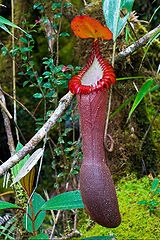
The Nepenthes popularly known as tropical pitcher plant
Pitcher plant
Pitcher plants are carnivorous plants whose prey-trapping mechanism features a deep cavity filled with liquid known as a pitfall trap. It has been widely assumed that the various sorts of pitfall trap evolved from rolled leaves, with selection pressure favouring more deeply cupped leaves over...
s or monkey cups, are a genus
Genus
In biology, a genus is a low-level taxonomic rank used in the biological classification of living and fossil organisms, which is an example of definition by genus and differentia...
of carnivorous plants in the monotypic
Monotypic
In biology, a monotypic taxon is a taxonomic group with only one biological type. The term's usage differs slightly between botany and zoology. The term monotypic has a separate use in conservation biology, monotypic habitat, regarding species habitat conversion eliminating biodiversity and...
family Nepenthaceae. The genus comprises roughly 130 species, numerous natural and many cultivated hybrids. They are mostly liana
Liana
A liana is any of various long-stemmed, woody vines that are rooted in the soil at ground level and use trees, as well as other means of vertical support, to climb up to the canopy to get access to well-lit areas of the forest. Lianas are especially characteristic of tropical moist deciduous...
-forming plants of the Old World
Old World
The Old World consists of those parts of the world known to classical antiquity and the European Middle Ages. It is used in the context of, and contrast with, the "New World" ....
tropics
Tropics
The tropics is a region of the Earth surrounding the Equator. It is limited in latitude by the Tropic of Cancer in the northern hemisphere at approximately N and the Tropic of Capricorn in the southern hemisphere at S; these latitudes correspond to the axial tilt of the Earth...
, ranging from South China
China
Chinese civilization may refer to:* China for more general discussion of the country.* Chinese culture* Greater China, the transnational community of ethnic Chinese.* History of China* Sinosphere, the area historically affected by Chinese culture...
, Indonesia
Indonesia
Indonesia , officially the Republic of Indonesia , is a country in Southeast Asia and Oceania. Indonesia is an archipelago comprising approximately 13,000 islands. It has 33 provinces with over 238 million people, and is the world's fourth most populous country. Indonesia is a republic, with an...
, Malaysia and the Philippines
Philippines
The Philippines , officially known as the Republic of the Philippines , is a country in Southeast Asia in the western Pacific Ocean. To its north across the Luzon Strait lies Taiwan. West across the South China Sea sits Vietnam...
; westward to Madagascar
Madagascar
The Republic of Madagascar is an island country located in the Indian Ocean off the southeastern coast of Africa...
(2 species) and the Seychelles
Seychelles
Seychelles , officially the Republic of Seychelles , is an island country spanning an archipelago of 115 islands in the Indian Ocean, some east of mainland Africa, northeast of the island of Madagascar....
(1); southward to Australia
Australia
Australia , officially the Commonwealth of Australia, is a country in the Southern Hemisphere comprising the mainland of the Australian continent, the island of Tasmania, and numerous smaller islands in the Indian and Pacific Oceans. It is the world's sixth-largest country by total area...
(3) and New Caledonia
New Caledonia
New Caledonia is a special collectivity of France located in the southwest Pacific Ocean, east of Australia and about from Metropolitan France. The archipelago, part of the Melanesia subregion, includes the main island of Grande Terre, the Loyalty Islands, the Belep archipelago, the Isle of...
(1); and northward to India
India
India , officially the Republic of India , is a country in South Asia. It is the seventh-largest country by geographical area, the second-most populous country with over 1.2 billion people, and the most populous democracy in the world...
(1) and Sri Lanka
Sri Lanka
Sri Lanka, officially the Democratic Socialist Republic of Sri Lanka is a country off the southern coast of the Indian subcontinent. Known until 1972 as Ceylon , Sri Lanka is an island surrounded by the Indian Ocean, the Gulf of Mannar and the Palk Strait, and lies in the vicinity of India and the...
(1). The greatest diversity occurs on Borneo
Borneo
Borneo is the third largest island in the world and is located north of Java Island, Indonesia, at the geographic centre of Maritime Southeast Asia....
and Sumatra
Sumatra
Sumatra is an island in western Indonesia, westernmost of the Sunda Islands. It is the largest island entirely in Indonesia , and the sixth largest island in the world at 473,481 km2 with a population of 50,365,538...
with many endemic species. Many are plants of hot humid lowland areas, but the majority are tropical montane
Montane
In biogeography, montane is the highland area located below the subalpine zone. Montane regions generally have cooler temperatures and often have higher rainfall than the adjacent lowland regions, and are frequently home to distinct communities of plants and animals.The term "montane" means "of the...
plants, receiving warm days but cool to cold humid nights year round. A few are considered tropical alpine with cool days and nights near freezing. The name monkey cups refers to the fact that monkey
Monkey
A monkey is a primate, either an Old World monkey or a New World monkey. There are about 260 known living species of monkey. Many are arboreal, although there are species that live primarily on the ground, such as baboons. Monkeys are generally considered to be intelligent. Unlike apes, monkeys...
s have been observed drinking rainwater from these plants.
Description
Nepenthes species usually consist of a shallow root system and a prostrateProstrate shrub
A prostrate shrub is a woody plant, most of the branches of which lie upon or just under the ground, rather than being held erect as are the branches of most trees and shrubs....
or climbing stem, often several metres long and up to 15 m (49 ft) or more, and usually 1 cm (0.393700787401575 in) or less in diameter, although this may be thicker in a few species (e.g. N. bicalcarata
Nepenthes bicalcarata
Nepenthes bicalcarata , also known as the Fanged Pitcher-Plant, is a tropical pitcher plant endemic to northwestern Borneo.-Botanical history:...
). From the stems arise alternate sword-shaped leaves with entire leaf margins. An extension of the midrib (tendril
Tendril
In botany, a tendril is a specialized stem, leaf or petiole with a threadlike shape that is used by climbing plants for support, attachment and cellular invasion by parasitic plants, generally by twining around suitable hosts. They do not have a lamina or blade, but they can photosynthesize...
), which in some species aid in climbing, protrudes from the tip of the leaf; at the end of the tendril the pitcher forms. The pitcher starts as a small bud and gradually expands to form a globe- or tube-shaped trap.
The trap contains a fluid of the plant's own production, which may be watery or syrup
Syrup
In cooking, a syrup is a thick, viscous liquid consisting primarily of a solution of sugar in water, containing a large amount of dissolved sugars but showing little tendency to deposit crystals...
y and is used to drown the prey. Research has shown that this fluid contains viscoelastic biopolymers that may be crucial to the retention of insects within the traps of many species. The trapping efficiency of this fluid remains high, even when significantly diluted by water, as inevitably happens in wet conditions.
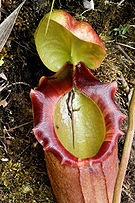
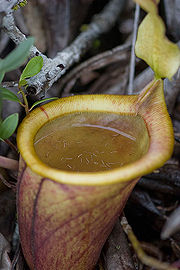
The lower part of the trap contains glands which absorb nutrients from captured prey. Along the upper inside part of the trap is a slick waxy coating which makes the escape of its prey nearly impossible. Surrounding the entrance to the trap is a structure called the peristome
Peristome
The word peristome is derived from the Greek peri, meaning 'around' or 'about', and stoma, 'mouth'. It is a term used to describe various anatomical features that surround an opening to an organ or structure. The term is used in plants and invertebrate animals, such as in describing the shells of...
(the "lip") which is slippery and often quite colorful, attracting prey but offering an unsure footing. Above the peristome is a lid (the operculum
Operculum (botany)
An operculum, in botany, is a term generally used to describe a structure within a plant, moss, or fungus acting as a cap, flap, or lid. In plants, it may also be called a bud cap.Examples of structures identified as opercula include:...
): in many species this keeps rain
Rain
Rain is liquid precipitation, as opposed to non-liquid kinds of precipitation such as snow, hail and sleet. Rain requires the presence of a thick layer of the atmosphere to have temperatures above the melting point of water near and above the Earth's surface...
from diluting the fluid within the pitcher, the underside of which may contain nectar glands which attract prey.
Nepenthes usually produce two types of pitchers, known as leaf dimorphism. Appearing near the base of the plant are the large lower traps, which typically sit on the ground. The upper or aerial pitchers are usually smaller, differently-coloured, and possess different features from the lower pitchers. These upper pitchers usually form as the plant reaches maturity and the plant grows taller. To keep the plant steady, the upper pitchers often form a loop in the tendril, allowing it to wrap around nearby support. In some species (e.g. N. rafflesiana) different prey may be attracted by the two types of pitchers. This varied morphology also often makes identification of species difficult.
Prey usually consists of insects, but the largest species (e.g. N. rajah
Nepenthes rajah
Nepenthes rajah is an insectivorous pitcher plant species of the Nepenthaceae family. It is endemic to Mount Kinabalu and neighbouring Mount Tambuyukon in Sabah, Malaysian Borneo. Nepenthes rajah grows exclusively on serpentine substrates, particularly in areas of seeping ground water where the...
and N. rafflesiana) may occasionally catch small vertebrate
Vertebrate
Vertebrates are animals that are members of the subphylum Vertebrata . Vertebrates are the largest group of chordates, with currently about 58,000 species described. Vertebrates include the jawless fishes, bony fishes, sharks and rays, amphibians, reptiles, mammals, and birds...
s, such as rats and lizards. There are even records of cultivated plants trapping small birds. Flower
Flower
A flower, sometimes known as a bloom or blossom, is the reproductive structure found in flowering plants . The biological function of a flower is to effect reproduction, usually by providing a mechanism for the union of sperm with eggs...
s occur in raceme
Raceme
A raceme is a type of inflorescence that is unbranched and indeterminate and bears pedicellate flowers — flowers having short floral stalks called pedicels — along the axis. In botany, axis means a shoot, in this case one bearing the flowers. In a raceme, the oldest flowers are borne...
s or more rarely in panicle
Panicle
A panicle is a compound raceme, a loose, much-branched indeterminate inflorescence with pedicellate flowers attached along the secondary branches; in other words, a branched cluster of flowers in which the branches are racemes....
s with male
Male
Male refers to the biological sex of an organism, or part of an organism, which produces small mobile gametes, called spermatozoa. Each spermatozoon can fuse with a larger female gamete or ovum, in the process of fertilization...
and female
Female
Female is the sex of an organism, or a part of an organism, which produces non-mobile ova .- Defining characteristics :The ova are defined as the larger gametes in a heterogamous reproduction system, while the smaller, usually motile gamete, the spermatozoon, is produced by the male...
flowers on separate plants. They are insect pollinated
Entomophily
Entomophily is a form of pollination whereby pollen is distributed by insects. Several insect are reported to be responsible for the pollination of many plant species, particularly bees, Lepidoptera , wasps, flies, ants and beetles. Some plant species co-evolved with a particular pollinator, such...
, the primary agents being flies (including blow flies, midge
Midge
A midge is a very small, two-winged flying insect. "Midge" may also refer to:-Real:* Midge Costanza , American politician* Mildred Gillars , aka "Midge", American broadcaster of Nazi propaganda during World War II...
s, and mosquito
Mosquito
Mosquitoes are members of a family of nematocerid flies: the Culicidae . The word Mosquito is from the Spanish and Portuguese for little fly...
es), moths, wasps, and butterflies. Their smell can range from sweet to musty or fungus
Fungus
A fungus is a member of a large group of eukaryotic organisms that includes microorganisms such as yeasts and molds , as well as the more familiar mushrooms. These organisms are classified as a kingdom, Fungi, which is separate from plants, animals, and bacteria...
-like. Seed
Seed
A seed is a small embryonic plant enclosed in a covering called the seed coat, usually with some stored food. It is the product of the ripened ovule of gymnosperm and angiosperm plants which occurs after fertilization and some growth within the mother plant...
is produced in a four-sided capsule which may contain 50–500 wind-distributed seeds, consisting of a central embryo
Embryo
An embryo is a multicellular diploid eukaryote in its earliest stage of development, from the time of first cell division until birth, hatching, or germination...
and two wings, one on either side.
Distribution and habitat
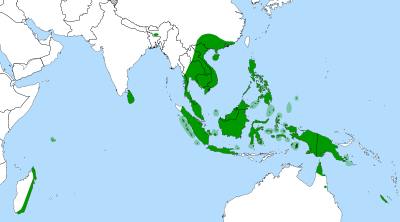
Malay Archipelago
The Malay Archipelago refers to the archipelago between mainland Southeastern Asia and Australia. The name was derived from the anachronistic concept of a Malay race....
, with the greatest biodiversity found on Borneo and Sumatra, especially in the Borneo montane rain forests
Borneo montane rain forests
The Borneo montane rain forests are an ecoregion, of Cloud forest, within the Tropical and subtropical moist broadleaf forests Biome, of the island of Borneo in south-east Asia .-Location and description:...
. The full range of the genus includes Madagascar (N. madagascariensis
Nepenthes madagascariensis
Nepenthes madagascariensis is one of two Nepenthes pitcher plant species native to Madagascar, the other being N. masoalensis.-Botanical history:...
and N. masoalensis
Nepenthes masoalensis
Nepenthes masoalensis is one of two tropical pitcher plant species from Madagascar, the other being N. madagascariensis.Nepenthes masoalensis is known only from eastern Madagascar; it occurs in the Masoala Peninsula and the Mount Ambato region. It has been recorded from Pandanus and Sphagnum...
), the Seychelles (N. pervillei
Nepenthes pervillei
Nepenthes pervillei is a tropical pitcher plant endemic to the Seychelles, specifically the islands of Mahé and Silhouette. It grows in rocky areas near granitic mountain summits at elevations of between 350 and 750 m above sea level....
), Sri Lanka (N. distillatoria
Nepenthes distillatoria
Nepenthes distillatoria is a tropical pitcher plant endemic to Sri Lanka. It was the second Nepenthes species to be described in print and the first to be formally named under the Linnaean system of taxonomy...
), and India (N. khasiana
Nepenthes khasiana
Nepenthes khasiana |endemic]]) is a tropical pitcher plant of the genus Nepenthes. It is the only Nepenthes species native to India....
) in the west to Australia (N. mirabilis
Nepenthes mirabilis
Nepenthes mirabilis , or the Common Swamp Pitcher-Plant, is a tropical carnivorous plant species of the pitfall trap variety. It has by far the widest distribution of any Nepenthes species and is known from the following countries and regions: Borneo, Sumatra, Thailand, Peninsular Malaysia,...
, N. rowanae
Nepenthes rowanae
Nepenthes rowanae is a species of pitcher plant endemic to Cape York, Australia. It is closely related to N. mirabilis and was once considered an extreme form of this species.-Taxonomy:...
, and N. tenax
Nepenthes tenax
Nepenthes tenax is a lowland species of tropical pitcher plant native to northern Queensland, Australia. It is the third Nepenthes species recorded from the continent and its second endemic species...
) and New Caledonia (N. vieillardii
Nepenthes vieillardii
Nepenthes vieillardii is a species of pitcher plant endemic to the island of New Caledonia. Its distribution is the most easterly of any Nepenthes species. Its natural habitat is subtropical or tropical dry forests....
) in the southeast. Most species are restricted to very small ranges, including some that are only found on individual mountains. These limited distributions and the inaccessibility of the region often means that some species go decades without being rediscovered in the wild (e.g. N. deaniana
Nepenthes deaniana
Nepenthes deaniana is a tropical pitcher plant endemic to the Philippines, where it grows at an altitude of 1180–1296 m above sea level. The species is known only from the summit region of Thumb Peak, a relatively small, ultramafic mountain in Puerto Princesa Province, Palawan.Nepenthes...
, which was rediscovered 100 years after its initial discovery). Approximately ten species have population distributions larger than a single island or group of smaller islands. Nepenthes mirabilis has the distinction of being the most widely distributed species in the genus, ranging from Indochina
Indochina
The Indochinese peninsula, is a region in Southeast Asia. It lies roughly southwest of China, and east of India. The name has its origins in the French, Indochine, as a combination of the names of "China" and "India", and was adopted when French colonizers in Vietnam began expanding their territory...
and throughout the Malay Archipelago to Australia.
Because of the nature of the habitats which Nepenthes species occupy, they are often graded as either lowland or highland species, depending on their altitude
Altitude
Altitude or height is defined based on the context in which it is used . As a general definition, altitude is a distance measurement, usually in the vertical or "up" direction, between a reference datum and a point or object. The reference datum also often varies according to the context...
above sea level
Sea level
Mean sea level is a measure of the average height of the ocean's surface ; used as a standard in reckoning land elevation...
, with 1200 m (3,937 ft) the rough delineation between lowland and highland. Species that grow at lower altitudes require continuously warm climates with little difference between day and night temperatures, whereas highland species thrive when they receive warm days and much cooler nights. Nepenthes lamii
Nepenthes lamii
Nepenthes lamii is a tropical pitcher plant endemic to New Guinea, where it grows at an altitude of up to 3520 m above sea level, higher than any other Nepenthes species...
is the species that holds the record of growing at a higher altitude than any other in the genus, up to 3520 m (11,549 ft).
Most Nepenthes species grow in environments that provide high humidity
Humidity
Humidity is a term for the amount of water vapor in the air, and can refer to any one of several measurements of humidity. Formally, humid air is not "moist air" but a mixture of water vapor and other constituents of air, and humidity is defined in terms of the water content of this mixture,...
and precipitation and moderate to high light levels. A few species, including N. ampullaria
Nepenthes ampullaria
Nepenthes ampullaria , the Flask-Shaped Pitcher-Plant, is a very distinctive and widespread species of Nepenthes, present in Borneo, Sumatra, Thailand, Peninsular Malaysia, Singapore, the Maluku Islands, and New Guinea...
, prefer the dense, shaded forests, but most other species thrive on the margins of tree/shrub communities or clearings. Some species (e.g. N. mirabilis) have been found growing in clear-cut
Clearcutting
Clearcutting, or clearfelling, is a controversial forestry/logging practice in which most or all trees in an area are uniformly cut down. Clearcutting, along with shelterwood and seed tree harvests, is used by foresters to create certain types of forest ecosystems and to promote select species that...
forest areas, roadsides, and disturbed fields. Other species have adapted to growing in savanna
Savanna
A savanna, or savannah, is a grassland ecosystem characterized by the trees being sufficiently small or widely spaced so that the canopy does not close. The open canopy allows sufficient light to reach the ground to support an unbroken herbaceous layer consisting primarily of C4 grasses.Some...
-like grass communities. The soils that Nepenthes grow in are usually acidic and low in nutrients, being composed of peat
Peat
Peat is an accumulation of partially decayed vegetation matter or histosol. Peat forms in wetland bogs, moors, muskegs, pocosins, mires, and peat swamp forests. Peat is harvested as an important source of fuel in certain parts of the world...
, white sand, sandstone
Sandstone
Sandstone is a sedimentary rock composed mainly of sand-sized minerals or rock grains.Most sandstone is composed of quartz and/or feldspar because these are the most common minerals in the Earth's crust. Like sand, sandstone may be any colour, but the most common colours are tan, brown, yellow,...
, or volcanic soils. There are, however, exceptions to these generalities, including species that thrive in soils that have high heavy metal content (e.g. N. rajah
Nepenthes rajah
Nepenthes rajah is an insectivorous pitcher plant species of the Nepenthaceae family. It is endemic to Mount Kinabalu and neighbouring Mount Tambuyukon in Sabah, Malaysian Borneo. Nepenthes rajah grows exclusively on serpentine substrates, particularly in areas of seeping ground water where the...
), on sandy beaches in the sea spray
Sea spray
Sea spray is a spray of water that forms when ocean waves crash.-Make up:As a result, salt spray contains a high concentration of mineral salts, particularly chloride anions.-Effects:...
zone (e.g. N. albomarginata
Nepenthes albomarginata
Nepenthes albomarginata , the White-Collared Pitcher-Plant, is a tropical pitcher plant native to Borneo, Peninsular Malaysia, and Sumatra...
). Other species grow on inselbergs and as lithophyte
Lithophyte
Lithophytes are a type of plant that grows in or on rocks. Lithophytes feed off moss, nutrients in rain water, litter, and even their own dead tissue....
s, while others, such as N. inermis
Nepenthes inermis
Nepenthes inermis is a tropical pitcher plant endemic to Sumatra. The specific epithet inermis is Latin for "unarmed" and probably refers to the upper pitchers of this species, which are unique in that they completely lack a peristome....
, can grow as epiphyte
Epiphyte
An epiphyte is a plant that grows upon another plant non-parasitically or sometimes upon some other object , derives its moisture and nutrients from the air and rain and sometimes from debris accumulating around it, and is found in the temperate zone and in the...
s with no soil contact.
Ecological relationships
Predation
In ecology, predation describes a biological interaction where a predator feeds on its prey . Predators may or may not kill their prey prior to feeding on them, but the act of predation always results in the death of its prey and the eventual absorption of the prey's tissue through consumption...
. Nepenthes species certainly attract and kill their prey, albeit passively, through active production of attractive colours, sugary nectar, and even sweet scents. From this relationship, the plants primarily gain nitrogen
Nitrogen
Nitrogen is a chemical element that has the symbol N, atomic number of 7 and atomic mass 14.00674 u. Elemental nitrogen is a colorless, odorless, tasteless, and mostly inert diatomic gas at standard conditions, constituting 78.08% by volume of Earth's atmosphere...
and phosphorus
Phosphorus
Phosphorus is the chemical element that has the symbol P and atomic number 15. A multivalent nonmetal of the nitrogen group, phosphorus as a mineral is almost always present in its maximally oxidized state, as inorganic phosphate rocks...
to supplement their nutrient requirements for growth, given that soil nutrients are typically lacking. The most frequent prey is an abundant and diverse group of arthropod
Arthropod
An arthropod is an invertebrate animal having an exoskeleton , a segmented body, and jointed appendages. Arthropods are members of the phylum Arthropoda , and include the insects, arachnids, crustaceans, and others...
s, with ant
Ant
Ants are social insects of the family Formicidae and, along with the related wasps and bees, belong to the order Hymenoptera. Ants evolved from wasp-like ancestors in the mid-Cretaceous period between 110 and 130 million years ago and diversified after the rise of flowering plants. More than...
s and other insect
Insect
Insects are a class of living creatures within the arthropods that have a chitinous exoskeleton, a three-part body , three pairs of jointed legs, compound eyes, and two antennae...
s topping the menu. Other arthropods that are found frequently include spider
Spider
Spiders are air-breathing arthropods that have eight legs, and chelicerae with fangs that inject venom. They are the largest order of arachnids and rank seventh in total species diversity among all other groups of organisms...
s, scorpion
Scorpion
Scorpions are predatory arthropod animals of the order Scorpiones within the class Arachnida. They have eight legs and are easily recognized by the pair of grasping claws and the narrow, segmented tail, often carried in a characteristic forward curve over the back, ending with a venomous stinger...
s, and centipede
Centipede
Centipedes are arthropods belonging to the class Chilopoda of the subphylum Myriapoda. They are elongated metameric animals with one pair of legs per body segment. Despite the name, centipedes can have a varying number of legs from under 20 to over 300. Centipedes have an odd number of pairs of...
s, while snail
Snail
Snail is a common name applied to most of the members of the molluscan class Gastropoda that have coiled shells in the adult stage. When the word is used in its most general sense, it includes sea snails, land snails and freshwater snails. The word snail without any qualifier is however more often...
s and frog
Frog
Frogs are amphibians in the order Anura , formerly referred to as Salientia . Most frogs are characterized by a short body, webbed digits , protruding eyes and the absence of a tail...
s are more unusual but not unheard of. The most uncommon prey for Nepenthes species includes rats found in N. rajah. The composition of prey captured depends on many factors, including location, but can incorporate hundreds of individual insects and many different species. While many Nepenthes are generalists in what they capture, at least one, N. albomarginata
Nepenthes albomarginata
Nepenthes albomarginata , the White-Collared Pitcher-Plant, is a tropical pitcher plant native to Borneo, Peninsular Malaysia, and Sumatra...
, has specialised and almost exclusively traps termite
Termite
Termites are a group of eusocial insects that, until recently, were classified at the taxonomic rank of order Isoptera , but are now accepted as the epifamily Termitoidae, of the cockroach order Blattodea...
s and produces nearly no nectar. Nepenthes albomarginata gains its name from the ring of white trichome
Trichome
Trichomes are fine outgrowths or appendages on plants and certain protists. These are of diverse structure and function. Examples are hairs, glandular hairs, scales, and papillae.- Algal trichomes :...
s that are directly beneath the peristome. These trichomes—or "hairs"—are palatable to termites and will attract them to the pitcher. In the course of collecting the edible trichomes, hundreds or thousands of termites will fall into the pitcher.
Symbioses
Nepenthes bicalcarataNepenthes bicalcarata
Nepenthes bicalcarata , also known as the Fanged Pitcher-Plant, is a tropical pitcher plant endemic to northwestern Borneo.-Botanical history:...
provides space in the hollow tendrils of its upper pitchers for the carpenter ant Camponotus schmitzi
Camponotus schmitzi
Camponotus schmitzi is a species of carpenter ant native to northwestern Borneo.The ant makes its nest in the hollow tendrils of the pitcher plant Nepenthes bicalcarata....
to build nests. The ants take larger prey from the pitchers, which may benefit N. bicalcarata by reducing the amount of putrefaction
Putrefaction
Putrefaction is one of seven stages in the decomposition of the body of a dead animal. It can be viewed, in broad terms, as the decomposition of proteins, in a process that results in the eventual breakdown of cohesion between tissues and the liquefaction of most organs.-Description:In terms of...
of collected organic matter that could harm the natural community of infaunal
Nepenthes infauna
Nepenthes infauna are the organisms that inhabit the pitchers of Nepenthes plants. These include fly and midge larvae, spiders, mites, ants, and even a species of crab, Geosesarma malayanum. The most common and conspicuous predators found in pitchers are mosquito larvae, which consume large...
species that aid the plant's digestion.
Nepenthes lowii
Nepenthes lowii
Nepenthes lowii , or Low's Pitcher-Plant, is a tropical pitcher plant endemic to Borneo. It is named after Hugh Low, who discovered it on Mount Kinabalu...
has also formed a dependent relationship, but this time it is with vertebrates instead of insects. The pitchers of N. lowii provide a sugary exudate reward on the reflexed pitcher lid (operculum) and a perch for tree shrew species, which have been found eating the exudate and defecating into the pitcher. A 2009 study, which coined the term "tree shrew lavatories", determined that anywhere between 57 and 100% of the plant's foliar nitrogen uptake comes from the faeces of tree shrews. Another study published the following year showed that the shape and size of the pitcher orifice of N. lowii exactly match the dimensions of a typical tree shrew (Tupaia montana). A similar adaptation was found in N. macrophylla
Nepenthes macrophylla
Nepenthes macrophylla , the Large-Leaved Pitcher-Plant, is a tropical pitcher plant known only from a very restrictive elevation on Mount Trus Madi in Sabah, Malaysian Borneo...
and N. rajah
Nepenthes rajah
Nepenthes rajah is an insectivorous pitcher plant species of the Nepenthaceae family. It is endemic to Mount Kinabalu and neighbouring Mount Tambuyukon in Sabah, Malaysian Borneo. Nepenthes rajah grows exclusively on serpentine substrates, particularly in areas of seeping ground water where the...
, and is also likely to be present in N. ephippiata
Nepenthes ephippiata
Nepenthes ephippiata , or the Saddle-Leaved Pitcher-Plant, is a tropical pitcher plant endemic to Borneo. It occurs in the Hose Mountains of central Sarawak, as well as Mount Raya and Bukit Lesung in Kalimantan. Plants from the Hose Mountains appear to lack the decurrent leaf attachment found in...
.
Infauna
Organisms that spend at least part of their lives within the pitchers of Nepenthes species are often called Nepenthes infauna. The most common infaunal species, often representing the top trophic levelTrophic level
The trophic level of an organism is the position it occupies in a food chain. The word trophic derives from the Greek τροφή referring to food or feeding. A food chain represents a succession of organisms that eat another organism and are, in turn, eaten themselves. The number of steps an organism...
of the infaunal ecosystem, are many species of mosquito
Mosquito
Mosquitoes are members of a family of nematocerid flies: the Culicidae . The word Mosquito is from the Spanish and Portuguese for little fly...
larvae. Other infaunal species include fly
Fly
True flies are insects of the order Diptera . They possess a pair of wings on the mesothorax and a pair of halteres, derived from the hind wings, on the metathorax...
and midge
Midge
A midge is a very small, two-winged flying insect. "Midge" may also refer to:-Real:* Midge Costanza , American politician* Mildred Gillars , aka "Midge", American broadcaster of Nazi propaganda during World War II...
larvae, spiders, mite
Mite
Mites, along with ticks, are small arthropods belonging to the subclass Acari and the class Arachnida. The scientific discipline devoted to the study of ticks and mites is called acarology.-Diversity and systematics:...
s, ants, and even a species of crab (Geosesarma malayanum
Geosesarma malayanum
Geosesarma malayanum is a species of small red crab which is found in Malaysia. It is famous for its relationship with pitcher plants: as such, it is classified as a nepenthephile. G. malayanum is known to visit Nepenthes ampullaria plants and raid the pitchers of their contents. It uses its claws...
). Many of these species specialise to one pitcher plant species and are found nowhere else. These specialists are called nepenthebionts. Others that are often associated but are not dependent on Nepenthes species are called nepenthophiles. Nepenthexenes, on the other hand, are rarely found in the pitchers, but will often appear when putrefaction approaches a certain threshold, attracting fly larvae that would normally not be found in the pitcher infaunal community. The complex ecological relationship between pitcher plant and infauna is not yet fully understood, but it has been suggested that the relationship is mutualistic: the infauna is given shelter, food, or protection and the plant that harbours the infauna receives expedited breakdown of captured prey, increasing the rate of digestion and keeping harmful bacterial populations repressed.
Botanical history
The earliest known record of Nepenthes dates back to the 17th century. In 1658, French colonial governor Etienne de FlacourtÉtienne de Flacourt
Étienne de Flacourt was a French governor of Madagascar, born at Orléans in 1607. He was named governor of Madagascar by the French East India Company in 1648....
published a description of a pitcher plant in his seminal work Histoire de la Grande Isle de Madagascar. It reads:
It is a plant growing about 3 feet high which carries at the end of its leaves, which are 7 inches long, a hollow flower or fruit resembling a small vase, with its own lid, a wonderful sight. There are red ones and yellow ones, the yellow being the biggest. The inhabitants of this country are reluctant to pick the flowers, saying that if somebody does pick them in passing, it will not fail to rain that day. As to that, I and all the other Frenchmen did pick them, but it did not rain. After rain these flowers are full of water, each one containing a good half-glass. [translated from French in Pitcher-Plants of BorneoPitcher-Plants of BorneoPitcher-Plants of Borneo is a monograph by Anthea Phillipps and Anthony Lamb on the tropical pitcher plants of Borneo. It was first published in 1996 by Natural History Publications , in association with the Royal Botanic Gardens, Kew and the Malaysian Nature Society...
]
Flacourt called the plant Amramatico, after a local name. More than a century later, this species was formally described
Species description
A species description or type description is a formal description of a newly discovered species, usually in the form of a scientific paper. Its purpose is to give a clear description of a new species of organism and explain how it differs from species which have been described previously, or are...
as N. madagascariensis
Nepenthes madagascariensis
Nepenthes madagascariensis is one of two Nepenthes pitcher plant species native to Madagascar, the other being N. masoalensis.-Botanical history:...
.
The second species to be described was N. distillatoria
Nepenthes distillatoria
Nepenthes distillatoria is a tropical pitcher plant endemic to Sri Lanka. It was the second Nepenthes species to be described in print and the first to be formally named under the Linnaean system of taxonomy...
, the Sri Lanka
Sri Lanka
Sri Lanka, officially the Democratic Socialist Republic of Sri Lanka is a country off the southern coast of the Indian subcontinent. Known until 1972 as Ceylon , Sri Lanka is an island surrounded by the Indian Ocean, the Gulf of Mannar and the Palk Strait, and lies in the vicinity of India and the...
n endemic. In 1677, Bartholinus made brief mention of it under the name Miranda herba, Latin for "marvellous herb". Three years later, Dutch merchant Jacob Breyne referred to this species as Bandura zingalensium, after a local name for the plant. Bandura subsequently became the most commonly used name for the tropical pitcher plants, until Linnaeus coined Nepenthes in 1737.
Nepenthes distillatoria was again described in 1683, this time by Swedish physician H. N. Grimm. Grimm called it Planta mirabilis destillatoria or the "miraculous distilling plant", and was the first to clearly illustrate a tropical pitcher plant. Three years later, in 1686, English naturalist John Ray
John Ray
John Ray was an English naturalist, sometimes referred to as the father of English natural history. Until 1670, he wrote his name as John Wray. From then on, he used 'Ray', after "having ascertained that such had been the practice of his family before him".He published important works on botany,...
quoted Grimm as saying:
The root draws up moisture from the earth which with the help of the sun's rays rises up into the plant itself and then flows down through the stems and nerves of the leaves into the natural utensil to be stored there until used for human needs. [translated from Latin in Pitcher-Plants of BorneoPitcher-Plants of BorneoPitcher-Plants of Borneo is a monograph by Anthea Phillipps and Anthony Lamb on the tropical pitcher plants of Borneo. It was first published in 1996 by Natural History Publications , in association with the Royal Botanic Gardens, Kew and the Malaysian Nature Society...
]
One of the earliest illustrations of Nepenthes appears in Leonard Plukenet's Almagestum Botanicum of 1696. The plant, called Utricaria vegetabilis zeylanensium, is undoubtedly N. distillatoria.
It was around the same time that German botanist Georg Eberhard Rumphius
Georg Eberhard Rumphius
Georg Eberhard Rumphius or originally Rumpf was a German-born botanist employed by the Dutch East India Company in what is now eastern Indonesia, and is best known for his work, Herbarium Amboinense....
discovered two new Nepenthes species in the Malay Archipelago
Malay Archipelago
The Malay Archipelago refers to the archipelago between mainland Southeastern Asia and Australia. The name was derived from the anachronistic concept of a Malay race....
. Rumphius illustrated the first one, now considered synonymous with N. mirabilis
Nepenthes mirabilis
Nepenthes mirabilis , or the Common Swamp Pitcher-Plant, is a tropical carnivorous plant species of the pitfall trap variety. It has by far the widest distribution of any Nepenthes species and is known from the following countries and regions: Borneo, Sumatra, Thailand, Peninsular Malaysia,...
, and gave it the name Cantharifera, meaning "tankard-bearer". The second, referred to as Cantharifera alba, is thought to have been N. maxima
Nepenthes maxima
Nepenthes maxima , the Great Pitcher-Plant, is a carnivorous pitcher plant species of the genus Nepenthes. It has a relatively wide distribution covering Sulawesi, New Guinea, and the Maluku Islands. It is closely related to N. eymae....
. Rumphius described the plants in his most famous work, the six-volume Herbarium Amboinense, a catalogue of the flora
Flora
Flora is the plant life occurring in a particular region or time, generally the naturally occurring or indigenous—native plant life. The corresponding term for animals is fauna.-Etymology:...
of Ambon Island
Ambon Island
Ambon Island is part of the Maluku Islands of Indonesia. The island has an area of , and is mountainous, well watered, and fertile. Ambon Island consists of 2 territories: The main city and seaport is Ambon , which is also the capital of Maluku province and Maluku Tengah Ambon Island is part of the...
. However, it would not be published until many years after his death.
After going blind in 1670, when the manuscript was only partially complete, Rumphius continued work on Herbarium Amboinensis with the help of clerks and artists. In 1687, with the project nearing completion, at least half of the illustrations were lost in a fire. Persevering, Rumphius and his helpers first completed the book in 1690. However, two years later, the ship carrying the manuscript to the Netherlands was attacked and sunk by the French, forcing them to start over from a copy that had fortunately been retained by Governor-General Johannes Camphuijs. The Herbarium Amboinensis finally arrived in the Netherlands in 1696. Even then, the first volume did not appear until 1741, thirty-nine years after Rumphius's death. By this time, Linnaeus's name Nepenthes had become established.
Nepenthes distillatoria was again illustrated in Johannes Burmann's Thesaurus Zeylanicus of 1737. The drawing depicts the end of a flowering stem with pitchers. Burmann refers to the plant as Bandura zeylanica.
The next mention of tropical pitcher plants was made in 1790, when Portuguese priest João de Loureiro
João de Loureiro
João de Loureiro was a Portuguese Jesuit missionary, paleontologist, physician and botanist.In 1742 he travelled to Cochinchina, remaining there for 30 years. He became a specialist in Asian flora and on his return published Flora Cochinchinensis .- References :...
described Phyllamphora mirabilis, or the "marvellous urn-shaped leaf", from Vietnam
Vietnam
Vietnam – sometimes spelled Viet Nam , officially the Socialist Republic of Vietnam – is the easternmost country on the Indochina Peninsula in Southeast Asia. It is bordered by China to the north, Laos to the northwest, Cambodia to the southwest, and the South China Sea –...
. Despite living in the country for around 35 years, it seems unlikely that Loureiro observed living plants of this species, as he states that the lid is a moving part, actively opening and closing
Rapid plant movement
Rapid plant movement encompasses movement in plant structures occurring over a very short period of time, usually under one second. For example, the Venus Flytrap closes its trap in about 100 milliseconds. The Dogwood Bunchberry's flower opens its petals and fires pollen in less than 0.5 milliseconds...
. In his most celebrated work, Flora Cochinchinensis, he writes:
[...] (the) leaf-tip ends in a long hanging tendril, twisted spirally in the middle, from which hangs a sort of vase, oblong, pot-bellied, with a smooth lip with a projecting margin and a lid affixed to one side, which of its own nature freely opens and closes in order to receive the dew and store it. A marvellous work of the Lord! [translated from French in Pitcher-Plants of BorneoPitcher-Plants of BorneoPitcher-Plants of Borneo is a monograph by Anthea Phillipps and Anthony Lamb on the tropical pitcher plants of Borneo. It was first published in 1996 by Natural History Publications , in association with the Royal Botanic Gardens, Kew and the Malaysian Nature Society...
]
Phyllamphora mirabilis was eventually transferred to the genus Nepenthes by George Claridge Druce
George Claridge Druce
George Claridge Druce, MA, LLD, JP, FRS, FLS was an English botanist and a Mayor of Oxford.G. Claridge Druce was born at Potterspury on Watling Street in Northamptonshire. He was the illegitimate son of Jane Druce, born 1815 in Buckinghamshire.He went to school in the village of Yardley Gobion....
in 1916. As such, P. mirabilis is the basionym
Basionym
Basionym is a term used in botany, regulated by the International Code of Botanical Nomenclature...
of this most cosmopolitan of tropical pitcher plant species.
Loureiro's description of a moving lid was repeated by Jean Louis Marie Poiret
Jean Louis Marie Poiret
Jean Louis Marie Poiret was a French clergyman, botanist and explorer.From 1785 to 1786 he was sent by Louis XVI to Algeria to study the flora...
in 1797. Poiret described two of the four Nepenthes species known at the time: N. madagascariensis and N. distillatoria. He gave the former its current name and called the latter Nepente de l'Inde, or simply "Nepenthes of India", although this species is absent from the mainland. In Jean-Baptiste Lamarck
Jean-Baptiste Lamarck
Jean-Baptiste Pierre Antoine de Monet, Chevalier de la Marck , often known simply as Lamarck, was a French naturalist...
's Encyclopédie Méthodique Botanique, he included the following account:
This urn is hollow, as I have just said, usually full of soft, clear water, and then closed. It opens during the day and more than half the liquid disappears, but this loss is repaired during the night, and the next day the urn is full again and closed by its lid. This is its sustenance, and enough for more than one day because it is always about half-full at the approach of night. [translated from French in Pitcher-Plants of BorneoPitcher-Plants of BorneoPitcher-Plants of Borneo is a monograph by Anthea Phillipps and Anthony Lamb on the tropical pitcher plants of Borneo. It was first published in 1996 by Natural History Publications , in association with the Royal Botanic Gardens, Kew and the Malaysian Nature Society...
]
With the discovery of new species and Sir Joseph Banks'
Joseph Banks
Sir Joseph Banks, 1st Baronet, GCB, PRS was an English naturalist, botanist and patron of the natural sciences. He took part in Captain James Cook's first great voyage . Banks is credited with the introduction to the Western world of eucalyptus, acacia, mimosa and the genus named after him,...
original introduction of specimens to Europe in 1789, interest in Nepenthes grew throughout the 19th century, culminating in what has been called the "Golden Age of Nepenthes" in the 1880s. However, the popularity of the plants dwindled in the early 20th century, before all but disappearing by World War II
World War II
World War II, or the Second World War , was a global conflict lasting from 1939 to 1945, involving most of the world's nations—including all of the great powers—eventually forming two opposing military alliances: the Allies and the Axis...
. This is evidenced by the fact that no new species were described between 1940 and 1966. The revival of global interest in the cultivation and study of Nepenthes is credited to Japan
Japan
Japan is an island nation in East Asia. Located in the Pacific Ocean, it lies to the east of the Sea of Japan, China, North Korea, South Korea and Russia, stretching from the Sea of Okhotsk in the north to the East China Sea and Taiwan in the south...
ese botanist Shigeo Kurata
Shigeo Kurata
is a Japanese botanist and Nepenthes taxonomist whose work in the 1960s and 1970s contributed much to the current popularity of these plants. Of particular note is his 1976 guide, Nepenthes of Mount Kinabalu....
, whose work in the 1960s and 1970s did much to bring attention to these plants.
Etymology
The name Nepenthes was first published in 1737 in Carolus LinnaeusCarolus Linnaeus
Carl Linnaeus , also known after his ennoblement as , was a Swedish botanist, physician, and zoologist, who laid the foundations for the modern scheme of binomial nomenclature. He is known as the father of modern taxonomy, and is also considered one of the fathers of modern ecology...
's Hortus Cliffortianus
Hortus Cliffortianus
The Hortus Cliffortianus is a work of early botanical literature published in 1738.The work was a collaboration between Carl Linnaeus and Georg Dionysius Ehret, financed by George Clifford in 1735-1736. Clifford, a wealthy Amsterdam banker was a keen botanist with a large herbarium and governor of...
. It references a passage in Homer
Homer
In the Western classical tradition Homer , is the author of the Iliad and the Odyssey, and is revered as the greatest ancient Greek epic poet. These epics lie at the beginning of the Western canon of literature, and have had an enormous influence on the history of literature.When he lived is...
's Odyssey
Odyssey
The Odyssey is one of two major ancient Greek epic poems attributed to Homer. It is, in part, a sequel to the Iliad, the other work ascribed to Homer. The poem is fundamental to the modern Western canon, and is the second—the Iliad being the first—extant work of Western literature...
, in which the potion "Nepenthes pharmakon" is given to Helen by an Egypt
Egypt
Egypt , officially the Arab Republic of Egypt, Arabic: , is a country mainly in North Africa, with the Sinai Peninsula forming a land bridge in Southwest Asia. Egypt is thus a transcontinental country, and a major power in Africa, the Mediterranean Basin, the Middle East and the Muslim world...
ian queen. "Nepenthe
Nepenthe
Nepenthe is a medicine for sorrow, literally an anti-depressant – a "drug of forgetfulness" mentioned in ancient Greek literature and Greek mythology, depicted as originating in Egypt....
" literally means "without grief" (ne = not, penthos = grief) and, in Greek mythology
Greek mythology
Greek mythology is the body of myths and legends belonging to the ancient Greeks, concerning their gods and heroes, the nature of the world, and the origins and significance of their own cult and ritual practices. They were a part of religion in ancient Greece...
, is a drug that quells all sorrows with forgetfulness. Linnaeus explained:
If this is not Helen's Nepenthes, it certainly will be for all botanists. What botanist would not be filled with admiration if, after a long journey, he should find this wonderful plant. In his astonishment past ills would be forgotten when beholding this admirable work of the Creator! [translated from Latin by Harry VeitchHarry VeitchSir Harry James Veitch was an eminent English horticulturist in the nineteenth century, who was the head of the family nursery business, James Veitch & Sons, based in Chelsea, London...
]
The plant Linnaeus described was Nepenthes distillatoria
Nepenthes distillatoria
Nepenthes distillatoria is a tropical pitcher plant endemic to Sri Lanka. It was the second Nepenthes species to be described in print and the first to be formally named under the Linnaean system of taxonomy...
, a species from Sri Lanka
Sri Lanka
Sri Lanka, officially the Democratic Socialist Republic of Sri Lanka is a country off the southern coast of the Indian subcontinent. Known until 1972 as Ceylon , Sri Lanka is an island surrounded by the Indian Ocean, the Gulf of Mannar and the Palk Strait, and lies in the vicinity of India and the...
.
Nepenthes was formally published as a generic
Genus
In biology, a genus is a low-level taxonomic rank used in the biological classification of living and fossil organisms, which is an example of definition by genus and differentia...
name in 1753 in Linnaeus's famous Species Plantarum
Species Plantarum
Species Plantarum was first published in 1753, as a two-volume work by Carl Linnaeus. Its prime importance is perhaps that it is the primary starting point of plant nomenclature as it exists today. This means that the first names to be considered validly published in botany are those that appear...
, which established botanical nomenclature
Botanical nomenclature
Botanical nomenclature is the formal, scientific naming of plants. It is related to, but distinct from taxonomy. Plant taxonomy is concerned with grouping and classifying plants; botanical nomenclature then provides names for the results of this process. The starting point for modern botanical...
as it exists today. Nepenthes distillatoria is the type species
Type species
In biological nomenclature, a type species is both a concept and a practical system which is used in the classification and nomenclature of animals and plants. The value of a "type species" lies in the fact that it makes clear what is meant by a particular genus name. A type species is the species...
of the genus.
The name monkey cups was discussed in the May 1964 issue of National Geographic, in which Paul A. Zahl wrote:
The carriers called them "monkey cups," a name I had heard elsewhere in reference to Nepenthes, but the implication that monkeys drink the pitcher fluid seemed farfetched. I later proved it true. In Sarawak I found an orangutanOrangutanOrangutans are the only exclusively Asian genus of extant great ape. The largest living arboreal animals, they have proportionally longer arms than the other, more terrestrial, great apes. They are among the most intelligent primates and use a variety of sophisticated tools, also making sleeping...
that had been raised as a pet and later freed. As I approached it gingerly in the forest, I offered it a half-full pitcher. To my surprise, the ape accepted it and, with the finesse of a lady at tea, executed a delicate bottoms-up.
Cultivation

Nepenthes alata
Nepenthes alata is a tropical pitcher plant endemic to the Philippines. It is found on all the major islands of the archipelago, with the possible exception of Palawan. It is one of the easiest and most popular Nepenthes species in cultivation....
, N. ventricosa
Nepenthes ventricosa
Nepenthes ventricosa is a tropical pitcher plant endemic to the Philippines, where it is a highland species, growing at an elevation of 1000–2000 m above sea level. It has been recorded from the islands of Luzon, Panay, and Sibuyan...
, N. khasiana
Nepenthes khasiana
Nepenthes khasiana |endemic]]) is a tropical pitcher plant of the genus Nepenthes. It is the only Nepenthes species native to India....
, and N. sanguinea
Nepenthes sanguinea
Nepenthes sanguinea is a large and vigorous Nepenthes pitcher plant species, native to the Malay Peninsula, where it grows at 900–1800 m altitude. The pitchers are variable in size, from 10–30 cm tall, and range from green and yellow to orange and red. The insides of the pitchers are usually...
. These four species are highlanders (N. alata has both lowland and highland forms), some easy lowlander species are N. rafflesiana
Nepenthes rafflesiana
Nepenthes rafflesiana , or Raffles' Pitcher-Plant, is a species of pitcher plant. It has a very wide distribution covering Borneo, Sumatra, Peninsular Malaysia, and Singapore. Nepenthes rafflesiana is extremely variable with numerous forms and varieties described. In Borneo alone, there are at...
, N. bicalcarata
Nepenthes bicalcarata
Nepenthes bicalcarata , also known as the Fanged Pitcher-Plant, is a tropical pitcher plant endemic to northwestern Borneo.-Botanical history:...
, N. mirabilis
Nepenthes mirabilis
Nepenthes mirabilis , or the Common Swamp Pitcher-Plant, is a tropical carnivorous plant species of the pitfall trap variety. It has by far the widest distribution of any Nepenthes species and is known from the following countries and regions: Borneo, Sumatra, Thailand, Peninsular Malaysia,...
, and N. hirsuta
Nepenthes hirsuta
Nepenthes hirsuta , the Hairy Pitcher-Plant, is a tropical pitcher plant endemic to Borneo. It is characterised by an indumentum of thick brown hairs, which is even present on the inflorescence. Pitchers are mostly green throughout with some having red blotches on the inside surfaces.N. hirsuta...
.
Highland forms are those species that grow in habitats that are generally higher up in elevation, and thus exposed to cooler evening temperatures. Lowland forms are those species that grow nearer to sea level. Both forms respond best to rainwater (but tap water works as long as you flush it out with rainwater every month or if you have soft water), bright light (not full sun), a well drained medium, good air circulation and relatively high humidity, although easier species such as N. alata can adapt to lower humidity environments. Highland species must have night-time cooling to thrive in the long-term. Chemical fertilisers are best used at low strength. Occasional feeding with frozen (thawed before use) cricket
Cricket (insect)
Crickets, family Gryllidae , are insects somewhat related to grasshoppers, and more closely related to katydids or bush crickets . They have somewhat flattened bodies and long antennae. There are about 900 species of crickets...
s may be beneficial. Terrarium culture of smaller plants like N. bellii
Nepenthes bellii
Nepenthes bellii is a tropical pitcher plant endemic to the Philippine islands of Mindanao and Dinagat, where it grows at elevations of 0–800 m above sea level.The specific epithet bellii honours American botanist Clyde Ritchie Bell....
, N. × trichocarpa
Nepenthes × trichocarpa
Nepenthes × trichocarpa , the Dainty Pitcher-Plant, is a common natural hybrid involving N. ampullaria and N. gracilis. It was originally thought to be a distinct species and was described as such....
and N. ampullaria
Nepenthes ampullaria
Nepenthes ampullaria , the Flask-Shaped Pitcher-Plant, is a very distinctive and widespread species of Nepenthes, present in Borneo, Sumatra, Thailand, Peninsular Malaysia, Singapore, the Maluku Islands, and New Guinea...
is possible, but most plants will get too large over time.
Plants can be propagated by seed, cuttings, and tissue culture. Seeds are usually sown on damp chopped Sphagnum
Sphagnum
Sphagnum is a genus of between 151 and 350 species of mosses commonly called peat moss, due to its prevalence in peat bogs and mires. A distinction is made between sphagnum moss, the live moss growing on top of a peat bog on one hand, and sphagnum peat moss or sphagnum peat on the other, the...
moss
Moss
Mosses are small, soft plants that are typically 1–10 cm tall, though some species are much larger. They commonly grow close together in clumps or mats in damp or shady locations. They do not have flowers or seeds, and their simple leaves cover the thin wiry stems...
, or on sterile plant tissue culture media once they have been properly disinfected. The seeds generally become nonviable soon after harvesting, so seed are not usually the preferred method of propagation. A 1:1 mixture of orchid medium with moss or perlite
Perlite
Perlite is an amorphous volcanic glass that has a relatively high water content, typically formed by the hydration of obsidian. It occurs naturally and has the unusual property of greatly expanding when heated sufficiently...
has been used for germination and culture. Seed may take two months to germinate, and two years or more to yield mature plants. Cuttings may be rooted in damp Sphagnum moss in a plastic bag or tank with high humidity and moderate light. They can begin to root in 1–2 months and start to form pitchers in about six months. Tissue culture
Tissue culture
Tissue culture is the growth of tissues or cells separate from the organism. This is typically facilitated via use of a liquid, semi-solid, or solid growth medium, such as broth or agar...
is now used commercially and helps reduce collection of wild plants, as well as making many rare species available to hobbyists at reasonable prices. Nepenthes are considered threatened or endangered plants and are listed in CITES appendices 1 & 2.
Species
Around 135 species of Nepenthes are currently recognised as valid. This number is quickly increasing, with several new species being described each year.Hybrids and cultivars
There are many hybrid Nepenthes and numerous named cultivarCultivar
A cultivar'Cultivar has two meanings as explained under Formal definition. When used in reference to a taxon, the word does not apply to an individual plant but to all those plants sharing the unique characteristics that define the cultivar. is a plant or group of plants selected for desirable...
s. Some of the more well known artificially produced hybrids include:
- N. 'Coccinea' ((N. rafflesiana × N. ampullaria) × N. mirabilis)
- N. 'Emmarene' (N. khasiana × N. ventricosa)
- N. 'Gentle' (N. fusca × N. maxima)
- N. 'Judith Finn' (N. veitchii × N. spathulata)
- N. 'Miranda' ((N. maxima × N. northiana) × N. maxima)
- N. 'Mixta' (N. northiana × N. maxima)
See also
- Nepenthes classificationNepenthes classificationThe taxonomy of Nepenthes has been revised several times during the nineteenth and twentieth centuries.-Nineteenth century:The first subgeneric division of the Nepenthes was made by Joseph Dalton Hooker in his 1873 monograph, "Nepenthaceae"...
- Nepenthes infaunaNepenthes infaunaNepenthes infauna are the organisms that inhabit the pitchers of Nepenthes plants. These include fly and midge larvae, spiders, mites, ants, and even a species of crab, Geosesarma malayanum. The most common and conspicuous predators found in pitchers are mosquito larvae, which consume large...
Further reading
- Amagase, S., S. Nakayama & A. Tsugita 1969. Acid protease in Nepenthes. II. Study on the specificity of nepenthesin. The Journal of Biochemistry 66(4): 431–439.
- Athauda, S.B.P., K. Matsumoto, S. Rajapakshe, M. Kuribayashi, M. Kojima, N. Kubomura-Yoshida, A. Iwamatsu, C. Shibata, H. Inoue & K. Takahashi 2004. (manuscript BJ20031575) Biochemical Journal 381(1): 295–306. doi:10.1042/BJ20031575
- Bauer, U., Bohn, H.F. & Federle, W. 2008. Proceedings of the Royal Society B 275(1632): 259-265.
- Beaver, R.A. 1979. Biological studies of the fauna of pitcher plants Nepenthes in west Malaysia. Annales de la Société Entomologique de France 15: 3–17.
- Beaver, R.A. 1983. The communities living in Nepenthes pitcher plants: fauna and food webs. In: J.H. Frank & L.P. Lounibos (eds.) Phytotelmata: Plants as Hosts for Aquatic Insect Communities. Plexus Publishing, New Jersey. pp. 129–159.
- Beaver, R.A. 1985. Geographical variation in food web structure in Nepenthes pitcher plants. Ecological Entomology 10: 241–248.
- Beekman, E.M. 2004. A Note on the Priority of Rumphius' Observation of Decapod Crustacea Living In Nepenthes. Crustaceana 77(8): 1019–1021.
- Bohn, H.F. & W. Federle 2004. Proceedings of the National Academy of SciencesProceedings of the National Academy of SciencesThe Proceedings of the National Academy of Sciences of the United States of America, usually referred to as PNAS, is the official journal of the United States National Academy of Sciences...
101(39): 14138–14143. doi:10.1073/pnas.0405885101 Boulay, J. 1997. Les Nepenthes. DionéeDionéeDionée is a quarterly French-language periodical and the official publication of Association Francophone des Amateurs de Plantes Carnivores, a carnivorous plant society based in France. Typical articles include matters of horticultural interest, field reports, and scientific studies...
38. - Carlquist, S. 1981. Wood Anatomy of Nepenthaceae. Bulletin of the Torrey Botanical Club 108(3): 324–330.
- Chia, T.F., H.H. Aung, A.N. Osipov, N.K. Goh & L.S. Chia 2004. Carnivorous pitcher plant uses free radicals in the digestion of prey. Redox Report 9(5): 255–261.
- Edwards, P. 2005. Victorian Carnivorous Plant Society JournalVictorian Carnivorous Plant Society JournalThe Victorian Carnivorous Plant Society Journal is a quarterly periodical and the official publication of the Victorian Carnivorous Plant Society of Australia. Typical articles include matters of horticultural interest, field reports, literature reviews, and plant descriptions. The journal was...
75: 6–8. - Edwards, P. 2005. Victorian Carnivorous Plant Society JournalVictorian Carnivorous Plant Society JournalThe Victorian Carnivorous Plant Society Journal is a quarterly periodical and the official publication of the Victorian Carnivorous Plant Society of Australia. Typical articles include matters of horticultural interest, field reports, literature reviews, and plant descriptions. The journal was...
76: 6–9. - Frazier, C.K. 2000. The Enduring Controversies Concerning the Process of Protein Digestion in Nepenthes. Carnivorous Plant NewsletterCarnivorous Plant NewsletterThe Carnivorous Plant Newsletter is the official publication of the International Carnivorous Plant Society , the largest such organization in the world.-History and editorship:...
29(2): 56–61. - Jenkin, A. 2005. Victorian Carnivorous Plant Society JournalVictorian Carnivorous Plant Society JournalThe Victorian Carnivorous Plant Society Journal is a quarterly periodical and the official publication of the Victorian Carnivorous Plant Society of Australia. Typical articles include matters of horticultural interest, field reports, literature reviews, and plant descriptions. The journal was...
75: 12–13. - Jennings, D.E. & JR. Rohr 2011. A review of the conservation threats to carnivorous plants. Biological Conservation, published online on April 3, 2011.
- Meimberg, H., A. Wistuba, P. Dittrich & G. Heubl 2001. Molecular Phylogeny of Nepenthaceae Based on Cladistic Analysis of Plastid trnK Intron Sequence Data. Plant Biology (Stuttgart, Germany) 3: 164–175.
- Mithöfer, A. 2010. Carnivorous pitcher plants: insights in an old topic. Phytochemistry, published online on December 22, 2010.
- Mokkamul, P., A. Chaveerach, R. Sudmoon & T. Tanee 2007. Pakistan Journal of Biological Sciences 10(4): 561–567. doi:10.3923/pjbs.2007.561.567
- Moran, J.A., W.E. Booth & J.K. Charles 1999. Annals of Botany 83: 521–528.
- Nosonovsky, M. 2011. Materials science: slippery when wetted. Nature 477: 412–413.
- Osunkoya, O.O., S.D. Daud, B. Di-Giusto, F.L. Wimmer & T.M. Holige 2007. Construction Costs and Physico-chemical Properties of the Assimilatory Organs of Nepenthes Species in Northern Borneo. Annals of Botany 99(5): 895–906.
- Pavlovič, A., E. Masarovičová & J. Hudák 2007. Carnivorous Syndrome in Asian Pitcher Plants of the Genus Nepenthes. Annals of Botany 100(3): 527–536.
- Poppinga, S., K. Koch, H.F. Bohn & W. Barthlott 2010. Comparative and functional morphology of hierarchically structured anti-adhesive surfaces in carnivorous plants and kettle trap flowers. Functional Plant Biology 37(10): 952–961.
- Riedel, M., A. Eichner, H. Meimberg & R. Jetter 2007. Chemical composition of epicuticular wax crystals on the slippery zone in pitchers of five Nepenthes species and hybrids. Planta 225(6): 1517–1534.
- Schulze, W., W.B. Frommer & J.M. Ward 1999. The Plant Journal 17(6): 637–646. doi:10.1046/j.1365-313x.1999.00414.x
- Vines, S.H. 1876. On the Digestive Ferment of Nepenthes. Journal of Anatomy and Physiology 11(1): 124–127.
- Wong, T.-S., S.H. Kang, S.K.Y. Tang, E.J. Smythe, B.D. Hatton, A. Grinthal & J. Aizenberg 2011. Bioinspired self-repairing slippery surfaces with pressure-stable omniphobicity. Nature 477: 443–447.
External links
- Nepenthes - the Monkey Cups from the Botanical Society of AmericaBotanical Society of AmericaThe Botanical Society of America represents professional and amateur botanists, researchers, educators and students in over 80 countries of the world...
- Photographs of Nepenthes in their natural habitats by Joachim NerzJoachim NerzDr. Joachim Nerz is a taxonomist and botanist specialising in the carnivorous plant genera Heliamphora and Nepenthes. Nerz has described several new species, mostly with Andreas Wistuba.-Publications:...
- Nepenthes photographs at the Carnivorous Plant Photo Finder
- A video about Nepenthes from The Private Life of PlantsThe Private Life of PlantsThe Private Life of Plants is a BBC nature documentary series written and presented by David Attenborough, first shown in the UK from 11 January 1995....
- The Carnivorous Plant FAQ: Nepenthes by Barry Rice
- Evolution -- Nepenthes Phylogeny from the International Carnivorous Plant SocietyInternational Carnivorous Plant SocietyThe International Carnivorous Plant Society is a non-profit organization founded in 1972. It is the International Cultivar Registration Authority for carnivorous plants...