


Alpha taxonomy

Encyclopedia
Species
In biology, a species is one of the basic units of biological classification and a taxonomic rank. A species is often defined as a group of organisms capable of interbreeding and producing fertile offspring. While in many cases this definition is adequate, more precise or differing measures are...
of living or fossil
Fossil
Fossils are the preserved remains or traces of animals , plants, and other organisms from the remote past...
organism
Organism
In biology, an organism is any contiguous living system . In at least some form, all organisms are capable of response to stimuli, reproduction, growth and development, and maintenance of homoeostasis as a stable whole.An organism may either be unicellular or, as in the case of humans, comprise...
s. This field is supported by institutions holding collections of these organisms, with relevant data, carefully curated: such institutes include natural history museums, herbaria
Herbarium
In botany, a herbarium – sometimes known by the Anglicized term herbar – is a collection of preserved plant specimens. These specimens may be whole plants or plant parts: these will usually be in a dried form, mounted on a sheet, but depending upon the material may also be kept in...
and botanical garden
Botanical garden
A botanical garden The terms botanic and botanical, and garden or gardens are used more-or-less interchangeably, although the word botanic is generally reserved for the earlier, more traditional gardens. is a well-tended area displaying a wide range of plants labelled with their botanical names...
s.
The term "alpha" refers to alpha taxonomy being the first and most basic step in taxonomy
Taxonomy
Taxonomy is the science of identifying and naming species, and arranging them into a classification. The field of taxonomy, sometimes referred to as "biological taxonomy", revolves around the description and use of taxonomic units, known as taxa...
.
Describing species
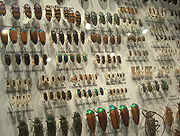
A formal description of a species follow certain rules. From a collection of organisms, one or more specimen are selected as basis for the description, these ideally being "typical" specimen of the new species. In living species where specimen are easily obtainable, these should ideally represent both adult and young individuals. Often they are not however, and with fossil specimen, the basis for the description can be fragmentary and often the only known specimen available. These are designated type specimen, and are to be kept as reference for the species in a special type collection. MammalMammal
Mammals are members of a class of air-breathing vertebrate animals characterised by the possession of endothermy, hair, three middle ear bones, and mammary glands functional in mothers with young...
s and bird
Bird
Birds are feathered, winged, bipedal, endothermic , egg-laying, vertebrate animals. Around 10,000 living species and 188 families makes them the most speciose class of tetrapod vertebrates. They inhabit ecosystems across the globe, from the Arctic to the Antarctic. Extant birds range in size from...
s are often kept as skin and skeletons (sometimes only the skull
Skull
The skull is a bony structure in the head of many animals that supports the structures of the face and forms a cavity for the brain.The skull is composed of two parts: the cranium and the mandible. A skull without a mandible is only a cranium. Animals that have skulls are called craniates...
). Insect
Insect
Insects are a class of living creatures within the arthropods that have a chitinous exoskeleton, a three-part body , three pairs of jointed legs, compound eyes, and two antennae...
s are commonly kept as dried specimens, while other animals are often preserved whole in alcohol
Alcohol
In chemistry, an alcohol is an organic compound in which the hydroxy functional group is bound to a carbon atom. In particular, this carbon center should be saturated, having single bonds to three other atoms....
or formaldehyde
Formaldehyde
Formaldehyde is an organic compound with the formula CH2O. It is the simplest aldehyde, hence its systematic name methanal.Formaldehyde is a colorless gas with a characteristic pungent odor. It is an important precursor to many other chemical compounds, especially for polymers...
. Plant
Plant
Plants are living organisms belonging to the kingdom Plantae. Precise definitions of the kingdom vary, but as the term is used here, plants include familiar organisms such as trees, flowers, herbs, bushes, grasses, vines, ferns, mosses, and green algae. The group is also called green plants or...
s are preserved flattened and dry in herbaria
Herbarium
In botany, a herbarium – sometimes known by the Anglicized term herbar – is a collection of preserved plant specimens. These specimens may be whole plants or plant parts: these will usually be in a dried form, mounted on a sheet, but depending upon the material may also be kept in...
.
For the new species to be valid, the formal description must be published in a scientific journal
Scientific journal
In academic publishing, a scientific journal is a periodical publication intended to further the progress of science, usually by reporting new research. There are thousands of scientific journals in publication, and many more have been published at various points in the past...
. Several journals exist devoted to the publishing of new species. The description of a species will contain a description of typical features of the organisms, and how it differs from other similar organisms. The new species is given a binominal name
Binomial nomenclature
Binomial nomenclature is a formal system of naming species of living things by giving each a name composed of two parts, both of which use Latin grammatical forms, although they can be based on words from other languages...
according to scientific naming conventions, usually accompanied by a formal biological classification
Biological classification
Biological classification, or scientific classification in biology, is a method to group and categorize organisms by biological type, such as genus or species. Biological classification is part of scientific taxonomy....
giving Kingdom
Kingdom (biology)
In biology, kingdom is a taxonomic rank, which is either the highest rank or in the more recent three-domain system, the rank below domain. Kingdoms are divided into smaller groups called phyla or divisions in botany...
, Phylum
Phylum
In biology, a phylum The term was coined by Georges Cuvier from Greek φῦλον phylon, "race, stock," related to φυλή phyle, "tribe, clan." is a taxonomic rank below kingdom and above class. "Phylum" is equivalent to the botanical term division....
or Division, Class
Class (biology)
In biological classification, class is* a taxonomic rank. Other well-known ranks are life, domain, kingdom, phylum, order, family, genus, and species, with class fitting between phylum and order...
, Order
Order (biology)
In scientific classification used in biology, the order is# a taxonomic rank used in the classification of organisms. Other well-known ranks are life, domain, kingdom, phylum, class, family, genus, and species, with order fitting in between class and family...
, Family
Family (biology)
In biological classification, family is* a taxonomic rank. Other well-known ranks are life, domain, kingdom, phylum, class, order, genus, and species, with family fitting between order and genus. As for the other well-known ranks, there is the option of an immediately lower rank, indicated by the...
, Genus
Genus
In biology, a genus is a low-level taxonomic rank used in the biological classification of living and fossil organisms, which is an example of definition by genus and differentia...
, and Species
Species
In biology, a species is one of the basic units of biological classification and a taxonomic rank. A species is often defined as a group of organisms capable of interbreeding and producing fertile offspring. While in many cases this definition is adequate, more precise or differing measures are...
. Special rules apply in botany
Botany
Botany, plant science, or plant biology is a branch of biology that involves the scientific study of plant life. Traditionally, botany also included the study of fungi, algae and viruses...
, where a formal description must have a summary in Latin
Latin
Latin is an Italic language originally spoken in Latium and Ancient Rome. It, along with most European languages, is a descendant of the ancient Proto-Indo-European language. Although it is considered a dead language, a number of scholars and members of the Christian clergy speak it fluently, and...
giving a brief description of the shape of leaves and flowers.
About authors, authorities and auctors
In botanyBotany
Botany, plant science, or plant biology is a branch of biology that involves the scientific study of plant life. Traditionally, botany also included the study of fungi, algae and viruses...
, an alpha taxonomist who names taxa is called an auctor
Auctor
Auctor is Latin for author or originator. The term is used in Scholasticism for a "renowned scholar", and in alpha taxonomy for the scientist describing a species. The term is widely replaced by author in zoological nomenclature, but is still in use in botany.Related to the notion of legitimacy on...
, from the scholastic
Scholasticism
Scholasticism is a method of critical thought which dominated teaching by the academics of medieval universities in Europe from about 1100–1500, and a program of employing that method in articulating and defending orthodoxy in an increasingly pluralistic context...
term for author. In zoology
Zoology
Zoology |zoölogy]]), is the branch of biology that relates to the animal kingdom, including the structure, embryology, evolution, classification, habits, and distribution of all animals, both living and extinct...
, the term auctor has been replaced with the terms "author" or "authority".
A scientist who attempts to describe new taxa has to be intimately familiar with all the previously published scientific literature on that group of organisms. This is necessary in order to avoid errors such as describing an already-named species (thus creating an unnecessary junior synonym
Synonym (taxonomy)
In scientific nomenclature, a synonym is a scientific name that is or was used for a taxon of organisms that also goes by a different scientific name. For example, Linnaeus was the first to give a scientific name to the Norway spruce, which he called Pinus abies...
) or using a species name that is already taken. The literature on any one group of organisms often spans centuries, and is often written in several different languages, making alpha taxonomy very much the realm of specialists.
Once a species (or any other taxonomic unit) is named, the name of the auctor is associated with the description. In zoology, the full formal name of a species contains not only the Latin binominal
Binomial nomenclature
Binomial nomenclature is a formal system of naming species of living things by giving each a name composed of two parts, both of which use Latin grammatical forms, although they can be based on words from other languages...
(genus and species name), but also the name of the original authority and the year of the original publication. While the overall name of a species may change (usually by the species being transferred to a new genus) the authority name and year still apply. The zoological code is considered to have started in 1758 with the 10th edition of Systema Naturæ
10th edition of Systema Naturae
The 10th edition of Systema Naturae was a book written by Carl Linnaeus and published in two volumes in 1758 and 1759, which marks the starting point of zoological nomenclature...
. Many of the most well known animals thus have (Linnaeus, 1758) as the author-date, e.g. the common earth worm
Lumbricus terrestris
Lumbricus terrestris is a large reddish worm native to Europe, but now also widely distributed elsewhere around the world due to human introductions...
, Lumbricus terrestris (Linnaeus, 1758).
Names of certain very prolific authorities are sometimes abbreviated; this was quite common during the early years of Linnaean taxonomy
Linnaean taxonomy
Linnaean taxonomy can mean either of two related concepts:# the particular form of biological classification set up by Carl Linnaeus, as set forth in his Systema Naturæ and subsequent works...
. It is no longer done in zoology, but a system of abbreviations is still used in botany. Many of the more well known species of plants were described by Carl Linnaeus in Species Plantarum
Species Plantarum
Species Plantarum was first published in 1753, as a two-volume work by Carl Linnaeus. Its prime importance is perhaps that it is the primary starting point of plant nomenclature as it exists today. This means that the first names to be considered validly published in botany are those that appear...
, published in 1753, and this is considered the formal starting point for the botanical code. Thus the common buttercup is Ranunculus acris L., where the 'L' is the standardised abbreviation for Linnaeus. Unlike in zoology, the date (year) is not usually given. The same style of abbreviated author names can be found in old zoological work, and was kept the longest for Linnaeus himself, e.g. the tiger
Tiger
The tiger is the largest cat species, reaching a total body length of up to and weighing up to . Their most recognizable feature is a pattern of dark vertical stripes on reddish-orange fur with lighter underparts...
can be found as "Panthera tigris (L., 1758)" in older works.
Alpha taxonomy and systematics
For a long time the term "taxonomyTaxonomy
Taxonomy is the science of identifying and naming species, and arranging them into a classification. The field of taxonomy, sometimes referred to as "biological taxonomy", revolves around the description and use of taxonomic units, known as taxa...
" was used for what is today seen as alpha taxonomy. Over time, the term "taxonomy" has gained several other meanings and has thus became potentially confusing. To some extent it is being replaced, in its original (and narrow) meaning, by "alpha taxonomy". As such, alpha taxonomy deals mostly with actual organisms and fossils: species and lower ranking taxa. Higher ranking taxa (including clade
Clade
A clade is a group consisting of a species and all its descendants. In the terms of biological systematics, a clade is a single "branch" on the "tree of life". The idea that such a "natural group" of organisms should be grouped together and given a taxonomic name is central to biological...
s and grades
Evolutionary grade
In alpha taxonomy, a grade refers to a taxon united by a level of morphological or physiological complexity. The term was coined by British biologist Julian Huxley, to contrast with clade, a strictly phylogenetic unit.-Definition:...
) mostly are the province of "beta taxonomy", more commonly called systematics
Systematics
Biological systematics is the study of the diversification of terrestrial life, both past and present, and the relationships among living things through time. Relationships are visualized as evolutionary trees...
. Systematics (as a science) deals with the relationships between taxa, especially at the higher levels. These days systematics is greatly influenced by data derived from DNA from nuclei, mitochondria and chloroplasts. This is sometimes known as molecular systematics which is becoming increasingly more common, perhaps at the expense of traditional morphological taxonomy.
See also
- BiologyBiologyBiology is a natural science concerned with the study of life and living organisms, including their structure, function, growth, origin, evolution, distribution, and taxonomy. Biology is a vast subject containing many subdivisions, topics, and disciplines...
- Biological classificationBiological classificationBiological classification, or scientific classification in biology, is a method to group and categorize organisms by biological type, such as genus or species. Biological classification is part of scientific taxonomy....
- CladisticsCladisticsCladistics is a method of classifying species of organisms into groups called clades, which consist of an ancestor organism and all its descendants . For example, birds, dinosaurs, crocodiles, and all descendants of their most recent common ancestor form a clade...
- Evolutionary tree
- Important publications in taxonomy
- Integrated Taxonomic Information SystemIntegrated Taxonomic Information SystemThe Integrated Taxonomic Information System is a partnership designed to provide consistent and reliable information on the taxonomy of biological species. ITIS was originally formed in 1996 as an interagency group within the U.S...
- SystematicsSystematicsBiological systematics is the study of the diversification of terrestrial life, both past and present, and the relationships among living things through time. Relationships are visualized as evolutionary trees...
- TaxonTaxon|thumb|270px|[[African elephants]] form a widely-accepted taxon, the [[genus]] LoxodontaA taxon is a group of organisms, which a taxonomist adjudges to be a unit. Usually a taxon is given a name and a rank, although neither is a requirement...
External links
- uBio Taxonomic Name Reconciliation
- Integrated Taxonomic Information System - Generalized N. American server Mexico Server Canada Server
- Tree of Life
- BioLib
- NCBI Taxonomy
- Taxonomy & Informatics An AMNH & NSFNational Science FoundationThe National Science Foundation is a United States government agency that supports fundamental research and education in all the non-medical fields of science and engineering. Its medical counterpart is the National Institutes of Health...
Project - Merriam-Webster Online Dictionary: definition- taxonomy
- The Nature of Plant Species - article on a study by University BloomingtonIndiana University BloomingtonIndiana University Bloomington is a public research university located in Bloomington, Indiana, in the United States. IU Bloomington is the flagship campus of the Indiana University system. Being the flagship campus, IU Bloomington is often referred to simply as IU or Indiana...
scientists - Aphia: North Sea flora and fauna taxonomic register
- VisualTaxa: Taxonomic subdivision of life