

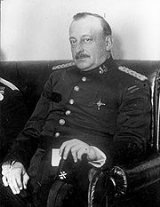
Miguel Primo de Rivera

Encyclopedia
Miguel Primo de Rivera y Orbaneja, 2nd Marquis of Estella, 22nd Count of Sobremonte, Knight of Calatrava (January 8, 1870 – March 16, 1930) was a Spanish dictator, aristocrat, and a military official who was appointed Prime Minister by the King and who for seven years (1923–1930) was a dictator, ending the turno
system of alternating parties.
. His father was a retired colonel. His uncle, Fernando, was Captain General in Madrid and the soon-to-be first marquis of Estella. Fernando later participated in the plot to restore the constitutional monarchy in 1875, ending the tumultuous First Republic
. His mother was Fernandina de Busqueros (1845-1892), daughter of Roche de Busqueros, Knight of Calatrava (1822-1906). His great-grandfather was Bértrand Primo de Rivera (1741-1813), 21nd Count of Sobremonte, a general and hero of the Spanish Resistance against Napoleon Bonaparte.
The young Miguel grew up as part of what Gerald Brenan
called "a hard-drinking, whoring, horse-loving aristocracy" that ruled "over the most starved and down-trodden race of agricultural labourers in Europe." Studying history and engineering before deciding upon a military career, he won admission to the newly created General Academy in Toledo
, and graduated in 1884.
s of the Rif
region in northern Morocco, and promotions and decorations came steadily. Primo de Rivera became convinced that Spain probably could not hold on to its North African colony. For many years, the government had tried without success to crush the Berber rebels, wasting lives and money. He concluded Spain must withdraw from what was called Spanish Morocco
if it could not dominate the colony. Posted to Cuba
and the Philippines
, he witnessed their loss to the United States
in 1898, bringing a close to his nation's once-great empire
. That loss frustrated many Spaniards, Primo de Rivera included. They criticized the politicians and the parliamentary system which could not maintain order or foster economic development at home, nor preserve the vestiges of Spain's imperial glory.
Primo de Rivera went to Madrid to serve in the Ministry of War with his uncle. Renowned for his amorous conquests, he reverted to the carefree days of his youth in Jerez. Then in 1902, he married a young Hispano-Cuban, Casilda Sáenz de Heredia. Their marriage was happy, and Casilda bore six children before her death in 1908, following the birth of Fernando. He later was sent on a military mission to France, Switzerland, and Italy in 1909.
The British historian Hugh Thomas
says of Primo de Rivera in his monumental The Spanish Civil War: "He would work enormously hard for weeks on end and then disappear for a juerga of dancing, drinking and love-making with gypsies. He would be observed almost alone in the streets of Madrid, swathed in an opera cloak, making his way from one café to another, and on returning home would issue a garrulous and sometimes even intoxicated communiqué -- which he would often have to cancel in the morning."
Between 1909 and 1923, Primo de Rivera's career blossomed, but he became increasingly discouraged with the fortunes of his country. Having returned to Spanish Morocco
, he was promoted to brigadier general
in 1911, the first graduate of the General Academy to receive such a promotion. Yet social revolution had flared briefly in Barcelona
, during the Tragic Week of 1909. After the army had called up conscripts to fight in the Second Rif War in Morocco, Radical republicans and anarchists in Catalonia had proclaimed a general strike. Violence had erupted when the government declared martial law
. Anticlerical rioters had burned churches and convents, and tensions grew as socialists and anarchists pressed for radical changes in Spain. The government proved unable to reform itself or the nation and frustration mounted.
After 1918, post-World War I
economic difficulties heightened social unrest in Spain. The Cortes
(Spanish parliament) under the constitutional monarchy seemed to have no solution to Spain's unemployment, labor strikes, and poverty. In 1921, the Spanish army suffered a stunning defeat in Morocco at the Battle of Annual, which discredited the military's North African policies. By 1923, deputies of the Cortes called for an investigation into the responsibility of King Alfonso XIII
and the armed forces for the debacle. Rumors of corruption in the army became rampant.
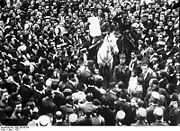 On September 13, 1923, the indignant military, headed by Captain General Miguel Primo de Rivera in Barcelona, overthrew the parliamentary government, upon which Primo de Rivera established himself as dictator. In his typically florid prose, he issued a Manifesto explaining the coup to the people. Resentful of the parliamentarians' attacks against him, King Alfonso tried to give Primo de Rivera legitimacy by naming him prime minister. In justifying his coup d'état, Primo de Rivera announced: "Our aim is to open a brief parenthesis in the constitutional life of Spain and to re-establish it as soon as the country offers us men uncontaminated with the vices of political organization." In other words, he believed that the old class of politicians had ruined Spain, that they sought only their own interests rather than patriotism and nationalism.
Although many leftists opposed the dictatorship, some of the public supported Primo de Rivera. Those Spaniards were tired of the turmoil and economic problems and hoped a strong leader, backed by the military, could put their country on the right track. Others were enraged that the parliament had been brushed aside. As he travelled through Spain, his emotional speeches left no doubt that he was a Spanish patriot. He proposed to keep the dictatorship in place long enough to sweep away the mess created by the politicians. In the meantime, he would use the state to modernize the economy and alleviate the problems of the working class.
Primo de Rivera began by appointing a supreme Directory of eight military men, with himself as president. He then decreed martial law and fired civilian politicians in the provinces, replacing them with middle-ranking officers. When members of the Cortes complained to the king, Alfonso dismissed them, and Primo de Rivera suspended the constitution and dissolved the legislative body. He also moved to repress separatists, who wanted to make the Basque provinces and Catalonia independent from Spain. Despite some reservations, the great Spanish philosopher and intellectual, José Ortega y Gasset
, wrote:
Nevertheless, other intellectuals such as Miguel de Unamuno
and Vicente Blasco Ibáñez
criticized the regime and were exiled.
The dictator enjoyed several successes in the early years of his regime. Chief among them was Morocco, which had been festering since the turn of the century. Primo de Rivera talked of abandoning the colony altogether, unless sufficient resources were available to defeat the rebellion, and began withdrawing Spanish forces. But when the Moroccans attacked the French sector, they drove the French and Spanish to unite to crush the defiance in 1925. Primo de Rivera himself went to Africa to help lead the troops, and 1927 brought victory to the Franco-Spanish forces. Grateful Spaniards rejoiced to think that decades of North African bloodletting and recriminations were over.
 De Rivera also worked to build infrastructure for his economically backward country. Spain had few cars when he came to power; by 1930, it possessed Europe's best network of automobile roads. The Barcelona Metro
, started many years earlier, opened in 1924. His economic planners built dams to harness the hydroelectric power of rivers, especially the Duero and the Ebro, and to provide water for irrigation. For the first time, electricity reached some of Spain's rural regions. The regime upgraded Spain's railroads, and this helped the Spanish iron and steel industry prosper. Between 1923 and 1927, foreign trade increased 300%. Overall, his government intervened to protect national producers from foreign competition. Such economic nationalism was largely the brainchild of Primo de Rivera's finance minister, José Calvo Sotelo
. While Spain benefited from the European post-World War I boom, its economic growth also came from Primo de Rivera's policies and the order his regime gave the country.
The tranquility was, in part, due to the dictatorship's ways to accommodate the interests of Spanish workers. Imitating the example of Benito Mussolini in Italy, Primo de Rivera forced management and labor to cooperate by organizing 27 corporations representing different industries and professions. Within each corporation, government arbitrators mediated disputes over wages, hours, and working conditions. This gave Spanish labor more influence than ever before. Individual workers also benefited because the regime undertook massive public works. The government financed such projects with huge public loans, which Calvo Sotelo argued would be repaid by the increased taxes resulting from economic expansion. Unemployment largely disappeared.
But Primo de Rivera brought order to Spain with a price: his regime was a dictatorship, albeit a mild one. He censored the press. When intellectuals criticized the government, he closed El Ateneo, the country's most famous political and literary club. To suppress the separatist fever in Barcelona, the regime tried to expunge Catalan culture. It was illegal to use Catalan in church services or to dance the sardana
. Furthermore, many of the dictator's economic reforms did not actually help the poor as huge public spending led to inflation, which the rich could cope with more easily. This led to a huge income disparity between the wealthy and working classes in Spain at the time.
Yet despite his paternalistic conservatism, Primo de Rivera was enough of a reformer and his policies were radical enough to threaten the interests of the traditional power elite. According to British historian Gerald Brenan
, "Spain needed radical reforms and he could only govern by the permission of the two most reactionary forces in the country—the Army and the Church." Primo de Rivera dared not tackle what was seen as Spain's most pressing problem, agrarian reform, because it would have provoked the great landholding elite. Writes historian Richard Herr, "Primo was not one to waken sleeping dogs, especially if they were big."
Primo de Rivera chiefly failed because he did not create a viable, legitimate political system to preserve and continue his reforms. He seems to have sincerely wanted the dictatorship to be as brief as possible and initially hoped that Spain could live with the Constitution of 1876 and a new group of politicians. The problem was to find new civilian leadership to take the place of the military. In 1923, he began to create a new "apolitical" party, the Patriotic Union
(UP), which was formally organized the following year. Primo de Rivera liked to claim that members of the UP were above the squabbling and corruption of petty politics, that they placed the nation's interests above their own. He thought it would bring ideal democracy to Spain by representing true public opinion. But the UP quite obviously was a political party, despite the dictator's naive protestations. Furthermore, it failed to attract enthusiastic support or even many members.
On December 3, 1925, he moved to restore legitimate government by dismissing the military Directory and replacing it with civilians. Still, the constitution remained suspended, and criticisms of the regime grew. By summer 1926, former politicians, led by conservative José Sánchez Guerra, pressed the king to remove Primo de Rivera and restore constitutional government. To demonstrate his public support, Primo de Rivera ordered the UP to conduct a plebiscite in September. Voters could endorse the regime or abstain. About a third of those able to vote declined to go to the polls.
As Spaniards tired of the dictatorship, the economic boom ended. The value of the peseta fell against foreign currencies, 1929 brought a bad harvest, and Spain's imports far outstripped the worth of its exports. Conservative critics blamed rising inflation on the government's spending for public works projects. Although no one recognized it at the time, the final months of the year brought the international economic slump which turned into the great depression of the 1930s.
When Primo de Rivera lost the support of the king and the armed forces, his dictatorship was doomed. The Spanish military had never unanimously backed his seizure of power, although it had tolerated his rule. But when Primo de Rivera began to inject politics into promotions for the artillery corps, it provoked hostility and opposition. Troubled by the regime's failure to legitimize itself or to solve the country's woes, the king also began to draw away. Alfonso, who had sponsored the establishment of Madrid's University City, watched with dismay as the country's students took to the streets to protest the dictatorship and the king's support for it. A clandestine pamphlet portrayed Alfonso as Primo de Rivera's dancing partner. Yet the king did not have to remove Primo de Rivera. On 26 January 1930, the dictator asked the military leaders if he still had their support. Their lukewarm responses, and his recognition that the king no longer backed him, persuaded him to resign two days later. Primo de Rivera retired to Paris, where he died from fever and diabetes on 16 March 1930.
In the early 1930s, as most of the western world, Spain fell into economic and political chaos. Alfonso XIII appointed General Dámaso Berenguer
, one of Primo de Rivera's opponents, to govern. But the monarch had discredited himself by siding with the dictatorship. Social revolution fermented in Catalonia. In April 1931, General José Sanjurjo
informed the King that he could not count on the loyalty of the armed forces. Alfonso XIII suspended the monarchy on 14 April 1931, leaving the royal family in Madrid. The act ushered in the Second Republic
. Two years later Primo de Rivera's eldest son, José Antonio
, founded the Falange
, a Spanish fascist party. Both José Antonio and his brother Fernando were arrested by republican forces once the Spanish Civil War
began in July 1936 and were executed in prison. The Nationalists led by Francisco Franco
won the Civil War and established a far more authoritarian regime. By that time, many Spaniards regarded Primo de Rivera's relatively mild regime and its economic optimism with greater fondness.
Turno
After almost a whole century of political instability and many civil wars, the aim of the Restoration was to ensure political stability in Spain. Under this plan, El Turno Pacífico was a system put in place by Antonio Cánovas del Castillo whereby the two "official" parties of the Cánovas...
system of alternating parties.
Early years
Miguel Primo de Rivera was born into a landowning military family of Jerez de la FronteraJerez de la Frontera
Jerez de la Frontera is a municipality in the province of Cádiz in the autonomous community of Andalusia, in southwestern Spain, situated midway between the sea and the mountains. , the city, the largest in the province, had 208,896 inhabitants; it is the fifth largest in Andalusia...
. His father was a retired colonel. His uncle, Fernando, was Captain General in Madrid and the soon-to-be first marquis of Estella. Fernando later participated in the plot to restore the constitutional monarchy in 1875, ending the tumultuous First Republic
First Spanish Republic
The First Spanish Republic was the political regime that existed in Spain between the parliamentary proclamation on 11 February 1873 and 29 December 1874 when General Arsenio Martínez-Campos's pronunciamento marked the beginning of the Bourbon Restoration in Spain...
. His mother was Fernandina de Busqueros (1845-1892), daughter of Roche de Busqueros, Knight of Calatrava (1822-1906). His great-grandfather was Bértrand Primo de Rivera (1741-1813), 21nd Count of Sobremonte, a general and hero of the Spanish Resistance against Napoleon Bonaparte.
The young Miguel grew up as part of what Gerald Brenan
Gerald Brenan
Edward FitzGerald "Gerald" Brenan, CBE was a British writer and Hispanist who spent much of his life in Spain.He is best known for The Spanish Labyrinth, a historical work on the background to the Spanish Civil War, and for South from Granada: Seven Years in an Andalusian Village...
called "a hard-drinking, whoring, horse-loving aristocracy" that ruled "over the most starved and down-trodden race of agricultural labourers in Europe." Studying history and engineering before deciding upon a military career, he won admission to the newly created General Academy in Toledo
Toledo, Spain
Toledo's Alcázar became renowned in the 19th and 20th centuries as a military academy. At the outbreak of the Spanish Civil War in 1936 its garrison was famously besieged by Republican forces.-Economy:...
, and graduated in 1884.
Early military career
Duty stationed him in posts within Spain and overseas. He showed courage and initiative in battles against the BerberBerber people
Berbers are the indigenous peoples of North Africa west of the Nile Valley. They are continuously distributed from the Atlantic to the Siwa oasis, in Egypt, and from the Mediterranean to the Niger River. Historically they spoke the Berber language or varieties of it, which together form a branch...
s of the Rif
Rif
The Rif or Riff is a mainly mountainous region of northern Morocco, with some fertile plains, stretching from Cape Spartel and Tangier in the west to Ras Kebdana and the Melwiyya River in the east, and from the Mediterranean Sea in the north to the river of Wergha in the south.It is part of the...
region in northern Morocco, and promotions and decorations came steadily. Primo de Rivera became convinced that Spain probably could not hold on to its North African colony. For many years, the government had tried without success to crush the Berber rebels, wasting lives and money. He concluded Spain must withdraw from what was called Spanish Morocco
Spanish Morocco
The Spanish protectorate of Morocco was the area of Morocco under colonial rule by the Spanish Empire, established by the Treaty of Fez in 1912 and ending in 1956, when both France and Spain recognized Moroccan independence.-Territorial borders:...
if it could not dominate the colony. Posted to Cuba
Cuba
The Republic of Cuba is an island nation in the Caribbean. The nation of Cuba consists of the main island of Cuba, the Isla de la Juventud, and several archipelagos. Havana is the largest city in Cuba and the country's capital. Santiago de Cuba is the second largest city...
and the Philippines
Philippines
The Philippines , officially known as the Republic of the Philippines , is a country in Southeast Asia in the western Pacific Ocean. To its north across the Luzon Strait lies Taiwan. West across the South China Sea sits Vietnam...
, he witnessed their loss to the United States
United States
The United States of America is a federal constitutional republic comprising fifty states and a federal district...
in 1898, bringing a close to his nation's once-great empire
Spanish Empire
The Spanish Empire comprised territories and colonies administered directly by Spain in Europe, in America, Africa, Asia and Oceania. It originated during the Age of Exploration and was therefore one of the first global empires. At the time of Habsburgs, Spain reached the peak of its world power....
. That loss frustrated many Spaniards, Primo de Rivera included. They criticized the politicians and the parliamentary system which could not maintain order or foster economic development at home, nor preserve the vestiges of Spain's imperial glory.
Primo de Rivera went to Madrid to serve in the Ministry of War with his uncle. Renowned for his amorous conquests, he reverted to the carefree days of his youth in Jerez. Then in 1902, he married a young Hispano-Cuban, Casilda Sáenz de Heredia. Their marriage was happy, and Casilda bore six children before her death in 1908, following the birth of Fernando. He later was sent on a military mission to France, Switzerland, and Italy in 1909.
The British historian Hugh Thomas
Hugh Thomas
Hugh Thomas , is a British historian and life peer.Hugh Thomas may also refer to:* Hugh Thomas , American choral conductor, pianist and educator* Hugh Thomas , Australian rules football coach...
says of Primo de Rivera in his monumental The Spanish Civil War: "He would work enormously hard for weeks on end and then disappear for a juerga of dancing, drinking and love-making with gypsies. He would be observed almost alone in the streets of Madrid, swathed in an opera cloak, making his way from one café to another, and on returning home would issue a garrulous and sometimes even intoxicated communiqué -- which he would often have to cancel in the morning."
Between 1909 and 1923, Primo de Rivera's career blossomed, but he became increasingly discouraged with the fortunes of his country. Having returned to Spanish Morocco
Spanish Morocco
The Spanish protectorate of Morocco was the area of Morocco under colonial rule by the Spanish Empire, established by the Treaty of Fez in 1912 and ending in 1956, when both France and Spain recognized Moroccan independence.-Territorial borders:...
, he was promoted to brigadier general
Brigadier General
Brigadier general is a senior rank in the armed forces. It is the lowest ranking general officer in some countries, usually sitting between the ranks of colonel and major general. When appointed to a field command, a brigadier general is typically in command of a brigade consisting of around 4,000...
in 1911, the first graduate of the General Academy to receive such a promotion. Yet social revolution had flared briefly in Barcelona
Barcelona
Barcelona is the second largest city in Spain after Madrid, and the capital of Catalonia, with a population of 1,621,537 within its administrative limits on a land area of...
, during the Tragic Week of 1909. After the army had called up conscripts to fight in the Second Rif War in Morocco, Radical republicans and anarchists in Catalonia had proclaimed a general strike. Violence had erupted when the government declared martial law
Martial law
Martial law is the imposition of military rule by military authorities over designated regions on an emergency basis— only temporary—when the civilian government or civilian authorities fail to function effectively , when there are extensive riots and protests, or when the disobedience of the law...
. Anticlerical rioters had burned churches and convents, and tensions grew as socialists and anarchists pressed for radical changes in Spain. The government proved unable to reform itself or the nation and frustration mounted.
After 1918, post-World War I
World War I
World War I , which was predominantly called the World War or the Great War from its occurrence until 1939, and the First World War or World War I thereafter, was a major war centred in Europe that began on 28 July 1914 and lasted until 11 November 1918...
economic difficulties heightened social unrest in Spain. The Cortes
Cortes Generales
The Cortes Generales is the legislature of Spain. It is a bicameral parliament, composed of the Congress of Deputies and the Senate . The Cortes has power to enact any law and to amend the constitution...
(Spanish parliament) under the constitutional monarchy seemed to have no solution to Spain's unemployment, labor strikes, and poverty. In 1921, the Spanish army suffered a stunning defeat in Morocco at the Battle of Annual, which discredited the military's North African policies. By 1923, deputies of the Cortes called for an investigation into the responsibility of King Alfonso XIII
Alfonso XIII of Spain
Alfonso XIII was King of Spain from 1886 until 1931. His mother, Maria Christina of Austria, was appointed regent during his minority...
and the armed forces for the debacle. Rumors of corruption in the army became rampant.
Military establishes dictatorship
Although many leftists opposed the dictatorship, some of the public supported Primo de Rivera. Those Spaniards were tired of the turmoil and economic problems and hoped a strong leader, backed by the military, could put their country on the right track. Others were enraged that the parliament had been brushed aside. As he travelled through Spain, his emotional speeches left no doubt that he was a Spanish patriot. He proposed to keep the dictatorship in place long enough to sweep away the mess created by the politicians. In the meantime, he would use the state to modernize the economy and alleviate the problems of the working class.
Primo de Rivera began by appointing a supreme Directory of eight military men, with himself as president. He then decreed martial law and fired civilian politicians in the provinces, replacing them with middle-ranking officers. When members of the Cortes complained to the king, Alfonso dismissed them, and Primo de Rivera suspended the constitution and dissolved the legislative body. He also moved to repress separatists, who wanted to make the Basque provinces and Catalonia independent from Spain. Despite some reservations, the great Spanish philosopher and intellectual, José Ortega y Gasset
José Ortega y Gasset
José Ortega y Gasset was a Spanish liberal philosopher and essayist working during the first half of the 20th century while Spain oscillated between monarchy, republicanism and dictatorship. He was, along with Nietzsche, a proponent of the idea of perspectivism.-Biography:José Ortega y Gasset was...
, wrote:
- "The alpha and omega of the task that the military Directory has imposed is to make an end of the old politics.
- "The purpose is so excellent, that there is no room for objections. The old politics must be ended."
Nevertheless, other intellectuals such as Miguel de Unamuno
Miguel de Unamuno
Miguel de Unamuno y Jugo was a Spanish essayist, novelist, poet, playwright and philosopher.-Biography:...
and Vicente Blasco Ibáñez
Vicente Blasco Ibáñez
Vicente Blasco Ibáñez was a Spanish realist novelist writing in Spanish, a screenwriter and occasional film director....
criticized the regime and were exiled.
The dictator enjoyed several successes in the early years of his regime. Chief among them was Morocco, which had been festering since the turn of the century. Primo de Rivera talked of abandoning the colony altogether, unless sufficient resources were available to defeat the rebellion, and began withdrawing Spanish forces. But when the Moroccans attacked the French sector, they drove the French and Spanish to unite to crush the defiance in 1925. Primo de Rivera himself went to Africa to help lead the troops, and 1927 brought victory to the Franco-Spanish forces. Grateful Spaniards rejoiced to think that decades of North African bloodletting and recriminations were over.
Promoting infrastructure
Barcelona Metro
The Barcelona Metro , part of the public transportation system of Barcelona, Catalonia, is an extensive network of electrified railways that run underground in central Barcelona and above ground into the city's suburbs. Since July 31, 2010, Barcelona Metro system consists of 11 lines with 165...
, started many years earlier, opened in 1924. His economic planners built dams to harness the hydroelectric power of rivers, especially the Duero and the Ebro, and to provide water for irrigation. For the first time, electricity reached some of Spain's rural regions. The regime upgraded Spain's railroads, and this helped the Spanish iron and steel industry prosper. Between 1923 and 1927, foreign trade increased 300%. Overall, his government intervened to protect national producers from foreign competition. Such economic nationalism was largely the brainchild of Primo de Rivera's finance minister, José Calvo Sotelo
José Calvo Sotelo
José Calvo Sotelo, 1st Duke of Calvo Sotelo was a Spanish politician prior to and during the Second Spanish Republic...
. While Spain benefited from the European post-World War I boom, its economic growth also came from Primo de Rivera's policies and the order his regime gave the country.
The tranquility was, in part, due to the dictatorship's ways to accommodate the interests of Spanish workers. Imitating the example of Benito Mussolini in Italy, Primo de Rivera forced management and labor to cooperate by organizing 27 corporations representing different industries and professions. Within each corporation, government arbitrators mediated disputes over wages, hours, and working conditions. This gave Spanish labor more influence than ever before. Individual workers also benefited because the regime undertook massive public works. The government financed such projects with huge public loans, which Calvo Sotelo argued would be repaid by the increased taxes resulting from economic expansion. Unemployment largely disappeared.
But Primo de Rivera brought order to Spain with a price: his regime was a dictatorship, albeit a mild one. He censored the press. When intellectuals criticized the government, he closed El Ateneo, the country's most famous political and literary club. To suppress the separatist fever in Barcelona, the regime tried to expunge Catalan culture. It was illegal to use Catalan in church services or to dance the sardana
Sardana
The sardana is a type of circle dance typical of Catalonia, Spain. The dance was originally from the Empordà region, but started gaining popularity throughout Catalonia during the 20th century....
. Furthermore, many of the dictator's economic reforms did not actually help the poor as huge public spending led to inflation, which the rich could cope with more easily. This led to a huge income disparity between the wealthy and working classes in Spain at the time.
Yet despite his paternalistic conservatism, Primo de Rivera was enough of a reformer and his policies were radical enough to threaten the interests of the traditional power elite. According to British historian Gerald Brenan
Gerald Brenan
Edward FitzGerald "Gerald" Brenan, CBE was a British writer and Hispanist who spent much of his life in Spain.He is best known for The Spanish Labyrinth, a historical work on the background to the Spanish Civil War, and for South from Granada: Seven Years in an Andalusian Village...
, "Spain needed radical reforms and he could only govern by the permission of the two most reactionary forces in the country—the Army and the Church." Primo de Rivera dared not tackle what was seen as Spain's most pressing problem, agrarian reform, because it would have provoked the great landholding elite. Writes historian Richard Herr, "Primo was not one to waken sleeping dogs, especially if they were big."
Primo de Rivera chiefly failed because he did not create a viable, legitimate political system to preserve and continue his reforms. He seems to have sincerely wanted the dictatorship to be as brief as possible and initially hoped that Spain could live with the Constitution of 1876 and a new group of politicians. The problem was to find new civilian leadership to take the place of the military. In 1923, he began to create a new "apolitical" party, the Patriotic Union
Spanish Patriotic Union
The Spanish Patriotic Union, UPE was the political party created from above by Spanish dictator Miguel Primo de Rivera, conceived as a support to his conservative dictatorship and integrating political catholicism, technocrats, and the business-owning classes.After the establishment of the Second...
(UP), which was formally organized the following year. Primo de Rivera liked to claim that members of the UP were above the squabbling and corruption of petty politics, that they placed the nation's interests above their own. He thought it would bring ideal democracy to Spain by representing true public opinion. But the UP quite obviously was a political party, despite the dictator's naive protestations. Furthermore, it failed to attract enthusiastic support or even many members.
On December 3, 1925, he moved to restore legitimate government by dismissing the military Directory and replacing it with civilians. Still, the constitution remained suspended, and criticisms of the regime grew. By summer 1926, former politicians, led by conservative José Sánchez Guerra, pressed the king to remove Primo de Rivera and restore constitutional government. To demonstrate his public support, Primo de Rivera ordered the UP to conduct a plebiscite in September. Voters could endorse the regime or abstain. About a third of those able to vote declined to go to the polls.
New political system created
Nevertheless, buoyed by his victory, Primo de Rivera decided to create an entirely new political system. On 10 October 1927, with the king in attendance, he opened a National Assembly. Although they met in the Cortes chamber, members of the regime-appointed assembly could only advise Primo de Rivera. They had no legislative power. In 1929, following guidance from the dictator, the assembly finally produced a new constitution. Among its provisions, it gave women the vote because Primo de Rivera believed their political views less susceptible to political radicalism. He intended to have the nation accept the new constitution in another plebiscite, to be held in 1930.As Spaniards tired of the dictatorship, the economic boom ended. The value of the peseta fell against foreign currencies, 1929 brought a bad harvest, and Spain's imports far outstripped the worth of its exports. Conservative critics blamed rising inflation on the government's spending for public works projects. Although no one recognized it at the time, the final months of the year brought the international economic slump which turned into the great depression of the 1930s.
When Primo de Rivera lost the support of the king and the armed forces, his dictatorship was doomed. The Spanish military had never unanimously backed his seizure of power, although it had tolerated his rule. But when Primo de Rivera began to inject politics into promotions for the artillery corps, it provoked hostility and opposition. Troubled by the regime's failure to legitimize itself or to solve the country's woes, the king also began to draw away. Alfonso, who had sponsored the establishment of Madrid's University City, watched with dismay as the country's students took to the streets to protest the dictatorship and the king's support for it. A clandestine pamphlet portrayed Alfonso as Primo de Rivera's dancing partner. Yet the king did not have to remove Primo de Rivera. On 26 January 1930, the dictator asked the military leaders if he still had their support. Their lukewarm responses, and his recognition that the king no longer backed him, persuaded him to resign two days later. Primo de Rivera retired to Paris, where he died from fever and diabetes on 16 March 1930.
In the early 1930s, as most of the western world, Spain fell into economic and political chaos. Alfonso XIII appointed General Dámaso Berenguer
Dámaso Berenguer
Dámaso Berenguer y Fusté, Count of Xauen was a Spanish soldier and politician.Berenguer was born in San Juan de los Remedios, Cuba, while that island nation was still a Spanish province....
, one of Primo de Rivera's opponents, to govern. But the monarch had discredited himself by siding with the dictatorship. Social revolution fermented in Catalonia. In April 1931, General José Sanjurjo
José Sanjurjo
General José Sanjurjo y Sacanell, 1st Marquis of the Rif was a General in the Spanish Army who was one of the chief conspirators in the military uprising that led to the Spanish Civil War.-Early life:...
informed the King that he could not count on the loyalty of the armed forces. Alfonso XIII suspended the monarchy on 14 April 1931, leaving the royal family in Madrid. The act ushered in the Second Republic
Second Spanish Republic
The Second Spanish Republic was the government of Spain between April 14 1931, and its destruction by a military rebellion, led by General Francisco Franco....
. Two years later Primo de Rivera's eldest son, José Antonio
José Antonio Primo de Rivera
José Antonio Primo de Rivera y Sáenz de Heredia, 1st Duke of Primo de Rivera, 3rd Marquis of Estella , was a Spanish lawyer, nobleman, politician, and founder of the Falange Española...
, founded the Falange
Falange
The Spanish Phalanx of the Assemblies of the National Syndicalist Offensive , known simply as the Falange, is the name assigned to several political movements and parties dating from the 1930s, most particularly the original fascist movement in Spain. The word means phalanx formation in Spanish....
, a Spanish fascist party. Both José Antonio and his brother Fernando were arrested by republican forces once the Spanish Civil War
Spanish Civil War
The Spanish Civil WarAlso known as The Crusade among Nationalists, the Fourth Carlist War among Carlists, and The Rebellion or Uprising among Republicans. was a major conflict fought in Spain from 17 July 1936 to 1 April 1939...
began in July 1936 and were executed in prison. The Nationalists led by Francisco Franco
Francisco Franco
Francisco Franco y Bahamonde was a Spanish general, dictator and head of state of Spain from October 1936 , and de facto regent of the nominally restored Kingdom of Spain from 1947 until his death in November, 1975...
won the Civil War and established a far more authoritarian regime. By that time, many Spaniards regarded Primo de Rivera's relatively mild regime and its economic optimism with greater fondness.
External links
- Encyclopædia Britannica
- Miguel Primo de Rivera on Spanish Wikipedia