


Pamplona

Encyclopedia
Pamplona is the historial capital city of Navarre
, in Spain
, and of the former kingdom of Navarre
.
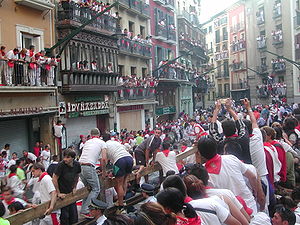
The city is famous worldwide for the San Fermín
festival, from July 6 to 14, in which the running of the bulls is one of the main attractions. This festival was immortalised by Ernest Hemingway
in his novel The Sun Also Rises
.
After the 2011 municipal elections, there are 27 councillors in Pamplona Municipality: eleven of Navarrese People's Union
(Unión del Pueblo Navarro), seven of Nafarroa Bai
, three of Spanish Socialist Workers' Party
, three of Bildu
, two of People's Party
, and one of Izquierda-Ezkerra.
valley. It is 92 kilometres from the city of San Sebastián, 117 kilometres from Bilbao, 735 kilometres from Paris and 407 kilometres from Madrid. The climate and landscape of the basin is a transition between those two main Navarrese geographical regions. Its central position at crossroads has served as a commercial link between those very different natural parts of Navarre.
The historical centre of Pamplona is on the right bank of the Arga
, a tributary of the Ebro. The city has developed on both sides of the river. Its climate is Oceanic
with influences of Continental Mediterranean.
general Pompey
in the war against Sertorius. He is considered to be the founder of Pompaelo, which became Pamplona, in modern Spanish language
. Actually it was the chief town of the Vascones, and they called it Iruña, 'the city'. Roman Pompaelo was located in the province of Hispania Tarraconensis
, on the Ab Asturica Burdigalam
, the road from Burdigala (modern Bordeaux
) to Asturica (modern Astorga
); it was a civitas stipendiaria in the jurisdiction of the conventus
of Caesaraugusta (modern Zaragoza
).
´s ravaging, Pamplona went through much disruption and destruction, starting a cycle of general decline along with other towns across the Basque territory but managing to keep some sort of urban life. During the Visigothic period (fifth to eighth centuries), Pamplona alternated between self-rule, Visigoth domination or Frankish suzerainty in the Duchy of Vasconia
(Councils of Toledo unattended by several Pamplonese bishop
s between 589 and 684). In the years 466 to 472, Pamplona was conquered by the Visigoth count Gauteric, but they seemed to abandon the restless position soon, struggling as the Visigoth Kingdom was to survive and rearrange its lands after their defeats in Gaul. During the beginning of the 6th century, Pamplona probably stuck to an unstable self-rule, but in 541 Pamplona along with other northern Iberian cities was raided by the Franks.
Circa 581, the Visigoth king Liuvigild overcame the Basques, seized Pamplona and founded in Vasconia the town of Victoriacum. Despite the legend citing Saint Fermin
as the first bishop of Pamplona and his baptising of 40,000 pagan inhabitants in just three days, first reliable accounts of a bishop date from 589, when bishop Liliolus attended the Third Council of Toledo
. After 684 and 693, a bishop called Opilano is mentioned again in 829, followed by Wiliesind and a certain Jimenez from 880 to 890. Even in the 10th century important gaps are found in bishop succession, which is recorded unbroken only after 1005.
At the time of the Muslim invasion in 711, the Visigothic king Roderic
was fighting the Basques in Pamplona and had to turn his attention to the new enemy coming from the south. By 714-16, the Muslims troops reached the Basque held Pamplona, with the town submitting apparently after a treaty was brokered between the inhabitants and the Arab military commanders. During the following years, the Basques south of the Pyrenees don´t seem to have showed much resistance to the Moorish thrust, and even Pamplona may have flourished as a launching point and centre of assembly for their expeditions to Gascony
. However, in 755 the last governor of Al-Andalus
, Yusuf al Fihri, detoured an expedition north to quash Basque unrest near Pamplona, resulting in the defeat of the Arab army.
During the eighth century, Pamplona and its hinterland oscillated between two powerful states, Moors
and Franks
, but they proved unable to permanently secure its rule over the Basque region. That alternation reflected the internal struggles of the Basque warrior nobility. Although sources are not clear, it seems apparent that in 778 the town was in hands of a Basque local or Muslim rebel faction loyal to the Franks at the moment of Charlemagne´s crossing of the Pyrenees to the south. However, on his way back from the failed expedition to Saragossa in August, the walls and probably the town was destroyed by Charlemagne
ahead of the Frankish defeat in the famous Battle of Roncevaux, out of fear that the anti-Frankish party strong in the town may use the position against them.
After the Frankish defeat in Roncevaux, Pamplona switched again to Cordovan rule up to the 799 rebellion. This year, Pamplonese maybe led by a certain Velasko stirred against the Ummayyad governor of the town Mutarrif ibn-Musa and later the inhabitants provided some support for the Banu Qasi
Fortun ibn-Musa's uprising. This regional revolt was shortly after suppressed by the Cordovan emir Hisham I
and order re-establihsed, but failed to retain grip on the town, since the Pamplonese returned to Frankish suzerainty in 806.
Following a failed expedition to the town led by Louis the Pious
around 812, allegiance to the Franks collapsed after Enecco Arista jumped to prominence. Moreover, he was crowned as king of Pamplona in 824 when himself and the Banu Qasi
gained momentum in the wake of their victorious the third battle of Roncevaux. The new kingdom, inextricably linked to the Banu Qasi of Tudela, strengthened its independence from the weakened Frankish empire and Cordoban emirate
.
During this period Pamplona was not properly a town but just a kind of fortress. In 924 Muslim sources describe Pamplona as "not being especially gifted by nature", with its inhabitants being poor, not eating enough and dedicating to banditry. They are reported to speak Basque for the most part, which "makes them incomprehensible". On the 24 July, in this Cordovan military campaign, Pamplona's houses and buildings were destroyed and its celebrated church pulled down by the Muslim army, who found the position deserted and forsaken. The town´s urban and human shape would only change after the Vikings' and Muslim raids came to an end and the establishment of new cultures via Way of St James hailing from north of the Pyrenees, starting in 1083.
, had actually held the religious authority. The pilgrimages to Santiago de Compostela contributed a lot to revive the commercial and cultural exchanges with Christian Europe beyond the Pyrenees
. In the 12th century, the city enlarged with two new separate burgos (independent boroughs): San Cernín (Saint Saturnin) and San Nicolás, in which the population of local Navarrese was swelled by Occitan merchants and artisans. The boroughs showed very distinct features both socially and culturally, and were almost always engaged in quarrels among themselves. The most dramatic episode was the destruction of the Navarrería by the other two boroughs and the massacre of its population in 1276. Its site was abandoned for nearly fifty years. King Charles III
decreed the unification of the boroughs in a single city in 1423.
built a castle in the early 14th century in the site that is known today as Plaza del Castillo (Castle Square). After the Castilian conquest, king Ferdinand V ordered in 1513 the demolition of the medieval castle and the building of a new one in a very close place. But the progress of artillery
demanded a complete renewal of the fortified system. King Philip II
ordered the building of a star fort
and the modernization of all the walls in the southern side of the city, mainly to keep locals in check and strengthen the outpost Pamplona had become on the border with France. The walls that exist today date from the late 16th to 18th centuries.
 During the eighteenth century, Pamplona was considerably beautified and its urban services improved. A continuous water supply
was established and the streets were paved, among many other enhancements. Rich aristocrats and businessmen also built their mansions. In the nineteenth century this fortress-city played a key role in several wars in which Spain was involved. During the Napoleonic Wars
French troops occupied the city in 1808 and remained in it until 1813. During the Carlist Wars
(1833–1839 and 1872–1876) Pamplona was each time controlled by the liberals, not just because the few liberals that lived in Navarre were mainly Pamplonese, but because of the governmental control over the fortified city. Although Carlist rebels easily ruled the countryside, the government army had no problem in dominating the walled capital of Navarre. Nevertheless, during the last Carlist war, modern artillery operated by Carlists from surrounding mountains showed that the old walls would not be enough in the face of a stronger enemy. Thus, the Government decided to build a fort on the top of mount San Cristóbal
, just three kilometers north of Pamplona.
Due to its military role, the city could not grow outside its walled belt. Furthermore, building in the closest area to the walls was banned to avoid any advantage for a besieger; thus the city could only grow by increasing its housing density. Higher and narrower houses were built and courtyards gradually disappeared. During the nineteenth century road transportation improved, and the railway came in 1860. Nevertheless, industry in Pamplona as well as in Navarre as a whole was weak during century of the Industrial Revolution
. Anyway, no industrial development was feasible in such a constrained fortress-city.
After a slight modification of the star fort allowed an expansion of just six blocks in 1888, the First World War demonstrated that the fortified system of Pamplona was already obsolete. In 1915, the Army allowed the destruction of the walls and abolished the building ban in the city's surroundings. The southern side of the walls was destroyed and the other three remained as they did not hinder urban growth. The star fort continued to serve as a military facility until 1964, but just as a garrison.
has been accompanied by the development of industry and services. Population growth has been the effect of an intense immigration process during the 1960s and 1970s: from the Navarrese countryside and from other less developed regions of Spain, mainly Castile and León
and Andalusia
. Since the 1990s the immigration is coming mainly from abroad
.
Pamplona is listed as a city with one of the highest standards of living
and quality of life
in Spain. Its industry rate is higher than the national average, although it is threatened by delocalization. Crime statistics
are lower than the national average but cost of living, especially housing, is considerably higher. Thanks to its small size and an acceptable public transport
service, there are no major transport problems. Political life is affected by bitter confrontation between parties with opposing Basque and Spanish national views.
decreed the unification of the three places under a single municipality in 1423.
The city did not expand until the late 19th century. In 1888, a modest modification of the star fort was allowed, but it just permitted the building of six blocks. It was called the I Ensanche (literally, "first widening"). The southern walls were destroyed in 1915 and the II Ensanche ("second widening") was planned. Its plan followed the grid pattern
model designed by Ildefons Cerdà
for Barcelona
. Its blocks were built between the 20s and the 50s. The prevailing housing model is apartment buildings of five to eight floors.
After the Civil War
, three new zones of Pamplona began to grow: Rochapea, Milagrosa, and Chantrea. Only the last one was a planned neighborhood, the other two being disorderly growths. In 1957, the municipality designed the first general ordination plan for the city, which established the guidelines for further urban development. According to this, during the 60s and 70s saw the creation of new neighborhoods like San Juan, Iturrama, San Jorge, Etxbakoitz, and Orbina.
The urban growth of Pamplona outgrew the administrative limits of the city and involved municipalities like Barañáin
, Burlada
, Villava, Ansoain
, Berriozar
, Noain
or Huarte
in a larger metropolitan area. During the 1980s and 1990s, new neighborhoods were born: Azpilagaña, Mendebaldea, and Mendillorri. Rochapea was profoundly renewed. The urban development of those new neighborhoods is very similar to other Spanish provincial capitals that experienced a similar intense economic development during the sixties and seventies. Although the grid plan is not applied anymore, the urbanization in Pamplona is previously designed and the apartment buildings are taller: never less than five floors and many taller than ten. Industry, which previously coexisted with housing, was moved to industrial parks (the oldest and the only one within municipal limits of Pamplona is Landaben).
In recent years, single-family house neighborhoods have grown in the metropolitan area: Zizur Mayor
, Cizur Menor
, Mutilva Alta
, Mutilva Baja
, Olaz
, Esquíroz
, Artica
and Alzuza
. New neighborhoods are being building in Buztintxuri, Lezkairu, and Sarriguren
. The apartment buildings in those zones tend to be quite shorter, usually not more than six floors and with more room for green areas.
sector is diversified although the most important activity is related to automobile industry. Volkswagen
manufactures Polo model
in its factory of Landaben and there are many auxiliary industries that work for Volkswagen and other companies. Other remarkable industries are building materials, metalworking
and food processing
. Renewable energy technologies are also an increasing economic sector (wind turbines manufacturing and generation
) and neighboring Sarriguren
is the seat of the National Centre for Renewable Energies (CENER) and of Acciona Energía
.
Pamplona is the main commercial and services center of Navarre. Its area of influence is not beyond the province, except for the University of Navarre and its teaching hospital, which provide private educational and health services nationwide and even internationally.
, a corporate work of Opus Dei
founded in 1952, which is ranked as the best private university in Spain, and the Public University of Navarre
, established by the Government of Navarre in 1987. There is also a local branch of the UNED (Universidad Nacional de Educación a Distancia).
The two most important museums in Pamplona are the Museo de Navarra, devoted to the archaeological and artistic heritage of Navarre, and the Museo Diocesano of religious art, located in the cathedral. Pamplona is the first Spanish city in the French way
of the Way of Saint James. Since 2004, Pamplona venues Punto de Vista International Documentary Film Festival
, the most important Spanish documentary film
festival.
(1978), San Sebastián
, Vitoria
(1995) and Logroño
(2006). Since 2007 buses use a new bus station
in the city centre that replaces the old one (1934). The airport
(1972), operated by Aena
and located in Noain
, schedules several flights daily to Madrid
and Barcelona
. There are railway (1861) links with Madrid
, Zaragoza
and northern Spain, operated by Renfe
. High speed train
link with Zaragoza Madrid and Barcelona is not expected before 2014. A new railway station will be built in the southern part of the city. There are 23 daytime lines and 10 night lines of public buses, operated by TCC La Montañesa, the chartered company of the Mancomunidad de la Comarca de Pamplona
.
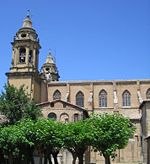 The most important religious building is the fourteenth century Gothic
Cathedral
, with an outstanding cloister
and a Neoclassical
façade
. There are another two main Gothic churches in the old city: Saint Sernin and Saint Nicholas, both built during the thirteenth century. Two other Gothic churches were built during the sixteenth century: Saint Dominic and Saint Augustine. During the seventeenth and eighteenth century were built the Baroque
chapels of Saint Fermin, in the church of Saint Lawrence, and of the Virgin of the Road (Virgen del Camino), in the church of Saint Sernin, the convents of the Augustinian Recollect
nuns and the Carmelite friars, and the Saint Ignatius of Loyola basilica in the place where he was injured in the battle and during the subsequent convalescence he decided to be a priest. The most remarkable twentieth century religious buildings are probably the new diocesan seminary
(1931) and the classical-revival style memorial church (1942) to the Navarrese dead in the Nationalist side of the Civil War
and that is used today as temporary exhibitions room.
The oldest civil building today existing is a fourteenth century house that was used as Cámara de Comptos (the court of auditors of the early modern autonomous kingdom of Navarre) from the sixteenth to the nineteenth century. There are also several medieval bridges on the Arga: Santa Engracia, Miluce, Magdalena, and San Pedro. The medieval palace of Saint Peter, which was alternatively used by Navarrese kings and Pamplonese bishops, was used during the early modern age as the Viceroy's
palace and later was the seat of the military governor of Navarre; from the time of the Civil War it was in ruins but was recently rebuilt to be used as the General Archive of Navarre.
The most outstanding Baroque civil architecture is from the eighteenth century: town hall, episcopal palace, Saint John the Baptist seminary, and the Rozalejo's, Ezpeleta's (today music school), Navarro-Tafalla's (today, the local office of PNV), and Guenduláin's (today, a hotel) mansions. The provincial government built its own Neoclassical palace, the so-called Palace of Navarre, during the nineteenth century.
Late nineteenth and early twentieth century Pamplonese architecture shows the tendencies that are fully developed in other more important Spanish cities: La Agrícola building (1912), several apartment buildings with some timid modernist ornamentation, etc. The most notable architect in twentieth century Pamplona was Víctor Eusa (1894–1979), whose designs were influenced by the European expressionism and other avant-garde movements.
The Media Luna park was built as part of the II Ensanche and is intended to allow relaxing strolling and sightseeing over the northern part of the town. After its demilitarization, the citadel (Ciudadela) and its surrounding area (Vuelta del Castillo) shifted into a park area with large lawns and modern sculptures.
The most remarkable parks of the new neighborhoods include the Yamaguchi park, between Iturrama and Ermitagaña, which includes a little Japanese garden
; the campus of the University of Navarre; the Parque del Mundo in Chantrea; and the Arga park.
(CA "Health") is the local football team. Their home stadium is called Reyno de Navarra ("Kingdom of Navarre
"), known as El Sadar until January, 2006.
Pamplona's bull ring was rebuilt in 1923. It seats 19,529 and is the third largest in the world, after the bull rings of Mexico and Madrid.
Other sports with some of the top clubs in Pamplona include handball
(Portland San Antonio, Europe's championship winner 2001), futsal
(MRA Xota) and water polo
(Larraina).
Pamplona's favourite son may well be Miguel Indurain
, five time Tour de France
winner. Arsenal
goalkeeper Manuel Almunia
is also from Pamplona.
The Caisse d'Epargne Cycling Team, the direct descendent of Indurain's Banesto team, is based in Egüés
, a municipality
in the metropolitan area
of Pamplona.
Pamplona is also home to the headquarters of The International Federation of Basque Pelota (FIPV). Basque pelota is principally practiced in France, SSpain and North and South America, but also in another countries like Italy and Philippines.
Navarre
Navarre , officially the Chartered Community of Navarre is an autonomous community in northern Spain, bordering the Basque Country, La Rioja, and Aragon in Spain and Aquitaine in France...
, in Spain
Spain
Spain , officially the Kingdom of Spain languages]] under the European Charter for Regional or Minority Languages. In each of these, Spain's official name is as follows:;;;;;;), is a country and member state of the European Union located in southwestern Europe on the Iberian Peninsula...
, and of the former kingdom of Navarre
Kingdom of Navarre
The Kingdom of Navarre , originally the Kingdom of Pamplona, was a European kingdom which occupied lands on either side of the Pyrenees alongside the Atlantic Ocean....
.
The city is famous worldwide for the San Fermín
San Fermín
The festival of San Fermín in the city of Pamplona , is a deeply rooted celebration held annually from 12:00, 6 July, when the opening of the fiesta is marked by setting off the pyrotechnic chupinazo, to midnight 14 July, with the singing of the Pobre de Mí...
festival, from July 6 to 14, in which the running of the bulls is one of the main attractions. This festival was immortalised by Ernest Hemingway
Ernest Hemingway
Ernest Miller Hemingway was an American author and journalist. His economic and understated style had a strong influence on 20th-century fiction, while his life of adventure and his public image influenced later generations. Hemingway produced most of his work between the mid-1920s and the...
in his novel The Sun Also Rises
The Sun Also Rises
The Sun Also Rises is a 1926 novel written by American author Ernest Hemingway about a group of American and British expatriates who travel from Paris to the Festival of San Fermín in Pamplona to watch the running of the bulls and the bullfights. An early and enduring modernist novel, it received...
.
After the 2011 municipal elections, there are 27 councillors in Pamplona Municipality: eleven of Navarrese People's Union
Navarrese People's Union
The Navarrese People's Union , abbreviated to UPN, is a regional conservative political party in Navarre, Spain. Until 2008, it was a fraternal party of the People's Party , acting as the latter's Navarrese branch....
(Unión del Pueblo Navarro), seven of Nafarroa Bai
Nafarroa Bai
Nafarroa Bai is a Navarrese coalition of both left and right wing Basque nationalist parties which was created for the 2004 Spanish General election....
, three of Spanish Socialist Workers' Party
Spanish Socialist Workers' Party
The Spanish Socialist Workers' Party is a social-democratic political party in Spain. Its political position is Centre-left. The PSOE is the former ruling party of Spain, until beaten in the elections of November 2011 and the second oldest, exceeded only by the Partido Carlista, founded in...
, three of Bildu
Bildu
Bildu is a Basque nationalist, separatist and abertzale leftist political coalition active in the Basque Country and Navarre. It was official launched on 3 April 2011...
, two of People's Party
People's Party (Spain)
The People's Party is a conservative political party in Spain.The People's Party was a re-foundation in 1989 of the People's Alliance , a party led and founded by Manuel Fraga Iribarne, a former Minister of Tourism during Francisco Franco's dictatorship...
, and one of Izquierda-Ezkerra.
Geography
Pamplona is located in the middle of Navarre in a rounded valley, known as the Basin of Pamplona, that links the mountainous North with the EbroEbro
The Ebro or Ebre is one of the most important rivers in the Iberian Peninsula. It is the biggest river by discharge volume in Spain.The Ebro flows through the following cities:*Reinosa in Cantabria.*Miranda de Ebro in Castile and León....
valley. It is 92 kilometres from the city of San Sebastián, 117 kilometres from Bilbao, 735 kilometres from Paris and 407 kilometres from Madrid. The climate and landscape of the basin is a transition between those two main Navarrese geographical regions. Its central position at crossroads has served as a commercial link between those very different natural parts of Navarre.
The historical centre of Pamplona is on the right bank of the Arga
Arga River
The Arga is a river of Navarre, in Spain and is one of the tributaries of the river Ebro. The Arga was known as the river Runa in antiquity. Situated in the north-east of Spain, the river stretches some 145 kilometres, and has a basin of 2,759 km², 2,652 km² of which is in Navarre...
, a tributary of the Ebro. The city has developed on both sides of the river. Its climate is Oceanic
Oceanic climate
An oceanic climate, also called marine west coast climate, maritime climate, Cascadian climate and British climate for Köppen climate classification Cfb and subtropical highland for Köppen Cfb or Cwb, is a type of climate typically found along the west coasts at the middle latitudes of some of the...
with influences of Continental Mediterranean.
Foundation and Roman times
In the winter of 75–74 BC, the area served as a camp for the RomanRoman Republic
The Roman Republic was the period of the ancient Roman civilization where the government operated as a republic. It began with the overthrow of the Roman monarchy, traditionally dated around 508 BC, and its replacement by a government headed by two consuls, elected annually by the citizens and...
general Pompey
Pompey
Gnaeus Pompeius Magnus, also known as Pompey or Pompey the Great , was a military and political leader of the late Roman Republic...
in the war against Sertorius. He is considered to be the founder of Pompaelo, which became Pamplona, in modern Spanish language
Spanish language
Spanish , also known as Castilian , is a Romance language in the Ibero-Romance group that evolved from several languages and dialects in central-northern Iberia around the 9th century and gradually spread with the expansion of the Kingdom of Castile into central and southern Iberia during the...
. Actually it was the chief town of the Vascones, and they called it Iruña, 'the city'. Roman Pompaelo was located in the province of Hispania Tarraconensis
Hispania Tarraconensis
Hispania Tarraconensis was one of three Roman provinces in Hispania. It encompassed much of the Mediterranean coast of Spain along with the central plateau. Southern Spain, the region now called Andalusia, was the province of Hispania Baetica...
, on the Ab Asturica Burdigalam
Ab Asturica Burdigalam
Ab Asturica Burdigalam was a Roman road that linked the towns of Asturica Augusta in Gallaecia and Burdigala in Aquitania....
, the road from Burdigala (modern Bordeaux
Bordeaux
Bordeaux is a port city on the Garonne River in the Gironde department in southwestern France.The Bordeaux-Arcachon-Libourne metropolitan area, has a population of 1,010,000 and constitutes the sixth-largest urban area in France. It is the capital of the Aquitaine region, as well as the prefecture...
) to Asturica (modern Astorga
Astorga, Spain
Astorga is a town in the province of León, northern Spain. It lies southwest of the provincial capital of León, and is the head of the council of La Maragatería. The river Tuerto flows through it. , its population was about 12,100 people....
); it was a civitas stipendiaria in the jurisdiction of the conventus
Conventus iuridicus
In Ancient Rome territorial organization, a conventus iuridicus was the capital city of a subdivision of some provinces with functions of seat of a district court of justice and maybe others.-External links:...
of Caesaraugusta (modern Zaragoza
Zaragoza
Zaragoza , also called Saragossa in English, is the capital city of the Zaragoza Province and of the autonomous community of Aragon, Spain...
).
Early Middle Ages
During the Germanic invasions of 409 and later as a result of RechiarRechiar
Rechiar or Rechiarius was the Suevic King of Galicia from 448 until his death. He was the first Catholic Germanic king in Europe and one of the most innovative and belligerent of the Suevi monarchs...
´s ravaging, Pamplona went through much disruption and destruction, starting a cycle of general decline along with other towns across the Basque territory but managing to keep some sort of urban life. During the Visigothic period (fifth to eighth centuries), Pamplona alternated between self-rule, Visigoth domination or Frankish suzerainty in the Duchy of Vasconia
Duchy of Vasconia
The Duchy of Vasconia , or Wasconia, was originally a Frankish march formed by 602 to keep the Basques in check. It comprised the former Roman province of Novempopulania and, at least in some periods, also the lands south of the Pyrenees centred on Pamplona.In the ninth century, civil war within...
(Councils of Toledo unattended by several Pamplonese bishop
Bishop
A bishop is an ordained or consecrated member of the Christian clergy who is generally entrusted with a position of authority and oversight. Within the Catholic Church, Eastern Orthodox, Oriental Orthodox Churches, in the Assyrian Church of the East, in the Independent Catholic Churches, and in the...
s between 589 and 684). In the years 466 to 472, Pamplona was conquered by the Visigoth count Gauteric, but they seemed to abandon the restless position soon, struggling as the Visigoth Kingdom was to survive and rearrange its lands after their defeats in Gaul. During the beginning of the 6th century, Pamplona probably stuck to an unstable self-rule, but in 541 Pamplona along with other northern Iberian cities was raided by the Franks.
Circa 581, the Visigoth king Liuvigild overcame the Basques, seized Pamplona and founded in Vasconia the town of Victoriacum. Despite the legend citing Saint Fermin
Saint Fermin
Saint Fermin of Amiens is one of many locally venerated Catholic saints. Fermin is the co-patron of Navarra, where his feast, the 'San Fermín' in the capital Pamplona, is forever associated with the Encierro or 'Running of the Bulls' made famous by Ernest Hemingway...
as the first bishop of Pamplona and his baptising of 40,000 pagan inhabitants in just three days, first reliable accounts of a bishop date from 589, when bishop Liliolus attended the Third Council of Toledo
Third Council of Toledo
The Third Council of Toledo marks the entry of Catholic Christianity into the rule of Visigothic Spain, and the introduction into Western Christianity of the filioque clause...
. After 684 and 693, a bishop called Opilano is mentioned again in 829, followed by Wiliesind and a certain Jimenez from 880 to 890. Even in the 10th century important gaps are found in bishop succession, which is recorded unbroken only after 1005.
At the time of the Muslim invasion in 711, the Visigothic king Roderic
Roderic
Ruderic was the Visigothic King of Hispania for a brief period between 710 and 712. He is famous in legend as "the last king of the Goths"...
was fighting the Basques in Pamplona and had to turn his attention to the new enemy coming from the south. By 714-16, the Muslims troops reached the Basque held Pamplona, with the town submitting apparently after a treaty was brokered between the inhabitants and the Arab military commanders. During the following years, the Basques south of the Pyrenees don´t seem to have showed much resistance to the Moorish thrust, and even Pamplona may have flourished as a launching point and centre of assembly for their expeditions to Gascony
Duchy of Vasconia
The Duchy of Vasconia , or Wasconia, was originally a Frankish march formed by 602 to keep the Basques in check. It comprised the former Roman province of Novempopulania and, at least in some periods, also the lands south of the Pyrenees centred on Pamplona.In the ninth century, civil war within...
. However, in 755 the last governor of Al-Andalus
Al-Andalus
Al-Andalus was the Arabic name given to a nation and territorial region also commonly referred to as Moorish Iberia. The name describes parts of the Iberian Peninsula and Septimania governed by Muslims , at various times in the period between 711 and 1492, although the territorial boundaries...
, Yusuf al Fihri, detoured an expedition north to quash Basque unrest near Pamplona, resulting in the defeat of the Arab army.
During the eighth century, Pamplona and its hinterland oscillated between two powerful states, Moors
Moors
The description Moors has referred to several historic and modern populations of the Maghreb region who are predominately of Berber and Arab descent. They came to conquer and rule the Iberian Peninsula for nearly 800 years. At that time they were Muslim, although earlier the people had followed...
and Franks
Franks
The Franks were a confederation of Germanic tribes first attested in the third century AD as living north and east of the Lower Rhine River. From the third to fifth centuries some Franks raided Roman territory while other Franks joined the Roman troops in Gaul. Only the Salian Franks formed a...
, but they proved unable to permanently secure its rule over the Basque region. That alternation reflected the internal struggles of the Basque warrior nobility. Although sources are not clear, it seems apparent that in 778 the town was in hands of a Basque local or Muslim rebel faction loyal to the Franks at the moment of Charlemagne´s crossing of the Pyrenees to the south. However, on his way back from the failed expedition to Saragossa in August, the walls and probably the town was destroyed by Charlemagne
Charlemagne
Charlemagne was King of the Franks from 768 and Emperor of the Romans from 800 to his death in 814. He expanded the Frankish kingdom into an empire that incorporated much of Western and Central Europe. During his reign, he conquered Italy and was crowned by Pope Leo III on 25 December 800...
ahead of the Frankish defeat in the famous Battle of Roncevaux, out of fear that the anti-Frankish party strong in the town may use the position against them.
After the Frankish defeat in Roncevaux, Pamplona switched again to Cordovan rule up to the 799 rebellion. This year, Pamplonese maybe led by a certain Velasko stirred against the Ummayyad governor of the town Mutarrif ibn-Musa and later the inhabitants provided some support for the Banu Qasi
Banu Qasi
The Banu Qasi, Banu Kasi, Beni Casi or Banu Musa were a Basque Muladi dynasty that ruled the upper Ebro valley in the 9th century, before being displaced in the first quarter of the 10th century.-Dynastic beginnings:...
Fortun ibn-Musa's uprising. This regional revolt was shortly after suppressed by the Cordovan emir Hisham I
Hisham I
Hisham I or Hisham Al-Reda was the second Umayyad Emir of Cordoba, ruling from 788 to 796 in the Al-Andalus .Hisham was born in Cordoba. He was the 1st son of Abd ar-Rahman I and his wife, Halul and the younger half brother of Suleiman. He built many mosques and completed the Mezquita. In 792 he...
and order re-establihsed, but failed to retain grip on the town, since the Pamplonese returned to Frankish suzerainty in 806.
Following a failed expedition to the town led by Louis the Pious
Louis the Pious
Louis the Pious , also called the Fair, and the Debonaire, was the King of Aquitaine from 781. He was also King of the Franks and co-Emperor with his father, Charlemagne, from 813...
around 812, allegiance to the Franks collapsed after Enecco Arista jumped to prominence. Moreover, he was crowned as king of Pamplona in 824 when himself and the Banu Qasi
Banu Qasi
The Banu Qasi, Banu Kasi, Beni Casi or Banu Musa were a Basque Muladi dynasty that ruled the upper Ebro valley in the 9th century, before being displaced in the first quarter of the 10th century.-Dynastic beginnings:...
gained momentum in the wake of their victorious the third battle of Roncevaux. The new kingdom, inextricably linked to the Banu Qasi of Tudela, strengthened its independence from the weakened Frankish empire and Cordoban emirate
Caliphate of Córdoba
The Caliphate of Córdoba ruled the Iberian peninsula and part of North Africa, from the city of Córdoba, from 929 to 1031. This period was characterized by remarkable success in trade and culture; many of the masterpieces of Islamic Iberia were constructed in this period, including the famous...
.
During this period Pamplona was not properly a town but just a kind of fortress. In 924 Muslim sources describe Pamplona as "not being especially gifted by nature", with its inhabitants being poor, not eating enough and dedicating to banditry. They are reported to speak Basque for the most part, which "makes them incomprehensible". On the 24 July, in this Cordovan military campaign, Pamplona's houses and buildings were destroyed and its celebrated church pulled down by the Muslim army, who found the position deserted and forsaken. The town´s urban and human shape would only change after the Vikings' and Muslim raids came to an end and the establishment of new cultures via Way of St James hailing from north of the Pyrenees, starting in 1083.
Three boroughs and one city
From the 11th century, reviving economic development allowed Pamplona to recover its urban life. The bishops of Pamplona recovered their ecclesiastical leading role; during the previous centuries isolated monasteries, especially LeyreMonastery of Leyre
The Monastery of San Salvador of Leyre is a religious complex at the south of the Sierra of Leyre, in northern Navarre, Spain, standing out as one of the most important historical monasteries of Spain. The oldest records of the site date from 842, when Íñigo Arista, held as first king of Pamplona,...
, had actually held the religious authority. The pilgrimages to Santiago de Compostela contributed a lot to revive the commercial and cultural exchanges with Christian Europe beyond the Pyrenees
Pyrenees
The Pyrenees is a range of mountains in southwest Europe that forms a natural border between France and Spain...
. In the 12th century, the city enlarged with two new separate burgos (independent boroughs): San Cernín (Saint Saturnin) and San Nicolás, in which the population of local Navarrese was swelled by Occitan merchants and artisans. The boroughs showed very distinct features both socially and culturally, and were almost always engaged in quarrels among themselves. The most dramatic episode was the destruction of the Navarrería by the other two boroughs and the massacre of its population in 1276. Its site was abandoned for nearly fifty years. King Charles III
Charles III of Navarre
Charles III , called the Noble, was King of Navarre from 1387 to his death and Count of Évreux from 1387 to 1404, when he exchanged it for the title Duke of Nemours...
decreed the unification of the boroughs in a single city in 1423.
A fortress-city
After the annexation of Navarre to Spain (1512), Pamplona remained as capital of the autonomous kingdom of Navarre, which preserved its own institutions and laws. Pamplona acquired a key role in the military defence of the Pyrenees. The southern side of the city was the weaker and the Navarrese king Louis ILouis X of France
Louis X of France, , called the Quarreler, the Headstrong, or the Stubborn was the King of Navarre from 1305 and King of France from 1314 until his death...
built a castle in the early 14th century in the site that is known today as Plaza del Castillo (Castle Square). After the Castilian conquest, king Ferdinand V ordered in 1513 the demolition of the medieval castle and the building of a new one in a very close place. But the progress of artillery
Artillery
Originally applied to any group of infantry primarily armed with projectile weapons, artillery has over time become limited in meaning to refer only to those engines of war that operate by projection of munitions far beyond the range of effect of personal weapons...
demanded a complete renewal of the fortified system. King Philip II
Philip II of Spain
Philip II was King of Spain, Portugal, Naples, Sicily, and, while married to Mary I, King of England and Ireland. He was lord of the Seventeen Provinces from 1556 until 1581, holding various titles for the individual territories such as duke or count....
ordered the building of a star fort
Star fort
A star fort, or trace italienne, is a fortification in the style that evolved during the age of gunpowder, when cannon came to dominate the battlefield, and was first seen in the mid-15th century in Italy....
and the modernization of all the walls in the southern side of the city, mainly to keep locals in check and strengthen the outpost Pamplona had become on the border with France. The walls that exist today date from the late 16th to 18th centuries.
Water supply
Water supply is the provision of water by public utilities, commercial organisations, community endeavours or by individuals, usually via a system of pumps and pipes...
was established and the streets were paved, among many other enhancements. Rich aristocrats and businessmen also built their mansions. In the nineteenth century this fortress-city played a key role in several wars in which Spain was involved. During the Napoleonic Wars
Napoleonic Wars
The Napoleonic Wars were a series of wars declared against Napoleon's French Empire by opposing coalitions that ran from 1803 to 1815. As a continuation of the wars sparked by the French Revolution of 1789, they revolutionised European armies and played out on an unprecedented scale, mainly due to...
French troops occupied the city in 1808 and remained in it until 1813. During the Carlist Wars
Carlist Wars
The Carlist Wars in Spain were the last major European civil wars in which contenders fought to establish their claim to a throne. Several times during the period from 1833 to 1876 the Carlists — followers of Infante Carlos and his descendants — rallied to the cry of "God, Country, and King" and...
(1833–1839 and 1872–1876) Pamplona was each time controlled by the liberals, not just because the few liberals that lived in Navarre were mainly Pamplonese, but because of the governmental control over the fortified city. Although Carlist rebels easily ruled the countryside, the government army had no problem in dominating the walled capital of Navarre. Nevertheless, during the last Carlist war, modern artillery operated by Carlists from surrounding mountains showed that the old walls would not be enough in the face of a stronger enemy. Thus, the Government decided to build a fort on the top of mount San Cristóbal
Fort San Cristóbal (Spain)
thumb|250px|Entrance of the fort.The Fort Alfonso XII or San Cristóbal is a fort located on the top of the mount San Cristóbal , 4 km from Pamplona, Spain....
, just three kilometers north of Pamplona.
Due to its military role, the city could not grow outside its walled belt. Furthermore, building in the closest area to the walls was banned to avoid any advantage for a besieger; thus the city could only grow by increasing its housing density. Higher and narrower houses were built and courtyards gradually disappeared. During the nineteenth century road transportation improved, and the railway came in 1860. Nevertheless, industry in Pamplona as well as in Navarre as a whole was weak during century of the Industrial Revolution
Industrial Revolution
The Industrial Revolution was a period from the 18th to the 19th century where major changes in agriculture, manufacturing, mining, transportation, and technology had a profound effect on the social, economic and cultural conditions of the times...
. Anyway, no industrial development was feasible in such a constrained fortress-city.
After a slight modification of the star fort allowed an expansion of just six blocks in 1888, the First World War demonstrated that the fortified system of Pamplona was already obsolete. In 1915, the Army allowed the destruction of the walls and abolished the building ban in the city's surroundings. The southern side of the walls was destroyed and the other three remained as they did not hinder urban growth. The star fort continued to serve as a military facility until 1964, but just as a garrison.
Industrialization and modernization
Freed from its military function, Pamplona could lead the process of industrialization and modernization in which Navarre was involved during the 20th century, especially during its second half. The urban growthUrbanization
Urbanization, urbanisation or urban drift is the physical growth of urban areas as a result of global change. The United Nations projected that half of the world's population would live in urban areas at the end of 2008....
has been accompanied by the development of industry and services. Population growth has been the effect of an intense immigration process during the 1960s and 1970s: from the Navarrese countryside and from other less developed regions of Spain, mainly Castile and León
Castile and León
Castile and León is an autonomous community in north-western Spain. It was so constituted in 1983 and it comprises the historical regions of León and Old Castile...
and Andalusia
Andalusia
Andalusia is the most populous and the second largest in area of the autonomous communities of Spain. The Andalusian autonomous community is officially recognised as a nationality of Spain. The territory is divided into eight provinces: Huelva, Seville, Cádiz, Córdoba, Málaga, Jaén, Granada and...
. Since the 1990s the immigration is coming mainly from abroad
Immigration to Spain
As of 2010, there were 6.4 million foreign-born residents in Spain, corresponding to 14.0% of the total population. Of these, 4.1 million were born outside the European Union and 2.3 million were born in another EU Member State....
.
Pamplona is listed as a city with one of the highest standards of living
Standard of living
Standard of living is generally measured by standards such as real income per person and poverty rate. Other measures such as access and quality of health care, income growth inequality and educational standards are also used. Examples are access to certain goods , or measures of health such as...
and quality of life
Quality of life
The term quality of life is used to evaluate the general well-being of individuals and societies. The term is used in a wide range of contexts, including the fields of international development, healthcare, and politics. Quality of life should not be confused with the concept of standard of...
in Spain. Its industry rate is higher than the national average, although it is threatened by delocalization. Crime statistics
Crime statistics
Crime statistics attempt to provide statistical measures of the crime in societies. Given that crime is usually secretive by nature, measurements of it are likely to be inaccurate....
are lower than the national average but cost of living, especially housing, is considerably higher. Thanks to its small size and an acceptable public transport
Public transport
Public transport is a shared passenger transportation service which is available for use by the general public, as distinct from modes such as taxicab, car pooling or hired buses which are not shared by strangers without private arrangement.Public transport modes include buses, trolleybuses, trams...
service, there are no major transport problems. Political life is affected by bitter confrontation between parties with opposing Basque and Spanish national views.
Urbanism
Like many other European cities, it is very easy to distinguish what is so called the "old city" and the new neighborhoods. The oldest part of the old city is Navarrería, which corresponds with the Roman city. During the 12th century, the boroughs of Saint Sernin (San Saturnino or San Cernin) and Saint Nicholas (San Nicolás) were established. Charles IIICharles III of Navarre
Charles III , called the Noble, was King of Navarre from 1387 to his death and Count of Évreux from 1387 to 1404, when he exchanged it for the title Duke of Nemours...
decreed the unification of the three places under a single municipality in 1423.
The city did not expand until the late 19th century. In 1888, a modest modification of the star fort was allowed, but it just permitted the building of six blocks. It was called the I Ensanche (literally, "first widening"). The southern walls were destroyed in 1915 and the II Ensanche ("second widening") was planned. Its plan followed the grid pattern
Grid plan
The grid plan, grid street plan or gridiron plan is a type of city plan in which streets run at right angles to each other, forming a grid...
model designed by Ildefons Cerdà
Ildefons Cerdà
Ildefons Cerdà i Sunyer was the progressive Catalan Spanish urban planner who designed the 19th-century "extension" of Barcelona called the Eixample.-Biography:...
for Barcelona
Eixample
The Eixample is a district of Barcelona between the old city and what were once surrounding small towns , constructed in the 19th and early 20th centuries....
. Its blocks were built between the 20s and the 50s. The prevailing housing model is apartment buildings of five to eight floors.
After the Civil War
Spanish Civil War
The Spanish Civil WarAlso known as The Crusade among Nationalists, the Fourth Carlist War among Carlists, and The Rebellion or Uprising among Republicans. was a major conflict fought in Spain from 17 July 1936 to 1 April 1939...
, three new zones of Pamplona began to grow: Rochapea, Milagrosa, and Chantrea. Only the last one was a planned neighborhood, the other two being disorderly growths. In 1957, the municipality designed the first general ordination plan for the city, which established the guidelines for further urban development. According to this, during the 60s and 70s saw the creation of new neighborhoods like San Juan, Iturrama, San Jorge, Etxbakoitz, and Orbina.
The urban growth of Pamplona outgrew the administrative limits of the city and involved municipalities like Barañáin
Barañáin
Barañain is a town and municipality located in the province and autonomous community of Navarre, northern Spain.-External links:**...
, Burlada
Burlada
Burlada is a municipality in Navarre province, Spain on the outskirts of the city of Pamplona.-External links:**...
, Villava, Ansoain
Ansoáin
Ansoain is a town and municipality located in the province and autonomous community of Navarra, northern Spain.-External links:*...
, Berriozar
Berriozar
Berriozar is a town and municipality located in the province and autonomous community of Navarre, northern Spain.-Notable residents:All members of rock band Marea come from Berriozar.-External links:*...
, Noain
Noáin (Valle de Elorz) - Noain (Elortzibar)
Noáin – Noain is a municipality in Navarre, Spain. The main settlement is Noáin, a suburb in the southern part of the Pamplona metropolitan area and with many industrial parks. The municipality comprises also several rural villages. Pamplona airport is located in Noáin.-External links:...
or Huarte
Huarte - Uharte
Huarte or Uharte is a town and municipality located in the province and autonomous community of Navarre, northern Spain.-External links:**...
in a larger metropolitan area. During the 1980s and 1990s, new neighborhoods were born: Azpilagaña, Mendebaldea, and Mendillorri. Rochapea was profoundly renewed. The urban development of those new neighborhoods is very similar to other Spanish provincial capitals that experienced a similar intense economic development during the sixties and seventies. Although the grid plan is not applied anymore, the urbanization in Pamplona is previously designed and the apartment buildings are taller: never less than five floors and many taller than ten. Industry, which previously coexisted with housing, was moved to industrial parks (the oldest and the only one within municipal limits of Pamplona is Landaben).
In recent years, single-family house neighborhoods have grown in the metropolitan area: Zizur Mayor
Zizur Mayor
Zizur Mayor is a municipality in the Spanish autonomous community of Navarra, Northern Spain.It's located near the capital city of Navarra ....
, Cizur Menor
Cizur
Cizur is a town and municipality located in the province and autonomous community of Navarre, northern Spain.The municipality is composed of 8 councils : Astráin, Cizur Minor, Gazólaz, Larraya , Muru-Astráin , Paternáin , Undiano and Zariquiegui and 3 populated places: Eriete, Guenduláin and...
, Mutilva Alta
Aranguren
Aranguren is a town and municipality located in the province and autonomous community of Navarre, northern Spain.-External links:**...
, Mutilva Baja
Aranguren
Aranguren is a town and municipality located in the province and autonomous community of Navarre, northern Spain.-External links:**...
, Olaz
Egüés
Egüés or Egüés Valley is a municipality of Navarre, Spain, in the metropolitan area of Pamplona. Its population is 5379....
, Esquíroz
Galar
Galar is a town and municipality located in the province and autonomous community of Navarre, northern Spain.-External links:*...
, Artica
Berrioplano
Berrioplano is a town and municipality located in the province and autonomous community of Navarre, northern Spain.-External links:*...
and Alzuza
Egüés
Egüés or Egüés Valley is a municipality of Navarre, Spain, in the metropolitan area of Pamplona. Its population is 5379....
. New neighborhoods are being building in Buztintxuri, Lezkairu, and Sarriguren
Egüés
Egüés or Egüés Valley is a municipality of Navarre, Spain, in the metropolitan area of Pamplona. Its population is 5379....
. The apartment buildings in those zones tend to be quite shorter, usually not more than six floors and with more room for green areas.
Economy
Pamplona has shifted in a few decades from a little administrative and even rural town to a medium-size city of industry and services. The industryIndustry
Industry refers to the production of an economic good or service within an economy.-Industrial sectors:There are four key industrial economic sectors: the primary sector, largely raw material extraction industries such as mining and farming; the secondary sector, involving refining, construction,...
sector is diversified although the most important activity is related to automobile industry. Volkswagen
Volkswagen
Volkswagen is a German automobile manufacturer and is the original and biggest-selling marque of the Volkswagen Group, which now also owns the Audi, Bentley, Bugatti, Lamborghini, SEAT, and Škoda marques and the truck manufacturer Scania.Volkswagen means "people's car" in German, where it is...
manufactures Polo model
Volkswagen Polo
The Volkswagen Polo is a supermini car manufactured by Volkswagen. It is sold in Europe and other markets worldwide in hatchback, saloon, coupé and estate variants....
in its factory of Landaben and there are many auxiliary industries that work for Volkswagen and other companies. Other remarkable industries are building materials, metalworking
Metalworking
Metalworking is the process of working with metals to create individual parts, assemblies, or large scale structures. The term covers a wide range of work from large ships and bridges to precise engine parts and delicate jewelry. It therefore includes a correspondingly wide range of skills,...
and food processing
Food processing
Food processing is the set of methods and techniques used to transform raw ingredients into food or to transform food into other forms for consumption by humans or animals either in the home or by the food processing industry...
. Renewable energy technologies are also an increasing economic sector (wind turbines manufacturing and generation
Wind power
Wind power is the conversion of wind energy into a useful form of energy, such as using wind turbines to make electricity, windmills for mechanical power, windpumps for water pumping or drainage, or sails to propel ships....
) and neighboring Sarriguren
Egüés
Egüés or Egüés Valley is a municipality of Navarre, Spain, in the metropolitan area of Pamplona. Its population is 5379....
is the seat of the National Centre for Renewable Energies (CENER) and of Acciona Energía
Acciona Energy
Acciona Energy, a subsidiary of Acciona based in Madrid, is a Spanish company developing renewable energy projects, including small hydro, biomass, solar energy and thermal energy, and the marketing of biofuels. It also has assets in the field of co-generation and wind turbine manufacture...
.
Pamplona is the main commercial and services center of Navarre. Its area of influence is not beyond the province, except for the University of Navarre and its teaching hospital, which provide private educational and health services nationwide and even internationally.
Education and culture
The city is home to two universities: the above mentioned University of NavarreUniversity of Navarra
The University of Navarra is a private pontifical university based at the southeast border of Pamplona, Spain. It was founded in 1952 by St. Josemaría Escrivá de Balaguer, the founder of Opus Dei as a corporate work of the apostolate of Opus Dei....
, a corporate work of Opus Dei
Opus Dei
Opus Dei, formally known as The Prelature of the Holy Cross and Opus Dei , is an organization of the Catholic Church that teaches that everyone is called to holiness and that ordinary life is a path to sanctity. The majority of its membership are lay people, with secular priests under the...
founded in 1952, which is ranked as the best private university in Spain, and the Public University of Navarre
Universidad Pública de Navarra
The Universidad Pública de Navarra was created in 1987 by the government of the Spanish autonomous region of Navarre .The main campus is located in Pamplona, at the outskirts of the city, near the CA Osasuna soccer stadium Estadio Reyno de Navarra, and plans are being studied to create a new...
, established by the Government of Navarre in 1987. There is also a local branch of the UNED (Universidad Nacional de Educación a Distancia).
The two most important museums in Pamplona are the Museo de Navarra, devoted to the archaeological and artistic heritage of Navarre, and the Museo Diocesano of religious art, located in the cathedral. Pamplona is the first Spanish city in the French way
The French Way
The French Way is the most popular of the routes of the Way of St. James, the ancient pilgrimage route to Santiago de Compostela in Spain. It runs from Saint-Jean-Pied-de-Port on the French side of the Pyrenees to Roncesvalles on the Spanish side and then another 780km on to Santiago de...
of the Way of Saint James. Since 2004, Pamplona venues Punto de Vista International Documentary Film Festival
Punto de Vista International Documentary Film Festival
The Punto de Vista Documentary Film Festival is a space for celebrating, discovering and analysing the form of cinema generically grouped under the heading of ‘documentary’...
, the most important Spanish documentary film
Documentary film
Documentary films constitute a broad category of nonfictional motion pictures intended to document some aspect of reality, primarily for the purposes of instruction or maintaining a historical record...
festival.
Transportation
Pamplona is linked by motorways with neighbouring ZaragozaAutovía A-15
The Autovía A-15 is a highway in Spain from Tudela to San Sebastián.The road sets off in the N-I from Andoain, south of San Sebastián. It heads south east by the Aralar Range crossing the green mountainous region of north-eastern Navarre past the stream Larraun until Irurtzun, where a more rolling...
(1978), San Sebastián
Autovía A-15
The Autovía A-15 is a highway in Spain from Tudela to San Sebastián.The road sets off in the N-I from Andoain, south of San Sebastián. It heads south east by the Aralar Range crossing the green mountainous region of north-eastern Navarre past the stream Larraun until Irurtzun, where a more rolling...
, Vitoria
Autovía A-10
The Autovia A-10 is a highway in Navarre, north western Spain. It was created by re-numbering the N240.The road links the Autovía A-15 and the Autovía A-1....
(1995) and Logroño
Autovía A-12
The Autovía A-12 is a highway in Spain known as the Autovía del Camino de Santiago between Pamplona and Burgos.It is currently under construction and follows the route of the N-111 passing via Logroño and Burgos where it becomes the Autovía A-231....
(2006). Since 2007 buses use a new bus station
Bus station
A bus station is a structure where city or intercity buses stop to pick up and drop off passengers. It is larger than a bus stop, which is usually simply a place on the roadside, where buses can stop...
in the city centre that replaces the old one (1934). The airport
Pamplona Airport
-External links:*...
(1972), operated by Aena
Aena
Aeropuertos Españoles y Navegación Aérea , literally "Spanish Airports and Air Navigation", is the Spanish public body that owns and operates the majority of airports in Spain, with the exceptions of the private owned Ciudad Reals and Lleida-Alguaire Airport. Aena is also responsible for Air...
and located in Noain
Noáin (Valle de Elorz) - Noain (Elortzibar)
Noáin – Noain is a municipality in Navarre, Spain. The main settlement is Noáin, a suburb in the southern part of the Pamplona metropolitan area and with many industrial parks. The municipality comprises also several rural villages. Pamplona airport is located in Noáin.-External links:...
, schedules several flights daily to Madrid
Madrid
Madrid is the capital and largest city of Spain. The population of the city is roughly 3.3 million and the entire population of the Madrid metropolitan area is calculated to be 6.271 million. It is the third largest city in the European Union, after London and Berlin, and its metropolitan...
and Barcelona
Barcelona
Barcelona is the second largest city in Spain after Madrid, and the capital of Catalonia, with a population of 1,621,537 within its administrative limits on a land area of...
. There are railway (1861) links with Madrid
Madrid
Madrid is the capital and largest city of Spain. The population of the city is roughly 3.3 million and the entire population of the Madrid metropolitan area is calculated to be 6.271 million. It is the third largest city in the European Union, after London and Berlin, and its metropolitan...
, Zaragoza
Zaragoza
Zaragoza , also called Saragossa in English, is the capital city of the Zaragoza Province and of the autonomous community of Aragon, Spain...
and northern Spain, operated by Renfe
RENFE
Renfe Operadora is the state-owned company which operates freight and passenger trains on the 1668-mm "Iberian gauge" and 1435-mm "European gauge" networks of the Spanish national railway infrastructure company ADIF .- History :The name RENFE is derived from that of the former Spanish National...
. High speed train
High Speed Train
There are three types of trains in Britain that have been traditionally viewed as high speed trains:* Advanced Passenger Train - Tilting trains which never entered into regular revenue-earning service....
link with Zaragoza Madrid and Barcelona is not expected before 2014. A new railway station will be built in the southern part of the city. There are 23 daytime lines and 10 night lines of public buses, operated by TCC La Montañesa, the chartered company of the Mancomunidad de la Comarca de Pamplona
Mancomunidad de la Comarca de Pamplona
The Mancomunidad de la Comarca de Pamplona is a community of municipalities of the Pamplona metropolitan area, whose functions are water supply and sewage treatment, waste management, metropolitan public transportation, taxi and the Arga metropolitan park....
.
Main sights
Several notable churches, most of its 16th to 18th century fortified system and other civil architecture buildings belong to the historic-artistic heritage of Pamplona.Religious architecture
Gothic architecture
Gothic architecture is a style of architecture that flourished during the high and late medieval period. It evolved from Romanesque architecture and was succeeded by Renaissance architecture....
Cathedral
Cathedral of Pamplona
The Cathedral of Royal Saint Mary is the Roman Catholic cathedral of the archdiocese of Pamplona, Spain. The current 15th century Gothic temple replaced an older Romanesque one. Archaeological excavations have revealed the existence of other two previous churches. The Neoclassical façade was...
, with an outstanding cloister
Cloister
A cloister is a rectangular open space surrounded by covered walks or open galleries, with open arcades on the inner side, running along the walls of buildings and forming a quadrangle or garth...
and a Neoclassical
Neoclassical architecture
Neoclassical architecture was an architectural style produced by the neoclassical movement that began in the mid-18th century, manifested both in its details as a reaction against the Rococo style of naturalistic ornament, and in its architectural formulas as an outgrowth of some classicizing...
façade
Facade
A facade or façade is generally one exterior side of a building, usually, but not always, the front. The word comes from the French language, literally meaning "frontage" or "face"....
. There are another two main Gothic churches in the old city: Saint Sernin and Saint Nicholas, both built during the thirteenth century. Two other Gothic churches were built during the sixteenth century: Saint Dominic and Saint Augustine. During the seventeenth and eighteenth century were built the Baroque
Baroque
The Baroque is a period and the style that used exaggerated motion and clear, easily interpreted detail to produce drama, tension, exuberance, and grandeur in sculpture, painting, literature, dance, and music...
chapels of Saint Fermin, in the church of Saint Lawrence, and of the Virgin of the Road (Virgen del Camino), in the church of Saint Sernin, the convents of the Augustinian Recollect
Augustinians
The term Augustinians, named after Saint Augustine of Hippo , applies to two separate and unrelated types of Catholic religious orders:...
nuns and the Carmelite friars, and the Saint Ignatius of Loyola basilica in the place where he was injured in the battle and during the subsequent convalescence he decided to be a priest. The most remarkable twentieth century religious buildings are probably the new diocesan seminary
Seminary
A seminary, theological college, or divinity school is an institution of secondary or post-secondary education for educating students in theology, generally to prepare them for ordination as clergy or for other ministry...
(1931) and the classical-revival style memorial church (1942) to the Navarrese dead in the Nationalist side of the Civil War
Spanish Civil War
The Spanish Civil WarAlso known as The Crusade among Nationalists, the Fourth Carlist War among Carlists, and The Rebellion or Uprising among Republicans. was a major conflict fought in Spain from 17 July 1936 to 1 April 1939...
and that is used today as temporary exhibitions room.
Military and civil architecture
From the prominent military past of Pamplona remain three of the four sides of the city walls and, with little modifications, the citadel or star fort. All the mediaeval structures were replaced and improved during 16th, 17th and 18th centuries in order to resist artillery sieges. Completely obsolete for modern warfare, they are used today as parks.The oldest civil building today existing is a fourteenth century house that was used as Cámara de Comptos (the court of auditors of the early modern autonomous kingdom of Navarre) from the sixteenth to the nineteenth century. There are also several medieval bridges on the Arga: Santa Engracia, Miluce, Magdalena, and San Pedro. The medieval palace of Saint Peter, which was alternatively used by Navarrese kings and Pamplonese bishops, was used during the early modern age as the Viceroy's
Viceroy
A viceroy is a royal official who runs a country, colony, or province in the name of and as representative of the monarch. The term derives from the Latin prefix vice-, meaning "in the place of" and the French word roi, meaning king. A viceroy's province or larger territory is called a viceroyalty...
palace and later was the seat of the military governor of Navarre; from the time of the Civil War it was in ruins but was recently rebuilt to be used as the General Archive of Navarre.
The most outstanding Baroque civil architecture is from the eighteenth century: town hall, episcopal palace, Saint John the Baptist seminary, and the Rozalejo's, Ezpeleta's (today music school), Navarro-Tafalla's (today, the local office of PNV), and Guenduláin's (today, a hotel) mansions. The provincial government built its own Neoclassical palace, the so-called Palace of Navarre, during the nineteenth century.
Late nineteenth and early twentieth century Pamplonese architecture shows the tendencies that are fully developed in other more important Spanish cities: La Agrícola building (1912), several apartment buildings with some timid modernist ornamentation, etc. The most notable architect in twentieth century Pamplona was Víctor Eusa (1894–1979), whose designs were influenced by the European expressionism and other avant-garde movements.
Parks
Pamplona has many parks and green areas. The oldest is the Taconera park, whose early designs are from the seventeenth century. Taconera is today a romantic park, with wide pedestrian paths, parterres, and sculptures.The Media Luna park was built as part of the II Ensanche and is intended to allow relaxing strolling and sightseeing over the northern part of the town. After its demilitarization, the citadel (Ciudadela) and its surrounding area (Vuelta del Castillo) shifted into a park area with large lawns and modern sculptures.
The most remarkable parks of the new neighborhoods include the Yamaguchi park, between Iturrama and Ermitagaña, which includes a little Japanese garden
Japanese garden
, that is, gardens in traditional Japanese style, can be found at private homes, in neighborhood or city parks, and at historical landmarks such as Buddhist temples, Shinto shrines and old castles....
; the campus of the University of Navarre; the Parque del Mundo in Chantrea; and the Arga park.
Sports
CA OsasunaCA Osasuna
Club Atlético Osasuna, known as Osasuna, is a Spanish football team based in Iruñea-Pamplona, in the autonomous community of Navarre.Founded in 1920, it currently plays in the Spanish first division, holding home games at the 19,553-capacity Estadio Reyno de Navarra...
(CA "Health") is the local football team. Their home stadium is called Reyno de Navarra ("Kingdom of Navarre
Kingdom of Navarre
The Kingdom of Navarre , originally the Kingdom of Pamplona, was a European kingdom which occupied lands on either side of the Pyrenees alongside the Atlantic Ocean....
"), known as El Sadar until January, 2006.
Pamplona's bull ring was rebuilt in 1923. It seats 19,529 and is the third largest in the world, after the bull rings of Mexico and Madrid.
Other sports with some of the top clubs in Pamplona include handball
Team handball
Handball is a team sport in which two teams of seven players each pass a ball to throw it into the goal of the other team...
(Portland San Antonio, Europe's championship winner 2001), futsal
Futsal
Futsal is a variant of association football that is played on a smaller pitch and mainly played indoors. Its name is a portmanteau of the Portuguese futebol de salão and the Spanish fútbol de salón , which can be translated as "hall football" or "indoor football"...
(MRA Xota) and water polo
Water polo
Water polo is a team water sport. The playing team consists of six field players and one goalkeeper. The winner of the game is the team that scores more goals. Game play involves swimming, treading water , players passing the ball while being defended by opponents, and scoring by throwing into a...
(Larraina).
Pamplona's favourite son may well be Miguel Indurain
Miguel Indurain
Miguel Ángel Indurain Larraya is a retired Spanish road racing cyclist. He won five consecutive Tour de Frances from 1991 and 1995, the first to do so, and the fourth athlete to win five times. He won the Giro d'Italia twice, becoming one of only seven people in history to achieve the Giro Tour...
, five time Tour de France
Tour de France
The Tour de France is an annual bicycle race held in France and nearby countries. First staged in 1903, the race covers more than and lasts three weeks. As the best known and most prestigious of cycling's three "Grand Tours", the Tour de France attracts riders and teams from around the world. The...
winner. Arsenal
Arsenal F.C.
Arsenal Football Club is a professional English Premier League football club based in North London. One of the most successful clubs in English football, it has won 13 First Division and Premier League titles and 10 FA Cups...
goalkeeper Manuel Almunia
Manuel Almunia
Manuel Almunia Rivero is a professional footballer. He plays as a goalkeeper for Arsenal.-Early career:Born in Pamplona, Navarre, Almunia started his senior career with Osasuna's reserve team in 1997, playing two seasons with the team in Segunda División B...
is also from Pamplona.
The Caisse d'Epargne Cycling Team, the direct descendent of Indurain's Banesto team, is based in Egüés
Egüés
Egüés or Egüés Valley is a municipality of Navarre, Spain, in the metropolitan area of Pamplona. Its population is 5379....
, a municipality
Municipality
A municipality is essentially an urban administrative division having corporate status and usually powers of self-government. It can also be used to mean the governing body of a municipality. A municipality is a general-purpose administrative subdivision, as opposed to a special-purpose district...
in the metropolitan area
Metropolitan area
The term metropolitan area refers to a region consisting of a densely populated urban core and its less-populated surrounding territories, sharing industry, infrastructure, and housing. A metropolitan area usually encompasses multiple jurisdictions and municipalities: neighborhoods, townships,...
of Pamplona.
Pamplona is also home to the headquarters of The International Federation of Basque Pelota (FIPV). Basque pelota is principally practiced in France, SSpain and North and South America, but also in another countries like Italy and Philippines.
International relations
Twin towns and sister cities
Pamplona is twinned with the following cities:| Yamaguchi Yamaguchi, Yamaguchi is the capital city of Yamaguchi Prefecture, Japan.As of February 1, 2010, the city has an estimated population of 198,971 and a population density of 194.44 persons per km²... , Japan Japan Japan is an island nation in East Asia. Located in the Pacific Ocean, it lies to the east of the Sea of Japan, China, North Korea, South Korea and Russia, stretching from the Sea of Okhotsk in the north to the East China Sea and Taiwan in the south... , since 1980 Bayonne Bayonne Bayonne is a city and commune in south-western France at the confluence of the Nive and Adour rivers, in the Pyrénées-Atlantiques department, of which it is a sub-prefecture... , France France The French Republic , The French Republic , The French Republic , (commonly known as France , is a unitary semi-presidential republic in Western Europe with several overseas territories and islands located on other continents and in the Indian, Pacific, and Atlantic oceans. Metropolitan France... , since 1980 Paderborn Paderborn Paderborn is a city in North Rhine-Westphalia, Germany, capital of the Paderborn district. The name of the city derives from the river Pader, which originates in more than 200 springs near Paderborn Cathedral, where St. Liborius is buried.-History:... , Germany Germany Germany , officially the Federal Republic of Germany , is a federal parliamentary republic in Europe. The country consists of 16 states while the capital and largest city is Berlin. Germany covers an area of 357,021 km2 and has a largely temperate seasonal climate... , since 1992 Pamplona Pamplona, Colombia Pamplona is a municipality and city in Norte de Santander, Colombia.-Colonization:Nueva Pamplona del Valle del Espíritu Santo, the name by which Don Pedro de Ursúa and Don Ortún Velasco de Velázquez paid tribute to the capital of the province of Navarre in Spain, was founded on 1 November 1549... , Colombia Colombia Colombia, officially the Republic of Colombia , is a unitary constitutional republic comprising thirty-two departments. The country is located in northwestern South America, bordered to the east by Venezuela and Brazil; to the south by Ecuador and Peru; to the north by the Caribbean Sea; to the... , since 1980 |
External links
- Pamplona City Council website.
- The Way of St. James Pamplona is one of the most important cities along the Way of St. James (or in Spanish: El Camino de Santiago). Learn everything about this fascinating pilgrimage route.
- Pamplona.- Medieval History of Navarre