

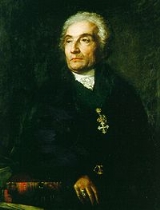
Joseph de Maistre

Encyclopedia
Joseph-Marie, comte
de Maistre (də mɛstʁ 1 April 1753 – 26 February 1821) was a French-speaking
Savoy
ard philosopher, writer, lawyer, and diplomat. He defended hierarchical societies and a monarchical State
in the period immediately following the French Revolution
. Despite his close ties with France, Maistre was a subject of the King of Piedmont-Sardinia
, whom he served as member of the Savoy Senate (1787–1792), ambassador to Russia (1803–1817), and minister of state to the court in Turin
(1817–1821).
Maistre, a key figure of the Counter-Enlightenment
, saw monarchy as a divinely sanctioned institution
. He not only called for the restoration of the House of Bourbon
to the throne of France, he argued that the Pope should have ultimate temporal authority. He claimed that it was the rationalist
rejection of Christianity
which was directly responsible for the the disorder and bloodshed which followed the French Revolution of 1789. As well as defending Christian monarchies and the Papacy, he also asserted that history is directed by Divine Providence
.
, in the Duchy of Savoy
, which at that time was part of the Kingdom of Piedmont-Sardinia
, ruled by the House of Savoy
. His family was of French origin. His grandfather André Maistre, who came from Provence
, had been a draper and councilman in Nice
(then under the rule of the House of Savoy), and his father François-Xavier, who moved to Chambéry in 1740, became a magistrate and senator, eventually receiving the title of count
from the King of Piedmont-Sardinia. His mother's family, whose surname was Desmotz, were from Rumilly
. Joseph's younger brother, Xavier
, who became an army officer, was a popular writer of fiction.
Joseph was probably educated by the Jesuits
. After the Revolution, he became an ardent defender of their Order, increasingly associating the spirit of the Revolution with the Jesuits' traditional enemies, the Jansenists
. After completing his training in the law at the University of Turin
in 1774, he followed in his father's footsteps by becoming a Senator in 1787.
A member of the progressive Scottish Rite
Masonic
lodge at Chambéry from 1774 to 1790, Maistre originally favoured political reform in France, supporting the efforts of the magistrates in the Parlement
s to force King Louis XVI
to call a States-General
. As a landowner in France, Maistre was eligible to join that body, and there is some evidence that he contemplated that possibility. He was alarmed however by the decision of the States-General to combine clergy, aristocracy, and commoner
s into a single legislative body, which became the National Constituent Assembly
, and after the passing of the August Decrees
on 4 August 1789 he decisively rejected those who were seeking radical political reform in France.
Maistre fled Chambéry when it was taken by a French revolutionary army in 1792, but unable to find a position in the royal court in Turin, he returned the following year. Deciding that he could not support the French-controlled regime, he departed for Lausanne
, in Switzerland. He discussed politics and theology at the salon of Madame de Staël
, and began his career as a counter-revolutionary writer, with works such as Lettres d'un royaliste savoisien ("Letters from a Savoyard Royalist", 1793), Discours à Mme. la marquise Costa de Beauregard, sur la vie et la mort de son fils ("Discourse to the Marchioness Costa de Beauregard, on the Life and Death of her Son", 1794) and Cinq paradoxes à la Marquise de Nav... ("Five Paradoxes for the Marchioness of Nav...", 1795).
From Lausanne, Maistre emigrated to Venice
, and then Cagliari
, which is where the King of Piedmont-Sardinia was exiled after French armies took control of Turin in 1798. Maistre's relations with the court at Cagliari were not always easy and in 1803 he was sent to Saint Petersburg
in Russia, as ambassador to Tsar
Alexander I
. His diplomatic responsibilities were few, and he became a well-loved fixture in aristocratic circles, converting some of his friends to Roman Catholicism, and writing his most influential works on political philosophy.
Maistre's observations on Russian life, contained in his diplomatic memoirs and in his personal correspondence, was one of Tolstoy
's sources for his novel War and Peace
. After the defeat of Napoleon and the restoration of the House of Savoy's dominion over Piedmont
(under the terms of the Congress of Vienna
), Maistre returned in 1817 to Turin, and served there as magistrate
and minister of state until his death. He died on 26 February 1821 is buried in the Jesuit Church of the Holy Martyrs (Chiesa dei Santi Martiri).
mission as the principal instrument of good and of evil
on Earth
. He perceived the Revolution of 1789 to be a Providential
event: the monarchy, the aristocracy, and the Ancien Régime, instead of using the influence of French civilization to benefit mankind, had promoted the atheistic
doctrines of the eighteenth-century philosophers
. The crimes of the Reign of Terror
were the logical consequence of Enlightenment
thought, and therefore its divinely-decreed punishment.
In his short book Essai sur le principe générateur des constitutions politiques et des autres institutions humaines ("Essay on the Generative Principle of Political Constitutions and other Human Institutions," 1809), Maistre argued that constitutions are not the product of human reason, but come from God, who slowly brings them to maturity. After the appearance in 1816 of his French translation of Plutarch
's treatise On the Delay of Divine Justice in the Punishment of the Guilty, in 1819 Maistre published Du Pape ("On the Pope
"), the most complete exposition of his authoritarian conception of politics.
Maistre argued that any attempt to justify government on rational grounds will lead to unresolvable arguments about the legitimacy of any existing government. This, in turn, leads to violence and chaos. Defending the divine right of kings
Maistre declared that the legitimacy of government is based on non-rational grounds, which must not be questioned. Maistre claimed that ultimate authority in politics derives from religion, and in Europe this is supplied by the Pope. His analysis of the legitimacy of political authority foreshadows some of the views of sociologists
such as Saint-Simon
and Auguste Comte
. Armenteros claims that his writings influenced Utopian Socialists as well as conservative political thinkers.
In addition to his voluminous correspondence, Maistre left two posthumous works. Examen de la philosophie de Bacon, ("An Examination of the Philosophy of Bacon," 1836), is a critique of Francis Bacon
, whom Maistre considers to be the fountainhead of the Enlightenment
. Soirées de St. Pétersbourg ("The Saint Petersburg Dialogues", 1821) is a theodicy
in the form of a Platonic dialogue, in which he argues that evil exists because of a divine plan. He claims that the blood sacrifice of innocents returns men back to God, via the expiation of the sins of the guilty. According to Maistre this is a law of human history, as indubitable as it is mysterious.
statesman and philosopher Edmund Burke
, is viewed as one of the fathers of European conservatism. Since the 19th century however, his authoritarian conception of conservatism has declined in influence in comparision with the more liberal conservatism of Burke. His skills as a writer however ensure that he continues to be read. The Catholic Encyclopedia of 1910 describes his writing style as "strong, lively, picturesque," and his "animation and good humour temper his dogmatic tone. He possesses a wonderful facility in exposition, precision of doctrine, breadth of learning, and dialectic
al power." Alphonse de Lamartine
, though a political opponent, admired the splendour of his prose:
 Émile Faguet
described Maistre as "a fierce absolutist, a furious theocrat, an intransigent legitimist, apostle of a monstrous trinity composed of pope, king and hangman, always and everywhere the champion of the hardest, narrowest and most inflexible dogmatism, a dark figure out of the Middle Ages, part learned doctor, part inquisitor, part executioner."
Isaiah Berlin
in his Freedom and Its Betrayal notes that many view his writings as "the last despairing effort of feudalism...to resist the march of progress." but he claims that Maistre imposes "an official legitimist
Catholic framework upon what is really a deeply violent, deeply revolutionary, ultimately Fascist inner passion" which rejects what it sees as the shallow optimism of the Enlightenment. According to Berlin his fundamental doctrine is that nature is red in tooth and claw and what really fascinates him is power.
Amongst those who admired him was the poet Charles Baudelaire
, who described himself a disciple of the Savoyard counter-revolutionary, claiming that he had taught him "how to think." Maistre also influenced the 20th century monarchist Charles Maurras
and the counter-revolutionary political movement Action Française
.
Count
A count or countess is an aristocratic nobleman in European countries. The word count came into English from the French comte, itself from Latin comes—in its accusative comitem—meaning "companion", and later "companion of the emperor, delegate of the emperor". The adjective form of the word is...
de Maistre (də mɛstʁ 1 April 1753 – 26 February 1821) was a French-speaking
French language
French is a Romance language spoken as a first language in France, the Romandy region in Switzerland, Wallonia and Brussels in Belgium, Monaco, the regions of Quebec and Acadia in Canada, and by various communities elsewhere. Second-language speakers of French are distributed throughout many parts...
Savoy
Savoy
Savoy is a region of France. It comprises roughly the territory of the Western Alps situated between Lake Geneva in the north and Monaco and the Mediterranean coast in the south....
ard philosopher, writer, lawyer, and diplomat. He defended hierarchical societies and a monarchical State
Monarchy
A monarchy is a form of government in which the office of head of state is usually held until death or abdication and is often hereditary and includes a royal house. In some cases, the monarch is elected...
in the period immediately following the French Revolution
French Revolution
The French Revolution , sometimes distinguished as the 'Great French Revolution' , was a period of radical social and political upheaval in France and Europe. The absolute monarchy that had ruled France for centuries collapsed in three years...
. Despite his close ties with France, Maistre was a subject of the King of Piedmont-Sardinia
Kingdom of Sardinia
The Kingdom of Sardinia consisted of the island of Sardinia first as a part of the Crown of Aragon and subsequently the Spanish Empire , and second as a part of the composite state of the House of Savoy . Its capital was originally Cagliari, in the south of the island, and later Turin, on the...
, whom he served as member of the Savoy Senate (1787–1792), ambassador to Russia (1803–1817), and minister of state to the court in Turin
Turin
Turin is a city and major business and cultural centre in northern Italy, capital of the Piedmont region, located mainly on the left bank of the Po River and surrounded by the Alpine arch. The population of the city proper is 909,193 while the population of the urban area is estimated by Eurostat...
(1817–1821).
Maistre, a key figure of the Counter-Enlightenment
Counter-Enlightenment
"Counter-Enlightenment" is a term used to refer to a movement that arose in the late-18th and early-19th centuries in opposition to the 18th century Enlightenment...
, saw monarchy as a divinely sanctioned institution
Divine Right of Kings
The divine right of kings or divine-right theory of kingship is a political and religious doctrine of royal and political legitimacy. It asserts that a monarch is subject to no earthly authority, deriving his right to rule directly from the will of God...
. He not only called for the restoration of the House of Bourbon
House of Bourbon
The House of Bourbon is a European royal house, a branch of the Capetian dynasty . Bourbon kings first ruled Navarre and France in the 16th century. By the 18th century, members of the Bourbon dynasty also held thrones in Spain, Naples, Sicily, and Parma...
to the throne of France, he argued that the Pope should have ultimate temporal authority. He claimed that it was the rationalist
Rationalism
In epistemology and in its modern sense, rationalism is "any view appealing to reason as a source of knowledge or justification" . In more technical terms, it is a method or a theory "in which the criterion of the truth is not sensory but intellectual and deductive"...
rejection of Christianity
Christianity
Christianity is a monotheistic religion based on the life and teachings of Jesus as presented in canonical gospels and other New Testament writings...
which was directly responsible for the the disorder and bloodshed which followed the French Revolution of 1789. As well as defending Christian monarchies and the Papacy, he also asserted that history is directed by Divine Providence
Divine Providence
In Christian theology, divine providence, or simply providence, is God's activity in the world. " Providence" is also used as a title of God exercising His providence, and then the word are usually capitalized...
.
Biography
Maistre was born in 1753 at ChambéryChambéry
Chambéry is a city in the department of Savoie, located in the Rhône-Alpes region in southeastern France.It is the capital of the department and has been the historical capital of the Savoy region since the 13th century, when Amadeus V of Savoy made the city his seat of power.-Geography:Chambéry...
, in the Duchy of Savoy
Duchy of Savoy
From 1416 to 1847, the House of Savoy ruled the eponymous Duchy of Savoy . The Duchy was a state in the northern part of the Italian Peninsula, with some territories that are now in France. It was a continuation of the County of Savoy...
, which at that time was part of the Kingdom of Piedmont-Sardinia
Kingdom of Sardinia
The Kingdom of Sardinia consisted of the island of Sardinia first as a part of the Crown of Aragon and subsequently the Spanish Empire , and second as a part of the composite state of the House of Savoy . Its capital was originally Cagliari, in the south of the island, and later Turin, on the...
, ruled by the House of Savoy
House of Savoy
The House of Savoy was formed in the early 11th century in the historical Savoy region. Through gradual expansion, it grew from ruling a small county in that region to eventually rule the Kingdom of Italy from 1861 until the end of World War II, king of Croatia and King of Armenia...
. His family was of French origin. His grandfather André Maistre, who came from Provence
Provence
Provence ; Provençal: Provença in classical norm or Prouvènço in Mistralian norm) is a region of south eastern France on the Mediterranean adjacent to Italy. It is part of the administrative région of Provence-Alpes-Côte d'Azur...
, had been a draper and councilman in Nice
Nice
Nice is the fifth most populous city in France, after Paris, Marseille, Lyon and Toulouse, with a population of 348,721 within its administrative limits on a land area of . The urban area of Nice extends beyond the administrative city limits with a population of more than 955,000 on an area of...
(then under the rule of the House of Savoy), and his father François-Xavier, who moved to Chambéry in 1740, became a magistrate and senator, eventually receiving the title of count
Count
A count or countess is an aristocratic nobleman in European countries. The word count came into English from the French comte, itself from Latin comes—in its accusative comitem—meaning "companion", and later "companion of the emperor, delegate of the emperor". The adjective form of the word is...
from the King of Piedmont-Sardinia. His mother's family, whose surname was Desmotz, were from Rumilly
Rumilly, Haute-Savoie
Rumilly is a commune of over 12000 inhabitants in the Haute-Savoie department in the Rhône-Alpes region in south-eastern France.-Geography:The Chéran forms part of the commune's eastern border, crosses the village, flows north-northwestward through the northern part of the commune, then flows into...
. Joseph's younger brother, Xavier
Xavier de Maistre
Xavier de Maistre of Savoy , lived largely as a military man, but is known as a French writer. The younger brother of noted philosopher and counter-revolutionary Joseph de Maistre, Xavier was born to an aristocratic family at Chambéry in October 1763...
, who became an army officer, was a popular writer of fiction.
Joseph was probably educated by the Jesuits
Society of Jesus
The Society of Jesus is a Catholic male religious order that follows the teachings of the Catholic Church. The members are called Jesuits, and are also known colloquially as "God's Army" and as "The Company," these being references to founder Ignatius of Loyola's military background and a...
. After the Revolution, he became an ardent defender of their Order, increasingly associating the spirit of the Revolution with the Jesuits' traditional enemies, the Jansenists
Jansenism
Jansenism was a Christian theological movement, primarily in France, that emphasized original sin, human depravity, the necessity of divine grace, and predestination. The movement originated from the posthumously published work of the Dutch theologian Cornelius Otto Jansen, who died in 1638...
. After completing his training in the law at the University of Turin
University of Turin
The University of Turin is a university in the city of Turin in the Piedmont region of north-western Italy...
in 1774, he followed in his father's footsteps by becoming a Senator in 1787.
A member of the progressive Scottish Rite
Scottish Rite
The Ancient and Accepted Scottish Rite of Freemasonry , commonly known as simply the Scottish Rite, is one of several Rites of the worldwide fraternity known as Freemasonry...
Masonic
Freemasonry
Freemasonry is a fraternal organisation that arose from obscure origins in the late 16th to early 17th century. Freemasonry now exists in various forms all over the world, with a membership estimated at around six million, including approximately 150,000 under the jurisdictions of the Grand Lodge...
lodge at Chambéry from 1774 to 1790, Maistre originally favoured political reform in France, supporting the efforts of the magistrates in the Parlement
Parlement
Parlements were regional legislative bodies in Ancien Régime France.The political institutions of the Parlement in Ancien Régime France developed out of the previous council of the king, the Conseil du roi or curia regis, and consequently had ancient and customary rights of consultation and...
s to force King Louis XVI
Louis XVI of France
Louis XVI was a Bourbon monarch who ruled as King of France and Navarre until 1791, and then as King of the French from 1791 to 1792, before being executed in 1793....
to call a States-General
French States-General
In France under the Old Regime, the States-General or Estates-General , was a legislative assembly of the different classes of French subjects. It had a separate assembly for each of the three estates, which were called and dismissed by the king...
. As a landowner in France, Maistre was eligible to join that body, and there is some evidence that he contemplated that possibility. He was alarmed however by the decision of the States-General to combine clergy, aristocracy, and commoner
Commoner
In British law, a commoner is someone who is neither the Sovereign nor a peer. Therefore, any member of the Royal Family who is not a peer, such as Prince Harry of Wales or Anne, Princess Royal, is a commoner, as is any member of a peer's family, including someone who holds only a courtesy title,...
s into a single legislative body, which became the National Constituent Assembly
National Constituent Assembly
The National Constituent Assembly was formed from the National Assembly on 9 July 1789, during the first stages of the French Revolution. It dissolved on 30 September 1791 and was succeeded by the Legislative Assembly.-Background:...
, and after the passing of the August Decrees
August Decrees
The August Decrees were nineteen decrees made in August 1789 by the National Constituent Assembly during the French Revolution.-Background:The fall of the Bastille on 14 July 1789 was followed by a mass uproar spreading from Paris to the countryside. Noble families were attacked and the...
on 4 August 1789 he decisively rejected those who were seeking radical political reform in France.
Maistre fled Chambéry when it was taken by a French revolutionary army in 1792, but unable to find a position in the royal court in Turin, he returned the following year. Deciding that he could not support the French-controlled regime, he departed for Lausanne
Lausanne
Lausanne is a city in Romandy, the French-speaking part of Switzerland, and is the capital of the canton of Vaud. The seat of the district of Lausanne, the city is situated on the shores of Lake Geneva . It faces the French town of Évian-les-Bains, with the Jura mountains to its north-west...
, in Switzerland. He discussed politics and theology at the salon of Madame de Staël
Anne Louise Germaine de Staël
Anne Louise Germaine de Staël-Holstein , commonly known as Madame de Staël, was a French-speaking Swiss author living in Paris and abroad. She influenced literary tastes in Europe at the turn of the 19th century.- Childhood :...
, and began his career as a counter-revolutionary writer, with works such as Lettres d'un royaliste savoisien ("Letters from a Savoyard Royalist", 1793), Discours à Mme. la marquise Costa de Beauregard, sur la vie et la mort de son fils ("Discourse to the Marchioness Costa de Beauregard, on the Life and Death of her Son", 1794) and Cinq paradoxes à la Marquise de Nav... ("Five Paradoxes for the Marchioness of Nav...", 1795).
From Lausanne, Maistre emigrated to Venice
Venice
Venice is a city in northern Italy which is renowned for the beauty of its setting, its architecture and its artworks. It is the capital of the Veneto region...
, and then Cagliari
Cagliari
Cagliari is the capital of the island of Sardinia, a region of Italy. Cagliari's Sardinian name Casteddu literally means castle. It has about 156,000 inhabitants, or about 480,000 including the outlying townships : Elmas, Assemini, Capoterra, Selargius, Sestu, Monserrato, Quartucciu, Quartu...
, which is where the King of Piedmont-Sardinia was exiled after French armies took control of Turin in 1798. Maistre's relations with the court at Cagliari were not always easy and in 1803 he was sent to Saint Petersburg
Saint Petersburg
Saint Petersburg is a city and a federal subject of Russia located on the Neva River at the head of the Gulf of Finland on the Baltic Sea...
in Russia, as ambassador to Tsar
Tsar
Tsar is a title used to designate certain European Slavic monarchs or supreme rulers. As a system of government in the Tsardom of Russia and Russian Empire, it is known as Tsarist autocracy, or Tsarism...
Alexander I
Alexander I of Russia
Alexander I of Russia , served as Emperor of Russia from 23 March 1801 to 1 December 1825 and the first Russian King of Poland from 1815 to 1825. He was also the first Russian Grand Duke of Finland and Lithuania....
. His diplomatic responsibilities were few, and he became a well-loved fixture in aristocratic circles, converting some of his friends to Roman Catholicism, and writing his most influential works on political philosophy.
Maistre's observations on Russian life, contained in his diplomatic memoirs and in his personal correspondence, was one of Tolstoy
Leo Tolstoy
Lev Nikolayevich Tolstoy was a Russian writer who primarily wrote novels and short stories. Later in life, he also wrote plays and essays. His two most famous works, the novels War and Peace and Anna Karenina, are acknowledged as two of the greatest novels of all time and a pinnacle of realist...
's sources for his novel War and Peace
War and Peace
War and Peace is a novel by the Russian author Leo Tolstoy, first published in 1869. The work is epic in scale and is regarded as one of the most important works of world literature...
. After the defeat of Napoleon and the restoration of the House of Savoy's dominion over Piedmont
Piedmont
Piedmont is one of the 20 regions of Italy. It has an area of 25,402 square kilometres and a population of about 4.4 million. The capital of Piedmont is Turin. The main local language is Piedmontese. Occitan is also spoken by a minority in the Occitan Valleys situated in the Provinces of...
(under the terms of the Congress of Vienna
Congress of Vienna
The Congress of Vienna was a conference of ambassadors of European states chaired by Klemens Wenzel von Metternich, and held in Vienna from September, 1814 to June, 1815. The objective of the Congress was to settle the many issues arising from the French Revolutionary Wars, the Napoleonic Wars,...
), Maistre returned in 1817 to Turin, and served there as magistrate
Magistrate
A magistrate is an officer of the state; in modern usage the term usually refers to a judge or prosecutor. This was not always the case; in ancient Rome, a magistratus was one of the highest government officers and possessed both judicial and executive powers. Today, in common law systems, a...
and minister of state until his death. He died on 26 February 1821 is buried in the Jesuit Church of the Holy Martyrs (Chiesa dei Santi Martiri).
Political and moral philosophy
In Considérations sur la France ("Considerations on France," 1796), Maistre claimed that France has a divineGod
God is the English name given to a singular being in theistic and deistic religions who is either the sole deity in monotheism, or a single deity in polytheism....
mission as the principal instrument of good and of evil
Evil
Evil is the violation of, or intent to violate, some moral code. Evil is usually seen as the dualistic opposite of good. Definitions of evil vary along with analysis of its root motive causes, however general actions commonly considered evil include: conscious and deliberate wrongdoing,...
on Earth
Earth
Earth is the third planet from the Sun, and the densest and fifth-largest of the eight planets in the Solar System. It is also the largest of the Solar System's four terrestrial planets...
. He perceived the Revolution of 1789 to be a Providential
Divine Providence
In Christian theology, divine providence, or simply providence, is God's activity in the world. " Providence" is also used as a title of God exercising His providence, and then the word are usually capitalized...
event: the monarchy, the aristocracy, and the Ancien Régime, instead of using the influence of French civilization to benefit mankind, had promoted the atheistic
Atheism
Atheism is, in a broad sense, the rejection of belief in the existence of deities. In a narrower sense, atheism is specifically the position that there are no deities...
doctrines of the eighteenth-century philosophers
Age of Enlightenment
The Age of Enlightenment was an elite cultural movement of intellectuals in 18th century Europe that sought to mobilize the power of reason in order to reform society and advance knowledge. It promoted intellectual interchange and opposed intolerance and abuses in church and state...
. The crimes of the Reign of Terror
Reign of Terror
The Reign of Terror , also known simply as The Terror , was a period of violence that occurred after the onset of the French Revolution, incited by conflict between rival political factions, the Girondins and the Jacobins, and marked by mass executions of "enemies of...
were the logical consequence of Enlightenment
Enlightenment
-Culture:*Age of Enlightenment, period in Western history and its corresponding movement*Enlightenment , a final blessed state free from ignorance, desire and suffering*Enlightenment in Western secular tradition*Enlightenment in Buddhism...
thought, and therefore its divinely-decreed punishment.
In his short book Essai sur le principe générateur des constitutions politiques et des autres institutions humaines ("Essay on the Generative Principle of Political Constitutions and other Human Institutions," 1809), Maistre argued that constitutions are not the product of human reason, but come from God, who slowly brings them to maturity. After the appearance in 1816 of his French translation of Plutarch
Plutarch
Plutarch then named, on his becoming a Roman citizen, Lucius Mestrius Plutarchus , c. 46 – 120 AD, was a Greek historian, biographer, essayist, and Middle Platonist known primarily for his Parallel Lives and Moralia...
's treatise On the Delay of Divine Justice in the Punishment of the Guilty, in 1819 Maistre published Du Pape ("On the Pope
On the Pope
On the Pope is an 1819 book written by Savoyard philosopher Joseph de Maistre, which many consider to be his literary masterpiece.-Sovereignty of papal power:The work is divided into four parts...
"), the most complete exposition of his authoritarian conception of politics.
Maistre argued that any attempt to justify government on rational grounds will lead to unresolvable arguments about the legitimacy of any existing government. This, in turn, leads to violence and chaos. Defending the divine right of kings
Divine Right of Kings
The divine right of kings or divine-right theory of kingship is a political and religious doctrine of royal and political legitimacy. It asserts that a monarch is subject to no earthly authority, deriving his right to rule directly from the will of God...
Maistre declared that the legitimacy of government is based on non-rational grounds, which must not be questioned. Maistre claimed that ultimate authority in politics derives from religion, and in Europe this is supplied by the Pope. His analysis of the legitimacy of political authority foreshadows some of the views of sociologists
Sociology
Sociology is the study of society. It is a social science—a term with which it is sometimes synonymous—which uses various methods of empirical investigation and critical analysis to develop a body of knowledge about human social activity...
such as Saint-Simon
Claude Henri de Rouvroy, comte de Saint-Simon
Claude Henri de Rouvroy, comte de Saint-Simon, often referred to as Henri de Saint-Simon was a French early socialist theorist whose thought influenced the foundations of various 19th century philosophies; perhaps most notably Marxism, positivism and the discipline of sociology...
and Auguste Comte
Auguste Comte
Isidore Auguste Marie François Xavier Comte , better known as Auguste Comte , was a French philosopher, a founder of the discipline of sociology and of the doctrine of positivism...
. Armenteros claims that his writings influenced Utopian Socialists as well as conservative political thinkers.
In addition to his voluminous correspondence, Maistre left two posthumous works. Examen de la philosophie de Bacon, ("An Examination of the Philosophy of Bacon," 1836), is a critique of Francis Bacon
Francis Bacon
Francis Bacon, 1st Viscount St Albans, KC was an English philosopher, statesman, scientist, lawyer, jurist, author and pioneer of the scientific method. He served both as Attorney General and Lord Chancellor of England...
, whom Maistre considers to be the fountainhead of the Enlightenment
Age of Enlightenment
The Age of Enlightenment was an elite cultural movement of intellectuals in 18th century Europe that sought to mobilize the power of reason in order to reform society and advance knowledge. It promoted intellectual interchange and opposed intolerance and abuses in church and state...
. Soirées de St. Pétersbourg ("The Saint Petersburg Dialogues", 1821) is a theodicy
Theodicy
Theodicy is a theological and philosophical study which attempts to prove God's intrinsic or foundational nature of omnibenevolence , omniscience , and omnipotence . Theodicy is usually concerned with the God of the Abrahamic religions Judaism, Christianity, and Islam, due to the relevant...
in the form of a Platonic dialogue, in which he argues that evil exists because of a divine plan. He claims that the blood sacrifice of innocents returns men back to God, via the expiation of the sins of the guilty. According to Maistre this is a law of human history, as indubitable as it is mysterious.
Repute and influence
Maistre, together with the Anglo-IrishAnglo-Irish
Anglo-Irish was a term used primarily in the 19th and early 20th centuries to identify a privileged social class in Ireland, whose members were the descendants and successors of the Protestant Ascendancy, mostly belonging to the Church of Ireland, which was the established church of Ireland until...
statesman and philosopher Edmund Burke
Edmund Burke
Edmund Burke PC was an Irish statesman, author, orator, political theorist and philosopher who, after moving to England, served for many years in the House of Commons of Great Britain as a member of the Whig party....
, is viewed as one of the fathers of European conservatism. Since the 19th century however, his authoritarian conception of conservatism has declined in influence in comparision with the more liberal conservatism of Burke. His skills as a writer however ensure that he continues to be read. The Catholic Encyclopedia of 1910 describes his writing style as "strong, lively, picturesque," and his "animation and good humour temper his dogmatic tone. He possesses a wonderful facility in exposition, precision of doctrine, breadth of learning, and dialectic
Dialectic
Dialectic is a method of argument for resolving disagreement that has been central to Indic and European philosophy since antiquity. The word dialectic originated in Ancient Greece, and was made popular by Plato in the Socratic dialogues...
al power." Alphonse de Lamartine
Alphonse de Lamartine
Alphonse Marie Louis de Prat de Lamartine was a French writer, poet and politician who was instrumental in the foundation of the Second Republic.-Career:...
, though a political opponent, admired the splendour of his prose:
Émile Faguet
Auguste Émile Faguet was a French author and literary critic.Faguet was born at La Roche-sur-Yon, and educated at the École normale supérieure in Paris. After teaching for some time in La Rochelle and Bordeaux, he returned to Paris to act as assistant professor of poetry in the university. He...
described Maistre as "a fierce absolutist, a furious theocrat, an intransigent legitimist, apostle of a monstrous trinity composed of pope, king and hangman, always and everywhere the champion of the hardest, narrowest and most inflexible dogmatism, a dark figure out of the Middle Ages, part learned doctor, part inquisitor, part executioner."
Isaiah Berlin
Isaiah Berlin
Sir Isaiah Berlin OM, FBA was a British social and political theorist, philosopher and historian of ideas of Russian-Jewish origin, regarded as one of the leading thinkers of the twentieth century and a dominant liberal scholar of his generation...
in his Freedom and Its Betrayal notes that many view his writings as "the last despairing effort of feudalism...to resist the march of progress." but he claims that Maistre imposes "an official legitimist
Legitimists
Legitimists are royalists in France who adhere to the rights of dynastic succession of the descendants of the elder branch of the Bourbon dynasty, which was overthrown in the 1830 July Revolution. They reject the claim of the July Monarchy of 1830–1848, whose kings were members of the junior...
Catholic framework upon what is really a deeply violent, deeply revolutionary, ultimately Fascist inner passion" which rejects what it sees as the shallow optimism of the Enlightenment. According to Berlin his fundamental doctrine is that nature is red in tooth and claw and what really fascinates him is power.
Amongst those who admired him was the poet Charles Baudelaire
Charles Baudelaire
Charles Baudelaire was a French poet who produced notable work as an essayist, art critic, and pioneering translator of Edgar Allan Poe. His most famous work, Les Fleurs du mal expresses the changing nature of beauty in modern, industrializing Paris during the nineteenth century...
, who described himself a disciple of the Savoyard counter-revolutionary, claiming that he had taught him "how to think." Maistre also influenced the 20th century monarchist Charles Maurras
Charles Maurras
Charles-Marie-Photius Maurras was a French author, poet, and critic. He was a leader and principal thinker of Action Française, a political movement that was monarchist, anti-parliamentarist, and counter-revolutionary. Maurras' ideas greatly influenced National Catholicism and "nationalisme...
and the counter-revolutionary political movement Action Française
Action Française
The Action Française , founded in 1898, is a French Monarchist counter-revolutionary movement and periodical founded by Maurice Pujo and Henri Vaugeois and whose principal ideologist was Charles Maurras...
.
Works
- Nobilis Ioseph Maistre Camberiensis ad i.u. lauream anno 1772. die 29. Aprilis hora 5. pomeridiana (Turin, 1772) – Joseph de Maistre's decree thesis, kept in the National Library of the University of Turin (http://www.sbn.it/opacsbn/opaclib?db=iccu&select_db=iccu&nentries=1&from=5&searchForm=opac/iccu/error.jsp&resultForward=opac/iccu/full.jsp&do=search_show_cmd&rpnlabel=+Autore+%3D+Joseph+de+Maistre+%28parole+in+AND%29++Anno+di+pubblicazione%3E%3D1700++AND+Anno+di+pubblicazione%3C%3D1810+&rpnquery=%40attrset+bib-1+%40and+%40and++%40attr+1%3D31+%40attr+4%3D4++%40attr++2%3D4+%221700%22++%40attr+1%3D1003+%40attr+4%3D2+%22Joseph+de+Maistre%22++%40attr+1%3D31+%40attr+4%3D4++%40attr++2%3D2+%221810%22&totalResult=9&fname=none&brief=brieflink]).
- Éloge de Victor-Amédée III (Chambéry, 1775)
- Lettres d'un royaliste savoisien à ses compatriotes (1793)
- Étude sur la souveraineté (1794)
- De l'État de nature, ou Examen d'un écrit de Jean-Jacques Rousseau (1795)
- Considérations sur la France (London [Basel], 1796)
- Intorno allo stato del Piemonte rispetto alla carta moneta (Turn, Aosta, Venice, 1797–1799)
- Essai sur le principe générateur des constitutions politiques (St Petersborg, 1809)
- Du Pape (Lyon, 1819)
- De l'Église gallicane, édit. Rodolphe de Maistre (Lyon, 1821)
- Les Soirées de Saint-Pétersbourg ou Entretiens sur le gouvernement temporel de la Providence, édit. Rodolphe de Maistre (Paris, 1821)
- Lettres à un gentilhomme russe sur l'Inquisition espagnole, édit. Rodolphe de Maistre (Paris, 1822)
- Examen de la philosophie de Bacon, édit. Rodolphe de Maistre (Paris, 1836)
- Lettres et opuscules inédits du comte Joseph de Maistre, édit. Rodolphe de Maistre (Paris, 1853)
- Mémoires politiques et correspondance diplomatique, édit. Albert Blanc (Paris, 1858)
Work in English translation
- Memoir on the Union of Savoy and Switzerland (1795).
- Essay on the Generative Principle of Political Constitutions (1809, English translation 1847).
- The Pope: Considered in His Relations with the Church, Temporal Sovereignties, Separated Churches and the Cause of Civilization (1817, English translation 1850).
- Letters to a Russian Gentleman on the Spanish Inquisition (1822, English translation 1851)
- Blum, Christopher Olaf (editor and translator), 2004. Critics of the Enlightenment. WilmingtonWilmington, DelawareWilmington is the largest city in the state of Delaware, United States, and is located at the confluence of the Christina River and Brandywine Creek, near where the Christina flows into the Delaware River. It is the county seat of New Castle County and one of the major cities in the Delaware Valley...
, Delaware : ISI Books.- 1798, "Reflections on Protestantism in its Relations to Sovereignty". 133-56.
- 1819, "On the Pope". 157-96.
- Lively, Jack, 1965. The Works of Joseph de Maistre. Macmillan.
External links
- The Joseph de Maistre Homepage at the University of Cambridge
- Works of Joseph de Maistre in English Translation