
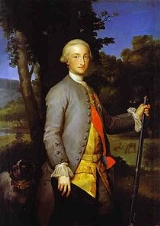
Charles IV was
King of Spain from 14 December 1788 until his abdication on 19 March 1808.
Early life
Charles was the second son of
Charles IIICharles III was the King of Spain and the Spanish Indies from 1759 to 1788. He was the eldest son of Philip V of Spain and his second wife, the Princess Elisabeth Farnese...
and his wife
Maria Amalia of SaxonyMaria Amalia of Saxony was a German princess from the House of Wettin and was the wife of Charles III of Spain; she was the Queen consort of Naples and Sicily from 1738 till 1759 and then Queen consort of Spain from 1759 until her death in 1760...
. He was born at
NaplesNaples is a city in Southern Italy, situated on the country's west coast by the Gulf of Naples. Lying between two notable volcanic regions, Mount Vesuvius and the Phlegraean Fields, it is the capital of the region of Campania and of the province of Naples...
(11 of November, 1748), while his father was king of the Two Sicilies. His elder brother Don Felipe was passed over for the two thrones as
mentally retardedMental retardation is a generalized disorder appearing before adulthood, characterized by significantly impaired cognitive functioning and deficits in two or more adaptive behaviors...
and
epilepticEpilepsy is a common chronic neurological disorder characterized by seizures. These seizures are transient signs and/or symptoms of abnormal, excessive or hypersynchronous neuronal activity in the brain.About 50 million people worldwide have epilepsy, and nearly two out of every three new cases...
. In Naples and Sicily he was styled as the
Prince of Taranto.
Charles had inherited a great frame and immense physical strength from the Saxon line of his mother, granddaughter of August the Strong. When young he was fond of wrestling with the strongest countrymen he could find. While he was considered by many to be intellectually sluggish and quite credulous he was also known for his acts of kindness.
Reign
In 1788, Charles III died and Charles IV succeeded to the throne. Even though he had a profound belief in the sanctity of his office and kept up the appearance of an absolute, powerful monarch, he never took more than a passive part in the direction of his own government, occupying himself with
huntingHunting is the practice of pursuing any living thing, usually wildlife, for food, recreation, or trade. In present-day use, the term refers to lawful hunting, as distinguished from poaching, which is the killing, trapping or capture of the hunted species contrary to applicable law...
. The affairs of government he left to his wife and his prime minister. In 1792, Maria Luisa finally succeeded in ousting
the Count of FloridablancaJosé Moñino y Redondo, Count of Floridablanca , Spanish statesman. He was the reformist chief minister of King Charles III of Spain, and also served briefly under Charles IV. He was arguably Spain's most effective statesman in the eighteenth century...
from office and had him replaced with
Pedro Pablo Abarca de Bolea, Count of ArandaDon Pedro Pablo Abarca de Bolea y Jiménez de Urrea, 10th Count of Aranda , was a Spanish statesman and diplomat.-Early life:...
, the chief of the
Aragonese party. However, in the wake of the war against
Republican FranceThe French Revolution , sometimes distinguished as the 'Great French Revolution' , was a period of radical social and political upheaval in France and Europe. The absolute monarchy that had ruled France for centuries collapsed in three years...
, the liberal-leaning Count of Aranda was replaced by
Manuel de GodoyDon Manuel Francisco Domingo de Godoy y Álvarez de Faria, de los Ríos y Sánchez-Zarzosa, also Manuel de Godoy y Álvarez de Faria de los Ríos Sánchez Zarzosa , was Prime Minister of Spain from 1792 to 1797 and from 1801 to 1808...
, a favourite of the Queen and allegedly her lover, who thenceforth enjoyed the lasting favour of the King.
Godoy continued Aranda's policy of neutrality towards France but after Spain protested against the execution of
the deposed kingLouis XVI was a Bourbon monarch who ruled as King of France and Navarre until 1791, and then as King of the French from 1791 to 1792, before being executed in 1793....
in 1793, France declared war on Spain. After the declaration of war against Spain, Portugal and Spain signed a treaty of mutual protection against France. In 1795 France forced Godoy to conclude an alliance and declare war on the
Kingdom of Great BritainThe former Kingdom of Great Britain, sometimes described as the 'United Kingdom of Great Britain', That the Two Kingdoms of Scotland and England, shall upon the 1st May next ensuing the date hereof, and forever after, be United into One Kingdom by the Name of GREAT BRITAIN. was a sovereign...
.
In 1803, after smallpox had affected his daughter María Luísa, the king commissioned his doctor
Francisco Javier de BalmisFrancisco Javier de Balmis was a Spanish physician who headed an 1804 expedition to Spanish America to vaccinate the populations against smallpox....
to
bring the vaccine to the Spanish coloniesThe Balmis Expedition was a three year mission to the Americas led by Dr Francisco Javier de Balmis with the aim of giving thousands the smallpox vaccine. He set off from La Coruña on 30 November 1803...
on state expenses.
Spain remained an ally of France and supported the Continental Blockade until
the British naval victory at TrafalgarThe Battle of Trafalgar was a sea battle fought between the British Royal Navy and the combined fleets of the French Navy and Spanish Navy, during the War of the Third Coalition of the Napoleonic Wars ....
. However, After Napoleon's victory over
PrussiaPrussia was a German kingdom and historic state originating out of the Duchy of Prussia and the Margraviate of Brandenburg. For centuries, the House of Hohenzollern ruled Prussia, successfully expanding its size by way of an unusually well-organized and effective army. Prussia shaped the history...
in 1807, Godoy again steered Spain back onto the French side. This switching back and forth devalued Charles' position as a trustworthy ally while the return to the French alliance increased Godoy's unpopularity and strengthened
partido fernandista, the supporters of
Crown Prince Ferdinand, who favoured a close relationship with the
United KingdomThe United Kingdom of Great Britain and Northern IrelandIn the United Kingdom and Dependencies, other languages have been officially recognised as legitimate autochthonous languages under the European Charter for Regional or Minority Languages...
.
Abdication
When King Charles was told that his son Ferdinand was appealing to Napoleon against Godoy, he took the side of the minister. When
the populace rose at AranjuezThe Mutiny of Aranjuez, or Motín de Aranjuez as it is known in Spain, was an early nineteenth century popular uprising against King Charles IV, which managed to overthrow him and place his son, Ferdinand VII, on the throne...
in 1808 he abdicated on 19 March, in favour of his son, to save the minister who had been taken prisoner. Ferdinand took the throne as Ferdinand VII, but was mistrusted by Napoleon who had 100,000 soldiers in Spain by that time.
Charles IV found refuge in France, and became a prisoner of Napoleon: the latter, posing as arbiter, summoned both Charles IV and his son to
BayonneBayonne is a city and commune in south-western France at the confluence of the Nive and Adour rivers, in the Pyrénées-Atlantiques department, of which it is a sub-prefecture...
in April and coaxed Charles (who had a difficult time restraining himself from assaulting his son) to retract his earlier abdication and abdicate, on 5 May 1808, in favour of Napoleon. Napoleon then made his brother
Joseph BonaparteJoseph-Napoléon Bonaparte was the elder brother of Napoleon Bonaparte, who made him King of Naples and Sicily , and later King of Spain...
king in Spain.
Later life
Charles was then interned in
Talleyrand's
castleChâteau de Valençay is a residence of the d'Estampes and Talleyrand-Périgord families in the commune of Valençay, the Indre département of France. Although geographically it is part of the province of Berry, its architecture invites comparison with the Renaissance châteaux of the Loire Valley,...
in
ValençayValençay is a commune in the Indre department in central France.-Geography:Valençay is situated in the Loire Valley on a hillside overlooking the River Nahon.-History:...
. He accepted a pension from the French Emperor and spent the rest of his life between his wife and Godoy, staying briefly in
CompiègneCompiègne is a city in northern France. It is designated municipally as a commune within the département of Oise.The city is located along the Oise River...
and longer in
MarseilleMarseille , known in antiquity as Massalia , is the second largest city in France, after Paris, with a population of 852,395 within its administrative limits on a land area of . The urban area of Marseille extends beyond the city limits with a population of over 1,420,000 on an area of...
.
In 1812, he finally settled in
RomeRome is the capital of Italy and the country's largest and most populated city and comune, with over 2.7 million residents in . The city is located in the central-western portion of the Italian Peninsula, on the Tiber River within the Lazio region of Italy.Rome's history spans two and a half...
in the
Palazzo BarberiniPalazzo Barberini is a palace in Rome, facing the piazza of the same name in Rione Trevi and is home to the Galleria Nazionale d'Arte Antica.-History:...
. His wife, the former Queen, died on 2 January 1819. He died, reportedly of overwhelming despair and heartbreak because of the death of his wife, on 20 January 1819.
Marriage and children
Charles IV married his first cousin
Maria LouisaMaria Luisa of Parma was Queen consort of Spain from 1788 to 1808 as the wife of King Charles IV of Spain. She was the youngest daughter of Duke Philip of Parma and his wife, Louise-Élisabeth of France, the eldest daughter of King Louis XV.She was christened Luisa Maria Teresa Ana, but was known...
, the daughter of Philip, Duke of Parma, in 1765. The couple had fourteen children, six of whom survived into adulthood:
- Charles Clement (Carlos Clemente) (19 September 1771 – 7 March 1774)
- Charlotte Joaquina
Doña Carlota Joaquina of Spain was a Queen consort of Portugal as wife of John VI...
(Carlota Joaquina) (25 April 1775 – 7 January 1830), married Prince John of Portugal, later King John VIJohn VI John VI John VI (full name: João Maria José Francisco Xavier de Paula Luís António Domingos Rafael; (13 May 1767 – 10 March 1826) was King of the United Kingdom of Portugal, Brazil and the Algarves (later changed to just King of Portugal and the Algarves, after Brazil was recognized...
- Maria Louisa (Maria Luisa) (11 September 1777 – 2 July 1782)
- Maria Amalia
Maria Amalia of Bourbon, Infanta of Spain , was a Spanish princess. She was a daughter of King Charles IV of Spain and his spouse, Queen Maria Louisa of Bourbon-Parma ....
(9 January 1779 – 22 July 1798), married her uncle Infante Antonio Pascual of Spain200px|thumb|Infante Antonio Pascual, painted by [[Francisco de Goya|Goya]].Antonio Pascual de Borbón y Wettin was an infante of Spain, son of King Charles III of Spain and younger brother of King Charles IV of Spain and Ferdinand I of the Two Sicilies.-Biography:Born Antonio Pascual Francisco...
in 1795, no issue.
- Charles Dominic (Carlos Domingo) (5 March 1780 – 11 June 1783)
- Maria Louisa (Maria Luisa) (6 July 1782 – 13 March 1824), married Louis, heir of Bourbon-Parma
Louis was the first of only two Kings of Etruria.Louis was the son of Ferdinand, Duke of Parma and Maria Amalia of Austria, the second surviving daughter of Maria Theresa of Austria and Francis I, Holy Roman Emperor....
and became Queen consort of Etruria and Duchess of Lucca
- Charles Francis (Carlos Francisco) (5 September 1783 – 11 November 1784)
- Philip Francis (Felipe Francisco) (5 September 1783 – 18 October 1784)
- Ferdinand (Fernando) (14 October 1784 – 29 September 1833), succeeded his father as King of Spain
- Charles (Carlos), Count of Molina (29 March 1788 – 10 March 1855), later the first Carlist pretender
Carlism is a traditionalist and legitimist political movement in Spain seeking the establishment of a separate line of the Bourbon family on the Spanish throne. This line descended from Infante Carlos, Count of Molina , and was founded due to dispute over the succession laws and widespread...
- Maria Isabella
María Isabella of Spain was an Infanta of Spain and the Queen of the Two Sicilies. She was the second wife of Francis I and the youngest surviving daughter of the Spanish king Charles IV and his consort Maria Luisa of Parma...
(6 June 1789 – 13 September 1848), married Francis I, King of the Two Sicilies-Biography:Francis was born in Naples, the son of Ferdinand I of the Two Sicilies and his wife Archduchess Maria Carolina of Austria. He was also the nephew of Marie Antoinette and Louis XVI the last King and Queen of France before the first French Republic....
- Maria Teresa (16 February 1791 – 2 November 1794)
- Felipe Maria (28 March 1792 – 1 March 1794)
- Francisco Antonio de Paula, Duke of Cadiz
Infante Francisco de Paula of Spain was the youngest son of Charles IV of Spain and Maria Luisa of Parma.-Marriage and children:...
(10 March 1794 – 13 August 1865)
Maria Luisa was widely considered a vicious and coarse woman who thoroughly dominated the king. During the lifetime of Charles IV, she led her husband into court intrigues against the prime minister,
the Count of FloridablancaJosé Moñino y Redondo, Count of Floridablanca , Spanish statesman. He was the reformist chief minister of King Charles III of Spain, and also served briefly under Charles IV. He was arguably Spain's most effective statesman in the eighteenth century...
.
Ancestors
Titles and styles
- 11 November 1748 – 10 August 1759 His Royal Highness the Prince of Taranto
- 10 August 1759 – 14 December 1788 His Royal Highness the Prince of the Asturias
- 14 December 1788 – 19 March 1808 His Majesty the King
- 19 March 1808 – 20 January 1819 His Majesty King Carlos