
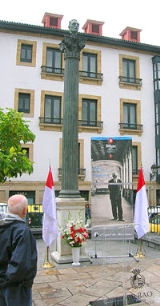
Miguel de Unamuno y Jugo (29 September 1864,
BilbaoBilbao ) is a Spanish municipality, capital of the province of Biscay, in the autonomous community of the Basque Country. With a population of 353,187 , it is the largest city of its autonomous community and the tenth largest in Spain...
,
BiscayBiscay is a province of Spain and a historical territory of the Basque Country, heir of the ancient Lord of Biscay. Its capital city is Bilbao...
,
Basque CountryThe Basque Country is an autonomous community of northern Spain. It includes the Basque provinces of Álava, Biscay and Gipuzkoa, also called Historical Territories....
,
SpainSpain , officially the Kingdom of Spain languages]] under the European Charter for Regional or Minority Languages. In each of these, Spain's official name is as follows:;;;;;;), is a country and member state of the European Union located in southwestern Europe on the Iberian Peninsula...
– 31 December 1936,
SalamancaSalamanca is a city in western Spain, in the community of Castile and León. Because it is known for its beautiful buildings and urban environment, the Old City was declared a UNESCO World Heritage Site in 1988. It is the most important university city in Spain and is known for its contributions to...
, Salamanca,
Castile and LeónCastile and León is an autonomous community in north-western Spain. It was so constituted in 1983 and it comprises the historical regions of León and Old Castile...
, Spain) was a Spanish
essayAn essay is a piece of writing which is often written from an author's personal point of view. Essays can consist of a number of elements, including: literary criticism, political manifestos, learned arguments, observations of daily life, recollections, and reflections of the author. The definition...
ist,
novelA novel is a book of long narrative in literary prose. The genre has historical roots both in the fields of the medieval and early modern romance and in the tradition of the novella. The latter supplied the present generic term in the late 18th century....
ist,
poetPoetry is a form of literary art in which language is used for its aesthetic and evocative qualities in addition to, or in lieu of, its apparent meaning...
,
playwrightTheatre is a collaborative form of fine art that uses live performers to present the experience of a real or imagined event before a live audience in a specific place. The performers may communicate this experience to the audience through combinations of gesture, speech, song, music or dance...
and philosopher.
Biography
Miguel de Unamuno was born in Bilbao, a port city of Spain, the son of Félix de Unamuno and Salomé Jugo. As a young man, he was interested in the
Basque languageBasque is the ancestral language of the Basque people, who inhabit the Basque Country, a region spanning an area in northeastern Spain and southwestern France. It is spoken by 25.7% of Basques in all territories...
, and competed for a teaching position in the
Instituto de Bilbao, against
Sabino AranaSabino Arana Goiri, self-styled as Arana ta Goiri'taŕ Sabin, , was a Spanish and Basque writer. He was the founder of the Basque Nationalist Party and father of Basque nationalism....
. The contest was finally won by the Basque scholar
Resurrección María de AzkueResurrección María de Azkue was an influential Basque priest, musician, poet, writer, sailor and academic. He made several made several major contributions to the study of the Basque language and was the first head of the Euskaltzaindia, the Academy of the Basque Language...
.
Unamuno worked in all major genres: the essay, the novel, poetry and theatre, and, as a
modernistModernism, in its broadest definition, is modern thought, character, or practice. More specifically, the term describes the modernist movement, its set of cultural tendencies and array of associated cultural movements, originally arising from wide-scale and far-reaching changes to Western society...
, contributed greatly to dissolving the boundaries between genres. There is some debate as to whether Unamuno was in fact a member of the
Generation of '98The Generation of '98 was a group of novelists, poets, essayists, and philosophers active in Spain at the time of the Spanish-American War ....
(an
ex post facto literary group of Spanish
intellectualAn intellectual is a person who uses intelligence and critical or analytical reasoning in either a professional or a personal capacity.- Terminology and endeavours :"Intellectual" can denote four types of persons:...
s and philosophers that was the creation of
José Martínez RuizJosé Augusto Trinidad Martínez Ruíz, also known as Azorín , was a Spanish writer and literary critic.-Early life and education:Martínez Ruiz was born in Monovar, Alicante in 1873...
— a group that includes
Antonio MachadoAntonio Cipriano José María y Francisco de Santa Ana Machado y Ruiz, known as Antonio Machado was a Spanish poet and one of the leading figures of the Spanish literary movement known as the Generation of '98....
, Azorín,
Pío BarojaPío Baroja y Nessi was a Spanish Basque writer, one of the key novelists of the Generation of '98. He was a member of an illustrious family, his brother Ricardo was a painter, writer and engraver, and his nephew Julio Caro Baroja, son of his younger sister Carmen, was a well known...
,
Ramón del Valle-InclánRamón María del Valle-Inclán y de la Peña , Spanish dramatist, novelist and member of the Spanish Generation of 98, is considered perhaps the most noteworthy and certainly the most radical dramatist working to subvert the traditionalism of the Spanish...
,
Ramiro de MaeztuRamiro de Maeztu y Whitney was a Spanish political theorist, journalist, literary critic, occasional diplomat and member of the Generation of '98....
and
Ángel GanivetÁngel Ganivet García , Spanish writer and diplomat. He was considered a precursor to the Generation of '98.-Some of his works:* Granada la bella. * Idearium español...
, among others).
In addition to his writing, Unamuno played an important role in the intellectual life of Spain. He served as rector of the
University of SalamancaThe University of Salamanca is a Spanish higher education institution, located in the town of Salamanca, west of Madrid. It was founded in 1134 and given the Royal charter of foundation by King Alfonso IX in 1218. It is the oldest founded university in Spain and the third oldest European...
for two periods: from 1900 to 1924 and 1930 to 1936, during a time of great social and political upheaval. Unamuno was removed from his two university chairs by the dictator General
Miguel Primo de RiveraMiguel Primo de Rivera y Orbaneja, 2nd Marquis of Estella, 22nd Count of Sobremonte, Knight of Calatrava was a Spanish dictator, aristocrat, and a military official who was appointed Prime Minister by the King and who for seven years was a dictator, ending the turno system of alternating...
in 1924, over the protest of other Spanish intellectuals. He lived in exile until 1930, first banished to
FuerteventuraFuerteventura , a Spanish island, is one of the Canary Islands, in the Atlantic Ocean off the coast of Africa. It is situated at 28°20' north, 14°00' west. At 1,660 km² it is the second largest of the Canary Islands, after Tenerife...
(
Canary IslandsThe Canary Islands , also known as the Canaries , is a Spanish archipelago located just off the northwest coast of mainland Africa, 100 km west of the border between Morocco and the Western Sahara. The Canaries are a Spanish autonomous community and an outermost region of the European Union...
), from where he escaped to
FranceThe French Republic , The French Republic , The French Republic , (commonly known as France , is a unitary semi-presidential republic in Western Europe with several overseas territories and islands located on other continents and in the Indian, Pacific, and Atlantic oceans. Metropolitan France...
. After a year in Paris, Unamuno established himself in Hendaye in the French Basque Country, on the border with Spain. Unamuno returned to Spain after the fall of General Primo de Rivera's dictatorship in 1930 and took up his rectorship again. It is said in Salamanca that the day he returned to the University, Unamuno began his lecture by saying "As we were saying yesterday, ...", as Fray Luis de León had done in the same place four centuries before, as though he had not been absent at all. After the fall of Rivera's dictatorship, Spain embarked on its
second RepublicThe Second Spanish Republic was the government of Spain between April 14 1931, and its destruction by a military rebellion, led by General Francisco Franco....
. He was a candidate for the small intellectual party
Agrupación al Servicio de la República.
Having begun his literary career as an internationalist, Unamuno gradually became convinced of the universal values of Spanish culture, feeling that Spain's essential qualities would be destroyed if influenced too much by outside forces. Thus he welcomed Franco's revolt as necessary to rescue Spain from the excesses of the Spanish Republic. However, the harsh tactics employed by the Francoists in the struggle against their republican opponents caused him to oppose both the Republic and Franco. Unamuno said of the military revolt that it would be the victory of "a brand of Catholicism that is not Christian and of a paranoid militarism bred in the colonial campaigns", referring in the latter case to uprising of Franco's forces in
Spanish MoroccoThe Spanish protectorate of Morocco was the area of Morocco under colonial rule by the Spanish Empire, established by the Treaty of Fez in 1912 and ending in 1956, when both France and Spain recognized Moroccan independence.-Territorial borders:...
.
In 1936 Unamuno had a public quarrel with the Nationalist general Millán Astray at the University in which he denounced both Astray—with whom he had had verbal battles in the 1920's—and elements of the rebel movement. He called the battle cry of the elite armed forces group named La Legión—"Long live death!"—repellent and suggested Astray wanted to see Spain crippled. One historian notes that his address was a "remarkable act of moral courage" and that he risked being lynched on the spot but was saved by Franco's wife who took him out of the place. Shortly afterwards, Unamuno was effectively removed for a second time from his University post, broken-hearted. His death followed ten weeks later.
Unamuno was a well-known
lusophileLusophilia is the love of, or friendship or sympathy toward, Portugal and/or Portuguese things. The word derives from Luso- plus -philia...
, being probably the best Spanish connoisseur of Portuguese culture, literature and history of his time. He believed it was as important for a Spaniard to became familiar with the great names of Portuguese literature as with those of Catalan literature. He was also a supporter of Iberian Federalism.
Fiction
Unamuno wrote the following books, in chronological order:
- Paz en la guerra (Peace in War) (1897) — a novel that explores the relationship of self and world through familiarity with death. It is based on his experiences as a child during the Carlist siege of Bilbao in the Third Carlist War
The Third Carlist War was the last Carlist War in Spain. It is very often referred to as the Second Carlist War, as the 'second' had been small in scale and almost trivial in political consequence....
.
- Amor y pedagogía (Love and Pedagogy) (1902) — a novel uniting comedy and tragedy in an absurd parody of positivist
Positivism is a a view of scientific methods and a philosophical approach, theory, or system based on the view that, in the social as well as natural sciences, sensory experiences and their logical and mathematical treatment are together the exclusive source of all worthwhile information....
sociologySociology is the study of society. It is a social science—a term with which it is sometimes synonymous—which uses various methods of empirical investigation and critical analysis to develop a body of knowledge about human social activity...
.
- El espejo de la muerte (The Mirror of Death) (1913) — a collection of stories.
- Niebla
Mist is a nivola written by Miguel de Unamuno and published in 1914.-Plot summary:The plot revolves around the character of Augusto, a wealthy, intellectual and introverted young man. He falls in love with a girl as she walks past him on the street, called Eugenia, and sets about trying to court...
(Mist) (1914) — one of Unamuno's key works, which he called a nivolaNivola is a term created by Miguel de Unamuno to refer to his works that contrasted with the realism prevalent in Spanish novels during the early 20th century...
to distinguish it from the supposedly fixed form of the novel ("novela" in SpanishSpanish , also known as Castilian , is a Romance language in the Ibero-Romance group that evolved from several languages and dialects in central-northern Iberia around the 9th century and gradually spread with the expansion of the Kingdom of Castile into central and southern Iberia during the...
).
- Abel Sánchez
Abel Sánchez: The History of a Passion is a 1917 novel by Miguel de Unamuno. Abel Sanchez is a re-telling of the story of Cain and Abel set in modern times, which uses the parable to explore themes of envy.-References:...
(1917) — a novel that uses the story of Cain and Abel to explore envy.
- Tulio Montalbán (1920) — a short novel on the threat of a man's public image undoing his true personality, a problem familiar to the famous Unamuno.
- Tres novelas ejemplares y un prólogo (Three Exemplary Novels and a Prologue) (1920) — a much-studied work with a famous prologue. The title deliberately recalls the famous novelas ejemplares of Miguel de Cervantes
Miguel de Cervantes Saavedra was a Spanish novelist, poet, and playwright. His magnum opus, Don Quixote, considered the first modern novel, is a classic of Western literature, and is regarded amongst the best works of fiction ever written...
.
- La tía Tula (Aunt Tula) (1921) — his final large-scale novel, a work about maternity, a theme that he had already examined in Amor y pedagogía and Dos madres.
- Teresa (1924) — a narrative work that contains romantic poetry, achieving an ideal through the re-creation of the beloved.
- Cómo se hace una novela (How to Make a Novel) (1927) — the autopsy of an Unamuno novel.
- Don Sandalio, jugador de ajedrez (Don Sandalio, Chess Player) (1930).
- San Manuel Bueno, mártir
San Manuel Bueno, mártir is a novella by Miguel de Unamuno . It experiments with changes of narrator as well as minimalism of action and of description, and as such has been described as a nivola, a literary genre invented by Unamuno to describe his work...
(Saint Emmanuel the Good, Martyr) (1930) — a brief novella that synthesizes virtually all of Unamuno's thought. The novella centres on a heroic priest who has lost his faith in immortality, yet says nothing of his doubts to his parishioners, not wanting to disturb their faith, which he recognizes is a necessary support for their lives.
Philosophy
Unamuno's philosophy was not systematic, but rather a negation of all systems and an affirmation of faith "in itself." He developed intellectually under the influence of
rationalismIn epistemology and in its modern sense, rationalism is "any view appealing to reason as a source of knowledge or justification" . In more technical terms, it is a method or a theory "in which the criterion of the truth is not sensory but intellectual and deductive"...
and
positivismPositivism is a a view of scientific methods and a philosophical approach, theory, or system based on the view that, in the social as well as natural sciences, sensory experiences and their logical and mathematical treatment are together the exclusive source of all worthwhile information....
, but during his youth he wrote articles that clearly show his sympathy for socialism and his great concern for the situation in which he found Spain at the time. An important concept for Unamuno was
intrahistoria. He thought that history could best be understood by looking at the small histories of anonymous people, rather than by focusing on major events such as wars and political pacts.
Unamuno's
Del Sentimiento Trágico de la Vida (
The Tragic Sense of Life) (1912) as well as two other works —
La Agonía del Cristianismo (
The Agony of Christianity) (1931) and his novella "San Manuel Bueno, mártir" — were included on the
Index Librorum ProhibitorumThe Index Librorum Prohibitorum was a list of publications prohibited by the Catholic Church. A first version was promulgated by Pope Paul IV in 1559, and a revised and somewhat relaxed form was authorized at the Council of Trent...
.
Unamuno summarized his personal creed thus: "My religion is to seek for truth in life and for life in truth, even knowing that I shall not find them while I live." He said, "Among men of flesh and bone there have been typical examples of those who possess this tragic sense of life. I recall now
Marcus Aurelius,
St. AugustineAugustine of Hippo , also known as Augustine, St. Augustine, St. Austin, St. Augoustinos, Blessed Augustine, or St. Augustine the Blessed, was Bishop of Hippo Regius . He was a Latin-speaking philosopher and theologian who lived in the Roman Africa Province...
,
Pascal Blaise Pascal , was a French mathematician, physicist, inventor, writer and Catholic philosopher. He was a child prodigy who was educated by his father, a tax collector in Rouen...
,
RousseauJean-Jacques Rousseau was a Genevan philosopher, writer, and composer of 18th-century Romanticism. His political philosophy influenced the French Revolution as well as the overall development of modern political, sociological and educational thought.His novel Émile: or, On Education is a treatise...
, Rene, Obermann, Thomson, Leopardi, Vigny, Lenau, Kleist, Amiel,
QuentalAntero Tarquínio de Quental , old spelling Anthero, , a Portuguese poet, philosopher and writer, whose works became a milestone in the Portuguese language, alongside those of Camões or Bocage....
, Kierkegaard--men burdened with wisdom rather than with knowledge." He provides a stimulating discussion of the differences between faith and reason in his book
The Tragic Sense of Life.
A historically influential paperfolder, from childhood to his last, difficult days, in several works Unamuno ironically expressed philosophical views of
PlatonismPlatonism is the philosophy of Plato or the name of other philosophical systems considered closely derived from it. In a narrower sense the term might indicate the doctrine of Platonic realism...
,
ScholasticismScholasticism is a method of critical thought which dominated teaching by the academics of medieval universities in Europe from about 1100–1500, and a program of employing that method in articulating and defending orthodoxy in an increasingly pluralistic context...
,
positivismPositivism is a a view of scientific methods and a philosophical approach, theory, or system based on the view that, in the social as well as natural sciences, sensory experiences and their logical and mathematical treatment are together the exclusive source of all worthwhile information....
, and the "
science vs religionThe conflict thesis proposes an intrinsic intellectual conflict between religion and science. The original historical usage of the term denoted that the historical record indicates religion’s perpetual opposition to science. Later uses of the term denote religion’s epistemological opposition to...
" issue in terms of '
origamiis the traditional Japanese art of paper folding, which started in the 17th century AD at the latest and was popularized outside Japan in the mid-1900s. It has since then evolved into a modern art form...
' figures, notably the traditional Spanish
pajarita.
Poetry
For Unamuno, art was a way of expressing spiritual problems. His themes were the same in his poetry as in his other fiction: spiritual anguish, the pain provoked by the silence of God, time and death.
Unamuno was always attracted to traditional meters and, though his early poems did not rhyme, he subsequently turned to rhyme in his later works.
Among his outstanding works of poetry are:
- Poesías (Poems) (1907) — his first collection of poetry, in which he outlined the themes that would dominate his poetics: religious conflict, Spain, and domestic life
- Rosario de sonetos líricos (Rosary of Lyric Sonnets) (1911)
- El Cristo de Velázquez (The Christ of Velázquez) (1920) — a religious work, divided into four parts, where Unamuno analyzes the figure of Christ from different perspectives: as a symbol of sacrifice and redemption, as a reflection on his Biblical names (Christ the myth, Christ the man on the cross, Christ, God, Christ the Eucharist), as poetic meaning, as painted by Diego Velázquez
Diego Rodríguez de Silva y Velázquez was a Spanish painter who was the leading artist in the court of King Philip IV. He was an individualistic artist of the contemporary Baroque period, important as a portrait artist...
, etc.
- Andanzas y visiones españolas (1922) — something of a travel book, in which Unamuno expresses profound emotion and experiments with landscape both evocative and realistic (a theme typical of his generation of writers)
- Rimas de dentro (Rhymes from Within) (1923)
- Rimas de un poeta desconocido (Rhymes from an Unknown Poet) (1924)
- De Fuerteventura a París (From Fuerteventura to Paris) (1925)
- Romancero del destierro (Ballads of Exile) (1928)
- Cancionero (Songbook) (1953, published posthumously)
Drama
Unamuno's dramatic production presents a philosophical progression.
Questions such as individual spirituality, faith as a "vital lie", and the problem of a double personality were at the center of
La esfinge (
The Sphinx) (1898), and
La verdad (
Truth), (1899).
In 1934, he wrote
El hermano Juan o El mundo es teatro (
Brother Juan or The World is a Theatre).
Unamuno's theatre is schematic; he did away with artifice and focused only on the conflicts and passions that affect the characters. This austerity was influenced by
classical Greek theatreThe theatre of Ancient Greece, or ancient Greek drama, is a theatrical culture that flourished in ancient Greece between c. 550 and c. 220 BC. The city-state of Athens, which became a significant cultural, political and military power during this period, was its centre, where it was...
. What mattered to him was the presentation of the drama going on inside of the characters, because he understood the novel as a way of gaining knowledge about life.
By symbolizing passion and creating a theatre austere both in word and presentation, Unamuno's theatre opened the way for the renaissance of Spanish theatre undertaken by
Ramón del Valle-InclánRamón María del Valle-Inclán y de la Peña , Spanish dramatist, novelist and member of the Spanish Generation of 98, is considered perhaps the most noteworthy and certainly the most radical dramatist working to subvert the traditionalism of the Spanish...
, Azorín, and
Federico García LorcaFederico del Sagrado Corazón de Jesús García Lorca was a Spanish poet, dramatist and theatre director. García Lorca achieved international recognition as an emblematic member of the Generation of '27. He is believed to be one of thousands who were summarily shot by anti-communist death squads...
.
Confrontation with Millán-Astray
On 12 October 1936 the celebration of
Columbus DayMany countries in the New World and elsewhere celebrate the anniversary of Christopher Columbus's arrival in the Americas, which occurred on October 12, 1492, as an official holiday...
had brought together a politically diverse crowd at the
University of SalamancaThe University of Salamanca is a Spanish higher education institution, located in the town of Salamanca, west of Madrid. It was founded in 1134 and given the Royal charter of foundation by King Alfonso IX in 1218. It is the oldest founded university in Spain and the third oldest European...
, including Enrique Pla y Deniel, the Archbishop of Salamanca, and
Carmen Polo Martínez-ValdésMaría del Carmen Polo y Martínez-Valdés, 1st Lady of Meirás, Grandee of Spain was the wife of Francisco Franco and a member of the Spanish nobility.-Family:...
, the wife of Franco, Falangist General
José Millán AstrayJosé Millán-Astray y Terreros was a Spanish soldier, the founder and first commander of the Spanish Foreign Legion, and a major early figure of Francisco Franco's Regime in Spain.- Early life :...
and Unamuno himself. According to the
BritishThe United Kingdom of Great Britain and Northern IrelandIn the United Kingdom and Dependencies, other languages have been officially recognised as legitimate autochthonous languages under the European Charter for Regional or Minority Languages...
historian
Hugh ThomasHugh Thomas , is a British historian and life peer.Hugh Thomas may also refer to:* Hugh Thomas , American choral conductor, pianist and educator* Hugh Thomas , Australian rules football coach...
in his magnum opus
The Spanish Civil War (1961), the evening began with an impassioned speech by the
FalangistFalangism is the political ideology of the Spanish Falange as well as derivatives of it in other countries. In its original form, Falangism is widely associated as a fascist ideology, the Spanish Falange denied this, claiming it was not a copy of any foreign movement...
writer
José María PemánJosé María Pemán y Pemartín, KOGF was a Spanish journalist, poet, novelist, essayist, and right-wing intellectual....
. After this, Professor Francisco Maldonado decried
CataloniaCatalonia is an autonomous community in northeastern Spain, with the official status of a "nationality" of Spain. Catalonia comprises four provinces: Barcelona, Girona, Lleida, and Tarragona. Its capital and largest city is Barcelona. Catalonia covers an area of 32,114 km² and has an...
and the
Basque CountryThe Basque Country is an autonomous community of northern Spain. It includes the Basque provinces of Álava, Biscay and Gipuzkoa, also called Historical Territories....
as
"cancers on the body of the nation," adding that
"FascismFascism is a radical authoritarian nationalist political ideology. Fascists seek to rejuvenate their nation based on commitment to the national community as an organic entity, in which individuals are bound together in national identity by suprapersonal connections of ancestry, culture, and blood...
, the healer of Spain, will know how to exterminate them, cutting into the live flesh, like a determined surgeon free from false sentimentalism."
From somewhere in the auditorium, someone cried out the motto
"¡Viva la Muerte!" As was his habit, Millán-Astray responded with
"¡España!"; the crowd replied with
"¡Una!" He repeated
"¡España!"; the crowd then replied
"¡Grande!" A third time, Millán-Astray shouted
"¡España!"; the crowd responded
"Libre!" This was a common Falangist cheer. Later, a group of uniformed Falangists entered,
salutingThe Roman salute is a gesture in which the arm is held out forward straight, with palm down, and fingers touching. In some versions, the arm is raised upward at an angle; in others, it is held out parallel to the ground. The former is a well known symbol of fascism that is commonly perceived to be...
the portrait of Franco that hung on the wall.
Unamuno, who was presiding over the meeting, rose up slowly and addressed the crowd:
"You are waiting for my words. You know me well, and know I cannot remain silent for long. Sometimes, to remain silent is to lie, since silence can be interpreted as assent. I want to comment on the so-called speech of Professor Maldonado, who is with us here. I will ignore the personal offence to the Basques and Catalonians. I myself, as you know, was born in BilbaoBilbao ) is a Spanish municipality, capital of the province of Biscay, in the autonomous community of the Basque Country. With a population of 353,187 , it is the largest city of its autonomous community and the tenth largest in Spain...
. The Bishop," Unamuno gestured to the Archbishop of Salamanca,
"whether you like it or not, is Catalan, born in BarcelonaBarcelona is the second largest city in Spain after Madrid, and the capital of Catalonia, with a population of 1,621,537 within its administrative limits on a land area of...
. But now I have heard this insensible and necrophilousNecrophilia, also called thanatophilia or necrolagnia, is the sexual attraction to corpses,It is classified as a paraphilia by the Diagnostic and Statistical Manual of the American Psychiatric Association. The word is artificially derived from the ancient Greek words: νεκρός and φιλία...
oath, "¡Viva la Muerte!", and I, having spent my life writing
paradoxSimilar to Circular reasoning, A paradox is a seemingly true statement or group of statements that lead to a contradiction or a situation which seems to defy logic or intuition...
es that have provoked the ire of those who do not understand what I have written, and being an expert in this matter, find this ridiculous paradox repellent. General Millán-Astray is an invalid. There is no need for us to say this with whispered tones. He is an invalid of war. So was
CervantesMiguel de Cervantes Saavedra was a Spanish novelist, poet, and playwright. His magnum opus, Don Quixote, considered the first modern novel, is a classic of Western literature, and is regarded amongst the best works of fiction ever written...
. But unfortunately, Spain today has too many invalids. And, if God does not help us, soon it will have very many more. It torments me to think that General Millán-Astray could dictate the norms of the psychology of the masses. An invalid, who lacks the spiritual greatness of Cervantes, hopes to find relief by adding to the number of invalids around him."
Millán-Astray responded:
"¡Muera la inteligencia! ¡Viva la Muerte!" ("Death to intelligence! Long live death!"), provoking applause from the Falangists. Pemán, in an effort to calm the crowd, exclaimed
"¡No! ¡Viva la inteligencia! ¡Mueran los malos intelectuales!" ("No! Long live intelligence! Death to the bad intellectuals!")
Unamuno continued:
"This is the temple of intelligence, and I am its high priest. You are profaning its sacred domain. You will win [venceréis]
, because you have enough brute force. But you will not convince [pero no convenceréis]
. In order to convince it is necessary to persuade, and to persuade you will need something that you lack: reason and right in the struggle. I see it is useless to ask you to think of Spain. I have spoken." Millán-Astray, controlling himself, shouted
"Take the lady's arm!" Unamuno took Carmen Polo by the arm and left in her protection.
External links